20 Books of Summer, #12–13, BLUE: Johnson & MacMahon
Blue has been the most common colour in my themed summer reading, showing up in six out of the 20 titles. In the two books I’m reviewing today, it’s used somewhat ironically, with a YA memoir subverting its association with conventional masculinity and a Women’s Prize-longlisted novel contrasting idyllic holiday weather with the persistence of grief.
All Boys Aren’t Blue: A Memoir-Manifesto by George M. Johnson (2020)
“you sometimes can’t see yourself if you can’t see other people like you existing, thriving”
Growing up in New Jersey in the late 1980s and early 1990s, Johnson knew he was different. He preferred Double-Dutch to football, called his classmates “Honeychild,” and begged for a pair of cowboy boots instead of the sneakers everyone else coveted. His effeminate ways earned the expected epithets. Even though he had plenty of LGBT precedents in his own family – a gay older half-brother, a lesbian aunt, a trans cousin – and his beloved Nanny assured him he was loved for who he was, he didn’t publicly confess his identity until he got to college and felt accepted as part of a fraternity. In fact, there are three instances in the book when, as a teenager, he’s asked directly if he’s gay and he denies it. (Do you hear a rooster?)
 Johnson is a warm, earnest storyteller and deftly chooses moments when he became aware of the social disadvantages inherent to his race and sexuality. His memoir is marketed to teens, who should find a lot to relate to here, such as dealing with bullies and realizing that what you’ve been taught is comforting myth. In the “‘Honest Abe’ Lied to Me” chapter, he discovers in middle school that Lincoln didn’t actually support racial equality and questions whether landmark achievements by Black people are just conciliatory tokens – “symbolism is a threat to actual change—it’s a chance for those in power to say, ‘Look how far you have come’ rather than admitting, ‘Look how long we’ve stopped you from getting here.’”
The manifesto element of the book lies in its investigation of the intersection of Blackness and queerness. Johnson is an activist and wants queer Black kids to have positive role models. He knows he was lucky to have family support and middle-class status; many have it harder, getting thrown out and ending up homeless. Multiple chapters are devoted to his family members, some in the form of letters. The structure didn’t always feel intuitive to me, with direct address to his cousin or grandmother coming seemingly out of nowhere. The language is informal, but that doesn’t excuse “me and so-and-so” constructions or referring to “people that” instead of “who”; young adult readers need to have good grammar reinforced.
I also questioned whether the author needed to be so sexually explicit in describing his molestation at the hands of an older male cousin (he has about a zillion cousins) and losing his virginity at age 20. Then again, today’s teens are probably a lot more sexually knowledgeable than I was 20+ years ago. All in all, I wondered if Johnson is more successful as a motivational speaker than a writer. I think his occasional bravado (he closes his introduction with “This is the story of George Matthew Johnson. This is a story for us all.”) would come across better in person than in print. Still, considering I couldn’t be much further from the target audience, I found this a sweet and engaging read. (Public library) 
Nothing but Blue Sky by Kathleen MacMahon (2020)
“Incongruous, the situations we found ourselves in. To be talking about such sorrow against the backdrop of a Mediterranean summer.”
SPOILERS in the following; otherwise it would be difficult to say anything other than that this novel is a deeply touching look at loss and what comes next. When I read a synopsis, I thought it would be Sue Miller’s Monogamy with the roles reversed, but that’s because the blurb makes it sound like there were secrets in David and Mary Rose’s marriage that only emerge after her death in a plane crash. I was on the alert for something sordid and earth-shattering, but in fact this is a quiet novel about what goes unsaid in any marriage.
 David, a foreign correspondent on Dublin’s television news, always put his career first, his sophistication and wicked humour masking the wounds of an emotionally chilly upbringing. Mary Rose, a hospital midwife, was the perfect foil, deflating his pomposity and calling him out on any unfeeling quips. Her loving nature was the soul of their relationship. Now that’s she gone, David regrets that he didn’t take more seriously her desperation to have children, a desire he didn’t share. His voice, even flattened and numbed by grief, is a delight. For instance, here’s how he describes Irish seaside holidays: “Summer to us was freezing your arse off on a windswept beach, with a trip to the ice-cream shop if you were lucky. Of course, they never had the ice-cream you wanted.”
The novel is set in Aiguaclara, a hidden gem on Spain’s Costa Brava where David and Mary Rose holidayed every summer for 20 years. Against his friends’ advice, he’s decided to come back alone this year. Although most of the book remembers their life together and their previous vacations here, there is also a present storyline running underneath. Initially subtle, it offers big surprises later on. These I won’t spoil; I’ll only say that David’s cynical belief that he’ll never experience happiness again is proven wrong. Grief, memory, fate: some of my favourite themes, elegantly treated. This reminded me of Three Junes and also, to a lesser extent, The Heart’s Invisible Furies. (Public library) 
Coming up next: Pairs of green and red titles.
Would you be interested in reading one of these?
Darke Matter by Rick Gekoski (Blog Tour Review)
Back in 2017, I enjoyed Rick Gekoski’s debut novel, Darke, in which curmudgeonly Dr. James Darke, a retired English teacher, literally seals himself off from the world after his wife Suzy’s death from cancer. I was pleasantly surprised to learn that a sequel was released last year – how appropriate to revisit themes of grief and isolation in 2020! – and right away was reminded of the delights of his grumpy, pompous first-person narration. As the second book opens, Darke is preparing to host his daughter Lucy with her partner Sam and son Rudy for Christmas and is in a Scrooge-like mood: “In my own home, I am blessedly safe from the canvassers, beggars and importuners spreading bubonically from house to house at Yuletide.”
Soon two things happen to shatter his peace: one is an invitation to join a poetry reading club hosted by a literary associate of his late wife – but he soon realizes it’s more of a support group for bereaved spouses. The second and much more serious interruption is a knock on the door from the police, who require more information about Suzy’s death. You see, early on in this book, Darke tells us himself that he gave Suzy a “soothing drink to carry her away,” and even in the face of others’ horror he maintains two seemingly contradictory facts: that he did not want for her to die, but that he did give her a fatal concoction to ease her terrible pain.
By coincidence, I was reading a nonfiction study of assisted dying, The Inevitable by Katie Engelhart, at the same time, and I’d also read That One Patient, a collection of interviews with Dutch medical professionals, some of whom have helped terminally ill patients to commit suicide, earlier this year. It was amusing, but also touching, to see Darke becoming an unwitting spokesman for this movement. He writes a manifesto headed “Easeful Death – Do you love your dog more than your wife?” and gets help disseminating it from a journalist acquaintance. Media attention follows and a scandal erupts.
One of the joys of this pair of novels is Darke’s fondness for literary allusions. In the previous book, these were mostly to Dante and Dickens. Here, the greatest debt is to Jonathan Swift: Darke has been reading Gulliver’s Travels to his grandson at bedtime, and decides to write a pastiche sequel to entertain the boy. Gradually, this turns into a coded story by which he can explain to Rudy what might happen to his grandfather. Will Captain Gulliver be found guilty of heresy? Will he have to flee to avoid jail?
Because we only ever experience Darke’s point of view, he is something of an unreliable narrator, and because he delivers the novel’s finale via his italicized Swiftian narrative, there is some uncertainty about what actually happens to our antihero. I didn’t enjoy this quite as much as the first book, but together they form a striking and witty character study. I especially appreciated how the sequel adds in a gentle note of controversy without allowing it to overtake the pleasures of the voice.
Darke Matter was first published in the UK by Constable in May 2020. The paperback edition came out on April 1st. My thanks to the publisher for the free copy for review.
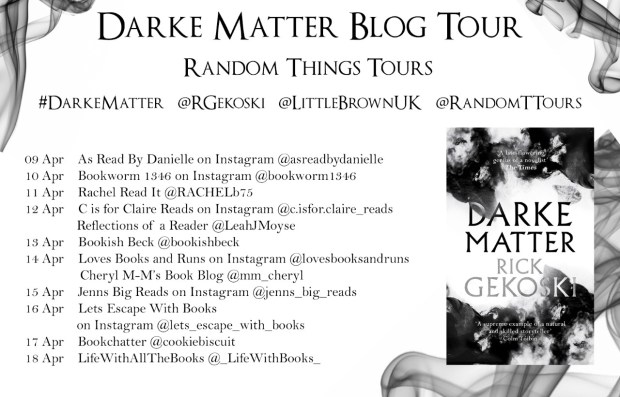
I was happy to take part in the blog tour for Darke Matter. See below for details of where other reviews and features have appeared or will be appearing.
The Still Point (of the Turning World & Sanctuary)
Amy Sackville’s debut novel, The Still Point, had been on my radar ever since I read her follow-up, Orkney. I finally put it on my wish list and got a copy for Christmas. In the meantime, I’d also acquired a copy of Emily Rapp’s memoir The Still Point of the Turning World as part of a big secondhand book haul at the start of the first lockdown.
Both books take their title from the eminently quotable T.S. Eliot*, specifically his poem “Burnt Norton.” I couldn’t resist the urge to review them together (along with Rapp’s recent sequel) – although, unlike with my dual review of two books titled Ex Libris, I won’t pit them against each other because they’re such different books.
That said, they do share a dreamlike quality and the search for people and places that might serve as refuges in a shattered life. All: 
The Still Point by Amy Sackville (2010)
no
I am not heroic, I prefer
not to conquer
polar regions, my
gardens in July
serve for me.
~from “emperor’s walk” by G.F. Dutton
 A sweltering summer versus an encasing of ice; an ordinary day versus decades of futile waiting. Sackville explores these contradictions only to deflate them, collapsing time such that a polar explorer’s wife and her great-great-niece can inhabit the same literal and emotional space despite being separated by more than a century. When Edward Mackley went off on his expedition in the early 1900s, he left behind Emily, his devoted, hopeful new bride. She was to live out the rest of her days in the Mackley family home with her brother-in-law and his growing family; Edward never returned. Now Julia and her husband Simon reside in that same Victorian house, serving as custodians of memories and artifacts from her ancestors’ travels and naturalist observations. From one early morning until the next, we peer into this average marriage with its sadness and silences. On this day, Julia discovers a family secret, and late on reveals another of her own, that subtly change how we see her and Emily.
This is a highly fluid and sensual novel, but somehow so sinuous as to be hard to grasp. I took in its interlocking story lines just a few pages at a time; floating on the gorgeous prose, basking in the alternating heat and chill. Sackville’s greatest stylistic debt must be to Virginia Woolf, but I was also reminded of Lucy Wood’s Weathering and Evie Wyld’s The Bass Rock – two similarly beautiful books in which a house and its ghosts are major characters – and of how some of Sarah Moss’s work braids the past into the everyday. I suspect this won’t be for every reader, but if you can find the right moment and mood, you might just be entranced.
One of Sackville’s research sources was Arctic Dreams by Barry Lopez, a work I recently skimmed for a winter post. Two passages that stood out to me apply equally well to Rapp’s books:
 “The literature of nineteenth-century arctic exploration is full of coincidence and drama—last-minute rescues, a desperate rifle shot to secure food for starving men, secret letters written to painfully missed loved ones. There are moments of surreal stillness, as in Parry’s journal when he writes of the sound of the human voice in the land. And of tender ministration and quiet forbearance in the face of inevitable death.”
“The continuous work of the imagination, I thought, to bring what is actual together with what is dreamed is an expression of human evolution. The conscious desire is to achieve a state, even momentarily, that like light is unbounded, nurturing, suffused with wisdom and creation, a state in which one has absorbed that very darkness which before was the perpetual sign of defeat.”
The Still Point of the Turning World by Emily Rapp (2013)
 In 2011 Rapp’s baby son Ronan was diagnosed with Tay-Sachs disease, a degenerative nerve condition that causes blindness, deafness, seizures, paralysis and, ultimately, death. Tay-Sachs is usually seen in Ashkenazi Jews, so it came as a surprise: Rapp and her husband Rick both had to be carriers, whereas only he was Jewish; they never thought to get tested.
This memoir was written while Ronan was still alive, and the rapid, in-the-thick-of-it composition is evident: it rides the same rollercoaster of feelings over and over again, even repeating some of the same facts. I put this down to the brain fog of anticipatory grief. “The constant push-pull: here but not for long. What will come next?” Rapp quotes extensively from other writers who have grappled with bereavement, especially poets, as if building an inner library to bolster herself against what is to come (“it wasn’t consolation I needed or desired, but the tools to walk through this fire without being consumed by it”).
Rapp puts her son’s life into context through memories of growing up disabled (she had a rare condition that necessitated the amputation of a leg as a child, and wore a prosthesis) in the conservative Midwest, contrasting the Christian theology she grew up in and studied at college with the Eastern and New Age spiritualities that prevail in Santa Fe, where she and Rick then lived with Ronan. She ponders the worth of a life that will be marked by no traditional achievements.
In The Art of Memoir, Mary Karr advises seven years between the events and the writing about them, but Rapp explains her strategy of instant reaction thus:
grief, this extreme experience, forces a writer to draw on her deepest resources, and such a dive demands so much work that what comes up must be heaved onto the page almost immediately; otherwise it might eat the thinker alive, drown them … Or at least that’s how I felt. You can eat fire for only so long, and then you’ve got to spit it out in another form or risk the burn.
She felt that “rendering loss was a way of honoring life,” which even with this death sentence hanging over the family had its times of pure joy: “there existed inside this helpless, frantic sadness exquisite moments of pristine happiness and an almost-perfect peace.” The title perfectly captures the necessity of finding this calmness of soul amidst a tumultuous life.
Sanctuary by Emily Rapp Black (2021)
 Things got worse before they got better. As is common for couples who lose a child, Rapp and her first husband separated, soon after she completed her book. In the six months leading up to Ronan’s death in February 2013, his condition deteriorated rapidly and he needed hospice caretakers. Rapp came close to suicide. But in those desperate months, she also threw herself into a new relationship with Kent, a 20-years-older man who was there for her as Ronan was dying and would become her second husband and the father of her daughter, Charlotte (“Charlie”). The acrimonious split from Rick and the astonishment of a new life with Kent – starting in the literal sanctuary of his converted New Mexico chapel, and then moving to California – were two sides of a coin. So were missing Ronan and loving Charlie.
Sanctuary is a similarly allusive text, with each chapter prefaced by a poem, and it is again full of flashbacks, threading all the seemingly disparate parts of a life into a chaotic tapestry. Rapp Black questions the sorts of words that she and her experience got branded with: “brave,” “tragic,” “resilient” – “I unwittingly became the poster child,” she wryly reports. In the same way that she’d been praised for “overcoming disability,” she saw that she was now being trotted out as an example of coping with unimaginable loss. But she didn’t want to be someone’s model; she just wanted the chance to live her life and be happy again. Her wisdom isn’t what makes it onto inspirational stickers, but it’s genuine and hard-won:
“It has little or nothing to do with bravery. Nobody is charging into warfare here. No gold stars are given because none are earned. I am no warrior of love or anything else.”
“Time doesn’t heal anything; it just changes things—reshapes and reorients them.”
“resilience is not always a function of the desire to survive. Either you survive, or you don’t. There’s no fault, no moral judgment, assigned to either outcome.”
“Isn’t it true that what doesn’t kill you makes you stronger? No. What doesn’t kill you changes you, and those who chose to love you. That is what it means to bear witness, a unique and salvific form of resilience.”
Although I was glad to have read both, to have experienced both the in-the-moment and the after-the-fact, I think Sanctuary could easily function as a standalone memoir because of how much of Ronan’s illness it relives. For being that bit more measured and wrought, I think it’s the better book by a hair’s breadth. It tames the fire and just radiates the light and warmth.
I read an advanced e-copy via NetGalley. Thanks to John Murray Press for the approval.
*Other Eliot-sourced titles I have reviewed: Teach Us to Sit Still by Tim Parks and The Stillness The Dancing by Wendy Perriam.
September Releases: Gyasi, McKay, Sheldrake, Tremain, Woolfson
September is always a big month in the publishing world, but even more so this year because of all the titles delayed from the spring and summer – apparently 600 books were published in the first week of September in the UK alone.
Still, I only ended up with my usual, manageable five new releases (with a few more on the way from the library). I read a beautiful novel about addiction and religion in contemporary America, speculative fiction about communication with wildlife in mid-pandemic (!) Australia, everything you ever wanted to know about fungi, historical fiction about outsiders in England and Borneo, and a study of our broken relationship with other animals.
Two of these are from my most anticipated list for the second half of 2020. Four of the five can be linked by the tenet that humans are only one species among many others necessary to life on this Earth, and not in some way above and beyond.
Transcendent Kingdom by Yaa Gyasi
 This follow-up to Gyasi’s dazzling, centuries-spanning linked story collection, Homegoing, won’t be out in the UK until March 2021, but I couldn’t resist reading an e-copy of the American edition (Knopf) from Edelweiss. It’s altogether a more subdued and subtle book, but its treatment of themes of addiction, grief, racism and religion is so spot on that it packs a punch. Gifty is a PhD student at Stanford, researching pleasure and reward circuits in the mouse brain. She gets mice hooked on a sugary drink and then performs experiments to see if she can turn off their compulsion to keep pressing a lever for more. Sometimes when they press the lever they get an electric shock. Certain mice give up; others never will. Why?
People who know Gifty well assume she chose her field because of a personal tragedy. When she was 10, her 16-year-old brother, Nana, a high school basketball star in this Ghanaian-American family’s Alabama town, died of an opiate overdose. He’d gotten addicted to prescription drugs after a sports injury. At one level, Gifty acknowledges she is trying to atone for her brother’s death, but she won’t see it in those terms. An intensely private person, she shoulders almost impossible burdens of grief and responsibility for her mother, who has plunged into depression and, when she comes to live with Gifty, spends all her time in bed.
The most compelling aspect of the novel for me was Gifty’s attitude towards the religion of her childhood. Though they were the only black family at their Pentecostal church, she was a model believer, writing prayers in her journal, memorizing scriptures, and never doubting that everything happens for a reason. Nana’s death shattered it all. Though she now looks to science for answers, she misses the certainty she once had: that she was saved, that humans are special, that someone was looking out for her and her family, that it all mattered. I highlighted dozens of passages, but it’s possible the book won’t mean quite as much to readers for whom there’s no personal resonance. The complex mother–daughter relationship is an asset, and musings on love and risk are tenderly expressed. I wanted a more climactic conclusion to take this into 5-star territory, but I’ve still added it to my Best of 2020 shelf.
Favorite lines:
the species Homo sapiens, the most complex animal, [is] the only animal who believed he had transcended his Kingdom, as one of my high school biology teachers used to say.
At times, my life now feels so at odds with the religious teachings of my childhood that I wonder what the little girl I once was would think of the woman I’ve become … I am looking for new names for old feelings. My soul is still my soul, even if I rarely call it that.
the more I do this work the more I believe in a kind of holiness in our connection to everything on Earth. Holy is the mouse.
My rating:
I read an advanced e-copy via Edelweiss.
The Animals in That Country by Laura Jean McKay
 McKay has a PhD in literary animal studies and serves as an animal expert and presenter on Australia’s ABC radio show Animal Sound Safari. Pair her academic background with the fact that this shares a title with a Margaret Atwood poetry collection and you’ll have some idea of what to expect here: mysterious but mostly believable speculative fiction that hinges on human communication with animals.
Jean Bennett isn’t your average grandma: a wise-cracking alcoholic, she drives the tourist train through the Australian wildlife park her daughter-in-law manages but wishes she could be a fully fledged ranger. Her ex-husband, Graham, left her and went down south, and eventually their only son Lee did the same. Now all Jean has left is Kim, her six-year-old granddaughter. Jean entertains Kim by imagining voices for the park’s animals. This no longer seems like a game, though, when news filters through of the “zooflu,” which has hit epidemic levels and has as a main symptom the ability to understand what animals say.
When Kim is kidnapped, Jean steals a camper van and takes Sue the dingo along to help her find her granddaughter. “There’s a new normal now,” a bus driver tells her. “And around here, not wearing a mask means you’ve gone animal. I’d put on my protective if I was you. Put that mutt in a cage.” It was uncanny reading this in the midst of a pandemic, but the specifics of McKay’s novel are hard to grasp. The animal language isn’t audible, necessarily, but a combination of smells, noises and body language. For a long time, they seem like pure nonsense, but gradually they resemble a sort of rough poetry. Here’s one example from Sue:
My front end
takes the food
quality.
Muzzle
for the Queen
(Yesterday).
(Sue usually calls Jean “Queen” or “Mother,” showing that she respects her authority, and “Yesterday” is frequently used to suggest a primitive sense of the past or of an older person.)
As entertaining a protagonist as Jean is, I lost interest in her road trip. If you focus on the journey into the wilderness and don’t mind a sudden ending, you may find this a worthwhile heir to Hollow Kingdom by Kira Jane Buxton and The Road by Cormac McCarthy.
My rating: 
I read a proof copy for a Nudge review, but it’s never shown up on their website.
Entangled Life: How Fungi Make Our Worlds, Change Our Minds, and Shape Our Futures by Merlin Sheldrake
 I first heard about Sheldrake through Robert Macfarlane’s Underland. He struck me as a mad genius – an impression that was only strengthened by reading his detailed, enthusiastic book about fungi. Sheldrake researches fungal life in the tropical forests of Panama, accompanies truffle hunters in Italy, takes part in a clinical study on the effects of LSD (derived from a fungus), observes lichens off the coast of British Columbia, and attends a conference in Oregon on Radical Mycology. But more than a travel memoir, this is a work of science – there are over 100 pages devoted to notes, bibliography and index.
Basic information you’ll soon learn: mushrooms are only the fruiting bodies of fungi; under the ground is the material bulk, the mycelium, a sprawling network of hyphae. In what’s sometimes called the “Wood Wide Web,” fungal networks link the trees in a forest, and join up with plants, such as in lichens. “I feel a … sense of vertigo when I think about the complexity of mycorrhizal relationships – kilometers of entangled life – jostling beneath my feet,” Sheldrake confesses. He gives examples of fungi navigating and solving problems – what of our concept of intelligence if a creature without a brain can do such things?
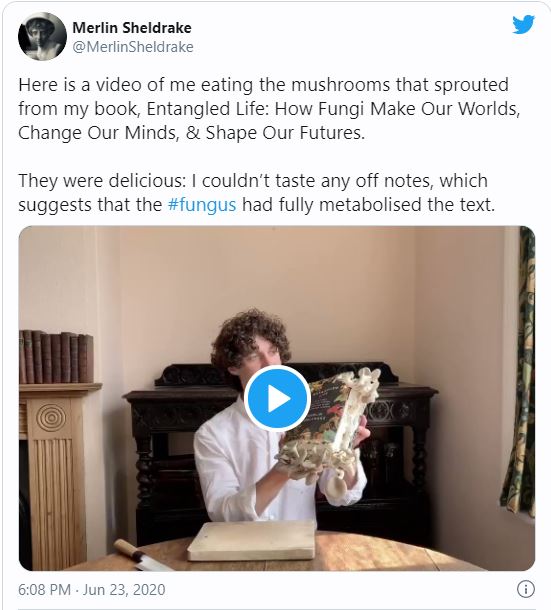
Fungi are very adaptable to extreme conditions. Research is underway to grow edible mushrooms on some of our most troublesome waste, such as used diapers (nappies) and cigarette butts. And, of course, for millennia we’ve relied on certain fungi – yeasts – to create products like bread and beer. Sheldrake is a very hands-on writer: When he wants to know something, he does it, whether that’s scrumping Isaac Newton’s apples in Cambridge and fermenting the juice into cider at home or growing mushrooms on a copy of this very book.
During the month I was reading this, I felt like I kept coming across references to fungi. (I even had a patch of ringworm!)

It’s a perspective-altering text, but one that requires solid concentration. I’ll confess that at times it went over my head and I wished for a glossary and diagrams. A greater than average interest in biology and/or botany would thus be a boon to a potential reader. But if you can keep up, the book will elicit many a cry of “wow!” and “what?!” I kept launching “did you know?” questions at my husband, especially about the zombie fungi that parasitize insects. What a strange and wonderful world.
Favorite lines: “Paying more attention to animals than plants contributes to humans’ plant-blindness. Paying more attention to plants than fungi makes us fungus-blind.”
My rating: 
My thanks to Bodley Head for the free copy for review.
Islands of Mercy by Rose Tremain
 I read this back in June to prepare for writing a profile of Tremain for a forthcoming issue of Bookmarks magazine. Here’s the summary I wrote: “In Bath, England in 1865, 24-year-old nurse Jane Adeane is nicknamed ‘The Angel of the Baths’ for her healing touch. If she marries Dr. Valentine Ross, a colleague of her surgeon father, she can earn respectability – but will have to hide her love for Julietta, a married woman. Meanwhile, Dr. Ross’s brother, Edmund, a naturalist following in the footsteps of Alfred Russel Wallace, has journeyed to Borneo. Ill with malaria, he is taken in by British eccentric Sir Ralph Savage, a lover of native men and benevolent local rajah who funds infrastructure projects like a paved road and a hospital. Exiled or inwardly tortured for loving the wrong people, Tremain’s characters search for moments of wonder and comfort – whether those come in a primitive hut in the Malay Archipelago or in a cozy tearoom in Bath.”
It’s a slightly odd title, but tells you a lot about what Tremain is doing in this 14th novel. Often at the mercy of forces internal and external, her outcast characters look for places where they can find rest and refuge after a time of suffering. Will they, in turn, extend mercy? The split perspective and the focus on people who have to hide their sexuality are most similar to Sacred Country. The Victorian tip of the hat is mostly directed, I think, to George Eliot; of recent work, I was reminded of The Doll Factory and The Essex Serpent. I especially liked Jane’s painter aunt, Emmeline, and Clorinda, the Irish woman whose opening of a tearoom sets the plot going. The settings are surprising and vivid, and if Tremain doesn’t quite bring them and their story lines together seamlessly, she is still to be applauded for her ambition. This is probably my joint favorite of her novels that I’ve read so far, with The Road Home.
Favorite lines:
We must be unconventional in our joys and find them wherever we can.
life, so often so cruel in the way it thrust the human soul into prisons from which there seemed to be no escape, could sometimes place it athwart an open door.
My rating:
I read an advanced e-copy via NetGalley.
Between Light and Storm: How We Live with Other Species by Esther Woolfson
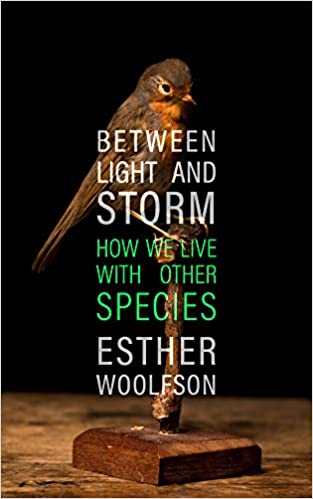 If you’ve read Woolfson’s Corvus, you’ve already met Chicken, an orphaned rook she raised. For over 31 years, Chicken was a constant presence in her home. The recently departed bird is the dedicatee of her new book, feted as “Colleague, companion, friend.” (No mere pet.) Relationships with these creatures with whom she shared her life led her to think differently about how we as humans conceive of the animal world in general. “If I had ever believed humans to be the only ones to live profound and interconnected lives, I couldn’t any more. … If we’re the gods now, shouldn’t we be better than we are?” From her introduction, it’s clear that her sympathy toward the more-than-human world extends even to spiders, and her language throughout – using words like “who” and “his” in reference to animals, rather than “that” or “its” – reinforces the view that all species are equally valuable.
Or, at least, should be. But our attitudes are fundamentally distorted, Woolfson believes, and have been since the days of Aristotle (whose Ladder of Nature is an origin of the ideas that nature is there for man to use) and the Old Testament writers (one of the two creation accounts in Genesis established the idea of “dominion”). From cave paintings to animal sacrifice, intensive farming to fur coats, taxidermy to whaling, she surveys what others have thought and said about how animals are, or should be, perceived. There was more of an academic tone to this book than I expected, and in early chapters I found too much overlap with other works I’ve read about deep time (Time Song, Surfacing, Underland again!).
I most appreciated the fragments of nature writing and memoir and would have liked more in the way of personal reflection. Woolfson’s perspective – as a Jewish woman in Scotland – is quite interesting. She is clearly troubled by how humans exploit animals, but mostly recounts others’ reasoning rather than coming to conclusions of her own. (Though there is a brilliant takedown of the gender politics of Watership Down.) It’s a book that demands more time and attention than I was able to give just now. As I only skimmed it, I’m going to refrain from assigning a rating and will pass this on to my husband and return to it one day. [I do wish the title, on its own (subtitle aside), was more indicative of the contents.]
My thanks to Granta for the free copy for review.
Which of those 600+ September releases can you recommend?
Adventures in Rereading: The Sixteenth of June by Maya Lang
Last year I reviewed Tenth of December by George Saunders on its title date; this year I couldn’t resist rereading one of my favorites from 2014 for today’s date (which just so happens to be Bloomsday, made famous by James Joyce’s Ulysses), The Sixteenth of June.
I responded to the novel at length when it first came out. No point in reinventing the wheel, so here are mildly edited paragraphs of synopsis from my review for The Bookbag:
 Maya Lang’s playful and exquisitely accomplished debut novel, set on the centenary of the original Bloomsday, transplants many characters and set pieces from Ulysses to near-contemporary Philadelphia. Don’t fret, though – even if, like me, you haven’t read Ulysses, you’ll have no trouble following the thread. In fact, Lang dedicates her book to “all the readers who never made it through Ulysses (or haven’t wanted to try).” (Though if you wish to spot parallels, pull up any online summary of Ulysses; there is also a page on Lang’s website listing her direct quotations from Joyce.)
On June 16, 2004, brothers Leopold and Stephen Portman have two major commitments: their grandmother Hannah’s funeral is happening at the local synagogue in the morning; and their parents’ annual Bloomsday party will take place at their opulent Delancey Street home in the evening. Around those two thematic poles – the genuine emotions of grief and regret on the one hand, and the realm of superficial entertainment on the other – the novel expands outward to provide a nuanced picture of three ambivalent twenty-something lives.
The third side of this atypical love triangle is Nora, Stephen’s best friend from Yale – and Leo’s fiancée. Nora, a trained opera singer, is still reeling from her mother’s death from cancer one year ago. She’s been engaging in self-harming behavior, and Leo – a macho, literal-minded IT consultant – just wants to fix her. Nora and Stephen, by contrast, are sensitive, artistic souls who seem better suited to each other. Stephen, too, is struggling to find a meaning in death, but also to finish his languishing dissertation on Virginia Woolf.
Literature is almost as potent a marker of upper-class status as money here: some of the Portmans might not have even read Joyce’s masterpiece, but that doesn’t stop them name-dropping and maintaining the pretense of being well-read. While Lang might not mimic the extremes of Joyce’s stream-of-consciousness style, she prioritizes interiority over external action by using a close third-person voice that shifts between her main characters’ points of view. Their histories and thoughts are revealed mostly through interior monologues and conversations. Lang’s writing is full of mordant shards of humor; one of my favorite lines was “No one in a eulogy ever said, She watched TV with the volume on too loud.”
During my rereading, I was captivated more by the portraits of grief than by the subtle intellectual and class differences. I appreciated the characterization and the Joycean peekaboo, and the dialogue and shifts between perspectives still felt fresh and effortless. I could relate to Stephen and Nora’s feelings of being stuck and unsure how to move on in life. And the ending, which I’d completely forgotten, was perfect. I didn’t enjoy this quite as much the second time around, but it’s still a treasured signed copy on my shelf.
My original rating (June 2014): 
My rating now: 
Readalikes: Writers & Lovers by Lily King and The Emperor’s Children by Claire Messud (my upcoming Doorstopper of the Month).
(See also my review of Lang’s recent memoir, What We Carry.)
Alas, I’ve also had a couple of failed rereading attempts recently…
Everything Is Illuminated by Jonathan Safran Foer (2002)
 I remembered this as a zany family history quest turned into fiction. A Jewish-American character named Jonathan Safran Foer travels to (fictional) Trachimbrod, Ukraine to find the traces of his ancestors and, specifically, the woman who hid his grandfather from the Nazis. I had totally forgotten about the comic narration via letters from Jonathan’s translator/tour guide, Alexander, who fancies himself a ladies’ man and whose English is full of comic thesaurus use (e.g. “Do not dub me that,” “Guilelessly yours”). This was amusing, but got to be a bit much. I’d also forgotten about the dense magic realism of the historical sections. As with A Visit from the Goon Squad, what felt dazzlingly clever on a first read (in January 2011) failed to capture me a second time. [35 pages]
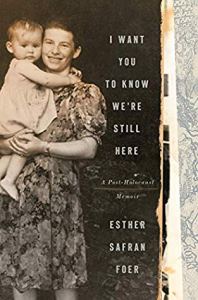 Interestingly, Foer’s mother, Esther, released a memoir earlier this year, I Want You to Know We’re Still Here. It’s about the family history her son turned into quirky autofiction: a largely fruitless trip he took to Ukraine to research his maternal grandfather’s life for his Princeton thesis, and a more productive follow-up trip she took with her older son in 2009. Esther Safran Foer was born in Poland and lived in a German displaced persons camp until she and her parents emigrated to Washington, D.C. in 1949. Her father committed suicide in 1954, making him almost a belated victim of the Holocaust. The stories she hears in Ukraine – of the slaughter of entire communities; of moments of good luck that allowed her parents to, separately, survive and find each other – are remarkable, but the book’s prose, while capable, never sings. Plus, she references her son’s novel so often that I wondered why someone would read her book when they could read his instead.
On Beauty by Zadie Smith (2005)
 This was an all-time favorite when it first came out. I remembered a sophisticated homage to E.M. Forster’s Howards End, featuring a biracial family in Cambridge, Mass. I remembered no specifics beyond a giant music store and (embarrassingly) an awkward sex scene. Howard Belsey’s long-distance rivalry with a fellow Rembrandt scholar gets personal when the Kipps family relocates from London to the Boston suburbs for Monty to be the new celebrity lecturer at the same college. Howard is in the doghouse with his African-American wife, Kiki, after having an affair. The Belsey boy and Kipps girl have an awkward romantic history. Zora Belsey is smitten with a lower-class spoken word poet she meets after a classical concert in the park when they pick up each other’s Discmans by accident (so dated!). All of the portraits felt like stereotypes to me, and there was so much telling, so much backstory, so many unnecessary secondary characters. Before I would have said this was my obvious Women’s Prize winner of winners, but now I have no idea what I’ll vote for. [107 pages]
Currently rereading: Watership Down by Richard Adams, Ella Minnow Pea by Mark Dunn, Dreams from My Father by Barack Obama
To reread soon: Heaven’s Coast by Mark Doty & Animal, Vegetable, Miracle by Barbara Kingsolver
Done any rereading lately?
Writers & Lovers by Lily King
(This was meant to be one entry in a roundup of mini-reviews, but I found that I had far too much to say about it. On Sunday I’ll feature three more May releases I’ve read.)
1997. Following a breakup and her mother’s sudden death, Casey Peabody is drowning in grief and debt. At 31, she lives in a tiny studio apartment off of her brother’s friend’s house and cycles everywhere. Between shifts waitressing at Iris, a trendy restaurant above a Harvard social club, she chips away at the Cuba-set novel she’s been writing for six years.
Through her writer friend Muriel she meets two love interests at a book launch for Oscar Kolton, a former Boston University professor and novelist who’s been leading a fiction workshop since his wife’s death a few years ago. One is the fortysomething Oscar himself; the other, who initially seems more promising, is Silas, a would-be writer from the workshop. But before they have a chance to see if this will go somewhere, Silas is off. He leaves Casey a voicemail saying he needs to get away for a while. Oh well; just another flake, she thinks.
After he and his adorable young sons come in to the restaurant for brunch one day, her interest is squarely in Oscar. Or, that is, until Silas comes back and she finds herself dating two men at the same time. A museum trip with Silas here, a dinner out with Oscar there. As if her love life isn’t complication enough, before long she finds herself looking for a new job, a place to live, a literary agent, and reassurance that she’ll be okay when she takes advantage of her short-lived health insurance to get some minor medical issues checked out.

I almost passed on reading this one because I’d gotten it in my head that it was nothing more than a romantic comedy with a love triangle. I’m so glad that Kate’s review convinced me to give it a try after all. On the face of it this could hardly be more different from King’s previous novel, Euphoria, about anthropologists doing field work in Papua New Guinea in the 1930s, but King’s attention to the intricacies of human relationships links the two. When I read Euphoria in late 2014, I noted the natives’ practice of cutting off a finger for every close relative lost. Here you also get the sense that everyone has lost someone, and that these losses are as visible as physical traits. Casey is only on her second conversation with Silas when she thinks, “I can tell he lost someone close somehow. You can feel that in people, an openness, or maybe it’s an opening that you’re talking into. With other people, people who haven’t been through something like that, you feel the solid wall. Your words go scattershot off of it.”
There are so many things to love about this novel, including the wonderful/terrible scenes where she rattles off her mother’s story to two doctors and her awful father and stepmother show up for lunch. Count the rest: The Boston-area setting, the restaurant bustle, that feeling we’ve all had of wasting our talents while stuck in the wrong job and the wrong living situation. Casey’s confiding first-person, present-tense narration, the little observations on writers (when John Updike comes into the restaurant she touches his loafer for luck; she nearly swoons when Jayne Anne Phillips is at one of her tables—“Black Tickets is like a prayer book to me”; she thinks she’s blown a high school English teacher interview when she states a dislike for Cormac McCarthy—“he seemed to be alternating between imitating Hemingway and imitating Faulkner”), and even the choice between Silas and Oscar (“Fireworks or coffee in bed”). She doesn’t make the ‘right’ choice I was expecting, but if you’ve been following the clues closely you’ll realize it’s the only one she could have made.
What I loved most, though, was that we see this character at rock bottom but also when things start to go well at long last. “There’s a particular feeling in your body when something goes right after a long time of things going wrong. It feels warm and sweet and loose.” I felt I knew Casey through and through, and I cheered for her as I did for Ana in Dominicana by Angie Cruz. Those who have tried writing a book will probably get even more out of this than I did, but it will resonate for anyone who’s ever felt lost and uncertain about life’s direction. “Isn’t our whole life just one long improvisation?” Casey hears at a writing festival.
Think of this as an older, sadder Sweetbitter, perhaps as written by Elizabeth Strout. It gives you all the feels, as they say.
A real standout and one of my few early favorites from 2020.
My rating:
With thanks to Picador for the unsolicited copy for review.
If All the World and Love Were Young by Stephen Sexton: The Dylan Thomas Prize Blog Tour
 For my second spot on the official Dylan Thomas Prize blog tour, I’m featuring the debut poetry collection If All the World and Love Were Young (2019) by Stephen Sexton, which was awarded the Forward Prize for Best First Collection. Sexton lives in Belfast (so this is also an incidental contribution to Reading Ireland Month) and was the winner of the 2016 National Poetry Competition and a 2018 Eric Gregory Award.
The book is a highly original hybrid of video game imagery and a narrative about the final illness of his mother, who died in 2012. As a child the poet was obsessed with Super Mario World. He overlays the game’s landscapes onto his life to create an almost hallucinogenic fairy tale. Into this virtual world, which blends idyll and threat, comes the news of his mother’s cancer:
One summer’s day I’m summoned home to hear of cells which split and glitch
so haphazardly someone is called to intervene with poisons
drawn from strange and peregrine trees flourishing in distant kingdoms.
Her doctors are likened to wizards attempting magic –
In blue scrubs the Merlins apply various elixirs potions
panaceas to her body
– until they give up and acknowledge the limitations of medicine:
So we wait in the private room turn the egg timer of ourselves.
Hippocrates in his white coat brings with him a shake of the head …
where we cannot do some good
at least we must refrain from harm.
Super Mario settings provide the headings: Yoshi’s Island, Donut Plains, Forest of Illusion, Chocolate Island and so on. There are also references to bridges, Venetian canals, mines and labyrinths, as if to give illness the gravity of a mythological hero’s journey. Meanwhile, the title repeats the first line of “The Nymph’s Reply to the Shepherd” by Sir Walter Raleigh, which, as a rebuttal to Christopher Marlowe’s “The Passionate Shepherd to His Love,” eschews romanticism in favor of realism about change and mortality. Sexton wanted to include both views. (He discusses his inspirations in detail in this Irish Times article.)
Apart from one rough pantoum (“Choco-Ghost House”), I didn’t notice any other forms being used. This is free verse; internally unpunctuated, it has a run-on feel. While I do think readers are likely to get more out of the poems if they have some familiarity with Super Mario World and/or are gamers themselves, this is a striking book that examines bereavement in a new way.
Note: Be sure to stick around past “The End” for the Credits, which summarize all the book’s bizarrely diverse elements, and a lovely final poem that’s rather like a benediction.
My thanks to Midas PR for the free copy for review.
The Swansea University International Dylan Thomas Prize recognizes the best published work in the English language written by an author aged 39 or under. All literary genres are eligible, so there are poetry collections nominated as well as novels and short stories.
To recap, the 12 books on this year’s longlist are:
- Surge, Jay Bernard
- Flèche, Mary Jean Chan (my review)
- Exquisite Cadavers, Meena Kandasamy
- Things We Say in the Dark by Kirsty Logan (my preview & an excerpt)
- Black Car Burning, Helen Mort
- Virtuoso, Yelena Moskovich
- Inland, Téa Obreht
- Stubborn Archivist, Yara Rodrigues Fowler (my review)
- If All the World and Love Were Young, Stephen Sexton
- The Far Field, Madhuri Vijay
- On Earth We’re Briefly Gorgeous, Ocean Vuong
- Lot, Bryan Washington
The shortlist will be announced on Tuesday, April 7th.
Nonfiction Review Books Roundup: Hay, Hope et al., Lee, Long, McLaren, Zuckerman
I’m continuing with the Nonfiction November focus by catching up on six nonfiction review books I’ve been sent over the last half a year. We’ve got a record of elderly parents’ decline, letters and poems written about the climate crisis, a family memoir set between Taiwan and Canada, a widow’s mushroom-hunting quest, a work of ecotheology that reflects on travels in the Galápagos Islands, and a defense of an entirely secular basis for morality. You can’t say I don’t read a variety, even within nonfiction! See if one or more of these tempts you.
All Things Consoled: A Daughter’s Memoir by Elizabeth Hay
 Gordon and Jean Hay stumbled into their early nineties in an Ottawa retirement home starting in 2009. Elizabeth Hay is one of four children, but caregiving fell to her for one reason and another, and it was a fraught task because of her parents’ prickly personalities: Jean was critical and thrifty to the point of absurdity, spooning thick mold off apple sauce before serving it and needling Elizabeth for dumping perfectly good chicken juice a year before; Gordon had a terrible temper and a history of corporal punishment of his children and of his students when he was a school principal. Jean’s knee surgery and subsequent infection finally put paid to their independence; her mind was never the same and she could no longer paint.
There are many harsh moments in this memoir, but almost as many wry ones, with Hay picking just the right anecdotes to illustrate her parents’ behavior and the shifting family dynamic. She never looks away, no matter how hard it all gets. Her father’s rage against the dying of the light contrasts with her mother’s fade into confusion – lightened by the surprisingly poetic turns of phrase she came out with despite her dementia and aphasia. The title phrase, for instance, was her attempt at “all things considered.” I would wholeheartedly recommend this to readers of Hay’s novels, but anyone can appreciate the picture of complicated love and grief. (See also Susan’s review.)
With thanks to MacLehose Press for the free copy for review.
Letters to the Earth: Writing to a Planet in Crisis, edited by Anna Hope et al.
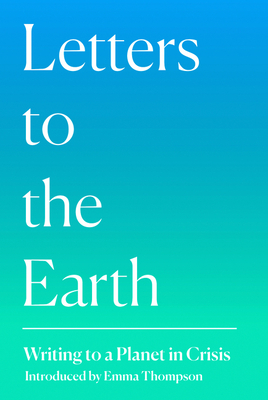 Culture Declares Emergency launched in April to bring the arts into the conversation about the climate emergency. Letters to the Earth compiles 100 short pieces by known and unknown names alike. Alongside published authors, songwriters, professors and politicians are lots of ordinary folk, including children as young as seven. The brief was broad: to write a letter in response to environmental crisis, whether to or from the Earth, to future generations (there are wrenching pieces written to children: “What can I say, now that it’s too late? … that I’m sorry, that I tried,” writes Stuart Capstick), to the government or to other species.
There are certainly relatable emotions here, especially the feeling of helplessness. “We take the train, go vegan, refuse plastic, buy less and less. But that is tiny. We are tiny,” novelist Jo Baker writes. I loved retired bishop Richard Holloway’s wry letter calling the author of Genesis to account for unhelpful language of dominion, Rob Cowen’s poem to a starling, and Anna Hope’s essay about parenting in a time of uncertainty. Unfortunately, much of the rest is twee or haranguing, e.g. “Forest fires are scorching INNOCENT wildlife. Plastic is strangling INNOCENT turtles and dolphins,” a 12-year-old writes. This was put together in a matter of months, and it shows. There is not enough tonal variety, a lot of overwriting has crept through, and errors, especially in the kids’ work, remain uncorrected. Perhaps six to 10 pieces stood out to me overall. I’d recommend the Extinction Rebellion handbook instead.
With thanks to Alison Menzies / William Collins for the free copy for review.
Two Trees Make a Forest: On Memory, Migration and Taiwan by Jessica J. Lee
 I loved Turning, Lee’s 2017 memoir about swimming in one of Berlin’s lakes per week for a year, so I jumped at the chance to read her follow-up, which delves into her maternal line’s history in Taiwan. She travels to Taipei for three months to brush up on her Chinese, write and hike. Interspersed with the lush descriptions of her walks are reflections on Taiwan’s history and on the hidden aspects of her grandfather Gong’s past that only came to light after Lee’s grandmother, Po, died and she and her mother discovered an autobiographical letter he’d written before he drifted into dementia. Nature, language, history and memory flow together in a delicate blend of genres – “I moved from the human timescale of my family’s story through green and unfurling dendrological time,” she writes.
This has got to be one of the most striking title and cover combinations of the year. Along with Chinese characters, the book includes some looping text and Nico Taylor’s maps and illustrations of Taiwanese flora and fauna. While you will likely get more out of this if you have a particular interest in Asian history, languages and culture, it’s impressive how Lee brings the different strands of her story together to form a hybrid nature memoir that I hope will be recognized by next year’s Wainwright Prize and Young Writer of the Year Award shortlists. She’d also be a perfect New Networks for Nature speaker.
With thanks to Virago for the free copy for review.
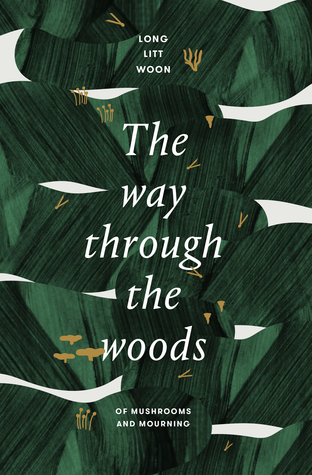
The Way through the Woods: Of Mushrooms and Mourning by Long Lit Woon
 [Trans. from the Norwegian by Barbara J. Haveland]
I couldn’t resist the sound of a bereavement memoir crossed with a mushroom hunting guide. When Long met her husband, Eiolf Olsen, she was an 18-year-old Malaysian exchange student in Stavanger, Norway. Meeting Eiolf changed the whole course of her life, keeping her in Europe for good; decades later, her life changed forever once again when Eiolf dropped dead at work one morning. “If anyone had told me that mushrooms would be my lifeline, the thing that would help me back onto my feet and quite literally back onto life’s track, I would have rolled my eyes. What had mushrooms to do with mourning?” she writes.
 The answer to that rhetorical question is nothing much, at least not inherently, so this ends up becoming a book of two parts, with the bereavement strand (printed in green and in a different font – green is for grief? I suppose) engaging me much more than the mushroom-hunting one, which takes her to Central Park and the annual Telluride, Colorado mushroom festival as well as to Norway’s woods again and again – “In Norway, outdoor life is tantamount to a religion.” But the quest for wonder and for meaning is a universal one. In addition, if you’re a mushroom fan you’ll find gathering advice, tasting notes, and even recipes. I fancy trying the “mushroom bacon” made out of oven-dried shiitakes.
With thanks to Scribe for the free copy for review.
God Unbound: Theology in the Wild by Brian McLaren
 McLaren was commissioned to launch a series that was part travel guide, part spiritual memoir and part theological reflection. Specifically, he was asked to write about the Galápagos Islands because he’d been before and they were important to him. He joins a six-day eco-cruise that tours around the island chain off Ecuador, with little to do except observe the birds, tortoises and iguanas, and swim with fish and sea turtles. For him this is a peaceful, even sacred place that reminds him of the beauty that still exists in the world despite so much human desecration. Although he avoids using his phone except to quickly check in with his wife, modernity encroaches unhelpfully through a potential disaster with his laptop.
I was surprised to see that McLaren leaves the Galápagos at the midpoint – whatever could fill the rest of the book, I wondered? He starts by reassessing Darwin, so often painted as a villain by Evangelical Christianity but actually a model of close, loving attention to nature. He also recalls how some of his most intense spiritual experiences have arisen from time in nature. McLaren’s books have been pivotal to my spiritual journey as we’ve both gradually become more liberal and environmentalist. His definition of God might horrify traditionalists, but holds appeal for me: “a centering singularity whose gravity holds me in insistent orbit, pulling me deeper into mystery, pondering who I am and what my life means.” This is an unusual but gently entrancing book full of photos and quotes from other thinkers including John Muir, Pope Francis and Richard Rohr. It’s an ideal introduction to ecotheology.
With thanks to Canterbury Press for the free copy for review.
What It Means to Be Moral: Why Religion Is Not Necessary for Living an Ethical Life by Phil Zuckerman
 From one end of the spectrum (progressive Christianity) to the other (atheism). Here’s a different perspective from a sociology professor at California’s Pitzer College. Zuckerman’s central argument is that humanism and free choice can fuel ethical behavior; since there’s no proof of God’s existence and theists have such a wide range of beliefs, it’s absurd to slap a “because God says so” label on our subjective judgments. Morals maintain the small communities our primate ancestors evolved into, with specific views (such as on homosexuality) a result of our socialization. Alas, the in-group/out-group thinking from our evolutionary heritage is what can lead to genocide. Instead of thinking in terms of ‘evil’, though, Zuckerman prefers Dr. Simon Baron-Cohen’s term, “empathy erosion.”
To tackle violent crime, Zuckerman contends, we need a more equal society, with the Scandinavian countries a model of how to achieve that through higher taxes, social services and the rehabilitation of prisoners. He uses a lot of relatable examples from history and from his own experience, as well as theoretical situations, to think through practical morality. I found his indictment of American Christianity accurate – how does it make sense for people who say they follow the way of Jesus to fight against equality, tolerance and scientific advances and instead advocate guns, the death penalty and Trump? Well, indeed.
It might seem odd for me to recommend this alongside the McLaren, but there is much to be gained from both viewpoints. Zuckerman’s work overlaps a fair bit with another I’ve read on the topic, Richard Holloway’s Godless Morality – even a bishop agrees we needn’t take our societal ethics straight from the Bible! I can’t go along fully with Zuckerman because I think progressive religion has been and can continue to be a force for good, but I would agree that atheists can be just as moral as people of faith – and often more so.
With thanks to Counterpoint Press for sending a proof copy for review.
Would you be interested in reading one or more of these?
Five Nonfiction Review Books: Hammond, Iorio, Rault, Riley & Rutt
A diagnosis of motor neurone disease; a father’s dispiriting experience of censorship trials. An illustrated history of fonts; an essay on grief; a cold weather-appropriate record of geese-watching. I gear up for Nonfiction November by catching up on five nonfiction review books I’ve been sent over the last couple of months. You can’t say that I don’t read a variety, even within nonfiction! See if one or more of these tempts you.
A Short History of Falling: Everything I Observed about Love whilst Dying by Joe Hammond
 Hammond, a playwright, takes a wry, clear-eyed approach to his diagnosis of motor neurone disease (ALS) and the knowledge that his physical capacities will only deteriorate from here on out. “New items arrive almost daily and I am unexpectedly becoming the curator of the Museum of my own Decline.” Yet he also freezes funnier moments, like blowing his nose on a slice of bread because he couldn’t reach a tissue box, or spending “six hours of my fiftieth birthday sat on this hospice toilet, with a bottle of good Scotch wedged between my knees.”
Still, Hammond regrets that he’s become like a third small child for his wife Gill to look after, joining his sons Tom and Jimmy, and that he won’t see his boys grow up. (This book arose from an article he wrote for the Guardian in 2018 about making 33 birthday cards for his sons to open in the years after his death.) Although I wasn’t as interested in the details of Hammond’s earlier life, or his relationship with his narcissistic father, I appreciated his quiet acceptance of disability, help and impending death.
Favorite lines:
“I’ve waited all my life to know this peace. To know that I am nothing more than this body.”
“my place in all of this is becoming smaller, historic and just the right size of important.”
With thanks to 4th Estate for the free copy for review.
An Author on Trial: The Story of a Forgotten Writer by Luciano Iorio
 The author’s father, Giuseppe Jorio, was a journalist and schoolteacher who wrote an infamous novel based on an affair he had in the 1930s. Using italicized passages from his father’s diary and letters to Tina, who was 19 when their affair started, Iorio reconstructs the sordid events and unexpected aftermath in fairly vivid detail. Tina fell pregnant and decided to abort the baby. Meanwhile, Giuseppe’s wife, Bruna, got the truth out of him and responded with more grace than might be expected. Giuseppe was devastated at the loss of his potential offspring, and realized he wanted to have a child with Bruna. He bid Tina farewell and the family moved to Rome, where the author was born in 1937.
Giuseppe’s novel inspired by the affair, Il Fuoco del Mondo (The Fire of the World) was rejected by all major publishers and accused of obscenity in a series of five trials that threatened his reputation and morale. It’s a less familiar echo of the Lady Chatterley’s Lover trial, and a poignant portrait of a man who felt he never lived up to his potential because of bad luck and societal disapproval. I enjoyed learning a bit about Italian literature. However, inconsistent use of tenses and shaky colloquial English (preposition issues, etc.) suggest that a co-writer or translator was needed to bring this self-published work up to scratch.
With thanks to the publicist for the free copy to review as part of a blog tour.
ABC of Typography by David Rault
[Translated from the French by Edward Gauvin]
 From cuneiform to Gutenberg to Comic Sans, this history of typography is delightful. Graphic designer David Rault wrote the whole thing, but each chapter has a different illustrator, so the resulting book is like a taster course in comics styles. As such, I would highly recommend it to those who are fairly new to graphic novels and want to see whose work appeals to them, as well as to anyone who enjoyed Simon Garfield’s book about fonts, Just My Type.
I found it fascinating to explore the technical characteristics (serif vs. sans serif, etc.) and aesthetic associations of various fonts. For instance, I didn’t realize that my mainstay – Times New Roman – is now seen as a staid choice: “Highly readable, but overexposed in the early days of the Internet, it took on a reputation for drabness that it hasn’t shed since the ’90s.” Nowadays, some newspapers and brands pay typeface creators to make a font for their exclusive use. Can you name the typeface that is used on German road signs, or in Barack Obama’s campaign materials? (You’ll be able to after you read this.)


With thanks to SelfMadeHero for the free copy for review.
Time Lived, Without Its Flow by Denise Riley
 What Virginia Woolf’s essay “On Being Ill” does for sickness, this does for bereavement. Specifically, Riley, whose son Jake died suddenly of a heart condition, examines how the experience of time changes during grief. “I’ll not be writing about death, but about an altered condition of life,” she opens. In short vignettes written from two weeks to three years after her son’s death, she reflects on how her thinking and feelings have morphed over time. She never rests with an easy answer when a mystery will do instead. “What if” questions and “as if” imaginings proliferate. Poetry – she has also written an exquisite book of poems, Say Something Back, responding to the loss of Jake – has a role to play in the acceptance of this new reality: “rhyme may do its minute work of holding time together.”
Max Porter provides a fulsome introduction to this expanded version of Riley’s essay, which first appeared in 2012. This small volume meant a lot more to him than it did to me; I preferred Riley’s poetic take on the same events. Still, this is sure to be a comfort for the bereaved.
Favorite passages:
“I’ll try to incorporate J’s best qualities of easy friendliness, warmth, and stoicism, and I shall carry him on in that way. Which is the only kind of resurrection of the dead that I know about.”
“I don’t experience him as in the least dead, but simply as ‘away’. Even if he’ll be away for my remaining lifetime. My best hope’s to have a hallucination of his presence when I’m dying myself.”
With thanks to Picador for the free copy for review.
Wintering: A Season with Geese by Stephen Rutt
 Rutt’s The Seafarers: A Journey among Birds, one of my favorite recent nature/travel books, came out in May. What have we done to deserve another publication from this talented young author just four months later?! I didn’t enjoy this as much as The Seafarers, yet it does a lot of the same things well: it provides stunning word portraits of individual bird species, explores the interaction between nature and one’s mental state, and gathers evidence of the cultural importance of birds through legends and classical writings.
Here the focus is on geese, which the author had mostly overlooked until the year he moved to southern Scotland. Suddenly they were impossible to ignore, and as he became accustomed to his new home these geese sightings were a way of marking the seasons’ turn. Ethical issues like hunting, foie gras and down production come into play, and, perhaps ironically, the author eats goose for Christmas dinner!
Rutt’s points of reference include Paul Gallico (beware plot spoilers!), Aldo Leopold, Mary Oliver and Peter Scott. The writing in this short book reminded me most of Horatio Clare (especially The Light in the Dark) and Jim Crumley (who’s written many short seasonal and single-species nature books) this time around.
A favorite passage (I sympathize with the feelings of nomadism and dislocation):
“I envy the geese their certainty, their habits of home. I am forever torn between multiple places that feel like home. Scotland where I live or Suffolk, Essex, Norfolk: the flatlands of golden evenings and reeds, mud and water and sand. The distant horizon and all the space in between I grew up with, which seems to lurk somewhere, subconsciously calling me back.”
[Neat aside: My husband and I both got quotes (about The Seafarers) on the press release for this book!]

With thanks to Elliott & Thompson for the free copy.
Would you be interested in reading one or more of these?
Re-Reading Modern Classics: Fiction Advocate’s “Afterwords” Series
I didn’t manage a traditional classic this month: I stalled on Cider with Rosie and gave up on Evelyn Waugh’s A Handful of Dust after just 16 pages. Instead, I’m highlighting three books from Fiction Advocate’s new series about re-reading modern classics, “…Afterwords.” Their tagline is “Essential Readings of the New Canon,” and the concept is to have “acclaimed writers investigate the contemporary classics.”
As Italo Calvino notes in his invaluable essay “Why Read the Classics?”, “The classics are those books about which you usually hear people saying: ‘I’m rereading…’, never ‘I’m reading…’.” Harold Bloom agrees in The Western Canon: “One ancient test for the canonical remains fiercely valid: unless it demands rereading, the work does not qualify.” But readers will also encounter books that strike such a chord with them that they become personal classics. Calvino exhorts readers that “during unenforced reading … you will come across the book which will become ‘your’ book…‘Your’ classic is a book to which you cannot remain indifferent, and which helps you define yourself in relation or even in opposition to it.”
For the Afterwords series, the three writers below have each chosen a modern classic that they can’t stop reading for all it has to say to their own situation and on humanity in general.
I Meant to Kill Ye: Cormac McCarthy’s Blood Meridian by Stephanie Reents (2018)
Blood Meridian must be one of the two or three bleakest books I’ve ever read. I was led to it by Bloom, who speaks about it as a, if not the, Great American Novel. It’s over 10 years since I’ve read it now, but I still remember some of the specific incidences of violence, like skewering babies and sodomizing corpses on a battlefield, as well as the overall feeling of nihilism: there’s no reason for the evil promulgated by characters like the Judge; it is simply a reality – perhaps the human condition.
 Reents, who teaches English at the College of the Holy Cross, returns to Blood Meridian, a novel she has re-read compulsively over the years, to ask why it continues to have such a hold over her. Its third-person perspective is so distant that we never understand characters’ motivations or glimpse their inner lives, she notes; everyone seems like a pawn in a fated course. She usually shies away from violence and long descriptive passages; she has an uneasy relationship with the West, having moved away from Idaho to live on the East coast. So why should this detached, brutal Western based on the Glanton Gang’s Mexico/Texas killing spree have so captivated her? “Often, we most admire the books that we could never produce, the writing styles or intellects so different from our own that we aren’t even tempted to try imitating them,” she offers as explanation. “It’s a pure kind of admiration, unsullied by envy.” (I feel that way about Faulkner and Steinbeck.)
As part of her quest, Reents recreated some of the Gang’s desert route and traveled to the Texas State University library near Austin to look at McCarthy’s early drafts, notes and correspondence. She was intrigued to learn that the Kid was a more conventional POV character to start with, and McCarthy initially included more foreshadowing. By cutting all of it, he made it so that the book’s extreme violence comes out of nowhere. Reents also explores the historical basis for the story via General Samuel Chamberlain’s dubious memoir. Pondering the volatility of the human heart as she drives along the Mexican border, she ends on the nicely timely note of a threatened Trump-built wall. I doubt I could stomach reading Blood Meridian again (though I’ve read another two McCarthy novels since), but I enjoyed revisiting it with Reents as she finds herself “re-bewildered by its beauty and horror.”
A Little in Love with Everyone: Alison Bechdel’s Fun Home by Genevieve Hudson (2018)
Alison Bechdel is one of Hudson’s queer heroes (along with James Baldwin, Tracy Chapman, and seven others), portrayed opposite the first page of each chapter in black and white drawings by Pace Taylor – the sort of people who gave her the courage to accept her lesbian identity after a conventional Alabama upbringing.
 As portrayed in her landmark graphic memoir Fun Home, Bechdel was in college and finally coming to terms with her sexuality at the same time that she learned that her father was gay and her parents were about to divorce. Her father died in an accident just a few months later and, though he had many affairs, had never managed to live out his homosexuality openly. As Bechdel’s mother scoffed, “Your father tell the truth? Please!” By contrast, Hudson appreciates Bechdel so much because of her hard-won honesty: “In her work, Bechdel does the opposite of lying. She excavates the real. She dredges up the stuff of her life, embarrassing parts and all.”
Hudson looks at how people craft their own coming-out narratives, the importance of which cannot be overemphasized, in her experience. “Coming out was a tangible thing with tangible effects. For every friend who left my life, a new person arrived—usually someone with broader horizons, exciting stories, and a deviance that seemed sweet and sexy and sincere. After I came out, roaming the streets of Charleston in fat sunglasses and thin dresses, a group of beautiful lesbians appeared out of nowhere. … Everyone was a little in love with everyone.”
A Cool Customer: Joan Didion’s The Year of Magical Thinking by Jacob Bacharach (2018)
 I made the mistake of not taking any notes on, or even marking out any favorite passages in, this, so all I can tell you is that for me it was the most powerful of the three I’ve tried from the series. The author re-examines Didion’s work in the light of his own encounter with loss – his brother’s death from a drug overdose – and ponders why it has become such a watershed in bereavement literature. Didion really is the patron saint of grief thanks to her two memoirs, Magical Thinking and Blue Nights – after she was widowed she also lost her only daughter – even though she writes with a sort of intellectual detachment; you have to intuit the emotion between the lines. Bacharach smartly weaves his family story with a literate discussion of Didion’s narratives and cultural position to make a snappy and inviting book you could easily read in one sitting.
Indeed, all of the Afterwords books are 120–160-page, small-format paperbacks that would handily slip into a pocket or purse.
My thanks to the publisher for the free copies for review.
The other titles in the series are An Oasis of Horror in a Desert of Boredom by Jonathan Russell Clark (on 2666 by Roberto Bolaño), New Uses for Failure by Adam Colman (on 10:04 by Ben Lerner, and Bizarro Worlds by Stacie Williams (on The Fortress of Solitude by Jonathan Lethem).
Next month’s plan: The Leopard by Giuseppe di Lampedusa will be my classic to get me in the mood for traveling to Italy for the first week of July.
 Bookish Beck = Rebecca Foster. American transplant to England. Freelance proofreader and book reviewer.
 Bookish Beck
