#ReadIndies and Review Catch-up: Hazrat, Nettel, Peacock, Seldon
Another four selections for Read Indies month. I’m particularly pleased that two from this latest batch are “just because” books that I picked up off my shelves; another two are catch-up review copies. A few more indie titles will appear in my February roundup on Tuesday. For today, I have a fun variety: a history of the exclamation point, a Mexican novel about choosing motherhood versus being childfree, a memoir of a decades-long friendship between two poets, and a posthumous poetry collection with themes of history, illness and nature.

An Admirable Point: A brief history of the exclamation mark by Florence Hazrat (2022)
I’m definitely a punctuation geek. (My favourite punctuation mark is the semicolon, and there’s a book about it, too: Semicolon: The Past, Present, and Future of a Misunderstood Mark by Cecelia Watson, which I have on my Kindle.) One might think that strings of exclamation points are a pretty new thing – rounding off phrases in (ex-)presidential tweets, for instance – but, in fact, Hazrat opens with a Boston Gazette headline from 1788 that decried “CORRUPTION AND BRIBERY!!!” in relation to the adoption of the new Constitution.
 The exclamation mark as we know it has been around since 1399, and by the 16th century its use for expression and emphasis had been codified. I was reminded of Gretchen McCulloch’s discussion of emoji in Because Internet, which also considers how written speech signifies tone, especially in the digital age. There have been various proposals for other “intonation points” over the centuries, but the question mark and exclamation mark are the two that have stuck. (Though I’m currently listening to an album called interrobang – ‽, that is. Invented by Martin Speckter in 1962; recorded by Switchfoot in 2021.)
I most enjoyed Chapter 3, on punctuation in literature. Jane Austen’s original manuscripts, replete with dashes, ampersands and exclamation points, were tidied up considerably before they made it into book form. She’s literature’s third most liberal user of exclamation marks, in terms of the number per 100,000 words, according to a chart Ben Blatt drew up in 2017, topped only by Tom Wolfe and James Joyce.
There are also sections on the use of exclamation points in propaganda and political campaigns – in conjunction with fonts, which brought to mind Simon Garfield’s Just My Type and the graphic novel ABC of Typography. It might seem to have a niche subject, but at just over 150 pages this is a cheery and diverting read for word nerds.
With thanks to Profile Books for the proof copy for review.
Still Born by Guadalupe Nettel (2020; 2022)
[Translated from the Spanish by Rosalind Harvey]
This was the Mexican author’s fourth novel; she’s also a magazine director and has published several short story collections. I’d liken it to a cross between Motherhood by Sheila Heti and (the second half of) No One Is Talking About This by Patricia Lockwood. Thirtysomething friends Laura and Alina veer off in different directions, yet end up finding themselves in similar ethical dilemmas. Laura, who narrates, is adamant that she doesn’t want children, and follows through with sterilization. However, when she becomes enmeshed in a situation with her neighbours – Doris, who’s been left by her abusive husband, and her troubled son Nicolás – she understands some of the emotional burden of motherhood. Even the pigeon nest she watches on her balcony presents a sort of morality play about parenthood.
 Meanwhile, Alina and her partner Aurelio embark on infertility treatment. Laura fears losing her friend: “Alina was about to disappear and join the sect of mothers, those creatures with no life of their own who, zombie-like, with huge bags under their eyes, lugged prams around the streets of the city.” They eventually have a daughter, Inés, but learn before her birth that brain defects may cause her to die in infancy or be severely disabled. Right from the start, Alina is conflicted. Will she cling to Inés no matter her condition, or let her go? And with various unhealthy coping mechanisms to hand, will her relationship with Aurelio stay the course?
Laura alternates between her life and her friends’ circumstances, taking on an omniscient voice on Nettel’s behalf – she recounts details she couldn’t possibly be privy to, at least not at the time (there’s a similar strategy in The Group by Lara Feigel). The question of what is fated versus what is chosen, also represented by Laura’s interest in tarot and palm-reading, always appeals to me. This was a wry and sharp commentary on women’s options. (Giveaway win from Bookish Chat on Twitter)
Still Born was published by Fitzcarraldo Editions in the UK and is forthcoming from Bloomsbury in the USA on August 8th.
A Friend Sails in on a Poem by Molly Peacock (2022)
I’ve read one of Peacock’s poetry collections, The Analyst, as well as her biography of Mary Delany, The Paper Garden. I was delighted when she got in touch to offer a review copy of her latest memoir, which reflects on her nearly half a century of friendship with fellow poet Phillis Levin. They met in a Johns Hopkins University writing seminar in 1976, and ever since have shared their work in progress over meals. They are seven years apart in age and their careers took different routes – Peacock headed up the Poetry Society of America’s subway poetry project and then moved to Toronto, while Levin taught at the University of Maryland – but over the years they developed “a sense of trust that really does feel familial … There is a weird way, in our conversations about poetry, that we share a single soul.” For a time they were both based in New York City and had the same therapist; more recently, they arranged annual summer poetry retreats in Cazenovia (recalled via diary entries), with just the two attendees. Jobs and lovers came and went, but their bond has endured.
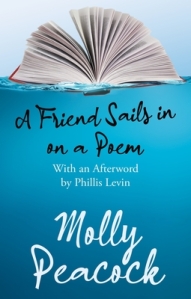 The book traces their lives but also their development as poets, through examples of their verse. Her friend is “Phillis” in real life, but “Levin” when it’s her work is being discussed – and her own poems are as written by “Peacock.” Both women became devoted to the sonnet, an unusual choice because at the time that they were graduate students free verse reigned and form was something one had to learn on one’s own time. Stanza means “room,” Peacock reminds readers, and she believes there is something about form that opens up space, almost literally but certainly metaphorically, to re-examine experience. She repeatedly tracks how traumatic childhood events, as much as everyday observations, were transmuted into her poetry. Levin did so, too, but with an opposite approach: intellectual and universal where Peacock was carnal and personal. That paradox of difference yet likeness is the essence of the friendships we sail on. What a lovely read, especially if you’re curious about ‘where poems come from’; I’d particularly recommend it to fans of Ann Patchett’s Truth and Beauty.
With thanks to Molly Peacock and Palimpsest Press for the free e-copy for review.
The Bright White Tree by Joanna Seldon (Worple Press, 2017)
This appeared the year after Seldon died of cancer; were it not for her untimely end and her famous husband Anthony (a historian and political biographer), I’m not sure it would have been published, as the poetry is fairly mediocre, with some obvious rhymes and twee sentiments. I wouldn’t want to speak ill of the dead, though, so think of this more like a self-published work collected in tribute, and then no problem. Some of the poems were written from the Royal Marsden Hospital, with “Advice” a useful rundown of how to be there for a friend undergoing cancer treatment (text to let them know you’re thinking of them; check before calling, or visiting briefly; bring sanctioned snacks; don’t be afraid to ask after their health).
 Seldon takes inspiration from history (the story of Kitty Pakenham, the bombing of the Bamiyan Buddhas), travels in England and abroad (“Robin in York” vs. “Tuscan Garden”), and family history. Her Jewish heritage is clear from poems about Israel, National Holocaust Memorial Day and Rosh Hashanah. Her own suffering is put into perspective in “A Cancer Patient Visits Auschwitz.” There are also ekphrastic responses to art and literature (a Gaugin, A Winter’s Tale, Jane Eyre, and so on). I particularly liked “Conker,” a reminder of a departed loved one “So is a good life packed full of doing / That may grow warm with others, even when / The many years have turned, and darkness filled / Places where memory shone bright and strong. / I feel the conker and feel he is here.” (New bargain book from Waterstones online sale with Christmas book token)
There are haikus dotted through the collection; here’s one perfect for the season:
“Snowdrops Haiku”
Maids demure, white tips to
Mob caps… Look now! They’ve
Splattered the lawn with snow
Have you discovered any new-to-you independent publishers recently?
Learning How to Be Sad via Books by Susan Cain and Helen Russell
There’s been a lot of sadness in my life over the past few months. If there’s a key lesson I learned from the latest work by these authors, who are among the best self-help writers out there, it’s that denying sadness is the worst thing we could do. Accepting sadness helps us to be compassionate towards others and to acknowledge but ultimately let go of generational pain. There are measures we can take to mitigate sadness – a focus of the second half of Russell’s book – but it can’t be avoided altogether. Alongside the classics of bereavement literature I have been rereading, I found these two books to be valuable companions in grief.
Bittersweet: How Sorrow and Longing Make Us Whole by Susan Cain (2022)
Cain’s Quiet must be one of the best-known nonfiction books of the millennium. It felt like vindication for introverts everywhere. Bittersweet is a little more nebulous in strategy but, boiled down, is a defence of the melancholic personality, one of the types identified by Aristotle (also explored in Richard Holloway’s The Heart of Things). Sadness is not the same as clinical depression, Cain rushes to clarify, though the two might coexist. Melancholy is often associated with creativity and sensitivity, and can lead us into empathy for others. Suffering and death seem like things to flee, but if we sit with them, we will truly be part of the human race and, per the “wounded healer” archetype, may also work toward restoration.
 A love for minor-key music, especially songs by Leonard Cohen, is what initially drew Cain to this topic, but there are other autobiographical seeds: the deaths of many ancestors, including her rabbi grandfather’s entire family, in the Holocaust; her difficult relationship with her controlling mother, who now has dementia; and the deaths from Covid of both her brother, a hospital doctor, and her elderly father in 2020.
Through interviews and attendance at conferences and other events, she draws in various side topics, like the longing that prompts mysticism (Kabbalah and Sufism), loving-kindness meditation, an American culture of positivity that demands “effortless perfection,” ways the business world could cultivate empathy, and how knowledge of death makes life precious. (The only chapter I found less than essential was one about transhumance – the hope of escaping death altogether. Mark O’Connell has that topic covered.) Cain weaves together her research with autobiographical material naturally. As a shy introvert with melancholy tendencies, I found both Quiet and Bittersweet comforting.
With thanks to Viking (Penguin) for the proof copy for review.
How to Be Sad: The Key to a Happier Life by Helen Russell (2021)
A reread, though I only skimmed the first time around – my tiny points of criticism would be that the book is a tad long – the print in the paperback is really rather small – and retreads some of the same ground as Leap Year (e.g., how exercise and culture can contribute to a sense of wellbeing). I read that just last year, after enjoying The Year of Living Danishly with my book club. She’s a reliable nonfiction author; I’d liken her to a funnier Gretchen Rubin.
 Russell has an appealingly self-deprecating style and breezily highlights statistics alongside personal anecdotes. Here she faces sources of sadness in her life head-on: her younger sister’s death from SIDS and the silence that surrounded that loss; her parents’ divorce and her sense of being abandoned by her father; struggles with eating disorders and alcohol and exercise addiction; and relationship trials, from changing herself to please boyfriends to undergoing IVF with her husband, T (aka “Legoman”), and adjusting to life as a mother of three.
As in her other self-help work, she interviews lots of experts and people who have gone through similar things to understand why we’re sad and what to do about it. I particularly appreciated chapters on “arrival fallacy” and “summit syndrome,” both of which refer to a feeling of letdown after we achieve what we think will make us happy, whether that be parenthood or the South Pole. Better to have intrinsic goals than external ones, Russell learns.
She also considers cultural differences in how we approach sadness: for instance, Russians relish sadness and teach their children to do the same, whereas the English, especially men, are expected to bury their feelings. Russell notes a waning of the rituals that could help us cope with loss, and a rise in unhealthy coping mechanisms. Like Cain, she also covers sad music (vs. one of her interviewees prescribing Jack Johnson as a mood equalizer). There are lots of laughs to be had, but the epilogue can’t fail to bring a tear to the eye. (Public library)
Both: 
I found this quote from the Russell a handy summary of both authors’ premise. Dr Lucy Johnstone says:
“The key question when encountering someone with mental or emotional distress shouldn’t be, ‘What’s wrong with you?’ but rather, ‘What’s happened to you?’”
Suffering is coming for all of us, so why not arm yourself to deal with it and help others through? That’s always been one of my motivations for reading widely: to understand other people’s situations and prepare myself for what the future holds.
Could you see yourself reading a book about sadness?
Three on a Theme: Queer Family-Making
Several 2021 memoirs have given me a deeper understanding of the special challenges involved when queer couples decide they want to have children.
“It’s a fundamentally queer principle to build a family out of the pieces you have”
~Jennifer Berney
“That’s the thing[:] there are no accidental children born to homosexuals – these babies are always planned for, and always wanted.”
~Michael Johnson-Ellis
The Other Mothers by Jennifer Berney
Berney remembers hearing the term “test-tube baby” for the first time in a fifth-grade sex ed class taught by a lesbian teacher at her Quaker school. By that time she already had an inkling of her sexuality, so suspected that she might one day require fertility help herself.
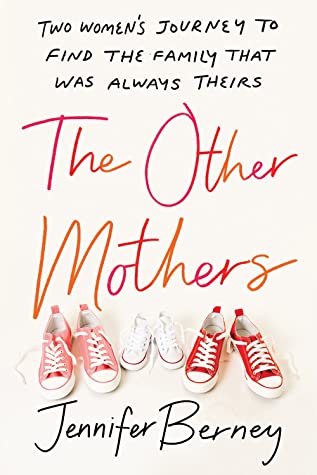 By the time she met her partner, Kellie, she knew she wanted to be a mother; Kellie was unsure. Once they were finally on the same page, it wasn’t an easy road to motherhood. They purchased donated sperm through a fertility clinic and tried IUI, but multiple expensive attempts failed. Signs of endometriosis had doctors ready to perform invasive surgery, but in the meantime the couple had met a friend of a friend (Daniel, whose partner was Rebecca) who was prepared to be their donor. Their at-home inseminations resulted in a pregnancy – after two years of trying to conceive – and, ultimately, in their son. Three years later, they did the whole thing all over again. Rebecca had sons at roughly the same time, too, giving their boys the equivalent of same-age cousins – a lovely, unconventional extended family.
It surprised me that the infertility business seemed entirely set up for heterosexual couples – so much so that a doctor diagnosed the problem, completely seriously, in Berney’s chart as “Male Factor Infertility.” This was in Washington state in c. 2008, before the countrywide legalization of gay marriage, so it’s possible the situation would be different now, or that the couple would have had a different experience had they been based somewhere like San Francisco where there is a wide support network and many gay-friendly resources.
Berney finds the joy and absurdity in their journey as well as the many setbacks. I warmed to the book as it went along: early on, it dragged a bit as she surveyed her younger years and traced the history of IVF and alternatives like international adoption. As the storyline drew closer to the present day, there was more detail and tenderness and I was more engaged. I’d read more from this author. (Published by Sourcebooks. Read via NetGalley) 
small: on motherhoods by Claire Lynch
A line from Berney’s memoir makes a good transition into this one: “I felt a sense of dread: if I turned out to be gay I believed my life would become unbearably small.” The word “small” is a sort of totem here, a reminder of the microscopic processes and everyday miracles that go into making babies, as well as of the vulnerability of newborns – and of hope.
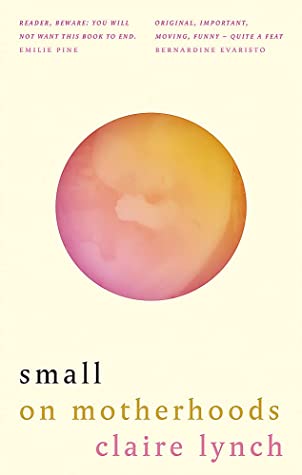
Lynch and her partner Beth’s experience in England was reminiscent of Berney’s in many ways, but with a key difference: through IVF, Lynch’s eggs were added to donor sperm to make the embryos implanted in Beth’s uterus. Mummy would have the genetic link, Mama the physical tie of carrying and birthing. It took more than three years of infertility treatment before they conceived their twin girls, born premature; they were followed by another daughter, creating a crazy but delightful female quintet. The account of the time when their daughters were in incubators reminded me of Francesca Segal’s Mother Ship.
There are two intriguing structural choices that make small stand out. The first you’d notice from opening the book at random, or to page 1. It is written in a hybrid form, the phrases and sentences laid out more like poetry. Although there are some traditional expository paragraphs, more often the words are in stanzas or indented. Here’s an example of what this looks like on the page. It also happens to be from one of the most ironically funny parts of the book, when Lynch is grouped in with the dads at an antenatal class:
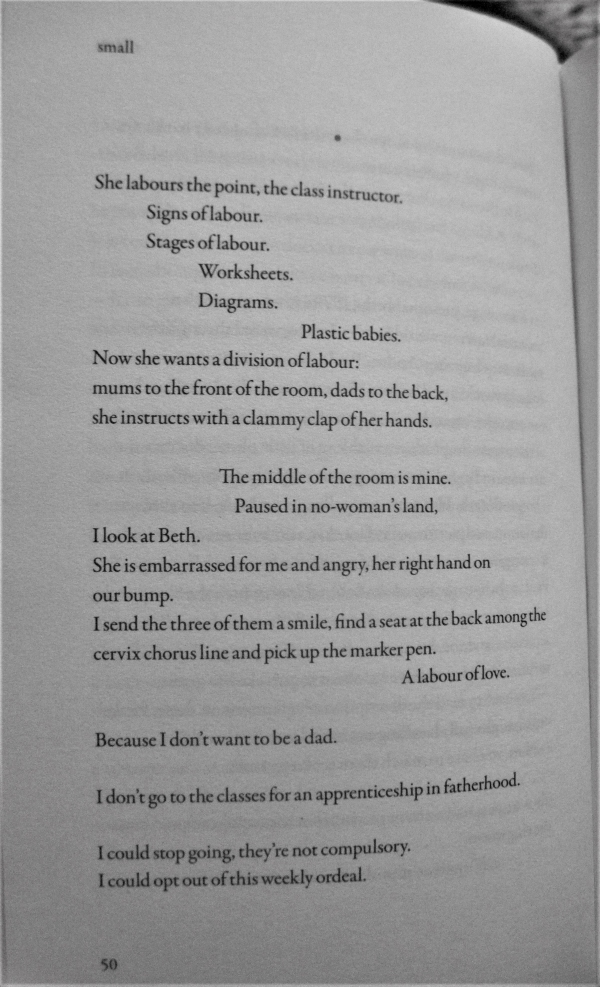
It’s a fast-flowing, artful style that may remind readers of Bernardine Evaristo’s work (and indeed, Evaristo gives one of the puffs). The second interesting decision was to make the book turn on a revelation: at the exact halfway mark we learn that, initially, the couple intended to have opposite roles: Lynch tried to get pregnant with Beth’s baby, but miscarried. Making this the pivot point of the memoir emphasizes the struggle and grief of this experience, even though we know that it had a happy ending.
With thanks to Brazen Books for the free copy for review.
How We Do Family by Trystan Reese
We mostly have Trystan Reese to thank for the existence of a pregnant man emoji. A community organizer who works on anti-racist and LGBTQ justice campaigns, Reese is a trans man married to a man named Biff. They expanded their family in two unexpected ways: first by adopting Biff’s niece and nephew when his sister’s situation of poverty and drug abuse meant she couldn’t take care of them, and then by getting pregnant in the natural (is that even the appropriate word?) way.
 All along, Reese sought to be transparent about the journey, with a crowdfunding project and podcast ahead of the adoption, and media coverage of the pregnancy. This opened the family up to a lot of online hatred. I found myself most interested in the account of the pregnancy itself, and how it might have healed or exacerbated a sense of bodily trauma. Reese was careful to have only in-the-know and affirming people in the delivery room so there would be no surprises for anyone. His doctor was such an ally that he offered to create a more gender-affirming C-section scar (vertical rather than horizontal) if it came to it. How to maintain a sense of male identity while giving birth? Well, Reese told Biff not to look at his crotch during the delivery, and decided not to breastfeed.
I realized when reading this and Detransition, Baby that my view of trans people is mostly post-op because of the only trans person I know personally, but a lot of people choose never to get surgical confirmation of gender (or maybe surgery is more common among trans women?). We’ve got to get past the obsession with genitals. As Reese writes, “we are just loving humans, like every human throughout all of time, who have brought a new life into this world. Nothing more than that, and nothing less. Just humans.”
This is a very fluid, quick read that recreates scenes and conversations with aplomb, and there are self-help sections after most chapters about how to be flexible and have productive dialogue within a family and with strangers. If literary prose and academic-level engagement with the issues are what you’re after, you’d want to head to Maggie Nelson’s The Argonauts instead, but I also appreciated Reese’s unpretentious firsthand view.
And here’s further evidence of my own bias: the whole time I was reading, I felt sure that Reese must be the figure on the right with reddish hair, since that looked like a person who could once have been a woman. But when I finished reading I looked up photos; there are many online of Reese during pregnancy. And NOPE, he is the bearded, black-haired one! That’ll teach me to make assumptions. (Published by The Experiment. Read via NetGalley)
Plus a bonus essay from the Music.Football.Fatherhood anthology, DAD:
“A Journey to Gay Fatherhood: Surrogacy – The Unimaginable, Manageable” by Michael Johnson-Ellis
 The author and his husband Wes had both previously been married to women before they came out. Wes already had a daughter, so they decided Johnson-Ellis would be the genetic father the first time. They then had different egg donors for their two children, but used the same surrogate for both pregnancies. I was astounded at the costs involved: £32,000 just to bring their daughter into being. And it’s striking both how underground the surrogacy process is (in the UK it’s illegal to advertise for a surrogate) and how exclusionary systems are – the couple had to fight to be in the room when their surrogate gave birth, and had to go to court to be named the legal guardians when their daughter was six weeks old. Since then, they’ve given testimony at the Houses of Parliament and become advocates for UK surrogacy.
(I have a high school acquaintance who has gone down this route with his husband – they’re about to meet their daughter and already have a two-year-old son – so I was curious to know more about it, even though their process in the USA might be subtly different.)
On the subject of queer family-making, I have also read: The Argonauts by Maggie Nelson ( ) and The Fixed Stars by Molly Wizenberg (
 ).
).
If you read just one … Claire Lynch’s small was the one I enjoyed most as a literary product, but if you want to learn more about the options and process you might opt for Jennifer Berney’s The Other Mothers; if you’re particularly keen to explore trans issues and LGTBQ activism, head to Trystan Reese’s How We Do Family.
Have you read anything on this topic?
Reading with the Seasons: Summer 2021, Part I
I’m more likely to choose lighter reads and dip into genre fiction in the summer than at other times of year. The past few weeks have felt more like autumn here in southern England, but summer doesn’t officially end until September 22nd. So, if I get a chance (there’s always a vague danger to labelling something “Part I”!), before then I’ll follow up with another batch of summery reads I have on the go: Goshawk Summer, Klara and the Sun, Among the Summer Snows, A Shower of Summer Days, and a few summer-into-autumn children’s books.
For this installment I have a quaint picture book, a mystery, a travel book featured for its title, and a very English classic. I’ve chosen a representative quote from each.
Summer Story by Jill Barklem (1980)
 One of a quartet of seasonal “Brambly Hedge” stories in small hardbacks. It wouldn’t be summer without weddings, and here one takes place between two mice, Poppy Eyebright and Dusty Dogwood (who work in the dairy and the flour mill, respectively), on Midsummer’s Day. I loved the little details about the mice preparing their outfits and the wedding feast: “Cool summer foods were being made. There was cold watercress soup, fresh dandelion salad, honey creams, syllabubs and meringues.” We’re given cutaway views of various tree stumps, like dollhouses, and the industrious activity going on within them. Like any wedding, this one has its mishaps, but all is ultimately well, like in a classical comedy. This reminded me of the Church Mice books or Beatrix Potter’s works: very sweet, quaint and English.
Source: Public library
My rating: 
These next two give a real sense of how heat affects people, physically and emotionally.
Heatstroke by Hazel Barkworth (2020)
“In the heat, just having a human body was a chore. Just keeping it suitable for public approval was a job”
 From the first word (“Languid”) on, this novel drips with hot summer atmosphere, with its opposing connotations of discomfort and sweaty sexuality. Rachel is a teacher of adolescents as well as the mother of a 15-year-old, Mia. When Lily, a pupil who also happens to be one of Mia’s best friends, goes missing, Rachel is put in a tough spot. I mostly noted how Barkworth chose to construct the plot, especially when to reveal what. By the one-quarter point, Rachel works out what’s happened to Lily; by halfway, we know why Rachel isn’t telling the police everything.
The dynamic between Rachel and Mia as they decide whether to divulge what they know is interesting. This is not the missing person mystery it at first appears to be, and I didn’t sense enough literary quality to keep me wanting to know what would happen next. I ended up skimming the last third. It would be suitable for readers of Rosamund Lupton, but novels about teenage consent are a dime a dozen these days and this paled in comparison to My Dark Vanessa. For a better sun-drenched novel, I recommend A Crime in the Neighborhood.
Source: Public library
My rating: 
The Shadow of the Sun: My African Life by Ryszard Kapuściński (1998; 2001)
[Translated from the Polish by Klara Glowczewska]
“Dawn and dusk—these are the most pleasant hours in Africa. The sun is either not yet scorching, or it is no longer so—it lets you be, lets you live.”
 The Polish Kapuściński was a foreign correspondent in Africa for 40 years and lent his name to an international prize for literary reportage. This collection of essays spans decades and lots of countries, yet feels like a cohesive narrative. The author sees many places right on the cusp of independence or in the midst of coup d’états. Living among Africans rather than removed in a white enclave, he develops a voice that is surprisingly undated and non-colonialist. While his presence as the observer is undeniable – especially when he falls ill with malaria and then tuberculosis – he lets the situation on the ground take precedence over the memoir aspect. I read the first half last year and then picked the book back up again to finish this year. The last piece, “In the Shade of a Tree, in Africa” especially stood out. In murderously hot conditions, shade and water are two essentials. A large mango tree serves as an epicenter of activities: schooling, conversation, resting the herds, and so on. I appreciated how Kapuściński never resorts to stereotypes or flattens differences: “Africa is a thousand situations, varied, distinct, even contradictory … everything depends on where and when.”
Along with Patrick Leigh Fermor’s A Time of Gifts and the Jan Morris anthology A Writer’s World, this is one of the best few travel books I’ve ever read.
Source: Free bookshop
My rating: 
August Folly by Angela Thirkell (1936)
“The sun was benignantly hot, the newly mown grass smelt sweet, bees were humming in a stupefying way, Gunnar was purring beside him, and Richard could hardly keep awake.”
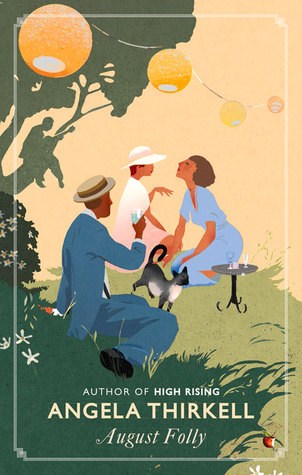 I’d been curious to try Thirkell, and this fourth Barsetshire novel seemed as good a place to start as any. Richard Tebben, not the best and brightest that Oxford has to offer, is back in his parents’ village of Worsted for the summer and dreading the boredom to come. That is, until he meets beautiful Rachel Dean and is smitten – even though she’s mother to a brood of nine, most of them here with her for the holidays. He sets out to impress her by offering their donkey, Modestine, for rides for the children, and rather accidentally saving her daughter from a raging bull. Meanwhile, Richard’s sister Margaret can’t decide if she likes being wooed, and the villagers are trying to avoid being roped into Mrs Palmer’s performance of a Greek play. The dialogue can be laughably absurd. There are also a few bizarre passages that seem to come out nowhere: when no humans are around, the cat and the donkey converse.
This was enjoyable enough, in the same vein as books I’ve read by Barbara Pym, Miss Read, and P.G. Wodehouse, though I don’t expect I’ll pick up more by Thirkell. (No judgment intended on anyone who enjoys these authors. I got so much flak and fansplaining when I gave Pym and Wodehouse 3 stars and dared to call them fluffy or forgettable, respectively! There are times when a lighter read is just what you want, and these would also serve as quintessential English books revealing a particular era and class.)
Source: Public library
My rating:
As a bonus, I have a book about how climate change is altering familiar signs of the seasons.
Forecast: A Diary of the Lost Seasons by Joe Shute (2021)
“So many records are these days being broken that perhaps it is time to rewrite the record books, and accept the aberration has become the norm.”
 Shute writes a weather column for the Telegraph, and in recent years has reported on alarming fires and flooding. He probes how the seasons are bound up with memories, conceding the danger of giving in to nostalgia for a gloried past that may never have existed. However, he provides hard evidence in the form of long-term observations (phenology) such as temperature data and photo archives that reveal that natural events like leaf fall and bud break are now occurring weeks later/earlier than they used to. He also meets farmers, hunts for cuckoos and wildflowers, and recalls journalistic assignments.
The book deftly recreates its many scenes and conversations, and inserts statistics naturally. It also delicately weaves in a storyline about infertility: he and his wife long for a child and have tried for years to conceive, but just as the seasons are out of kilter, there seems to be something off with their bodies such that something that comes so easily for others will not for them. A male perspective on infertility is rare – I can only remember encountering it before in Native by Patrick Laurie – and these passages are really touching. The tone is of a piece with the rest of the book: thoughtful and gently melancholy, but never hopeless (alas, I found The Eternal Season by Stephen Rutt, on a rather similar topic, depressing).
Forecast is wide-ranging and so relevant – the topics it covers kept coming up and I would say to my husband, “oh yes, that’s in Joe Shute’s book.” (For example, he writes about the Ladybird What to Look For series and then we happened on an exhibit of the artwork at Mottisfont Abbey.) I can see how some might say it crams in too much or veers too much between threads, but I thought Shute handled his material admirably.
Source: Public library
My rating:
Have you been reading anything particularly fitting for summer this year?
20 Books of Summer, #18–19: The Other’s Gold and Black Dogs
Today’s entries in my colour-themed summer reading are a novel about a quartet of college friends and the mistakes that mar their lives and a novella about the enduring impact of war set just after the fall of the Berlin Wall.
The Other’s Gold by Elizabeth Ames (2019)
Make new friends but keep the old,
One is silver and the other’s gold.
Do you know that little tune? We would sing it as a round at summer camp. It provides a clever title for this story of four college roommates whose lives are marked by the threat of sexual violence and ambivalent feelings about motherhood. Alice, Ji Sun, Lainey and Margaret first meet as freshmen in 2002 when they’re assigned to the same suite (with a window seat! how envious am I?) at Quincy-Hawthorn College.
 They live together for the whole four years – a highly unusual situation – and see each other through crises at college and in the years to come as they find partners and meander into motherhood. Iraq War protests and the Occupy movement form a turbulent background, but the friends’ overriding concerns are more personal. One girl was molested by her brother as a child and has kept secret her act of revenge; one has a crush on a professor until she learns he has sexual harassment charges being filed against him by multiple female students. Infertility later provokes jealousy between the young women, and mental health issues come to the fore.
As in Expectation by Anna Hope, the book starts to be all about babies at a certain point. That’s not a problem if you’re prepared for and interested in this theme, but I love campus novels so much that my engagement waned as the characters left university behind. Also, the characters seemed too artificially manufactured to inject diversity (Ji Sun is a wealthy Korean; adopted Lainey is of mixed Latina heritage, and bisexual; Margaret has Native American blood) and embody certain experiences. And, unfortunately, any #MeToo-themed read encountered in the wake of My Dark Vanessa is going to pale by comparison.
Part One held my interest, but after that I skimmed to the end. Ideally, I would have chosen replacements and not included skims like this and Green Mansions, but it’s not the first summer that I’ve had to count DNFs and skimmed books – my time and attention are always being diverted by paid review work, review copies and library books with imminent deadlines. I’ve read lots of fiction about groups of female friends this summer, partly by accident and partly by design, and will likely do a feature on it in an upcoming month. For now, I’d recommend Lara Feigel’s The Group instead of this. 
With thanks to Pushkin Press (ONE imprint) for the free e-copy for review.
Black Dogs by Ian McEwan (1992)
 When I read the blurb, I worried I’d read this before and forgotten it: all it mentions is a young couple setting off on honeymoon and having an encounter with evil. Isn’t that the plot of The Comfort of Strangers? I thought. In fact, this only happens to have the vacation detail in common, and has a very different setup and theme overall.
Jeremy lost his parents in a car accident (my least favourite fictional trope – far too convenient a way of setting a character off on their own!) when he was eight years old, and is self-aware enough to realize that he has been seeking for parental figures ever after. He becomes deeply immersed in the story of his wife’s parents, Bernard and June, even embarking on writing a memoir based on what June, from her nursing home bed, tells him of their early life (Part One).
After June’s death, Jeremy takes Bernard to Berlin (Part Two) to soak up the atmosphere just after the Wall comes down, but the elderly man is kicked by a skinhead. The other key thing that happens on this trip is that he refutes June’s account of their honeymoon. At June’s old house in France (Part Three), Jeremy feels her presence and seems to hear the couple’s voices. Only in Part Four do we learn what happened on their 1946 honeymoon trip to France: an encounter with literal black dogs that also has a metaphorical dimension, bringing back the horrors of World War II.
I think the novel is also meant to contrast Communist ideals – Bernard and June were members of the Party in their youth – with how Communism has played out in history. It was shortlisted for the Booker, which made me feel that I must be missing something. A fairly interesting read, most similar in his oeuvre (at least of the 15 I’ve read so far) to The Child in Time. (Secondhand purchase from a now-defunct Newbury charity shop)
Coming up next: The latest book by John Green – it’s due back at the library on the 31st so I’ll aim to review it before then, possibly with a rainbow-covered novel as a bonus read.
20 Books of Summer, #12–13, BLUE: Johnson & MacMahon
Blue has been the most common colour in my themed summer reading, showing up in six out of the 20 titles. In the two books I’m reviewing today, it’s used somewhat ironically, with a YA memoir subverting its association with conventional masculinity and a Women’s Prize-longlisted novel contrasting idyllic holiday weather with the persistence of grief.
All Boys Aren’t Blue: A Memoir-Manifesto by George M. Johnson (2020)
“you sometimes can’t see yourself if you can’t see other people like you existing, thriving”
Growing up in New Jersey in the late 1980s and early 1990s, Johnson knew he was different. He preferred Double-Dutch to football, called his classmates “Honeychild,” and begged for a pair of cowboy boots instead of the sneakers everyone else coveted. His effeminate ways earned the expected epithets. Even though he had plenty of LGBT precedents in his own family – a gay older half-brother, a lesbian aunt, a trans cousin – and his beloved Nanny assured him he was loved for who he was, he didn’t publicly confess his identity until he got to college and felt accepted as part of a fraternity. In fact, there are three instances in the book when, as a teenager, he’s asked directly if he’s gay and he denies it. (Do you hear a rooster?)
 Johnson is a warm, earnest storyteller and deftly chooses moments when he became aware of the social disadvantages inherent to his race and sexuality. His memoir is marketed to teens, who should find a lot to relate to here, such as dealing with bullies and realizing that what you’ve been taught is comforting myth. In the “‘Honest Abe’ Lied to Me” chapter, he discovers in middle school that Lincoln didn’t actually support racial equality and questions whether landmark achievements by Black people are just conciliatory tokens – “symbolism is a threat to actual change—it’s a chance for those in power to say, ‘Look how far you have come’ rather than admitting, ‘Look how long we’ve stopped you from getting here.’”
The manifesto element of the book lies in its investigation of the intersection of Blackness and queerness. Johnson is an activist and wants queer Black kids to have positive role models. He knows he was lucky to have family support and middle-class status; many have it harder, getting thrown out and ending up homeless. Multiple chapters are devoted to his family members, some in the form of letters. The structure didn’t always feel intuitive to me, with direct address to his cousin or grandmother coming seemingly out of nowhere. The language is informal, but that doesn’t excuse “me and so-and-so” constructions or referring to “people that” instead of “who”; young adult readers need to have good grammar reinforced.
I also questioned whether the author needed to be so sexually explicit in describing his molestation at the hands of an older male cousin (he has about a zillion cousins) and losing his virginity at age 20. Then again, today’s teens are probably a lot more sexually knowledgeable than I was 20+ years ago. All in all, I wondered if Johnson is more successful as a motivational speaker than a writer. I think his occasional bravado (he closes his introduction with “This is the story of George Matthew Johnson. This is a story for us all.”) would come across better in person than in print. Still, considering I couldn’t be much further from the target audience, I found this a sweet and engaging read. (Public library)
Nothing but Blue Sky by Kathleen MacMahon (2020)
“Incongruous, the situations we found ourselves in. To be talking about such sorrow against the backdrop of a Mediterranean summer.”
SPOILERS in the following; otherwise it would be difficult to say anything other than that this novel is a deeply touching look at loss and what comes next. When I read a synopsis, I thought it would be Sue Miller’s Monogamy with the roles reversed, but that’s because the blurb makes it sound like there were secrets in David and Mary Rose’s marriage that only emerge after her death in a plane crash. I was on the alert for something sordid and earth-shattering, but in fact this is a quiet novel about what goes unsaid in any marriage.
 David, a foreign correspondent on Dublin’s television news, always put his career first, his sophistication and wicked humour masking the wounds of an emotionally chilly upbringing. Mary Rose, a hospital midwife, was the perfect foil, deflating his pomposity and calling him out on any unfeeling quips. Her loving nature was the soul of their relationship. Now that’s she gone, David regrets that he didn’t take more seriously her desperation to have children, a desire he didn’t share. His voice, even flattened and numbed by grief, is a delight. For instance, here’s how he describes Irish seaside holidays: “Summer to us was freezing your arse off on a windswept beach, with a trip to the ice-cream shop if you were lucky. Of course, they never had the ice-cream you wanted.”
The novel is set in Aiguaclara, a hidden gem on Spain’s Costa Brava where David and Mary Rose holidayed every summer for 20 years. Against his friends’ advice, he’s decided to come back alone this year. Although most of the book remembers their life together and their previous vacations here, there is also a present storyline running underneath. Initially subtle, it offers big surprises later on. These I won’t spoil; I’ll only say that David’s cynical belief that he’ll never experience happiness again is proven wrong. Grief, memory, fate: some of my favourite themes, elegantly treated. This reminded me of Three Junes and also, to a lesser extent, The Heart’s Invisible Furies. (Public library)
Coming up next: Pairs of green and red titles.
Would you be interested in reading one of these?
Review Book Catch-Up: Motherhood, Nature Essays, Pandemic, Poetry
July slipped away without me managing to review any current-month releases, as I am wont to do, so to those three I’m adding in a couple of other belated review books to make up today’s roundup. I have: a memoir-cum-sociological study of motherhood, poems of Afghan women’s experiences, a graphic novel about a fictional worst-case pandemic, seasonal nature essays from voices not often heard, and poetry about homosexual encounters.
(M)otherhood: On the choices of being a woman by Pragya Agarwal
“Mothering would be my biggest gesture of defiance.”
 Growing up in India, Agarwal, now a behavioural and data scientist, wished she could be a boy for her father’s sake. Being the third daughter was no place of honour in society’s eyes, but her parents ensured that she got a good education and expected her to achieve great things. Still, when she got her first period, it felt like being forced onto a fertility track she didn’t want. There was a dearth of helpful sex education, and Hinduism has prohibitions that appear to diminish women, e.g. menstruating females aren’t permitted to enter a temple.
Married and unexpectedly pregnant in 1996, Agarwal determined to raise her daughter differently. Her mother-in-law was deeply disappointed that the baby was a girl, which only increased her stubborn pride: “Giving birth to my daughter felt like first love, my only love. Not planned but wanted all along. … Me and her against the world.” No element of becoming a mother or of her later life lived up to her expectations, but each apparent failure gave a chance to explore the spectrum of women’s experiences: C-section birth, abortion, divorce, emigration, infertility treatment, and finally having further children via a surrogate.
While I enjoyed the surprising sweep of Agarwal’s life story, this is no straightforward memoir. It aims to be an exhaustive survey of women’s life choices and the cultural forces that guide or constrain them. The book is dense with history and statistics, veers between topics, and needed a better edit for vernacular English and smoothing out academic jargon. I also found that I wasn’t interested enough in the specifics of women’s lives in India.
With thanks to Canongate for the free copy for review.
Forty Names by Parwana Fayyaz
“History has ungraciously failed the women of my family”
 Have a look at this debut poet’s journey: Fayyaz was born in Kabul in 1990, grew up in Afghanistan and Pakistan, studied in Bangladesh and at Stanford, and is now, having completed her PhD, a research fellow at Cambridge. Many of her poems tell family stories that have taken on the air of legend due to the translated nicknames: “Patience Flower,” her grandmother, was seduced by the Khan and bore him two children; “Quietude,” her aunt, was a refugee in Iran. Her cousin, “Perfect Woman,” was due to be sent away from the family for infertility but gained revenge and independence in her own way.
Fayyaz is bold to speak out about the injustices women can suffer in Afghan culture. Domestic violence is rife; miscarriage is considered a disgrace. In “Roqeeya,” she remembers that her mother, even when busy managing a household, always took time for herself and encouraged Parwana, her eldest, to pursue an education and earn her own income. However, the poet also honours the wisdom and skills that her illiterate mother exhibited, as in the first three poems about the care she took over making dresses and dolls for her three daughters.
As in Agarwal’s book, there is a lot here about ideals of femininity and the different routes that women take – whether more or less conventional. “Reading Nadia with Eavan” was a favourite for how it brought together different aspects of Fayyaz’s experience. Nadia Anjuman, an Afghan poet, was killed by her husband in 2005; many years later, Fayyaz found herself studying Anjuman’s work at Cambridge with the late Eavan Boland. Important as its themes are, I thought the book slightly repetitive and unsubtle, and noted few lines or turns of phrase – always a must for me when assessing a poetry collection.
With thanks to Carcanet Press for the free copy for review.
Resistance by Val McDermid; illus. Kathryn Briggs
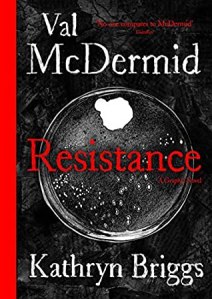 The second 2021 release I read in quick succession in which all but a small percentage of the human race (here, 2 million people) perishes in a pandemic – the other was Under the Blue. Like Aristide’s novel, this story had its origins in 2017 (in this case, on BBC Radio 4’s “Dangerous Visions”) but has, of course, taken on newfound significance in the time of Covid-19. McDermid imagines the sickness taking hold during a fictional version of Glastonbury: Solstice Festival in Northumberland. All the first patients, including a handful of rockstars, ate from Sam’s sausage sandwich van, so initially it looks like food poisoning. But vomiting and diarrhoea give way to a nasty rash, listlessness and, in many cases, death.
Zoe Beck, a Black freelance journalist who conducted interviews at Solstice, is friends with Sam and starts investigating the mutated swine disease, caused by an Erysipelas bacterium and thus nicknamed “the Sips.” She talks to the festival doctor and to a female Muslim researcher from the Life Sciences Centre in Newcastle, but her search for answers takes a backseat to survival when her husband and sons fall ill.
The drawing style and image quality – some panes are blurry, as if badly photocopied – let an otherwise reasonably gripping story down; the best spreads are collages or borrow a frame/backdrop (e.g. a medieval manuscript, NHS forms, or a 1910s title page).


SPOILER
{The ending, which has an immune remnant founding a new community, is VERY Parable of the Sower.}
With thanks to Profile Books/Wellcome Collection for the free copy for review.
Gifts of Gravity and Light: A Nature Almanac for the 21st Century, ed. Anita Roy and Pippa Marland
I hadn’t heard about this upcoming nature anthology when a surprise copy dropped through my letterbox. I’m delighted the publisher thought of me, as this ended up being just my sort of book: 12 autobiographical essays infused with musings on landscapes in Britain and elsewhere; structured by the seasons to create a gentle progression through the year, starting with the spring. Best of all, the contributors are mostly female, BIPOC (and Romany), working class and/or queer – all told, the sort of voices that are heard far too infrequently in UK nature writing. In momentous rites of passage, as in routine days, nature plays a big role.
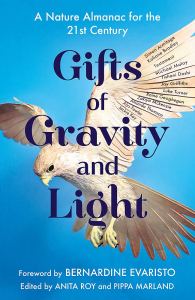 A few of my favourite pieces were by Kaliane Bradley, about her Cambodian heritage (the Wishing Dance associated with cherry blossom, her ancestors lost to genocide, the Buddhist belief that people can be reincarnated in other species); Testament, a rapper based in Leeds, about capturing moments through photography and poetry and about the seasons feeling awry both now and in March 2008, when snow was swirling outside the bus window as he received word of his uni friend’s untimely death; and Tishani Doshi, comparing childhood summers of freedom in Wales with growing up in India and 2020’s Covid restrictions.
Most of the authors hold two places in mind at the same time: for Michael Malay, it’s Indonesia, where he grew up, and the Severn estuary, where he now lives and ponders eels’ journeys; for Zakiya McKenzie, it’s Jamaica and England; for editor Anita Roy, it’s Delhi versus the Somerset field her friend let her wander during lockdown. Trees lend an awareness of time and animals a sense of movement and individuality. Alys Fowler thinks of how the wood she secretly coppices and lays on park paths to combat the mud will long outlive her, disintegrating until it forms the very soil under future generations’ feet.
A favourite passage (from Bradley): “When nature is the cuddly bunny and the friendly old hill, it becomes too easy to dismiss it as a faithful retainer who will never retire. But nature is the panic at the end of a talon, and it’s the tree with a heart of fire where lightning has struck. It is not our friend, and we do not want to make it our enemy.”
Also featured: Bernardine Evaristo (foreword), Raine Geoghegan, Jay Griffiths, Amanda Thomson, and Luke Turner.
With thanks to Hodder & Stoughton for the free copy for review.
Records of an Incitement to Silence by Gregory Woods
 Woods is an emeritus professor at Nottingham Trent University, where he was appointed the UK’s first professor of Gay & Lesbian Studies in 1998. Much of his sixth poetry collection is composed of unrhymed sonnets in two stanzas (eight lines, then six). The narrator is often a randy flâneur, wandering a city for homosexual encounters. One assumes this is Woods, except where the voice is identified otherwise, as in “[Walt] Whitman at Timber Creek” (“He gives me leave to roam / my idle way across / his prairies, peaks and canyons, my own America”) and “No Title Yet,” a long, ribald verse about a visitor to a stately home.
Other times the perspective is omniscient, painting a character study, like “Company” (“When he goes home to bed / he dare not go alone. … This need / of company defeats him.”), or of Frank O’Hara in “Up” (“‘What’s up?’ Frank answers with / his most unseemly grin, / ‘The sun, the Dow, my dick,’ / and saunters back to bed.”). Formalists are sure to enjoy Woods’ use of form, rhyme and meter. I enjoyed some of the book’s cheeky moments but had trouble connecting with its overall tone and content. That meant that it felt endless. I also found the end rhymes, when they did appear, over-the-top and silly (Demeter/teeter, etc.).
Two favourite poems: “An Immigrant” (“He turned away / to strip. His anecdotes / were innocent and his / erection smelled of soap.”) and “A Knot,” written for friends’ wedding in 2014 (“make this wedding supper all the sweeter / With choirs of LGBT cherubim”).
With thanks to Carcanet Press for the free copy for review.
Would you be interested in reading one or more of these?
Book Serendipity, Early 2021
I call it Book Serendipity when two or more books that I read at the same time or in quick succession have something pretty bizarre in common. Because I have so many books on the go at once (usually 20‒30), I suppose I’m more prone to such incidents.
Josh Cohen’s How to Live. What to Do, a therapist’s guide to literature, explains why this might happen:
More than one writer – the French poet Stéphane Mallarmé, the Argentinian writer Jorge Luis Borges – has advanced the exhilarating idea that each book is an infinitesimally small piece of one single, endless Book. I’ve always felt that this idea, unlikely as it might sound, makes perfect sense if you read enough novels [also nonfiction, for me]. The incidents, descriptions, phrases and images in the book you’re reading will always recall the incidents in another, and those in turn will call up the incidents in another, so that even as you’re reading one book, you’re reading countless others.
The following are in roughly chronological order.
- Mother‒baby swimming sessions in Some Body to Love by Alexandra Heminsley and The Still Point of the Turning World by Emily Rapp.


- [I think it would be a spoiler to even name them, but two novels I read simultaneously in January featured 1) a marriage / close relationship between a man and a woman – even though the man is gay; and 2) a character who beat his wife and then died in a convenient ‘accident’. One was published in 1997 and the other in 2020.]
- Stomas appeared in Dazzling Darkness by Rachel Mann and First Time Ever by Peggy Seeger late in my 2020 reading, and then in early 2021 in Pain: The Science of the Feeling Brain by Abdul-Ghaaliq Lalkhen and Love’s Work by Gillian Rose.
- An account of the author’s experience of ovarian hyperstimulation syndrome in Hormonal by Eleanor Morgan and I Miss You when I Blink by Mary Laura Philpott.
- Salmon fishing takes place in Snow Falling on Cedars by David Guterson and Kings of the Yukon by Adam Weymouth.


- The medical motto “see one, do one, teach one” appears in Breathtaking by Rachel Clarke and Complications by Atul Gawande.
- Filipino medical staff feature in America Is Not the Heart by Elaine Castillo and Breathtaking by Rachel Clarke.
- Twin Peaks is mentioned in The Fragments of My Father by Sam Mills and the anthology Trauma: Essays on Art and Mental Health; a different essay in the latter talks about Virginia Woolf’s mental health struggle, which is a strand in the former.
- St. Teresa of Ávila is mentioned in Heart by Gail Godwin and Sanatorium by Abi Palmer.

- The same Rachel Long poem appears in her debut collection, My Darling from the Lions, and The Emma Press Anthology of Love – but under different titles (“Portent” vs. “Delayed Gratification”).
- There’s a matriarch named Dot in Unsettled Ground by Claire Fuller and The Magician’s Assistant by Ann Patchett.
- There’s an Alaska setting in The Quality of Silence by Rosamund Lupton and Kings of the Yukon by Adam Weymouth.
- Becoming a mother is described as a baptism in Sanctuary by Emily Rapp Black and The Fragments of My Father by Sam Mills.


- While reading America Is Not the Heart by Elaine Castillo, I saw Castillo mentioned in the Acknowledgements of My Darling from the Lions by Rachel Long.
- Polar explorers’ demise is discussed in Ex Libris by Anne Fadiman and The Still Point by Amy Sackville.
- “Butterfingers” / “butter-fingered” is used in America Is Not the Heart by Elaine Castillo and The Clock Winder by Anne Tyler.
- There’s a mention of someone eating paper torn from books (the horror!) in Ex Libris by Anne Fadiman and The Clock Winder by Anne Tyler.
- I was reading three pre-releases at once, each of 288 pages: Milk Fed by Melissa Broder, Unsettled Ground by Claire Fuller, and A Town Called Solace by Mary Lawson.
- The Jewish golem myth is the overarching metaphor of Milk Fed by Melissa Broder and Golem Girl by Riva Lehrer.
- There’s a ceremony to pay respects to those who donated their bodies for medical school dissection in Maybe You Should Talk to Someone by Lori Gottlieb and Golem Girl by Riva Lehrer.
- An old woman with dementia features in The Living Sea of Waking Dreams by Richard Flanagan, Keeper by Andrea Gillies, and The Clock Winder by Anne Tyler.


- A mother dies of cancer on Christmas Day in This Party’s Dead by Erica Buist and The Fragments of My Father by Sam Mills.
- The main character does stand-up comedy in Milk Fed by Melissa Broder and This Party’s Dead by Erica Buist.
- Winning a goldfish at a carnival in The Air Year by Caroline Bird, A Feather on the Breath of God by Sigrid Nunez, and Anna Vaught’s essay in the Trauma anthology.
- ECT (electroconvulsive therapy) is mentioned in Adventures in Human Being by Gavin Francis and Woman on the Edge of Time by Marge Piercy.


- There’s a father who is non-medical hospital staff in The Push by Ashley Audrain (a cleaner) and A Feather on the Breath of God by Sigrid Nunez (a kitchen worker).
- There’s a character named Hart in The Wild Laughter by Caoilinn Hughes and The Birth House by Ami McKay.
- Cannibalism is a point of reference, a major metaphor, or a (surreal) reality in Mother for Dinner by Shalom Auslander, Eat or We Both Starve by Victoria Kennefick, and Light Perpetual by Francis Spufford.
- Infertility and caring for animals were two big themes shared by Brood by Jackie Polzin and Catalogue Baby by Myriam Steinberg. This became clearer when I interviewed both authors in February. Also, both women have shocks of pink hair in their publicity photos!


- A young woman works at a hotel in The Distance between Us by Maggie O’Farrell and My Dark Vanessa by Kate Elizabeth Russell (and The Glass Hotel by Emily St. John Mandel, which I read late last year).
What’s the weirdest reading coincidence you’ve had lately?
January’s Nonfiction Releases: Clarke, Heminsley and Lalkhen
Three new books with medical themes (no surprise there), including the first Covid wave in the UK; fertility and body issues in a new queer family; and pain management strategies.
Breathtaking: Inside the NHS in a Time of Pandemic by Rachel Clarke
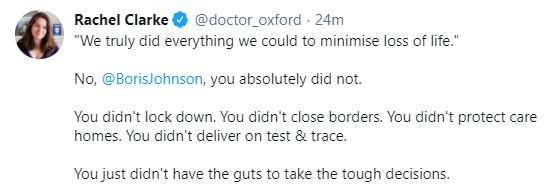
 Clarke is a palliative care doctor based in Oxfordshire. She runs the Katharine House hospice but during the coronavirus pandemic has also been on active duty in the Oxford University Hospitals system. If you’re on social media you have likely come across some of her postings as she has been equally vocal in her praise of the NHS and her criticism of Boris Johnson’s faltering policies, which are often of the too little, too late variety. So I was eager to read her insider’s account of hospital treatment of the first wave of Covid in the UK, especially because her previous book, Dear Life, was one of my top two nonfiction releases of last year.
The focus is on the first four full months of 2020, and the book originated in Clarke’s insomniac diaries and notes made when, even after manically busy shifts, she couldn’t rest her thoughts. Her pilot husband was flying to China even as increasingly alarming reports started coming in from Wuhan. She weaves in the latest news from China and Italy as well as what she hears from colleagues and disease experts in London. But the priority is given to stories: of the first doctor to die in China; of a Yorkshire ICU nurse’s father, who comes down with Covid and is on a ventilator in an Oxford hospital; and of her patients there and in the hospice. She is touched that so many are making great sacrifices, such as by deciding not to visit loved ones at the end of their lives so as not to risk spreading infection.
A shortage of PPE remained a major issue, though Dominic Pimenta (whose Duty of Care was my first COVID-19 book) pulled through for her with an emergency shipment for the hospice – without which it would have had to close. Clarke marvels at the NHS’s ability to create an extra 33,000 beds within a month, but knows that this comes at a cost of other services, including cancer care, being stripped back or cancelled, meaning that many are not receiving the necessary treatment or are pushing inescapable problems further down the road.
From January 26, 2021
A comparison with Gavin Francis’s Intensive Care, published earlier in the month, is inevitable. Both doctors bounce between headlines and everyday stories, government advice and the situation on the ground. Both had their own Covid scare – Clarke didn’t meet the criteria to be tested so simply went back to work two weeks later, when she felt well enough – and had connections to regions that foreshadowed what would soon happen in the UK. Both give a sense of the scope of the crisis and both lament that, just when patients need compassion most, full PPE leads to their doctors feeling more detached from them than ever.
However, within the same page count, Francis manages to convey more of the science behind the virus and its transmission, and helpfully explores the range of effects Covid is having for different groups. He also brings the story more up to the minute with a look back from November, whereas Clarke ends in April and follows up with an epilogue set in August. A book has to end somewhere, yes, but with this crisis ongoing, the later and more relevant its contents can be, the better. And in any book that involves a lot of death, mawkishness is a risk; Clarke so carefully avoided this in Dear Life, but sometimes succumbs here, with an insistence on how the pandemic has brought out the best in people (clapping and rainbows and all that). Her writing is as strong as ever, but I would have appreciated a sharper, more sombre look at the situation a few months later. Perhaps there will be a sequel.

From January 6, 2021
With thanks to Little, Brown UK for the free copy for review.
Some Body to Love: A Family Story by Alexandra Heminsley
 From Heminsley’s previous book, Leap In, I knew about her getting married and undergoing IVF. It was also a book about outdoor swimming; I appreciated her words on acquiring a new skill as an adult and overcoming body issues. This memoir continues the story: in 2017, after a gruelling journey through infertility treatment, Heminsley finally got the baby she wanted. But not before a couple more heart-wrenching moments: the lab made an error and notified her that she shared no DNA with this last embryo, and while heavily pregnant she was assaulted by a drunk man on a train. Both incidents left her feeling a loss of agency. “Why was I consistently being deemed the least reliable witness of my own reality?” she asks.
As they adjusted to new life with a baby, Heminsley started to notice that she wasn’t connecting with her husband, D, like she used to. She felt emotionally unsupported and, in fact, jealous of D’s relationship with their son, L. And while they’d never been the most conventional couple, D’s changes of appearance and wardrobe seemed like a sign of something bigger. Indeed, when L was six months old, D told Heminsley, “this body doesn’t represent who I am” and announced a decision to begin transitioning.
As D moved towards having a body that fit their identity, Heminsley, too, needed to get back in touch with her body. After books like Running Like a Girl, she was considered an exercise guru, but she didn’t see herself in the new obsession with Instagram-ready images of fitness perfection. This is not, then, primarily a memoir of queer family-making, because D’s transitioning was not Heminsley’s story to tell and mostly occurs in the background. Instead she focuses on what she does know and can control: her relationship to her own body.
However, this entails what can feel like irrelevant flashbacks to her teenage years of undergoing rehab at a military clinic in Germany for hypermobility, trips to Trinidad and Italy, and the genesis of her two sporting memoirs. Much as I applaud the sensitivity to trans and body issues, the book ends up feeling scattered. Still, the writing is so candid and the narrative so eventful that you’ll race through this even if you don’t normally pick up nonfiction. (For a bit more information, see my short write-up of the virtual book launch.)
With thanks to Chatto & Windus for the free copy for review.
Pain: The Science of the Feeling Brain by Abdul-Ghaaliq Lalkhen
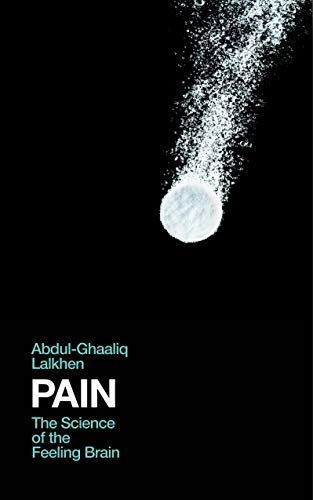 Originally from South Africa, Dr Lalkhen is an anaesthesiology and pain specialist based in Manchester. In a nutshell, his approach is “biopsychosocial,” meaning that he seeks to understand pain not just as a physical phenomenon resulting from acute injury or damage but as an ongoing process that is affected by emotional and psychological factors. Particularly in the context of chronic syndromes, he acknowledges that pain can continue even when its immediate cause has been repaired. Mental preparation can come into the equation: if a patient assumes they’ll wake up from surgery healed, they may be alarmed if pain persists. Lalkhen talks about managing patient expectations, perhaps with something as simple as the promise, “we’ll aim to get your pain down to a 4 after surgery.” In part, he blames Western society’s Cartesian philosophy for treating mind and body as separate rather than a system.
There are genetic and psychological reasons people might be predisposed to chronic pain. Pain itself can then change the brain chemistry, making the body more alert to pain signals. People can choose one of three paths, Lalkhen observes: “You can spend your time agitating about the alarm going off, you can try to ignore it (but the ignoring of it actually takes up more energy), or the final alternative is to learn to live with this deeply unpleasant situation.” Those who opt for pharmacological solutions can become addicted to opiates, which are less effective over time. Non-drug-related therapies involve the desensitization of nerves, the injection of anaesthetics or steroids, or the implanting of spinal cord stimulators. But all of these strategies have their limitations, and can diminish in efficacy. The patients he sees in his pain clinics may be disappointed that, rather than offering a panacea, he wants to wean them off their current pain relief and help them develop a new way of thinking about pain.
I felt I learned a lot from reading this. Lalkhen is careful to state that he is only referring to non-cancer pain (cancer pain in terminal patients will take all the morphine you can throw at it). Like many physicians, he worries about the modern epidemic of overtreatment and our obsession with wellness. I especially enjoyed the discussion of the understanding of pain and its treatment from the ancient world onward, and in particular the history of opiates. The prose is not literary, but this is an accessible and informational read if the subject matter draws you.
With thanks to Atlantic Books for the free copy for review.
What recent nonfiction releases can you recommend?
Fairy Tales, Outlaws, Experimental Prose: Three More January Novels
Today I’m featuring three more works of fiction that were released this month, as a supplement to yesterday’s review of Mrs Death Misses Death. Although the four are hugely different in setting and style, and I liked some better than others (such is the nature of reading and book reviewing), together they’re further proof – as if we needed it – that female authors are pushing the envelope. I wouldn’t be surprised to see any or all of these on the Women’s Prize longlist in March.
The Charmed Wife by Olga Grushin
 What happens next for Cinderella?
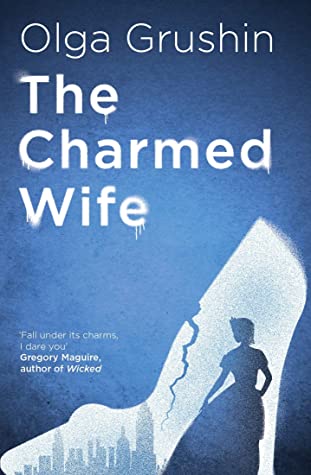
Grushin’s fourth novel unpicks a classic fairy tale narrative, starting 13.5 years into a marriage when, far from being starry-eyed with love for Prince Roland, the narrator hates her philandering husband and wants him dead. As she retells the Cinderella story to her children one bedtime, it only underscores how awry her own romance has gone: “my once-happy ending has proved to be only another beginning, a prelude to a tale dimmer, grittier, far more ambiguous, and far less suitable for children”. She gathers Roland’s hair and nails and goes to a witch for a spell, but her fairy godmother shows up to interfere. The two embark on a good cop/bad cop act as the princess runs backward through her memories: one defending Roland and the other convinced he’s a scoundrel.
Part One toggles back and forth between flashbacks (in the third person and past tense) and the present-day struggle for the narrator’s soul. She comes to acknowledge her own ignorance and bad behaviour. “All I want is to be free—free of him, free of my past, free of my story. Free of myself, the way I was when I was with him.” In Part Two, as the princess tries out different methods of escape, Grushin coyly inserts allusions to other legends and nursery rhymes: a stepsister lives with her many children in a house shaped like a shoe; the witch tells a variation on the Bluebeard story; the fairy godmother lives in a Hansel and Gretel-like candy cottage; the narrator becomes a maid for 12 slovenly sisters; and so on.
 The plot feels fairly aimless in this second half, and the mixture of real-world and fantasy elements is peculiar. I much preferred Grushin’s previous book, Forty Rooms (and Angela Carter’s The Bloody Chamber, one of her chief inspirations). However, her two novels share a concern with how women’s ambitions can take a backseat to their roles, and both weave folktales and dreams into a picture of everyday life. But my favourite part of The Charmed Wife was the subplot: interludes about Brie and Nibbles, the princess’s pet mice; their lives being so much shorter, they run through many generations of a dramatic saga while the narrator (whose name we do finally learn, just a few pages from the end) is stuck in place.
With thanks to Hodder & Stoughton for the free copy for review.
Outlawed by Anna North
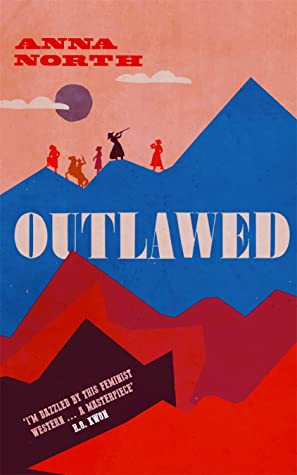 I was a huge fan of North’s previous novel, The Life and Death of Sophie Stark, which cobbles together the story of the title character, a bisexual filmmaker, from accounts by the people who knew her best. Outlawed, an alternative history/speculative take on the traditional Western, could hardly be more different. In a subtly different version of the United States, everyone now alive in the 1890s is descended from those who survived a vicious 1830s flu epidemic. The duty to repopulate the nation has led to a cult of fertility and devotion to the Baby Jesus. From her mother, a midwife and herbalist, Ada has learned the basics of medical care, but the causes of barrenness remain a mystery and childlessness is perceived as a curse.
Ada marries at 17 and fails to get pregnant within a year. After an acquaintance miscarries, rumours start to spread about Ada being a witch. Kicked out by her mother-in-law, she takes shelter first at a convent and then with the Hole in the Wall gang. She’ll be the doctor to this band of female outlaws who weren’t cut out for motherhood and shunned marriage – including lesbians, a mixed-race woman, and their leader, the Kid, who is nonbinary. The Kid is a mentally tortured prophet with a vision of making the world safe for people like them (“we were told a lie about God and what He wants from us”), mainly by, Robin Hood-like, redistributing wealth through hold-ups and bank robberies. Ada, who longs to conduct proper research into reproductive health rather than relying on religious propaganda, falls for another gender nonconformist, Lark, and does what she can to make the Kid’s dream a reality.
Reese Witherspoon choosing this for her Hello Sunshine book club was a great chance for North’s work to get more attention. However, I felt that the ideas behind this novel were more noteworthy than the execution. The similarity to The Handmaid’s Tale is undeniable, though I liked this a bit more. I most enjoyed the medical and religious themes, and appreciated the attention to childless and otherwise unconventional women. But the setup is so condensed and the consequences of the gang’s major heist so rushed that I wondered if the novel needed another 100 pages to stretch its wings. I’ll just have to await North’s next book.
With thanks to W&N for the proof copy for review.
little scratch by Rebecca Watson
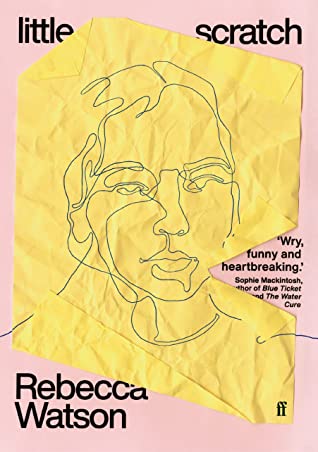 I love a circadian narrative and had heard interesting things about the experimental style used in this debut novel. I even heard Watson read a passage from it as part of the Faber Live Fiction Showcase and found it very funny and engaging. But I really should have tried an excerpt before requesting this for review; I would have seen at a glance that it wasn’t for me. I don’t have a problem with prose being formatted like poetry (Girl, Woman, Other; Stubborn Archivist; the prologue of Wendy McGrath’s Santa Rosa; parts of Mrs Death Misses Death), but here it seemed to me that it was only done to alleviate the tedium of the contents.
A young woman who, like Watson, works for a newspaper, trudges through a typical day: wake up, get ready, commute to the office, waste time and snack in between doing bits of work, get outraged about inconsequential things, think about her boyfriend (only ever referred to as “my him” – probably my biggest specific pet peeve about the book), and push down memories of a sexual assault. Thus, the only thing that really happens happened before the book even started. Her scratching, to the point of open wounds and scabs, seems like a psychosomatic symptom of unprocessed trauma. By the end, she’s getting ready to tell her boyfriend about the assault, which seems like a step in the right direction.
I might have found Watson’s approach captivating in a short story, or as brief passages studded in a longer narrative. At first it’s a fun puzzle to ponder how these mostly unpunctuated words, dotted around the pages in two to six columns, fit together – should one read down each column, or across each row, or both? – but when all the scattershot words are only there to describe a train carriage filling up or repetitive quotidian actions (sifting through e-mails, pedalling a bicycle), the style soon grates. You may have more patience with it than I did if you loved A Girl Is a Half-Formed Thing or books by Emma Glass.


A favourite passage: “got to do this thing again, the waking up thing, the day thing, the work thing, disentangling from my duvet thing, this is something, this is a thing I have to do then,” [appears all as one left-aligned paragraph]
With thanks to Faber & Faber for the free copy for review.
Tomorrow I’ll review three nonfiction works published in January, all on a medical theme.
 Bookish Beck = Rebecca Foster. American transplant to England. Freelance proofreader and book reviewer.
 Bookish Beck