The Single Hound by May Sarton (1938)
I spotted that the 30th anniversary of May Sarton’s death was coming up, so decided to read an unread book of hers from my shelves in time to mark the occasion. Today’s the day: she died on July 16, 1995 in York, Maine. Marcie of Buried in Print joined me for a buddy read (her review). I was drawn by the title, which comes from an Emily Dickinson quote. It’s the ninth Sarton novel I’ve read and, while in general I find her nonfiction more memorable than her fiction, this impressionistic debut novel was a solid read. It was clearly inspired by Virginia Woolf’s work and based on Sarton’s memories of her time on the fringes of the Bloomsbury Group.
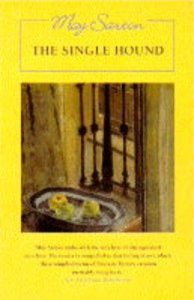 In Part I we are introduced to “the Little Owls,” three dear friends and winsome spinsters in their sixties – Doro, Annette and Claire – who teach and live above their schoolroom in Ghent, Belgium. (I couldn’t help but think of the Brontë sisters’ time in Belgium.) Doro, a poet, seems likely to be a stand-in for the author. I loved the gentle pace of this section; although the novel was published when she was only 26, Sarton was already displaying insight into friendship and ageing and appreciation of life’s small pleasures, elements that would recur in her later autobiographical work.
the three together made a complete world.
Was this life? This slow penetration of experience until nothing had been left untasted, unexplored, unused — until the whole of one’s life became a fabric, a tapestry with a pattern? She could not see the pattern yet.
tea was opium to them both, the time when the past became a soft pleasant country of the imagination, lost its bitterness, ceased to devour, and in some tea-inspired way nourished them.
Part II felt to me like a strange swerve into the story of Mark Taylor, an aspiring English writer who falls in love with a married painter named Georgia Manning. Their flirtation, as soon through the eyes of a young romantic like Mark, is monolithic, earth-shattering, but to readers is more of a clichéd subplot. In the meantime, Mark sticks to his vow of going on a pilgrimage to Belgium to meet Jean Latour, the poet whose work first inspired him. Part III brings the two strands together in an unexpected way, as Mark gains clarity about his hero and his potential future with Georgia, though cleverer readers than I may have been able to predict it – especially if they heeded the Brontë connection.
It was rewarding to spot the seeds of future Sarton themes here, such as discovering the vocation of teaching (The Small Room) and young people meeting their elder role models and soliciting words of wisdom on how to live (Mrs. Stevens Hears the Mermaids Singing). Through Doro, Sarton also expresses trust in poetry’s serendipitous power. “This is why one is a poet, so that some day, sooner or later, one can say the right thing to the right person at the right time.” I enjoyed my time with the Little Owls but mostly viewed this as a dress rehearsal for later, more mature work. (Secondhand – Awesomebooks.com) 
Three on a Theme: Books on Communes by Crossman, Heneghan & Twigg
Communal living always seems like a great idea but rarely works out well. Why? The short answer: Because people. A longer answer: Political ideals are hard to live out in the everyday when egos clash, practical arrangements become annoying, and lines of privacy or autonomy get crossed. All three books I review today are set in the aftermath of utopian failure. Susanna Crossman, who grew up in an English commune, looks back at 15 years of an abnormal childhood. The community in Birdeye is set to collapse after two founding members announce their departure, leaving one ageing woman and her disabled daughter. And in Spoilt Creatures, from a decade’s distance, Iris narrates the disastrous downfall of Breach House.
Home Is Where We Start: Growing up in the Fallout of the Utopian Dream by Susanna Crossman
For Crossman’s mother, “the community” was a refuge, a place to rebuild their family’s life after divorce and the death of her oldest daughter in a freak accident. For her three children, it initially was a place of freedom and apparent equality between “the Adults” and “the Kids” – who were swiftly indoctrinated into hippie opinions on the political matters of the day. “There is no difference between private and public conversations, between the inside and the outside. No euphemisms. Vaginas are discussed over breakfast alongside domestic violence and nuclear bombs.” Crossman’s present-tense recreation of her precocious eight-year-old perspective is canny, as when she describes watching Charles and Diana’s wedding on television:
It was beautiful, but I know marriage is a patriarchal institution, a capitalist trap, a snare. You can read about it in Spare Rib, or if you ask community members, someone will tell you marriage is legalized rape. It is a construction, and that means it’s not natural, and is part of the social reproduction of gender roles and women’s unpaid domestic labour.
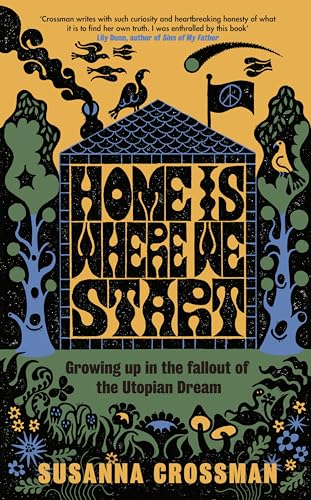 Their mum, now known only as “Alison,” often seemed unaware of what the Kids got up as they flitted in and out of each other’s units. Crossman once electrocuted herself at a plug. Another time she asked if she could go to an adult man’s unit for an offered massage. Both times her mother was unfazed.
The author is now a clinical arts therapist, so her recreation is informed by her knowledge of healthy child development and the long-term effects of trauma. She knows the Kids suffered from a lack of routine and individually expressed love. Community rituals, such as opening Christmas presents in the middle of a circle of 40 onlookers, could be intimidating rather than welcoming. Her molestation and her sister’s rape (when she was nine years old, on a trip to India ‘supervised’ by two other adults from the community) were cloaked in silence.
Crossman weaves together memoir and psychological theory as she examines where the utopian impulse comes from and compares her own upbringing with how she tries to parent her three daughters differently at home in France. Through vignettes based on therapy sessions with patients, she shows how play and the arts can help. (I’d forgotten that I’ve encountered Crossman’s writing before, through her essay on clowning for the Trauma anthology.) I somewhat lost interest as the Kids grew into teenagers. It’s a vivid and at times rather horrifying book, but the author doesn’t resort to painting pantomime villains. Behind things were good intentions, she knows, and there is nuance and complexity to her account. It’s a great mix of being back in the moment and having the hindsight to see it all clearly.
With thanks to Fig Tree (Penguin) for the proof copy for review.
Birdeye by Judith Heneghan
Like Crossman’s community, the Birdeye Colony is based in a big crumbling house in the countryside – but this time in the USA; the Catskills of upstate New York, to be precise. Liv Ferrars has been the de facto leader for nearly 50 years, since she was a young mother to twins. Now she’s a sixty-seven-year-old breast cancer survivor. To her amazement, her book, The Attentive Heart, still attracts visitors, “bringing their problems, their pain and loneliness, hoping to be mended, made whole.”
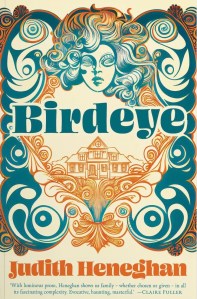 One of the ur-plots is “a stranger comes to town,” and that’s how Birdeye opens, with the arrival of a young man named Conor who’s read and admired Liv’s book, and seems to know quite a lot about the place. When Indian American siblings Sonny and Mishti, the only others who have been there almost from the beginning, announce that they’re leaving, it seems Birdeye is doomed. But Liv wonders if Conor can be part of a new generation to take it on.
It’s a bit of a sleepy book, with a touch of suspense as secrets emerge from Birdeye’s past. I was slightly reminded of May Sarton’s Kinds of Love. I most appreciated the character study of Liv and her very different relationships with her daughters, who are approaching fifty: Mary is a capable lawyer in London, while Rose suffered oxygen deprivation at birth and is severely intellectually disabled. Since Liv’s illness, Mary has pressured her to make plans for Rose’s future and, ultimately, her own. The duty of care we bear towards others – blood family; the chosen family of friends and comrades, even pets – arises as a major theme. I’d recommend this to those who love small-town novels.
With thanks to Salt Publishing for the free copy for review.
& 20 Books of Summer, #20:
Spoilt Creatures by Amy Twigg
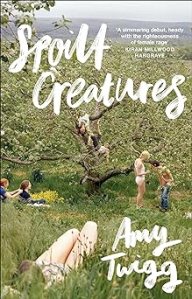 Alas, this proved to be another disappointment from the Observer’s 10 best new novelists feature (following How We Named the Stars by Andrés N. Ordorica). The setup was promising: in 2008, Iris reeling from her break-up from Nathan and still grieving her father’s death in a car accident, goes to live at Breach House after a chance meeting with Hazel, one of the women’s commune’s residents. “Breach House was its own ecosystem, removed from the malfunctioning world of indecision and patriarchy.” Any attempts to mix with the outside world go awry, and the women gain a reputation as strange and difficult. I never got a handle on the secondary characters, who fill stock roles (the megalomaniac leader, the reckless one, the disgruntled one), and it all goes predictably homoerotic and then Lord of the Flies. The dual-timeline structure with Iris’s reflections from 10 years later adds little. An example of the commune plot done poorly, with shallow conclusions rather than deeper truths at play.
With thanks to Tinder Press for the free copy for review.
On this topic, I have also read:
Novels:
Arcadia by Lauren Groff
The Blithedale Romance by Nathaniel Hawthorne
On my TBR:
O Sinners by Nicole Cuffy
We Burn Daylight by Bret Anthony Johnston
Nonfiction:
Heaven Is a Place on Earth by Adrian Shirk
#ReadingtheMeow2024 and 20 Books of Summer, 2: Sleeping with Cats by Marge Piercy
Reviews of books about cats have been a standard element on my blog over the years, and the second annual Reading the Meow challenge, hosted by Mallika of Literary Potpourri, was a good excuse to pick up some more. Tomorrow I’ll review two cat-themed novels; today I have a 2002 memoir that I have been meaning to read for ages.
I discovered Piercy through her poetry, then read Woman on the Edge of Time, a feminist classic that contrasts utopian and dystopian views of the future. Like May Sarton (whom Piercy knew), she devotes equal energy to both fiction and poetry and is an inveterate cat lady. Piercy is still publishing and blogging at 88; I have much to catch up on from her back catalogue. A précis of her life is almost stranger than fiction: she grew up in poverty in Detroit, joining a teen gang and discovering her sexuality first with other girls (“The first time I had an orgasm—I was eleven—I was astonished and also I had a feeling of recognition. Of course, that’s it. As if that was what I had been expecting or looking for”) then with men; had a couple abortions, including one self-administered, then got sterilized; honed her writing craft at college; married three times – briefly to a Frenchman, an unhappy open arrangement, and now for 40+ years to fellow writer Ira Wood; and wrote like a dervish yet has remained on the periphery of the literary establishment and thus struggled financially.
Political activism has been a constant for Piercy, whether protesting the Vietnam War or supporting women’s reproductive rights. She and Wood also nurtured a progressive Jewish community around their Cape Cod home. Again like Sarton, she has always embraced the term feminist but been more resistant to queerness. A generational thing, perhaps; nowadays we would surely call Piercy bisexual or at least sexually fluid, but she’s more apt to dismiss her teen girlfriends and her later affairs with women as a phase. The personal life and career mesh here, though there is more of a focus on the former, such that I haven’t really gotten a clear idea of which of her novels I might want to try. Each chapter ends with one of her poems (wordy, autobiographical free verse), giving a flavour of her work in other genres. She portrays herself as a nomad who wandered various cities before settling into an unexpectedly homely and seasonal existence: “I am a stray cat who has finally found a good home.”

I admired Piercy’s self-knowledge here: her determination to write (including to keep her late mother alive in her) and to preserve the solitude necessary to her work –
I know I am an intense, rather angular passionate woman, not easy to like, not easy to live with, even for myself. Convictions, causes jostle in me. My appetites are large. I have learned to protect my work time and my privacy fiercely. I have been a better writer than a person, and again and again I made that choice. Writing is my core. I do not regret the security I have sacrificed to serve it.
and her conviction that motherhood was not for her –
I did not want children. I never felt I would be less of a woman, but I feared I would be less of a writer if I reproduced. I didn’t feel anything special about my genetic composition warranted replicating it. … I liked many of my friends’ children as they grew older: I was a good aunt. But I never desired to possess them or have one of my own. … I have never regretted staying childless. My privacy, my time for work … are precious. I feel my life is full enough.
“There were no role models for a woman like me,” she felt at the end of college, but she can in her turn be a role model of the female artist’s life, socially engaged and willing to take risks.
As to the title: There is, of course, special delight here for cat lovers. Piercy has had cats since she was a child, and in the Cape Cod era has usually kept a band of five or so. In the interludes we meet some true characters: Arofa the Siamese, Cho-Cho who lived to 21, mother and son Dinah and Oboe, alpha male Jim Beam, and many more. Of course, they age and fall ill and there are some goodbye scenes. She mostly describes these unsentimentally – if you’ve read Doris Lessing on cats, I’d say the attitude is similar. There are extremes of both love and despair: she licks a kitten to bond with her; she euthanizes one beloved cat herself. She wrote this memoir at 65 and felt that her cats were teaching her how to age.
There is a sadness to living with old cats; also a comfort and pleasure, for you know each other thoroughly and the trust is almost absolute. … The knowledge of how much I will miss them is always with me, but so is the sense of my own time flowing out, my life passing and the necessity to value it as I value them. Old cats are precious.
Even those unfamiliar with Piercy’s work might enjoy reading a perspective on the radical movements of the 1960s and 70s. This was right up my street because of her love of cats, her defence of the childfree life, and her interest in identity and memory. Because she doesn’t talk in depth about her oeuvre, you needn’t have read anything else of hers to appreciate reading this. I hope you have a cat who will nap on your lap as you do so. (Secondhand, a gift from my wish list) 

Preposterous #NovNov23 Catch-Up Post
I have a big pile of novellas I read last month but never wrote about, plus a few more I’ve sneaked in by finishing them over the past couple of days. I tweaked my shoulder last weekend and the discomfort has moved into my neck, making daily life, and sleep, difficult. A taste of what it’s like to live with chronic pain, I suppose. Add in the freezing temperatures of recent days and I’ve been feeling pretty sorry for myself and haven’t succeeded in sitting at a computer for the time required to write at least a bit about these short books. But as today is the day our link-up finishes, I’m tucked up in bed with laptop, electric blanket, heater, cat, cup of tea and ice pack, ready to do all 16 the best justice I can through a paragraph each.
Fiction:
In the Sweep of the Bay by Cath Barton (2020)
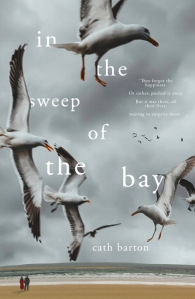 Susan put this on my radar and I bought it in publisher Louise Walters Books’ closing-down sale. Set in Morecambe, this bittersweet story of a half-century marriage and the figures on its margins – co-workers, children, even strangers – is both ambitious and intimate. Ted and Rene Marshall marry in the 1950s and soon drift into drudgery and traditional gender roles; “They forgot the happiness. Or rather, they pushed it away.” While Ted becomes a celebrated ceramics designer in the family company, Rene stagnates at home. It is not so much suspected infidelity as simply taking each other for granted that threatens their relationship. Barton moves through the decades and varies the perspective, letting us hear from one of the Marshalls’ daughters and giving kind attention to a gay couple. Strictly Come Dancing fans and those familiar with the northwest might take particular pleasure, but I enjoyed this quiet book reminiscent of Anne Tyler’s French Braid and (though less political) Jonathan Coe’s Bournville. (New purchase) [104 pages]
The Visitor by Maeve Brennan (2000)
 This posthumous novella was written in the 1940s but never published in Brennan’s lifetime. From Dublin, she was a longtime New Yorker staff member and wrote acclaimed short stories. After her mother’s death, Anastasia King travels from Paris, where the two set up residence after leaving her father, to Ireland to stay in the family home with her grandmother. Anastasia considers it a return, a homecoming, but her spiteful grandmother makes it clear that she is an unwelcome interloper. Mrs King can’t forgive the wrong done to her son, and so won’t countenance Anastasia’s plan to repatriate her mother’s remains. Rejection and despair eat away at Anastasia’s mental health (“She saw the miserable gate of her defeat already open ahead. There only remained for her to come up to it and pass through it and be done with it”) but she pulls herself together for an act of defiance. Most affecting for me was a scene in which we learn that Anastasia is so absorbed in her own drama that she does not fulfill the simple last wish of a dying friend. This brought to mind James Joyce’s The Dead. (Secondhand purchase – The Bookshop, Wigtown) [81 pages]
Bear by Marian Engel (1976)
 If you’ve heard of this, it’ll be for the fact that the main character – Lou, a librarian sent to archive the holdings of an octagonal house on an island one summer – has sex with a bear. That makes it sound much more repulsive and/or titillating than it actually is. The further I read the more I started to think of it as an allegory for women’s awakening; perhaps the strategy inspired Melissa Broder’s The Pisces (stuffed full of sex with a merman). “I have an odd sense of being reborn,” Lou writes to her boss, the Institute director, with whom she’d been having an affair. The bear lives in an outbuilding and at first Lou is indifferent, only feeding him as necessary. Then he becomes a friend, joining her for swims. Then he comes into the house. Bestiality is a taboo for a reason, but what mostly bothers me is the lack of mutuality, the sense of taking advantage. I’m also wary of stories in which animals have a primarily instrumental or metaphorical role. Still, this was a solid read, offbeat and nearly as shocking today as when it first appeared. (Secondhand purchase online) [167 pages]
So Late in the Day by Claire Keegan (2023)
 Several of us reviewed this for #NovNov though unsure it counts: in the UK the title story (originally for the New Yorker) was published in a standalone volume by Faber, while the U.S. release includes two additional earlier stories; I read the latter. The title story has Cathal spending what should have been his wedding weekend moping about Sabine calling off their engagement at the last minute. It’s no mystery why she did: his misogyny, though not overt, runs deep, most evident in the terms in which he thinks about women. And where did he learn it? From his father. (“The Long and Painful Death” is from Keegan’s second collection, Walk the Blue Fields, and concerns a woman on a writing residency at an author’s historic house in Ireland. She makes a stand for her own work by refusing to cede place to an entitled male scholar. The final story is “Antarctica,” the lead story in that 1999 volume and a really terrific one I’d already experienced before. It’s as dark and surprising as an early Ian McEwan novel.) Keegan proves, as ever, to be a master at portraying emotions and relationships, but the one story is admittedly slight on its own, and its point obvious. (Read via Edelweiss) [64 pages]
Swallowing Geography by Deborah Levy (1993)
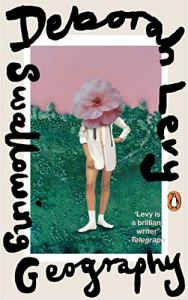 “She is Europe’s eerie child, and she is part of the storm.” J.K. is a young woman who totes her typewriter around different European locations, sleeps with various boyfriends, hears strangers’ stories, and so on. Many of the people she meets are only designated by an initial. By contrast, the most fully realized character is her mother, Lillian Strauss. The chapters feel unconnected and the encounters within them random, building to nothing. Though a bit like Crudo, this has very little detail to latch onto and so was pretentious in its opacity. I’ve generally gotten on much better with Levy’s nonfiction (see below) than her fiction. This, along with the Keegan (above), was my chosen train entertainment for the Booker Prize evening. I got so little out of it that it seemed like wasted reading time. Here’s a decent excerpted passage: “The arrogance of metaphor when facts save people’s lives. The succour of metaphor when facts inadequately describe people’s lives.” (Public library) [83 pages]
Nonfiction:
Starting with two from the Bloomsbury Object Lessons series, a great source of short monographs. These have been among my favourites so far.
Grave by Allison C. Meier (2023)
 Meier is a cemetery tour guide in Brooklyn, where she lives. She surveys American burial customs in particular, noting the lack of respect for Black and Native American burial grounds, the Civil War-era history of embalming, the increasing popularity of cremation, and the rise of garden cemeteries such as Mount Auburn in Cambridge, Massachusetts, which can serve as wildlife havens. The mass casualties and fear of infection associated with Covid-19 brought back memories of the AIDS epidemic, especially for those in New York City. Meier travels to a wide range of resting places, from potter’s fields for unclaimed bodies to the most manicured cemeteries. She also talks about newer options such as green burial, body composting, and the many memorial objects ashes can be turned into. I’m a dedicated reader of books about death and so found this fascinating, with the perfect respectful and just-shy-of-melancholy tone. It’s political and philosophical in equal measures. (Read via NetGalley) [168 pages]
Pregnancy Test by Karen Weingarten (2023)
 Laboratory pregnancy tests have been available since the 1930s and home pregnancy tests – the focus here – since the 1970s. All of them work by testing urine for the hormone hCG (human chorionic gonadotropin). What is truly wild is that pregnancy used to be verifiable only with laboratory animals – female mice and rabbits had to be sacrificed to see if their ovaries had swelled after the injection of a woman’s urine; later, female Xenopus toads were found to lay eggs in response, so didn’t need to be killed. Home pregnancy kits were controversial and available in Canada before the USA because it was thought that they could be unreliable or that they would encourage early abortions. Weingarten brings together the history, laypeople-friendly science, and cultural representations (taking a pregnancy test is excellent TV shorthand) in a readable narrative and makes a clear feminist statement: “the home pregnancy test gave back to women what should have always been theirs: first-hand knowledge about how their bodies worked” and thus “had the potential to upend a paternalistic culture.” (Read via NetGalley) [160 pages]
And from a different Bloomsbury series for monographs about seminal albums, 33 1/3:
Jesus Freak by Will Stockton and D. Gilson (2019)
 The dc Talk album Jesus Freak (1995) is the first CD I ever owned. My best friend and I listened to it (along with Bloom by Audio Adrenaline and Take Me to Your Leader by Newsboys) so many times that we knew every word and note by heart. So it’s hard for me to be objective rather than nostalgic; I was intrigued to see what two secular academics would have to say. Crucially, they were teenage dc Talk fans, now ex-Evangelicals and homosexual partners. As English professors, their approach is to spot musical influences (Nirvana on the title track; R&B and gospel elsewhere), critically analyse lyrics (with “Colored People” proving problematic for its “neoliberal multiculturalism and its potential for post-racial utopianism”), and put a queer spin on things. For those who don’t know, dc Talk were essentially a boy band with three singers, one Black and two white – one of these a rapper. Stockton and Gilson chronicle the confusion of living with a same-sex attraction they couldn’t express as teens, and cheekily suggest there may have been something going on between dc Talk members Toby McKeehan and Michael Tait, who were roommates at Liberty University and apparently dismantled their bunk beds so they could sleep side by side. Hmmm! I was interested enough in the subject matter to overlook the humanities jargon. (Birthday gift from my wish list last year) [132 pages]
And the rest:
Fifty Days of Solitude by Doris Grumbach (1994)
 Grumbach died last year at age 104. This was my third of her books; I read two previous memoirs, Extra Innings and The Presence of Absence, when they were brought back into print as Open Road Media e-books. I knew of Grumbach through her association with May Sarton, and the two in fact had a lot in common, including lesbianism, living in Maine and writing about older age. I was expecting something on a par with Sarton’s Journal of a Solitude, one of my favourite books, but this fell short in comparison. Grumbach spent a month and a half alone in Maine during the winter of 1993 while her partner, Sybil, was away amassing stock for their bookstore. The book is a collection of unconnected meditations about nature, the cold, creativity and so on. She finds herself writing fiction so the characters can keep her company, and notes “how much more I was aware of my vices.” Although she tries to avoid the news, word reaches her of acquaintances’ demises, and she recalls the recent death from AIDS of a young local man. Amusingly, she rereads Bear (see above) during the 50 days. Some atmosphere, but low on insight. (Secondhand purchase – Wonder Book and Video, Hagerstown) [114 pages]
Things I Don’t Want to Know: On Writing by Deborah Levy (2013)
 It feels like I made an error by reading Levy’s “Living Autobiography,” out of order. I picked up the middle volume of the trilogy, The Cost of Living, for #NovNov in 2021 and it ended up being my favourite nonfiction read of that year. I then read part of the third book, Real Estate, last year but set it aside. And now I’ve read the first because it was the shortest. It’s loosely structured around George Orwell’s four reasons for writing: political purpose, historical impulse, sheer egoism and aesthetic enthusiasm. The frame story has her flying to Majorca at a time when she was struggling with her mental health. She vaguely follows in the footsteps of George Sand and then pauses to tell a Chinese shopkeeper the story of her upbringing in apartheid-era South Africa and the family’s move to London. Although I generally admire recreations of childhood and there are some strong pen portraits of minor characters, overall there was little that captivated me here and I was too aware of the writerly shaping. (Secondhand purchase – 2nd & Charles, Hagerstown) [111 pages]
The Private Life of the Hare by John Lewis-Stempel (2019)
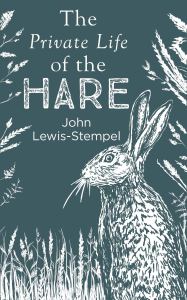 I reviewed a couple of JLS’s species-specific monographs for #NovNov in 2018: The Secret Life of the Owl and The Glorious Life of the Oak. There’s a similar range of material here: anatomy, natural history and cultural significance, including in poetry. There are chapters on hunting, the hare as food, and its appearances in myth and religion. I was engaged about half of the time; I tended to skip over longer excerpts from historical documents. The reliance on lengthy quotations and use of bullet points make it feel like a half-finished research project, with the kind of information you could find anywhere else. Too many of his recent books have felt like they were rushed into print. I would only pick this up if you’re particularly fascinated by hares. (Public library) [99 pages]
The Cancer Journals by Audre Lorde (1980)
 I’ve read so many cancer stories that it takes a lot to make one stand out. This feels like a random collection of documents rather than a coherent memoir. One of the three essays was originally a speech, and two were previously printed in another of her books. Lorde was diagnosed with breast cancer in 1978 and had a mastectomy. A Black lesbian feminist, she resisted wearing prostheses and spoke up about the potential environmental causes of breast cancer that need to be addressed in research (“I may be a casualty in the cosmic war against radiation, animal fat, air pollution, McDonald’s hamburgers and Red Dye No. 2”). Her actual journal entries make up little of the text, which is for the best because fear and pain can bring out the cliches in us – but occasionally a great quote like “if bitterness were a whetstone, I could be sharp as grief.” Another favourite line: “Pain does not mellow you, nor does it ennoble, in my experience.” I’m keen to read her memoir Zami. (University library) [77 pages]
A Month in Siena by Hisham Matar (2019)
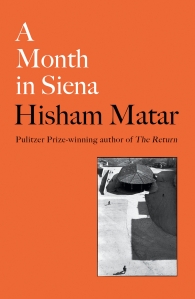 I’d not read Matar before I spotted this art book-cum-memoir and thought, why not. A Libyan American novelist who lives in London, Matar had long been fascinated by the Sienese School of painting (13th to 15th centuries), many of whose artists depicted biblical scenes or religious allegories – even though he’s not a Christian. He spent a month in Italy immersed in the art he loves; there are 15 colour reproductions here. His explications of art history are generalist enough to be accessible to all readers, but I engaged more with the glimpses into his own life. For instance, he meets a fellow Arabic speaker and they quickly form a brotherly attachment, and a Paradise scene gives him fanciful hope of being reunited with his missing father – the subject of his Folio Prize-winning memoir The Return, which I’d like to read soon. His prose is beautiful as he reflects on history, death and how memories occupy ‘rooms’ in the imagination. A little more interest in the art would have helped, though. (Little Free Library) [118 pages]
A Childhood in Scotland by Christian Miller (1981)
 I had high hopes for this childhood memoir that originally appeared in the New Yorker and was reprinted as part of the Canongate Classics series. But I soon resorted to skimming as her recollections of her shabby upper-class upbringing in a Highlands castle are full of page after page of description and dull recounting of events, with few scenes and little dialogue. This would be of high historical value for someone wanting to understand daily life for a certain fraction of society at the time, however. When Miller’s father died, she was only 10 and they had to leave the castle. I was intrigued to learn from her bio that she lived in Newbury for a time. (Secondhand purchase – Barter Books) [98 pages]
Here and Now: Living in the Spirit by Henri J.M. Nouwen (1994)
 This collection of micro-essays under themed headings like “Living in the Present” and “Suffering” was a perfect introduction to Nouwen’s life and theology. The Dutch Catholic priest lived in an Ontario community serving the physically and mentally disabled, and died of a heart attack just two years after this was published. I marked out many reassuring or thought-provoking passages. Here’s a good pre-Christmas one:
“God became a little child in the midst of a violent world. Are we surprised by joy or do we keep saying: ‘How nice and sweet, but the reality is different.’ What if the child reveals to us what is really real?”
I was taken by the ideas that the life of compassion is one of “downward mobility” and that inner freedom only comes when you don’t judge anyone. He encourages readers to not live in a past of shame and regret, but to be grateful for opportunities for God’s mercy and guidance. Very peaceful and readable; a good bedside devotional book. (Free from my stepfather) [175 pages] 
De Profundis by Oscar Wilde (1897)
 My only reread for the month. Wilde wrote this from prison. No doubt he had a miserable time there, but keeping in mind that he was a flamboyant dramatist and had an eye to this being published someday, this time around I found it more exaggerated and self-pitying than I had before. “Suffering is one very long moment. … Where there is sorrow there is holy ground,” he writes, stating that he has found “harmony with the wounded, broken, and great heart of the world.” He says he’s not going to try to defend his behaviour … but what is this but one extended apologia and humble brag, likening himself to a Greek tragic hero (“The gods had given me almost everything. But I let myself be lured into long spells of senseless and sensual ease. I amused myself with being a flâneur, a dandy, a man of fashion”) and even to Christ in his individuality as well as in his suffering at the hands of those who don’t understand him (the scene where he was pilloried consciously mimics a crucifixion tableau). As a literary document, it’s extraordinary, but I didn’t buy his sincerity. He feigns remorse but, really, wasn’t sorry about anything, merely sorry he got caught. (Free from a neighbour) [151 pages]
Original rating (2011):
Rating now:
Average:
Which of these have you read?
And which do you want to read? (You may choose no more than 4!)
In total, I read 27 novellas this November – close to my 2021 record of 29. The highlights included the Barton, Meier, Nouwen and Weingarten above plus Train Dreams by Denis Johnson and Western Lane by Chetna Maroo, but the best of the lot was Absolutely and Forever by Rose Tremain.
Coming right up, final statistics on the month’s participants and posts!
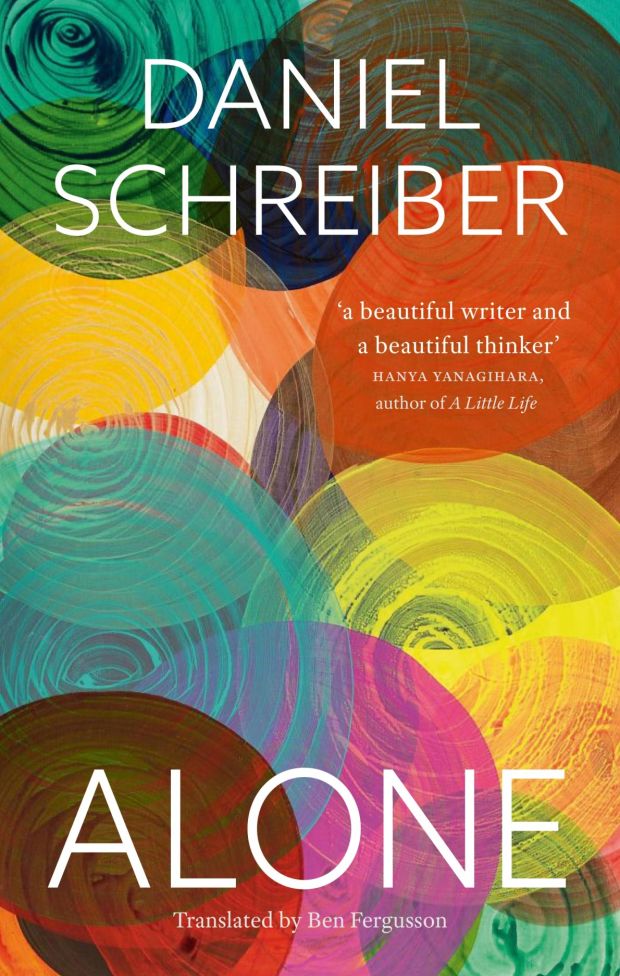
Alone by Daniel Schreiber (Blog Tour)
Daniel Schreiber is a Berlin-based essayist and biographer of Susan Sontag. These philosophical reflections on solitude and loneliness, coinciding with the first year of the pandemic, reveal his ambivalence about living alone and his frustration that the idea of the couple so defines society that anyone who does not fall in line is considered aberrant.
“I never made a conscious decision to live alone,” Schreiber says. Although he has had many partners, some of them long term, and even lived with two of them for a time, he is single at the time of writing, and can’t help but think that his state implies some kind of deficiency. Part of this he attributes to queer shame that he must have subconsciously internalized, and part to Pauline Boss’s concept of the “ambiguous loss” – missing what one has never had.
The author has many friends, men and women, but feels that society tells us platonic love is less than romantic love; “friendship is thus reduced to a time of transition … a threshold state that ends when one successfully integrates into traditional forms of cohabitation.” His friend novelist Hanya Yanagihara (who gives a quote on the cover) corroborates this suspicion, which A Little Life affirms: “In the end, she said, you are always alone when you are single.”
The “Never So Lonely” chapter is about the Covid-19 situation in particular. Schreiber acknowledges that being alone does not have to equate to loneliness, yet the less he saw of people during lockdowns, the more he struggled mentally and emotionally. “At some point, a self-reinforcing dynamic of fear set in: the lonelier I felt, the less I could talk about it. And the less I talked about it, the lonelier I felt.”
Hiking, gardening, yoga and, eventually, foreign travel were among his coping strategies. This is as much a mini-memoir as it is a work of cultural criticism. Its academic tone is evident from a glance at the bibliography: Hannah Arendt, Roland Barthes, Joan Didion, Deborah Levy, Audre Lorde, Maggie Nelson and so on. This resonated with other loneliness- or solitude-themed books I’ve read, such as The Lonely City by Olivia Laing and Journal of a Solitude by May Sarton. It offers not answers, but solemn, quiet thoughts.
(Original publication: 2021. Translated from the German by Ben Fergusson.)
With thanks to Reaktion Books for the proof copy for review.
Book Serendipity, Mid-April through Early June
I call it “Book Serendipity” when two or more books that I read at the same time or in quick succession have something in common – the more bizarre, the better. This is a regular feature of mine every few months. Because I usually have 20–30 books on the go at once, I suppose I’m more prone to such incidents. The following are in roughly chronological order.
- Fishing with dynamite takes place in Glowing Still by Sara Wheeler and In Memoriam by Alice Winn.
- Egg collecting (illegal!) is observed and/or discussed in Sea Bean by Sally Huband and The Jay, the Beech and the Limpetshell by Richard Smyth.

- Deborah Levy’s Things I Don’t Want to Know is quoted in What I’d Rather Not Think About by Jente Posthuma and Glowing Still by Sara Wheeler. I then bought a secondhand copy of the Levy on my recent trip to the States.
- “Piss-en-lit” and other folk names for dandelions are mentioned in The House of the Interpreter by Lisa Kelly and The Furrows by Namwali Serpell.
- Buttercups and nettles are mentioned in The House of the Interpreter by Lisa Kelly and Springtime in Britain by Edwin Way Teale (and other members of the Ranunculus family, which includes buttercups, in These Envoys of Beauty by Anna Vaught).

- The speaker’s heart is metaphorically described as green in a poem in Lo by Melissa Crowe and The House of the Interpreter by Lisa Kelly.
- Discussion of how an algorithm can know everything about you in Tomb Sweeping by Alexandra Chang and I’m a Fan by Sheena Patel.
- A brother drowns in The Loved Ones: Essays to Bury the Dead by Madison Davis, What I’d Rather Not Think About by Jente Posthuma, and The Furrows by Namwali Serpell.


A few cases of a book recalling a specific detail from an earlier read:
- This metaphor in The Chosen by Elizabeth Lowry links it to The Marriage Portrait by Maggie O’Farrell, another work of historical fiction I’d read not long before: “He has further misgivings about the scalloped gilt bedside table, which wouldn’t look of place in the palazzo of an Italian poisoner.”
- This reference in The Education of Harriet Hatfield by May Sarton links it back to Chase of the Wild Goose by Mary Louisa Gordon (could it be the specific book she had in mind? I suspect it was out of print in 1989, so it’s more likely it was Elizabeth Mavor’s 1971 biography The Ladies of Llangollen): “Do you have a book about those ladies, the eighteenth-century ones, who lived together in some remote place, but everyone knew them?”
- This metaphor in Things My Mother Never Told Me by Blake Morrison links it to The Chosen by Elizabeth Lowry: “Moochingly revisiting old places, I felt like Thomas Hardy in mourning for his wife.”
- A Black family is hounded out of a majority-white area by harassment in The Education of Harriet Hatfield by May Sarton and Ordinary Notes by Christina Sharpe.
 Wartime escapees from prison camps are helped to freedom, including with the help of a German typist, in My Father’s House by Joseph O’Connor and In Memoriam by Alice Winn.
- A scene of eating a deceased relative’s ashes in 19 Claws and a Black Bird by Agustina Bazterrica and The Loved Ones by Madison Davis.
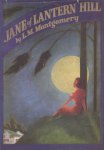
- A girl lives with her flibbertigibbet mother and stern grandmother in “Wife Days,” one story from How Strange a Season by Megan Mayhew Bergman, and Jane of Lantern Hill by L.M. Montgomery.
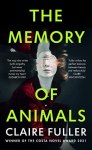
- Macramé is mentioned in How Strange a Season by Megan Mayhew Bergman, The Memory of Animals by Claire Fuller, Floppy by Alyssa Graybeal, and Sidle Creek by Jolene McIlwain.
- A fascination with fractals in Floppy by Alyssa Graybeal and one story in Sidle Creek by Jolene McIlwain. They are also mentioned in one essay in These Envoys of Beauty by Anna Vaught.
- I found disappointed mentions of the fact that characters wear blackface in Laura Ingalls Wilder’s Little Town on the Prairie in Monsters by Claire Dederer and, the very next day, Ordinary Notes by Christina Sharpe.


- Moon jellyfish are mentioned in the Blood and Cord anthology edited by Abi Curtis, Floppy by Alyssa Graybeal, and Sea Bean by Sally Huband.
- A Black author is grateful to their mother for preparing them for life in a white world in the memoirs-in-essays I Can’t Date Jesus by Michael Arceneaux and Ordinary Notes by Christina Sharpe.
- The children’s book The Owl Who Was Afraid of the Dark by Jill Tomlinson is mentioned in The Jay, the Beech and the Limpetshell by Richard Smyth and These Envoys of Beauty by Anna Vaught.
- The protagonist’s father brings home a tiger as a pet/object of display in The Marriage Portrait by Maggie O’Farrell and The Memory of Animals by Claire Fuller.

- Bloor Street, Toronto is mentioned in Jane of Lantern Hill by L.M. Montgomery and Ordinary Notes by Christina Sharpe.
- Ralph Waldo Emerson’s thinking about the stars is quoted in Jane of Lantern Hill by L.M. Montgomery and These Envoys of Beauty by Anna Vaught.
- Wondering whether a marine animal would be better off in captivity, where it could live much longer, in The Memory of Animals by Claire Fuller (an octopus) and Sea Bean by Sally Huband (porpoises).
 Martha Gellhorn is mentioned in The Collected Regrets of Clover by Mikki Brammer and Monsters by Claire Dederer.
- Characters named June in “Indigo Run,” the novella-length story in How Strange a Season by Megan Mayhew Bergman, and The Cats We Meet Along the Way by Nadia Mikail.
- “Explicate!” is a catchphrase uttered by a particular character in Girls They Write Songs About by Carlene Bauer and The Lake Shore Limited by Sue Miller.
- It’s mentioned that people used to get dressed up for going on airplanes in Fly Girl by Ann Hood and The Lights by Ben Lerner.

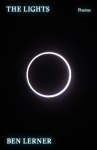
- Green-Wood Cemetery in Brooklyn is a setting in The Lights by Ben Lerner and Grave by Allison C. Meier.
- Last year I read Tomorrow, and Tomorrow, and Tomorrow by Gabrielle Zevin, in which Oregon Trail re-enactors (in a video game) die of dysentery; this is also a live-action plot point in “Pioneers,” one story in Lydia Conklin’s Rainbow Rainbow.
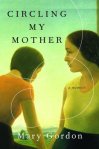
- A bunch (4 or 5) of Italian American sisters in Circling My Mother by Mary Gordon and Hello Beautiful by Ann Napolitano.
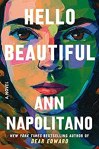
What’s the weirdest reading coincidence you’ve had lately?
A May Sarton Birthday Celebration
These days I consider May Sarton one of my favourite authors, but I’ve only been reading her for about nine years, since I picked up Journal of a Solitude on a whim. (Ten years prior, when I was a senior in college working in a used bookstore on evenings and weekends, a customer came up and asked me if we had anything by May Sarton. I had never heard of her so said no, only later discovering that we shelved her in with Classic literature. Huh. I can only apologize to that long-ago customer for my ignorance and negligence.)
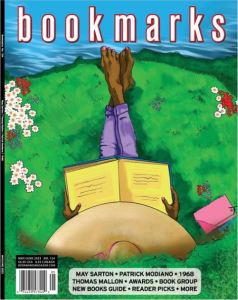 A general-interest article I wrote on May Sarton’s life and work appears in the May/June 2023 issue of Bookmarks magazine, for which I am an associate editor. I submitted this feature back in August 2019, so it’s taken quite some time for it to see the light of day, but I’m pleased that the publication happened to coincide with the anniversary of her birth. In fact, today, May 3rd, would have been her 111th birthday. For the article, I covered a selection of Sarton’s fiction and nonfiction, and gave a brief discussion of her poetry (which the magazine doesn’t otherwise cover).
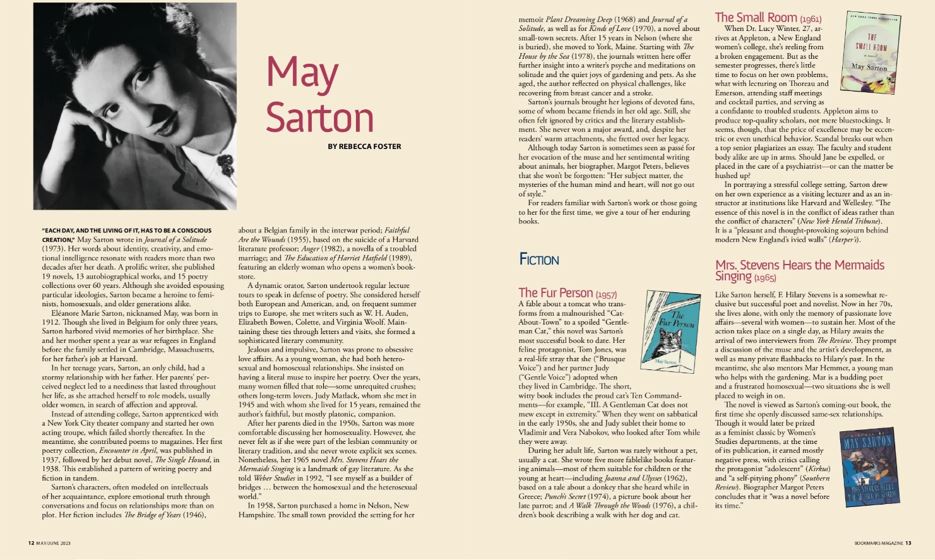
The two below, a journal and a novel, are works I’ve read more recently. Both were secondhand purchases, I think from Awesomebooks.com.
Encore: A Journal of the Eightieth Year (1993)
 Sarton is one of those reasonably rare authors who published autobiography, fiction AND poetry. I know I’m not alone in thinking that the journals and memoirs are where she really shines. (She herself was proudest of her poetry, and resented the fact that publishers only seemed to be interested in novels because they were what sold.) I came to her through her journals, which she started writing in her sixties, and I love them for how frankly they come to terms with ageing and the ill health and loss it inevitably involves. They are also such good, gentle companions in that they celebrate seasonality and small joys: her beautiful New England homes, her gardening hobby, her pets, and her writing routines and correspondence.
Encore was the only journal I had left unread; soon it will be time to start rereading my top few. When Sarton wrote this in 1991–2, she was recovering from a spell of illness and assumed it would be her final journal. (In fact, At Eighty-Two would appear two years later.) Although she still struggles with pain and low energy, the overall tone is of gratitude and rediscovery of wonder. Whereas a few of the later journals can get a bit miserable because she’s so anxious about her health and the state of the world, here there is more looking back at life’s highlights. Perhaps because Margot Peters was in the process of researching her biography (which would not appear until after her death), she was nudged into the past more often. I especially appreciated a late entry where she lists “peak experiences,” ranging from her teen years to age 80. What a positive way of thinking about one’s life!
For many months I kept this as a bedside book and read just an entry or two a night. When I started reading it more quickly and straight through, I did note some repetition, which Sarton worried would result from her dictating into a recording device. But I don’t think this detracts significantly. In this volume, events of note include a trip to London and commemorative publications plus a conference all to mark her 80th birthday. She’s just as pleased with tiny signs of her success, though, such as a fan letter saying The House by the Sea inspired the reader to put up a bird feeder. 
The Education of Harriet Hatfield (1988)
This is my eighth Sarton novel. In general, I’ve had less success with her fiction as it can be formulaic: characters exist to play stereotypical roles and/or serve as mouthpieces for the author’s opinions. That’s certainly true of Harriet Hatfield, who, like the protagonist of Mrs. Stevens Hears the Mermaids Singing, is fairly similar to Sarton. After the death of her long-time partner, Vicky, who ran a small publishing house, sixty-year-old Harriet decides to open a women’s bookstore in a Boston suburb. She has no business acumen, just enthusiasm (and money, via the inheritance from Vicky). College girls, housewives, nuns and older feminists all become regulars, but Hatfield House also attracts unwanted attention in this dodgy neighbourhood, especially after a newspaper outs Harriet: graffiti, petty theft and worse. The police are little help, but Harriet’s brothers and a local gay couple promise to look out for her.
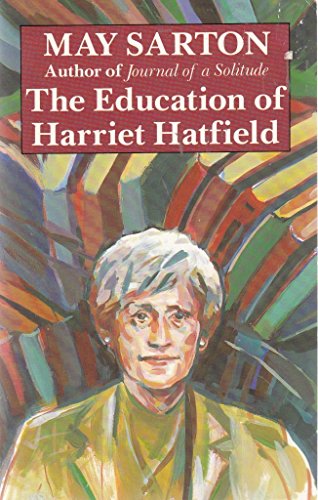 The central struggle for Harriet is whether she will remain a private lesbian – as one customer says to her, “you are old and respectable and no one would ever guess”; that is, she can pass as straight – or become part of a more audible, visible movement toward equal rights. It’s cringe-worthy how unsubtly Sarton has Harriet recognize (the “Education” the title speaks of) her privilege and accept her parity with other minorities through friendships with a Black mother, a battered wife who gets an abortion, and a man whose partner is dying of AIDS. Harriet’s brother, too, comes out to her as gay, and I was uneasy with the portrayal of him and the AIDS patient as promiscuous to the point of bringing any suffering on themselves.
Still, when I consider that Sarton was in her late seventies at the time she was writing this, and that public knowledge of AIDS would have been poor at best, I think this was admirably edgy. Harriet’s dilemma reflects Sarton’s own identity crisis, as expressed in Encore: “I do not wish to be labeled as a lesbian and do not wish to be labeled as a woman writer but consider myself a universal writer who is writing for human beings.” Nowadays, though, what Harriet deems discretion comes across as cowardice and priggishness.
While there are elements of Harriet Hatfield that have not aged well, if you focus on the Bythell-esque bookshop stuff (“I find that the people I love best are those who come in to browse, the silent shy ones, who are hungry for books rather than for conversation”) rather than the consciousness-raising or the mystery subplot, you might enjoy it as much as I did. Kudos for the first and last lines, anyway: “How rarely is it possible for anyone to begin a new life at sixty!” and “It’s the real world and I am fully alive in it.”
Book Serendipity, Mid-October to Mid-December 2022
The last entry in this series for the year. Those of you who join me for Love Your Library, note that I’ll host it on the 19th this month to avoid the holidays. Other than that, I don’t know how many more posts I’ll fit in before my year-end coverage (about six posts of best-of lists and statistics). Maybe I’ll manage a few more backlog reviews and a thematic roundup.
I call it “Book Serendipity” when two or more books that I read at the same time or in quick succession have something in common – the more bizarre, the better. This is a regular feature of mine every few months. Because I usually have 20–30 books on the go at once, I suppose I’m more prone to such incidents. The following are in roughly chronological order.
- Tom Swifties (a punning joke involving the way a quotation is attributed) in Savage Tales by Tara Bergin (“We get a lot of writers in here, said the rollercoaster operator lowering the bar”) and one of the stories in Birds of America by Lorrie Moore (“Would you like a soda? he asked spritely”).
- Prince’s androgynous symbol was on the cover of Dickens and Prince by Nick Hornby and is mentioned in the opening pages of Shameless by Nadia Bolz-Weber.


- Clarence Thomas is mentioned in one story of Birds of America by Lorrie Moore and Encore by May Sarton. (A function of them both dating to the early 1990s!)
- A kerfuffle over a ring belonging to the dead in one story of Shoot the Horses First by Leah Angstman and Motherthing by Ainslie Hogarth.
- Excellent historical fiction with a 2023 release date in which the amputation of a woman’s leg is a threat or a reality: one story of Shoot the Horses First by Leah Angstman and The House Is on Fire by Rachel Beanland.
- More of a real-life coincidence, this one: I was looking into Paradise, Piece by Piece by Molly Peacock, a memoir I already had on my TBR, because of an Instagram post I’d read about books that were influential on a childfree woman. Then, later the same day, my inbox showed that Molly Peacock herself had contacted me through my blog’s contact form, offering a review copy of her latest book!
- Reading nonfiction books titled The Heart of Things (by Richard Holloway) and The Small Heart of Things (by Julian Hoffman) at the same time.
- A woman investigates her husband’s past breakdown for clues to his current mental health in The Fear Index by Robert Harris and Motherthing by Ainslie Hogarth.
- “Tomorrow and tomorrow and tomorrow” is a repeated phrase in Another Brooklyn by Jacqueline Woodson, as it was in Tomorrow and Tomorrow and Tomorrow by Gabrielle Zevin.

- Massive, much-anticipated novel by respected author who doesn’t publish very often, and that changed names along the way: John Irving’s The Last Chairlift (2022) was originally “Darkness as a Bride” (a better title!); Abraham Verghese’s The Covenant of Water (2023) started off as “The Maramon Convention.” I plan to read the Verghese but have decided against the Irving.
- Looting and white flight in New York City in Feral City by Jeremiah Moss and Another Brooklyn by Jacqueline Woodson.
- Two bereavement memoirs about a loved one’s death from pancreatic cancer: Ti Amo by Hanne Ørstavik and Crying in H Mart by Michelle Zauner.


- The Owl and the Pussycat of Edward Lear’s poem turn up in an update poem by Margaret Atwood in her collection The Door and in Anna James’s fifth Pages & Co. book, The Treehouse Library.
- Two books in which the author draws security attention for close observation of living things on the ground: Where the Wildflowers Grow by Leif Bersweden and The Lichen Museum by A. Laurie Palmer.
- Seal and human motherhood are compared in Zig-Zag Boy by Tanya Frank and All of Us Together in the End by Matthew Vollmer, two 2023 memoirs I’m enjoying a lot.


- Mystical lights appear in Animal Life by Auður Ava Ólafsdóttir (the Northern Lights, there) and All of Us Together in the End by Matthew Vollmer.
- St Vitus Dance is mentioned in Zig-Zag Boy by Tanya Frank and Robin by Helen F. Wilson.
- The history of white supremacy as a deliberate project in Oregon was a major element in Heaven Is a Place on Earth by Adrian Shirk, which I read earlier in the year, and has now recurred in The Distance from Slaughter County by Steven Moore.


What’s the weirdest reading coincidence you’ve had lately?
Remainders of the Day by Shaun Bythell & What Remains? by Rupert Callender
I raced to finish all the September releases on my stack by the 30th, thinking I’d review them in one go, but that ended up being far too unwieldy. There was way too much to say about each of these excellent books (the first two pairs are here and here; Blurb Your Enthusiasm by Louise Willder is still to come, probably on Wednesday). I’ve mentioned before that the month’s crop of nonfiction was about either books or death. Here’s one of each, linked by their ‘remain’ titles. Both:
Remainders of the Day: More Diaries from The Bookshop, Wigtown by Shaun Bythell
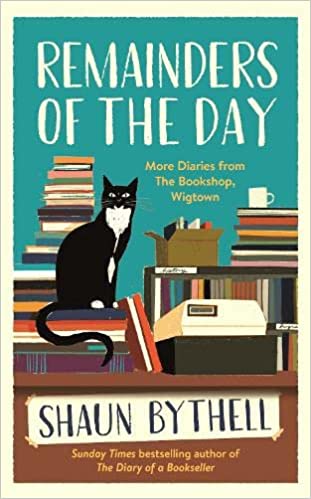 It’s just over five years since many of us were introduced to Wigtown and the ups and downs of running a bookshop there through Shaun Bythell’s The Diary of a Bookseller. (I’ve also reviewed the follow-up, Confessions of a Bookseller, which was an enjoyable read for me during a 2019 trip to Milan, and 2020’s Seven Kinds of People You Find in Bookshops.)
This third volume opens in February 2016. As in its predecessors, each monthly section is prefaced by an epigraph from a historical work on bookselling – this time R. M. Williamson’s 1904 Bits from an Old Bookshop. It’s the same winning formula as ever: the nearly daily entries start with the number of online orders received and filled, and end with the number of customers and the till takings for the day. (The average spend seems to be £10 per customer, which is fine in high tourist season but not so great in November and December when hardly anyone walks through the door.) In between, Bythell details notable customer encounters, interactions with shop helpers or local friends, trips out to buy book collections or go fishing, Wigtown events including the book festival, and the occasional snafu like the boiler breaking during a frigid November or his mum being hospitalized with a burst ulcer.
Reading May Sarton’s Encore recently, I came across a passage where she is reading a fellow writer’s journal (Doris Grumbach’s Coming into the End Zone):
I find hers extremely good reading, so I cannot bear to stop. I am reading it much too fast and I think I shall have to read it again. I know that I must not swallow it whole. There is something about a journal, I think, that does this to readers. So many readers tell me that they cannot put my journals down.
I’ve heard Zadie Smith say the same about Karl Ove Knausgaard’s My Struggle: it’s just the stuff of prosaic, everyday life and yet she refers to his memoirs/autofiction as literary crack.
I often read a whole month’s worth of entries at a sitting. I can think of a few specific reasons why Bythell’s journals are such addictive reading:
- “Sometimes you want to go where everybody knows your name.” Small-town settings are irresistible for many readers, and by now the fairly small cast of characters in Bythell’s books feel like old friends. Especially having been to Wigtown myself, I can picture many of the locations he writes about, and you get the rhythm of the seasons and the natural world as well as the town’s ebb and flow of visitors.
- (A related point) You know what to expect, and that’s a comforting thing. Bythell makes effective use of running gags. You know that when Granny, an occasional shop helper from Italy, appears, she will complain about her aches and pains, curse at Bythell and give him the finger. Petra’s belly-dancing class (held above the shop) will inevitably be poorly attended. If Eliot is visiting, he is sure to leave his shoes right where everyone will trip over them. Captain the cat will be portly and infuriating.
- What I most love about the series is the picture of the life cycle of books, from when they first enter the shop, or get picked up in his van, to when rejects are dropped at a Glasgow recycling plant. What happens in the meantime varies, with once-popular authors falling out of fashion while certain topics remain perennial bestsellers in the shop (railways, ornithology). There’s many a serendipitous moment when he comes across a book and it’s just what a customer wants, or buys a book as part of a lot and then sells it online the very next day. New, unpriced stock is always quick to go.
Also of note in this volume are his break-up with Amazon, after his account falls victim to algorithms and is suspended, the meta moment where he signs his first book contract with Profile, and the increasing presence of the Bookshop Band, who moved to Wigtown later in 2017. Bythell doesn’t seem to get much time to read – it’s a misconception of the bookselling life that you do nothing but read all day; you’d be better off as a book reviewer if that’s what you want – but when he does, it’s generally an intense experience: E.M. Forster’s sci-fi novella The Machine Stops (who knew it existed?!), Barbara Comyns’s A Touch of Mistletoe, Jonathan Safran Foer’s Everything Is Illuminated, and Oscar Wilde’s De Profundis.
I’m torn as to whether I hope there will be more year by year volumes filling in to the present day. As Annabel noted, the ‘where they are now’ approach in the Epilogue rather suggests that he and his publisher will leave it here at a trilogy. This might be for the best, as a few more pre-Covid years of the same routines could get old, though nosey parkers like myself will want to know how a confirmed bachelor turned into a family man…
Some favourite lines:
“Quiet day in the shop; even the cat looked bored.” (31 October)
“The life of the secondhand bookseller mainly involves moving boxes from one place to another, and trying to make them fit into a small space, like some sort of awful game of Tetris.”
(10 February and 15 March are great stand-alone entries that give a sense of what the whole is like. There are a lot of black-and-white photos printed amid the text in the first month; it’s a shame these don’t carry on through.)
With thanks to Profile Books for the free copy for review.
What Remains?: Life, Death and the Human Art of Undertaking by Rupert Callender
Call me morbid or call me realistic; in the last decade and a half I have read a lot of books about death, including terminal illness and bereavements. I’ve even read several nonfiction works by American mortician Caitlin Doughty. But I’ve not read anything quite like punk undertaker Rupert Callender’s manifesto about modern death and how much we get wrong in our conceptualization and conversations. It was poignant to be reading this in the weeks surrounding Queen Elizabeth II’s death – a time when death got more discussion than usual, yes, but when there was also some ridiculous pomp that obscured the basic human facts of it.
Callender is not okay with death, and never has been. When he was seven, his father died of a heart attack at age 63. His 1970s Edinburgh upbringing was shattered and his mother, who he has no doubt was doing her best, made a few terrible mistakes. First, a year before, she’d reassured him that his father wasn’t going to die. Second, she didn’t make him attend the funeral. (I still wish my mother had made me go back to tour my late grandmother’s house one final time when I was seven; instead, I stayed behind and played on a Ouija board with my cousins.) Third, she soon sent Callender away to boarding school, which left him feeling alone and betrayed. And lastly, when she died of cancer when he was 25, she had planned every detail of her funeral – whereas he believes that is a task for the survivors.
An orphan in his late twenties, Callender came across The Natural Death Handbook and it sealed his future. He’d been expelled from school and blown his inheritance; acid house culture had given him a sense of community. Now he had a vocation. The first funeral he coordinated was for a postman named Barry. The fourth was a suicide. Their first child burial was one of his partner’s daughter’s classmates.
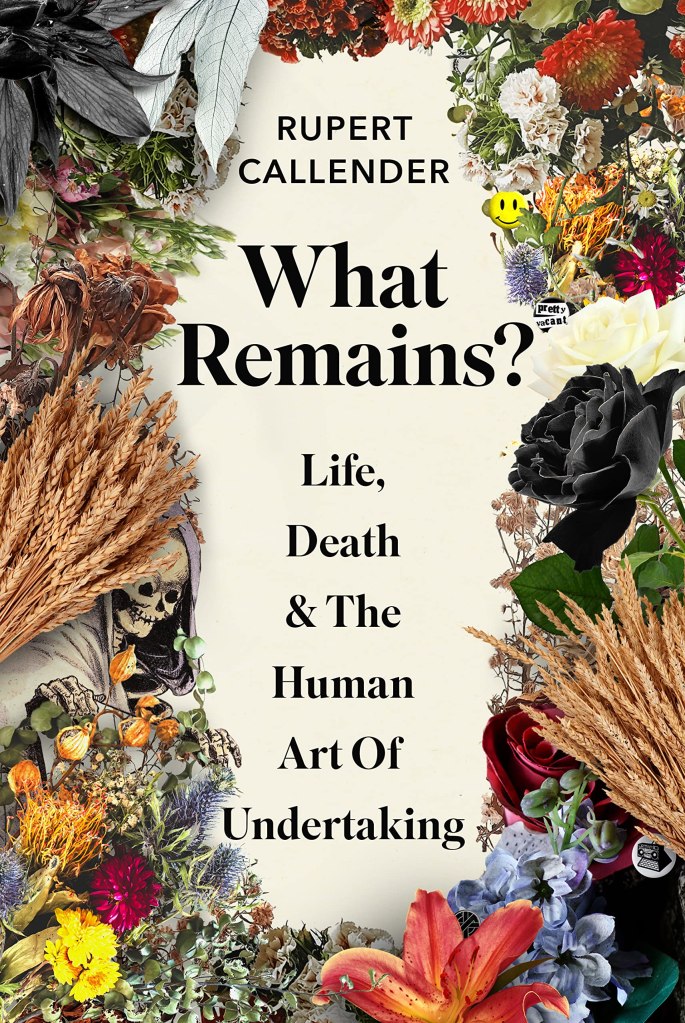
Over the next two decades, he and his (now ex-)wife Claire based Totnes’ The Green Funeral Company on old-fashioned values and homespun ceremonies. They oppose the overmedicalization of death and the clinical detachment of places like crematoria. Callender is vehemently anti-embalming – an intrusive process that involves toxic substances. They encourage the bereaved to keep the body at home for the week before a funeral, if they feel able (ice packs like you’d use in a picnic cool bag will work a treat), and to be their own pallbearers to make the memory of the funeral day a physical one. He performs the eulogies himself, and they use cardboard coffins.
This is a slippery work for how it intersperses personal stories with polemic and poetic writing. Despite a roughly chronological throughline, it feels more like a thematic set of essays than a sequential narrative. Callender has turned death rituals into both performance art (including at festivals and in collaboration with The KLF) and political protests (e.g., a public funeral he conducted for a homeless man who died of exposure, the third such death in his town that year). While he doesn’t shy away from the gruesome realities of dealing with corpses, he always brings it back to fundamentals: matter is what we are, but who we were lives on in others’ loving memories. Death rituals plug us into a human lineage and proclaim meaning in the face of nothingness. Whether you’ve seen/read it all or never considered picking up a book about death, I recommend Callender’s sui generis approach.
Some favourite lines:
“[The practice of having official pallbearers] is all part of the emotional infantilising encouraged by the funeral industry, all part of being turned into an audience at one of the most significant moments in your family history, instead of being empowered as a family and a community.”
“each death we experience contains every death we have ever lived through, Russian dolls of bereavement waiting to be unpacked.”
“Only once you are dead can the full arc of your life be clearly seen, and telling that story out loud and truthfully to the people who shared it is a powerful social act that both binds us together and place us within our culture.”
With thanks to Chelsea Green for the proof copy for review.
And as a bonus, given that today is Indigenous Peoples’ Day in the USA, here’s an excerpt from my Shelf Awareness review of another book that came out last month:
No Country for Eight-Spot Butterflies: A Lyric Essay by Julian Aguon
 An indigenous human rights lawyer, Aguon is passionate about protecting his homeland of Guam, which is threatened by climate change and military expansion. His tender collage of autobiographical vignettes and public addresses inspires activism and celebrates beauty worth preserving. The U.S. Department of Defense’s plan to site more Marines and firing ranges on Guam will destroy more than 1,000 acres of limestone forest—home to endemic and endangered species, including the Mariana eight-spot butterfly. Aguon has been a lead litigator in appeals rising all the way to the U.S. Supreme Court. Rejecting fatalism, he endorses peaceful resistance. Two commencement speeches, poems, a eulogy and an interview round out the varied and heartfelt collection.
Spring Reading, Part II: May, Moving and Swifts
Eight days after our move, there are still piles of boxes, but the furniture is in place and there are clear walkways, so we’ll call that progress. We got a lot of help on moving day from neighbours, one of whom built a tower of book boxes in the corner of the dining room! I had fun dismantling it last week and assigning each box to a particular bookcase. Arranging the contents on shelves will be for once we’re back from Spain.

What with moving and DIY, I haven’t had a lot of time for reading lately, so didn’t finish any more of the spring books I’d intended to include – except for one children’s book from the library. I’ll give a little rundown of some of what has been on my coffee table stack.
Busy Spring: Nature Wakes Up by Sean Taylor and Alex Morss; illus. Cinyee Chiu (2021)
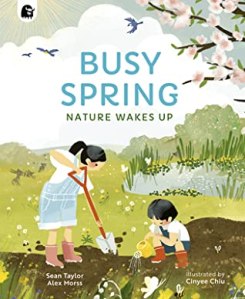 This was a cute read about two little girls helping their father in the garden and discovering the natural wonders of the season, like tadpoles in a pond, birds building nests, and insects and worms in the compost heap. A section at the end gives more information about the science of spring – unfortunately, it mislabels one bird and includes North American species without labelling them as such, whereas the rest of the book was clearly set in the UK. The strategy reminded me of that in Wild Child by Dara McAnulty. This year is the first time a children’s book Wainwright Prize will be awarded, so we’ll see this kind of book being recognized more.
May reads:
 Encore is my last unread journal of May Sarton’s. It begins in May 1991, when she’s 79 and in recovery from major illness. She’s still plagued by pain and fatigue, but her garden and visits from friends are a solace. Although she has to lie down to garden, “to put my hands in the earth to dig is life giving … it is almost as if the earth were nourishing me at the moment.” As usual, there are lovely reflections on the freedoms as well as the losses of ageing. This book, like the previous, was dictated, so there is a bit of repetition. I’ve been amused to see how pretentious she found A.S. Byatt’s Possession! An entry or two at a sitting helped calm my mind during the stress of moving week.
“In a funny way what drives me is the spring, the fleeting spring. Because of the enormous wind and rain we have had, a lot of the daffodils have blown down, though not as many as I feared. But the truth is that their peak is past. We shall have them for another week and then they will be gone. It seems quite unbearable but that is what spring is—the letting go. The waiting and waiting and waiting, and then the letting go.”

I started a reread of Snow in May by Kseniya Melnik and am partway through the second story. It’s a linked short story collection set in Magadan in northeast Russia – known for Stalin’s forced-labour camps. In “Love, Italian Style, or in Line for Bananas,” it’s 1975 and Tanya is on a shopping spree in Moscow. At a time of deprivation, she buys even things she doesn’t need or that aren’t quite right. Propositioned by an Italian football player on the plane ride over, she fantasizes about the exotic and romantic, juxtaposed against her everyday life.
“The pollen swirled around her like snow. There was a time when the distinctions between right and wrong seemed indisputable, and doing right felt good. When all the decisions had been premade and in her best interest. Back when she didn’t need so much to be happy.”
Belonging
 I saw it on shelf at the library and knew now was the perfect time to read My Life in Houses by Margaret Forster, a memoir via the places she’s lived, starting with the house where she was born in 1938, on a council estate in Carlisle. There’s something appealing to me about tracing a life story through homes – Paul Auster did the same in part of Winter Journal. I’d be tempted to undertake a similar exercise myself someday.
 The swifts come screeching down our new street and we saw one investigating a crevice in our back roof for a nest! In Fledgling by Hannah Bourne-Taylor, she is lonely in rural Ghana, where she and her husband had moved for his work, and takes in a young swift displaced from its nest. I’m only in the early pages, but can tell that her care for the bird will be a way of exploring her own feeling of displacement and the desire to belong. “Although I was unaware of it at the time, the English countryside and the birds had turned into my anchor of home.”
 Bookish Beck = Rebecca Foster. American transplant to England. Freelance proofreader and book reviewer.
 Bookish Beck