September Releases by Chloe Lane, Ben Lerner, Navied Mahdavian & More
September and October are bounteous months in the publishing world. I’ll have a bunch of books to plug in both, mostly because I’ve upped my reviewing quota for Shelf Awareness. There’s real variety here, from contemporary novellas and heavily autobiographical poetry to nature essays and a graphic memoir.
Arms & Legs by Chloe Lane
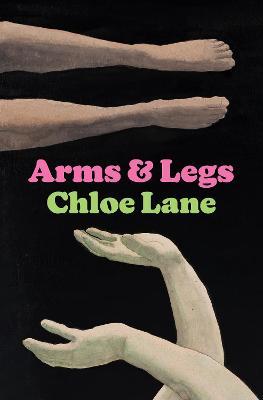 I reviewed Lane’s debut novel, The Swimmers, a black comedy about a family preparing for an assisted suicide, this time last year. It seems there’s an autobiographical setup to the author’s follow-up, which focuses on a couple from New Zealand now living in Florida with their young son. Narrator Georgie teaches writing at a local college and is having an affair with Jason, an Alabama-accented librarian she met through taking Finn to the Music & Movement class. She joins in a volunteer-led controlled burn in the forest, and curiosity quickly turns to horror when she discovers the decaying body of a missing student.
There’s a strong physicality to this short novel: fire, bodies and Florida’s dangerous fauna (“To choose to live in a place surrounded by these creatures, these threats, it made me feel like I was living a bold life”). Georgie has to decide whether setting fire to her marriage with Dan is what she really wants. A Barry Hannah short story she reads describes adultery as just a matter of arms and legs, a phrase that’s repeated several times.
Georgie is cynical and detached from her self-destructive choices, coming out with incisive one-liners (“My life isn’t a Muriel Spark novel, there’s no way to flash forward and find out if I make it out of the housefire alive” and “He rested the spade on his shoulder as if he were a Viking taking a drinks break in the middle of a battle”). Lane burrows into instinct and motivation, also giving a glimpse of the challenges of new motherhood. Apart from a wicked dinner party scene, though, the book as a whole was underwhelming: the body holds no mystery, and adultery is an old, old story.
With thanks to Gallic Books for the proof copy for review.
The Lights by Ben Lerner
 I’d read fiction and nonfiction from Lerner but had no idea of what to expect from his poetry. Almost every other poem is a prose piece, many of these being absurdist monologues that move via word association between topics seemingly chosen at random: psychoanalysis, birdsong, his brother’s colorblindness; proverbs, the Holocaust; art conservation, his partner’s upcoming C-section, an IRS Schedule C tax form, and so on.
The vocabulary and pronouncements can be a little pretentious. The conversational nature and randomness of the subjects contribute to the same autofiction feel you get from his novels. For instance, he probes parenting styles: his parents’ dilemma between understanding his fears and encouraging him in drama and sport; then his daughters’ playful adoption of his childhood nickname of Benner for him.
A few highlights: the enjambment in “Index of Themes”; the commentary on pandemic strictures and contrast between ancient poetry and modern technology in “The Stone.” I wouldn’t seek out more poetry by Lerner, but this was interesting to try. (Read via Edelweiss)
Sample lines:
“When you die in the patent office / there’s a pun on expiration”
“the goal is to be on both sides of the poem, / shuttling between the you and I. … Form / is always the answer to the riddle it poses”
“It’s raining now / it isn’t, or it’s raining in the near / future perfect when the poem is finished / or continuous, will have been completed”
This Country: Searching for Home in (Very) Rural America by Navied Mahdavian
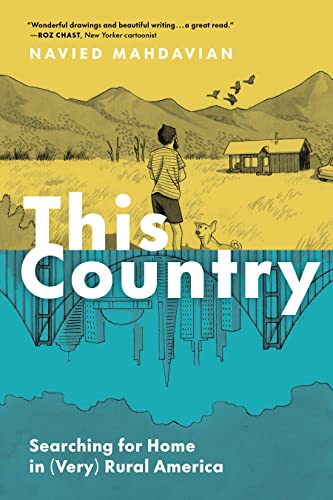 Mahdavian has also published comics in the New Yorker. His debut graphic novel is a memoir of the three years (2016–19) he and his wife lived in remote Idaho. Of Iranian heritage, the author had lived in Miami and then the Bay Area, so was pretty unprepared for living off-grid. His wife, Emelie (who is white), is a documentary filmmaker. They had a box house brought in on a trailer. After Trump’s surprise win, it was a challenging time to be a Brown man in the rural USA. “You’re not a Muslim, are you?” was the kind of question he got on their trips into town. Neighbors were outwardly friendly – bringing them firewood and elk kebabs, helping when their car wouldn’t start or they ran off the road in icy conditions, teaching them the local bald eagles’ habits – yet thought nothing of making racist and homophobic slurs.
I appreciated the self-deprecating depictions of learning DIY from YouTube videos and feeling like a wimp in comparison to his new friends who hunt and have gun collections – one funny spread has him imagining himself as a baby in a onesie sitting across from a manly neighbor. “I am shedding my city madness,” Mahdavian boasts as they plant an abundant garden and start learning about trees and birds. The references to Persian myth and melodrama are intriguing, though sometimes seem à propos of nothing, as do the asides on science and nature. I preferred when the focus was on the couple’s struggles with infertility and reopening the town movie theater – a flop because people only want John Wayne flicks.
This was enjoyable reading, but the simple black-and-white style is unlikely to draw in readers new to graphic storytelling, and I wondered if the overall premise – ‘we expected to find closed-minded racists and we did’ – was enough to hang a memoir on. (Read via Edelweiss)
Reviewed for Shelf Awareness:
(Links to full text)
The Wren, The Wren by Anne Enright
 Enright’s astute eighth novel traces the family legacies of talent and trauma through the generations descended from a famous Irish poet. Cycles of abandonment and abuse characterize the McDaraghs. Enright convincingly pinpoints the narcissism and codependency behind their love-hate relationships. (It was an honor to also interview Anne Enright. You can see our Q&A here.)
When My Ghost Sings by Tara Sidhoo Fraser
 This lyrical debut memoir is an experimental, literary recounting of the experience of undergoing a stroke and relearning daily skills while supporting a gender-transitioning partner. Fraser splits herself into two: the “I” moving through life, and “Ghost,” her memory repository. But “I can’t rely only on Ghost’s mental postcards,” Fraser thinks, and sets out to retrieve evidence of who she was and is.
The Vaster Wilds by Lauren Groff
 (Already featured in my Best of 2023 so far post.) Groff’s fifth novel combines visceral detail and magisterial sweep as it chronicles a runaway Jamestown servant’s struggle to endure the winter of 1610. Flashbacks to traumatic events seep into her mind as she copes with the harsh reality of life in the wilderness. The style is archaic and postmodern all at once. Evocative and affecting – and as brutal as anything Cormac McCarthy wrote. A potent, timely fable as much as a historical novel.
Zoo World: Essays by Mary Quade
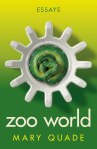 A collection of 15 thoughtful nature/travel essays that explore the interconnectedness of life and conservation strategies, and exemplify compassion for people and, particularly, animals. The book makes a round-trip journey, beginning at Quade’s Ohio farm and venturing further afield in the Americas and to Southeast Asia before returning home.
The Goodbye World Poem by Brian Turner
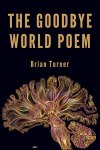 The lovely laments in Brian Turner’s fourth collection (a sequel to The Wild Delight of Wild Things) dwell in the aftermath of the loss of his wife and others, and cultivate compensatory appreciation for the natural world. Turner’s poetry is gilded with alliteration and maritime metaphors The long title piece, which closes the collection, repeats many phrases from earlier poems—a pleasing way of drawing the book’s themes together. (My review of the third volume in this loose trilogy is forthcoming.)
And a bonus review book, relevant for its title:
September and the Night by Maica Rafecas
[Translated from the Catalan by Megan Berkobien and María Cristina Hall]
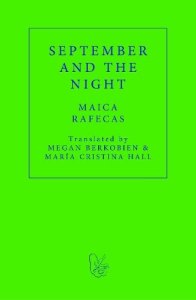 A new Logistics Centre is to cut through Anaïs’s family vineyards as part of a compulsory land purchase. While her father, Magí, and brother, Jan, are resigned to the loss, this single mother decides to resist, tying herself to a stone shed on the premises that will be right in the path of the bulldozers. This causes others to question her mental health, with social worker Elisa tasked with investigating the case. Key evidence of her irrational behaviour turns out to have perfectly good explanations.
Certain chapters alternate Jan’s and Anaïs’s perspectives, recreate her confusion in a psychiatric hospital, or have every sentence beginning with “There” or “And” – effective anaphora. Although I didn’t think Jan’s several romantic options added to the plot, this debut novella from a Spanish author was a pleasant surprise. It’s based on a true story, though takes place in fictional locations, and bears a gentle message of cultural preservation.
With thanks to Fum d’Estampa Press for the free copy for review.
August Releases: Bright Fear, Uprooting, The Farmer’s Wife, Windswept
This month I have three memoirs by women, all based on a connection to land – whether gardening, farming or crofting – and a sophomore poetry collection that engages with themes of pandemic anxiety as well as crossing cultural and gender boundaries.
My August highlight:
Bright Fear by Mary Jean Chan
Chan’s Flèche was my favourite poetry collection of 2019. Their follow-up returns to many of the same foundational subjects: race, family, language and sexuality. But this time, the pandemic is a lens through which all is filtered. This is particularly evident in Part I, “Grief Lessons.” “London, 2020” and “Hong Kong, 2003,” on facing pages, contrast Covid-19 with SARS, the major threat when they were a teenager. People have always made assumptions about them based on their appearance or speech. At a time when Asian heritage merited extra suspicion, English was both a means of frank expression and a source of ambivalence:
“At times, English feels like the best kind of evening light. On other days, English becomes something harder, like a white shield.” (from “In the Beginning Was the Word”)
“my Chinese / face struck like the glow of a torch on a white question: / why is your English so good, the compliment uncertain / of itself.” (from “Sestina”)
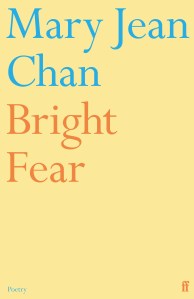 At the centre of the book, “Ars Poetica,” a multi-part collage incorporating lines from other poets, forms a kind of autobiography in verse. Chan also questions the lines between genres, wondering whether to label their work poetry, nonfiction or fiction (“The novel feels like a springer spaniel running off-/leash the poem a warm basket it returns to always”).
The poems’ structure varies, with paragraphs and stanzas of different lengths and placement on the page (including, in one instance, a goblet shape). The enjambment, as you can see in lines I’ve quoted above and below, is noteworthy. Part III, “Field Notes on a Family,” reflects on the pressures of being an only child whose mother would prefer to pretend lives alone rather than with a female partner. The book ends with hope that Chan might be able to be open about their identity. The title references the paradoxical nature of the sublime, beautifully captured via the alliteration that closes “Circles”: “a commotion of coots convincing / me to withstand the quotidian tug-/of-war between terror and love.”
Although Flèche still has the edge for me, this is another excellent work I would recommend even to those wary of poetry. 
Some more favourite lines, from “Ars Poetica”:
“What my mother taught me was how
to revere the light language emitted.”
“Home, my therapist suggests, is where
you don’t have to explain yourself.”
With thanks to Faber for the free copy for review.
Three land-based memoirs:
(All:  )
)
Uprooting: From the Caribbean to the Countryside – Finding Home in an English Country Garden by Marchelle Farrell
 This Nan Shepherd Prize-winning memoir shares Chan’s attention to pandemic-era restrictions and how they prompt ruminations about identity and belonging. Farrell is from Trinidad but came to the UK as a student and has stayed, working as a psychiatrist and then becoming a wife and mother. Just before Covid hit, she moved to the outskirts of Bath and started rejuvenating her home’s large and neglected garden. Under thematic headings that also correspond to the four seasons, chapters are named after different plants she discovered or deliberately cultivated. The peace she finds in her garden helps her to preserve her mental health even though, with the deaths of George Floyd and so many other Black people, she is always painfully aware of her fragile status as a woman of colour, and sometimes feels trapped in the confining routines of homeschooling. I enjoyed the exploration of postcolonial family history and the descriptions of landscapes large and small but often found Farrell’s metaphors and psychological connections obvious or strained.
With thanks to Canongate for the free copy for review.
The Farmer’s Wife: My Life in Days by Helen Rebanks
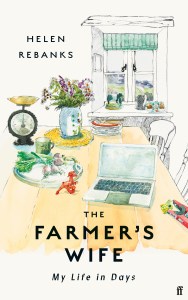 I fancied a sideways look at James Rebanks (The Shepherd’s Life and Wainwright Prize winner English Pastoral) and his regenerative farming project in the Lake District. (My husband spotted their dale from a mountaintop on holiday earlier in the month.) Helen Rebanks is a third-generation farmer’s wife and food and family are the most important things to her. One gets the sense that she has felt looked down on for only ever wanting to be a wife and mother. Her memoir, its recollections structured to metaphorically fall into a typical day, is primarily a defence of the life she has chosen, and secondarily a recipe-stuffed manifesto for eating simple, quality home cooking. (She paints processed food as the enemy.)
Growing up, Rebanks started cooking for her family early on, and got a job in a café as a teenager; her mother ran their farm home as a B&B but was forgetful to the point of being neglectful. She met James at 17 and accompanied him to Oxford, where they must have been the only student couple cooking and eating proper food. This period, when she was working an office job, baking cakes for a café, and mourning the devastating foot-and-mouth disease epidemic from a distance, is most memorable. Stories from travels, her wedding, and the births of her four children are pleasant enough, yet there’s nothing to make these experiences, or the telling of them, stand out. I wouldn’t make any of the dishes; most you could find a recipe for anywhere. Eleanor Crow’s black-and-white illustrations are lovely, though.
With thanks to Faber for the free copy for review.
Windswept: Life, Nature and Deep Time in the Scottish Highlands by Annie Worsley
 I’d come across Worsley in the Wildlife Trusts’ Seasons anthologies. For a decade she has lived on Red River Croft, in a little-known pocket of northwest Scotland. In word pictures as much as in the colour photographs that illustrate this volume, she depicts it as a wild land shaped mostly by natural forces – also, sometimes, manmade. From one September to the next, she documents wildlife spectacles and the influence of weather patterns. Chronic illness sometimes limited her daily walks to the fence at the cliff-top. (But what a view from there!) There is more here about local history and ecology than any but the keenest Scotland-phile may be interested to read. Worsley also touches on her upbringing in polluted Lancashire, and her former academic career and fieldwork in Papua New Guinea. Her descriptions are full of colours and alliteration, though perhaps a little wordy: “Pale-gold autumnal days are spliced by fickle and feisty bouts of turbulent weather. … Sunrises and sunsets may pour with cinnabar and henna; dawn and dusk can ripple with crimson and purple.” The kind of writing I could appreciate for the length of an essay but not a whole book.
With thanks to William Collins for the free copy for review.
Would you read one or more of these?
Six Degrees of Separation: Romantic Comedy to Wild Fell
This is a fun meme I take part in every few months.
For August we begin with Romantic Comedy by Curtis Sittenfeld, one of my top 2023 releases so far. (See Kate’s opening post.)
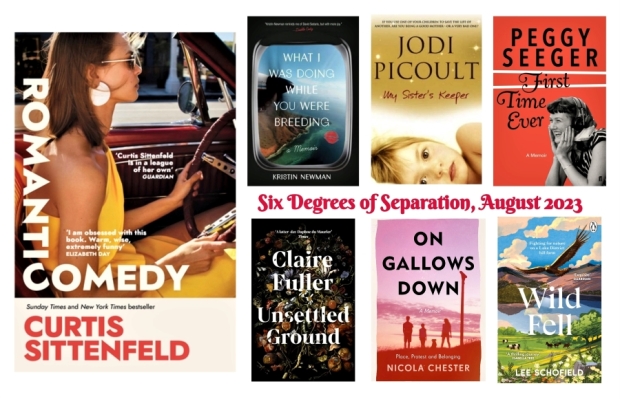
 #1 Sittenfeld’s protagonist, Sally Milz, writes TV comedy, as does Kristin Newman (That ’70s Show, How I Met Your Mother, etc.), author of What I Was Doing While You Were Breeding, a lighthearted record of her travels and romantic conquests. (She even has a passage that reminds me of Sally’s Danny Horst Rule: “I looked like a thirty-year-old writer. Not like a twenty-year-old model or actress or epically legged songstress, which is a category into which an alarmingly high percentage of Angelenas fall. And, because the city is so lousy with these leggy aliens, regular- to below-average-looking guys with reasonable employment levels can actually get one, another maddening aspect of being a woman in this city.”)
 #2 I didn’t realize when I picked it up in a charity shop that my copy smelled strongly of cigarette smoke. I aired it in kitty litter, then by scented candles, and it still reeks. I reckon I can tolerate the smell long enough to finish it and put it in the Little Free Library, which gets good ventilation. A novel I acquired from the free bookshop we used to have in the mall in town was the only book I can remember having to get rid of before reading because it just smelled too bad (also of cigarettes in that case): My Sister’s Keeper by Jodi Picoult.
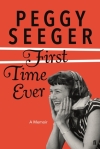 #3 So I didn’t read that, but I have read another Picoult novel, Sing You Home. The author is known for picking a central issue to address in each work, and in that one it was sexuality. Zoe, a music therapist, is married to Max but leaves him for Vanessa – and then decides to sue him for the use of the embryos they created together via IVF. It was the first book I’d read with that dynamic (a previously straight woman enters into a lesbian partnership), but by no means the last. Later came Untamed by Glennon Doyle, Hidden Nature by Alys Fowler, The Fixed Stars by Molly Wizenberg … and one you maybe weren’t expecting: the fantastic memoir First Time Ever by Peggy Seeger. The authors vary in how they account for it. They were gay all along but didn’t realize it? Their orientation changed? Or they just happened to fall in love with someone of the same gender? Seeger doesn’t explain at all, simply records how head-over-heels she was for Ewan MacColl … and then for Irene Pyper Scott.
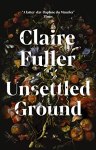 #4 Peggy Seeger is one of my heroes these days. I first got into her music through the lockdown livestreams put together by Folk on Foot and have since seen her live and acquired several of her albums, including a Smithsonian Folkways collection of her best-loved folk standards. One of these is, of course, “I’m Gonna Be an Engineer,” which was one of the inspirations for Claire Fuller’s Unsettled Ground.
 #5 Unsettled Ground, an unusual story of rural poverty and illiteracy, is set in a fictional village modelled on Inkpen, where Nicola Chester lives. Her memoir On Gallows Down, which held particular local interest for me, was shortlisted for the Wainwright Prize last year.
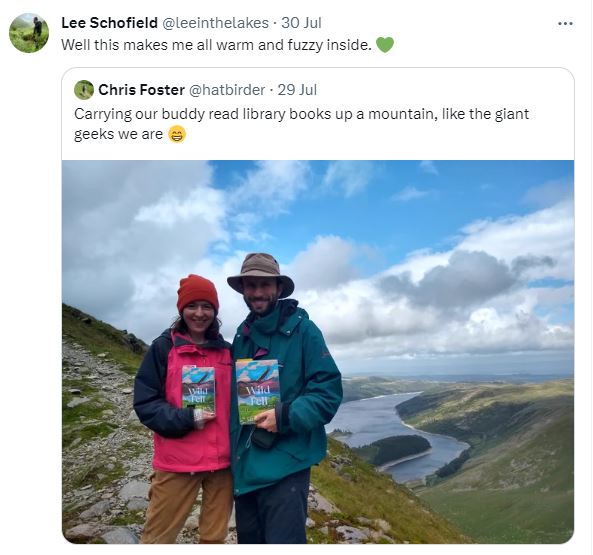
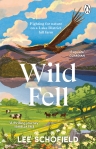 #6 Also shortlisted that year was Wild Fell by Lee Schofield, about his work at RSPB Haweswater. Like Chester, he’s been mired in the struggle to balance sustainable farming with conservation at a beloved place. And like a fellow Lakeland farmer (and previous Wainwright Prize winner for English Pastoral), James Rebanks, he’s trying to be respectful of tradition while also restoring valuable habitats. My husband and I each took a library copy of Wild Fell along to Cumbria last week (about which more anon) and packed it in a backpack for an on-location photo during our wild walk at the very atmospheric Haweswater.
Where will your chain take you? Join us for #6Degrees of Separation! (Hosted on the first Saturday of each month by Kate W. of Books Are My Favourite and Best.) Next month’s starting book is Wifedom by Anna Funder.
Have you read any of my selections? Tempted by any you didn’t know before?
The Best Books from the First Half of 2023
Yes, it’s that time of year already! It remains to be seen how many of these will make it onto my overall best-of year list, but for now, these are my 20 highlights. Plus, I sneakily preview another great novel that won’t release until September. (For now I’m highlighting 2023 releases, whereas at the end of the year I divide my best-of lists into current year and backlist. I’ve read 86 current-year releases so far and am working on another 20, so I’m essentially designating a top 20% here.) I give review excerpts and link to the full text from this site or elsewhere. Pictured below are the books I read in print; all the others were e-copies.

Fiction
 Shoot the Horses First by Leah Angstman: In 16 sumptuous historical stories, outsiders and pioneers face disability and prejudice with poise. The flash entries crystallize moments of realization, often about health. Longer pieces shine as their out-of-the-ordinary romances have space to develop. In the novella Casting Grand Titans, a botany professor in 1850s Iowa learns her salary is 6% of a male colleague’s. She strives for intellectual freedom, reporting a new-to-science species of moss, while working towards liberation for runaway slaves.
 The House Is on Fire by Rachel Beanland: Moving at a propulsive pace, Beanland’s powerful second novel rotates through the perspectives of these main characters – two men and two women; two white people and two enslaved Black people – caught up in the Richmond Theater Fire of 1811 (one of the deadliest events in early U.S. history) and its aftermath. Painstakingly researched and full of historical detail and full-blooded characters, it dramatizes the range of responses to tragedy and how people rebuild their lives.
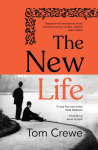 The New Life by Tom Crewe: Two 1890s English sex researchers (based on John Addington Symonds and Havelock Ellis) write a book called Sexual Inversion drawing on ancient Greek history and containing case studies of homosexual behaviour. Oscar Wilde’s trial puts everyone on edge; not long afterwards, their own book becomes the subject of an obscenity trial, and each man has to decide what he’s willing to give up in devotion to his principles. This is deeply, frankly erotic stuff, and, on the sentence level, just exquisite writing.
 Daughters of Nantucket by Julie Gerstenblatt: (Yes, another historical fire novel, and I reviewed both for Shelf Awareness!) This engrossing debut explores the options for women in the mid-19th century. Metaphorical conflagrations blaze in the background in the days leading up to the great Nantucket fire of 1846: each of three female protagonists (a whaling captain’s wife, a museum curator, and a pregnant Black entrepreneur) holds a burning secret and longs for a more expansive, authentic life. Tense and sultry; for Sue Monk Kidd fans.
 I Have Some Questions for You by Rebecca Makkai: When an invitation comes from her boarding school alma mater, Granby, to teach a two-week course on podcasting, Bodie indulges her obsession with the 1995 murder of her former roommate. Makkai has taken her cues from the true crime genre and constructed a convincing mesh of evidence and theories. She so carefully crafts her pen portraits, and so intimately involves us in Bodie’s psyche, that it’s impossible not to get invested. This is timely, daring, intelligent, enthralling storytelling.
 Sidle Creek by Jolene McIlwain: In this debut collection of 22 short stories, loosely linked by their location in the Appalachian hills in western Pennsylvania and a couple of recurring minor characters, McIlwain softens the harsh realities of addiction, poverty and violence with the tender bruises of infertility and lost love. Grief is a resonant theme in many of the stories, with pregnancy or infant loss a recurring element. At times harrowing, always clear-eyed, these stories are true to life and compassionate about human foibles and animal pain.
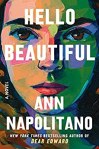 Hello Beautiful by Ann Napolitano: Oprah’s 100th book club pick. It’s a family story spanning three decades and focusing on the Padavanos, a working-class Italian American Chicago clan with four daughters. Julia meets melancholy basketball player William Waters while at Northwestern in the late 1970s. There is such warmth and intensity to the telling, and brave reckoning with bereavement, mental illness, prejudice and trauma. I love sister stories in general, and the subtle echoes of Leaves of Grass and Little Women add heft.
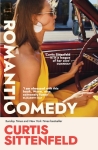 Romantic Comedy by Curtis Sittenfeld: Through her work as a writer for a sketch comedy show modelled on Saturday Night Live, Sally Milz meets Noah Brewster, a pop star with surfer-boy good looks. Plain Jane getting the hot guy – that never happens, right? In fact, Sally has a theory about this very dilemma… As always, Sittenfeld’s inhabiting of a first-person narrator is flawless, and Sally’s backstory and Covid-lockdown existence endeared her to me. Could this be called predictable? Well, what does one want from a romcom?
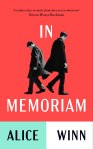 In Memoriam by Alice Winn: Heartstopper on the Western Front; swoon! Will Sidney Ellwood and Henry Gaunt both acknowledge that this is love and not just sex, as it is for so many teenage boys at their English boarding school? And will one or both survive the trenches of the First World War? Winn depicts the full horror of war, but in between there is banter, friendship and poetry. Some moments are downright jolly. This debut is obsessively researched, but Winn has a light touch with it. Engaging, thrilling, and, yes, romantic.
A bonus:
The Vaster Wilds by Lauren Groff (Riverhead/Hutchinson Heinemann, 12 September): Groff’s fifth novel combines visceral detail and magisterial sweep as it chronicles a runaway Jamestown servant’s struggle to endure the winter of 1610. Flashbacks to traumatic events seep into her mind as she copes with the harsh reality of life in the wilderness. The style is archaic and postmodern all at once. Evocative and affecting – and as brutal as anything Cormac McCarthy wrote. A potent, timely fable as much as a historical novel. (Review forthcoming for Shelf Awareness.)
Nonfiction
 All My Wild Mothers by Victoria Bennett: A lovely memoir about grief and gardening, caring for an ill child and a dying parent. The book is composed of dozens of brief autobiographical, present-tense essays, each titled after a wildflower with traditional healing properties. The format realistically presents bereavement and caring as ongoing, cyclical challenges rather than one-time events. Sitting somewhere between creative nonfiction and nature essays, it’s a beautiful read for any fan of women’s life writing.
 Monsters by Claire Dederer: The question posed by this hybrid work of memoir and cultural criticism is “Are we still allowed to enjoy the art made by horrible people?” It begins, in the wake of #MeToo, by reassessing the work of film directors Roman Polanski and Woody Allen. The book is as compassionate as it is incisive. While there is plenty of outrage, there is also much nuance. Dederer’s prose is forthright and droll; lucid even when tackling thorny issues. Erudite, empathetic and engaging from start to finish.
 Womb by Leah Hazard: A wide-ranging and accessible study of the uterus, this casts a feminist eye over history and future alike. Blending medical knowledge and cultural commentary, it cannot fail to have both personal and political significance for readers of any gender. The thematic structure of the chapters also functions as a roughly chronological tour of how life with a uterus might proceed: menstruation, conception, pregnancy, labour, caesarean section, ongoing health issues, menopause. Inclusive and respectful of diversity.
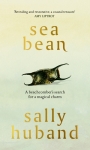 Sea Bean by Sally Huband: Stories of motherhood, the quest to find effective treatment in a patriarchal medical system, volunteer citizen science projects, and studying Shetland’s history and customs mingle in a fascinating way. Huband travels around the archipelago and further afield, finding vibrant beachcombing cultures. In many ways, this is about coming to terms with loss, and the author presents the facts about climate crisis with sombre determination. She writes with such poetic tenderness in this radiant debut memoir.
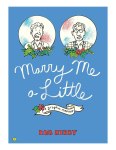 Marry Me a Little by Robert Kirby: Hopping around in time, this graphic memoir tells the story of how the author and his partner John decided to get married in 2013. The blue and red color scheme is effective at evoking a polarized America and the ebb and flow of emotions, with blue for calm, happy scenes and concentrated red for confusion or anger. This is political, for sure, but it’s also personal, and it balances those two aims well by tracing the history of gay marriage in the USA and memorializing his own relationship.
 All of Us Together in the End by Matthew Vollmer: In 2019, Vollmer’s mother died of complications of Alzheimer’s and Parkinson’s. Months later, his father reported blinking lights in the woods near the family cemetery. Although Vollmer had left the Seventh-Day Adventist Church in college, his religious upbringing influenced his investigation, which overlapped with COVID-19. Grief, mysticism, and acceptance of the unexplained are resonant themes. An unforgettable record of “a collision with the ineffable.”
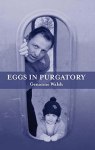 Eggs in Purgatory by Genanne Walsh: This autobiographical essay tells the story of the last few months of her father’s life. Aged 89, he lived downstairs from Walsh and her wife in San Francisco. He was quite the character: idealist, stubborn, outspoken; a former Catholic priest. Although he had no terminal conditions, he was sick of old age and its indignities and ready to exit. The task of a memoir is to fully mine the personal details of a situation but make of it something universal, and that’s just what she does here. Stunning.
Poetry
 More Sky by Joe Carrick-Varty: In this debut collection, the fact of his alcoholic father’s suicide is inescapable. The poet alternates between an intimate “you” address and third-person scenarios, auditioning coping mechanisms. His frame of reference is wide: football, rappers, Buddhist cosmology. The word “suicide” itself is repeated to the point where it becomes just a sibilant collection of syllables. The tone is often bitter, as is to be expected, but there is joy in the deft use of language.
 Lo by Melissa Crowe: This incandescent autobiographical collection delves into the reality of sexual abuse and growing up in rural poverty. Guns are insidious, used for hunting or mass shootings. Trauma lingers. “Maybe home is what gets on you and can’t / be shaken loose.” The collection is so carefully balanced in tone that it never feels bleak. In elegies and epithalamiums (poems celebrating marriage), Crowe honors family ties that bring solace. The collection has emotional range: sensuality, fear, and wonder at natural beauty.
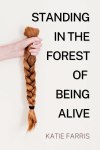 Standing in the Forest of Being Alive by Katie Farris: This debut collection addresses the symptoms and side effects of breast cancer treatment at age 36, but often in oblique or cheeky ways – it can be no mistake that “assistance” appears two lines before a mention of haemorrhoids, for instance, even though it closes an epithalamium distinguished by its gentle sibilance (Farris’s husband is Ukrainian American poet Ilya Kaminsky.) She crafts sensual love poems, and exhibits Japanese influences. (Review forthcoming at The Rumpus.)
 The House of the Interpreter by Lisa Kelly: Kelly is half-Danish and has single-sided deafness, and her second collection engages with questions of split identity. One section ends with the Deaf community’s outrage that the Prime Minister’s Covid briefings were not translated into BSL. Bizarre but delightful is the sequence of alliteration-rich poems about fungi, followed by a miscellany of autobiographical poems full of references to colour, nature and travel.
What are some of the best books you’ve read so far this year?
What 2023 releases should I catch up on right away?
Nature Book Catch-Up: Sally Huband, Richard Smyth & Anna Vaught
I’m catching up with a few nature- and travel-based 2023 releases that were sent to me for review. I’ve grouped them together because these British authors share some of the same interests and concerns. They celebrate beloved places that become ours through the time we spend in them and the attention we grant; they mourn the loss of biodiversity from rockpools and gardens and seabird cliffs. What kind of diminished world they’re raising their children into is a major worry for all three, and for Huband and Vaught the unease is exacerbated by chronic illness. Wild creatures, and the fellow authors who have hymned them, ease the hurt.
Sea Bean: A beachcomber’s search for a magical charm by Sally Huband
After more than a decade in her adopted home of Shetland, Sally Huband is still a newcomer. A tricky path to motherhood and ensuing chronic illness (the autoimmune disease palindromic rheumatism) limited her mobility and career. Beachcombing is at once her way of belonging to a specific place and feeling part of the wider world – what washes up on a Shetland beach might come from as far away as Atlantic Canada or the Caribbean. Sea glass, lobster pot tags, messages in bottles, driftwood … and a whole lot of plastic, of course. Early on, Huband sets her sights on a sea bean – also known as a drift-seed, from the tropics – which in centuries past was a talisman for ensuring safe childbirth. Possession of one was enough to condemn a 17th-century local woman to death for witchcraft, she learned.
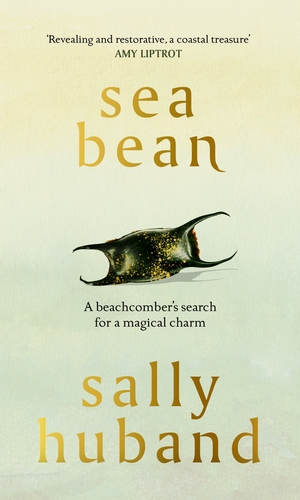 Stories of motherhood, the quest to find effective treatment in a patriarchal medical system, volunteer citizen science projects (monitoring numbers of dead seabirds, returning beached cetaceans to the water, dissecting fulmar stomachs to assess their plastic content), and studying Shetland’s history and customs mingle in a fascinating way. Huband travels around the archipelago and further afield, finding a vibrant beachcombing culture on the Dutch island of Texel. As in Moby-Duck by Donovan Hohn, one of my all-time favourite nonfiction books, there is delight at the randomness of what the ocean delivers.
I requested this book because Huband’s was my favourite essay in the Antlers of Water anthology. In it, she deplored the fact that women were still not allowed to participate in the Up Helly Aa fire festival in Lerwick. Good news: that is no longer the case, thanks to campaigning by Huband and others. In a late chapter, she also reports that blackface was recently banned from the festivals, and a Black Lives Matter demonstration drew 2000 people. Change does come, but slowly to a traditional island community. And sometimes it is not the right sort of change, as with an enormous wind farm, resisted vigorously by residents, that will primarily enrich a multinational company instead of serving the local people.
In many ways, this is a book about coming to terms with loss, and Huband presents the facts with sombre determination. Passages about the threats to birds and marine life had me near tears. But she writes with such poetic tenderness that the evocative specifics of island life point towards what’s true for all of us making the best of our constraints. I was lucky enough to visit several islands of Shetland in 2006; whether you have or not, this is a radiant memoir I would recommend to readers of Kathleen Jamie, Jean Sprackland and Malachy Tallack.
Some favourite lines:
No island can ever live up to the heightened expectations that we always seem to place on them; life catches up with us, sooner or later.
With each loss, emotional pain accretes for those who have paid attention.
If hope is a hierarchy of wishes then I am happy enough, each time that I beachcomb, to find fragments of the bark of paper birch
I’ve come to think of the ocean as an archive of sorts.
With thanks to Hutchinson Heinemann for the proof copy for review.
The Jay, the Beech and the Limpetshell: Finding Wild Things with My Kids by Richard Smyth
all around us
the stuff of spells. Our parents
let us go to scamper deeper,
leap from stumps lush with moss.
Everything aloof about me
fell into the soil once charged
with younger siblings
and freedoms of a wood.
…
I give you a damp valley floor,
this feather for your pocket.
~an extract from “Arger Fen,” from Latch by Rebecca Goss
I know Richard Smyth for his writing on birds (I’ve reviewed both A Sweet, Wild Note and An Indifference of Birds) and his somewhat controversial commentary on modern nature writing. This represents a change in direction for him toward more personal reflection, and with its focus on the phenomena of childhood and parenthood it recalls Wild Child by Patrick Barkham and The Nature Seed by Lucy Jones and Kenneth Greenway. But, as I knew to expect from previous works, he has such talent for reeling in the tangential and extrapolating from the concrete to the abstract that this lively read ends up being about everything: what it is to be human on this fading planet.
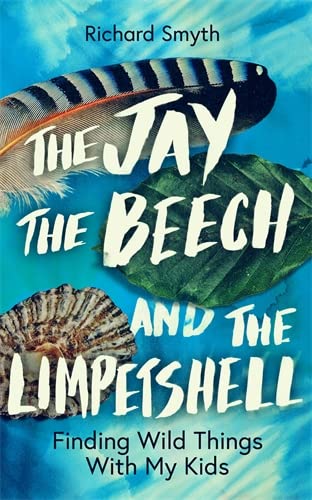 And this despite the fact that four of five chapter headings suggest pandemic-specific encounters with nature. Lockdown walks with his two children, and the totems they found in different habitats – also including a chaffinch nest and an owl pellet – are indeed jumping-off points, punctuating a wide-ranging account of life with nature. Smyth surveys the gateway experiences, whether books or television shows or a school tree-planting programme or collecting, that get young people interested; and talks about the people who beckon us into greater communion – sometimes authors and celebrities; other times friends and family. He also engages with questions of how to live in awareness of climate crisis. He acknowledges that he should be vegetarian, but isn’t; who does not harbour such everyday hypocrisies?
It’s still, unfortunately, rare for men to write about parenthood (and especially pregnancy loss – I only think of Native by Patrick Laurie and William Henry Searle’s books), so it’s great to see that represented, and it’s a charming idea that we create “downfamily” because the “upfamily” doesn’t last forever. Although there’s nostalgia for his childhood here, and anxiety about his kids’ chances of seeing wildlife in abundance, Smyth doesn’t get mired in the past or in existential dread. He has a humanist belief that people are essentially good and can do positive things like build offshore wind farms, and in the meantime he will take Genevieve and Daniel into the woods to play so they will develop a sense of wonder at all that lives on. Even for someone like me who doesn’t have children, this was a captivating, thought-provoking read: We’re all invested in the future of life on this planet.
With thanks to Icon Press for the free copy for review.
These Envoys of Beauty: A Memoir by Anna Vaught
Anna Vaught is a versatile author: I have a copy of her mental health-themed novel Saving Lucia, longlisted for the inaugural Barbellion Prize, on the shelf; she’s written a spooky set of stories, Famished (see Susan’s review); and I gave some early reader feedback on the opening pages of her forthcoming work of quirky historical fiction, The Zebra and Lord Jones. She’s also publishing a book on writing, and editing a collection of pieces submitted for the first Curae Prize for writers who are also carers. I was drawn to her first nonfiction release by reviews by fellow bloggers – it’s always good when a blog tour achieves its aim!
These dozen short essays are about how nature doesn’t necessarily heal, but is a most valued companion in a life marked by chronic illness and depression. The evocative title and epigraphs are from Ralph Waldo Emerson’s essay “Nature” (1836). The pieces loop through Vaught’s past and present, focussing on favourite places in Wiltshire, where she lives, and at the Pembrokeshire coast. It’s the second memoir about complex PTSD that I’ve read this year (see also What My Bones Know). Both at the time and now, when flashbacks of her parents’ verbal and physical abuse haunt her, lying down in a grassy field, exploring a sea cave or sucking on a gorse flower could be a salve. “Nature offered stability and satisfying detail; pattern, form and things that made sense.”
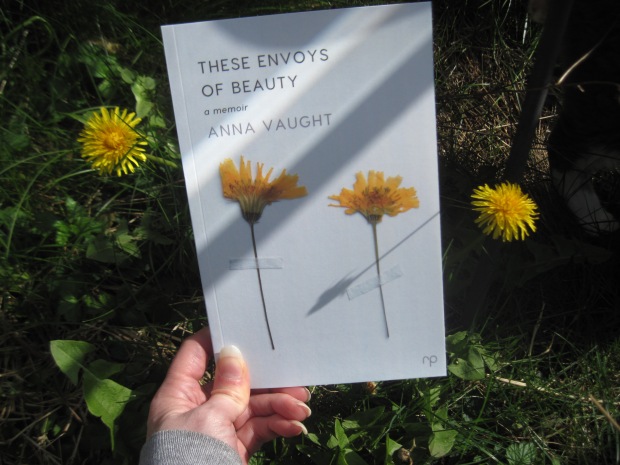
Vaught has a particular love for trees, flowers and moss – even just reciting their Latin names gives her a thrill, and she adds additional information about some species in footnotes. Although her childhood was painful, she retains gratitude for its wide-eyed wonder, and in the exuberance of her prose you can sense a willed childlike perspective (“But back to the list of clouds and writing about clouds!”). I found the frequent self-referential nature of the essays and direct reader address a little precious, but appreciated the thoughts about how nature holds us: “I have always felt a generosity around me, and that I was less lonely outside; at the very least, I could find something to comfort me”. She’s a bookish kindred spirit as well. I’ll be sure to try her work in other genres.
With thanks to Reflex Press for the free copy for review.
March Paperback Releases: Fledgling, Theatre of Marvels, What My Bones Know
I’m catching up on three 2022 books I was sent for review and didn’t read at their initial publication. Today I have a memoir of living between Ghana and England and hand-raising two birds, a Victorian pastiche starring a mixed-race actress in London, and an account of being diagnosed with complex PTSD and working towards healing of childhood trauma.
Fledgling by Hannah Bourne-Taylor
Nature-lover Hannah Bourne-Taylor lived in Ghana for eight years for her husband’s job. As a dependent spouse, she was not permitted to work and, in their rural setting, she felt cut off from any expatriate community. From childhood she’d been an obsessive animal rescuer – fishing ants out of swimming pools, for instance – and when she found a swift that had been displaced from its nest, her protective instincts went into overdrive. Collecting hundreds of termites, she fed the bird to a demanding schedule for two weeks before releasing it. This went as disastrously as it could, but she soon got another chance when she found a grounded bronze-winged mannikin finch fledgling after a storm. Their bond was even closer: the bird climbed her body and nested in her hair (she wrote a Guardian article about the experience), and they developed a mutual language of chirps. The care routine sounds like it was not so different from having an infant. She even calls the finch her daemon.
 There is something very insular about this narrative, such that I had trouble gauging the passage of time. Raising the two birds, adopting street dogs, going on a pangolin patrol with a conservation charity – was this a matter of a couple of months, or were events separated by years? Ghana is an intriguing setting, yet because there is no attempt to integrate, she can only give a white outsider’s perspective on the culture, and indigenous people barely feature. I was sympathetic to the author’s feelings of loneliness and being trapped between countries, not belonging in either, but she overstates the lessons of compassion and freedom the finch taught. The writing, while informed and passionate about nature, needs a good polish (many misplaced modifiers, wrong prepositions, errors in epigraph quotes, homonym slips – “sight” instead of “site”; “balled” in place of “bawled”; “base” where it should be “bass,” twice – and so on). Still, it’s a promising debut from a valuable nature advocate, and I share her annual delight in welcoming England’s swifts, as in the scenes that open and close the book.
With thanks to Aurum for the free copy for review. Fledgling came out in paperback on 9 March.
Theatre of Marvels by Lianne Dillsworth
Lianne Dillsworth is a Black British author with MAs in creative writing and Victorian studies, interests she combines in this debut novel set in Victorian London. Zillah’s mother, a slave from Barbados, was forced to abandon her seven-year-old daughter. Zillah is mixed-race and grew up in St Giles slum. Too light-skinned to convince as a “savage” when she headlines Crillick’s Variety Theatre show as “Amazonia,” she has to coat herself with greasepaint and soot. As mistress to a viscount, she has access to a life of luxury, but instead chooses to try to free her fellow Black performers, including the “Leopard Lady,” who is exhibited for her skin condition and confined in conditions little better than slavery.
 Through secondary characters, we glimpse other options for people of colour: one, Lucien Winters, is a shopkeeper (reminding me of the title character of The Secret Diaries of Charles Ignatius Sancho, a historical figure) but intends to move to Sierra Leone via a colonisation project; another passes as white to have a higher position in the theatre world. It felt odd, though, how different heritages were conflated, such that Zillah, of Caribbean descent, learns a few words of “Zulu” to speak to the Leopard Lady, and Lucien explains Africanness to her as if it is one culture. Perhaps this was an attempt to demonstrate solidarity among oppressed peoples.
There are rivalries with fellow actresses, and well-meaning Quakers who work toward a better society. Much of the characterisation is tissue-thin, however, and a few turns of phrase felt not of the time period (describing someone as being in a “pissy mood”; “If he was in this much of a funk there’d be no getting through to him. I might as well go to bed before he killed my mood completely.”). All told, this never lived up to its first paragraph –
Go to the theatre much? No, nor me. At least not before I became an actress. I know what you’re thinking. Actress, eh? But you can keep your dirty-minded thoughts to yourself. I trod the boards and no more. Doesn’t mean I don’t have a story or two to tell, mind. Would you be kind enough to indulge me if I talked about the old days? Hard as it was back then, I can’t say that if I had my time again I’d change it.
– which promised a much more original voice than we ever get from Zillah. It’s only worth writing in the first person if the narration is remarkable in some way, so this could easily have been in third person limited instead. This was a nicely undemanding selection to start on the ferry ride back from Spain last year, but took much effort to finish because of the 400+ page count and despite the jejune prose (some have labelled this YA for that reason). Fans of Stacey Halls may enjoy it. It’s certainly what I’d call an easy read. 
Hutchinson Heinemann sent a proof copy. Theatre of Marvels came out in paperback on 2 March.
What My Bones Know: A Memoir of Healing from Complex Trauma by Stephanie Foo
It’s okay to have some things you never get over.
Radio producer Stephanie Foo was diagnosed with complex PTSD at age 30. Although she briefly delves into the parental abuse that accounts for her trauma, this is – thankfully – mostly about the four years she spent trying to get better. The Malaysian Chinese Foo family moved to San Francisco when she was two years old. Her mother nagged and beat her, and both parents made credible threats to kill her and/or themselves, such as by driving off the road. It’s hard to read this material, but by proportion it doesn’t take up much of the book. Foo’s mother left when she was 13; she later gave her father an ultimatum one day (while wielding an axe!) that also saw him move out. This left her, then a high school student, living alone and in squalor. Unsurprisingly, she engaged in disordered eating and self-harm.
 A love of journalism kept Foo from committing suicide, got her into college and landed her podcast roles followed by her dream job with public radio programme This American Life in New York City. However, she struggled with a horrible, exacting boss and, when her therapist issued the diagnosis, she left to commit to the healing process, aided by her new partner, Joey. C-PTSD was named in the 1990s but is not recognised in the DSM; The Body Keeps the Score by Bessel van der Kolk is its alternative bible. Repeated childhood trauma, as opposed to a single event, rewires the brain to identify threats that might not seem rational, leading to self-destructive behaviour and difficulty maintaining healthy relationships.
All that Foo discovers in her research into C-PTSD feels damning, but she focuses on what she can control: sleep, diet, exercise, yoga, meditation, acupuncture, and seeing various therapists. She tries everything from hallucinogenic mushrooms and a gratitude journal to EMDR (like hypnosis but based on eye movement). Working with a therapist from the Center for Child Trauma and Resilience helped her to address the root cause rather than the symptoms. There came a point where I would have been okay with a condensed version of events instead of a blow-by-blow of every therapy attempted, but Foo writes with bravery and clarity, adroitly recreating scenes and dialogue and displaying impressive memory and self-knowledge. The detail and overall optimism should make this helpful to many. 
With thanks to Allen & Unwin for the free copy for review. What My Bones Know came out in paperback on 3 March.
Constructing a Nervous System by Margo Jefferson
I’ve had mixed feelings about the online nature of life recently. On Sunday I avoided the Internet altogether so as not to be bombarded with (UK) Mother’s Day memes and notifications. Yesterday our home broadband dropped out completely, such that I couldn’t do any freelance work or post about the Folio Prize poetry shortlist as I’d meant to do on World Poetry Day. Too much connectivity or not enough. Today – just as a line engineer is due to arrive; that usual irony – all is normal and I’m back in the swing of working and blogging.
Using my husband’s phone as a hotspot, I was at least still able to watch yesterday evening’s free 5×15 event with the Rathbones Folio Prize, featuring Amy Bloom, NoViolet Bulawayo, Sheila Heti, Margo Jefferson and Elizabeth Strout and hosted by interviewer Alex Clark. Over the next couple of days I’ll review Heti and Strout’s novels and the entire poetry shortlist, but for now I’ll weave some of the insight I gained last night into a review of Constructing a Nervous System by Margo Jefferson (2022), the new-to-me book from the nonfiction shortlist that I was most interested in reading.
Although the subtitle is “A Memoir,” this experimental text does such novel things with the genre that it bears little resemblance to most memoirs I’ve read. For that reason alone, I can see why the judges shortlisted it. During the 5×15 event, Jefferson described her book as “an assemblage of ideas, memories, sensations, feelings, and other people’s words—not just my own.” It’s also a reckoning with culture – particularly jazz music and dance by African Americans, but also particular examples from the white literary canon.
Jefferson was a long-time theatre and book critic for Newsweek and The New York Times and won a Pulitzer Prize for her criticism in 1995; she now teaches writing at Columbia University. She has previously published another memoir, Negroland, and a biography of Michael Jackson. Here she blends her chosen genres of life writing and cultural criticism. Her aim, she said, was to craft “criticism with the intensities and intimacies of memoir” and “memoir with the range of criticism.”

Jefferson mentioned that the deaths of her mother and older sister (who was like her muse) left her an orphan and, strangely, “cleared the stage for me to step out and speak my lines.” Indeed, the book is loosely structured as a play, opening with the metaphor of an empty stage and ending with the direction “BLACKOUT.” In between there are many imagined dialogues with herself or between historical figures, such as the bizarre pairing of George Eliot and W.E.B. Du Bois. Some quotations and definitions appear in italics or bold face. Ella Fitzgerald and Josephine Baker play major roles, but there’s also a surprisingly long section devoted to Willa Cather’s The Song of the Lark, which Jefferson loves and has often taught, yet finds problematic for how it enshrines whiteness (“Confederate Southern mythmaking”).
I don’t feel that I got much of a sense of the sweep of Jefferson’s life from the book, just a vague impression of an upper-middle-class Black upbringing. (Perhaps Negroland is a more straightforward memoir?) To be sure, she was keen to avoid “slogging through chronology,” as she explained, instead welcoming onto the page “a repertory company of myself as I encounter all the materials of my life—the factual and historical as well as the creative.” And so I do feel I have met her as an industrious mind, drawing connections between disparate aspects of experience and cultural consumption. This is a model of how a critic (like myself) might incorporate a body of work into a record of life. Yet when so many of her touchstones do not overlap with mine, I could only observe and admire from afar, not be truly drawn in.
Some lines I loved:
“Remember: Memoir is your present negotiating with versions of your past for a future you’re willing to show up in.”
“Older women’s tales— ‘Une femme d’un certain âge’ tales—are hard to pull off. They risk being arch.”
(of Ella Fitzgerald) “You turned the maw of black female labor into the wonderland of black female art.”
“Women’s anger needs to be honored—celebrated and protected—the way virginity used to be! … I’ve spent my adult years working on an assemblage of black feminist anger modes.”
With thanks to FMcM Associates and Granta Books for the free copy for review.
I was very impressed with both Amy Bloom and Margo Jefferson ‘in person’ (on Zoom): elegant, intellectual, well-spoken; authors at the top of their game. I reviewed Amy Bloom’s affecting memoir In Love, about her husband Brian’s early-onset Alzheimer’s and the decision to end his life at Dignitas in Zurich, last year. She told Alex Clark that the book started as a caregiver’s notes, but Brian made it clear that he wanted her to write about the experience, to inform people about end-of-life options. She believes that ultimately the memoir is about what it means to be a person and the decisions that make up a life. Her children joke that her only four subjects – in fiction or otherwise – are love, sex, family and death. Well, what else is there, really?
I know only the barest facts about the other three books on the Folio nonfiction shortlist but none of them screams ‘must read’ to me:
- The Passengers by Will Ashon – oral narratives from contemporary Britain
- The Escape Artist by Jonathan Freedland – biography of an Auschwitz whistle-blower
- The Social Distance Between Us by Darren McGarvey – a rapper’s book about inequality and antisocial behaviour
Have you read, or would you read, anything from the Folio nonfiction shortlist?
Tomorrow: Five poetry shortlist reviews
Friday: Two fiction shortlist reviews; my predictions for the category winners and overall prize winner
Young Writer of the Year Award Shortlist: Larger than an Orange by Lucy Burns
Looking back, being on the 2017 shadow panel for the Sunday Times Young Writer of the Year Award was still one of the best things I’ve achieved in my time as a book blogger. Each year I eagerly look out for this award’s shortlist to see how many titles I’ve read and who I think the judges will choose as the winner. For a couple years the prize has had a higher cash fund thanks to sponsorship from the Charlotte Aitken Trust, and is now, like the McKitterick Prize that I’ve judged the past two years, administered by the Society of Authors.

This year’s four nominees include two novels and two nonfiction works: Oxblood by Tom Benn is said to be a “poignantly rendered exploration of domesticity and violence” and Maddie Mortimer’s Maps of our Spectacular Bodies, which won the Desmond Elliott Prize and was longlisted for the Booker Prize, is a “lyrical and captivating look at mortality, desire and forgiveness”; Lucy Burns’s debut memoir is an examination of abortion through the prism of her personal experience; and Katherine Rundell’s Super-Infinite (winner of the Baillie Gifford Prize for Non-Fiction) is a biography of John Donne.
I was intrigued by the premise (narration by a young woman – and her cancer) of the Mortimer when it was longlisted for the Booker so bought a sale copy with a Christmas voucher, but the style and over-400-page length has been defeating me. I might try again, but for a debut author’s experimental work I think 200 pages would have been sufficient. I’m not keen to try the Benn, but would gladly read the Rundell from the library another time. The final book is one I requested as a review copy.
Larger Than an Orange by Lucy Burns (2021)
I’ve only read one other memoir of an abortion (as opposed to a memoir in which an abortion is simply one event of many), Happening by Annie Ernaux, so it was perhaps inevitable for me to get similar vibes from the two works. Both are fragmentary, spare; matter of fact in tone to avoid melodramatic extremes of emotion. The difference, of course, is that in the 1960s abortion was illegal in France and so ending a pregnancy required clandestine action. However, even in 2017, when the then 26-year-old Burns had a medical abortion in England, where it had been legal for 50 years, she found that the process was invasive and officious. She presents the experience as infantilizing – not trusting the patient, and lacking in compassion. And although it was the only practical choice for her at the time and she remains firmly committed to women’s right to an abortion, it sparked feelings of guilt, shame and depression that lingered and affected her work and personal life. At counselling appointments she expressed disgust at herself, and she became obsessed with looking up American pro-life propaganda and testimonials from former abortion clinic workers online.
 The book is, collage-like, assembled from pieces – sometimes as little as one paragraph or one line to a page – of dated autobiographical material, going back and forth between the summer of the abortion and the few-year aftermath as she suffers with irregular bleeding, chooses a new contraceptive method and has a short-term relationship; transcripts of radio debates; alphabetical lists of predicted search terms and so on. She even requests her medical records, including sections from it plus ultrasound images, and marks her baby’s would-be birthday.
I could imagine this working very well as a play for voices, especially because Burns is in the habit of counting each person she tells about the abortion and referring to them by their number until, at fifty-something, she gives up. Friends, receptionists, the people at work who adjudicate her petition to be granted two weeks’ leave: there are those she tells willingly and those she feels duty-bound to inform to explain her health or behaviour. Some remain a part of her life and others, awkward or judgemental, fade out of it.
This is a powerful read I can’t say I necessarily enjoyed, but did admire for its uncompromising clarity and honesty, and its willingness to probe both sides of ethical issues in a way that ‘good feminists’ might think they cannot.
With thanks to FMcM Associates and Chatto & Windus for the free copy for review.
Tomorrow we’ll hear the Young Writer of the Year results. My feeling is that Katherine Rundell, though already a prize winner for this book and an established author due to her children’s oeuvre, will win for Super-Infinite.
Have you read anything from this year’s shortlist?
Bill Bryson’s Notes from a Small Island: Reread and Stage Production
Bill Bryson, an American author of humorous travel and popular history or science books, is considered a national treasure in his adopted Great Britain. He is a particular favourite of my husband and in-laws, who got me into his work back in the early to mid-2000s. As I, too, was falling in love with the country, I found much to relate to in his travel-based memoirs of expatriate life and temporary returns to the USA. Sometimes it takes an outsider’s perspective to see things clearly.
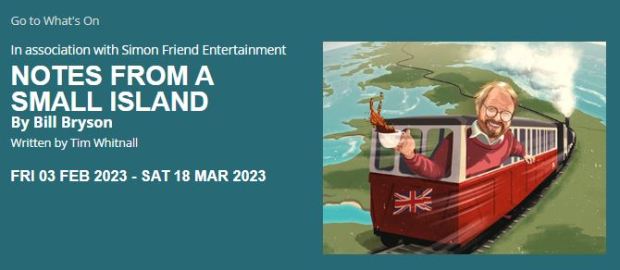
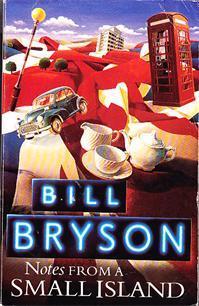 When we heard that Notes from a Small Island (1995), his account of a valedictory tour around Britain before returning to live in the States for the first time in 20 years, had been adapted into a play by Tim Whitnall and would be performed at our local theatre, the Watermill, we thought, huh, it never would have occurred to us to put this particular book on stage. Would it work? we wondered. The answer is yes and no, but it was entertaining and we were glad that we went. We presented tickets as my in-laws’ Christmas present and accompanied them to a mid-February matinee before supper at ours.
A few members of my book club decided to see the show later in the run and suggested we read – or reread, as was the case for several of us – the book in March. I started my reread before attending the play and had gotten through the first 50 pages, which is mostly about his first visit to England in 1973 (including a stay in a Dover boarding-house presided over by the infamously officious “Mrs Smegma”). This was ideal as the first bit contains the funniest stuff and, with the addition of some autobiographical material from later in the book plus his 2006 memoir The Life and Times of the Thunderbolt Kid, made up the entirety of the first act.
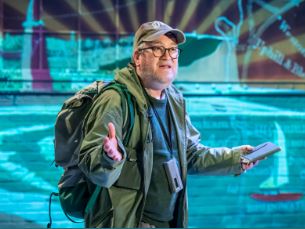
Photos are screenshots from the Watermill website.
Bryson traveled almost exclusively by public transport, so the set had the brick and steel walls of a generic terminal, and a bus shelter and benches were brought into service as the furnishing for most scenes. The problem with frontloading the play with hilarious scenes is that the second act, like the book itself on this reread, became rather a slog of random stops, acerbic observations, finding somewhere to stay and something to eat (often curry), and then doing it all over again.
Mark Hadfield, in the starring role, had the unenviable role of carrying the action and remembering great swathes of text lifted directly from the book. That’s all well and good as a strategy for giving a flavour of the writing style, but the language needed to be simplified; the poor man couldn’t cope and kept fluffing his lines. There were attempts to ease the burden: sections were read out by other characters in the form of announcements, letters or postcards; some reflections were played as if from Bryson’s Dictaphone. It was best, though, when there were scenes rather than monologues against a projected map, because there was an excellent ensemble cast of six who took on the various bit parts and these were often key occasions for humour: hotel-keepers, train-spotters, unintelligible accents in a Glasgow pub.
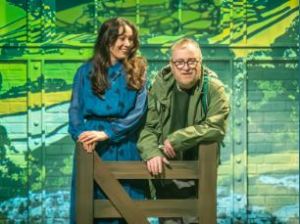
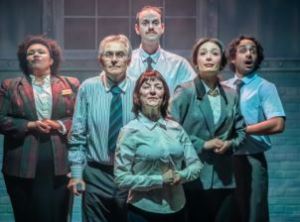
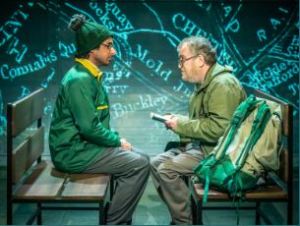
The trajectory was vaguely southeast to northwest – as far as John O’Groats, then back home to the Yorkshire Dales – but the actual route was erratic, based on whimsy as much as the availability of trains and buses. Bryson sings the praises of places like Salisbury and Durham and the pinnacles of coastal walks, and slates others, including some cities, seaside resorts and tourist traps. Places of personal significance make it onto his itinerary, such as the former mental asylum at Virginia Water, Surrey where he worked and met his wife in the 1970s. (My husband and I lived across the street from it for a year and a half.) He’s grumpy about having to pay admission fees that in today’s money sound minimal – £2.80 for Stonehenge!
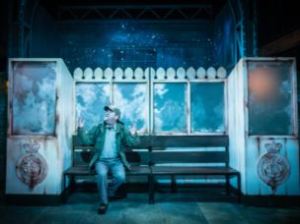 The main interest for me in both book and play was the layers of recent history: the nostalgia for the old-fashioned country he discovered at a pivotal time in his own young life in the 1970s; the disappointments but still overall optimism of the 1990s; and the hindsight the reader or viewer brings to the material today. At a time when workers of every type seem to be on strike, it was poignant to read about the protests against Margaret Thatcher and the protracted printers’ strike of the 1980s.
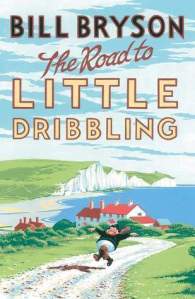 The central message of the book, that Britain has an amazing heritage that it doesn’t adequately appreciate and is rapidly losing to homogenization, still holds. Yet I’m not sure the points about the at-heart goodness and politeness of the happy-with-their-lot British remain true. Is it just me or have general entitlement, frustration, rage and nastiness taken over? Not as notable as in the USA, but social divisions and the polarization of opinions are getting worse here, too. One can’t help but wonder what the picture would have been post-Brexit as well. Bryson wrote a sort-of sequel in 2015, The Road to Little Dribbling, in which the sarcasm and curmudgeonly persona override the warmth and affection of the earlier book.
Indeed, my book club noted that a lot of the jokes were things he couldn’t get away with saying today, and the theatre issued a content warning: “This production includes the use of very strong language, language reflective of historical attitudes around Mental Health, reference to drug use, sexual references, mention of suicide, flashing lights, pyrotechnics, loud sound effect explosions, and haze. This production is most suitable for those aged 12+.”
So, yes, an amusing journey, but a bittersweet one to revisit, and an odd choice for the stage.
A favourite line I’ll leave you with: “To this day, I remain impressed by the ability of Britons of all ages and social backgrounds to get genuinely excited by the prospect of a hot beverage.”
Book:
Original rating (c. 2004):
My rating now:
Play:
Have you read anything by Bill Bryson? Are you a fan?
All My Wild Mothers by Victoria Bennett & I Have Some Questions for You by Rebecca Makkai
I’m catching up with reviews of two February releases that I spent the whole of last month submerged in. These are early entries on my Best of 2023 list: A lovely memoir about grief and gardening, caring for an ill child and a dying parent; and a riveting true crime-inspired novel, set on a boarding school campus, that rages at injustice and violence against women.
All My Wild Mothers: Motherhood, loss and an apothecary garden by Victoria Bennett
Early in February, I attended the online book launch via Sam Read Bookseller in Grasmere. With conversation, readings and song, it was the ideal introduction to the themes of this debut memoir by a poet. The book is composed of dozens of brief autobiographical, present-tense essays, each titled after a wildflower with traditional healing properties. The chapters are headed by a black-and-white woodcut of each plant (by Bennett’s husband, Adam Clarke) and a précis of its medicinal uses, as well as where it is found. Again and again, these descriptions site the flora on edgelands or “disturbed ground” – the perfect metaphorical tie-in to Bennett’s tumultuous life and the comfort that creating an apothecary garden brought.
Bennett is the youngest of six children. When she was expecting her son – much longed for after multiple pregnancy losses – news came that her eldest sister had died in a canoeing accident. At age two, her son was diagnosed with type 1 diabetes; managing his condition has imposed a heavy emotional burden. And years later, she was the primary caregiver for her elderly mother as she was dying of mesothelioma. The memoir’s format – which arose in part because it was written over the course of 10 years, during stolen moments – realistically presents bereavement and caring as ongoing, cyclical challenges rather than one-time events.

There are no simple solutions offered here, nothing so pat as that ‘gardening heals all hurts’, but Bennett writes into the broken places and finds joy in what comes to life spontaneously in nature or in her ramshackle yard on a social housing estate in Cumbria. She recalls a horse chestnut tree that looked over her outside the window of her childhood home; she and her son take impish delight in guerrilla gardening and sometimes disastrous cooking projects with foraged fruit. Some of my favourite individual vignettes were “Elder,” about the magic and medicine of making elderberry syrup from the few village trees that escape the chainsaw; “Dandelion,” about her trio of older sisters, who were Greenham Common protestors and always tried to protect her as well as nature; “Herb Robert,” about her sister-in-law’s funeral; and especially “Honeysuckle,” about a local agricultural show where the officious organizers make them feel like interlopers yet her son wins first place for their feral, fecund garden.
Many side topics twine into the narrative as well: a difficult relationship with a controlling mother; a family history that takes in boarding schools, cults, road trips, risk taking and mental health issues; the economic disparity that leads to one set of rules for the rich and another for those on benefits. But the core of the book is a tender mother–son relationship. “I can give him this: a seed, with all its defiant hope against the dark; and the memory that once, we grew a garden out of rock, and waste, and all things broken, and it thrived.” Sitting somewhere between creative nonfiction and nature essays, it’s a beautiful read for any fan of women’s life writing, especially if you share the interests in grief or gardening. I hope we’ll see it recognized on the Barbellion and Wainwright Prize shortlists alike.
Readalikes I have reviewed: A Still Life by Josie George, The Book of Difficult Fruit by Kate Lebo, The Cure for Sleep by Tanya Shadrick
With thanks to Victoria Bennett and Two Roads for the free copy for review.
I Have Some Questions for You by Rebecca Makkai
I’m a big fan of Makkai’s first two novels, The Borrower and The Hundred-Year House, and have her other two books lined up to read, so I was excited to hear about this new work and put it on my Most Anticipated list for the year. My interest was redoubled by Laura’s review, which likens it to a cross between Prep and My Dark Vanessa – irresistible.
Bodie Kane grew up in a deprived and dysfunctional family in Indiana, and has beneficent Mormon neighbours to thank for the tuition money that allowed her to attend Granby, an exclusive New Hampshire boarding school, in the early to mid-1990s. She was an angry and awkward high school student, yet her memories of Granby and the friendships she made there are still an emotional mainstay more than two decades later. In 2018, she is a successful film professor with a podcast about Hollywood starlets. Although she is separated from Jerome, her artist husband, he lives next door and they co-parent their two children.
After an invitation comes from Granby to teach a two-week course on podcasting, Bodie trades Los Angeles for a bitter New England winter. It’s the perfect excuse to indulge her obsession with the 1995 murder of her former Granby roommate, Thalia Keith, who was found dead in the swimming pool one March morning after a play performance. Bodie has never been comfortable with the flawed case against the Black athletics coach, Omar Evans, who has been imprisoned ever since. When one of her students chooses to make Thalia’s murder the subject of a podcast, it’s all the justification Bodie needs to dive deep into her pet hypothesis: Thalia was sleeping with the music director, Denny Bloch, and he was involved in her death in some way. Her blinkered view threatens to exclude a key explanation. Still, the informal sleuthing she and her students do is enough to warrant a follow-up hearing in 2022, but they – and Omar – are up against a broken system.

Makkai has taken her cues from the true crime genre and constructed a convincing mesh of evidence and theories. There’s a large cast of secondary characters, from Dorian, the bully who once humiliated Bodie with sexual slurs, to Fran, the faculty kid/gay best friend who now lives and works on campus herself and continues to be Bodie’s trusty backup. The combinations of background + teenage behaviour + 40-something lives all feel authentic in their randomness (when I saw that Makkai sourced 24 names from indie bookstore supporters, I realized afresh just how real, as opposed to ‘made-up’, these characters feel).
At times I wondered if there was too much detail on the case and the former classmates; I might even have streamlined the novel by doing away with the 2022 section altogether, though it ends up being crucial to the plot. But Makkai has so carefully crafted these pen portraits, and so intimately involved us in Bodie’s psyche, that it’s easy to become invested in the story. What’s more, the novel introduces a seam of rage about violence towards women – so predictably excused and allowed to recur by a justice system weighted against victims –
What’s as perfect as a girl stopped dead, midformation? Girl as blank slate. Girl as reflection of your desires, unmarred by her own. Girl as sacrifice to the idea of girl.
let’s say it was the one where the rugby team covered up the girl’s death and the school covered for the rugby team. Actually it was the one where the therapist spent years grooming her. It was the one where the senator, then a promising teenager, shoved his d*ck in the girl’s face. … It was the one where her body was never found. It was the one where her body was found in the snow. It was the one where he left her body for dead under the tarp.
– yet also finds nuance in the situation when Bodie’s ex-husband is subjected to exaggerated #MeToo accusations. It’s timely, daring, intelligent, enthralling storytelling. Susan (review here) and I are both hoping to see this make the Women’s Prize longlist next week.
Readalikes I have reviewed: Ghost Wall by Sarah Moss, My Dark Vanessa by Kate Elizabeth Russell, The Bass Rock by Evie Wyld
With thanks to Fleet for the proof copy for review.
What are the best 2023 books you’ve read so far?
 Bookish Beck = Rebecca Foster. American transplant to England. Freelance proofreader and book reviewer.
 Bookish Beck