Short Stories in September Roundup: Alexie, Donoghue, Groff Anthology, Houston, McCracken, Moore, Svoboda, Walker
I gave myself an extra week to finish up the story collections I was in the middle of, so I’ve managed to read 13 during this challenge to self (including my first and second posts). Again I’m borrowing Marcie’s five-sentence review format to keep things simple.
The Lone-Ranger and Tonto Fistfight in Heaven by Sherman Alexie (1993)
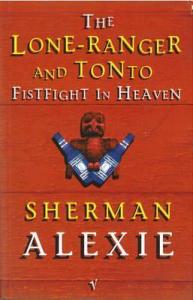 There are 22 stories in this fairly short book, so most top out at no more than 10 pages: little slices of life on and around the reservation at Spokane, Washington. Some central characters recur, such as Victor, Thomas Builds-the-Fire and James Many Horses, but there are so many tales that I couldn’t keep track of them across the book even though I read it quickly. My favourite was “This Is What It Means to Say Phoenix, Arizona,” in which Victor and Thomas fly out to collect the ashes of Victor’s father. Some of the longer titles give a sense of the tone: “Because My Father Always Said He Was the Only Indian Who Saw Jimi Hendrix Play ‘The Star-Spangled Banner’ at Woodstock” and “Jesus Christ’s Half-Brother Is Alive and Well on the Spokane Indian Reservation.” I couldn’t help but think of it as a so-so rehearsal for The Absolutely True Diary of a Part-Time Indian because a similar cast of drunks, jokers, relatives and basketball players populates the stories and a comparable voice prevails. (University library)
The Woman Who Gave Birth to Rabbits by Emma Donoghue (2002)
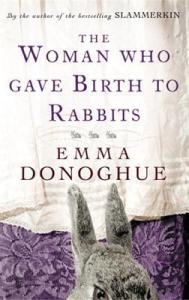 The title story is about Mary Toft – I thought of making her hoax the subject of a Three on a Theme post because I actually have two novels about her downloaded from NetGalley and Edelweiss (Mary and the Rabbit Dream by Noémi Kiss-Deáki and Mary Toft; or, The Rabbit Queen by Dexter Palmer), but the facts as conveyed here don’t seem like nearly enough to fuel a whole book, so I doubt I’ll read those. Donoghue has a good eye for historical curios and incidents and an academic’s gift for research, yet not many of these 17 stories, most of which are in the third person, rise above the novelty. Many protagonists are British or Irish women who were a footnote in the historical record: an animal rights activist, a lord’s daughter, a cult leader, a blind poet, a medieval rioter, a suspected witch. There are mild homoerotic touches, too. I enjoyed “Come, Gentle Night,” about John Ruskin’s honeymoon, and “Cured,” which reveals a terrifying surgical means of controlling women’s moods but, as I found with Astray and Learned by Heart, Donoghue sometimes lets documented details overwhelm other elements of a narrative. (Secondhand – Awesomebooks.com)
The Best Short Stories 2023: The O. Henry Prize Winners, ed. Lauren Groff (2023)
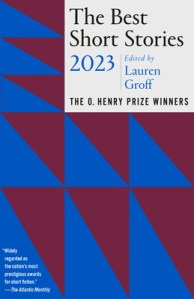 Hard to convey the variety of this 20-story anthology in a concise way because they run the gamut from realist (Nigerian homosexuality in “Happy Is a Doing Word” by Arinze Ifeakandu; Irish gangsters in “The Blackhills” by Eamon McGuinness) to absurd (Ling Ma’s “Office Hours” has academics passing through closet doors into a dream space; the title of Catherine Lacey’s “Man Mountain” is literal; “Ira and the Whale” is Rachel B. Glaser’s gay version of the Jonah legend). Also difficult to encapsulate my reaction, because for every story I would happily have seen expanded into a novel (the gloomy character study “The Locksmith” by Grey Wolfe LaJoie, the teenage friends’ coming-of-age in “After Hours at the Acacia Park Pool” by the marvellous Kirstin Valdez Quade), there was another I thought might never end (“Dream Man” by Cristina Rivera-Garza and “Temporary Housing” by Kathleen Alcott). Three are in translation. I admired Lisa Taddeo’s tale of grief and revenge, “Wisconsin,” and Naomi Shuyama-Gómez’s creepy Colombian-set “The Commander’s Teeth.” But my two favourites were probably “Me, Rory, and Aurora” by Jonas Eika (Danish), which combines an uneasy threesome, the plight of the unhoused and a downright chilling Ishiguro-esque ending; and “Xífù,” K-Ming Chang’s funny, morbid take on daughter/mother-in-law relations in China. (PDF review copy)
Waltzing the Cat by Pam Houston (1998)
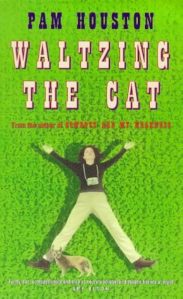 The novel-in-stories is about Lucy, a photographer in her early thirties with a penchant for falling for the wrong men – alcoholics or misogynists or ones who aren’t available. When she’s not working she’s thrill-seeking: rafting in Colorado, travelling in the Amazon, sailing in the Caribbean, or gliding. “Everything good I’ve gotten in life I’ve gotten by plunging in,” she boasts, to which a friend replies, “Sure, and everything bad you’ve gotten in your life you’ve gotten by plunging in.” Ultimately she ‘settles down’ on the Colorado ranch she inherits from her grandmother with a dog, making this – based on what I learned from the autobiographical essays in Deep Creek – even more autofiction for Houston than her debut, Cowboys Are My Weakness, was. Although the final magic realist touch of having her child-self come to her with a box of photographs of traumatic memories is overdone, the themes of accepting vulnerability, seeking to freeze time and creating a home for yourself resonated, and the title story, about the death of Lucy’s mother, is a brilliant and heart-wrenching standalone. (Secondhand – British Red Cross, Berwick)
The Souvenir Museum by Elizabeth McCracken (2021)
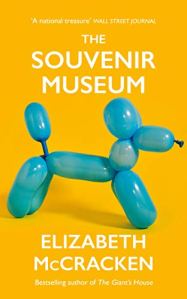 McCracken is terrific in short forms: The Hero of This Book, a novella, was one of my top books of 2022, and I also loved her previous story collection, Thunderstruck. Five of these dozen stories are taken from different points in the lives of Jack and Sadie, English and American academics (who I inevitably read as McCracken and her husband, Edward Carey) who come from large-family zaniness versus claustrophobic mother–daughter melancholy. I kept thinking that McCracken’s are just the sorts of scenarios Lucy and Olive would have told stories about in Tell Me Everything: accidents, misfortunes; random connections. Travel is a major element in many of the stories, including to Denmark (in the title story) and Amsterdam. I couldn’t decide whether I preferred the Jack-and-Sadie material or the rest, but I had a favourite from each: “The Irish Wedding” cracked me up as much as it did Sadie with the accidental use of crass American slang, while “Proof,” about a man communing with his father despite his early dementia, is set on a boat trip I’ve made (in 2004!) to see puffins on the Treshnish islands of Scotland. (Secondhand – Dogs Trust charity shop, Marlborough)
Like Life by Lorrie Moore (1990)
 Compared to Birds of America, this feels a little dated and the plots are overall less memorable. Still, the eight stories of Moore’s second collection are chewy with insight into relationships and the mindsets of youngish and middle-aged women, and there’s an effortless wry wit to her turns of phrase. Her exasperated would-be feminist characters remind me of Helen Simpson’s, while the cheese-selling protagonist of “Joy” made me think of an early Carol Shields story; and who knew a “cute meet” (aka a meet-cute) was a thing back then? New York City contrasts with the Midwest, most notably in “You’re Ugly, Too” and “The Jewish Hunter.” The title story, which comes last, crafts a weirdly muted dystopia built around shortages and marital misery; I preferred the (comparative lightness) of “Vissi d’Arte,” about a lonely playwright, and “Places to Look for Your Mind,” in which an empty-nest entrepreneur hosts an aimless young Englishman her daughter met on her study abroad year. (Secondhand – Bark charity shop, Berwick)
The Long Swim by Terese Svoboda (2023)
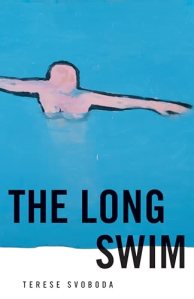 These 44 stories, mostly of flash fiction length, combine the grit of Denis Johnson with the bite of Flannery O’Connor. Siblings squabble over a late parent’s effects or wishes, marriages go wrong, the movie business isn’t as glittering as it’s cracked up to be, and drugs and alcohol complicate everything. The settings range through North America and the Caribbean, with a couple of forays to Europe. There are no speech marks and, whether the narrative is in first person or third, all the voices are genuine and distinctive yet flow together admirably. Svoboda has a poet-like talent for compact, zingy lines; two favourites were “my laziness is born of generalized-looking-to-get-specific grief, like an atom trying to make salt” (“Niagara”) and “Ditziness, a kind of Morse code of shriek-and-stop, erupts around the girls” (“Orphan Shop”).
Winner of the Juniper Prize for Fiction. Published by University of Massachusetts Press. With thanks to the author for the free PDF copy for review.
In Love and Trouble by Alice Walker (1973)
 I’d only ever read The Color Purple, so when I spotted this in a bookshop on our Northumberland holiday it felt like a good excuse to try something else by Walker. I had actually encountered one of the stronger stories before: “Everyday Use” is in the Close Company Virago anthology. In these Southern scenes (“a hate-filled state complete with magnolias, tornadoes and broken-tongued field hands”), Black women oppressed by fathers and partners gain what few advantages they can through deception or folk medicine. I liked “Entertaining God,” which opens with a boy abducting a gorilla from a zoo, and “To Hell with Dying,” about a friendship with an elderly neighbour in cotton country. Setting, style, characters; nothing drew me to any of the others or made me think I’ll read Walker again in the future. (Secondhand – Berrydin Books, Berwick)
Which of these would you read?
Currently reading: I’m not good at picking up short stories in the rest of the year, but I’ve discovered that I really enjoy reviewing them for Shelf Awareness – the length and format of their reviews really suits essay and story collections. So I’m now partway through Save Me, Stranger by Erika Krouse (2025) for an early Shelf Awareness review. Another book I started in Northumberland, Dreams of Dead Women’s Handbags by Shena Mackay, I didn’t finish in time for this challenge but will either continue or set aside and pick back up next year. Both are fantastic!
Carol Shields Prize Longlist: A Council of Dolls by Mona Susan Power
my doll is a collector of tragedy … the device I use to hide from something I already know
Mona Susan Power’s fourth novel, A Council of Dolls, is an Indigenous saga that draws on her own family history. Through first-person narratives by three generations of Dakhóta and Lakhóta women, she explores the ongoing effects of trauma resulting from colonialist oppression. The journey into the past begins with Sissy, a little girl in racist 1960s Chicago with an angry, physically abusive mother, Lillian. This section sets up the book’s pattern of ascribing voice and agency to characters’ dolls. Specifically, Sissy dissociates from her own emotions and upsetting experiences by putting them onto Ethel, her Black doll. Power relies on the dramatic irony between Sissy’s childhood perspective and readers’ understanding.
Moving backward: In 1930s North Dakota, we see Lillian coping with her father’s alcohol-fuelled violence by pretending she is being directed in a play. She loses her Shirley Temple doll, Mae, in an act of charity towards a sickly girl in the community. Lillian and her sister, Blanche, attend an Indian school in Bismarck. Run by nuns, it’s even crueller than the institution their parents, Cora and Jack, attended: the infamous Carlisle Indian Industrial School in Pennsylvania (also a setting in Wandering Stars by Tommy Orange). Cora’s beautifully introspective journal from the 1910s reveals the systematic cultural annihilation that took place there. Her doll, Winona, rescued from a massacre in the time of Sitting Bull, was on the pyre of precious belongings – tribal costumes, instruments, medals, sacred feathers – burned on students’ arrival. But her stone heart survives as a totem of resilience.

This is a powerful but harrowing story. The characterization and narration are strong, and the nesting-dolls structure means we get glimpses into the future for all three protagonists. However, I was disappointed by a number of Power’s decisions. It appeared that a fourth and final narrator close to the present day would introduce another aspect, but in fact Jesse is a new name that Sissy chose for herself. Now a 50-year-old academic and writer, she becomes a medium for the dolls’ accounts – but this ends up repeating material we’d already encountered. The personification of familial tragedy in the figure of “the injured woman” who appears to Cora verges on mawkish, and the touches of magic realism to do with the dolls sit uneasily beside clinical discussions of trauma. In Jesse’s section, there is something unsubtle about how this forms the basis of a conversation between her and her friend Izzy:
(Jesse thinks) “I wanted that chance to break the chain of passing on harmful inner scripts, the self-loathing that comes from brutally effective colonization.”
(Izzy says) “whoo, that’s a big fat pipe full of misery … Our people have been pathologized from the very beginning. Still are.”
It’s possible I would have responded to this with more enthusiasm had it been packaged as a family memoir. As it is, I was unsure about the hybridization of autofiction and magic realism and wondered what white readers coming to the novel should conclude. I kept in mind Elaine Castillo’s essay “How to Read Now,” about her sense of BIPOC writers’ job: “if our stories primarily serve to educate, console and productively scold a comfortable white readership, then those stories will have failed their readers”. Perhaps Power’s novel was not primarily intended to serve in that way.
I’ll let her have the last word, via the Author’s Note: “outrageously prejudiced depictions of my ancestors and our people are one reason I became a writer. From childhood I felt an urgent need to speak my truth, which was long suppressed. Writing this book was a healing endeavor. May it support the healing of others.”
With thanks to publicist Nicole Magas and Mariner Books for the free e-copy for review.
This was a buddy read with Laura; see her review here.
Before the shortlist is announced on 9 April, I plan to review my two current reads, Cocktail by Lisa Alward and Land of Milk and Honey by C Pam Zhang, and concoct a personal wish list.
Reviewing Two Books by Cancelled Authors
I don’t have anything especially insightful to say about these authors’ reasons for being cancelled, although in my review of the Clanchy I’ve noted the textual examples that have been cited as problematic. Alexie is among the legion of male public figures to have been accused of sexual misconduct in recent years. I’m not saying those aren’t serious allegations, but as Claire Dederer wrestled with in Monsters, our judgement of a person can be separate from our response to their work. So that’s the good news: I thought these were both fantastic books. They share a theme of education.
The Absolutely True Diary of a Part-Time Indian by Sherman Alexie (illus. Ellen Forney) (2007)
 Alexie is to be lauded for his contributions to the flourishing of both Indigenous literature and YA literature. This was my first of his books and I don’t know a thing about him or the rest of his work. But I feel like this must have groundbreaking for its time (or maybe a throwback to Adrian Mole et al.), and I suspect it’s more than a little autobiographical.
It reads exactly like a horny 14-year-old boy’s diary, but “Junior” (Arnold Spirit, Jr.) is also self-deprecating and sweetly vulnerable; Alexie’s tone is spot on. Junior has had a tough life on a Spokane reservation in Washington, being bullied for his poor eyesight and speech impediments that resulted from brain damage at birth and ongoing seizures. Poverty, alcoholism, casinos: they don’t feel like clichés of Indian reservations here because Alexie writes from experience and presents them matter-of-factly. Junior’s parents never got to pursue their dreams and his sister has run away to Montana, but he has a chance to change the trajectory. A rez teacher says his only hope for a bright future is to transfer to the elite high school in Reardan. So he does, even though it often requires hitch-hiking or walking miles.
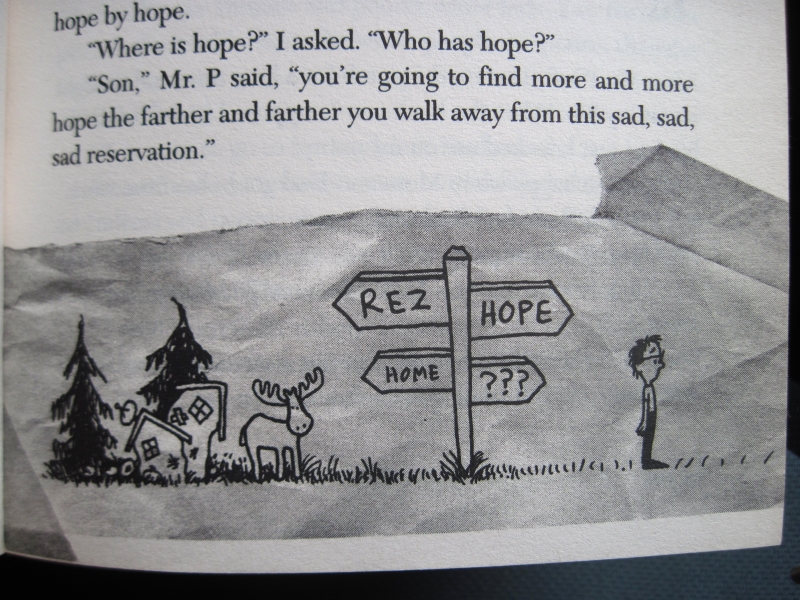
Junior soon becomes adept at code-switching: “Traveling between Reardan and Wellpinit, between the little white town and the reservation, I always felt like a stranger. I was half Indian in one place and half white in the other.” He gets a white girlfriend, Penelope, but has to work hard to conceal how impoverished he is. His best friend, Rowdy, is furious with him for abandoning his people. That resentment builds all the way to a climactic basketball match between Reardan and Wellpinit that also functions as a symbolic battle between the parts of Junior’s identity. Along the way, there are multiple tragic deaths in which alcohol, inevitably, plays a role. “I’m fourteen years old and I’ve been to forty-two funerals,” he confides. “Jeez, what a sucky life. … I kept trying to find the little pieces of joy in my life. That’s the only way I managed to make it through all of that death and change.”
One of those joys, for him, is cartooning. Describing his cartoons to his new white friend, Gordy, he says, “I use them to understand the world.”

Forney’s black-and-white illustrations make the cartoons look like found objects – creased scraps of notebook paper sellotaped into a diary. This isn’t a graphic novel, but most of the short chapters include several illustrations. There’s a casual intimacy to the whole book that feels absolutely authentic. Bridging the particular and universal, it’s a heartfelt gem, and not just for teens. (University library) 
Some Kids I Taught and What They Taught Me by Kate Clanchy (2019)
If your Twitter sphere and mine overlap, you may remember the controversy over the racialized descriptions in this Orwell Prize-winning memoir of 30 years of teaching – and the fact that, rather than issuing a humbled apology, Clanchy, at least initially, doubled down and refuted all objections, even when they came from BIPOC. It wasn’t a good look. Nor was it the first time I’ve found Clanchy to be prickly. (She is what, in another time, might have been called a formidable woman.) Anyway, I waited a few years for the furore to die down before trying this for myself.
I know vanishingly little about the British education system because I don’t have children and only experienced uni here at a distance, through my junior year abroad. So there may be class-based nuances I missed – for instance, in the chapter about selecting a school for her oldest son and comparing it with the underprivileged Essex school where she taught. But it’s clear that a lot of her students posed serious challenges. Many were refugees or immigrants, and she worked for a time on an “Inclusion Unit,” which seems to be more in the business of exclusion in that it’s for students who have been removed from regular classrooms. They came from bad family situations and were more likely to end up in prison or pregnant. To get any of them to connect with Shakespeare, or write their own poetry, was a minor miracle.

Clanchy is also a poet and novelist – I’ve read one of her novels, and her Selected Poems – and did much to encourage her students to develop a voice and the confidence to have their work published (she’s produced anthologies of student work). In many cases, she gave them strategies for giving literary shape to traumatic memories. The book’s engaging vignettes have all had the identifying details removed, and are collected under thematic headings that address the second part of the title: “About Love, Sex, and the Limits of Embarrassment” and “About Nations, Papers, and Where We Belong” are two example chapters. She doesn’t avoid contentious topics, either: the hijab, religion, mental illness and so on.
You get the feeling that she was a friend and mentor to her students, not just their teacher, and that they could talk to her about anything and rely on her support. Watching them grow in self-expression is heart-warming; we come to care for these young people, too, because of how sincerely they have been created from amalgams. Indeed, Clanchy writes in the introduction that “I have included nobody, teacher or pupil, about whom I could not write with love.”
And that is, I think, why she was so hurt and disbelieving when people pointed out racism in her characterization:
I was baffled when a boy with jet-black hair and eyes and a fine Ashkenazi nose named David Marks refused any Jewish heritage
her furry eyebrows, her slanting, sparking black eyes, her general, Mongolian ferocity. [but she’s Afghan??]
(of girls in hijabs) I never saw their (Asian/silky/curly?) hair in eight years.
They’re a funny pair: Izzat so small and square and Afghan with his big nose and premature moustache; Mo so rounded and mellow and Pakistani with his long-lashed eyes and soft glossy hair.
There are a few other ill-advised passages. She admits she can’t tell the difference between Kenyan and Somali faces; she ponders whether being a Scot in England gave her some taste of the prejudice refugees experience. And there’s this passage about sexuality:
Are we all ‘fluid’ now? Perhaps. It is commonplace to proclaim oneself transsexual. And to actually be gay, especially if you are as pretty as Kristen Stewart, is positively fashionable. A couple of kids have even changed gender, a decision … deliciously of the moment
My take: Clanchy wanted to craft affectionate pen portraits that celebrated children’s uniqueness, but had to make them anonymous, so resorted to generalizations. Doing this on a country or ethnicity basis was the mistake. Journalistic realism doesn’t require a focus on appearances (I would hope that, if I were ever profiled, someone could find more interesting things to say about me than that I am short and have a large nose). She could have just introduced the students with ‘facts,’ e.g., “Shakila, from Afghanistan, wore a hijab and was feisty and outspoken.” Note to self: white people can be clueless, and we need to listen and learn. The book was reissued in 2022 by independent publisher Swift Press, with offending passages removed (see here for more info). I’d be keen to see the result and hope that the book will find more readers because, truly, it is lovely. (Little Free Library)
Recent Writing for BookBrowse, Foreword, Shelf Awareness, Shiny New Books, and the TLS
I’ve compiled excerpts from some reviews I’ve contributed to other websites and publications this year. I link to the full text where available. (When writing a paid review, I seek to be balanced but positive. Ratings reflect my personal response.)
BookBrowse
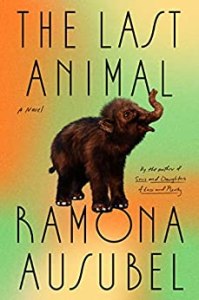 The Last Animal by Ramona Ausubel: In Ausubel’s offbeat third novel, a widowed scientist and her two daughters embark on a rogue plan to make history by resurrecting the woolly mammoth. There is a quirky combination of cosmic and domestic concerns here. A winsome sister duo is at the heart of the unusual and timely story, with priority given to the points of view of teenagers Eve and Vera, whose banter is a highlight. Ausubel has wisely chosen not to dwell on the scientific details of de-extinction, yet that means that this becomes more like speculative fiction or a fairy tale. Ironically, the fabulist-leaning novel is best when most realist, documenting struggles with bereavement, sexism and parenting teens.
 The Lost Wife by Susanna Moore: Moore’s hard-hitting novella is based in part on the memoir Six Weeks in the Sioux Tepees: A Narrative of Indian Captivity. In Moore’s version, Sarah, 25, leaves her baby behind when she flees an abusive husband, and once in Minnesota Territory marries John Brinton, who becomes a doctor on a Sioux reservation. By 1862, Sarah is friendly with the Native women. Although the Civil War is unfolding, the greater threat here is of revolt by the starving Indigenous residents. There is much of anthropological and historical interest, but Sarah’s flat storytelling, which may represent a pastiche of period style, means threatening or climactic scenes lose some of their potential gravity.
Foreword
 My Mother Says by Stine Pilgaard (trans. from the Danish by Hunter Simpson): After breaking up with her zookeeper girlfriend over their age gap and their conflicting takes on motherhood, the heroine moves back in with her father, a pastor who’s obsessed with Pink Floyd, and her stepmother. Her mother visits often, nagging her to finish her thesis. The line between her conversations and internal thoughts is thin. From her mansplaining doctor, she learns that the brain’s hippocampus is named for its seahorse shape. This inspires “Monologues of a Seahorse,” interludes of stream-of-consciousness association. Experimental and whimsical, this delivers deadpan narration of everyday woes.
 In Vitro: On Longing and Transformation by Isabel Zapata (trans. from the Spanish by Robin Myers): A Mexican poet probes the enduring mysteries of pregnancy and birth in a memoir in fragments that travels from fertility treatment through to the early weeks of pandemic-time motherhood. The clinical language of a gynecological history—late menstruation, polycystic ovary syndrome, eighteen years on the pill, and infertility—and the embryo transfer process contrasts with Zapata’s mystical thinking. The microessays integrate family stories, history, and artistic explorations. This resolute account of a personal metamorphosis alchemizes tender experiences into enchanting vignettes.
Shelf Awareness
Fiction
 Daughters of Nantucket by Julie Gerstenblatt: This engrossing debut novel explores the options for women in the mid-19th century while bringing a historical tragedy to life. Metaphorical conflagrations blaze in the background in the days leading up to the great Nantucket fire of 1846: each of three female protagonists (a whaling captain’s wife, a museum curator, and a pregnant Black entrepreneur) holds a burning secret and longs for a more expansive, authentic life. The action spans two tense weeks, one week before the fire through eight days after. The women’s lives collide in two climactic scenes. Gerstenblatt’s eye for detail results in sultry historical fiction for Sue Monk Kidd’s readers.
 Camp Zero by Michelle Min Sterling: Sterling’s brilliantly unsettling debut novel is set in mid-21st-century, post-oil North America. Prioritizing perspectives from two all-female communities, it contrasts the heights of opulence and technology with the basic instinct for survival. How the strands connect is a mystery sustained through much of the book. Characters go by multiple names and harbor ulterior motives; scenes echo each other as disparate subplots meet in unexpected ways. The background is all too plausible. Sterling also takes to its logical extreme the state of being constantly online. Compelling dystopian cli-fi with three-dimensional characters—perfect for fans of Station Eleven and To Paradise.
 Dear Chrysanthemums by Fiona Sze-Lorrain: In this elegant collection of 11 linked short stories by a poet and translator, China’s mid-20th-century political upheaval casts a long shadow. Music and food, not to mention love, bring meaning to those displaced in the aftermath of dissent. The stories—set in China, Singapore, Paris, and New York—span seven decades but always take place in a year ending in a six, a sacred number in Chinese divination. A highlight is “News from Saigon,” in which a prostitute meets Marguerite Duras in a Paris café. The connections are subtle, with the final story pulling together many strands. Ideal for readers of Madeleine Thien’s Do Not Say We Have Nothing.
Nonfiction
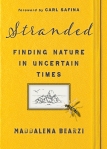 Stranded by Maddalena Bearzi: Bearzi developed a deep love for marine fauna during childhood summers in Sardinia and cofounded the Ocean Conservation Society in the 1990s. Temporarily confined to land by Covid-19 lockdowns, she adopts a different tactic for exploring animal behavior: “an urban safari in my backyard and neighborhood.” These nature essays exemplify evenhandedness, curiosity, and close observation. From wasps to night-blooming flowers, her interest is wide-ranging. Gardening is a relaxing pastime and a connection to her mother while they are separated. As a behavioral ecologist, she views even her dog as a subject of study. A passionate primer to appreciating everyday nature.
Poetry
 Lo by Melissa Crowe: This incandescent autobiographical collection travels from girlhood to marriage and motherhood in post-pandemic USA. Crowe delves into sexual abuse and growing up in rural poverty. Yet the collection is so carefully balanced in tone that it never feels bleak. The emotional range is enhanced by alliteration and botanical imagery.
 Dislocations by Karen Enns: The fourth collection by Canadian poet Enns skillfully evokes a rural upbringing and revels in the beauty of nature and music. One of its aphorisms could encapsulate the entire collection: “The ratio of love to grief / we understood as music.” Updating the pastoral tradition, the bittersweet verse also takes solace in the past.
Shiny New Books
A Fortunate Woman by Polly Morland & A Fortunate Man by John Berger: The similarities go much further than the title and subject matter: these two biographical works, both illustrated with black-and-white photographs, are set in the same English valley and the female subject of Morland’s is the next-but-one successor of the doctor who stars in Berger’s.
 Berger (1926–2017), an art critic and Booker Prize-winning novelist, spent six weeks shadowing the doctor, to whom he gives the pseudonym John Sassall, with Swiss documentary photographer Jean Mohr, his frequent collaborator. Sassall’s dedication was legendary: he attended every birth in this community, and nearly every death. Sassall’s middle-class origins set him apart from his patients. There’s something condescending about how Berger depicts the locals as simple peasants. Mohr’s photos include soft-focus close-ups on faces exhibiting a sequence of emotions, a technique that feels outdated in the age of video. Along with recording the day-to-day details of medical complaints and interventions, Berger waxes philosophical on topics such as infirmity and vocation. A Fortunate Man is a curious book, part intellectual enquiry and part hagiography.
 With its layers of local history and its braided biographical strands, A Fortunate Woman takes up many of the same heavy questions but feels more subtle and timely. It also soon delivers a jolting surprise: the doctor Berger called John Sassall was likely bipolar and, soon after the death of his beloved wife Betty, committed suicide in 1982. His story still haunts this community, where many of the older patients remember going to him for treatment. Like Berger, Morland keenly follows a range of cases. As the book progresses, we see this beautiful valley cycle through the seasons, with certain of Richard Baker’s landscape shots deliberately recreating Mohr’s scene setting. The timing of Morland’s book means that it morphs from a portrait of the quotidian for a doctor and a community to, two-thirds through, an incidental record of the challenges of medical practice during COVID-19.
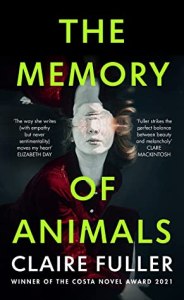 The Memory of Animals by Claire Fuller: Neffy has nothing to lose when she enrolls in a controversial vaccine trial in a familiar mid-pandemic landscape. The novel is presented as her journal. The bulk takes place in two weeks she spends on a locked unit with four fellow test subjects. In the meantime, she is introduced to an experimental technology for reliving memories. The characterisation of the four other cast members is somewhat thin, and the elements feel randomly assembled. The world-building and tech are unlikely to stand up to science fiction fans’ scrutiny, but this has just the right dose of the speculative for literary fiction readers. It also happens to fit into a recent vogue for octopus novels.
Times Literary Supplement
A late-twenties journalist sets out to survey the situation on the ground for ten British species being squeezed out by anthropogenic climate change: The mission is very similar, and both authors embody passionate dedication to conservation, but the difference in tone of these travel narratives makes them likely to appeal to separate audiences…
In Search of One Last Song by Patrick Galbraith & Forget Me Not by Sophie Pavelle:
 Galbraith’s is an elegiac tour through imperilled countryside and urban edgelands. Each chapter resembles an in-depth magazine article: a carefully crafted profile of a beloved bird species, with a focus on the specific threats it faces. Galbraith recognises the nuances of land use. However, shooting plays an outsized role. (Curious for his bio not to disclose that he is editor of the Shooting Times.) The title’s reference is to literal birdsong, but the book also celebrates birds’ cultural importance through their place in Britain’s folk music and poetry. He is clearly enamoured of countryside ways, but too often slips into laddishness, with no opportunity missed to mention him or another man having a “piss” outside. Readers could also be forgiven for concluding that “Ilka” (no surname, affiliation or job title), who briefs him on her research into kittiwake populations in Orkney, is the only female working in nature conservation in the entire country; with few exceptions, women only have bit parts: the farm wife making the tea, the receptionist on the phone line, and so on.
 Pavelle’s book is a tonic in more ways than one. Employed by Beaver Trust, she is enthusiastic and self-deprecating. Her nature quest has a broader scope, including insects like the marsh fritillary and marine species such as seagrass and the Atlantic salmon. Travelling between lockdowns in 2020–1, Pavelle took low-carbon transport wherever possible and bolsters her trip accounts with context, much of it gleaned from Zoom calls and e-mail correspondence with experts from museums and universities. Refreshingly, around half of these interviewees are women, and the animal subjects are never the obvious choices. Instead, she seeks out “underdog” species. The explanations are at a suitable level for laymen, true to her job as a science communicator. The snappy, casual prose (“the future of the bilberry bumblebee and its Aperol arse can be bright, but only if we get off our own”) could even endear her to teenage readers. As image goes, Pavelle’s cheerful naïveté holds more charm than Galbraith’s hardboiled masculinity.
 Taking Flight by Lev Parikian: Parikian’s accessible account of the animal kingdom’s development of flight exhibits a layman’s enthusiasm for an everyday wonder. He explicates the range of flying strategies and the structural adaptations that made them possible. The archaeopteryx section, chronicling the transition between dinosaurs and birds, is a highlight. Though the most science-heavy of the author’s six works, this, perhaps ironically, has fewer footnotes. His usual wit is on display: he describes the feral pigeon as “the Volkswagen Golf of birds” and penguins as “piebald blubber tubes”. This makes it a pleasure to tag along on a journey through evolutionary time, one sure to engage even history- and science-phobes.
Do any of these catch your eye?
20 Books of Summer, 17–20: Bennett, Davidson, Diffenbaugh, Kimmerer
As per usual, I’m squeezing in my final 20 Books of Summer reviews late on the very last day of the challenge. I’ll call it a throwback to the all-star procrastination of my high school and college years. This was a strong quartet to finish on: two novels, the one about (felling) trees and the other about communicating via flowers; and two nonfiction books about identifying trees and finding harmony with nature.
Tree-Spotting: A Simple Guide to Britain’s Trees by Ros Bennett; illus. Nell Bennett (2022)
Botanist Ros Bennett has designed this as a user-friendly guide that can be taken into the field to identify 52 of Britain’s most common trees. Most of these are native species, plus a few naturalized ones. “Walks in the countryside … take on a new dimension when you find yourself on familiar, first-name terms with the trees around you,” she encourages. She introduces tree families, basics of plant anatomy and chemistry, and the history of the country’s forests before moving into identification. Summer leaves make ID relatively easy with a three-step set of keys, explained in words as well as with impressively detailed black-and-white illustrations of representative species’ leaves (by her daughter, Nell Bennett).

Seasonality makes things trickier: “Identifying plants is not rocket science, though occasionally it does require lots of patience and a good hand lens. Identifying trees in winter is one of those occasions.” This involves a close look at details of the twigs and buds – a challenge I’ll be excited to take up on canalside walks later this year. The third section of the book gives individual profiles of each featured species, with additional drawings. I learned things I never realized I didn’t know (like how to pronounce family names, e.g., Rosaceae is “Rose-A-C”), and formalized other knowledge. For instance, I can recognize an ash tree by sight, but now I know you identify an ash by its 9–13 compound, opposite, serrated leaflets.

Some of the information was more academic than I needed (as with one of my earlier summer reads, The Ash Tree by Oliver Rackham), but it’s easy to skip any sections that don’t feel vital and come back to them another time. I most valued the approachable keys and their accompanying text, and will enjoy taking this compact naked hardback on autumn excursions. Bennett never dumbs anything down, and invites readers to delight in discovery. “So – go out, introduce yourself to your neighbouring trees and wonder at their beauty, ingenuity and variety.”
With thanks to publicist Claire Morrison and Welbeck for the free copy for review.
Damnation Spring by Ash Davidson (2021)
When this would-be Great American Novel* arrived unsolicited through my letterbox last summer, I was surprised I’d not encountered the pre-publication buzz. The cover blurb is from Nickolas Butler, which gives you a pretty good sense of what you’re getting into: a gritty, working-class story set in what threatens to be an overwhelmingly male milieu. For generations, Rich Gundersen’s family has been involved in logging California’s redwoods. Davidson is from Arcata, California, and clearly did a lot of research to recreate an insider perspective and a late 1970s setting. There is some specialist vocabulary and slang (the loggers call the largest trees “big pumpkins”), but it’s easy enough to understand in context.
 What saves the novel from going too niche is the double billing of Rich and his wife, Colleen, who is an informal community midwife and has been trying to get pregnant again almost ever since their son Chub’s birth. She’s had multiple miscarriages, and their family and acquaintances have experienced alarming rates of infant loss and severe birth defects. Conservationists, including an old high school friend of Colleen’s, are attempting to stop the felling of redwoods and the spraying of toxic herbicides.
A major element, then, is people gradually waking up to the damage chemicals are doing to their waterways and, thereby, their bodies. The problem, for me, was that I realized this much earlier than any of the characters, and it felt like Davidson laid it on too thick with the many examples of human and animal deaths and deformities. This made the book feel longer and less subtle than, e.g., The Overstory. I started it as a buddy read with Marcie (Buried in Print) 11 months ago and quickly bailed, trying several more times to get back into the book before finally resorting to skimming to the end. Still, especially for a debut author, Davidson’s writing chops are impressive; I’ll look out for what she does next. 
*I just spotted that it’s been shortlisted for the $25,000 Mark Twain American Voice in Literature Award.
With thanks to Tinder Press for the proof copy for review.
The Language of Flowers by Vanessa Diffenbaugh (2011)
The cycle would continue. Promises and failures, mothers and daughters, indefinitely.
 The various covers make this look more like chick lit than it is. Basically, it’s solidly readable issues- and character-driven literary fiction, on the lighter side but of the caliber of any Oprah’s Book Club selection. It reminded me most of White Oleander by Janet Fitch, one of my 20 Books selections in 2018, because of the focus on the foster care system and a rebellious girl’s development in California, and the floral metaphors.
In Diffenbaugh’s debut, Victoria Jones ages out of foster care at 18 and leaves her group home for an uncertain future. She spends time homeless in San Francisco but her love of flowers, and particularly the Victorian meanings assigned to them, lands her work in a florist’s shop and reconnects her with figures from her past. Chapters alternate between her present day and the time she came closest to being adopted – by Elizabeth, who owned a vineyard and loved flowers, when she was nine. We see how estrangements and worries over adequate mothering recur, with Victoria almost a proto-‘Disaster Woman’ who keeps sabotaging herself. Throughout, flowers broker reconciliations.
I won’t say more about a plot that would be easy to spoil, but this was a delight and reminded me of a mini flower dictionary with a lilac cover and elaborate cursive script that I owned when I was a child. I loved the thought that flowers might have secret messages, as they do for the characters here. Whatever happened to that book?! (Charity shop)
Braiding Sweetgrass: Indigenous Wisdom, Scientific Knowledge and the Teachings of Plants by Robin Wall Kimmerer (2013)
I’d heard Kimmerer recommended by just about every nature writer around, North American or British, and knew I needed this on my shelf. Before I ever managed to read it, I saw her interviewed over Zoom by Lucy Jones in July 2021 about her other popular science book, Gathering Moss, which was first published 18 years ago but only made it to the UK last year. So I knew what a kind and peaceful person she is: she just emanates warmth and wisdom, even over a computer screen.
And I did love Braiding Sweetgrass nearly as much as I expected to, with the caveat that the tiny-print 400 pages of my paperback edition make the essays feel very dense. I could only read a handful of pages in a sitting. Also, after about halfway, it started to feel a bit much, like maybe she had given enough examples from her life, Native American legend and botany. The same points about gratitude for the gifts of the Earth, kinship with other creatures, responsibility and reciprocity are made over and over.
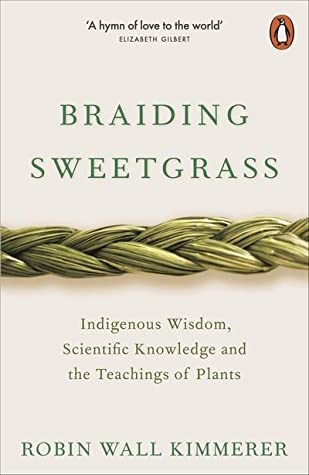 However, I feel like this is the spirituality the planet needs now, so I’ll excuse any repetition (and the basket-weaving essay I thought would never end). “In a world of scarcity, interconnection and mutual aid become critical for survival. So say the lichens.” (She’s funny, too, so you don’t have to worry about the contents getting worthy.) She effectively wields the myth of the Windigo as a metaphor for human greed, essential to a capitalist economy based on “emptiness” and “unmet desires.”
I most enjoyed the shorter essays that draw on her fieldwork or her experience of motherhood. “The Gift of Strawberries” – “An Offering” – “Asters and Goldenrod” make a stellar three-in-a-row, and “Collateral Damage” is an excellent later one about rescuing salamanders from the road, i.e. doing the small thing that we can do rather than being overwhelmed by the big picture of nature in crisis. “The Sound of Silverbells” is one of the most well-crafted individual pieces, about taking a group of students camping when she lived in the South. At first their religiosity (creationism and so on) grated, but when she heard them sing “Amazing Grace” she knew that they sensed the holiness of the Great Smoky Mountains.
But the pair I’d recommend most highly, the essays that made me weep, are “A Mother’s Work,” about her time restoring an algae-choked pond at her home in upstate New York, and its follow-up, “The Consolation of Water Lilies,” about finding herself with an empty nest. Her loving attention to the time-consuming task of bringing the pond back to life is in parallel to the challenges of single parenting, with a vision of the passing of time being something good rather than something to resist.
Here are just a few of the many profound lines:
For all of us, becoming indigenous to a place means living as if your children’s future mattered, to take care of the land as if our lives, both material and spiritual, depended on it.
I’m a plant scientist and I want to be clear, but I am also a poet and the world speaks to me in metaphor.
Ponds grow old, and though I will too, I like the ecological idea of aging as progressive enrichment, rather than progressive loss.
This will be a book to return to time and again. (Gift from my wish list several years ago)
I also had one DNF from this summer’s list:
Human Croquet by Kate Atkinson: This reminded me of a cross between The Crow Road by Iain Banks and The Heavens by Sandra Newman, what with the teenage narrator and a vague time travel plot with some Shakespearean references. I put it on the pile for this challenge because I’d read it had a forest setting. I haven’t had much luck with Atkinson in the past and this didn’t keep me reading past page 60. (Little Free Library)
A Look Back at My 20 Books of Summer 2022
Half of my reads are pictured here. The rest were e-books (represented by the Kindle) or have already had to go back to the library.

My fiction standout was The Language of Flowers, reviewed above. Nonfiction highlights included Forget Me Not and Braiding Sweetgrass, with Tree-Spotting the single most useful book overall. I also enjoyed reading a couple of my selections on location in the Outer Hebrides. The hands-down loser (my only 1-star rating of the year so far, I think?) was Bonsai. As always, there are many books I could have included and wished I’d found the time for, like (on my Kindle) A House among the Trees by Julia Glass, This Is Your Mind on Plants by Michael Pollan and Finding the Mother Tree by Suzanne Simard.
At the start, I was really excited about my flora theme and had lots of tempting options lined up, some of them literally about trees/flowers and others more tangentially related. As the summer went on, though, I wasn’t seeing enough progress so scrambled to substitute in other things I was reading from the library or for paid reviews. This isn’t a problem, per se, but my aim with this challenge has generally been to clear TBR reads from my own shelves. Maybe I didn’t come up with enough short and light options (just two novella-length works and a poetry collection; only the Diffenbaugh was what I’d call a page-turner); also, even with the variety I’d built in, having a few plant quest memoirs got a bit samey.

Next year…
I’m going to skip having a theme and set myself just one simple rule: any 20 print books from my shelves (NOT review copies). There will then be plenty of freedom to choose and substitute as I go along.
Literary Wives Club: The Sentence by Louise Erdrich
This has been my first read with the Literary Wives online book club. The other members will also be posting their thoughts this week; we consider four books per year in total.
See also the reviews by:
Kay at What Me Read
Lynn at Smoke & Mirrors
Naomi at Consumed by Ink
I wrote a general review of The Sentence in April when it was on the Women’s Prize longlist (it has since advanced to the shortlist). This time I’m focusing on the relationship between Tookie and Pollux. The central question we ask about the books we read for Literary Wives is:
What does this book say about wives or about the experience of being a wife?
 ~SPOILERS IN THIS ONE~
There are some unusual aspects to the central marriage in this novel. For one thing, Pollux, a former tribal policeman, was the one to arrest Tookie. For another, although he is a “ceremony man” keeping up Native American rituals (e.g., burning sweetgrass and receiving an eagle corpse from the government to make a fan), he doesn’t believe in ghosts, so Tookie keeps Flora’s haunting of the bookshop from him, as well as from some of her colleagues. For a time, this secret makes Tookie feel like she’s facing the supernatural alone.
Pollux does not, cumulatively, get a lot of page time in the novel, yet I got the sense that he was always there in the background as support. Their relationship is casual and sweet, with lots of banter and a good dollop of sex considering they’re some way into middle age. Clearly, they rely on each other. Their marriage keeps Tookie grounded even when traumatic memories or awful current events rear up.
Now I live as a person with a regular life. A job with regular hours after which I come home to a regular husband. … I live the way a person does who has ceased to dread each day’s ration of time. I live what can be called a normal life only if you’ve always expected to live such a way. If you think you have the right. Work. Love. Food. A bedroom sheltered by a pine tree. Sex and wine.
The thing I knew was that if anything happened to Pollux I would die too. I would be happy to die. I would make sure that I did.
With the latter passage in mind, I did fear the worst when Pollux caught Covid and was hospitalized; I was as relieved as Tookie when he was discharged.
Along with Pollux comes his daughter, Hetta, and her baby son Jarvis. Tookie and Hetta had generally been cool towards each other, but the presence of the baby and the lockdown situation soften things between them. Having never been a maternal sort, Tookie falls completely in love with Jarvis and takes every excuse to babysit him. This gives us a welcome glimpse into another aspect of her character.
I noted a couple of other passages where rituals have practical or metaphorical significance for the central relationship:
At a New Year’s buffet: “a wild rice argument can wreck friendships, kill marriages, if allowed to rage.”
“You let the logs burn long enough so they made a space between them. You gotta keep the fire new. Every piece of wood needs a companion to keep it burning. Now push them together. Not too much. They also need that air. Get them close, but not on top of each other. Just a light connection all the way along. Now you’ll see a row of even flames.”
Pollux is literally instructing Tookie in how to light a fire there, but could just as well be prescribing what makes a marriage work. Connection but a bit of distance; support plus freedom. Their existence as a couple seems to achieve that. They have their individual lives with separate jobs and hobbies, but also a cosy bond that buoys them.
Next book: Red Island House by Andrea Lee in September.
Women’s Prize Longlist Reviews (Erdrich, Mendelson, Ozeki) & Predictions
Tomorrow the Women’s Prize shortlist will be revealed. I’ve become much more invested in this prize over the past few years and will be following the 2022 race especially closely – look out for a related announcement soon. In recent years the nominees have tended to cluster thematically, which can feel redundant. This longlist has a notably high ghost quotient. Two novels I review below feature unquiet spirits, an appearance by the author, and the magical powers of books. The third is a straightforward contemporary dysfunctional family story.
The Sentence by Louise Erdrich
My second from Erdrich (I gave Love Medicine, her first novel, 5 stars in 2020). I will be revisiting this in June because it is our first pick for my tenure in the Literary Wives online book club. For that post I’ll focus on the relationship between Tookie and Pollux, which I won’t mention in this more general response. I was worried that a take on very recent events – this is set in Minneapolis between 2019 and 2020 and covers the first six months of the pandemic plus local protests following George Floyd’s murder – would seem either rushed or dated. I’m still unsure how I feel about encountering Covid-19 in fiction (vs. I’ve read 20 or more nonfiction records now), but I think this novel functions as a sturdy time capsule.
Tookie, the narrator, has a tough exterior but a tender heart. When she spent 10 years in prison for a misunderstanding-cum-body snatching, books helped her survive, starting with the dictionary. Once she got out, she translated her love of words into work as a bookseller at Birchbark Books, Louise Erdrich’s Minnesota independent bookshop (Louise herself is an occasional character). Bibliophiles are sure to enjoy the mentions of the books she presses into customers’ hands; there’s also a fun appendix of recommendations on particular topics.
However, the central mystery about Flora, a dead customer who haunts the store until Tookie figures out why she died and how to exorcise her, struck me as silly. I only appreciated this storyline to the extent that it explores authenticity (Flora may have fabricated her Native heritage) and the inescapability of history. I preferred real life: Tookie getting locked down with her stepdaughter and baby grandson and filling book orders from a closed shop.
Erdrich weaves in Indigenous customs naturally and the banter between the characters, including young shop employees, makes this hip and lighthearted, even as it deals with serious subjects. I smiled at the bookish lingo, like Tookie’s division of her reading into a Lazy Stack and a Hard Stack (“books I would avoid reading until some wellspring of mental energy was uncapped” – my occasional and set-aside titles could comprise the latter) and the “cowbirds,” self-published titles secreted on the shelves that aren’t found until inventory day. There’s also an excellent passage on novellas that I’ll be bringing out in November.
Like a vintage armchair, this is a little overstuffed, but so comfortable you’ll want to stay a while. (See also Laura’s review.) (Public library)
The Exhibitionist by Charlotte Mendelson
~SPOILERS IN THIS ONE~
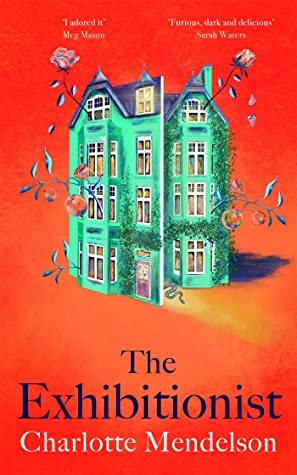 Artists, dysfunctional families, and limited settings (here, one crumbling London house and its environs; and about two days across one weekend) are irresistible elements for me, and I don’t mind a work being peopled with mostly unlikable characters. That’s just as well, because the narrative orbits Ray Hanrahan, a monstrous narcissist who insists that his family put his painting career above all else. His wife, Lucia, is a sculptor who has always sacrificed her own art to ensure Ray’s success. But now Lucia, having survived breast cancer, has the chance to focus on herself. She’s tolerated his extramarital dalliances all along; why not see where her crush on MP Priya Menon leads? What with fresh love and the offer of her own exhibition in Venice, maybe she truly can start over in her fifties.
Ray and Lucia’s three grown children, Leah, Patrick and Jess, are all home for Ray’s new exhibition. They’re mere sketches: Leah is Ray’s staunchest supporter and is infatuated with the no-show caterer; Patrick’s mental health is shaky, interfering with his job prospects; Jess, a teacher in Edinburgh, is pregnant but not sure she’s committed to her boyfriend long term. I wanted more depth from all the characters, but especially the offspring. I also expected a climactic late scene on Hampstead Heath to come to more.
Still, the build-up to the exhibit (followed by a laughably pitiful reveal) and Lucia’s inner life form an adequately strong foundation for Mendelson’s sardonic prose. The dialogue, full of interruptions, is true to life. This is her fifth novel and called to mind Jami Attenberg’s and Claire Fuller’s work. (Liz found shades of Iris Murdoch. Susan loved it, too.) I wouldn’t say I’m compelled to seek out more by Mendelson, but this was a solid read. (Public library)
The Book of Form and Emptiness by Ruth Ozeki
A Tale for the Time Being is one of my favourite novels of the century (and one of my most popular Goodreads reviews ever), My Year of Meats was a terrific backlist read a couple of summers ago, and I’m eager to catch up on All Over Creation. So I’d built up this fourth Ozeki novel in my head, thinking a library setting and magic realist elements presaged something deliciously Murakami-esque.
 What I actually found, having limped through it off and on for seven months, was something of a disappointment. A frank depiction of the mental health struggles of the Oh family? Great. A paean to how books and libraries can save us by showing us a way out of our own heads? A-OK. The problem is with the twee way that The Book narrates Benny’s story and engages him in a conversation about fate versus choice.
When Kenji Oh, a jazz musician, is run over by a chicken truck, Annabelle finds herself a single mother to Benny, a troubled teen who starts to hear everyday objects speaking to him. His voices and Annabelle’s hoarding habit jeopardize the viability of their household: Benny spends time on a psychiatric hospital ward for minors and Annabelle is threatened with eviction. For Benny, the library and the acquaintances he makes there – a fellow pedi-psych patient named Alice who calls herself The Aleph, an Eastern European philosopher who goes by The Bottleman (= Slavoj Žižek?), even the Ozeki figure tapping away on her laptop – may be his salvation; for Annabelle, it could be the book Tidy Magic (modelled on Marie Kondo’s work), written by a Buddhist nun. But until then, their stories get very dark indeed.
Concern for the principal pair and their relationship kept me reading even though this is too long and I wearied of Ozeki’s habit of literalizing metaphors (books speaking to people; being crushed by one’s belongings; crows playing a protective role). I’m still sympathetic to Ozeki’s aims, even if she doesn’t quite pull it all off here. If I pit the rather similar The Sentence and The Book of Form and Emptiness against each other, Erdrich comes out ahead.
With thanks to Canongate for the proof copy for review.
I’ve gotten to six books from the longlist so far and have a few more on order at the library. The others I’ve read, with ratings and links to my reviews, are:
Build Your House around My Body by Violet Kupersmith
Sorrow and Bliss by Meg Mason
I’m also partway through The Final Revival of Opal & Nev by Dawnie Walton, which is enjoyable enough but, alas, suffers in comparison to Daisy Jones and the Six, whose format (a composite oral history of a fictional 1960s/70s musical act) it repeats. The addition of the race issue doesn’t feel sufficient to call it original.
I’ve also DNFed a few from the longlist, two of them multiple times, so I have my fingers crossed that they don’t advance!
- The Paper Palace by Miranda Cowley Heller
- The Island of Missing Trees by Elif Shafak
- Great Circle by Maggie Shipstead
My attitude to the rest of the longlist is…
- The Bread the Devil Knead by Lisa Allen-Agostini – No plans to read.
- Salt Lick by Lulu Allison – I might read this from the library. I’m leery of dystopias, but I’m there for a chorus of cows.
- Careless by Kirsty Capes – No plans to read.
- Remote Sympathy by Catherine Chidgey – I would happily read it if it’s shortlisted, but at over 500 pages I fear it’ll be too dense.
- Flamingo by Rachel Elliott – Maybe. Sounds like pretty standard Sarah Winman-type stuff, but it could go down well with a book club.
- This One Sky Day by Leone Ross – No plans to read.
- Creatures of Passage by Morowa Yejidé – I was actually pretty keen to read this one, so I have it on reserve at the library. Egyptian mythology makes a change from the overdone Greeks, and the Washington, D.C. setting is a big draw. Laura’s review has tempered my expectations, but I might still give it a go.
My ideal shortlist (a wish list based on my reading and what I still want to read):
The Sentence by Louise Erdrich
Build Your House around My Body by Violet Kupersmith
Sorrow and Bliss by Meg Mason
The Exhibitionist by Charlotte Mendelson
The Final Revival of Opal & Nev by Dawnie Walton
Creatures of Passage by Morowa Yejidé
vs.
My predicted shortlist:
Remote Sympathy by Catherine Chidgey
The Sentence by Louise Erdrich
Sorrow and Bliss by Meg Mason
The Exhibitionist by Charlotte Mendelson
This One Sky Day by Leone Ross
The Island of Missing Trees by Elif Shafak
An overall winner? Gosh, it’s too early to tell. But maybe The Sentence, Sorrow and Bliss or The Island of Missing Trees.
See also Laura’s shortlist predictions.
What have you read from the longlist so far?
Which of these books are calling to you?
Three on a Theme for Valentine’s Day: “Love” Books by Natalie Diaz, Maile Meloy and Jane Smiley
This post is an annual tradition for me, somehow.* Love, whether erotic, romantic or familial, turns up in the titles of these three works by women writers: poems, short stories and a novella.
Postcolonial Love Poem by Natalie Diaz (2020)
Diaz, raised on a Mojave reservation in California, won a Pulitzer Prize for this honey-thick exploration of queer Native American identity. There are lustful moments aplenty here—
My lover comes to me like darkfall—long,
and through my open window. Mullion, transom. […]
I keep time on the hematite clocks of her shoulders.
(from “Like Church”)
 —but the mineral-heavy imagery (“the agate cups of your palms …the bronzed lamp of my breast”) is so weirdly archaic and the vocabulary so technical that I kept thinking of the Song of Solomon. Not that there’s anything wrong with that; it’s just not the model I expected to find.
So I ended up preferring the forthright political poems about contemporary Native American life. Police shootings, pipeline protests: it’s a fact that her people are disproportionately persecuted (see “American Arithmetic”). Her brother’s drug abuse and mental illness also form a repeating subject (e.g., “It Was the Animals”).
The collection is as much of a love poem to land as it is to a woman, with water bodies described as affectionately as female bodies. “The Colorado River is the most endangered river in the United States—also, it is a part of my body” is the opening line of “The First Water Is the Body”; see also “exhibits from the American Water Museum.”
My favourite single poem, “If I Should Come Upon Your House Lonely in the West Texas Desert,” is sexy but also, charmingly, features echoes of “Goldilocks and the Three Bears”:
I will swing my lasso of headlights
across your front porch,
let it drop like a rope of knotted light
at your feet.
While I put the car in park,
you will tie and tighten the loop
of light around your waist—
and I will be there with the other end
wrapped three times
around my hips horned with loneliness.
[…]
I will lie down in you.
Eat my meals at the red table of your heart.
Each steaming bowl will be, Just right.
I will eat it all up,
break all your chairs to pieces.
(New purchase, Awesomebooks.com) 
Half in Love by Maile Meloy (2002)
Meloy’s was a new name for me when I picked this up as part of a bargain secondhand book haul last year, but she’s actually published 10 books and is esteemed in literary circles; Ann Patchett even dedicated her latest release, These Precious Days, to her.
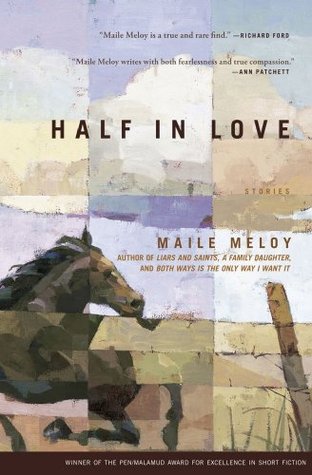 Meloy is from Montana and most of the 14 stories in this, her debut collection, are set in the contemporary American West among those who make their living from the outdoors, diving to work on hydroelectric dams or keeping cattle and horses. However, one of the more memorable stories, “Aqua Boulevard,” is set in Paris, where a geriatric father can’t tamp down his worries for his offspring.
The few historical stories have a melancholy air, with protagonists whose star has faded. There’s the brief, touching portrait of an outmoded career in “The Ice Harvester” and the secondhand reminiscences of being in late-colonial diplomatic service in the Middle East in “Last of the White Slaves”; “Red” is about an American soldier stationed in London during the Second World War.
Crime and its consequences recur. I loved the opening story, “Tome,” about a lawyer whose client wants her to keep in touch after he goes to jail. Teenage girls are the title characters in a couple of stories; “Ranch Girl” is in the second person. “Kite Whistler Aquamarine” is a heartbreaker about a filly born premature one winter. “Paint” was the standout for me: it’s pretty terrifying what a wife’s temporary attitude of neglect leads to when her luckless husband undertakes some DIY.
As is usual with a collection, a few of the stories left little impression on me. But there’s sufficient range and depth here to induce me to seek out more of Meloy’s work. I can recommend this to readers of Claire Boyles, David Guterson, Lily King, Jane Smiley (see below!) and David Vann. (Secondhand purchase, 2nd & Charles)
Favourite passages:
“Be interesting in your twenties,” Suzy says. “Otherwise you’ll want to do it in your thirties or forties, when it wreaks all kinds of havoc, and you’ve got a husband and kids.”
Eugénie invited my husband to Greece every summer because she wanted him to publish her memoir. She had lived a remarkable life but didn’t have a remarkable book, and it dragged through slow ghostwritten revisions. Every year, at work in the hot city, I thought of blue water and white bougainvillea and forgot how exhausting it was to be her guest, to stay in favor and say the right things. So each summer we would arrive, look at the new draft, give careful suggestions that would not be taken, and find ourselves on the terrace waiting for her to trip mercifully off to bed.
Ordinary Love by Jane Smiley (1990)
 This is one of Smiley’s earlier works and feels a little generic, like she hadn’t yet developed a signature voice or themes. One summer, a 52-year-old mother of five prepares for her adult son Michael’s return from India after two years of teaching. His twin brother, Joe, will pick him up from the airport later on. Through conversations over dinner and a picnic in the park, the rest of the family try to work out how Michael has changed during his time away. “I try to accept the mystery of my children, of the inexplicable ways they diverge from parental expectations, of how, however much you know or remember of them, they don’t quite add up.” The narrator recalls her marriage-ending affair and how she coped afterwards. Michael drops a bombshell towards the end of the 91-page novella. Readable yet instantly forgettable, alas. I bought it as part of a dual volume with Good Will, which I don’t expect I’ll read. (Secondhand purchase, Bookbarn International)
If you read just one … It’s got to be Postcolonial Love Poem, the most Eros-appropriate of the three by far.
*I’m really not a Valentine’s Day person, yet this is the sixth year in a row that I’ve put together a themed post featuring books that have “Love” or a similar word in the title in the run-up to mid-February (2017, 2018, 2019, 2020, and 2021).
Read any books about love lately?
Booker Prize 2020: Two More Shortlist Reviews and a Prediction
The 2020 Booker Prize will be announced on Thursday the 19th. (Delayed from the 17th, the date on my commemorative bookmark, so as not to be overshadowed by the release of the first volume of Barack Obama’s presidential memoirs.) After I reviewed Burnt Sugar and correctly predicted half of the shortlist in this post, I’ve managed to finish another two of the novels on the shortlist, along with two more from the longlist. As sometimes happens with prize lists – thinking also of the Women’s Prize race in 2019 – this year’s shortlist fell into rough pairs: two stark mother–daughter narratives, two novels set in Africa, and two gay coming-of-age stories.

The New Wilderness by Diane Cook
In a striking opening to a patchy novel, Bea goes off to the woods to give birth alone to a stillborn daughter. It’s such a different experience to when she birthed Agnes in a hospital eight years ago. Now, with coyotes and buzzards already circling, there’s no time for sentimentality; she turns her back on the baby and returns to the group. Bea is part of a wilderness living experiment that started out with 20 volunteers, but illness and accidents have since reduced their number.
 Back in the toxic, overcrowded City, Bea was an interior decorator and her partner a professor of anthropology. Bea left to give Agnes a better chance at life; like so many other children, she had become ill from her polluted surroundings. Now she is a bright, precocious leader in the making, fully participating in the community’s daily chores. Settlement tempts them, but the Rangers enforce nomadism. Newcomers soon swell their numbers, and there are rumors of other groups, too. Is it even a wilderness anymore if so many people live in it?
The cycles of seasons and treks between outposts make it difficult to get a handle on time’s passing. It’s a jolt to realize Agnes is now of childbearing age. Only when motherhood is a possibility can she fully understand her own mother’s decisions, even if she determines to not repeat the history of abandonment. The blurb promised a complex mother–daughter relationship, but this element of the story felt buried under the rigor of day-to-day survival.
It is as if Cook’s primary interest was in how humans would react to being returned to primitive hunter–gatherer conditions – she did a lot of research into Native American practices, for instance, and she explores the dynamics of sex and power and how legends arise. As a child I was fascinated by Native cultures and back-to-the-land stories, so I enjoyed the details of packing lists, habits, and early rituals that form around a porcelain teacup.
But for me some nuts and bolts of storytelling were lacking here: a propulsive plot, a solid backstory, secondary characters that are worthwhile in their own right and not just stereotypes and generic roles. The appealing description induced me to overcome my usual wariness about dystopian novels, but a plodding pace meant it took me months to read. A lovely short epilogue narrated by Agnes made me wonder how much less tedious this chronicle might have been if told in the first person by Bea and Agnes in turn. I’ll try Cook’s story collection, Man V. Nature, to see if her gifts are more evident in short form.
My rating: 
My thanks to Oneworld for the free copy for review.
Real Life by Brandon Taylor
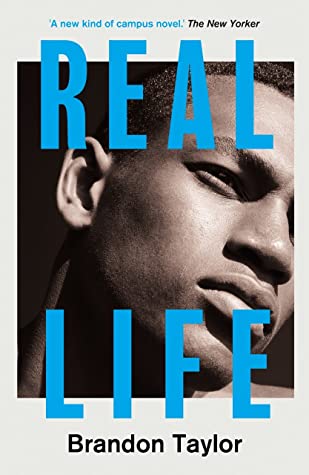 Over the course of one late summer weekend, Wallace questions everything about the life he has built. As a gay African American, he has always been an outsider at the Midwestern university where he’s a graduate student in biochemistry. Though they vary in background and include several homosexuals, some partnered and some unattached, most of his friends are white, and he’s been so busy that he’s largely missed out on evening socializing by the lake – and skipped his father’s funeral (though there are other reasons for that as well).
Tacit prejudice comes out into the open in ugly ways in these few days. When he finds his nematode experiments sabotaged, a female colleague at his lab accuses him of misogyny, brandishing his identity as a weapon against him: “you think that you get to walk around because you’re gay and black and act like you can do no wrong.” Then, in a deliciously awkward dinner party scene, an acquaintance brings up Wallace’s underprivileged Alabama upbringing as if it explains why he’s struggling to cope in his academic career.
Meanwhile, Wallace has hooked up with a male – and erstwhile straight – friend, and though there is unwonted tenderness in this relationship, there is also a hint of menace. The linking of sexuality and violence echoes the memories of abuse from Wallace’s childhood, which tumble out in the first-person stream of consciousness of Chapter 5. Other male friends, too, are getting together or breaking apart over mismatched expectations. Kindness is possible, but built-in injustice and cruelty, whether vengeful or motiveless, too often take hold.
There are moments when Wallace seems too passive or self-pitying, but the omniscient narration emphasizes that all of the characters have hidden depths and that emotions ebb and flow. What looks like despair on Saturday night might feel like no big deal come Monday morning. I so admired how this novel was constructed: the condensed timeframe, the first and last chapters in the past tense (versus the rest in the present tense), the contrast between the cerebral and the bodily, and the thematic and linguistic nods to Virginia Woolf. A very fine debut indeed.
My rating: 
I also read two more of the longlisted novels from the library:
Such a Fun Age by Kiley Reid
 Such a fun book! I’d read the first chapter earlier in the year and set it aside, thinking it was too hip for me. I’m glad I decided to try again – it was a great read, so assured and contemporary. Once I got past a slightly contrived first chapter, I found it completely addictive. The laser-precision plotting and characterization reminded me of Jennifer Egan, Jonathan Franzen and Zadie Smith at their peak, but the sassy voice is all Reid’s own. There are no clear villains here; Alix Chamberlain could easily have filled that role, but I felt for her and for Kelley as much as I did for Emira. The fact that I didn’t think anyone was completely wrong shows how much nuance Reid worked in. The question of privilege is as much about money as it is about race, and these are inextricably intertwined.
Love and Other Thought Experiments by Sophie Ward
 An intriguing set of linked short stories that combine philosophy and science fiction. Rachel and Eliza are preparing to have a baby together when an ant crawls into Rachel’s eye and she falls ill. Eliza wants to believe her partner but, as a scientist, can’t affirm something that doesn’t make sense (“We don’t need to resort to the mystical to describe physical processes,” she says). Other chapters travel to Turkey, Brazil and Texas – and even into space. It takes 60+ pages to figure out, but you can trust all the threads will converge around Rachel and her son, Arthur, who becomes an astronaut. I was particularly taken by a chapter narrated by the ant (yes, really) as it explores Rachel’s brain. Each section is headed by a potted explanation of a thought experiment from philosophy. I wasn’t entirely sure what to make of the alternative future of the two final chapters. Still, I was impressed with the book’s risk-taking and verve. It’s well worth making a rare dip into sci-fi for this one.
Back in September I still thought Hilary Mantel would win the whole thing, but since her surprise omission from the shortlist I’ve assumed the prize will go to Shuggie Bain by Douglas Stuart. This was a DNF for me, but I’ll try it again next year in case it was just a matter of bad timing (like the Reid and The Go-Between – two books I attempted a second time this year and ended up loving). Given that it was my favorite of the ones I read, I would be delighted to see Real Life win, but I think it unlikely. My back-up prediction is The Shadow King by Maaza Mengiste, which I would consider reserving from the library if it wins.

Have you read anything from the Booker shortlist?
Which book do you expect to win?
Review Books Roundup: Blackburn, Bryson, Pocock, Setterwall, Wilson
I’m attempting to get through all my 2019 review books before the end of the year, so expect another couple of these roundups. Today I’m featuring a work of poetry about one of Picasso’s mistresses, a thorough yet accessible introduction to how the human body works, a memoir of personal and environmental change in the American West, Scandinavian autofiction about the sudden loss of a partner, and a novel about kids who catch on fire. You can’t say I don’t read a variety! See if one or more of these tempts you.
The Woman Who Always Loved Picasso by Julia Blackburn
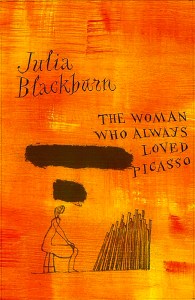 Something different from Blackburn: biographical snippets in verse about Marie-Thérèse Walter, one of Pablo Picasso’s many mistress-muses. When they met she was 17 and he was 46. She gave birth to a daughter, Maya – to his wife Olga’s fury. Marie-Thérèse’s existence was an open secret: he rented a Paris apartment for her to live in, and left his home in the South of France to her (where she committed suicide three years after his death), but unless their visits happened to overlap she was never introduced to his friends. “I lived in the time I was born into / and I kept silent, / acquiescing / to everything.”
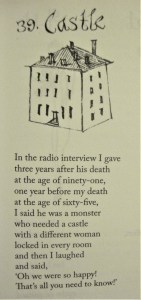 In Marie-Thérèse’s voice, Blackburn depicts Picasso as a fragile demagogue: in one of the poems that was a highlight for me, “Bird,” she describes how others would replace his caged birds when they died, hoping he wouldn’t notice – so great was his horror of death. I liked getting glimpses into a forgotten female’s life, and appreciated the whimsical illustrations by Jeffrey Fisher, but as poems these pieces don’t particularly stand out. (Plus, there are no page numbers! which doesn’t seem like it should make a big difference but ends up being annoying when you want to refer back to something. Instead, the poems are numbered.)
My rating:
With thanks to Carcanet Press for the free copy for review. Published today.
The Body: A Guide for Occupants by Bill Bryson
 Shelve this next to Being Mortal by Atul Gawande in a collection of books everyone should read – even if you don’t normally choose nonfiction. Bryson is back on form here, indulging his layman’s curiosity. As you know, I read a LOT of medical memoirs and popular science. I’ve read entire books on organ transplantation, sleep, dementia, the blood, the heart, evolutionary defects, surgery and so on, but in many cases these go into more detail than I need and I can find my interest waning. That never happens here. Without ever being superficial or patronizing, the author gives a comprehensive introduction to every organ and body system, moving briskly between engaging anecdotes from medical history and encapsulated research on everything from gut microbes to cancer treatment.
Bryson delights in our physical oddities, and his sense of wonder is infectious. He loves a good statistic, and while this book is full of numbers and percentages, they are accessible rather than obfuscating, and will make you shake your head in amazement. It’s a persistently cheerful book, even when discussing illness, scientists whose work was overlooked, and the inevitability of death. Yet what I found most sobering was the observation that, having conquered many diseases and extended our life expectancy, we are now overwhelmingly killed by lifestyle, mostly a poor diet of processed and sugary foods and lack of exercise.
My rating: 
With thanks to Doubleday for the free copy for review.
Surrender: Mid-Life in the American West by Joanna Pocock
 Prompted by two years spent in Missoula, Montana and the disorientation felt upon a return to London, this memoir-in-essays varies in scale from the big skies of the American West to the smallness of one human life and the experience of loss and change. Then in her late forties, Pocock had started menopause and recently been through the final illnesses and deaths of her parents, but was also mother to a fairly young daughter. She explores personal endings and contradictions as a kind of microcosm of the paradoxes of the Western USA.
It’s a place of fierce independence and conservatism, but also mystical back-to-the-land sentiment. For an outsider, so much of the lifestyle is bewildering. The author attends a wolf-trapping course, observes a Native American buffalo hunt, meets a transsexual rewilding activist, attends an ecosexuality conference, and goes foraging. All are attempts to reassess our connection with nature and ask what role humans can play in a diminished planet.
This is an elegantly introspective work that should engage anyone interested in women’s life writing and the environmental crisis. There are also dozens of black-and-white photographs interspersed in the text. In 2018 Pocock won the Fitzcarraldo Editions Essay Prize for this work-in-progress. It came to me as an unsolicited review copy and hung around on my shelves for six months before I picked it up; I’m glad I finally did.
My rating:
With thanks to Fitzcarraldo Editions for the free copy for review.
Let’s Hope for the Best by Carolina Setterwall
[Trans. from the Swedish by Elizabeth Clark Wessel]
 Although this is fiction, it very closely resembles the author’s own life. She wrote this debut novel to reflect on the sudden loss of her partner and how she started to rebuild her life in the years that followed. It quickly splits into two parallel story lines: one begins in April 2009, when Carolina first met Aksel at a friend’s big summer bash; the other picks up in October 2014, after Aksel’s death from cardiac arrest. The latter proceeds slowly, painstakingly, to portray the aftermath of bereavement. In the alternating timeline, we see Carolina and Aksel making their life together, with her always being the one to push the relationship forward.
Setterwall addresses the whole book in the second person to Aksel. When the two story lines meet at about the two-thirds point, it carries on into 2016 as she moves house, returns to work and resumes a tentative social life, even falling in love. This is a wrenching story reminiscent of In Every Moment We Are Still Alive by Tom Malmquist, and much of it resonated with my sister’s experience of widowhood. There are many painful moments that stick in the memory. Overall, though, I think it was too long by 100+ pages; in aiming for comprehensiveness, it lost some of its power. Page 273, for instance (the first anniversary of Aksel’s death, rather than the second, where the book actually ends), would have made a fine ending.
My rating:
With thanks to Bloomsbury UK for the proof copy for review.
Nothing to See Here by Kevin Wilson
 I’d read a lot about this novel while writing a synopsis and summary of critical opinion for Bookmarks magazine – perhaps too much, as it felt familiar and offered no surprises. Lillian, a drifting twentysomething, is offered a job as a governess for her boarding school roommate Madison’s stepchildren. Madison’s husband is a Tennessee senator in the running for the Secretary of State position, so it’s imperative that they keep a lid on the situation with his 10-year-old twins, Bessie and Roland.
You see, when they’re upset these children catch on fire; flames destroy their clothes and damage nearby soft furnishings, but leave the kids themselves unharmed. Temporary, generally innocuous spontaneous combustion? Okay. That’s the setup. Wilson writes so well that it’s easy to suspend your disbelief about this, but harder to see a larger point, except perhaps creating a general allegory for the challenges of parenting. This was entertaining enough, mostly thanks to Lillian’s no-nonsense narration, but for me it didn’t soar.
My rating:
With thanks to Text Publishing UK for the PDF for review. This came out in the States in October and will be released in the UK on January 30th.
 Bookish Beck = Rebecca Foster. American transplant to England. Freelance proofreader and book reviewer.
 Bookish Beck