The Bitch by Pilar Quintana: Blog Tour and #WITMonth 2020, Part I
My first selection for Women in Translation Month is an intense Colombian novella originally published in 2017 and translated from the Spanish by Lisa Dillman. The Bitch, which won the Colombian Biblioteca de Narrativa Prize and has been preserved in a time capsule in Bogotá, is Pilar Quintana’s first book to become available in English translation.

The title is literal, yet its harshness is deliberate: It’s clear from the first scene onwards that this is no cosy tale for animal lovers. Doña Elodia, who runs a beachfront restaurant, has just found her dog dead on the sand, killed either accidentally or intentionally by rat poison. Just six days before, the dog had given birth to 10 puppies. Damaris agrees to adopt a grey female from the litter. Her husband Rogelio already keeps three guard dogs at their shantytown shack and is mean to them, but Damaris is determined things will be different with this pup.
Damaris seems to be cursed, though: she’s still haunted by the death by drowning of a neighbour boy, Nicolasito Reyes, who didn’t heed her warning about the dangerous rocks and waves; she lost her mother to a stray bullet when she was 14; and despite trying many herbs and potions she and Rogelio have not been able to have children. Tenderness has ebbed and flowed in her marriage; “She was over forty now, the age women dry up.” Her cousin disapproves of the attention she lavishes on the puppy, Chirli – the name she would have given a daughter.
Chirli doesn’t repay Damaris’ love with the devotion she expects. She’d been hoping for a faithful companion during her work as a caretaker and cleaner at the big houses on the bluff, but Chirli keeps running off – once disappearing for 33 days – and coming back pregnant. The dog serves as a symbol of parts of herself she doesn’t want to acknowledge, and desires she has repressed. This dark story of guilt and betrayal set at the edge of a menacing jungle can be interpreted at face value or as an allegory – the latter was the only way I could accept.
I appreciated the endnotes about the book design. The terrific cover photograph by Felipe Manorov Gomes was taken on a Brazilian beach. The stray’s world-weary expression is perfect.
The Bitch is published by World Editions on the 20th of August. I was delighted to be asked to participate in the blog tour. See below for details of where other reviews and features have appeared or will be appearing soon.

Are you doing any special reading for Women in Translation month this year?
Some Books about Marriage
My pre-Valentine’s Day reading involved a lot of books with “love”, “heart”, “romance”, etc. in the title (here’s the post that resulted). I ended up with a number of leftovers, plus some incidental reads from late in 2019, that focused on marriage – whether it’s happy or troubled, or not technically a marriage at all.
Marriage: A Duet by Anne Taylor Fleming (2003)
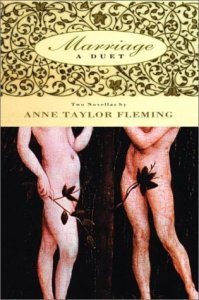 Two novellas in one volume. In “A Married Woman,” Caroline Betts’s husband, William, is in a coma after a stroke or heart attack. As she and her adult children visit him in the hospital and ponder the decision they will have to make, she remains haunted by the affair William had with one of their daughter’s friends 15 years ago. Although at the time it seemed to destroy their marriage, she stayed and they built a new relationship.
I fully expected the second novella, “A Married Man,” to give William’s perspective (like in Carol Shields’s Happenstance), but instead it’s a separate story with different characters, though still set in California c. 2000. Here the dynamic is flipped: it’s the wife who had an affair and the husband who has to try to come to terms with it. David and Marcia Sanderson start marriage therapy at New Beginnings and, with the help of Prozac and Viagra, David hopes to get past his bitterness and give in to his wife’s romantic overtures.
Fleming is a careful observer of how marriages change over time and in response to shocks, but overall I found the tone of these tales abrasive and the language slightly raunchy. 
Not quite about a marriage, but a relationship so lovely that I can’t resist including it…
Our Souls at Night by Kent Haruf (2015)
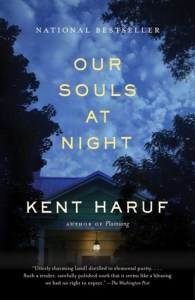 Understated, bittersweet, realistic. Perfect. I’d long meant to try Kent Haruf’s work and even had the first two Plainsong trilogy books on the shelf, but this novella, picked up secondhand at a bargain price from a charity warehouse, demanded to be read first. Fans of Elizabeth Strout’s work will find in Haruf’s Holt, Colorado an echo of her Crosby, Maine – fictional towns where ordinary folk live out their quiet triumphs and sorrows. From the first line, which opens in medias res, Haruf draws you in, making you feel as if you’ve known these characters forever: “And then there was the day when Addie Moore made a call on Louis Waters.” She has a proposal for her neighbor. She’s a widow; he’s a widower. They’re both lonely and prone to melancholy thoughts about how they could have done better by their families (“life hasn’t turned out right for either of us, not the way we expected,” Louis says). Would he like to come over to her house at nights to talk and sleep? Just two ageing creatures huddling together for comfort; no hanky-panky expected or desired.
So that’s just what they do. Before long, though, they come up against the disapproval of locals and family, especially when Addie’s grandson comes to stay and they join Louis to make a makeshift trio. The matter-of-fact prose, delivered without speech marks, belies a deep undercurrent of emotion in this story about the everyday miracle of human connection. There’s even a neat little reference to Haruf’s Benediction at the start of Chapter 34 (again like Strout, who peppered Olive, Again with cameo appearances from characters introduced in her earlier books). I also loved that the characters live on Cedar Street – I grew up on a Cedar Street. This gets my highest recommendation. 
State of the Union: A Marriage in Ten Parts by Nick Hornby (2019)
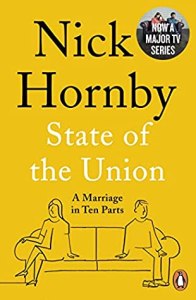 Hornby has been making quite a name for himself in film and television. State of the Union is also a TV series, and reads a lot like a script because it’s composed mostly of the dialogue between Tom and Louise, an estranged couple who each week meet up for a drink in the pub before their marriage counseling appointment. There’s very little descriptive writing, and much of the time Hornby doesn’t even need to add speech attributions because it’s clear who’s saying what in the back and forth.
The crisis in this marriage was precipitated by Louise, a gerontologist, sleeping with someone else after her sex life with Tom, an underemployed music writer, dried up. They rehash their life together, what went wrong, and what might happen next in 10 snappy chapters that are funny but also cut close to the bone. What married person hasn’t wondered where the magic went as midlife approaches? (Tom: “I hate to be unromantic, but convenient placement is pretty much the definition of marital sex.”) 
Two-Part Invention: The Story of a Marriage by Madeleine L’Engle (1988)
 The fourth and final volume of the autobiographical Crosswicks Journal. This one focuses on L’Engle’s 40-year marriage to Hugh Franklin, an actor best known for his role as Dr. Charles Tyler in All My Children between 1970 and 1983. In the book’s present day, the summer of 1986, she’s worried about Hugh when his bladder cancer, which starts off seeming treatable, leads to every possible complication and deterioration. Her days are divided between home, work (speaking engagements; teaching workshops at a writers’ conference) and the hospital.
Drifting between past and present, she remembers how she and Hugh met in the 1940s NYC theatre world, their early years of marriage, becoming parents to Josephine and Bion and then, when close friends died suddenly, adopting their goddaughter, and taking on the adventure of renovating Crosswicks farmhouse in Connecticut and temporarily running the local general store. As usual, L’Engle writes beautifully about having faith in a time of uncertainty. (The title refers not just to marriage, but also to Bach pieces that she, a devoted amateur piano player, used for practice.)
A wonderful passage about marriage:
“Our love has been anything but perfect and anything but static. Inevitably there have been times when one of us has outrun the other and has had to wait patiently for the other to catch up. There have been times when we have misunderstood each other, demanded too much of each other, been insensitive to the other’s needs. I do not believe there is any marriage where this does not happen. The growth of love is not a straight line, but a series of hills and valleys. I suspect that in every good marriage there are times when love seems to be over. Sometimes these desert lines are simply the only way to the next oasis, which is far more lush and beautiful after the desert crossing than it could possibly have been without it.”
The Wife by Meg Wolitzer (2003)
 My latest book club read. On a flight to Finland, where her supposed genius writer of a husband, Joe Castleman, will accept the prestigious Helsinki Prize, Joan finally decides to leave him. When she first met Joe in 1956, she was a student at Smith College and he was her (married) creative writing professor, even though he’d only had a couple of stories published in middling literary magazines. Joan was a promising author in her own right, but when Joe left his first wife for her and she dropped out of college, she willingly took up a supporting role instead, and has remained in it for decades.
Ever since his first novel, The Walnut, a thinly veiled account of leaving Carol for Joan, Joe has produced books “populated by unhappy, unfaithful American husbands and their complicated wives.” Add on the fact that he’s Jewish and you have a Saul Bellow or Philip Roth type, a serial womanizer who’s publicly uxorious.
Alternating between the trip to Helsinki and telling scenes from earlier in their marriage, this short novel is deceptively profound. The setup may feel familiar, but Joan’s narration is bitingly funny and the points about the greater value attributed to men’s work are still valid. There’s also a juicy twist I never saw coming, as Joan decides what role she wants to play in perpetuating Joe’s literary legacy. My second by Wolitzer; I’ll certainly read more. 
Plus a DNF:
The Story of a Marriage by Andrew Sean Greer (2008)
 In 1953 in San Francisco, Pearlie Cook learns two major secrets about her husband Holland after his old friend shows up at their door. Greer tries to present another fact about the married couple as a big surprise, but had planted so many clues, starting on page 9, that I’d already guessed it and wasn’t shocked at the end of Part I as I was supposed to be. Greer writes perfectly capably, but I wasn’t able to connect with this one and didn’t love Less as much as most people did. I don’t think I’ll be trying another of his books. (I read 93 pages out of 195.)
Have you read any books about marriage recently?
Love, Etc. – Some Thematic Reading for Valentine’s Day
Even though we aren’t big on Valentine’s Day (we went out to a “Flavours of Africa” supper club last weekend and are calling it our celebration meal), for the past three years I’ve ended up doing themed posts featuring books that have “Love” or a similar word in the title or that consider romantic or familial love in some way. (Here are my 2017, 2018 and 2019 posts.) These seven selections, all of them fiction, sometimes end up being more bittersweet or ironic than straightforwardly romantic, but see what catches your eye anyway.
Shotgun Lovesongs by Nickolas Butler (2014)
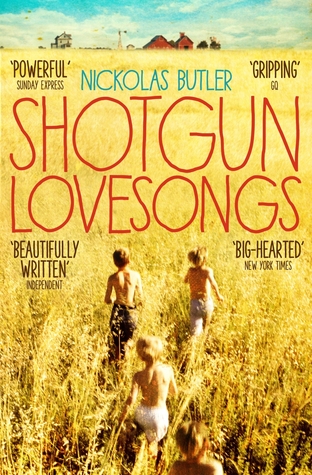 Four childhood friends from Little Wing, Wisconsin; four weddings (no funeral – though there are a couple of close calls along the way). Which bonds will last, and which will be strained to the breaking point? Henry is the family man, a dairy farmer who married his college sweetheart, Beth. Lee* is a musician, the closest thing to a rock star Little Wing will ever produce. He became famous for Shotgun Lovesongs, a bestselling album he recorded by himself in a refurbished chicken coop for $600, and now lives in New York City and hobnobs with celebrities. Kip gave up being a Chicago commodities trader to return to Little Wing and spruce up the old mill into an events venue. Ronny lived for alcohol and rodeos until a drunken accident ended his career and damaged his brain.
The friends have their fair share of petty quarrels and everyday crises, but the big one hits when one guy confesses to another that he’s in love with his wife. Male friendship still feels like a rarer subject for fiction, but you don’t have to fear any macho stylings here. The narration rotates between the four men, but Beth also has a couple of sections, including the longest one in the book. This is full of nostalgia and small-town (especially winter) atmosphere, but also brimming with the sort of emotion that gets a knot started in the top of your throat. All the characters are wondering whether they’ve made the right decisions. There are a lot of bittersweet moments, but also some comic ones. The entire pickled egg sequence, for instance, is a riot even as it skirts the edge of tragedy.
*Apparently based on Bon Iver (Justin Vernon), whose first album was a similarly low-budget phenomenon recorded in Wisconsin. I’d never heard any Bon Iver before and expected something like the more lo-fi guy-with-guitar tracks on the Garden State soundtrack. My husband has a copy of the band’s 2011 self-titled album, so I listened to that and found that it has a very different sound: expansive, trance-like, lots of horns and strings. (But NB, the final track is called “Beth/Rest.”) For something more akin to what Lee might play, try this video.
Mr Loverman by Bernardine Evaristo (2013)
 Barry came to London from Antigua and has been married for 50 years to Carmel, the mother of his two adult daughters. For years Carmel has been fed up with his drinking and gallivanting, assuming he has lots of women on the side. Little does she know that Barry’s best friend, Morris, has also been his lover for 60 years. Morris divorced his own wife long ago, and he’s keen for Barry to leave Carmel and set up home with him, maybe even get a civil partnership. When Carmel goes back to Antigua for her father’s funeral, it’s Barry’s last chance to live it up as a bachelor and pluck up his courage to tell his wife the truth.
Barry’s voice is a delight: a funny mixture of patois and formality; slang and Shakespeare quotes. Cleverly, Evaristo avoids turning Carmel into a mute victim by giving her occasional chapters of her own (“Song of…” versus Barry’s “The Art of…” chapters), written in the second person and in the hybrid poetry style readers of Girl, Woman, Other will recognize. From these sections we learn that Carmel has her own secrets and an equal determination to live a more authentic life. Although it’s sad that these two characters have spent so long deceiving each other and themselves, this is an essentially comic novel that pokes fun at traditional mores and includes several glittering portraits.
Mariette in Ecstasy by Ron Hansen (1991)
 Set in an upstate New York convent mostly in 1906–7, this is a story of religious fervor, doubt and jealousy. Mariette Baptiste is a 17-year-old postulant; her (literal) sister, 20 years older, is the prioress here. Mariette is given to mystical swoons and, just after the Christmas mass, also develops the stigmata. Her fellow nuns are divided: some think Mariette is a saint who is bringing honor to their organization; others believe she has fabricated her calling and is vain enough to have inflicted the stigmata on herself. A priest and a doctor both examine her, but ultimately it’s for the sisters to decide whether they are housing a miracle or a fraud.
The short sections are headed by the names of feasts or saints’ days, and often open with choppy descriptive phrases that didn’t strike me as quite right for the time period (versus Hansen has also written a Western, in which such language would seem appropriate). Although the novella is slow to take off – the stigmata don’t arrive until after the halfway point – it’s a compelling study of the psychology of a religious body, including fragments from others’ testimonies for or against Mariette. I could imagine it working well as a play. 
Bizarre Romance by Audrey Niffenegger and Eddie Campbell (2018)
 Most of these pieces originated as text-only stories by Niffenegger and were later adapted into comics by Campbell. By the time they got married, they had been collaborating long-distance for a while. Some of the stories incorporate fairies, monsters, ghosts and other worlds. A young woman on her way to a holiday party travels via a mirror to another land where she is queen; a hapless bar fly trades one fairy mistress for another; Arthur Conan Doyle’s father sketches fairies in an asylum; a middle-aged woman on a cruise decides to donate her remaining years to her aged father.
My favorite of the fantastical ones was “Jakob Wywialowski and the Angels,” a story of a man dealing with an angel infestation in the attic; it first appeared as a holiday story on the Amazon homepage in 2003 and is the oldest piece here, with the newest dating from 2015. I also liked “Thursdays, Six to Eight p.m.,” in which a man goes to great lengths to assure two hours of completely uninterrupted reading per week. Strangely, my two favorite pieces were the nonfiction ones: “Digging up the Cat,” about burying her frozen pet with its deceased sibling; and “The Church of the Funnies,” a secular sermon about her history with Catholicism and art that Niffenegger delivered at Manchester Cathedral as part of the 2014 Manchester Literary Festival.
The Nine-Chambered Heart by Janice Pariat (2017)
 I find second-person narration intriguing, and I like the idea of various people’s memories of a character being combined to create a composite portrait (previous books that do this that I have enjoyed are The Life and Death of Sophie Stark and Kitchens of the Great Midwest). The protagonist here, never named, is a young Indian writer who travels widely, everywhere from the Himalayas to Tuscany. She also studies and then works in London, where she meets and marries a fellow foreigner. We get the sense that she is restless, eager for adventure and novelty: “You seem to be a woman to whom something is always about to happen.”
An issue with the book is that most of the nine viewpoints belong to her lovers, which would account for the title but makes their sections seem repetitive. By contrast, I most enjoyed the first chapter, by her art teacher, because it gives us the earliest account of her (at age 12) and so contributes to a more rounded picture of her as opposed to just the impulsive, flirtatious twentysomething hooking up on holidays and at a writers’ residency. I also wish Pariat had further explored the main character’s relationship with her parents. Still, I found this thoroughly absorbing and read it in a few days, steaming through over 100 pages on one.
Kinds of Love by May Sarton (1970)
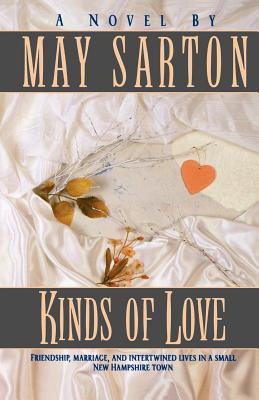 Christina and Cornelius Chapman have been “summer people,” visiting Willard, New Hampshire each summer for decades, but in the town’s bicentennial year they decide to commit to it full-time. They are seen as incomers by the tough mountain people, but Cornelius’s stroke and their adjustments to his disability and older age have given them the resilience to make it through a hard winter. Sarton lovingly builds up pictures of the townsfolk: Ellen Comstock, Christina’s gruff friend; Nick, Ellen’s mentally troubled son, who’s committed to protecting the local flora and fauna; Jane Tuttle, an ancient botanist; and so on. Willard is clearly a version of Sarton’s beloved Nelson, NH. She’s exploring love for the land as well as love between romantic partners and within families.
It’s a meandering novel pleasant for its atmosphere and its working out of philosophies of life through conversation and rumination, but Part Three, “A Stranger Comes to Willard,” feels like a misstep. A college dropout turns up at Ellen’s door after his car turns over in a blizzard. Before he’s drafted into the Vietnam War, he has time to fall in love with Christina’s 15-year-old granddaughter, Cathy. There may only be a few years between the teens, but this still didn’t sit well with me.
I liked how each third-person omniscient chapter ends with a passage from Christina’s journal, making things personal and echoing the sort of self-reflective writing for which Sarton became most famous. The book could have been closer to 300 pages instead of over 460, though.
The Dearly Beloved by Cara Wall (2019)
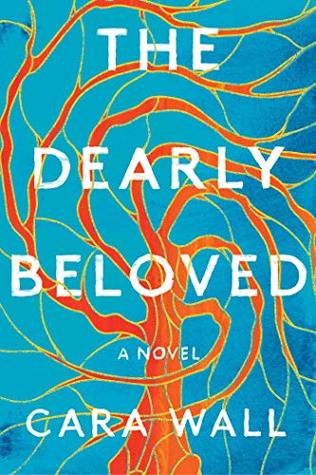 An elegant debut novel about two couples thrown together in 1960s New York City when the men are hired as co-pastors of a floundering Presbyterian church. Nearly the first half is devoted to the four main characters’ backstories and how each couple met. It’s a slow, subtle, quiet story (so much so that I only read the first half and skimmed the second), and I kept getting Charles and James, and Lily and Nan confused.
So here’s the shorthand: Charles is the son of an atheist Harvard professor and plans to study history until a lecture gets him thinking seriously about faith. Lily has closed herself off to life since she lost her parents in a car accident; though she eventually accedes to Charles’s romantic advances, she warns him she won’t bend where it comes to religion. James grew up in a poor Chicago household with an alcoholic father, while Nan is a Southern preacher’s daughter who goes up to Illinois to study music at Wheaton.
James doesn’t have a calling per se, but is passionate about social justice. As co-pastor, his focus will be on outreach and community service, while Charles’s will be on traditional teaching and ministry duties. Nan is desperate for a baby but keeps having miscarriages; Lily has twins, one of whom is autistic (early days for that diagnosis; doctors thought the baby should be institutionalized). Although Lily remains prickly, Nan and James’s friendship is a lifeline for them. The “dearly beloved” term thus applies outside of marriage as well, encompassing all the ties that sustain us – in the last line, Lily thinks, “these friends would forever be her stitches, her scaffold, her ballast, her home.”
Have you read any “love” books, or books about love of any kind, lately?
Novellas in November Wrap-Up and Mini-Reviews
Novellas in November is one of my favorite blogging challenges of the year. Earlier in the month I reviewed a first batch of five novellas. For this second and final installment I have 11 small books to feed back on: fiction, graphic novels, and miscellaneous nonfiction.

Classic of the Month
Giovanni’s Room by James Baldwin (1956)
[150 pages]
 This was my first taste of Baldwin’s fiction, and it was very good indeed. David, a penniless American, came to Paris to find himself. His second year there he meets Giovanni, an Italian barman. They fall in love and move in together. There’s a problem, though: David has a fiancée – Hella, who’s traveling in Spain. It seems that David had bisexual tendencies but went off women after Giovanni. “Much has been written of love turning to hatred, of the heart growing cold with the death of love.” We know from the first pages that David has fled to the south of France and Giovanni faces the guillotine in the morning, but all through Baldwin maintains the tension as we wait to hear why he is sentenced to death. Deeply sad, but also powerful and brave. I’ll make Go Tell It on the Mountain my next one by Baldwin.
Graphic Novels
 Garfield, Why Do You Hate Mondays? by Jim Davis (1982)
[128 pages]
This was like a trip back to childhood, as “Garfield” was always the first thing I would turn to in the Sunday comics section of the Washington Post. The story of the tubby, lasagna-stealing, dog-outsmarting ginger cat even managed to feel relevant to my life now, since our furball is on a perpetual diet – and it’s working, he’s actually lost most of a kilo this year! Most of the three-pane pages are stand-alones in which Garfield gets into scrapes or plays pranks. Fat jokes abound. There is actually a narrative in the latter half, though: Garfield stows away in Jon’s suitcase on a vacation to Hawaii and gets locked up in the local pound. He and a couple of other cats have to team up to escape. [To my amusement, two photos of a bust-up Nissan were being used as bookmarks in the copy that came into the free bookshop where I volunteer.]

Reading Quirks: Weird Things that Bookish Nerds Do! by The Wild Detectives (2019)
[96 pages]
 This is a collected comic strip that appeared on Instagram between 2016 and 2018 (you can view it in full here). The brainchild of bookstore/bar owners in Dallas, Texas, it highlights behaviors that many might find strange but that make total sense to a bibliophile: buying multiple copies of a book so that your less-careful partner doesn’t ruin yours or you don’t lose a friend when they fail to return a borrowed copy; being so glued to a book that you take it everywhere; buying a coat with an eye to whether the pockets accommodate a paperback; exulting at a broken leg for the extra reading time a temporary handicap could buy you; reading with a headtorch after a bedmate has gone to sleep; and so on. The simple four-pane comics usually contain just one or two colors. The captions add as much as the dialogue. Read this next if you enjoyed Book Love by Debbie Tung.

Other Fiction
Jonathan Livingston Seagull by Richard Bach (1972)
[93 pages]
 I was curious about this bestselling fable, but wish I’d left it to its 1970s oblivion. The title seagull stands out from the flock for his desire to fly higher and faster than seen before. He’s not content to be like all the rest; once he arrives in birdie heaven he starts teaching other gulls how to live out their perfect freedom. “We can lift ourselves out of ignorance, we can find ourselves as creatures of excellence and intelligence and skill.” Gradually comes the sinking realization that JLS is a Messiah figure. I repeat, the seagull is Jesus. (“They are saying in the Flock that if you are not the Son of the Great Gull Himself … then you are a thousand years ahead of your time.”) An obvious allegory, unlikely dialogue, dated metaphors (“like a streamlined feathered computer”), cringe-worthy New Age sentiments and loads of poor-quality soft-focus photographs: This was utterly atrocious.
Agatha by Anne Cathrine Bomann (2019)
[Trans. from the Danish by Caroline Waight; 147 pages]
 In late-1940s Paris, a psychiatrist counts down the days and appointments until his retirement. He’s so jaded that he barely listens to his patients anymore. “Was I just lazy, or was I genuinely so arrogant that I’d become bored by other people’s misery?” he asks himself. A few experiences awaken him from his apathy: learning that his longtime secretary’s husband has terminal cancer and visiting the man for some straight talk about death; discovering that the neighbor he’s never met, but only known via piano playing through the wall, is deaf, and striking up a friendship with him; and meeting Agatha, a new German patient with a history of self-harm, and vowing to get to the bottom of her trauma. This debut novel by a psychologist (and table tennis champion) is a touching, subtle and gently funny story of rediscovering one’s purpose late in life.
Agatha will be released on 12th December. With thanks to Sceptre for the proof copy for review.
The Dig by Cynan Jones (2014)
[156 pages]
 Daniel is a recently widowed farmer in rural Wales. On his own for the challenges of lambing, he hates who he’s become. “She would not have liked this anger in me. I was not an angry man.” In the meantime, a badger-baiter worries the police are getting wise to his nocturnal misdemeanors and looks for a new, remote locale to dig for badgers. I kept waiting for these two story lines to meet explosively, but instead they just fizzle out. I should have been prepared for the animal cruelty I’d encounter here, but it still bothered me. Even the descriptions of lambing, and of Daniel’s wife’s death, are brutal. Jones’s writing reminded me of Andrew Michael Hurley’s; while I did appreciate the observation that violence begets more violence in groups of men (“It was the gangness of it”), this was a tough read for me.
Nonfiction
Shelf Respect: A Book Lover’s Defence by Annie Austen (2019)
[183 pages, but with large type and not many words on a page]
 This seems destined to be in many a bibliophile’s Christmas stocking this year. It’s a collection of mini-essays, quotations and listicles on topics such as DNFing, merging your book collection with a new partner’s, famous bibliophiles and bookshelves from history, and how you choose to organize your library. It’s full of fun trivia. Two of my favorite factoids: Bill Clinton keeps track of his books via a computerized database, and the original title of Hemingway’s A Farewell to Arms was “I Have Committed Fornication but that Was in Another Country” (really?!). It’s scattered and shallow, but fun in the same way that Book Riot articles generally are. (I almost always click through to 2–5 articles in my Book Riot e-newsletters, so that’s no problem in my book.) I couldn’t find a single piece of information on ‘Annie Austen’, not even a photo – I sincerely doubt she’s that Kansas City lifestyle blogger, for instance – so I suspect she’s actually a collective of interns.

An illustration of Barack Obama’s summer 2016 reads.
With thanks to Sphere for the free copy for review.
Intoxicated by My Illness: And Other Writings on Life and Death by Anatole Broyard (1992)
[135 pages]
 This posthumous collection brings together essays Broyard wrote for the New York Times after being diagnosed with metastatic prostate cancer in 1989, journal entries, a piece he’d written after his father’s death from bladder cancer in 1954, and essays from the early 1980s about “the literature of death.” He writes to impose a narrative on his illness, expatiating on what he expects of his doctor and how he plans to live with style even as he’s dying. “If you have to die, and I hope you don’t, I think you should try to die the most beautiful death you can,” he charmingly suggests. It’s ironic that he laments a dearth of literature (apart from Susan Sontag) about illness and dying – if only he could have seen the flourishing of cancer memoirs in the last two decades! [An interesting footnote: in 2007 Broyard’s daughter Bliss published a memoir, One Drop: My Father’s Hidden Life—A Story of Race and Family Secrets, about finding out that her father was in fact black but had passed as white his whole life. I’ll be keen to read that.]
Sold for a Farthing by Clare Kipps (1953)
[72 pages]
 This was a random 50p find at the Hay-on-Wye market on our last trip. In July 1940 Kipps adopted a house sparrow that had fallen out of the nest – or, perhaps, been thrown out for having a deformed wing and foot. Clarence became her beloved pet, living for just over 12 years until dying of old age. A former professional musician, Kipps served as an air-raid warden during the war; she and Clarence had a couple of close shaves and had to evacuate London at one point. Clarence sang more beautifully than the average sparrow and could do a card trick and play dead. He loved to nestle inside Kipps’s blouse and join her for naps under the duvet. At age 11 he had a stroke, but vet attention (and champagne) kept him going for another year, though with less vitality. This is sweet but not saccharine, and holds interest for its window onto domesticated birds’ behavior. With photos, and a foreword by Julian Huxley.

A Year Lost and Found by Michael Mayne (1987)
[82 pages]
 Mayne was vicar at the university church in Cambridge when he came down with a mysterious, debilitating illness, only later diagnosed as myalgic encephalomyelitis or post-viral fatigue syndrome. During his illness he was offered the job of Dean of Westminster, and accepted the post even though he worried about his ability to carry out his duties. He writes of his frustration at not getting better and receiving no answers from doctors, but much of this short memoir is – unsurprisingly, I suppose – given over to theological musings on the nature of suffering, with lots of quotations (too many) from theologians and poets. Curiously, he also uses Broyard’s word, speaking of the “intoxication of convalescence.”
Ordinary Sacred: The Simple Beauty of Everyday Life by Kent Nerburn (2006)
[120 pages]
 The author has a PhD in religion and art and produced sculptures for a Benedictine abbey in British Columbia and the Peace Museum in Hiroshima. I worried this would be too New Agey for me, but at 20p from a closing-down charity shop, it was worth taking a chance on. Nerburn feels we are often too “busy with our daily obligations … to surround our hearts with the quiet that is necessary to hear life’s softer songs.” He tells pleasant stories of moments when he stopped to appreciate meaning and connection, like watching a man in a wheelchair fly a kite, setting aside his to-do list to have coffee with an ailing friend, and attending the funeral of a Native American man he once taught.
Total number of novellas read this month: 16 (compared to last year’s 26)
My overall favorite: Agatha by Anne Cathrine Bomann
Runners-up: Giovanni’s Room by James Baldwin, Intoxicated by My Illness by Anatole Broyard, and Hope in the Dark by Rebecca Solnit
What’s the best novella you’ve read recently? Do you like the sound of any of the ones I read?
Novellas in November, Part 1: 3 Nonfiction, 2 Super-Short Fiction
Short books; short reviews.
Nonfiction:
The Measure of My Days by Florida Scott-Maxwell (1968)
[150 pages]
 I learned about this from one of May Sarton’s journals, which shares its concern with ageing and selfhood. The author was an American suffragist, playwright, mother and analytical psychologist who trained under Jung and lived in England and Scotland with her Scottish husband. She kept this notebook while she was 82, partly while recovering from gallbladder surgery. It’s written in short, sometimes aphoristic paragraphs. While I appreciated her thoughts on suffering, developing “hardihood,” the simplicity that comes with giving up many cares and activities, and the impossibility of solving “one’s own incorrigibility,” I found this somewhat rambly and abstract, especially when she goes off on a dated tangent about the equality of the sexes. (Free from The Book Thing of Baltimore)
Hope in the Dark: Untold Histories, Wild Possibilities by Rebecca Solnit (2004)
[143 pages]
 “Activism is not a journey to the corner store, it is a plunge into the unknown. The future is always dark.” This resonated with the Extinction Rebellion handbook I reviewed earlier in the year. Solnit believes in the power of purposeful individuals working towards social justice, even in the face of dispiriting evidence (the largest protests the world had seen didn’t stop the Iraq War). Instead of perfectionism, she advises flexibility and resilience; things could be even worse had we not acted. At first I thought it depressing that 15 years on we’re still dealing with many of the issues she mentions here, and the environmental crisis has only deepened. But her strong and stirring writing is a reminder that, though injustice is always with us, so is everyday heroism. (Free from The Book Thing of Baltimore)
Lama by Derek Tangye (1966)
[160 pages]
 Tangye wrote a series of cozy animal books similar to Doreen Tovey’s. He and his wife Jean ran a flower farm in Cornwall and had a succession of cats, along with donkeys and a Muscovy duck named Boris. After the death of their beloved cat Monty, Jean wanted a kitten for Christmas but Tangye, who considered himself a one-cat man rather than a wholesale cat lover, hesitated. The matter was decided for them when a little black stray started coming round and soon made herself at home. (Her name is a tribute to the Dalai Lama’s safe flight from Tibet.) Mild adventures ensue, such as Lama going down a badger sett and Jeannie convincing herself that she’s identified another stray as Lama’s mother. Pleasant, if slight; I’ll read more by Tangye. (From Kennet Centre free bookshop)
Fiction:
The Small Miracle by Paul Gallico (1951)
[47 pages]
 Like Tangye, Gallico is known for writing charming animal books, but fables rather than memoirs. Set in postwar Assisi, Italy, this stars Pepino, a 10-year-old orphan boy who runs errands with his donkey Violetta to earn his food and board. When Violetta falls ill, he dreads losing not just his livelihood but also his only friend in the world. But the powers that be won’t let him bring her into the local church so that he can pray to St. Francis for her healing. Pepino takes to heart the maxim an American corporal gave him – “don’t take no for an answer” – and takes his suit all the way to the pope. This story of what faith can achieve just manages to avoid being twee. (From Kennet Centre free bookshop)
Birthday Girl by Haruki Murakami (2002; English translation by Jay Rubin, 2003)
[42 pages]
 Reprinted as a stand-alone pamphlet to celebrate the author’s 70th birthday, this is about a waitress who on her 20th birthday is given the unwonted task of taking dinner up to the restaurant owner, who lives above the establishment. He is taken with the young woman and offers to grant her one wish. We never hear exactly what that wish was. It’s now more than 10 years later and she’s recalling the occasion for a friend, who asks her if the wish came true and whether she regrets what she requested. She surveys her current life and says that it remains to be seen whether her wish will be fulfilled; I could only assume that she wished for happiness, which is shifting and subjective. Encountering this in a larger collection would be fine, but it wasn’t particularly worth reading on its own. (Public library)
I’ve also had a number of novella DNFs so far this month, alas: Atlantic Winds by William Prendiville (not engaging in the least), By Grand Central Station I Sat Down and Wept by Elizabeth Smart (fascinating autobiographical backstory; pretentious prose) and The Dream Life of Balso Snell by Nathanael West (even more bizarre and crass than I’m used to from him).
Onwards!
Have you read any of these novellas? Which one takes your fancy?
November Plans: Novellas, Margaret Atwood Reading Month & More
This is my fourth year joining Laura Frey and others in reading mostly novellas in November. Last year Laura put together a history of the challenge (here); it has had various incarnations but has no particular host or rules. Join us if you like! (#NovNov and #NovellasinNovember) The definition of a novella is loose – it’s based more on the word count than the number of pages – so it’s up to you what you’d like to classify as one. I generally limit myself to books of 150 pages or fewer, though I might go as high as 180-some if there aren’t that many words on a page. Some, including Laura and Susan, would be as generous as 200.


I’ve trawled my shelves for fiction and nonfiction stacks to select from, as well as a few volumes that include several novellas (I’d plan on reading at least the first one) and some slightly longer novels (150–190 pages) for backups. [From the N. West volume, I just have the 52-page novella The Dream Life of Balso Snell, his debut, to read. The Tangye book with the faded cover is Lama.] Also available on my Kindle are The Therapist by Nial Giacomelli*, Record of a Night too Brief by Hiromi Kawakami, Childhood: Two Novellas by Gerard Reve, and Milton in Purgatory by Edward Vass* (both *Fairlight Moderns Novellas, as is Atlantic Winds by William Prendiville).
Other November reading plans…
Margaret Atwood Reading Month
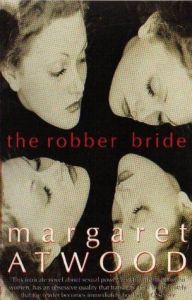 This is the second year of #MARM, hosted by Canadian bloggers extraordinaires Marcie of Buried in Print and Naomi of Consumed by Ink. This year they’re having a special The Handmaid’s Tale/The Testaments theme, but even if you’re avoiding the sequel, join us in reading one or more Atwood works of your choice. She has so much to choose from! Last year I read The Edible Woman and Surfacing. This year I’ve earmarked copies of the novel The Robber Bride (1993) and Moral Disorder (2006), a linked short story collection, both of which I got for free – the former from the free bookshop where I volunteer, and the latter from a neighbor who was giving it away.
Nonfiction November
I don’t usually participate in this challenge because nonfiction makes up at least 40% of my reading anyway, but last year I enjoyed putting together some fiction and nonfiction pairings and ‘being the expert’ on women’s religious memoirs, a subgenre I have a couple of books to add to this year. So I will probably end up doing at least one post. The full schedule is here.
Young Writer of the Year Award
Being on the shadow panel for the Sunday Times/PFD Young Writer of the Year Award was a highlight of 2017 for me. I was sad to not be able to attend any of the events last year. I’m excited for this year’s shadow panelists, a couple of whom are blogging friends (one I’ve met IRL), and I look forward to following along with the nominated books and attending the prize ceremony at the London Library on December 5th.
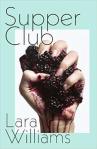 With any luck I will already have read at least one or two books from the shortlist, which is to be announced on November 3rd. I have my fingers crossed for Yara Rodrigues Fowler, Daisy Johnson, Elizabeth Macneal, Stephen Rutt and Lara Williams; I expect we may also see repeat appearances from one of the poets recognized by the Forward Prizes and Guy Gunaratne, the winner of the 2019 Dylan Thomas Prize.
Any reading plans for November? Will you be joining in with novellas, Margaret Atwood’s books or Nonfiction November?
R.I.P. Classics for Halloween: The Haunting of Hill House, Dr. Jekyll & Mr. Hyde
I’ve enjoyed my second year participating in the Readers Imbibing Peril challenge. The highlights from my spooky October of reading were the classic ghost stories from my first installment and the Shirley Jackson novel below.
As this goes live I’m preparing to catch a train to York for the New Networks for Nature conference. Ever since the year I did my Master’s at Leeds, York is a place I’ve often contrived to be in late October or early November. What with ghost tours and fireworks for Bonfire Night, its cobbled streets are an atmospheric place to spend chilly evenings.
The Haunting of Hill House by Shirley Jackson (1959)
 The only thing I’d read by Jackson before is “The Lottery,” which I studied in a high school English class. I’d long meant to read one of her full-length books, so I snapped this up when it came into the free bookshop where I volunteer.
Dr. Montague, an anthropologist, assembles a small team to live at Hill House one summer and record any evidence that it is indeed haunted. Joining him are Luke Sanderson, the flippant heir to the house; Theodora (“Theo”), rumoured to have psychic abilities; and Eleanor Vance, a diffident 32-year-old who experienced an unexplained event when she was a child and now, after the recent death of the mother for whom she was a nurse for years, determines to have an adventure all of her own. As the four become familiar with the house’s history of tragedies and feuds, their attempts to explore the house and grounds leave them feeling disoriented and, later, terrified.
Things really heat up at about the halfway point. There’s a feeling that the house has power –
“the evil is the house itself, I think … it is a place of contained ill will” (Dr. Montague)
“It’s the house. I think it’s biding its time.” (Eleanor)
– what could it make them all do? I don’t often read from the suspense or horror genre, but I did find this gripping and frightening, and I never saw the ending coming. Hard to believe the book is 60 years old.
(I wondered if Claire Fuller could have taken this as partial inspiration for Bitter Orange, in which a thirtysomething woman who was her mother’s carer for many years until the older woman’s death undertakes a summer of study at a dilapidated house.)
The Strange Case of Dr. Jekyll and Mr. Hyde by Robert Louis Stevenson (1886)
 As with The Picture of Dorian Gray, which I attempted in 2017, I think the problem here was that the story was too culturally familiar to me. Everyone knows the basics of Jekyll & Hyde: a respectable doctor occasionally transforms into a snarling boor and commits acts of violence. The only thing that was murky for me was exactly how this happens. (Jekyll has been experimenting with drugs that will provoke mystical experiences and a taste of the dark side of humanity; to become Hyde he takes a potion of his own devising. At first the metamorphosis is something he can control, but eventually he starts becoming Hyde without any warning, until it seems there’s no returning to his normal life.)
The novella is mostly from the point of view of Mr. Utterson, Jekyll’s lawyer friend, who drew up his will leaving everything to Hyde. Utterson has always been uncomfortable with the terms of the will, but even more so as he hears of Hyde knocking over a young girl and beating a gentleman to death in the street. The third-person narrative is interspersed with documents including letters and confessions, a bit like in Dracula. For its first readers this must have been a thrilling read full of shocking revelations, but I found my mind wandering. I’ve tried a few Stevenson books now; I think this was probably my last.
(Available as a free download from Project Gutenberg.)
Happy Halloween!
R.I.P. Reads: Dahl, Le Guin, Lessing, Paver
This is my second year participating in R.I.P. – Readers Imbibing Peril, now in its 14th year. I assembled a lovely pile of magical or spooky reads to last me through October and noticed they were almost all by women, so I decided to make it an all-female challenge (yes, even with a Dahl title – see below) this year. I’m in the middle of another book and have a few more awaiting me, but with just two weeks left in the month I don’t know if I’ll manage to follow up this post with a Part II. At any rate, these first four were solid selections: classic ghost stories, children’s fantasy, a horror novella about an evil child, and an Arctic chiller.
Fear: Tales of Terror and Suspense (selected by Roald Dahl) (2017)
“Spookiness is, after all, the real purpose of the ghost story. It should give you the creeps and disturb your thoughts.”
I was sent this selection of Dahl-curated ghost stories as part of a book bundle in advance of a blog tour for Roald Dahl Day last year. For now I’ve read just the five stories by women, and will polish off the rest next year.
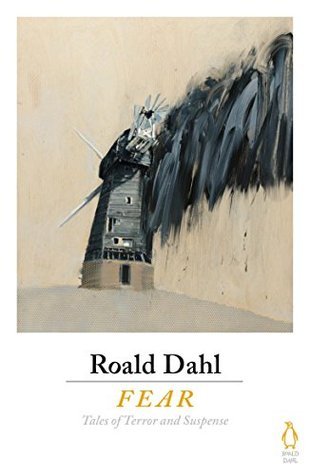 This collection originated from a television series on ghost stories that Dahl proposed for the American market in 1958 (the pilot was poorly received and it never got made). For his research he read nearly 750 ghost stories and whittled them down to the top 24. Women authors dominated early on in the selection process, but by the end the genders came out nearly even, with 13 men and 11 women. It’s disappointing, then, that only five of the 14 stories included here are by women – one of whom gets two entries, so there’s just four female authors recognized. And this even though Dahl claims that, when it comes to ghost stories, “it is the women who have written some of the very best ones.”
Any road, these are the five stories I read, all of which I found suitably creepy, though the Wharton is overlong. Each one pivots on a moment when the narrator realizes that a character they have been interacting with is actually dead. Even if you’ve seen the twist coming, there’s still a little clench of the heart when you have it confirmed by a third party.
“Harry” and “Christmas Meeting” by Rosemary Timperley: A little girl who survived a murder attempt is reclaimed by her late brother; a woman meets a century-dead author one lonely holiday – I liked that in this one each character penetrates the other’s time period.
“The Corner Shop” by Cynthia Asquith: An inviting antique shop is run by two young women during the day, but by a somber old man in the evenings. He likes to give his customers a good deal to atone for his miserly actions of the past.
“The Telephone” by Mary Treadgold: A man continues communicating with his dead ex-wife via the phone line.
“Afterward” by Edith Wharton: An American couple settles in a home in Dorset, and the husband disappears, after a dodgy business deal, in the company of a mysterious stranger.
A Wizard of Earthsea by Ursula K. Le Guin (1968)
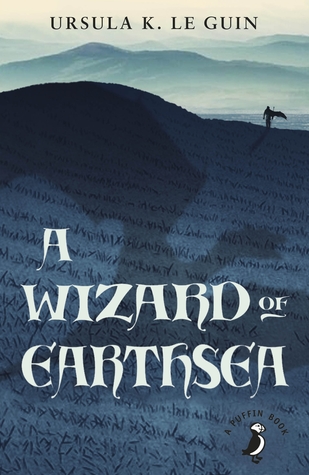 This was my second attempt with the late Le Guin, who would be turning 90 on the 21st; I didn’t get far at all with a buddy read of The Left Hand of Darkness last year. I enjoyed this a fair bit more, perhaps because it’s meant for children – I reckon I would have liked it most when I was ages nine to 11 and obsessed with various series of fantasy novels featuring dragons.
Long before Harry Potter was a glimmer, this was the archetypal story of a boy wizard learning magic at school. Ged meets many cryptic mentors and realizes that naming a thing gives you power over it. In his rivalry with the other boys, he accidentally releases a shadow beast and has to try to gain back control of it. It’s slightly difficult to keep on top of all the names and places (Le Guin created a whole archipelago, which you can see in the opening map) and I found my interest waning after the halfway point, but I did love the scene of Ged fighting with a dragon. 
A favorite passage: “But you must not change one thing, one pebble, one grain of sand, until you know what good and evil will follow on the act. … A wizard’s power of Changing and of Summoning can shake the balance of the world.”
The Fifth Child by Doris Lessing (1988)
Shelve this alongside We Need to Talk about Kevin as a book to make you rethink having kids. Harriet and David Lovatt buy a large Victorian house within commuting distance of London and dream of filling it with children – six, eight; however many. Their first four children are all they’d hoped for, if not spaced out as much as they intended. The Lovatts enjoy hosting the extended family at Easter and Christmas and during the summer holidays. Although there are good-natured jokes about the couple’s fertility, everyone enjoys the cozy, bustling atmosphere. “The Lovatts were a happy family. It was what they had chosen and what they deserved.”
[MILD SPOILERS ENSUE]
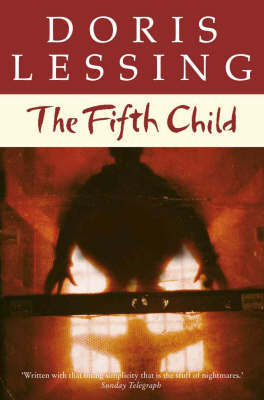 Everything changes with pregnancy #5, which is different right from the off. This “savage thing inside her” is kicking Harriet black and blue from the inside and grown to full term by eight months. When Ben is born Harriet thinks, “He’s like a troll, or a goblin.” Like a succubus, he sucks her dry, biting her nipples black and blue; he screams and thrashes non-stop; he’s freakishly strong and insatiably hungry. He strangles house pets and eats a raw chicken with his bare hands. Although he learns basic language and social skills from watching his older siblings and mimicking his idols from a motorcycle gang, something in him is not human. Yet Harriet cannot bear to leave Ben to rot in an institution.
At first I wondered if this was a picture of an extremely autistic child, but Lessing makes the supernatural element clear. “We are being punished,” Harriet says to David. “For presuming … we could be happy.” I think I was waiting for a few more horrific moments and a climactic ending, whereas Lessing almost normalizes Ben, making him part of a gang of half-feral youths who rampage around late-1980s Britain (and she took up his story in a sequel, Ben in the World). But I raced through this in just a few days and enjoyed the way dread overlays the fable-like simplicity of the family’s early life.
Dark Matter: A Ghost Story by Michelle Paver (2010)
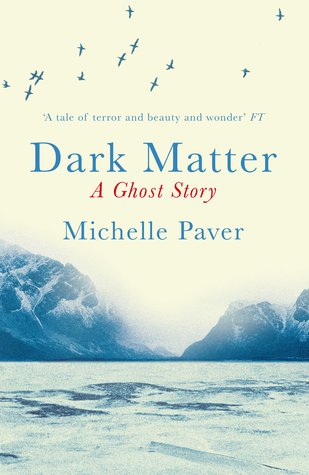 I read Paver’s Thin Air as part of last year’s R.I.P. challenge and it was very similar: a 1930s setting, an all-male adventure, an extreme climate (in that case: the Himalayas). Most of Dark Matter is presented as a journal written by Jack Miller, a lower-class lad who wanted to become a physicist but had to make a living as a clerk instead. He feels he doesn’t truly belong among the wealthier chaps on this Arctic expedition, but decides this is his big chance and he’s not going to give it up.
Even as the others drop out due to bereavement and illness, he stays the course, continuing to gather meteorological data and radio it back to England from this bleak settlement in the far north of Norway. For weeks his only company is a pack of sled dogs, and his grasp on reality becomes shaky as he begins to be visited by the ghost of a trapper who was tortured to death nearby – “the one who walks again.” Paver’s historical thrillers are extremely readable. I tore through this, yet never really found it scary.
Note: This book is the subject of the Bookshop Band song “Steady On” (video here).
And, alas, three DNFs:
 The Wych Elm by Tana French – French writes really fluid prose and inhabits the mind of a young man with admirable imagination. I read the first 100 pages and skimmed another 50 and STILL hadn’t gotten to the main event the blurb heralds: finding a skull in the wych elm in the garden at Ivy House. I kept thinking, “Can we get on with it? Let’s cut to the chase!” I have had French’s work highly recommended so may well try her again.
 The Hoarder by Jess Kidd – Things in Jars was terrific; I thought Kidd’s back catalogue couldn’t fail to draw me in. This was entertaining enough that I made it to page 152, if far too similar to Jars (vice versa, really, as this came first; ghosts/saints only the main character sees; a transgender landlady/housekeeper); I then found that picking it back up didn’t appeal at all. Maud Drennan is a carer to a grumpy giant of a man named Cathal Flood whose home is chock-a-block with stuff. What happened to his wife? And to Maud’s sister? Who cares!
 The Silent Companions by Laura Purcell – Purcell is now on her third Gothic novel in three years. I had a stab at her first and it was distinctly okay. I read the first 24 pages and skimmed to p. 87. Reminiscent of The Shadow Hour, The Familiars, etc.
Have you been reading anything fantastical or spooky this October?
Women in Translation Month 2019, Part I: Ernaux and Poschmann
Two rather different books to start off #WITMonth: a brief (c. 70 pp.) account of a mother’s decline with dementia; and a haiku-inspired novel of the quest for life and death in disorienting modern Japan. Both are admirable but detached – a judgment I seem more likely to make about work in translation – so don’t earn my wholehearted recommendation. My rating for both:
I Remain in Darkness by Annie Ernaux (1997; English translation, 1999)
[Translated from the French by Tanya Leslie]
 This is the second short, somewhat harrowing autobiographical work I’ve read by Ernaux this year (after Happening, her account of her abortion, in March). A collection of mostly present-tense fragments, it’s drawn from the journal she kept during her mother’s final years, 1983–6. “I Remain in Darkness” were the last words her mother wrote, in a letter to a friend (“Je ne suis pas sortie de ma nuit,” which more literally means “I have not left my night,” strikes me as cryptic and poetic, though maybe I’m missing a colloquialism). Slipping into Alzheimer’s, her mother spent these years in a long-term hospital geriatric ward. Ernaux could see her mother becoming like a child again:
This morning she got up and, in a timid voice, said: ‘I wet the bed. I couldn’t help it.’ The same words I would use when I was a child.
Now her room is on the third floor. A bunch of women circle us, addressing my mother with the familiar tu form: ‘You’re going to be in our group?’ They are like kids talking to the ‘new girl’ at school. When I take leave of her, she looks at me in panic and confusion: ‘You’re not leaving, are you?’
—and herself becoming like her mother: “It’s crystal-clear: she is me in old age and I can see the deterioration of her body threatening to take hold of me – the wrinkles on her legs, the creases in her neck”. Ernaux vacillates between guilt, fear and cruelty in how she approaches her mother. She tenderly shaves the older woman’s face every week when she visits, and buys her all manner of sweets. Food is one of her mother’s last remaining pleasures, though she often misses her mouth when she tries to eat the cakes her daughter brings.
Superficially, this is very similar to another book I’ve reviewed this year, Be With by Mike Barnes, a series of short letters written during his time as a caregiver to his mother, who also has Alzheimer’s. But where Barnes is reassuring and even humorous at times, Ernaux refuses to give any comfort, false or otherwise. This hospital is a bleak place that reeks of urine and is hiding excrement everywhere (really). A lazier reviewer than I generally try to be would brandish the word “unflinching.”
The entries from a few days after her mother’s death explain what the author is trying to do with her work, whether memoir or autofiction: “I am incapable of producing books that are not precisely that – an attempt to salvage part of our lives, to understand, but first to salvage … I’ll have to tell her story in order to ‘distance myself from it’.” That dual purpose, saving and distancing, makes her work honest yet unemotional, such that I have trouble warming to it.
This is easily read in a sitting. I may try again to get into Ernaux’s novel The Years, which, like the Poschmann (below), was on this past year’s Man Booker International Prize shortlist.
I Remain in Darkness will be released on September 18th. With thanks to Fitzcarraldo Editions for the free copy for review.
The Pine Islands by Marion Poschmann (2017; English translation, 2018)
[Translated from the German by Jen Calleja]
(Though I read this mostly in July, I finished it on August 1st, so I’m including it in my WIT Month coverage. It’s the first of the author’s books to be made available in English.)
 A man wakes up from a dream convinced that his wife is cheating on him, and sets off for Tokyo on a whim, where he embarks on a Bashō-inspired pilgrimage to the pine islands of Matsushima. This Gilbert Silvester, a beard historian, acquires an unlikely companion: a young man named Yosa, who’s looking for the best place to kill himself and takes Gilbert along to cliffs and forests famous for their suicide rates. Although there are still cherry blossoms and kabuki theatre, Gilbert soon learns that this isn’t Bashō’s Japan anymore.
From the haikus he composes and the letters he writes to Mathilda back home, we track his inward journey as it contrasts with the outward ones he undertakes. I enjoyed the surreal touches – Yosa says he once dated a woman who was actually a fox – and the Murakami setup (the wife’s adultery and the hair patterns are reminiscent of The Wind-Up Bird Chronicle).
Somehow, though, for me this is a book that succeeds more in its ideas (searching for the essence of a place but only finding the clichés; coniferous versus deciduous trees as a metaphor for what lasts in life versus what fades) than in its actual execution. It never all quite comes together, and the inconclusive ending makes you question how much of this has been a dream or a fantasy. It’s ambitious and intellectually impressive, but something about its dignified aloofness is hard to be enthusiastic about.
Do watch Lost in Translation, one of my favorite films, afterwards…
And a DNF: The Days of Abandonment by Elena Ferrante. The time has come to admit that I simply do not appreciate Ferrante’s work. I could only make it 25 pages into this one; I’ve read a different short novel of hers (The Lost Daughter), and skimmed another (My Brilliant Friend). While I enjoyed the narrator’s voice well enough, and loved the scene in which her errant husband finds broken glass in his dinner, I found that I had no interest in how this seemingly predictable story of the end of a marriage might play out.
Up next for Part II: The Wind that Lays Waste by Selva Almada, on its way from Charco Press, and The Awakening of Miss Prim by Natalia Sanmarin Fenollera.
Are you doing any special reading for Women in Translation month this year?
March Reading Plans and Books to Look out For
My apologies if you’ve already heard this story on social media: I was supposed to be in France this past weekend, but for the fourth time in a row we’ve been plagued by transport problems on a holiday: a flat tire in Wigtown, a cancelled train to Edinburgh, a cancelled flight to the States, and now car trouble so severe we couldn’t get on the ferry to Normandy. Though we made it all the way to the ferry port in Poole, our car was by then making such hideous engine noises that it would have been imprudent to drive it any further. We got a tow back to the auto shop where our car is usually serviced and currently await its prognosis. If it can be fixed, we may be able to reschedule our trip for this coming weekend.
The good news about our strange (non-)travel day: I got a jump on my Doorstopper of the Month, Cutting for Stone by Abraham Verghese, a terrific read that reminds me of a cross between Midnight’s Children and The Cider House Rules, and also started Priestdaddy by Patricia Lockwood – though my husband made me stop reading it because I couldn’t stop sniggering while he was trying to make important phone calls about the car. We ended up having a nice weekend at home anyway: going out for Nepalese food, gelato and a screening of The Favorite; doing some gardening and getting bits of work and writing done; and (of course) doing plenty of reading. Waking up with a purring cat on my legs and tucking into a stack of pancakes with maple syrup, I thought to myself, being home is pretty great, too.
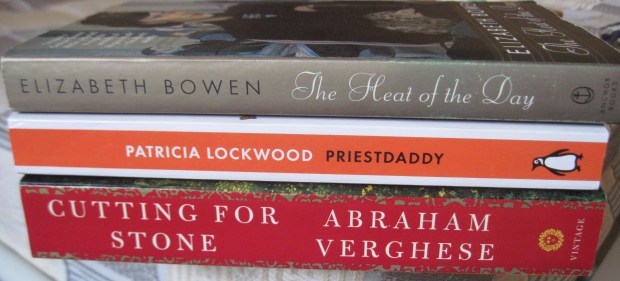
What I packed to read in France.
Reading Ireland Month 2019
This will be my second time participating in the annual challenge hosted by Cathy of 746 Books. I recently started The Heat of the Day by Elizabeth Bowen and I’m also currently reading two nonfiction books by Irish women: a review copy of Vagina: A Re-Education by Lynn Enright (which releases on March 7th) and the essay collection Notes to Self by Emilie Pine, on my Kindle. I have several other novels to choose from – two of which are set in Ireland rather than by Irish authors – plus a classic travel book by Dervla Murphy.
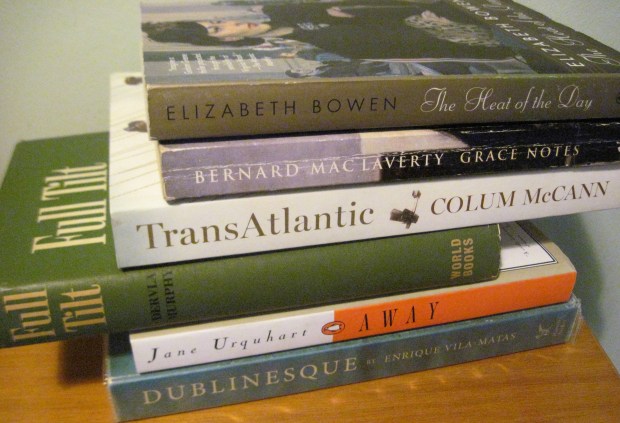
Irish selections.
Wellcome Book Prize
The second of my ‘assigned’ longlist reviews will be going up on Wednesday. I’m currently reading another three books from the longlist and will post some brief thoughts on them if I manage to finish them before the shortlist announcement on the 19th. At that point I will have read 10 out of the 12 books on the longlist, so should feel pretty confident about making predictions (or at least stating wishes) for what will go through to the next round.
Blog Tours
I have two blog tours coming up later in the month, including the official one that’s being run for the Dylan Thomas Prize longlist.
Review Books
I’ve got a pile-up of review copies that came out in February or are releasing early this month – 9, I think? Some I’ve already read and some are still in progress. So I will be doing my best to group these sensibly and write short reviews, but you may well notice a lot of posts from me.
Blog Anniversary
This Friday marks four years that I’ve been blogging about books!
Here are a few March releases I’ve read that you may want to look out for:
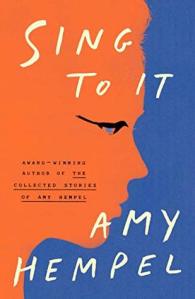 Sing to It: New Stories by Amy Hempel [releases on the 26th]: “When danger approaches, sing to it.” That Arabian proverb provides the title for Amy Hempel’s fifth collection of short fiction, and it’s no bad summary of the purpose of the arts in our time: creativity is for defusing or at least defying the innumerable threats to personal expression. Only roughly half of the flash fiction achieves a successful triumvirate of character, incident and meaning. The author’s passion for working with dogs inspired the best story, “A Full-Service Shelter,” set in Spanish Harlem. A novella, Cloudland, takes up the last three-fifths of the book and is based on the case of the “Butterbox Babies.” (Reviewed for the Pittsburgh Post-Gazette.)
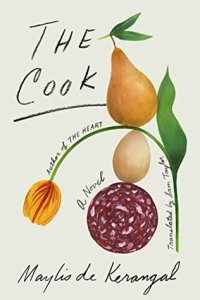 The Cook by Maylis de Kerangal (translated from the French by Sam Taylor) [releases on the 26th]: This is a pleasant enough little book, composed of scenes in the life of a fictional chef named Mauro. Each chapter picks up with the young man at a different point as he travels through Europe, studying and working in various restaurants. If you’ve read The Heart / Mend the Living, you’ll know de Kerangal writes exquisite prose. Here the descriptions of meals are mouthwatering, and the kitchen’s often tense relationships come through powerfully. Overall, though, I didn’t know what all these scenes are meant to add up to. Kitchens of the Great Midwest does a better job of capturing a chef and her milieu.
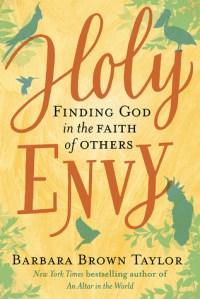 Holy Envy: Finding God in the Faith of Others by Barbara Brown Taylor [releases on the 12th]: After she left the pastorate, Taylor taught Religion 101 at Piedmont College, a small Georgia institution, for 20 years. This book arose from what she learned about other religions – and about Christianity – by engaging with faith in an academic setting and taking her students on field trips to mosques, temples, and so on. She emphasizes that appreciating other religions is not about flattening their uniqueness or looking for some lowest common denominator. Neither is it about picking out what affirms your own tradition and ignoring the rest. It’s about being comfortable with not being right, or even knowing who is right.
 Bookish Beck = Rebecca Foster. American transplant to England. Freelance proofreader and book reviewer.
 Bookish Beck