The Barbellion Prize 2021 Longlist
This is the second year that the Barbellion Prize will be awarded “to an author whose work has best represented the experience of chronic illness and/or disability.” It was a joy to read the entire shortlist for the inaugural prize this past February and support the well-deserved win of Riva Lehrer for Golem Girl. I’ll be following the 2021–22 race with interest again, not least because one of the three judges is a long-time blogger friend of mine, Eleanor Franzen.
This year’s longlist looks fascinating: it contains fiction, poetry and memoir, and includes two works in translation. I happen to have already read the three nonfiction selections, but hadn’t heard of the other nominees.

Click on any title below for more information from the publisher website.
Ultimatum Orangutan by Khairani Barokka (Nine Arches Press)
From the synopsis: “Barokka’s second poetry collection is an intricate exploration of colonialism and environmental injustice … Through these defiant, potent verses, the body—particularly the disabled body—is centred as an ecosystem in its own right.”
What Willow Says by Lynn Buckle (Époque Press)
From the synopsis: “Sharing stories of myths, legends and ancient bogs, a deaf child and her grandmother experiment with the lyrical beauty of sign language. A poignant tale of family bonding and the quiet acceptance of change.”
 A Still Life: A Memoir by Josie George (Bloomsbury)
Excerpt from my TLS review: Chronic illness long ago reduced George’s territory to her home and garden. The magic of A Still Life is in how she finds joy and purpose despite extreme limitations. Opening on New Year’s Day and travelling from one winter to the next, the book is a window onto her quiet existence as well as the turning of the seasons. (One of my favourites of the year.) 
I Live a Life Like Yours: A Memoir by Jan Grue (Farrar, Straus and Giroux, and Pushkin Press). Translated by B. L. Crook
Excerpt from my Shelf Awareness review: The University of Oslo professor was diagnosed with spinal muscular atrophy at age three and relies on an electric wheelchair. In his powerful, matter-of-fact memoir, he alternates between his own story and others’, doctors’ reports and theorists’ quotations, mingling the academic and the intimate. 
Ill Feelings by Alice Hattrick (Fitzcarraldo Editions)
Excerpt from my blog review: Hattrick and their mother share a ME/CFS diagnosis. The book searches desultorily for medical answers but ultimately rests in mystery. Into a family story, Hattrick weaves the lives and writings of chronically ill women such as Elizabeth Barrett Browning, Alice James and Virginia Woolf.
The Coward by Jarred McGinnis (Canongate)
From the synopsis: “After a car accident Jarred discovers he’ll never walk again. … Add in a shoplifting habit, an addiction to painkillers and the fact that total strangers now treat him like he’s an idiot, it’s a recipe for self-destruction. How can he stop himself careering out of control?”
Duck Feet by Ely Percy (Monstrous Regiment)
From the synopsis: “A coming-of-age novel, set in the mid-noughties in Renfrew and Paisley, Scotland. … This book is a celebration of youth in an ever-changing world. It uses humour to tackle hard-hitting subjects such as drugs, bullying, sexuality, and teenage pregnancy.”
Elena Knows by Claudia Piñeiro (Charco Press). Translated by Frances Riddle
From the synopsis: “After Rita is found dead in the bell tower of the church she used to attend, the official investigation into the incident is quickly closed. Her sickly mother is the only person still determined to find the culprit.”
I’m most keen to read Ultimatum Orangutan (that title!), but would gladly read any of the new-to-me titles. The shortlist will be announced in January 2022.
Do any of the nominees appeal to you?
The Mystery of Henri Pick by David Foenkinos (Walter Presents Blog Tour)
A library populated entirely by rejected books? Such was Richard Brautigan’s brainchild in one of his novels, and after his suicide a fan made it a reality. Now based in Vancouver, Washington, the Brautigan Library houses what French novelist David Foenkinos calls “the world’s literary orphans.” In The Mystery of Henri Pick, he imagines what would have happened had a French librarian created its counterpart in a small town in Brittany and a canny editor discovered a gem of a bestseller among its dusty stacks.
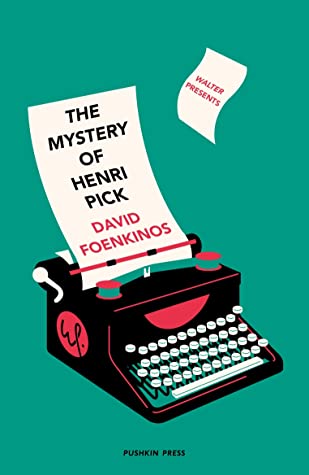 Delphine Despero is a rising Parisian editor who’s fallen in love with her latest signed author, Frédéric Koskas. Unfortunately, his novel The Bathtub is a flop, but he persists in writing a second, The Bed. On a trip home to Brittany so Frédéric can meet her parents, he and Delphine drop into the library of rejected books at Crozon and find a few amusing turkeys – but also a masterpiece. The Last Hours of a Love Affair is what it says on the tin, but also incorporates the death of Pushkin. The name attached to it is that of the late pizzeria owner in Crozon. His elderly widow and middle-aged daughter had no idea that their humble Henri had ever had literary ambitions, let alone that he had a copy of Eugene Onegin in the attic.
The Last Hours of a Love Affair becomes a publishing sensation – for its backstory more than its writing quality – yet there are those who doubt that Henri Pick could have been its author. The doubting faction is led by Jean-Michel Rouche, a disgraced literary critic who, having lost his job and his girlfriend, now has all the free time in the world to research the foundation of the Library of Rejects and those who deposited manuscripts there. Just when you think matters are tied up, Foenkinos throws a curveball.
This was such a light and entertaining read that I raced through. It has the breezy, mildly zany style I associate with films like Amélie. Despite the title, there’s not that much of a mystery here, but that suited me since I pretty much never pick up a crime novel. Foenkinos inserts lots of little literary in-jokes (not least: this is published by Pushkin Press!), and through Delphine he voices just the jaded but hopeful attitude I have towards books, especially as I undertake my own project of assessing unpublished manuscripts:
She had about twenty books to read during August, and they were all stored on her e-reader. [Her friends] asked her what those novels were about, and Delphine confessed that, most of the time, she was incapable of summarizing them. She had not read anything memorable. Yet she continued to feel excited at the start of each new book. Because what if it was good? What if she was about to discover a new author? She found her job so stimulating, it was almost like being a child again, hunting for chocolate eggs in a garden at Easter.
Great fun – give it a go!
My rating: 
(Originally published in 2016. Translation from the French by Sam Taylor, 2020.)
My thanks to Poppy at Pushkin Press for arranging my e-copy for review.
(Walter Presents, a foreign-language drama streaming service, launched in the UK (on Channel 4) in 2016 and is also available in the USA, Australia, and various European countries.)
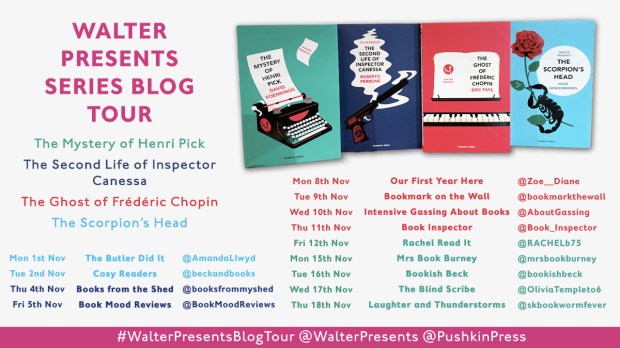
I was delighted to be part of the Walter Presents blog tour. See below for details of where other books and reviews have featured.
20 Books of Summer, #18–19: The Other’s Gold and Black Dogs
Today’s entries in my colour-themed summer reading are a novel about a quartet of college friends and the mistakes that mar their lives and a novella about the enduring impact of war set just after the fall of the Berlin Wall.
The Other’s Gold by Elizabeth Ames (2019)
Make new friends but keep the old,
One is silver and the other’s gold.
Do you know that little tune? We would sing it as a round at summer camp. It provides a clever title for this story of four college roommates whose lives are marked by the threat of sexual violence and ambivalent feelings about motherhood. Alice, Ji Sun, Lainey and Margaret first meet as freshmen in 2002 when they’re assigned to the same suite (with a window seat! how envious am I?) at Quincy-Hawthorn College.
 They live together for the whole four years – a highly unusual situation – and see each other through crises at college and in the years to come as they find partners and meander into motherhood. Iraq War protests and the Occupy movement form a turbulent background, but the friends’ overriding concerns are more personal. One girl was molested by her brother as a child and has kept secret her act of revenge; one has a crush on a professor until she learns he has sexual harassment charges being filed against him by multiple female students. Infertility later provokes jealousy between the young women, and mental health issues come to the fore.
As in Expectation by Anna Hope, the book starts to be all about babies at a certain point. That’s not a problem if you’re prepared for and interested in this theme, but I love campus novels so much that my engagement waned as the characters left university behind. Also, the characters seemed too artificially manufactured to inject diversity (Ji Sun is a wealthy Korean; adopted Lainey is of mixed Latina heritage, and bisexual; Margaret has Native American blood) and embody certain experiences. And, unfortunately, any #MeToo-themed read encountered in the wake of My Dark Vanessa is going to pale by comparison.
Part One held my interest, but after that I skimmed to the end. Ideally, I would have chosen replacements and not included skims like this and Green Mansions, but it’s not the first summer that I’ve had to count DNFs and skimmed books – my time and attention are always being diverted by paid review work, review copies and library books with imminent deadlines. I’ve read lots of fiction about groups of female friends this summer, partly by accident and partly by design, and will likely do a feature on it in an upcoming month. For now, I’d recommend Lara Feigel’s The Group instead of this. 
With thanks to Pushkin Press (ONE imprint) for the free e-copy for review.
Black Dogs by Ian McEwan (1992)
 When I read the blurb, I worried I’d read this before and forgotten it: all it mentions is a young couple setting off on honeymoon and having an encounter with evil. Isn’t that the plot of The Comfort of Strangers? I thought. In fact, this only happens to have the vacation detail in common, and has a very different setup and theme overall.
Jeremy lost his parents in a car accident (my least favourite fictional trope – far too convenient a way of setting a character off on their own!) when he was eight years old, and is self-aware enough to realize that he has been seeking for parental figures ever after. He becomes deeply immersed in the story of his wife’s parents, Bernard and June, even embarking on writing a memoir based on what June, from her nursing home bed, tells him of their early life (Part One).
After June’s death, Jeremy takes Bernard to Berlin (Part Two) to soak up the atmosphere just after the Wall comes down, but the elderly man is kicked by a skinhead. The other key thing that happens on this trip is that he refutes June’s account of their honeymoon. At June’s old house in France (Part Three), Jeremy feels her presence and seems to hear the couple’s voices. Only in Part Four do we learn what happened on their 1946 honeymoon trip to France: an encounter with literal black dogs that also has a metaphorical dimension, bringing back the horrors of World War II.
I think the novel is also meant to contrast Communist ideals – Bernard and June were members of the Party in their youth – with how Communism has played out in history. It was shortlisted for the Booker, which made me feel that I must be missing something. A fairly interesting read, most similar in his oeuvre (at least of the 15 I’ve read so far) to The Child in Time. (Secondhand purchase from a now-defunct Newbury charity shop) 
Coming up next: The latest book by John Green – it’s due back at the library on the 31st so I’ll aim to review it before then, possibly with a rainbow-covered novel as a bonus read.
Three for Novellas in November: Bythell, Carey and Diop
I started my reading for Novellas in November early with these three review books, one nonfiction and two fiction. They have in common the fact that they are published today –although I believe two were released early to beat the lockdown. Don’t worry, though; there are still plenty of ways of getting hold of new books: most publishers and bookshops are still filling orders, or you can use the UK’s newly launched Bookshop.org site and support your local indie.
Seven Kinds of People You Find in Bookshops by Shaun Bythell
[137 pages]
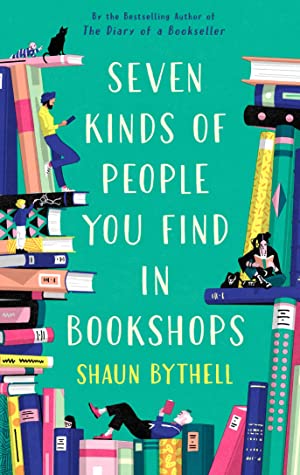 Cheerfully colored and sized to fit into a Christmas stocking, this is a fun follow-up to Bythell’s accounts of life at The Bookshop in Wigtown, The Diary of a Bookseller and Confessions of a Bookseller. Within his seven categories are multiple subcategories, all given tongue-in-cheek Latin names as if naming species. When I saw him chat with Lee Randall at the opening event of the Wigtown Book Festival, he introduced a few, such as the autodidact who knows more than you and will tell you all about their pet subject (the Homo odiosus, or bore). This is not the same, though, as the expert who shares genuinely useful knowledge – of a rare cover version on a crime paperback, for instance (Homo utilis, a helpful person).
There’s also the occultists, the erotica browsers, the local historians, the self-published authors, the bearded pensioners (Senex cum barba) holidaying in their caravans, and the young families – now that he has one of his own, he’s become a bit more tolerant. Setting aside the good-natured complaints, who are his favorite customers? Those who revel in the love of books and don’t quibble about the cost. Generally, these are not antiquarian book experts looking for a bargain, but everyday shoppers who keep a low-key collection of fiction or maybe specifically sci-fi and graphic novels, which fly off the shelves for good prices.
So which type am I? Well, occasionally I’m a farter (Crepans), but you won’t hold that against me, will you? I’d like to think I fit squarely into the normal people category (Homines normales) when I visited Wigtown in April 2018: we went in not knowing what we wanted but ended up purchasing a decent stack and even had a pleasant conversation with the man himself at the till – he’s much less of a curmudgeon in person than in his books. I do recommend this to those who have read and loved his other work.
With thanks to Profile Books for the free copy for review.
The Swallowed Man by Edward Carey
[160 pages]
 Carey’s historical novel Little was one of my highlights of 2018, so I jumped at the chance to read his new book. Interestingly, this riff on the Pinocchio story, narrated by Geppetto from the belly of a giant shark, originally appeared in Italian to accompany an exhibition hosted by the Fondazione Nazionale Carlo Collodi at the Parco di Pinocchio in Collodi. Geppetto came from a pottery-painting family but turned to wood when creating a little companion for his loneliness, the wooden boy who astounded him by coming to life. Now a son rather than a mere block of wood, Pinocchio sets off for school but never comes home. When he gets word that a troublesome automaton has been thrown into the sea, Geppetto sets out in a dinghy to find his son but is swallowed by the enormous fish that has been seen off the coast.
The picture of this new world-within-a-world is enthralling. Geppetto finds himself inside a swallowed ship, the Danish schooner Maria. Within the vessel is all he needs to occupy himself, at least for now: wood on which to paint the women he has loved; candle wax and hardtack for sculpting figures. Seaweed to cover his bald spot. Squid ink for his pen so he can write this notebook. A crab that lives in his beard. Relics of the captain’s life to intrigue him.
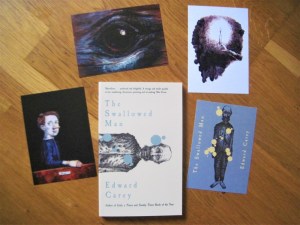
As a narrator, Geppetto is funny and gifted at wordplay (“This tome is my tomb”; “I unobjected him. Can you object to that?”), yet haunted by his decisions. Carey deftly traces Geppetto’s state of mind as he muses on his loss and imprisonment. The Afterword adds a sly pseudohistorical note to the fantasy. There are black-and-white illustrations throughout, as well as photos of the objects described in the text (and, presumably, featured in the exhibition). For me this didn’t live up to Little, but it would be a great introduction to Carey’s work.
With thanks to Gallic Books for the free copy for review.
At Night All Blood Is Black by David Diop
[145 pages; translated from the French by Anna Moschovakis]
 I had no idea that Africans (“Chocolat soldiers”) fought for France in World War I. Diop’s second novel, which has already won several major European prizes, is about two Senegalese brothers-in-arms caught up in trench warfare. Alfa Ndaiye, aged 20, considers Mademba Diop his blood brother or “more-than-brother” (the novel’s French title is “Soul Brother”). From the start we know that Mademba has died. Gravely injured in battle, entrails spilling out, he begged Alfa to end his misery; three times Alfa refused. Having watched his friend die in agony, he knows he did the wrong thing. Slitting the man’s throat would have been the compassionate choice. From now on, Alfa will atone by brutally wreaking Mademba’s method of death on Germans. “The captain’s France needs our savagery, and because we are obedient, myself and the others, we play the savage.” Alas, I thought this bleak exploration of (in)humanity was marred by the repetitive language and unpleasantly sexualized metaphors.
With thanks to Pushkin Press for the proof copy for review.
Do any of these novellas take your fancy?
What November releases can you recommend?
Recommended March Releases: Magnusson, May, Moor and More
March has been a huge month for new releases. With so many authors feeling let down about book tours and events being cancelled, it’s a great time for bloggers to step in and help. I attended two virtual book launches on Twitter on the 19th and have another one coming up on the 31st. I also have three more March releases on order from my local indie bookstore: Greenery by Tim Dee, tracking the arrival of spring; Footprints by David Farrier, about the fossil traces modern humans will leave behind; and The Bass Rock by Evie Wyld, a novel about violence against women set on the Scottish coast in three different time periods.
Today I have short reviews of five March releases I recommend (plus a bonus one now out in paperback): a Victorian pastiche infused with Scottish folklore, an essay collection about disparate experiences of motherhood, a thriller about victims of domestic violence, poems in graphic novel form, a novel about natural and personal disasters in Australia, and a lovely story of friendship and literature changing a young man’s life forever. All:
The Ninth Child by Sally Magnusson
(Published by Two Roads on the 19th)
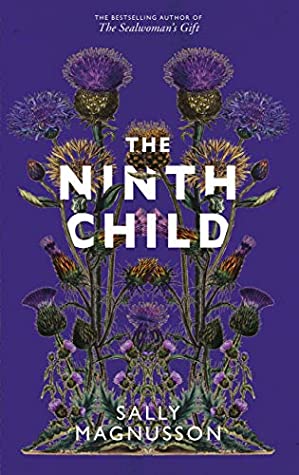 Like Hannah Kent’s The Good People and Sarah Perry’s The Essex Serpent, this is an intense, convincing work of fiction that balances historical realism with magical elements. In mid-1850s Britain, in the wake of a cholera epidemic, there is a drive to ensure clean water. Alexander Aird, hired as the on-site physician for the Glasgow waterworks, moves to the Loch Katrine environs with his wife, Isabel, who has had eight miscarriages or stillbirths. With no living babies requiring her care, Isabel spends her days wandering the hills and meets a strange scarecrow of a man, Reverend Robert Kirke … who died in 1692.
A real-life Episcopalian minister, Kirke wrote a book about fairies and other Celtic supernatural beings and, legend has it (as recounted by Sir Walter Scott and others), was taken into the faery realm after his death and continued to walk the earth looking for rest. It takes a while for Isabel to learn the truth about Kirke – though her servant, Kirsty McEchern, immediately intuits that something isn’t right about the man – and longer still to understand that he wants something from her. “Whatever else, Robert Kirke could be relied on to ruffle this mind of hers that was slowly opening to experience again, and to thinking, and to life.”
This was a rollicking read that drew me in for its medical elements (premature birth, a visit to Joseph Lister, interest in Florence Nightingale’s nursing methods) as well as the plot. It often breaks from the omniscient third-person voice to give testimonies from Kirsty and from Kirke himself. There are also amusing glimpses into the Royal household when Victoria and Albert stay at Balmoral and return to open the waterworks during the “heaviest, windiest, most umbrella-savaging, face-slashing deluge that Scotland had experienced in twenty years.” Best of all, it gives a very different picture of women’s lives in the Victorian period.
My thanks to the publisher for the proof copy for review.
The Best Most Awful Job: Twenty Writers Talk Honestly about Motherhood, edited by Katherine May
(Published by Elliott & Thompson on the 19th)
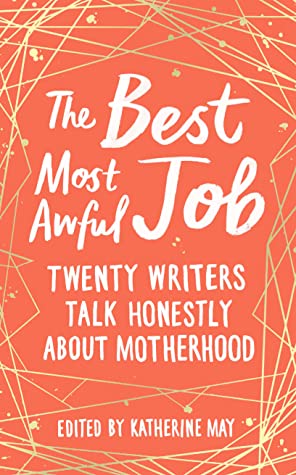 These are essays for everyone who has had a mother – not just everyone who has been a mother. I enjoyed every piece separately, but together they form a vibrant collage of women’s experiences. Care has been taken to represent a wide range of situations and attitudes. The reflections are honest about physical as well as emotional changes, with midwife Leah Hazard (author of Hard Pushed) kicking off with an eye-opening rundown of the intimate scarring some mothers will have for the rest of their lives. We hear from a mother of six who’s “addicted” to pregnancy (Jodi Bartle), but also from a woman who, after an ectopic pregnancy, realized “there are lots of ways to mother, even if your body won’t let you” (Peggy Riley, in one of my two favorite pieces in the book).
Women from BAME communities recount some special challenges related to cultural and family expectations, but others that are universal. An autistic mother (Joanne Limburg) has to work out how to parent a neurotypical child; queer parents (including author Michelle Tea) wonder how to raise a son at a time of toxic masculinity. There are also several single mothers, one of them disabled (Josie George – hers was my other favorite essay; do follow her on Twitter via @porridgebrain if you don’t already).
What I most appreciated is that these authors aren’t saying what they think they should say about motherhood; they’re willing to admit to boredom, disappointment and rage: “motherhood is an infinite, relentless slog from which there is no rest or recuperation … a ceaseless labour, often devoid of acknowledgment, recognition and appreciation” (Javaria Akbar); “I step barefoot on a rogue piece of Lego and it’s game over. I scream” (Saima Mir). These are punchy, distinctive slices of life writing perfectly timed for Mother’s Day. I plan to pass the book around my book club; mothers or not, I know everyone will appreciate it.
My thanks to the publisher for the proof copy for review.
Keeper by Jessica Moor
(Published by Viking/Penguin on the 19th)
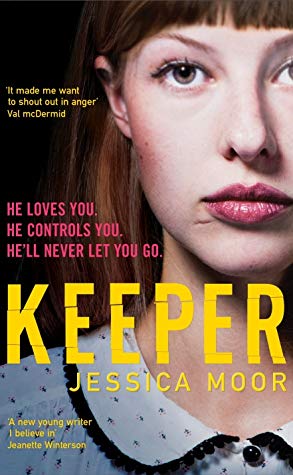 Val McDermid and Jeanette Winterson are among the fans of this, Penguin’s lead debut title of 2020. When a young woman is found drowned at a popular suicide site in the Manchester area, the police plan to dismiss the case as an open-and-shut suicide. But the others at the women’s shelter where Katie Straw worked aren’t convinced, and for nearly the whole span of this taut psychological thriller readers are left to wonder if it was suicide or murder.
The novel alternates between chapters marked “Then” and “Now”: in the latter story line, we follow the police investigation and meet the women of the refuge; in the former, we dive into Katie’s own experience of an abusive relationship back in London. While her mother was dying of cancer she found it comforting to have a boyfriend who was so attentive to her needs, but eventually Jamie’s obsessive love became confining.
I almost never pick up a mystery, but this one was well worth making an exception for. I started suspecting the twist at maybe the two-thirds point, but that didn’t detract from my enjoyment. Based on Moor’s year working in the violence against women sector, it’s a gripping and grimly fascinating story of why women stay with their abusers and what finally drives them to leave.
I picked up a proof copy at a Penguin Influencers event.
 Poems to See by: A Comic Artist Interprets Great Poetry by Julian Peters
(To be published by Plough Publishing House on the 31st)
Peters is a comics artist based in Montreal. Here he has chosen 24 reasonably well-known poems by the likes of e.e. cummings, Emily Dickinson, Robert Frost, Seamus Heaney, Langston Hughes, Edgar Allan Poe, Christina Rossetti and W.B. Yeats and illustrated each one in a markedly different fashion. From black-and-white manga to a riot of color and music, from minimalist calligraphy-like Japanese watercolor to imitations of Brueghel, there is such a diversity of style here that at first I presumed there were multiple artists involved (as in one of my favorite graphic novels of last year, ABC of Typography, where the text was written by one author but each chapter had a different illustrator). But no, this is all Peters’ work; I was impressed by his versatility.
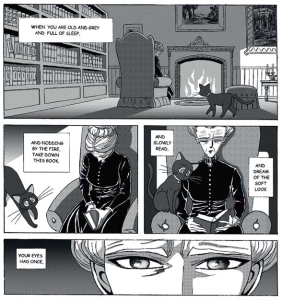
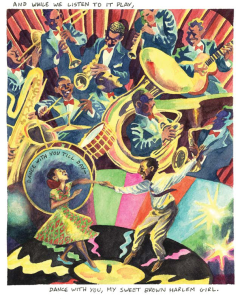
The illustrations range from realistic to abstract, with some more obviously cartoon-like. A couple of sequences reminded me of the style of Raymond Briggs. For “Caged Bird” by Maya Angelou, lines are inlaid on the squares of a painted patchwork quilt. Other sets look to have been done via wood engraving, or with old-fashioned crayons. You could quibble with the more obvious poetry selections, but I encountered a few that were new to me, including “Buffalo Dusk” by Carl Sandburg and “Conscientious Objector” by Edna St. Vincent Millay. Peters has grouped them into six thematic categories: self, others, art, nature, time and death. Teenagers, especially, will enjoy the introduction to a variety of poets and comics styles.
I read an e-copy via NetGalley.
The Inland Sea by Madeleine Watts
(Published by ONE/Pushkin on the 5th)
 “Emergency police fire, or ambulance?” The young female narrator of this debut novel lives in Sydney and works for Australia’s emergency call service. Over her phone headset she gets appalling glimpses into people’s worst moments: a woman cowers from her abusive partner; a teen watches his body-boarding friend being attacked by a shark. Although she strives for detachment, her job can’t fail to add to her anxiety – already soaring due to the country’s flooding and bush fires.
Against that backdrop of natural disasters, a series of minor personal catastrophes play out. The narrator is obsessed with a rape/murder case that’s dominating the television news, and narrowly escapes sexual assault herself. She drinks to excess, keeps hooking up with her ex-boyfriend, Lachlan, even after he gets a new girlfriend, and seems to think abortion and the morning after pill are suitable methods of birth control. Irresponsible to the point of self-sabotage, she’s planning a move to London but in the meantime is drifting through life, resigned to the fact that there is no unassailable shelter and no surefire way to avoid risk.
The title comes from the quest of John Oxley (presented here as the narrator’s ancestor), who in 1817 searched for a water body in the Australian interior. Quotations from his journals and discussions of the work of Patrick White, the subject of Lachlan’s PhD thesis, speak to the search for an Australian identity. But the inland sea is also the individual psyche, contradictory and ultimately unknowable. Like a more melancholy version of Jenny Offill’s Weather or a more cosmic autofiction than Yara Rodrigues Fowler’s Stubborn Archivist, this is a timely, quietly forceful story of how women cope with concrete and existential threats.
My thanks to the publisher for the PDF copy for review.
And a bonus…
The Offing by Benjamin Myers (2019)
(Paperback published by Bloomsbury on the 5th)
 With the Second World War only recently ended and nothing awaiting him apart from the coal mine where his father works, sixteen-year-old Robert Appleyard sets out on a journey. From his home in County Durham, he walks southeast, doing odd jobs along the way in exchange for food and lodgings. One day he wanders down a lane near Robin Hood’s Bay and gets a surprisingly warm welcome from a cottage owner, middle-aged Dulcie Piper, who invites him in for tea and elicits his story. Almost accidentally, he ends up staying for the rest of the summer, clearing scrub and renovating her garden studio.
Dulcie is tall, outspoken and unconventional – I pictured her as (Meryl Streep as) Julia Child in the movie Julie & Julia. She introduces Robert to whole new ways of thinking: that not everyone believes in God, that Germans might not be all bad, that life can be about adventure and pleasure instead of duty. “The offing” is a term for the horizon, as well as the title of a set of poems Robert finds in the dilapidated studio, and both literature and ambition change his life forever. Bright, languid and unpredictable, the novel delights in everyday sensual pleasures like long walks with a dog, dips in the ocean and an abundance of good food. I can’t think of another book I’ve read that’s quite like it – how refreshing is that?
I pre-ordered the paperback using a Waterstones voucher I got for Christmas.
What recent releases can you recommend?
Women in the Polar Night: Christiane Ritter and Sigri Sandberg
I’m continuing a Nonfiction November focus with reviews of two recently (re-)released memoirs about women spending time in the Arctic north of Norway. I enjoy reading about survival in extreme situations – it’s the best kind of armchair traveling because you don’t have to experience the cold and privation for yourself.
A Woman in the Polar Night by Christiane Ritter (1938; English text, 1954)
[Translated by Jane Degras]
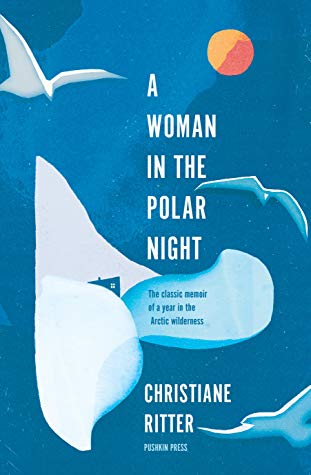 In 1934, Ritter, an Austrian painter, joined her husband Hermann for a year in Spitsbergen. He’d participated in a scientific expedition and caught the Arctic bug, it seems, for he stayed on to fish and hunt. They shared a small, remote hut with a Norwegian trapper, Karl. Ritter was utterly unprepared for the daily struggle, having expected a year’s cozy retreat: “I could stay by the warm stove in the hut, knit socks, paint from the window, read thick books in the remote quiet and, not least, sleep to my heart’s content.” Before long she was disabused of her rosy vision. “It’s a ghastly country, I think to myself. Nothing but water, fog, and rain.” The stove failed. Dry goods ran out; they relied on fresh seal meat. Would they get enough vitamins? she worried. Every time Hermann and Karl set off hunting, leaving her alone in the hut, she feared they wouldn’t return. And soon the 132 straight days of darkness set in.
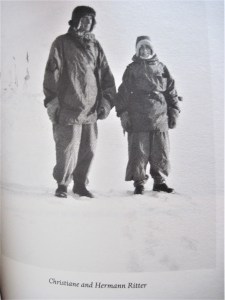 I was fascinated by the details of Ritter’s daily tasks, but also by how her perspective on the landscape changed. No longer a bleak wilderness, it became a tableau of grandeur. “A deep blue-green, the mountains rear up into a turquoise-coloured sky. From the mountaintops broad glaciers glittering in the sun flow down into the fjord.” She thought of the Arctic almost as a site of spiritual pilgrimage, where all that isn’t elemental falls away. “Forgotten are all externals; here everything is concerned with simple being.” The year is as if outside of time: she never reminisces about her life back home, and barely mentions their daughter. By the end you see that the experience has changed her: she’ll never fret over trivial things again. She lived to age 103 (only dying in 2000), so clearly the time in the Arctic did her no harm.
Ritter wrote only this one book. A travel classic, it has never been out of print in German but has been for 50 years in the UK. Pushkin Press is reissuing the English text on the 21st with a foreword by Sara Wheeler, a few period photographs and a hand-drawn map by Neil Gower.
My rating: 
With thanks to Pushkin Press for the free copy for review.
Notes: Michelle Paver drew heavily on this book when creating the setting for Dark Matter. (There’s even a bear post outside the Ritters’ hut.)
I found some photos of the Ritters’ hut here.
(Although I did not plan it this way, this book also ties in with German Literature Month!)
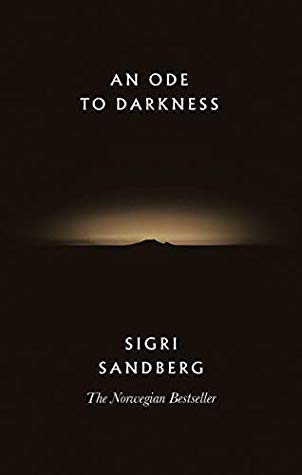
An Ode to Darkness by Sigri Sandberg (2019)
[Translated by Siân Mackie]
Ritter’s book is a jumping-off point for Norwegian journalist Sandberg’s investigation of darkness as both a physical fact and a cultural construct. She travels alone from her home in Oslo to her cabin in the mountains at Finse, 400 miles south of the Arctic Circle. Ninety percent of Norway’s wildlife sleeps through the winter, and she often wishes she could hibernate as well. Although she only commits to five days in the far north compared to Ritter’s year, she experiences the same range of emotions, starting with a primitive fear of nature and the dark.
It is a fundamental truth that darkness does not exist from an astronomical standpoint. Happy fact. I’m willing to accept this. I try to find it comforting, helpful. But I still struggle to completely believe that darkness does not actually exist. Because what does it matter to a small, poorly designed human whether darkness is real or perceived? And what about the black holes in the universe, what about dark matter, what about the night sky and the threats against it, and … and now I’m exhausted. I’m done for the day. I feel so small, and I’m tired of being afraid.
 Over the course of the book she talks to scientists about the human need for sleep and sunshine, discusses solitude and dark sky initiatives, and quotes from a number of poets, especially Jon Fosse, “Norway’s greatest writer,” who often employs metaphors of light and dark: “Deep inside me / … it was like the empty darkness was shining”.
In occasional passages labeled “Christiane” Sandberg also recounts fragments of Ritter’s experiences. I read Sandberg’s book first, so these served as a tantalizing introduction to A Woman in the Polar Night. “Is there anywhere as silent as a white winter plateau on a windless day? And how long can anyone spend alone before they start to feel, like Christiane did, as if their very being is disintegrating?”
This is just the sort of wide-ranging nonfiction I love; it intersperses biographical and autobiographical information with scientific and cultural observations.
 [Another recent book tries to do a similar thing but is less successful – partially due to the author’s youthful optimism, but also due to the rambly, shallow nature of the writing. (My
  review will be in the November 29th issue of the Times Literary Supplement.)]
My rating:
With thanks to Sphere for the free copy for review.
Related reading: This Cold Heaven: Seven Seasons in Greenland by Gretel Ehrlich
Do you like reading about polar exploration, or life’s extremes in general?
No Place to Lay One’s Head by Françoise Frenkel (1945)
Fittingly, I finished reading this on Sunday, which was International Holocaust Remembrance Day. Even after seven decades, we’re still unearthing new Holocaust narratives, such as this one: rediscovered in a flea market in 2010, it was republished in French in 2015 and first became available in English translation in 2017.
 Born Frymeta Idesa Frenkel in Poland, the author (1889–1975) was a Jew who opened the first French-language bookstore in Berlin in 1921. After Kristallnacht and the seizure of her stock and furniture, she left for France and a succession of makeshift situations, mostly in Avignon and Nice. She lived in a hotel, a chateau, and the spare room of a sewing machinist whose four cats generously shared their fleas. All along, the Mariuses, a pair of hairdressers, were like guardian angels she could go back to between emergency placements.
This memoir showcases the familiar continuum of uneasiness blooming into downright horror as people realized what was going on in Europe. To start with one could downplay the inconveniences of having belongings confiscated and work permits denied, of squeezing onto packed trains and being turned back at closed borders. Only gradually, as rumors spread of what was happening to deported Jews, did Frenkel understand how much danger she was in.
The second half of the book is more exciting than the first, especially after Frenkel is arrested at the Swiss border. (Even though you know she makes it out alive.) Her pen portraits of her fellow detainees show real empathy as well as writing talent. Strangely, Frenkel never mentions her husband, who went into exile in France in 1933 and died in Auschwitz in 1942. I would also have liked to hear more about her 17 years of normal bookselling life before everything kicked off. Still, this is a valuable glimpse into the events of the time, and a comparable read to Władysław Szpilman’s The Pianist.
My rating: 
No Place to Lay One’s Head (translated from the French by Stephanie Smee) is issued in paperback today, January 31st, by Pushkin Press. This edition includes a preface by Patrick Modiano and a dossier of documents and photos relating to Frenkel’s life. My thanks to the publisher for the free copy for review.
 Bookish Beck = Rebecca Foster. American transplant to England. Freelance proofreader and book reviewer.
 Bookish Beck