The Party by Tessa Hadley (Blog Tour and #NovNov24)
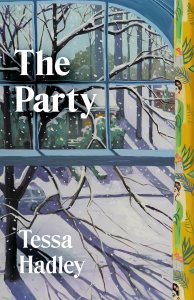 You can count on Tessa Hadley for atmospheric, sophisticated stories of familial and romantic relationships in mid- to late-twentieth-century England. The Party is a novella of sisters Moira and Evelyn, university students on the cusp of womanhood. In 1950s Bristol, the Second World War casts a long shadow and new conflicts loom – Moira’s former beau was sent to Malaya. Suave as they try to seem, with Evelyn peppering her speech with the phrases she’s learning in the first year of her French degree, the girls can’t hide their origins in the Northeast. When Evelyn joins Moira at an art students’ party in a pub, fashionable outfits make them look older and more confident than they really are. Evelyn admits to her classmate, Donald, “I’m always disappointed at parties. I long to be, you know, a succès fou, but I never am.” Then the sisters meet Paul and Sinden, who flatter them by taking an interest; they are attracted to the men’s worldly wise air but also find them oddly odious.
The novella’s three chapters each revolve around a party. First is the Bristol dockside pub party (published as a short story in the New Yorker); second is a cocktail party the girls’ parents are preparing for, giving us a window onto their troubled marriage; finally is a gathering Paul invites them to at the shabby inherited mansion he lives in with his cousin, invalid brother, and louche sister. “We camp in it like kids,” Paul says. “Just playing at being grown up, you know.” During their night spent at the mansion, the sisters become painfully aware of the class difference between them and Paul’s moneyed family. The divide between innocence and experience may be sharp, but the line between love and hatred is not always as clear as they expected. And from moments of decision all the rest of life flows.
In her novels and story collections, Hadley often writes about strained families, young women on the edge, and the way sex can force a change in direction. This was my eighth time reading her, and though The Party is as stylish as all her work, it didn’t particularly stand out for me, lacking the depth of her novels and the concentration of her stories. Still, it would be a good introduction to Hadley or, if you’re an established fan like me, you could read it in a sitting and be reminded of her sharp eye for manners and pretensions – and the emotions they mask.
[115 pages]

With thanks to Anne Cater of Random Things Tours and Jonathan Cape (Penguin) for the proof copy for review.
Buy The Party from Bookshop.org [affiliate link]
I was delighted to be part of the blog tour for The Party. See below for details of where other reviews have appeared or will appear soon.
A New Chapter in My McKitterick Prize Judging
 For the past four years, I have been a judge for the McKitterick Prize, one of various awards administered by the Society of Authors (the UK trade union for writers). Since 1990, this Prize has been given to a debut novelist aged 40+. It’s unique in that it considers unpublished manuscripts as well as published novels – Tom McKitterick, who endowed the prize, was a former Political Quarterly editor and left an unpublished novel at his death. The overlapping Paul Torday Memorial Prize (for debut authors of 60+) closed last year, so this is one of just two prizes I know of for authors OVER a certain age, the other being the RSL Christopher Bland Prize, which is for fiction or nonfiction.
In 2021–24, my role was helping to whittle down the unpublished manuscripts, which then joined the traditionally published novels for judging. For 2025, I’m delighted to announce that I’m one of the judges assessing the published material (this includes self-published books). The opportunity came about by happenstance, really. I realized that I hadn’t heard from the SoA lately and assumed they didn’t need me this year, but e-mailed in case and learned that a judge had just had to bow out, leaving a space for me. It feels like a big step up as judging ‘proper books’ – by which I mean published, and in print format – for a literary prize is a longstanding ambition of mine.


My first shipment arrived on Thursday and I’ve already gotten stuck into my first two reads. I didn’t take a look at the list before the parcel was delivered so I could have the fun of unboxing surprises. Four of the submissions are ones I (secretly) predicted, and I recognized another six titles. The rest are new to me. I likely won’t be able to share more about the process or any of my reading until after the shortlist in May and/or the winner announcement in June at the annual SoA Awards ceremony. My hope is that I will find lots of gems so the task never turns tedious. Longlist choices are due in March, so I’m going to be busy over the next few months! I pulled out a notebook I won in a giveaway on Cathy’s blog to act as a repository for my notes and thoughts. I’m excited to see what themes emerge and encounter some debut novelists the world needs to hear about.


#NovNov24 Halfway Check-In & Small Things Like These Film Review
Somehow half of November has flown by. We hope you’ve been enjoying reading and reviewing short books this month. So far we have had 40 participants and 84 posts! Remember to add your posts to the link-up, or alert us via a comment here or on Bluesky (@cathybrown746.bsky.social / @bookishbeck.bsky.social), Instagram (@cathy_746books / @bookishbeck), or X (@cathy746books / @bookishbeck).

If you haven’t already, there’s no better time to pick up our buddy read, Orbital by Samantha Harvey, which won the Booker Prize on Tuesday evening. Chair of judges Edmund de Waal said it is “about a wounded world” and that the panel’s “unanimity about Orbital recognises its beauty and ambition.” I was surprised to learn that it is only the second-shortest Booker winner; Offshore by Penelope Fitzgerald is even shorter.

Another popular novella many of us have read is Small Things Like These by Claire Keegan (my latest review is here). I went to see the excellent film adaptation, with a few friends from book club, at our tiny local arthouse cinema on Wednesday afternoon. I’ve read the book twice now – I might just read it a third time before Christmas – and from memory the film is remarkably faithful to its storyline and scope. (The only significant change I think of is that Bill doesn’t visit Ned in the hospital, but there are still flashbacks to the role that Ned played in Bill’s early life.)
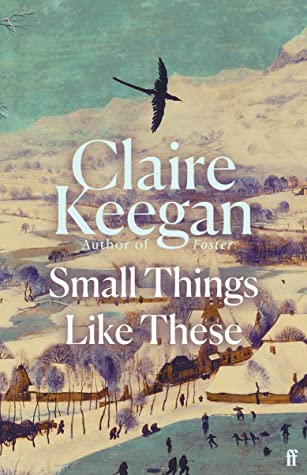 The casting and cinematography are exceptional. Cillian Murphy portrays Bill with just the right blend of stoicism, meekness, and angst. Emily Watson is chilling as Sister Mary, the Mother Superior of the convent, which is suitably creepy with dim brick hallways and clinical laundry rooms. The grimy cobbles and dull streetlamps of the town contrast with the warm light in the scenes of Bill’s remembered childhood at Mrs Wilson’s. Repeated shots – of Bill’s truck setting off across the bridge in the early morning, of him scrubbing coal dust from his hands with carbolic soap, of his eyes wide open in the middle of the night – are not recursive but a way of establishing the gruelling nature of his tasks and the unease that plagues him. A life of physical labour has aged him beyond 39 (cf. Murphy is 48) and he’s in pain from shouldering sacks of coal day in and day out.
Both book and film are set in 1985 but apart from the fashions and the kitschy Christmas decorations and window dressings you’d be excused for thinking it was the 1950s. Bill’s business deals in coal, peat and tinder; rural Ireland really was that economically depressed and technologically constrained. (Another Ireland-set film I saw last year, The Miracle Club, is visually very similar – it even features two of the same actors – although it takes place in 1967. It’s as if nothing changed for decades.)
 By its nature, the film has to be a little more overt about what Bill is feeling (and generally not saying, as he is such a quiet man): there are tears at Murphy’s eyes and anxious breathing to make Bill’s state of mind obvious. Yet the film retains much of the subtlety of Keegan’s novella. You have to listen carefully during the conversation between Bill and Sister Mary to understand she is attempting to blackmail him into silence about what goes on at the convent.
At the end of the film showing, you could have heard a pin drop. Everyone was stunned at the simple beauty of the final scene, and the statistics its story is based on. It’s truly astonishing that Magdalene Laundries were in operation until the late 1990s, with Church support. Rage and sorrow build in you at the very thought, but Bill’s quietly heroic act of resistance is an inspiration. What might we, ordinary people all, be called on to do for women, the poor, and the oppressed in the years to come? We have no excuse not to advocate for them.
(Arti of Ripple Effects has also reviewed the film here.)
So far this month I’ve read nine novellas and reviewed eight. One of these was a one-sitting read, and I have another pile of ones that I could potentially read of a morning or evening next week. I’m currently reading another 16 … it remains to be seen whether I will average one a day for the month!
#NovNov24 and #GermanLitMonth: Knulp by Hermann Hesse (1915)
My second contribution to German Literature Month (hosted by Lizzy Siddal) after A Simple Intervention by Yael Inokai. This was my first time reading the German-Swiss Nobel Prize winner Hermann Hesse (1877–1962). I had heard of his novels Siddhartha and Steppenwolf, of course, but didn’t know about any of his shorter works before I picked this up from the Little Free Library last month. Knulp is a novella in three stories that provide complementary angles on the title character, a carefree vagabond whose rambling years are coming to an end.
“Early Spring” has a first-person plural narrator, opening “Once, early in the nineties, our friend Knulp had to go to hospital for several weeks.” Upon his discharge he stays with an old friend, the tanner Rothfuss, and spends his time visiting other local tradespeople and casually courting a servant girl. Knulp is a troubadour, writing poems and songs. Without career, family, or home, he lives in childlike simplicity.
He had seldom been arrested and never convicted of theft or mendicancy, and he had highly respected friends everywhere. Consequently, he was indulged by the authorities very much, as a nice-looking cat is indulged in a household, and left free to carry on an untroubled, elegant, splendidly aristocratic and idle existence.
 “My Recollections of Knulp” is narrated by a friend who joined him as a tramp for a few weeks one midsummer. It wasn’t all music and jollity; Knulp also pondered the essential loneliness of the human condition in view of mortality. “His conversation was often heavy with philosophy, but his songs had the lightness of children playing in their summer clothes.”
In “The End,” Knulp encounters another school friend, Dr. Machold, who insists on sheltering the wayfarer. They’re in their forties but Knulp seems much older because he is ill with tuberculosis. As winter draws in, he resists returning to the hospital, wanting to die as he lived, on his own terms. The book closes with an extraordinary passage in which Knulp converses with God – or his hallucination of such – expressing his regret that he never made more of his talents or had a family. ‘God’ speaks these beautiful words of reassurance:
Look, I wanted you the way you are and no different. You were a wanderer in my name and wherever you went you brought the settled folk a little homesickness for freedom. In my name, you did silly things and people scoffed at you; I myself was scoffed at in you and loved in you. You are my child and my brother and a part of me. There is nothing you have enjoyed and suffered that I have not enjoyed and suffered with you.
I struggle with episodic fiction but have a lot of time for the theme of spiritual questioning. The seasons advance across the stories so that Knulp’s course mirrors the year’s. Knulp could almost be a rehearsal for Stoner: a spare story of the life and death of an Everyman. That I didn’t appreciate it more I put down to the piecemeal nature of the narrative and an unpleasant conversation between Knulp and Machold about adolescent sexual experiences – as in the attempted gang rape scene in Cider with Rosie, it’s presented as boyish fun when part of what Knulp recalls is actually molestation by an older girl cousin. I might be willing to try something else by Hesse. Do give me recommendations! (Little Free Library) 
Translated from the German by Ralph Manheim.
[125 pages]


Mini playlist:
- “Ramblin’ Man” by Lemon Jelly
- “I’ve Been Everywhere” by Johnny Cash
- “Rambling Man” by Laura Marling
- “Ballad of a Broken Man” by Duke Special
- “Railroad Man” by Eels
 I have also recently read a 2025 release that counts towards these challenges, The Café with No Name by Robert Seethaler (Europa Editions; translated by Katy Derbyshire; 192 pages). The protagonist, Robert Simon [Robert S., eh? Coincidence?], is not unlike Knulp, though less blithe, or the unassuming Bob Burgess from Elizabeth Strout’s novels (e.g., Tell Me Everything). Robert takes over the market café in Vienna and over the next decade or so his establishment becomes a haven for the troubled. The Second World War still looms large, and disasters large and small unfold. It’s all rather melancholy; I admired the chapters that turn the customers’ conversation into a swirling chorus. In my review, pending for Foreword Reviews, I call it “a valedictory meditation on the passage of time and the bonds that last.”
Nonfiction November Book Pairings: Autistic Husbands & The Ocean
Liz is the host for this week’s Nonfiction November prompt. The idea is to choose a nonfiction book and pair it with a fiction title with which it has something in common.
I came up with these two based on my recent reading:
An Autistic Husband
The Rosie Effect by Graeme Simsion (also The Rosie Project and The Rosie Result)
&
Disconnected: Portrait of a Neurodiverse Marriage by Eleanor Vincent
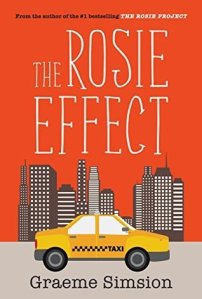 Graeme Simsion’s Don Tillman trilogy tells the odd-couple story of an autistic professor and how he falls in love with and marries a wholly unsuitable neurotypical woman. He turns this situation into romantic comedy. For Eleanor Vincent, it wasn’t so funny. She met her third husband, computer scientist Lars (a pseudonym), through Zydeco dancing when she was in her sixties. Though aware that he could be unemotional and act strangely, she found him chivalrous and sweet. They dated for a time but he hurt and confused her by asking for his apartment keys back. After a five-year period she calls their “Interregnum,” the two got back together and married. Despite their years of friendship, she was completely unprepared for what living with him would be like. “At the age of seventy-one, I had married a stranger,” she writes.
It didn’t help that Covid hit partway through their four-year marriage, nor that they each received a cancer diagnosis (cervical vs. prostate). But the problems were more with their everyday differences in responses and processing. During their courtship, she ignored some bizarre things he did around her family: he bit her nine-year-old granddaughter as a warning of what would happen if she kept antagonizing their cat, and he put a gift bag over his head while they were at the dinner table with her siblings. These are a couple of the most egregious instances, but there are examples throughout of how Lars did things she didn’t understand. Through support groups and marriage counselling, she realized how well Lars had masked his autism when they were dating – and that he wasn’t willing to do the work required to make their marriage succeed. The book ends with them estranged but a divorce imminent.
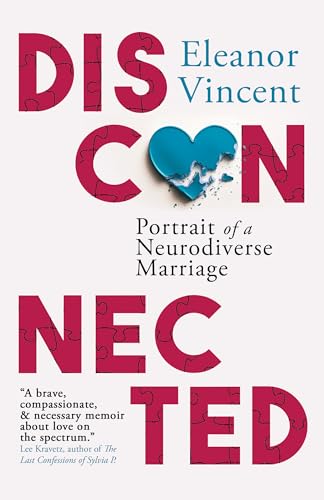 If this were purely carping about a husband’s weirdness, it might have been tedious or depressing. But Vincent doesn’t blame Lars, and she incorporates so much else in this short memoir, including a number of topics that are of particular interest to me. There’s her PTSD from a traumatic upbringing, her parents’ identity as closeted gay people, the complications around her father’s death, the tragedy of her older daughter’s death, as well as the more everyday matters of being a working single parent, finding an affordable property in California’s Bay Area, and blending households.
Vincent crafts engaging scenes with solid recreated dialogue, and I especially liked the few meta chapters revealing “What I Left Out” – a memoir is always a shaped narrative, while life is messy; this shows both. She is also honest about her own failings and occasional bad behavior. I probably could have done with a little less detail on their sex life, however.
This had more relevance to me than expected. While my sister and I were clearing our mother’s belongings from the home she shared with her second husband for the 16 months between their wedding and her death, our stepsisters mentioned to us that they suspected their father was autistic. It was, as my sister said, a “lightbulb” moment, explaining so much about our respective parents’ relationship, and our interactions with him as well. My stepfather (who died just 10 months after my mother) was a dear man, but also maddening at times. A retired math professor, he was logical and flat of affect. Sometimes his humor was off-kilter and he made snap, unsentimental decisions that we couldn’t fathom. Had they gotten longer together, no doubt many of the issues Vincent experienced would have arisen. (Read via BookSirens)
[173 pages]
The Ocean
Playground by Richard Powers
&
Rachel Carson and the Power of Queer Love by Lida Maxwell
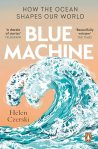
The Blue Machine by Helen Czerski
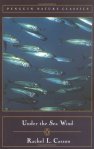
Under the Sea Wind by Rachel Carson
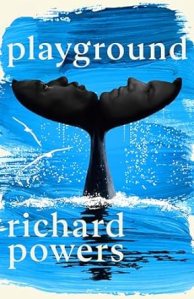 While I was less than enraptured with its artificial intelligence theme and narrative trickery, I loved the content about the splendour of the ocean in Richard Powers’s Booker Prize-longlisted Playground. Most of this comes via Evelyne Beaulieu, a charismatic French Canadian marine biologist (based in part on Sylvia Earle) who is on the first all-female submarine mission and is still diving in the South Pacific in her nineties. Powers explicitly references Rachel Carson’s The Sea Around Us. Between that and the revelation of Evelyne as a late-bloomer lesbian, I was reminded of Rachel Carson and the Power of Queer Love, a forthcoming novella-length academic study by Lida Maxwell that I have assessed for Foreword Reviews. Maxwell’s central argument is that Carson’s romantic love for a married woman, Dorothy Freeman, served as an awakening to wonder and connection and spurred her to write her greatest works.
After reading Playground, I decided to place a library hold on Blue Machine by Helen Czerski (winner of the Wainwright Writing on Conservation Prize this year), which Powers acknowledges as an inspiration that helped him to think bigger. I have also pulled my copy of Under the Sea Wind by Rachel Carson off the shelf as it’s high time I read more by her.
Previous book pairings posts: 2018 (Alzheimer’s, female friendship, drug addiction, Greenland and fine wine!) and 2023 (Hardy’s Wives, rituals and romcoms).
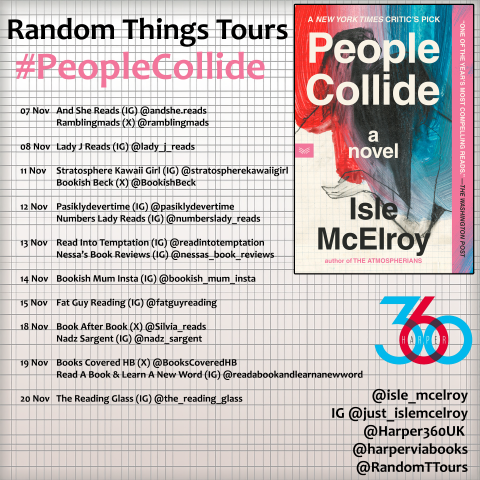
People Collide by Isle McElroy (Blog Tour)
People Collide (2023), nonbinary author Isle McElroy’s second novel, is a body swap story that explores the experiences and gender expectations of a heterosexual couple when they switch places. It’s not so much magic realism as a what-if experiment. Eli wakes up one morning in his wife Elizabeth’s body in their “pie slice of an apartment” in southern Bulgaria, where they moved for her government-sponsored teaching position. At first, finding himself alone, he thinks she’s disappeared and goes to the school to ask after her. The staff and students there, seeing him as Elizabeth, think they’re witnessing some kind of mental breakdown and send ‘her’ home. One of them is gone, yes, but it’s Elizabeth – in Eli’s body.
Both sets of parents get involved in the missing person case and, when a credit card purchase indicates Elizabeth is in Paris, Eli sets off after her. He is an apt narrator because he sees himself as malleable and inessential: “I wasn’t a person but a protean blob, intellectually and emotionally gelatinous, shaped by whatever surrounded me; “I could never shake the sense that I was, for [Elizabeth], like a supplementary arm grafted onto the center of her stomach.” He comes from a rough family background, has a history of disordered eating, and doesn’t have a career, so is mildly resentful of Elizabeth’s. She’s also an aspiring novelist and her solitary work takes priority while he cooks the meals and grades her students’ papers.

The couple already pushed against gender stereotypes, then, but it is still a revelation to Elizabeth how differently she is treated as a male. “I can’t name a single thing I don’t like about it. Everything’s become so much easier for me in your body,” she says to Eli when they finally meet up in Paris. There follows an arresting seven-page sex scene as they experience a familiar act anew in their partner’s body. “All that had changed was perspective.” But interactions with the partner’s parents assume primacy in much of the rest of the book.
This novel has an intriguing premise that offered a lot of potential, but it doesn’t really go anywhere with it. The sex scene actually struck me as the most interesting part, showing how being in a different body would help one understand desire. Beyond that, it feels like a stale rumination on passing as female (Elizabeth schooling Eli about menstruation and how to respond to her parents’ news about extended family) and women not being taken seriously in the arts (a lecture by a Rachel Cusk-like writer in the final chapter). I also couldn’t account for two unusual authorial decisions: Eli is caught up in a Parisian terrorist attack, but nothing results. Was it to shake things up at the one-third point, for want of a better idea? I also questioned the late shift to Elizabeth’s mother’s narration. Introducing a new first-person narrator, especially so close to the end, feels like cheating, or admitting defeat if there’s something important that Eli can’t witness. The author is skilled at creating backstory and getting characters from here to there. But in figuring out how the central incident would play out, the narrative falls short. Ultimately, I would have preferred this at short story length, where suggestion would be enough and more could have been left to the imagination.
With thanks to Anne Cater of Random Things Tours and HarperVia for the free copy for review.
Buy People Collide from Bookshop.org [affiliate link]
I was delighted to be part of the blog tour for People Collide. See below for details of where other reviews have appeared or will appear soon.
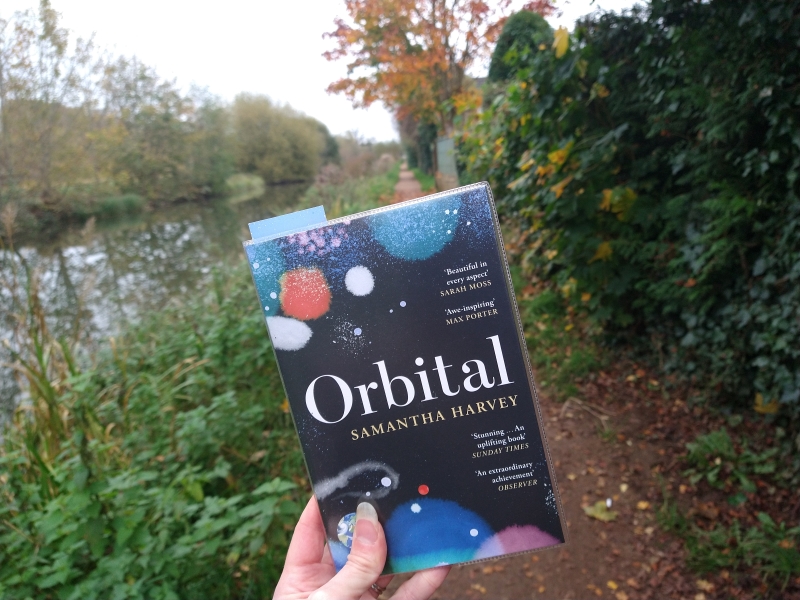
Orbital by Samantha Harvey (#NovNov24 Buddy Read)
Orbital is a circadian narrative, but its one day contains multitudes. Every 90 minutes, a spacecraft completes an orbit of the Earth; the 24 hours the astronauts experience equate to 16 days. And in the same way, this Booker Prize-shortlisted novella contains much more than seems possible for its page length. It plays with scale, zooming from the cosmic down to the human, then back. The situation is simultaneously extraordinary and routine:
Six of them in a great H of metal hanging above the earth. They turn head on heel, four astronauts (American, Japanese, British, Italian) and two cosmonauts (Russian, Russian); two women, four men, one space station made up of seventeen connecting modules, seventeen and a half thousand miles an hour. They are the latest six of many, nothing unusual about this any more[.]
We see these characters – Anton, Roman, Nell, Chie, Shaun, and Pietro – going about daily life as they approach the moon: taking readings, recording data on their health and lab mice’s, exercising, conversing over packaged foods, watching a film, then getting back into the sleeping bags where they started the day. Apart from occasional messages from family, theirs is a completely separate, closed-off existence. Is it magical or claustrophobic? Godlike, they cast benevolent eyes over a whole planet, yet their thoughts are always with the two or three individual humans who mean most to them. A wife, a daughter, a mother who has just died.
Apart from the bereaved astronaut – the one I sympathized with most – I didn’t get a strong sense of the characters as individuals. This may have been deliberate on Harvey’s part, to emphasize how reliant the six are on each other for survival: “we are one. Everything we have up here is only what we reuse and share. … We drink each other’s recycled urine. We breathe each other’s recycled air.” That collectivity and the overt messaging give the book the air of a parable.
Maybe it’s hard to shift from thinking your planet is safe at the centre of it all to knowing in fact it’s a planet of normalish size and normalish mass rotating about an average star in a solar system of average everything in a galaxy of innumerably many, and that the whole thing is going to explode or collapse.
Our lives here are inexpressibly trivial and momentous at once … Both repetitive and unprecedented. We matter greatly and not at all.
Gaining perspective on humankind is always valuable. There is also a strong environmental warning here. “The planet is shaped by the sheer amazing force of human want, which has changed everything, the forests, the poles, the reservoirs, the glaciers, the rivers, the seas, the mountains, the coastlines, the skies”. The astronauts observe climate breakdown firsthand through the inexorable development of a super-typhoon over the Philippines.
There are some stunning lyrical passages (“We exist now in a fleeting bloom of life and knowing, one finger-snap of frantic being … This summery burst of life is more bomb than bud. These fecund times are moving fast”), but Harvey sometimes gets carried away with the sound of words or the sweep of imagery, such that the style threatens to overwhelm the import. This was especially true of the last line. At times, I felt I was watching a BBC nature documentary full of soaring panoramas and time-lapse shots, all choreographed to an ethereal Sigur Rós soundtrack. Am I a cynic for saying so? I confess I don’t think this will win the Booker. But for the most part, I was entranced; grateful for the peek at the immensity of space, the wonder of Earth, and the fragility of human beings. (Public library)
[136 pages]
Mini playlist:
- “Space Walk” by Lemon Jelly
- “Spacewalk” by Bell X1
- “Magic” & “Wonder” by Gungor
- “Hoppípolla” by Sigur Rós
- “Little Astronaut” by Jim Molyneux and Spell Songs
Never fear, others have been more enthusiastic!
Reviewed for this challenge so far by:
A Bag Full of Stories (Susana)
Book Chatter (Tina)
Books Are My Favourite and Best (Kate)
Buried in Print (Marcie)
Calmgrove (Chris)
The Intrepid Angeleno (Jinjer)
My Head Is Full of Books (Anne)
Words and Peace (Emma)
Reviewed earlier by other participants and friends:
#SciFiMonth: A Simple Intervention (#NovNov24 and #GermanLitMonth) & Station Eleven Reread
It’s rare for me to pick up a work of science fiction but occasionally I’ll find a book that hits the sweet spot between literary fiction and sci-fi. Parable of the Sower by Octavia Butler, The Book of Strange New Things by Michel Faber and The Sparrow by Mary Doria Russell are a few prime examples. It was the comparisons to Margaret Atwood and Kazuo Ishiguro, masters of the speculative, that drew me to my first selection, a Peirene Press novella. My second was a reread, 10 years on, for book club, whose postapocalyptic content felt strangely appropriate for a week that delivered cataclysmic election results.

A Simple Intervention by Yael Inokai (2022; 2024)
[Translated from the German by Marielle Sutherland]
Meret is a nurse on a surgical ward, content in the knowledge that she’s making a difference. Her hospital offers a pioneering procedure that cures people of mental illnesses. It’s painless and takes just an hour.
The doctor had to find the affected area and put it to sleep, like a sick animal. That was his job. Mine was to keep the patients occupied. I was to distract them from what was happening and keep them interacting with me. As long as they stayed awake, we knew the doctor and his instruments had found the right place.
 The story revolves around Meret’s emotional involvement in the case of Marianne, a feisty young woman who has uneasy relationships with her father and brothers. The two play cards and share family anecdotes. Until the last few chapters, the slow-moving plot builds mostly through flashbacks, including to Meret’s affair with her fellow nurse, Sarah. This roommates-to-lovers thread reminded me of Learned by Heart by Emma Donoghue. When Marianne’s intervention goes wrong, Meret and Sarah doubt their vocation and plan an act of heroism.
Inokai invites us to ponder whether what we perceive as defects are actually valuable personality traits. More examples of interventions and their aftermath would be a useful point of comparison, though, and the pace is uneven, with a lot of unnecessary-seeming backstory about Meret’s family life. In the letter that accompanied my review copy, Inokai explained her three aims: to portray a nurse (her mother’s career) because they’re underrepresented in fiction, “to explore our yearning to cut out our ‘demons’,” and to offer “a queer love story that was hopeful.” She certainly succeeds with those first and third goals, but with the central subject I felt she faltered through vagueness.
Born in Switzerland, Inokai now lives in Berlin. This also counts as my first contribution to German Literature Month; another is on the way!
[187 pages]
With thanks to Peirene Press for the free copy for review.
Station Eleven by Emily St. John Mandel (2014)
For synopsis and analysis I can’t do better than when I reviewed this for BookBrowse a few months after its release, so I’d direct you to the full text here. (It’s slightly depressing for me to go back to old reviews and see that I haven’t improved; if anything, I’ve gotten lazier.) A couple book club members weren’t as keen, I think because they’d read a lot of dystopian fiction or seen many postapocalyptic films and found this vision mild and with a somewhat implausible setup and tidy conclusion. But for me this and Cormac McCarthy’s The Road have persisted as THE literary depictions of post-apocalypse life because they perfectly blend the literary and the speculative in an accessible and believable way (this was a National Book Award finalist and won the Arthur C. Clarke Award), contrasting a harrowing future with nostalgia for an everyday life that we can already see retreating into the past.
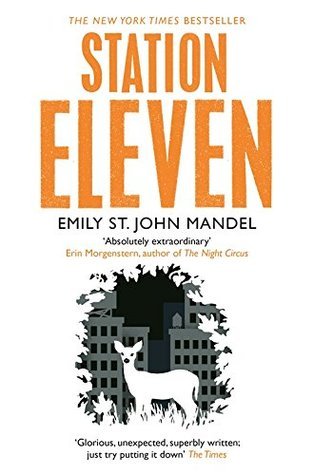 Station Eleven has become a real benchmark for me, against which I measure any other dystopian novel. On this reread, I was captivated by the different layers of the nonlinear story, from celebrity gossip to a rare graphic novel series, and enjoyed rediscovering the links between characters and storylines. I remembered a few vivid scenes and settings. Mandel also seeds subtle connections to later work, particularly The Glass Hotel (island off Vancouver, international shipping and finance) but also Sea of Tranquility (music, an airport terminal). I haven’t read her first three novels, but wouldn’t be surprised if they have additional links.
The two themes that most struck me this time were the enduring power of art and how societal breakdown would instantly eliminate the international – but compensate for it with the return of the extremely local. At a time when it feels difficult to trust central governments to have people’s best interests at heart, this is a rather comforting prospect. Just in my neighbourhood, I see how we implement this care on a small scale. In settlements of up to a few hundred, the remnants of Station Eleven create something like normal life by Year 20.
Book club members sniped that the characters could have better pooled skills, but we agreed that Mandel was wise to limit what could have been tedious details about survival. “Survival is insufficient,” as the Traveling Symphony’s motto goes (borrowed from Star Trek). Instead, she focuses on love, memory, and hunger for the arts. In some ways, this feels prescient of Covid-19, but even more so of the climate-related collapse I expect in my lifetime. I’ve rated this a little bit higher the second time for its lasting relevance. (Free from a neighbour) 
Some favourite passages:
the whole of Chapter 6, a bittersweet litany that opens “An incomplete list: No more diving into pools of chlorinated water lit green from below” and includes “No more pharmaceuticals,” “No more flight,” and “No more countries”
“what made it bearable were the friendships, of course, the camaraderie and the music and the Shakespeare, the moments of transcendent beauty and joy”
“The beauty of this world where almost everyone was gone. If hell is other people, what is a world with almost no people in it?”

Astraea by Kate Kruimink (Weatherglass Novella Prize) #NovNov24
Astraea by Kate Kruimink is one of two winners* of the inaugural Weatherglass Novella Prize, as chosen by Ali Smith. Back in September, I was introduced to it through Weatherglass Books’ “The Future of the Novella” event in London (my write-up is here).
Taking place within about a day and a half on a 19th-century convict ship bound for Australia, it is the intense story of a group of women and children chafing against the constraints men have set for them. The protagonist is just 15 years old and postpartum. Within a hostile environment, the women have created an almost cosy community based on sisterhood. They look out for each other; an old midwife can still bestow her skills.
The ship was their shelter, the small chalice carrying them through that which was inhospitable to human life. But there was no shelter for her there, she thought. There was only a series of confines between which she might move but never escape.
The ship’s doctor and chaplain distrust what they call the “conspiracy of women” and are embarrassed by the bodily reality of one going into labour, another tending to an ill baby, and a third haemorrhaging. They have no doubt they know what is best for their charges yet can barely be bothered to learn their names.

Indeed, naming is key here. The main character is effectively erased from the historical record when a clerk incorrectly documents her as Maryanne Maginn. Maryanne’s only “maybe-friend,” red-haired Sarah, has the surname Ward. “Astraea” is the name not just of the ship they travel on but also of a star goddess and a new baby onboard.
The drama in this novella arises from the women’s attempts to assert their autonomy. Female rage and rebellion meet with punishment, including a memorable scene of solitary confinement. A carpenter then constructs a “nice little locking box that will hold you when you sin, until you’re sorry for it and your souls are much recovered,” as he tells the women. They are all convicts, and now their discipline will become a matter of religious theatrics.
Given the limitations of setting and time and the preponderance of dialogue, I could imagine this making a powerful play. The novella length is as useful a framework as the ship itself. Kruimink doesn’t waste time on backstory; what matters is not what these women have done to end up here, but how their treatment is an affront to their essential dignity. Even in such a low page count, though, there are intriguing traces of the past and future, as well as a fleeting hint of homoeroticism. I would recommend this to readers of The Mercies by Kiran Millwood Hargrave, Devotion by Hannah Kent and Women Talking by Miriam Toews. And if you get a hankering to follow up on the story, you can: this functions as a prequel to Kruimink’s first novel, A Treacherous Country. (See also Cathy’s review.)
[115 pages]
With thanks to Weatherglass Books for the free copy for review.
*The other winner, Aerth by Deborah Tomkins, a novella-in-flash set on alternative earths, will be published in January. I hope to have a proof copy in hand before the end of the month to review for this challenge plus SciFi Month.
Basket of Deplorables by Tom Rachman (2017)
“Basket of deplorables” is a term that Hillary Clinton applied to the xenophobic wing of Donald Trump’s supporters in a September 2016 campaign speech. Basket of Deplorables is Tom Rachman’s third of five books and I somehow had never heard of it until a good few years after its release. That surprised me because I’ve followed his career with interest and read his other works right at their publication.
Like Rachman’s The Imperfectionists and The Imposters, it’s a linked short story collection. The five stories are on the longish side but read quickly. In the opening title piece, a woman who went blind after an accident co-hosts a 2016 presidential election watch party with her husband in their Manhattan apartment. Their friends are uniformly left-wing and choke with disbelief as results start to filter through. In “Truth Is for Losers,” Glen agrees to stage a funeral for his billionaire brother Fleming, who has faked his own death. The memorial service is an opportunity for high farce, but I also warmed to Glen for his simple enthusiasm for his job as a Starbucks barista in Kalamazoo. This was my favourite of the stories; its depiction of the spread of fake news feels like a worthwhile analogy rather than a rehashing of headlines.
“Leakzilla” imagines the complications of Internet dating in an alternate world where would-be partners can scour each other’s e-mail history at will – and find out that someone masquerading as clued-in voted for Trump in 2016. “Sad! Wrong! Not Nice!” follows Fleming, a Trump-esque blowhard, into his new life in Italy. The backstory of a minor character explains a mysterious moment from the first piece, and the sister of the woman from “Leakzilla” is then the protagonist of “How the End Begins.” Here, Kelly discovers with quiet horror a website where you can input any person’s name and view their future cause of death. There is a grim dystopian edge to this final story.

Rachman gave the book the tagline (not quite a subtitle) of “Almost-true stories.” I suspect it was written quickly in response to Trump’s election and it is rather thin, aiming at obvious targets and exhibiting wholly reasonable yet unsubtle liberal outrage. I found it so depressing to see how history threatens to repeat itself less than a decade later:
“David’s worry is that Trump won’t accept his defeat, throwing the whole democratic process into chaos”
“More a boomerang of history, where we keep throwing out the bad bits, and they keep flying back, hitting us in the mouth.”
I can hardly bear to think about tomorrow’s election. The USA could elect the first woman president (of color, no less), or hand power back to a cretin – a convicted felon and probably the worst holder of the office in its nearly 250 years. It’s a choice between progress and regression. Between sanity and sleepwalking into destruction. And whatever happens at the polls, it seems inevitable that Trump will foment further violence and hatred.
 Did I do all I could? I sent in my postal vote several weeks ago, and donated to the Harris/Walz campaign (which means I now get seven e-mails a day from them, but that’s fine). The local Democrats Abroad branch didn’t reply to me over the summer, so I missed out on the chance to volunteer with them, whereas in 2020 I colored in postcards to send to Democrat-registered North Carolina voters in the UK to remind them to get their ballots.
My leanings are clear, then, and I’m sure pretty much all my readers will concur. That I didn’t enjoy this obscure Rachman work more is due to my low tolerance for satire in general and to the fact that these stories of division and deception are not almost true, but all too true. (Secondhand – gift from my wish list, Christmas 2023)
 Bookish Beck = Rebecca Foster. American transplant to England. Freelance proofreader and book reviewer.
