#ReadIndies Nonfiction Catch-Up: Ansell, Farrier, Febos, Hoffman, Orlean and Stacey
These are all 2025 releases; for some, it’s approaching a year since I was sent a review copy or read the book. Silly me. At last, I’ve caught up. Reading Indies month, hosted by Kaggsy in memory of her late co-host Lizzy Siddal, is the perfect time to feature books from five independent publishers. I have four works that might broadly be classed as nature writing – though their topics range from birdsong and technology to living in Greece and rewilding a plot in northern Spain – and explorations of celibacy and the writer’s profession.
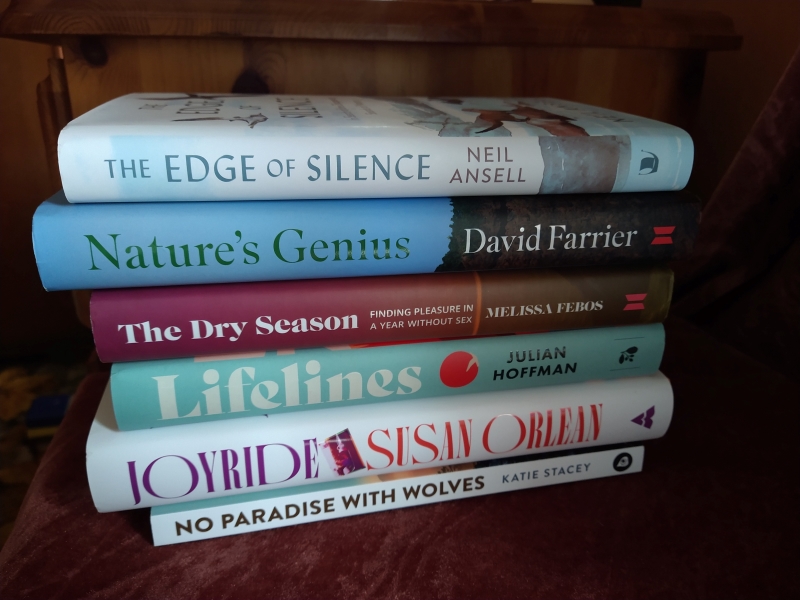
The Edge of Silence: In Search of the Disappearing Sounds of Nature by Neil Ansell
 Ansell draws parallels between his advancing hearing loss and the biodiversity crisis. He puts together a wish list of species – mostly seabirds (divers, grebes), but also inland birds (nightjars) and a couple of non-avian representatives (otters) – that he wants to hear and sets off on public transport adventures to find them. “I must find beauty where I can, and while I still can,” he vows. From his home on the western coast of Scotland near the Highlands, this involves trains or buses that never align with the ferry timetables. Furthest afield for him are two nature reserves in northern England where his mission is to hear bitterns “booming” and natterjack toads croaking at night. There are also mountain excursions to locate ptarmigan, greenshank, and black grouse. His island quarry includes Manx shearwaters (Rum), corncrakes (Coll), puffins (Sanday), and storm petrels (Shetland).
Camping in a tent means cold nights, interrupted sleep, and clouds of midges, but it’s all worth it to have unrepeatable wildlife experiences. He has a very high hit rate for (seeing and) hearing what he intends to, even when they’re just on the verge of what he can decipher with his hearing aids. On the rare occasions when he misses out, he consoles himself with earlier encounters. “I shall settle for the memory, for it feels unimprovable, like a spell that I do not want to break.” I’ve read all of Ansell’s nature memoirs and consider him one of the UK’s top writers on the natural world. His accounts of his low-carbon travels are entertaining, and the tug-of-war between resisting and coming to terms with his disability is heartening. “I have spent this year in defiance of a relentless, unstoppable countdown,” he reflects. What makes this book more universal than niche is the deadline: we and all of these creatures face extinction. Whether it’s sooner or later depends on how we act to address the environmental polycrisis.
With thanks to Birlinn for the free copy for review.
Nature’s Genius: Evolution’s Lessons for a Changing Planet by David Farrier
 Farrier’s Footprints, which tells the story of the human impact on the Earth, was one of my favourite books of 2020. This contains a similar blend of history, science, and literary points of reference (Farrier is a professor of literature and the environment at the University of Edinburgh), with past changes offering a template for how the future might look different. “We are forcing nature to reimagine itself, and to avert calamity we need to do the same,” he writes. Cliff swallows have evolved blunter wings to better evade cars; captive breeding led foxes to develop the domesticated traits of pet dogs.
It’s not just other species that experience current evolution. Thanks to food abundance and a sedentary lifestyle, humans show a “consumer phenotype,” which superseded the Palaeolithic (95% of human history) and tends toward earlier puberty, autoimmune diseases, and obesity. Farrier also looks at notions of intelligence, language, and time in nature. Sustainable cities will have to cleverly reuse materials. For instance, The Waste House in Brighton is 90% rubbish. (This I have to see!)
There are many interesting nuggets here, and statements that are difficult to argue with, but I struggled to find an overall thread. Cool to see my husband’s old housemate mentioned, though. (Duncan Geere, for collaborating on a hybrid science–art project turning climate data into techno music.)
With thanks to Canongate for the free copy for review.
The Dry Season: Finding Pleasure in a Year without Sex by Melissa Febos
Febos considers but rejects the term “sex addiction” for the years in which she had compulsive casual sex (with “the Last Man,” yes, but mostly with women). Since her early teen years, she’d never not been tied to someone. Brief liaisons alternated with long-term relationships: three years with “the Best Ex”; two years that were so emotionally tumultuous that she refers to the woman as “the Maelstrom.” It was the implosion of the latter affair that led to Febos deciding to experiment with celibacy, first for three months, then for a whole year. “I felt feral and sad and couldn’t explain it, but I knew that something had to change.”
 The quest involved some research into celibate movements in history, but was largely an internal investigation of her past and psyche. Febos found that she was less attuned to the male gaze. Having worn high heels almost daily for 20 years, she discovered she’s more of a trainers person. Although she was still tempted to flirt with attractive women, e.g. on an airplane, she consciously resisted the impulse to spin random meetings into one-night stands. (A therapist had stopped her short with the blunt observation, “you use people.”) With a new focus on the life of the mind, she insists, “My life was empty of lovers and more full than it had ever been.” (This reminded me of Audre Lorde’s writing on the erotic.) As Silvana Panciera, an Italian scholar on the beguines (a secular nun-like sisterhood), told her: “When you don’t belong to anyone, you belong to everyone. You feel able to love without limits.”
Intriguing that this is all a retrospective, reflecting on her thirties; Febos is now in her mid-forties and married to a woman (poet Donika Kelly). Clearly she felt that it was an important enough year – with landmark epiphanies that changed her and have the potential to help others – to form the basis for a book. For me, she didn’t have much new to offer about celibacy, though it was interesting to read about the topic from an areligious perspective. But I admire the depth of her self-knowledge, and particularly her ability to recreate her mindset at different times. This is another one, like her Girlhood, to keep on the shelf as a model.
With thanks to Canongate for the free copy for review.
Lifelines: Searching for Home in the Mountains of Greece by Julian Hoffman
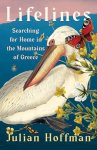
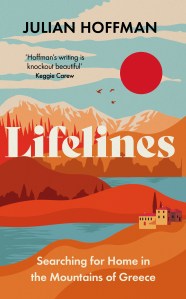 Hoffman’s Irreplaceable was my nonfiction book of 2019. Whereas that was a work with a global environmentalist perspective, Lifelines is more personal in scope. It tracks the author’s unexpected route from Canada via the UK to Prespa, a remote area of northern Greece that’s at the crossroads with Albania and North Macedonia. He and his wife, Julia, encountered Prespa in a book and, longing for respite from the breakneck pace of life in London, moved there in 2000. “Like the rivers that spill into these shared lakes, lifelines rarely flow straight. Instead, they contain bends, meanders and loops; they hold, at times, turns of extraordinary surprise.” Birdwatching, which Hoffman suggests is as “a way of cultivating attention,” had been their gateway into a love for nature developed over the next quarter-century and more, and in Greece they delighted in seeing great white and Dalmatian pelicans (which feature on the splendid U.S. cover. It would be lovely to have an illustrated edition of this.)
 One strand of this warm and fluent memoir is about making a home in Greece: buying and renovating a semi-derelict property, experiencing xenophobia and hospitality from different quarters, and finding a sense of belonging. They’re happy to share their home with nesting wrens, who recur across the book and connect to the tagline of “a story of shelter shared.” In probing the history of his adopted country, Hoffman comes to realise the false, arbitrary nature of borders – wildlife such as brown bears and wolves pay these no heed. Everything is connected and questions of justice are always intersectional. The Covid pandemic and avian influenza (which devastated the region’s pelicans) are setbacks that Hoffman addresses honestly. But the lingering message is a valuable one of bridging divisions and learning how to live in harmony with other people – and with other species.
With thanks to Elliott & Thompson for the free copy for review.
Joyride by Susan Orlean
As a long-time staff writer for The New Yorker, Orlean has had the good fortune to be able to follow her curiosity wherever it leads, chasing the subjects that interest her and drawing readers in with her infectious enthusiasm. She grew up in suburban Ohio, attended college in Michigan, and lived in Portland, Oregon and Boston before moving to New York City. Her trajectory was from local and alternative papers to the most enviable of national magazines: Esquire, Rolling Stone and Vogue. Orlean gives behind-the-scenes information on lots of her early stories, some of which are reprinted in an appendix. “If you’re truly open, it’s easy to fall in love with your subject,” she writes; maintaining objectivity could be difficult, as when she profiled an Indian spiritual leader with a cult following; and fended off an interviewee’s attachment when she went on the road with a Black gospel choir.
 Her personal life takes a backseat to her career, though she is frank about the breakdown of her first marriage, her second chance at love and late motherhood, and a surprise bout with lung cancer. The chronological approach proceeds book by book, delving into her inspirations, research process and publication journeys. Her first book was about Saturday night as experienced across America. It was a more innocent time, when subjects were more trusting. Orlean and her second husband had farms in the Hudson Valley of New York and in greater Los Angeles, and she ended up writing a lot about animals, with books on Rin Tin Tin and one collecting her animal pieces. There was also, of course, The Library Book, about the wild history of the main Los Angeles public library. But it’s her The Orchid Thief – and the movie (not) based on it, Adaptation – that’s among my favourites, so the long section on that was the biggest thrill for me. There are also black-and-white images scattered through.
It was slightly unfortunate that I read this at the same time as Book of Lives – who could compete with Margaret Atwood? – but it is, yes, a joy to read about Orlean’s writing life. She’s full of enthusiasm and good sense, depicting the vocation as part toil and part magic:
“I find superhuman self-confidence when I’m working on a story. The bashfulness and vulnerability that I might otherwise experience in a new setting melt away, and my desire to connect, to observe, to understand, powers me through.”
“I like to do a gut check any time I dismiss or deplore something I don’t know anything about. That feels like reason enough to learn about it.”
“anything at all is worth writing about if you care about it and it makes you curious and makes you want to holler about it to other people”
With thanks to Atlantic Books for the free copy for review.
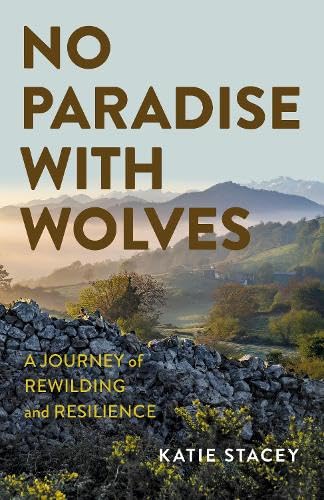
No Paradise with Wolves: A Journey of Rewilding and Resilience by Katie Stacey
I had the good fortune to visit Wild Finca, Luke Massey and Katie Stacey’s rewilding site in Asturias, while on holiday in northern Spain in May 2022, and was intrigued to learn more about their strategy and experiences. This detailed account of the first four years begins with their search for a property in 2018 and traces the steps of their “agriwilding” of a derelict farm: creating a vegetable garden and tending to fruit trees, but also digging ponds, training up hedgerows, and setting up rotational grazing. Their every decision went against the grain. Others focussed on one crop or type of livestock while they encouraged unruly variety, keeping chickens, ducks, goats, horses and sheep. Their neighbours removed brush in the name of tidiness; they left the bramble and gorse to welcome in migrant birds. New species turned up all the time, from butterflies and newts to owls and a golden fox.
Luke is a wildlife guide and photographer. He and Katie are conservation storytellers, trying to get people to think differently about land management. The title is a Spanish farmers’ and hunters’ slogan about the Iberian wolf. Fear of wolves runs deep in the region. Initially, filming wolves was one of the couple’s major goals, but they had to step back because staking out the animals’ haunts felt risky; better to let them alone and not attract the wrong attention. (Wolf hunting was banned across Spain in 2021.) There’s a parallel to be found here between seeing wolves as a threat and the mild xenophobia the couple experienced. Other challenges included incompetent house-sitters, off-lead dogs killing livestock, the pandemic, wildfires, and hunters passing through weekly (as in France – as we discovered at Le Moulin de Pensol in 2024 – hunters have the right to traverse private land in Spain).
Luke and Katie hope to model new ways of living harmoniously with nature – even bears and wolves, which haven’t made it to their land yet, but might in the future – for the region’s traditional farmers. They’re approaching self-sufficiency – for fruit and vegetables, anyway – and raising their sons, Roan and Albus, to love the wild. We had a great day at Wild Finca: a long tour and badger-watching vigil (no luck that time) led by Luke; nettle lemonade and sponge cake with strawberries served by Katie and the boys. I was clear how much hard work has gone into the land and the low-impact buildings on it. With the exception of some Workaway volunteers, they’ve done it all themselves.
Katie Stacey’s storytelling is effortless and conversational, making this impassioned memoir a pleasure to read. It chimed perfectly with Hoffman’s writing (above) about the fear of bears and wolves, and reparation policies for farmers, in Europe. I’d love to see the book get a bigger-budget release complete with illustrations, a less misleading title, the thorough line editing it deserves, and more developmental work to enhance the literary technique – as in the beautiful final chapter, a present-tense recreation of a typical walk along The Loop. All this would help to get the message the wider reach that authors like Isabella Tree have found. “I want to be remembered for the wild spaces I leave behind,” Katie writes in the book’s final pages. “I want to be remembered as someone who inspired people to seek a deeper connection to nature.” You can’t help but be impressed by how much of a difference two people seeking to live differently have achieved in just a handful of years. We can all rewild the spaces available to us (see also Kate Bradbury’s One Garden against the World), too.
With thanks to Earth Books (Collective Ink) for the free copy for review.
Which of these do you fancy reading?
20 Books of Summer, 19–20: Emily St. James and Abraham Verghese
Going out on a high! My last three books for the challenge (also including Beautiful Ruins) were particularly great, just the sort of absorbing and rewarding reading that I wish I could guarantee for all of my summer selections.
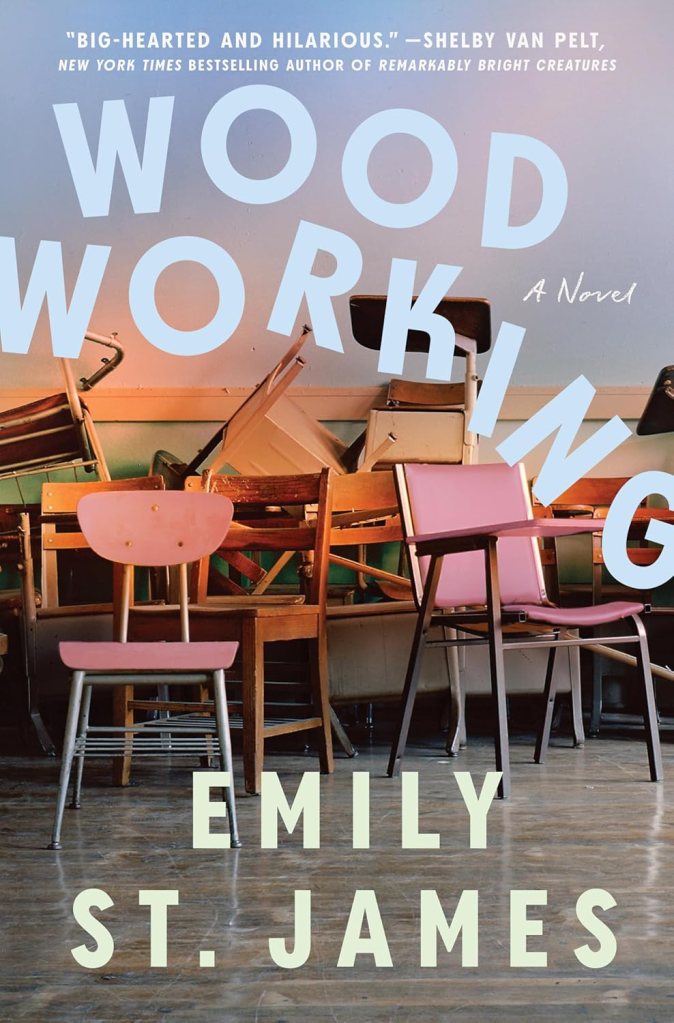
Woodworking by Emily St. James (2025)
Colloquially, “woodworking” is disappearing in plain sight; doing all you can to fade into the woodwork. Erica has only just admitted her identity to herself, and over the autumn of 2016 begins telling others she’s a woman – starting with her ex-wife Constance, who is now pregnant by her fiancé, John. To everyone else, Erica is still Mr. Skyberg, a 35-year-old English teacher at Mitchell High involved in local amateur dramatics. When Erica realizes that not only is there another trans woman in her small South Dakota town but that it’s one of her students, Abigail Hawkes, she lights up. Abigail may be half her age but is further along in her transition journey and has sassy confidence. But this foul-mouthed new mentor has problems of her own, starting with parents who refuse to refer to her by her chosen name. Abigail lives with her adult sister instead, and gains an unexpected surrogate family via her boyfriend Caleb, a Korean adoptee whose mother, Brooke Daniels, is directing Our Town. Brooke is surprisingly supportive given that she attends Isaiah Rose’s megachurch.
As Trump/Pence signs proliferate, a local election is heating up, too: Pastor Rose is running for State Congress on the Republican ticket, opposed by Helen Swee. Erica befriends Helen and becomes faculty advisor for the school’s Democrat club (which has all of two members: Abigail and her Leslie Knope-like friend Megan). The plot swings naturally between the personal and political, emphasizing how the personal business of 1% of the population has been made into a political football. Chapters alternate between Abigail in first person and Erica in third. The characters feel utterly real and the dialogue is as genuine as the narrative voices. The support group Erica and Abigail attend presents a range of trans experiences based on when one came of age. Some are still deep undercover. There’s a big reveal I couldn’t quite accept, though I can see its purpose. It’s particularly effective how St. James lets second- and third-person narration shade into first as characters accept their selves. Grey rectangles cover up deadnames all but once, making the point that even allies can get it wrong.
This was pure page-turning enjoyment with an important message to convey. It reminded me a lot of Under the Rainbow by Celia Laskey but also had the flavour of classic Tom Perrotta (Election). In the Author’s Note, St. James writes, “They say the single greatest determinant of whether someone will support and affirm trans people is if they know a trans person.” I feel lucky to count three trans people among my friends. It’s impossible to make detached pronouncements about bathrooms and slippery slopes if you care about people whose rights and very existence are being undermined. We should all be reading books by and about trans women. (New purchase from Bookshop.org) 
The Covenant of Water by Abraham Verghese (2023)
All too often, I shy away from doorstoppers because they seem like too much of a time commitment. Why read 715 pages in one novel when I could read 3.5 of 200 pages each? Yet there’s something special about being lost in the middle of a great big book and trusting that wherever the story goes will be worthwhile. I let this review copy languish on the shelf for over TWO YEARS when I should have known that the author of the amazing Cutting for Stone couldn’t possibly let me down. Verghese’s second novel is very much in the same vein: a family saga that spans decades and in every generation focuses on medical issues. Verghese is a practicing doctor as well as a Stanford professor and you can tell he glories in the details of hand and brain surgeries, disability and rare diseases – and luckily, so do I.
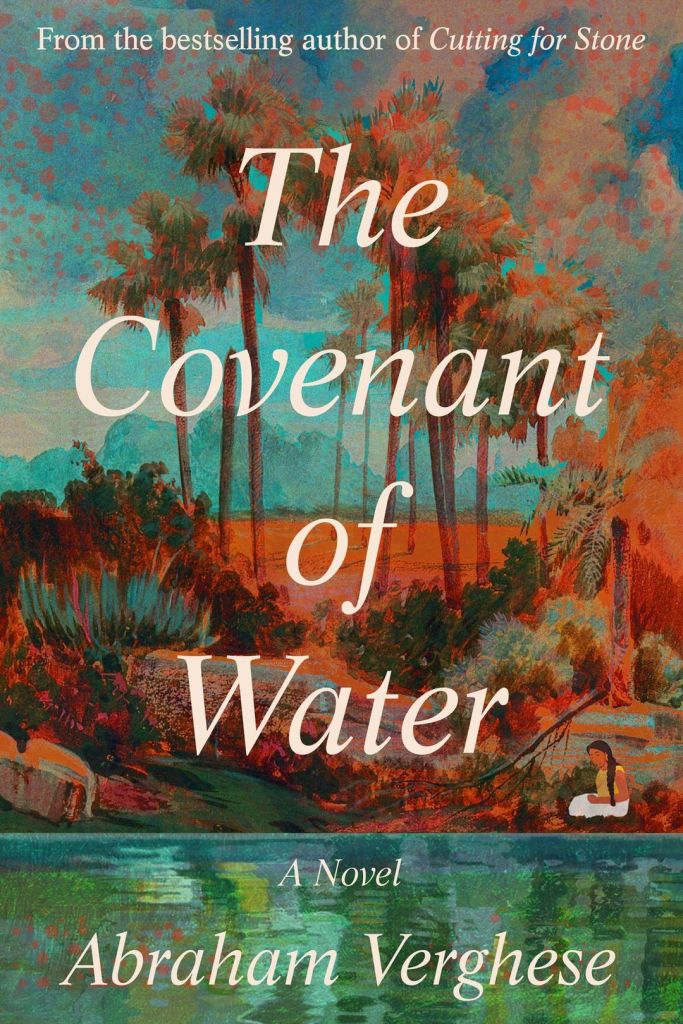
Wider events play out in the background (wars, partition, the fall of the caste system), but the focus is always on one family in Kerala, starting in 1900 when a 12-year-old girl is brought to the Parambil estate for her arranged marriage to a 40-year-old widower. One day she will be Big Ammachi, the matriarch of a family with a mysterious Condition: In every generation, someone drowns. As a result, they all avoid water, even if it requires going hours out of their way. Her son Philipose longs to be a scholar, but is so hard of hearing that his formal education is cut short. He becomes a columnist in a local newspaper and marries Elsie, a spirited artist. Their daughter, Mariamma, trains as a doctor. In parallel, we follow the story of Digby Kilgour, a Glaswegian surgeon whose career takes him to India. Through Digby and Mariamma’s interactions with colleagues, we watch colonial incompetence and sexism play out. Addiction and suicide recur across the years. Destiny and choice lock horns. I enjoyed the window onto the small community of St. Thomas Christians and felt fond of all the characters, including Damodaran the elephant. It’s also really clever how Verghese makes the Condition a cross between a mystical curse and a diagnosable ailment. An intellectual soap opera that makes you think about storytelling, purpose and inheritance, this is extraordinary. 
With thanks to Atlantic Books for the proof copy for review.

I read 10 of the books I selected in my initial planning post. I’m pleased that I picked off a couple of long-neglected review copies and several recent purchases. The rest were substituted at whim. There were two duds, but the overall quality was high, with 10 books I rated 4 stars or higher! Along with the above and Beautiful Ruins, Pet Sematary and Storm Pegs were overall highlights. I also managed to complete a row on the Bingo card, a fun add-on. And, bonus: I cleared 7 books from my shelves by reselling or giving them away after I read them.
April 3rd Releases by Emily Jungmin Yoon & Jean Hannah Edelstein
It’s not often that I manage to review books for their publication date rather than at the end of the month, but these two were so short and readable that I polished them off over the first few days of April. So, out today in the UK: a poetry collection about Asian American identity and environmental threat, and a memoir in miniature about how body parts once sexualized and then functionalized are missed once they’re gone.
Find Me as the Creature I Am by Emily Jungmin Yoon (2024)
 The Korean American poet’s second full-length work is broadly about loss experienced or expected – but also about the love that keeps us going in dire times. The free verse links personal bereavement with larger-scale tragedies, including climate grief. “All my friends who loved trees are dead” tells of Yoon’s grandmother’s death, while “I leave Asia and become Asian” remembers the murders of eight Asian spa workers in Atlanta in 2021. Violence against women, and the way the Covid-19 pandemic spurred further anti-Asian racism, are additional topics in the early part of the book. For me, Part III’s environmental poems resonated the most. Yoon reflects on the ways in which we are, sometimes unwittingly, affecting the natural world, especially marine ecosystems: “there is no ‘eco-friendly’ way to swim with dolphins. / We do not have to touch everything we love,” she writes. “I look at the ocean like it’s goodbye. … I look at your face / like it’s goodbye.” This is a tricky one to assess; while I appreciated the themes, I did not find the style or language distinctive. The collection reminded me of a cross between Rupi Kaur and Jenny Xie.
Published in the USA by Knopf on October 22, 2024. With thanks to Atlantic Books for the free copy for review.
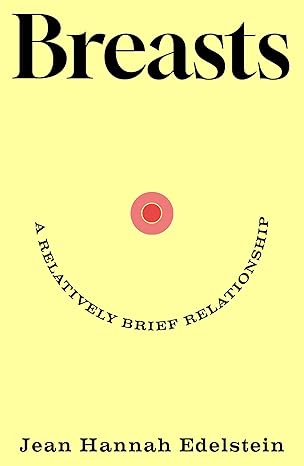
Breasts: A Relatively Brief Relationship by Jean Hannah Edelstein
From my Most Anticipated list. I loved Edelstein’s 2018 memoir This Really Isn’t About You, and I regularly read her Substack. This micro-memoir in three essays explores the different roles breasts have played in her life: “Sex” runs from the day she went shopping for her first bra as a teenager with her mother through to her early thirties living in London. Edelstein developed early and eventually wore size DD, which attracted much unwanted attention in social situations and workplaces alike. (And not just a slightly sleazy bar she worked in, but an office, too. Twice she was groped by colleagues; the second time she reported it. But: drunk, Christmas party, no witnesses; no consequences.) “It felt like a punishment, a consequence of my own behavior (being a woman, having a fun night out, doing these things while having large breasts),” she writes.
 “Food” recounts how her perspective on her breasts changed when she had her two children via IVF – so they wouldn’t inherit Lynch syndrome from her – and initially struggled to breastfeed. “I wanted to experience the full utility of my breasts,” she explains, so, living in Brooklyn now, she consulted a lactation consultant known as “the breast whisperer.” Part 3 is “Cancer”: when Edelstein was 41, mammograms discovered Stage 0 cancer in one breast. “For so long I’d been subject to unwelcome opinions about the kind of person that I was because of the size of my breasts.” But now it was up to her. She chose a double mastectomy for balance, with simultaneous reconstruction by a plastic surgeon.
Although this is a likable book, the retelling is quite flat; better that than mawkish, certainly, but none of the experiences feel particularly unique. It’s more a generic rundown of what it’s like to be female – which, yes, varies to an extent but not that much if we’re talking about the male gaze. There wasn’t the same spark or wit that I found in Edelstein’s first book. Perhaps in the context of a longer memoir, I would have appreciated these essays more.
With thanks to Phoenix for the free copy for review.
January Releases: Greathead, Kauffman, Mills & Watts (#ReadIndies)
I feel out of practice writing reviews after the endless period of sluggish and slightly lackluster reading that was January. Here we are at the start of Kaggsy and Lizzy Siddal’s Reading Independent Publishers Month challenge and I’m happy to make this my first tie-in post as these four books all happen to be from independent publishers. The first two are American novels (that could arguably be called linked short story collections) very much in my wheelhouse for their focus on dysfunctional families and disappointing characters. I also have a group biography aiming to illuminate bisexuality, and a poetry collection about girlhood/womanhood and nature.
The Book of George by Kate Greathead
The marketing for this novel courts relatability: you probably know a George – you might have dated one (women read the most litfic). Each chapter dates to a different period in George’s life, adolescence to late thirties. From the fact that 9/11 happened when he was a college freshman, I know he’s my exact contemporary, and I could indeed see bits of myself in this Everyman schmuck: indecisive, lazy, underachieving, privileged but never living up to his own or others’ expectations. Life keeps happening around him, but you wonder if he’ll ever make something happen for himself. Two gags are revealing: In college he is known for his impression of a clinically depressed penis going through airport security, and later he has 15 minutes of fame for appearing in a hidden-camera Super Bowl commercial. He’s been writing fiction for years – first a Stoner rip-off, then a Kerouac homage – but by the time he gets a short story collection together, it’s the height of #MeToo and he’s missed his moment to publish. Meanwhile, his cohort is doing great things, winning awards for documentaries (his pal Jeremiah) or becoming pro bono lawyers (his longsuffering girlfriend Jenny).
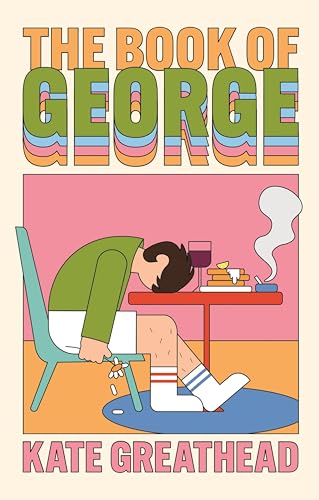 If you need to like a protagonist, expect frustration. Some of George’s behaviour is downright maddening, as when he obsessively plays his old Gameboy while his mother and Jenny pack up his childhood room. Tracing his relationships with his mother, his sister Cressida, and Jenny is rewarding. Sometimes they confront him over his shortcomings; other times they enable him. The novel is very funny, but it’s a biting, ironic humour, and there’s plenty of pathos as well. There are a few particular gut-punches, one relating to George’s father and others surrounding nice things he tries to do that backfire horribly. I thought of George as a rejoinder to all those ‘So-and-So Is Not Okay at All’ type of books featuring a face-planting woman on the cover. Greathead’s portrait is incisive but also loving. And yes, there is that hint of George, c’est moi recognition. His failings are all too common: the mildest of first-world tragedies but still enough to knock your confidence and make you question your purpose. For me this had something of the old-school charm of Jennifer Egan and Jonathan Safran Foer novels I read in the Naughties. I’ll seek out the author’s debut, Laura & Emma.
With thanks to Atlantic Books for the free copy for review. (Published in the USA by Henry Holt and Co. in 2024.)
I’ll Come to You by Rebecca Kauffman
Is 30 years long enough ago to count as historical fiction? In any case, this takes us through the whole of 1995, proceeding month by month and rotating through the close third-person perspectives of the members of one extended family as they navigate illnesses, break-ups and fraught parenting journeys. Corinne and Paul are trying to get pregnant; Paul’s mother, Ellen (again!), is still smarting from her husband leaving with no explanation; Corinne’s father, Bruce, has dementia but his wife, Janet, is doing her best to keep his cognitive deficiencies from the rest of the family. Son Rob is bitter about his ex-wife moving on so quickly, but both he and Ellen will have new romantic prospects before the end.
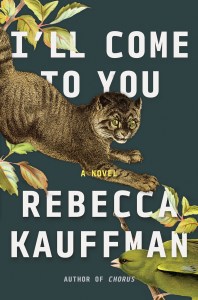 The family’s lies and secrets – also involving a Christmas run-in with Bruce’s shell-shocked brother decades ago – lead to everything coming to a head in a snowstorm. (As best I can tell, the 1995 setting was important mostly so there wouldn’t be cell phones during this crisis.) As with The Book of George, the episodic nature of the narrative means that particular moments are memorable but the whole maybe less so, and the interactions between characters stand out more than the people themselves. I’ll Come to You, named after a throwaway line in the text, is poorly served by both its cover and title, which give no sense of the contents. However, it’s a sweet, offbeat portrait of genuine, if generic, Americans; I was most reminded of J. Ryan Stradal’s work. Although I DNFed Kauffman’s The Gunners some years back, I’d be interested in trying her again with Chorus, which sounds like another linked story collection.
With thanks to Counterpoint (USA) for the advanced e-copy for review.
Uneven: Nine Lives that Redefined Bisexuality by Sam Mills
Back in 2022 I reviewed Julia Shaw’s Bi: The hidden culture, history and science of bisexuality, which took a social sciences approach. By contrast, this is a group biography of nine bisexuals – make that 10, as there are plenty of short memoir-ish passages from Mills, too. Oscar Wilde, Colette, Marlene Dietrich, Anaïs Nin, Susan Sontag: more or less familiar names, though not all of them are necessarily known for their sexuality. The chapters deliver standard potted biographies of the individuals’ work and relationships, probably containing little that couldn’t be found elsewhere in recent scholarship and not really living up to the revolutionary promise of the subtitle. However, it was worthwhile for Mills to recover Wilde as a bisexual rather than a closeted homosexual. A final trilogy of chapters comes more up to date with David Bowie, Jean-Michel Basquiat and Madonna. The closer to the present day, the more satisfying connections there are between figures. For instance, Madonna looked to both Dietrich and Bowie as role models and fashion icons, and she and Basquiat were lovers.
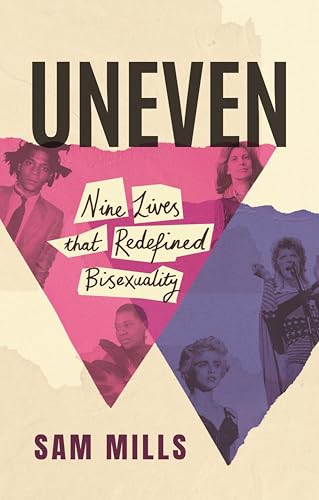 Mills and Shaw consider the same fundamental issues: bi erasure, with bisexuality the least understood and most easily overlooked element of LGBT and many passing as straight if in heterosexual marriages; and the stereotype of bis as hypersexual or promiscuous. Mills is keen to stress that bisexuals have very different trajectories and phases. Like Wilde, they might have a heterosexual era of happy marriage and parenthood followed by a homosexual spree. Or they might have simultaneous lovers of multiple genders. Some might never even act on strong same-sex desires. (Late last year I encountered a similar unity-in-diversity approach in Daniel Tamet’s Nine Minds, a group biography about autistic people.)
The 1890s to 1980s window allows for a record of changing mores yet means that the book seems rather dated. Were it written by an author of a later generation (Mills, who I knew for The Fragments of My Father, is around 50), the point of view and terminology would likely be quite different. Also, including a section on Bessie Smith within a chapter mostly on Colette felt tokenistic. (Though later considering Basquiat separately does add a BIPOC view.) Ultimately, though, my problem with Uneven was that I don’t want to know about behaviour – which is all that a biography can usually document – so much as the internal, soul stuff. Even from Mills, whose accounts of her long-term relationships and flings (including, yes, a threesome) can be titillating but not very enlightening, I didn’t get a sense of what it feels like. So neither the Shaw nor the Mills gave me precisely what I was looking for, which means that the perfect book on bisexuality either doesn’t exist or is out there but I haven’t found it yet. Any suggestions?
With thanks to Atlantic Books for the free copy for review.
The Face in the Well by Rebecca Watts
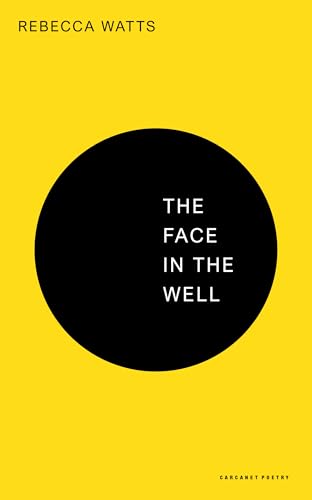 I’ve also read Watts’ The Met Office Advises Caution and Red Gloves; this is her third collection. The Suffolk and Cambridgeshire scenery of her early and adult lives weaves all through, sometimes as an idyll that blurs the lines between humans and nature (“Private No Access”) but other times provoking anxiety about common or gendered dangers, as in the title poem or “The Old Mill” (“What happened there, / down by the old mill, / they never tell. // Something about / a man and a girl / is the most you’ll hear.”). “Woman Seeks” is a tongue-in-cheek advert for the perfect man. Animals – a dolphin, a shark, rodents, a wandering albatross, a robin – recur, as do women poets, especially Emily Brontë, and Victorian death culture (“Victoriana” and “Baroque”). Adulthood brings routine whereas childhood stands out for minor miracles, such as a free soda from a vending machine.
The format and tone vary a lot, so the book is more of a grab bag than a cohesive statement. I noted slant rhymes and alliteration, always a favourite technique of mine. I especially liked “Entropy,” about finding a slice of cake in the freezer labeled by someone who is now dead (“Nothing ever // really dies: all the pieces of you / persist, riven and reconfigured / in infinite unknowable ways”) and “Personal Effects,” about the artefacts from her childhood that her mother guards under the bed (“twists of my hair, my teeth, / my bracelet from the hospital.”).
With thanks to Carcanet Press for the advanced e-copy for review.
Which of these appeal to you? What indie publishers have you been reading from recently?
Review Catch-Up: Monica, Bibliomaniac, Family Meal, Fudge & More
I’m catching up with reviews of the many October releases I read, including these four sent by publishers…
- a genre-bending, Technicolor graphic novel in the form of short comics
- a book-addict’s memoir of an ambitious Covid-times tour of Britain’s bookshops
- an understated novel about queer men of colour coping with death and mental illness
- and a quirky contemporary poetry collection I read in one sitting.
Followed by a bonus list of October books I reviewed for Shelf Awareness, similarly varied in genre: autofiction, flash fiction, horror-tinged historical fiction, graphic memoirs and more.
Monica by Daniel Clowes
 Daniel Clowes is a respected American graphic novelist best known for Ghost World, which was adapted into a 2001 film starring Scarlett Johansson. I’m not sure what I was expecting of Monica. Perhaps something closer to a quiet life story like Alison by Lizzy Stewart? In any case, not this jumble of 1970s nostalgia and supernatural horror. The book is in nine loosely connected stories that make the head spin with their genre and tonal shifts; one thing that stays constant is Clowes’s drawing style, which combines vibrant, campy colour with exaggerated faces and blunt haircuts.
At first it seems there will be a straightforward linear narrative: the prologue, “Foxhole,” has two soldiers dreaming of what life will be like Vietnam, with the one looking forward to a simple life with his fiancée Penny. “Pretty Penny” shatters those illusions as we see that Penny has fully embraced sexual liberation while he’s been away. She rejects her mother and, in a countercultural decision, keeps the baby when she gets pregnant. Young Monica has a sequence of stepfather figures before Penny dumps her with her parents and goes AWOL.
To an extent, the rest of the book is about Monica’s search for her parents. We see her as a young college student communicating with her dead grandfather via a radio, as a successful entrepreneur selling candles, and as an older woman caretaking for a California Airbnb. But in between there are bizarre sci-fi/folk horror interludes – “The Glow Infernal” and “The Incident” – about unconnected characters, and Monica’s involvement with a cult inevitably turns strange. I couldn’t get past the distasteful story lines or grotesque style. Mostly, I wasn’t convinced that Clowes liked or cared about any of his own characters, so why should I? (This might be Tom Cox’s dream book, but not mine.) I suppose I might try a classic work by Clowes one day, but only if I can be assured that it has more plot and heart.
With thanks to Jonathan Cape (Penguin) for the free copy for review.
Bibliomaniac: An Obsessive’s Tour of the Bookshops of Britain by Robin Ince
Do you know anyone who can buy just one book? Do you know anyone who leaves a bookshop only with what they walked in to buy?
I understand that Robin Ince is a radio personality and comedian who, though holding no formal qualifications, often delivers presentations about science. He was meant to undertake a stadium tour with Professor Brian Cox in the autumn of 2021, but a Covid resurgence put paid to that. Not one for sitting around at home – he comes across as driven, antsy; positively allergic to boredom – he formulated Plan B: 100+ events, most of them in independent bookshops (the oddest venue was a Chinese restaurant; he was speaking to the Plymouth Humanists), over the course of two months, criss-crossing Britain and hitting many favourite places such as Hay-on-Wye, Hungerford (my local indie) and Wigtown. The topic of his previous book was curiosity, which gave him free rein to feature anything that interested him, so no two talks were the same and he incorporated lots of ad hoc book recommendations.
 Ince is not just a speaker at the bookshops but, invariably, a customer – as well as at just about every charity shop in a town. Even when he knows he’ll be carrying his purchases home in his luggage on the train, he can’t resist a browse. And while his shopping basket would look wildly different to mine (his go-to sections are science and philosophy, the occult, 1960s pop and alternative culture; alongside a wide but utterly unpredictable range of classic and contemporary fiction and antiquarian finds), I sensed a kindred spirit in so many lines:
“A bookshop with a proximity to an interesting graveyard is a fine combination.”
“I like charity bookshops, because I can delude myself into believing that I am committing an altruistic act by purchasing too many books. I am not satisfying my consumer lust – I am digging a well in Uganda.”
“This is one of the wonders of books: the delight of being a species that can chronicle and preserve. I pick up a book from a shelf, and someone who is no more than ash or bone can still change me.”
He’s also refreshingly open-minded, determined not to become a white male dinosaur: he once spent a wonderful year reading only women authors, and gratefully accepts the gift of a Black queer feminist work – at which he knows a younger version of himself would have scoffed. I took lots of notes on shops I hadn’t heard of, but also appreciated the witty asides on British ways and on the rigours and coincidences of the tour. If you liked White Spines, this will be right up your street, though to me this was universal where the Royle was too niche. And it didn’t matter a jot that I was previously unfamiliar with Ince as a public figure.
Bibliomaniac came out in paperback on 5 October. My thanks to Atlantic Books for the free copy for review.
Family Meal by Bryan Washington
After the verve of his linked short stories (Lot, which won the Dylan Thomas Prize) and the offbeat tenderness of his debut novel, Memorial, I couldn’t wait for Bryan Washington’s next book. While it’s set in the multicultural Houston of his first book and similarly peopled by young queer men of colour, Family Meal shares the more melancholy edge of Memorial with its focus on bereavement and the habits and relationships that help the characters to cope.
Cam has moved back to Houston from Los Angeles after the untimely death of his boyfriend Kai, who had a budding career as a translator and spent part of each year in Japan. Cam works in a failing gay bar, crashes with his boss and has mostly stopped eating. Although he still loves cooking Asian food for others, he rarely tastes it himself; his overpowering appetite now is for pills and sex, leading him to arrange as many as four hook-ups per day. Kai still appears and communicates to him. “Easier to spend time dwelling on death than it is to live, says Kai.” Is it to escape this spectre, or the memory of what happened to Kai, that Cam descends into his addictions? Meanwhile, his estranged friend TJ, with whom Cam grew up at TJ’s Korean American family’s bakery after the death of Cam’s parents, has his own history of loss and unhealthy relationships. But a connection with the bakery’s new nonbinary employee, Noel, seems like it might be different.
If you’ve read Washington before, you’ll know what to expect: no speech marks, obscenity-strewn dialogue, sexually explicit scenes that seem to be there for the sake of it (because sex is part of life, rather than because they particularly advance the plot). An issue I had here, like with Memorial, is that having multiple first-person narrators doesn’t add anything; Kai and TJ sound so much like Cam, who narrates roughly the first half, that it’s hard to tell their affectless accounts apart. Such interchangeable voices two books running suggests to me that Washington hasn’t yet managed to fully imagine himself outside of his own personality.

The novel has much to convey about found family, food as nurture, and how we try to fill the emptiness in our lives with things that aren’t good for us. However, it often delivers these messages through what wise secondary characters say, which struck me as unsubtle.
“You don’t have to do this alone, says TJ.”
(Kai:) “My mother would say, Cooking is care. The act is the care.”
“Love can be a lot of things though, says Noel. Right? It’s pleasure but it’s also washing the dishes and sorting medication and folding the laundry. It’s picking out what to eat for dinner three nights in a row, even if you don’t want to. And it’s knowing when to speak up, and when to stay quiet, and when, I think, to move on. But also when to fight for it.”
“Sometimes the best we can do is live for each other, she [Kai’s sister] says. It’s enough. Even if it seems like it isn’t.”
There’s no doubting how heartfelt this story is. It brought tears to my eyes at the beginning and end, but in between did not captivate me as much as I hoped. While intermittently poignant on the subject of bereavement, it is so mired in the characters’ unhealthy coping mechanisms that it becomes painful to read.
In my mind Washington and Brandon Taylor are in the same basket, though that may be reductive or unimaginative of me (young, gay Black authors from the American South who have published three books and tend to return to the same themes and settings). Before this year I would have said Taylor had the edge, but The Late Americans was so disappointingly similar to his previous work that Washington has taken the lead. I just hope that with his next work he challenges himself instead of coasting along in the groove he’s created thus far.
I wish I could get a copy of this into the hands of Sufjan Stevens…
With thanks to Atlantic Books for the free copy for review.
Fudge by Andrew Weatherhead
 I read this over a chilled-out coffee at the Globe bar in Hay-on-Wye (how perfect, then, to come across the lines “I know the secret of life / Is to read good books”). Weatherhead mostly charts the rhythms of everyday existence in pandemic-era New York City, especially through a haiku sequence (“The blind cat asleep / On my lap—and coffee / Just out of reach” – a situation familiar to any cat owner). His style is matter-of-fact and casually funny, juxtaposing random observations about hipster-ish experiences. From “Things the Photoshop Instructor Said and Did”: “Someone gasped when he increased the contrast / I feel like everyone here is named Taylor.”
The central piece, “Poem While on Hold with NBA League Pass Customer Support Nov. 17, 2018,” descends into the absurd, but his four hours lost on the phone are reclaimed through his musings on a sport he once played (“I had begun to find meaning in art and music / I was always too cerebral a player anyways … That feeling—of perfect grace and equanimity— / must be what we’re all searching for in this life”) and on life in general. This is poetry that doesn’t feel like poetry, if that makes sense. I have a hunch that it might appeal to readers of David Foster Wallace.
Published by Publishing Genius. With thanks to publicist Lori Hettler for the e-copy for review.
Reviewed for Shelf Awareness:
(Links to full text)
The Flowers of Provence by Jamie Beck (Gift books feature): A gorgeous book of photographs, perfect for gardeners, romantics, and armchair travelers. Her still lifes are as detailed and colorful as medieval paintings.
Edith Holler by Edward Carey (forthcoming): A dark fairy tale about a precocious girl confined to her family’s theatre in Norwich, England yet driven to reveal the truth behind her city’s child disappearances. Reminiscent of Dahl, Dickens, and Shakespeare at their goriest.
I Must Be Dreaming by Roz Chast: A laugh-out-loud-funny tour through her dream journal as well as a brief introduction to dream theory. Delightfully captures the randomness of dream topics and dialogues.

Tremor by Teju Cole: A kaleidoscopic work of autofiction that journeys between the US and Nigeria as it questions the ownership and meaning of Black art. The sophisticated structure is a highlight of this elegant study of art criticism, suffering, and subjectivity.
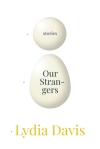
Our Strangers by Lydia Davis (Review and Q&A): In her ninth collection of mostly flash-length stories (a whopping 143 of them), an overarching theme is the mystery of human communication and connection. A real cornucopia of genres, structures, and voices. [Only available via Bookshop.org and independent bookstores.]
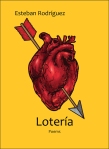
Lotería by Esteban Rodríguez: Lotería is a traditional Mexican game of chance. Each Spanish-language card is allotted a one-page poem in a creative, poignant recounting of his Mexican American family history.
Glass Half Empty by Rachael Smith: The British comics artist third graphic memoir is a refreshingly candid account of her recovery from alcoholism after her father’s death. In some panes, her adult self appears alongside her younger self, offering advice.


The Dead Peasant’s Handbook by Brian Turner: The final installment – after The Wild Delight of Wild Things and The Goodbye World Poem – in an intimate, autobiographical trilogy. Love is presented as the key to surviving bereavement and wartime trauma.
Review Catch-Up: Capildeo, Castillo, Nagamatsu & Wedlich
A second catch-up for April. Today I have a sprightly poetry collection about history, language and nature; a linked short story collection that imagines funerary rituals and human meaning in a post-pandemic future; and a wide-ranging popular science book about the diverse connotations and practical uses of slime. As a bonus, I have a preview essay from a forthcoming collection about how reading promotes empathy and social justice.
Like a Tree, Walking by Vahni Capildeo (2021)
 Capildeo is a nonbinary Trinidadian Scottish poet and the current University of York writer in residence. Their fourth collection is richly studded with imagery of the natural world, especially birds and trees. “In Praise of Birds” makes a gorgeous start:
“In praise of high-contrast birds, purple bougainvillea thicketing the golden oriole. … In praise of grackles quarrelling on the lawn. / In praise of unbeautiful birds abounding in Old Norse, language of scavenging ravens, thought and memory, a treacherous duo”
and finds a late echo in “In Praise of Trees”: “If I could have translated piano practice into botany, the lichen is that Mozart phrase my left hand trialled endlessly.”
The title section (named after a moment from the book of Mark) draws on several numbered series – “Walk #2,” “Nocturne #1,” “Lullaby 4,” and so on – that appeared in a pamphlet they published last year. These are not uncomplicated idylls, though. Walks might involve dull scenery and asthma-inducing dust, as well as danger: “If nobody has abducted you, I’ll double back to meet you. … Before raper-man corner and the gingerbread house.” Lullabies wish for good sleep despite lawnmowers and a neighbour shooting his guns. There’s more bold defiance of expectations in phrases like “This is the circus for dead horses only”.
Language is a key theme, with translations from the French of Eugène Ionesco, and of Pierre de Ronsard into Trini patois. There are also dual-language erasure poems after Dame Julian of Norwich (Middle English) and Simone Weil (French). Much of the work is based on engagement with literature, or was written in collaboration with performers.
“Death is a thief in a stationery shop. He strolls out. The shopkeeper, a poor man, runs after, shouting. – I saw you! Give that back! – Give back what? Death says, strolling out. Hermes is a tram attendant who holds your coffee, helping you find the coin you dropped; it rolls underfoot.” (from “Odyssey Response”)
“Windrush Reflections” impresses for its research into the situation of Caribbean immigrants to Britain. It’s one of a number of long, multipart pieces, some of them prose poems. The verse relies mostly on alliteration and anaphora for its sonic qualities. Along with history, there is reflection on current events, as in “Plague Poems.” Experiences of casual racism fuel one of my favourite passages:
“the doorbell was ringing / the downstairs american oxford neighbours / wanted to check / by chatting on the intercom / if i was doing terrorism / i was doing transcriptions” (from “Violent Triage”)
Honorifics by Cynthia Miller, which I reviewed last week, had more personal resonance for me, but these are both powerful collections – alive to the present moment and revelling in language and in flora and fauna. However, only Capildeo progressed from the Jhalak Prize longlist onto the shortlist, which was announced yesterday.
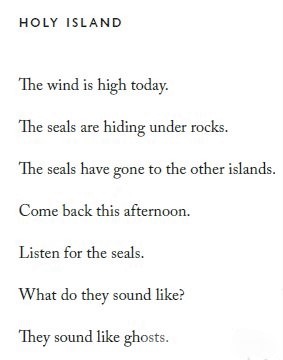
With thanks to Carcanet Press for the free e-copy for review.
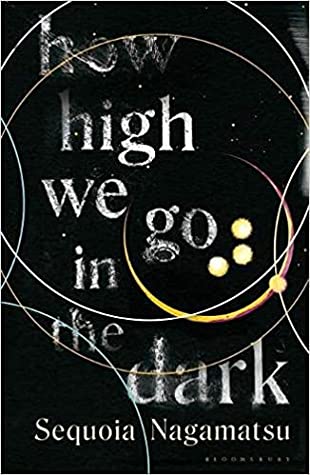
How High We Go in the Dark by Sequoia Nagamatsu (2022)
“Things are bad in every generation. But we still have to live our life.”
This linked short story collection was one of my most anticipated books of the year. Like two of its fellow entries on that list, Sea of Tranquility by Emily St. John Mandel and To Paradise by Hanya Yanagihara, it’s just the right blend of literary fiction and science fiction – an Octavia E. Butler level of the latter that I can handle. Opening in 2031 and stretching another 70 years into the future, it imagines how a pandemic reshapes the world and how communication and connection might continue after death. In the first story, Cliff is on the ground at the start of the Arctic plague, which emerges from a thawing Siberia (the same setup as in Under the Blue!), where his late daughter, Clara, had been part of a research group that discovered a 30,000-year-old Neanderthal girl they named Annie.
 The virus is highly transmissible and deadly, and later found to mostly affect children. In the following 13 stories (most about Asian Americans in California, plus a few set in Japan), the plague is a fact of life but has also prompted a new relationship to death – a major thread running through is the funerary rites that have arisen, everything from elegy hotels to “resomation.” In the stand-out story, the George Saunders-esque “City of Laughter,” Skip works at a euthanasia theme park whose roller coasters render ill children unconscious before stopping their hearts. He’s proud of his work, but can’t approach it objectively after he becomes emotionally involved with Dorrie and her son Fitch, who arrives in a bubble.
All but one of these stories are in the first person, so they feel like intimate testimonies of how a pandemic transforms existence. Almost all of the characters have experienced a bereavement, or are sick themselves. Relatives or acquaintances become protagonists in later stories. For instance, in “Pig Son,” Dorrie’s ex, David, is a scientist growing organs for transplantation. Bereavement coordinator Dennis and his doctor brother Bryan narrate #5 and #8, respectively. Six years on, Cliff’s wife Miki takes their granddaughter on a space mission. My other two favourites were “Through the Garden of Memory,” in which patients on a plague ward build a human pyramid and plot a sacrifice, and “Songs of Your Decay,” about a researcher at a forensic body farm who bonds with her one live donor over rock music.
Some stories are weaker or less original than others, but this is one case where the whole is definitely greater than the sum of its parts. The focus on illness and death, but also on the love that survives, made this a winner for me. I’d be especially likely to recommend it to fans of Kazuo Ishiguro and Karen Russell.
With thanks to Bloomsbury for the free copy for review.
Slime: A Natural History by Susanne Wedlich (2021)
[Translated from the German by Ayça Türkoğlu]
 This is just the sort of wide-ranging popular science book that draws me in. Like Entangled Life by Merlin Sheldrake, a work I’ve had many opportunities to recommend even to those who don’t normally pick up nonfiction, it incorporates many weird and wonderful facts about life forms we tend to overlook. Wedlich, a freelance science journalist in Germany, starts off at the Hunterian Museum in Glasgow, where she seeks a sample of the “primordial slime” collected by the HMS Challenger in 1876. “It seems to be an unwritten rule of horror: slime sells!” she remarks – from H. P. Lovecraft to Ghostbusters, it has provoked disgust. Jellyfish, snails, frogs and carnivorous plants – you’re in for a sticky tour of the natural world.
The technical blanket term for slimy substances is “hydrogels,” which are 99% water and held together by polymers. Biological examples have been inspiring new technologies, like friction reducers (e.g. in fire hoses) modelled on fish mucus, novel adhesives to repair organs and seal wounds, and glue traps to remove microplastics. Looking to nature to aid our lives is nothing new, of course: Wedlich records that slugs were once used to lubricate cart wheels.
The book branches off in a lot of directions. You’ll hear about writers who were spellbound or terrified by marine life (Patricia Highsmith kept snails, while Jean-Paul Sartre was freaked out by sea creatures), the Victorian fascination with underwater life, the importance of the microbiome and the serious medical consequences of its dysfunction, and animals such as amphibians that live between land and water. At times it felt like the narrative jumped from one topic to another, especially between the biological and the cultural, without following a particular plan, but there are enough remarkable nuggets to hold the interest.
With thanks to Granta for the free copy for review.
And a bonus:
 I was delighted to be sent a preview pamphlet containing the author’s note and title essay of How to Read Now by Elaine Castillo, coming from Atlantic in August. This guide to cultural criticism – how to read anything, not just a book – is alive to the biased undertones of everyday life. “Anyone who is perfectly comfortable with keeping the world just as it is now and reading it the way they’ve always read it … cannot be trusted”. Castillo writes that it is not the job of people of colour to enlighten white people (especially not through “the gooey heart-porn of the ethnographic” – war, genocide, tragedy, etc.); “if our stories primarily serve to educate, console and productively scold a comfortable white readership, then those stories will have failed their readers”. This is bold, provocative stuff. I’m sure to learn a lot.
Would you be interested in reading one or more of these?
#NonFicNov Catch-Up 2: Abbs, Hattrick, Powles, DAD Anthology, Santhouse
I’m sneaking in with five more review books on the final day of Nonfiction November, after a first catch-up earlier on in the month. Today I have a sprightly travel book based on the journeys of female writers and artists, a probing account of repeated chronic illness in the family, an anthology of essays showcasing the breadth of fatherhood experiences, a lyrical memoir-in-essays exploring racial identity, and a psychiatrist’s case studies of how the mind influences what the body feels. My apologies to the publishers for the brief responses.
Windswept: Walking in the footsteps of remarkable women by Annabel Abbs
 After a fall landed her in hospital with a cracked skull, Abbs couldn’t wait to roam again and vowed all her future holidays would be walking ones. What time she had for pleasure reading while raising children was devoted to travel books; looking at her stacks, she realized they were all by men. Her challenge to self was to find the women and recreate their journeys. I was drawn to this because I’d enjoyed Abbs’s novel about Frieda Lawrence and knew she was the subject of the first chapter here. During research for Frieda, Abbs omitted the Lawrences’ six-week honeymoon in the German mountains, so now she makes it a family cycling holiday, imitating Frieda’s experience by walking in a skirt and sunbathing nude. Other chapters follow Welsh painter Gwen John in Bordeaux, Nan Shepherd in Scotland, Georgia O’Keeffe in the American Southwest, and so on. Questions of risk and compulsion recur as Abbs asks how these women sought to achieve liberation. The interplay between biographical information and travel narrative is carefully controlled, but somehow this never quite came together for me in the way that, for instance, Sara Wheeler’s O My America! did.
(Two Roads, June 2021.) With thanks to the publisher for the free copy for review.
Ill Feelings by Alice Hattrick
 “My mother and I have symptoms of illness without any known cause,” Hattrick writes. When they showed signs of the ME/CFS their mother had suffered from since 1995, it was assumed there was imitation going on – that a “shared hysterical language” was fuelling their continued infirmity. It didn’t help that both looked well, so could pass as normal despite debilitating fatigue. Into their own family’s story, Hattrick weaves the lives and writings of chronically ill women such as Elizabeth Barrett Browning (see my review of Fiona Sampson’s biography, Two-Way Mirror), Alice James and Virginia Woolf. All these figures knew that what Hattrick calls “crip time” is different: more elastic; about survival rather than achievement.
The book searches desultorily for answers – could this have something to do with Giardiasis at age two? – but ultimately rests in mystery. ME/CFS patients rarely experience magical recovery, instead exhibiting repeated cycles of illness and being ‘well enough’. Hattrick also briefly considers long Covid as another form of postviral syndrome. My mother had fibromyalgia for years, so I’m always interested to read more about related illnesses. Earlier in the year I read Tracie White’s Waiting for Superman, and this also reminded me of Suzanne O’Sullivan’s books, though it’s literary and discursive rather than scientific.
(Fitzcarraldo Editions, August 2021.) With thanks to the publisher for the free copy for review.
Small Bodies of Water by Nina Mingya Powles
 I loved Powles’s bite-size food memoir, Tiny Moons. She won the inaugural Nan Shepherd Prize for underrepresented voices in nature writing for this work in progress, and I was eager to read more of her autobiographical essays. Watery metaphors are appropriate for a poet’s fluid narrative about moving between countries and identities. Powles grew up in a mixed-race household in New Zealand with a Malaysian Chinese mother and a white father, and now lives in London after time spent in Shanghai. Water has been her element ever since she learned to swim in a pool in Borneo, where her grandfather was a scholar of freshwater fish.
The book travels between hemispheres, seasons and languages, and once again food is a major point of reference. “I am the best at being alone when cooking and eating a soft-boiled egg,” she writes. Many of the essays are in short fragments – dated, numbered or titled. A foodstuff or water body (like the ponds at Hampstead Heath) might serve as a link: A kōwhai tree, on which the unofficial national flower of New Zealand grows, when encountered in London, collapses the miles between one home and another. Looking back months later (given I failed to take notes), this evades my grasp; it’s subtle, slippery but admirable.
(Canongate, August 2021.) With thanks to the publisher for the free copy for review.
DAD: Untold Stories of Fatherhood, Love, Mental Health and Masculinity, edited by Elliott Rae
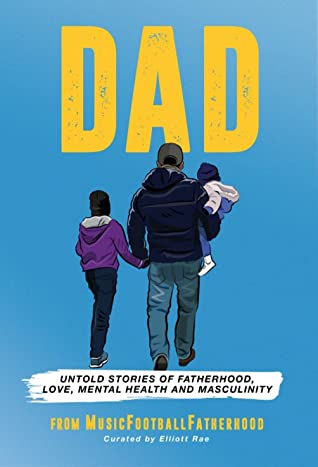 Music.Football.Fatherhood, a British equivalent of Mumsnet, brings dads together in conversation. These 20 essays by ordinary fathers run the gamut of parenting experiences: postnatal depression, divorce, single parenthood, a child with autism, and much more. We’re used to childbirth being talked about by women, but rarely by their partners, especially things like miscarriage, stillbirth and trauma. I’ve already written on Michael Johnson-Ellis’s essay on surrogacy; I also found particularly insightful R.P. Falconer’s piece on trying to be the best father he can be despite not having a particularly good role model in his own absent father, and Sam Draper’s on breaking the mould as a stay-at-home dad (“the bar for expectations regarding fathers is low, very low”) – I never understood how parental leave works in the UK before reading this. The book is full of genial and relatable stories and half or more of its authors are non-white. It could do with more rigorous editing to get the grammar and writing style up to the standard of traditionally published work, but even for someone like me who is not in the target audience it was an enjoyable set of everyday voices.
(Music.Football.Fatherhood, June 2021.) With thanks for the free copy for review.
Head First: A Psychiatrist’s Stories of Mind and Body by Alastair Santhouse
 Santhouse is a consultant psychiatrist at London’s Guy’s and Maudsley hospitals. This book was an interesting follow-up to Ill Feelings (above) in that the author draws an important distinction between illness as a subjective experience and disease as an objective medical reality. Like Abdul-Ghaaliq Lalkhen does in Pain, Santhouse adopts a biopsychosocial approach: “to focus solely on the scientific and neglect he social aspects of illness is a mistake that we continue to make,” he says. Using a patchwork of anonymous case studies, he delves into topics like depression, altruism, obesity, self-diagnosis, medical mysteries, evidence-based medicine, and preparation for death. A discussion of CFS again echoes the Hattrick. He brings the picture up to date with a final chapter on Covid-19. I’ve read so many doctors’ memoirs that this one didn’t stand out for me at all, but those less familiar with the subject matter could find it a good introduction to some ins and outs of mind–body medicine.
(Atlantic Books, July 2021.) With thanks to the publicist for the free copy for review.
Would you be interested in reading one or more of these?
Review Book Catch-Up: Dennis, Galloway, Leland-St. John and Sampson
Capsule reviews today, of four books I am inexcusably late in reviewing. I have a record of personal experience with species reintroductions, a memoir about living among reindeer herders in the far north of Norway, a set of elegiac poems, and a biography of a Victorian woman poet who struggled with poor health for most of her life.
Restoring the Wild: Sixty Years of Rewilding Our Skies, Woods and Waterways by Roy Dennis
 Rewilding is a big buzz word in current nature and environmental writing. Few could be said to have played as major a role in the UK’s successful species reintroduction projects as Roy Dennis, who has been involved with the RSPB and other key organizations since the late 1950s. He trained as a warden at two of the country’s most famous bird observatories, Lundy Island and Fair Isle. Most of his later work was to focus on birds: white-tailed eagles, red kites, and ospreys. Some of these projects extended into continental Europe. He also writes about the special challenges posed by mammal reintroductions; beavers get a chapter of their own. Every initiative is described in exhaustive detail, full of names and dates, whereas I would have been okay with an overview. This feels like more of an insider’s history rather than a layman’s introduction. I have popped it on my husband’s bedside table in hopes that, with his degree in wildlife conservation, he’ll be more interested in the nitty-gritty.
Favourite lines:
“Tenacity and a long view to the future are important in wildlife conservation.”
“for every successful project that gets the go-ahead, there are others into which people put great effort but which then run up against problems.”
With thanks to William Collins for the free copy for review.
Dálvi: Six Years in the Arctic Tundra by Laura Galloway
 The title is the word for winter in the Northern Sámi language. Galloway, a journalist, traded in New York City for Arctic Norway after a) a DNA test told her that she had Sámi blood and b) she met and fell for Áilu, a reindeer herder, at a wedding. She enrolled in an intensive language learning course at university level and got used to some major cultural changes: animals were co-workers here rather than pets (like the two cats she brought with her); communal meals and drawn-out goodbyes were not the done thing; and shamans were still active (one helped them find a key she lost). Footwear neatly sums up the difference. The Prada heels she brought “just in case” ended up serving as hammers; instead, she helped Áilu’s mother make reindeer skins into boots. Two factors undermined my enjoyment: Alternating chapters about her unhappy upbringing in Indiana don’t add much of interest, and, after her relationship with Áilu ends, the book feels aimless. However, I appreciated her words about DNA not defining you, and family being what you make it.
With thanks to Atlantic Books for the free copy for review.
A Raga for George Harrison by Sharmagne Leland St.-John (2020)
 Native American poet Sharmagne Leland St.-John’s fifth collection is a nostalgic and bittersweet look at people and places from one’s past. There are multiple elegies for public figures – everyone from Janis Joplin to Virginia Woolf – as well as for some who aren’t household names but have important stories that should be commemorated, like Hector Pieterson, a 12-year-old boy killed during the Soweto Uprising for protesting enforced teaching of Afrikaans in South Africa in 1976. Many of the elegies are presented as songs. Personal sources of sadness, such as a stillbirth, disagreements with a daughter, and ageing, weigh as heavily as tragic world events.
Rhyming and alliteration create inviting rhythms throughout the book, and details of colour and fashion animate poems like “La Kalima.” Leland St.-John remembers meeting street children in Mexico, while bamboo calls to mind time spent in Japan. “Promised Land” is an ironic account of land being seized from natives and people of colour. I especially liked “Things I Would Have Given to My Mother Had She Asked” (some literal and some more abstract), which opens “A piece of my liberal mind. 5 more minutes of my time”, and the sombre “Cat’s Cradle” (“Drenched starlings perch on a cat’s cradle of telephone wires”).
You can read “I Said Coffee” and a few more of her poems online.
With thanks to the author for sending a free e-copy for review.
Two-Way Mirror: The Life of Elizabeth Barrett Browning by Fiona Sampson
 Coming in at under 260 pages, this isn’t your standard comprehensive biography. Sampson instead describes it as a “portrait,” one that takes up the structure of EBB’s nine-book epic poem, Aurora Leigh, and is concerned with themes of identity and the framing of stories. Elizabeth, as she is cosily called throughout the book, wrote poems that lend themselves to autobiographical interpretation – “her body of work creates a kind of looking glass in which, dimly, we make out the person who wrote it,” Sampson asserts.
Nicknamed “Ba,” Elizabeth was born in 1806 and brought up with 11 younger siblings at a Herefordshire estate, Hope End. Her father, Edward, had been born in Jamaica and the family fortune was based on sugar – and slavery. Sampson makes much of this inherited guilt, and also places an emphasis on EBB’s lifelong ill health, which involved headaches, back and side pain, and depression. She also suffered from respiratory complaints. The modern medically minded reader tries to come up with a concrete diagnosis. Tardive dystonia? Post-viral syndrome? The author offers many potential explanations, and notes that her subject was the very type of the Victorian female invalid. She would also suffer from miscarriages, but had one son, Pen. The Brownings were in the unusual position of the wife being the more famous partner.
Sampson draws heavily on correspondence and earnestly interrogates scenes and remembrances, but her use of the present tense is a bit odd for a historical narrative, and I found my casual curiosity about the Brownings wasn’t enough to sustain my interest. However, this did make me eager to try more of EBB’s poetry. I wonder if I still have that copy of Sonnets from the Portuguese in a box in the States?
Favourite lines:
“Within the continual process of reputation-making and remaking that is literary history, Elizabeth Barrett Browning remains a bellwether for the rising and sinking stock of women writers. … Elizabeth dramatizes the two-way creation of every writing self, from without and from within. That the life of the body both enables and limits the life of the mind is the paradox of the thinking self.”
With thanks to Profile Books for the free copy for review.
Would you be interested in reading one or more of these?
Review Book Catch-Up: Ante, Evans, Foster and White
Today I have a book of poems about the Filipinx experience in the UK, a collection of short stories reflecting on racial injustice, a monograph on a bird that spells summer for many of us, and a biographical investigation into a little-understood medical condition.
Antiemetic for Homesickness by Romalyn Ante
I was drawn to this debut collection by the terrific title and cover, but also by the accolades it received: it was on the Dylan Thomas Prize longlist and the Jhalak Prize shortlist. I hope we’ll see it on the Sunday Times Young Writer of the Year Award shortlist, too. Ante grew up in the Philippines but at age 16 joined her mother in the UK, where she had moved years before to work as a nurse in the NHS. She has since followed in her mother’s footsteps as a nurse – indeed, overseas Filipinx workers (Jamaicans, too) are a mainstay of the NHS.
 Ante remembers the years when her mother was absent but promised to send for the rest of the family soon: “You said all I needed to do was to sleep and before I knew it, / you’d be back. But I woke to the rice that needed rinsing, / my siblings’ school uniforms that needed ironing.” The medical profession as a family legacy and noble calling is a strong element of these poems, especially in “Invisible Women,” an ode to the “goddesses of caring and tending” who walk the halls of any hospital. Hard work is a matter of survival, and family – whether physically present or not – bolsters weary souls. A series of short, untitled poems are presented as tape recordings made for her mother.
Food is inextricably entwined with memory (reminding me of Nina Mingya Powles’s approach in Tiny Moons) and provides some of the standout metaphors, especially in “Patis” and “Ode to a Pot Noodle.” Ante uses a lot of alliteration and adapts various forms. I especially liked “Tagay!”, a traditional drinking song, and “Mateo,” printed in the shape of a pound sign. The nuanced look at the immigrant experience reminded me of Jenny Xie’s Eye Level. Movement entails losses as well as benefits. The focus on the Filipinx experience also made me think of America Is Not the Heart. My favourite single poem was “The Making of a Smuggler,” which opens “Wherever we travel, we carry / the whole country with us – // our rice terraces are folded garments, / we have pillars of trees, a rainforest // on a hairbrush.”
Favourite lines:
“Gone are the nights he steals / the moon with a mango picker / and swaps it for her pocket mirror”
“The yellow admission papers in my hands escaped / flustering at my face into a flight of orioles.”
“I am halved in order to be whole – / I rebuild by leaving / everything I love.”
With thanks to Chatto & Windus for the free copy for review.
The Office of Historical Corrections by Danielle Evans
To boil these six stories and a novella down to the topic of race in America risks painting them as solemn or strident – more concerned with meaning than with art – when the truth is that they are playful and propulsive even though they keep cycling back to bereavement and injustice. Several of the protagonists are young Black women coming to terms with a loss.
 In “Happily Ever After,” Lyssa works in the gift shop of a Titanic replica and is cast as an extra in a pop star’s music video. Mythical sea monsters are contrasted with the real dangers of her life, like cancer and racism. “Anything Could Disappear” was a favourite of mine, though it begins with that unlikely scenario of a single woman acquiring a baby as if by magic. What starts off as a burden becomes a bond she can’t bear to let go. A family is determined to clear the name of their falsely imprisoned ancestor in “Alcatraz.” In “Richard of York Gave Battle in Vain” (a mnemonic for the colours of the rainbow), photojournalist Rena is wary about attending the wedding of a friend she met when their plane was detained in Africa some years ago. The only wedding she’s been in is her sister’s, which ended badly.
Mistakes and deceit seem to follow these characters. In the title novella that closes the book, Cassie and her colleagues combat fake news, going around putting correction labels on plaques that whitewash history. When she and her former colleague meet up in Wisconsin to find the truth behind a complex correction case, a clash with a white supremacist group quickly turns pedantry into a matter of life and death. The story I’d heard the most about beforehand was “Boys Go to Jupiter,” about a college girl who dons a Confederate flag bikini, not caring what message it sends to others in her dorm. It turns out she has history with a Black family, but has chosen to airbrush this experience out of her life.
There was only one story I didn’t care for, “Why Won’t Women Just Say What They Want,” about a celebrity who turns apologizing into performance art. Overall, this is a very strong collection I would recommend to readers of Brit Bennett and Raven Leilani, with some stories also reminding me of recent work by Curtis Sittenfeld and Mary South. I’ll be sure to seek out Evans’s previous book (also short stories), too.
With thanks to Picador for the proof copy for review.
The Screaming Sky by Charles Foster
The other week I was volunteering at our local community garden and looked up to see a dozen common swifts wheeling over the Kennet & Avon canal and picking off insects among the treetops. I hope this fellow Foster (for whom my husband was once confused on a nature conference attendee list) would be proud of me for pausing to gaze at the birds for a while. My impression of the author is as a misanthropic eccentric. A Renaissance man as well versed in law and theology as he is in natural history, he’s obsessed with swifts and ashamed of his own species: for looking down at their feet when they could be watching the skies; for the “pathological tidiness” that leaves swifts and so many other creatures no place to live.
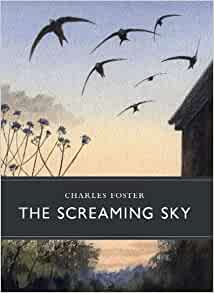 The obsession began when he was eight years old and someone brought him a dead swift fledgling for his taxidermy hobby. Ever since, he’s dated the summer by their arrival. “It is always summer for them,” though, as his opening line has it. This monograph is structured chronologically. Much like Tim Dee does in Greenery, Foster follows the birds for a year: from their winter territory in Africa to the edges of Europe in spring and then to his very own Oxford street in high summer. When they leave, he’s bereft and ready to book a flight back to Africa.
Along the way, Foster delivers heaps of information: the fossil evidence of swifts, how they know where to migrate (we have various theories but don’t really know), their nesting habits and lifespan, and the typical fates of those individuals that don’t survive. But, thumbing his nose at his “ex-friend” (a closed-minded biologist he repeatedly, and delightfully, rails against), he refuses to stick to a just-the-facts approach. Acknowledging the risks of anthropomorphizing, he speaks of swifts as symbols of aspiration, of life lived with intensity. He believes that we can understand animal emotions analogously through our own, so that, inappropriate as such words might seem, we can talk about what birds hope and plan for. He scorns reductive ecosystem services lingo that defines creatures by what we get out of them.
Also like Dee, Foster quotes frequently from poetry. His prose is full of sharp turns of phrase and moments of whimsy and made me eager to try more of his work (I know the most about but have not yet read Being a Beast).
Swifts know the roar of lions better than the roar of the M25, the piping of hornbills better than the Nunc Dimittis of parish Evensong … Are memories of our eaves spiralling high above the Gulf of Guinea? … They don’t seem to prevaricate. One moment they’re there, the next they’re off, diving straight into the journey. It’s the way we should run into cold water.
 As I’ve found with a number of Little Toller releases now (On Silbury Hill, Snow, Landfill), knowledge meets passion to create a book that could make an aficionado of the most casual of readers. Towards the close I was also reminded of Richard Smyth’s An Indifference of Birds: “When Homo sapiens has gone there will be lots of ideal swift holes in the decaying buildings we’ll leave behind.” It’s comforting to think of natural cycles continuing after we’re gone … but let’s start making the space for them now. Jonathan Pomroy’s black-and-white illustrations of swift behaviour only add to this short book’s charms.
With thanks to Little Toller Books for the free copy for review.
Waiting for Superman: One Family’s Struggle to Survive – and Cure – Chronic Fatigue Syndrome by Tracie White
Like Suzanne O’Sullivan’s books (most recently, The Sleeping Beauties), this is presented as an investigation into a medical mystery. White, a Stanford Medicine journalist, focuses on one family that has been indelibly changed by chronic fatigue syndrome – now linked with myalgic encephalomyelitis and termed ME/CFS for short. Whitney Dafoe was a world traveller and promising photographer before, in 2010, a diagnosis of ME/CFS explained his exhaustion and gastrointestinal problems. By the time White first met the family in 2016, the thirtysomething was bedbound in his parents’ home with a feeding tube, only able to communicate via gestures and rearranging Scrabble tiles. He couldn’t bear loud noises, or to be touched. At times he was nearly comatose.
 Whitney’s father, Ron Davis, is a Stanford geneticist whose research has contributed to the Human Genome Project. He has devoted himself to studying ME/CFS, which affects 20 million people worldwide yet receives little research funding; he calls it “the last major disease we know nothing about.” Testing his son’s blood, he found a problem with the citric acid cycle that produces ATP, essential fuel for the body’s cells – proof that there was a physiological reason for Whitney’s condition. Frustratingly, though, a Stanford colleague who examined Whitney prescribed a psychological intervention. This is in line with the current standard of care for ME/CFS: a graded exercise regime (nigh on impossible for someone who can’t get out of bed) and cognitive behavioural therapy.
White delves into Whitney’s past, looking for clues to what could have triggered his illness (having mono in high school? a parasite he picked up in India?). She also goes back to the mid-1980s to consider the Lake Tahoe outbreak of ME/CFS, whose victims “looked too healthy to be sick and were repeatedly disbelieved.” The media called it “yuppie flu,” downplaying the extreme fatigue involved. White also meets Laura Hillenbrand, author of Seabiscuit, who suffers from ME/CFS and managed to write her bestselling books from bed. Like Whitney, she only has a certain allotment of energy and mustn’t use it up too fast.
- A neat connection: Stephanie Land, author of Maid, was Whitney’s ex-girlfriend when he was 19 and living in Alaska; she wrote a Longreads article about their relationship.
- The title is from a Flaming Lips lyric and expresses Whitney’s trust in his dad’s ability to cure him; the U.S. title is The Puzzle Solver and the working title was The Invisible Patient.
With thanks to Atlantic Books for the free copy for review.
Would you be interested in reading one or more of these?
The Inevitable: Dispatches on the Right to Die by Katie Engelhart
Why, she wanted to know, was I so interested in the subject?
“Why isn’t everyone?” I asked.
The fact that I read a lot more books about death than the average person is something I attribute not to some morbid curiosity, but to pragmatism. As the title of Canadian reporter and documentary filmmaker Katie Engelhart’s book makes clear, this is the one subject none of us can avoid indefinitely, so why not learn about and understand it as much as possible? The Inevitable focuses on the controversial matter of assisted dying, also known as assisted suicide, euthanasia, or physician-assisted death. It’s a topic that’s already come up in my reading a couple of times this year: in the Dutch context of That One Patient by Ellen de Visser, and as a key part of the narrative in Darke Matter by Rick Gekoski.

Engelhart spends time with doctors and patients who are caught up in the assisted dying argument, chiefly in Western Europe and the United States. Ten states plus Washington, D.C. have assisted dying laws, sparked by Oregon’s Death with Dignity Act in 1994. In California, the author follows Dr. Lonny Shavelson for a month, observing all the meticulous regulations surrounded a physician-assisted death: patients with a terminal diagnosis and less than six months to live have to complete multiple forms, give many signatures, deliver oral testimony, and be able to drink the fatal concoction by themselves (whereas in other countries doctors can administer lethal injections). And if, when the time comes, a patient is too far gone to give spoken consent, the procedure is cancelled.
Other chapters consider specific cases that are not generally covered by current legislation but can drive people to seek assisted suicide: the ravages of old age, chronic degenerative illnesses, dementia, and severe mental illness. Each of these is given its own long chapter, like an extended magazine profile.
- Meet Avril Henry, a former Exeter University professor in her eighties, now living alone with a failing body but no specific diagnosis that would qualify her for AD. Pain has long since outweighed pleasure in her life, so she illegally imports Nembutal from a veterinary supplier in Mexico and makes a careful plan for what will happen with her body, home, and possessions after she takes the drug in the bathtub.
- Meet Maia Calloway, a 39-year-old former filmmaker confined to a wheelchair by multiple sclerosis. Her medicines cost $65,000 a year, not all covered by Medicare, and she can no longer rely on the patience of her boyfriend, who acts as her carer. She decides to raise the money to travel from Taos to a Swiss assisted dying clinic.
- Meet Debra, a 65-year-old widow so rapidly declining with dementia that she knows she has to make her arrangements at once. She contacts the Final Exit Network, which gives advice and equipment (e.g. a nitrogen tank) that can make a death look unexplained or like a standard suicide.
- Meet Adam, a 27-year-old in daily distress from OCD, anxiety, and depersonalization disorder. Though he’s lobbied for the inclusion of mental illness, he doesn’t qualify for AD under Canada’s laws. In 2017 he starts a Facebook livestream from a hotel room, intending to take poison off-screen. He loses his nerve this time, but is determined to try again.
These stories are so wrenching, but so compassionately told. Engelhart explores the nuances of each situation, crafting expert portraits of suffering people and the medical professionals who seek to help them, and adding much in the way of valuable context. Hers is a voice of reason and empathy. She mostly stays in the background, as befits a journalist, but occasionally emotional responses or skepticism come through – Exit International’s Philip Nitschke, vilified as a “Dr. Death” like Jack Kevorkian, is too much of a maverick for her.
And while her sympathy for the AD cause is evident, she also presents opposing arguments: from hospice doctors, from those afraid that the disabled will be pushed into assisted suicide to free up resources, from the family members of her subjects, and from those who have witnessed abuses of the system. There are those who frame this as a question of rights, and others who recognize a rare privilege; some who scorn the notion of escape, and others who speak of dignity and the kindness one would show a dying pet. The book is a vital contribution to an ongoing debate, with human stories at its heart.
With thanks to Atlantic Books for the free copy for review. The Inevitable was published in the UK on March 11th and is available from St. Martin’s Press in the USA.
 Bookish Beck = Rebecca Foster. American transplant to England. Freelance proofreader and book reviewer.
 Bookish Beck