May Releases, Part II (Fiction): Le Blevennec, Lynch, Puchner, Stanley, Ullmann, and Wald
A cornucopia of May novels, ranging from novella to doorstopper and from Montana to Tunisia; less of a spread in time: only the 1980s to now. Just a paragraph on each to keep things simple. I’ll catch up soon with May nonfiction and poetry releases I read.
Friends and Lovers by Nolwenn Le Blevennec (2023; 2025)
[Translated from French by Madeleine Rogers]
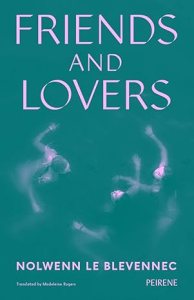 Armelle, Rim, and Anna are best friends – the first two since childhood. They formed a trio a decade or so ago when they worked on the same magazine. Now in their mid-thirties, partnered and with children, they’re all gripped by a sexual “great awakening” and long to escape Paris and their domestic commitments – “we went through it, this mutiny, like three sisters,” poised to blow up the “perfectly executed choreography of work, relationships, children”. The friends travel to Tunisia together in December 2014, then several years later take a completely different holiday: a disaster-prone stay in a lighthouse-keeper’s cottage on an island off the coast of Brittany. They used to tolerate each other’s foibles and infidelities, but now resentment has sprouted up, especially as Armelle (the narrator) is writing a screenplay about female friendship that’s clearly inspired by Rim and Anna. Armelle is relatably neurotic (a hilarious French blurb for the author’s previous novel is not wrong: “Woody Allen meets Annie Ernaux”) and this is wise about intimacy and duplicity, yet I never felt invested in any of the three women or sufficiently knowledgeable about their lives.
With thanks to Peirene Press for the free copy for review.
A Family Matter by Claire Lynch
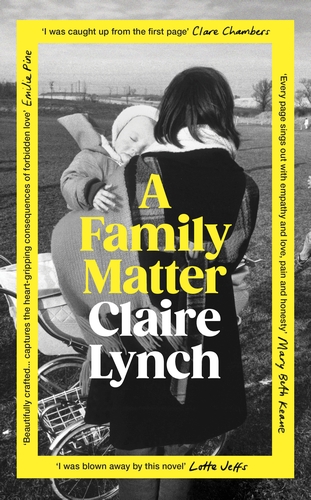 “The fluke of being born at a slightly different time, or in a slightly different place, all that might gift you or cost you.” At events for Small, Lynch’s terrific memoir about how she and her wife had children, women would speak up about how different their experience had been. Lesbians born just 10 or 20 years earlier didn’t have the same options. Often, they were in heterosexual marriages because that’s all they knew to do; certainly the only way they thought they could become mothers. In her research into divorce cases in the UK in the 1980s, Lynch learned that 90% of lesbian mothers lost custody of their children. Her aim with this earnest, delicate debut novel, which bounces between 2022 and 1982, is to imagine such a situation through close portraits of Heron, an ageing man with terminal cancer; his daughter, Maggie, who in her early forties bears responsibility for him and her own children; and Dawn, who loved Maggie desperately but felt when she met Hazel that she was “alive at last, at twenty-three.” How heartbreaking that Maggie knew only that her mother abandoned her when she was little; not until she comes across legal documents and newspaper clippings does she understand the circumstances. Lynch made the wise decision to invite sympathy for Heron from the start, so he doesn’t become the easy villain of the piece. Her compassion, and thus ours, is equal for all three characters. This confident, tender story of changing mores and steadfast love is the new Carol for our times. (Such a lovely but low-key novel was liable to make few ripples, so I’m delighted for Lynch that the U.S. release got a Read with Jenna endorsement.)
With thanks to Chatto & Windus (Penguin) for the proof copy for review.
Dream State by Eric Puchner
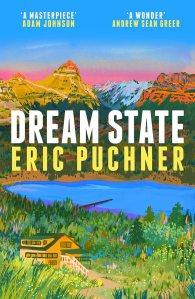 If it starts and ends with a wedding, it must be a comedy. If much of the in between is marked by heartbreak, betrayal, failure, and loss, it must be a tragedy. If it stretches towards 2050 and imagines a Western USA smothered in smoke from near-constant forest fires, it must be an environmental dystopian. Somehow, this novel is all three. The first 163 pages are pure delight: a glistening romantic comedy about the chaos surrounding Charlie and Cece’s wedding at his family’s Montana lake house in the summer of 2004. First half the wedding party falls ill with norovirus, then Charlie’s best friend, Garrett (who’s also the officiant), falls in love with the bride. Do I sound shallow if I admit this was the section I enjoyed the most? The rest of this Oprah’s Book Club doorstopper examines the fallout of this uneasy love triangle. Charlie is an anaesthesiologist, Cece a bookstore owner, and Garrett a wolverine researcher in Glacier National Park, which is steadily losing its wolverines and its glaciers. The next generation comes of age in a diminished world, turning to acting or addiction. There are still plenty of lighter moments: funny set-pieces, warm family interactions, private jokes and quirky descriptions. But this feels like an appropriately grown-up vision of idealism ceding to a reality we all must face. I struggled with a lack of engagement with the children, but loved Puchner’s writing so much on the sentence level that I will certainly seek out more of his work. Imagine this as a cross between Jonathan Franzen and Maggie Shipstead.
With thanks to Sceptre (Hodder) for the proof copy for review.
Consider Yourself Kissed by Jessica Stanley
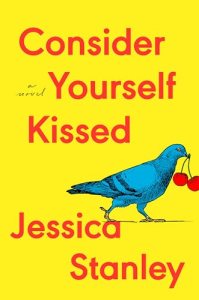 Coralie is nearing 30 when her ad agency job transfers her from Australia to London in 2013. Within a few pages, she meets Adam when she rescues his four-year-old, Zora, from a lake. That Adam and Coralie will be together is never really in question. But over the next decade of personal and political events, we wonder whether they have staying power – and whether Coralie, a would-be writer, will lose herself in soul-destroying work and motherhood. Adam’s job as a political journalist and biographer means close coverage of each UK election and referendum. As I’ve thought about some recent Jonathan Coe novels: These events were so depressing to live through, who would want to relive them through fiction? I also found this overlong and drowning in exclamation points. Still, it’s so likable, what with Coralie’s love of literature (the title is from The Group) and adjustment to expat life without her mother; and secondary characters such as Coralie’s brother Daniel and his husband, Adam’s prickly mother and her wife, and the mums Coralie meets through NCT classes. Best of all, though, is her relationship with Zora. This falls solidly between literary fiction and popular/women’s fiction. Given that I was expecting a lighter romance-led read, it surprised me with its depth. It may well be for you if you’re a fan of Meg Mason and David Nicholls.
With thanks to Hutchinson Heinemann for the proof copy for review.
Girl, 1983 by Linn Ullmann (2021; 2025)
[Translated from Norwegian by Martin Aitken]
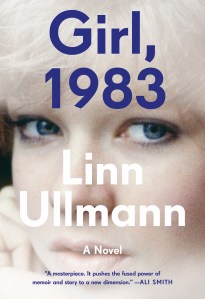 Ullmann is the daughter of actress Liv Ullmann and film director Ingmar Bergman. That pedigree perhaps accounts for why she got the opportunity to travel to Paris in the winter of 1983 to model for a renowned photographer. She was 16 at the time and spent the whole trip disoriented: cold, hungry, lost. Unable to retrace the way to her hotel and wearing a blue coat and red hat, she went to the only address she knew – that of the photographer, K, who was in his mid-forties. Their sexual relationship is short-lived and unsurprising, at least in these days of #MeToo revelations. Its specifics would barely fill a page, yet the novel loops around and through the affair for more than 250. Ullmann mostly pulls this off thanks to the language of retrospection. She splits herself both psychically and chronologically. There’s a “you” she keeps addressing, a childhood imaginary friend who morphs into a critical voice of conscience and then the self dissociated from trauma. And there’s the 55-year-old writer looking back with empathy yet still suffering the effects. The repetition made this something of a sombre slog, though. It slots into a feminist autofiction tradition but is not among my favourite examples.
With thanks to Hamish Hamilton (Penguin) for the proof copy for review.
The Bayrose Files by Diane Wald
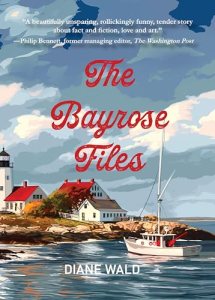 In the 1980s, Boston journalist Violet Maris infiltrates the Provincetown Home for Artists and Writers, intending to write a juicy insider’s exposé of what goes on at this artists’ colony. But to get there she has to commit a deception. Her gay friend Spencer Bayrose has a whole sheaf of unpublished short stories drawing on his Louisiana upbringing, and he offers to let her submit them as her own work to get a place at PHAW. Here Violet finds eccentrics aplenty, and even romance, but when news comes that Spence has AIDS, she has to decide how far she’ll go for a story and what she owes her friend. At barely over 100 pages, this feels more like a long short story, one with a promising setting and a sound plot arc, but not enough time to get to know or particularly care about the characters. I was reminded of books I’ve read by Julia Glass and Sara Maitland. It’s offbeat and good-natured but not top tier.
Published by Regal House Publishing. With thanks to publicist Jackie Karneth of Books Forward for the advanced e-copy for review.
A Family Matter was the best of the bunch for me, followed closely by Dream State.
Which of these do you fancy reading?
April Releases by Chung, Ellis, Gaige, Lutz, McAlpine and Rubin
April felt like a crowded publishing month, though May looks to be twice as busy again. Adding this batch to my existing responses to books by Jean Hannah Edelstein & Emily Jungmin Yoon plus Richard Scott, I reviewed nine April releases. Today I’m featuring a real mix of books by women, starting with two foodie family memoirs, moving through a suspenseful novel about a lost hiker, a sparse Scandinavian novella, and a lovely poetry collection with themes of nature and family, and finishing up with a collection of aphorisms. I challenged myself to write just a paragraph on each for simplicity and readability.

Chinese Parents Don’t Say I Love You: A memoir of saying the unsayable with food by Candice Chung
“to love is to gamble, sometimes gastrointestinally … The stomach is a simple animal. But how do we settle the heart—a flailing, skittish thing?”
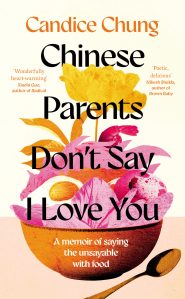 I got Caroline Eden (Cold Kitchen) and Nina Mingya Powles (Tiny Moons) vibes from this vibrant essay collection spotlighting food and family. The focus is on 2019–2021, a time of huge changes for Chung. She’s from Hong Kong via Australia, and reconnects with her semi-estranged parents by taking them along on restaurant review gigs for a Sydney newspaper. Fresh from a 13-year relationship with “the psychic reader,” she starts dating again and quickly falls in deep with “the geographer.” Sharing meals in restaurants and at home kindles closeness and keeps their spirits up after Covid restrictions descend. But when he gets a job offer in Scotland, they have to make decisions about their relationship sooner than intended. Although there is a chronological through line, the essays range in time and style, including second-person advice column (“Faux Pas”) and choose-your-own adventure (“Self-Help Meal”) segments alongside lists, message threads and quotes from the likes of Deborah Levy. My favourite piece was “The Soup at the End of the Universe.” Chung delicately contrasts past and present, singleness and being partnered, and different mental health states. The essays meld to capture a life in transition and the tastes and bonds that don’t alter.
With thanks to Elliott & Thompson for the free copy for review.
Chopping Onions on My Heart: On Losing and Preserving Culture by Samantha Ellis
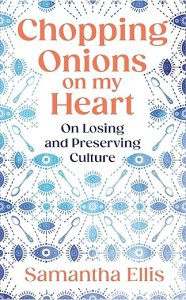 Ellis was distressed to learn that her refugee parents’ first language, Judeo-Iraqi Arabic, is in danger of extinction. Her own knowledge of it is piecemeal, mostly confined to its colourful food-inspired sayings – for example, living “eeyam al babenjan (in the days of the aubergines)” means that everything feels febrile and topsy-turvy. She recounts her family’s history with conflict and displacement, takes a Zoom language class, and ponders what words, dishes, and objects she would save on an imaginary “ark” that she hopes to bequeath to her son. Along the way, she reveals surprising facts about Ashkenazi domination of the Jewish narrative. “Did you know the poet [Siegfried Sassoon] was an Iraqi Jew?” His great-grandfather even invented a special variety of mango pickle. All of the foods described sound delicious, and some recipes are given. Ellis’s writing is enthusiastic and she braids the book’s various strands effectively. I wasn’t as interested in the niche history as I wanted to be, but I did appreciate learning about an endangered culture and language.
With thanks to Chatto & Windus (Vintage/Penguin) for the proof copy for review.
Heartwood by Amity Gaige
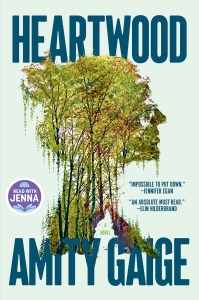 This was on my Most Anticipated list after how much I’d enjoyed Sea Wife when we read it for Literary Wives club. In July 2022, 42-year-old nurse Valerie Gillis, nicknamed “Sparrow,” goes missing in the Maine woods while hiking the Appalachian Trail. An increasingly desperate search ensues as the chances of finding her alive diminish with each day. The shifting formats – letters, transcripts, news reports, tip line messages – hold the interest. However, the chapters voiced by Lt. Bev, the warden who heads the mission, are much the most engaging, and it’s a shame that her delightful interactions with her sisters and nieces are so few and come so late. The third-person passages about Lena Kucharski in her Connecticut retirement home are intriguing but somehow feel like they belong in a different book. Gaige attempts to bring the threads together through three mother–daughter pairs, which struck me as heavy-handed. Mostly, this hits the sweet spot between mystery and literary fiction (apart from some red herrings), but because I wasn’t particularly invested in the characters, even Valerie, this fell a little short of my expectations. (Read via Edelweiss)
Wild Boar by Hannah Lutz (2016; 2025)
[Translated from Swedish by Andy Turner]
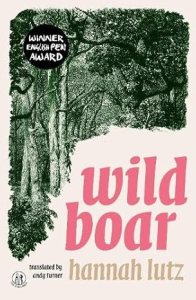 “I have seen them, the wild boar, they have found their way into my dreams!” Ritve travels from Finland to the forests of southern Sweden to track the creatures. Glenn, who appraises project applications for the council, has boar wander onto his property in the middle of the night. Mia, recipient of a council grant for her Recollections of a Sigga Child proposal, brings her ailing grandfather to record his memories for the local sound archive. As midsummer approaches, these three characters plus a couple of their partners will have encounters with the boar and with each other. Short sections alternate between their first-person perspectives. There is a strong sense of place and how migration poses challenges for both the human and more-than-human worlds. But it’s over before it begins. I found myself frustrated by how little happens, how stingily the characters reveal themselves, and how the boar, ultimately, are no more than a metaphor or plot device – a frequent complaint of mine when animals are central to a narrative. This might appeal to fans of Melissa Harrison’s fiction. In any case, I congratulate The Emma Press on their first novel, which won an English PEN Award.
With thanks to The Emma Press for the free copy for review.
Small Pointed Things by Erica McAlpine
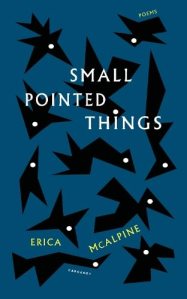 McAlpine is an associate professor of English at Oxford. Her second poetry collection is full of flora and fauna imagery. The title phrase comes from the opening poem, “Bats and Swallows” – in the “gloaming,” it’s hard to tell the difference between the flying creatures. The verse is bursting with alliteration and end rhymes, as just this first one shows (emphasis mine): “we couldn’t see / from where we stood in soft shadows / any signs that they were swallows // or bats”; “One seemed almost iridescent / as I tried to track / its crescent / flight across the hill.” Other poems consider moths, manatees, bees, swans and ladybirds; snowdrops and a cedar tree. Part II expands the view through conversations, theories and travel. What-ifs, consequences and regrets seep in. Parts III and IV incorporate mythical allusions, elegies and the concerns of motherhood. Sometimes the rhyme scheme adheres to a particular form. For instance, I loved “Triolet on My Mother’s 74th Birthday” – “You cannot imagine one season in another. … You cannot imagine life without your mother.” This is just my sort of poetry, sweet on the ear and rooted in nature and the everyday. A sample poem:
“Clementines”
New Year’s Day – another turning
of the sphere, with all we planned
in yesteryear as close to hand
as last night’s coals left unmanned
in the fire, still orange and burning.
It is the season for clementines
and citrus from Seville
and whatever brightness carries us until
leaves and petals once more fill
the treetops and the vines.
If ever you were to confess
some cold truth about love’s
dwindling, now would be the time – less
in order for things to improve
than for the half-bitter happiness
of peeling rinds
during mid-winter
recalling days that are behind
us and doors we cannot re-enter
and other doors we couldn’t find.
With thanks to Carcanet Press for the advanced e-copy for review.
Secrets of Adulthood: Simple Truths for Our Complex Lives by Gretchen Rubin
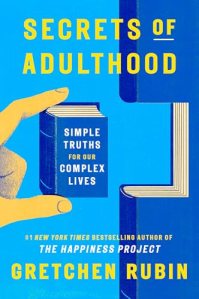 Rubin is one of the best self-help authors out there: Her books are practical, well-researched and genuinely helpful. She understands human nature and targets her strategies to suit different personality types. If you know her work, you’re likely aware of her fondness for aphorisms. “Sometimes, a single sentence can provide all the insight we need,” she believes. Here she collects her own pithy sayings relating to happiness, self-knowledge, relationships, work, creativity and decision-making. Some of the aphorisms were familiar to me through her previous books or her social media. They’re straightforward and sensible, distilling down to a few words truths we might be aware of but hadn’t truly absorbed. Like the great aphorists throughout history, Rubin relishes alliteration, repetition and contrasts. Some examples:
Accept yourself, and expect more from yourself.
I admire nature, and I am also nature. I resent traffic, and I am also traffic.
Work is the play of adulthood. If we’re not failing, we’re not trying hard enough.
Don’t wait until you have more free time. You may never have more free time.
This is not as meaty as her other work, and some parts feel redundant, but that’s the nature of the project. It would make a good bedside book for nibbles of inspiration. (Read via Edelweiss)
Which of these appeal to you?
February Releases by Hess, Kim, Sides (#ReadIndies); Atwood and Shah
I’m pleased to have, between this post and yesterday’s review catch-up, featured 9 books from 8 independent publishers for Read Indies this month. (I have also done some indie reading from my shelves, which I’ll summarize early in March.) Three of the books in my February review stacks were indie releases. I’ve got a hybrid memoir that blends poetic exploration of scripture with personal psychological reflections; an out-of-the-ordinary mystery about a father’s disappearance that comments on disability, racism and much more; and a terrific set of fabulist short stories. My two bonus (non-indie) February books are an unconvincing collaborative novel and a counselling-focussed bibliotherapy guide.

When Fragments Make a Whole: A Personal Journey through Healing Stories in the Bible by Lory Widmer Hess
 Some of you may know Lory, who is training as a spiritual director, from her blog, Enter Enchanted. It was so kind of her to get in touch offering her first book for review. It’s a unique combination of poetry, scriptural exegesis, and fragments of memoir. Each chapter considers a different healing story from the Gospels. As in the lectio divina I learned from college Christian fellowships, the idea with the verse retellings from the Bible is to imagine oneself into a character’s position and consider the crises that led to seeking Jesus’ help. I especially liked the poem “Talitha, Koum,” which links the stories of the woman with the issue of blood and the resurrection of Jairus’ daughter. In both, faith reverses a seemingly hopeless situation.
The short sections of commentary draw in a lot of context as well as etymology from the Greek. The autobiographical essays chart a history of physical and mental challenges, including dissociation, low self-esteem and shame, and offer openness to healing as its own miracle when there are no easy answers. They are notable for their vulnerability, especially when discussing marital problems. The outlook is intellectual and psychological rather than the spiritualizing I’m used to from my evangelical background – Lory comes from the anthroposophy tradition, which I don’t claim to fully understand but (I think) eschews dogma like original sin and atonement and instead makes the spiritual journey a matter of human reconnection with God through free will and the intellect. This is nicely balanced, though, by her work with developmentally disabled adults in residential homes in New England and Switzerland, which reminds her “there is a truth beyond intellectual knowledge, a language beyond words”. It is a calm, honest, methodical book that will intrigue anyone interested in thinking through how the Bible is applicable to the challenges of daily life.
With thanks to the author and Floris Books (Edinburgh) for the free copy for review.
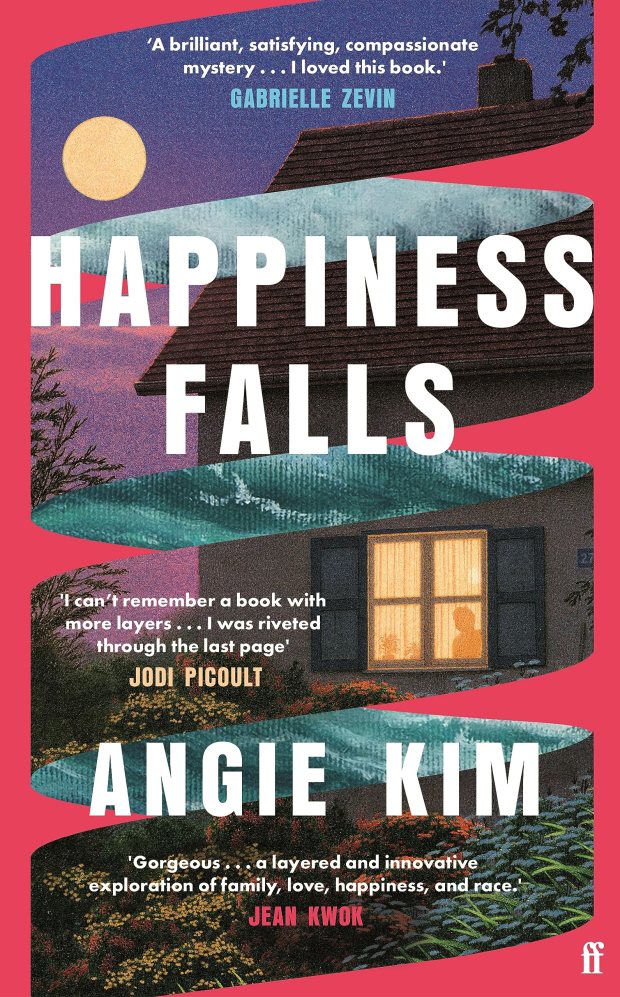
Happiness Falls by Angie Kim
Buzz from across the pond about Kim’s novels led me to request this even though I don’t typically read mysteries. The bulk is set over 2.5 days in June 2020 as the Korean American Parkson family investigates, on their own and with the help of police and various local tip-offs, what happened to the father, Adam, who’d been at River Falls Park with the severely disabled 14-year-old son, Eugene, who is autistic and has mosaic Angelman syndrome. Mother Hannah and 20-year-old twins Mia and John, home from college for the lockdown, quickly realise something is wrong when Eugene, who has blood on his shirt and under his nails, stumbles home on his own and Adam is unreachable by phone. There’s more to the setup than that, and many complicated side-tracks to the investigation, but the basic questions remain for 300+ pages: What happened to Adam? and What was Eugene’s part in it?
Mia narrates, and it’s a pleasure spending time with her quick, systematic brain as she runs through all the options and deals with each new theory and red herring. She clearly gets it from her father, whose recovered notebook is full of amateur experimentation on the “Happiness Quotient”. Her wit and garrulousness (sample aside: “I’m sorry, but I don’t care how much you love fun fonts—you cannot talk about prison rape in Comic Sans”) spills over into footnotes as if in effusive counterpoint to Eugene, who is nonspeaking.
The pandemic setting places interesting constraints on the official proceedings, and the prospect of a new communication method (involving painstaking spelling with a letter stencil) revolutionizes this family as they grasp that Eugene is far from nonverbal and has been ‘locked in’ all along. The account a therapist elicits from him seems to clinch the case, but uncertainty lingers.
This is like a blend of Celeste Ng’s Everything I Never Told You, Rebecca Makkai’s I Have Some Questions for You, and Naoki Higashida’s The Reason I Jump; if you’ve liked one or more of these, I would strongly recommend it. Mystery readers may lack patience for the digressions. The solution is eclipsed by the many issues – prejudice based on race and disability, how one’s circumstances affect contentment, nuances of communication, sibling relationships and twin ESP – explored along the way. Because I am not a crime reader, the pace was no problem for me. My annoyances were with the preponderance of hindsight (“I wish I’d said something,” “It didn’t occur to me until much later”) and the fact that Mia says “begs the question” for raising a question (misuse of a rhetorical term) several times. I found personal meaning in the book because of the Washington, DC-area locales and my severely disabled, nonverbal goddaughter. What if there really is something going on in her mind, and we could find out what it was… I mused. I’ll be keen to read Kim’s debut, Miracle Creek.
With thanks to Faber for the free copy for review.
Crocodile Tears Didn’t Cause the Flood by Bradley Sides
 These 17 flash fiction stories fully embrace the possibilities of magic and weirdness, particularly to help us reconnect with the dead. Brad and I are literary acquaintances from our time working on (the now defunct) Bookkaholic web magazine in 2014–15. I liked this even more than his first book, Those Fantastic Lives (2021), although the contours are very similar. Young people, animals and monsters abound – and sometimes the lines between those identities are unclear. There’s a lot of experimentation with form: a choose-your-own-adventure narrative, a police transcript, a two-truths-and-a-lie challenge, a story all in questions, an English exam, and a letter. A few of my favorite stories were “The Guide to King George,” about an amusement farm’s resident pond monster; “Claire & Hank,” in which a paleontologist’s unearthed Pteranodon becomes a sister to his motherless son; and “Dying at Allium Farm,” whose sassy undead owners think they’re fooling their Tennessee customers. And can you imagine a better title and cover combination?!
With thanks to Montag Press and publicist Lori Hettler for the e-copy for review.
And a couple of bonus February releases that are not from indie publishers:
Fourteen Days, ed. Margaret Atwood and Douglas Preston
This Authors Guild Foundation collaborative project is a Covid-era Decameron update in which the residents of an increasingly derelict New York City apartment complex meet on the rooftop every evening for two early lockdown weeks to clap for healthcare workers, indulge in adult beverages, and swap random stories. The tenants all go by nicknames like “Hello Kitty,” “Florida” and “Vinegar.” The frame narrative has the building superintendent (Yessie, a lesbian of Romanian heritage) worrying over her father’s wellbeing in a care home and surreptitiously recording the oral stories on her phone to later transcribe into the “bible” kept by the previous super. We’re told up front that the manuscript ends up in police custody.
 I had a misconception that each chapter would be written by a different author. I think that would actually have been the more interesting approach. Instead, each character is voiced by a different author, and sometimes by multiple authors across the 14 chapters (one per day) – a total of 36 authors took part. I soon wearied of the guess-who game. I most enjoyed the frame story, which was the work of Douglas Preston, a thriller author I don’t otherwise know.
There was a promising idea here, but problems with the execution. One is that, for the most part, the stories are pointless. The characters get hung up on whether they’re ‘true’ or not, but for readers it’s all made up and, while one or two individual tales might be amusing, they do nothing to build a plot and so I found myself mostly skipping over them to get back to the interactions on the roof and the super’s commentary. Another is that, to stand out from an ensemble cast, a voice needs to be really distinctive, and only “Eurovision” (flamboyantly gay) was that for me – based on my love for his rabbit story in particular, I should be reading Joseph Cassara. And finally, the book culminates with an annoying twist that made me cross.
With thanks to Chatto & Windus (Penguin) for the proof copy for review.
Bibliotherapy: The Healing Power of Reading by Bijal Shah
Bibliotherapy is one of my niche bookish interests (see my write-up of my bibliotherapy appointment with Ella Berthoud at the School of Life), so I was delighted to be offered a copy of another relevant book. Bijal Shah grew up in an East African Indian community before moving to the UK with her family as a teenager. When she was in training as a psychodynamic counsellor and attended therapy sessions herself, she realised how helpful literature was in helping her think through traumatic experiences from her past, such as sexism, colourism and a painful break-up. “I have lived half my life in the pages of books,” she observes, “relying on them to put my real life into perspective.” I feel the same way.

The emphasis is very much on therapy here, as Shah elaborates on practices such as literary journaling, recording audio notes, writing poetry, and focusing on gratitude. About half of the book is given over to anonymized sample case studies where she looks at the reasons why a client might come to her for bibliotherapy, the books and exercises she prescribed them, and the sorts of realizations people came to when reflecting on their own lives in relation to what they read. I suspect that the majority of readers, unless they have a vested interest in counselling, will, like me, most enjoy browsing the A–Z list of book prescriptions in the final 20% of the book (with more on Shah’s website). There is good variety to these in terms of author diversity, new vs. backlist reads, and both YA and adult fiction, though most of the recommendations are nonfiction, particularly psychology and self-help: these are much more literal (and, generally, obvious) prescriptions than Berthoud and Elderkin’s playful take.
With thanks to the author and Piatkus (Hachette) for the free copy for review.
Young Writer of the Year Award Shortlist: Larger than an Orange by Lucy Burns
Looking back, being on the 2017 shadow panel for the Sunday Times Young Writer of the Year Award was still one of the best things I’ve achieved in my time as a book blogger. Each year I eagerly look out for this award’s shortlist to see how many titles I’ve read and who I think the judges will choose as the winner. For a couple years the prize has had a higher cash fund thanks to sponsorship from the Charlotte Aitken Trust, and is now, like the McKitterick Prize that I’ve judged the past two years, administered by the Society of Authors.

This year’s four nominees include two novels and two nonfiction works: Oxblood by Tom Benn is said to be a “poignantly rendered exploration of domesticity and violence” and Maddie Mortimer’s Maps of our Spectacular Bodies, which won the Desmond Elliott Prize and was longlisted for the Booker Prize, is a “lyrical and captivating look at mortality, desire and forgiveness”; Lucy Burns’s debut memoir is an examination of abortion through the prism of her personal experience; and Katherine Rundell’s Super-Infinite (winner of the Baillie Gifford Prize for Non-Fiction) is a biography of John Donne.
I was intrigued by the premise (narration by a young woman – and her cancer) of the Mortimer when it was longlisted for the Booker so bought a sale copy with a Christmas voucher, but the style and over-400-page length has been defeating me. I might try again, but for a debut author’s experimental work I think 200 pages would have been sufficient. I’m not keen to try the Benn, but would gladly read the Rundell from the library another time. The final book is one I requested as a review copy.
Larger Than an Orange by Lucy Burns (2021)
I’ve only read one other memoir of an abortion (as opposed to a memoir in which an abortion is simply one event of many), Happening by Annie Ernaux, so it was perhaps inevitable for me to get similar vibes from the two works. Both are fragmentary, spare; matter of fact in tone to avoid melodramatic extremes of emotion. The difference, of course, is that in the 1960s abortion was illegal in France and so ending a pregnancy required clandestine action. However, even in 2017, when the then 26-year-old Burns had a medical abortion in England, where it had been legal for 50 years, she found that the process was invasive and officious. She presents the experience as infantilizing – not trusting the patient, and lacking in compassion. And although it was the only practical choice for her at the time and she remains firmly committed to women’s right to an abortion, it sparked feelings of guilt, shame and depression that lingered and affected her work and personal life. At counselling appointments she expressed disgust at herself, and she became obsessed with looking up American pro-life propaganda and testimonials from former abortion clinic workers online.
 The book is, collage-like, assembled from pieces – sometimes as little as one paragraph or one line to a page – of dated autobiographical material, going back and forth between the summer of the abortion and the few-year aftermath as she suffers with irregular bleeding, chooses a new contraceptive method and has a short-term relationship; transcripts of radio debates; alphabetical lists of predicted search terms and so on. She even requests her medical records, including sections from it plus ultrasound images, and marks her baby’s would-be birthday.
I could imagine this working very well as a play for voices, especially because Burns is in the habit of counting each person she tells about the abortion and referring to them by their number until, at fifty-something, she gives up. Friends, receptionists, the people at work who adjudicate her petition to be granted two weeks’ leave: there are those she tells willingly and those she feels duty-bound to inform to explain her health or behaviour. Some remain a part of her life and others, awkward or judgemental, fade out of it.
This is a powerful read I can’t say I necessarily enjoyed, but did admire for its uncompromising clarity and honesty, and its willingness to probe both sides of ethical issues in a way that ‘good feminists’ might think they cannot.
With thanks to FMcM Associates and Chatto & Windus for the free copy for review.
Tomorrow we’ll hear the Young Writer of the Year results. My feeling is that Katherine Rundell, though already a prize winner for this book and an established author due to her children’s oeuvre, will win for Super-Infinite.
Have you read anything from this year’s shortlist?
Review Book Catch-Up: Ante, Evans, Foster and White
Today I have a book of poems about the Filipinx experience in the UK, a collection of short stories reflecting on racial injustice, a monograph on a bird that spells summer for many of us, and a biographical investigation into a little-understood medical condition.
Antiemetic for Homesickness by Romalyn Ante
I was drawn to this debut collection by the terrific title and cover, but also by the accolades it received: it was on the Dylan Thomas Prize longlist and the Jhalak Prize shortlist. I hope we’ll see it on the Sunday Times Young Writer of the Year Award shortlist, too. Ante grew up in the Philippines but at age 16 joined her mother in the UK, where she had moved years before to work as a nurse in the NHS. She has since followed in her mother’s footsteps as a nurse – indeed, overseas Filipinx workers (Jamaicans, too) are a mainstay of the NHS.
 Ante remembers the years when her mother was absent but promised to send for the rest of the family soon: “You said all I needed to do was to sleep and before I knew it, / you’d be back. But I woke to the rice that needed rinsing, / my siblings’ school uniforms that needed ironing.” The medical profession as a family legacy and noble calling is a strong element of these poems, especially in “Invisible Women,” an ode to the “goddesses of caring and tending” who walk the halls of any hospital. Hard work is a matter of survival, and family – whether physically present or not – bolsters weary souls. A series of short, untitled poems are presented as tape recordings made for her mother.
Food is inextricably entwined with memory (reminding me of Nina Mingya Powles’s approach in Tiny Moons) and provides some of the standout metaphors, especially in “Patis” and “Ode to a Pot Noodle.” Ante uses a lot of alliteration and adapts various forms. I especially liked “Tagay!”, a traditional drinking song, and “Mateo,” printed in the shape of a pound sign. The nuanced look at the immigrant experience reminded me of Jenny Xie’s Eye Level. Movement entails losses as well as benefits. The focus on the Filipinx experience also made me think of America Is Not the Heart. My favourite single poem was “The Making of a Smuggler,” which opens “Wherever we travel, we carry / the whole country with us – // our rice terraces are folded garments, / we have pillars of trees, a rainforest // on a hairbrush.”
Favourite lines:
“Gone are the nights he steals / the moon with a mango picker / and swaps it for her pocket mirror”
“The yellow admission papers in my hands escaped / flustering at my face into a flight of orioles.”
“I am halved in order to be whole – / I rebuild by leaving / everything I love.”
With thanks to Chatto & Windus for the free copy for review.
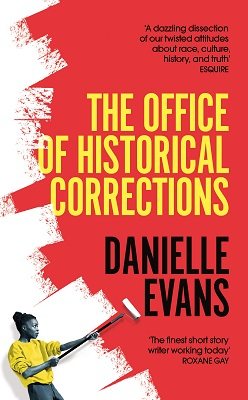
The Office of Historical Corrections by Danielle Evans
To boil these six stories and a novella down to the topic of race in America risks painting them as solemn or strident – more concerned with meaning than with art – when the truth is that they are playful and propulsive even though they keep cycling back to bereavement and injustice. Several of the protagonists are young Black women coming to terms with a loss.
 In “Happily Ever After,” Lyssa works in the gift shop of a Titanic replica and is cast as an extra in a pop star’s music video. Mythical sea monsters are contrasted with the real dangers of her life, like cancer and racism. “Anything Could Disappear” was a favourite of mine, though it begins with that unlikely scenario of a single woman acquiring a baby as if by magic. What starts off as a burden becomes a bond she can’t bear to let go. A family is determined to clear the name of their falsely imprisoned ancestor in “Alcatraz.” In “Richard of York Gave Battle in Vain” (a mnemonic for the colours of the rainbow), photojournalist Rena is wary about attending the wedding of a friend she met when their plane was detained in Africa some years ago. The only wedding she’s been in is her sister’s, which ended badly.
Mistakes and deceit seem to follow these characters. In the title novella that closes the book, Cassie and her colleagues combat fake news, going around putting correction labels on plaques that whitewash history. When she and her former colleague meet up in Wisconsin to find the truth behind a complex correction case, a clash with a white supremacist group quickly turns pedantry into a matter of life and death. The story I’d heard the most about beforehand was “Boys Go to Jupiter,” about a college girl who dons a Confederate flag bikini, not caring what message it sends to others in her dorm. It turns out she has history with a Black family, but has chosen to airbrush this experience out of her life.
There was only one story I didn’t care for, “Why Won’t Women Just Say What They Want,” about a celebrity who turns apologizing into performance art. Overall, this is a very strong collection I would recommend to readers of Brit Bennett and Raven Leilani, with some stories also reminding me of recent work by Curtis Sittenfeld and Mary South. I’ll be sure to seek out Evans’s previous book (also short stories), too.
With thanks to Picador for the proof copy for review.
The Screaming Sky by Charles Foster
The other week I was volunteering at our local community garden and looked up to see a dozen common swifts wheeling over the Kennet & Avon canal and picking off insects among the treetops. I hope this fellow Foster (for whom my husband was once confused on a nature conference attendee list) would be proud of me for pausing to gaze at the birds for a while. My impression of the author is as a misanthropic eccentric. A Renaissance man as well versed in law and theology as he is in natural history, he’s obsessed with swifts and ashamed of his own species: for looking down at their feet when they could be watching the skies; for the “pathological tidiness” that leaves swifts and so many other creatures no place to live.
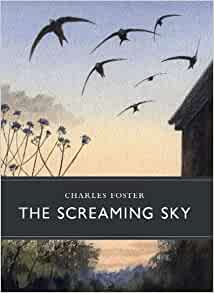 The obsession began when he was eight years old and someone brought him a dead swift fledgling for his taxidermy hobby. Ever since, he’s dated the summer by their arrival. “It is always summer for them,” though, as his opening line has it. This monograph is structured chronologically. Much like Tim Dee does in Greenery, Foster follows the birds for a year: from their winter territory in Africa to the edges of Europe in spring and then to his very own Oxford street in high summer. When they leave, he’s bereft and ready to book a flight back to Africa.
Along the way, Foster delivers heaps of information: the fossil evidence of swifts, how they know where to migrate (we have various theories but don’t really know), their nesting habits and lifespan, and the typical fates of those individuals that don’t survive. But, thumbing his nose at his “ex-friend” (a closed-minded biologist he repeatedly, and delightfully, rails against), he refuses to stick to a just-the-facts approach. Acknowledging the risks of anthropomorphizing, he speaks of swifts as symbols of aspiration, of life lived with intensity. He believes that we can understand animal emotions analogously through our own, so that, inappropriate as such words might seem, we can talk about what birds hope and plan for. He scorns reductive ecosystem services lingo that defines creatures by what we get out of them.
Also like Dee, Foster quotes frequently from poetry. His prose is full of sharp turns of phrase and moments of whimsy and made me eager to try more of his work (I know the most about but have not yet read Being a Beast).
Swifts know the roar of lions better than the roar of the M25, the piping of hornbills better than the Nunc Dimittis of parish Evensong … Are memories of our eaves spiralling high above the Gulf of Guinea? … They don’t seem to prevaricate. One moment they’re there, the next they’re off, diving straight into the journey. It’s the way we should run into cold water.
 As I’ve found with a number of Little Toller releases now (On Silbury Hill, Snow, Landfill), knowledge meets passion to create a book that could make an aficionado of the most casual of readers. Towards the close I was also reminded of Richard Smyth’s An Indifference of Birds: “When Homo sapiens has gone there will be lots of ideal swift holes in the decaying buildings we’ll leave behind.” It’s comforting to think of natural cycles continuing after we’re gone … but let’s start making the space for them now. Jonathan Pomroy’s black-and-white illustrations of swift behaviour only add to this short book’s charms.
With thanks to Little Toller Books for the free copy for review.
Waiting for Superman: One Family’s Struggle to Survive – and Cure – Chronic Fatigue Syndrome by Tracie White
Like Suzanne O’Sullivan’s books (most recently, The Sleeping Beauties), this is presented as an investigation into a medical mystery. White, a Stanford Medicine journalist, focuses on one family that has been indelibly changed by chronic fatigue syndrome – now linked with myalgic encephalomyelitis and termed ME/CFS for short. Whitney Dafoe was a world traveller and promising photographer before, in 2010, a diagnosis of ME/CFS explained his exhaustion and gastrointestinal problems. By the time White first met the family in 2016, the thirtysomething was bedbound in his parents’ home with a feeding tube, only able to communicate via gestures and rearranging Scrabble tiles. He couldn’t bear loud noises, or to be touched. At times he was nearly comatose.
 Whitney’s father, Ron Davis, is a Stanford geneticist whose research has contributed to the Human Genome Project. He has devoted himself to studying ME/CFS, which affects 20 million people worldwide yet receives little research funding; he calls it “the last major disease we know nothing about.” Testing his son’s blood, he found a problem with the citric acid cycle that produces ATP, essential fuel for the body’s cells – proof that there was a physiological reason for Whitney’s condition. Frustratingly, though, a Stanford colleague who examined Whitney prescribed a psychological intervention. This is in line with the current standard of care for ME/CFS: a graded exercise regime (nigh on impossible for someone who can’t get out of bed) and cognitive behavioural therapy.
White delves into Whitney’s past, looking for clues to what could have triggered his illness (having mono in high school? a parasite he picked up in India?). She also goes back to the mid-1980s to consider the Lake Tahoe outbreak of ME/CFS, whose victims “looked too healthy to be sick and were repeatedly disbelieved.” The media called it “yuppie flu,” downplaying the extreme fatigue involved. White also meets Laura Hillenbrand, author of Seabiscuit, who suffers from ME/CFS and managed to write her bestselling books from bed. Like Whitney, she only has a certain allotment of energy and mustn’t use it up too fast.
- A neat connection: Stephanie Land, author of Maid, was Whitney’s ex-girlfriend when he was 19 and living in Alaska; she wrote a Longreads article about their relationship.
- The title is from a Flaming Lips lyric and expresses Whitney’s trust in his dad’s ability to cure him; the U.S. title is The Puzzle Solver and the working title was The Invisible Patient.
With thanks to Atlantic Books for the free copy for review.
Would you be interested in reading one or more of these?
February Releases by de Visser, George, Lawson, and Smiley
Nonfiction about doctors’ memorable patients and a life of chronic pain and disability; novels set in 1970s Canada and contemporary (but magically outside-of-time) Paris.
That One Patient: Doctors’ and nurses’ stories of the patients who changed their lives forever by Ellen de Visser
[Translated from the Dutch by Brent Annable]
Ellen de Visser is a science writer for the most popular newspaper in the Netherlands, De Volkskrant. Her “That One Patient” column, which began in the summer of 2017, turns interviews with medical professionals into punchy first-person narratives. A collection of them was published in Dutch in 2019. This English translation tacks on 10 additional pieces based on conversations with English and American practitioners (including Dr. Anthony Fauci, immunologist and presidential medical advisor), four of them explicitly reflecting on COVID-19.
Many of the cases are decades old yet stuck with the doctor or nurse in question because of a vital lesson learned. Overtreatment is regretted just as much as an omission of care. Again and again, these medical professionals conclude that it’s impossible to judge someone else’s decisions or quality of life. For instance, a surgeon admits he had a hard time empathizing with his obese patients undergoing stomach reduction until he followed up with a young woman who told him about how invisible she’d felt before her surgery. Premature and disabled children bring grief or joy, not always in the expected doses. A doctor resents the work his team puts into repairing a woman who jumped from an eighth-floor window – why the heroic measures for someone who wanted to die? – until he learns she was pushed. A cancer surgeon develops breast cancer and now knows exactly what her patients go through.
 Some of these stories are disturbing: being stalked by a patient with a personality disorder, a man poisoning his girlfriend, a farmer predicting the very day and time of his death. A gynaecologist changes his mind about abortion after he meets a 15-year-old who gave birth at home and left her baby outside in a plastic bag to die of exposure. Other pieces are heart-warming: A paramedic delivers a premature, breech baby right in the ambulance. Staff throw a wedding at the hospital for a dying teen (as in Dear Life by Rachel Clarke). A woman diagnosed with cancer while pregnant has chemotherapy and a healthy baby – now a teenager. There’s even a tale from a vet who crowdfunded prostheses for a lively terrier.
One unique thing about the Netherlands is that euthanasia is legal and provided by doctors upon the express request of a patient suffering from a terminal illness. It is taken for granted in these essays, yet some interviewees express their discomfort with it as an option for young patients. De Visser is careful to note that, even with the situation as it is, only 4% of deaths in the Netherlands are by euthanasia, and the majority of these are end-stage cancer cases.
As with any collection of this nature, some stories are more enticing than others, but overall I found it a surprising and moving set of reflections that is alive to ethical complexities and grapples with tough issues like disability, doctor error, loneliness, pain, and sense of purpose.
Two quotes, in particular, stood out to me, one from a nurse – “We are only ever guests in other people’s lives, and that’s how we ought to behave” – and the other from Dr. Fauci’s piece. In 2014 he treated a doctor who had been volunteering in Sierra Leone after an Ebola outbreak but became ill with the virus and had to be evacuated. “He cited Hippocrates: ‘It is far more important to know what sort of person has the disease, rather than what sort of disease the person has.’ You treated me like a person, not a disease, he said. And that’s what medicine is all about.” 
With thanks to 4th Estate for the proof copy for review.
A Still Life: A Memoir by Josie George
 Over a year of lockdowns, many of us have become accustomed to spending most of the time at home. But for Josie George, social isolation is nothing new. Chronic illness long ago reduced her territory to her home and garden. The magic of A Still Life is in how she finds joy and purpose despite extreme limitations. Opening on New Year’s Day and travelling from one winter to the next, the book is a window onto George’s quiet existence as well as the turning of the seasons. (My full review will appear in a forthcoming issue of the Times Literary Supplement. See also Eleanor’s thorough review.) This is top of my wish list for next year’s Barbellion Prize shortlist.
With thanks to Bloomsbury for the proof copy for review.
A Town Called Solace by Mary Lawson
I discovered Mary Lawson in 2015 with Road Ends and caught up with Crow Lake in the summer of 2019. All four of her books are set in fictional locations inspired by the villages and rural areas of Northern Ontario, where the author grew up before moving to England in 1968. So Solace, while not a real town, is true to her memory and, despite the sometimes gruff or know-it-all locals, an emotional landmark for the three central characters, all of whom are processing trauma and looking for places of comfort where they can start over.
 1972. First we meet Clara, a plucky seven-year-old sitting vigil. She’s waiting for the return of two people: her sixteen-year-old sister, Rose, who ran away from home; and their next-door neighbour, Mrs. Orchard, whose cat, Moses, she’s feeding until the old lady gets back from the hospital. As days turn into weeks, though, it seems less likely that either will come home, and one day Clara sees a strange man moving boxes around in Mrs. Orchard’s house. This is Liam Kane, who’s inherited the house from a family friend. In his thirties and recently divorced, he’s taking a break in this tiny town, never imagining that he might find a new life. The third protagonist, and only first-person narrator, is Elizabeth, who lies in a hospital bed with heart trouble and voices her memories as a monologue to her late husband.
As we cycle through these three characters’ perspectives in alternating chapters, we gradually come to understand the connections between them. There are satisfying parallels in that, on multiple occasions but in slightly different ways, a child attaches to an older person or an adult stands in as a guardian for a neglected child. All of Lawson’s creations, even the secondary figures, are dealing with distressing memories or a loss of some kind, the details of which might only emerge much later on. Solace offers myriad opportunities for recovery, whether kitty playtime at Mrs. Orchard’s or diner food and homemade ice cream.
Like Lawson’s other works, this is a slow burner featuring troubled families. Her characters, often full of regret and sorrow, take a shadowy past as a prompt to reset their lives. They’re charming in spite of their flaws. I recalled that Crow Lake also looks back to the climactic happenings experienced by a seven-year-old girl. And like Road Ends, A Town Called Solace makes a convincing case for present decisions being influenced by historical trauma. It’s a tender and inviting story I’d recommend to readers of Wendy McGrath and Anne Tyler, with Clever Girl by Tessa Hadley and Olive, Again by Elizabeth Strout as specific readalikes. (My dilemma now is whether to read my only remaining Lawson novel, The Other Side of the Bridge, right away or save it: she’s not the most prolific author, with four books in 19 years.)
A favorite passage:
[Liam’s] life prior to coming north seemed to be taking on the quality of an old movie, one in which he’d been deeply engrossed while watching it but which now seemed trivial, unconvincing and profoundly lacking in either colour or plot. Solace had colour and plot in spades, maybe too much. In every way it was coming to seem more real than Toronto, with its endless malls and traffic jams and high-powered jobs. Though maybe, if he went back to Toronto, the same would be true in reverse. Maybe when he’d been back for a couple of months he’d find that it was Solace that seemed unreal, its unremarkable streets and stores like something from a dream, its dramatic landscape fading to nothing, like a holiday photo left in the sun.
With thanks to Chatto & Windus for the free copy for review.
The Strays of Paris by Jane Smiley
(Published in the USA in December 2020 under the title Perestroika in Paris. It’s been given a The Boy, the Mole, the Fox and the Horse treatment for its UK release.)
 My summary for Bookmarks magazine: “A racehorse, Perestroika—nicknamed Paras—strays from her unlocked suburban stable one day, carrying her groom’s purse in her mouth, and ends up in Paris’s Place du Trocadéro. Here she meets Frida the dog, Sid and Nancy the mallards, and Raoul the raven. Frida, whose homeless owner died, knows about money. She takes euros from the purse to buy food from a local market, while Paras gets treats from a baker on predawn walks. Etienne, an eight-year-old orphan who lives with his ancient great-grandmother, visits the snowy park to feed the wary animals (who can talk to each other), and offers Paras a home. A sweet fable for animal lovers.”
Yes, this is a talking animal book, but the animals only talk to each other; they communicate with humans through their gestures and soulful eyes. Kindly shopkeepers work out what Frida wants to buy based on what she stares at or points to with a paw; the baker whose window Paras passes on her early morning walks intuits that the horse is hungry; Etienne, who gives a couple of the stray animals a home during a chill winter, learns to understand when Paras needs to go out to relieve herself, after piles of dung build up in the sitting room.
I liked how patiently and convincingly Smiley builds the portrait of each character – human or animal – and the overall situation of kindness and good fortune. Raoul is particularly amusing for his birdsplaining: “It is a feature of age. I have learned so many things in my life that they just force their way out of my beak,” he says. However, a crow would be much more realistic for Paris (or any city) than a raven, and, overall, this was a little twee and farfetched for my tastes. It was nice to read something a bit different from Smiley, who I haven’t tried since her Last Hundred Years Trilogy. She has a sideline in YA horse novels; this should probably have been lumped with those.  (Annabel liked it a bit more.)
I was sent an unsolicited review copy by Picador/Mantle.
What recent releases can you recommend?
January’s Nonfiction Releases: Clarke, Heminsley and Lalkhen
Three new books with medical themes (no surprise there), including the first Covid wave in the UK; fertility and body issues in a new queer family; and pain management strategies.
Breathtaking: Inside the NHS in a Time of Pandemic by Rachel Clarke
 Clarke is a palliative care doctor based in Oxfordshire. She runs the Katharine House hospice but during the coronavirus pandemic has also been on active duty in the Oxford University Hospitals system. If you’re on social media you have likely come across some of her postings as she has been equally vocal in her praise of the NHS and her criticism of Boris Johnson’s faltering policies, which are often of the too little, too late variety. So I was eager to read her insider’s account of hospital treatment of the first wave of Covid in the UK, especially because her previous book, Dear Life, was one of my top two nonfiction releases of last year.
The focus is on the first four full months of 2020, and the book originated in Clarke’s insomniac diaries and notes made when, even after manically busy shifts, she couldn’t rest her thoughts. Her pilot husband was flying to China even as increasingly alarming reports started coming in from Wuhan. She weaves in the latest news from China and Italy as well as what she hears from colleagues and disease experts in London. But the priority is given to stories: of the first doctor to die in China; of a Yorkshire ICU nurse’s father, who comes down with Covid and is on a ventilator in an Oxford hospital; and of her patients there and in the hospice. She is touched that so many are making great sacrifices, such as by deciding not to visit loved ones at the end of their lives so as not to risk spreading infection.
A shortage of PPE remained a major issue, though Dominic Pimenta (whose Duty of Care was my first COVID-19 book) pulled through for her with an emergency shipment for the hospice – without which it would have had to close. Clarke marvels at the NHS’s ability to create an extra 33,000 beds within a month, but knows that this comes at a cost of other services, including cancer care, being stripped back or cancelled, meaning that many are not receiving the necessary treatment or are pushing inescapable problems further down the road.
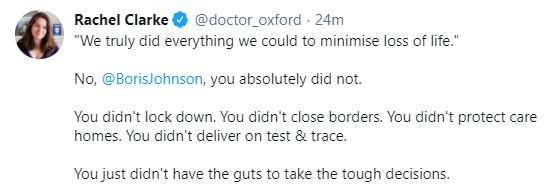
From January 26, 2021
A comparison with Gavin Francis’s Intensive Care, published earlier in the month, is inevitable. Both doctors bounce between headlines and everyday stories, government advice and the situation on the ground. Both had their own Covid scare – Clarke didn’t meet the criteria to be tested so simply went back to work two weeks later, when she felt well enough – and had connections to regions that foreshadowed what would soon happen in the UK. Both give a sense of the scope of the crisis and both lament that, just when patients need compassion most, full PPE leads to their doctors feeling more detached from them than ever.
However, within the same page count, Francis manages to convey more of the science behind the virus and its transmission, and helpfully explores the range of effects Covid is having for different groups. He also brings the story more up to the minute with a look back from November, whereas Clarke ends in April and follows up with an epilogue set in August. A book has to end somewhere, yes, but with this crisis ongoing, the later and more relevant its contents can be, the better. And in any book that involves a lot of death, mawkishness is a risk; Clarke so carefully avoided this in Dear Life, but sometimes succumbs here, with an insistence on how the pandemic has brought out the best in people (clapping and rainbows and all that). Her writing is as strong as ever, but I would have appreciated a sharper, more sombre look at the situation a few months later. Perhaps there will be a sequel.

From January 6, 2021
With thanks to Little, Brown UK for the free copy for review.
Some Body to Love: A Family Story by Alexandra Heminsley
 From Heminsley’s previous book, Leap In, I knew about her getting married and undergoing IVF. It was also a book about outdoor swimming; I appreciated her words on acquiring a new skill as an adult and overcoming body issues. This memoir continues the story: in 2017, after a gruelling journey through infertility treatment, Heminsley finally got the baby she wanted. But not before a couple more heart-wrenching moments: the lab made an error and notified her that she shared no DNA with this last embryo, and while heavily pregnant she was assaulted by a drunk man on a train. Both incidents left her feeling a loss of agency. “Why was I consistently being deemed the least reliable witness of my own reality?” she asks.
As they adjusted to new life with a baby, Heminsley started to notice that she wasn’t connecting with her husband, D, like she used to. She felt emotionally unsupported and, in fact, jealous of D’s relationship with their son, L. And while they’d never been the most conventional couple, D’s changes of appearance and wardrobe seemed like a sign of something bigger. Indeed, when L was six months old, D told Heminsley, “this body doesn’t represent who I am” and announced a decision to begin transitioning.
As D moved towards having a body that fit their identity, Heminsley, too, needed to get back in touch with her body. After books like Running Like a Girl, she was considered an exercise guru, but she didn’t see herself in the new obsession with Instagram-ready images of fitness perfection. This is not, then, primarily a memoir of queer family-making, because D’s transitioning was not Heminsley’s story to tell and mostly occurs in the background. Instead she focuses on what she does know and can control: her relationship to her own body.
However, this entails what can feel like irrelevant flashbacks to her teenage years of undergoing rehab at a military clinic in Germany for hypermobility, trips to Trinidad and Italy, and the genesis of her two sporting memoirs. Much as I applaud the sensitivity to trans and body issues, the book ends up feeling scattered. Still, the writing is so candid and the narrative so eventful that you’ll race through this even if you don’t normally pick up nonfiction. (For a bit more information, see my short write-up of the virtual book launch.)
With thanks to Chatto & Windus for the free copy for review.
Pain: The Science of the Feeling Brain by Abdul-Ghaaliq Lalkhen
 Originally from South Africa, Dr Lalkhen is an anaesthesiology and pain specialist based in Manchester. In a nutshell, his approach is “biopsychosocial,” meaning that he seeks to understand pain not just as a physical phenomenon resulting from acute injury or damage but as an ongoing process that is affected by emotional and psychological factors. Particularly in the context of chronic syndromes, he acknowledges that pain can continue even when its immediate cause has been repaired. Mental preparation can come into the equation: if a patient assumes they’ll wake up from surgery healed, they may be alarmed if pain persists. Lalkhen talks about managing patient expectations, perhaps with something as simple as the promise, “we’ll aim to get your pain down to a 4 after surgery.” In part, he blames Western society’s Cartesian philosophy for treating mind and body as separate rather than a system.
There are genetic and psychological reasons people might be predisposed to chronic pain. Pain itself can then change the brain chemistry, making the body more alert to pain signals. People can choose one of three paths, Lalkhen observes: “You can spend your time agitating about the alarm going off, you can try to ignore it (but the ignoring of it actually takes up more energy), or the final alternative is to learn to live with this deeply unpleasant situation.” Those who opt for pharmacological solutions can become addicted to opiates, which are less effective over time. Non-drug-related therapies involve the desensitization of nerves, the injection of anaesthetics or steroids, or the implanting of spinal cord stimulators. But all of these strategies have their limitations, and can diminish in efficacy. The patients he sees in his pain clinics may be disappointed that, rather than offering a panacea, he wants to wean them off their current pain relief and help them develop a new way of thinking about pain.
I felt I learned a lot from reading this. Lalkhen is careful to state that he is only referring to non-cancer pain (cancer pain in terminal patients will take all the morphine you can throw at it). Like many physicians, he worries about the modern epidemic of overtreatment and our obsession with wellness. I especially enjoyed the discussion of the understanding of pain and its treatment from the ancient world onward, and in particular the history of opiates. The prose is not literary, but this is an accessible and informational read if the subject matter draws you.
With thanks to Atlantic Books for the free copy for review.
What recent nonfiction releases can you recommend?
The Not the Wellcome Prize Blog Tour: Francesca Segal and Ian Williams
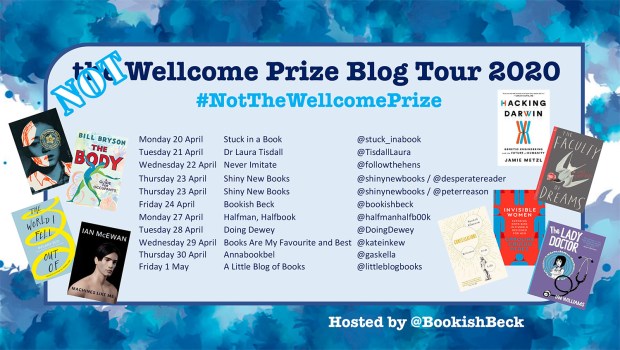
It’s my stop on the “Not the Wellcome Prize” blog tour. With two dozen reviews of health-themed 2019 books to choose from, I decided to nominate these two for the longlist because they’re under the radar compared to some other medical releases, plus they showcase the breadth of the books that the Prize recognizes: from a heartfelt memoir of a mother welcoming premature babies to a laugh-out-loud graphic novel about a doctor practicing in a small town in Wales. (The Prize website says “picture-led books are not eligible,” so in fact it is likely that graphic novels have never been considered, but we’ve been flexible with the rules for this unofficial blog tour.)
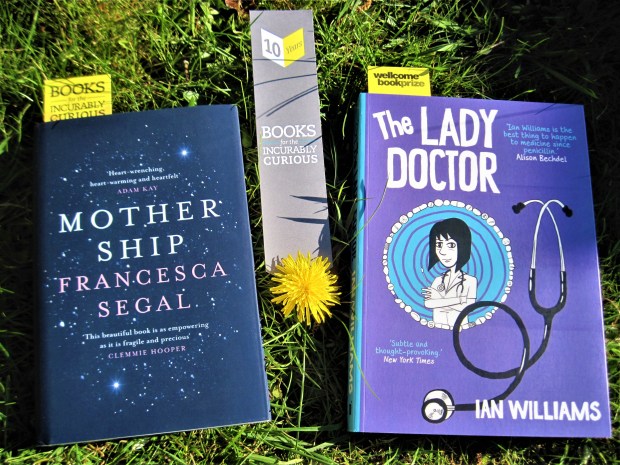
Mother Ship by Francesca Segal
 This first work of nonfiction from the author of the exquisite The Innocents is a visceral diary of the first eight weeks in the lives of her twin daughters, who were born by Caesarean section at 29 weeks in October 2015 and spent the next two months in the NICU, “an extremely well-funded prison or perhaps more accurately a high-tech zoo.” In Mother Ship, she strives to come to terms with this unnatural start to motherhood. “Taking my unready daughters from within me felt not like a birth but an evisceration,” she writes. “My children do not appear to require mothering. Instead they need sophisticated medical intervention.”
Segal describes with tender precision the feeling of being torn: between the second novel she’d been in the middle of writing and the all-consuming nature of early parenthood; and between her two girls (known for much of the book as “A-lette” and “B-lette”), who are at one point separated in different hospitals. Her attitude towards the NHS is pure gratitude.
As well as portraying her own state of mind, she crafts twinkly pen portraits of the others she encountered in the NICU, including the staff but especially her fellow preemie mums, who met in a “milking shed” where they pumped breast milk for the babies they were so afraid of losing that they resisted naming. (Though it was touch and go for a while, A-lette and B-lette finally earned the names Raffaella and Celeste and came home safely.) Female friendship is thus a subsidiary theme in this exploration of desperate love and helplessness.
The Lady Doctor by Ian Williams
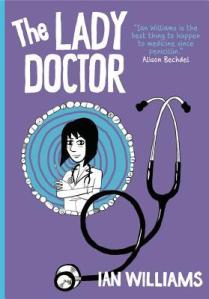 This sequel to 2014’s The Bad Doctor returns to a medical practice in small-town Wales. This time, though, the focus is on Iwan James’s colleague, Dr. Lois Pritchard, who also puts in two days a week treating embarrassing ailments at the local hospital’s genitourinary medicine clinic. At nearly 40, Lois is a divorcee with no children; just a dog. She enjoys her nights out drinking with her best friend, Geeta, but her carefree life is soon beset by various complications: she has to decide whether she wants to join the health centre as a full partner, a tryst with her new fella goes horribly wrong, and her estranged mother suddenly reappears in her life, hoping that Lois will give her a liver transplant. And that’s not to mention all the drug addicts and VD-ridden lotharios hanging about.
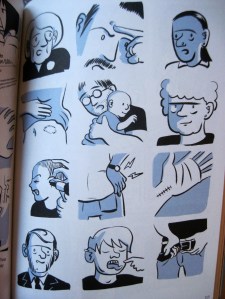 Williams was a GP in North Wales for 20 years, and no doubt his experiences have inspired his comics. His tone is wonderfully balanced: there are plenty of hilarious, somewhat raunchy scenes, but also touching moments where Lois learns that a doctor is never completely off duty and has no idea what medical or personal challenge will crop up next. The drawing style reminded me most of Alison Bechdel’s or Posy Simmonds’, with single shades from rose to olive alternating as the background. I especially loved the pages where each panel depicts a different patient to show the range of people and complaints a doctor might see in a day. Myriad Editions have a whole “Graphic Medicine” series that I’m keen to explore.
See below for details of the blogs where other reviews have appeared or will be appearing soon.
The shadow panel will choose a shortlist of six titles to be announced on 4 May. We will then vote to choose a winner, with the results of a Twitter poll serving as one additional vote. The Not the Wellcome Prize winner will be announced on 11 May.
Three Review Books: Brian Kimberling, Jessica Pan & Francesca Segal
Three May–June releases: A fish-out-of-water comic novel about teaching English in Prague; and memoirs about acting like an extrovert and giving birth to premature twins.
Goulash by Brian Kimberling
 “Look where we are. East meets West. Communism meets capitalism.” In 1998 Elliott Black leaves Indiana behind for a couple of years to teach English in Prague. The opening sequence, in which he discovers that his stolen shoes have been incorporated into an art installation, is an appropriate introduction to a country where bizarre things happen. Elliott doesn’t work for a traditional language school; his students are more likely to be people he meets in the pub or tobacco company executives. Their quirky, deadpan conversations are the highlight of the book.
Elliott starts dating a fellow teacher from England, Amanda (she “looked like azaleas in May and she spoke like the BBC World Service”), who also works as a translator. They live together in an apartment they call Graceland. Much of this short novel is about their low-key, slightly odd adventures, together and separately, while the epilogue sees Elliott looking back at their relationship from many years later.
I was tickled by a number of the turns of phrase, but didn’t feel particularly engaged with the plot, which was inspired by Kimberling’s own experiences living in Prague.
With thanks to Tinder Press for a proof copy to review.
Favorite passages:
“Sorrowful stories like airborne diseases made their way through the windows and under the doorframe, bubbled up like the bathtub drain. It was possible to fill Graceland with light and color and music and the smell of good food, and yet the flat was like a patient with some untreatable condition, and we got tired of palliative care.”
“‘It’s good to be out of Prague,’ he said. ‘Every inch drenched in blood and steeped in alchemy, with a whiff of Soviet body odor.’ ‘You should write for Lonely Planet,’ I said.”
Sorry I’m Late, I Didn’t Want to Come: An Introvert’s Year of Living Dangerously by Jessica Pan
 Like Jessica Pan, I’m a shy introvert (a “shintrovert”) as well as an American in the UK, so I was intrigued to see the strategies she employed and the experiences she sought out during a year of behaving like an extrovert. She forced herself to talk to strangers on the tube, give a talk at London’s Union Chapel as part of the Moth, use friendship apps to make new girlfriends, do stand-up comedy and improv, go to networking events, take a holiday to an unknown destination, eat magic mushrooms, and host a big Thanksgiving shindig.
Like Help Me!, which is a fairly similar year challenge book, it’s funny, conversational and compulsive reading that was perfect for me to be picking up and reading in chunks while I was traveling. Although I don’t think I’d copy any of Pan’s experiments – there’s definitely a cathartic element to reading this; if you’re also an introvert, you’ll feel nothing but relief that she’s done these things so you don’t have to – I can at least emulate her in initiating deeper conversations with friends and pushing myself to attend literary and networking events instead of just staying at home.
With thanks to Doubleday UK for a proof copy to review.
Mother Ship by Francesca Segal
I’m a big fan of Segal’s novels, especially The Innocents, one of the loveliest debut novels of the last decade, so I was delighted to hear she was coming out with a health-themed memoir about giving birth to premature twins. Mother Ship is a visceral diary of the first eight weeks in the lives of her daughters, who were born by Caesarean section at 29 weeks in October 2015 and spent the next two months in the NICU, “an extremely well-funded prison or perhaps more accurately a high-tech zoo.”
Segal strives to come to terms with this unnatural start to motherhood. “Taking my unready daughters from within me felt not like a birth but an evisceration,” she writes; “my children do not appear to require mothering. Instead they need sophisticated medical intervention.” She describes with tender precision the feeling of being torn: between the second novel she’d been in the middle of writing and the all-consuming nature of early parenthood; and between her two girls (known for much of the book as “A-lette” and “B-lette”), who are at one point separated in different hospitals.

Spotted at Philadelphia airport.
As well as portraying her own state of mind, Segal crafts twinkly pen portraits of the others she encountered in the NICU, including the staff but especially her fellow preemie mums, who met in a “milking shed” where they pumped breast milk for the babies they were so afraid of losing that they resisted naming. (Though it was touch and go for a while, A-lette and B-lette finally earned the names Raffaella and Celeste and came home safely.) Female friendship is a subsidiary theme in this exploration of desperate love and helplessness. The layman’s look at the inside workings of medicine would have made this one of my current few favorites for next year’s Wellcome Book Prize (which, alas, is on hiatus). After encountering some unpleasant negativity about the NHS in a recent read, I was relieved to find that Segal’s outlook is pure gratitude.
With thanks to Chatto & Windus for the free copy for review.
Would you be interested in reading one or more of these?
The Language of Kindness: A Nurse’s Story by Christie Watson
After all that Wellcome Book Prize reading, I’ve given myself a break from the medical reads, right? No way! I’m already eagerly looking out for hopefuls for next year’s prize – I’ve amassed quite a nice little pile – and this is a particularly strong candidate, based on the 20 years that Watson spent as a nurse in England’s health system before leaving to write full-time. (Her debut, Tiny Sunbirds Far Away, won the Costa First Novel Award in 2011; she followed it up with Where Women Are Kings in 2013.) It taps into the widespread feeling that medicine is in desperate need of a good dose of compassion, and will ring true for anyone who spends time in hospitals, whether as a patient or a carer.
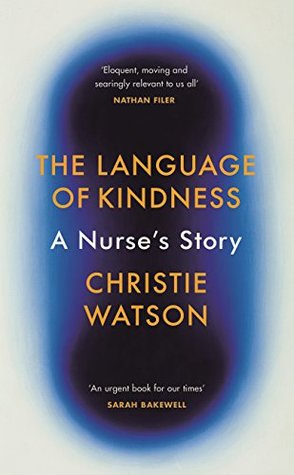 Watson presents her book as a roughly chronological tour through the stages of nursing – from pediatrics through to elderly care and the tending to dead bodies – but also through her own career, as she grows from a seventeen-year-old trainee who’s squeamish about blood to a broadly experienced nurse who can hardly be fazed by anything. The first chapter is set up like a tour of the hospital, describing everything she sees and hears as she makes her way up to her office, and the final chapter takes place on her very last day as a nurse, when, faced with a laboring mother in a taxi, she has to deliver the baby right there in the carpark.
In between we hear a series of vivid stories that veer between heartwarming and desperately sad. Watson sees children given a second shot at life. Aaron gets a heart–lung transplant to treat his cystic fibrosis and two-year-old Charlotte bounces back from sepsis – though with prosthetic limbs. But she also sees the ones who won’t get better: Tia, a little girl with a brain tumor; Mahesh, who has muscular dystrophy and relies on a breathing tube; and Jasmin, who is brought to the hospital after a house fire but doesn’t survive for long. She dies in the nurses’ arms as they’re washing the smoke smell out of her hair.
Although Watson specialized in children’s intensive care nursing, she trained in all branches of nursing, so we follow her into the delivery room, mental health ward, and operating theatre. As in Maggie O’Farrell’s I Am, I Am, I Am, we learn about her links to hospitals over the years, starting with her memories of being nursed as a child. She met her former partner, a consultant, at the hospital; they had a child together and adopted another before splitting 12 years later. And as her father was dying of lung cancer, she developed a new appreciation for what nurses do as she observed the dedicated care he received from his hospice nurse. She characterizes nursing as a career that requires great energy, skill and emotional intelligence, “that demands a chunk of your soul on a daily basis,” yet is all too often undervalued.

(The superior American cover.)
For me the weakest sections of Watson’s book are the snippets of history about hospitals and the development of the theory and philosophy of nursing. These insertions feel a little awkward and break up the flow of personal disclosure. The same applies to the occasional parenthetical phrase that seems to talk down to the reader, such as “women now receive medical help (IVF) to have their babies” and “obstetricians (doctors) run the show.” Footnotes or endnotes connected to a short glossary might have been a less obtrusive way of adding such explanatory information.
I would particularly recommend this memoir to readers of Kathryn Mannix’s With the End in Mind and Henry Marsh’s Admissions. But with its message of empathy for suffering and vulnerable humanity, it’s a book that anyone and everyone should read. I have it on good authority that there has recently been a copy on the desk of Jeremy Hunt, Health Secretary of the UK, which seems like an awfully good start.
A few favorite passages:
“I wanted to live many lives, to experience different ways of living. I didn’t know then that I would find exactly what I searched for: that both nursing and writing are about stepping into other shoes all the time.”
“What I thought nursing involved when I started: chemistry, biology, physics, pharmacology and anatomy. And what I now know to be the truth of nursing: philosophy, psychology, art, ethics and politics.”
“You get used to all sorts of smells, as a nurse. [An amazingly graphic passage!] But for all that I’ve seen and touched and smelled, and as difficult as it is at the time, there is a patient at the centre of it, afraid and embarrassed. … The horror of our bodies – our humanity, our flesh and blood – is something nurses must bear, lest the patient think too deeply, remember the lack of dignity that makes us all vulnerable. It is our vulnerability that unites us. Promoting dignity in the face of illness is one of the best gifts a nurse can give.”
My rating: 
The Language of Kindness was published in the UK on May 3rd by Chatto & Windus. My thanks to the publisher for the free review copy. It is released today, May 8th, by Doubleday Canada and Tim Duggan Books in the States.
 Bookish Beck = Rebecca Foster. American transplant to England. Freelance proofreader and book reviewer.
 Bookish Beck