October Books: Ballard, Czarnecki, Moss, Oliver, Ostriker, Steed & More
Apparently October is THE biggest month of the year for new releases. A sterling set came my way this year, including two beautiful novella-length memoirs, a luxuriantly illustrated work dedicated to an everyday bird species, two very different but equally elegant poetry collections, and a book of offbeat comics. Time and concentration only allow for a paragraph or so on each, but I hope that gives a flavour of the contents and will pique interest in the ones that suit you best. Plus I excerpt and link to my BookBrowse review of a poignant story of sisters and mental illness, and my Shelf Awareness review of a fantastic graphic novel adaptation.
Bound: A Memoir of Making and Remaking by Maddie Ballard
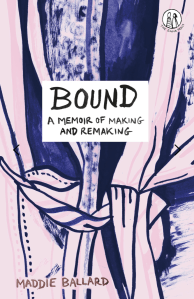 This collection of micro-essays considers sewing and much more. Each piece is headed by a pattern name and list of materials that Ballard made into an article of clothing for herself or for someone else. Among the minutiae of the craft, she slips in so many threads: about her mixed Chinese heritage and her relationship with her grandmother, about the environmental and financial benefits of making one’s own clothing, and especially about the upheaval of her twenties: the pandemic, a break-up, leaving a job to go back to school, finding roommates. I can barely mend a sock and I’m clueless when it comes to fashion, yet I can appreciate how sewing blends comfort and creativity. Ballard presents it as a meditative act of self-care:
I lower the needle and the world recedes. The process of sewing a garment – printing the pattern, tracing and cutting, sewing the first and the second and the fiftieth seam – is a lesson in taking your time.
Like gardening, sewing is an investment in the future – in what sort of person your future self will be, and how she will feel about her body, and what she will want to wear.
Similar to two other very short works of nonfiction I’ve read from The Emma Press, How Kyoto Breaks Your Heart by Florentyna Leow and Tiny Moons by Nina Mingya Powles (Ballard, too, is from New Zealand), this is a graceful, enriching book about a young woman making her way in the world and figuring out what is essential to her sense of home and identity. I commend it whether or not you have any particular interest in handicraft.
With thanks to The Emma Press for the free copy for review.
Encounters with Inscriptions: A Memoir Exploring Books Gifted by Parents by Kristin Czarnecki
When Kristin Czarnecki got in touch to offer a copy of her bibliomemoir about revisiting the books her late parents gifted her, I was instantly intrigued but couldn’t have known in advance how perfect it would be for me. Niche it might seem, but it combines several of my reading interests: bereavement, books about books, relationships with parents (especially a mother) and literary travels.
 The book starts, aptly, with childhood. A volume of Shel Silverstein poetry and A Child’s Christmas in Wales serve as perfect vehicles for the memories of how her parents passed on their love of literature and created family holiday rituals. Thereafter, the chapters are not strictly chronological but thematic. A work of women’s history opens up her mother’s involvement in the feminist movement; reading a Thomas Merton book reveals why his thinking was so important to her Catholic father. The interplay of literary criticism, cultural commentary and personal significance is especially effective in pieces on Alice Munro and Flannery O’Connor. A Virginia Woolf biography points to Czarnecki’s academic specialism and a cookbook to how food embodies memories.
It seems fitting to be reviewing this on the second anniversary of my mother’s death. The afterword, which follows on from the philosophical encouragement of a chapter on the Rubaiyat of Omar Khayyam, exhorts readers to cherish loved ones while we can – and be grateful for the tokens they leave behind. I had told Kristin about books my parents inscribed to me, as well as the journals I inherited from my mother. But I didn’t know there would be other specific connections between us, too, such as being childfree and hopeless in the kitchen. (Also, I have family in South Bend, Indiana, where she’s from, and our mothers were born in the first week of August.) All that to say, I felt that I found a kindred spirit in this lovely book, which is one of the nicest things that happens through reading.
With thanks to the author for the advanced e-copy for review.
The Starling: A Biography by Stephen Moss
 Moss has written a whole series of accessible bird species monographs suitable for nature buffs; this is the sixth. (I’ve not read the others, just Moss’s Wild Hares and Hummingbirds and Skylarks with Rosie, but we do have a copy of The Robin on the shelf that I’ve earmarked for Christmas.) The choice of the term ‘biography’ indicates the meeting of a comprehensive aim and intimate detail. The book conveys much anatomical and historical information about the starling’s relatives, habits, and worldwide spread, yet is only 187 pages – and plenty of those feature relevant paintings and photographs, too. It’s well known that starlings were introduced to Anglophone countries as part of misguided “acclimatisation” projects that we would now dub cultural imperialism. In the USA and elsewhere, the bird is still considered common. But with the industrialisation of agriculture, starlings are actually having less breeding success and thus are in decline.
Overall, the style of the book is dry and slightly workmanlike. However, when he’s recounting murmurations he’s seen in Somerset or read about, Moss’s enthusiasm lifts it into something special. Autumn dusk is a great time to start watching out for starling gatherings. I love observing and listening to the starlings just in the treetops and aerials of my neighbourhood, but we do also have a small local murmuration that I try to catch at least a few times in the season. Here’s how he describes their magic: “At a time when, both as a society and as individuals, we are less and less in touch with the natural world, attending this fleeting but memorable event is a way we can reconnect, regain our primal sense of wonder – and still be home in time for tea.”
With thanks to Square Peg, an imprint of Vintage (Penguin Random House) for the free copy for review.
The Alcestis Machine by Carolyn Oliver
 Carolyn is a blogger friend whose first collection, Inside the Storm I Want to Touch the Tremble, was on my Best Books of 2022 list. Her second is again characterized by precise vocabulary and crystalline imagery, often related to etymology, book history, or pigments (“You and I are marginalia shadowed / by a careless hand, we are gall-soaked vellum / invisible appetites consume.”). Astronomy and technology are a counterpoint, juxtaposing the ancient and the cutting-edge. I loved the language of sea creatures in “Strange Attractor” and the oblique approach to the passage of time (“Three popes ago, you and I”). The repeated three-word opening “In another life” gives a sense of many worlds, e.g., “In another life I’m a florist sometimes accused of inappropriate gravity.” Prose poems relay childhood memories. Love poems are tantalizing and utterly original: “If I promise not to describe the moon, will you / come with me a ways further into the night? / We’ll wash the forest floor / of ash and find a fairy ring / half-eaten, muted crescent bereft of power.” And alliteration never fails to win me over: “Tonight, snow tumbles over sophomores and starlings” and “the pillars in the water make a pillory not a pier”. Some of the collection remained cryptic for me; there was a bit less that grabbed me emotionally. But it’s still stirring work. And how flabbergasted was I to spot my name in the Acknowledgments? (Read via Edelweiss)
The Holy & Broken Bliss: Poems in Plague Time by Alicia Ostriker
“The words of an old woman shuffling the cards of her own decline the decline
of her husband the decline of her nation her plague-smitten world”
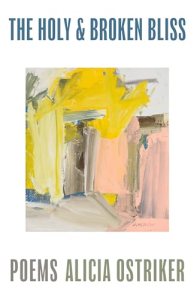 Out of pandemic isolation come new rituals: watching days and seasons pass, fighting for her own health but mostly her husband’s, and lamenting public displays of hate. Lines feel stark with honesty; some poems are just haiku length. Elsewhere, repetition and alliteration create a wistful tone. Jewish scripture and mysticism are the source of much of the language and outlook. Music and nature, too, promise the transcendent. Simple and remarkable. Here’s a stanza about late autumn:
It is almost winter and still
as I walk to the clinic the gingkos
sing their seraphic air
as if there is no tomorrow
With thanks to Alice James Books for the advanced e-copy for review.
Forces of Nature by Edward Steed
 Steed is a longtime New Yorker cartoonist who produces single panels. This means there is no story progression (as in a graphic novel), just what you see on one page. Some of the comics are wordless; many scenes are visual gags which, to be entirely honest, I didn’t always grasp. Steed’s recurring characters are unhappy couples, exiles on desert islands, and dumb cops or criminals. His style is deliberately simplistic: the people not much more advanced than stick figures and the animals especially sketchy. There are multiple attempted prison breaks and satirical depictions of God and the Garden of Eden. Many of the setups are contrived, and the tone can be absurd or prickly, even shading into gruesome. These comics weren’t altogether my cup of tea, though I did get a laugh out of a few of them (a seasonal example is below). Endorsed if you fancy a cross between Edward Gorey and The Book of Bunny Suicides.
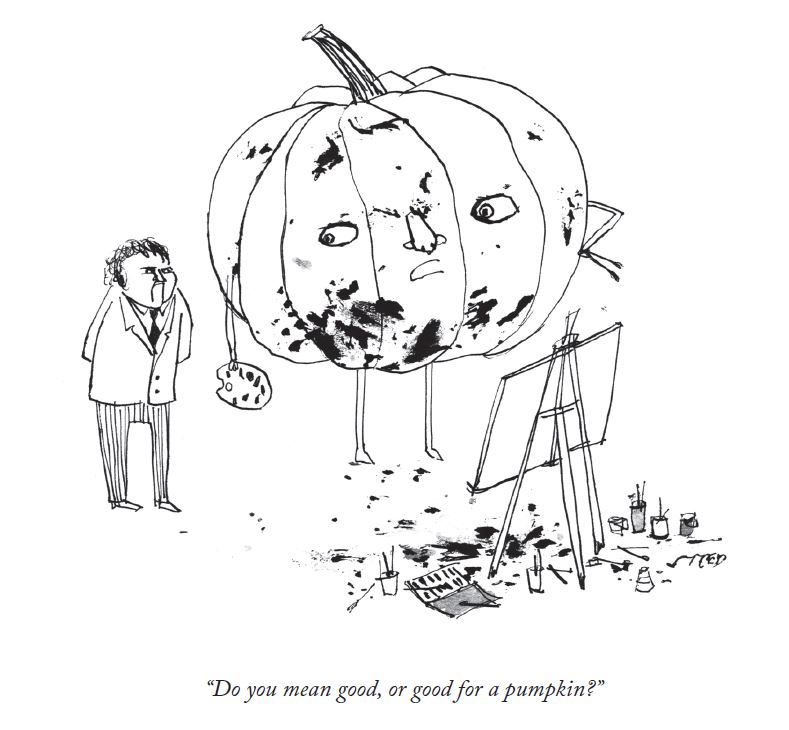
With thanks to Drawn & Quarterly for the e-copy for review.
Reviewed for BookBrowse:
 Shred Sisters by Betsy Lerner – “No one will love you more or hurt you more than a sister” is a wry aphorism that appears late in Lerner’s debut novel. Over the course of two decades, there is much heartache for the Shred family, but also moments of joy. Ultimately, a sisterly bond endures despite secrets, betrayals, and intermittent estrangement. Through her psychologically astute portrait of Olivia (“Ollie”) and Amy Shred, Lerner captures the lasting effects that mental illness can have on not just an individual, but an entire family.
Reviewed for Shelf Awareness:
 The Worst Journey in the World, Volume 1: Making Our Easting Down: The Graphic Novel by Sarah Airriess – The thrilling opening to a cinematically vivid adaptation of Apsley Cherry-Garrard’s 1922 memoir. He was an assistant zoologist on Robert Falcon Scott’s 1910-13 Terra Nova expedition to the South Pole. Even before the ship entered the pack ice, the journey was perilous. The book resembles a full-color storyboard for a Disney-style maritime adventure film. There is jolly camaraderie as the men sing sea shanties to boost morale. The second volume can’t arrive soon enough.
Summer Reading, Part II: Beanland, Watters; O’Farrell, Oseman Rereads
Apparently the UK summer officially extends to the 22nd – though you’d never believe it from the autumnal cold snap we’re having just now – so that’s my excuse for not posting about the rest of my summery reading until today. I have a tender ancestry-inspired story of a Jewish family’s response to grief, a bizarre YA fantasy comic, and two rereads, one a family story from one of my favourite contemporary authors and the other the middle instalment in a super-cute graphic novel series.
Florence Adler Swims Forever by Rachel Beanland (2020)
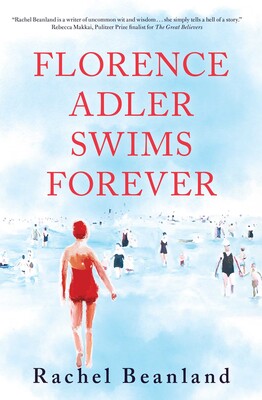 After reviewing Beanland’s second novel, The House Is on Fire, I wanted to catch up on her debut. Both are historical and give a broad but detailed view of a particular milieu and tragic event through the use of multiple POVs. It’s the summer of 1934 in Atlantic City, New Jersey. Florence, a plucky college student who intends to swim the English Channel, drowns on one of her practice swims. This happens in the first chapter (and is announced in the blurb), so the rest is aftermath. The Adlers make the unusual decision to keep Florence’s death from her sister, Fannie, who is on hospital bedrest during her third pregnancy because she lost a premature baby last year. Fannie’s seven-year-old daughter, Gussie, is sworn to silence about her aunt – with Stuart, the lifeguard who loved Florence, and Anna, a German refugee the Adlers have sponsored, turning it into a game for her by creating the top-secret “Florence Adler Swims Forever Society” with its own language.
The particulars can be chalked up to family history: this really happened; the Gussie character was Beanland’s grandmother, and the author believes her great-great-aunt Florence died of hypertrophic cardiomyopathy. It’s intriguing to get glimpses of Jewish ritual, U.S. anti-Semitism and early concern over Nazism, but I was less engaged with other subplots such as Fannie’s husband Isaac’s land speculation in Florida. There’s a satisfying queer soupcon, and Beanland capably inhabits all of the perspectives and the bereaved mindset. (Secondhand – Awesomebooks.com) 
Lumberjanes: Campfire Songs by Shannon Watters et al. (2020)
 This comics series created by a Boom! Studios editor ran from 2014 to 2020 and stretched to 75 issues that have been collected in 20+ volumes. Watters wanted to create a girl-centric comic and roped in various writers who together decided on the summer scout camp setting. I didn’t really know what I was getting into with this set of six stand-alone stories, each illustrated by a different artist. The characters are recognizably the same across the stories, but the variation in style meant I didn’t know what they’re “supposed” to look like. All are female or nonbinary, including queer and trans characters. I guess I expected queer coming-of-age stuff, but this is more about friendship and fantastical adventures. Other worlds are just a few steps away. They watch the Northern Lights with a pair of yeti, attend a dinner party cooked by a ghost chef, and play with green kittens and giant animate pumpkins. My favourite individual story was “A Midsummer Night’s Scheme,” in which Puck the fairy interferes with preparations for a masquerade ball. I won’t bother reading other installments. (Public library)
And the rereads:
Instructions for a Heatwave by Maggie O’Farrell (2013)
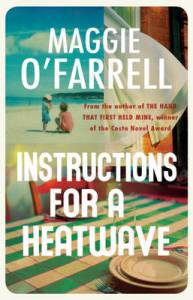 I read this when it first came out (original review here) and saw O’Farrell speak on it, in conversation with Julie Cohen, at a West Berkshire Libraries event – several years before I lived in the county. I expected it to be a little more atmospheric about the infamous UK drought of summer 1976. All I’d remembered otherwise was that one character is hiding illiteracy and another has an affair while leading a residential field trip. The novel opens, Harold Fry-like, with Robert Riordan disappearing from his suburban home. Gretta phones each of her adult children to express concern, but she’s so focussed on details like how she’ll get into the shed without Robert’s key that she fails to convey the gravity of the situation. Eventually the three descend on her from London, Gloucestershire and New York and travel to Ireland together to find him, but much of the novel is a patient filling-in of backstory: why Monica and Aoife are estranged, what went wrong in Michael Francis’s marriage, and so on.
I had forgotten the two major reveals, but this time they didn’t seem as important as the overall sense of decisions with unforeseen consequences. O’Farrell was using extreme weather as a metaphor for risk and cause-and-effect (“a heatwave will act upon people. It lays them bare, it wears down their guard. They start behaving not unusually but unguardedly”), and it mostly works. But this wasn’t a top-tier O’Farrell on a reread. (Little Free Library)
My original rating (2013): 
My rating now:
Average:
Heartstopper: Volume 3 by Alice Oseman (2020)
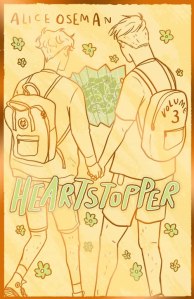 Heartstopper was my summer crush back in 2021, and I couldn’t resist rereading the series in the hardback reissue. That I started with the middle volume (original review here) is an accident of when my library holds arrived for me, but it turned out to be an apt read for the Olympics summer because it mostly takes place during a one-week school trip to Paris, full of tourism, ice cream, hijinks and romance. Nick and Charlie are dating but still not out to everyone in their circle. This is particularly true for Nick, who is a jock and passes as straight but is actually bisexual. Charlie experienced a lot of bullying at his boys’ school before his coming-out, so he’s nervous for Nick, and the psychological effects persist in his disordered eating. Oseman deals sensitively with mental health issues here, and has fun adding more queer stories into the background: Darcy and Tara, Tao and Elle (trans), and even the two male trip chaperones. It’s adorable how everything flirtation-related is so dramatic and the characters are always blushing and second-guessing. Lucky teens who get to read this at the right time. (Public library)
Any final “heat” or “summer” books for you this year?
The 2023 Releases I’ve Read So Far
Some reviewers and book bloggers are constantly reading three to six months ahead of what’s out on the shelves, but I tend to get behind on proof copies and read from the library instead. (Who am I kidding? I’m no influencer.)
In any case, I happen to have read a number of pre-release books, generally for paid review for Foreword, Shelf Awareness, etc. Most of my reviews haven’t been published yet; I’ll give very brief excerpts and ratings here to pique the interest.
Early in January I’ll follow up with my 20 Most Anticipated titles of the coming year.
My top recommendations so far:
(In alphabetical order)
 Shoot the Horses First by Leah Angstman [Feb. 28, Kernpunkt Press]: Sixteen sumptuous historical stories ranging from flash to novella length depict outsiders and pioneers who face disability and prejudice with poise.
 The House Is on Fire by Rachel Beanland [April 4, Simon & Schuster]: Four characters – two men and two women; two white people and two Black slaves – are caught up in the Richmond Theater Fire of 1811. Painstakingly researched and a propulsive read.
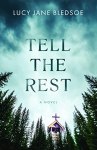 Tell the Rest by Lucy Jane Bledsoe [March 7, Akashic Books]: A high school girl’s basketball coach and a Black poet, both survivors of a conversion therapy camp in Oregon, return to the site of their spiritual abuse, looking for redemption.
 All of Us Together in the End by Matthew Vollmer [April 4, Hub City Press]: A pensive memoir investigates the blinking lights that appeared in his family’s woods soon after his mother’s death from complications of Alzheimer’s and Parkinson’s in 2019.
Other 2023 releases I’ve read:
(In publication date order; links to the few reviews that are already available online)
 Pusheen the Cat’s Guide to Everything by Claire Belton [Jan. 10, Gallery Books]: Good-natured and whimsical comic scenes delight in the endearing quirks of Pusheen, everyone’s favorite cartoon cat since Garfield. Belton creates a family and pals for her, too.
 Everything’s Changing by Chelsea Stickle [Jan. 13, Thirty West]: The 20 weird flash fiction stories in this chapbook are like prizes from a claw machine: you never know whether you’ll pluck a drunk raccoon or a red onion the perfect size to replace a broken heart.
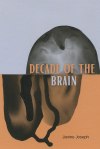 Decade of the Brain by Janine Joseph [Jan. 17, Alice James Books]: With formal variety and thematic intensity, this second collection by the Philippines-born poet ruminates on her protracted recovery from a traumatic car accident and her journey to U.S. citizenship.
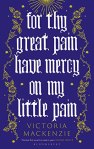 For Thy Great Pain Have Mercy on My Little Pain by Victoria Mackenzie [Jan. 19, Bloomsbury]: Two female medieval mystics, Julian of Norwich and Margery Kempe, are the twin protagonists of Mackenzie’s debut. She allows each to tell her life story through alternating first-person strands that only braid together very late on.
 The Faraway World by Patricia Engel [Jan. 24, Simon & Schuster]: These 10 short stories contrast dreams and reality. Money and religion are opposing pulls for Latinx characters as they ponder whether life will be better at home or elsewhere.
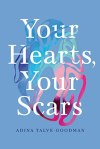 Your Hearts, Your Scars by Adina Talve-Goodman [Jan. 24, Bellevue Literary Press]: The author grew up a daughter of rabbis in St. Louis and had a heart transplant at age 19. This posthumous collection gathers seven poignant autobiographical essays about living joyfully and looking for love in spite of chronic illness.
 God’s Ex-Girlfriend: A Memoir About Loving and Leaving the Evangelical Jesus by Gloria Beth Amodeo [Feb. 21, Ig Publishing]: In a candid memoir, Amodeo traces how she was drawn into Evangelical Christianity in college before coming to see it as a “common American cult” involving unhealthy relationship dynamics and repressed sexuality.
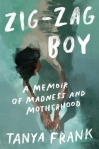 Zig-Zag Boy: A Memoir of Madness and Motherhood by Tanya Frank [Feb. 28, W. W. Norton]: A wrenching debut memoir ranges between California and England and draws in metaphors of the natural world as it recounts a decade-long search to help her mentally ill son.
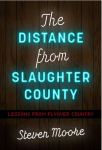 The Distance from Slaughter County by Steven Moore [March 7, The University of North Carolina Press]: An Iowan now based in Oregon, Moore balances nostalgia and critique to craft nuanced, hypnotic autobiographical essays about growing up in the Midwest. The piece on Shania Twain is a highlight.
Currently reading:
(In release date order)
 My What If Year: A Memoir by Alisha Fernandez Miranda [Feb. 7, Zibby Books]: “On the cusp of turning forty, Alisha Fernandez Miranda … decides to give herself a break, temporarily pausing her stressful career as the CEO of her own consulting firm … she leaves her home in London to spend one year exploring the dream jobs of her youth.”
 Sea Change by Gina Chung [April 11, Vintage]: “With her best friend pulling away to focus on her upcoming wedding, Ro’s only companion is Dolores, a giant Pacific octopus who also happens to be Ro’s last remaining link to her father, a marine biologist who disappeared while on an expedition when Ro was a teenager.”
Additional pre-release books on my shelf:
(In release date order)
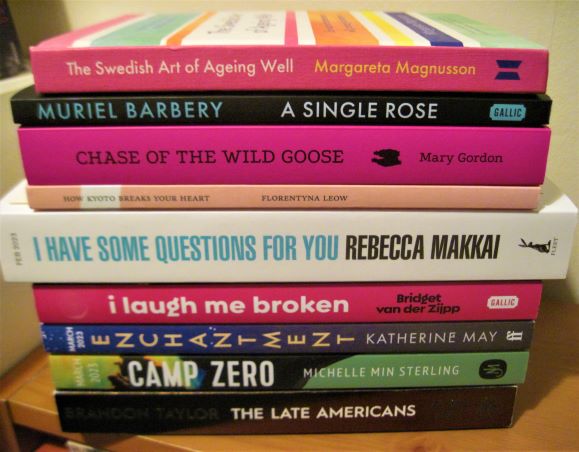
Will you look out for one or more of these?
Any 2023 reads you can recommend already?
Five Final Novellas: Adichie, Glück, Jhabvala, Victory for Ukraine, Woodson (#NovNov22)
We’ll wrap up Novellas in November and give some final statistics tomorrow. Today, I have mini reviews of another five novellas I read this month: one short nonfiction reread and then fiction ranging from India in the 1920s to short stories in comics about the war in Ukraine.
Notes on Grief by Chimamanda Ngozi Adichie (2021)
[85 pages]
 This came out in May last year – I pre-ordered it from Waterstones with points I’d saved up, because I’m that much of a fan – and it’s rare for me to reread something so soon, but of course it took on new significance for me this month. Like me, Adichie lived on a different continent from her family and so technology mediated her long-distance relationships. She saw her father on their weekly Sunday Zoom on June 7, 2020 and he appeared briefly on screen the next two days, seeming tired; on June 10, he was gone, her brother’s phone screen showing her his face: “my father looks asleep, his face relaxed, beautiful in repose.”
My experience of my mother’s death was similar: everything was sudden; my sister was the one there at the hospital, while all I could do was wait by the phone/laptop for news. So these details were particularly piercing, but the whole essay resonated with me as she navigates the early days of grief and remembers what she most admires about her father, including his piety, record-keeping and pride in her. (How lucky I am that Covid travel restrictions were no longer a factor; they delayed his memorial service.) My original review is here. Cathy also reviewed it. If you wish, you can read the New Yorker piece it arose from here.
Marigold and Rose: A Fiction by Louise Glück (2022)
[52 pages]
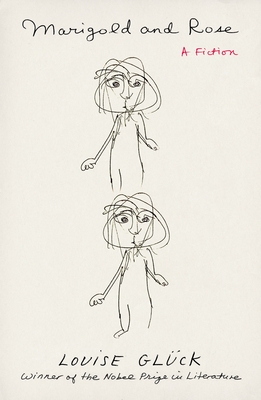 The first (and so far only) fiction by the poet and 2020 Nobel Prize winner, this is a curious little story that imagines the inner lives of infant twins and closes with their first birthday. Like Ian McEwan’s Nutshell, it ascribes to preverbal beings thoughts and wisdom they could not possibly have. Marigold, the would-be writer of the pair, is spiky and unpredictable, whereas Rose is the archetypal good baby.
Marigold did not like people. She liked Mother and Father; everyone else had not yet been properly inspected. Rose did like people and she intended them to like her. … Everyone understood that Marigold lived in her head and Rose lived in the world.
Now every day was like the days when the twins did not perform well at naptime. Then Mother and Father would begin to look tired and harassed. Mother explained that babies got tired too; often, they cried because they were tired. I don’t cry because I’m tired, Marigold thought. I cry because something has disappointed me.
As a psychological allegory, this tracks personality development and the growing awareness of Mother and Father as separate people with their own characteristics, some of which each girl replicates. But I failed to find much of a point. 
With thanks to Carcanet Press for the free e-copy for review.
Heat and Dust by Ruth Prawer Jhabvala (1975)
[181 pages]
 A lesser-known Booker Prize winner that we read for our book club’s women’s classics subgroup. My reading was interrupted by the last-minute trip back to the States, so I ended up finishing the last two-thirds after we’d had the discussion and also watched the movie. I found I was better able to engage with the subtle story and understated writing after I’d seen the sumptuous 1983 Merchant Ivory film: the characters jumped out for me much more than they initially had on the page, and it was no problem having Greta Scacchi in my head.
In 1923, Olivia is a bored young officer’s wife in India who becomes infatuated with the Nawab, an Indian prince involved in some dodgy dealings. In the novel’s present day, Olivia’s step-granddaughter (never named; in the film she’s called Anne, played by Julie Christie and changed to a great-niece for some reason) is also in India, enjoying the hippie freedom and rediscovering Olivia’s life through the letters she wrote to her sister. Both novel and film cut quickly and often between the two time periods to draw increasingly overt parallels between the women’s lives, culminating in unexpected pregnancies and difficult decisions to be made. I enjoyed the atmosphere (see also The Painted Veil and China Room) and would recommend the film, but I doubt I’ll seek out more by Jhabvala. (Public library) 
PEREMOHA: Victory for Ukraine (2022)
[96 pages]
 Various writers and artists contributed these graphic shorts, so there are likely to be some stories you enjoy more than others. “The Ghost of Kyiv” is about a mythical hero from the early days of the Russian invasion who shot down six enemy planes in a day. I got Andy Capp vibes from “Looters,” about Russian goons so dumb they don’t even recognize the appliances they haul back to their slum-dwelling families. (Look, this is propaganda. Whether it comes from the right side or not, recognize it for what it is.) In “Zmiinyi Island 13,” Ukrainian missiles destroy a Russian missile cruiser. Though hospitalized, the Ukrainian soldiers involved – including a woman – can rejoice in the win. “A pure heart is one that overcomes fear” is the lesson they quote from a legend. “Brave Little Tractor” is an adorable Thomas the Tank Engine-like story-within-a-story about farm machinery that joins the war effort. A bit too much of the superhero, shoot-’em-up stylings (including perfectly put-together females with pneumatic bosoms) for me here, but how could any graphic novel reader resist this Tokyopop compilation when a portion of proceeds go to RAZOM, a nonprofit Ukrainian-American human rights organization? (Read via Edelweiss)
Another Brooklyn by Jacqueline Woodson (2016)
[175 pages]
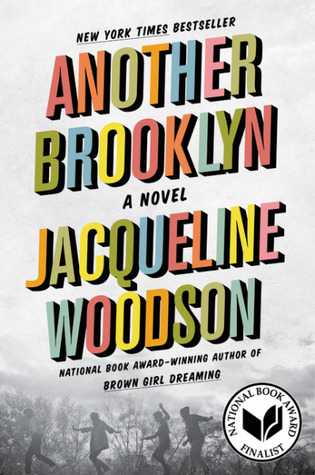 August looks back on her coming of age in 1970s Bushwick, Brooklyn. She lived with her father and brother in a shabby apartment, but friendship with Angela, Gigi and Sylvia lightened a gloomy existence: “as we stood half circle in the bright school yard, we saw the lost and beautiful and hungry in each of us. We saw home.” As in Very Cold People, though, this is not an untroubled girlhood. Male threat is everywhere, and if boyfriends bring sexual awakening they are also a constant goad to do more than girls are ready for. In short, flitting paragraphs, Woodson explores August’s past – a childhood in Tennessee, her uncle who died in the Vietnam War, her father’s growing involvement with the Nation of Islam. What struck me most, though, was August’s coming to terms with her mother’s death, a fact she doesn’t even acknowledge at first, and the anthropological asides about other cultures’ death rituals. This was my second from Woodson after the Women’s Prize-longlisted Red at the Bone, and I liked them about the same. A problem for me was that Brown Girls, which, with its New York City setting and focus on friendships between girls of colour, must have at least partially been inspired by Another Brooklyn, was better. (Public library)
In total, I read 17 novellas this November, though if you add in the ones I’d read in advance and then reviewed over the course of the month, I managed 24. All things considered, I think that’s a great showing. The 5-star stand-outs for me were The Hero of This Book and Body Kintsugi, but Up at the Villa was also a great read.
Fair Play by Tove Jansson (#NovNov22 Translated Week)
Apart from A Winter Book and The Summer Book, I’m still new to Tove Jansson’s writing for adults, having become most familiar with her Moomins series over the last 11 years. This is a late work, first published in 1989 but not available in English translation (by Thomas Teal; published by Sort Of Books, with an introduction by Ali Smith) until 2007.
 Rather like a linked short story collection, it presents vignettes from the lives of two female artists – Mari, a writer and illustrator; and Jonna, a visual artist and filmmaker – who are long-term, devoted partners. Of course, this cannot be read as other than autobiographical of Jansson and her partner of 45 years, Tuulikki Pietilä. There are other specific details drawn from life, too.
What the book does beautifully is recreate the rhythm of life lived alongside another person. The two women have studio space at either end of a large apartment building and meet to watch films (the subject of “Videomania”) and go on trips. Each other’s work is a background hum if no longer a daily keeping-to-task.
Not a lot happens, so not too much stood out; a couple of other favourite stories were “Wladyslaw,” about welcoming a Polish refugee friend, and “In the Great City of Phoenix,” about a stop at an Arizona hotel. The final piece, “The Letter,” however, does present an imminent change: one of the partners is invited on a foreign fellowship and love means a temporary letting go. (Public library)
[127 pages]
I also recently read a forthcoming artistic/biographical study of Tove Jansson for Shelf Awareness, to be released by Thames & Hudson on December 6th. As it is also novella-length, it’s a good link between our literature in translation week and next week’s nonfiction focus. Here’s an excerpt from my review:
Tove Jansson: The Illustrators by Paul Gravett
 This potted biography of the author best known for the Moomins showcases the development of her artistic style and literary themes. Born at the start of World War I into a family of artists (her father a sculptor, her mother a graphic designer, her brother Lars a collaborator on her comics), Jansson wanted to paint but had limited opportunities as a woman. The book contains a wealth of illustrations – over 100, so nearly one per page – including photographs and high-quality reproductions, many in color and some in black and white, of Jansson’s comics, paintings and book covers. Gravett also probes the autobiographical influences on Jansson’s work, which are particularly clear in her 15 books for adults. A sensitive portrayal of Finland’s most widely translated author, this is itself a work of art.
[112 pages]

September Releases by John Clegg & Tom Gauld (Lots More to Come!)
There aren’t enough hours in the day, or days left in this month, to write up all the terrific September releases I’ve read. The nonfiction fell into two broad thematic camps: books about books (Remainders of the Day by Shaun Bythell and Blurb Your Enthusiasm by Louise Willder still to come), or books about death (What Remains? by Rupert Callender, And Finally by Henry Marsh, and Sinkhole by Juliet Patterson still to come). However, I’ll start off with the two I happen to have written about so far, which are (the odd one out) poetry about science and watery travel, and bookish cartoons. Both:
Aliquot by John Clegg
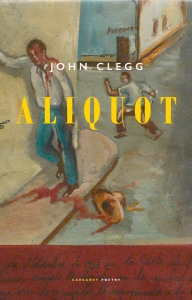 This is the second Carcanet collection by the London bookseller. An aliquot is a sample, a part that represents the whole; a scientific counterpart to synecdoche. It’s a perfect word for what poetry can do: point at larger truths through the pinpricks of meaning found in the everyday. The title poem juxtaposes two moments where the poet muses on the part/whole dichotomy: watching a catering school student and teacher transferring peas from one container to another and spotting two cellists on a tube train. Drawn in by detail, we observe the inevitable movement from separation to togetherness.
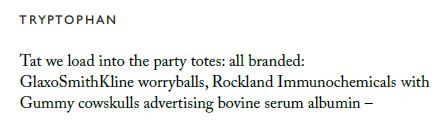
A high point is “A Gene Sequence,” about an administrator working behind the scenes at a genomics conference on a Cambridge campus: each poem is named after a different amino acid and the lines (sometimes with the help of extreme enjambment) always begin with the arrangement of A, C, G, and T that encodes them. Here’s an example:
Much of the imagery is maritime, with the occasional reference to a desert (“Language as Sonora”) or settlement (“Dormer Windows” and “Quebec City”). The locations include a science campus and a storm-threatened hotel (“Hurricane Joaquin,” one of my favourites). A proverb is described as being as potent as a raw onion. Here’s a lynx you’ll never see – but she will see you. Like in a Caroline Bird collection, there’s many an absurd or imagined situation. The vocabulary is unusual, sometimes lofty: “their cursory repertoire of query.” Alliteration teems, as in “The High Lama Explains How Items Are Procured for Shangri-La.” Overall, a noteworthy and unique collection that I’d recommend.
A favourite, apropos of nothing stanza from “Lucan – The Waterline”:
There is a kind of crab known to devour human flesh.
There is a shelf five storeys undersea
Where small yachts pile up like bric-a-brac.
There is a town in Maryland called Alibi.
With thanks to Carcanet for the advanced e-copy for review.
Revenge of the Librarians by Tom Gauld
You have probably seen Gauld’s cartoons in the Guardian, New Scientist or New Yorker. I’ve saved clippings of my favourite bookish ones over the years. They’re full of literary in-jokes and bibliophile problems, and divided about equally between a writer’s perspective and a reader’s: the struggle for inspiration and novelty on the one hand, and the battle with the TBR and the impulse to read what one feels one should versus what one enjoys on the other. He pokes holes in the pretensions on either side. Jane Austen features frequently.
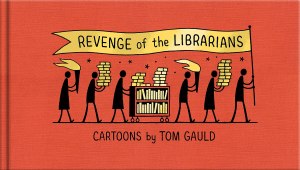
Gauld’s figures are usually blocky stick figures without complete facial features (or books or ghosts), and he often makes use of multiple choice and choose your own adventure structures. Elsewhere he plays around with book titles and typical plots, or stages mild-mannered arguments between authors and their editors or publicists, who generally have quite different notions of quality and marketability.
Lest you dismiss cartoons as being out of touch, the effect of the pandemic on bookshops, libraries and literary events is mentioned a few times. Librarians are depicted as old-time gangsters peddling books while their buildings are closed: “Overdue books are dealt with swiftly and mercilessly” it reads under a panel of a fedora-wearing, revolver-toting figure warning, “The boss says if you ain’t finished ‘The Mirror and the Light’ by tomorrow, it’s curtains!”
Some more favourite lines:
- “1903: Henry James writes a sentence so long and circuitous that he becomes lost inside it for three days.”
- (says one pigeon to another) “I’ve become a psychogeographer. It’s mainly walking around disapproving of gentrification.”
- “A horrible feeling crept over Elaine that perhaps the problems with her novel couldn’t be overcome by changing the font.”
Two spreads that are too good not to share in full (I feel seen!):
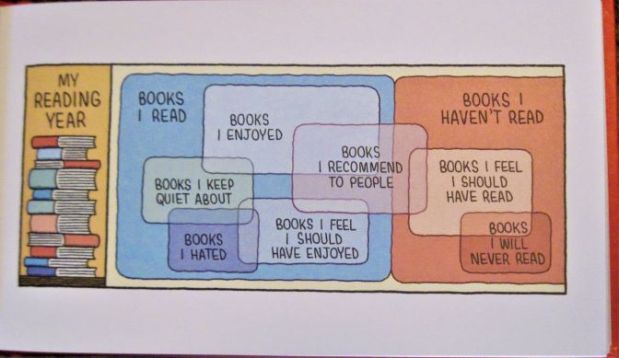

And would you look at this attention to detail on the inside cover!
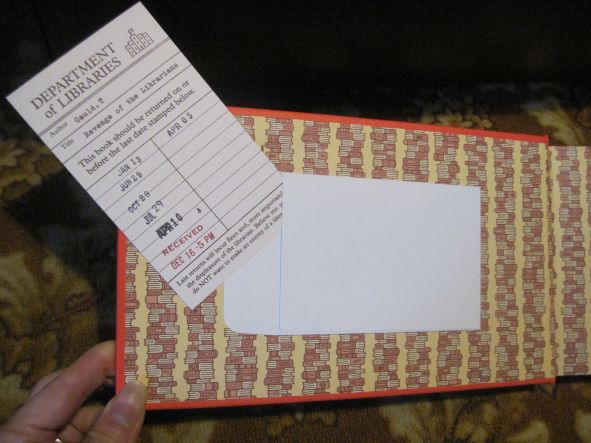
This is destined for many a book-lover’s Christmas stocking.
With thanks to Canongate for the free copy for review.
Tempted to read one of these?
What other September releases can you recommend?
Six Short Cat Books for #NovNov: Muriel Barbery, Garfield and More
Reviews of books about cats have been a regular element on my blog over the years, though not for quite a while. I happen to have amassed a number of illustrated novelty cat books recently, all of them under 150 pages, so Novellas in November is my excuse to feature them together. All six were enjoyable and a nice break from heavier reads on my stacks: .
The Writer’s Cats by Muriel Barbery; illus. Maria Guitart (2020; 2021)
[Translated from the French by Alison Anderson; 80 pages]
 I could have included this in a translated literature post, but decided to go by theme instead; I also considered reviewing it during nonfiction week as I thought it was a brief memoir. As it turns out, it’s a whimsical tale I’d be more likely to classify under fiction. Barbery has four Chartreux cats – two pairs of siblings: Ocha and Mizu, and Kirin and Petrus. Kirin, one of the younger pair, narrates the book, giving the cats’ view of the writer (and the musician she lives with). They diagnose her as being afflicted with restlessness, doubt and denial, and decide to learn to read so that they can act as literary advisors and comment on her work in progress. Naturally, they’d like to receive royalties for this service. “Yes, we are – in all modesty – decorative, protective deities watching over her rigid little aesthetic world”. Barbery is a Japanophile, so Guitart’s illustrations mix Japanese minimalism with Parisian chic and use as a palette the grey and orange colouring of the cats themselves. This was cute! (Also reviewed by Annabel and Davida.) A favourite illustration:
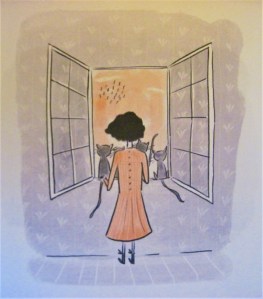
With thanks to Gallic Books for the free copy for review.
Four Garfield comics anthologies by Jim Davis:
Two’s Company (#5, 1984), We Love You Too (#10, 1985), Here We Go Again (#11, 1986), Flying High (#16, 1988)
[Each: 128 pages]


When these came into our temporary Little Free Library at the end of the summer I snapped them up, remembering happy times reading the syndicated comic in the Washington Post and watching the animated TV show on weekends growing up. I could even hear the actor who voices Garfield in my head on some lines.
In a sense, if you’ve read one of these volumes you’ve read them all, because the same sorts of set pieces repeat. Garfield’s gluttony and laziness know no bounds, so in between naps, he’ll snatch lasagnes and whatever other people food he can get. He’ll mock owner Jon, bait Odie the dog, ignore the mice in the house, terrorize Nermal the cute kitten, and flirt with Arlene. For the most part, the plots don’t leave the house, though in Two’s Company Jon and Garfield fly to Hawaii on vacation.
Garfield was the original grumpy cat, with smugness the only other emotion you’ll regularly see on his face. His ways will remind you of your own feline acquaintances (except he also drinks coffee and hates Mondays). The sense of humour is sarcasm par excellence. A favourite page from Flying High:

The Calculating Cat Returns by Nancy Prevo; illus. Eric Gurney (1978)
[138 pages]
 A tongue-in-cheek book mostly composed of black-and-white cartoons. The “calculating cat” is a bit like Terry Pratchett’s “real cat” from The Unadulterated Cat, but comes in a few varieties (or “CAT-egories,” as they’re called here): Pampered Cats, Working Cats, and Tramp cats. My cat was apparently the third type, living on the streets, for a short time, though you’d never know it to look at him now. During his 10th summer he tried working as a hunter, but quickly retired. He’s now solidly of the pampered class.
There are chapters here on playtime, eating habits, sleep, travel, and mating (not something many of us cat owners have to worry about these days). This remains reasonably undated because cats don’t change; it’s the human fashions that evolve and would look different in a book published today. (Free bookshop)
A favourite drawing:

Any cat (or dog) books among your recent reading?
Two Recommended January Releases: Dominicana and Let Me Be Frank
Much as I’d like to review books in advance of their release dates, that doesn’t seem to be how things are going this year. I hope readers will find it useful to learn about recent releases they might have missed.
This month I’m featuring a fictionalized immigration story from the Dominican Republic and a collection of autobiographical comics by a New Zealander.
Dominicana by Angie Cruz
(Published by John Murray on the 23rd)
It’s easy to assume that all the immigration (or Holocaust, or WWI; whatever) stories have been told. This is proof that that is not true; it felt completely fresh to me. Ana Canción is 11 when Juan Ruiz first proposes to her in 1961 – the same year dictator Rafael Trujillo is assassinated, throwing their native Dominican Republic into chaos. The Ruiz brothers are admired for their entrepreneurial spirit; they jet back and forth to New York City to earn money they plan to invest in a restaurant back home. To Ana’s parents, pairing their daughter with a man with such good prospects makes financial sense, so though Ana doesn’t love him and knows nothing about sex, she finds herself married to Juan at age 15. With fake papers that claim she’s 19, she arrives in New York on the first day of 1965 to start a new life.
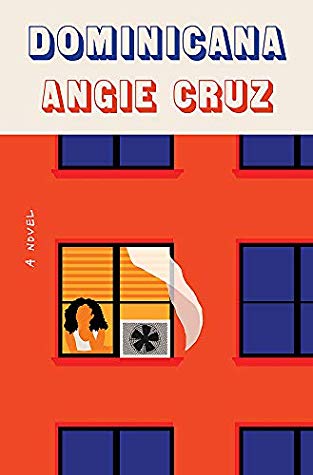 It is not the idyll she expected. Ana often feels confused and isolated in their tiny apartment, and the political unrest in NYC (e.g. the assassination of Malcolm X) and in DR mirrors the turbulence of her marriage. Juan is violent and unfaithful, and although Ana dreams of leaving him she soon learns that she is pregnant and has to think of her duty to her family, who expect to join her in America. The content of the novel could have felt like heavy going, but Ana is such a plucky and confiding narrator that you’re drawn into her world and cheer for her as she comes up with ways to earn money of her own (such as selling pastelitos to homesick factory workers and at the World’s Fair) and figures out what she wants from life.
This allowed me to imagine what it would be like to have an arranged marriage and arrive in a country not knowing a word of the language. Cruz based the story on her mother’s experience, even though her mother thought her life was too common and boring to interest anyone. The literary style – short chapters with no speech marks – could be offputting for some but worked for me, and I loved the tongue-in-cheek references to I Love Lucy. Had I only managed to read this in December, it would have been on my Best of 2019 list – it was first published in September by Flatiron Books, USA.
Let Me Be Frank by Sarah Laing
(Published by Lightning Books on the 16th)
 Laing is a novelist and comics artist from New Zealand known for her previous graphic memoir, Mansfield and Me, about her obsession with acclaimed NZ writer Katherine Mansfield. This collection brings together the autobiographical comics that originally appeared on Laing’s blog of the same title in 2010‒19. She started posting the comics when she was writer-in-residence at the Frank Sargeson Centre in Auckland. (I know the name Sargeson because he helped Janet Frame when she was early in her career.)
So what is the book about? All of life, really: growing up with type 1 diabetes, having boyfriends, being part of a family, the constant niggle of body issues, struggling as a writer, and trying to be a good mother. Other specific topics include her teenage obsession with music (especially Morrissey) and her run-ins with various animals (a surprising number of dead possums!). She ruminates about the times when she hasn’t done enough to help people who were in trouble. She also admits her confusion about fashion: she is always looking for, but never finding, ‘her look’. And is she modeling a proper female identity for her children? “I feel like I’m betraying feminism, buying my daughter a fairy princess dress,” she frets.


But even as she expresses these worries, she wonders how genuine she can be since they form the basis of her art. Is she just “publically performing my neuroses”? The work/life divide is especially tricksy when your life inspires your work.


I took half a month to read these comics on screen, usually just a few pages a day. It’s a tough book to assess as a whole because there is such a difference between the full-color segments and the sketch-like black-and-white ones. There is also a ‘warts-and-all’ approach here, with typos and cross-outs kept in. (Two that made me laugh were “aesophegus” [for oesophagus] and “Diana Anthill”!) Overall, though, I think this is a relatable and fun book that would suit fans of Alison Bechdel and Roz Chast but should also draw in readers new to the graphic novel format.
My thanks to Eye/Lightning Books for sending me an e-book to review.
What recent releases can you recommend?
11 Days, 11 Books: 2020’s Reads, from Best to Worst
I happen to have finished 11 books so far this year – though a number of them were started in 2019 (one as far back as September) and several of them are novelty books and/or of novella length. Just for kicks, I’ve arranged them from best to worst. Here’s how my reading year has started off…
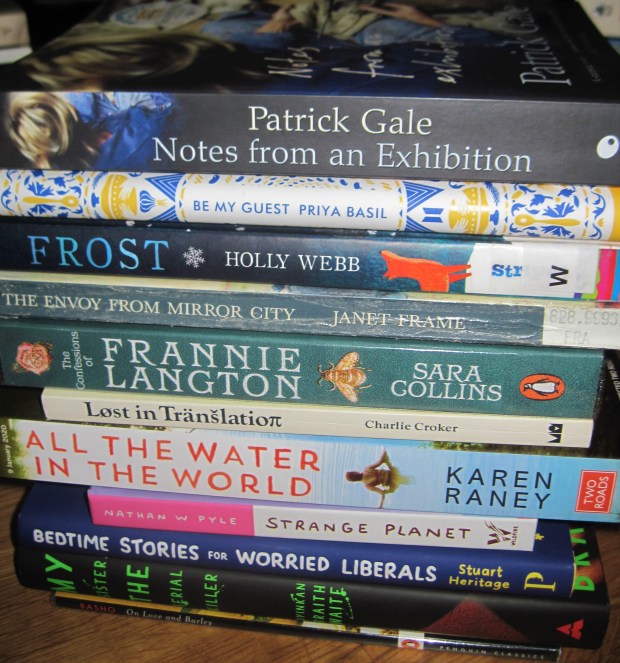
 Notes from an Exhibition by Patrick Gale – Nonlinear chapters give snapshots of the life of bipolar Cornwall artist Rachel Kelly and her interactions with her husband and four children, all of whom are desperate to earn her love. Quakerism, with its emphasis on silence and the inner light in everyone, sets up a calm and compassionate atmosphere, but also allows for family secrets to proliferate. There are two cameo appearances by an intimidating Dame Barbara Hepworth, and three wonderfully horrible scenes in which Rachel gives a child a birthday outing. The novel questions patterns of inheritance (e.g. of talent and mental illness) and whether happiness is possible in such a mixed-up family. (Our joint highest book club rating ever, with Red Dust Road. We all said we’d read more by Gale.)
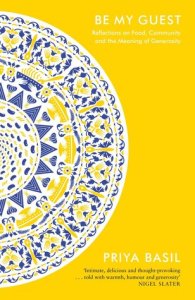 Be My Guest: Reflections on Food, Community and the Meaning of Generosity by Priya Basil – An extended essay whose overarching theme of hospitality stretches into many different topics. Part of an Indian family that has lived in Kenya and England, Basil is used to a culture of culinary abundance. Greed, especially for food, feels like her natural state, she acknowledges. However, living in Berlin has given her a greater awareness of the suffering of the Other – hundreds of thousands of refugees have entered the EU, often to be met with hostility. Yet the Sikhism she grew up in teaches unconditional kindness to strangers. She asks herself, and readers, how to cultivate the spirit of generosity. Clearly written and thought-provoking. (And typeset in Mrs Eaves, one of my favorite fonts.) See also Susan’s review, which convinced me to order a copy with my Christmas bookstore voucher.
 Frost by Holly Webb – Part of a winter animals series by a prolific children’s author, this combines historical fiction and fantasy in an utterly charming way. Cassie is a middle child who always feels left out of her big brother’s games, but befriending a fox cub who lives on scrubby ground near her London flat gives her a chance for adventures of her own. One winter night, Frost the fox leads Cassie down the road – and back in time to the Frost Fair of 1683 on the frozen Thames. I rarely read middle-grade fiction, but this was worth making an exception for. It’s probably intended for ages eight to 12, yet I enjoyed it at 36. My library copy smelled like strawberry lip gloss, which was somehow just right.
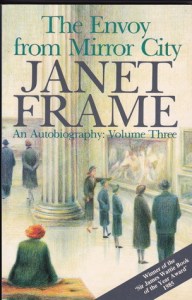 The Envoy from Mirror City by Janet Frame – This is the last and least enjoyable volume of Frame’s autobiography, but as a whole the trilogy is an impressive achievement. Never dwelling on unnecessary details, she conveys the essence of what it is to be (Book 1) a child, (2) a ‘mad’ person, and (3) a writer. After years in mental hospitals for presumed schizophrenia, Frame was awarded a travel fellowship to London and Ibiza. Her seven years away from New Zealand were a prolific period as, with the exception of breaks to go to films and galleries, and one obsessive relationship that nearly led to pregnancy out of wedlock, she did little else besides write. The title is her term for the imagination, which leads us to see Plato’s ideals of what might be.
 The Confessions of Frannie Langton by Sara Collins – Collins won the first novel category of the Costa Awards for this story of a black maid on trial in 1826 London for the murder of her employers, the Benhams. Margaret Atwood hit the nail on the head in a tweet describing the book as “Wide Sargasso Sea meets Beloved meets Alias Grace” (she’s such a legend she can get away with being self-referential). Back in Jamaica, Frances was a house slave and learned to read and write. This enabled her to assist Langton in recording his observations of Negro anatomy. Amateur medical experimentation and opium addiction were subplots that captivated me more than Frannie’s affair with Marguerite Benham and even the question of her guilt. However, time and place are conveyed convincingly, and the voice is strong.
(The next one is a book my husband received for Christmas, as are the Heritage and Pyle, further down, which were from me. Yes, I read them as well. What of it?)
 Lost in Translation by Charlie Croker – This has had us in tears of laughter. It lists examples of English being misused abroad, e.g. on signs, instructions and product marketing. China and Japan are the worst repeat offenders, but there are hilarious examples from around the world. Croker has divided the book into thematic chapters, so the weird translated phrases and downright gobbledygook are grouped around topics like food, hotels and medical advice. A lot of times you can see why mistakes came about, through the choice of almost-but-not-quite-right synonyms or literal interpretation of a saying, but sometimes the mind boggles. Two favorites: (in an Austrian hotel) “Not to perambulate the corridors in the hours of repose in the boots of ascension” and (on a menu in Macao) “Utmost of chicken fried in bother.”
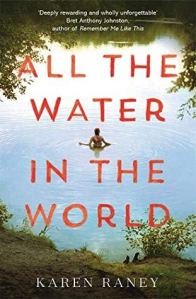 All the Water in the World by Karen Raney – Like The Fault in Our Stars (though not YA), this is about a teen with cancer. Sixteen-year-old Maddy is eager for everything life has to offer, so we see her having her first relationship – with Jack, her co-conspirator on an animation project to be used in an environmental protest – and contacting Antonio, the father she never met. Sections alternate narration between her and her mother, Eve. I loved the suburban D.C. setting and the e-mails between Maddy and Antonio. Maddy’s voice is sweet yet sharp, and, given that the main story is set in 2011, the environmentalism theme seems to anticipate last year’s flowering of youth participation. However, about halfway through there’s a ‘big reveal’ that fell flat for me because I’d guessed it from the beginning.
This was published on the 9th. My thanks to Two Roads for the proof copy for review.
 Strange Planet by Nathan W. Pyle – I love these simple cartoons about aliens and the sense they manage to make of Earth and its rituals. The humor mostly rests in their clinical synonyms for everyday objects and activities (parenting, exercise, emotions, birthdays, office life, etc.). Pyle definitely had fun with a thesaurus while putting these together. It’s also about gentle mockery of the things we think of as normal: consider them from one remove, and they can be awfully strange. My favorites are still about the cat. You can also see his work on Instagram.

 Bedtime Stories for Worried Liberals by Stuart Heritage – I bought this for my husband purely for the title, which couldn’t be more apt for him. The stories, a mix of adapted fairy tales and new setups, are mostly up-to-the-minute takes on US and UK politics, along with some digs at contemporary hipster culture and social media obsession. Heritage quite cleverly imitates the manner of speaking of both Boris Johnson and Donald Trump. By its nature, though, the book will only work for those who know the context (so I can’t see it succeeding outside the UK) and will have a short shelf life as the situations it mocks will eventually fade into collective memory. So, amusing but not built to last. I particularly liked “The Night Before Brexmas” and its all-too-recognizable picture of intergenerational strife.
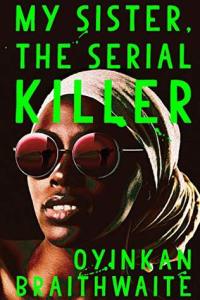 My Sister, the Serial Killer by Oyinkan Braithwaite – The Booker Prize longlist and the Women’s Prize shortlist? You must be kidding me! The plot is enjoyable enough: a Nigerian nurse named Korede finds herself complicit in covering up her gorgeous little sister Ayoola’s crimes – her boyfriends just seem to end up dead somehow; what a shame! – but things get complicated when Ayoola starts dating the doctor Korede has a crush on and the comatose patient to whom Korede had been pouring out her troubles wakes up. My issue was mostly with the jejune writing, which falls somewhere between high school literary magazine and television soap (e.g. “My hands are cold, so I rub them on my jeans” & “I have found that the best way to take your mind off something is to binge-watch TV shows”).
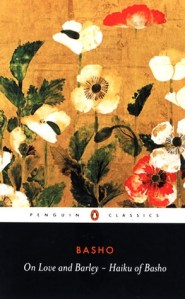 On Love and Barley – Haiku of Basho [trans. from the Japanese by Lucien Stryk] – These hardly work in translation. Almost every poem requires a contextual note on Japan’s geography, flora and fauna, or traditions; as these were collected at the end but there were no footnote symbols, I didn’t know to look for them, so by the time I read them it was too late. However, here are two that resonated, with messages about Zen Buddhism and depression, respectively: “Skylark on moor – / sweet song / of non-attachment.” (#83) and “Muddy sake, black rice – sick of the cherry / sick of the world.” (#221; reminds me of Samuel Johnson’s “tired of London, tired of life” maxim). My favorite, for personal relevance, was “Now cat’s done / mewing, bedroom’s / touched by moonlight.” (#24)
Any of these you have read or would read?
Onwards with the 2020 reading!
Novellas in November Wrap-Up and Mini-Reviews
Novellas in November is one of my favorite blogging challenges of the year. Earlier in the month I reviewed a first batch of five novellas. For this second and final installment I have 11 small books to feed back on: fiction, graphic novels, and miscellaneous nonfiction.

Classic of the Month
Giovanni’s Room by James Baldwin (1956)
[150 pages]
 This was my first taste of Baldwin’s fiction, and it was very good indeed. David, a penniless American, came to Paris to find himself. His second year there he meets Giovanni, an Italian barman. They fall in love and move in together. There’s a problem, though: David has a fiancée – Hella, who’s traveling in Spain. It seems that David had bisexual tendencies but went off women after Giovanni. “Much has been written of love turning to hatred, of the heart growing cold with the death of love.” We know from the first pages that David has fled to the south of France and Giovanni faces the guillotine in the morning, but all through Baldwin maintains the tension as we wait to hear why he is sentenced to death. Deeply sad, but also powerful and brave. I’ll make Go Tell It on the Mountain my next one by Baldwin.
Graphic Novels
 Garfield, Why Do You Hate Mondays? by Jim Davis (1982)
[128 pages]
This was like a trip back to childhood, as “Garfield” was always the first thing I would turn to in the Sunday comics section of the Washington Post. The story of the tubby, lasagna-stealing, dog-outsmarting ginger cat even managed to feel relevant to my life now, since our furball is on a perpetual diet – and it’s working, he’s actually lost most of a kilo this year! Most of the three-pane pages are stand-alones in which Garfield gets into scrapes or plays pranks. Fat jokes abound. There is actually a narrative in the latter half, though: Garfield stows away in Jon’s suitcase on a vacation to Hawaii and gets locked up in the local pound. He and a couple of other cats have to team up to escape. [To my amusement, two photos of a bust-up Nissan were being used as bookmarks in the copy that came into the free bookshop where I volunteer.]

Reading Quirks: Weird Things that Bookish Nerds Do! by The Wild Detectives (2019)
[96 pages]
 This is a collected comic strip that appeared on Instagram between 2016 and 2018 (you can view it in full here). The brainchild of bookstore/bar owners in Dallas, Texas, it highlights behaviors that many might find strange but that make total sense to a bibliophile: buying multiple copies of a book so that your less-careful partner doesn’t ruin yours or you don’t lose a friend when they fail to return a borrowed copy; being so glued to a book that you take it everywhere; buying a coat with an eye to whether the pockets accommodate a paperback; exulting at a broken leg for the extra reading time a temporary handicap could buy you; reading with a headtorch after a bedmate has gone to sleep; and so on. The simple four-pane comics usually contain just one or two colors. The captions add as much as the dialogue. Read this next if you enjoyed Book Love by Debbie Tung.

Other Fiction
Jonathan Livingston Seagull by Richard Bach (1972)
[93 pages]
 I was curious about this bestselling fable, but wish I’d left it to its 1970s oblivion. The title seagull stands out from the flock for his desire to fly higher and faster than seen before. He’s not content to be like all the rest; once he arrives in birdie heaven he starts teaching other gulls how to live out their perfect freedom. “We can lift ourselves out of ignorance, we can find ourselves as creatures of excellence and intelligence and skill.” Gradually comes the sinking realization that JLS is a Messiah figure. I repeat, the seagull is Jesus. (“They are saying in the Flock that if you are not the Son of the Great Gull Himself … then you are a thousand years ahead of your time.”) An obvious allegory, unlikely dialogue, dated metaphors (“like a streamlined feathered computer”), cringe-worthy New Age sentiments and loads of poor-quality soft-focus photographs: This was utterly atrocious.
Agatha by Anne Cathrine Bomann (2019)
[Trans. from the Danish by Caroline Waight; 147 pages]
 In late-1940s Paris, a psychiatrist counts down the days and appointments until his retirement. He’s so jaded that he barely listens to his patients anymore. “Was I just lazy, or was I genuinely so arrogant that I’d become bored by other people’s misery?” he asks himself. A few experiences awaken him from his apathy: learning that his longtime secretary’s husband has terminal cancer and visiting the man for some straight talk about death; discovering that the neighbor he’s never met, but only known via piano playing through the wall, is deaf, and striking up a friendship with him; and meeting Agatha, a new German patient with a history of self-harm, and vowing to get to the bottom of her trauma. This debut novel by a psychologist (and table tennis champion) is a touching, subtle and gently funny story of rediscovering one’s purpose late in life.
Agatha will be released on 12th December. With thanks to Sceptre for the proof copy for review.
The Dig by Cynan Jones (2014)
[156 pages]
 Daniel is a recently widowed farmer in rural Wales. On his own for the challenges of lambing, he hates who he’s become. “She would not have liked this anger in me. I was not an angry man.” In the meantime, a badger-baiter worries the police are getting wise to his nocturnal misdemeanors and looks for a new, remote locale to dig for badgers. I kept waiting for these two story lines to meet explosively, but instead they just fizzle out. I should have been prepared for the animal cruelty I’d encounter here, but it still bothered me. Even the descriptions of lambing, and of Daniel’s wife’s death, are brutal. Jones’s writing reminded me of Andrew Michael Hurley’s; while I did appreciate the observation that violence begets more violence in groups of men (“It was the gangness of it”), this was a tough read for me.
Nonfiction
Shelf Respect: A Book Lover’s Defence by Annie Austen (2019)
[183 pages, but with large type and not many words on a page]
 This seems destined to be in many a bibliophile’s Christmas stocking this year. It’s a collection of mini-essays, quotations and listicles on topics such as DNFing, merging your book collection with a new partner’s, famous bibliophiles and bookshelves from history, and how you choose to organize your library. It’s full of fun trivia. Two of my favorite factoids: Bill Clinton keeps track of his books via a computerized database, and the original title of Hemingway’s A Farewell to Arms was “I Have Committed Fornication but that Was in Another Country” (really?!). It’s scattered and shallow, but fun in the same way that Book Riot articles generally are. (I almost always click through to 2–5 articles in my Book Riot e-newsletters, so that’s no problem in my book.) I couldn’t find a single piece of information on ‘Annie Austen’, not even a photo – I sincerely doubt she’s that Kansas City lifestyle blogger, for instance – so I suspect she’s actually a collective of interns.

An illustration of Barack Obama’s summer 2016 reads.
With thanks to Sphere for the free copy for review.
Intoxicated by My Illness: And Other Writings on Life and Death by Anatole Broyard (1992)
[135 pages]
 This posthumous collection brings together essays Broyard wrote for the New York Times after being diagnosed with metastatic prostate cancer in 1989, journal entries, a piece he’d written after his father’s death from bladder cancer in 1954, and essays from the early 1980s about “the literature of death.” He writes to impose a narrative on his illness, expatiating on what he expects of his doctor and how he plans to live with style even as he’s dying. “If you have to die, and I hope you don’t, I think you should try to die the most beautiful death you can,” he charmingly suggests. It’s ironic that he laments a dearth of literature (apart from Susan Sontag) about illness and dying – if only he could have seen the flourishing of cancer memoirs in the last two decades! [An interesting footnote: in 2007 Broyard’s daughter Bliss published a memoir, One Drop: My Father’s Hidden Life—A Story of Race and Family Secrets, about finding out that her father was in fact black but had passed as white his whole life. I’ll be keen to read that.]
Sold for a Farthing by Clare Kipps (1953)
[72 pages]
 This was a random 50p find at the Hay-on-Wye market on our last trip. In July 1940 Kipps adopted a house sparrow that had fallen out of the nest – or, perhaps, been thrown out for having a deformed wing and foot. Clarence became her beloved pet, living for just over 12 years until dying of old age. A former professional musician, Kipps served as an air-raid warden during the war; she and Clarence had a couple of close shaves and had to evacuate London at one point. Clarence sang more beautifully than the average sparrow and could do a card trick and play dead. He loved to nestle inside Kipps’s blouse and join her for naps under the duvet. At age 11 he had a stroke, but vet attention (and champagne) kept him going for another year, though with less vitality. This is sweet but not saccharine, and holds interest for its window onto domesticated birds’ behavior. With photos, and a foreword by Julian Huxley.

A Year Lost and Found by Michael Mayne (1987)
[82 pages]
 Mayne was vicar at the university church in Cambridge when he came down with a mysterious, debilitating illness, only later diagnosed as myalgic encephalomyelitis or post-viral fatigue syndrome. During his illness he was offered the job of Dean of Westminster, and accepted the post even though he worried about his ability to carry out his duties. He writes of his frustration at not getting better and receiving no answers from doctors, but much of this short memoir is – unsurprisingly, I suppose – given over to theological musings on the nature of suffering, with lots of quotations (too many) from theologians and poets. Curiously, he also uses Broyard’s word, speaking of the “intoxication of convalescence.”
Ordinary Sacred: The Simple Beauty of Everyday Life by Kent Nerburn (2006)
[120 pages]
 The author has a PhD in religion and art and produced sculptures for a Benedictine abbey in British Columbia and the Peace Museum in Hiroshima. I worried this would be too New Agey for me, but at 20p from a closing-down charity shop, it was worth taking a chance on. Nerburn feels we are often too “busy with our daily obligations … to surround our hearts with the quiet that is necessary to hear life’s softer songs.” He tells pleasant stories of moments when he stopped to appreciate meaning and connection, like watching a man in a wheelchair fly a kite, setting aside his to-do list to have coffee with an ailing friend, and attending the funeral of a Native American man he once taught.
Total number of novellas read this month: 16 (compared to last year’s 26)
My overall favorite: Agatha by Anne Cathrine Bomann
Runners-up: Giovanni’s Room by James Baldwin, Intoxicated by My Illness by Anatole Broyard, and Hope in the Dark by Rebecca Solnit
 Bookish Beck = Rebecca Foster. American transplant to England. Freelance proofreader and book reviewer.
 Bookish Beck