Most Anticipated Books of 2026
Later than intended, but here we are. I’ve narrowed it down to the 25 books I’m most looking forward to in January–September, though no doubt I’ll have heard of many more unmissable titles before that time is up. My list is dominated by fiction, which I tend to find out about earlier. Also on my radar are novels by Sharon Bala, Freya Bromley, Mary Costello, Louise Kennedy, Ben Lerner, Paula McLain, Liz Nugent and Tom Perrotta; short stories by Jess Gibson (Margaret Atwood’s daughter); and nonfiction from Margaret Drabble, Cal Flyn, Siri Hustvedt and Anne Lamott.
In release date order, with UK publication info given first if available. The blurbs are adapted from Goodreads. I’ve taken the liberty of using whichever cover I prefer.
Fiction
 Departure(s) by Julian Barnes [20 Jan., Vintage (Penguin) / Knopf]: (Currently reading) I get more out of rereading Barnes’s classics than reading his latest stuff, but I’ll still attempt anything he publishes. He’s 80 and calls this his last book. So far, it’s heavily about memory. “Julian played matchmaker to Stephen and Jean, friends he met at university in the 1960s; as the third wheel, he was deeply invested in the success of their love”. Sounds way too similar to 1991’s Talking It Over, and the early pages have been tedious. (Review copy from publisher)
 Half His Age by Jennette McCurdy [20 Jan., Fourth Estate / Ballantine]: McCurdy’s memoir, I’m Glad My Mom Died, was stranger than fiction. I was so impressed by her recreation of her childhood perspective on her dysfunctional Mormon/hoarding/child-actor/cancer survivor family that I have no doubt she’ll do justice to this reverse-Lolita scenario about a 17-year-old who’s in love with her schlubby creative writing teacher. (Library copy on order)
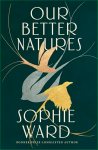 Our Better Natures by Sophie Ward [5 Feb., Corsair]: I loved Ward’s Booker-longlisted Love and Other Thought Experiments (though the follow-up, The Schoolhouse, was a letdown). “Amid the chaos and political upheaval of 1970s America, three very different women must accept the world as it is, or act to change it. Phyllis Patterson is a housewife in White Plains, Illinois. … Andrea Dworkin is an activist in Amsterdam. … Muriel Rukeyser is a poet in New York.” (Library copy on order)
 Brawler: Stories by Lauren Groff [Riverhead, Feb. 24]: (Currently reading) Controversial opinion: Short stories are where Groff really shines. Three-quarters in, this collection is just as impressive as Delicate Edible Birds or Florida. “Ranging from the 1950s to the present day and moving across age, class, and region (New England to Florida to California) these nine stories reflect and expand upon a shared the ceaseless battle between humans’ dark and light angels.” (For Shelf Awareness review) (Edelweiss download)
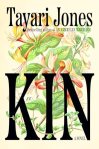 Kin by Tayari Jones [24 Feb., Oneworld / Knopf]: I’m a big fan of Leaving Atlanta and An American Marriage. This sounds like Brit Bennett meets Toni Morrison. “Vernice and Annie, two motherless daughters raised in Honeysuckle, Louisiana, have been best friends and neighbors since earliest childhood, but are fated to live starkly different lives. … A novel about mothers and daughters, about friendship and sisterhood, and the complexities of being a woman in the American South”. (Edelweiss download)
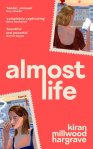 Almost Life by Kiran Millwood Hargrave [12 March, Picador / March 24, S&S/Summit Books]: There have often been queer undertones in Hargrave’s work, but this David Nicholls-esque plot sounds like her most overt. “Erica and Laure meet on the steps of the Sacré-Cœur in Paris, 1978. … The moment the two women meet the spark is undeniable. But their encounter turns into far more than a summer of love. It is the beginning of a relationship that will define their lives and every decision they have yet to make.” (Edelweiss download)
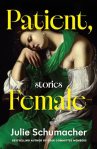 Patient, Female: Stories by Julie Schumacher [May 5, Milkweed Editions]: I found out about this via a webinar with Milkweed and a couple of other U.S. indie publishers. I loved Schumacher’s Dear Committee Members. “[T]his irreverent collection … balances sorrow against laughter. … Each protagonist—ranging from girlhood to senescence—receives her own indelible voice as she navigates social blunders, generational misunderstandings, and the absurdity of the human experience.” The publicist likened the tone to Meg Wolitzer.
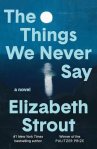 The Things We Never Say by Elizabeth Strout [7 May, Viking (Penguin) / May 5, Random House]: Hurrah for moving on from Lucy Barton at last! “Artie Dam is living a double life. He spends his days teaching history to eleventh graders … and, on weekends, takes his sailboat out on the beautiful Massachusetts Bay. … [O]ne day, Artie learns that life has been keeping a secret from him, one that threatens to upend his entire world. … [This] takes one man’s fears and loneliness and makes them universal.”
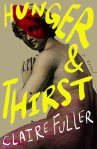 Hunger and Thirst by Claire Fuller [7 May, Penguin / June 2, Tin House]: I’ve read everything of Fuller’s and hope this will reverse the worsening trend of her novels, though true crime is overdone. “1987: After a childhood trauma and years in and out of the care system, sixteen-year-old Ursula … is invited to join a squat at The Underwood. … Thirty-six years later, Ursula is a renowned, reclusive sculptor living under a pseudonym in London when her identity is exposed by true-crime documentary-maker.” (Edelweiss download)
 Little Vanities by Sarah Gilmartin [21 May, ONE (Pushkin)]: Gilmartin’s Service was great. “Dylan, Stevie and Ben have been inseparable since their days at Trinity, when everything seemed possible. … Two decades on, … Dylan, once a rugby star, is stranded on the sofa, cared for by his wife Rachel. Across town, Stevie and Ben’s relationship has settled into weary routine. Then, after countless auditions, Ben lands a role in Pinter’s Betrayal. As rehearsals unfold, the play’s shifting allegiances seep into reality, reviving old jealousies and awakening sudden longings.”
 Said the Dead by Doireann Ní Ghríofa [21 May, Faber / Sept. 22, Farrar, Straus and Giroux]: A Ghost in the Throat was brilliant and this sounds right up my street. “In the city of Cork, a derelict Victorian mental hospital is being converted into modern apartments. One passerby has always flinched as she passes the place. Had her birth occurred in another decade, she too might have lived within those walls. Now, … she finds herself drawn into an irresistible river of forgotten voices”.
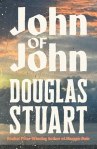 John of John by Douglas Stuart [21 May, Picador / May 5, Grove Press]: I DNFed Shuggie Bain and haven’t tried Stuart since, but the Outer Hebrides setting piqued my attention. “[W]ith little to show for his art school education, John-Calum Macleod takes the ferry back home to the island of Harris [and] begrudgingly resumes his old life, stuck between the two poles of his childhood: his father John, a sheep farmer, tweed weaver, and pillar of their local Presbyterian church, and his maternal grandmother Ella, a profanity-loving Glaswegian”. (For early Shelf Awareness review) (Edelweiss download)
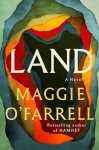 Land by Maggie O’Farrell [2 June, Tinder Press / Knopf]: I haven’t fully loved O’Farrell’s shift into historical fiction, but I’m still willing to give this a go. “On a windswept peninsula stretching out into the Atlantic, Tomás and his reluctant son, Liam [age 10], are working for the great Ordnance Survey project to map the whole of Ireland. The year is 1865, and in a country not long since ravaged and emptied by the Great Hunger, the task is not an easy one.” (Edelweiss download)
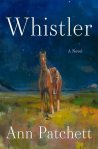 Whistler by Ann Patchett [2 June, Bloomsbury / Harper]: Patchett is hella reliable. “When Daphne Fuller and her husband Jonathan visit the Metropolitan Museum of Art, they notice an older, white-haired gentleman following them. The man turns out to be Eddie Triplett, her former stepfather, who had been married to her mother for a little more than year when Daphne was nine. … Meeting again, time falls away; … [in a story of] adults looking back over the choices they made, and the choices that were made for them.” (Edelweiss download)
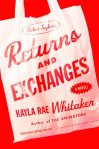 Returns and Exchanges by Kayla Rae Whitaker [2 June, Scribe / May 19, Random House]: Whitaker’s The Animators is one of my favourite novels that hardly anyone else has ever heard of. “A sweeping novel of one [discount department store-owning] Kentucky family’s rise and fall throughout the 1980s—a tragicomic tour de force about love and marriage, parents and [their four] children, and the perils of mixing family with business”. (Edelweiss download)
 The Great Wherever by Shannon Sanders [9 July, Viking (Penguin) / July 7, Henry Holt]: Sanders’s linked story collection Company left me keen to follow her career. Aubrey Lamb, 32, is “grieving the recent loss of her father and the end of a relationship.” She leaves Washington, DC for her Black family’s ancestral Tennessee farm. “But the land proves to be a burdensome inheritance … [and] the ghosts of her ancestors interject with their own exasperated, gossipy commentary on the flaws and foibles of relatives living and dead”. (Edelweiss download)
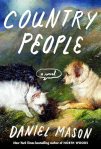 Country People by Daniel Mason [14 July, John Murray / July 7, Random House]: It doesn’t seem long enough since North Woods for there to be another Mason novel, but never mind. “Miles Krzelewski is … twelve years late with his PhD on Russian folktales … [W]hen his wife Kate accepts a visiting professorship at a prestigious college in the far away forests of Vermont, he decides that this will be his year to finally move forward with his life. … [A] luminous exploration of marriage and parenthood, the nature of belief and the power of stories, and the ways in which we find connection in an increasingly fragmented world.”
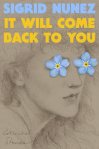 It Will Come Back to You: Collected Stories by Sigrid Nunez [14 July, Virago / Riverhead]: Nunez is one of my favourite authors but I never knew she’d written short stories. The blurb reveals very little about them! “Carefully selected from three decades of work … Moving from the momentous to the mundane, Nunez maintains her irrepressible humor, bite, and insight, her expert balance between intimacy and universality, gravity and levity, all while entertainingly probing the philosophical questions we have come to expect, such as: How can we withstand the passage of time? Is memory the greatest fiction?” (Edelweiss download)
 Exit Party by Emily St. John Mandel [17 Sept., Picador / Sept. 15, Knopf]: The synopsis sounds a bit meh, but in my eyes Mandel can do no wrong. “2031. America is at war with itself, but for the first time in weeks there is some good news: the Republic of California has been declared, the curfew in Los Angeles is lifted, and everyone in the city is going to a party. Ari, newly released from prison, arrives with her friend Gloria … Years later, living a different life in Paris, Ari remains haunted by that night.”
The Housekeeper by Rose Tremain [17 Sept., Vintage (Penguin); no cover image yet]: “Set in 1930s England and fictionalises the inspiration behind Daphne du Maurier’s famous novel, Rebecca.” Strangely, this started life as a short story (in The American Lover), then become a screenplay authored by Tremain (the film is in production and stars Uma Thurman and Anthony Hopkins), and is now being expanded into a novel. Tremain is 82 and a survivor of major cancer; I do wonder if this is the last book we can expect from her.
Nonfiction
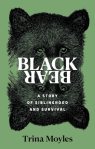 Black Bear: A Story of Siblinghood and Survival by Trina Moyles [Jan. 6, Pegasus Books]: Out now! “When Trina Moyles was five years old, her father … brought home an orphaned black bear cub for a night before sending it to the Calgary Zoo. … After years of working for human rights organizations, Trina returned to northern Alberta for a job as a fire tower lookout, while [her brother] Brendan worked in the oil sands … Over four summers, Trina begins to move beyond fear and observe the extraordinary essence of the maligned black bear”. (For BookBrowse review) (Review e-copy)
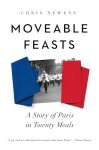 Moveable Feasts: A Story of Paris in Twenty Meals by Chris Newens [Feb. 3, Pegasus Books; came out in the UK in July 2025 but somehow I missed it!]: I’m a sucker for foodie books and Paris books. A “long-time resident of the historic slaughterhouse quartier Villette takes us on a delightful gastronomic journey around Paris … From Congolese catfish in the 18th to Middle Eastern falafels in the 4th, to the charcuterie served at the libertine nightclubs of Pigalle in the 9th, Newens lifts the lid on the city’s ever-changing, defining, and irresistible food culture.” (Edelweiss download)
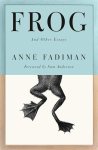 Frog: And Other Essays by Anne Fadiman [Feb. 10, Farrar, Straus and Giroux]: Fadiman publishes rarely, and it can be difficult to get hold of her books, but they are always worth it. “Ranging in subject matter from her deceased frog, to archaic printer technology, to the fraught relationship between Samuel Taylor Coleridge and his son Hartley, these essays unlock a whole world—one overflowing with mundanity and oddity—through sly observation and brilliant wit.”
 The Beginning Comes after the End: Notes on a World of Change by Rebecca Solnit [March 3, Haymarket Books]: A sequel to Hope in the Dark. Hope is a critically endangered species these days, but Solnit has her eyes open. “While the white nationalist and authoritarian backlash drives individualism and isolation, this new world embraces antiracism, feminism, a more expansive understanding of gender, environmental thinking, scientific breakthroughs, and Indigenous and non-Western ideas, pointing toward a more interconnected, relational world.” (Edelweiss download)
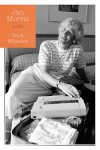 Jan Morris: A Life by Sara Wheeler [7 April, Faber / April 14, Harper]: I didn’t get on with the mammoth biography Paul Clements published in 2022 – it was dry and conventional; entirely unfitting for Morris – but hope for better things from a fellow female travel writer. “Wheeler uncovers the complexity of this twentieth-century icon … Drawing on unprecedented access to Morris’s papers as well as interviews with family, friends and colleagues, Wheeler assembles a captivating … story of longing, traveling and never reaching home.” (Edelweiss download)
Others’ lists whence a few of my ideas came!
What catches your eye here? What other 2026 titles do I need to know about?
Three on a Theme: Matrescence Memoirs (and a Bonus Novel)
I think of pregnancy and childbirth like any extreme adventure (skydiving, polar exploration): wholly extraordinary experiences with much to recommend them – though better appreciated retrospectively than in the moment – to which my response is a hearty “no, thanks.” But just as books have taken me to deserts and the frozen north, miles above or below the earth, into many eras and cultures, they’ve long been my window onto motherhood.
Matrescence, a word coined by anthropologist Dana Raphael in the 1970s, is the process of becoming a mother. It’s a transition period, like adolescence, that involves radical physical and mental changes and has lasting effects. And as Lucy Jones reports, up to 45% of women describe childbirth as traumatic. That’s not a niche experience; it’s an epidemic. If it was men going through this, you can bet it would be at the top of international research agendas.
These three memoirs (and a bonus novel) are bold, often harrowing accounts of the metamorphosis involved in motherhood. They’re personal yet political in how they expose the lack of social support for creating and raising the next generation. All four of these 2023 releases are eye-opening, lyrical and vital; they deserve to be better known.
Matrescence: On the Metamorphosis of Pregnancy, Childbirth and Motherhood by Lucy Jones
Like Jones’s previous book, Losing Eden, about climate breakdown and the human need for nature, Matrescence is a potent blend of scientific research and stories from the frontline. She has synthesized a huge amount of information into a tight 260-some pages that are structured thematically but also proceed roughly chronologically through her own matrescence. Not long into her pregnancy with her first child, a daughter, she realised the extent to which outdated and sexist expectations still govern motherhood: concepts like “natural childbirth” and “maternal instinct,” the judgemental requirement for exclusive breastfeeding, the idea that a parent should “enjoy every minute” of their offspring’s babyhood rather than admitting depression or overwhelm. After the cataclysm of birth, loneliness set in. “Matrescence was another country, another planet. I didn’t know how to talk about the existential crisis I was facing, or the confronting, encompassing relationship I was now in.”
 Jones is now a mother of three. You might think delivery would get easier each time, but in fact the birth of her second son was worst, physically: she had to go into immediate surgery for a fourth-degree anal sphincter tear. In reflecting on her own experiences, and speaking with experts, she has become passionate about fostering open discussion about the pain and risk of childbirth, and how to mitigate them. Women who aren’t informed about what they might go through suffer more because of the shock and isolation. There’s the medical side, but also the equally important social implications: new mothers need so much more practical and mental health support, and their unpaid care work must be properly valued by society. “Yet the focus remains on individual responsibility, maintaining the illusion that we are impermeable, impenetrable machines, disconnected from the world around us.”
The hybrid nature of the book is its genius. A purely scientific approach might have been dry; a social history well-trod and worthy; a memoir too inward-looking to make wider points. Instead it’s equally committed to all three purposes. I appreciated the laser focus on her own physical and emotional development, but the statistical and theoretical context gives a sense of the universal. The literary touches – lists and word clouds, verse-like meditations and flash vignettes about natural phenomena – are not always successful, but there is a thrill to seeing Jones experimenting. Like Leah Hazard’s Womb, this is by no means a book that’s just for mothers; it’s for anyone who’s ever had a mother.
With thanks to Allen Lane (Penguin) for the free copy for review.
Milk: On Motherhood and Madness by Alice Kinsella
 Kinsella is an Irish poet who became a mother in her mid-twenties; that’s young these days. In unchronological vignettes dated in relation to her son’s birth – the number of months after; negative numbers to indicate that it happened before – she explores her personality, mental health and bodily experiences, but also comments more widely on Irish culture (the stereotype of the ‘mammy’; the only recent closure of Magdalene laundries and overturning of anti-abortion laws) and theories about motherhood.
I liked this most when the author stuck close to her own sensory and emotional life; overall, the book felt too long and I thought a late segue into an argument against the dairy industry was unnecessary. Had I been the editor, I would have cut the titled essays and just stuck to the time-stamped pieces. At its best, though, this is a poetic engagement with the tropes and reality of motherhood, sometimes delivered in paragraphs that more closely resemble verse:
+1 I have become the common myth. Mother. The sleepy hum of early memories. The smell of shampoo, of Olay, of lavender. The feeling of safety. The absence of fear.
+2 There’s a possibility,
that we are among the happiest
people in the world:
mothers.[Record freeze preserve.] Fighting death by reproducing our days. Fighting death by reproducing. Here: your life on paper. Here: their life to come.
We’re expected to be mothers the instant we lock eyes with our baby. To shed everything we were and be reborn: Madonnas.
The baby’s favourite thing to do is sit on my lap and interact with other people. This is what mothers are for, I think. Comfort, security, a place to get to know the world from.
The language is gorgeous, and while Kinsella complains of disorientation to the point of worrying about losing herself (although she had struggled with mental health earlier in life, the subtitle’s reference to ‘madness’ seemed to me like overkill compared to other memoirs I’ve read of postpartum depression, trauma or psychosis, such as Inferno by Catherine Cho and Birth Notes by Jessica Cornwell), she comes across as entirely lucid. Her goal here is to find and add to the missing literature of motherhood, in much the same way that Jazmina Barrera, another young mother and writer, attempted with Linea Nigra. This would also make a good companion read to A Ghost in the Throat by Doireann Ní Ghríofa.
Kinsella is among my predictions for the Sunday Times Charlotte Aitken Young Writer of the Year Award shortlist, along with Eliza Clark (Penance) and Tom Crewe (The New Life). (Public library)
The Unfamiliar: A Queer Motherhood Memoir by Kirsty Logan
 I’ve read one of Kirsty Logan’s novels and dipped into her short stories. I immediately knew her parenting memoir would be up my street, but wondered how her fantasy/horror style might translate into nonfiction. Second-person narration is perfect for describing her journey into motherhood: a way of capturing the bewildering weirdness of this time but also forcing the reader to experience it firsthand. It is, in a way, as feminist and surreal as her other work. “You and your partner want a baby. But your two bodies can’t make a baby together. So you need some sperm.” That opening paragraph is a jolt, and the frank present-tense storytelling carries all through.
To start with, Logan’s wife Annie tried getting pregnant. They had a known sperm donor and did home insemination, then advanced to IVF. But after three miscarriages and a failed cycle, they took a doctor’s advice and switched to the younger womb – Logan’s, by four years. As “The Planning” makes way for “The Growing,” it helps that Annie knows exactly what she’s going through. The pregnancy sticks, though the fear of something going wrong never abates, and after the alternating magic and discomfort of those nine months (“You’ve reached the ‘shoplifting a honeydew’ stage”) it’s time for “The Birth,” as horrific an account as I’ve read. The baby had shifted to be back-to-back, which required an emergency C-section, but before that there was a sense of total helplessness, abandonment to unmanaged pain.
Finally the doctor comes. She asks what you would like, and you, shaking shitting pissing bleeding, unable to see when the pain reaches its peak, not screaming, not swearing, not being rude to anyone, not begging for an epidural, … say: I’d like to try some gas and air, if that’s okay, please.
What is remarkable is how Logan recreates this time so intensely – she took notes all through the pregnancy, plus on her phone in hospital and in the early days after bringing the baby home – but can also see how, even in the first hours, she was shaping it into a narrative. “You like that it’s a story. You like that it’s Gothic and gory … and funny.” Except it wasn’t. “You thought you were going to die.” And yet. “How can the lucid, everyday world explain this? The wonder, the curiosity, the recognition. The baby has lived inside your body, and you’ve only just met. The baby is your familiar, and deeply unfamiliar.”
This reminded me of other memoirs I’ve read about queer family-making, especially small by Claire Lynch, which similarly turns on the decision about which female partner will carry the pregnancy and is written in an experimental style. The Unfamiliar is utterly absorbing and conveys so much about the author and her family, even weaving in her father’s death seven years before. I’ve signed up for Logan’s online memoir-writing course (“Where to Start and Where to End”) organised by Writers & Artists (part of Bloomsbury) for next month.
With thanks to Virago Press for the free copy for review.
And, as a bonus, a short novel that deals with many of these same themes:
Reproduction by Louisa Hall
 Procreation. Duplication. Imitation. All three connotations are appropriate for the title of an allusive novel about motherhood and doppelgangers. A pregnant writer starts composing a novel about Mary Shelley and finds the borders between fiction and (auto)biography blurring: “parts of her story detached themselves from the page and clung to my life.” The first long chapter, “Conception,” is full of biographical information about Shelley and the writing and plot of Frankenstein, chiming with Mary and the Birth of Frankenstein by Anne Eekhout, which I read last year. It’s a recognisable piece of autofiction, moving with Hall from Texas to New York to Montana to Iowa as she marries, takes on various university teaching roles and goes through two miscarriages and then, in the “Birth” section, the traumatic birth of her daughter, after which she required surgery and blood transfusions.
These first two sections are exceptional. There’s a sublime clarity to them, like life has been transcribed to the page exactly as it was lived. The change of gears to the third section, “Science Fiction,” put me off, and it took me a long time to get back into the flow. In this final part, the narrator reconnects with a friend and colleague, Anna, who is determined to get pregnant on her own and genetically engineer her embryos to minimise all risk. Here she is more like a Rachel Cusk protagonist, eclipsed by another’s story and serving primarily as a recorder. I found this tedious. It all takes place during Trump’s presidency [Laura F. told me I accidentally published with that saying pregnancy – my brain was definitely saturated with the topic after these reads!] and the Covid pandemic, heightening the strangeness of matrescence and of the lengths Anna goes to. “What, after all, in these end times we lived in, was still really ‘natural’ at all?” the narrator ponders. She casts herself as the narrating Walton, and Anna as Dr. Frankenstein (or sometimes his monster), in this tale of transformation – chosen or not – and peril in a country hurtling toward self-implosion. It’s brilliantly envisioned, and – almost – flawlessly executed. (Public library)
Additional related reading:
Notes Made while Falling by Jenn Ashworth
After the Storm by Emma Jane Unsworth
And coming out in 2025: Mother, Animal by Helen Jukes (Elliott & Thompson)
#WITMonth, Part I: de Beauvoir, Jansson, NDiaye
My first four reads for Women in Translation month were quite a varied selection: a sobering autobiographical essay about the loss of a mother, a characteristically impish children’s novel, a confoundingly elliptical family memoir, and a preview of a forthcoming Mexican novel about women’s friendships and handicraft. Another four coming up later in August.
A Very Easy Death by Simone de Beauvoir (1964; 1965)
[Translated from the French by Patrick O’Brian]
“When someone you love dies you pay for the sin of outliving her with a thousand piercing regrets.”
I’d read a lot about Simone de Beauvoir but not one of her own works until this reissue came my way. It was right up my street as a miniature bereavement memoir (just 84 pages) that doesn’t shy away from the physical details of decline or the emotional complications of a fraught mother–daughter relationship.
 In October 1963, de Beauvoir was in Rome when she got a call informing her that her mother had had an accident. Expecting the worst, she was relieved – if only temporarily – to hear that it was a fall at home, resulting in a broken femur. But when Françoise de Beauvoir got to the hospital, what at first looked like peritonitis was diagnosed as stomach cancer with an intestinal obstruction. Her daughters knew that she was dying, but she had no idea (from what I’ve read, this paternalistic notion that patients must be treated like children and kept ignorant of their prognosis is more common on the Continent, and continues even today).
Over the next month, de Beauvoir and her sister Poupette took turns visiting. Initially alarmed by their mother’s condition, they soon grew used to the deterioration. “I was not worried by her nakedness any more: it was no longer my mother, but a poor tormented body.” They found her in varying states of awareness and discomfort. “In this race between pain and death we most earnestly hoped that death would come first.” Some nurses were better than others. De Beauvoir makes tantalizing references to the standoff between her and her mother about the Catholic faith Simone left behind. (I’ll need to read Memoirs of a Dutiful Daughter for more on that.) Even the hope of heaven didn’t fully neutralize self-pity and physical suffering for the dying woman because she feared her daughters wouldn’t be joining her.
The title is what a nurse told the grieving daughters: that their mother’s had been a very easy death in the end (and an upper-class one, de Beauvoir adds). The word used in French for easy, douce, can also be translated as “gentle,” a tie-in to the epigraph from Dylan Thomas’s “Do not go gentle into that good night.” Is it better for a loved one to die suddenly, or protractedly? I’ve debated this with myself and a few others since my mother’s death from a stroke in October. Ultimately, it’s pointless to ask; any death is an affront, hard to accept and adjust to no matter how much warning is given. I appreciated how matter-of-factly and concisely de Beauvoir’s essay encapsulates the duties and feelings surrounding a death. Frank and unshowy yet potent, this is a classic of the subgenre. 
Published as Fitzcarraldo Editions Classics No. 2 in June. With thanks to the publisher for the free copy for review.
(Books of Summer, #10)
Finn Family Moomintroll by Tove Jansson (1948; 1950)
[Translated from the Swedish by Elizabeth Portch]
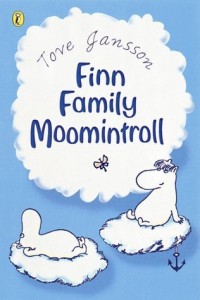 My sixth Moomins book, and ninth by Jansson overall. The novella’s gentle peril is set in motion by the discovery of the Hobgoblin’s Hat, which transforms anything placed within it. As spring moves into summer, this causes all kind of mild mischief until Thingumy and Bob, who speak in spoonerisms, show up with a suitcase containing something desired by both the Groke and the Hobgoblin, and make a deal that stops the disruptions.
As always, the creatures and events, conveyed by Jansson’s black-and-white drawings as much as by her words, are inventive and whimsical. There’s a cosy charm to the seasonal rituals, like the end-of-summer pancake party here. But what I value even more is the pointed accounts of the secondary characters’ neuroses. The Moomins are generally on a pretty even keel, though there is mention of Moominpappa’s sense of being hard done by because of childhood bullying and an enduring lack of respect. However, characters like the Muskrat and the Hemulen get a wry smile and shake of the head from me because their predicaments are so familiar: The Muskrat, terrified of mortifying situations, decides the life of a hermit might be preferable; the Hemulen gives up stamp collecting and switches to botanizing because there’s no joy in a finished quest, only in an ongoing search. The Moomins books offer the perfect combination of the familial and routine with the novel and adventurous. Even staid adults should give them a try. (Little Free Library)
Self-Portrait in Green by Marie NDiaye (2005; 2015)
[Translated from the French by Jordan Stump]
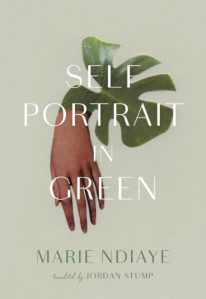 I tend to love a memoir that tries something new or experimental with the form (such as Constructing a Nervous System or In the Dream House), but this was a step too far for me; the self referred to in the title is almost wholly absent. NDiaye, a French–Senegalese author, opens in 2003 with the expected flooding of the Garonne in southwest France. Fragments of narrative from 2000–2003 chart her encounters with various women dressed in green, starting with one she thinks she sees under a banana tree (though her four children see nothing). Then there’s Katia Depetiteville, dead 10 years … NDiaye’s stepmother, once her childhood best friend; her friend Jenny’s rival for Ivan’s affection; and her mother, who now has a new family. What is a ‘woman in green’? The author explicitly associates the colour with cruelty, with presumably the usual connotation of jealousy as well. But it still feels arbitrary.
It’s all rather dreamlike, with poetic repetition, rhetorical questions and black-and-white photos that seem marginally relevant. “I’m saying to myself: Is all this really real?” NDiaye writes, and the reader will surely be asking the same. “I’m always interested in stories,” she adds, and while I’d agree, I need to know that they’re being told to build to some greater meaning. It was only in the last fifth of the book, when the author goes to a literary symposium in Ouagadougou and visits her father (a many-times-married former restaurateur and amateur architect now suffering from cataracts) and stepmother that I felt like there was a purpose: a bringing together of past and present for psychological clarity. I was relieved that this was only 112 pages. (Edelweiss) 
The 10th anniversary edition is being reissued by Two Lines Press next month.
And a bonus preview:
Cross-Stitch by Jazmina Barrera (2021; 2023)
[Translated from the Spanish by Christina MacSweeney]
 In the inventive debut novel by Mexican author Jazmina Barrera, a sudden death provokes an intricate examination of three young women’s years of shifting friendship. Their shared hobby of embroidery occasions a history of women’s handiwork, woven into a relationship study that will remind readers of works by Elena Ferrante and Deborah Levy. Citlali, Dalia, and Mila had been best friends since middle school. Mila, a writer with a young daughter, is blindsided by news that Citlali has drowned off Senegal. While waiting to be reunited with Dalia for Citlali’s memorial service, she browses her journal to revisit key moments from their friendship, especially travels in Europe and to a Mexican village. Cross-stitch becomes its own metaphorical language, passed on by female ancestors and transmitted across social classes. Reminiscent of Still Born and A Ghost in the Throat. (Edelweiss)
Coming out on 7 November from Two Lines Press. My full review for Shelf Awareness is pending.
Literary Wives Club: The Harpy by Megan Hunter
(My fifth read with the Literary Wives online book club; see also Kay’s and Naomi’s reviews.)
Megan Hunter’s second novella, The Harpy (2020), treads familiar ground – a wife discovers evidence of her husband’s affair and questions everything about their life together – but somehow manages to feel fresh because of the mythological allusions and the hint of how female rage might reverse familial patterns of abuse.
Lucy Stevenson is a mother of two whose husband Jake works at a university. One day she opens a voicemail message on her phone from a David Holmes, saying that he thinks Jake is having an affair with his wife, Vanessa. Lucy vaguely remembers meeting the fiftysomething couple, colleagues of Jake’s, at the Christmas party she hosted the year before.
As further confirmation arrives and Lucy tries to carry on with everyday life (another Christmas party, a pirate-themed birthday party for their younger son), she feels herself transforming into a wrathful, ravenous creature – much like the harpies she was obsessed with as a child and as a Classics student before she gave up on her PhD.

Like the mythical harpy, Lucy administers punishment. At first, it’s something of a joke between her and Jake: he offers that she can ritually harm him three times. Twice it takes physical form; once it’s more about reputational damage. The third time, it goes farther than either of them expected. It’s clever how Hunter presents this formalized violence as an inversion of the domestic abuse of which Lucy’s mother was a victim.
Lucy also expresses anger at how women are objectified, and compares three female generations of her family in terms of how housewifely duties were embraced or rejected. She likens the grief she feels over her crumbling marriage to contractions or menstrual cramps. It’s overall a very female text, in the vein of A Ghost in the Throat. You feel that there’s a solidarity across time and space of wronged women getting their own back. I enjoyed this so much more than Hunter’s debut, The End We Start From. (Birthday gift from my wish list) 
The main question we ask about the books we read for Literary Wives is:
What does this book say about wives or about the experience of being a wife?
“Marriage and motherhood are like death … no one comes back unchanged.”
So much in life can remain unspoken, even in a relationship as intimate as a marriage. What becomes routine can cover over any number of secrets; hurts can be harboured until they fuel revenge. Lucy has lost her separate identity outside of her family relationships and needs to claw back a sense of self.
I don’t know that this book said much that is original about infidelity, but I sympathized with Lucy’s predicament. The literary and magical touches obscure the facts of the ending, so it’s unclear whether she’ll stay with Jake or not. Because we’re mired in her perspective, it’s hard to see Jake or Vanessa clearly. Our only choice is to side with Lucy.
Next book: Sea Wife by Amity Gaige in September
Four for #WITMonth: Jansson, Lamarche, Lunde and Vogt
I’ve managed four novels for this year’s Women in Translation month: a nostalgic, bittersweet picture of island summers poised between childhood and old age; a brief, impressionistic account of domestic violence and rape; the third in a series looking at how climate change and species loss reverberate amid family situations; and a visceral meditation on women’s bodies and relationships. Two of these were review copies from the recently launched Héloïse Press, which “champions world-wide female talent”.

The Summer Book by Tove Jansson (1972; 1974)
[Translated from the Swedish by Thomas Teal]
It was just the same long summer, always, and everything lived and grew at its own pace.
 This was only the second time I’ve read one of Jansson’s books aimed at adults (as opposed to five from the Moomins series). Whereas A Winter Book didn’t stand out to me when I read it in 2012 – though I will try it again this winter, having acquired a free copy from a neighbour – this was a lovely read, so evocative of childhood and of languid summers free from obligation. For two months, Sophia and Grandmother go for mini adventures on their tiny Finnish island. Each chapter is almost like a stand-alone story in a linked collection. They make believe and welcome visitors and weather storms and poke their noses into a new neighbour’s unwanted construction.
Six-year-old Sophia, based on Jansson’s niece of the same name, is precocious and opinionated, liable to change her mind in an instant. In “The Cat,” one of my favourite stand-alone bits, she’s fed up with their half-feral pet who kills lots of birds and swaps him for a friend’s soppy lap cat, but then regrets it. She’s learning that logic and emotion sometimes contradict each other, which becomes clearer as she peppers Grandmother with questions about religion and superstition.
As is common to Jansson’s books, there’s a melancholy undercurrent here.
Everything was fine, and yet everything was overshadowed by a great sadness. It was August, and the weather was sometimes stormy and sometimes nice, but for Grandmother, no matter what happened, it was only time on top of time, since everything is vanity and a chasing after the wind.
Sophia’s mother died, and although her grandmother has the greater presence, Papa is also around, dealing with practicalities in the background. Death stalks around the edges, reminding Grandmother of her mortality through bouts of vertigo that have her grabbing for her heart medication. On just the second page we have this memento mori:
“When are you going to die?” the child asked.
And Grandmother answered, “Soon. But that is not the least concern of yours.”
And so it doesn’t feel like our concern either; the focus is on the now, on these beautiful little moments of connection across the generations – like in “Playing Venice,” when Grandmother stays up all night rebuilding Sophia’s model city that was washed away by the rain. (Public library)
The Memory of the Air by Caroline Lamarche (2014; 2022)
[Winner of an English PEN Award; translated from the French by Katherine Gregor]
 In a hypnotic monologue, a woman tells of her time with a violent partner (the man before, or “Manfore”) who thinks her reaction to him is disproportionate and all due to the fact that she has never processed being raped two decades ago. When she goes in for a routine breast scan, she shows the doctor her bruised arm, wanting there to be a definitive record of what she’s gone through. It’s a bracing echo of the moment she walked into a police station to report the sexual assault (and oh but the questions the male inspector asked her are horrible).
The novella opens with an image that returns in dreams but is almost more a future memory of what might have been: “I went down into a ravine and, at the bottom, found a dead woman. She was lying in a shroud, on a carpet of fallen leaves.” I read this in one sitting – er, yoga session – and it has stayed in my mind in intense flashes like that and the flounce of her red dress on the summer day that turned into a nightmare. At an intense 70 pages, this reminded me of Annie Ernaux’s concise autofiction (I’ve reviewed Happening and I Remain in Darkness). An introduction by Dr Dominique Carlini-Versini contextualizes the work by considering the treatment of rape in contemporary French women’s writing.
The Memory of the Air will be published on 26 September. With thanks to Héloïse Press for the proof copy for review.
The Last Wild Horses by Maja Lunde (2019; 2022)
[Translated from the Norwegian by Diane Oatley]
The third in Lunde’s “Climate Quartet,” with its recurring elements of migration, shortages and environmental collapse. Always, though, the overall theme is parent–child relationships and the love that might be the only thing that keeps us going in the face of unspeakable challenges. Here she returns to the tripartite structure of The History of Bees (much my favourite of the three): a historical strand, a near-contemporary one, and a dystopian future story line. The link between the three is Przewalski’s horses (aka takhi).
 In the early 1880s, Mikhail Alexandrovich Kovrov, assistant director of St. Petersburg Zoo, is brought the hide and skull of an ancient horse species assumed extinct. Although a timorous man who still lives with his mother, he becomes part of an expedition to Mongolia to bring back live specimens. In 1992, Karin, who has been obsessed with Przewalski’s horses since encountering them as a child in Nazi Germany, spearheads a mission to return the takhi to Mongolia and set up a breeding population. With her is her son Matthias, tentatively sober after years of drug abuse. In 2064 Norway, Eva and her daughter Isa are caretakers of a decaying wildlife park that houses a couple of wild horses. When a climate migrant comes to stay with them and the electricity goes off once and for all, they have to decide what comes next. This future story line engaged me the most.
I appreciated some aspects: queer and middle-aged romances, the return of a character from The End of the Ocean, the consideration across all three plots of what makes a good mother. However, the horses seemed neither here nor there. There are also many, many animal deaths. Perhaps an unsentimental attitude is necessary to reflect past and future values, and the apparent cruelty of natural processes, but it limits the book’s appeal to animal lovers. Maybe the tone fits the Norwegian prose, which the translator describes as lean.
The fourth book of the quartet, publishing in Norway next month, is called something like The Dream of a Tree; a focus on trees would be a draw for me. After the disappointment of Books 2 and 3, I’m unsure whether I want to bother with the final volume, but it makes sense to do so, if only to grasp Lunde’s full vision. (Public library)
What Concerns Us by Laura Vogt (2020; 2022)
[Translated from the German by Caroline Waight]
 Vogt’s Swiss-set second novel is about a tight-knit matriarchal family whose threads have started to unravel. For Rahel, motherhood has taken her away from her vocation as a singer. Boris stepped up when she was pregnant with another man’s baby and has been as much of a father to Rico as to Leni, the daughter they had together afterwards. But now Rahel’s postnatal depression is stopping her from bonding with the new baby, and she isn’t sure this quartet is going to make it in the long term.
Meanwhile, Rahel’s sister Fenna knows she’s pregnant but refuses a doctor’s care. When she comes to stay with Rahel, she confides that the encounter with her partner, Luc, that led to conception was odd, rough; maybe not consensual. And all this time, the women’s mother, Verena, has been undergoing treatment for breast cancer. All three characters appear to be matter-of-factly bisexual; Rahel and Fenna’s father has long been out of the picture, replaced in Verena’s affections by Inge.
As I was reading, I kept thinking of the declaration running through A Ghost in the Throat by Doireann Ní Ghríofa: “This is a female text.” Vogt’s vision is all breasts and eggs, genitals actual and metaphorical. I loved the use of food in the novel: growing up, the girls cherished “silly nights” when their mother prepared an egg feast and paired it with a feminist lecture on reproduction. Late on, there’s a wonderful scene when the three main characters gorge on preserved foodstuffs from the cellar and share their secrets. (Their language is so sexually frank; would anyone really talk to their mother and siblings in that way?!) As in the Lunde, the main question is what it means to be a mother, but negotiating their relationships with men stretches the bonds of this feminine trio. One for fans of Rachel Cusk and Sally Rooney.
With thanks to Héloïse Press for the proof copy for review.
The Beginning of Spring with Penelope Fitzgerald & Karl Ove Knausgaard
(From To Star the Dark by Doireann Ní Ghríofa)
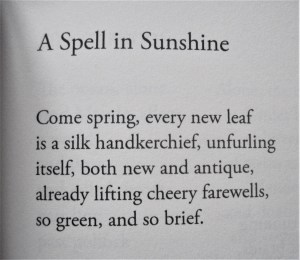
Reading with the seasons is one way I mark time. This is the first of two, or maybe three, batches of spring reading for me this year. The daffodils have already gone over; bluebells and peonies are coming out; and all the trees, including the two wee apple trees we’ve planted at our new house, are sprouting hopeful buds.
The Beginning of Spring by Penelope Fitzgerald (1988)
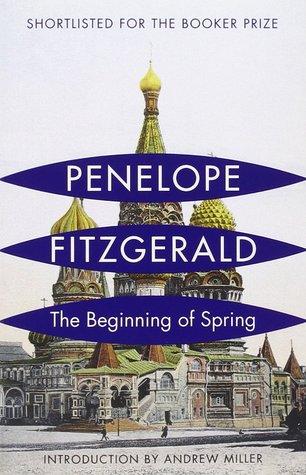 My fourth from Fitzgerald. One of her later novels, this was shortlisted for the Booker Prize. Its pre-war Moscow setting seemed to take on extra significance as I read it during the early weeks of the Russian occupation of Ukraine. Its title is both literal, referring to the March days in 1913 when “there was the smell of green grass and leaves, inconceivable for the last five months” and the expatriate Reid family can go to their dacha once again, and metaphorical. For what seems to printer Frank Reid – whose wife Nellie has taken a train back to England and left him to raise their three children alone – like an ending may actually presage new possibilities when his accountant, Selwyn, hires a new nanny for the children.
I have previously found Fitzgerald’s work slight, subtle to the point of sailing over my consciousness without leaving a ripple. While her characters and scenes still underwhelm – I always want to go deeper – I liked this better than the others I’ve read (The Bookshop, Offshore, and The Blue Flower), perhaps simply because it’s not a novella so is that little bit more expansive. And though she’s not an author you’d turn to for plot, more does actually happen here, including a gunshot. Frank is a genial Everyman, fond of Russia yet exasperated with its bureaucracy and corruption – this “magnificent and ramshackle country.” He knows how things work and isn’t above giving a bribe when it’s expedient for his business:
He took an envelope out of his drawer, and, conscious of taking only a mild risk, since the whole unwieldy administration of All the Russias, which kept working, even if only just, depended on the passing of countless numbers of such envelopes, he slid it across the top of the desk. The inspector opened it without embarrassment, counted out the three hundred roubles it contained and transferred them to a leather container, half way between a wallet and a purse, which he kept for ‘innocent income’.
I particularly liked Uncle Charlie’s visit, the glimpses of Orthodox Easter rituals, and a strangely mystical moment of communion with some birch trees. A part of me did wonder if the setting was neither here nor there, if a few plastered-on descriptions of Moscow were truly enough to constitute convincing historical fiction. That’s a question for those more familiar with Russia and its literature to answer, but I enjoyed the seasonal awakening. (Secondhand, charity shop in Bath)
Spring by Karl Ove Knausgaard (2016; 2018)
[Translated from the Norwegian by Ingvild Burkey; illustrated by Anna Bjerger]
 Knausgaard is a repeat presence in my seasonal posts: I’ve also reviewed Autumn, Winter and Summer. I read his quartet out of order, finishing with the one that was published third. The project was conceived as a way to welcome his fourth child, Anna, into the world. Whereas the other books prioritize didactic essays on seasonal experiences, this is closer in format to Knausgaard’s granular autofiction: the throughline is a journey through an average day with his baby girl, from when she wakes him before 6 a.m. to a Walpurgis night celebration (“the evening when spring is welcomed in with song in Sweden”). They see the other kids off to school, then make a disastrous visit to a mental hospital – he forgets his bank card and ID, the baby’s bottle, everything, and has to beg cash from his bank to buy petrol to get home.
Looming over the circadian narrative is his wife’s mental health crisis the summer before (his ex-wife Linda Boström Knausgård, a writer in her own right, has bipolar disorder), while she was pregnant with Anna, and the repercussions it has had for their family. Other elements echo those of the previous books: the formation of memories, to what extent his personality is fixed, whether he’s fated to turn into his father, minor health concerns, and so on. Although this volume is less aphoristic than the previous books, there are still moments when he muses on life and gives general advice:
Self-deception is perhaps the most human thing of all. … And perhaps the following is nothing but self-deception: the easy life is nothing to aspire to, the easy choice is never the worthiest solution, only the difficult life is a life worth living. I don’t know. But I think that’s how it is. What would seem to contradict this, is that I wish you and your siblings simple, easy, long and happy lives. … The advantage of having siblings is that it is a lifelong attachment, and that nothing can break it.
All in all, this was the highlight of the series for me. Each of the four is illustrated by a different contemporary artist. Bjerger is less abstract than some of the others, which I count as a plus. (New bargain/remainder copy, Minster Gate Bookshop, York)

This daffodil bookmark was embroidered by local textile artist Christine Highnett. My mother bought it for me from Sandham Memorial Chapel’s gift shop last summer.
A favourite random moment: A creeper coming through the tile roof of his office pushes a book off the shelf. It’s American Psycho. “I still found it incredible. And a little frightening, the blind force of growth”.
Speaking of meaningful, or perhaps ironic, timing: He records a conversation with his neighbour, who was mansplaining about Russian aggression and the place of Ukraine: “Kiev was the first great city in what became the Russian empire. … The Ukraine and Russia are like twins. … They belong together. At least the Russians see it that way. … The very idea of Russia is imperialistic.”
Any spring reads on your plate?
March Reading Plans
It’s beginning to look a lot like spring, with daffodils a-blooming, so I have amassed a set of appropriate reads and aim to report on them in two installments between April and May. I was already partway through Davidson’s novel, I’m getting stuck into the Fitzgerald and Knausgaard, and I hope to start the Woolf soon. I also have a review copy of Ghosts of Spring by Luis Carrasco.

Much as I tried with #FinishItFebruary, I still have some set-aside titles I couldn’t get through before the end of last month. It’s a good thing that (as I’ll never forget Damian Barr commenting) books are patient. I’ll reintroduce these to my stacks in the weeks to come, but NO MORE BOOKS can join them. I’m going to be strict with myself: keep going with a book or DNF it; no more limbo.
One of my informal goals for the rest of the year is to have a buddy read on the go with my husband at all times. I’d noticed that I happened to have duplicate copies of a couple of books, and then started to look out for extra copies at the free mall bookshop and Little Free Library in 2019–21, so I’ve ended up with 11 books in total: three nature classics, four travel books, three novels to reread, and one to read for the first time. Nature/travel is where our taste most often overlaps, but John Irving is our mutual favourite author and English Passengers is a novel we both loved. We’ll work out a schedule for 1–2 per month. He reads faster than I do (but has much less time to read overall), so we’ll agree on a time frame and chat either as we go or when we’ve both finished a book. Let me know if you fancy joining in with any of these.
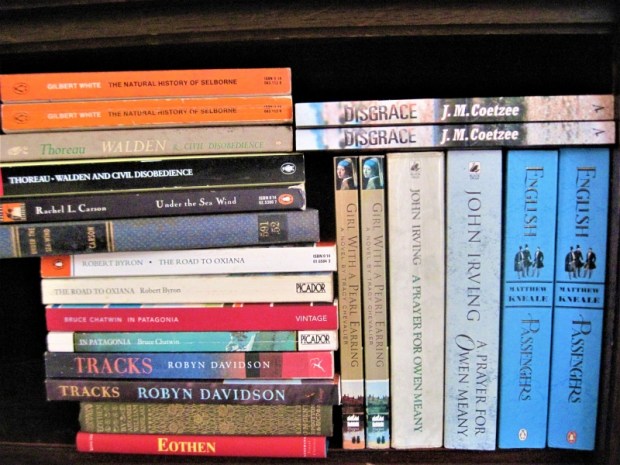
Of course, it’s also Reading Ireland Month, hosted by Cathy of 746 Books, and I’ve earmarked these fiction options for the next few weeks. So far I’ve started Maggie O’Farrell’s debut novel. Plus I just got Wendy Erskine’s story collection Dance Move out from the library, and I have Colm Tóibín’s forthcoming poetry collection on my e-reader.
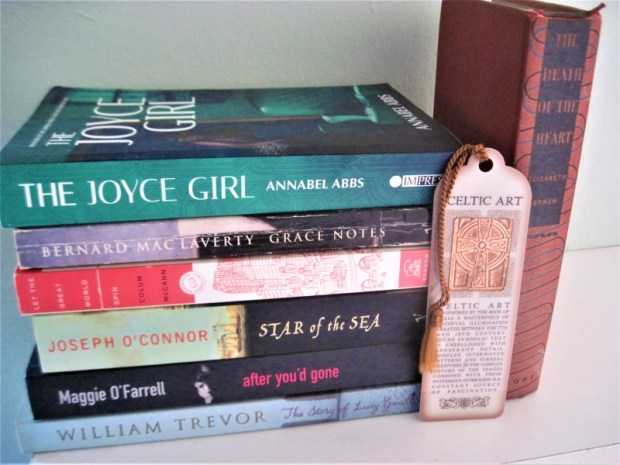
I’m currently reading A Portrait of the Artist as a Young Girl, a collection of autobiographical essays by Irish women writers that originated on the radio. I also got a jump-start in late February by reading these two short books by writers from Ireland:
Wild Child: A Journey through Nature by Dara McAnulty; illus. Barry Falls (2021)
 I’d expected this to be just a picture book. Instead, it’s a guided tour through four landscapes – the garden, the woods, the uplands, and a river – and it combines Robert Macfarlane-esque poetry (the rhyming and alliteration are reminiscent of The Lost Words books) with facts and crafts/activities. It starts small, with the birds a child in the UK might be able to see out their window, and then ventures further afield. There is a teaching focus, with information on species’ classification, life cycles and migrations. I also learned to recognize hazel catkins and flowers, and then identified them on our walk later the same day! But the main aim, I think, is simply to encourage wonder and inspire children to get outside and explore the nature around them. I liked the illustrations, but wish the birds hadn’t been given slightly googly eyes. (Public library)
To Star the Dark by Doireann Ní Ghríofa (2021)
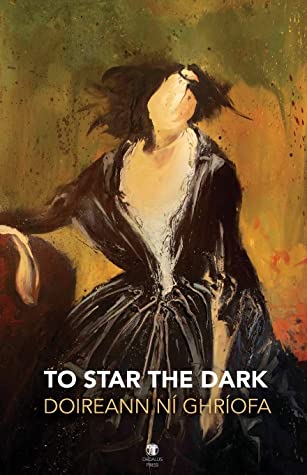 Like many, I discovered Ní Ghríofa through A Ghost in the Throat, a genre-bending work of feminist autofiction. I treated myself to a copy of this, her sixth poetry collection, as part of a Waterstones haul with my Christmas book token. One poem actually mentions Eibhlín Dubh, subject of A Ghost in the Throat, and the work as a whole has some of the same attributes, blending biographical portraits and historical reflection with autobiographical material.
“Two Daydreams” connects a teenager in a history exam with the generations leading back to the Famine. “An Experiment to Engineer an Inheritance of Fear” wonders if there is an inherited Irish trauma: “Give her terror in a meadow. / Bind her fear to a black potato. … / When exposed to the ancestral scent, great-grandchildren will show signs of distress.” A newborn’s stay in the NICU occasions “Seven Postcards from a Hospital” (originally addressed to Sara Baume, Ní Ghríofa reveals in the Notes). Marine biologist Maude Delap is the subject of one multi-part poem.
Sensual imagery abounds, and there are several incantatory spells, including the spring one below. My favourite poem was “Craquelure,” likening cracks in a fellow bus passenger’s phone screen to the weathering old paintings develop. (New purchase)
Recent Literary Awards & Online Events: Folio Prize and Claire Fuller
Literary prize season is in full swing! The Women’s Prize longlist, revealed on the 10th, contained its usual mixture of the predictable and the unexpected. I correctly predicted six of the nominees, and happened to have already read seven of them, including Claire Fuller’s Unsettled Ground (more on this below). I’m currently reading another from the longlist, Luster by Raven Leilani, and I have four on order from the library. There are only four that I don’t plan to read, so I’ll be in a fairly good place to predict the shortlist (due out on April 28th). Laura and Rachel wrote detailed reaction posts on which there has been much chat.
Rathbones Folio Prize
This year I read almost the entire Rathbones Folio Prize shortlist because I was lucky enough to be sent the whole list to feature on my blog. The winner, which the Rathbones CEO said would stand as the “best work of literature for the year” out of 80 nominees, was announced on Wednesday in a very nicely put together half-hour online ceremony hosted by Razia Iqbal from the British Library. The Folio scheme also supports writers at all stages of their careers via a mentorship scheme.
It was fun to listen in as the three judges discussed their experience. “Now nonfiction to me seems like rock ‘n’ roll,” Roger Robinson said, “far more innovative than fiction and poetry.” (Though Sinéad Gleeson and Jon McGregor then stood up for the poetry and fiction, respectively.) But I think that was my first clue that the night was going to go as I’d hoped. McGregor spoke of the delight of getting “to read above the categories, looking for freshness, for excitement.” Gleeson said that in the end they had to choose “the book that moved us, that enthralled us.”
All eight authors had recorded short interview clips about their experience of lockdown and how they experiment with genre and form, and seven (all but Doireann Ní Ghríofa) were on screen for the live announcement. The winner of the £30,000 prize, author of an “exceptional, important” book and teller of “a story that had to be told,” was Carmen Maria Machado for In the Dream House. I was delighted with this result: it was my first choice and is one of the most remarkable memoirs I’ve read. I remember reading it on my Kindle on the way to and from Hungerford for a bookshop event in early March 2020 – my last live event and last train ride in over a year and counting, which only made the reading experience more memorable.

I like what McGregor had to say about the book in the media release: “In the Dream House has changed me – expanded me – as a reader and a person, and I’m not sure how much more we can ask of the books that we choose to celebrate.”
There are now only two previous Folio winners that I haven’t read, the memoir The Return by Hisham Matar and the novel Lost Children Archive by Valeria Luiselli, so I’d like to get those two out from the library soon and complete the set.
Other literary prizes
 The following day, the Dylan Thomas Prize shortlist was announced. Still in the running are two novels I’ve read and enjoyed, Pew by Catherine Lacey and My Dark Vanessa by Kate Elizabeth Russell, and one I’m currently reading (Luster). Of the rest, I’m particularly keen on Kingdomtide by Rye Curtis, and I would also like to read Alligator and Other Stories by Dima Alzayat. I’d love to see Russell win the whole thing. The announcement will be on May 13th. I hope to participate in a shortlist blog tour leading up to it.
I also tuned into the Edward Stanford Travel Writing Awards ceremony (on YouTube), which was unfortunately marred by sound issues. This year’s three awards went to women: Dervla Murphy (Edward Stanford Outstanding Contribution to Travel Writing), Anita King (Bradt Travel Guides New Travel Writer of the Year; you can read her personal piece on Syria here), and Taran N. Khan for Shadow City: A Woman Walks Kabul (Stanford Dolman Travel Book of the Year in association with the Authors’ Club).
Other prize races currently in progress that are worth keeping an eye on:
- The Jhalak Prize for writers of colour in Britain (I’ve read four from the longlist and would be interested in several others if I could get hold of them)
- The Republic of Consciousness Prize for work from small presses (I’ve read two; Doireann Ní Ghríofa gets another chance – fingers crossed for her)
- The Walter Scott Prize for historical fiction (next up for me: The Dictionary of Lost Words by Pip Williams, to review for BookBrowse)
Claire Fuller
Yesterday evening, I attended the digital book launch for Claire Fuller’s Unsettled Ground (my review will be coming soon). I’ve read all four of her novels and count her among my favorite contemporary writers. I spotted Eric Anderson and Ella Berthoud among the 200+ attendees, and Claire’s agent quoted from Susan’s review – “A new novel from Fuller is always something to celebrate”! Claire read a passage from the start of the novel that introduces the characters just as Dot starts to feel unwell. Uniquely for online events I’ve attended, we got a tour of the author’s writing room, with Alan the (female) cat asleep on the daybed behind her, and her librarian husband Tim helped keep an eye on the chat.
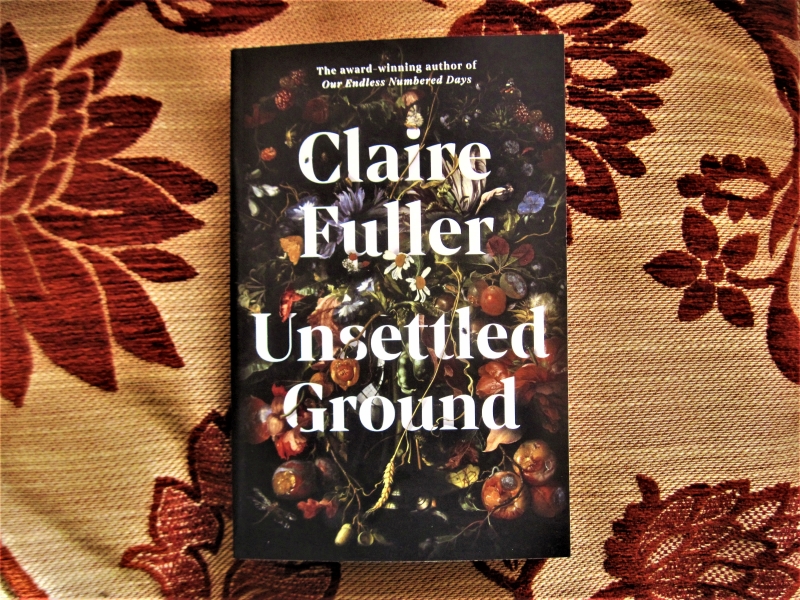
After each novel, as a treat to self, she buys a piece of art. This time, she commissioned a ceramic plate from Sophie Wilson with lines and images from the book painted on it. Live music was provided by her son Henry Ayling, who played acoustic guitar and sang “We Roamed through the Garden,” which, along with traditional folk song “Polly Vaughn,” are quoted in the novel and were Claire’s earworms for two years. There was also a competition to win a chocolate Easter egg, given to whoever came closest to guessing the length of the new novel in words. (It was somewhere around 89,000.)
Good news – she’s over halfway through Book 5!
Rathbones Folio Prize 2021 Shortlist Reviews & Prediction
I’ve nearly managed to read the whole Rathbones Folio Prize shortlist before the prize is announced on the evening of Wednesday the 24th. (You can sign up to watch the online ceremony here.) I reviewed the Baume and Ní Ghríofa as part of a Reading Ireland Month post on Saturday, and I’d reviewed the Machado last year in a feature on out-of-the-ordinary memoirs. This left another five books. Because they were short, I’ve been able to read and/or review another four over the past couple of weeks. (The only one unread is As You Were by Elaine Feeney, which I made a false start on last year and didn’t get a chance to try again.)
Nominations come from the Folio Academy, an international group of writers and critics, so the shortlisted authors have been chosen by an audience of their peers. Indeed, I kept spotting judges’ or fellow nominees’ names in the books’ acknowledgements or blurbs. I tried to think about the eight as a whole and generalize about what the judges were impressed by. This was difficult for such a varied set of books, but I picked out two unifying factors: A distinctive voice, often with a musicality of language – even the books that don’t include poetry per se are attentive to word choice; and timeliness of theme yet timelessness of experience.
Poor by Caleb Femi
 Femi brings his South London housing estate to life through poetry and photographs. This is a place where young Black men get stopped by the police for any reason or none, where new trainers are a status symbol, where boys’ arrogant or seductive posturing hides fear. Everyone has fallen comrades, and things like looting make sense when they’re the only way to protest (“nothing was said about the maddening of grief. Nothing was said about loss & how people take and take to fill the void of who’s no longer there”). The poems range from couplets to prose paragraphs and are full of slang, Caribbean patois, and biblical patterns. I particularly liked Part V, modelled on scripture with its genealogical “begats” and a handful of portraits:
The Story of Ruthless
Anyone smart enough
to study the food chain
of the estate knew exactly
who this warrior girl was;
once she lined eight boys
up against a wall,
emptied their pockets.
Nobody laughed at the boys.
Another that stood out for me was the two-part “A Designer Talks of Home / A Resident Talks of Home,” a found poem partially constructed from dialogue from a Netflix documentary on interior design. It ironically contrasts airy aesthetic notions with survival in a concrete wasteland. If you loved Surge by Jay Bernard, this should be next on your list.
My Darling from the Lions by Rachel Long
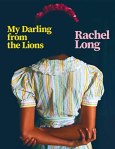 I first read this when it was on the Costa Awards shortlist. As in Femi’s collection, race, sex, and religion come into play. The focus is on memories of coming of age, with the voice sometimes a girl’s and sometimes a grown woman’s. Her course veers between innocence and hazard. She must make her way beyond the world’s either/or distinctions and figure out how to be multiple people at once (biracial, bisexual). Her Black mother is a forceful presence; “Red Hoover” is a funny account of trying to date a Nigerian man to please her mother. Much of the rest of the book failed to click with me, but the experience of poetry is so subjective that I find it hard to give any specific reasons why that’s the case.
The Mermaid of Black Conch by Monique Roffey
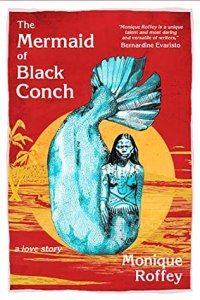 After the two poetry entries on the shortlist, it’s on to a book that, like A Ghost in the Throat, incorporates poetry in a playful but often dark narrative. In 1976, two competitive American fishermen, a father-and-son pair down from Florida, catch a mermaid off of the fictional Caribbean island of Black Conch. Like trophy hunters, the men take photos with her; they feel a mixture of repulsion and sexual attraction. Is she a fish, or an object of desire? In the recent past, David Baptiste recalls what happened next through his journal entries. He kept the mermaid, Aycayia, in his bathtub and she gradually shed her tail and turned back into a Taino indigenous woman covered in tattoos and fond of fruit. Her people were murdered and abused, and the curse that was placed on her runs deep, threatening to overtake her even as she falls in love with David. This reminded me of Ernest Hemingway’s The Old Man and the Sea and Lydia Millet’s Mermaids in Paradise. I loved that Aycayia’s testimony was delivered in poetry, but this short, magical story came and went without leaving any impression on me.
Indelicacy by Amina Cain
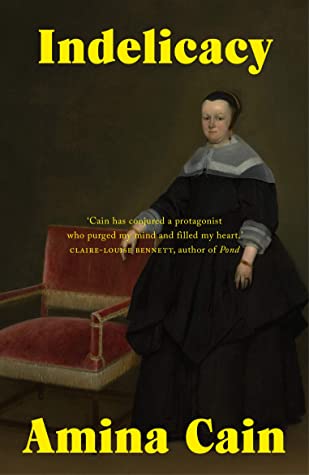 Having heard that this was about a cleaner at an art museum, I expected it to be a readalike of Asunder by Chloe Aridjis, a beautifully understated tale of ghostly perils faced by a guard at London’s National Gallery. Indelicacy is more fable-like. Vitória’s life is in two halves: when she worked at the museum and had to forego meals to buy new things, versus after she met her rich husband and became a writer. Increasingly dissatisfied with her marriage, she then comes up with an escape plot involving her hostile maid. Meanwhile, she makes friends with a younger ballet student and keeps in touch with her fellow cleaner, Antoinette, a pregnant newlywed. Vitória tries sex and drugs to make her feel something. Refusing to eat meat and trying to persuade Antoinette not to baptize her baby become her peculiar twin campaigns.
The novella belongs to no specific time or place; while Cain lives in Los Angeles, this most closely resembles ‘wan husks’ of European autofiction in translation. Vitória issues pretentious statements as flat as the painting style she claims to love. Some are so ridiculous they end up being (perhaps unintentionally) funny: “We weren’t different from the cucumber, the melon, the lettuce, the apple. Not really.” The book’s most extraordinary passage is her husband’s rambling, defensive monologue, which includes the lines “You’re like an old piece of pie I can’t throw away, a very good pie. But I rescued you.”
It seems this has been received as a feminist story, a cheeky parable of what happens when a woman needs a room of her own but is trapped by her social class. When I read in the Acknowledgements that Cain took lines and character names from Octavia E. Butler, Jean Genet, Clarice Lispector, and Jean Rhys, I felt cheated, as if the author had been engaged in a self-indulgent writing exercise. This was the shortlisted book I was most excited to read, yet ended up being the biggest disappointment.
On the whole, the Folio shortlist ended up not being particularly to my taste this year, but I can, at least to an extent, appreciate why these eight books were considered worthy of celebration. The authors are “writers’ writers” for sure, though in some cases that means they may fail to connect with readers. There was, however, some crossover this year with some more populist prizes like the Costa Awards (Roffey won the overall Costa Book of the Year).
The crystal-clear winner for me is In the Dream House by Carmen Maria Machado, her memoir of an abusive same-sex relationship. Written in the second person and in short sections that examine her memories from different angles, it’s a masterpiece and a real game changer for the genre – which I’m sure is just what the judges are looking for.
The only book on the shortlist that came anywhere close to this one, for me, was A Ghost in the Throat by Doireann Ní Ghríofa, an elegant piece of feminist autofiction that weaves in biography, imagination, and poetry. It would be a fine runner-up choice.
(On the Rathbones Folio Prize Twitter account, you will find lots of additional goodies like links to related articles and interviews, and videos with short readings from each author.)
My thanks to the publishers and FMcM Associates for the free copies for review.
The Rathbones Folio Prize 2021 Shortlist
The Rathbones Folio Prize is unique in that nominations come from the Folio Academy, an international group of writers and critics, and any book written in English is eligible, so nonfiction and poetry share space with fiction on the varied shortlist of eight titles:
- handiwork by Sara Baume (Tramp Press)
- Indelicacy by Amina Cain (Daunt Books)
- As You Were by Elaine Feeney (Harvill Secker)
- Poor by Caleb Femi (Penguin)
- My Darling from the Lions by Rachel Long (Picador)
- In the Dream House: A Memoir by Carmen Maria Machado (Serpent’s Tail)
- A Ghost in the Throat by Doireann Ní Ghríofa (Tramp Press)
- The Mermaid of Black Conch by Monique Roffey (Peepal Tree Press)
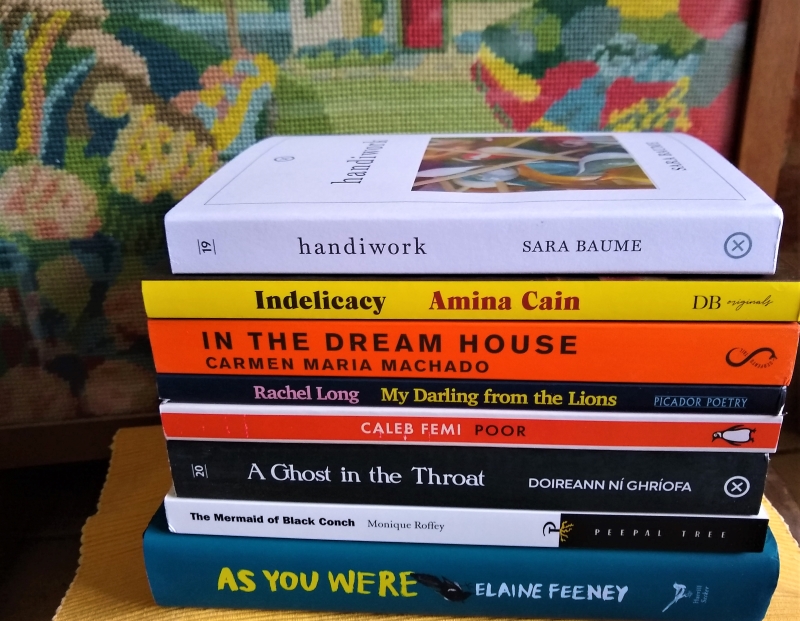
 I was delighted to be sent the whole shortlist to feature. I’d already read Rachel Long’s poetry collection and Carmen Maria Machado’s memoir (reviewed here), but I’m keen to start on the rest and will read and review as many as possible before the online prize announcement on Wednesday the 24th. I’m starting with the Baume, Cain, Femi and Roffey.
For more information on the prize, these eight authors, and the longlist, see the website.
(The remainder of the text in this post comes from the official press release.)
The Rathbones Folio Prize — known as the “writers’ prize” — rewards the best work of literature of the year, regardless of form. It is the only award governed by an international academy of distinguished writers and critics, ensuring a unique quality and consistency in the nomination and judging process.
The judges (Roger Robinson, Sinéad Gleeson, and Jon McGregor) have chosen books by seven women and one man to be in contention for the £30,000 prize which looks for the best fiction, non-fiction and poetry in English from around the world. Six out of the eight titles are by British and Irish writers, with three out of Ireland alone (two of which are published by the same publisher, Tramp Press). The spirit of experimentation is also reflected in the strong showing of independent publishers and small presses (five out of eight).
Chair of judges Roger Robinson says: “It was such a joy to spend detailed and intimate time with the books nominated for the Rathbones Folio Prize and travel deep into their worlds. The judges chose the eight books on the shortlist because they are pushing at the edges of their forms in interesting ways, without sacrificing narrative or execution. The conversations between the judges may have been as edifying as the books themselves. From a judges’ vantage point, the future of book publishing looks incredibly healthy – and reading a book is still one of the most revolutionary things that one can do.”
 The 2021 shortlist ranges from Amina Cain’s Indelicacy – a feminist fable about class and desire – and the exploration of the estates of South London through poetry and photography in Caleb Femi’s Poor, to a formally innovative, genre-bending memoir about domestic abuse in Carmen Maria Machado’s In the Dream House, and a feminist revision of Caribbean mermaid myths, in Monique Roffey’s The Mermaid of Black Conch.
In the darkly comic novel As You Were, poet Elaine Feeney tackles the intimate histories, institutional failures, and the darkly present past of modern Ireland, while Doireann Ní Ghríofa’s A Ghost in the Throat finds the eighteenth-century poet Eibhlín Dubh Ní Chonaill haunting the life of a contemporary young mother, prompting her to turn detective. Doireann Ní Ghríofa is published by Dublin’s Tramp Press, also publishers of Sara Baume’s handiwork – which charts the author’s daily process of making and writing, and explores what it is to create and to live as an artist – while poet Rachel Long’s acclaimed debut collection My Darling from the Lions skewers sexual politics, religious awakenings and family quirks with wit, warmth and precision.
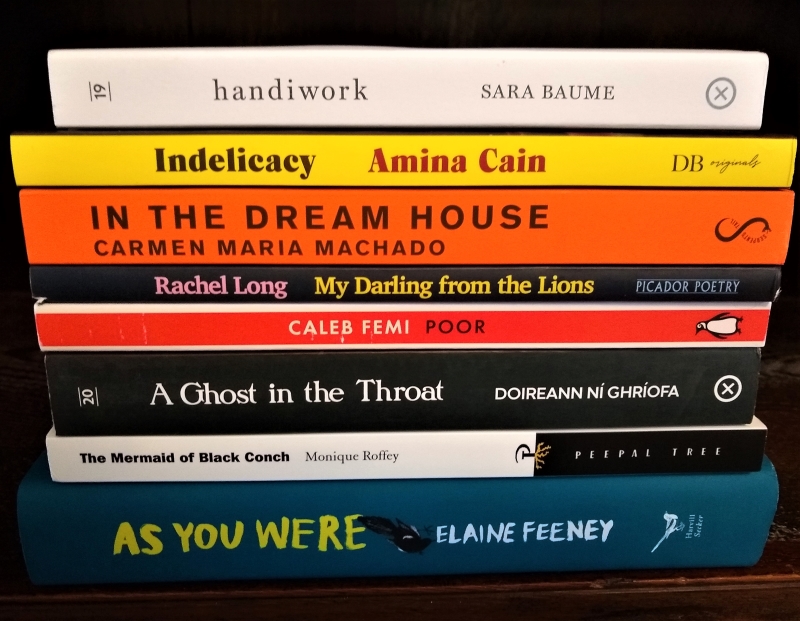
My thanks to the publishers and FMcM Associates for the free copies for review.
 Bookish Beck = Rebecca Foster. American transplant to England. Freelance proofreader and book reviewer.
 Bookish Beck