September Focus on Short Stories, with Reviews of Bloom and de Kerangal
This is the eighth year in a row in which I’m making a special effort to read short stories in September; otherwise, story collections tend to languish on my shelves (and Kindle) unread. In September 2021 I read 12 collections and in September 2022 it was 11.5; let’s see how many I get to this year!
As someone who doesn’t claim to love short stories, I was surprised to see that I’ve already read 19 collections this year. Some of the highlights have been Old Babes in the Wood by Margaret Atwood, How Strange a Season by Megan Mayhew Bergman, What We Talk about When We Talk about Love by Raymond Carver, Games and Rituals by Katherine Heiny, and Sidle Creek by Jolene McIlwain.
I have a whole shelf of short story options set out for me and will make my selections from there. For now, I have brief reviews of two collections I read during a quick trip to the USA.
A Blind Man Can See How Much I Love You by Amy Bloom (2000)
 My second collection by Bloom this year, after Where the God of Love Hangs Out; somewhat confusingly, the latter reprints two of this volume’s Lionel and Julia stories, so there were actually only six stories here that were new to me (5 x first-person; 3 x third-person). However, they’re all typically great ones. The title story has a mother accompanying her daughter to the medical appointments that will transform Jessie into Jess, her son, and also taking a chance on romance. “Rowing to Eden” explores the dynamic between best friends, one lesbian and one married to a man; the one has already been through breast cancer treatment so can counsel her friend from experience.
In “Stars at Elbow and Foot,” a woman whose baby died goes back to the children’s hospital to volunteer with the disabled. “Hold Tight” also reflects on loss and accidents (but is probably the throw-away story if I had to name one). “The Story,” which closes the book, had me hunting for autobiographical correlations what with its mentions of “Amy.” By far my favourite was “The Gates Are Closing,” in which D.M. is having an affair with the synagogue president’s husband, who has Parkinson’s disease. As Yom Kippur approaches, he gives his mistress an ultimatum. The minor assisted dying theme in this one felt ironically prescient of Bloom’s own experience accompanying her husband to Dignitas (the subject of In Love). As always, Bloom’s work is sensual, wry and emotionally wise. 
Canoes by Maylis de Kerangal (2021; 2023)
[Translated from the French by Jessica Moore]
These eight stories are all in the first person; although I tend to prefer more diversity of narration, the plots are so dissimilar that it makes up for that homogeneity. In an author’s note at the end, de Kerangal writes that her overall theme was voices, especially women’s voices; perhaps ironically, then, the collection uses no speech marks. In “Mountain Stream and Iron Filings,” the narrator’s friend Zoé is on a mission to lower her voice to make it more suitable for radio. “Nevermore” has a woman contributing a recording of herself reading Edgar Allan Poe’s epic poem “The Raven” to an audio library. “A Light Bird,” which I found particularly poignant, is about a widower and his daughter deciding what to do about their late wife’s/mother’s voice on the answering machine.
 “After” has a school leaver partying and figuring out what comes next, “Ontario” revolves around a trip to Canada, and “Arianespace” has an investigator visiting an elderly woman who has reported a UFO sighting. The longest story (billed as a novella), “Mustang,” focuses on a French family that has relocated to Colorado in the 1990s. The mother, recently bereaved, learns to drive their rather impractical American car.
Like Painting Time, the collection is in thrall to questions of deep time. This is clearest in “Bivouac,” in which a woman undergoes a procedure while the dentist tells her about an ancient human jawbone found deep under Paris. Prehistory is even present in the metaphorical language: “the first foothills of the Rockies sketched the backbone of a sleepy stegosaurus who’d escaped extinction” (from “Mustang”). Each story also mentions a canoe, if only in passing (e.g., the dentist’s necklace charm in the first story).
As was my main quibble with Mend the Living, though, de Kerangal is all too fond of arcane vocabulary. I mean, she uses “alveolar” twice in this very short book; there’s also “sagittal slices” and “sinuous mnemic circuits.” Some sentences stretch to fill two-plus pages. So overwriting is a recurrent issue I have with her work, but I would certainly recommend that her fans read her short fiction, which I found more accessible than her novels. 
With thanks to MacLehose Press for the free copy for review. Canoes will be published on 28 September.
Currently reading: Revenge of the Lawn by Richard Brautigan; I Meant It Once by Kate Doyle; The Best Short Stories 2023: The O. Henry Prize Winners, ed. Lauren Groff; Why I Don’t Write by Susan Minot; Hateship, Friendship, Courtship, Loveship, Marriage by Alice Munro; The Human Origins of Beatrice Porter and Other Essential Ghosts by Soraya Palmer (linked stories); Small, Burning Things by Cathy Ulrich.
Resuming soon: The Secrets of a Fire King by Kim Edwards; If I Survive You by Jonathan Escoffery (I read the first two stories ages ago, but its longlisting for the Booker Prize is the impetus I need to pick it back up); Hey Yeah Right Get a Life by Helen Simpson.
Are you a short story fan? Read any good ones recently?
#WITMonth, Part I: de Beauvoir, Jansson, NDiaye
My first four reads for Women in Translation month were quite a varied selection: a sobering autobiographical essay about the loss of a mother, a characteristically impish children’s novel, a confoundingly elliptical family memoir, and a preview of a forthcoming Mexican novel about women’s friendships and handicraft. Another four coming up later in August.
A Very Easy Death by Simone de Beauvoir (1964; 1965)
[Translated from the French by Patrick O’Brian]
“When someone you love dies you pay for the sin of outliving her with a thousand piercing regrets.”
I’d read a lot about Simone de Beauvoir but not one of her own works until this reissue came my way. It was right up my street as a miniature bereavement memoir (just 84 pages) that doesn’t shy away from the physical details of decline or the emotional complications of a fraught mother–daughter relationship.
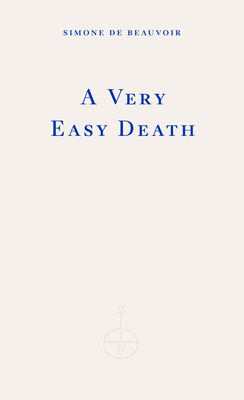 In October 1963, de Beauvoir was in Rome when she got a call informing her that her mother had had an accident. Expecting the worst, she was relieved – if only temporarily – to hear that it was a fall at home, resulting in a broken femur. But when Françoise de Beauvoir got to the hospital, what at first looked like peritonitis was diagnosed as stomach cancer with an intestinal obstruction. Her daughters knew that she was dying, but she had no idea (from what I’ve read, this paternalistic notion that patients must be treated like children and kept ignorant of their prognosis is more common on the Continent, and continues even today).
Over the next month, de Beauvoir and her sister Poupette took turns visiting. Initially alarmed by their mother’s condition, they soon grew used to the deterioration. “I was not worried by her nakedness any more: it was no longer my mother, but a poor tormented body.” They found her in varying states of awareness and discomfort. “In this race between pain and death we most earnestly hoped that death would come first.” Some nurses were better than others. De Beauvoir makes tantalizing references to the standoff between her and her mother about the Catholic faith Simone left behind. (I’ll need to read Memoirs of a Dutiful Daughter for more on that.) Even the hope of heaven didn’t fully neutralize self-pity and physical suffering for the dying woman because she feared her daughters wouldn’t be joining her.
The title is what a nurse told the grieving daughters: that their mother’s had been a very easy death in the end (and an upper-class one, de Beauvoir adds). The word used in French for easy, douce, can also be translated as “gentle,” a tie-in to the epigraph from Dylan Thomas’s “Do not go gentle into that good night.” Is it better for a loved one to die suddenly, or protractedly? I’ve debated this with myself and a few others since my mother’s death from a stroke in October. Ultimately, it’s pointless to ask; any death is an affront, hard to accept and adjust to no matter how much warning is given. I appreciated how matter-of-factly and concisely de Beauvoir’s essay encapsulates the duties and feelings surrounding a death. Frank and unshowy yet potent, this is a classic of the subgenre.
Published as Fitzcarraldo Editions Classics No. 2 in June. With thanks to the publisher for the free copy for review.
(Books of Summer, #10)
Finn Family Moomintroll by Tove Jansson (1948; 1950)
[Translated from the Swedish by Elizabeth Portch]
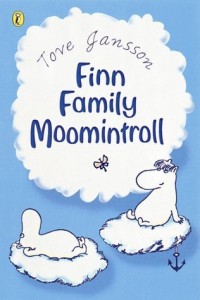 My sixth Moomins book, and ninth by Jansson overall. The novella’s gentle peril is set in motion by the discovery of the Hobgoblin’s Hat, which transforms anything placed within it. As spring moves into summer, this causes all kind of mild mischief until Thingumy and Bob, who speak in spoonerisms, show up with a suitcase containing something desired by both the Groke and the Hobgoblin, and make a deal that stops the disruptions.
As always, the creatures and events, conveyed by Jansson’s black-and-white drawings as much as by her words, are inventive and whimsical. There’s a cosy charm to the seasonal rituals, like the end-of-summer pancake party here. But what I value even more is the pointed accounts of the secondary characters’ neuroses. The Moomins are generally on a pretty even keel, though there is mention of Moominpappa’s sense of being hard done by because of childhood bullying and an enduring lack of respect. However, characters like the Muskrat and the Hemulen get a wry smile and shake of the head from me because their predicaments are so familiar: The Muskrat, terrified of mortifying situations, decides the life of a hermit might be preferable; the Hemulen gives up stamp collecting and switches to botanizing because there’s no joy in a finished quest, only in an ongoing search. The Moomins books offer the perfect combination of the familial and routine with the novel and adventurous. Even staid adults should give them a try. (Little Free Library)
Self-Portrait in Green by Marie NDiaye (2005; 2015)
[Translated from the French by Jordan Stump]
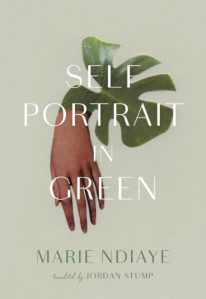 I tend to love a memoir that tries something new or experimental with the form (such as Constructing a Nervous System or In the Dream House), but this was a step too far for me; the self referred to in the title is almost wholly absent. NDiaye, a French–Senegalese author, opens in 2003 with the expected flooding of the Garonne in southwest France. Fragments of narrative from 2000–2003 chart her encounters with various women dressed in green, starting with one she thinks she sees under a banana tree (though her four children see nothing). Then there’s Katia Depetiteville, dead 10 years … NDiaye’s stepmother, once her childhood best friend; her friend Jenny’s rival for Ivan’s affection; and her mother, who now has a new family. What is a ‘woman in green’? The author explicitly associates the colour with cruelty, with presumably the usual connotation of jealousy as well. But it still feels arbitrary.
It’s all rather dreamlike, with poetic repetition, rhetorical questions and black-and-white photos that seem marginally relevant. “I’m saying to myself: Is all this really real?” NDiaye writes, and the reader will surely be asking the same. “I’m always interested in stories,” she adds, and while I’d agree, I need to know that they’re being told to build to some greater meaning. It was only in the last fifth of the book, when the author goes to a literary symposium in Ouagadougou and visits her father (a many-times-married former restaurateur and amateur architect now suffering from cataracts) and stepmother that I felt like there was a purpose: a bringing together of past and present for psychological clarity. I was relieved that this was only 112 pages. (Edelweiss) 
The 10th anniversary edition is being reissued by Two Lines Press next month.
And a bonus preview:
Cross-Stitch by Jazmina Barrera (2021; 2023)
[Translated from the Spanish by Christina MacSweeney]
 In the inventive debut novel by Mexican author Jazmina Barrera, a sudden death provokes an intricate examination of three young women’s years of shifting friendship. Their shared hobby of embroidery occasions a history of women’s handiwork, woven into a relationship study that will remind readers of works by Elena Ferrante and Deborah Levy. Citlali, Dalia, and Mila had been best friends since middle school. Mila, a writer with a young daughter, is blindsided by news that Citlali has drowned off Senegal. While waiting to be reunited with Dalia for Citlali’s memorial service, she browses her journal to revisit key moments from their friendship, especially travels in Europe and to a Mexican village. Cross-stitch becomes its own metaphorical language, passed on by female ancestors and transmitted across social classes. Reminiscent of Still Born and A Ghost in the Throat. (Edelweiss)
Coming out on 7 November from Two Lines Press. My full review for Shelf Awareness is pending.
#NovNov Translated Week: In the Company of Men and Winter Flowers
I’m sneaking in under the wire here with a couple more reviews for the literature in translation week of Novellas in November. These both happen to be translated from the French, and attracted me for their medical themes: the one ponders the Ebola crisis in Africa, and the other presents a soldier who returns from war with disfiguring facial injuries.
In the Company of Men: The Ebola Tales by Véronique Tadjo (2017; 2021)
[Translated from the French by the author and John Cullen; Small Axes Press; 133 pages]
 This creative and compassionate work takes on various personae to plot the course of the Ebola outbreak in West Africa in 2014–16: a doctor, a nurse, a morgue worker, bereaved family members and browbeaten survivors. The suffering is immense, and there are ironic situations that only compound the tragedy: the funeral of a traditional medicine woman became a super-spreader event; those who survive are shunned by their family members. Tadjo flows freely between all the first-person voices, even including non-human narrators such as baobab trees and the fruit bat in which the virus likely originated (then spreading to humans via the consumption of the so-called bush meat). Local legends and songs, along with a few of her own poems, also enter into the text.
Like I said about The Appointment, this would make a really interesting play because it is so voice-driven and each character epitomizes a different facet of a collective experience. Of course, I couldn’t help but think of the parallels with Covid – “you have to keep your distance from other people, stay at home, and wash your hands with disinfectant before entering a public space” – none of which could have been in the author’s mind when this was first composed. Let’s hope we’ll soon be able to join in cries similar to “It’s over! It’s over! … Death has brushed past us, but we have survived! Bye-bye, Ebola!” (Secondhand purchase)
Winter Flowers by Angélique Villeneuve (2014; 2021)
[Translated from the French by Adriana Hunter; 172 pages]
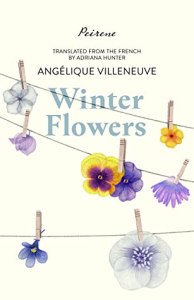 With Remembrance Day not long past, it’s been the perfect time to read this story of a family reunited at the close of the First World War. Jeanne Caillet makes paper flowers to adorn ladies’ hats – pinpricks of colour to brighten up harsh winters. Since her husband Toussaint left for the war, it’s been her and their daughter Léonie in their little Paris room. Luckily, Jeanne’s best friend Sidonie, an older seamstress, lives just across the hall. When Toussaint returns in October 1918, it isn’t the rapturous homecoming they expected. He’s been in the facial injuries department at the Val-de-Grâce military hospital, and wrote to Jeanne, “I want you not to come.” He wears a white mask over his face, hasn’t regained the power of speech, and isn’t ready for his wife to see his new appearance. Their journey back to each other is at the heart of the novella, the first of Villeneuve’s works to appear in English.
I loved the chapters that zero in on Jeanne’s handiwork and on Toussaint’s injury and recovery (Lindsey Fitzharris, author of The Butchering Art, is currently writing a book on early plastic surgery; I’ve heard it also plays a major role in Louisa Young’s My Dear, I Wanted to Tell You – both nominated for the Wellcome Book Prize), and the two gorgeous “Word is…” litanies – one pictured below – but found the book as a whole somewhat meandering and quiet. If you’re keen on the time period and have enjoyed novels like Birdsong and The Winter Soldier, it would be a safe bet. (Cathy’s reviewed this one, too.)

With thanks to Peirene Press for the free copy for review.
(In a nice connection with a previous week’s buddy read, Villeneuve’s most recent novel is about Helen Keller’s mother and is called La Belle Lumière (“The Beautiful Light”). I hope it will also be made available in English translation.)
The Mystery of Henri Pick by David Foenkinos (Walter Presents Blog Tour)
A library populated entirely by rejected books? Such was Richard Brautigan’s brainchild in one of his novels, and after his suicide a fan made it a reality. Now based in Vancouver, Washington, the Brautigan Library houses what French novelist David Foenkinos calls “the world’s literary orphans.” In The Mystery of Henri Pick, he imagines what would have happened had a French librarian created its counterpart in a small town in Brittany and a canny editor discovered a gem of a bestseller among its dusty stacks.
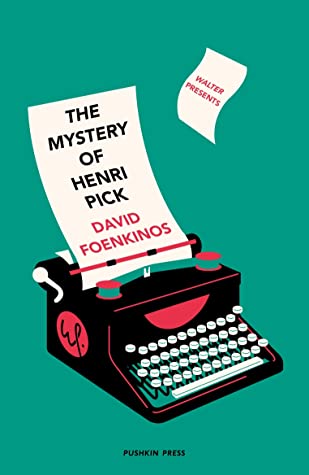 Delphine Despero is a rising Parisian editor who’s fallen in love with her latest signed author, Frédéric Koskas. Unfortunately, his novel The Bathtub is a flop, but he persists in writing a second, The Bed. On a trip home to Brittany so Frédéric can meet her parents, he and Delphine drop into the library of rejected books at Crozon and find a few amusing turkeys – but also a masterpiece. The Last Hours of a Love Affair is what it says on the tin, but also incorporates the death of Pushkin. The name attached to it is that of the late pizzeria owner in Crozon. His elderly widow and middle-aged daughter had no idea that their humble Henri had ever had literary ambitions, let alone that he had a copy of Eugene Onegin in the attic.
The Last Hours of a Love Affair becomes a publishing sensation – for its backstory more than its writing quality – yet there are those who doubt that Henri Pick could have been its author. The doubting faction is led by Jean-Michel Rouche, a disgraced literary critic who, having lost his job and his girlfriend, now has all the free time in the world to research the foundation of the Library of Rejects and those who deposited manuscripts there. Just when you think matters are tied up, Foenkinos throws a curveball.
This was such a light and entertaining read that I raced through. It has the breezy, mildly zany style I associate with films like Amélie. Despite the title, there’s not that much of a mystery here, but that suited me since I pretty much never pick up a crime novel. Foenkinos inserts lots of little literary in-jokes (not least: this is published by Pushkin Press!), and through Delphine he voices just the jaded but hopeful attitude I have towards books, especially as I undertake my own project of assessing unpublished manuscripts:
She had about twenty books to read during August, and they were all stored on her e-reader. [Her friends] asked her what those novels were about, and Delphine confessed that, most of the time, she was incapable of summarizing them. She had not read anything memorable. Yet she continued to feel excited at the start of each new book. Because what if it was good? What if she was about to discover a new author? She found her job so stimulating, it was almost like being a child again, hunting for chocolate eggs in a garden at Easter.
Great fun – give it a go!
My rating:
(Originally published in 2016. Translation from the French by Sam Taylor, 2020.)
My thanks to Poppy at Pushkin Press for arranging my e-copy for review.
(Walter Presents, a foreign-language drama streaming service, launched in the UK (on Channel 4) in 2016 and is also available in the USA, Australia, and various European countries.)
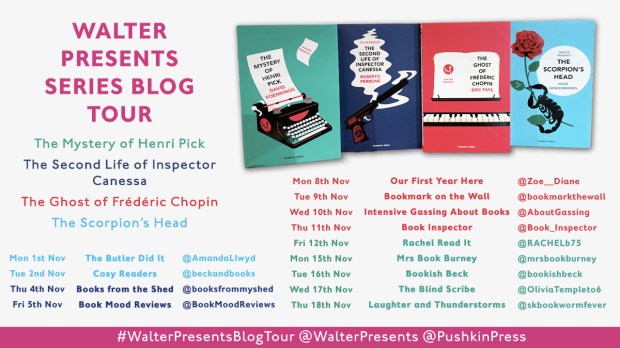
I was delighted to be part of the Walter Presents blog tour. See below for details of where other books and reviews have featured.
Autumnal Children’s and YA Books
Browsing through old magazines, I found a fun BookPage reading list from October 2019 entitled “Pumpkin spice latte literature.” It asks, “what if autumn were distilled into a book? The mixture of crispness and warmth, the thrill of possibility, the bittersweetness of change—these books are pure pumpkin spice.” I love the lateral thinking that came up with
 The Art of Fielding by Chad Harbach (back to school in the Midwest)
- I Remember Nothing by Nora Ephron (wry reflections from the autumn of a life)
- Possession by A.S. Byatt (bookish geeking out)
- Calling a Wolf a Wolf by Kaveh Akbar (taking comfort from a vision of recovery from alcoholism)
- An Enchantment of Ravens by Margaret Rogerson (wit and magic)
I’ve read the first three, and am keen to catch up on Akbar’s debut poetry collection after loving Pilgrim Bell this summer. I’m only unlikely to pick up Rogerson’s fantasy. In any case, I enjoyed seeing how the editors came up with their selections.
I tend to be rather more literal with my seasonal reading recommendations. Does it have autumn in the title or as a setting?! Is it about pumpkins or Halloween?
This year I happen to have amassed all children’s and YA selections.
October, October by Katya Balen (2020)
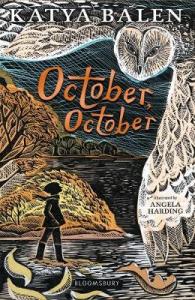 I’ll admit it: it was Angela Harding’s gorgeous cover illustration that drew me to this one. But I found a story that lived up to it, too. October, who has just turned 11 and is named after her birth month, lives in the woods with her father. Their shelter and their ways are fairly primitive, but it’s what October knows and loves. When her father has an accident and she’s forced into joining her mother’s London life, her only consolations are her rescued barn owl chick, Stig, and the mudlarking hobby she takes up with her new friend, Yusuf.
The child’s perspective is well rendered through artful run-on sentences. Balen is careful to show the consequences of October’s decisions and to present advantages as well as disadvantages so it’s not just countryside = good, city = bad. I thought the father’s recovery a bit too quick, but overall, this middle grade novel was a great read for any age, as well as one to get kids thinking about illness and loss. And how about these heart-tugging last lines? “There are stories everywhere and I want to tell them all. And all the world is wild and waiting for me.” (Public library)
Autumn Story by Jill Barklem (1980)
 The second in the quartet of seasonal “Brambly Hedge” stories. Autumn is a time for stocking the pantry shelves with preserves, so the mice are out gathering berries, fruit and mushrooms. Young Primrose wanders off, inadvertently causing alarm – though all she does is meet a pair of elderly harvest mice and stay for tea and cake in their round nest amid the cornstalks. I love all the little touches in the illustrations: the patchwork tea cosy matches the quilt on the bed one floor up, and nearly every page is adorned with flowers and other foliage. After we get past the mild peril that seems to be de rigueur for any children’s book, all is returned to a comforting normal. Time to get the Winter volume out from the library. (Public library)
Une Chanson d’ours by Benjamin Chaud (2011)
 The first whole book I’ve read in French in many a year. I just about coped, given that it’s a picture book with not all that many words on a page; any vocabulary I didn’t know offhand, I could understand in context. It’s late into the autumn and Papa Bear is ready to start hibernating for the year, but Little Bear spies a late-flying bee and follows it out of the woods and all the way to the big city. Papa Bear, realizing his lad isn’t beside him in the cave, sets out in pursuit and bee, cub and bear all end up at the opera hall, to the great surprise of the audience. What will Papa do with his moment in the spotlight? This is a lovely book that, despite the whimsy, still teaches about the seasons and parent–child bonds as it offers a vision of how humans and animals could coexist. I’ve since found out that this was made into a series of four books, all available in English translation. (Little Free Library)
Pumpkinheads by Rainbow Rowell; illus. Faith Erin Hicks (2019)
 This YA graphic novel is set on a Nebraska pumpkin patch that’s more like Disney World than a simple field down the road. Josiah and Deja have worked together at the Succotash Hut for the last three autumns. Today they’re aware that it’s their final Halloween before leaving for college. Deja’s goal is to try every culinary delicacy the patch has to offer – a smorgasbord of foodstuffs that are likely to be utterly baffling to non-American readers: candy apples, Frito pie (even I hadn’t heard of this one), kettle corn, s’mores, and plenty of other saccharine confections.
Josiah’s goal, by contrast, is to catch the eye of Marcy, the beauty who works at the fudge stand. Deja convinces him to desert the Succotash Hut and go in pursuit of Marcy via as many food stands as possible. She’s willing to indulge his unrealistic fantasy even though, as a bisexual who’s dated just about everyone at the patch, she knows romance is sometimes not all it’s cracked up to be. Meanwhile, there’s an angry billy goat on the loose.
This is a fun and quick romp, and the ending genuinely surprised me. I liked the story better than the art, though – my main problem was that these teen characters look more like they’re 30 (Josiah, especially, looks almost haggard what with the sharp lines down the sides of his face – I guess they’re to give him a ‘chiselled’ jaw?), similar to that weird phenomenon of much older actors playing high schoolers. So, I laughed to see in an afterword conversation between Rowell and Hicks that one of the major things they changed from early mock-ups was making the protagonists look older. (Public library) 
Pick a Pumpkin by Patricia Toht; illus. Jarvis (2019)
 From picking the best pumpkin at the patch to going out trick-or-treating, this is a great introduction to Halloween traditions. It even gives step-by-step instructions for carving a jack-o’-lantern. The drawing style – generally 2D, and looking like it could be part cut paper collages, with some sponge painting – reminds me of Ezra Jack Keats and most of the characters are not white, which is refreshing. There are lots of little autumnal details to pick out in the two-page spreads, with a black cat and crows on most pages and a set of twins and a mouse on some others. The rhymes are either in couplets or ABCB patterns. Perfect October reading. (Public library)
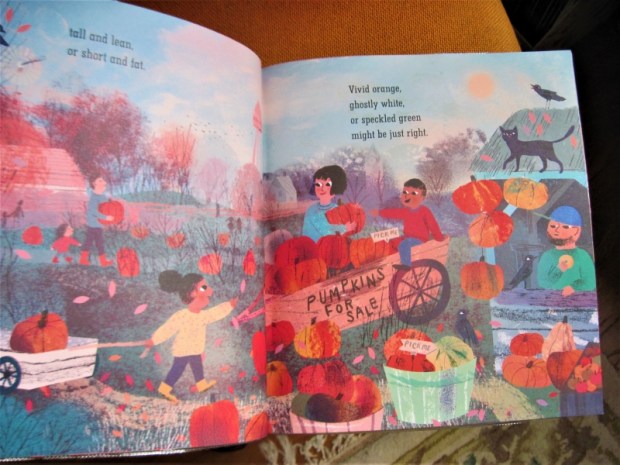 Any super-autumnal reading for you this year?
Do you read children’s picture books and YA novels even if you (and any children) are well past that age – or is it just me?
Five Novellas in Translation
We’re coming to the close of Literature in Translation week of Novellas in November. Cathy and I have both noted that novellas seem more common in other languages, with the work more likely to take on experimental forms. We wondered why this is – do foreign languages and cultures somehow lend themselves to concise storytelling that takes more risks? However, a commenter on a post of Cathy’s suggested that economic realities may have something to do with it: translating short works is faster and cheaper. In a recent blog post, Louise Walters, whose indie publishing imprint is preparing to release its shortest book yet (In the Sweep of the Bay by Cath Barton, 22,000 words), confirms that production and shipping costs are lower for novellas, so she has the chance of recouping her investment.

I’ve gotten to five short translated works this month: three fiction and two nonfiction. (Or should that be four fiction and one nonfiction? With autofiction it’s hard to tell.)
Dependency by Tove Ditlevsen (1971; 2019)
[Translated from the Danish by Michael Favala Goldman]
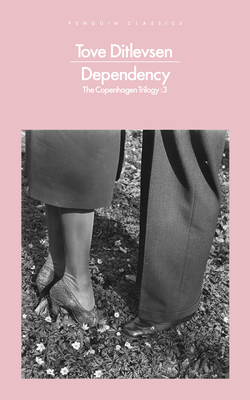 The final volume of the autobiographical Copenhagen Trilogy, after Childhood and Youth. Ditlevsen recalls her upbringing in poverty and her early success as a poet. By the end of the second book, she’s engaged to a much older literary editor. A series of marriages and affairs follows: Viggo, Ebbe, Carl and Victor are the major names, with some others in between. She produces stories and poems as well as a daughter and a son, but also has two abortions. Carl performs one of these and gives her a Demerol shot; ever afterwards, she takes advantage of his obsession with her chronic ear infection to beg for painkiller shots. “Then time ceases to be relevant. An hour could be a year, and a year could be an hour. It all depends on how much is in the syringe.” Addiction interferes with her work and threatens her relationships, but it’s an impulse that never leaves her even when she swaps the harder stuff for alcohol.
I only skimmed this one because from the other volumes I knew how flat and detached the prose is, even when describing desperate circumstances. I can admire this kind of writing – the present-tense scenes, the lack of speech marks, the abrupt jumps between time periods and emotional states, all coldly expressed – but I’m not sure I’ll ever love it. Of the three books, I liked Childhood the best for its universal observations.
La Symphonie Pastorale by André Gide (1919; 1931)
[Translated from the French by Dorothy Bussy]
“Love is blindness / I don’t want to see” (U2)
 I had a secondhand French copy when I was in high school, always assuming I’d get to a point of fluency where I could read it in its original language. It hung around for years unread and was a victim of the final cull before my parents sold their house. Oh well! There’s always another chance with books. In this case, a copy of this plus another Gide novella turned up at the free bookshop early this year. A country pastor takes Gertrude, the blind 15-year-old niece of a deceased parishioner, into his household and, over the next two years, oversees her education as she learns Braille and plays the organ at the church. He dissuades his son Jacques from falling in love with her, but realizes that he’s been lying to himself about his own motivations. This reminded me of Ethan Frome as well as of other French classics I’ve read (Madame Bovary and Thérèse Raquin). Melodramatic, maybe, but I loved the religious and medical themes (deaf-blind Laura Bridgman gets a mention; when the preacher and Gertrude attend the title symphony, he encourages her synesthetic thinking).
Stammered Songbook: A Mother’s Book of Hours by Erwin Mortier (2011; 2015)
[Translated from the Dutch by Paul Vincent]
 In fragmentary vignettes, some as short as a few lines, Belgian author Mortier chronicles his mother’s Alzheimer’s, which he describes as a “twilight zone between life and death.” His father tries to take care of her at home for as long as possible, but it’s painful for the family to see her walking back and forth between rooms, with no idea of what she’s looking for, and occasionally bursting into tears for no reason. Most distressing for Mortier is her loss of language. As if to compensate, he captures her past and present in elaborate metaphors: “Language has packed its bags and jumped over the railing of the capsizing ship, but there is also another silence … I can no longer hear the music of her soul”. He wishes he could know whether she feels hers is still a life worth living. There are many beautifully meditative passages, some of them laid out almost like poetry, but not much in the way of traditional narrative; it’s a book for reading piecemeal, when you have the fortitude.
Bonjour Tristesse by Françoise Sagan (1954; 1955)
[Translated from the French by Irene Ash]
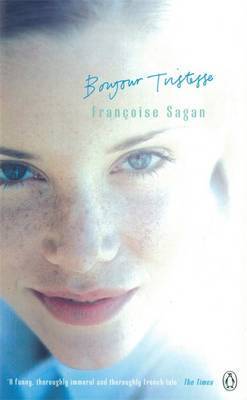 Like The Go-Between and Atonement, this is overlaid with regret about childhood caprice that has unforeseen consequences. That Sagan, like her protagonist, was only a teenager when she wrote it only makes this 98-page story the more impressive. Although her widower father has always enjoyed discreet love affairs, seventeen-year-old Cécile has basked in his undivided attention until, during a holiday on the Riviera, he announces his decision to remarry a friend of her late mother. Over the course of one summer spent discovering the pleasures of the flesh with her boyfriend, Cyril, Cécile also schemes to keep her father to herself. Dripping with sometimes uncomfortable sensuality, this was a sharp and delicious read.
The Order of the Day by Éric Vuillard (2017; 2018)
[Translated from the French by Mark Polizzotti]
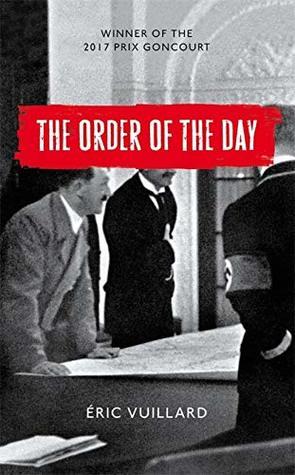 February 1933: 24 German captains of industry meet with Hitler to consider the advantages of a Nazi government. I loved the pomp of the opening chapter: “Through doors obsequiously held open, they stepped from their huge black sedans and paraded in single file … they doffed twenty-four felt hats and uncovered twenty-four bald pates or crowns of white hair.” As the invasion of Austria draws nearer, Vuillard recreates pivotal scenes featuring figures who will one day commit suicide or stand trial for war crimes. Reminiscent in tone and contents of HHhH, The Tobacconist, and the film Downfall, this starts off promisingly and ends with clear relevance to the present moment (“a mysterious respect for lies. Political manoeuvring tramples facts”) and a brilliant final paragraph, but in between was dull. You’d have to have more interest in history than I do to love this Prix Goncourt winner.
Publishers that specialize in novellas in translation:
Charco Press – I’ve reviewed:
 The Wind that Lays Waste by Selva Almada
Fish Soup by Margarita García Robayo
Die, My Love by Ariana Harwicz
Peirene Press – I’ve reviewed:
Mr. Darwin’s Gardener by Kristina Carlson
The Looking-Glass Sisters by Gøhril Gabrielsen
Ankomst by Gøhril Gabrielsen
 Dance by the Canal by Kerstin Hensel
The Last Summer by Ricarda Huch
Snow, Dog, Foot by Claudio Morandini
Her Father’s Daughter by Marie Sizun
The Orange Grove by Larry Tremblay
The Man I Became by Peter Verhelst
A few more favorite novellas in translation:
The Plimsoll Line by Juan Gracia Armendáriz
 Silk by Alessandro Baricco
Agatha by Anne Cathrine Bomann
Swallowing Mercury by Wioletta Greg
Next week, we’re closing out Novellas in November with a focus on short classics. I’ll introduce the week’s theme with some of my favorite examples on Monday.
Any theories as to why so many novellas are from other languages?
What are some of your favorites?
Three for Novellas in November: Bythell, Carey and Diop
I started my reading for Novellas in November early with these three review books, one nonfiction and two fiction. They have in common the fact that they are published today –although I believe two were released early to beat the lockdown. Don’t worry, though; there are still plenty of ways of getting hold of new books: most publishers and bookshops are still filling orders, or you can use the UK’s newly launched Bookshop.org site and support your local indie.
Seven Kinds of People You Find in Bookshops by Shaun Bythell
[137 pages]
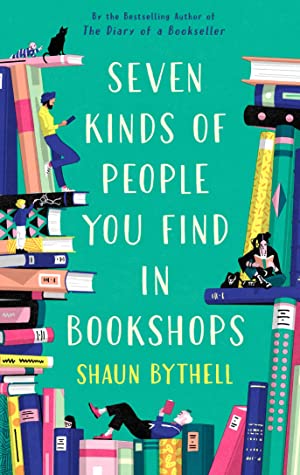 Cheerfully colored and sized to fit into a Christmas stocking, this is a fun follow-up to Bythell’s accounts of life at The Bookshop in Wigtown, The Diary of a Bookseller and Confessions of a Bookseller. Within his seven categories are multiple subcategories, all given tongue-in-cheek Latin names as if naming species. When I saw him chat with Lee Randall at the opening event of the Wigtown Book Festival, he introduced a few, such as the autodidact who knows more than you and will tell you all about their pet subject (the Homo odiosus, or bore). This is not the same, though, as the expert who shares genuinely useful knowledge – of a rare cover version on a crime paperback, for instance (Homo utilis, a helpful person).
There’s also the occultists, the erotica browsers, the local historians, the self-published authors, the bearded pensioners (Senex cum barba) holidaying in their caravans, and the young families – now that he has one of his own, he’s become a bit more tolerant. Setting aside the good-natured complaints, who are his favorite customers? Those who revel in the love of books and don’t quibble about the cost. Generally, these are not antiquarian book experts looking for a bargain, but everyday shoppers who keep a low-key collection of fiction or maybe specifically sci-fi and graphic novels, which fly off the shelves for good prices.
So which type am I? Well, occasionally I’m a farter (Crepans), but you won’t hold that against me, will you? I’d like to think I fit squarely into the normal people category (Homines normales) when I visited Wigtown in April 2018: we went in not knowing what we wanted but ended up purchasing a decent stack and even had a pleasant conversation with the man himself at the till – he’s much less of a curmudgeon in person than in his books. I do recommend this to those who have read and loved his other work.
With thanks to Profile Books for the free copy for review.
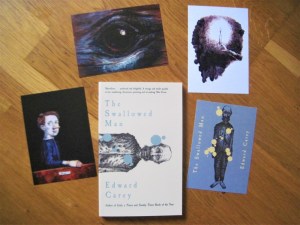
The Swallowed Man by Edward Carey
[160 pages]
 Carey’s historical novel Little was one of my highlights of 2018, so I jumped at the chance to read his new book. Interestingly, this riff on the Pinocchio story, narrated by Geppetto from the belly of a giant shark, originally appeared in Italian to accompany an exhibition hosted by the Fondazione Nazionale Carlo Collodi at the Parco di Pinocchio in Collodi. Geppetto came from a pottery-painting family but turned to wood when creating a little companion for his loneliness, the wooden boy who astounded him by coming to life. Now a son rather than a mere block of wood, Pinocchio sets off for school but never comes home. When he gets word that a troublesome automaton has been thrown into the sea, Geppetto sets out in a dinghy to find his son but is swallowed by the enormous fish that has been seen off the coast.
The picture of this new world-within-a-world is enthralling. Geppetto finds himself inside a swallowed ship, the Danish schooner Maria. Within the vessel is all he needs to occupy himself, at least for now: wood on which to paint the women he has loved; candle wax and hardtack for sculpting figures. Seaweed to cover his bald spot. Squid ink for his pen so he can write this notebook. A crab that lives in his beard. Relics of the captain’s life to intrigue him.
As a narrator, Geppetto is funny and gifted at wordplay (“This tome is my tomb”; “I unobjected him. Can you object to that?”), yet haunted by his decisions. Carey deftly traces Geppetto’s state of mind as he muses on his loss and imprisonment. The Afterword adds a sly pseudohistorical note to the fantasy. There are black-and-white illustrations throughout, as well as photos of the objects described in the text (and, presumably, featured in the exhibition). For me this didn’t live up to Little, but it would be a great introduction to Carey’s work.
With thanks to Gallic Books for the free copy for review.
At Night All Blood Is Black by David Diop
[145 pages; translated from the French by Anna Moschovakis]
 I had no idea that Africans (“Chocolat soldiers”) fought for France in World War I. Diop’s second novel, which has already won several major European prizes, is about two Senegalese brothers-in-arms caught up in trench warfare. Alfa Ndaiye, aged 20, considers Mademba Diop his blood brother or “more-than-brother” (the novel’s French title is “Soul Brother”). From the start we know that Mademba has died. Gravely injured in battle, entrails spilling out, he begged Alfa to end his misery; three times Alfa refused. Having watched his friend die in agony, he knows he did the wrong thing. Slitting the man’s throat would have been the compassionate choice. From now on, Alfa will atone by brutally wreaking Mademba’s method of death on Germans. “The captain’s France needs our savagery, and because we are obedient, myself and the others, we play the savage.” Alas, I thought this bleak exploration of (in)humanity was marred by the repetitive language and unpleasantly sexualized metaphors.
With thanks to Pushkin Press for the proof copy for review.
Do any of these novellas take your fancy?
What November releases can you recommend?
A Hundred Million Years and a Day by Jean-Baptiste Andrea
 Stanislas Armengol remembers finding his first trilobite at the age of six. His fossils and his dog were his best friends during a lonely childhood dominated by a violent father nicknamed “The Commander.” Now, in the summer of 1954, Stan is a 52-year-old paleontologist embarking on the greatest project of his career. He sold his apartment in Paris to finance this expedition to the French/Italian Alps in search of a “dragon” (perhaps a diplodocus) said to be buried in a glacier between three mountain peaks.
“A scientist does not unquestioningly swallow a tall tale without demanding some proof, some concrete detail,” Stan insists. “Doubt is our religion.” But he’s seen a promising bone fragment from the region, and his excitement soon outweighs his uncertainty. This is his chance to finally make a name for himself. Arriving from Turin to join Stan are his friend and former assistant Umberto, and Umberto’s assistant, Peter. Gio, a local, will be their guide. It’s a tough climb requiring ropes and harnesses. As autumn approaches, and then winter, the hunt for the fossil becomes more frantic. The others are prepared to come back next year if it’s no longer sensible to continue, but Stan has staked everything on the venture and won’t quit.
Stan’s obsession puts him in touch with deep time – he’s “someone whose profession forces him to think in terms of millions of years” – but his thoughts keep returning to moments of joy or distress from his childhood. Although she died when he was nine years old, his beloved mother still looms large in his memory. Even as the realities of cold and hunger intensify, his past comes to seem more vivid than his present.
This French bestseller was shortlisted for the Grand Prix de l’Académie Française last year. Sam Taylor’s translation is flawless, as always (I only noted one tiny phrase that felt wrong for the time period – “honestly, what a brat” – though for all I know it’s off in the original, too). However, I found the novella uncannily similar to Snow, Dog, Foot by Claudio Morandini, which is about a hermit in the Italian Alps whose mental illness is exacerbated by snowy solitude. I found Morandini’s witty, macabre story more memorable. Although A Hundred Million Years and a Day is well constructed, there’s something austere about it that meant my admiration never quite moved into fondness.
My rating:
A Hundred Million Years and a Day will be published in the UK tomorrow, the 11th. My thanks to Gallic Books for the free copy for review.
I was delighted to be invited to participate in the blog tour. See below for details of where other reviews and features have appeared or will be appearing soon.

Women in Translation Month 2019, Part I: Ernaux and Poschmann
Two rather different books to start off #WITMonth: a brief (c. 70 pp.) account of a mother’s decline with dementia; and a haiku-inspired novel of the quest for life and death in disorienting modern Japan. Both are admirable but detached – a judgment I seem more likely to make about work in translation – so don’t earn my wholehearted recommendation. My rating for both:
I Remain in Darkness by Annie Ernaux (1997; English translation, 1999)
[Translated from the French by Tanya Leslie]
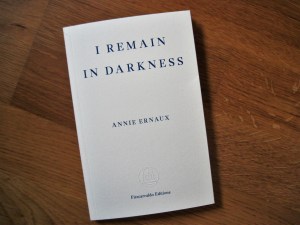 This is the second short, somewhat harrowing autobiographical work I’ve read by Ernaux this year (after Happening, her account of her abortion, in March). A collection of mostly present-tense fragments, it’s drawn from the journal she kept during her mother’s final years, 1983–6. “I Remain in Darkness” were the last words her mother wrote, in a letter to a friend (“Je ne suis pas sortie de ma nuit,” which more literally means “I have not left my night,” strikes me as cryptic and poetic, though maybe I’m missing a colloquialism). Slipping into Alzheimer’s, her mother spent these years in a long-term hospital geriatric ward. Ernaux could see her mother becoming like a child again:
This morning she got up and, in a timid voice, said: ‘I wet the bed. I couldn’t help it.’ The same words I would use when I was a child.
Now her room is on the third floor. A bunch of women circle us, addressing my mother with the familiar tu form: ‘You’re going to be in our group?’ They are like kids talking to the ‘new girl’ at school. When I take leave of her, she looks at me in panic and confusion: ‘You’re not leaving, are you?’
—and herself becoming like her mother: “It’s crystal-clear: she is me in old age and I can see the deterioration of her body threatening to take hold of me – the wrinkles on her legs, the creases in her neck”. Ernaux vacillates between guilt, fear and cruelty in how she approaches her mother. She tenderly shaves the older woman’s face every week when she visits, and buys her all manner of sweets. Food is one of her mother’s last remaining pleasures, though she often misses her mouth when she tries to eat the cakes her daughter brings.
Superficially, this is very similar to another book I’ve reviewed this year, Be With by Mike Barnes, a series of short letters written during his time as a caregiver to his mother, who also has Alzheimer’s. But where Barnes is reassuring and even humorous at times, Ernaux refuses to give any comfort, false or otherwise. This hospital is a bleak place that reeks of urine and is hiding excrement everywhere (really). A lazier reviewer than I generally try to be would brandish the word “unflinching.”
The entries from a few days after her mother’s death explain what the author is trying to do with her work, whether memoir or autofiction: “I am incapable of producing books that are not precisely that – an attempt to salvage part of our lives, to understand, but first to salvage … I’ll have to tell her story in order to ‘distance myself from it’.” That dual purpose, saving and distancing, makes her work honest yet unemotional, such that I have trouble warming to it.
This is easily read in a sitting. I may try again to get into Ernaux’s novel The Years, which, like the Poschmann (below), was on this past year’s Man Booker International Prize shortlist.
I Remain in Darkness will be released on September 18th. With thanks to Fitzcarraldo Editions for the free copy for review.
The Pine Islands by Marion Poschmann (2017; English translation, 2018)
[Translated from the German by Jen Calleja]
(Though I read this mostly in July, I finished it on August 1st, so I’m including it in my WIT Month coverage. It’s the first of the author’s books to be made available in English.)
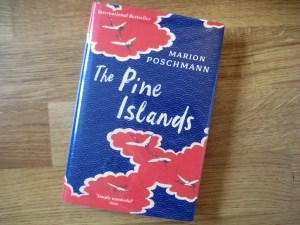 A man wakes up from a dream convinced that his wife is cheating on him, and sets off for Tokyo on a whim, where he embarks on a Bashō-inspired pilgrimage to the pine islands of Matsushima. This Gilbert Silvester, a beard historian, acquires an unlikely companion: a young man named Yosa, who’s looking for the best place to kill himself and takes Gilbert along to cliffs and forests famous for their suicide rates. Although there are still cherry blossoms and kabuki theatre, Gilbert soon learns that this isn’t Bashō’s Japan anymore.
From the haikus he composes and the letters he writes to Mathilda back home, we track his inward journey as it contrasts with the outward ones he undertakes. I enjoyed the surreal touches – Yosa says he once dated a woman who was actually a fox – and the Murakami setup (the wife’s adultery and the hair patterns are reminiscent of The Wind-Up Bird Chronicle).
Somehow, though, for me this is a book that succeeds more in its ideas (searching for the essence of a place but only finding the clichés; coniferous versus deciduous trees as a metaphor for what lasts in life versus what fades) than in its actual execution. It never all quite comes together, and the inconclusive ending makes you question how much of this has been a dream or a fantasy. It’s ambitious and intellectually impressive, but something about its dignified aloofness is hard to be enthusiastic about.
Do watch Lost in Translation, one of my favorite films, afterwards…
And a DNF: The Days of Abandonment by Elena Ferrante. The time has come to admit that I simply do not appreciate Ferrante’s work. I could only make it 25 pages into this one; I’ve read a different short novel of hers (The Lost Daughter), and skimmed another (My Brilliant Friend). While I enjoyed the narrator’s voice well enough, and loved the scene in which her errant husband finds broken glass in his dinner, I found that I had no interest in how this seemingly predictable story of the end of a marriage might play out.
Up next for Part II: The Wind that Lays Waste by Selva Almada, on its way from Charco Press, and The Awakening of Miss Prim by Natalia Sanmarin Fenollera.
Are you doing any special reading for Women in Translation month this year?
Classic of the Month: Thérèse Raquin by Émile Zola
I didn’t even make it past the first page of Giuseppe di Lampedusa’s The Leopard, which I’d planned for June, so in the middle of the month I had to rifle through my shelves for a short and accessible classic and found just that in Thérèse Raquin (1868) by Émile Zola. I’d only read one Zola novel previously, Germinal (1885), about seven years ago. I remember finding Germinal, an exposé of the working conditions of miners, heavy-handed, and while the same could be said of Thérèse Raquin, the latter is so deliciously Gothic that I could forgive the hammering on extreme emotions and points of morality that takes up the second half.
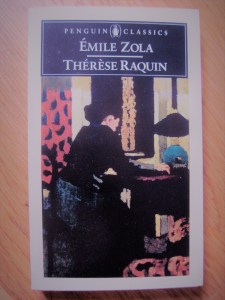 “The Passage du Pont-Neuf is no place to go for a nice stroll. You use it as a short cut and time-saver.” Yet this is the Paris street on which Madame Raquin runs her haberdashery shop, having moved here from a Normandy town when her son Camille insisted on getting a job with the Orléans railway. He has recently married his first cousin, Thérèse, whom Mme Raquin raised as her own daughter and always intended for Camille. Mme Raquin’s brother, a naval captain, had dropped off this product of his short-lived relationship with “a native woman of great beauty” from Algeria. Thérèse used to bear sisterly feelings for the sickly Camille, but finds him repulsive as a bedfellow, and their new Paris lodgings feel like a “newly-dug grave” – she can “see her whole life stretching before her totally void.”
It’s no particular surprise, then, when Thérèse is drawn to Laurent, a colleague and old school-friend of Camille’s who joins in their regular Thursday night soirées. Laurent and Thérèse start an affair right under the noses of Camille and Mme Raquin, with Thérèse throwing “herself into adultery with a kind of furious honesty, flouting danger, and as it were, taking pride in doing so.” There are details here that make today’s reader cringe: Thérèse’s “African blood” is cited as the reason for her reckless passion, and her first encounter with Laurent doesn’t sound fully consensual (“The act was silent and brutal”). But you also have to cheer for Thérèse, at least a little, because she’s finally chosen something for herself instead of just going along with what everyone else wants for her.
Before long Laurent and Thérèse are dreaming of how much better their lives would be if only Camille were out of the way and they could be together forever. They start plotting. This is a definite case of “be careful what you wish for.” I’ll say no more for fear of spoilers, except that the rest of this brief, claustrophobic book is a consideration of the ramifications of their decision, and it’s a gloriously lurid vision of what guilt can drive people to. From the “delicious terrors and agonizing thrills of adultery,” the couple is thrown deeper into a “sink of filth.” While you might predict the book’s general outcome, its exact ending surprised me.

Zola in 1870. [Public domain]
My rating:
I read a Penguin Classics edition of Leonard Tancock’s 1962 translation.
Next month’s plan: I have George Orwell’s Down and Out in Paris and London on my stack to read soon. After Sophie Ratcliffe’s The Lost Properties of Love, I might be inspired to read the first in Anthony Trollope’s Chronicles of Barsetshire series, The Warden. Or maybe after a week spent in Italy I’ll be led to pick up D.H. Lawrence’s Sea and Sardinia. L.P. Hartley’s The Go-Between would also seem like an appropriate classic to pick up in the summer months.
 Bookish Beck = Rebecca Foster. American transplant to England. Freelance proofreader and book reviewer.
