Alone by Daniel Schreiber (Blog Tour)
Daniel Schreiber is a Berlin-based essayist and biographer of Susan Sontag. These philosophical reflections on solitude and loneliness, coinciding with the first year of the pandemic, reveal his ambivalence about living alone and his frustration that the idea of the couple so defines society that anyone who does not fall in line is considered aberrant.
“I never made a conscious decision to live alone,” Schreiber says. Although he has had many partners, some of them long term, and even lived with two of them for a time, he is single at the time of writing, and can’t help but think that his state implies some kind of deficiency. Part of this he attributes to queer shame that he must have subconsciously internalized, and part to Pauline Boss’s concept of the “ambiguous loss” – missing what one has never had.
The author has many friends, men and women, but feels that society tells us platonic love is less than romantic love; “friendship is thus reduced to a time of transition … a threshold state that ends when one successfully integrates into traditional forms of cohabitation.” His friend novelist Hanya Yanagihara (who gives a quote on the cover) corroborates this suspicion, which A Little Life affirms: “In the end, she said, you are always alone when you are single.”
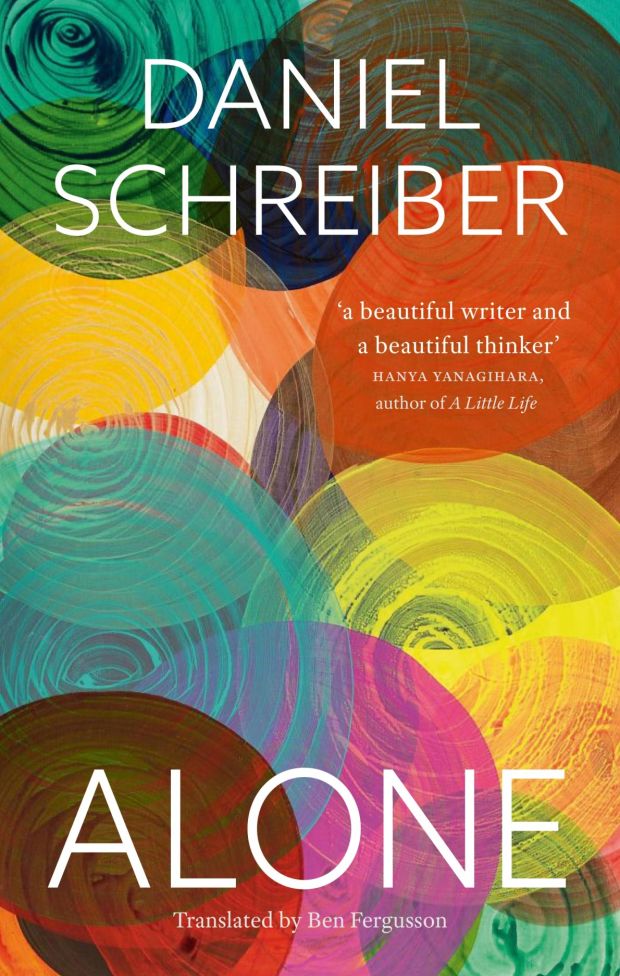
The “Never So Lonely” chapter is about the Covid-19 situation in particular. Schreiber acknowledges that being alone does not have to equate to loneliness, yet the less he saw of people during lockdowns, the more he struggled mentally and emotionally. “At some point, a self-reinforcing dynamic of fear set in: the lonelier I felt, the less I could talk about it. And the less I talked about it, the lonelier I felt.”
Hiking, gardening, yoga and, eventually, foreign travel were among his coping strategies. This is as much a mini-memoir as it is a work of cultural criticism. Its academic tone is evident from a glance at the bibliography: Hannah Arendt, Roland Barthes, Joan Didion, Deborah Levy, Audre Lorde, Maggie Nelson and so on. This resonated with other loneliness- or solitude-themed books I’ve read, such as The Lonely City by Olivia Laing and Journal of a Solitude by May Sarton. It offers not answers, but solemn, quiet thoughts.
(Original publication: 2021. Translated from the German by Ben Fergusson.)
With thanks to Reaktion Books for the proof copy for review.
Women’s Prize Shadowing & Men Reading Books by Women
Back in April I announced that my book club was one of six selected to shadow this year’s Women’s Prize shortlist by reading and discussing one of the finalists. Our assigned title was one I’d already read, but I skimmed back through it before our meet-up and enjoyed getting reacquainted with Martha Friel. Here’s our group’s review:

Sorrow and Bliss by Meg Mason
Readability: 5/5
Characters: 5/5
Storyline: 4/5
Can’t Put It Down: 4.5/5
Total = 18.5/20
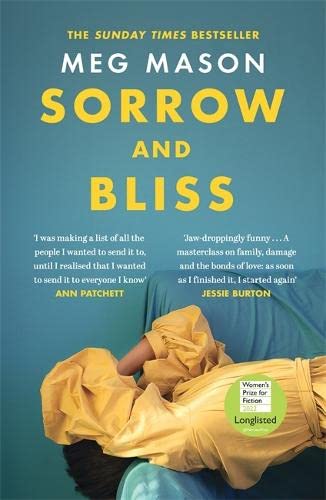 Our joint highest rating, and one of our best discussions – taking in mental illness and its diagnosis and treatment, marriage, childlessness, alcoholism, sisterhood, creativity, neglect, unreliable narrators and loneliness. For several of us, these issues hit close to home due to personal or family experience. We particularly noted the way that Mason sets up parallels between pairs of characters, accurately reflecting how family dynamics can be replicated in later generations.
Even the minor characters are fully rounded, and although Martha is not always pleasant to spend time with, her voice is impressively rendered. The picture of mental illness from the inside feels authentic, including the fact that Martha uses it as an excuse for her bad behaviour, becoming self-absorbed and not seeing how she is affecting others around her. Our main point of disagreement was about Mason’s decision not to name the mental illness Martha is suffering from. It seemed clear to several of us that it was meant to be bipolar disorder, so we wondered if it was a copout not to identify it as such.
We also thought about the meaning of the term “literary fiction”, and whether this has the qualities of a prize winner and will stand the test of time.
We had to fill out a feedback questionnaire about our experience of shadowing, and most of us sent in individual blurbs in response to the book. Some ended up in the final Reading Agency article. Here was mine:
“This deceptively light novel was a perfect book club selection, eliciting deep discussion about mental illness, family relationships and parenthood. Martha’s (unreliable) narration is a delight, wry and deadpan but also with moments of wrenching emotion. Mason masterfully controls the tone to create something that is witty and poignant all at once.”
Probably the main reason we were chosen for this opportunity is that we have a man – my husband, that is! – who attends regularly. This year the prize has been particularly keen to get more men reading books by women (see more below). So, he was responsible for giving The Male Response to the novel. No pressure, right? Luckily, he enjoyed it just as much as the rest of us. From the cover and blurb, it didn’t necessarily seem like the sort of book that he would pick up to read for himself, but he was fully engaged with the themes of mental illness, family relationships, and the question of whether or not to have children, and was so compelled that he read over half of it in a day.
I’m not sure who I expect to be awarded the Women’s Prize tomorrow. We of West Fields Readers would be delighted if it went to Meg Mason for Sorrow and Bliss, but I’d also be happy with a win for Louise Erdrich or Ruth Ozeki – though I wasn’t taken with their latest works compared with earlier ones I’ve read, they are excellent authors who deserve recognition. I don’t think The Bread the Devil Knead has a chance; I’d be disappointed in a win by Elif Shafak in that I would feel obligated to try her novel – the kind that gives magic realism a bad name – again; and, while I’m a Maggie Shipstead fan in general and admire the ambition of Great Circle, it would be galling for a book I DNFed twice to take the title!
Who are you rooting for/predicting?
I’d like to mock you with that thought,
jeer at the man
who won’t read novels
written by women –
at least not if they’re still alive
~from The Poet by Louisa Reid
Maybe you’ve seen on social media that the Women’s Prize has been canvassing opinion on the books by women that all men should read. This was prompted by some shocking statistics suggesting that even bestselling female authors can only attract a 20% male readership, whereas the best-known male authors are almost equally popular with men and women. They solicited 60 nominations from big names and ran a public poll. I voted for these 10:
Half of a Yellow Sun (Chimamanda Ngozi Adichie)
Possession (A.S. Byatt)
Homegoing (Yaa Gyasi)
The Poisonwood Bible (Barbara Kingsolver)
The Sea, The Sea (Iris Murdoch)
The Stone Diaries (Carol Shields)
We Need to Talk about Kevin (Lionel Shriver)
Olive Kitteridge (Elizabeth Strout)
The Goldfinch (Donna Tartt)
Orlando (Virginia Woolf)
*If I could have added to that list, though, my top recommendations for all men to read would be Station Eleven by Emily St. John Mandel and Bring Up the Bodies by Hilary Mantel (and probably a different Octavia E. Butler novel from the one nominated).


Three of my selections were among the 10 essential reads announced on the WP website. Their list was headed by Margaret Atwood’s The Handmaid’s Tale, though of her works I’d be more likely to direct men to Oryx and Crake.
I’ve seen discussions on Twitter about why men don’t read novels (at all, prioritizing nonfiction), or specifically not ones by women. Do you have any theories?
What one book by a woman do you think all men should read?
Review and Q&A: Those Fantastic Lives by Bradley Sides
Bradley Sides and I worked together on Bookkaholic web magazine in 2014–15 and I’ve been following his career ever since. I was delighted to get early access to his debut short story collection, Those Fantastic Lives (out today from Blacklight Press), which was an ideal transition for me from September’s short story focus to October’s R.I.P. challenge for how it blends the genres of dystopia, horror, and magic realism with literary writing.
Many of the protagonists in these 17 stories are orphans or children who have lost one parent. Grief uproots them, leaves them questing; combine their loneliness with dashes of the supernatural and you have perfect situations for strange and wonderful things to happen. So in the title story we have Sam, who at eight longs to follow in his psychic grandmother’s footsteps. In the achingly beautiful “Dolls for the End of the World,” young Patrick’s empathy somehow makes the apocalypse more bearable. In “The Hunt,” 10-year-old Zoey is obsessed with finding a sasquatch, while “In the Hollow” Walt trusts wolf-like creatures to lead him to his dead mother.
“Commencement,” in a first-person plural voice, is the creepiest of the lot, documenting preparations for graduation at a special academy. To be named the class valedictorian is an enduring yet dubious honor… But there are flashes of humor in the book as well. For instance, the lighthearted werewolf story “A Complicated Correspondence” is told via a series of increasingly convoluted e-mails. These two and “Back in Crowville,” in which scarecrows are used to scare off ghosts, too, struck me as perfect Halloween reading. I’d particularly recommend the book to readers of Kelly Link and Lydia Millet.
Brad and I had a chat over e-mail about his inspiration, themes and publication process.
Can you remember what the seed was for some of these stories? A particular line, scene, image, or character? Do you start writing a story with a title in mind, or does the title usually suggest itself later on?
Almost all of the stories I write come to me initially as a vision. I don’t mean in a dream or anything that dramatic, but I might be walking and see a stream, and suddenly that stream is placed in another world, and the stakes are much, much higher. Once I see my characters or my setting or my situation, I have to write a story that leads up to the moment I’m seeing. Writing and creating is, for me, a very internalized process.
Titles are so hard for me. I wish this weren’t the case, but I never write with titles in mind. Sometimes I’ll have the story ready, and I might have to wait weeks before I come to the right title. In regards to writing, I think I’m the worst at titling.
I think my favorite line in the book might be “Just because something can’t be seen doesn’t mean that it’s gone.” That’s from “The Comet Seekers,” about a pair of brothers in search of their father. A number of the stories feature children who have lost a guardian. How does bereavement alter the course of these coming-of-age narratives?
I’m so interested in loss in general. In life, we lose things. As kids. As adults. It doesn’t stop. I grew up on a farm, and animals died constantly. Chickens were slaughtered by foxes. Ducks were killed on their nests by turtles. Cows were sold and slaughtered. Pets died. Loss was everywhere. I’ve always thought about it. I guess, in many ways, loss haunts me.
I feel like bereavement and orphanhood create tension in many of my stories, but they also serve to add stakes to my characters’ lives. It’s tough to keep losing. Sometimes, you’ll do anything to keep from experiencing that—or to try to keep from experiencing that, at least. There’s power there.
I imagine that, like sequencing an album, choosing the order of the stories was a pleasurable challenge. How did you decide on the structure of the book – the opening story, the closing story; the themes running into or contrasting with each other; transitions; and so on?
It was a fun process to start putting all of my work together. I mean, it was also a little stressful once I got near the end and was getting ready to send Those Fantastic Lives out, but it was still fun. I have written a lot of stories, but for my collection, I wanted to only include the stories I love the most. I cut and cut based on just pure writerly love first—and gut instinct, I suppose. Once I had it narrowed, I started looking closely at themes. I removed a handful that felt like they didn’t belong. I really like slim collections (and slim books in general), so I wanted something relatively short—something less than 200 pages. The strangest thing I did was that I read the collection aloud. SEVERAL times, too. If a story didn’t fit the sound, I cut it. I really wanted to put out a cohesive collection, and I think (hope?) I’ve done that with these seventeen stories.
I loved how elements recurred in later tales – for instance, in both “Losing Light” and “The Mooneaters” characters consume sources of light and glow from the inside, and “What They Left Behind” connects back to “The Mooneaters” in that a character starts to sprout feathers. How do you account for these pervasive images?
This is probably a terrible response to such a great question, but it’s the truth: I look at the sky a lot. As in, probably way beyond what is normal. When I walk my dog, I look up at the morning sky and think about the clouds and the rising sun. When my wife and I are out on the porch in the evenings, I look up and think about the approaching stars. The coming moon. Whether early or late, the birds are always around, flying to wherever it is they go. I am so amazed by and curious of the sky. It’s such a beautiful, mysterious place that hovers above us, and it’s kind of the perfect space for me to root a lot of the fantastical elements of my stories.
In my favorite story, “The Galactic Healers,” Lian makes contact with aliens who offer a therapeutic balm. His suspicious father takes the medicine by force – a plan that quickly backfires. To what extent might this one be read as a parable of colonial exploitation and toxic masculinity?
I’m so glad you liked “The Galactic Healers,” Rebecca. It is one of my favorites, too. I’m naturally drawn, just as a human and not even necessarily speaking as a writer, to the topics you mention. I think about otherness. What it means to be outside or different. In that same way, I think about tender versus toxic behavior. I think the reading you have of the story is definitely a good one. And it probably captures where I was, in my head, at that time.
I sensed shades of Karen Russell and George Saunders. Who are some of your favorite writers, and who would you cite as inspirations for the collection?
I love Karen Russell and George Saunders both. I’m honored that my work reminds you of their writing. I think they are both influences on my fiction. I’m also inspired by Ray Bradbury a lot. I’m a very visual creator, so television writers also serve as huge inspirations for me. Mike Flanagan’s work (The Haunting of Hill House and The Haunting of Bly Manor) haunts me, and I love it.

Bradley Sides. Photo by Abraham Rowe.
Versions of 12 of the stories previously appeared in various publications. What has your experience been of getting your work into literary magazines?
Getting published in literary magazines is an exhausting process. Don’t get me wrong, it’s a necessary one and one that gives me a lot of joy in the long run, but it’s also tough. I write weird stuff. Not every magazine wants a story about glowing monsters or a tiny kid whose home planet was invaded by giants and now lives on an ice cube. Finding the right magazine takes time, and even when I think I’ve found the right place, I’m sometimes wrong. I submit, hope for the best, and keep submitting. Usually, most of my stories wind up finding homes in the first five or so magazines I submit them to, but that’s not always the case. With “What They Left Behind,” for example, I bet I sent that story to twenty or thirty magazines before I found the perfect match at Crow & Cross Keys. Although it took some time to land at its home, it found its PERFECT home.
These stories were seven years in the making. What was your road to publication like, and how did you land at Blacklight Press?
Like many yet-to-publish-a-book writers, I was constantly searching for publication information as I was reaching the end of my writing cycle for Those Fantastic Lives, and I kept encountering these articles about how long and tough the publication process can be. I was prepared for it to take years before I found a press willing to take on my collection.
Once it was ready, I sent Those Fantastic Lives out to a handful of publishers—all of which I’d found out about with basic web searches. A couple were interested, but the offer wasn’t what I was looking for. A couple showed interest, but ultimately passed. Blacklight landed, and I knew it was what I was looking for very early on.
The process of when I began to when I found my publisher was probably less than six months.
The whole team at Blacklight has been fantastic, too. It’s really been a dream experience. I feel very grateful.
In your day job, you teach English and creative writing to high schoolers. What are some of the most important lessons you hope your students will take away from your classes, and what have you learned from them?
I hope, more than anything, that my students learn that their words—and their stories—matter. If they truly put themselves into their work, it is art, and it is important. I also hope they leave my classroom knowing how important respect is. To other writers. To themselves. To their eventual readers. To people in general. Respect is key.
I’ve learned so much from my creative writing students. They inspire me. They motivate me. Seeing their excitement when they write something they are proud of reminds me why I write in the first place. They are also wonderfully eager readers. I love discussing stories with them and learning how they perceive texts. Creative writing classes are treasured places.
What are you working on next?
Earlier this year, I began working on my next set of stories. I’m a slow writer. Maybe a very slow writer. With it being so early in the process, it’s hard to say exactly what the next collection will look like, but I do think I’ll largely stay focused on the same kinds of themes. Loss, loneliness, and transformation are naturally interesting to me. There’ll be more experimentation with form. A story in the shape of a manual. A gameplay story. A transcript. A flash in questions. There’ll be plenty of magical weirdness, too, with, probably, pond monsters, apocalypses, a shark boy, kidnapping ghosts, and who knows what else. I just hope it won’t take me so long to write this second book!

Three May Graphic Novel Releases: Orwell, In, and Coma
These three terrific graphic novels all have one-word titles and were published on the 13th of May. Outwardly, they are very different: a biography of a famous English writer, the story of an artist looking for authentic connections, and a memoir of a medical crisis that had permanent consequences. The drawing styles are varied as well. But if the books share one thing, it’s an engagement with loneliness: It’s tempting to see the self as being pitted against the world, with illness an additional isolating force, but family, friends and compatriots are there to help us feel less alone and like we are a part of something constructive.
Orwell by Pierre Christin; illustrated by Sébastien Verdier
[Translated from the French by Edward Gauvin]
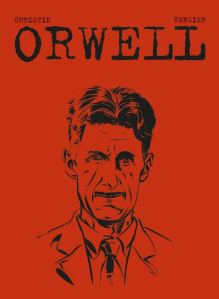 George Orwell was born Eric Blair in Bengal, where his father worked for the colonial government. As a boy, he loved science fiction and knew that he would become a writer. He had an unhappy time at prep school, where he was on reduced fees, and proceeded to Eton and then police training in Burma. Already he felt that “imperialism was an evil thing.” Among this book’s black-and-white panes, the splashes of colour – blood, a British flag – stand out, and guest artists contribute a two-page colour spread each, illustrating scenes from Orwell’s major works. His pen name commemorates a local river and England’s patron saint, marking his preoccupation with the essence of Englishness: something deeper than his hated militarism and capitalism. Even when he tried to ‘go native’ for embedded journalism (Down and Out in Paris and London and The Road to Wigan Pier), his accent marked him out as posh. He was opinionated and set out “rules” for clear writing and the proper making of tea.
The book’s settings range from Spain, where Orwell went to fight in the Civil War, via a bomb shelter in London’s Underground, to the island of Jura, where he retired after the war. I particularly loved the Scottish scenery. I also appreciated the notes on where his life story entered into his fiction (especially in A Clergyman’s Daughter and Keep the Aspidistra Flying). During World War II he joined the Home Guard and contributed to BBC broadcasting alongside T.S. Eliot. He had married Eileen, adopted a baby boy, and set up a smallholding. Even when hospitalized for tuberculosis, he wouldn’t stop typing (or smoking).
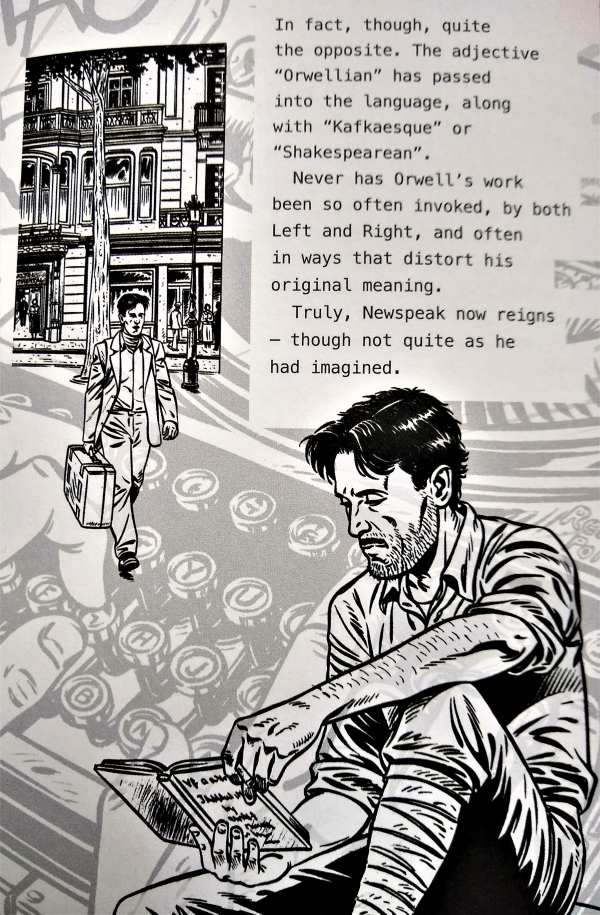 Christin creates just enough scenes to give a sense of the sweep of Orwell’s life, and incorporates plenty of the author’s own words in a typewriter font. He recognizes all the many aspects, sometimes contradictory, of his subject’s life. And in an afterword, he makes a strong case for Orwell’s ideas being more important now than ever before. My knowledge of Orwell’s oeuvre, apart from the ones everyone has read – Animal Farm and 1984 – is limited; luckily this is suited not just to Orwell fans but to devotees of life stories of any kind.
With thanks to SelfMadeHero for the free copy for review.
In by Will McPhail
Nick never knows the right thing to say. The bachelor artist’s well-intentioned thoughts remain unvoiced, such that all he can manage is small talk. Whether he’s on a subway train, interacting with his mom and sister, or sitting in a bar with a tongue-in-cheek name (like “Your Friends Have Kids” or “Gentrificchiato”), he’s conscious of being the clichéd guy who’s too clueless or pathetic to make a real connection with another human being. That starts to change when he meets Wren, a Black doctor who instantly sees past all his pretence.
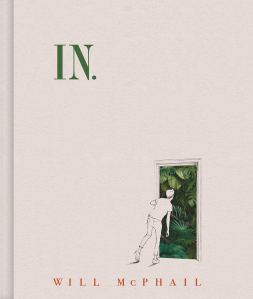 Like Orwell, In makes strategic use of colour spreads. “Say something that matters,” Nick scolds himself, and on the rare occasions when he does figure out what to say or ask – the magic words that elicit an honest response – it’s as if a new world opens up. These full-colour breakthrough scenes are like dream sequences, filled with symbols such as a waterfall, icy cliff, or half-submerged building with classical façade. Each is heralded by a close-up image on the other person’s eyes: being literally close enough to see their eye colour means being metaphorically close enough to be let in. Nick achieves these moments with everyone from the plumber to his four-year-old nephew.

Alternately laugh-out-loud funny and tender, McPhail’s debut novel is as hip as it is genuine. It’s a spot-on picture of modern life in a generic city. I especially loved the few pages when Nick is on a Zoom call with carefully ironed shirt but no trousers and the potential employers on the other end get so lost in their own jargon that they forget he’s there. His banter with Wren or with his sister reveals a lot about these characters, but there’s also an amazing 12-page wordless sequence late on that conveys so much. While I’d recommend this to readers of Alison Bechdel, Craig Thompson, and Chris Ware (and expect it to have a lot in common with Kristen Radtke’s forthcoming Seek You: A Journey through American Loneliness), it’s perfect for those brand new to graphic novels, too – a good old-fashioned story, with all the emotional range of Writers & Lovers. I hope it’ll be a wildcard entry on the Sunday Times Young Writer of the Year Award shortlist.
With thanks to Sceptre for the free copy for review.
Coma by Zara Slattery
In May 2013, Zara Slattery’s life changed forever. What started as a nagging sore throat developed into a potentially deadly infection called necrotising fascitis. She spent 15 days in a medically induced coma and woke up to find that one of her legs had been amputated. As in Orwell and In, colour is used to differentiate different realms. Monochrome sketches in thick crayon illustrate her husband Dan’s diary of the everyday life that kept going while she was in hospital, yet it’s the coma/fantasy pages in vibrant blues, reds and gold that feel more real.
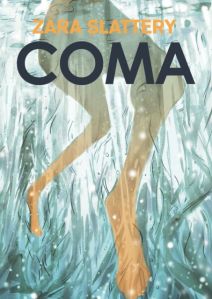 Slattery remembers, or perhaps imagines, being surrounded by nightmarish skulls and menacing animals. She feels accused and guilty, like she has to justify her continued existence. In one moment she’s a puppet; in another she’s in ancient China, her fate being decided for her. Some of the watery landscapes and specific images here happen to echo those in McPhail’s novel: a splash park, a sunken theatre; a statue on a plinth. There’s also a giant that reminded me a lot of one of the monsters in Spirited Away.
Meanwhile, Dan was holding down the fort, completing domestic tasks and reassuring their three children. Relatives came to stay; neighbours brought food, ran errands, and gave him lifts to the hospital. He addresses the diary directly to Zara as a record of the time she spent away from home and acknowledges that he doesn’t know if she’ll come back to them. A final letter from Zara’s nurse reveals how bad off she was, maybe more so than Dan was aware.


This must have been such a distressing time to revisit. In this interview, Slattery talks about the courage it took to read Dan’s diary even years after the fact. I admired how the book’s contrasting drawing styles recreate her locked-in mental state and her family’s weeks of waiting – both parties in limbo, wondering what will come next.
Brighton, where Slattery is based, is a hotspot of the Graphic Medicine movement spearheaded by Ian Williams (author of The Lady Doctor). Regular readers know how much I love health narratives, and with my keenness for graphic novels this series couldn’t be better suited to my interests.
With thanks to Myriad Editions for the free copy for review.
Read any graphic novels recently?
The Lonely Passion of Judith Hearne by Brian Moore (1955)
The readalong that Cathy of 746 Books is hosting for Brian Moore’s centenary was just the excuse I needed to try his work for the first time. My library had a copy of The Lonely Passion of Judith Hearne, his most famous work and the first to be published under his own name (after some pseudonymous potboilers), so that’s where I started.
Judith Hearne is a pious, set-in-her-ways spinster in Belfast. As the story opens, the piano teacher is moving into a new boarding house and putting up the two portraits that watch over her: a photo of her late aunt, whom Judith cared for in her sunset years; and the Sacred Heart. This establishment is run by a nosy landlady, Mrs. Henry Rice, and her adult son Bernard, who is writing his poetic magnum opus and carrying on with the maid. Recently joining the household is James Madden, the landlady’s brother, who is back from 30 years in New York City. Disappointed in his career and in his adult daughter, he’s here to start over.
Moore’s third-person narration slips easily between the viewpoints of multiple characters, creating a dramatic irony between their sense of themselves and what others think of them. Initially, we spend the most time in Judith’s head – an uncomfortable place to be because of how simultaneously insecure and hypercritical she is. She’s terrified of rejection, which she has come to expect, but at the same time she has nasty, snobbish thoughts about her fellow lodgers, especially overweight Bernard. The dynamic is reversed on her Sunday afternoons with the O’Neills, who, peering through the curtains as she arrives, groan at their onerous duty of entertaining a dull visitor who always says the same things and gets tipsy on sherry.
 An unfortunate misunderstanding soon arises between Judith and James: in no time she’s imagining romantic scenarios, whereas he, wrongly suspecting she has money stashed away, hopes she can be lured into investing in his planned American-style diner in Dublin. “A pity she looks like that,” he thinks. Later we get a more detailed description of Judith from a bank cashier: “On the wrong side of forty with a face as plain as a plank, and all dressed up, if you please, in a red raincoat, a red hat with a couple of terrible-looking old wax flowers in it.”
Oh how the heart aches for this figure of pathos. James’s situation, what with the ultimate failure of his American dream, echoes hers in several ways. Something happens that lessens our sympathy for James, but Judith remains a symbol of isolation and collapse. The title also reflects the spiritual aspect of this breakdown: Judith feels that she’s walking a lonely road, like Jesus did on the way to the crucifixion, and the Catholic Church to which she’s devoted, far from being a support in time of despair, is only the source of more judgment.
Alcoholism, mental illness, and religious doubt swirl together to make for a truly grim picture of life on the margins. The novel also depicts casual racism and a scene of sexual assault. No bed of roses here. But Moore’s writing, unflinching yet compassionate, renders each voice and perspective distinct in an unforgettable character study full of intense scenes. I especially loved how the final scene returns full circle. I’d particularly recommend this to readers of Tove Ditlevsen, Muriel Spark and Elizabeth Taylor, and fans of Barbara Pym’s Quartet in Autumn. I’ll definitely try more from Moore – I found a copy of The Colour of Blood in a Little Free Library in Somerset, so will add that to my stack for 20 Books of Summer.
My rating: 
The “P.S.” section of the Harper Perennial paperback I borrowed from the library contains a lot of interesting information on Moore’s life and the composition of Judith Hearne. After time as a civilian worker in the British army, Moore moved to Canada and became a journalist. Later he would move to Malibu and write the screenplay for Alfred Hitchcock’s Torn Curtain.
The protagonist was based on a woman Moore’s parents invited over for Sunday diners in Belfast. Like Judith, she loved wearing red and went on about the aunt who raised her. Moore said, “When I wrote Judith Hearne I was very lonely, writing in a rented caravan, I had almost no friends, I’d given up my beliefs, was earning almost no money as a reporter and I didn’t see much of a future. So I could identify with a dipsomaniac, isolated spinster.” The novel was rejected by 12 publishing houses before the firm André Deutsch, namely reader Laurie Lee and co-director Diana Athill, recognized its genius and accepted it for publication.
First Four in a Row: Márai, Maupin, McEwan, McKay
I announced a few new TBR reading projects back in May 2020, including a Four in a Row Challenge (see the ‘rules’, such as they are, in my opening post). It only took me, um, nearly 11 months to complete a first set! The problem was that I kept changing my mind on which four to include and acquiring more that technically should go into the sequence, e.g. McCracken, McGregor; also, I stalled on the Maupin for ages. But here we are at last. Debbie, meanwhile, took up the challenge and ran with it, completing a set of four novels – also by M authors, clearly a numerous and tempting bunch – back in October. Here’s hers.

I’m on my way to completing a few more sets: I’ve read one G, one and a bit H, and I selected a group of four L. I’ve not chosen a nonfiction quartet yet, but that could be an interesting exercise: I file by author surname even within categories like science/nature and travel, so this could throw up interesting combinations of topics. Do feel free to join in this challenge if, like me, you could use a push to get through more of the books on your shelves.
Embers by Sándor Márai (1942)
[Translated from the Hungarian by Carol Brown Janeway]
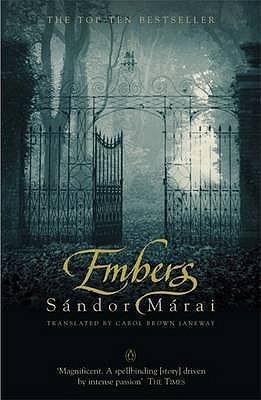 My first work of Hungarian literature.* This was a random charity shop purchase, simply because I’m always trying to read more international literature and had enjoyed translations by Carol Brown Janeway before. In 1940, two old men are reunited for the first time in 41 years at a gloomy castle, where they will dine by candlelight and, over the course of a long conversation, face up to the secret that nearly destroyed their friendship. This is the residence of 75-year-old Henrik, usually referred to as “the General,” who lives alone apart from Nini, his 91-year-old wet nurse. His wife, Krisztina, died 33 years ago.
Henrik was 10 when he met Konrad at an academy school. They were soon the best of friends, but two things came between them: first was the difference in their backgrounds (“each forgave the other’s original sin: wealth on the one hand and poverty on the other”); second was their love for the same woman.
I appreciated the different setup to this one – a male friendship, just a few very old characters, the probing of the past through memory and dialogue – but it was so languid that I struggled to stay engaged with the plot. 
*My next will be Journey by Moonlight by Antal Szerb, another charity shop find.
Favourite lines:
“My homeland was a feeling, and that feeling was mortally wounded.”
“Life becomes bearable only when one has come to terms with who one is, both in one’s own eyes and in the eyes of the world.”
Tales of the City by Armistead Maupin (1978)
I’d picked this up from the free bookshop we used to have in the local mall (the source of my next two as well) and started it during Lockdown #1 because in The Novel Cure it is given as a prescription for Loneliness. Berthoud and Elderkin suggest it can make you feel like part of a gang of old friends, and it’s “as close to watching television as literature gets” due to the episodic format – the first four Tales books were serialized in the San Francisco Chronicle.
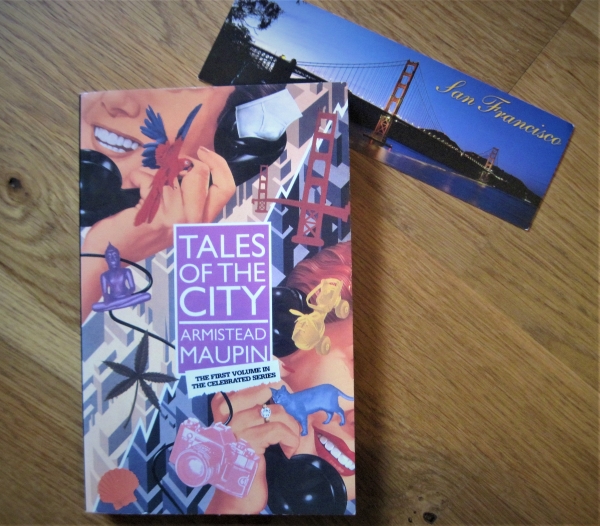
How I love a perfect book and bookmark combination!
The titled chapters are each about three pages long, which made it an ideal bedside book – I would read a chapter per night before sleep. The issue with this piecemeal reading strategy, though, was that I never got to know any of the characters; because I’d often only pick up the book once a week or so, I forgot who people were and what was going on. That didn’t stop individual vignettes from being entertaining, but meant it didn’t all come together for me.
Maupin opens on Mary Ann Singleton, a 25-year-old secretary who goes to San Francisco on vacation and impulsively decides to stay. She rooms at Anna Madrigal’s place on Barbary Lane and meets a kooky assortment of folks, many of them gay – including her new best friend, Michael Tolliver, aka “Mouse.” There are parties and affairs, a pregnancy and a death, all told with a light touch and a clear love for the characters; dialogue predominates. While it’s very much of its time, it manages not to feel too dated overall. I can see why many have taken the series to heart, but don’t think I’ll go further with Maupin’s work.
Note: Long before I tried the book, I knew about it through one of my favourite Bookshop Band songs, “Cleveland,” which picks up on Mary Ann’s sense of displacement as she ponders whether she’d be better off back in Ohio after all. Selected lyrics:
Quaaludes and cocktails
A story book lane
A girl with three names
A place, post-Watergate
Freed from its bird cage
Where the unafraid parade
[…]
Perhaps, we should all
Go back to Cleveland
Where we know what’s around the bend
[…]
Citizens of Atlantis
The Madrigal Enchantress cries
And we decide, to stay and bide our time
On this far-out, far-flung peninsula.
The Children Act by Ian McEwan (2014)
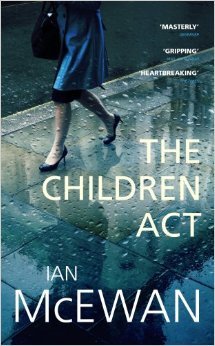 Although it’s good to see McEwan take on a female perspective – a rarer choice for him, though it has shown up in Atonement and On Chesil Beach – this is a lesser novel from him, only interesting insomuch as it combines elements from two of his previous works, The Child in Time (legislation around child welfare) and Enduring Love (a religious stalker). Fiona Maye, a High Court judge, has to decide whether 17-year-old Adam, a bright and musical young man with acute leukaemia, should be treated with blood transfusions despite his Jehovah’s Witness parents’ objection.
[SPOILERS FOLLOW]
She rules that the doctors should go ahead with the treatment. “He must be protected from his religion and from himself.” Adam, now better but adrift from the religion he was raised in, starts stalking Fiona and sending her letters and poems. Estranged from her husband, who wants her to condone his affair with a young colleague, and fond of Adam, Fiona spontaneously kisses the young man while traveling for work near Newcastle. But thereafter she ignores his communications, and when he doesn’t seek treatment for his recurring cancer and dies, she blames herself.
[END OF SPOILERS]
It’s worth noting that the AI in McEwan’s most recent full-length novel, Machines Like Me, is also named Adam, and in both books there’s uncertainty about whether the Adam character is supposed to be a child substitute. 
The Birth House by Ami McKay (2006)
Dora is the only daughter to be born into the Rare family of Nova Scotia’s Scots Bay in five generations. At age 17, she becomes an apprentice to Marie Babineau, a Cajun midwife and healer who relies on ancient wisdom and appeals to the Virgin Mary to keep women safe and grant them what they want, whether that’s a baby or a miscarriage. As the 1910s advance and the men of the village start leaving for the war, the old ways represented by Miss B. and Dora come to be seen as a threat. Dr. Thomas wants women to take out motherhood insurance and commit to delivering their babies at the new Canning Maternity Home with the help of chloroform and forceps. “Why should you ladies continue to suffer, most notably the trials of childbirth, when there are safe, modern alternatives available to you?” he asks.
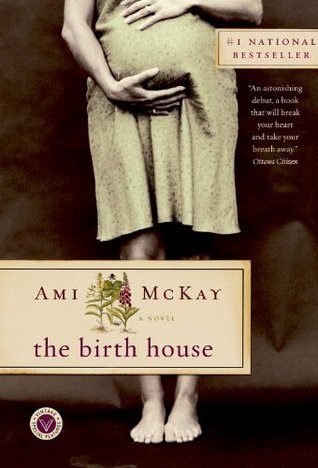 Encouraged into marriage at an early age, Dora has to put her vocation on hold to be a wife to Archer Bigelow, a drunkard with big plans for how he’s going to transform the area with windmills that generate electricity. Dora’s narration is interspersed with journal entries, letters, faux newspaper articles, what look like genuine period advertisements, and a glossary of herbal remedies – creating what McKay, in her Author’s Note, calls a “literary scrapbook.” I love epistolary formats, and there are so many interesting themes and appealing secondary characters here. Early obstetrics is not the only aspect of medicine included; there is also an exploration of “hysteria” and its treatment, and the Spanish flu makes a late appearance. Dora, away in Boston at the time, urges her friends from the Occasional Knitters’ Society to block the road to the Bay, make gauze masks, and wash their hands with hot water and soap.
There are a few places where the narrative is almost overwhelmed by all the (admittedly, fascinating) facts McKay, a debut author, turned up in her research, and where the science versus superstition dichotomy seems too simplistic, but for the most part this was just the sort of absorbing, atmospheric historical fiction that I like best. McKay took inspiration from her own home, an old birthing house in the Bay of Fundy. 
Pandemic Reading Strategies & Recommendations, Serious or Tongue-in-Cheek
If you’ve been spending time blog-hopping or on Twitter over the last few weeks, you will have seen countless riffs on this topic. Everyone’s pondering what’s best to read in these times. All we can get our hands on about plagues (Boccaccio, Camus, Defoe)? Allegories of similarly challenging worldwide disasters (WWII, 9/11)? Childhood favorites? Comfort reads? Funny books? Light, undemanding stuff? Rereads?
My general answer would be: as always, read whatever you want or can – anything that captures your attention is worthwhile. We’re under so much stress that our reading should be entirely unpressured. But to be a little more specific, I’ve gathered reading recommendations on a variety of topics, drawing on lists that others have made and linking to my own blog reviews where applicable.
(Some of these ideas are less serious than others.)
If you are brave enough to learn about zoonotic diseases:
 Spillover: Animal Infections and the Next Human Pandemic by David Quammen: This is top-notch scientific journalism: pacey, well-structured, and gripping. The best chapters are on Ebola and SARS; the SARS chapter, in particular, reads like a film screenplay, if this were a far superior version of Contagion. It’s a sobering subject, with some quite alarming anecdotes and statistics, but this is not scare-mongering for the sake of it; Quammen is frank about the fact that we’re still all more likely to get heart disease or be in a fatal car crash.
If you can’t look away from pandemic stories, historical or imagined:


I already had Philip Roth’s Nemesis (set in 1940s New Jersey amid a polio epidemic) out from the library because it was on the Wellcome Book Prize shortlist in 2011. I was also inspired to take Year of Wonders by Geraldine Brooks (set in the 1660s and featuring an English village that quarantined itself during the Plague) off the shelf. I’m nearing the end of these two and should have my reviews up next week.
You will see no one book referenced more than Station Eleven by Emily St. John Mandel. It’s a wholly believable dystopian novel in which 99% of the population has been wiped out by a pandemic. The remnant bands together not just to survive but to create and preserve art. “What was lost in the collapse: almost everything, almost everyone, but there is still such beauty.” (My full BookBrowse review from December 2014.)
See also this Publishers Weekly list of “13 Essential Pandemic Novels.”
If you’re feeling cooped up…
 Infinite Home by Kathleen Alcott: “Edith is a widowed landlady who rents apartments in her Brooklyn brownstone to an unlikely collection of humans, all deeply in need of shelter.” (I haven’t read it, but I do have a copy; now would seem like the time to read it!)
…yet want to appreciate the home you’re stuck in:


Years ago I read and loved At Home: A Short History of Private Life by Bill Bryson and Happier at Home by Gretchen Rubin. I can’t tell you anything more than that because it was before the days when I reviewed everything I read, but these are both reliable authors.
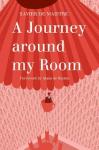 I love the sound of A Journey Around My Room by Xavier de Maistre: “Finding himself locked in his room for six weeks, a young officer journeys around his room in his imagination, using the various objects it contains as inspiration for a delightful parody of contemporary travel writing and an exercise in Sternean picaresque.”
I’m also drawn to Home: The Story of Everyone Who Ever Lived in Our House by Julie Myerson, who combed archives for traces of all the former residents of her 1870s terraced house in Clapham.
If you’re struggling with being on your own:


The Lonely City by Olivia Laing: This remarkable book on outsider artists interweaves biography, art criticism and memoir. Laing is a tour guide into the peculiar, lonely crowdedness you find in a world city.
How to Be Alone by Sara Maitland: Maitland argues that although being alone is easy to achieve, there is an art to doing it properly, and solitude and loneliness are by no means the same thing. Profiling everyone from the Desert Fathers of early Christianity to the Romantic poets, she enumerates all the benefits that solitude confers.
Journal of a Solitude by May Sarton: A one-year account of her writing life in New Hampshire, this is Sarton’s best. The book dwells on the seasonal patterns of the natural world (shovelling snow, gardening, caring for animals) but also the rhythms of the soul – rising in hope but also falling into occasional, inevitable despair.
See also this Penguin UK list of books to read in self-isolation.
If you’ve been passing the time by baking…
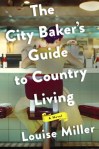 The City Baker’s Guide to Country Living by Louise Miller: As chief baker at the Sugar Maple Inn in Guthrie, Vermon, Olivia Rawlings settles into a daily routine of baking muffins, bread and cakes. This is a warm, cozy debut novel full of well-drawn secondary characters and romantic possibilities. There’s nothing clichéd about it, though. Livvy is a sassy narrator, and I loved how Miller documents the rhythms of the small-town country year, including tapping the maple trees in the early spring and a pie baking contest at the summer county fair.
 Sourdough by Robin Sloan: Lois Clary, a Bay Area robot programmer, becomes obsessed with baking. “I needed a more interesting life. I could start by learning something. I could start with the starter.” She attempts to link her job and her hobby by teaching a robot arm to knead the bread she makes for a farmer’s market. Madcap adventures ensue. It’s a funny and original novel and it makes you think, too – particularly about the extent to which we should allow technology to take over our food production.
…but can’t find yeast or eggs in the shop:
Yeast: A Problem by Charles Kingsley (1851). Nope, I haven’t read it, but our friend has a copy in his Everyman’s Library collection and the title makes us laugh every time we see it.
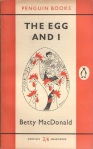 The Egg & I by Betty Macdonald: MacDonald and her husband started a rural Washington State chicken farm in the 1940s. Her account of her failure to become the perfect farm wife is hilarious. The voice reminded me of Doreen Tovey’s: mild exasperation at the drama caused by household animals, neighbors, and inanimate objects. “I really tried to like chickens. But I couldn’t get close to the hen either physically or spiritually, and by the end of the second spring I hated everything about the chicken but the egg.” Perfect pre-Easter reading.
And here are a few lists I put together for Hungerford Bookshop:
If you need a laugh:
Fiction:
Lucky Jim by Kingsley Amis
The Darling Buds of May (and sequels) by H.E. Bates
Ella Minnow Pea by Mark Dunn
Heartburn by Nora Ephron
 Cold Comfort Farm by Stella Gibbons
Anything by Nick Hornby
Three Men in a Boat by Jerome K. Jerome
Anything by David Lodge
Dear Committee Members by Julie Schumacher
The Rosie Project (and sequels) by Graeme Simsion
To Say Nothing of the Dog by Connie Willis
Nonfiction:
 Anything by Bill Bryson
21st-Century Yokel by Tom Cox
Anything by Gerald Durrell
Anything by Nora Ephron (essays)
This Is Going to Hurt by Adam Kay
Priestdaddy by Patricia Lockwood
Dear Lupin by Roger Mortimer
Anything by David Sedaris
Little Failure by Gary Shteyngart
If you want to disappear into a long book:


The Heart’s Invisible Furies by John Boyne
Jonathan Strange & Mr Norrell by Susanna Clarke
David Copperfield by Charles Dickens
Middlesex by Jeffrey Eugenides
The Crimson Petal and the White by Michel Faber
The Signature of All Things by Elizabeth Gilbert
The Nix by Nathan Hill
We, the Drowned by Carsten Jensen
Mary Ann Sate, Imbecile by Alice Jolly
The Poisonwood Bible by Barbara Kingsolver
The Wind-Up Bird Chronicle by Haruki Murakami
The Sparrow by Mary Doria Russell
American Wife by Curtis Sittenfeld
East of Eden by John Steinbeck
The Goldfinch by Donna Tartt
Cutting for Stone by Abraham Verghese
The Paying Guests by Sarah Waters
If you’re looking for some hope:
 Almost Everything: Notes on Hope by Anne Lamott
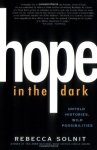
Hope in the Dark by Rebecca Solnit
Hope Dies Last: Making a Difference in an Indifferent World by Studs Terkel
I’ve been doing a combination of the above strategies, reading about historical plagues in fiction and nonfiction but also doing some rereading and consuming lighter genre stuff like mysteries. I continue to dip into new releases, and I enjoy the ongoing challenge of my reading projects. Right now, I’m working through a few current Women’s Prize longlistees, as well as some past Wellcome Book Prize nominees and Women’s Prize winners, and I’m about to start a third #1920Club title. Plus I’m already thinking about my 20 Books of Summer (I’m considering an all-foodie theme).
Further reading:
- Book Riot pinpoints seven categories of books to read during a pandemic.
- Clare surveys the post-pandemic literary landscape.
- Elle logs her pandemic reading and viewing.
- Laura discusses pandemic reading strategies and distraction reading.
- Literary Hub looks at parallel situations, including post-9/11 reads, to make predictions, and asks what your “go-to quarantine read” says about you. (I’ve read Kindred most recently, but I wouldn’t say that describes me.)
- Simon thinks about what we can and should read.
- Susan highlights some comfort reads.
What are your current reading strategies?
Just Okay for Me, Dawg
This was one of the catchphrases of long-time judge Randy Jackson on the reality TV show American Idol, which was my guilty pleasure viewing for a decade or more. The three recent books for which I provide short-ish reviews below have nothing much in common apart from the fact that I requested or accepted them from publishers and ended up feeling disappointed but like I still owed a review. You can consider them all  .
.
The Friendship Cure by Kate Leaver
(Duckworth, March 22nd)
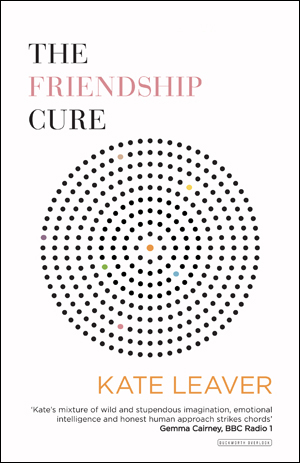 We’re in the middle of a loneliness epidemic, so friends are more important than ever. That’s the impetus for Kate Leaver’s jaunty, somewhat insubstantial book about modern friendship. She observes teen girls on the Tube and reflects on how we as primates still engage in social grooming – though language has replaced much of this more primitive bond-forming behavior. We experience a spike in our number of friends through adolescence and early adulthood, but friendships can fall by the wayside during our thirties as we enter long-term relationships and turn our attention to children and other responsibilities. Leaver argues that female friendships can amplify women’s voices and encourage us to embrace imperfection. She also surveys the bromance, mostly in its TV and film manifestations. There are plenty of pop culture references in the book; while I enjoy a Scrubs or Parks and Recreation scene or quotation as much as the next fan, the reliance on pop culture made the book feel lightweight.
Perhaps the most useful chapter was the one on online friendships (hi, book blogger friends!). We so often hear that these can’t replace IRL friendships, but Leaver sticks up for social media: it allows us to meet like-minded people, and is good for introverted and private people. Anything is better than isolation. The biggest problem I had with the book was the tone: Leaver is going for a Caitlin Moran vibe, and peppers in hip references to Taylor Swift, Lindsay Lohan and the like. But then she sometimes tries for more of a Mary Beard approach, yet doesn’t trust herself to competently talk about science, so renders it in matey, anti-intellectual language like “Robin [Dunbar, of Oxford University] did some fancy maths” (um, I think you mean “Dr. Dunbar”!) or “Let me hit you with a bit of research.”
Favorite lines:
“on some days, somewhere in our souls, we still count the number of social media connections as a measure of who we are”
“When you successfully recruit a new person into your friendship circle, you’re essentially confirming that you are a likable human being, worthy of someone’s time and emotional investment.”
You might choose to read instead: Kory Floyd’s The Loneliness Cure; Ann Patchett’s Truth and Beauty; Anna Quindlen’s essay “Girlfriends” from Lots of Candles, Plenty of Cake.
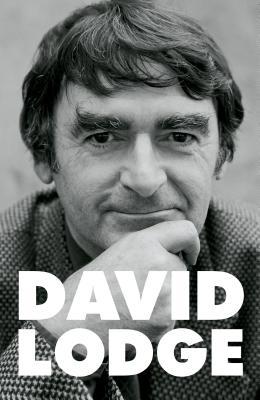
Writer’s Luck: A Memoir: 1976–1991 by David Lodge
(Harvill Secker, January 11th)
David Lodge has been one of my favorite authors for over a decade. His first memoir, Quite a Good Time to Be Born: A Memoir, 1935–1975 (see my Nudge review), is a good standalone read, even for non-fans, for its insight into the social changes of post-war Britain. However, this volume makes the mistake of covering much less ground, in much more detail – thanks to better record-keeping at the peak of his career – and the result is really rather tedious. The book opens with the publication of How Far Can You Go? and carries through to the reception of Paradise News, with a warning that he cannot promise a third volume; he is now 83. Conferences, lecture tours, and travels are described in exhaustive detail. There’s also a slightly bitter edge to Lodge’s attempts to figure out why ventures flopped or novels got negative reviews (Small World, though Booker-shortlisted, was better received in America), though he concludes that his career was characterized by more good luck than bad.
 I liked the account of meeting Muriel Spark in Italy, and valued the behind-the-scenes look at the contentious task of judging the 1989 Booker Prize, which went to Kazuo Ishiguro for The Remains of the Days. Especially enjoyable is a passage about getting hooked on saunas via trips to Finland and to Center Parcs, a chain of all-inclusive holiday activity camps in England. Oh how I laughed at his description of nude sauna-going in midlife (whether I was supposed to or not, I’m not sure): “The difference in pleasure between swimming wearing a costume of any kind and the sensation of swimming without one, the water coursing unimpeded round your loins as you move through it, cannot be exaggerated, and I first discovered it in Center Parcs.” I also cringed at the Lodges placing “our Down’s son” Christopher in a residential care home – I do hope thinking about disability has moved on since the mid-1980s.
Ultimately, I’m not sure Lodge has had an interesting enough life to warrant a several-volume project. He’s an almost reassuringly dull chap; “The fact is that I am constitutionally monogamous,” he admits at one point. Although it was fun for me to see the genesis of novels like Paradise News, I don’t think I’d have the stomach for reading any more about why Lodge thinks his star faded starting in the 1990s. However, I’ll keep this on the shelf to go back to for some context when I finally get around to rereading Small World and Nice Work.
Favorite lines:
“there has been a downside to the Prize Culture which the Booker engendered. It has warped the evaluation of new fiction by measuring success as if it were a competitive sport.”
You might choose to read instead: Lodge’s Quite a Good Time to Be Born or John Carey’s The Unexpected Professor: An Oxford Life in Books – overall the better autobiography of a working-class, bookish lad.
The Parentations by Kate Mayfield
(Point Blank [Oneworld], March 29th)
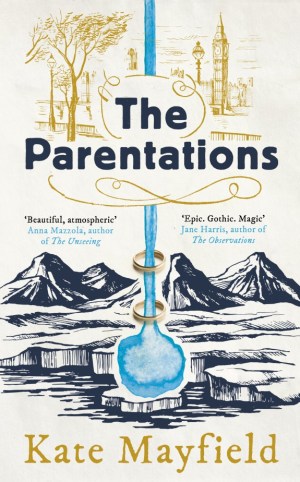 Sisters Constance and Verity Fitzgerald have been alive for over 200 years. A green pool in Iceland, first discovered in 1783, gives them “extended mortality” so long as they take the occasional two-week nap and only swallow two drops of the liquid at a time. In London in 2015, they eat a hearty stew by candlelight and wait for their boy to come. Then they try the churchyard: dead or alive, they are desperate to have him back. Meanwhile, Clovis Fowler is concealing extra phials of the elixir from her husband, their son and the maid. What’s going on here? We go back to Iceland in 1783 to see how the magic pool was first found, and then hop across to 1783 London to meet the sisters as children.
I read the first 67 pages, continued skimming to page 260, and then gave up. At well past the one-third point, the novel still hasn’t established basic connections. A book of nearly 500 pages has to hook the reader in sooner and more securely, not lull them with wordiness (case in point: on the first page of the first chapter, the adjective “macilent” – I looked it up and it means thin or lean, either of which would have been a far preferable word to use).
I could see faint echoes here of so many great books – Jonathan Strange and Mr. Norrell, A Discovery of Witches, Slade House, The Essex Serpent; works by Hannah Kent and Diane Setterfield, maybe even Matt Haig? I liked Mayfield’s memoir The Undertaker’s Daughter and had hoped for improvement with this debut novel. As it is, The Parentations has an interesting premise and lineage, but doesn’t deliver.
Favorite lines:
“His rage foments a decision. He will either take his place in the mounds of the dead, or he will find a good reason to stay alive.”
“Francis and Averil Lawless have impressed upon their daughters the concept of the consequences of a single moment, and there is no better teacher than the river’s majesty and its demand for respect for its waters, which can easily bring violence and ruin as well as wealth and peace.”
You might choose to read instead: Any of the literary fantasy novels listed above.
What books have disappointed or defeated you lately?
All the Lonely People*
Last week I finished two books, one fiction and one nonfiction, that had loneliness as a central theme – although their treatment of the subject was vastly different.
First was Quartet in Autumn by Barbara Pym, which was recommended to me by various bloggers and certainly lived up to their praise. Originally published in 1977, this was Pym’s seventh novel out of nine; she died in 1980. It’s about four London office workers, all sixty-somethings who are partnerless and don’t have, or at least don’t live with, any immediate family members. We never learn what they do in this office; in fact, Edwin, Norman, Letty and Marcia don’t seem to be filling much of a need, especially given the fact that the two old girls aren’t replaced when they retire midway through the novel.
 For as long as they’ve been working together, the four haven’t given in to the usual human impulse to know and be known. At first there doesn’t seem to be much to know about them; with only one or two shorthand facts apiece it’s a minor challenge to tell them apart. Widower Edwin’s hobby is attending Anglican services; Norman lives off fried food and visits his brother-in-law in hospital; Letty lives in a boarding house and has a friend in the countryside; Marcia has had a mastectomy and hoards tinned food and empty milk bottles.
But for all of them a line applied to Letty holds true: “It was a comfortable enough life, if a little sterile, perhaps even deprived.” Especially after her retirement, Letty knows “she must never give the slightest hint of loneliness or boredom, the sense of time hanging heavy.”
From what I’d heard about Pym, I might have expected a lighthearted satire about country manners and Anglican vicars. Perhaps that’s a fair assessment of some of her earlier books? But this is much darker, and the humor always has a bitter edge:
- When Marcia finds a plastic bag labeled “To avoid danger of suffocation keep this wrapper away from babies and children,” the narrator adds, “They could have said from middle-aged and elderly persons too, who might well have an irresistible urge to suffocate themselves.”
- Offered the option of moving into a care home, Letty thinks “better to lie down in the wood under the beech leaves and bracken and wait quietly for death.”
Overall it’s quite a melancholy little book, a warning against letting your life become too small and private. Yet the last line, remarkably, is a sudden injection of optimism: “it made one realize that life still held infinite possibilities for change.” I’d recommend this to readers who have enjoyed Mrs. Palfrey at the Claremont by Elizabeth Taylor.
As an unwittingly positive counterpart, I was at the same time reading How to Be Alone by Sara Maitland. This is part of a School of Life series that turns the “how-to” concept on its head: instead of areas where we think we need instruction, the books are about areas where we feel like experts, topics so simple or automatic they don’t seem to need explanation (e.g. How to Be Bored, or How to Age).

I feel it’s important to point out that the author’s last name is spelled wrong on the cover!
But Maitland argues that although being alone is easy to achieve, there is an art to doing it properly, and solitude and loneliness are by no means the same thing. She knows whereof she speaks: though she grew up in a large Catholic family, after her divorce she moved to a remote area of Scotland and lives alone in a house a quarter mile from the nearest road.
Despite our modern obsession with self-confidence and fulfilling relationships, Maitland believes “the present paradigm is not really working.” More of us than ever are depressed and afraid to spend time alone lest it might make us appear selfish, pathetic or in some way unlovable.
Profiling everyone from the Desert Fathers of early Christianity to the Romantic poets, she counters by enumerating all the benefits that solitude confers: self-knowledge and a rest from constant relating (that goes for extroverts as well as introverts), a connection to nature and to the divine, and the freedom to create. She convinced me, and includes a great bibliography of further reading about solitude.
*I only found out the other week that Eleanor Rigby “picks up the rice” in a church. For my entire life I’d thought she “picks up her ice” (granted, that doesn’t make much sense, but the Beatles could be trippy lads). You learn something new every day!
The Lonely City by Olivia Laing
For several years in her mid-thirties, British author Olivia Laing lived in New York City. A relationship had recently fallen through and she was subletting an apartment from a friend. Whole days went by when she hardly left the flat, whiling away her time on social media and watching music videos on YouTube. Whenever she did go out, she felt cut off because of her accent and her unfamiliarity with American vernacular; she wished she could wear a Halloween mask all the time to achieve anonymity. How ironic, she thought, that in a city of millions she could be so utterly lonely.
Loneliness feels like such a shameful experience, so counter to the lives we are supposed to lead, that it becomes increasingly inadmissible, a taboo state whose confession seems destined to cause others to turn and flee. … [L]oneliness inhibits empathy because it induces in its wake a kind of self-protective amnesia, so that when a person is no longer lonely they struggle to remember what the condition is like.
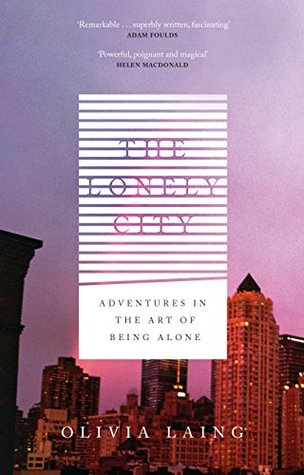 Whereas alcoholic writers were the points of reference for her previous book, the superb The Trip to Echo Spring (2013), here outsider artists take center stage: Edward Hopper, Andy Warhol, David Wojnarowicz, Henry Darger, and the many lost to AIDS in the 1980s to 1990s. It’s a testament to Laing’s skill at interweaving biography, art criticism and memoir when I say that I knew next to nothing about any of these artists to start with and have little fondness for modern art but still found her book completely absorbing.
Several of the artists shared underlying reasons for loneliness: an abusive childhood, mental illness and/or sexuality perceived as aberrant. Edward Hopper might seem the most ‘normal’ of the artists profiled, but even he was bullied when he shot up to 6 feet at age 12; his wife Jo, doing some amateur psychoanalyzing, named it the root of his notorious taciturnity. His Nighthawks, with its “noxious pallid green” shades, perfectly illustrates the inescapability of “urban alienation,” Laing writes: when she saw it in person at the Whitney, she realized the diner has no door. (It’s a shame the book couldn’t accommodate a centerfold of color plates, but each chapter opens with a black-and-white photograph of its main subject.)
Andy Warhol was born Andrej Warhola to Slovakian immigrants in Pittsburgh in 1928. He was often tongue-tied and anxious, and used fashion and technology as ways of displacing attention. In 1968 he was shot in the torso by Valerie Solanas, the paranoid, sometimes-homeless author of SCUM Manifesto, and ever after had to wear surgical corsets. For Warhol and Wojnarowicz, art and sex were possible routes out of loneliness. As homosexuals, though, they could be restricted to sordid cruising grounds such as cinemas and piers. Like Klaus Nomi, a gay German electro-pop singer whose music Laing listened to obsessively, Wojnarowicz died of AIDS. Nomi was one of the first celebrities to succumb, in 1983. The epidemic only increased the general stigma against gay people. Even Warhol, as a lifelong hypochondriac, was leery about contact with AIDS patients. Through protest marches and artworks, Wojnarowicz exposed the scale of the tragedy and the lack of government concern.
In some ways Henry Darger is the oddest of the outsiders Laing features. He is also the only one not based in New York: he worked as a Chicago hospital janitor for nearly six decades; it was only when he was moved into a nursing home and the landlord cleared out his room that an astonishing cache of art and writing was discovered. Darger’s oeuvre included a 15,000-page work of fiction set in “the Realms of the Unreal” and paintings that veer towards sadism and pedophilia. Laing spent a week reading his unpublished memoir. With his distinctive, not-quite-coherent style and his affection for the asylum where he lived as an orphaned child, he reminded me of Royal Robertson, the schizophrenic artist whose work inspired Sufjan Stevens’s The Age of Adz album, and the artist character in the movie Junebug (2005).
A few of the chapters are less focused because they split the time between several subjects. I also felt that a section on Josh Harris, Internet entrepreneur and early reality show streaming pioneer, pulled the spotlight away from outsider art. Although I can see, in theory, how his work is performance art reflecting on our lack of true connection in an age of social media and voyeurism, I still found this the least relevant part.

The American cover
The book is best when Laing is able to pull all her threads together: her own seclusion – flitting between housing situations, finding dates through Craigslist and feeling trapped behind her laptop screen; her subjects’ troubled isolation; and the science behind loneliness. Like Korey Floyd does in The Loneliness Cure, Laing summarizes the physical symptoms and psychological effects associated with solitude. She dips into pediatrician D.W. Winnicott’s work on attachment and separation in children, and mentions Harry Harlow’s abhorrent rhesus monkey experiments in which babies were raised without physical contact.
The tone throughout is academic but not inaccessible. Ultimately I didn’t like this quite as much as The Trip to Echo Spring, but it’s still a remarkable piece of work, fusing social history, commentary on modern art, biographical observation and self-knowledge. The first chapter and the last five paragraphs, especially, are simply excellent. Your interest may wax and wane through the rest of the book, but I expect that, like me, you’ll willingly follow Laing as a tour guide into the peculiar, lonely crowdedness you find in a world city.
(See also Laing’s list of 10 Books about Loneliness, chosen for Publishers Weekly.)
With thanks to Canongate for sending a free copy.
My rating: 
 Bookish Beck = Rebecca Foster. American transplant to England. Freelance proofreader and book reviewer.
 Bookish Beck