The Bookshop Band in Abingdon & 20 Books of Summer, 6: Orphans of the Carnival by Carol Birch
The Bookshop Band have been among my favourite musical acts since I first saw play live at the Hungerford Literary Festival in 2014. Initially formed of three local musicians for hire, they got their start in 2010 as the house band at Mr B’s Emporium of Reading Delights in Bath, England. For their first four years, they wrote a pair of original songs about a new book, often the very day of an author’s event in the shop, and performed them on guitar, cello, and ukulele as an interlude to the evening’s reading and discussion.
Notable songs from their first 13 albums are based on Glow by Ned Beauman (“We Are the Foxes”), Don’t Let’s Go to the Dogs Tonight by Alexandra Fuller (“Bobo and the Cattle”), The Unlikely Pilgrimage of Harold Fry by Rachel Joyce (“How Not to Woo a Woman”), and Bring Up the Bodies by Hilary Mantel (“You Make the Best Plans, Thomas”). They have also written responses to classic literature, with songs inspired by Alice in Wonderland, various Shakespeare plays, and a compilation of first lines called “Once Upon a Time.”
I got to see the band live five times pre-pandemic, even after husband-and-wife-duo Ben Please and Beth Porter moved nearly 400 miles away to Wigtown, the Book Town of Scotland. During the first six months of Covid-19 lockdown, the livestream concerts from their attic were weekly treats to look forward to. They also interviewed authors for a breakfast chat show as part of the Wigtown Book Festival, which went online that year.

In the years since, the band has kept busy with other projects (not to mention two children). Porter sings and performs on the two Spell Songs albums based on Robert Macfarlane’s The Lost Words and its sequel. Together they composed the soundtrack to Aardman Animations’ short film, Robin Robin (2021) – winning Best Music at the British Animation Awards, and wrote an album of songs based on Scottish children’s literature. And they have continued writing one-off book songs, such as for the launch of Birnam Wood by Eleanor Catton. (I’m disappointed their songs about All My Wild Mothers by Victoria Bennett and The Spinning Heart by Donal Ryan still haven’t made it onto record.)
 I’ve been enthusing about them for nearly a decade, but they’ve remained mostly under the radar in that time. Not so any longer; their recent album Emerge, Return was produced by Pete Townshend of The Who; the production value has notably advanced while retaining their indie spirit. Foreword Reviews kindly agreed to pay me to fangirl – er, write a blog – about Emerge, Return and the tour supporting it, so I’ll leave it there for the music criticism (their complete discography is now available on Bandcamp and Spotify). I’ll just add that a number of these ‘new’ songs have been kicking around for six to ten years but went unrecorded until now. For that reason, I worried that it might feel like a collection of cast-offs, but in fact they’ve managed to produce something sonically and thematically cohesive. It’s darker than some of their previous work, with moody minor chords and slightly sinister subjects.

Julia Pastrana after death. George Wick, Public domain, via Wikimedia Commons.
I’ve often found that the band will zero in on a detail, scene, or idea that never would have stood out to me while reading a book but, in retrospect, evokes the whole with great success. I decided to test this out by reading Carol Birch’s Orphans of the Carnival in the weeks leading up to seeing them on their months-long UK summer/autumn tour. It’s a historical novel about real-life 1850s Mexican circus “freak” Julia Pastrana, who had congenital conditions that caused her face and body to be covered in thick hair and her jaw and lips to protrude. Cruel contemporaries called her the world’s ugliest woman and warned that pregnant women should not be allowed to see her on tour lest the shock cause them to miscarry. Medical doctors posited, in all seriousness, that she was a link between humans and orangutans.
My copy of Birch’s novel was a remainder, and it is certainly a minor work compared to the Booker Prize-shortlisted Jamrach’s Menagerie. Facts about Julia’s travel itinerary and fellow oddballs quickly grow tedious, and while one of course sympathizes when children throw rocks at her, she never becomes a fully realized character rather than a curiosity.
There is also a bizarre secondary storyline set in 1983, in which Rose fills her London apartment with hoarded objects, including a doll she rescues from a skip and names Tattoo. She becomes obsessed with the idea of visiting a doll museum in Mexico. I thought that Tattoo would turn out to be Julia’s childhood doll Yatzi (similar to in A Council of Dolls by Mona Susan Power, where dolls have sentimental and magical power across the centuries), but the connection, though literal, was not as I expected. It’s more grotesque than that. And stranger than fiction, frankly.
{SPOILERS AHEAD}
 Birch sticks to the known details of Julia’s life. She had various agents, the final one being Theo Lent, who married her. (In the novel, he can’t bring himself to kiss her, but he can, you know, impregnate her.) She died of a fever soon after childbirth. Her son, Theo Junior, who inherited her hypertrichosis, also died within days. Both bodies were embalmed, sold, and exhibited. Theo then married another hairy woman, Marie Bartel of Germany, who took the name “Zenora” and posed as Julia’s sister. Theo died, syphilitic (or so Birch implies) and insane, in a Russian asylum. Julia and Theo Junior’s remains were displayed and mislaid at various points over the years, with Julia’s finally repatriated to Mexico for a proper burial in 2013. In the novel, Tattoo is, in fact, Theo Junior’s mummy.
Two Bookshop Band songs from the new album are about the novel: “Doll” and “Waggons and Wheels.” “Doll” is one of the few more lighthearted numbers on the album. It ended up being a surprise favourite track for me (along with the creepy “Eve in Your Garden,” about Margaret Atwood’s The Testaments, and “Room for Three,” a sombre yet resolute epic written for the launch of Philip Pullman’s La Belle Sauvage) because of its jaunty music-hall tempo; the pattern of repeating most nouns three times; and the hand claps, “deedily” vocal fills, unhinged recorder playing, and springy sound effects. The lyrics are almost a riddle: “When’s a doll (doll doll) not a doll (doll doll)?” They somehow avoid all spoilers while conveying something of the mental instability of a couple of characters.
The gorgeous “Waggons and Wheels” picks up on the melancholy tone and parental worries of earlier tracks from the album. The chorus has a wistful air as Julia ponders the passage of time and her constant isolation: “old friends, new deals / Winter or spring, I am hiding … Winter or spring, I’ll be travelling.” Porter’s mellow soprano tempers Julia’s outrage at mistreatment: “who are you to shout / Indecency and shame? / Shocking, I shock, so lock me out / I’m locked into this face.” She fears, too, what will happen to her child, “a beast or a boy, a monster or joy”. Listening to the song, I feel that the band saw past the specifics to plumb the universal feelings that get readers empathizing with Julia as a protagonist. They’ve gotten to the essence of the story in a way that Birch perhaps never did. Mediocre book; lovely songs. (New (bargain) purchase – Dollar Tree, Bowie, Maryland) 
I caught the Emerge, Return tour at St Nicolas’ Church in Abingdon (an event hosted by Mostly Books) last night. It was my sixth time seeing the Bookshop Band in concert – see also my write-ups of two 2016 events plus one in 2018 and another in 2019 – but the first time in person since the pandemic. I got to show off my limited-edition T-shirt. How nice it was to meet up again with blogger friend Annabel, too! Fun fact for you: Ben was born in Abingdon but hadn’t been back since he was two. Beth’s cousin turned up to the show as well. Although they have their daughters, 2 and 7, on the tour with them, they were being looked after elsewhere for the evening so the parents could relax a bit. Across the two sets, they played seven tracks from the new album, six old favourites, and two curios: one Spell Song, and an untitled song they wrote for the audiobook of Jackie Morris’s The Unwinding. It was a brilliant evening!


Women’s Prize Longlist Reviews (Erdrich, Mendelson, Ozeki) & Predictions
Tomorrow the Women’s Prize shortlist will be revealed. I’ve become much more invested in this prize over the past few years and will be following the 2022 race especially closely – look out for a related announcement soon. In recent years the nominees have tended to cluster thematically, which can feel redundant. This longlist has a notably high ghost quotient. Two novels I review below feature unquiet spirits, an appearance by the author, and the magical powers of books. The third is a straightforward contemporary dysfunctional family story.
The Sentence by Louise Erdrich
My second from Erdrich (I gave Love Medicine, her first novel, 5 stars in 2020). I will be revisiting this in June because it is our first pick for my tenure in the Literary Wives online book club. For that post I’ll focus on the relationship between Tookie and Pollux, which I won’t mention in this more general response. I was worried that a take on very recent events – this is set in Minneapolis between 2019 and 2020 and covers the first six months of the pandemic plus local protests following George Floyd’s murder – would seem either rushed or dated. I’m still unsure how I feel about encountering Covid-19 in fiction (vs. I’ve read 20 or more nonfiction records now), but I think this novel functions as a sturdy time capsule.
 Tookie, the narrator, has a tough exterior but a tender heart. When she spent 10 years in prison for a misunderstanding-cum-body snatching, books helped her survive, starting with the dictionary. Once she got out, she translated her love of words into work as a bookseller at Birchbark Books, Louise Erdrich’s Minnesota independent bookshop (Louise herself is an occasional character). Bibliophiles are sure to enjoy the mentions of the books she presses into customers’ hands; there’s also a fun appendix of recommendations on particular topics.
However, the central mystery about Flora, a dead customer who haunts the store until Tookie figures out why she died and how to exorcise her, struck me as silly. I only appreciated this storyline to the extent that it explores authenticity (Flora may have fabricated her Native heritage) and the inescapability of history. I preferred real life: Tookie getting locked down with her stepdaughter and baby grandson and filling book orders from a closed shop.
Erdrich weaves in Indigenous customs naturally and the banter between the characters, including young shop employees, makes this hip and lighthearted, even as it deals with serious subjects. I smiled at the bookish lingo, like Tookie’s division of her reading into a Lazy Stack and a Hard Stack (“books I would avoid reading until some wellspring of mental energy was uncapped” – my occasional and set-aside titles could comprise the latter) and the “cowbirds,” self-published titles secreted on the shelves that aren’t found until inventory day. There’s also an excellent passage on novellas that I’ll be bringing out in November.
Like a vintage armchair, this is a little overstuffed, but so comfortable you’ll want to stay a while. (See also Laura’s review.) (Public library) 
The Exhibitionist by Charlotte Mendelson
~SPOILERS IN THIS ONE~
 Artists, dysfunctional families, and limited settings (here, one crumbling London house and its environs; and about two days across one weekend) are irresistible elements for me, and I don’t mind a work being peopled with mostly unlikable characters. That’s just as well, because the narrative orbits Ray Hanrahan, a monstrous narcissist who insists that his family put his painting career above all else. His wife, Lucia, is a sculptor who has always sacrificed her own art to ensure Ray’s success. But now Lucia, having survived breast cancer, has the chance to focus on herself. She’s tolerated his extramarital dalliances all along; why not see where her crush on MP Priya Menon leads? What with fresh love and the offer of her own exhibition in Venice, maybe she truly can start over in her fifties.
Ray and Lucia’s three grown children, Leah, Patrick and Jess, are all home for Ray’s new exhibition. They’re mere sketches: Leah is Ray’s staunchest supporter and is infatuated with the no-show caterer; Patrick’s mental health is shaky, interfering with his job prospects; Jess, a teacher in Edinburgh, is pregnant but not sure she’s committed to her boyfriend long term. I wanted more depth from all the characters, but especially the offspring. I also expected a climactic late scene on Hampstead Heath to come to more.
Still, the build-up to the exhibit (followed by a laughably pitiful reveal) and Lucia’s inner life form an adequately strong foundation for Mendelson’s sardonic prose. The dialogue, full of interruptions, is true to life. This is her fifth novel and called to mind Jami Attenberg’s and Claire Fuller’s work. (Liz found shades of Iris Murdoch. Susan loved it, too.) I wouldn’t say I’m compelled to seek out more by Mendelson, but this was a solid read. (Public library)
The Book of Form and Emptiness by Ruth Ozeki
A Tale for the Time Being is one of my favourite novels of the century (and one of my most popular Goodreads reviews ever), My Year of Meats was a terrific backlist read a couple of summers ago, and I’m eager to catch up on All Over Creation. So I’d built up this fourth Ozeki novel in my head, thinking a library setting and magic realist elements presaged something deliciously Murakami-esque.
 What I actually found, having limped through it off and on for seven months, was something of a disappointment. A frank depiction of the mental health struggles of the Oh family? Great. A paean to how books and libraries can save us by showing us a way out of our own heads? A-OK. The problem is with the twee way that The Book narrates Benny’s story and engages him in a conversation about fate versus choice.
When Kenji Oh, a jazz musician, is run over by a chicken truck, Annabelle finds herself a single mother to Benny, a troubled teen who starts to hear everyday objects speaking to him. His voices and Annabelle’s hoarding habit jeopardize the viability of their household: Benny spends time on a psychiatric hospital ward for minors and Annabelle is threatened with eviction. For Benny, the library and the acquaintances he makes there – a fellow pedi-psych patient named Alice who calls herself The Aleph, an Eastern European philosopher who goes by The Bottleman (= Slavoj Žižek?), even the Ozeki figure tapping away on her laptop – may be his salvation; for Annabelle, it could be the book Tidy Magic (modelled on Marie Kondo’s work), written by a Buddhist nun. But until then, their stories get very dark indeed.
Concern for the principal pair and their relationship kept me reading even though this is too long and I wearied of Ozeki’s habit of literalizing metaphors (books speaking to people; being crushed by one’s belongings; crows playing a protective role). I’m still sympathetic to Ozeki’s aims, even if she doesn’t quite pull it all off here. If I pit the rather similar The Sentence and The Book of Form and Emptiness against each other, Erdrich comes out ahead. 
With thanks to Canongate for the proof copy for review.
I’ve gotten to six books from the longlist so far and have a few more on order at the library. The others I’ve read, with ratings and links to my reviews, are:
Build Your House around My Body by Violet Kupersmith
Sorrow and Bliss by Meg Mason 
I’m also partway through The Final Revival of Opal & Nev by Dawnie Walton, which is enjoyable enough but, alas, suffers in comparison to Daisy Jones and the Six, whose format (a composite oral history of a fictional 1960s/70s musical act) it repeats. The addition of the race issue doesn’t feel sufficient to call it original.
I’ve also DNFed a few from the longlist, two of them multiple times, so I have my fingers crossed that they don’t advance!
- The Paper Palace by Miranda Cowley Heller
- The Island of Missing Trees by Elif Shafak
- Great Circle by Maggie Shipstead
My attitude to the rest of the longlist is…
- The Bread the Devil Knead by Lisa Allen-Agostini – No plans to read.
- Salt Lick by Lulu Allison – I might read this from the library. I’m leery of dystopias, but I’m there for a chorus of cows.
- Careless by Kirsty Capes – No plans to read.
- Remote Sympathy by Catherine Chidgey – I would happily read it if it’s shortlisted, but at over 500 pages I fear it’ll be too dense.
- Flamingo by Rachel Elliott – Maybe. Sounds like pretty standard Sarah Winman-type stuff, but it could go down well with a book club.
- This One Sky Day by Leone Ross – No plans to read.
- Creatures of Passage by Morowa Yejidé – I was actually pretty keen to read this one, so I have it on reserve at the library. Egyptian mythology makes a change from the overdone Greeks, and the Washington, D.C. setting is a big draw. Laura’s review has tempered my expectations, but I might still give it a go.
My ideal shortlist (a wish list based on my reading and what I still want to read):
The Sentence by Louise Erdrich
Build Your House around My Body by Violet Kupersmith
Sorrow and Bliss by Meg Mason
The Exhibitionist by Charlotte Mendelson
The Final Revival of Opal & Nev by Dawnie Walton
Creatures of Passage by Morowa Yejidé
vs.
My predicted shortlist:
Remote Sympathy by Catherine Chidgey
The Sentence by Louise Erdrich
Sorrow and Bliss by Meg Mason
The Exhibitionist by Charlotte Mendelson
This One Sky Day by Leone Ross
The Island of Missing Trees by Elif Shafak
An overall winner? Gosh, it’s too early to tell. But maybe The Sentence, Sorrow and Bliss or The Island of Missing Trees.
See also Laura’s shortlist predictions.
What have you read from the longlist so far?
Which of these books are calling to you?
Six Degrees of Separation: From The End of the Affair to Nutshell

 This month we begin with The End of the Affair by Graham Greene, a perfect excuse for me to review a novel I finished more than a year ago. This was only my second novel from Greene, after The Quiet American many a year ago. It’s subtle: low on action and majoring on recollection and regret. Mostly what we get are the bitter memories of Maurice Bendrix, a writer who had an affair with his clueless friend Henry’s wife Sarah during the last days of the Second World War. After she broke up with him, he remained obsessed with her and hired Parkis, a lower-class private detective, to figure out why. To his surprise, Sarah’s diaries revealed, not that she’d taken up with another man, but that she’d found religion. Maurice finds himself in the odd position of being jealous of … God? (More thoughts here.)
 #1 I asked myself if I’d ever read another book where someone was jealous of a concept rather than a fellow human being, and finally came up with one. I enjoyed Cooking as Fast as I Can by Cat Cora even though I wasn’t aware of this Food Network celebrity and restaurateur. Her memoir focuses on her Mississippi upbringing in a half-Greek adoptive family and the challenges of being gay in the South. Separate obsessions plagued her marriage; I remember at one point she gave her wife an ultimatum: it’s either me or the hot yoga.
 #2 Yoga for People Who Can’t Be Bothered to Do It by Geoff Dyer is one of my favourite-ever book titles. The title is his proposed idea for a self-help book, but … wait for the punchline … he couldn’t be bothered to write it. It’s a book of disparate travel essays, with him as the bumbling antihero, sluggish and stoned. This wasn’t one of his better books, but his descriptions and one-liners are always amusing (my review).
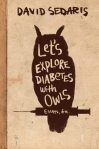 #3 Another book with a fantastic title that has nothing to do with the contents: Let’s Explore Diabetes with Owls by David Sedaris. Again, not my favourite of his essay collections (try Me Talk Pretty One Day or When You Are Engulfed in Flames instead), but he’s reliable for laughs.
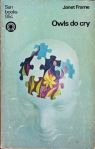 #4 No more about owls than the previous one; Owls Do Cry by Janet Frame is an autobiographical novel that tells the same story as her An Angel at My Table trilogy (but less compellingly): a hardscrabble upbringing in New Zealand and mental illness that led to incarceration in psychiatric hospitals. The title phrase is from Ariel’s song in The Tempest, which the Withers siblings learn at school. I’ve been ‘reading’ this for nearly a year and a half; really, it’s mostly been on the set-aside shelf for that time.
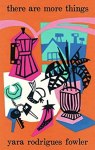 #5 Another title drawn from Shakespeare: there are more things by Yara Rodrigues Fowler is one of my Most Anticipated Books of 2022. It’s about a female friendship that links Brazil and London. I’m holding out hope for a review copy.
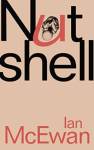 #6 Fowler’s title comes from Hamlet, which provides the plot for Ian McEwan’s Nutshell, one of his strongest novels of recent years. Within a few pages, I was captivated and utterly convinced by the voice of this contemporary, in utero Hamlet. Not even born and already a snob with an advanced vocabulary and a taste for fine wine, this foetus is a delight to spend time with. His captive state pairs perfectly with Hamlet’s existential despair, but also makes him (and us as readers) part of the conspiracy: even as he wants justice for his father, he has to hope his mother and uncle will get away with their crime; his future depends on it.
Where will your chain take you? Join us for #6Degrees of Separation! (Hosted on the first Saturday of each month by Kate W. of Books Are My Favourite and Best.)
Have you read any of my selections? Tempted by any you didn’t know before?
The 1976 Club: Woman on the Edge of Time & The Takeover
It’s my fourth time participating in one of Simon and Karen’s reading weeks (after last year’s 1920 Club and 1956 Club and April’s 1936 Club). I start with a novel I actually read for my book club’s short-lived feminist classics subgroup way back in March but didn’t manage to review before now, and then have another I picked up especially for this challenge. Both were from the university library.

Woman on the Edge of Time by Marge Piercy
An unusual and fascinating novel with hints of science fiction, but still grounded in the real world (in a way that would attract fans of Octavia E. Butler’s Kindred and Parable duology), this contrasts utopian and dystopian scenes experienced by a Latina woman who’s been confined to a mental hospital. At 37, Connie Ramos has had a tough life marked by deprivation and domestic violence; “it was a crime to be born poor as it was a crime to be born brown.” She finds herself in conversation with Luciente, a plant geneticist who claims to be visiting from the future – coastal Massachusetts in 2137 – and has heard rumors of this prior Age of Greed and Waste. Luciente senses that Connie is a “catcher,” receptive to the wavelength of other times and places.
 When drawn into Luciente’s future, Connie thinks of it more as a peasant past because of the animal husbandry and agriculture, but comes to appreciate how technology and gender equality contribute to a peaceful society and environmentally restored landscape. I was intrigued by the dynamic Piercy imagines: everyone is of indeterminate gender (the universal pronouns are “person” and “per” – how about it? Both less confusing and more aesthetically pleasing than they/them!); embryos are cultured in machines and the resulting children raised communally with three honorary named “mother” figures. People choose their own names and change them in response to rites of passage. There’s no government or police. Free love reigns. “Our notions of evil center around power and greed” rather than sex, Connie is told.
With Connie and her fellow inmates facing mind-altering surgery in the ‘real’ world, Luciente’s community becomes a blessed escape. But on one of her time travels, she ends up in a dystopian future New York City instead. From 126 floors up, all that’s visible through the smoggy air is other towers. Everyone is genetically modified and everything is owned by corporations. Which scenario represents the authentic evolution of human society?
The way Piercy intersperses these visions with life at the mental hospital, and closes with excerpts from Connie’s patient notes, forces you to question whether they might all be hallucinations. We didn’t come to any firm conclusion during our Zoom discussion. The others found Connie’s life unremittingly bleak, but I love me a good mental hospital narrative. While I wearied a bit of the anthropological detail as the novel went on, I thought it an intense cultural commentary from a writer ahead of her time on gender roles and the environment (small-scale food production, foraging, renewable energy and reusing/recycling are givens in her utopia, and she questions the nonsensical reliance on cars. Why didn’t we listen to the prophets of the 1970s when we maybe had a chance to turn things around?!).
My rating:
The Takeover by Muriel Spark
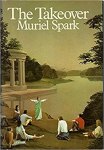 Had I read this in manuscript with no author name attached, I might have declared it to have been written by Iris Murdoch for the clutch of amoral characters, the love triangles, the peculiar religious society, the slight meanness of the attitude, and the detachment of the prose. Maggie Radcliffe is a rich American who owns three houses in the vicinity of Rome, one of which she rents out to Hubert Mallindaine, an effete homosexual who alleges that he is descended from the goddess Diana and founds a cult in her honour. He holds to this belief as fiercely as he defends his right to remain at Nemi even when Maggie decides she wants him out and employs lawyers to start eviction proceedings. There are odd priests, adulterous family members, scheming secretaries, and art and jewellery thieves, too. I wouldn’t say I’m a fan, but I liked this, my fourth novel by Spark, better than the rest. Italian bureaucracy makes for an amusing backdrop to what is almost a financial farce with an ensemble cast.
My rating: 
Another 1976 release I’ve reviewed this year: The Easter Parade by Richard Yates.
Short Stories in September, Part II: Tove Jansson, Brandon Taylor, Eley Williams
Each September I make a special effort to read short stories, which otherwise tend to languish on my shelves and TBR unread. After my first four reviewed last week, I have another three wonderfully different collections, ranging from bittersweet children’s fantasy in translation to offbeat, wordplay-filled love notes via linked stories suffused with desire and desperation.
Tales from Moominvalley by Tove Jansson (1962; 1963)
[Trans. from the Swedish by Thomas Warburton]
 I only discovered the Moomins in my late twenties, but soon fell in love with the quirky charm of Jansson’s characters and their often melancholy musings. Her stories feel like they can be read on multiple levels, with younger readers delighting in the bizarre creations and older ones sensing the pensiveness behind their quests. There are magical events here: Moomintroll discovers a dragon small enough to be kept in a jar; laughter is enough to bring a fearful child back from literal invisibility. But what struck me more was the lessons learned by neurotic creatures. In “The Fillyjonk who believed in Disasters,” the title character fixates on her belongings—
“we are so very small and insignificant, and so are our tea cakes and carpets and all those things, you know, and still they’re important, but always they’re threatened by mercilessness…”
—but when a gale and a tornado come and sweep it all away, she experiences relief and joy:
“the strange thing was that she suddenly felt quite safe. It was a very strange feeling, and she found it indescribably nice. But what was there to worry about? The disaster had come at last.”
My other favourite was “The Hemulen who loved Silence.” After years as a fairground ticket-taker, he can’t wait to retire and get away from the crowds and the noise, but once he’s obtained his precious solitude he realizes he needs others after all. The final story, “The Fir Tree,” is a lovely Christmas one in which the Moomins, awoken midway through their winter hibernation, get caught up in seasonal stress and experience the holiday for the first time. (Public library)
Filthy Animals by Brandon Taylor (2021)
Real Life was one of my five favourite novels of 2020, and we are in parallel fictional territory here. Lionel, the protagonist in four of the 11 stories, is similar to Wallace insomuch as both are gay African Americans at a Midwestern university who become involved with a (straight?) white guy. The main difference is that Lionel has just been released from hospital after a suicide attempt. A mathematician (rather than a biochemist like Wallace), he finds numbers soothingly precise in comparison to the muddle of his thoughts and emotions.
 In the opening story, “Potluck,” he meets Charles, a dancer who’s dating Sophie, and the three of them shuffle into a kind of awkward love triangle where, as in Real Life, sex and violence are uncomfortably intertwined. It’s a recurring question in the stories, even those focused around other characters: how does tenderness relate to desire? In the throes of lust, is there room for a gentler love? The troubled teens of the title story are “always in the thick of violence. It moves through them like the Holy Ghost might.” Milton, soon to be sent to boot camp, thinks he’d like to “pry open the world, bone it, remove the ugly hardness of it all.”
Elsewhere, young adults face a cancer diagnosis (“Mass” and “What Made Them Made You”); a babysitter is alarmed by her charge’s feral tendencies (“Little Beast”); and same-sex couples renegotiate their relationships (Simon and Hartjes in “As Though That Were Love” and Sigrid and Marta in “Anne of Cleves,” one of my favourites). While the longer Lionel/Charles/Sophie stories, “Potluck” and “Proctoring,” are probably the best and a few others didn’t make much of an impression, the whole book has an icy angst that resonates. Taylor is a confident orchestrator of scenes and conversations, and the slight detachment of the prose only magnifies his characters’ longing for vulnerability (Marta says to Sigrid before they have sex for the first time: “I’m afraid I’ll mess it up. I’m afraid you’ll see me.” To which Sigrid replies, “I see you. You’re wonderful.”). (New purchase, Forum Books)
 A bonus story: “Oh, Youth” was published in Kink (2021), an anthology edited by Garth Greenwell and R.O. Kwon. I requested this from NetGalley just so I could read the stories by Carmen Maria Machado and Brandon Taylor. All of Taylor’s work feels of a piece, such that his various characters might be rubbing shoulders at a party – which is appropriate because the centrepiece of Real Life is an excruciating dinner party, Filthy Animals opens at a potluck, and “Oh, Youth” is set at a dinner party.
Grisha is here with Enid and Victor, his latest summer couple. He’s been a boytoy for hire since his architecture professor, Nate, surprised him by inviting him into his open marriage with Brigid. “His life at the time was a series of minor discomforts that accumulated like grit in a socket until rotation was no longer possible.” The liaisons are a way to fund a more luxurious lifestyle and keep himself in cigarettes.
While Real Life brought to mind Virginia Woolf, Taylor’s stories recall E.M. Forster or Thomas Mann. In other words, he’s the real deal: a blazing talent, here to stay.
Attrib. and Other Stories by Eley Williams (2017)
 After enjoying her debut novel, The Liar’s Dictionary, this time last year, I was pleased to find Williams’s first book in a charity shop last year. Her stories are brief (generally under 10 pages) and 15 of the 17 are first-person narratives, often voiced by a heartbroken character looking for the words to describe their pain or woo back a departed lover. A love of etymology is patent and, as in Ali Smith’s work, the prose is enlivened by the wordplay.
The settings range from an art gallery to a beach where a whale has washed up, and the speakers tend to have peculiar careers like an ortolan chef or a trainer of landmine-detecting rats. My favourite was probably “Synaesthete, Would Like to Meet,” whose narrator is coached through online dating by a doctor.
 I found a number of the stories too similar and thin, and it’s a shame that the hedgehog featured on the cover of the U.S. edition has to embody human carelessness in “Spines,” which is otherwise one of the standouts. But the enthusiasm and liveliness of the language were enough to win me over. (Secondhand purchase from the British Red Cross shop, Hay-on-Wye – how fun, then, to find the line “Did you know Timbuktu is twinned with Hay-on-Wye?”)
I’ll have one more set of short story reviews coming up before the end of the month, with a few other collections then spilling into October for R.I.P.
20 Books of Summer, #1–4: Adichie, de Bernières, Egan, and Styron
The first four books for this summer’s colour theme took me from Australia to New York City to Nigeria, and into a mind plagued by depression.
Purple Hibiscus by Chimamanda Ngozi Adichie (2003)
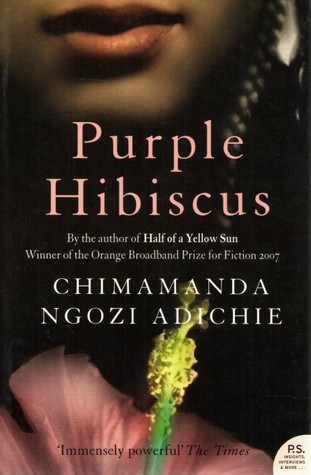 This was my last remaining unread book by Adichie, and that probably goes a long way toward explaining why I found it underwhelming. In comparison to her two later novels, and even her short stories (of which this reminded me the most), the canvas is small and the emotional scope limited. Kambili is a Nigerian teenager caught between belief systems: her grandfather’s traditional (“pagan”) ancestor worship versus the strict Catholicism that is the preserve of her abusive father, but also of the young priest on whom she has a crush. She and her brother try to stay out of their father’s way, but they are held to such an impossibly high standard of behaviour that it seems inevitable that they will disappoint him.
Adichie’s debt to her literary hero, Chinua Achebe, is evident from the first line onward: “Things started to fall apart at home when my brother, Jaja, did not go to communion and Papa flung his heavy missal across the room and broke the figurines on the étagère.” It also sets up, with a certain lack of subtlety, the way in which religion is wielded as a weapon in the novel. Meanwhile, the title suggests rarity, beauty, and fragile hope. Had this been my first taste of Adichie’s fiction, I probably would have stopped there, so in a way I’m glad that I read her first book last. Now I just have to wait with tapping fingers for the next one… (Free from a neighbour) 
Blue Dog by Louis de Bernières (2016)
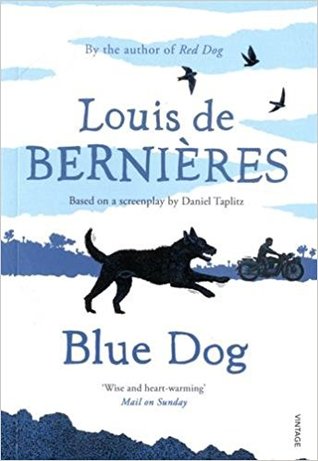 A sweet coming-of-age novella about a boy moving to the Australian Outback to live with his grandfather in the 1960s and adopting a stray dog – a red cloud kelpie, but named Blue. I didn’t realize that this is a prequel (to Red Dog), and based on a screenplay. It was my third book by de Bernières, and it was interesting to read in the afterword that he sees this one as being suited to 12-year-olds, yet most likely to be read by adults.
Mick’s father is dead and his mother has had a breakdown, so Granpa is the only one around to look after him, though out at the cattle station the boy mostly fends for himself, having adventures with stinging lizards and cyclones and bushfires and cursed caves. All along, Blue and his motorcycle are constant companions. Taylor Pete, a wry Aboriginal man, and Betty Marble, a pretty blonde hired as his teacher, are two amusing secondary characters.
This reminded me of Gerald Durrell’s writing about his childhood, and was pleasant airport and plane reading for me: light and fun, but not fluffy, and offering an armchair traveling opportunity. I especially liked the Australian lingo and the blue and black illustrations at the head and foot of each chapter, with a flipbook-style cartoon of a running dog in the upper right corner of each odd-numbered page. (Public library)
Emerald City by Jennifer Egan (1993)
 Each of these 11 stories has a fantastic first line – my favorite, from “Sacred Heart,” being “In ninth grade I was a great admirer of Jesus Christ” – but often I felt that these stories of relationships on the brink did not live up to their openers. Most take place in a major city (Chicago, New York, San Francisco) or a holiday destination (Bora Bora, China, Mexico, Spain), but no matter the setting, the terrain is generally a teen girl flirting with danger or a marriage about to implode because the secret of a recent or long-ago affair has come out into the open.
Recurring elements include models/stylists/fashion photographers and people getting conned out of money. The title story is set in New York, described as “a place that glittered from a distance even when you reached it.”
To me the best story, for offering something a bit different, was “One Piece,” about a brother who seems to hurt everything he touches but comes through for his sister when it counts. Egan’s characters are caught between emotional states: remembering a golden age, regretting a moment that changed everything, or hoping that the best is yet to come. “The Stylist” was the one story that reminded me most of A Visit from the Goon Squad. As soon as I closed the book, I found that I had trouble remembering details of any of the stories. (Little Free Library in suburban Philadelphia, May 2019)
Darkness Visible: A Memoir of Madness by William Styron (1990)
 (Visible darkness must have a colour, right?) I had long wanted to read this and finally came across a secondhand copy the other day. What I never realized was that, at 84 pages, it is essentially an extended essay: It started life as a lecture given at Johns Hopkins in 1989, was expanded into a Vanity Fair essay, and then further expanded into this short book.
Approaching age 60 and on his way to Paris to accept a prestigious award, Styron could feel his depression worsening. Rather than being proud or grateful, he could only doubt his own talent. The pills his doctor prescribed him for insomnia exacerbated his feelings of despair. When he threw away the journal he had been keeping, he knew it was a potential prelude to suicide. Hearing a piece by Brahms on a movie soundtrack was the one thing that reminded him of the beauty of the world and the richness of his life, enough for him to reach out and get seven weeks of treatment at a mental hospital, which was what saved him. These experiences, recounted in sections VI and VII, are the highlight of the book.
Styron also muses on the creative temperament and the ubiquity of suicide among writers, especially those who, like him, had an early trauma (his mother died when he was 13). The prose is forthright and intimate, ably evoking a psychic pain that is “quite unimaginable to those who have not suffered it.” This made me want to try his fiction, too. (Secondhand purchase, June 2021) 
Favourite lines:
“each day’s pattern of distress exhibits fairly predictable alternating periods of intensity and relief. The evening’s relief for me—an incomplete but noticeable letup, like the change from a torrential downpour to a steady shower—came in the hours after dinnertime and before midnight, when the pain lifted a little and my mind would become lucid enough to focus on matters beyond the immediate upheaval convulsing my system.”
“Alcohol was an invaluable senior partner of my intellect, besides being a friend whose ministrations I sought daily—sought also, I now see, as a means to calm the anxiety and incipient dread that I had hidden away for so long somewhere in the dungeons of my spirit.”
Next two in progress: A Pair of Blue Eyes by Thomas Hardy and Ruby by Ann Hood.
Read any of these? Interested?
Finishing Off the Barbellion Prize Shortlist: Sam Mills and Dr Amit Patel
The Barbellion Prize 2020 will be awarded tomorrow “to an author whose work has best represented the experience of chronic illness and/or disability.” (See also my reviews of Golem Girl by Riva Lehrer and Sanatorium by Abi Palmer.)
These two memoirs, though very different outwardly, both draw attention to the practical and emotional challenges of life with disability or a mental illness, and call for compassion from individuals and a commitment to help from governing bodies.
The Fragments of My Father: A memoir of madness, love and being a carer by Sam Mills
One in eight people in the UK cares for an ill or disabled relative. Sam Mills has been a carer for a parent – not once, but twice. The first time was for her mother, who had kidney cancer that spread to her lungs and died one Christmas. A few years later, Mills’s father, Edward, who has paranoid schizophrenia, started having catatonic episodes, as with the incident she opens her memoir on. In 2016, on what would have been her mother’s 70th birthday, Edward locked himself in the toilet of the family home in Surrey. Her brother had to break in with a screwdriver and ambulance staff took him away to a hospital. It wasn’t the first time he’d been institutionalized for a mental health crisis, nor would it be the last. It was always excruciating to decide whether he was better off at home or sectioned on a ward.
Mills darts between past and present as she contrasts her father’s recent condition with earlier points in their family life. She only learned about his diagnosis from her mother when, at age 14, she saw him walk down the stairs naked and then cry when he burned the chips. While schizophrenia can have a genetic element, relatives of a schizophrenic are also more likely to be high achievers. So, although Mills went through a time of suicidal depression as a teenager, meditation got her through and she exhibits more of the positive traits: An author of six books and founder of the small press Dodo Ink, she is creative and driven. Still, being her father’s full-time carer with few breaks often leaves her exhausted and overwhelmed.
The book’s two main points of reference are Leonard Woolf and F. Scott Fitzgerald, who cared for mentally ill wives and had to make difficult choices about their treatment and housing. In a nutshell, Mills concludes that Woolf was a good carer while Fitzgerald was a terrible one. Leonard was excused World War I service due to his nervous exhaustion from being a carer, and he gave up on the idea of children when doctors said that motherhood would be disastrous for Virginia. Virginia herself absolved Leonard in her suicide note, reassuring him that no couple could have been happier and that no one could have looked after her better. Scott, on the other hand, couldn’t cope with Zelda’s unpredictable behaviour – not least because of his own alcoholism – so had her locked up in expensive yet neglectful institutions and censored her work when it came too close to overlapping with his own plots.
The Fragments of My Father brings together a lot of my favourite topics to read about: grief, physical and mental illness, and literary biography. It had already been on my wish list since I first heard about it last year, but I’m glad the Barbellion Prize shortlisting gave me a chance to read it. It helps to have an interest in the Fitzgeralds and Woolfs – though in my case I had read a bit too extensively about them for this strand to feel fully fresh. (I also had a ‘TMI’ response to some revelations about the author’s relationships and sex life.)
Ultimately, I most appreciated the information on being a carer, including the mental burden and the financial and social resources available. (Although there is a government allowance for carers, Mills wasn’t eligible because of her freelance earnings, so she had to apply for Society of Authors grants instead.) With caring so common, especially for women, we need a safety net in place for all whose earnings and relationships will be affected by family duties. I read this with an eye to the future, knowing there’s every possibility that one day I’ll be a carer for a parent(-in-law) or spouse.
Readalikes I have also reviewed:
- Labours of Love: The Crisis of Care by Madeleine Bunting
- All the Lives We Ever Lived: Seeking Solace in Virginia Woolf by Katharine Smyth
Favorite lines:
“had I ever made a conscious choice? Caring felt like something that was happening to me, as though my father’s illness had been an eruption that had flowed like lava over my life. … I can’t think of any other job where someone defines your role by conferring its title on you, as though they are holding out a mould that you must fill.”
“caring is rarely simple because its nature is not static. It creates routines, crafts the days into set shapes, lulls you into states of false security, and then mutates, slaps you with fresh challenges, leaves you lost just when you feel you have gained wisdom.”
With thanks to Fourth Estate for the free copy for review.
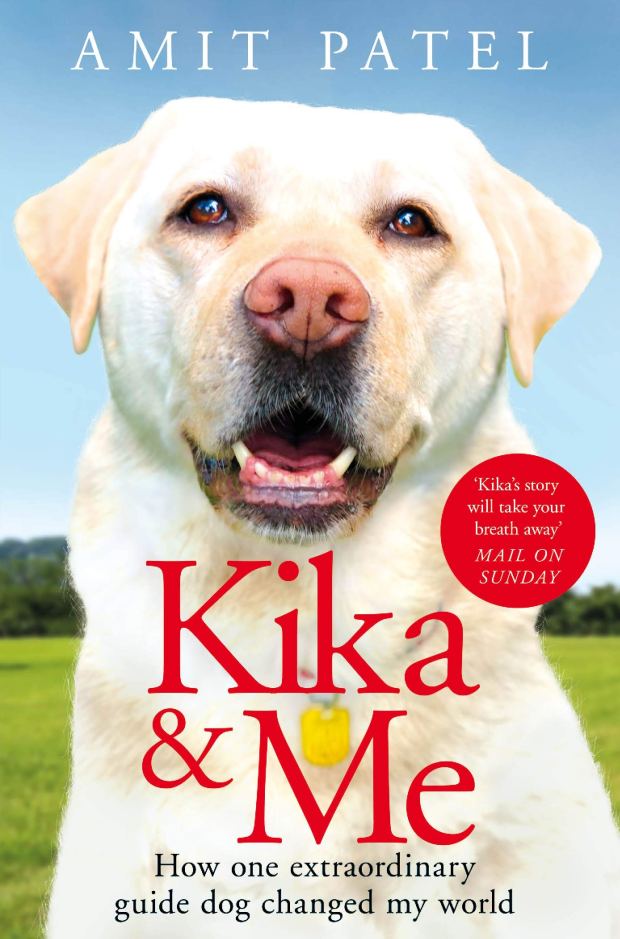
Kika & Me: How one extraordinary guide dog changed my world by Dr Amit Patel with Chris Manby
Dr Patel grew up in Guildford, studied medicine at Cambridge, and specialised in trauma medicine as a junior doctor in London. Diagnosed with keratocornus, which changes the shape of the cornea (it affects 1 in 450), he required first special contact lenses and then a series of cornea transplants. By the time of his eighth transplant, he’d remortgaged his house to pay an American specialist. Meeting and marrying Seema was a time of brightness before, in November 2013, he completely lost his vision within 36 hours. Blindness meant that he could no longer do his job, and constant eye pain and inactivity exacerbated his depression. While white cane and Braille training, plus the Royal National Institute of Blind People’s “Living with Sight Loss” course, started to boost his independence, it was being paired with his guide dog, Kika the Labrador, in 2015 that truly gave Patel his life back.
Trying out guide dogs sounds a little bit like speed dating. The Guide Dogs for the Blind Association (founded in the UK in 1931) warned that Kika was a “Marmite dog,” moody and likely to push boundaries; there was no guarantee she and Patel would get along. But from the start Kika was just right for him. More than once, what seemed like her pure stubbornness – lying on his feet and refusing to move – kept him from dangerous situations, like getting trapped between a busy road and a building site on an unfamiliar route. After a 10-day core skills training course, during which man and dog stayed at a hotel together, Kika was ready to join them at home. In the days to come, she would learn all Patel’s usual routes around their neighbourhood and into the City – with the help of smears of mackerel pâté.
If you’re like me, you’ll be most curious to learn about the nitty-gritty of life for a visually impaired person. I loved hearing about how Patel practiced his Braille letters with an egg container and ping pong balls. Since he went blind, he and his wife have had two children, and with Kika’s help manoeuvring a baby buggy is no problem. Guide dogs are trained to be predictable, e.g., doing their business in the same spot at the same times so it’s much easier to find and clean up. Some dog training tricks also worked for children, like putting a bell on a Labrador or a toddler to know when they wandered off!
Patel has had some unfortunate experiences since he went blind, particularly on the London Underground: teenagers picking him up and spinning him around on a train platform, busy commuters barging past him and Kika on an escalator, and an impatient woman hitting Kika with her handbag. While Patel doesn’t like being negative on social media, he finds that posting video clips of these incidents raises awareness of the challenges VIPs face. Every time he hits a setback, he uses it as an opportunity. For instance, one Diwali he was excited to visit Neasden Temple, only to be dismayed that they wouldn’t allow Kika inside. Since then, he has worked with temples around the world to improve disability services. He is also involved in London’s “Transport for All” work, and advises companies on access issues.
More so than the rest of the shortlist, Kika & Me is illuminating about daily life with a disability and has a campaigning focus. It’s an easy read, and not just for animal lovers. Judging the book by the cover, I might not have picked it up otherwise, so I’m grateful that the Barbellion put it on my radar. I’m deeply impressed by what Patel has achieved and the positive attitude he maintains. (Kika has her own Twitter account! @Kika_GuideDog)
With thanks to Pan Macmillan for the free copy for review.
(Fellow bloggers John Fish and Jackie Law have also been reading along with the Barbellion Prize shortlist. See their reviews thus far: John—Mills and Palmer; Jackie—Mills and Palmer.)
Next year the Barbellion Prize hopes to award more money, including to all nominated authors. They are accepting submissions for 2021, and are grateful for any Paypal donations via their website (see the page footer). I’ve donated to the cause. Can you help, too?
Young Writer of the Year Award 2020: Shortlist Reviews and Predictions
Being on the shadow panel for the Sunday Times Young Writer of the Year Award was a bookish highlight of 2017 for me. I’m pleased for this year’s panelists, especially blogging friend Marina Sofia, to have had the same opportunity, and I look forward to hearing who they choose as their shadow panel winner on December 3rd and then attending the virtual prize ceremony on December 10th.

At the time of the shortlisting, I happened to have already read Exciting Times by Naoise Dolan and was halfway through Catherine Cho’s memoir Inferno. I got the poetry collection Surge by Jay Bernard out from the library to have another go (after DNFing it last year), and the kind folk of FMcM Associates sent me the other two shortlisted books, a poetry collection and a novel, so that I could follow along with the shadow panel’s deliberations. Here are my brief thoughts on all five nominees.
Surge by Jay Bernard (2019)
 As a writer-in-residence at the George Padmore Institute, a research centre for radical Black history, in 2016, Bernard investigated the New Cross Massacre, a fire that killed 13 young people in 1981. In 2017, the tragedy found a horrific echo in the Grenfell Tower fire, which left 72 dead. This debut poetry collection bridges that quarter-century through protest poems from various perspectives, giving voice to victims and their family members and exploring the interplay between race, sexuality and violence. Patois comes in at several points, most notably in “Songbook.” I especially liked “Peg” and “Pride,” and the indictment of government indifference in “Blank”: “It-has-nothing-to-do-with-us today issued this statement: / those involved have defended their actions and been … acquitted / retired with full pay”. On the whole, I found it difficult to fully engage with this collection, but I am reliably informed that Bernard’s protest poems have more impact when performed aloud.
Readalikes: In Nearby Bushes by Kei Miller, A Portable Paradise by Roger Robinson and Don’t Call Us Dead by Danez Smith
My rating:
Inferno by Catherine Cho (2020)
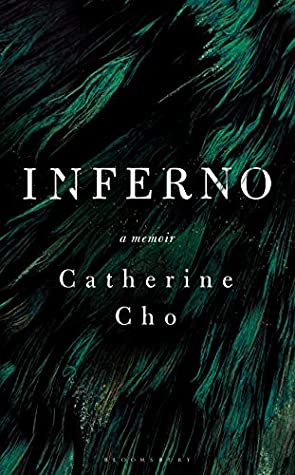 Cho, a Korean American literary agent based in London, experienced stress-induced postpartum psychosis after the birth of her son. She and her husband had returned to the USA when Cato was two months old to introduce him to friends and family, ending with a big Korean 100-day celebration at her in-laws’ home. Almost as soon as they got to her in-laws’, though, she started acting strangely: she was convinced cameras were watching their every move, and Cato’s eyes were replaced with “devil’s eyes.” She insisted they leave for a hotel, but soon she would be in a hospital emergency room, followed by a mental health ward. Cho alternates between her time in the mental hospital and a rundown of the rest of her life before the breakdown, weaving in her family history and Korean sayings and legends. Twelve days: That was the length of her hospitalization in early 2018, but Cho so painstakingly depicts her mindset that readers are fully immersed in an open-ended purgatory. She captures extremes of suffering and joy in this vivid account. (Reviewed in full here.)
Readalikes: An Angel at My Table by Janet Frame and Dear Scarlet by Teresa Wong
My rating:
Exciting Times by Naoise Dolan (2020)
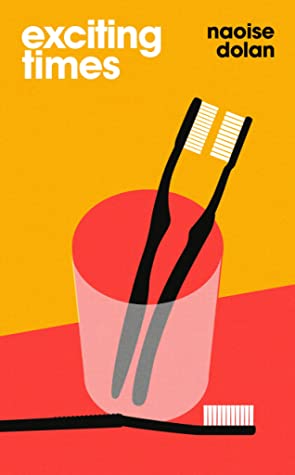 At 22, Ava leaves Dublin to teach English as a foreign language to wealthy preteens in Hong Kong and soon comes to a convenient arrangement with her aloof banker friend, Julian, who lets her live with him without paying rent and buys her whatever she wants. They have sex, yes, but he’s not her boyfriend per se, so when he’s transferred to London for six months, there’s no worry about hard feelings when her new friendship with Edith Zhang turns romantic. It gets a little more complicated, though, when Julian returns and she has to explain these relationships to her two partners and to herself. On the face of it, this doesn’t sound like it would be an interesting plot, and the hook-up culture couldn’t be more foreign to me. But with Ava Dolan has created a funny, deadpan voice that carries the entire novel. I loved the psychological insight, the playfulness with language, and the zingy one-liners (“I wondered if Victoria was a real person or three Mitford sisters in a long coat”). (Reviewed in full here.)
Readalikes: Besotted by Melissa Duclos and Conversations with Friends by Sally Rooney
My rating:
Tongues of Fire by Seán Hewitt (2020)
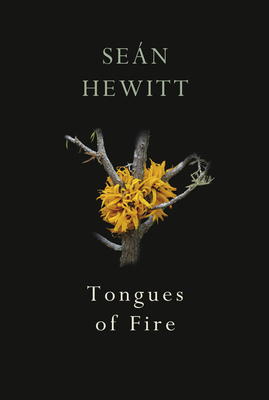 In the title poem, the arboreal fungus from the cover serves as “a bright, ancestral messenger // bursting through from one realm to another” like “the cones of God, the Pentecostal flame”. This debut collection is alive with striking imagery that draws links between the natural and the supernatural. Sex and grief, two major themes, are silhouetted against the backdrop of nature. Fields and forests are loci of meditation and epiphany, but also of clandestine encounters between men: “I came back often, // year on year, kneeling and being knelt for / in acts of secret worship, and now / each woodland smells quietly of sex”. Hewitt recalls travels to Berlin and Sweden, and charts his father’s rapid decline and death from an advanced cancer. A central section of translations of the middle-Irish legend “Buile Suibhne” is less memorable than the gorgeous portraits of flora and fauna and the moving words dedicated to the poet’s father: “You are not leaving, I know, // but shifting into image – my head / already is haunted with you” and “In this world, I believe, / there is nothing lost, only translated”.
Readalikes: Physical by Andrew McMillan and If All the World and Love Were Young by Stephen Sexton
My rating:
Nightingale by Marina Kemp (2020)
 Marguerite Demers, a 24-year-old nurse, has escaped Paris to be a live-in carer for elderly Jérôme Lanvier in southern France. From the start, she senses she’s out of place here – “She felt, as always in this village, that she was being observed”. She strikes up a friendship with a fellow outsider, an Iranian émigrée named Suki, who, in this story set in 2002, stands out for wearing a hijab. Everyone knows everyone here, and everyone has history with everyone else – flirtations, feuds, affairs, and more. Brigitte Brochon, unhappily married to a local farmer, predicts Marguerite will be just like the previous nurses who failed to hack it in service to the curmudgeonly Monsieur Lanvier. But Marguerite sticks up for herself and, though plagued by traumatic memories, makes her own bid for happiness. The novel deals sensitively with topics like bisexuality, euthanasia, and family estrangement, but the French provincial setting and fairly melodramatic plot struck me as old-fashioned. Still, the writing is strong enough to keep an eye out for what Kemp writes next. (U.S. title: Marguerite.)
Readalikes: French-set novels by Joanne Harris and Rose Tremain; The Hoarder by Jess Kidd
My rating:
General thoughts:
After last year’s unexpected winner – Raymond Antrobus for his poetry collection The Perseverance – I would have said that it’s time for a novel by a woman to win. However, I feel like a Dolan win would be too much of a repeat of 2017’s win (for Sally Rooney), and Kemp’s debut novel isn’t quite up to scratch. Much as I enjoyed Inferno, I can’t see it winning over these judges (three of whom are novelists: Kit de Waal, Sebastian Faulks and Tessa Hadley), though it would be suited to the Wellcome Book Prize if that comes back in 2021. So, to my surprise, I think it’s going to be another year for poetry.
I’ve been following the shadow panel’s thoughts via Marina’s blog and the others’ Instagram accounts and it looks like they are united in their admiration for the poetry collections, particularly the Hewitt. That would be my preference, too: I respond better to theme and style in poetry (Hewitt) than to voice and message (Bernard). However, I think that in 2020 the Times may try to trade its rather fusty image for something more woke, bearing in mind the Black Lives Matter significance and the unprecedented presence of a nonbinary author.
My predictions:
Shadow panel winner: Tongues of Fire by Seán Hewitt
Official winner: Surge by Jay Bernard
Have you read anything from this year’s shortlist?
Be(com)ing an ‘Expert’ on Postpartum Depression for #NonficNov
This Being/Becoming/Asking the Expert week of the month-long Nonfiction November challenge is hosted by Rennie of What’s Nonfiction.
I’m also counting this as the first entry in my new “Three on a Theme” series, where I’ll review three books that have something significant in common and tell you which one to pick up if you want to read into the topic for yourself. I have another medical-themed one lined up for this Friday as a second ‘Being the Expert’ entry.

I never set out to read several memoirs of women’s experience of postpartum depression this year; it sort of happened by accident. I started with the graphic memoir and then chanced upon a recent pair of traditional memoirs published in the UK – in fact, I initially pitched them as a dual review to the TLS, but they’d already secured a reviewer for one of the books.
Inferno: A Memoir by Catherine Cho
I was delighted to see this prediction of mine make the Sunday Times Young Writer of the Year Award shortlist. Coincidentally, I was already halfway through the book on my Kindle (via NetGalley) at that point, but its nomination gave me the push to finish in a timely manner. Cho, a Korean American literary agent based in London, experienced stress-induced postpartum psychosis after the birth of her son, Cato. She and her husband James had gone back to the USA when Cato was two months old to introduce him to friends and family, ending with a big Korean 100-day celebration for him at her in-laws’ home in New Jersey. Almost as soon as they got to her in-laws’, though, she started acting strangely: she was convinced there were cameras watching their every move, and Cato’s eyes were replaced with “devil’s eyes.” She insisted they leave for a hotel, but soon she would be in an emergency room, followed by a mental health ward.
Cho alternates between her time on the New Bridge ward – writing in a notebook, trying to act normal whenever James visited, expressing milk from painfully swollen breasts, and interacting with her fellow patients with all their quirks – and a rundown of the rest of her life before the breakdown. Her Kentucky childhood was marked by her mathematician father’s detachment and the sense that she and her brother were together “in the trenches,” pitted against the world. In her twenties she worked in a New York City corporate law firm and got caught up in an abusive relationship with a man she moved to Hong Kong to be with. All along she weaves in her family’s history and Korean sayings and legends that explain their values.
Twelve days. That was the length of her hospitalization in early 2018, but Cho so painstakingly depicts her mindset that readers are fully immersed in an open-ended purgatory – a terrifying time when she questioned her sanity and whether she was cut out for motherhood. “Koreans believe that happiness can only tempt the fates and that any happiness must be bought with sorrow,” she writes. She captures both extremes, of suffering and joy, in this vivid account.
My rating:
What Have I Done? An honest memoir about surviving postnatal mental illness by Laura Dockrill
 Dockrill is a British children’s author. Her style reminded me of others of her contemporaries who do a good line in light, witty, warts-and-all, here’s-what-it’s-really-like-to-be-a-woman books: Dolly Alderton, Caitlin Moran and the like. From a labor that quickly deviated from her birth plan due to an emergency Caesarean to the usual post-baby blues to full-blown psychosis, Dockrill recreates her experience with fluid dialogue and italicized passages of her paranoid imaginings. Her memoir resembles Cho’s in its broad strokes but also in certain particulars, like imagining surveillance cameras and hearing a voice in her head telling her she is a bad mum. I skimmed this one because of a library deadline and because of an overload on similar content. I had a greater affinity for Cho’s literary style compared to the more between-girlfriends, self-help bent of this memoir. With the glossary and resources at the end, though, I’d say this one would be more useful for someone going through the same thing.
My rating:
Dear Scarlet: The Story of My Postpartum Depression by Teresa Wong (2019)
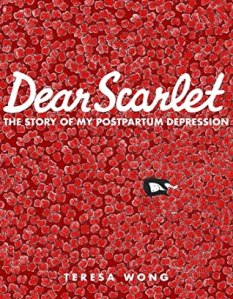 Memoir as letter and as graphic novel. Wong narrates the traumatic birth of her first child and her subsequent postpartum depression in black-and-white sketches that manage to feel breezy and fun despite the heavy subject matter. “I felt lost. I had no maternal instincts and no clue how I was supposed to take care of a baby,” she writes to Scarlet. “Your first two months in the world were the hardest two months of my life.”
For Wong, a combination of antidepressants, therapy, a postnatal doula, an exercise class, her mother’s help, and her husband’s constant support got her through, and she knows she’s lucky to have had a fairly mild case and to have gotten assistance early on. I loved the “Not for the Faint of Heart” anatomical spreads and the reflections on her mother’s tough early years after arriving in Canada from China.
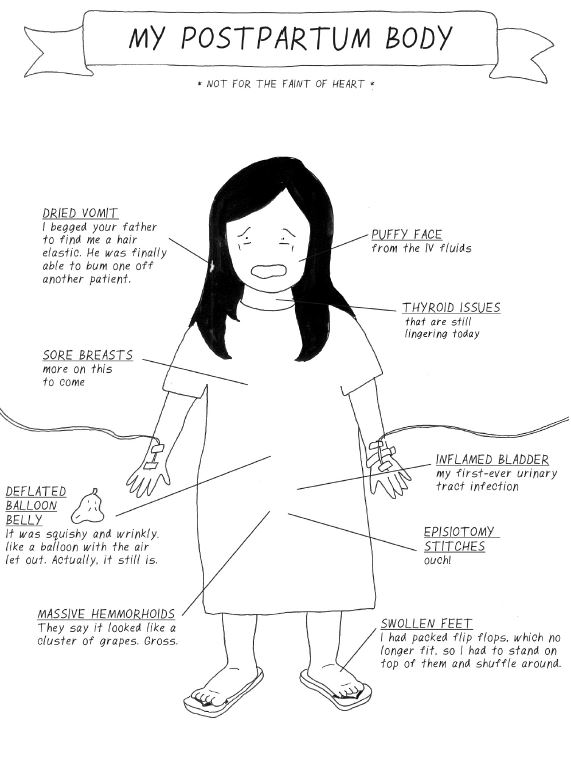
The drawing and storytelling style is similar to that of Sarah Laing and Debbie Tung. The writing is more striking than the art, though, so I hope that with future work the author will challenge herself to use more color and more advanced designs (from her Instagram page it looks like she is heading that way).
My rating:
My thanks to publicist Beth Parker for the free e-copy for review.
What I learned:
All three authors emphasize that motherhood does not always come naturally; “You might not instantly love your baby,” as Dockrill puts it. There might be a feeling of detachment – from the baby and/or from one’s new body. They all note that postpartum depression is common and that new mothers should not be ashamed of seeking help from medical professionals, baby nurses, family members and any other sources of support.
These two passages were representative for me:
Cho: “I don’t feel a rush of love or an overwhelming weight of responsibility, emotions that I’d been expecting. Instead, I felt curious, like I’d just been introduced to a stranger. He was a creature, an idea, not even human yet, just a being, a life. … I’d thought I would reclaim my body after birth, but instead, it was now a tool, something to sustain life.”
Dockrill: “If childbirth and motherhood are the most natural, universal, common things in the world, the things that women have been doing since the beginning of time, then why does nobody tell us that there’s a good chance that you might not feel like yourself after you have a baby? That you might even lose your head? That you might not ever come back?”
 On this topic, I have also read: Birth of a New Brain by Dyane Harwood. There are more book ideas here and here.
Nobody Told Me by Hollie McNish, one of my current bedside books, also deals with complicated pregnancy emotions and the chaotic early months of motherhood.
If you read just one, though… Make it Inferno by Catherine Cho.
Can you see yourself reading any of these books?
Short Stories in September, Part I
Each September I make a bit more of an effort to read short stories, which otherwise tend to sit on my shelves and Kindle unread. I’ve read three collections recently, all of them released this August or September, and I have a few more on the go to report on later in the month.
Likes by Sarah Shun-Lien Bynum
 This was a hit and miss collection for me: I only loved one of the stories, and enjoyed another three; touches of magic realism à la Aimee Bender produce the two weakest stories, and there are a few that simply tail off without having made a point. My favorite was “Many a Little Makes,” about a trio of childhood best friends whose silly sleepover days come to an end as they develop separate interests and one girl sleeps with another one’s brother. In “Tell Me My Name,” set in a post-economic collapse California, an actress who was a gay icon back in New York City pitches a TV show to the narrator’s wife, who makes kids’ shows.
“Julia and Sunny,” about two couples – one that makes it and one that doesn’t – who all met in medical school, reminded me of a Wallace Stegner plot. “The Bears” has a wispy resemblance to Goldilocks and the Three Bears and stars a woman convalescing from a miscarriage at a retreat center while writing a chapter on William James. In James’s famous metaphor involving a bear, bodily action precedes emotion – we are afraid because we flee; not vice versa. The touch of magic in this story is light enough to not be off-putting, whereas “The Erlking” and “The Young Wife’s Tale” take their fairy tale similarities too far.
The title story, about a father trying to understand his 12-year-old through her Instagram posts either side of the Trump election, is promising but doesn’t go anywhere, and “The Burglar” and “Bedtime Story” struck me as equally insubstantial, making nothing of their setups. Seven of these nine stories had been previously published in other publications in some form.
My rating:
Published in the USA by Farrar, Straus and Giroux. I read an advanced e-copy via Edelweiss.
Black Light by Kimberly King Parsons
 Parsons’s debut collection, longlisted for the U.S. National Book Award in 2019, contains a dozen gritty stories set in or remembering her native Texas. Eleven of the 12 are in the first person, with the mostly female narrators unnamed or underdeveloped and thus difficult to differentiate from each other. The homogeneity of voice and recurring themes – drug use, dysfunctional families, overweight bodies, lesbian or lopsided relationships – lead to monotony.
“Glow Hunter” and “We Don’t Come Natural to It” are representative: in the former, Sarah and her girlfriend Bo have sex and go for a drive while tripping on magic mushrooms; in the latter, the narrator has a crush on her co-worker Suki, who has lost 200 pounds, and they remain obsessed with their and others’ fat bodies (the references are inescapable: “a pudgy,” “the fatty,” “some cow,” “thinspiration”). The opening story, “Guts,” is uncomfortable for the way that it both fetishizes fat and medicalizes sex: when unreliable, alcoholic receptionist Sheila turns up at her boyfriend Tim’s hospital saying there’s something wrong with her internally, he performs an examination that’s part striptease and part children playing doctor.
“The Light Will Pour In” is refreshingly different for its Lolita-type situation. “Into the Fold,” set at a girls’ boarding school, reminded me of Scarlett Thomas’s Oligarchy. In “Fiddlebacks,” my favorite, siblings on a night hunt for creepy-crawlies come across their newly religious mother and the handyman trysting in a car. “Starlite,” the only one in the third person, has colleagues, one a supervisor and both married, meet up in a seedy motel for drugs and junk food. The shortest stories at just a few pages each, “In Our Circle” and “The Animal Part” animate art therapy in a mental hospital and urban legends told while camping (though I’d forgotten it, I’d encountered the former in The Best Small Fictions 2017).
These stories engaged me at neither the sentence level nor the plot level, but many readers (and critics) have felt otherwise. Here are two lines I liked, from “Glow Hunter”: “Bo says everything that scares you is something to poke at with a stick, to pick up and turn in your hands” & “I’m very aware that we are organisms on the surface of a rock, orbiting a burning star.”
My rating: 
My thanks to Atlantic Books for the free copy for review.
You Will Never Be Forgotten by Mary South
“In the modern world, you might be easily forgotten, but you could also carve out your own niche.”

In the 10 stories of this debut collection, characters turn to technology to stake a claim on originality, compensate for their losses, and leave a legacy. In “Keith Prime,” a widowed nurse works at a warehouse that produces unconscious specimens for organ harvesting. When her favorite Keith wakes up, she agrees to raise him at home, but human development and emotional connection are inconveniences in a commodity. The narrator of “FAQs about Your Craniotomy” is a female brain surgeon who starts out by giving literal answers to potential patient questions and then segues into bitterly funny reflections on life after her husband’s suicide.
In “Architecture for Monsters,” a young woman interviews Helen Dannenforth, a formidable female architect whose designs are inspired by anatomy, specifically by her disabled daughter’s condition. The narrator’s mother, a molecular biologist, was assaulted and murdered by a lab technician. Dannenforth is a hero/replacement mother figure to her, even after she learns about the complicated situation with the architect’s sister, who was the surrogate for her niece but then got cut out of the child’s life.
I particularly liked “The Age of Love,” a funny one in which the nurses at a nursing home listen in to their elderly patients’ calls to phone sex lines. Their conversations aren’t about smut so much as they’re about loneliness and nostalgia. Another favorite of mine was “Camp Jabberwocky for Recovering Internet Trolls,” about a Martha’s Vineyard camp for teens who need a better relationship with social media. When camper Rex Hasselbach, who had posted foul content in his father’s name to get revenge on being beaten up at home, goes missing, three counselors with guilt or identity issues of their own go looking for him. The title story also engages with social media as a woman obsessively tracks her rapist and works as a “digital media curator” deleting distressing video content.
All of the characters have had a bereavement or other traumatic incident and are looking for the best way to move on, but some make bizarre and unhealthy decisions – such as to restage events from a dead daughter’s life, to breastfeed grown men, or to communicate by text with a deceased wife. These quirky, humorous stories never strayed so far into science fiction as to alienate me. I loved the medical themes and the subtle, incisive observations about a technology-obsessed culture. I’ll be looking out for what Mary South does next.
(Note: The cover image is a creepily pixelated version of the author’s photo.)
My rating:
My thanks to Picador for the proof copy for review.
 Bookish Beck = Rebecca Foster. American transplant to England. Freelance proofreader and book reviewer.
