May Releases, Part II (Fiction): Le Blevennec, Lynch, Puchner, Stanley, Ullmann, and Wald
A cornucopia of May novels, ranging from novella to doorstopper and from Montana to Tunisia; less of a spread in time: only the 1980s to now. Just a paragraph on each to keep things simple. I’ll catch up soon with May nonfiction and poetry releases I read.
Friends and Lovers by Nolwenn Le Blevennec (2023; 2025)
[Translated from French by Madeleine Rogers]
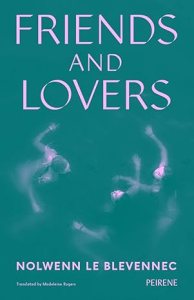 Armelle, Rim, and Anna are best friends – the first two since childhood. They formed a trio a decade or so ago when they worked on the same magazine. Now in their mid-thirties, partnered and with children, they’re all gripped by a sexual “great awakening” and long to escape Paris and their domestic commitments – “we went through it, this mutiny, like three sisters,” poised to blow up the “perfectly executed choreography of work, relationships, children”. The friends travel to Tunisia together in December 2014, then several years later take a completely different holiday: a disaster-prone stay in a lighthouse-keeper’s cottage on an island off the coast of Brittany. They used to tolerate each other’s foibles and infidelities, but now resentment has sprouted up, especially as Armelle (the narrator) is writing a screenplay about female friendship that’s clearly inspired by Rim and Anna. Armelle is relatably neurotic (a hilarious French blurb for the author’s previous novel is not wrong: “Woody Allen meets Annie Ernaux”) and this is wise about intimacy and duplicity, yet I never felt invested in any of the three women or sufficiently knowledgeable about their lives.
With thanks to Peirene Press for the free copy for review.
A Family Matter by Claire Lynch
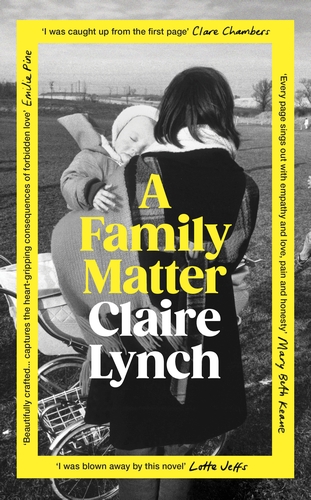 “The fluke of being born at a slightly different time, or in a slightly different place, all that might gift you or cost you.” At events for Small, Lynch’s terrific memoir about how she and her wife had children, women would speak up about how different their experience had been. Lesbians born just 10 or 20 years earlier didn’t have the same options. Often, they were in heterosexual marriages because that’s all they knew to do; certainly the only way they thought they could become mothers. In her research into divorce cases in the UK in the 1980s, Lynch learned that 90% of lesbian mothers lost custody of their children. Her aim with this earnest, delicate debut novel, which bounces between 2022 and 1982, is to imagine such a situation through close portraits of Heron, an ageing man with terminal cancer; his daughter, Maggie, who in her early forties bears responsibility for him and her own children; and Dawn, who loved Maggie desperately but felt when she met Hazel that she was “alive at last, at twenty-three.” How heartbreaking that Maggie knew only that her mother abandoned her when she was little; not until she comes across legal documents and newspaper clippings does she understand the circumstances. Lynch made the wise decision to invite sympathy for Heron from the start, so he doesn’t become the easy villain of the piece. Her compassion, and thus ours, is equal for all three characters. This confident, tender story of changing mores and steadfast love is the new Carol for our times. (Such a lovely but low-key novel was liable to make few ripples, so I’m delighted for Lynch that the U.S. release got a Read with Jenna endorsement.)
With thanks to Chatto & Windus (Penguin) for the proof copy for review.
Dream State by Eric Puchner
 If it starts and ends with a wedding, it must be a comedy. If much of the in between is marked by heartbreak, betrayal, failure, and loss, it must be a tragedy. If it stretches towards 2050 and imagines a Western USA smothered in smoke from near-constant forest fires, it must be an environmental dystopian. Somehow, this novel is all three. The first 163 pages are pure delight: a glistening romantic comedy about the chaos surrounding Charlie and Cece’s wedding at his family’s Montana lake house in the summer of 2004. First half the wedding party falls ill with norovirus, then Charlie’s best friend, Garrett (who’s also the officiant), falls in love with the bride. Do I sound shallow if I admit this was the section I enjoyed the most? The rest of this Oprah’s Book Club doorstopper examines the fallout of this uneasy love triangle. Charlie is an anaesthesiologist, Cece a bookstore owner, and Garrett a wolverine researcher in Glacier National Park, which is steadily losing its wolverines and its glaciers. The next generation comes of age in a diminished world, turning to acting or addiction. There are still plenty of lighter moments: funny set-pieces, warm family interactions, private jokes and quirky descriptions. But this feels like an appropriately grown-up vision of idealism ceding to a reality we all must face. I struggled with a lack of engagement with the children, but loved Puchner’s writing so much on the sentence level that I will certainly seek out more of his work. Imagine this as a cross between Jonathan Franzen and Maggie Shipstead.
With thanks to Sceptre (Hodder) for the proof copy for review.
Consider Yourself Kissed by Jessica Stanley
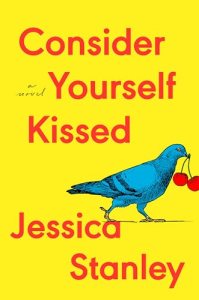 Coralie is nearing 30 when her ad agency job transfers her from Australia to London in 2013. Within a few pages, she meets Adam when she rescues his four-year-old, Zora, from a lake. That Adam and Coralie will be together is never really in question. But over the next decade of personal and political events, we wonder whether they have staying power – and whether Coralie, a would-be writer, will lose herself in soul-destroying work and motherhood. Adam’s job as a political journalist and biographer means close coverage of each UK election and referendum. As I’ve thought about some recent Jonathan Coe novels: These events were so depressing to live through, who would want to relive them through fiction? I also found this overlong and drowning in exclamation points. Still, it’s so likable, what with Coralie’s love of literature (the title is from The Group) and adjustment to expat life without her mother; and secondary characters such as Coralie’s brother Daniel and his husband, Adam’s prickly mother and her wife, and the mums Coralie meets through NCT classes. Best of all, though, is her relationship with Zora. This falls solidly between literary fiction and popular/women’s fiction. Given that I was expecting a lighter romance-led read, it surprised me with its depth. It may well be for you if you’re a fan of Meg Mason and David Nicholls.
With thanks to Hutchinson Heinemann for the proof copy for review.
Girl, 1983 by Linn Ullmann (2021; 2025)
[Translated from Norwegian by Martin Aitken]
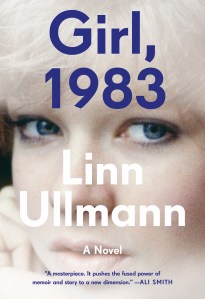 Ullmann is the daughter of actress Liv Ullmann and film director Ingmar Bergman. That pedigree perhaps accounts for why she got the opportunity to travel to Paris in the winter of 1983 to model for a renowned photographer. She was 16 at the time and spent the whole trip disoriented: cold, hungry, lost. Unable to retrace the way to her hotel and wearing a blue coat and red hat, she went to the only address she knew – that of the photographer, K, who was in his mid-forties. Their sexual relationship is short-lived and unsurprising, at least in these days of #MeToo revelations. Its specifics would barely fill a page, yet the novel loops around and through the affair for more than 250. Ullmann mostly pulls this off thanks to the language of retrospection. She splits herself both psychically and chronologically. There’s a “you” she keeps addressing, a childhood imaginary friend who morphs into a critical voice of conscience and then the self dissociated from trauma. And there’s the 55-year-old writer looking back with empathy yet still suffering the effects. The repetition made this something of a sombre slog, though. It slots into a feminist autofiction tradition but is not among my favourite examples.
With thanks to Hamish Hamilton (Penguin) for the proof copy for review.
The Bayrose Files by Diane Wald
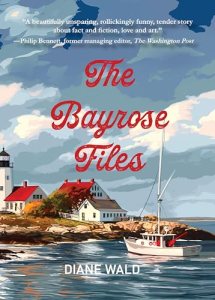 In the 1980s, Boston journalist Violet Maris infiltrates the Provincetown Home for Artists and Writers, intending to write a juicy insider’s exposé of what goes on at this artists’ colony. But to get there she has to commit a deception. Her gay friend Spencer Bayrose has a whole sheaf of unpublished short stories drawing on his Louisiana upbringing, and he offers to let her submit them as her own work to get a place at PHAW. Here Violet finds eccentrics aplenty, and even romance, but when news comes that Spence has AIDS, she has to decide how far she’ll go for a story and what she owes her friend. At barely over 100 pages, this feels more like a long short story, one with a promising setting and a sound plot arc, but not enough time to get to know or particularly care about the characters. I was reminded of books I’ve read by Julia Glass and Sara Maitland. It’s offbeat and good-natured but not top tier.
Published by Regal House Publishing. With thanks to publicist Jackie Karneth of Books Forward for the advanced e-copy for review.
A Family Matter was the best of the bunch for me, followed closely by Dream State.
Which of these do you fancy reading?
20 Books of Summer, 14–16: Polly Atkin, Nan Shepherd and Susan Allen Toth
I’m still plugging away at the challenge. It’ll be down to the wire, but I should finish and review all 20 books by the 31st! Today I have a chronic illness memoir, a collection of poetry and prose pieces, and a reread of a cosy travel guide.
Some of Us Just Fall: On Nature and Not Getting Better by Polly Atkin (2023)
I was heartened to see this longlisted for the Wainwright Prize. It was a perfect opportunity to recognize the disabled/chronically ill experience of nature and the book achieves just what the award has recognised in recent years: the braiding together of life writing and place-based observation. (Wainwright has also done a great job on diversity this year: there are three books by BIPOC and five by women on the nature writing shortlist alone.)
 Polly Atkin knew something was different about her body from a young age. She broke bones all the time, her first at 18 months when her older brother ran into her on his bicycle. But it wasn’t until her thirties that she knew what was wrong – Ehlers-Danlos syndrome and haemochromatosis – and developed strategies to mitigate the daily pain and the drains on her energy and mobility. “Correct diagnosis makes lives bearable,” she writes. “It gives you access to the right treatment. It gives you agency.”
The book assembles long-ish fragments, snippets from different points of her past alternating with what she sees on rambles near her home in Grasmere. She writes in some depth about Lake District literature: Thomas De Quincey as well as the Wordsworths – Atkin’s previous book is a biography of Dorothy Wordsworth that spotlights her experience with illness. In describing the desperately polluted state of Windermere, Atkin draws parallels with her condition (“Now I recognise my body as a precarious ecosystem”). Although she spurns the notion of the “Nature Cure,” swimming is a valuable therapy for her.
Theme justifies form here: “This is the chronic life, lived as repetition and variance, as sedimentation of broken moments, not as a linear progression.” For me, there was a bit too much particularity; if you don’t connect to the points of reference, there’s no way in and the danger arises of it all feeling indulgent. Besides, by the time I opened this I’d already read two Ehlers-Danlos memoirs (All My Wild Mothers by Victoria Bennett and Floppy by Alyssa Graybeal) and another reference soon came my way in The Invisible Kingdom by Meghan O’Rourke. So overfamiliarity was a problem. And by the time I forced myself to pick this off of my set-aside shelf and finish it, I’d read Nina Lohman’s stellar The Body Alone. For those newer to reading about chronic illness, though, especially if you also have an interest in the Lakes, it could be an eye-opener.
With thanks to Sceptre (Hodder) for the free copy for review.
Selected Prose & Poetry by Nan Shepherd (2023)
 I’d read and enjoyed Shepherd’s The Living Mountain, which has surged in popularity as an early modern nature writing classic thanks to Robert Macfarlane et al. I’m not sure I’d go as far as the executor of the Nan Shepherd Estate, though, who describes her in the Preface as “Taylor Swift in hiking boots.” The pieces reprinted here are from her one published book of poems, In the Cairngorms, and the mixed-genre collection Wild Geese. There is also a 28-page “novella,” Descent from the Cross. After World War I, Elizabeth, a workers’ rights organiser for a paper mill, marries a shell-shocked veteran who wants to write a book but isn’t sure he has either the genius or the dedication. It’s interesting that Shepherd would write about a situation where the wife has the economic upper hand, but the tragedy of the sickly failed author put me in mind of George Gissing or D.H. Lawrence, so didn’t feel fresh. Going by length alone, I would have called this a short story, but I understand why it would be designated a novella, for the scope.
None of the miniature essays – field observations and character studies – stood out to me. About half of the book is given over to poetry. As with the nature writing, there is a feeling of mountain desolation. There are a lot of religious references and hints of the mystical, as in “The Bush,” which opens “In that pure ecstasy of light / The bush is burning bright. / Its substance is consumed away / And only form doth stay”. It’s a mixed bag: some feels very old-fashioned and sentimental, with every other line or, worse, every line rhyming, and some archaic wording and rather impenetrable Scots dialect. It could have been written 100 years before, by Robert Burns if not William Blake. But every so often there is a flash of brilliance. “Blackbird in Snow” is quite a nice one, and reminiscent of Thomas Hardy’s “The Darkling Thrush.” I even found the cryptic lines from “Real Presence” that inspired a song on David Gray’s Skellig. My favourite poem by far was:
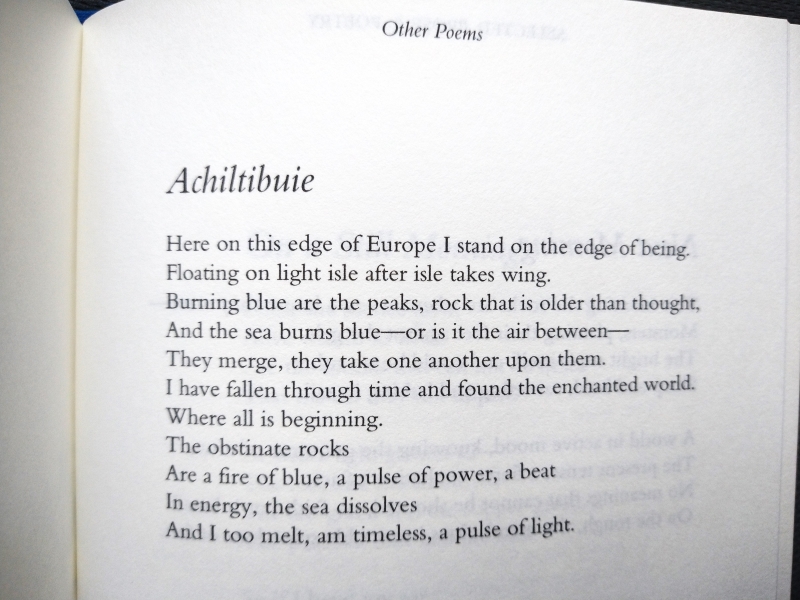
Overall, this didn’t engage me; it’s only for Shepherd fanatics and completists. (Won from Galileo Publishers in a Twitter giveaway)
England As You Like It: An Independent Traveler’s Companion by Susan Allen Toth (1995)
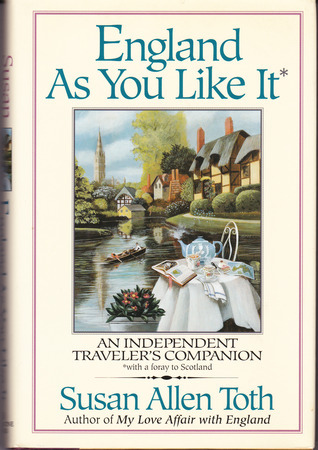 A reread. As I was getting ready to go overseas for the first time in the summer of 2003, Toth’s trilogy of memoirs whetted my appetite for travel in Britain. (They’re on my Landmark Books in My Life, Part II list.) This is the middle book and probably the least interesting in that it mostly recounts stays in particular favourite locations, such as Dorset, the Highlands, and various sites in Cornwall. However, I’ve never forgotten her “thumbprint theory,” which means staying a week or more in an area no larger than her thumb covers on a large-scale map, driving an hour or less for day trips. Not for her those cram-it-all-in trips where you race through multiple countries in a week (I have American friends who did Paris, London and Rome within six days, or five countries in eight days; blame it on stingy vacation policies, I guess). Instead, she wants to really bed into one place and have the time to make serendipitous discoveries such as an obscure museum or a rare opening of a private garden.
I most liked the early general chapters about how to make air travel bearable, her obsession with maps, her preference for self-catering, and her tendency to take home edible souvenirs. Of course, all the “Floating Facts” are hopelessly out-of-date. This being the early to mid-1990s, she had to order paper catalogues to browse cottage options (I still did this for honeymoon prep in 2006–7) and make international phone calls to book accommodation. She recommends renting somewhere from the National Trust or Landmark Trust. Ordnance Survey maps could be special ordered from the British Travel Bookshop in New York City. Entry fees averaged a few pounds. It’s all so quaint! An Anglo-American time capsule of sorts. I’ve always sensed a kindred spirit in Toth, and those whose taste runs toward the old-fashioned will probably also find her a charming tour guide. I’ve also reviewed the third book, England for All Seasons. (Free from The Book Thing of Baltimore)
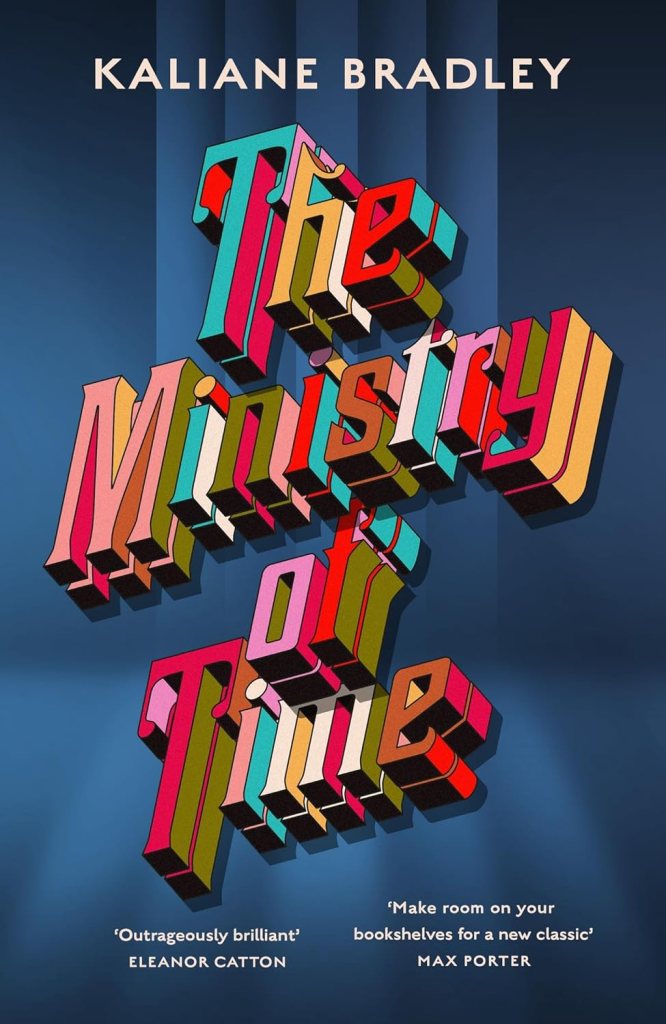
The Ministry of Time by Kaliane Bradley
This was one of my Most Anticipated releases of the year and I’m happy to report that it pretty much lived up to my high hopes. I rightly had in mind that it would be a zany time-travel romance involving a modern-day civil servant falling in love with her charge, who was a real-life Victorian polar explorer. The blurb had me expecting something rather light and one-dimensional, so it was a pleasant surprise to find that this nuanced debut novel alternately goes along with and flouts the tropes of spy fiction and science fiction, and makes clever observations about how we frame stories of empire and progress.
The unnamed first-person narrator is, like Bradley, a young British-Cambodian woman. She is blasé about her government work in languages and relishes the chance to do something a bit different. After a rigorous set of interviews for the Ministry’s mysterious new project, she is hired as a “bridge” helping to resettle one of five “expatriates” from history in near-future London. Her expat is “1847,” 38-year-old Commander Graham Gore, rescued before his death on Sir John Franklin’s ill-fated Arctic expedition.
Two of the other expats, Arthur aka “1916” and seventeenth-century nonconformist Margaret Kemble (both queer), become Gore’s close friends. It’s a delight to watch these characters take up new vocabulary and technology and handpick the things they appreciate about popular culture. There are some hilarious scenes of the gang all together, particularly those involving music: Arthur and Graham put on a ‘disco’, the narrator teaches them all to do the electric slide before a clubbing outing, and they have a go on a theremin.
Gore lives in the narrator’s flat while she oversees his adjustment. At times he is like her “overgrown son,” testing the boundaries and expressing knee-jerk disapproval of things he doesn’t understand. Gradually their bizarre housemate situation turns into an odd-couple romance. “He was an anachronism, a puzzle, a piss-take, a problem, but he was, above all things, a charming man. … I was concussed with love for him. I bent my head to the cudgel.”
Although this feels like wish-fulfilment (imagine choosing a historical figure you find vaguely hot, bringing them back to life, and then giving your fictional stand-in a chance with them), Bradley doesn’t completely gloss over the difficulties their backgrounds and mores would cause. Most noteworthy is his exoticization of her as a mixed-race woman. Occasional passages in archaic font introducing vignettes from Gore’s time in the Arctic suggest that his reaction to the narrator may be informed by a pivotal encounter he had with a bereaved Inuit woman. The expats undergo intense sensitivity training, but the imperial mindset is hard to root out, and even the narrator, whose mother was a refugee from the Khmer Rouge, isn’t sure she’s always getting it right when it comes to racism and assimilation.
Bradley’s descriptive prose is a highlight (“he looked oddly formal, as if he was the sole person in serif font”; “A great graphite pencil inscribed the diagonal journey of water on the air”), memorable but never too quirky just for the sake of it. At a certain point, plot starts to take over and pushes aside the quiet playfulness of the culture shock scenes. I did miss the innocent joy, but that’s Bradley’s point: mess around with the past and grave consequences are bound to follow. We learn that the Ministry has a double agent, that there are visitors from later centuries as well as previous ones, and that the narrator’s own future is at stake.
Maybe because I don’t read hard SF, it didn’t bother me that the explanations and world-building are a little bit thin here. You just have to suspend disbelief at the start and then go with it. The result is a witty, sexy, off-kilter gem. I haven’t had so much sheer fun with a book since Curtis Sittenfeld’s Romantic Comedy, and I will be looking out for whatever Bradley writes next. 
With thanks to Sceptre for the free copy for review.
Buy a copy from Bookshop.org UK! [affiliate link]
May was a big month for new releases and I have lots more review books on the go or waiting in the wings to be reviewed in catch-up posts!
My Most Anticipated Releases of 2024
I feel a sense of freedom and anticipation about the reading opportunities stretching out ahead of me and want to preserve that, so apart from participating in my usual challenges and trying to read more from my own shelves, I have no specific reading goals for the year. (My ever-growing set-aside shelf does make me feel guilty, though.)
Knowing myself, close to half of my reading will be current-year releases. I’ve already read 10 releases from 2024 (8 are written up here), and I’m also looking forward to new work from Julia Armfield, Tracy Chevalier, Matt Gaw, Garth Risk Hallberg, Sheila Heti, Ann Hood, Rachel Khong, Sarah Manguso, Tommy Orange, Francesca Segal, Joe Shute and J. Courtney Sullivan. If there’s a recurring theme here, it’s sophomore novels from authors whose debuts I loved. Only a few nonfiction releases are musts for me.
I’ve chosen the dozen below as my most anticipated titles that I know about so far. They are arranged in UK release date order, within sections by genre. (U.S. details given too/instead if USA-only.) Quotes are excerpts from the publisher blurbs, e.g., from Goodreads. I’ve noted if I have sourced a review copy already.
Fiction
 Wellness by Nathan Hill [Jan. 25, Picador; has been out since September from Knopf] Hill’s debut novel, The Nix, was fantastic. I’ve developed an allergy to doorstoppers over the past year, but am determined to read this anyway. “Moving from the gritty 90s Chicago art scene to a suburbia of detox diets and home renovation hysteria, Wellness mines the absurdities of modern technology and modern love to reveal profound, startling truths about intimacy and connection.” Has been likened to Egan, Franzen and Strout. (Print proof copy)
 The Vulnerables by Sigrid Nunez [Jan. 25, Virago; has been out since November from Riverhead] I’ve read and loved three of Nunez’s novels. I’m a third of the way into this, “a meditation on our contemporary era, as a solitary female narrator asks what it means to be alive at this complex moment in history … Humor, to be sure, is a priceless refuge. Equally vital is connection with others, who here include an adrift member of Gen Z and a spirited parrot named Eureka.” (Print proof copy)
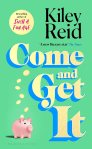 Come and Get It by Kiley Reid [Jan. 30, Bloomsbury / Jan. 9, G.P. Putnam’s] Such a Fun Age was a surprise hit with me, so I’m keen to try her second novel, set on a college campus. “It’s 2017 at the University of Arkansas. Millie Cousins, a senior resident assistant, wants to graduate, get a job, and buy a house. So when Agatha Paul, a [lesbian] visiting professor and writer, offers Millie an easy yet unusual opportunity, she jumps at the chance. But Millie’s starry-eyed hustle becomes jeopardised by odd new friends, vengeful dorm pranks and illicit intrigue.” (NetGalley download / public library reservation)
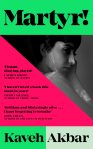 Martyr! by Kaveh Akbar [March 7, Picador /Jan. 23, Knopf] I’ve read Akbar’s two full-length poetry collections and particularly admired Pilgrim Bell. His debut novel sounds kind of unhinged, but I figure it’s worth a try. “When Cyrus’s obsession with the lives of the martyrs – Bobby Sands, Joan of Arc – leads him to a chance encounter with a dying artist, he finds himself drawn towards the mysteries of an uncle who rode through Iranian battlefields dressed as the Angel of Death; and toward his [late] mother, who may not have been who or what she seemed.” (NetGalley download)
 Memory Piece by Lisa Ko [March 7, Dialogue Books / March 19, Riverhead] Ko’s debut, The Leavers, was a favourite of mine from 2018, so it was great to hear that she is coming out with a new book. “Moving from the predigital 1980s to the art and tech subcultures of the 1990s to a strikingly imagined portrait of the 2040s, Memory Piece is an innovative and audacious story of three lifelong [female, Asian American] friends as they strive to build satisfying lives in a world that turns out to be radically different from the one they were promised.”
 The Paris Novel by Ruth Reichl [April 23, Random House] I’m reading this for an early Shelf Awareness review. It’s fairly breezy but enjoyable, with an expected foodie theme plus hints of magic but also trauma from the protagonist’s upbringing. “When her estranged mother dies, Stella is left with an unusual gift: a one-way plane ticket, and a note reading ‘Go to Paris’. But Stella is hardly cut out for adventure … When her boss encourages her to take time off, Stella resigns herself to honoring her mother’s last wishes.” (PDF review copy)
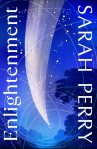 Enlightenment by Sarah Perry [May 2, Jonathan Cape / May 7, Mariner Books] “Thomas Hart and Grace Macauley are fellow worshippers at the Bethesda Baptist chapel in the small Essex town of Aldleigh. Though separated in age by three decades, the pair are kindred spirits – torn between their commitment to religion and their desire for more. But their friendship is threatened by the arrival of love.” Sounds a lot like The Essex Serpent (which is a very good thing) but with astronomy. (Print proof copy)
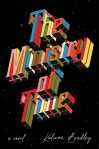 The Ministry of Time, Kaliane Bradley [May 7, Sceptre/Avid Reader Press] “A time travel romance, a speculative spy thriller, a workplace comedy, and an ingeniously constructed exploration of the nature of truth and power and the potential for love to change it. In the near future, a civil servant is offered the salary of her dreams and is, shortly afterward, told what project she’ll be working on. A recently established government ministry is gathering ‘expats’ from across history to establish whether time travel is feasible—for the body, but also for the fabric of space-time.” Promises to be zany and fun.
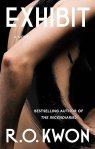 Exhibit by R.O. Kwon [May 21, Virago/Riverhead] I loved The Incendiaries and look forward to reading this next month for an early Shelf Awareness review. “At a lavish party in the hills outside of San Francisco, Jin Han meets Lidija Jung and nothing will ever be the same for either woman. A brilliant, young photographer, Jin is at a crossroads in her work, in her marriage to college sweetheart Phillip, in who she is and who she wants to be. Lidija is a glamorous, injured world-class ballerina on hiatus from her ballet company under mysterious circumstances. Drawn to each other by their intense artistic drives, the two women talk all night.” Bisexual rep from Kwon. (PDF review copy)
Nonfiction
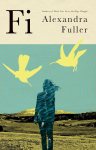 Fi: A Memoir of My Son by Alexandra Fuller [April 9, Grove Press] Fuller is one of the best memoirists out there (Don’t Let’s Go to the Dogs Tonight and Leaving Before the Rains Come), and I read pretty much every bereavement memoir I can get my hands on anyway. “It’s midsummer in Wyoming and Alexandra is barely hanging on. Grieving her father and pining for her home country of Zimbabwe, reeling from a midlife breakup, freshly sober and piecing her way uncertainly through a volatile new relationship with a younger woman, Alexandra vows to get herself back on even keel. And then – suddenly and incomprehensibly – her son Fi, at 21 years old, dies in his sleep.” (PDF review copy)
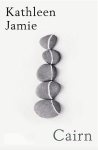 Cairn by Kathleen Jamie [June 13, Sort Of Books] Thanks to Paul (I link to his list below) for letting me know about this one. I’ll read anything Kathleen Jamie writes. “Cairn: A marker on open land, a memorial, a viewpoint shared by strangers. For the last five years … Kathleen Jamie has been turning her attention to a new form of writing: micro-essays, prose poems, notes and fragments. Placed together, like the stones of a wayside cairn, they mark a changing psychic and physical landscape.” Which leads nicely into…
Poetry
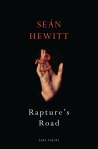 Rapture’s Road by Seán Hewitt [Jan. 11, Jonathan Cape] Hewitt’s debut collection, Tongues of Fire, was brilliant. This sounds like more of the same: “these poems forge their own unique path through the landscape. … Following the reciprocal relationship between queer sexuality and the natural world that he explored in [his previous book, the poet conjures us here into a trance: a deep delirium of hypnotic, hectic rapture where everything is called into question, until a union is finally achieved – a union in nature, with nature.”
Other lists for more ideas:
Electric Lit (all by women of color, as chosen by R.O. Kwon)
Kate – we overlap on a couple of our picks
Laura – we overlap on a few of our picks
Paul (mostly nonfiction)
What catches your eye here? What other 2024 titles do I need to know about?
Monsters: A Fan’s Dilemma by Claire Dederer
The question posed by Claire Dederer’s third hybrid work of memoir and cultural criticism might be stated thus: “Are we still allowed to enjoy the art made by horrible people?” You might be expecting a hard-line response – prescriptive rules for cancelling the array of sexual predators, drunks, abusers and abandoners (as well as lesser offenders) she profiles. Maybe you’ve avoided Monsters for fear of being chastened about your continuing love of Michael Jackson’s music or the Harry Potter series. I have good news: This book is as compassionate as it is incisive, and while there is plenty of outrage, there is also much nuance.
Dederer begins, in the wake of #MeToo, with film directors Roman Polanski and Woody Allen, setting herself the assignment of re-watching their masterpieces while bearing in mind their sexual crimes against underage women. In a later chapter she starts referring to this as “the stain,” a blemish we can’t ignore when we consider these artists’ work. Try as we might to recover prelapsarian innocence, it’s impossible to forget allegations of misconduct when watching The Cosby Show or listening to Miles Davis’s Kind of Blue. Nor is it hard to find racism and anti-Semitism in the attitude of many a mid-20th-century auteur.

Does “genius” excuse all? Dederer asks this in relation to Picasso and Hemingway, then counteracts that with a fascinating chapter about Lolita – as far as we know, Nabokov never engaged in, or even contemplated, sex with minors, but he was able to imagine himself into the mind of Humbert Humbert, an unforgettable antihero who did. “The great writer knows that even the blackest thoughts are ordinary,” she writes. Although she doesn’t think Lolita could get published today, she affirms it as a devastating picture of stolen childhood.
“The death of the author” was a popular literary theory in the 1960s that now feels passé. As Dederer notes, in the Internet age we are bombarded with biographical information about favourite writers and musicians. “The knowledge we have about celebrities makes us feel we know them,” and their bad “behavior disrupts our ability to apprehend the work on its own terms.” This is not logical, she emphasizes, but instinctive and personal. Some critics (i.e., white men) might be wont to dismiss such emotional responses as feminine. Super-fans are indeed more likely to be women or teenagers, and heartbreak over an idol’s misdoings is bound up with the adoration, and sense of ownership, of the work. She talks with many people who express loyalty “even after everything” – love persists despite it all.

U.S. cover
In a book largely built around biographical snapshots and philosophical questions, Dederer’s struggle to make space for herself as a female intellectual, and write a great book, is a valuable seam. I particularly appreciated her deliberations on the critic’s task. She insists that, much as we might claim authority for our views, subjectivity is unavoidable. “We are all bound by our perspectives,” she asserts; “consuming a piece of art is two biographies meeting: the biography of the artist, which might disrupt the consuming of the art, and the biography of the audience member, which might shape the viewing of the art.”
While men’s sexual predation is a major focus, the book also weighs other sorts of failings: abandonment of children and alcoholism. The “Abandoning Mothers” chapter posits that in the public eye this is the worst sin that a woman can commit. Her two main examples are Doris Lessing and Joni Mitchell, but there are many others she could have mentioned. Even giving more mental energy to work than to childrearing is frowned upon. Dederer wonders if she has been a monster in some ways, and confronts her own drinking problem.

A painting by Cathy Lomax of girls at a Bay City Rollers concert.
Here especially, the project reminded me most of books by Olivia Laing: the same mixture of biographical interrogation, feminist cultural criticism, and memoir as in The Trip to Echo Spring and Everybody; some subjects even overlap (Raymond Carver in the former; Ana Mendieta and Valerie Solanas in the latter – though, unfortunately, these two chapters by Dederer were the ones I thought least necessary; they could easily have been omitted without weakening the argument in any way). I also thought of how Lara Feigel’s Free Woman examines her own life through the prism of Lessing’s.
The danger of being quick to censure any misbehaving artist, Dederer suggests, is a corresponding self-righteousness that deflects from our own faults and hypocrisy. If we are the enlightened ones, we can look back at the casual racism and daily acts of violence of other centuries and say: “1. These people were simply products of their time. 2. We’re better now.” But are we? Dederer redirects all the book’s probing back at us, the audience. If we’re honest about ourselves, and the people we love, we will admit that we are all human and so capable of monstrous acts.
Dederer’s prose is forthright and droll; lucid even when tackling thorny issues. She has succeeded in writing the important book she intended to. Erudite, empathetic and engaging from start to finish, this is one of the essential reads of 2023. 
With thanks to Sceptre for the free copy for review.
Buy Monsters from Bookshop.org [affiliate link]
R.I.P. Reads for Halloween: Ashworth, Bazterrica, Hill, Machado & More
I don’t often read anything that could be classed as suspense or horror, so the R.I.P. challenge is a fun excuse to dip a toe into these genres each year. This year I have an eerie relationship study, a dystopian scenario where cannibalism has become the norm, some traditional ghost stories old and new, and a bonus story encountered in an unrelated anthology.

Ghosted: A Love Story by Jenn Ashworth (2021)
Laurie’s life is thrown off kilter when, after they’ve been together 15 years, her husband Mark disappears one day, taking nothing with him. She continues in her job as a cleaner on a university campus in northwest England. After work she visits her father, who is suffering from dementia, and his Ukrainian carer Olena. In general, she pretends that nothing has happened, caring little how odd it will appear that she didn’t call the police until Mark had been gone for five weeks. Despite her obsession with true crime podcasts, she can’t seem to imagine that anything untoward has happened to him. What happened to Mark, and what’s with that spooky spare room in their flat that Laurie won’t let anyone enter?
 If you find unreliable narrators delicious, you’re in the right place. The mood is confessional, yet Laurie is anything but confiding. Occasionally she apologizes for her behaviour: “I realise this does not sound very sane” is one of her concessions to readers’ rationality. So her drinking problem doesn’t become evident until nearly halfway through, and a bombshell is still to come. It’s the key to understanding our protagonist and why she’s acted this way.
Ghosted wasn’t what I expected. Its air of supernatural menace mellows; what is to be feared is much more ordinary. The subtitle should have been more of a clue for me. I appreciated the working class, northern setting (not often represented; Ashworth is up for this year’s Portico Prize) and the unusual relationships Laurie has with Olena, as well as with co-worker Eddie and neighbour Katrina. Reminiscent of Jo Baker’s The Body Lies and Sue Miller’s Monogamy, this story of a storm-tossed marriage was a solid introduction to Ashworth’s fiction – this is her fifth novel – but I’m not sure the payoff lived up to that amazing cover.
With thanks to Sceptre for the free copy for review.
Tender Is the Flesh by Agustina Bazterrica (2017; 2020)
[Translated from the Spanish by Sarah Moses]
 This sledgehammer of a short Argentinian novel has a simple premise: not long ago, animals were found to be infected with a virus that made them toxic to humans. During the euphemistic “Transition,” all domesticated and herd animals were killed and the roles they once held began to be filled by humans – hunted, sacrificed, butchered, scavenged, cooked and eaten. A whole gastronomic culture quickly developed around cannibalism.
Marcos is our guide to this horrific near-future world. Although he works in a slaughterhouse, he’s still uneasy with some aspects of the arrangement. The standard terminology is an attempt at dispassion: the “heads” are “processed” for their “meat.” Smarting from the loss of his baby son and with his father in a nursing home, Marcos still has enough compassion that when he’s gifted a high-quality female he views her as a person rather than potential cuts of flesh. His decisions from here on will call into question his loyalty to the new system.
I wondered if there would come a point where I was no longer physically able to keep reading. But it’s fiendishly clever how the book beckons you into analogical situations and then forces you to face up to cold truths. It’s impossible to avoid the animal-rights message (in a book full of gruesome scenes, the one that involves animals somehow hits hardest), but I also thought a lot about how human castes might work – dooming some to muteness, breeding and commodification, while others are the privileged overseers granted peaceful ends. Bazterrica also conflates sex and death in uncomfortable ways. In one sense, this was not easy to read. But in another, I was morbidly compelled to turn the pages. Brutal but brilliant stuff. (Public library/Edelweiss)
Fear: Tales of Terror and Suspense, selected by Roald Dahl (2017)
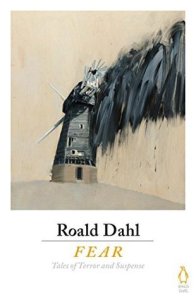 I reviewed the five female-penned ghost stories for R.I.P. back in 2019. This year I picked out another five, leaving a final four for another year. (Review copy)
“W.S.” by L.P. Hartley: The only thing I’ve read of Hartley’s besides The Go-Between. Novelist Walter Streeter is confronted by one of his characters, to whom he gave the same initials. What’s real and what’s only going on in his head? Perfectly plotted and delicious.
“In the Tube” by E.F. Benson: The concept of time is called into question when someone witnesses a suicide on the London Underground some days before it could actually have happened. All recounted as a retrospective tale. Believably uncanny.
“Elias and the Draug” by Jonas Lie: A sea monster and ghost ship plague Norwegian fishermen.
“The Ghost of a Hand” by J. Sheridan Le Fanu: A disembodied hand wreaks havoc in an eighteenth-century household.
“On the Brighton Road” by Richard Middleton: A tramp meets an ill boy on a road in the Sussex Downs. A classic ghost story that pivots on its final line.
The Small Hand: A Ghost Story by Susan Hill (2010)
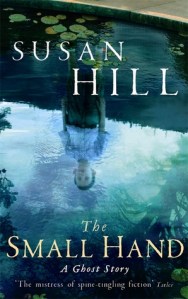 This was my fourth of Hill’s classic ghost stories, after The Woman in Black, The Man in the Picture and Dolly. They’re always concise and so fluently written that the storytelling voice feels effortless. I wondered if this one might have been inspired by “The Ghost of a Hand” (above). It doesn’t feature a disembodied hand, per se, but the presence of a young boy who slips his hand into antiquarian book dealer Adam Snow’s when he stops at an abandoned house in the English countryside, and again when he goes to a French monastery to purchase a Shakespeare First Folio. Each time, Adam feels the ghost is pulling him to throw himself into a pond. When Adam confides in the monks and in his brother, he gets different advice. A pleasant and very quick read, if a little predictable. (Free from a neighbour)
And a bonus story:
 Carmen Maria Machado’s “The Lost Performance of the High Priestess of the Temple of Horror” appears in Kink (2021), a short story anthology edited by Garth Greenwell and R.O. Kwon. (I requested it from NetGalley just so I could read the stories by Machado and Brandon Taylor.) It opens “I would never forget the night I saw Maxa decompose before me.” A seamstress, obsessed with an actress, becomes her dresser. Set in the 19th-century Parisian theatre world, this pairs queer desire and early special effects and is over-the-top sensual in the vein of Angela Carter, with hints of the sadomasochism that got it a place here.
Sample lines: “Women seep because they occupy the filmy gauze between the world of the living and the dead.” & “Her body blotted out the moon. She was an ambulatory garden, a beacon in a dead season, life where life should not grow.”
Also counting the short stories by Octavia E. Butler and Bradley Sides, I did some great R.I.P. reading this year! I think the book that will stick with me the most is Tender Is the Flesh.
Three May Graphic Novel Releases: Orwell, In, and Coma
These three terrific graphic novels all have one-word titles and were published on the 13th of May. Outwardly, they are very different: a biography of a famous English writer, the story of an artist looking for authentic connections, and a memoir of a medical crisis that had permanent consequences. The drawing styles are varied as well. But if the books share one thing, it’s an engagement with loneliness: It’s tempting to see the self as being pitted against the world, with illness an additional isolating force, but family, friends and compatriots are there to help us feel less alone and like we are a part of something constructive.
Orwell by Pierre Christin; illustrated by Sébastien Verdier
[Translated from the French by Edward Gauvin]
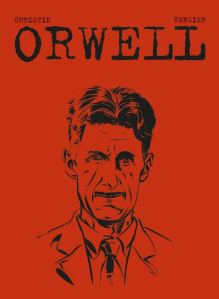 George Orwell was born Eric Blair in Bengal, where his father worked for the colonial government. As a boy, he loved science fiction and knew that he would become a writer. He had an unhappy time at prep school, where he was on reduced fees, and proceeded to Eton and then police training in Burma. Already he felt that “imperialism was an evil thing.” Among this book’s black-and-white panes, the splashes of colour – blood, a British flag – stand out, and guest artists contribute a two-page colour spread each, illustrating scenes from Orwell’s major works. His pen name commemorates a local river and England’s patron saint, marking his preoccupation with the essence of Englishness: something deeper than his hated militarism and capitalism. Even when he tried to ‘go native’ for embedded journalism (Down and Out in Paris and London and The Road to Wigan Pier), his accent marked him out as posh. He was opinionated and set out “rules” for clear writing and the proper making of tea.
The book’s settings range from Spain, where Orwell went to fight in the Civil War, via a bomb shelter in London’s Underground, to the island of Jura, where he retired after the war. I particularly loved the Scottish scenery. I also appreciated the notes on where his life story entered into his fiction (especially in A Clergyman’s Daughter and Keep the Aspidistra Flying). During World War II he joined the Home Guard and contributed to BBC broadcasting alongside T.S. Eliot. He had married Eileen, adopted a baby boy, and set up a smallholding. Even when hospitalized for tuberculosis, he wouldn’t stop typing (or smoking).
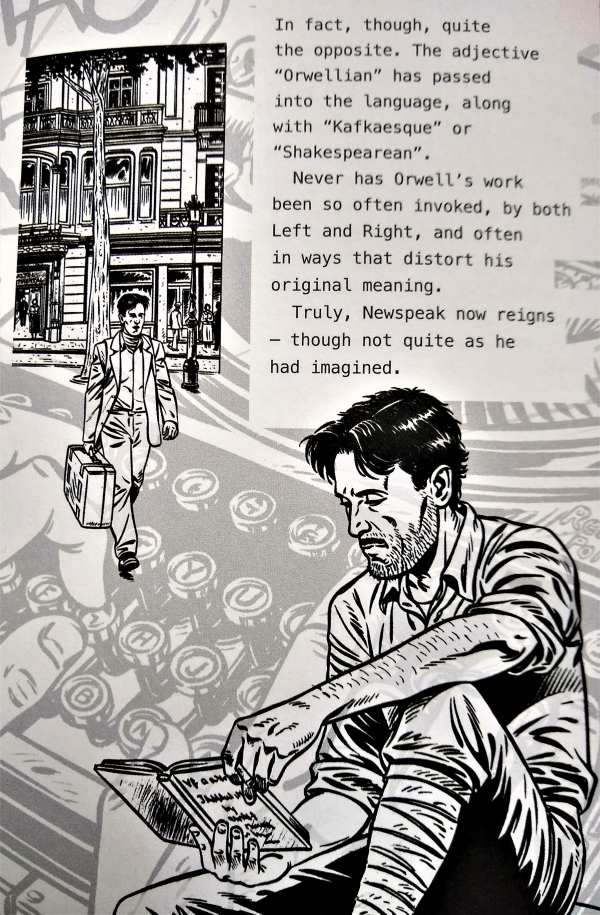 Christin creates just enough scenes to give a sense of the sweep of Orwell’s life, and incorporates plenty of the author’s own words in a typewriter font. He recognizes all the many aspects, sometimes contradictory, of his subject’s life. And in an afterword, he makes a strong case for Orwell’s ideas being more important now than ever before. My knowledge of Orwell’s oeuvre, apart from the ones everyone has read – Animal Farm and 1984 – is limited; luckily this is suited not just to Orwell fans but to devotees of life stories of any kind.
With thanks to SelfMadeHero for the free copy for review.
In by Will McPhail
Nick never knows the right thing to say. The bachelor artist’s well-intentioned thoughts remain unvoiced, such that all he can manage is small talk. Whether he’s on a subway train, interacting with his mom and sister, or sitting in a bar with a tongue-in-cheek name (like “Your Friends Have Kids” or “Gentrificchiato”), he’s conscious of being the clichéd guy who’s too clueless or pathetic to make a real connection with another human being. That starts to change when he meets Wren, a Black doctor who instantly sees past all his pretence.
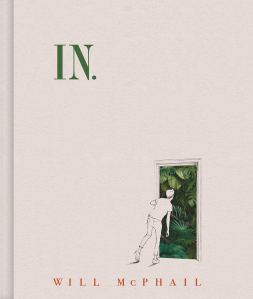 Like Orwell, In makes strategic use of colour spreads. “Say something that matters,” Nick scolds himself, and on the rare occasions when he does figure out what to say or ask – the magic words that elicit an honest response – it’s as if a new world opens up. These full-colour breakthrough scenes are like dream sequences, filled with symbols such as a waterfall, icy cliff, or half-submerged building with classical façade. Each is heralded by a close-up image on the other person’s eyes: being literally close enough to see their eye colour means being metaphorically close enough to be let in. Nick achieves these moments with everyone from the plumber to his four-year-old nephew.

Alternately laugh-out-loud funny and tender, McPhail’s debut novel is as hip as it is genuine. It’s a spot-on picture of modern life in a generic city. I especially loved the few pages when Nick is on a Zoom call with carefully ironed shirt but no trousers and the potential employers on the other end get so lost in their own jargon that they forget he’s there. His banter with Wren or with his sister reveals a lot about these characters, but there’s also an amazing 12-page wordless sequence late on that conveys so much. While I’d recommend this to readers of Alison Bechdel, Craig Thompson, and Chris Ware (and expect it to have a lot in common with Kristen Radtke’s forthcoming Seek You: A Journey through American Loneliness), it’s perfect for those brand new to graphic novels, too – a good old-fashioned story, with all the emotional range of Writers & Lovers. I hope it’ll be a wildcard entry on the Sunday Times Young Writer of the Year Award shortlist.
With thanks to Sceptre for the free copy for review.
Coma by Zara Slattery
In May 2013, Zara Slattery’s life changed forever. What started as a nagging sore throat developed into a potentially deadly infection called necrotising fascitis. She spent 15 days in a medically induced coma and woke up to find that one of her legs had been amputated. As in Orwell and In, colour is used to differentiate different realms. Monochrome sketches in thick crayon illustrate her husband Dan’s diary of the everyday life that kept going while she was in hospital, yet it’s the coma/fantasy pages in vibrant blues, reds and gold that feel more real.
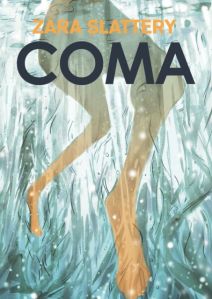 Slattery remembers, or perhaps imagines, being surrounded by nightmarish skulls and menacing animals. She feels accused and guilty, like she has to justify her continued existence. In one moment she’s a puppet; in another she’s in ancient China, her fate being decided for her. Some of the watery landscapes and specific images here happen to echo those in McPhail’s novel: a splash park, a sunken theatre; a statue on a plinth. There’s also a giant that reminded me a lot of one of the monsters in Spirited Away.
Meanwhile, Dan was holding down the fort, completing domestic tasks and reassuring their three children. Relatives came to stay; neighbours brought food, ran errands, and gave him lifts to the hospital. He addresses the diary directly to Zara as a record of the time she spent away from home and acknowledges that he doesn’t know if she’ll come back to them. A final letter from Zara’s nurse reveals how bad off she was, maybe more so than Dan was aware.


This must have been such a distressing time to revisit. In this interview, Slattery talks about the courage it took to read Dan’s diary even years after the fact. I admired how the book’s contrasting drawing styles recreate her locked-in mental state and her family’s weeks of waiting – both parties in limbo, wondering what will come next.
Brighton, where Slattery is based, is a hotspot of the Graphic Medicine movement spearheaded by Ian Williams (author of The Lady Doctor). Regular readers know how much I love health narratives, and with my keenness for graphic novels this series couldn’t be better suited to my interests.
With thanks to Myriad Editions for the free copy for review.
Read any graphic novels recently?
Novellas in November Wrap-Up and Mini-Reviews
Novellas in November is one of my favorite blogging challenges of the year. Earlier in the month I reviewed a first batch of five novellas. For this second and final installment I have 11 small books to feed back on: fiction, graphic novels, and miscellaneous nonfiction.

Classic of the Month
Giovanni’s Room by James Baldwin (1956)
[150 pages]
 This was my first taste of Baldwin’s fiction, and it was very good indeed. David, a penniless American, came to Paris to find himself. His second year there he meets Giovanni, an Italian barman. They fall in love and move in together. There’s a problem, though: David has a fiancée – Hella, who’s traveling in Spain. It seems that David had bisexual tendencies but went off women after Giovanni. “Much has been written of love turning to hatred, of the heart growing cold with the death of love.” We know from the first pages that David has fled to the south of France and Giovanni faces the guillotine in the morning, but all through Baldwin maintains the tension as we wait to hear why he is sentenced to death. Deeply sad, but also powerful and brave. I’ll make Go Tell It on the Mountain my next one by Baldwin.
Graphic Novels
 Garfield, Why Do You Hate Mondays? by Jim Davis (1982)
[128 pages]
This was like a trip back to childhood, as “Garfield” was always the first thing I would turn to in the Sunday comics section of the Washington Post. The story of the tubby, lasagna-stealing, dog-outsmarting ginger cat even managed to feel relevant to my life now, since our furball is on a perpetual diet – and it’s working, he’s actually lost most of a kilo this year! Most of the three-pane pages are stand-alones in which Garfield gets into scrapes or plays pranks. Fat jokes abound. There is actually a narrative in the latter half, though: Garfield stows away in Jon’s suitcase on a vacation to Hawaii and gets locked up in the local pound. He and a couple of other cats have to team up to escape. [To my amusement, two photos of a bust-up Nissan were being used as bookmarks in the copy that came into the free bookshop where I volunteer.] 

Reading Quirks: Weird Things that Bookish Nerds Do! by The Wild Detectives (2019)
[96 pages]
 This is a collected comic strip that appeared on Instagram between 2016 and 2018 (you can view it in full here). The brainchild of bookstore/bar owners in Dallas, Texas, it highlights behaviors that many might find strange but that make total sense to a bibliophile: buying multiple copies of a book so that your less-careful partner doesn’t ruin yours or you don’t lose a friend when they fail to return a borrowed copy; being so glued to a book that you take it everywhere; buying a coat with an eye to whether the pockets accommodate a paperback; exulting at a broken leg for the extra reading time a temporary handicap could buy you; reading with a headtorch after a bedmate has gone to sleep; and so on. The simple four-pane comics usually contain just one or two colors. The captions add as much as the dialogue. Read this next if you enjoyed Book Love by Debbie Tung.

Other Fiction
Jonathan Livingston Seagull by Richard Bach (1972)
[93 pages]
 I was curious about this bestselling fable, but wish I’d left it to its 1970s oblivion. The title seagull stands out from the flock for his desire to fly higher and faster than seen before. He’s not content to be like all the rest; once he arrives in birdie heaven he starts teaching other gulls how to live out their perfect freedom. “We can lift ourselves out of ignorance, we can find ourselves as creatures of excellence and intelligence and skill.” Gradually comes the sinking realization that JLS is a Messiah figure. I repeat, the seagull is Jesus. (“They are saying in the Flock that if you are not the Son of the Great Gull Himself … then you are a thousand years ahead of your time.”) An obvious allegory, unlikely dialogue, dated metaphors (“like a streamlined feathered computer”), cringe-worthy New Age sentiments and loads of poor-quality soft-focus photographs: This was utterly atrocious.
Agatha by Anne Cathrine Bomann (2019)
[Trans. from the Danish by Caroline Waight; 147 pages]
 In late-1940s Paris, a psychiatrist counts down the days and appointments until his retirement. He’s so jaded that he barely listens to his patients anymore. “Was I just lazy, or was I genuinely so arrogant that I’d become bored by other people’s misery?” he asks himself. A few experiences awaken him from his apathy: learning that his longtime secretary’s husband has terminal cancer and visiting the man for some straight talk about death; discovering that the neighbor he’s never met, but only known via piano playing through the wall, is deaf, and striking up a friendship with him; and meeting Agatha, a new German patient with a history of self-harm, and vowing to get to the bottom of her trauma. This debut novel by a psychologist (and table tennis champion) is a touching, subtle and gently funny story of rediscovering one’s purpose late in life.
Agatha will be released on 12th December. With thanks to Sceptre for the proof copy for review.
The Dig by Cynan Jones (2014)
[156 pages]
 Daniel is a recently widowed farmer in rural Wales. On his own for the challenges of lambing, he hates who he’s become. “She would not have liked this anger in me. I was not an angry man.” In the meantime, a badger-baiter worries the police are getting wise to his nocturnal misdemeanors and looks for a new, remote locale to dig for badgers. I kept waiting for these two story lines to meet explosively, but instead they just fizzle out. I should have been prepared for the animal cruelty I’d encounter here, but it still bothered me. Even the descriptions of lambing, and of Daniel’s wife’s death, are brutal. Jones’s writing reminded me of Andrew Michael Hurley’s; while I did appreciate the observation that violence begets more violence in groups of men (“It was the gangness of it”), this was a tough read for me.
Nonfiction
Shelf Respect: A Book Lover’s Defence by Annie Austen (2019)
[183 pages, but with large type and not many words on a page]
 This seems destined to be in many a bibliophile’s Christmas stocking this year. It’s a collection of mini-essays, quotations and listicles on topics such as DNFing, merging your book collection with a new partner’s, famous bibliophiles and bookshelves from history, and how you choose to organize your library. It’s full of fun trivia. Two of my favorite factoids: Bill Clinton keeps track of his books via a computerized database, and the original title of Hemingway’s A Farewell to Arms was “I Have Committed Fornication but that Was in Another Country” (really?!). It’s scattered and shallow, but fun in the same way that Book Riot articles generally are. (I almost always click through to 2–5 articles in my Book Riot e-newsletters, so that’s no problem in my book.) I couldn’t find a single piece of information on ‘Annie Austen’, not even a photo – I sincerely doubt she’s that Kansas City lifestyle blogger, for instance – so I suspect she’s actually a collective of interns.

An illustration of Barack Obama’s summer 2016 reads.
With thanks to Sphere for the free copy for review.
Intoxicated by My Illness: And Other Writings on Life and Death by Anatole Broyard (1992)
[135 pages]
 This posthumous collection brings together essays Broyard wrote for the New York Times after being diagnosed with metastatic prostate cancer in 1989, journal entries, a piece he’d written after his father’s death from bladder cancer in 1954, and essays from the early 1980s about “the literature of death.” He writes to impose a narrative on his illness, expatiating on what he expects of his doctor and how he plans to live with style even as he’s dying. “If you have to die, and I hope you don’t, I think you should try to die the most beautiful death you can,” he charmingly suggests. It’s ironic that he laments a dearth of literature (apart from Susan Sontag) about illness and dying – if only he could have seen the flourishing of cancer memoirs in the last two decades! [An interesting footnote: in 2007 Broyard’s daughter Bliss published a memoir, One Drop: My Father’s Hidden Life—A Story of Race and Family Secrets, about finding out that her father was in fact black but had passed as white his whole life. I’ll be keen to read that.]
Sold for a Farthing by Clare Kipps (1953)
[72 pages]
 This was a random 50p find at the Hay-on-Wye market on our last trip. In July 1940 Kipps adopted a house sparrow that had fallen out of the nest – or, perhaps, been thrown out for having a deformed wing and foot. Clarence became her beloved pet, living for just over 12 years until dying of old age. A former professional musician, Kipps served as an air-raid warden during the war; she and Clarence had a couple of close shaves and had to evacuate London at one point. Clarence sang more beautifully than the average sparrow and could do a card trick and play dead. He loved to nestle inside Kipps’s blouse and join her for naps under the duvet. At age 11 he had a stroke, but vet attention (and champagne) kept him going for another year, though with less vitality. This is sweet but not saccharine, and holds interest for its window onto domesticated birds’ behavior. With photos, and a foreword by Julian Huxley.

A Year Lost and Found by Michael Mayne (1987)
[82 pages]
 Mayne was vicar at the university church in Cambridge when he came down with a mysterious, debilitating illness, only later diagnosed as myalgic encephalomyelitis or post-viral fatigue syndrome. During his illness he was offered the job of Dean of Westminster, and accepted the post even though he worried about his ability to carry out his duties. He writes of his frustration at not getting better and receiving no answers from doctors, but much of this short memoir is – unsurprisingly, I suppose – given over to theological musings on the nature of suffering, with lots of quotations (too many) from theologians and poets. Curiously, he also uses Broyard’s word, speaking of the “intoxication of convalescence.”
Ordinary Sacred: The Simple Beauty of Everyday Life by Kent Nerburn (2006)
[120 pages]
 The author has a PhD in religion and art and produced sculptures for a Benedictine abbey in British Columbia and the Peace Museum in Hiroshima. I worried this would be too New Agey for me, but at 20p from a closing-down charity shop, it was worth taking a chance on. Nerburn feels we are often too “busy with our daily obligations … to surround our hearts with the quiet that is necessary to hear life’s softer songs.” He tells pleasant stories of moments when he stopped to appreciate meaning and connection, like watching a man in a wheelchair fly a kite, setting aside his to-do list to have coffee with an ailing friend, and attending the funeral of a Native American man he once taught.
Total number of novellas read this month: 16 (compared to last year’s 26)
My overall favorite: Agatha by Anne Cathrine Bomann
Runners-up: Giovanni’s Room by James Baldwin, Intoxicated by My Illness by Anatole Broyard, and Hope in the Dark by Rebecca Solnit
What’s the best novella you’ve read recently? Do you like the sound of any of the ones I read?
Three Recommended July Releases: Starling Days, Hungry, Supper Club
While very different, these three books tie together nicely with their themes of the hunger for food, adventure and/or love.
Starling Days by Rowan Hisayo Buchanan
(Coming on July 11th from Sceptre [UK])
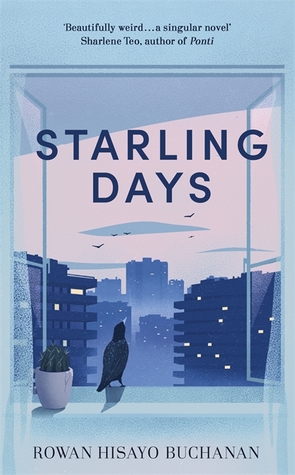 Buchanan’s second novel reprises many of the themes from her first, Harmless Like You, including art, mental illness, and having one’s loyalties split across countries and cultures. Oscar and Mina have been together for over a decade, but their marriage got off to a bad start six months ago: on their wedding night Mina took an overdose, and Oscar was lucky to find her in time. The novel begins and ends with her contemplating suicide again; in between, Oscar takes her from New York City to England, where he grew up, for a change of scenery and to work on getting his father’s London flats ready to sell. For Mina, an adjunct professor and Classics tutor, it will be labeled a period of research on her monograph about the rare women who survive in Greek and Roman myth. But when work for his father’s Japanese import company takes Oscar back to New York, Mina is free to pursue her fascination with Phoebe, the sister of Oscar’s childhood friend.
Both Oscar and Mina have Asian ancestry and complicated, dysfunctional family histories. For Oscar, his father’s health scare is a wake-up call, reminding him that everything he has taken for granted is fleeting, and Mina’s uncertain mental and reproductive health force him to face the fact that they might never have children. Although I found this less original and compelling than Buchanan’s debut, I felt true sympathy for the central couple. It’s a realistic picture of marriage: you have to keep readjusting your expectations for a relationship the longer you’re together, and your family situation is inevitably going to have an impact on how you envision your future. I also admired the metaphors and the use of color.
The title is, I think, meant to refer to a sort of time outside of time when wishes can come true; in Mina’s case that’s these few months in London. Bisexuality is something you don’t encounter too often in fiction, so I guess that’s reason enough for it to be included here as a part of Mina’s story, though I wouldn’t say it adds much to the narrative. If it had been up to me, instead of birds I would have picked up on the repeated peony images (Mina has them tattooed up her arms, for instance) for the title and cover.
Hungry: Eating, Road-Tripping, and Risking It All with the Greatest Chef in the World by Jeff Gordinier
(Coming on July 9th from Tim Duggan Books [USA] and on October 3rd from Icon Books [UK])
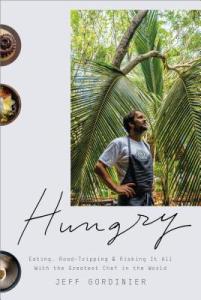 Noma, René Redzepi’s restaurant in Copenhagen, Denmark, has widely been considered the best in the world. In 2013, though, it suffered a fall from grace when some bad mussels led to a norovirus outbreak that affected dozens of customers. Redzepi wanted to shake things up and rebuild Noma’s reputation for culinary innovation, so in the four years that followed he also opened pop-up restaurants in Tulum, Mexico and Sydney, Australia. Journalist Jeff Gordinier, food and drinks editor at Esquire magazine, went along for the ride and reports on the Noma team’s adventures, painting a portrait of a charismatic, driven chef. For foodies and newbies alike, it’s a brisk, delightful tour through world cuisine as well as a shrewd character study. (Full review coming soon to BookBrowse.)
Supper Club by Lara Williams
(Coming on July 9th from G.P. Putnam’s Sons [USA] and July 4th from Hamish Hamilton [UK])
“What could violate social convention more than women coming together to indulge their hunger and take up space?” Roberta and Stevie become instant besties when Stevie is hired as an intern at the fashion website where Roberta has been a writer for four years. Stevie is a would-be artist and Roberta loves to cook; they decide to combine their talents and host Supper Clubs that allow emotionally damaged women to indulge their appetites. The pop-ups take place at down-at-heel or not-strictly-legal locations, the food is foraged from dumpsters, and there are sometimes elaborate themes and costumes. These bacchanalian events tend to devolve into drunkenness, drug-taking, partial nudity and food fights.
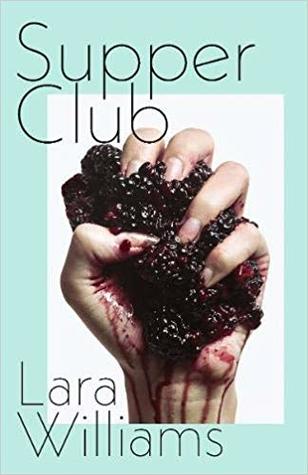 The central two-thirds of the book alternates chapters between the present day, when Roberta is 28–30, and her uni days. I don’t think it can be coincidental that Roberta and Stevie are both feminized male names; rather, we are meant to ask to what extent all the characters have defined themselves in terms of the men in their lives. For Roberta, this includes the father who left when she was seven and now thinks he can send her chatty e-mails whenever he wants; the fellow student who raped her at uni; and the philosophy professor she dated for ages even though he treated her like an inconvenient child. Supper Club is performance art, but it’s also about creating personal meaning when family and romance have failed you.
I was slightly disappointed that Supper Club itself becomes less important as time goes on, and that we never get closure about Roberta’s father. I also found it difficult to keep the secondary characters’ backstories straight. But overall this is a great debut novel with strong themes of female friendship and food. Roberta opens most chapters with cooking lore and tips, and there are some terrific scenes set in cafés. I suspect this will mean a lot to a lot of young women. Particularly if you’ve liked Sweetbitter (Stephanie Danler) and Friendship (Emily Gould), give it a taste.
With thanks to Sapphire Rees of Penguin for the proof copy for review.
Have you read any other July releases you would recommend?
Madness Is Better than Defeat by Ned Beauman
I’ve been a Ned Beauman fan ever since I read his debut, Boxer, Beetle, in 2011. Born in 1985, the Londoner is now the author of four novels and was named one of Granta’s 20 best British novelists under the age of 40. His books are madcap and complex; three out of four have historical settings (all broadly in the World War II era), but this is definitely not historical fiction as we know it. If I tell you that some common elements in his work are Nazis, pharmaceuticals and gay sex, and that his first two books reminded me most of Nick Harkaway, you’ll get some idea of the niche he’s working in.
 Madness Is Better than Defeat takes its title from a line in Orson Welles’s never-filmed screenplay of Heart of Darkness. We open in 1959 with Zonulet, a 43-year-old alcoholic CIA officer, writing a tell-all memoir about what happened when two parties set out to find a Mayan temple in Honduras in 1938. Sadistic business magnate Elias Coehorn, Sr. sent his feckless son, Elias Jr., to dismantle the temple and bring it back to New York City, while Arnold Spindler, chairman of Kingdom Pictures, tasked Jervis Whelt with directing a movie on location at the temple: Hearts in Darkness, a comedy about a spoiled society boy who’s sent on an archaeological dig to a Mayan temple and opens a nightclub when he gets there.
The scene is set for a clash of cultures: the New York faction bent on destruction versus the Los Angeles crew intent on creation. They’re joined by Joan Burlingame, a stuffy Cambridge anthropologist, and Leland Trimble, a gossip journalist who was formerly Zonulet’s colleague at the New York Evening Mirror. To start with the screwball plot is uncannily similar to that of Hearts in Darkness itself, and it seems the stalemate between the two groups will be mined purely for comic potential. But as the years pass and the deadlock continues, this becomes more of a psychological study of a community in isolation, rather like The Lord of the Flies or T.C. Boyle’s The Terranauts.
Alliances are formed and broken based on blackmail over the characters’ past and present indiscretions; routines and workarounds are developed (though an attempt to recreate Bloody Marys and Eggs Benedict fails); soon a whole new generation is being raised with little knowledge of what’s happened outside this jungle for more than a decade; all they have to go on is false information about the outcome of World War II conveyed by an ex-Nazi.
They spoke in American accents and they had all been taught a sort of eschatology in which they would one day return with their parents to Hollywood or New York. But they belonged to the rainforest and to the temple. And the geometry of the latter … was so primal to them that any talk of disassembly or reassembly struck them as abstract, almost paradoxical.
One of the hardest things to believe about the story line – so you’ll simply have to suspend your disbelief – is that no one was overly concerned when these two groups failed to reappear after assignments that were meant to last only a matter of weeks. Not until Zonulet gets to Honduras in 1956 to learn more about a secret CIA guerrilla training camp in the area is there sustained interest in what became of these exiled Americans, and it’s another two years before their jungle idyll comes to an explosive end.
What we have here is a twist on the Mummy’s Curse trope, with the temple causing many to lose their minds or their lives. I wish the novel could have retained its initial screwball charm without going quite so dark and strange, but that’s Beauman for you. I also thought that this was a good 100–150 pages too long, with many more secondary characters, subplots and asides than necessary. Ironically, even after nearly 500 pages, its conclusion left me wondering about some loose ends. But the writing is consistently amusing, particularly the voices captured in letters or diaries and the wacky metaphors:
- “The sky in the west was mixing an Old-Fashioned”
- “All her blood had thickened in her head like the last of the catsup”
- “They were so slathered in mulch that their two bodies together might have been some octopod newly burped from a mudpot.”
- “To describe the truck as temperamental would have been condescending; rather, I had the impression it had been earnestly wrestling with a deep crisis of personal faith about the very principle of internal combustion as a motive power.”
If you’re new to Ned Beauman, I’d suggest starting with The Teleportation Accident, my favorite of his novels. From there you could move on to Boxer, Beetle or Glow; this one can wait until you’re a confirmed admirer.
My rating:
Madness Is Better than Defeat is published in the UK today, August 24th, by Sceptre and will be available in the USA in February. With thanks to Ruby Mitchell for the free review copy.
 Bookish Beck = Rebecca Foster. American transplant to England. Freelance proofreader and book reviewer.
 Bookish Beck