The Bookshop Band in Abingdon & 20 Books of Summer, 6: Orphans of the Carnival by Carol Birch
The Bookshop Band have been among my favourite musical acts since I first saw play live at the Hungerford Literary Festival in 2014. Initially formed of three local musicians for hire, they got their start in 2010 as the house band at Mr B’s Emporium of Reading Delights in Bath, England. For their first four years, they wrote a pair of original songs about a new book, often the very day of an author’s event in the shop, and performed them on guitar, cello, and ukulele as an interlude to the evening’s reading and discussion.
Notable songs from their first 13 albums are based on Glow by Ned Beauman (“We Are the Foxes”), Don’t Let’s Go to the Dogs Tonight by Alexandra Fuller (“Bobo and the Cattle”), The Unlikely Pilgrimage of Harold Fry by Rachel Joyce (“How Not to Woo a Woman”), and Bring Up the Bodies by Hilary Mantel (“You Make the Best Plans, Thomas”). They have also written responses to classic literature, with songs inspired by Alice in Wonderland, various Shakespeare plays, and a compilation of first lines called “Once Upon a Time.”
I got to see the band live five times pre-pandemic, even after husband-and-wife-duo Ben Please and Beth Porter moved nearly 400 miles away to Wigtown, the Book Town of Scotland. During the first six months of Covid-19 lockdown, the livestream concerts from their attic were weekly treats to look forward to. They also interviewed authors for a breakfast chat show as part of the Wigtown Book Festival, which went online that year.

In the years since, the band has kept busy with other projects (not to mention two children). Porter sings and performs on the two Spell Songs albums based on Robert Macfarlane’s The Lost Words and its sequel. Together they composed the soundtrack to Aardman Animations’ short film, Robin Robin (2021) – winning Best Music at the British Animation Awards, and wrote an album of songs based on Scottish children’s literature. And they have continued writing one-off book songs, such as for the launch of Birnam Wood by Eleanor Catton. (I’m disappointed their songs about All My Wild Mothers by Victoria Bennett and The Spinning Heart by Donal Ryan still haven’t made it onto record.)
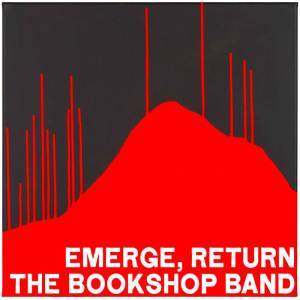 I’ve been enthusing about them for nearly a decade, but they’ve remained mostly under the radar in that time. Not so any longer; their recent album Emerge, Return was produced by Pete Townshend of The Who; the production value has notably advanced while retaining their indie spirit. Foreword Reviews kindly agreed to pay me to fangirl – er, write a blog – about Emerge, Return and the tour supporting it, so I’ll leave it there for the music criticism (their complete discography is now available on Bandcamp and Spotify). I’ll just add that a number of these ‘new’ songs have been kicking around for six to ten years but went unrecorded until now. For that reason, I worried that it might feel like a collection of cast-offs, but in fact they’ve managed to produce something sonically and thematically cohesive. It’s darker than some of their previous work, with moody minor chords and slightly sinister subjects.

Julia Pastrana after death. George Wick, Public domain, via Wikimedia Commons.
I’ve often found that the band will zero in on a detail, scene, or idea that never would have stood out to me while reading a book but, in retrospect, evokes the whole with great success. I decided to test this out by reading Carol Birch’s Orphans of the Carnival in the weeks leading up to seeing them on their months-long UK summer/autumn tour. It’s a historical novel about real-life 1850s Mexican circus “freak” Julia Pastrana, who had congenital conditions that caused her face and body to be covered in thick hair and her jaw and lips to protrude. Cruel contemporaries called her the world’s ugliest woman and warned that pregnant women should not be allowed to see her on tour lest the shock cause them to miscarry. Medical doctors posited, in all seriousness, that she was a link between humans and orangutans.
My copy of Birch’s novel was a remainder, and it is certainly a minor work compared to the Booker Prize-shortlisted Jamrach’s Menagerie. Facts about Julia’s travel itinerary and fellow oddballs quickly grow tedious, and while one of course sympathizes when children throw rocks at her, she never becomes a fully realized character rather than a curiosity.
There is also a bizarre secondary storyline set in 1983, in which Rose fills her London apartment with hoarded objects, including a doll she rescues from a skip and names Tattoo. She becomes obsessed with the idea of visiting a doll museum in Mexico. I thought that Tattoo would turn out to be Julia’s childhood doll Yatzi (similar to in A Council of Dolls by Mona Susan Power, where dolls have sentimental and magical power across the centuries), but the connection, though literal, was not as I expected. It’s more grotesque than that. And stranger than fiction, frankly.
{SPOILERS AHEAD}
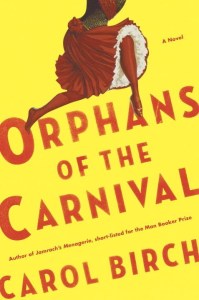 Birch sticks to the known details of Julia’s life. She had various agents, the final one being Theo Lent, who married her. (In the novel, he can’t bring himself to kiss her, but he can, you know, impregnate her.) She died of a fever soon after childbirth. Her son, Theo Junior, who inherited her hypertrichosis, also died within days. Both bodies were embalmed, sold, and exhibited. Theo then married another hairy woman, Marie Bartel of Germany, who took the name “Zenora” and posed as Julia’s sister. Theo died, syphilitic (or so Birch implies) and insane, in a Russian asylum. Julia and Theo Junior’s remains were displayed and mislaid at various points over the years, with Julia’s finally repatriated to Mexico for a proper burial in 2013. In the novel, Tattoo is, in fact, Theo Junior’s mummy.
Two Bookshop Band songs from the new album are about the novel: “Doll” and “Waggons and Wheels.” “Doll” is one of the few more lighthearted numbers on the album. It ended up being a surprise favourite track for me (along with the creepy “Eve in Your Garden,” about Margaret Atwood’s The Testaments, and “Room for Three,” a sombre yet resolute epic written for the launch of Philip Pullman’s La Belle Sauvage) because of its jaunty music-hall tempo; the pattern of repeating most nouns three times; and the hand claps, “deedily” vocal fills, unhinged recorder playing, and springy sound effects. The lyrics are almost a riddle: “When’s a doll (doll doll) not a doll (doll doll)?” They somehow avoid all spoilers while conveying something of the mental instability of a couple of characters.
The gorgeous “Waggons and Wheels” picks up on the melancholy tone and parental worries of earlier tracks from the album. The chorus has a wistful air as Julia ponders the passage of time and her constant isolation: “old friends, new deals / Winter or spring, I am hiding … Winter or spring, I’ll be travelling.” Porter’s mellow soprano tempers Julia’s outrage at mistreatment: “who are you to shout / Indecency and shame? / Shocking, I shock, so lock me out / I’m locked into this face.” She fears, too, what will happen to her child, “a beast or a boy, a monster or joy”. Listening to the song, I feel that the band saw past the specifics to plumb the universal feelings that get readers empathizing with Julia as a protagonist. They’ve gotten to the essence of the story in a way that Birch perhaps never did. Mediocre book; lovely songs. (New (bargain) purchase – Dollar Tree, Bowie, Maryland) 
I caught the Emerge, Return tour at St Nicolas’ Church in Abingdon (an event hosted by Mostly Books) last night. It was my sixth time seeing the Bookshop Band in concert – see also my write-ups of two 2016 events plus one in 2018 and another in 2019 – but the first time in person since the pandemic. I got to show off my limited-edition T-shirt. How nice it was to meet up again with blogger friend Annabel, too! Fun fact for you: Ben was born in Abingdon but hadn’t been back since he was two. Beth’s cousin turned up to the show as well. Although they have their daughters, 2 and 7, on the tour with them, they were being looked after elsewhere for the evening so the parents could relax a bit. Across the two sets, they played seven tracks from the new album, six old favourites, and two curios: one Spell Song, and an untitled song they wrote for the audiobook of Jackie Morris’s The Unwinding. It was a brilliant evening!


20 Books of Summer, 5: A House Full of Daughters by Juliet Nicolson
Journalist and popular historian Juliet Nicolson is Vita Sackville-West’s granddaughter and one of the few remaining guardians of her living memory. This 2015 family memoir chronicles the lives of seven (eight, really) generations of women and travels from Malaga in the 1830s to present-day England. Nicolson acknowledges the inherited privilege that has typified this clan since the time of Vita’s grandmother but prefers to emphasize the roles that place and talent have played. It is enough of a biography of Vita to have won a Bisexual Book Award but, even though Vita only had sons, the focus is on mother–daughter bonds and how values and experiences have recurred across nearly two centuries.
First came Pepita, who rose from poverty in southern Spain to be a legendary dancer (“the Beyoncé of her day,” Nicolson quipped at an online event I attended – see below) and catch the eye of an English diplomat, Lionel Sackville-West, at a performance in Paris. Although Pepita was already married to her dancing teacher, she shook off her controlling mother and became Sackville-West’s longtime mistress, bearing him seven children. They could all have been disinherited for illegitimacy, however, had Pepita’s daughter Victoria not secured the link – and access to the family estate, Knole – by marrying her cousin, young Lionel Sackville-West. Vita wrote in Pepita, her joint biography of her mother and grandmother, “My mother appears to have been born with the faculty of attracting the most peculiar and improbable happenings,” such as a proposal of marriage from the recently widowed U.S. president, Chester Arthur, when she accompanied her father to Washington, DC.

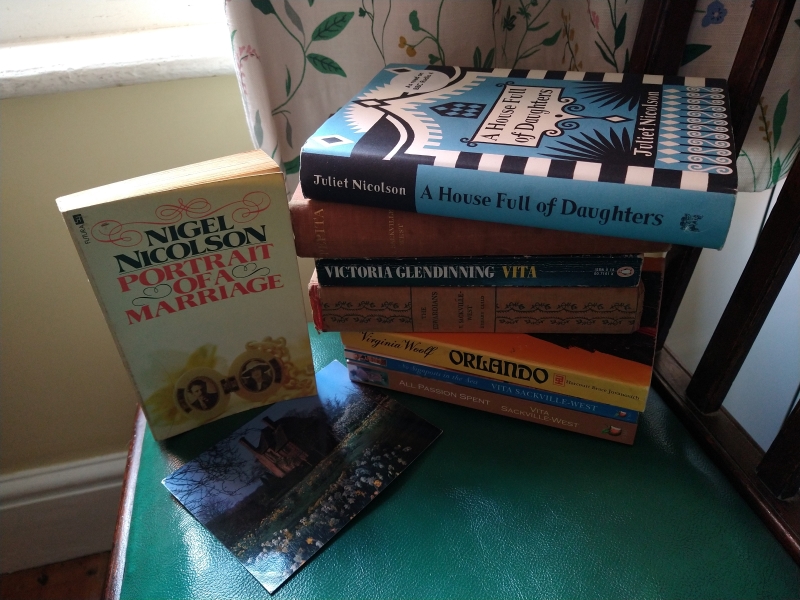
Vita is the book’s presiding spirit and pivot point, but I already knew a lot about her from reading Victoria Glendinning’s biography plus two of her novels, so this material was too familiar. The fact that we then leap from daughters to a daughter-in-law (Nicolson’s mother, Philippa Tennyson-d’Eyncourt – these figures are all posher than posh!) is unfortunate as it dilutes the theme. However, Nicolson gives a behind-the-scenes look at Sissinghurst and the marriages between Vita and Harold, loving but also a cover for same-sex relationships for both of them; and Nigel and Philippa, which was a disaster almost from the start. Nicolson is also brave to admit the alcoholism that she subconsciously received from her mother. Philippa died at 58, but by admitting she had a problem Nicolson was able to get help and turn things around. Two generations followed: her two daughters and one granddaughter, who is now 11.
Nicolson sees patterns repeating across the generations: emotional abandonment by parents, “the lack of confidence, the fear of failure, and the seeking of approval where there was none” as well as “writing about the life and work of an earlier generation.” She hopes that with this book she has marked the arrival of “an increasingly tolerant and accepting generation, one that is not afraid to learn from the mistakes of the past and is determined not to repeat them”. (Fun but unrelated fact: Penelope Fitzgerald was one of Nicolson’s teachers.)

On the staircase leading up to Vita’s study in the tower, September 2009.
I visited Sissinghurst in 2009 – I can’t believe I haven’t been back in the past 15 years – and when we briefly lived in Sevenoaks in 2012 we also went to Knole. Both are magical places, especially Sissinghurst. For a few years there I was on a kick of reading a lot by and about Vita (I can recommend No Signposts in the Sea) and I also absorbed a fair bit via Adam Nicolson’s books (that’s Juliet’s brother) and his wife Sarah Raven’s – her recipes are to die for, and she’s kept up the gardens in a way that would make Vita proud. So I’d say it probably helps to have an existing interest in the family, but it should be a reasonably engrossing read in any case. (Free from a neighbour) 
Yesterday I watched “The Inspiration of Vita Sackville-West,” a recording of an RSL event held at the London Library in October that was aired to tie in with their annual Dalloway Day as well as the 95th anniversary of the publication of Virginia Woolf’s Orlando (for which Vita was a model) and, of course, Pride Month. The panelists were Juliet Nicolson; trans novelist Shola von Reinhold, whose LOTE (2020) won the Republic of Consciousness and James Tait Black Memorial Prizes; fashion critic Charlie Porter; and writer Olivia Laing. The discussion was expertly chaired by Shahidha Bari, an academic, fashion writer and presenter of BBC Two’s Inside Culture. She opened by asking each speaker to define Vita in one word. Nicolson chose “lover,” which von Reinhold echoed. Porter said “physical.” Laing cheated with a made-up compound word: “androgynous-aristocratic-aesthete.”
And the conversation went on from there. Nicolson spoke of her grandmother as a formidable woman, tall and tobacco-scented, and remembered the exotic treasures she and her siblings found in Vita’s tower study, such as a bottle of emerald-green nail polish. She described Vita as enigmatic and representing duality: she was born a Victorian but has been embraced by modernist and queer studies; she was conventional in some ways, but also a rebel. Porter has written about fashion and the Bloomsbury circle, with Woolf as one of his subjects, so he thinks about Vita mostly as a muse. He read from Vita’s letter to Harold describing meeting Woolf, whom she thought “quite old” and “atrociously dressed.” Nonetheless, she’d lost her heart. Woolf in her turn commented on Vita’s moustache, which was likely a sign of her Spanish heritage rather than excess testosterone as some have theorized.
For von Reinhold, Vita is an early example of androgyny, a precursor to today’s trans and nonbinary identities. Laing, who has recently published a book on gardening, focused on Vita as a garden writer and designer. She said she doesn’t really value Vita’s novels but thinks her garden books (collections of her Observer columns) are extraordinary and read a passage in which she dreamt up the famous White Garden she would create at Sissinghurst (I read a kinda crummy novel about it a few years ago, The White Garden by Stephanie Barron).
The event gave a very good sense of Vita as a person but not as a writer. Audience questions brought up her poetry (oh God, it’s awful!) and travel books but that was as far as it went, and there was no discussion of the novels. Nicolson mentioned Pepita in passing but mostly talked about Portrait of a Marriage, which was half written by Vita and then finished by Nigel, a publisher (he was half of Weidenfeld and Nicolson, aka W&N). He had the courage to reveal his mother’s sexuality and Nicolson said that she believes Vita’s legacy is courage – to create a garden from scratch as a self-taught amateur, yes; but mostly to be oneself.
Assisted Dying: Intervals by Marianne Brooker; Wendy Mitchell; and a Local Panel Discussion
Intervals by Marianne Brooker is on the longlist for the inaugural Women’s Prize for Non-Fiction, which my book club has applied to shadow. I’ve now read three of the nominees, the others being Matrescence and A Flat Place (review coming up tomorrow). Unsurprisingly, I’ve gravitated towards the ones based around a personal narrative – although all three are also political and incorporate research and cultural critique. Brooker’s is an extended essay about her mother’s protracted death with multiple sclerosis and the issues it brought up around disability, poverty, and inequality of access to medical care and services.

Specifically, Brooker decries the injustice of the wealthy having the option of travelling to Dignitas in Switzerland for an assisted death (current cost: £15,000), whereas her single mother, who lived in rented accommodation and had long been disabled and unable to work, apart from crafting and reading tarot, had so such relief in sight. Instead, she resorted to refusing life-sustaining nourishment. VSED, or voluntarily stopping eating and drinking, was a topic much on my mind anyway because of Wendy Mitchell’s death last month.
 Mitchell was diagnosed with early-onset Alzheimer’s in her fifties and was an energetic campaigner for dementia education and research for the last decade of her life. With a co-author, she wrote three books that give a valuable insider’s view of life with dementia: Somebody I Used to Know, What I Wish People Knew About Dementia, and One Last Thing, in which she specifically discusses VSED. She was determined to live independently. For her, a dignified life was being able to meet her own daily physical needs. She did not want to be in a care home, or to exist past the point where she could no longer recognise her daughters. So when, in January, she fell and broke both wrists, giving her a taste of dependency and derailing her plans to travel to Dignitas, she knew that the time had come. VSED was her way out. You can read her farewell message here.
Is wilful starvation a good death? I don’t really know. It’s peaceful, at least; a person simply gets weaker and weaker, spending more and more time asleep until they fade out, at home. But it can take two weeks to die in this way. Should loved ones have to watch this process?
Denied a liveable life and a legal right to die, my mum made a choice within and between the lines of the law. A decade after her diagnosis, when she was forty-nine and I was twenty-six, she decided to stop eating and drinking to end her suffering and her life. Her MS symptoms were barely treatable and certainly incurable: severe pain, incontinence, fatigue, the gradual but intensifying loss of mobility, vision and speech. But these medical symptoms were compounded by social conditions: isolation, stress, debt and fear of a future in which she would not be able to live or die in her chosen home. We were caught in a perfect storm.
Brooker’s description of the vigil of these last days, like her account of her vivacious mother’s life, is both tender and unflinching. It’s almost like a counterpoint to Simone de Beauvoir’s A Very Easy Death, but with the same incisive attention and emotional transfer between mother and daughter. The book also incorporates political commentary and quotations from psychologists and cultural critics. This somewhat distances the reader; it feels less like a bereavement memoir and more like an impassioned, personally inspired treatise. But that’s not to say there isn’t some levity. She remembers good times from their earlier life together, and reckons with her new role as her mother’s memorial and archivist in a way that really rang true for me. I wish the title was more evocative so as to draw the right readers to this book. 
With thanks to Fitzcarraldo Editions for the free copy for review.
Also on this topic, I have read In Love by Amy Bloom, That One Patient by Ellen de Visser, The Inevitable by Katie Engelhart, Darke Matter by Rick Gekoski, and Wild and Precious Life by Deborah Ziegler.
Last night I attended a local panel discussion put on by the Campaign for Dignity in Dying. It wasn’t a debate in that 3.5 of the 4 members on the panel were pro-assisted dying, and I would guess more than four-fifths of the audience as well. In fact, the only anti- voice of the evening was from a young Catholic man during question time. I knew about the event because one panelist attends my church: George Carey, a former archbishop of Canterbury.
The Anglican Church’s line – the religious response in general – is to uphold the sanctity of life and thus to oppose assisted suicide, so for Lord Carey to do otherwise is noteworthy. He changed his mind in 2014, he explained, after the high-profile case of Tony Nicklinson, who was paralysed after a stroke and lost his appeal over the right to die. “There is no theological contradiction between valuing life and wanting a good death,” Carey insisted. Jesus showed mercy to the ill and dying, and so should we. (He also, more facetiously, described King Saul’s mercy killing by an enemy soldier in 2 Samuel as an assisted death.)
The other panelists were a lawyer, a retired doctor, and a Member of Parliament. Lawyer Graham Wood noted that the 1961 Suicide Act, under which anyone who assists a suicide can be prosecuted, would have to be abolished, and that there would also need to be a negotiation regarding Article 2 of the European Convention on Human Rights, which protects the “right to life.” He was the most wary of the speakers, warning of the danger of undue influence being exerted by relatives when money and assets are involved – he said he sees the worst of humanity in his line of work.

Dr Barry Newman pinned his support for assisted dying to compassion and autonomy, two overriding values of a liberal society. He acknowledged the current professional risk for doctors, and noted that the UK’s main medical bodies remain neutral. However, he brought up a loophole, “double effect,” administering a medication that might end life but whose intent is to alleviate suffering, e.g., a high dose of morphine to an end-stage cancer patient.
Kit Malthouse, Conservative MP for northwest Hampshire, co-chairs a group on end-of-life and has campaigned for assisted dying. (American readers may be surprised by a conservative politician having liberal views on an ethical matter. In the UK, morality is not in lockstep with religions and/or political parties as it is in the USA. This was something it took me a while to get used to: I have Christian friends who vote for four different political parties.) He was disappointed that a members’ bill on assisted dying failed in 2015, but has hope that multiple recent cases (e.g., Esther Rantzen) will put it back on the agenda and believes support in the Commons is sufficient to push legislation through in six months.
“It’s coming,” he assured, not least because many of the UK’s European neighbours and other allies have introduced assisted dying. The UK bill does not go as far as the Dutch legislation, about which all the panelists expressed doubt, and can be tailored to this country’s health system. The status quo, Malthouse cautioned, is people suffering. We know from Oregon that the current proposal will work well, he said; there is vanishingly little abuse of the system in any of the places that have instituted assisted dying legislation.
It was all preaching to the choir as far as I was concerned. Indeed, the spontaneous applause and affirming subvocalizations reminded me of a Pentecostal church service. Clearly, many from the audience had witnessed loved ones dying in horrible ways (a few of these stories came out during question time, such as a woman whose husband went to Dignitas and another who had to fight for her terminally ill sister’s wishes when she was mistakenly resuscitated by paramedics after a suicide attempt). Malthouse observed that supporters of assisted dying have often been through horrific experiences with relatives or spouses.
I was already firmly in support so last night didn’t sway me in any way, but I was encouraged that so many people are thinking and talking about these issues. Maybe by the time I face such a crisis myself, or on someone else’s behalf, a compassionate law will be in place.
The Booker Prize 2023 Ceremony
Yesterday evening Eleanor Franzen of Elle Thinks and I had the enormous pleasure of attending the Booker Prize awards ceremony at Old Billingsgate in London. I won tickets through “The Booker Prize Book Club” Facebook group, which launched just 10 or so weeks ago but has already garnered over 6000 members from around the world. They ran a competition for shortlist book reviews and probably did not attract nearly as many entries as they expected to. This probably worked to my advantage, but as it’s the only prize I can recall winning for my writing, I am going to take it as a compliment nonetheless! I submitted versions of my reviews of If I Survive You and Western Lane – the only shortlistees that I’ve read – and it was the latter that won us tickets.
We arrived at the venue 15 minutes before the doors opened, sheltering from the drizzle under an overhang and keeping a keen eye on arrivals (Paul Lynch and sodden Giller Prize winner Sarah Bernstein, her partner wearing both a kilt and their several-week-old baby). Elle has a gift for small talk and we had a nice little chat with Jonathan Escoffery and his 4th Estate publicist before they were whisked inside. His head was spinning from the events of the week, including being part of a Booker delegation that met Queen Camilla.


There was a glitzy atmosphere, with a photographer-surrounded red carpet and large banners for each shortlisted novel along the opposite wall, plus an exhibit of the hand-bound editions created for each book. We enjoyed some glasses of champagne and canapés (the haddock tart was the winner) and collared Eric Karl Anderson of Lonesome Reader. It was lovely to catch up with him and Eleanor and do plenty of literary celebrity spotting: Graeme Macrae Burnet, Eleanor Catton, judge Mary Jean Chan, Natalie Haynes, Alan Hollinghurst, Anna James, Jean McNeil, Johanna Thomas-Corr (literary editor of the Sunday Times) and Sarah Waters. Later we were also able to chat with Julianne Pachico, our Sunday Times Young Writer Award shadow panel winner from 2017. She has recently gotten married and released her third novel.

We were allocated to Table 11 in the front right corner. Also at our table were some Booker Prize editorial staff members, the other competition winner (for a video review) and her guest, an Instagram influencer, a Reading Agency employee, and several more people. The three-course dinner was of a very high standard for mass catering and the wine flowed generously. I thoroughly enjoyed my meal. Afterward we had a bit of time for taking red carpet photos and one of Eleanor with the banner for our predicted winner, Prophet Song.


Some of you may have watched the YouTube livestream, or listened to the Radio 4 live broadcast. Nazanin Zaghari-Ratcliffe’s speech was a highlight. She spoke about the secret library at the Iranian prison where she was held for six years. Doctor Thorne by Anthony Trollope, War and Peace by Leo Tolstoy, The Handmaid’s Tale by Margaret Atwood (there was a long waiting list among the prisoners and wardens, she said), and especially The Return by Hisham Matar meant a lot to her. From earlier on in the evening, I also enjoyed judge Adjoa Andoh’s dramatic reading of an excerpt from Possession in honour of the late Booker winner A.S. Byatt, and Shehan Karunatilaka’s tongue-in-cheek reflections on winning the Booker – he warned the next winner that they won’t write a word for a whole year.


There was a real variety of opinion in the room as to who would win. Earlier in the evening we’d spoken to people who favoured Western Lane, This Other Eden and The Bee Sting. But both Elle and I were convinced that Prophet Song would take home the trophy, and so it did. Despite his genuine display of shock, Paul Lynch was well prepared with an excellent speech in which he cited the apocrypha and Albert Camus. In a rapid-fire interview with host Samira Ahmed, he added that he can still remember sitting down and weeping after finishing The Mayor of Casterbridge, age 15 or 16, and hopes that his work might elicit similar emotion. I’m not sure that I plan on reading it myself, but from what I’ve heard it’s a powerfully convincing dystopian novel that brings political and social collapse home in a realistic way.
All in all, a great experience for which I am very grateful! (Thanks to Eleanor for all the photos.)
Have you read Prophet Song? Did you expect it to win the Booker Prize?
“The Possibilities of Place” Webinar with Nina Mingya Powles
Yesterday was National Nonfiction Day in the UK, apparently, as well as being part of the ongoing Nonfiction November challenge. Appropriately, I attended what I think must be my first writing workshop, run online by The Emma Press, a Birmingham-based publisher whose poetry and essay collections I enjoy. Thanks to Arts Council England funding, they’ve been able to arrange a series of masterclass webinars that explore some of the genres they publish.

The life writing class I participated in was led by Nina Mingya Powles, a poet and essayist whose terrific books Magnolia, Small Bodies of Water, and Tiny Moons (The Emma Press’s best-selling memoir) I’ve read and reviewed. Other attendees hailed from as far afield as Orkney, West Cork, the South of France, Berlin and New Zealand. The seminar was in Zoom presenter mode, so only Nina was on screen and the rest of us communicated via the chat box. I had been nervous about joining from my PC without a webcam or microphone, so I was relieved that this was the setup.


Nina spoke about how broad the umbrella of “life writing” is, potentially incorporating poetry and autofiction as well as straightforward prose. “Creative nonfiction” is a term sometimes used interchangeably with it. Today she wanted to focus on how memories (especially childhood memories), food and place are intertwined.
For our first warm-up exercise, she had us draw a rough map of a body of water and put a point on it, then write ourselves into that place. During this 7-minute freewrite, I compiled a list of not particularly poetic sense impressions of Annapolis harbour. I found myself crying as I realized I might never have a reason to go back to a place that was so important in my teen and early adult years.
Nina’s black-and-white cat, Otto, often butted in, in amusing and feline-appropriate ways. We proceeded to consider food as a portal to memories and to different places we’ve lived or travelled. Nina likes to think about being an outsider and the visitor’s perspective. She acknowledged that our relationships with food can be complicated, so sometimes it is a loaded topic. Mostly she is looking for gentle, tender, joyful depictions of food.
 She read aloud Rebecca May Johnson’s recipe poem “to purge the desire to write like a man,” which on one level is about making tomato sauce (as is Small Fires) but ends with a “found incantation” from Natalia Ginzburg that reclaims the female realm of the kitchen as a place of power. I loved how the first stanzas describe the body as an archive, containing multitudes. Then we considered a Jennifer Wong poem, “A personal history of soups,” about all the Chinese soups she loves and misses, and their personal and legendary meanings.
Taking the Wong title as our prompt, we spent 15 minutes writing a rough piece about a foodstuff. I’ve reproduced mine below, without any tidying-up. I mimicked the part-recipe format of the Johnson and tried to picture the kitchen of our first Bowie house and the cookware we had there.
A personal history of apple pie
As American as…
Dad did all the cooking when I was growing up, so for my mother to accompany me in the kitchen was a big thing. One year of my adolescence, there was a baking contest at the church my best friend and her family attended. I didn’t expect to take part at all or, if anything, perhaps I assumed I’d knock together some simple chocolate chip cookies on my own. But Mom insisted we would make an apple pie from scratch together – crust and all.
An apron each. One green, one red. Hand-embroidered heirlooms made by her grandmother. (Don’t keep them folded away in a drawer. Use them. They are your lineage, your artefacts.)
Half shortening, half butter. Glass bowl. Cold water. Half-moon cutter criss-crosses through chunks of semi-solid fat to render them smaller and smaller, flour-covered pebbles the size of peas.
Scent clouds of cinnamon and cloves billow up from a pan of stewing apples. A ceramic dish with crimping around the rim. A wooden rolling pin to achieve a uniform one-quarter inch round of dough. Freshly washed fingers gently pressing divots into the sides until every air bubble disappears.
Blind bake the crust. Trust that it will hold your creation. The sizzle of softened fruit in contact with the part-baked crust.
I have no memory of whether we won a prize. And me so competitive! The prize was the time. The prize was the attention. The assurance that this was worth it, that I was worth it.
Next we moved on to think about place and journeys, especially departures and arrivals – bringing places with us versus leaving them behind. An attendee commented, and Nina agreed, that often distance is useful: we can most easily write about somewhere after we’ve left it, once there is a sense of yearning. For this section we looked at a few-page extract from Larissa Pham’s essay collection Pop Song in which she describes a drive from Albuquerque to Taos. Expecting beautiful Georgia O’Keeffe-type scenery, she experiences the letdown of signs of the opioid crisis and Trump voters.
Borrowing a line from the Pham essay, Nina invited us to spend 20 minutes writing a piece that would bring the reader into the immediacy of our experience of a place. She reminded us, as a general rule, to remember to cite whatever we borrow, or to remove the borrowed line afterwards and see if it still works. My take on “Here I was now in the distant place…” ended up being a few rambling paragraphs contrasting my two study abroad years, one magical and one difficult. (Sample line: “Everything in England was like that: partially familiar but slightly askew.”)
At the end, three participants unmuted themselves and read their food pieces aloud. One was about food and a mother’s love; milk and rice. The other two, amusingly, were both about meringue: making a cherry meringue pie with a Scottish granny, and assembling pavlovas with aunts in New Zealand.
Nina encouraged us to think of life writing as a fluid thing, including journaling, blogging, travel and nature writing. This was heartening because I’ve always indulged in bits of autobiographical writing on my blog, and I started a journal last month as my 40th birthday approached, inspired in part by the 150 journals I inherited from my mother as well as by the desires to document my life and believe that the day-to-day has meaning.
The two-hour workshop was incredibly good value, especially considering that The Emma Press sent a voucher for £4 off of one of their books. (I’ve ordered their poetry anthology on ageing.) Nina also generously circulated lists of additional writing prompts, magazines that accept life writing submissions, and relevant competitions to enter.
I’d purchased a ticket on a whim but wasn’t sure whether I’d participate fully – I have a bad habit of skipping the exercises in books, after all. I’m so glad I did join, and gave myself over to the writing prompts. Who knows if anything will come of it, but it was cathartic to think about life experiences I don’t often have at the forefront of my mind, and to see how much can be produced in short periods of concerted writing.
Happy Birthday & Bookshop Day
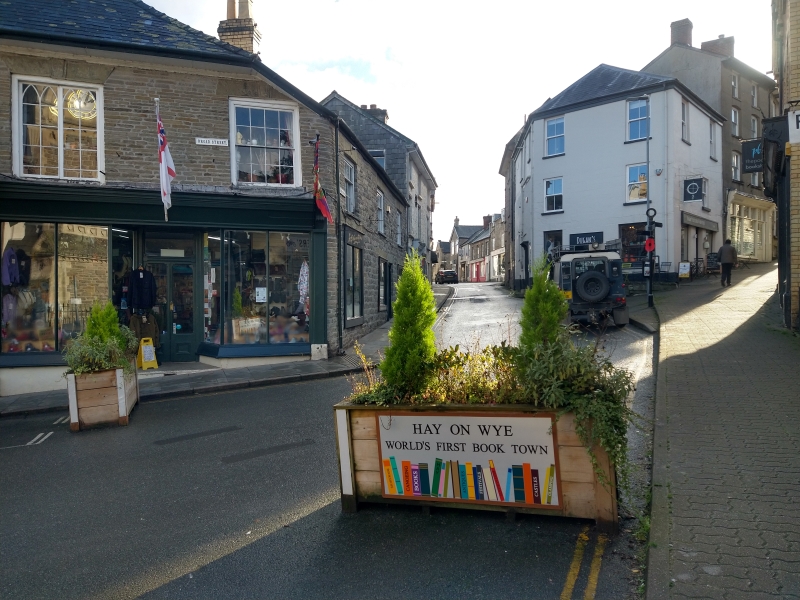
Happy Bookshop Day from Hay-on-Wye (and its newest bookshop, Gay on Wye)!


Today is my 40th birthday and I have been spending the weekend book shopping, reading, eating and drinking. What more could I ask for?


Before we left for Wales, I had my book club over for birthday cakes and bubbles. My husband made me a chocolate Guinness cake (vegan so everyone could share it) and pumpkin chai cupcakes; both recipes were from Hummingbird Bakery cookbooks.


I’ll report back on Monday with my book haul and trip highlights.
For now, here are some sweet lines from a children’s book I read this morning, about cats named Tom and Mot who discover that friendship and imagination are the greatest gifts, and that present has a double meaning: the now that must be appreciated.
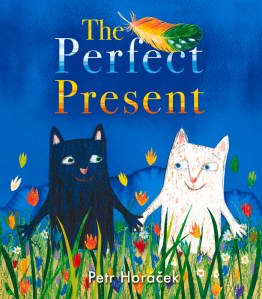
“And then it was time for a hot drink and the cake. The cake tasted like the BEST birthday cake in the world. … ‘Today was the best present in the world,’ said Tom. ‘The perfect present!’”
Hungerford Bookshop’s Summer Reading Celebration
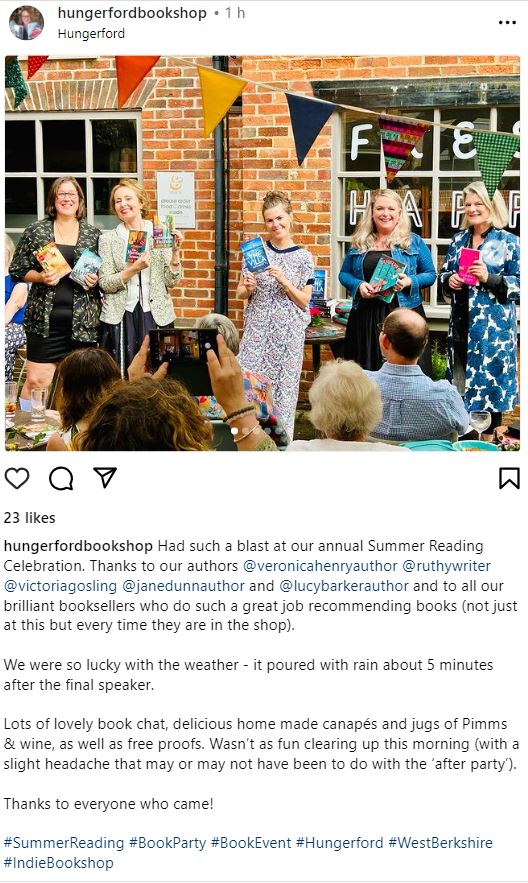
On Saturday evening my nearest indie, Hungerford Bookshop, hosted a Summer Reading celebration with five authors, some of them local, introducing their novels. It was such a delight to be invited! The rain just about held off for the duration of the outdoor event, and it was fun to learn more about new-to-me books over Pimm’s and canapes and pick up some proof copies.
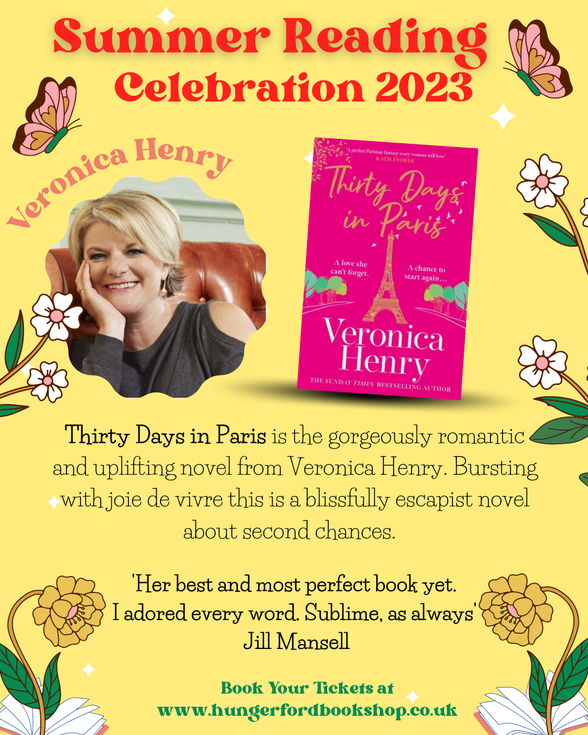
Veronica Henry usually writes English countryside and coastal stories, but this time it’s Thirty Days in Paris, about Juliet, a woman of a certain age who takes a one-month rental in the city to write a novel, having amicably separated from her husband. Henry based the flat on one she stayed in in Paris, and called this novel a wish fulfilment for her.
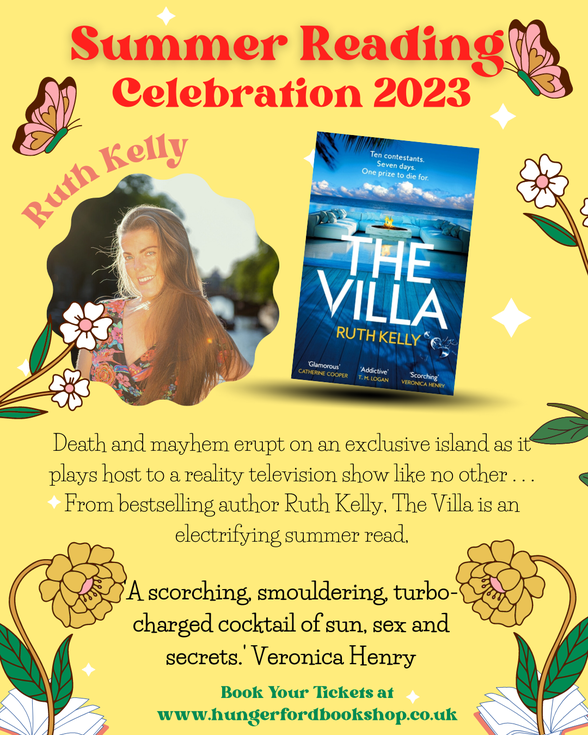
Ruth Kelly, a ghostwriter (The Prison Doctor, etc.) based in Kintbury, has written her first novel, The Villa, a thriller about a reality TV franchise. The main character is a journalist and the other two POVs are the producer and viewers collectively. She said the book starts with the body and moves backwards.
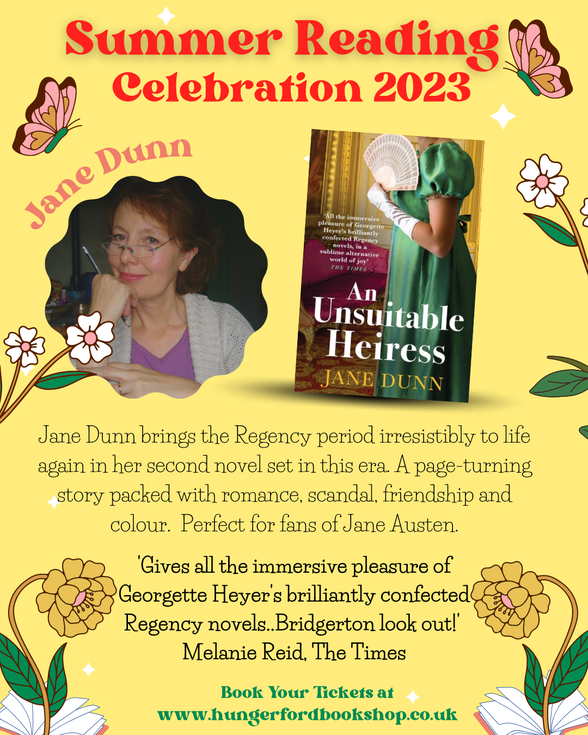
Jane Dunn is a biographer (of Daphne du Maurier, Antonia White et al.) who pivoted to writing Regency romances, having been inspired by a newfound love of Georgette Heyer. Her books, including An Unsuitable Heiress, feature women who are slightly on the periphery: a widow, illegitimate children, a male impersonator, and so on.
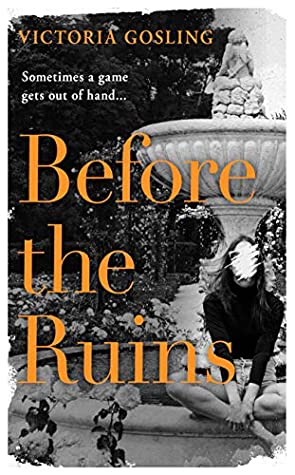
Victoria Gosling was a last-minute fill-in for an author who couldn’t make it. She moved back to Marlborough from Berlin, where she was living when she wrote her book set in Marlborough, Before the Ruins. She called it a slow-burn (Secret History-type) thriller about four people who spent the summer they were 17 squatting in a derelict manor house and have been dealing with the fallout ever since. I’ll get this one out from the library soon.
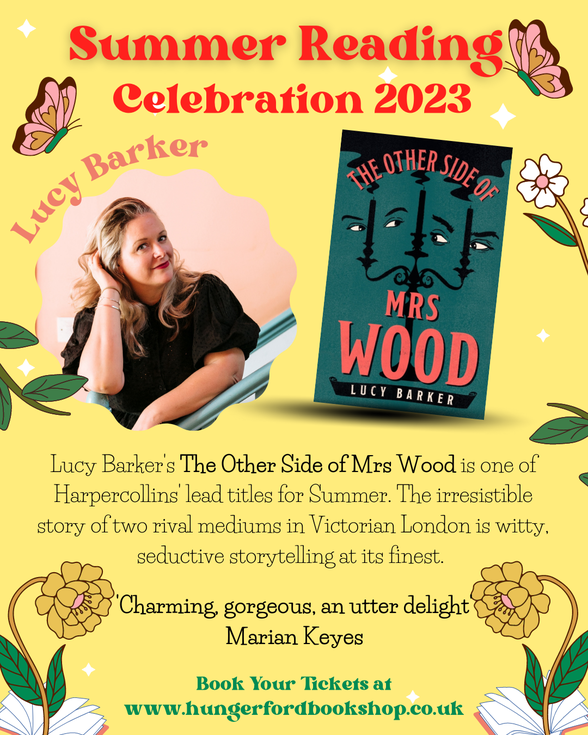
Lucy Barker’s debut novel, The Other Side of Mrs Wood, is about two warring mediums in 1873. Since I love most things set in the Victorian period, this was the one I’d already heard about and placed an order on through the library. It’s based on real-life mediums Agnes Guppy and Florence Cook and sounds like great fun! The summer reading choices are usually paperbacks, but an exception was made for this one still in hardback.
Which of these take your fancy?
There was also bookshop news and bookseller recommendations. The big announcement was the opening of a new branch in Wantage, taking over a closing-down shop.
Bookseller recommendations:
 Hilary: Briefly, A Delicious Life by Nell Stevens (I’d second that one; here’s my review)
Tessa: The Redemption of Isobel Farrar by Alan Robert Clark
Alison: Shrines of Gaiety by Kate Atkinson
Emma: Beautiful Ruins by Jess Walter (I’ve long been interested in this one)
Alex: The Sanctuary by Andrew Hunter Murray (& Lessons by Ian McEwan in paperback)
Imogen: Little Wing by Freya North (my ears pricked up to hear it’s set on the Isle of Harris)
In Memoriam by Alice Winn: Review & Author Event
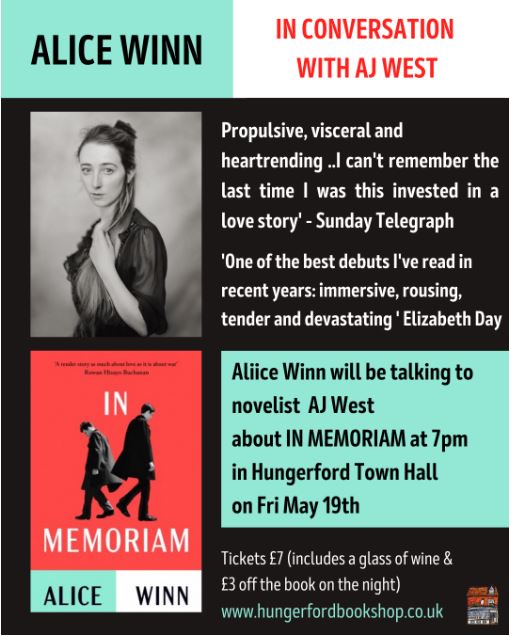
I read In Memoriam by Alice Winn last month, then had the chance to see the author in conversation at Hungerford Town Hall, an event hosted by Hungerford Bookshop, on Friday evening. Here’s what I thought of the novel, which is on my Best of 2023 list.
Review
Heartstopper on the Western Front; swoon! It’s literary fiction set in the trenches of WWI, yes, but also a will-they-won’t they romance that opens at an English boarding school. Oh they will (have sex, that is), before the one-third point, but the lingering questions are: will Sidney Ellwood and Henry Gaunt both acknowledge this is love and not just sex, as it is for many teenage boys at their school (either consensually, as buddies; or forced by bullies); and will one or both survive the war? “It was ridiculous, incongruous for Ellwood to be bandying about words like ‘love’ when they were preparing to venture out into No Man’s Land.”
Winn is barely past 30 (and looks like a Victorian waif in her daguerreotype-like author photo), yet keeps a tight control of her tone and plot in this debut novel. She depicts the full horror of war, with detailed accounts of battles at Loos, Ypres and the Somme, and the mental health effects on soldiers, but in between there is light-heartedness: banter, friendship, poetry. Some moments are downright jolly. I couldn’t help but laugh at the fact that Adam Bede is the only novel available and most of them have read it four times. Gaunt is always the more pessimistic of the two, while Ellwood’s initially flippant sunniness darkens through what he sees and suffers.

I only learned from the Acknowledgements and Historical Note that Preshute is based on Marlborough College, a posh school local to me that Winn attended, and that certain particulars are drawn from Siegfried Sassoon, as well as other war literature. It’s clear the book has been thoroughly, even obsessively, researched. But Winn has a light touch with it, and characters who bring social issues into the narrative aren’t just 2D representatives of them but well rounded and essential: Gaunt (xenophobia), Ellwood (antisemitism), Hayes (classism), Devi (racism); not to mention disability and mental health for several.
I also loved how Ellwood is devoted to Tennyson and often quotes from his work, including the book-length elegy In Memoriam itself. This plus the “In Memoriam” columns of the school newspaper give the title extra resonance. I thought I was done with war fiction, but really what I was done with was worthy, redundant Faulks-ian war fiction. This was engaging, thrilling (a prison escape!), and, yes, romantic. (Public library) 
Readalike: The New Life by Tom Crewe, another of my early favourites of 2023, is set in a similar time period and also considers homosexual relationships. It, too, has epistolary elements and feels completely true to the historical record.
Some favourite lines:
“If Ellwood were a girl, he might have held his hand, kissed his temple. He might have bought a ring and tied their lives together. But Ellwood was Ellwood, and Gaunt had to be satisfied with the weight of his head on his shoulder.”
“Gaunt wished the War had been what Ellwood wanted it to be. He wished they could have ridden across a battlefield on horseback, brandishing a sword alongside their gallant king. He put on his gas mask. His men followed.”
Buy In Memoriam from Bookshop.org [affiliate link]
Event
Winn is in the UK on a short book tour; although she is English, she now lives in Brooklyn and recently had a baby. She was in conversation with AJ West, the author of The Spirit Engineer, also set on the cusp of WWI. Unrecognizable from her author photo – now blonde with glasses – she is petite rather than willowy. As I was leaving, two ladies remarked to each other how articulate she was. Indeed, she was well spoken and witty and, I expect, has always been precocious and a high achiever. I think she’s 32. Before this she wrote three novels that remain unpublished. She amazed us all by admitting she wrote the bulk of In Memoriam in just two weeks, pausing only to research trench warfare, then edited it for a year and a half.
West asked her about the genesis of the novel and she explained her obsession with the wartime newspapers of Sassoon’s school and then the letters sent home by soldiers, tracking the shift in tenor from early starry-eyed gallantry to feeling surrounded by death. She noted that it was a struggle for her to find a balance between the horrors of the Front and the fact that these young men come across in their written traces as so funny. She got that balance just right.
Was she being consciously anti-zeitgeist in focusing on privileged white men rather than writing women and minorities back into the narrative, as is so popular with publishers today, West asked? She demurred, but added that she wanted to achieve something midway between being of that time and a 2023 point-of-view in terms of the sexuality. Reading between the lines and from secondary sources, she posited that it was perhaps easier to get away with homosexuality than one might think, in that it wasn’t expected and so long as it was secret, temporary (before marrying a woman), or an experiment, it was tolerated. However, she took poetic licence in giving Gaunt and Ellwood supportive friends.
Speaking of … West (a gay man) jokingly asked Winn if she is actually a gay man, because she got their experiences and feelings spot on. She said that she has some generous friends who helped her with the authenticity of the sex scenes. In the novel she has Ellwood interpret Tennyson’s In Memoriam as crypto-homosexual, but scholars do not believe that it is; Gaunt’s twin sister Maud also, unconsciously in that case, has a Tennysonian name. This was in response to an audience question; this plus another one asking if Winn had read The New Life reassured me that my reaction was well founded! (Yes, she has, and will in fact be in conversation with Crewe in London on the 23rd. She’s also appearing at Hay Festival.)
If you’ve read the book and/or are curious, Winn revealed the inspirations for her three main characters, the real people who are “in their DNA,” as she put it: Gaunt = Robert Graves (half-German, interest in the Greek classics); Ellwood = Sassoon; Maud = Vera Brittain. She read a 5-minute passage incorporating a school scene between Gaunt and Sandys and a letter from the Front. She spoke a little too quickly and softly, such that I was glad I was within the first few rows. However, I’m sure this is a new-author thing and, should you be so lucky as to see her speak in future, you will be as impressed as I was.
The Suspicions of Mr Whicher Stage Production
Just a few months after Notes from a Small Island, it was back to one of my local theatres, The Watermill, for the stage adaptation of another book club selection, this time the Victorian true crime narrative The Suspicions of Mr Whicher by Kate Summerscale, which won the Samuel Johnson Prize (now called the Baillie Gifford Prize) for non-fiction in 2008.
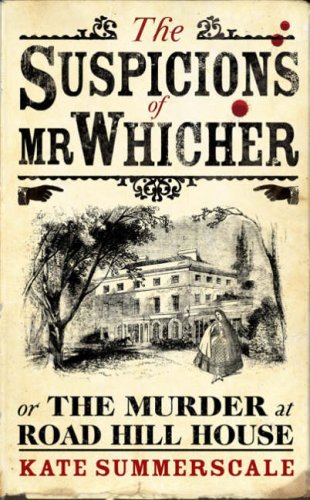
{SPOILERS ENSUE}
I must have read the book in 2009, the year after it first came out, and while I had the best intentions of rereading it in time for our book club meeting earlier this month, I didn’t even manage to skim it. I remembered one fact alone, the method of murder, which is not surprising as it was particularly gruesome: A young boy had his throat slit and was stuffed down the privy. But that was all that had remained with me. My husband filled me in on the basics and the discussion, held at our house, reminded me of the rest. We then made it a book club outing to the theatre.
The crime took place in late June 1860 at the Wiltshire home of the Kent family: the patriarch, a factory inspector; his four children from his first marriage; his second wife, formerly the older set’s governess; and their three young children. Jonathan “Jack” Whicher, sent by Scotland Yard to investigate, was one of London’s first modern detectives and inspired Wilkie Collins and Charles Dickens. Constance Kent, 16, later confessed to the murder of her three-year-old half-brother, Saville, motivated by anger at her stepmother for replacing her mentally ill mother, but uncertainty remained as to whether she had acted alone.

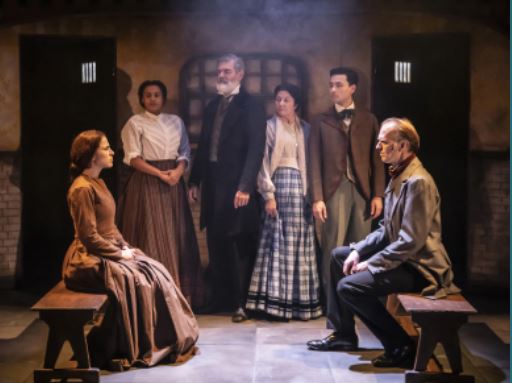
The play was very well done, maintaining tension even though there was a decision to introduce Constance as the killer immediately: the action opens on her and Mr Whicher in her cell at Fulham Prison in the 1880s. This is an invented scene in which he has come to visit, begging her to tell him the whole truth in exchange for him writing a letter to try to secure her early release. (She appealed four times but ended up serving a full 20-year sentence.)
Cold, stark lighting and a minimal set of two benches against a backdrop of steel doors and a mullioned window evoke the prison setting, with only the subtle change to warmer lighting indicating flashbacks as Constance and Whicher remember or act out events from 20 or more years before. These two remain on stage for the entirety of the first act. Four other actors cycle in and out, playing Kent family members and various other small roles. For instance, the bearded middle-aged actor who plays Mr Kent also appears as a coroner giving a precis of Saville’s autopsy – he mentions Collins and Dickens, but the evolution of the Victorian detective is, by necessity, a much smaller element of the play than it was in the book.
It’s a tiny theatre, but projections on a screen (such as a sinuous family tree) and a balcony, used for wordless presence or loud pronouncements, made it seem bigger than it was. Saville himself is only depicted as a mute figure on that upper level, in the truly spooky scene that closes the first act. I remember when the Watermill put out a discreet call for child actors, warning parents about the sort of content to expect. Three children play the role (plus one other bit part) in rotation. Pulsing violin music enhanced the feeling of dread, and each act was no more than 45 minutes, so the atmosphere remained taut.

Production photographs by Pamela Raith.
A missing nightdress – presumably blood-stained – as well as her own father’s hunch, were among the main evidence against Constance, so Whicher did not secure a conviction at the time and was publicly ridiculed for his failure to crack the case. That and his own loss of a child are suggested to be behind his obsession with tying up loose ends. While Constance expresses regret for her actions and calmly takes him through the accepted timeline of the murder, she refuses to give him anything extra.
The second act delves into what happened next for Constance: living among nuns in France and then in Brighton, where she decided to confess, and then relocating to Australia, where she worked in a halfway house for lepers and troubled youth, as if to make up for the harm she caused earlier in her life (and she lived to age 100!). This involved the most significant change of set and actors, with the former Mr. and Mrs. Kent now filling in as the older Constance and William, the brother closest to her in age.
The play fixates on the siblings’ relationship, returning several times to their whim to run away to Bristol and be “cabin boys” together. I wondered if there was even meant to be a sexual undercurrent to their connection. William Savill-Kent went on to be a successful marine biologist specialising in corals and Australian fisheries. One theory is that they were accomplices in the murder but Constance took the fall so that her brother could live a full life.
Intriguingly, the team behind the production decided to espouse this hypothesis explicitly. In the chilling final scene, then, a crib is wheeled out to the centre of the stage and Constance floats on in a white nightdress to lower the side closest to the audience. Just before the lights go down, William, too, appears in a white nightdress and stands over the far side of the crib.
Although I referred to the book as “compulsive” in the one mention I find of it in my computer files, from 2011, I only gave it 3 stars – my most common rating in those years, an indication that a book was alright but I moved right along to the next in the stack and it didn’t stick with me. My book club had mixed feelings, too, generally feeling that there was too much extraneous detail, which perhaps kept a narrative that could have read as fluidly as a novel from being truly gripping. The play, though, was thrilling.
Book (c. 2009): 
Play: 
Buy The Suspicions of Mr. Whicher from Bookshop.org [affiliate link]
Bill Bryson’s Notes from a Small Island: Reread and Stage Production
Bill Bryson, an American author of humorous travel and popular history or science books, is considered a national treasure in his adopted Great Britain. He is a particular favourite of my husband and in-laws, who got me into his work back in the early to mid-2000s. As I, too, was falling in love with the country, I found much to relate to in his travel-based memoirs of expatriate life and temporary returns to the USA. Sometimes it takes an outsider’s perspective to see things clearly.

 When we heard that Notes from a Small Island (1995), his account of a valedictory tour around Britain before returning to live in the States for the first time in 20 years, had been adapted into a play by Tim Whitnall and would be performed at our local theatre, the Watermill, we thought, huh, it never would have occurred to us to put this particular book on stage. Would it work? we wondered. The answer is yes and no, but it was entertaining and we were glad that we went. We presented tickets as my in-laws’ Christmas present and accompanied them to a mid-February matinee before supper at ours.
A few members of my book club decided to see the show later in the run and suggested we read – or reread, as was the case for several of us – the book in March. I started my reread before attending the play and had gotten through the first 50 pages, which is mostly about his first visit to England in 1973 (including a stay in a Dover boarding-house presided over by the infamously officious “Mrs Smegma”). This was ideal as the first bit contains the funniest stuff and, with the addition of some autobiographical material from later in the book plus his 2006 memoir The Life and Times of the Thunderbolt Kid, made up the entirety of the first act.
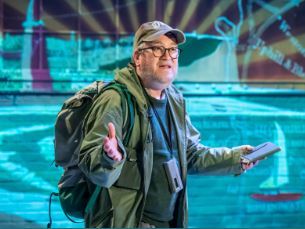
Photos are screenshots from the Watermill website.
Bryson traveled almost exclusively by public transport, so the set had the brick and steel walls of a generic terminal, and a bus shelter and benches were brought into service as the furnishing for most scenes. The problem with frontloading the play with hilarious scenes is that the second act, like the book itself on this reread, became rather a slog of random stops, acerbic observations, finding somewhere to stay and something to eat (often curry), and then doing it all over again.
Mark Hadfield, in the starring role, had the unenviable role of carrying the action and remembering great swathes of text lifted directly from the book. That’s all well and good as a strategy for giving a flavour of the writing style, but the language needed to be simplified; the poor man couldn’t cope and kept fluffing his lines. There were attempts to ease the burden: sections were read out by other characters in the form of announcements, letters or postcards; some reflections were played as if from Bryson’s Dictaphone. It was best, though, when there were scenes rather than monologues against a projected map, because there was an excellent ensemble cast of six who took on the various bit parts and these were often key occasions for humour: hotel-keepers, train-spotters, unintelligible accents in a Glasgow pub.
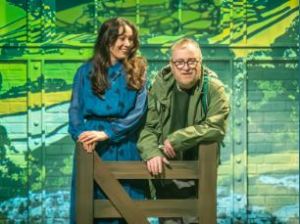
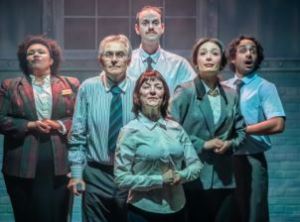
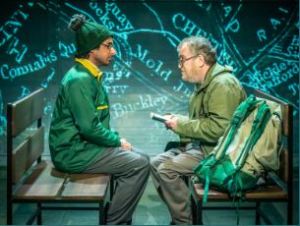
The trajectory was vaguely southeast to northwest – as far as John O’Groats, then back home to the Yorkshire Dales – but the actual route was erratic, based on whimsy as much as the availability of trains and buses. Bryson sings the praises of places like Salisbury and Durham and the pinnacles of coastal walks, and slates others, including some cities, seaside resorts and tourist traps. Places of personal significance make it onto his itinerary, such as the former mental asylum at Virginia Water, Surrey where he worked and met his wife in the 1970s. (My husband and I lived across the street from it for a year and a half.) He’s grumpy about having to pay admission fees that in today’s money sound minimal – £2.80 for Stonehenge!
 The main interest for me in both book and play was the layers of recent history: the nostalgia for the old-fashioned country he discovered at a pivotal time in his own young life in the 1970s; the disappointments but still overall optimism of the 1990s; and the hindsight the reader or viewer brings to the material today. At a time when workers of every type seem to be on strike, it was poignant to read about the protests against Margaret Thatcher and the protracted printers’ strike of the 1980s.
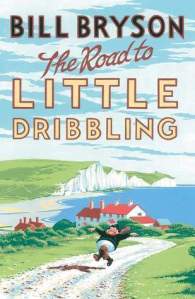 The central message of the book, that Britain has an amazing heritage that it doesn’t adequately appreciate and is rapidly losing to homogenization, still holds. Yet I’m not sure the points about the at-heart goodness and politeness of the happy-with-their-lot British remain true. Is it just me or have general entitlement, frustration, rage and nastiness taken over? Not as notable as in the USA, but social divisions and the polarization of opinions are getting worse here, too. One can’t help but wonder what the picture would have been post-Brexit as well. Bryson wrote a sort-of sequel in 2015, The Road to Little Dribbling, in which the sarcasm and curmudgeonly persona override the warmth and affection of the earlier book.
Indeed, my book club noted that a lot of the jokes were things he couldn’t get away with saying today, and the theatre issued a content warning: “This production includes the use of very strong language, language reflective of historical attitudes around Mental Health, reference to drug use, sexual references, mention of suicide, flashing lights, pyrotechnics, loud sound effect explosions, and haze. This production is most suitable for those aged 12+.”
So, yes, an amusing journey, but a bittersweet one to revisit, and an odd choice for the stage.
A favourite line I’ll leave you with: “To this day, I remain impressed by the ability of Britons of all ages and social backgrounds to get genuinely excited by the prospect of a hot beverage.”
Book:
Original rating (c. 2004):
My rating now:
Play:
Have you read anything by Bill Bryson? Are you a fan?
 Bookish Beck = Rebecca Foster. American transplant to England. Freelance proofreader and book reviewer.
 Bookish Beck