August Releases: Sarah Manguso (Fiction), Sarah Moss (Memoir), and Carl Phillips (Poetry)
Today I feature a new-to-me poet and two women writers whose careers I’ve followed devotedly but whose latest books – forthright yet slippery; their genre categories could easily be reversed – I found very emotionally difficult to read. Gruelling, almost, but admirable. Many rambling thoughts ensue. Then enjoy a nice poem.
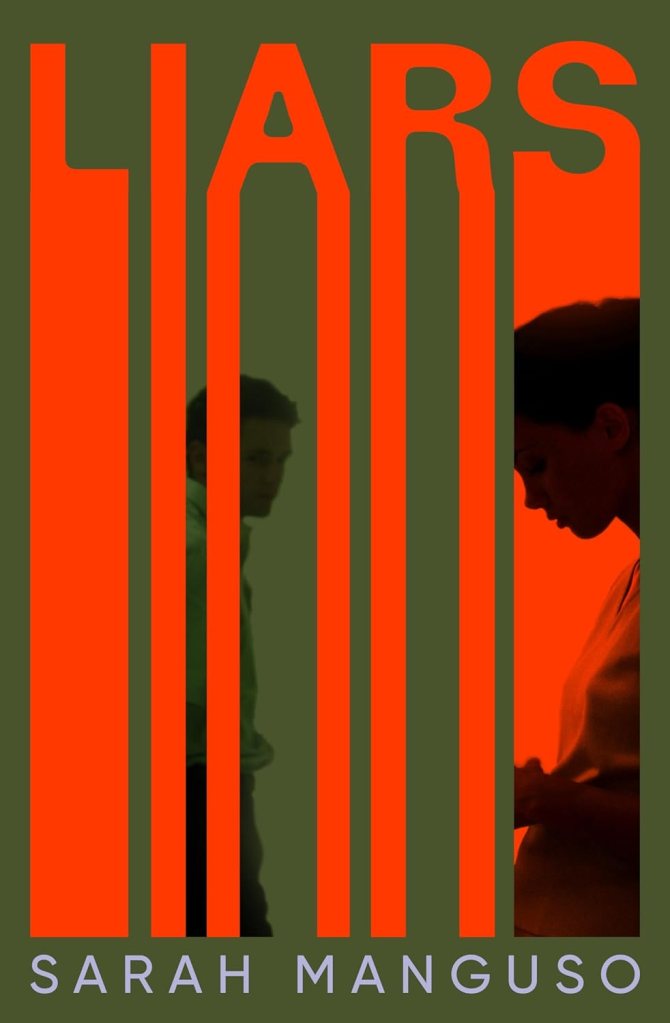
Liars by Sarah Manguso
As part of a profile of Manguso and her oeuvre for Bookmarks magazine, I wrote a synopsis and surveyed critical opinion; what follow are additional subjective musings. I’ve read six of her nine books (all but the poetry and an obscure flash fiction collection) and I esteem her fragmentary, aphoristic prose, but on balance I’m fonder of her nonfiction. Had Liars been marketed as a diary of her marriage and divorce, Manguso might have been eviscerated for the indulgence and one-sided presentation. With the thinnest of autofiction layers, is it art?
Jane recounts her doomed marriage, from the early days of her relationship with John Bridges to the aftermath of his affair and their split. She is a writer and academic who sacrifices her career for his financially risky artistic pursuits. Especially once she has a baby, every domestic duty falls to her, while he keeps living like a selfish stag and gaslights her if she tries to complain, bringing up her history of mental illness. The concise vignettes condense 14+ years into 250 pages, which is a relief because beneath the sluggish progression is such repetition of type of experiences that it could feel endless. John’s last name might as well be Doe: The novel presents him – and thus all men – as despicable and useless, while women are effortlessly capable and, by exhausting themselves, achieve superhuman feats. This is what heterosexual marriage does to anyone, Manguso is arguing. Indeed, in a Guardian interview she characterized this as a “domestic abuse novel,” and elsewhere she has said that motherhood can be unlinked from patriarchy, but not marriage.
Let’s say I were to list my every grievance against my husband from the last 17+ years: every time he left dirty clothes on the bedroom floor (which is every day); every time he loaded the dishwasher inefficiently (which is every time, so he leaves it to me); every time he failed to seal a packet or jar or Tupperware properly (which – yeah, you get the picture) – and he’s one of the good guys, bumbling rather than egotistical! And he’d have his own list for me, too. This is just what we put up with to live with other people, right? John is definitely worse (“The difference between John and a fascist despot is one of degree, not type”). But it’s not edifying, for author or reader. There may be catharsis to airing every single complaint, but how does it help to stew in bitterness? Look at everything I went through and validate my anger.
There are bright spots: Jane’s unexpected transformation into a doting mother (but why must their son only ever be called “the child”?), her dedication to her cat, and the occasional dark humour:
So at his worst, my husband was an arrogant, insecure, workaholic, narcissistic bully with middlebrow taste, who maintained power over me by making major decisions without my input or consent. It could still be worse, I thought.
Manguso’s aphoristic style makes for many quotably mordant sentences. My feelings vacillated wildly, from repulsion to gung-ho support; my rating likewise swung between extremes and settled in the middle. I felt that, as a feminist, I should wholeheartedly support a project of exposing wrongs. It’s easy to understand how helplessness leads to rage, and how, considering sunk costs, a partner would irrationally hope for a situation to improve. So I wasn’t as frustrated with Jane as some readers have been. But I didn’t like the crass sexual language, and on the whole I agreed with Parul Sehgal’s brilliant New Yorker review that the novel is so partial and the tone so astringent that it is impossible to love. 
With thanks to Picador for the proof copy for review.
And a quote from the Moss memoir (below) to link the two books: “Homes are places where vulnerable people are subject to bullying, violence and humiliation behind closed doors. Homes are places where a woman’s work is never done and she is always guilty.”
20 Books of Summer, #19:
My Good Bright Wolf by Sarah Moss
I’ve reviewed this memoir for Shelf Awareness (it’s coming out in the USA from Farrar, Straus and Giroux on October 22nd) so will only give impressions, in rough chronological order:
Sarah Moss returns to nonfiction – YES!!!
Oh no, it’s in the second person. I’ve read too much of that recently. Fine for one story in a collection. A whole book? Not so sure. (Kirsty Logan got away with it, but only because The Unfamiliar is so short and meant to emphasize how matrescence makes you other.)
 The constant second-guessing of memory via italicized asides that question or refute what has just been said; the weird nicknames (her father is “the Owl” and her mother “the Jumbly Girl”) – in short, the deliberate artifice – at first kept me from becoming submerged. This must be deliberate and yet meant it was initially a chore to pick up. It almost literally hurt to read. And yet there are some breathtakingly brilliant set pieces. Oh! when her mother’s gay friend Keith buys her a chocolate éclair and she hides it until it goes mouldy.
Once she starts discussing her childhood reading – what it did for her then and how she views it now – the book really came to life for me. And she very effectively contrasts the would-be happily ever after of generally getting better after eight years of disordered eating with her anorexia returning with a vengeance at age 46 – landing her in A&E in Dublin. (Oh! when she reads War and Peace over and over on a hospital bed and defiantly uses the clean toilets on another floor.) This crisis is narrated in the third person before a return to second person.
The tone shifts throughout the book, so that what threatens to be slightly cloying in the childhood section turns academically curious and then, somehow, despite the distancing pronouns, intimate. So much so that I found myself weeping through the last chapters over this lovely, intelligent woman’s ongoing struggles. As an overly cerebral person who often thinks it’s pesky to have to live in a body, I appreciated her probing of the body/mind divide; and as she tracks where her food issues came from, I couldn’t help but think about my sister’s years of eating disorders and my mother’s fear that it was all her fault.
Beyond Moss’s usual readers, I’d also recommend this to fans of Laura Freeman’s The Reading Cure and Noreen Masud’s A Flat Place.
Overall: shape-shifting, devastating, staunchly pragmatic. I’m not convinced it all hangs together (and I probably would have ended it at p. 255), but it’s still a unique model for transmuting life into art. 
With thanks to Picador for the free copy for review.
Scattered Snows, to the North by Carl Phillips
 Phillips is a prolific poet I’d somehow never heard of. In fact, he won the Pulitzer Prize last year for his selected poetry volume. He’s gay and African American, and in his evocative verse he summons up landscapes and a variety of weather, including as a metaphor for emotions – guilt, shame, and regret. Looking back over broken relationships, he questions his memory.
Will I remember individual poems? Unlikely. But the sense of chilly, clear-eyed reflection, yes. (Sample poem below) 
With thanks to Carcanet for the advanced e-copy for review.
Record of Where a Wind Was
Wave-side, snow-side,
little stutter-skein of plovers
lifting, like a mind
of winter—
We’d been walking
the beach, its unevenness
made our bodies touch,
now and then, at
the shoulders mostly,
with that familiarity
that, because it sometimes
includes love, can
become confused with it,
though they remain
different animals. In my
head I played a game with
the waves called Weapon
of Choice, they kept choosing
forgiveness, like the only
answer, as to them
it was, maybe. It’s a violent
world. These, I said, I choose
these, putting my bare hands
through the air in front of me.
Any other August releases you’d recommend?
Recent Poetry Releases by Anderson, Godden, Gomez, Goodan, Lewis & O’Malley
Nature, social engagement, and/or women’s stories are linking themes across these poetry collections, much as they vary in their particulars. After my brief thoughts, I offer one sample poem from each book.
And I Will Make of You a Vowel Sound by Morag Anderson
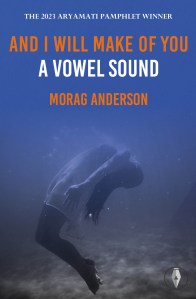 Morag Anderson was the 2023 Makar of the Federation of Writers in Scotland. She won the Aryamati Pamphlet Prize for this second chapbook of 25 poems. Her subjects are ordinary people: abandoned children, a young woman on a council estate, construction workers, and a shoplifter who can’t afford period products. The verse is rich with alliteration, internal rhymes and neologisms. Although sub/urban settings predominate, there are also poems dedicated to birds and to tracking the seasons’ march along a river. There is much sibilance to “Little Wren,” while “Cormorant Speaks” enchants with its fresh compound words: “Barefoot in mudslick streambeds I pathpick over rotsoft limbs, wade neckdeep in suncold loch”. “No Ordinary Tuesday, 2001” is about 9/11 and “None of the Nine Were There” expresses feminist indignation at the repeal of Roe v. Wade: “all nine were busy / stitching rules into the seams / of bleeding wombs.” A trio of poems depicts the transformation of matrescence: “Long after my shelterbody shucks / her reluctant skull / from my shell, // her foetal cells— / rosefoamed in my core— / migrate to mend my flensed heart.” Impassioned and superbly articulated. A confident poet whose work I was glad to discover.

With thanks to Fly on the Wall Press for the free copy for review.
With Love, Grief and Fury by Salena Godden
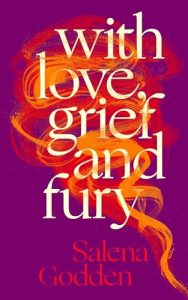 “In a time of apathy, / hope is a revolutionary act”. I knew Godden from her hybrid novel Mrs Death Misses Death, but this was my first taste of the poetry for which she is better known. The title gives a flavour of the variety in tone. Poems arise from environmental anxiety; feminist outrage at discrimination and violence towards women; and personal experiences of bisexuality, being childfree (“Book Mother” and “Egg and Spoon Race”), and entering perimenopause (“Evergreen Tea”). Solidarity and protest are strategies for dispelling ignorance about all of the above. Godden also marks the rhythms of everyday life for a single artist, and advises taking delight in life’s small pleasures. The social justice angle made it a perfect book for me to read portions of on the Restore Nature Now march through London in June …

… and while volunteering as an election teller at a polling station last week. It contains 81 poems (many of them overlong prose ones), making for a much lengthier collection than I would usually pick up. The repetition, wordplay and run-on sentences are really meant more for performance than for reading on the page, but if you’re a fan of Hollie McNish or Kae Tempest, you’re likely to enjoy this, too.
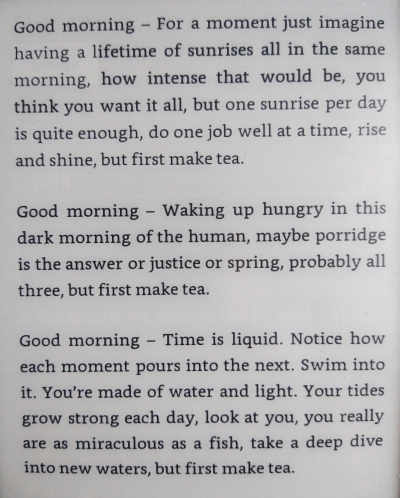
An excerpt from “But First Make Tea”
(Read via NetGalley) Published in the UK by Canongate Press.
Inconsolable Objects by Nancy Miller Gomez
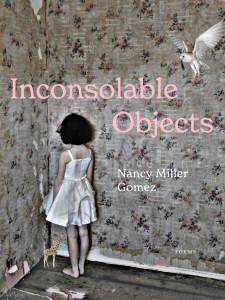 Nancy Miller Gomez’s debut collection recalls a Midwest girlhood of fairground rides and lake swimming; tornadoes and cicadas. But her remembered Kansas is no site of rose-tinted nostalgia. “Missing History” notes how women’s stories, such as her grandmother’s, are lost to time. A pet snake goes missing and she imagines it haunting her mother. In “Tilt-A-Whirl,” her older sister’s harmless flirtation with a ride operator turns sinister. “Mothering,” likewise, eschews the cosy for images of fierce protection. The poet documents the death of her children’s father and abides with a son enduring brain scans and a daughter in recovery from heroin addiction. She also takes ideas from the headlines, with poems about the Ukraine invasion and species extinction. There is a prison setting in two in a row – she has taught Santa Cruz County Jail poetry workshops. The alliteration and slant rhymes are to die for, and I love the cover (Owl Collage by Alexandra Gallagher) and frequent bird metaphors. This also appeared on my Best Books from the First Half of 2024 list. [My full review is on Goodreads.]

With thanks to publicist Sarah Cassavant (Nectar Literary) and YesYes Books for the e-copy for review.
In the Days that Followed by Kevin Goodan
 These 41 poems, each limited to one stanza and one page, are named for their first lines, like hymns. With their old-fashioned lyricism and precise nature vocabulary, they are deeply rooted in place and animated by frequent rhetorical questions. Birds and fields, livestock and wildfires: Goodan marks where human interest and the natural world meet, or sometimes clash. He echoes Emily Dickinson (“After great patience, a small bird comes”) and also reminds me of Keith Taylor, whose upcoming collection I’ve reviewed for Shelf Awareness. The pages are rain-soaked and ghost-haunted, creating a slightly melancholy atmosphere. Unusual phrasing and alliteration stand out: “on the field / A fallow calm falls / Leaving the soil / To its feraling.” He’s a new name for me though this is his seventh collection; I’d happily read more. [After I read the book I looked at the blurb on Goodreads. I got … none of that from my reading, so be aware that it’s very subtle.]
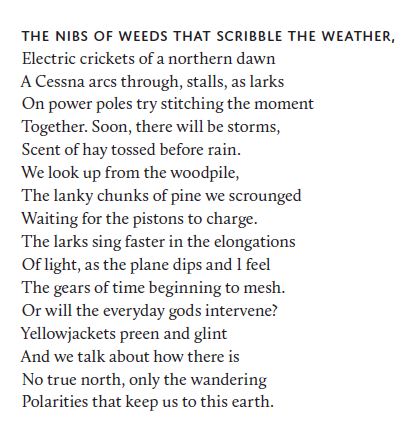
With thanks to Alice James Books for the e-copy for review.
From Base Materials by Jenny Lewis
 This nicely ties together many of the themes covered by the other collections I’ve discussed: science and nature imagery, ageing, and social justice pleas. But Lewis adds in another major topic: language itself, by way of etymology and translation. “Another Way of Saying It” gives the origin of all but incidental words in parentheses. The “Tales from Mesopotamia” are from a commissioned verse play she wrote and connect back to her 2014 collection Taking Mesopotamia, with its sequence inspired by The Epic of Gilgamesh. There are also translations from the Arabic and a long section paraphrases the Rubaiyat of Omar Khayyam, which recalls the books of Ecclesiastes and Job with its self-help aphorisms. Other poems are inspired by a mastectomy, Julian of Norwich, Japanese phrases, and Arthurian legend. The title phrase comes from the Rubaiyat and refers to the creation of humanity from clay. There’s such variety of subject matter here, but always curiosity and loving attention.
“On Translation”
The trouble with translating, for me, is that
when I’ve finished, my own words won’t come;
like unloved step-children in a second marriage,
they hang back at table, knowing their place.
While their favoured siblings hold forth, take
centre stage, mine remain faint, out of ear-shot
like Miranda on her island shore before the boats
came near enough, signalling a lost language;
and always the boom of another surf – pounding,
subterranean, masculine, urgent – makes my words
dither and flit, become little and scattered
like flickering shoals caught up in the slipstream
of a whale, small as sand crabs at the bottom of a bucket,
harmless; transparent as zooplankton.
With thanks to Carcanet Press for the e-copy for review.
The Shark Nursery by Mary O’Malley
 This was my first time reading Irish poet Mary O’Malley. Nature looms large in her tenth collection, as in several of the other books I’ve reviewed here, with poems about flora and fauna. “Late Swallow” is a highlight (“your loops and dives leave ripples in the air, / a winged Matisse, painting with scissors”) and the title’s reference is to dogfish – what’s in a name, eh? The meticulous detail in her descriptions made me think of still lifes, as did a mention of an odalisque. Other verse is stimulated by Greek myth, travel to Lisbon, and the Gaelic language. Sections are devoted to pandemic experiences (“Another Plague Season”) and to technology. “The Dig” imagines what future archaeologists will make of our media. I noted end and internal rhymes in “April” and the repeated sounds and pattern of stress of “clean as a quiver of knives.” O’Malley has a light touch but leaves a big impression.
“Holy”
The days lengthen, the sky quickens.
Something invisible flows in the sticks
and they blossom. We learn to let this
be enough. It isn’t; it’s enough to go on.
Then a lull and a clip on my phone
of a small girl playing with a tennis ball
her three-year-old face a chalice brimming
with life, and I promise when all this is over
I will remember what is holy. I will say
the word without shame, and ask if God
was his own fable to help us bear absence,
the cold space at the heart of the atom.
With thanks to Carcanet Press for the e-copy for review.
June Releases by Caroline Bird, Kathleen Jamie, Glynnis MacNicol and Naomi Westerman
These four books by women all incorporate life writing to an extent. Although the forms differ, a common theme – as in the other June releases I’ve reviewed, Sandwich and Others Like Me – is grappling with what a woman’s life should be, especially for those who have taken an unconventional path (i.e. are queer or childless) or are in midlife or later. I’ve got a poet up to her usual surreal shenanigans but with a new focus on lesbian parenting; a hybrid collection of poetry and prose giving snapshots of nature in crisis; an account of a writer’s hedonistic month in pandemic-era Paris; and mordant essays about death culture.
Ambush at Still Lake by Caroline Bird
 Caroline Bird has become one of my favourite contemporary poets over the past few years. Her verse is joyously cheeky and absurdist. A great way to sample it is via her selected poems, Rookie. This seventh collection is muted by age and circumstance – multiple weddings and a baby – but still hilarious in places. Instead of rehab or hospital as in In These Days of Prohibition, the setting is mostly the domestic sphere. Even here, bizarre things happen. The police burst in at 4 a.m. for no particular reason; search algorithms and the baby monitor go haywire. Her brother calls to deliver a paranoid rant (in “Up and at ’Em”), while Nannie Edna’s dying wish is to dangle her great-grandson from her apartment window (in “Last Rites”). The clinic calls to announce that their sperm donor was a serial killer – then ‘oops, wrong vial, never mind!’ A toddler son’s strange and megalomaniac demands direct their days. My two favourites were “Ants,” in which a kitchen infestation signals general chaos, and “The Frozen Aisle,” in which a couple scrambles to finish the grocery shop and get home to bed before a rare horny moment passes. A lesbian pulp fiction cover, mischievous wit and topics of addiction and queer parenting: this is not your average poetry.
With thanks to Carcanet Press for the free copy for review.
A sample poem:
Siblings
A woman gave birth
to the reincarnation
of Gilbert and Sullivan
or rather, two reincarnations:
one Gilbert, one Sullivan.
What are the odds
of both being resummoned
by the same womb
when they could’ve been
a blue dart frog
and a supply teacher
on separate continents?
Yet here they were, squidged
into a tandem pushchair
with their best work
behind them, still smarting
from the critical reception
of their final opera
described as ‘but an echo’
of earlier collaborations.
Cairn by Kathleen Jamie
 As she approached age 60, Kathleen Jamie found her style changing. Whereas her other essay collections alternate extended nature or travel pieces with few-page vignettes, Cairn eschews longer material and instead alternates poems with micro-essays on climate crisis and outdoor experiences. In the prologue she calls these “distillations and observations. Testimonies” that she has assembled into “A cairn of sorts.”
As in Surfacing, she writes many of the autobiographical fragments in the second person. The book is melancholy at times, haunted by all that has been lost and will be lost in the future:
What do we sense on the moor but ghost folk,
ghost deer, even ghost wolf. The path itself is a
phantom, almost erased in ling and yellow tormentil (from “Moor”)
In “The Bass Rock,” Jamie laments the effect that bird flu has had on this famous gannet colony and wishes desperately for better news:
The light glances on the water. The haze clears, and now the rock is visible; it looks depleted. But hallelujah, a pennant of twenty-odd gannets is passing, flying strongly, now rising now falling They’ll be Bass Rock birds. What use the summer sunlight, if it can’t gleam on a gannet’s back? You can only hope next year will be different. Stay alive! You call after the flying birds. Stay alive!
Natural wonders remind her of her own mortality and the insignificance of human life against deep time. “I can imagine the world going on without me, which one doesn’t at 30.” She questions the value of poetry in a time of emergency: “If we are entering a great dismantling, we can hardly expect lyric to survive. How to write a lyric poem?” (from “Summer”). The same could be said of any human endeavour in the face of extinction: We question the point but still we continue.
My two favourite pieces were “The Handover,” about going on an environmental march with her son and his friends in Glasgow and comparing it with the protests of her time (Greenham Common and nuclear disarmament) – doom and gloom was ever thus – and the title poem, which piles natural image on image like a cone of stones. Although I prefer the depth of Jamie’s other books to the breadth of this one, she is an invaluable nature writer for her wisdom and eloquence, and I am grateful we have heard from her again after five years.
With thanks to Sort Of Books for the free copy for review.
I’m Mostly Here to Enjoy Myself: One Woman’s Pursuit of Pleasure in Paris by Glynnis MacNicol
 I loved New York City freelance writer Glynnis MacNicol’s No One Tells You This (2018), which approached her 40th year as an adventure into the unknown. This second memoir is similarly frank and intrepid as MacNicol examines the unconscious rules that people set for women in their mid-forties and gleefully flouts them, remaining single and childfree and delighting in the freedom that allows her to book a month in Paris on a whim. She knows that she is an anomaly for being “untethered”; “I am ready for anything. To be anyone.”
This takes place in August 2021, when some pandemic restrictions were still in force, and she found the city – a frequent destination for her over the years – drained of locals, who were all en vacances, and largely empty of tourists, too. Although there was still a queue for the Mona Lisa, she otherwise found the Louvre very quiet, and could ride her borrowed bike through the streets without having to look out for cars. She and her single girlfriends met for rosé-soaked brunches and picnics, joined outdoor dance parties and took an island break.
And then there was the sex. MacNicol joined a hook-up app called Fruitz and met all sorts of men. She refused to believe that, just because she was 46 going on 47, she should be invisible or demure. “All the attention feels like pure oxygen. Anything is possible.” Seeing herself through the eyes of an enraptured 27-year-old Italian reminded her that her body was beautiful even if it wasn’t what she remembered from her twenties (“there is, on average, a five-year gap between current me being able to enjoy the me in the photos”). The book’s title is something she wrote while messaging with one of her potential partners.
As I wrote yesterday about Others Like Me, there are plenty of childless role models but you may have to look a bit harder for them. MacNicol does so by tracking down the Paris haunts of women writers such as Edith Wharton and Colette. She also interrogates this idea of women living a life of pleasure by researching the “odalisque” in 18th- and 19th-century art, as in the François Boucher painting on the cover. This was fun, provocative and thoughtful all at once; well worth seeking out for summer reading and armchair travelling.
(Read via Edelweiss) Published in the USA by Penguin Life/Random House.
Happy Death Club: Essays on Death, Grief & Bereavement across Cultures by Naomi Westerman
 Like Erica Buist (This Party’s Dead) and Caitlin Doughty (Smoke Gets in Your Eyes, From Here to Eternity and Will My Cat Eat My Eyeballs?), playwright Naomi Westerman finds the comical side of death. Part of 404 Ink’s Inklings series (“Big ideas, pocket-sized books” – perfect for anyone looking for short nonfiction for Novellas in November!), this is a collection of short essays about her own experiences of bereavement as well as her anthropological research into rituals and beliefs around death. “The Rat King of South London” is about her father’s sudden death from an abdominal aneurysm. An instantaneous death is a good one, she contends. More than 160,000 people die every day, and what to do with all those bodies is a serious question. A subversive sense of humour is there right from the start, as she gives a rundown of interment options. “Mummification: Beloved by Ancient Egyptians and small children going through their Ancient Egypt phase, it’s a classic for a reason!” Meanwhile, she legally owns her father’s plot so also buries dead pet rats there.
Other essays are about taking her mother’s ashes along on world travels, the funeral industry and “red market” sales of body parts, grief as a theme in horror films, the fetishization of dead female bodies, Mexico’s Day of the Dead festivities, and true crime obsession. In “Batman,” an excerpt from one of her plays, she goes to have a terrible cup of tea with the man she believes to be responsible for her mother’s death – a violent one, after leaving an abusive relationship. She also used the play to host an on-stage memorial for her mother since she wasn’t able to sit shiva. In the final title essay, Westerman tours lots of death cafés and finds comfort in shared experiences. These pieces are all breezy, amusing and easy to read, so it’s a shame that this small press didn’t achieve proper proofreading, making for a rather sloppy text, and that the content was overall too familiar for me.
With thanks to 404 Ink and publicist Claire Maxwell for the free copy for review.
Does one or more of these catch your eye?
What June releases can you recommend?
April Releases by Brownrigg, Ernaux, O’Connor, Waterman and Wood
Family history is a common element for the first four of these review books: a multi-generational story (incorporating autofiction in places) about Anglo-American writers and the legacy of suicide; a brief slice of memoir about the loss of a mother; a historical novella inspired by family stories and set on an island at the cusp of war; and a poetry collection drawing on a father’s death as well as on local folklore. Addiction and dementia are specific links between pairs. And to round off, a set of short stories about pregnancy and motherhood.
The Whole Staggering Mystery: A Story of Fathers Lost and Found by Sylvia Brownrigg
“The dead don’t come back, but they are not as far away as you think.”
I knew Brownrigg’s name as a novelist thanks to Susan’s blog (see her review of Pages for Her), but when I read about this family memoir it piqued my interest more than her fiction might have. The Brownrigg clan are nobility (really – her brother has the title “Baronet”) but have rejected conventional Englishness over the past century. First her grandfather, Gawen, separated from his wife and moved to Nairobi to work as a journalist. He also published two obscure novels before dying at age 27. The empty bottle of Nembutal and recent changes to his will suggested suicide, though his mother resisted the notion vociferously. Gawen’s son, Nicholas, was raised in California by his mother, Lucia, and became an alcoholic who lived off-grid on a ranch and had an unpublished Beats-influenced novel.
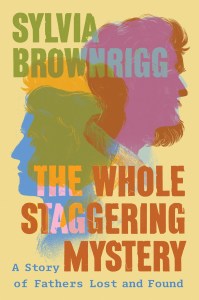 After Nicholas’s death in 2018, Brownrigg was compelled to trace her family’s patterns of addiction and creativity. It’s a complex network of relatives and remarriages here. The family novels and letters were her primary sources, along with a scrapbook her great-grandmother Beatrice made to memorialize Gawen for Nicholas. Certain details came to seem uncanny. For instance, her grandfather’s first novel, Star Against Star, was about, of all things, a doomed lesbian romance – and when Brownrigg first read it, at 21, she had a girlfriend.
Along with the more traditional memoir sections, there are the documents that speak for themselves and extended passages of autofiction. I loved an imaginary letter by Gawen’s older brother, who died in young childhood, and a third-person segment about Beatrice’s life in England during the Second World War. But I mostly skipped over the 90 lightly fictionalized pages about the author’s (“Sophie’s”) life with her father in California. You might view this as a showcase of possible methods for engaging with family history, some of which work better than others. All of it is fascinating material, though.
Published by Counterpoint in the USA. With thanks to Nectar Literary for the advanced e-copy for review.
A Woman’s Story by Annie Ernaux (1988; 2024)
[Translated from the French by Tanya Leslie]
 This memoir of Ernaux’s mother’s life and death is, at 58 pages, little more than an extended (auto)biographical essay. Confusingly, it covers the same period she wrote about in I Remain in Darkness (originally published nine years later), a diary of her mother’s final years with dementia; I even remembered two specific events and quotes. Why not combine the two into a full-length biographical recollection? Or pair it with A Man’s Place, Ernaux’s memoir of her father, in one volume? Perhaps her works will be repackaged in the future. But this came first: Ernaux started writing just a couple of weeks after her mother’s death, and spent 10 months over it. It’s clear she was determined to salvage what she could of her mother’s life:
It’s a difficult undertaking. For me, my mother has no history. She has always been there. When I speak of her, my first impulse is to ‘freeze’ her in a series of images unrelated to time … This book can be seen as a literary venture as its purpose is to find out the truth about my mother, a truth that can be conveyed only by words. … I believe I am writing about my mother because it is my turn to bring her into the world.
Ernaux opens with news of the death, and the funeral. But soon she’s pushing back into the past. Her mother grew up in poverty near Rouen and worked in a factory before her marriage, when she and her husband took on a grocery store and café. The Second World War was in some romantic way the great drama of her life. She was exacting of her daughter: “Her overriding concern was to give me everything she hadn’t had. But this involved so much work, so much worrying about money”. In her widowhood she came to live with Ernaux, who was then divorced with two sons, and tried to find a middle way between independence and connection. Eventually, though, her memory loss required admission to a nursing home.
I’ve felt the same about all three short works I’ve read by Ernaux so far: though precisely observed, they conceal themselves behind emotional distance. So while this might seem similar to A Very Easy Death by Simone de Beauvoir, I found the latter more engaging.
With thanks to Fitzcarraldo Editions for the free copy for review.
Whale Fall by Elizabeth O’Connor
 The remote Welsh island setting of O’Connor’s debut novella was inspired by several real-life islands that were depopulated in the twentieth century due to a change in climate and ways of life: Bardsey, St Kilda, the Blasket Islands, and the Aran Islands. (A letter accompanying my review copy explained that the author’s grandmother was a Welsh speaker from North Wales and her Irish grandfather had relatives on the Blasket Islands.)
Eighteen-year-old Manod Llan is the older daughter of a lobster fisherman. Her sweetheart recently left to find work in a mainland factory. It’s 1938 and there are vague rumbles about war, but more pressing is the arrival of strangers here to study a vanishing culture. Anthropologists Edward and Joan learn snatches of Welsh and make recordings of local legends and songs, which are interspersed with the fragmentary narrative. Manod, star-struck, seeks the English researchers’ approval as she helps with translation and other secretarial duties, but becomes disillusioned with their misinterpretations and fascist leanings.
The gradual disintegration of a beached whale casts a metaphorical shadow of decay over the slow-burning story. I kept waiting for momentous events that never came. More definitive consequences? Something to do with Manod’s worries for her little sister, Llinos? A flash-forward to the abandoned island’s after-years? Or to Manod’s future? As it is, the sense of being stuck at a liminal time makes it all feel like prologue. But O’Connor’s writing is quite lovely (“The milk had formed a film over the surface and puckered, like a strange kiss”; “All of my decisions felt like trying to catch a fish that did not exist until I caught it”) and the book is strong on atmosphere and tension. I’ll look out for her next work.
With thanks to Picador for the free copy for review.
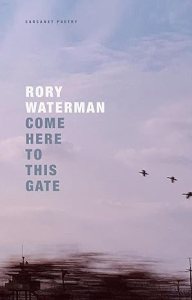
Come Here to This Gate by Rory Waterman
I was most drawn to the poems in Part I, “All but Forgotten,” about his father’s last year or so.
The titles participate in telling the story: “Alcoholic Dementia,” followed by “Twin Oaks Nursing Home.”
The sheep-tracks of your mind were worn to trenches.
…
Then what you’ve turned yourself into – half there
on one side of a final single bed
you might not leave till the rest of you has left –
starts, stares through me, says ‘I’m being held
against my will!’, tells a nurse to ‘Just fuck off’
then thanks her. Old boy, when did you get like this?
The sheep-tracks of my mind are worn to trenches.
Then they moved you to a home
that still wasn’t home. ‘Why
am I in this fucking place?
Nothing’s wrong with me.’
So I’d tell you all over again,
but only the easy part (‘You’re
not remembering things well
at present.’ ‘Yes I fucking am’)
and you relearned that you’d
never learn – mindless torture,
until I stopped it. Your
silences were trains departing.
From the miscellany of Part II, I plucked out “Gooseberries” and “Perennials,” both of which conceal emotion among plants. Then Part III, “Lincolnshire Folk Tales,” turns the tone mischievous, with the ABCB end-rhymes of “Yallery Brown,” “The Metheringham Lass,” “The Lincoln Imp,” and “Nanny Rutt” (I felt I’d stumbled on a limerick with its rhythm: “Math Wood is a small plot of trees south of Bourne, / next to McDonald’s and Lidl. / It’s privately owned, full of shot-gun shells, pheasants – / but still, a bit of an idyll”). Plenty of good stuff, then, but it doesn’t all seem to fit together in the same collection.
With thanks to Carcanet Press for the advanced e-copy for review.
This Is Why We Can’t Have Nice Things by Naomi Wood
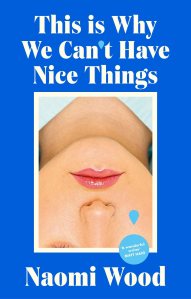 I requested this because a) I had enjoyed Wood’s novels Mrs. Hemingway and The Hiding Game and b) I couldn’t resist the title. These nine contemporary stories (five in the first person and four in the third person) all feature women who are pregnant and/or mothers of young children. Three dwell on work–life balance in particular, with the female protagonists of “Lesley, in Therapy” and “Dracula at the Movies” an animator and a filmmaker, respectively. The third, “Hurt Feelings,” in which a medical emergency forces a choice between career and motherhood, was my favourite. Claudia is working on an advertising campaign for a large pharmaceutical company whose newest product targets chronic pain. Although she suspects it’s a placebo, she knows how valuable it is for these people to have their pain acknowledged given it’s as invisible as her history of pregnancy loss.
Other highlights included “Peek-a-Boo,” in which pregnant twin sisters fly to Italy to remonstrate with their father, who refuses to cede a holiday flat to the next renters; and “Wedding Day,” about a woman bitter enough to try to sabotage her ex’s big day by demanding he bring their daughter, the flower girl, home by bedtime. “Flatten the Curve” is about restrictions and desires during Covid lockdown. Family, neighbour, and co-worker dynamics fuel the drama. In a few cases, Wood imagined promising situations but didn’t deliver on them. I could hardly believe “Comorbidities,” about a mother who films a sex tape with her husband to distract from her eco-anxiety, won the 2023 BBC National Short Story Award. If Wood was aiming for edgy, she landed on peevish instead. “Dino Moms,” the final story, was worst, with its absurd dinosaur-vet reality-TV setup. Overall, the collection is too one-note because of the obsession with motherhood (“It is not very interesting to be in love with your child; it’s commonplace, this sacrificial love”). Back to novels soon, please.
With thanks to Phoenix (Orion) for the free copy for review.
Does one of these catch your eye? What April releases can you recommend?
Miscellaneous #ReadIndies Reviews: Mostly Poetry + Brown, Sands
Catching up on a few final #ReadIndies contributions in early March! Short responses to some indie reading I did from my shelves over the course of last month.

Bloodaxe Books:
Parables & Faxes by Gwyneth Lewis (1995)
 I was surprised to discover this was actually my fourth book by Lewis, a bilingual Welsh author: two memoirs, one of depression and one about marriage; and now two poetry collections. The table of contents suggest there are only 16 poems in the book, but most of the titles are actually headings for sections of anywhere between 6 and 16 separate poems. She ranges widely at home and abroad, as in “Welsh Espionage” and the “Illinois Idylls.” “I shall taste the tang / of travel on the atlas of my tongue,” Lewis writes, an example of her alliteration and sibilance. She’s also big on slant and internal rhymes – less so on end rhymes, though there are some. Medieval history and theology loom large, with the Annunciation featuring more than once. I couldn’t tell you now what that many of the poems are about, but Lewis’s telling is always memorable.
Sample lines:
For the one
who said yes,
how many
said no?
…
But those who said no
for ever knew
they were damned
to the daily
as they’d disallowed
reality’s madness,
its astonishment.
(from “The ‘No’ Madonnas,” part of “Parables & Faxes”)
(Secondhand purchase – Westwood Books, Sedbergh) 
&
Fields Away by Sarah Wardle (2003)
 Wardle’s was a new name for me. I saw two of her collections at once and bought this one as it was signed and the themes sounded more interesting to me. It was her first book, written after inpatient treatment for schizophrenia. Many of the poems turn on the contrast between city (London Underground) and countryside (fields and hedgerows). Religion, philosophy, and Greek mythology are common points of reference. End rhymes can be overdone here, and I found a few of the poems unsubtle (“Hubris” re: colonizers and “How to Be Bad” about daily acts of selfishness vs. charity). However, there are enough lovely ones to compensate: “Flight,” “Word Tasting” (mimicking a wine tasting), “After Blake” (reworking “Jerusalem” with “And will chainsaws in modern times / roar among England’s forests green?”), “Translations” and “Word Hill.”
Favourite lines:
(oh, but the last word is cringe!)
Catkin days and hedgerow hours
fleet like shafts of chapel sun.
Childhood in a cobwebbed bower
guards a treasure chest of fun.
(from “Age of Awareness”)
(Secondhand purchase – Carlisle charity shop) 
Carcanet Press:
Tripping Over Clouds by Lucy Burnett (2019)
 The title is a setup for the often surrealist approach, but where another Carcanet poet, Caroline Bird, is warm and funny with her absurdism, Burnett is just … weird. Like, I’d get two stanzas into a poem and have no idea what was going on or what she was trying to say because of the incomplete phrases and non-standard punctuation. Still, this is a long enough collection that there are a good number of standouts about nature and relationships, and alliteration and paradoxes are used to good effect. I liked the wordplay in “The flight of the guillemet” and the off-beat love poem “Beer for two in Brockler Park, Berlin.” The noteworthy Part III is composed of 34 ekphrastic poems, each responding to a different work of (usually modern) art.
Favourite lines:
This is a place of uncalled-for space
and by the grace of the big sky,
and the serrated under-silhouette of Skye,
an invitation to the sea unfolds
to come and dine with mountain.
(from “Big Sands”)
(New (bargain) purchase – Waterstones website) 
&
The Met Office Advises Caution by Rebecca Watts (2016)
 The problem with buying a book mostly for the title is that often the contents don’t live up to it. (Some of my favourite ever titles – An Arsonist’s Guide to Writers’ Homes in New England, The Voluptuous Delights of Peanut Butter and Jam – were of books I couldn’t get through). There are a lot of nature poems here, which typically would be enough to get me on board, but few of them stood out to me. Trees, bats, a dead hare on the road; maps, Oxford scenes, Christmas approaching. All nice enough; maybe it’s just that the poems don’t seem to form a cohesive whole. Easy to say why I love or hate a poet’s style; harder to explain indifference.
Sample lines:
Branches lash out; old trees lie down and don’t get up.
A wheelie bin crosses the road without looking,
lands flat on its face on the other side, spilling its knowledge.
(from the title poem)
(New (bargain) purchase – Amazon with Christmas voucher)
Faber:
Places I’ve Taken My Body by Molly McCully Brown (2020)
 The title signals right away how these linked autobiographical essays split the ‘I’ from the body – Brown resents the fact that disability limits her experience. Oxygen deprivation at their premature birth led to her twin sister’s death and left her with cerebral palsy severe enough that she generally uses a wheelchair. In Bologna for a travel fellowship, she writes, “There are so many places that I want to be, but I can’t take my body anywhere. But I must take my body everywhere.” A medieval city is particularly unfriendly to those with mobility challenges, but chronic pain and others’ misconceptions (e.g. she overheard a guy on her college campus lamenting that she’d die a virgin) follow her everywhere.
A poet, Brown earned minor fame for her first collection, which was about historical policies of enforced sterilization for the disabled and mentally ill in her home state of Virginia. She is also a Catholic convert. I appreciated her exploration of poetry and faith as ways of knowing: “both … a matter of attending to the world: of slowing my pace, and focusing my gaze, and quieting my impatient, indignant, protesting heart long enough for the hard shell of the ordinary to break open and reveal the stranger, subtler singing underneath.” This is part of a terrific run of three pieces, the others about sex as a disabled person and the odious conservatism of the founders of Liberty University. Also notable: “Fragments, Never Sent,” letters to her twin; and “Frankenstein Abroad,” about rereading this novel of ostracism at its 200th anniversary. (Secondhand purchase – Amazon)
New River Books:
The Hedgehog Diaries: A Story of Faith, Hope and Bristle by Sarah Sands (2023)
 Reasons for reading: 1) I’d enjoyed Sands’s The Interior Silence and 2) Who can resist a book about hedgehogs? She covers a brief slice of 2021–22 when her aged father was dying in a care home. Having found an ill hedgehog in her garden and taken it to a local sanctuary, she developed an interest in the plight of hedgehogs. In surveys they’re the UK’s favourite mammal, but it’s been years since I saw one alive. Sands brings an amateur’s enthusiasm to her research into hedgehogs’ place in literature, philosophy and science. She visits rescue centres, meets activists in Oxfordshire and Shropshire who have made hedgehog welfare a local passion, and travels to Uist to see where hedgehogs were culled in 2004 to protect ground-nesting birds’ eggs. The idea is to link personal brushes with death with wider threats of extinction. Unfortunately, Sands’s lack of expertise is evident. This was well-meaning, but inconsequential and verging on twee. (Christmas gift from my wishlist)
Recent Poetry Releases by Allison Blevins, Kit Fan, Lisa Kelly and Laura Scott
I’m catching up on four 2023 poetry collections from independent publishers, three of them from Carcanet Press, which so graciously keeps me stocked up with work by contemporary poets. Despite the wide range of subject matter, style and technique, nature imagery and erotic musings are links. From each I’ve chosen one short poem as a representative.
Cataloguing Pain by Allison Blevins
 Last year I reviewed Allison Blevins’ Handbook for the Newly Disabled. This shares its autobiographical consideration of chronic illness and queer parenting. Specifically, she looks back to her MS diagnosis and three IVF pregnancies, and her spouse’s transition. Both partners were undergoing bodily transformations and coming into new identities, the one as disabled and the other as a man. In later poems she calls herself “The shell”, while “Elegy for My Wife,” which closes Part I, makes way for references to “my husband” in Part II.
“I won’t wail for your dead name. I don’t mean that violence. I wish for a word other than elegy to explain how some of this feels like goodbye.”
In unrhymed couplets or stanzas and bittersweet paragraphs, Blevins marshals metaphors from domestic life – colours, food, furniture, gardening – to chart the changes that pain and disability force onto their family’s everyday routines. “Fall Risk” and “Fly Season” are particular highlights. This is a potent and frankly sexual text for readers drawn to themes of health and queer family-making (see also my Three on a Theme post on that topic).

Published by YesYes Books on 19 April. With thanks to the author for the advanced e-copy for review.
The Ink Cloud Reader by Kit Fan
 Kit Fan was raised in Hong Kong and moved to the UK as an adult. This is his third collection of poetry. “Suddenly” tells a version of his life story in paragraphs or single lines that all incorporate the title word (with an ironic nod, through the epigraph, to Elmore Leonard’s writing ‘rule’ that “suddenly” should never be used). The “IF” statements of “Delphi” then ponder possible future events; a trip to hospital sees him contemplating his mortality (“Glück,” written as a miniature three-act play) and appreciating tokens of beauty (“Geraniums in May”). “Yew,” unusually, is a modified sonnet where every line rhymes.
As the collection’s title suggests, it is equally interested in the natural and the human. There are poems describing the cycles of the moon (the lines of “Moon Salutation” curve into a half-moon parabola) and the wind. Ink pulls together calligraphy, the Chinese zodiac and literature. “The Art of Reading,” which commemorates important moments, real and imaginary, of the poet’s reading life, was a favourite of mine, as was “Derek Jarman’s Garden.” Fan also writes of memory and travels – including to the underworld. His relationship with his husband is a subtle background subject. (“Even though we’ve lived together for nearly twenty years and are always reading sometimes I can’t read you at all which I guess is a good thing”). It’s an opulent and allusive work that has made me eager to try more by Fan. Luckily, I have his debut novel (passed on to me by Laura T.) on the shelf.
Readalike: Moving House by Theophilus Kwek

Published on 27 April. With thanks to Carcanet Press for the advanced e-copy for review.
The House of the Interpreter by Lisa Kelly
 Lisa Kelly’s concern with deafness is sure to bring to mind Raymond Antrobus and Ilya Kaminsky, but I prefer her work. Kelly is half-Danish and has single-sided deafness, and in Part I of this second collection, entitled “Chamber,” her poems engage with questions of split identity:
Is this what it is like for us all? Always having to relearn home
with a strange tongue and alien hands, prepared to open our mouths
as if to beg, to touch tongue-tip with fingertip to reveal ourselves?
The title poem relishes the absurdities of telephone communication, closing with:
In the House of the Interpreter,
Oralism and Manualism, like Passion and Patience,
are rewarded differently and at different times.
Hello, this is your Interpreter. What is your wishlist?
This section ends with “#WhereIsTheInterpreter,” about the Deaf community’s outrage that the Prime Minister’s Covid briefings were not simultaneously translated into BSL.
Bizarrely but delightfully, Kelly then moves onto “Oval Window,” a sequence of alliteration-rich poems about fungi. “Mycology Abecedarian” is a joyful list of species’ common names, while “Mycelium” notes how mushrooms show that different ways of evolution and reproduction are possible. “Darning Mushroom” even combines images of fungi and holey socks. Part III, “Canal,” is a miscellany of autobiographical poems and homages to Faith Ringgold, full of references to colour, language, nature and travel.
Readalike: In the Quaker Hotel by Helen Tookey
Published on 27 April. With thanks to Carcanet Press for the advanced e-copy for review.
The Fourth Sister by Laura Scott
 Back in 2019 I reviewed Laura Scott’s debut collection, So Many Rooms. Her second book reflects some of the same preoccupations: art, birds, colour and Russian literature. Chekhov is a recurring point of reference across the two; here, for instance, we have a found poem composed of excerpts from his letters. Scott also writes about the deaths of her parents, voicing resentment towards her father and remarking on life’s irony. As the title suggests, her family constellation includes sisters. Her godparents loom surprisingly large; her godmother was, apparently, a spy. My favourite of the poems, “Still Life,” imagines the whole of life being prized as a glass in an exhibit, appealingly pristine and praiseworthy in comparison to what we usually perceive: “the raggy sprawl of a life … the wrong turns and longing of it.” Elsewhere, metaphors are drawn from the theatre: performing lines, taking items from a wardrobe. I loved the way the pull of nostalgia is set up in opposition to the now.

Published on 23 February. With thanks to Carcanet Press for the advanced e-copy for review.
Read any good poetry recently?
Some 2022 Reading Superlatives
Longest book read this year: To Paradise by Hanya Yanagihara (720 pages)

Shortest book read this year: Everything’s Changing by Chelsea Stickle (37 pages)

Authors I read the most by this year: Nicola Colton (4), Jakob Wegelius (3), Tove Jansson and Sarah Ruhl (2)
Publishers I read the most from: (Besides the ubiquitous Penguin and its many imprints) Canongate, Carcanet and Picador – which is part of the Pan Macmillan group.
An author I ‘discovered’ and now want to read everything by: Matthew Vollmer
My overall top discovery of the year: The Murderer’s Ape by Jakob Wegelius

My proudest non-bookish achievement: Giving a eulogy at my mom’s funeral (and even getting some laughs).
The books that made me laugh the most: Revenge of the Librarians by Tom Gauld, Undoctored by Adam Kay, Forget Me Not by Sophie Pavelle, Blurb Your Enthusiasm by Louise Willder
The books that made me cry the most: Foster by Claire Keegan, The Hero of This Book by Elizabeth McCracken


Most useful fact gleaned from a book: To convert a Celsius temperature to Fahrenheit, double it and add 30. It’s a rough estimate, but it generally works! I learned this from, of all places, The Hero of This Book by Elizabeth McCracken.
Best book club selections: The Boys in the Boat by Daniel James Brown, Falling Angels by Tracy Chevalier, Small Things Like These by Claire Keegan


Best first line encountered this year: “First, I got myself born.” (Demon Copperhead, Barbara Kingsolver)
Best last lines encountered this year:
- “Darling, that’s what life’s for – to take risks.” (Up at the Villa, W. Somerset Maugham)
- “The defiant soul of the city doesn’t die. It stays alive, right below the surface, pressing up against the boot heels, crouched like the life inside an egg, the force that drives the flower, forever reaching for its next breath.” (Feral City, Jeremiah Moss)
 “Until the future, whatever it was going to be.” (This Time Tomorrow, Emma Straub)
A book that put a song in my head every time I picked it up: Heaven Is a Place on Earth by Adrian Shirk

Shortest book title encountered: O (a poetry collection by Zeina Hashem Beck), followed by XO (a memoir by Sara Rauch)
Best 2022 book title: I Want to Die But I Want to Eat Tteokbokki by Baek Se-hee (No, I haven’t read it and I’m unlikely to, not having had great luck with recent translations of work by Japanese and Korean women.)
Favourite title and cover combo of the year: Briefly, A Delicious Life by Nell Stevens

Most fun cover serendipity: Two books I read in 2022 featured Matisse cut-outs.


Biggest disappointment: The Book of Form and Emptiness by Ruth Ozeki ( for me)
Two 2022 books that everyone was in raptures about but me: Trust by Hernan Diaz and Demon Copperhead by Barbara Kingsolver (both for me)


A 2022 book that everyone was reading but I decided not to: The Marriage Portrait by Maggie O’Farrell – since I thought Hamnet her weakest work, I’m not eager to try more historical fiction by her.
A 2022 book I can’t read: (No matter how good the reviews might be, because of the title) I’m Glad My Mom Died by Jennette McCurdy
The worst books I read this year: The Reactor by Nick Blackburn, Treacle Walker by Alan Garner, Anthropology by Dan Rhodes, Bonsai by Alejandro Zambra (1-star ratings are extremely rare from me; these were this year’s four)
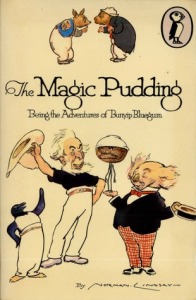
The downright strangest book I read this year: The Magic Pudding by Norman Lindsay
 Bookish Beck = Rebecca Foster. American transplant to England. Freelance proofreader and book reviewer.
 Bookish Beck