Winter Reads, Part II: Au, Glück, Hall, Rautiainen, Slaght
In the week before Christmas I reviewed a first batch of wintry reads. We’ve had hardly any snowfall here in southern England this season, so I gave up on it in real life and sought winter weather on the page. After we’ve seen the back of Storm Franklin (it’s already moved on from Eunice!), I hope it will feel appropriate to start right in on some spring reading. But for today I have a Tokyo-set novella, sombre poems, an OTT contemporary Gothic novel, historical fiction in translation from the Finnish, and – the cream of the crop – a real-life environmentalist adventure in Russia.
Cold Enough for Snow by Jessica Au (2022)
 This slim work will be released in the UK by Fitzcarraldo Editions on the 23rd and came out elsewhere this month from New Directions and Giramondo. I actually read it in December during my travel back from the States. It’s a delicate work of autofiction – it reads most like a Chloe Aridjis or Rachel Cusk novel – about a woman and her Hong Kong-raised mother on a trip to Tokyo. You get a bit of a flavour of Japan through their tourism (a museum, a temple, handicrafts, trains, meals), but the real focus is internal as Au subtly probes the workings of memory and generational bonds.
The woman and her mother engage in surprisingly deep conversations about the soul and the meaning of life, but these are conveyed indirectly rather than through dialogue: “she said that she believed that we were all essentially nothing, just series of sensations and desires, none of it lasting. … The best we could do in this life was to pass through it, like smoke through the branches”. Though I highlighted a fair few passages, I find that no details have stuck with me. This is just the sort of spare book I can admire but not warm to. (NetGalley) 
Winter Recipes from the Collective by Louise Glück (2021)
 The only other poetry collection of Glück’s that I’d read was Vita Nova. This, her first release since her Nobel Prize win, was my final read of 2021 and my shortest, at 40-some pages; it’s composed of just 15 poems, a few of which stretch to five pages or more. “The Denial of Death,” a prose piece with more of the feel of an autobiographical travel essay, was a standout; the title poem, again in prose paragraphs, and the following one, “Winter Journey,” about farewells, bear a melancholy chill. Memories and dreams take pride of place, with the poet’s sister appearing frequently. “How heavy my mind is, filled with the past.” There are also multiple references to Chinese concepts and characters (as on the cover). The overall style is more aphoristic and reflective than expected. Few individual lines or images stood out to me.
With thanks to Carcanet Press for the e-copy for review.
The Snow Collectors by Tina May Hall (2020)
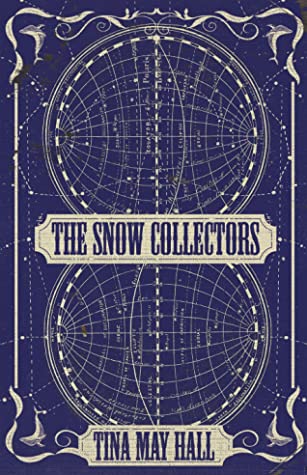 Henna is alone in the world since her parents and twin sister disappeared in a boating accident. She lives a solitary existence with her sister’s basset hound Rembrandt in a New England village, writing encyclopaedia entries on the Arctic, until she stumbles on a corpse and embarks on an amateur investigation involving scraps of 19th-century correspondence. The dead woman asked inconvenient questions about a historical cover-up; if she takes up the thread, Henna could be a target, too. Her collaboration with the police chief, Fletcher, turns into a flirtation. After her house burns down, she ends up living with him – and his mother and housekeeper – in a Gothic mansion stuffed with birds of prey and historical snow samples. She’s at the mercy of this quirky family and the weather, wearing ancient clothing from Fletcher’s great-aunts and tramping through blizzards looking for answers.
This is a kitchen-sink novel with loads going on, as if Hall couldn’t decide which of her interests to include so threw them all in. Yet at only 221 pages, it might actually have been expanded a little to flesh out the backstory and mystery plot. It gets more than a bit ridiculous in places, but its Victorian fan fiction vibe is charming escapism nonetheless. What with the historical fiction interludes about the Franklin expedition, this reminded me most of The Still Point, but also of The World Before Us and The Birth House. I’d happily read Hall’s 2010 short story collection, too. (Christmas gift) 
Land of Snow and Ashes by Petra Rautiainen (2022)
[Translated from the Finnish by David Hackston]
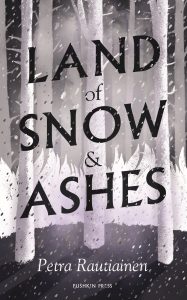 In the middle years of World War II, Finland was allied with Nazi Germany against Russia, a mutual enemy. After the Moscow Armistice, the Germans retreated in disgrace, burning as many buildings and planting as many landmines as they could (“the Lapland War”). I gleaned this helpful background information from Hackston’s preface. The story that follows is in two strands: one is set in 1944 and told via diary entries from Väinö Remes, a Finnish soldier called up to interpret at a Nazi prison camp in Inari. The other, in third person, takes place between 1947 and 1950, the early years of postwar reconstruction. Inkeri, a journalist, has come to Enontekiö to find out what happened to her husband. An amateur photographer, she teaches art to the local Sámi children and takes on one girl, Bigga-Marja, as her protégée.
Collusion and secrets; escaped prisoners and physical measurements being taken of the Sámi: there are a number of sinister hints that become clearer as the novel goes on. I felt a distance from the main characters that I could never quite overcome, such that the reveals didn’t land with as much power as I think was intended. Still, this has the kind of forthright storytelling and precise writing that fans of Hubert Mingarelli should appreciate. For another story of the complexities of being on the wrong side of history, see The Women in the Castle by Jessica Shattuck.
With thanks to Pushkin Press for the proof copy for review.
Winter words:
“Fresh snow has fallen, forming drifts across the terrain. White. Grey. Undulating. The ice has cracked here and there, raising its head in the thawed sections of the river. There is only a thin layer of ice left.”
Owls of the Eastern Ice: The Quest to Find and Save the World’s Largest Owl by Jonathan C. Slaght (2020)
Slaght has become an expert on the Blakiston’s fish owl during nearly two decades of fieldwork in the far east of Russia – much closer to Korea and Japan than to Moscow, the region is also home to Amur tigers. For his Master’s and PhD research at the University of Minnesota, he plotted the territories of breeding pairs of owls and fit them with identifying bands and data loggers to track their movements over the years. He describes these winter field seasons as recurring frontier adventures. Now, I’ve accompanied my husband on fieldwork from time to time, and I can tell you it would be hard to make it sound exciting. Then again, gathering beetles from English fields is pretty staid compared to piloting snowmobiles over melting ice, running from fire, speeding to avoid blockaded logging roads, and being served cleaning-grade ethanol when the vodka runs out.
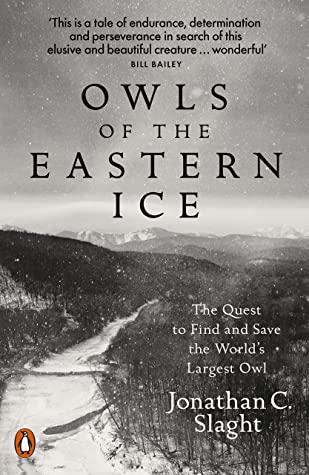 The sorts of towns Slaght works near are primitive places where adequate food and fuel is a matter of life and death. He and his assistants rely on the hospitality of Anatoliy the crazy hermit and also stay in huts and caravans. Tracking the owls is a rollercoaster experience, with expensive equipment failures and trial and error to narrow down the most effective trapping methods. His team develops a new low-tech technique involving a tray of live fish planted in the river shallows under a net. They come to know individuals and mourn their loss: the Sha-Mi female he’s holding in his author photo was hit by a car four years later.
Slaght thinks of Russia as his second home, and you can sense his passion for the fish owl and for conservation in general. He boils down complicated data and statistics into the simple requirements for this endangered species (fewer than 2000 in the wild): valleys containing old-growth forest with large trees and rivers that don’t fully freeze over. There are only limited areas with these characteristics. These specifications and his ongoing research – Slaght is now the Northeast Asia Coordinator for the Wildlife Conservation Society – inform the policy recommendations given to logging companies and other bodies.
Amid the science, this is just a darn good story, full of bizarre characters like Katkov, a garrulous assistant exiled for his snoring. (“He fueled his monologue with sausage and cheese, then belched zeppelins of aroma into that confined space.”) Slaght himself doesn’t play much of a role in the book, so don’t expect a soul-searching memoir. Instead, you get top-notch nature and travel writing, and a ride along on a consequential environmentalist quest. This is the kind of science book that, like Lab Girl and Entangled Life, I’d recommend even if you don’t normally pick up nonfiction. (Christmas gift) 
And a bonus children’s book:
If Winter Comes, Tell It I’m Not Here by Simona Ciraolo (2020)

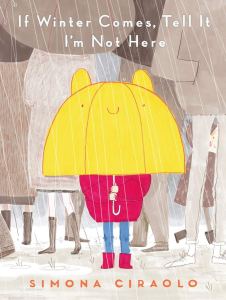 The little boy loves nothing more than to spend hours at the swimming pool and then have an ice cream cone. His big sister warns him the carefree days of summer will be over soon; it will turn cold and dark and he’ll be cooped up inside. Her words come to pass, yet the boy realizes that every season has its joys and he has to take advantage of them while they last. Cute and colourful, though the drawing style wasn’t my favourite. And a correction is in order: as President Biden would surely tell you, ice cream is a year-round treat! (Public library)
Any snowy or icy reading (or weather) for you lately?
Seasons’ Greetings: Winter (Part I) & Christmas Reading
My first few wintry reads for the season included a modern children’s classic, a wonderful poetry collection, and a so-so Advent-set novella. For my pre-Christmas reads, I have a couple of story-length classics and two recent novellas.
Winter Story by Jill Barklem (1980)
 My favourite of the series so far (just Spring still to go) for how nostalgic it is for winter traditions.
“Tobogganing tomorrow,” said Wilfred.
“Snow pancakes for tea,” said Clover.
“We’ll make a snow mouse,” said Catkin.
The mice host a Snow Ball at the Ice Hall, with outfits and dances out of Austen and victuals out of Dickens. As always, the tree-trunk interiors are lit up like doll’s house tableaux with cosy rooms and well-stocked larders. Nothing much happens in this one, but that was fine with me: no need for a conflict and its resolution when you’ve got such a lovely, lucky life. (Public library) 
The Winter Orchards by Nina Bogin (2001)
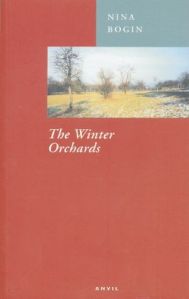 After enjoying Thousandfold in 2019, I was keen to catch up on Bogin’s previous poetry. Themes I’d noted in her latest work, nature and family, are key here, too. There is an overall wistful tone to the book, as in the passages below:
I didn’t like lungwort at first,
its spotted leaves, its furred
flowers, and I didn’t like its name.
But now I want to gather lungwort again,
now that I can’t return
to the brook meadow I picked it in (from “Lungwort”)
I’ll love the fallow and forgotten fields
because I have no choice, and woods
whose paths have been erased. (from “Landscape”)
The losses responded to are sometimes personal – saying Kaddish for her father – and sometimes more broadly representative, as when she writes about a dead bird found on the road or conflicts like the Gulf War and former Yugoslavia. Alongside beautiful nature poetry featuring birds and plants are vignettes from travels in France, Sweden, and upstate New York. (New purchase) 
An Advent Calendar by Shena Mackay (1978)
 I smugly started this on the first day of Advent, and initially enjoyed Mackay’s macabre habit of taking elements of the Nativity scene or a traditional Christmas and giving them a seedy North London twist. So we open on a butcher’s shop and a young man wearing “bloody swabbing cloths” rather than swaddling clothes, having lost a finger to the meat mincer (and later we see “a misty Christmas postman with his billowy sack come out of the abattoir’s gates”). In this way, John Wood becomes an unwitting cannibal after taking a parcel home from the butcher’s that day, and can’t forget about it as he moves his temporarily homeless family into his old uncle’s house and continues halfheartedly in his job as a cleaner. His wife has an affair; so does a teenage girl at the school where his sister works. No one is happy and everything is sordid. “Scouring powder snowed” and the animal at this perverse manger scene is the uncle’s neglected goat. This novella is soon read, but soon forgotten. (Secondhand purchase)
And so to Christmas…
“The Christmas Dinner” by Washington Irving (1820)
 An evocative portrait of an English Christmas meal, hosted by a squire in the great hall of his manor, originally published in Irving’s The Sketch Book of Geoffrey Crayon, Gent. A boar’s head, a mummers’ play, the Lord of Misrule: you couldn’t get much more traditional. “Master Simon covered himself with glory by the stateliness with which, as Ancient Christmas, he walked a minuet with the peerless, though giggling, Dame Mince Pie.” Irving’s narrator knows this little tale isn’t profound or intellectually satisfying, but hopes it will raise a smile. He also has a sense that he is recording something that might soon pass away:
I felt also an interest in the scene, from the consideration that these fleeting customs were posting fast into oblivion. … There was a quaintness, too, mingled with all this revelry, that gave it a peculiar zest; it was suited to the time and place; and as the old Manor House almost reeled with mirth and wassail, it seemed echoing back the joviality of long-departed years.
A pleasant one-sitting read; so much better than a Christmas card!
This Renard Press pamphlet is in support of Three Peas, a charity providing food and medical care to refugees in Europe. Thanks to Annabel for my gifted copy!
Small Things Like These by Claire Keegan (2021)
Always, Christmas brought out the best and the worst in people.
 This was our second most popular read during last month’s Novellas in November challenge. I’d read a lot about it in fellow bloggers’ posts and newspaper reviews so knew to expect a meticulously chiselled and heartwarming story about a coal merchant in 1980s Ireland who comes to value his quiet family life all the more when he sees how difficult existence is for the teen mothers sent to work in the local convent’s laundry service. Born out of wedlock himself nearly 40 years ago, he is grateful that his mother received kindness and wishes he could do more to help the desperate girls he meets when he makes deliveries to the convent.
I found this a fairly predictable narrative, and the nuns are cartoonishly villainous. So I wasn’t as enthusiastic as many others have been, but still enjoyed having this as one of my reads on my travel day to the USA. I was familiar with the Magdalene Laundries from the movie The Magdalene Sisters and found this a touching reminder to be grateful for what you have while helping those less fortunate. A perfect message for Christmas. (NetGalley) 
Miss Marley by Vanessa Lafaye (2018)
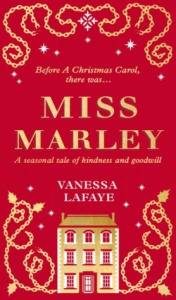 Lafaye was a local-ish author to me, an American expat living in Marlborough. When she died of breast cancer in 2018, she left this A Christmas Carol prequel unfinished, and fellow historical novelist Rebecca Mascull completed it for her. Clara and Jacob Marley come from money but end up on the streets, stealing from the rich to get by. Jacob sets himself up as a moneylender to the poor and then, after serving an apprenticeship alongside Ebenezer Scrooge, goes into business with him. They are a bad influence on each other, reinforcing each other’s greed and hard hearts. Jacob is determined never to be poor again. Because he’s forgotten what it’s like, he has no compassion when Clara falls in love with a luckless Scottish tea merchant. Like Scrooge, Jacob is offered one final chance to mend his ways. This was easy and pleasant reading, but I did wonder if there was a point to reading this when one could just reread Dickens’s original. (Secondhand purchase)
A Child’s Christmas in Wales by Dylan Thomas (1952)
(Illus. Edward Ardizzone, 1978)
 It’s a wonder I’d never managed to read this short story before. I was prepared for something slightly twee; instead, it is sprightly and imaginative, full of unexpected images and wordplay. In the Wales of his childhood, there were wolves and bears and hippos. Young boys could get up to all sorts of mischief, but knew that a warm house packed with relatives and a cosy bed awaited at the end of a momentous day. Reflective and magical in equal measure; a lovely wee volume that I am sure to reread year after year. (Little Free Library)
A favourite passage:
Our snow was not only shaken from whitewash buckets down the sky, it came shawling out of the ground and swam and drifted out of the arms and hands and bodies of the trees; snow grew overnight on the roofs of the houses like a pure and grandfather moss, minutely white-ivied the walls and settled on the postman, opening the gate, like a dumb, numb thunderstorm of white, torn Christmas cards.
If there’s been one adjective linking most of these books, it’s been “nostalgic.” There’s something about winter in general, and the holiday season in particular, that lends itself to thinking back to the past and trying to preserve traditions, isn’t there?
What’s on your holiday reading pile this year?
Love Your Library Begins: October 2021
It’s the opening month of my new Love Your Library meme! I hope some of you will join me in writing about the libraries you use and what you’ve borrowed from them recently. I plan to treat these monthly posts as a sort of miscellany.
Although I likely won’t do thorough Library Checkout rundowns anymore, I’ll show photos of what I’ve borrowed, give links to reviews of a few recent reads, and then feature something random, such as a reading theme or library policy or display.

Do share a link to your own post in the comments, and feel free to use the above image. I’m co-opting a hashtag that is already popular on Twitter and Instagram: #LoveYourLibrary.
Here’s a reminder of my ideas of what you might choose to post (this list will stay up on the project page):
- Photos or a list of your latest library book haul
- An account of a visit to a new-to-you library
- Full-length or mini reviews of some recent library reads
- A description of a particular feature of your local library
- A screenshot of the state of play of your online account
- An opinion piece about library policies (e.g. Covid procedures or fines amnesties)
- A write-up of a library event you attended, such as an author reading or book club.
If it’s related to libraries, I want to hear about it!
Recently borrowed


Stand-out reads
The Echo Chamber by John Boyne
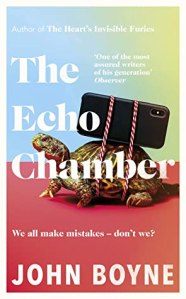 John Boyne is such a literary chameleon. He’s been John Irving (The Heart’s Invisible Furies), Patricia Highsmith (A Ladder to the Sky) and David Mitchell (A Traveller at the Gates of Wisdom). Now, with this Internet-age state-of-the-nation satire featuring variously abhorrent characters, he’s channelling the likes of Jamie Attenberg, Jonathan Coe, Patricia Lockwood, Lionel Shriver and Emma Straub. Every member of the Cleverley family is a morally compromised fake. Boyne gives his characters amusing tics, and there are also some tremendously funny set pieces, such as Nelson’s speed dating escapade and George’s public outbursts. He links several storylines through the Ukrainian dancer Pylyp, who’s slept with almost every character in the book and has Beverley petsit for his tortoise.
What is Boyne spoofing here? Mostly smartphone addiction, but also cancel culture. I imagined George as Hugh Bonneville throughout; indeed, the novel would lend itself very well to screen adaptation. And I loved how Beverley’s new ghostwriter, never given any name beyond “the ghost,” feels like the most real and perceptive character of all. Surely one of the funniest books I will read this year. (Full review).
Beautiful World, Where Are You by Sally Rooney
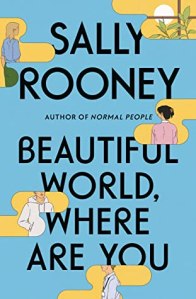 I was one of those rare readers who didn’t think so much of Normal People, so to me this felt like a return to form. Conversations with Friends was a surprise hit with me back in 2017 when I read it as part of the Sunday Times Young Writer of the Year Award shadow panel the year she won. The themes here are much the same: friendship, nostalgia, sex, communication and the search for meaning. BWWAY is that little bit more existential: through the long-form e-mail correspondence between two friends from college, novelist Alice and literary magazine editor Eileen, we imbibe a lot of philosophizing about history, aesthetics and culture, and musings on the purpose of an individual life against the backdrop of the potential extinction of the species.
Through their relationships with Felix (a rough-around-the-edges warehouse worker) and Simon (slightly older and involved in politics), Rooney explores the question of whether lasting bonds can be formed despite perceived differences of class and intelligence. The background of Alice’s nervous breakdown and Simon’s Catholicism also bring in sensitive treatments of mental illness and faith. (Full review).
This month’s feature
I spotted a few of these during my volunteer shelving and then sought out a couple more. All five are picture books composed by authors not known for their writing for children.
 Islandborn by Junot Díaz (illus. Leo Espinosa): “Every kid in Lola’s school was from somewhere else.” When the teacher asks them all to draw a picture of the country they came from, plucky Lola doesn’t know how to depict the Island. Since she left as a baby, she has to interview relatives and neighbours for their lasting impressions. For one man it’s mangoes so sweet they make you cry; for her grandmother it’s dolphins near the beach. She gathers the memories into a vibrant booklet. The 2D cut-paper style reminded me of Ezra Jack Keats.
 The Islanders by Helen Dunmore (illus. Rebecca Cobb): Robbie and his family are back in Cornwall to visit Tamsin and her family. These two are the best of friends and explore along the beach together, creating their own little island by digging a channel and making a dam. As the week’s holiday comes toward an end, a magical night-time journey makes them wonder if their wish to make their island life their real life forever could come true. The brightly coloured paint and crayon illustrations are a little bit Charlie and Lola and very cute.
 Rose Blanche by Ian McEwan (illus. Roberto Innocenti): Patriotism is assumed for the title character and her mother as they cheer German soldiers heading off to war. There’s dramatic irony in Rose being our innocent witness to deprivations and abductions. One day she follows a truck out of town and past barriers and fences and stumbles onto a concentration camp. Seeing hungry children’s suffering, she starts bringing them food. Unfortunately, this gets pretty mawkish and, while I liked some of the tableau scenes – reminiscent of Brueghel or Stanley Spencer – the faces are awful. (Based on a story by Christophe Gallaz.)
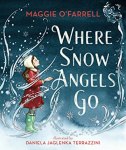 Where Snow Angels Go by Maggie O’Farrell (illus. Daniela Jaglenka Terrazzini): The snow angel Sylvie made last winter comes back to her to serve as her guardian angel, saving her from illness and accident risks. If you’re familiar with O’Farrell’s memoir I Am, I Am, I Am, this presents a similar catalogue of near-misses. For a picture book, it has a lot of words – several paragraphs’ worth on most of its 70 pages – so I imagine it’s more suitable for ages seven and up. I loved the fairy tale atmosphere, touches of humour, and drawing style.
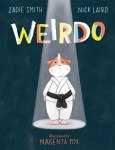 Weirdo by Zadie Smith and Nick Laird (illus. Magenta Fox): Kit’s birthday present is Maud, a guinea pig in a judo uniform. None of the other household pets – Derrick the cockatoo, Dora the cat, and Bob the pug – know what to make of her. Like in The Secret Life of Pets, the pets take over, interacting while everyone’s out at school and work. At first Maud tries making herself like the others, but after she spends an afternoon with an eccentric neighbour she realizes all she needs to be is herself. It’s not the first time married couple Smith and Laird have published an in-joke (their 2018 releases – an essay collection and a book of poems, respectively – are both entitled Feel Free): Kit is their daughter’s name and Maud is their pug’s. But this was cute enough to let them off.
Autumnal Children’s and YA Books
Browsing through old magazines, I found a fun BookPage reading list from October 2019 entitled “Pumpkin spice latte literature.” It asks, “what if autumn were distilled into a book? The mixture of crispness and warmth, the thrill of possibility, the bittersweetness of change—these books are pure pumpkin spice.” I love the lateral thinking that came up with
 The Art of Fielding by Chad Harbach (back to school in the Midwest)
- I Remember Nothing by Nora Ephron (wry reflections from the autumn of a life)
- Possession by A.S. Byatt (bookish geeking out)
- Calling a Wolf a Wolf by Kaveh Akbar (taking comfort from a vision of recovery from alcoholism)
- An Enchantment of Ravens by Margaret Rogerson (wit and magic)
I’ve read the first three, and am keen to catch up on Akbar’s debut poetry collection after loving Pilgrim Bell this summer. I’m only unlikely to pick up Rogerson’s fantasy. In any case, I enjoyed seeing how the editors came up with their selections.
I tend to be rather more literal with my seasonal reading recommendations. Does it have autumn in the title or as a setting?! Is it about pumpkins or Halloween?
This year I happen to have amassed all children’s and YA selections.
October, October by Katya Balen (2020)
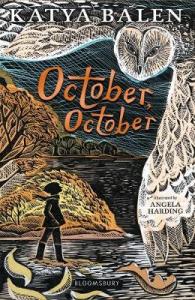 I’ll admit it: it was Angela Harding’s gorgeous cover illustration that drew me to this one. But I found a story that lived up to it, too. October, who has just turned 11 and is named after her birth month, lives in the woods with her father. Their shelter and their ways are fairly primitive, but it’s what October knows and loves. When her father has an accident and she’s forced into joining her mother’s London life, her only consolations are her rescued barn owl chick, Stig, and the mudlarking hobby she takes up with her new friend, Yusuf.
The child’s perspective is well rendered through artful run-on sentences. Balen is careful to show the consequences of October’s decisions and to present advantages as well as disadvantages so it’s not just countryside = good, city = bad. I thought the father’s recovery a bit too quick, but overall, this middle grade novel was a great read for any age, as well as one to get kids thinking about illness and loss. And how about these heart-tugging last lines? “There are stories everywhere and I want to tell them all. And all the world is wild and waiting for me.” (Public library)
Autumn Story by Jill Barklem (1980)
 The second in the quartet of seasonal “Brambly Hedge” stories. Autumn is a time for stocking the pantry shelves with preserves, so the mice are out gathering berries, fruit and mushrooms. Young Primrose wanders off, inadvertently causing alarm – though all she does is meet a pair of elderly harvest mice and stay for tea and cake in their round nest amid the cornstalks. I love all the little touches in the illustrations: the patchwork tea cosy matches the quilt on the bed one floor up, and nearly every page is adorned with flowers and other foliage. After we get past the mild peril that seems to be de rigueur for any children’s book, all is returned to a comforting normal. Time to get the Winter volume out from the library. (Public library)
Une Chanson d’ours by Benjamin Chaud (2011)
 The first whole book I’ve read in French in many a year. I just about coped, given that it’s a picture book with not all that many words on a page; any vocabulary I didn’t know offhand, I could understand in context. It’s late into the autumn and Papa Bear is ready to start hibernating for the year, but Little Bear spies a late-flying bee and follows it out of the woods and all the way to the big city. Papa Bear, realizing his lad isn’t beside him in the cave, sets out in pursuit and bee, cub and bear all end up at the opera hall, to the great surprise of the audience. What will Papa do with his moment in the spotlight? This is a lovely book that, despite the whimsy, still teaches about the seasons and parent–child bonds as it offers a vision of how humans and animals could coexist. I’ve since found out that this was made into a series of four books, all available in English translation. (Little Free Library)
Pumpkinheads by Rainbow Rowell; illus. Faith Erin Hicks (2019)
 This YA graphic novel is set on a Nebraska pumpkin patch that’s more like Disney World than a simple field down the road. Josiah and Deja have worked together at the Succotash Hut for the last three autumns. Today they’re aware that it’s their final Halloween before leaving for college. Deja’s goal is to try every culinary delicacy the patch has to offer – a smorgasbord of foodstuffs that are likely to be utterly baffling to non-American readers: candy apples, Frito pie (even I hadn’t heard of this one), kettle corn, s’mores, and plenty of other saccharine confections.
Josiah’s goal, by contrast, is to catch the eye of Marcy, the beauty who works at the fudge stand. Deja convinces him to desert the Succotash Hut and go in pursuit of Marcy via as many food stands as possible. She’s willing to indulge his unrealistic fantasy even though, as a bisexual who’s dated just about everyone at the patch, she knows romance is sometimes not all it’s cracked up to be. Meanwhile, there’s an angry billy goat on the loose.
This is a fun and quick romp, and the ending genuinely surprised me. I liked the story better than the art, though – my main problem was that these teen characters look more like they’re 30 (Josiah, especially, looks almost haggard what with the sharp lines down the sides of his face – I guess they’re to give him a ‘chiselled’ jaw?), similar to that weird phenomenon of much older actors playing high schoolers. So, I laughed to see in an afterword conversation between Rowell and Hicks that one of the major things they changed from early mock-ups was making the protagonists look older. (Public library)
Pick a Pumpkin by Patricia Toht; illus. Jarvis (2019)
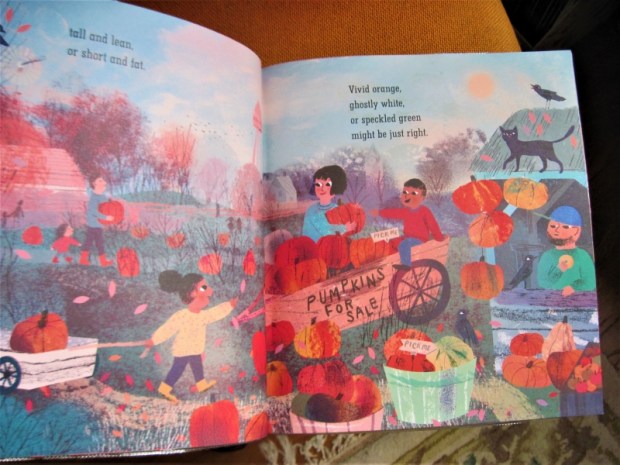
 From picking the best pumpkin at the patch to going out trick-or-treating, this is a great introduction to Halloween traditions. It even gives step-by-step instructions for carving a jack-o’-lantern. The drawing style – generally 2D, and looking like it could be part cut paper collages, with some sponge painting – reminds me of Ezra Jack Keats and most of the characters are not white, which is refreshing. There are lots of little autumnal details to pick out in the two-page spreads, with a black cat and crows on most pages and a set of twins and a mouse on some others. The rhymes are either in couplets or ABCB patterns. Perfect October reading. (Public library)
 Any super-autumnal reading for you this year?
Do you read children’s picture books and YA novels even if you (and any children) are well past that age – or is it just me?
Short Stories in September, Part II: Tove Jansson, Brandon Taylor, Eley Williams
Each September I make a special effort to read short stories, which otherwise tend to languish on my shelves and TBR unread. After my first four reviewed last week, I have another three wonderfully different collections, ranging from bittersweet children’s fantasy in translation to offbeat, wordplay-filled love notes via linked stories suffused with desire and desperation.
Tales from Moominvalley by Tove Jansson (1962; 1963)
[Trans. from the Swedish by Thomas Warburton]
 I only discovered the Moomins in my late twenties, but soon fell in love with the quirky charm of Jansson’s characters and their often melancholy musings. Her stories feel like they can be read on multiple levels, with younger readers delighting in the bizarre creations and older ones sensing the pensiveness behind their quests. There are magical events here: Moomintroll discovers a dragon small enough to be kept in a jar; laughter is enough to bring a fearful child back from literal invisibility. But what struck me more was the lessons learned by neurotic creatures. In “The Fillyjonk who believed in Disasters,” the title character fixates on her belongings—
“we are so very small and insignificant, and so are our tea cakes and carpets and all those things, you know, and still they’re important, but always they’re threatened by mercilessness…”
—but when a gale and a tornado come and sweep it all away, she experiences relief and joy:
“the strange thing was that she suddenly felt quite safe. It was a very strange feeling, and she found it indescribably nice. But what was there to worry about? The disaster had come at last.”
My other favourite was “The Hemulen who loved Silence.” After years as a fairground ticket-taker, he can’t wait to retire and get away from the crowds and the noise, but once he’s obtained his precious solitude he realizes he needs others after all. The final story, “The Fir Tree,” is a lovely Christmas one in which the Moomins, awoken midway through their winter hibernation, get caught up in seasonal stress and experience the holiday for the first time. (Public library)
Filthy Animals by Brandon Taylor (2021)
Real Life was one of my five favourite novels of 2020, and we are in parallel fictional territory here. Lionel, the protagonist in four of the 11 stories, is similar to Wallace insomuch as both are gay African Americans at a Midwestern university who become involved with a (straight?) white guy. The main difference is that Lionel has just been released from hospital after a suicide attempt. A mathematician (rather than a biochemist like Wallace), he finds numbers soothingly precise in comparison to the muddle of his thoughts and emotions.
 In the opening story, “Potluck,” he meets Charles, a dancer who’s dating Sophie, and the three of them shuffle into a kind of awkward love triangle where, as in Real Life, sex and violence are uncomfortably intertwined. It’s a recurring question in the stories, even those focused around other characters: how does tenderness relate to desire? In the throes of lust, is there room for a gentler love? The troubled teens of the title story are “always in the thick of violence. It moves through them like the Holy Ghost might.” Milton, soon to be sent to boot camp, thinks he’d like to “pry open the world, bone it, remove the ugly hardness of it all.”
Elsewhere, young adults face a cancer diagnosis (“Mass” and “What Made Them Made You”); a babysitter is alarmed by her charge’s feral tendencies (“Little Beast”); and same-sex couples renegotiate their relationships (Simon and Hartjes in “As Though That Were Love” and Sigrid and Marta in “Anne of Cleves,” one of my favourites). While the longer Lionel/Charles/Sophie stories, “Potluck” and “Proctoring,” are probably the best and a few others didn’t make much of an impression, the whole book has an icy angst that resonates. Taylor is a confident orchestrator of scenes and conversations, and the slight detachment of the prose only magnifies his characters’ longing for vulnerability (Marta says to Sigrid before they have sex for the first time: “I’m afraid I’ll mess it up. I’m afraid you’ll see me.” To which Sigrid replies, “I see you. You’re wonderful.”). (New purchase, Forum Books)
 A bonus story: “Oh, Youth” was published in Kink (2021), an anthology edited by Garth Greenwell and R.O. Kwon. I requested this from NetGalley just so I could read the stories by Carmen Maria Machado and Brandon Taylor. All of Taylor’s work feels of a piece, such that his various characters might be rubbing shoulders at a party – which is appropriate because the centrepiece of Real Life is an excruciating dinner party, Filthy Animals opens at a potluck, and “Oh, Youth” is set at a dinner party.
Grisha is here with Enid and Victor, his latest summer couple. He’s been a boytoy for hire since his architecture professor, Nate, surprised him by inviting him into his open marriage with Brigid. “His life at the time was a series of minor discomforts that accumulated like grit in a socket until rotation was no longer possible.” The liaisons are a way to fund a more luxurious lifestyle and keep himself in cigarettes.
While Real Life brought to mind Virginia Woolf, Taylor’s stories recall E.M. Forster or Thomas Mann. In other words, he’s the real deal: a blazing talent, here to stay.
Attrib. and Other Stories by Eley Williams (2017)
 After enjoying her debut novel, The Liar’s Dictionary, this time last year, I was pleased to find Williams’s first book in a charity shop last year. Her stories are brief (generally under 10 pages) and 15 of the 17 are first-person narratives, often voiced by a heartbroken character looking for the words to describe their pain or woo back a departed lover. A love of etymology is patent and, as in Ali Smith’s work, the prose is enlivened by the wordplay.
The settings range from an art gallery to a beach where a whale has washed up, and the speakers tend to have peculiar careers like an ortolan chef or a trainer of landmine-detecting rats. My favourite was probably “Synaesthete, Would Like to Meet,” whose narrator is coached through online dating by a doctor.
 I found a number of the stories too similar and thin, and it’s a shame that the hedgehog featured on the cover of the U.S. edition has to embody human carelessness in “Spines,” which is otherwise one of the standouts. But the enthusiasm and liveliness of the language were enough to win me over. (Secondhand purchase from the British Red Cross shop, Hay-on-Wye – how fun, then, to find the line “Did you know Timbuktu is twinned with Hay-on-Wye?”)
I’ll have one more set of short story reviews coming up before the end of the month, with a few other collections then spilling into October for R.I.P.
Summer 2021 Reading, Part II & Transitioning into Autumn
In the past couple of weeks, we’ve taken advantage of the last gasp of summer with some rare chances at socializing, outdoors and in. Our closest friends came to visit us last weekend and accompanied us to a beer festival held in a local field, and this weekend we’ve celebrated birthdays with a formal-wear party at a local arts venue and a low-key family meal.


After my first installment of summer reads, I’ve also finished Klara and the Sun (a bust with me, alas) and the three below: a wildlife photographer’s memoir of lockdown summer spent filming in the New Forest, a record of searching for the summer’s remnants of snow in the Highlands, and an obscure 1950s novel about the psychological connections between four characters in one Irish summer. I close with a summer-into-autumn children’s book.
Goshawk Summer: A New Forest Season Unlike Any Other by James Aldred (2021)
My second nature book about the New Forest this year (after The Circling Sky by Neil Ansell) has only sharpened my hankering to get back there and have a good wander after many years away. In March 2020, Aldred had recently returned from filming cheetahs in Kenya when the UK went into its first national lockdown. He had the good fortune to obtain authorization from Forestry England that allowed him to travel regularly from his home in Somerset to the New Forest to gather footage for a documentary for the Smithsonian channel.
 Zooming up on empty roads and staying in local cottages so he can start at 4 each morning, he marvels at the peace of a place when humans are taken out of the equation. His diary chronicles a few months of extraordinary wildlife encounters – not only with the goshawks across from whose nest he built a special treetop platform, but also with dragonflies, fox cubs, and rare birds like cuckoo and Dartford warbler. The descriptions of animal behaviour are superb, and the tone is well balanced: alongside the delight of nature watching is anger at human exploitation of the area after the reopening and despair at seemingly intractable declines – of 46 curlew pairs in the Forest, only three chicks survived that summer.
Despite the woe at nest failures and needless roadkill, Aldred is optimistic – in a similar way to Ansell – that sites like the New Forest can be a model of how light-handed management might allow animals to flourish. “I believe that a little space goes a long way and sometimes all we really need to do is take a step back to let nature do its thing. … It is nature’s ability to help itself, to survive in spite of us in fact, that gives me tentative hope”. (Unsolicited review copy)
With thanks to Elliott & Thompson for the free copy.
Among the Summer Snows by Christopher Nicholson (2017)
 After the death from cancer of his wife Kitty, a botanical illustrator, Nicholson set off for Scotland’s Cairngorms and Ben Nevis in search of patches of snow that persist into summer. “Summer snow is a miracle, a piece of out-of-season magic: to see it is one thing, to make physical contact with it is another.” His account of his travels washed over me, leaving little impression. I appreciated the accompanying colour photographs, as the landscape is otherwise somewhat difficult to picture, but even in these it is often hard to get a sense of scale. I think I expected more philosophical reflection in the vein of The Snow Leopard, and, while Nicholson does express anxiety over what happens if one day the summer snows are no more, I found the books on snow by Charlie English and Marcus Sedgwick more varied and profound. (Secondhand, gifted)
A Shower of Summer Days by May Sarton (1952)
 Although I’m more a fan of Sarton’s autobiographical material, especially her journals, I’ve also enjoyed exploring her fiction. This was my seventh of her novels. It’s set in Ireland at Dene’s Court, the grand house Violet inherited. She and her husband Charles have lived in Burma for two decades, but with the Empire on the wane they decide to settle in Violet’s childhood home. Gardening and dressing for dinner fill their languid days until word comes that Violet’s 20-year-old niece, Sally, is coming to stay.
The summer is meant to cure Sally of her infatuation with an actor named Ian. Violet reluctantly goes along with the plan because she feels so badly about the lasting rivalry with her sister, Barbara. Sally is a “bolt of life” shaking up Violet and Charles’s marriage, and when Ian, too, flies out from America, a curious love triangle is refashioned as a quadrilateral. The house remains the one constant as the characters wrestle with their emotional bonds (“the kaleidoscope of feelings was being rather violently shaken up”) and reflect on the transitory splendour of the season (“a kind of timelessness, the warm sun in the enclosed garden in the morning, the hum of bees, and the long slow twilights”). This isn’t one of my favourites from Sarton, but it has low-key charm. I saw it as being on a continuum from Virginia Woolf to Tessa Hadley (e.g. The Past) via Elizabeth Bowen. (Secondhand purchase from Awesomebooks.com)
And finally, one for the seasons’ transition:
Goodbye Summer, Hello Autumn by Kenard Pak (2016)
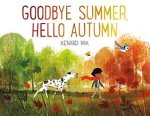 A child and dog pair set out from home, through the woods, by a river, and into town, greeting other creatures and marking the signs of the season. “Hello!” the beavers reply. “We have no time to play because we’re making cozy nests and dens. It will be cold soon, and we want to get ready.” The quaint Americana setting and papercut-style illustrations reminded me of Vermont college towns and Jon Klassen’s work. I liked the focus on nature. (Free from a neighbour)
What books are accompanying you from summer into autumn this year?
Adventures in Rereading: Madeleine L’Engle and Posy Simmonds
I’m not doing as well with my rereading goal this year as I did in 2020. So far I’ve gotten to The Republic of Love by Carol Shields and the two below (with another DNF). Considering that I completed 16 rereads last year, I’m looking seriously behind. I still have a bulging shelf of books I’d like to reread, but they never seem to make it onto my current reading stack…
A Wrinkle in Time by Madeleine L’Engle (1962)
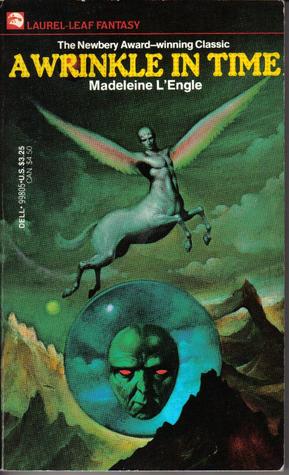 I probably picked this up at age seven or so as a natural follow-on from the Chronicles of Narnia – both are well-regarded children’s sci fi/fantasy from an author with a Christian worldview. In my memory I didn’t connect with L’Engle’s work particularly well, finding it vague and cerebral, if creative, compared to Lewis’s. I don’t think I ever went on to the multiple sequels. As an adult I’ve enjoyed L’Engle’s autobiographical and spiritual writing, especially the Crosswicks Journals, so I thought I’d give her best-known book another try.
On a proverbially dark and stormy night, Meg Murry and her precocious little brother Charles Wallace come down to the kitchen to join their mother for a snack. In blows Mrs. Whatsit with the promise of a way of rescuing their missing scientist father through a “tesseract,” or wrinkle in time. Mrs. Who and Mrs. Which, rounding out a trio of Macbeth-like witches, accompany the children and their friend Calvin on a perilous journey to face up to cosmic darkness in the form of a disembodied brain called IT that keeps their father hostage and tries to entrance Charles Wallace as well.
Interplanetary stories have never held a lot of interest for me. (As a child, I was always more drawn to talking-animal stuff.) Again I found the travels and settings hazy. It’s admirable of L’Engle to introduce kids to basic quantum physics, and famous quotations via Mrs. Who, but this all comes across as consciously intellectual rather than organic and compelling. Even the home and school talk feels dated. I most appreciated the thought of a normal – or even not very bright – child like Meg saving the day through bravery and love. This wasn’t for me, but I hope that for some kids, still, it will be pure magic.
Favorite lines:
“The only way to cope with something deadly serious is to try to treat it a little lightly.”
“we can’t take any credit for our talents. It’s how we use them that counts.”
Original rating (as remembered from childhood):
My rating now:
Tamara Drewe by Posy Simmonds (2007)
This must be one of the first graphic novels I ever read. Hearing that it was an adaptation of Thomas Hardy’s Far from the Madding Crowd, one of my favorite novels, was enough to attract me. During the years that I worked at King’s College London, I took full advantage of Lambeth Library’s extensive graphic novel collection and would pick up big piles of all sorts of books on my lunch breaks – I got a gentle ribbing from library staff nearly every time I showed up. Anyway, this is all backstory to me finding a severely underpriced secondhand copy (99p! the dear old ladies pricing things couldn’t have known what they had) in the Hay-on-Wye Oxfam shop in April 2017. It took me until earlier this year to reread it, though.
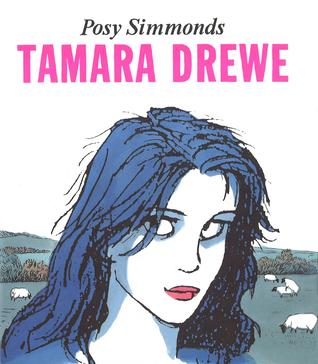 Simmonds recreates the central situation of FFTMC – an alluring young woman returns to her ancestral village and enraptures three very different men – but doesn’t stick slavishly to its plot. Her greatest innovation is in the narration. Set in and around a writers’ retreat, the novel is told in turns by Dr. Glen Larson, a (chubby, Bryson-esque) visiting American academic trying to get to grips with his novel; Beth Hardiman, who runs the retreat center and does all the admin for her philandering crime writer husband, Nicholas; and Casey Shaw, a lower-class teenager who, with her bold pal Jody, observes all the goings-on among the posh folk from the local bus shelter and later gets unexpectedly drawn in to their lives.
Tamara is a hotshot London journalist and, after a nose job, is irresistible to men. Andy Cobb, the Hardimans’ groundsman, runs a small organic food business and is a clear stand-in for Hardy’s Farmer Oak. He’s known Tamara nearly all their lives, and isn’t fussed about her new appearance and glitzy reputation. But she certainly turns Nicholas’s head, and also draws the attention of Ben, former drummer for a washed-up band. Tamara and Ben are a power couple in this sleepy village, and stir up jealousy. Ben is closest to Sergeant Troy, but he and Nicholas (who’s most like Boldwood) aren’t one-to-one equivalents. Casey and Jody fill the role of the servants and rustics, with chavs serving as the early 21st-century peasantry.
So Simmonds takes what she wants from Hardy, but adapts it as it suits her. There are a lot of words on the page compared to some graphic novels, so this would be a good halfway house for someone who’s new to comics for adults and still wants a good story to get the teeth into. At nearly 150 pages, there’s plenty of time for Simmonds to spin an involved, dramatic tale and give insight into her characters and their interactions. One ends up feeling, perhaps inevitably, more sympathy for the narrators than for the other characters, but all are well drawn. There’s a surprise ending, too. Back in 2010 I was probably more interested in getting a straight Hardy remake, so might have been disappointed when Simmonds strayed from the source material, but now I thoroughly enjoyed this for its own sake.
Original rating (2010?):
My rating now:
And a DNF:
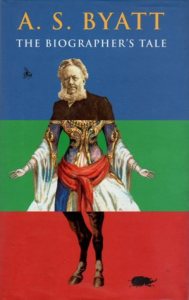 I’ve long considered A.S. Byatt a favorite author, and early last year my reread of one of her story collections was successful. But trying again with The Biographer’s Tale (2000) – which I remember reading in an airport as I traveled to or from Leeds, where I was doing a Master’s degree, to see my family for Christmas in 2005/6 – was a lost cause. I remembered an intricate, clever, witty take on the biographer’s art, but couldn’t have recited any details for you. I managed about the first 100 pages this time. Phineas G. sets out to write a biography of famous biographer Scholes Destry-Scholes, whose subjects included Francis Galton, Henrik Ibsen, and Carl Linnaeus. The novel quotes extensively from Destry-Scholes’s writing on these three, and his general notes on writing biography. I got lost somewhere in the documents. I think in my early twenties I was more impressed by virtuoso faux-scholarly writing like you often get in Byatt or Julian Barnes. Alas, it engages me less now.
Done any rereading lately?
Spring Reading 2021: Birdsong, Cherry Blossom & More
It’s been a gorgeously sunny spring here – how about where you are? Although there have still been some frosty nights troubling the gardeners among us, it’s been warm in the daytime and the flowers and blossom are coming on apace.
Recently I’ve read a couple of books reflecting on the spring of 2020, specifically the opportunities it offered to reconnect with local nature at a time when we were isolated and couldn’t travel.
I’ve also been feeling nostalgic for Washington, D.C. and the Maryland suburbs, where I grew up. It’s been two years since my last trip back, but I’m holding out hope that I can make it over in June for a family wedding.
Rounding out my selection of “Spring” titles is an offbeat Japanese novella.
Looking back to the coronavirus spring:
On Thursday evening I watched “The Act of Nature Watching,” a special Earth Day Zoom talk for West Berkshire Libraries by local nature writer Nicola Chester, whose memoir is coming out in the autumn. The UK is one of the most nature-depleted countries, she lamented. We are hardwired to watch and love nature, she noted, yet have never been more alienated from it. Reading from her columns and anthology contributions (as well as the Lovatt, below) and giving tips on recognizing birdsong and mammal signs, she spoke of nature-watching as a form of mindfulness – an approach that chimed with the first three books I feature here.
Birdsong in a Time of Silence: An Awakening by Steven Lovatt (2021)
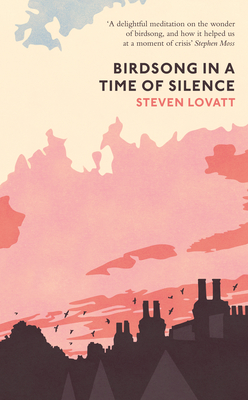 During the UK’s first lockdown, with planes grounded and cars stationary, many remarked on the quiet. All the better to hear birds going about their usual spring activities. For Lovatt, from Birmingham and now based in South Wales, it was the excuse he needed to return to his childhood birdwatching hobby. In between accounts of his spring walks, he tells lively stories of common birds’ anatomy, diet, lifecycle, migration routes, and vocalizations. (He even gives step-by-step instructions for sounding like a magpie.) Birdsong takes him back to childhood, but feels deeper than that: a cultural memory that enters into our poetry and will be lost forever if we allow our declining bird species to continue on the same trajectory.
Mentions of current events are sparse and subtle, so the spring feels timeless, as it should. I worried there might be too much overlap with A Sweet, Wild Note by Richard Smyth, but there’s room for both on your shelf. Lovatt’s writing is introspective and poetic, delighting in metaphors for sounds: “The song of a turtle dove is like the aural equivalent of a heat-haze, the gentlest corrugation of air, always just on the edge of your hearing.”
Skylarks with Rosie: A Somerset Spring by Stephen Moss (2021)
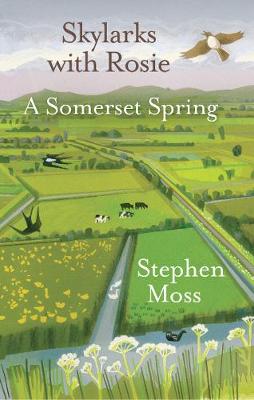 Lovatt must have been a pupil of Moss’s on the Bath Spa University MA degree in Travel and Nature Writing. The prolific Moss’s latest also reflects on the spring of 2020, but in a more overt diary format. Devoting one chapter to each of the 13 weeks of the first lockdown, he traces the season’s development alongside his family’s experiences and the national news. With four of his children at home, along with one of their partners and a convalescing friend, it’s a pleasingly full house. There are daily cycles or walks around “the loop,” a three-mile circuit from their front door, often with Rosie the Labrador; there are also jaunts to corners of the nearby Avalon Marshes. Nature also comes to him, with songbirds in the garden hedges and various birds of prey flying over during their 11:00 coffee breaks.
His speaking engagements and trips cancelled, Moss turns to online events instead. Twitter serves as a place for sharing outrage over UK politics and world events like George Floyd’s murder, but also as a welcoming community for sharing nature sightings. As the lockdown come to a close, he realizes that this time has had unexpected benefits: “Having to press the pause button … has made me rethink my life, in a good way.” He feels that, for once, he has truly appreciated the spring, “rediscovering the joys of wildlife-watching close to home”. This made for perfect reading in Somerset last week.
Also recommended: The Consolation of Nature by Marren, McCarthy and Mynott
Remembering springs back home:
Spring in Washington by Louis J. Halle (1947)
“The discovery of spring each year, after the winter’s hibernation, is like a rediscovery of the universe … knowledge of spring gives me the freedom of the world.”
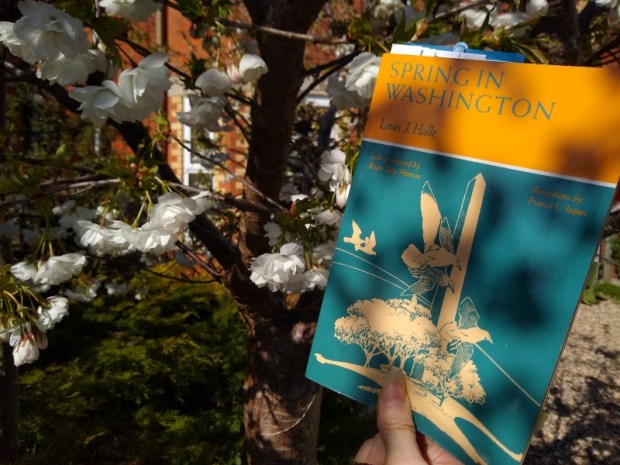 For Halle, who worked in the State Department, nature was an antidote to hours spent shuffling papers behind a desk. In this spring of 1945, there was plenty of wildfowl to see in central D.C. itself, but he also took long early morning bike rides along the Potomac or the C&O Canal, or in Rock Creek Park. From first migrant in February to last in June, he traces the spring mostly through the birds that he sees. More so than the specific observations of familiar places, though, I valued the philosophical outlook that makes Halle a forerunner of writers like Barry Lopez and Peter Matthiessen. He notes that those caught up in the rat race adapt the world to their comfort and convenience, prizing technology and manmade tidiness over natural wonders. By contrast, he feels he sees more clearly – literally as well as metaphorically – when he takes the long view of a landscape.
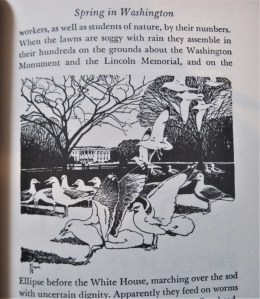 I marked so many passages of beautiful description. Halle had mastered the art of noticing. But he also sounds a premonitory note, one that was ahead of its time in the 1940s and needs heeding now more than ever: “When I see men able to pass by such a shining and miraculous thing as this Cape May warbler, the very distillate of life, and then marvel at the internal-combustion engine, I think we had all better make ourselves ready for another Flood.”
This was a lucky find at Hay Cinema Bookshop back in September. For me it was the ideal combination of thoughtful prose and vicarious travel, though I imagine it might not mean as much to those without a local connection. The black-and-white in-text illustrations by Francis L. Jaques are a particularly nice addition. 
Pussy cat, pussy cat, where have you been? I’ve been to Washington, and guess what I’ve seen… by Russell Punter and Dan Taylor (2019)
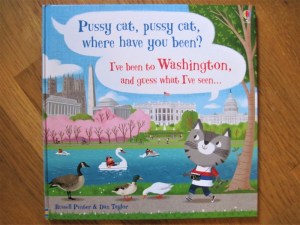 More cherry blossoms over tourist landmarks! This is part of a children’s series inspired by the 1805 English rhyme about London; other volumes visit New York City, Paris, and Rome. In rhyming couplets, he takes us from the White House to the Lincoln Memorial via all the other key sights of the Mall and further afield: museums and monuments, the Library of Congress, the National Cathedral, Arlington Cemetery, even somewhere I’ve never been – Theodore Roosevelt Island. Realism and whimsy (a kid-sized cat) together; lots of diversity in the crowd scenes. What’s not to like? (Titled Kitty cat, kitty cat… in the USA.)
And, as a bonus, some fiction in translation:
Spring Garden by Tomoka Shibasaki (2014; 2017)
[Translated from the Japanese by Polly Barton]
 Like a Murakami protagonist, Taro is a divorced man in his thirties, mildly interested in the sometimes peculiar goings-on in his vicinity. Rumor has it that his Tokyo apartment complex will be torn down soon, but for now the PR manager is happy enough here. “Avoiding bother was Taro’s governing principle.” But bother comes to find him in the form of a neighbor, Nishi, who is obsessed with a nearby house that was the backdrop for the art book Spring Garden, a collection of photographs of a married couple’s life. Her enthusiasm gradually draws Taro into the depicted existence of the TV commercial director and actress who lived there 25 years ago, as well as the young family who live there now. This Akutagawa Prize winner failed to hold my interest – like The Guest Cat, it’s oddly preoccupied with architectural detail, a Japanese fascination that doesn’t translate so well.
Have you been reading anything particularly appropriate for spring this year?
The 1936 Club: Murder in the Cathedral and Ballet Shoes
It’s my third time participating in one of Simon and Karen’s reading weeks (after last year’s 1920 Club and 1956 Club). Like last time, I made things easy for myself by choosing two classics of novella length – as opposed to South Riding, another 1936 book on my shelves. They also both happen to be theatrical in nature.
Murder in the Cathedral by T.S. Eliot
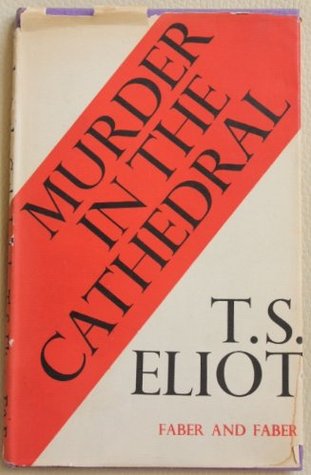 At about the time her memoir came out, I remember Jeanette Winterson describing this as her gateway drug into literature: she went to the library and picked it out for her mother, thinking it was just another murder mystery, and ended up devouring it herself. It is in fact a play about the assassination of Thomas à Becket, a medieval archbishop of Canterbury. The last time I read a play was probably eight years ago, when I was on an Alan Ayckbourn kick; before that, I likely hadn’t read one since my college Shakespeare class. And indeed, this wasn’t dissimilar to Shakespeare’s histories (or tragedies) in content and tone. It is mostly in verse, with some rhyming couplets, offset by a couple of long prose passages.
I struggled mostly because of complete unfamiliarity with the context, though some liberal Googling would probably be enough to set anyone straight. The action takes place in December 1170 and is in two long acts, separated by an interlude in which Thomas gives a Christmas sermon. The main characters besides Thomas are three priests who try to protect him and a chorus of local women who lament his fate. In Part I there are four tempters who, like Satan to Jesus in the desert, come to taunt Thomas with the lure of political power – upon being named archbishop, he resigned his chancellorship. The four knights, who replace the tempters in Part II and ultimately kill Thomas, feel that he betrayed King Henry and the nation by not keeping both roles and thus linking Church and state.
Most extraordinary is the knights’ prose defence late in the second act, in which they claim to have been completely “disinterested” in killing Thomas and that it was his own fault – to the extent that his death might as well be deemed a suicide. I always appreciate a first-person plural chorus, and I love Eliot’s poetry in general: there are some of his lines I keep almost as mantras, and more I read nearly 20 years ago that still resonate. I expected notable quotes here, but there were no familiar lines. As usually is the case with plays, this probably works better on stage. A nice touch was that my 1938 Faber copy, acquired from the free bookshop we used to have in our local mall, was owned by two fellows of St. Chad’s College, Durham, whose names appear one after the other in blue ink on the flyleaf. One of them added in marginal notes relating to how the play was performed by the Pilgrim Players in March 1941.
My rating:
Ballet Shoes by Noel Streatfeild
I was glad to have an excuse to read this beloved children’s classic. Like many older books and films geared towards children, it’s a realistic fantasy about orphans finding affection and success. Great-Uncle Matthew (“Gum”) goes hunting for fossils around the world and has a peculiar habit of finding unwanted babies that are to be raised by his niece, Sylvia (“Garnie”), and a nursemaid, Nana. He names the three girls he has magically acquired Pauline, Petrova, and Posy, and gifts them all the surname Fossil. When Gum goes back out on his travels, the money soon runs out and the girls’ schooling takes a backseat to the need for money. Sylvia takes in lodgers and the girls are accepted to attend a dance and theatre academy for free.
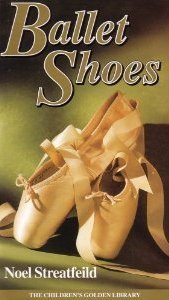 Every year, the sisters vow to do all they can to get the Fossil name in history books – and this on their own merit, not based on anything their (unknown) ancestors have done – and to get as much household money for Garnie as possible. Pauline is a gifted actress and Posy a talented dancer, but Petrova knows the performing world is not for her; she’d rather learn about how machines work, and operate cars and airplanes. While beautiful blonde Pauline plays the lead role in Alice in Wonderland and one of the princes in Richard III, Petrova is happy to stay in the background as a fairy or a page in Shakespeare productions.
I found the social history particularly interesting here. The family seems upper class by nature, yet a lack of money means they find it a challenge to keep the girls in an appropriate wardrobe. There is much counting of guineas and shillings, with Pauline the chief household earner. Acting in plays and films is no mere hobby for her. The same goes for Winifred, who auditions opposite Pauline for Alice but doesn’t get the part – even though she is the better actress and needs the money to care for her ill father and five younger siblings – because she’s not as pretty. Pauline and Petrova also notice that child actors with cockney accents don’t get picked for the best roles. The Fossils sometimes feel compassion for those children worse off than themselves, but at other times let their achievements go to their heads.
At a certain point, I wearied of the recurring money, wardrobe, and audition issues, but I still found this a charming book about how luck and skill combine as girls dream about who they want to be when they grow up. There are also some cosy and witty turns of phrase, like “She was in that state of having a cold when nothing is very nice to do … she felt hot, and not very much like eating toffee, and what is the fun of making toffee unless you want to eat it.” I daresay if I had encountered this at age seven instead of 37, it would have been a favourite.
My rating:
Snow and Winter Reads, Part II
Since I wrote about my first batch of wintry reads in early February, it’s turned much more spring-like here in southern England, with blue skies and the daffodils blooming. Still, temperatures continue chilly and some nights I’ve had trouble falling asleep because of the wind tearing down the street and flapping the bin lids. With meteorological spring due to start tomorrow, I’m bidding farewell to winter with a few more snow-covered reads: a children’s classic, a modern classic from the 1990s, and an implausible but enjoyably rollicking thriller.
The Wolves of Willoughby Chase by Joan Aiken (1962)
 Aiken’s books were not part of my childhood, but I was vaguely aware of this first book in a long series when I plucked it from a neighbor’s giveaway pile. The snowy scene on the cover and described in the first two paragraphs drew me in and the story, a Victorian-set fantasy with notes of Oliver Twist and Jane Eyre, soon did, too. In this alternative version of the 1830s, Britain already had an extensive railway network and wolves regularly used the Channel Tunnel (which did not actually open until 1994) to escape the Continent’s brutal winters for somewhat milder climes.
One winter, the orphaned Sylvia travels by train from London to the north of England to live with her cousin Bonnie and her parents, Sir Willoughby and Lady Green. But dodgy things are afoot at Willoughby Chase: Miss Slighcarp, a distant cousin, has been hired as the girls’ governess but, just as soon as Bonnie’s parents leave on a long trip, she sets about taking over the house. Bonnie and Sylvia, exiled to a workhouse, rely on a secret network of friends and servants to keep them safe and get them home via an intrepid journey.
Miss Slighcarp is just one of the novel’s Dickensian villains – balanced out by some equally Dickensian urchins and helpful adults, all of them with hearts of gold. There’s something perversely cozy about the plight of an orphan in children’s books: the characters call to the lonely child in all of us, and we rejoice to see how ingenuity and luck come together to defeat wickedness. There are charming passages here in which familiar smells and favorite foods offer comfort. I especially loved their friend Simon’s cave and his little rituals. This would make a perfect stepping stone from Roald Dahl to one of the actual Victorian classics.
My only quibble with the book overall would be that the wolves seem unnecessary: they only truly appear once, for a climactic scene during the train ride, and the rest of the time are just a background menace. From fairy tales onwards, wolves have gotten a bad rap, and we don’t need to perpetuate myths about how dangerous they are to humans.
Snow Falling on Cedars by David Guterson (1994)
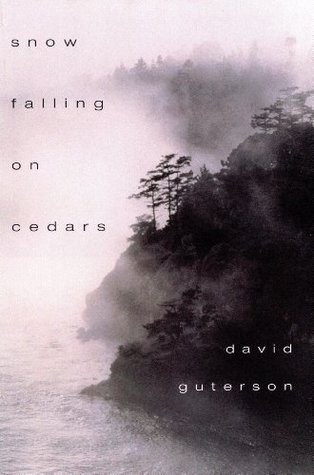 My first 5-star read of the year! It certainly took a while, but I’m now on a roll with a bunch of 4.5- and 5-star ratings bunching together. I remember the buzz surrounding this novel, mostly because of the Ethan Hawke film version that came out when I was a teenager. Even though I didn’t see it, I was aware of it, as I was of other literary fiction that got turned into Oscar-worthy films at about that time, like The Shipping News and House of Sand and Fog.
The novel is set in 1954 on San Piedro, an island of 5,000 off the coast of Washington state. A decade on from the war, the community’s chickens come home to roost when a Japanese American man, Kabuo Miyamoto, is charged with murdering a fellow fisherman, Carl Heine. The men had been engaged in a dispute over some land – seven acres of strawberry fields that were seized from the Miyamoto family when, like the rest of the country’s Japanese population, they were rounded up in internment camps. Meanwhile, Ishmael Chambers, who runs the local newspaper and lost an arm in the war, stumbles on a piece of evidence that might turn the case around. Still in love with Hatsue, now Kabuo’s wife but once his teenage obsession, he is torn between winning her back and wanting to do what’s right.
Guterson alternates between trial scenes and flashbacks to war service or stolen afternoons Ishmael and Hatsue spent kissing in the shelter of massive cedar trees. The mystery element held me completely gripped – readers are just as in the dark as the jurors until very close to the end – but this is mostly a powerful picture of the lasting effects of racism. All the characters are well drawn, even minor ones like elderly defense attorney Nels Gudmundsson. Even though I only read 10 or 15 pages at a sitting over the course of a month, every time I picked up the book I was instantly immersed in the atmosphere, whether it was a warm courtroom with a snowstorm swirling outside or a troop ship entering the Pacific Theater. This has the epic feel of a doorstopper, though it’s only 400 pages. I can’t recommend it highly enough.
The Quality of Silence by Rosamund Lupton (2015)
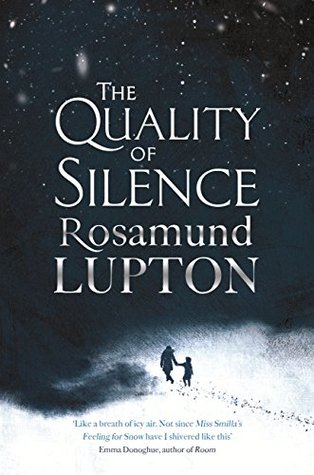 Ten-year-old Ruby and her mother Yasmin have arrived in Alaska to visit Ruby’s dad, Matt, who makes nature documentaries. When they arrive, police inform them that the town where he was living has been destroyed by fire and he is presumed dead. But Yasmin won’t believe it and they set out on a 500-mile journey north to find her husband, first hitching a ride with a trucker and then going it alone in a stolen vehicle. All the time, with the weather increasingly brutal, they’re aware of someone following them – someone with malicious intent.
The narration is in short segments, alternating between Ruby’s first person and a third-person account from Yasmin’s point-of-view. There are many interesting elements here: Ruby is deaf so communicates via a combination of sign language, voice recognition software, blogs and social media, and describes things synesthetically; Yasmin is a physicist drawing metaphors to scientific concepts, but can’t explain her own mystical certainty that Matt is still alive; and there is an environmentalist message behind the fracking cover-up plot.
But starting with the first page, there are so many improbabilities in play, from a 10-year-old having a Twitter account to Yasmin managing to drive a big rig on ice roads in a foreign country. I knew from reviewing Three Hours last year that Lupton writes addictive thrillers. This one was perfectly readable, but not as good. It’s our book club read for early March, and I expect I won’t be the only one to find it hardly believable.
Plus a skim:
Arctic Dreams by Barry Lopez (1986)
 This was my first time trying the late Lopez. It was supposed to be a buddy read with my husband because we ended up with two free copies, but he raced ahead while I limped along just a few pages at a time before admitting defeat and skimming to the end (it was the 20 pages on musk oxen that really did me in). For me, the reading experience was most akin to The Snow Leopard by Peter Matthiessen in that both are about a literal journey in an extreme environment, yet what stands out are the philosophical musings. Where Matthiessen was animated by Buddhist ideas about selfhood and loss, Lopez takes the secular long view of human life and responsibility in light of potential extinction. The epilogue, in particular, is endlessly quotable. It’s depressing to encounter books like this now, though: 30+ years ago, literary nature writers were issuing clarion calls about climate disaster, and we didn’t listen.
Some favorite passages:
“Whenever I met a collared lemming on a summer day and took its stare I would think: Here is a tough animal. Here is a valuable life. … If it could tell me of its will to survive, would I think of biochemistry, or would I think of the analogous human desire? If it could speak of the time since the retreat of the ice, would I have the patience to listen?”
“The cold view to take of our future is that we are therefore headed for extinction in a universe of impersonal chemical, physical, and biological laws. A more productive, certainly more engaging view, is that we have the intelligence to grasp what is happening, the composure not to be intimidated by its complexity, and the courage to take steps that may bear no fruit in our lifetimes.”
“One of the oldest dreams of mankind is to find a dignity that might include all living things. And one of the greatest of human longings must be to bring such dignity to one’s own dreams, for each to find his or her own life exemplary in some way. The struggle to do this is a struggle because an adult sensibility must find some way to include all the dark threads of life. A way to do this is to pay attention to what occurs in a land not touched by human schemes, where an original order prevails.”
 Bookish Beck = Rebecca Foster. American transplant to England. Freelance proofreader and book reviewer.
 Bookish Beck