The BBC National Short Story Award 2025 Anthology
Another quick contribution to #ShortStorySeptember. I was delighted when Comma Press sent me a surprise copy of The BBC National Short Story Award 2025, which prints the five stories shortlisted for this year’s prize.
Now in its 20th year, the award has recognised established authors and newcomers alike – the roster of winners includes Lucy Caldwell, Sarah Hall (twice), Cynan Jones, James Lasdun, KJ Orr, Ingrid Persaud, Ross Raisin, Lionel Shriver and Naomi Wood – and the £15,000 prize money is very generous indeed for a single story.
This very evening, the winner will be announced live on the BBC Radio 4 Front Row programme (it starts at 7:15 p.m. if you’re in the UK). I’ll update my post later with news of the winner. For now, here are my brief thoughts on the five stories and which I hope will win.
“You Cannot Thread a Moving Needle” is an excerpt from Colwill Brown’s linked short story collection, We Pretty Pieces of Flesh. It’s in broad Doncaster dialect and written in the second person, thus putting the reader into the position of a young woman who is often pressured – by men and by the prevailing standards of beauty – into uncomfortable situations. It’s all drinking and sex and feeling in competition with other girls. ‘You’ grow up limited and bitter and wondering if revenge is possible. This was admirable for its gritty realism but not pleasant per se, and convinced me I don’t want to read the whole book.
“Little Green Man” by Edward Hogan begins with a classic scenario of two very different people being thrown together. Carrie stands out not just for being nearly six feet tall but also for being the only woman working for Parks and Gardens in Derby. One morning she’s assigned a temporary apprentice, Ryan, who is half her age and might be dismissed with one look as being no good (“lines shaved into his eyebrows … dyed blond hair” and a baby at home). But their interactions go beyond stereotypes as we learn of Ryan’s ambitions and his disapproving dad; and of Carrie’s ex, Bridget, who wanted more spontaneity. It’s a solid, feel-good story about not making your mind up about people, in the vein of Groundskeeping.

“Yair” by Emily Abdeni-Holman is another two-character drama, with the title figure an Israeli estate agent who takes the female narrator looking for an apartment in Jerusalem in 2018. Sexual tension and conflicting preconceived notions are crackling between them. A simple story with an autofiction feel, it reminded me of writing by Sigrid Nunez and Elizabeth Strout and exposes the falsity of facile us-and-them distinctions.
“Two Hands” by Caoilinn Hughes is a three-player comedy starring a married couple and their driving instructor. After a motorway crash in the beloved Fiat Panda they brought with them from Italy when they moved back to Ireland, Desmond and Gemma are in need of some renewed confidence behind the wheel. They talk about work – Des’s ancient archaeology research, Gemma’s translations – but not about the accident, which clearly is still affecting them both. Meanwhile, their late-seventies instructor is a War and Peace-reading calm presence whose compassion stretches only so far. I found this sharp, witty and original, just like Hughes’s Orchid & the Wasp.
Last but not least, “Rain: a history” by Andrew Miller is set in a sodden near-future English village. The protagonist has been having heart trouble and failing to connect with his traumatized teenage son. Nothing in his house or on his person ever feels dry. Their surroundings are menacing and desolate, yet still somehow beautiful. A letter came through the door last week, inviting everyone to meet in the parish church this evening. What can be done? Perhaps solidarity is as much as they, and we, can hope for. This was spare and haunting, and so much better than The Land in Winter.
I thoroughly enjoyed reading these entries and wouldn’t mind four out of the five winning. My sense of the spirit of the award is that it should go to a stand-alone story by an up-and-coming author. It’s hard to say what judges William Boyd, Lucy Caldwell, Ross Raisin, Kamila Shamsie and Di Speirs will go for: realism, novelty, subtlety, humour or prophecy? My personal favourite was “Yair,” but I have an inkling the award might go to Caoilinn Hughes and I would be very happy with that result as well.
With thanks to Comma Press for the free copy for review.
UPDATE: The winner was … the story I enjoyed the least, “You Cannot Thread a Moving Needle.” Nonetheless, I acknowledge that Colwill Brown has a distinctive voice.
20 Books of Summer, 9–10: Leave the World Behind & Leaving Atlanta
Halfway there! And I’m doing better than it might appear in that I’m in the middle of another 7 books and just have to decide what the final 3 will be. This was a sobering but satisfying pair of novels in which race and class play a part but the characters are ultimately helpless in the face of disasters and violence. Both: 
Leave the World Behind by Rumaan Alam (2020)
The title heralds a perfect holiday read, right? A New York City couple, Amanda and Clay, have rented a secluded vacation home in Long Island with their teenagers, Archie and Rose, and plan on a week of great beach weather and mild hedonism: food, drink, secret cigarettes, a hot tub, maybe some sex. But late on the first night there’s a knock on the door from the owners, sixtysomething Black couple Ruth and G. H. Something is going on; although the house still has power, all phone and Internet services have gone down. Rather than return to a potentially chaotic city, the older couple set course for their country retreat to hunker down. George is in finance and believes money solves everything, so he offers Amanda and Clay $1000 cash for the inconvenience of having their holiday interrupted.
 From an amassing herd of deer to Archie’s sudden mystery illness, everything quickly turns odd. Glimpses of what’s happening in the wider world are surrounded by a menacing haziness, but the events seem to embody modern anxieties about being cut off from information and wondering who to trust. Given the blurbs and initial foreshadowing, I expected racial tension to be a main driver of an incendiary household climax. Instead, the threat is external and largely unexplained, and the couples are forced to rely on each other as tribalism sets in. (It’s uncanny that this was written before Covid, published during.)
This was a book club read and one of the most divisive I can remember. I was among the few who thought it gripping, intriguing, and even genuinely frightening. Others found the characters unlikable, the plot implausible or silly, and the writing heavy-handed. Alam is definitely poking fun at privileged bougie families. He draws attention to the author as puppet-master, inserting shrewd hints of what is occurring elsewhere or will soon befall certain characters. Some passages skirt pomposity with their anaphora and rhetorical questioning. Alliteration, repetition, and stark pronouncements make the prose almost baroque in places. Alam’s style is theatrical, even arch, but it suits the premonitory tone. I admired how he constantly upends genre expectations, moving from literary fiction to domestic drama to dystopia to magic realism to horror. The stuff of nightmares – being naked in front of strangers, one’s teeth falling out – becomes real, or at least real in the world of the book. The reminder is that we are never as in control as we think we are; always, disasters are unfolding. What will we do, and who will we be, as the inevitable unfolds?
You demanded answers, but the universe refused. Comfort and safety were just an illusion. Money meant nothing. All that meant anything was this—people, in the same place, together. This was what was left to them.
Absorbing, timely, controversial: read it! (Free from a neighbour)
Leaving Atlanta by Tayari Jones (2002)
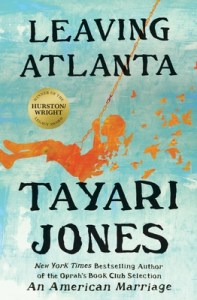 Jones’s debut novel is about the Atlanta Child Murders, a real-life serial killer spree that targeted 29 African American children between 1979 and 1982. (Two of the victims attended her elementary school.) Rather than addressing the gruesome reality, however, she takes a sideways look by considering the effect that fear has on students whose classmates start disappearing. Three sections rather like linked novellas take on the perspective of three different Oglethorpe Elementary fifth graders: LaTasha Baxter, Rodney Green, and Octavia Harrison. The POV moves from third to second to first person, a creative writing experiment that succeeds at pulling readers closer in. The AAVE-inflected dialogue and interactions feel genuine in each, and I liked the playful addition of “Tayari Jones” as a fringe character.
Even as their school is making news headlines, the children’s concerns are perennial adolescent ones: how to avoid bullying, who to sit with at lunch, how to be friendly yet not falsely encourage members of the opposite sex. And at home, all three struggle with an absent or overbearing father. At age 11, these kids are just starting to realize that their parents aren’t perfect and might not be able to keep them safe. I especially warmed to Octavia’s voice, even as her story made my heart ache: “cussing at myself for being too stupid to see that nothing lasts. That people get away from you like a handful of sweet smoke.” I preferred this offbeat, tender coming-of-age novel to Silver Sparrow and would place it on a par with An American Marriage. (Birthday gift from my wish list)
May Releases, Part II (Fiction): Le Blevennec, Lynch, Puchner, Stanley, Ullmann, and Wald
A cornucopia of May novels, ranging from novella to doorstopper and from Montana to Tunisia; less of a spread in time: only the 1980s to now. Just a paragraph on each to keep things simple. I’ll catch up soon with May nonfiction and poetry releases I read.
Friends and Lovers by Nolwenn Le Blevennec (2023; 2025)
[Translated from French by Madeleine Rogers]
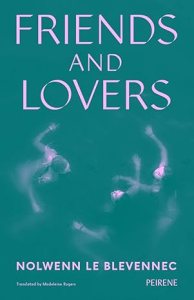 Armelle, Rim, and Anna are best friends – the first two since childhood. They formed a trio a decade or so ago when they worked on the same magazine. Now in their mid-thirties, partnered and with children, they’re all gripped by a sexual “great awakening” and long to escape Paris and their domestic commitments – “we went through it, this mutiny, like three sisters,” poised to blow up the “perfectly executed choreography of work, relationships, children”. The friends travel to Tunisia together in December 2014, then several years later take a completely different holiday: a disaster-prone stay in a lighthouse-keeper’s cottage on an island off the coast of Brittany. They used to tolerate each other’s foibles and infidelities, but now resentment has sprouted up, especially as Armelle (the narrator) is writing a screenplay about female friendship that’s clearly inspired by Rim and Anna. Armelle is relatably neurotic (a hilarious French blurb for the author’s previous novel is not wrong: “Woody Allen meets Annie Ernaux”) and this is wise about intimacy and duplicity, yet I never felt invested in any of the three women or sufficiently knowledgeable about their lives.
With thanks to Peirene Press for the free copy for review.
A Family Matter by Claire Lynch
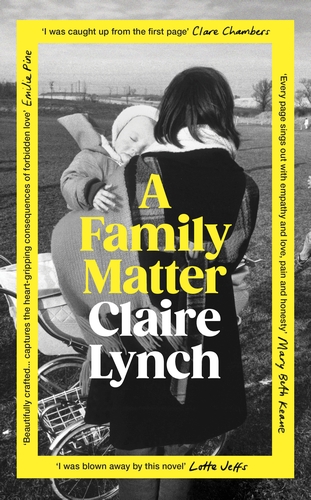 “The fluke of being born at a slightly different time, or in a slightly different place, all that might gift you or cost you.” At events for Small, Lynch’s terrific memoir about how she and her wife had children, women would speak up about how different their experience had been. Lesbians born just 10 or 20 years earlier didn’t have the same options. Often, they were in heterosexual marriages because that’s all they knew to do; certainly the only way they thought they could become mothers. In her research into divorce cases in the UK in the 1980s, Lynch learned that 90% of lesbian mothers lost custody of their children. Her aim with this earnest, delicate debut novel, which bounces between 2022 and 1982, is to imagine such a situation through close portraits of Heron, an ageing man with terminal cancer; his daughter, Maggie, who in her early forties bears responsibility for him and her own children; and Dawn, who loved Maggie desperately but felt when she met Hazel that she was “alive at last, at twenty-three.” How heartbreaking that Maggie knew only that her mother abandoned her when she was little; not until she comes across legal documents and newspaper clippings does she understand the circumstances. Lynch made the wise decision to invite sympathy for Heron from the start, so he doesn’t become the easy villain of the piece. Her compassion, and thus ours, is equal for all three characters. This confident, tender story of changing mores and steadfast love is the new Carol for our times. (Such a lovely but low-key novel was liable to make few ripples, so I’m delighted for Lynch that the U.S. release got a Read with Jenna endorsement.)
With thanks to Chatto & Windus (Penguin) for the proof copy for review.
Dream State by Eric Puchner
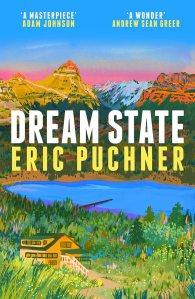 If it starts and ends with a wedding, it must be a comedy. If much of the in between is marked by heartbreak, betrayal, failure, and loss, it must be a tragedy. If it stretches towards 2050 and imagines a Western USA smothered in smoke from near-constant forest fires, it must be an environmental dystopian. Somehow, this novel is all three. The first 163 pages are pure delight: a glistening romantic comedy about the chaos surrounding Charlie and Cece’s wedding at his family’s Montana lake house in the summer of 2004. First half the wedding party falls ill with norovirus, then Charlie’s best friend, Garrett (who’s also the officiant), falls in love with the bride. Do I sound shallow if I admit this was the section I enjoyed the most? The rest of this Oprah’s Book Club doorstopper examines the fallout of this uneasy love triangle. Charlie is an anaesthesiologist, Cece a bookstore owner, and Garrett a wolverine researcher in Glacier National Park, which is steadily losing its wolverines and its glaciers. The next generation comes of age in a diminished world, turning to acting or addiction. There are still plenty of lighter moments: funny set-pieces, warm family interactions, private jokes and quirky descriptions. But this feels like an appropriately grown-up vision of idealism ceding to a reality we all must face. I struggled with a lack of engagement with the children, but loved Puchner’s writing so much on the sentence level that I will certainly seek out more of his work. Imagine this as a cross between Jonathan Franzen and Maggie Shipstead.
With thanks to Sceptre (Hodder) for the proof copy for review.
Consider Yourself Kissed by Jessica Stanley
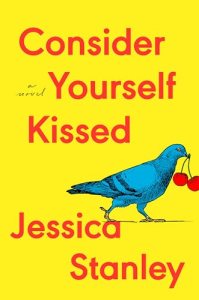 Coralie is nearing 30 when her ad agency job transfers her from Australia to London in 2013. Within a few pages, she meets Adam when she rescues his four-year-old, Zora, from a lake. That Adam and Coralie will be together is never really in question. But over the next decade of personal and political events, we wonder whether they have staying power – and whether Coralie, a would-be writer, will lose herself in soul-destroying work and motherhood. Adam’s job as a political journalist and biographer means close coverage of each UK election and referendum. As I’ve thought about some recent Jonathan Coe novels: These events were so depressing to live through, who would want to relive them through fiction? I also found this overlong and drowning in exclamation points. Still, it’s so likable, what with Coralie’s love of literature (the title is from The Group) and adjustment to expat life without her mother; and secondary characters such as Coralie’s brother Daniel and his husband, Adam’s prickly mother and her wife, and the mums Coralie meets through NCT classes. Best of all, though, is her relationship with Zora. This falls solidly between literary fiction and popular/women’s fiction. Given that I was expecting a lighter romance-led read, it surprised me with its depth. It may well be for you if you’re a fan of Meg Mason and David Nicholls.
With thanks to Hutchinson Heinemann for the proof copy for review.
Girl, 1983 by Linn Ullmann (2021; 2025)
[Translated from Norwegian by Martin Aitken]
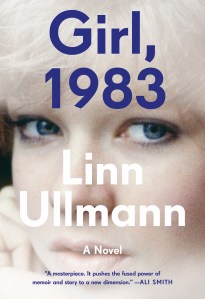 Ullmann is the daughter of actress Liv Ullmann and film director Ingmar Bergman. That pedigree perhaps accounts for why she got the opportunity to travel to Paris in the winter of 1983 to model for a renowned photographer. She was 16 at the time and spent the whole trip disoriented: cold, hungry, lost. Unable to retrace the way to her hotel and wearing a blue coat and red hat, she went to the only address she knew – that of the photographer, K, who was in his mid-forties. Their sexual relationship is short-lived and unsurprising, at least in these days of #MeToo revelations. Its specifics would barely fill a page, yet the novel loops around and through the affair for more than 250. Ullmann mostly pulls this off thanks to the language of retrospection. She splits herself both psychically and chronologically. There’s a “you” she keeps addressing, a childhood imaginary friend who morphs into a critical voice of conscience and then the self dissociated from trauma. And there’s the 55-year-old writer looking back with empathy yet still suffering the effects. The repetition made this something of a sombre slog, though. It slots into a feminist autofiction tradition but is not among my favourite examples.
With thanks to Hamish Hamilton (Penguin) for the proof copy for review.
The Bayrose Files by Diane Wald
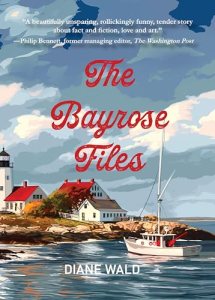 In the 1980s, Boston journalist Violet Maris infiltrates the Provincetown Home for Artists and Writers, intending to write a juicy insider’s exposé of what goes on at this artists’ colony. But to get there she has to commit a deception. Her gay friend Spencer Bayrose has a whole sheaf of unpublished short stories drawing on his Louisiana upbringing, and he offers to let her submit them as her own work to get a place at PHAW. Here Violet finds eccentrics aplenty, and even romance, but when news comes that Spence has AIDS, she has to decide how far she’ll go for a story and what she owes her friend. At barely over 100 pages, this feels more like a long short story, one with a promising setting and a sound plot arc, but not enough time to get to know or particularly care about the characters. I was reminded of books I’ve read by Julia Glass and Sara Maitland. It’s offbeat and good-natured but not top tier.
Published by Regal House Publishing. With thanks to publicist Jackie Karneth of Books Forward for the advanced e-copy for review.
A Family Matter was the best of the bunch for me, followed closely by Dream State.
Which of these do you fancy reading?
May Graphic Novels by Alison Bechdel, Peter Kuper & Craig Thompson
May has been chock-full of new releases for me! For this first batch of reviews, I’m featuring three fantastic graphic novels that have made it onto my Best of 2025 (so far) list. I don’t read graphic books as often as I’d like to – my library tends to major on superhero comics and manga, which aren’t my cup of tea – but I sometimes get a chance to access them for paid review purposes. (The first two below are ones I was sent for potential Shelf Awareness reviews, but I missed the deadlines.) Reading these took me back to the early 2010s when I worked for a university library in South London and would walk to Lambeth Library on my lunch breaks to borrow huge piles of books, mostly taking advantage of their excellent graphic novel selection. That was where my education and fascination began.
Spent: A Comic Novel by Alison Bechdel
 I’ve read all but one of Bechdel’s works now. Fun Home was among the first graphic books I read and is a great choice if you’re new to this form of storytelling. It’s a family memoir about her father’s funeral home business and closeted lifestyle, which emerged shortly after her own coming-out – and shortly before his accidental death. In Spent, Alison and her handy wife Holly live on a Vermont pygmy goat farm. Alison has writer’s block and is struggling financially despite her famous memoir about her taxidermist father having been made into a successful TV series, Death & Taxidermy. Mostly, she’s consumed with anxiety about the state of the world, what with the ongoing pandemic, her sister’s right-wing opinions, and the litany of awful headlines. “Who can draw when the world is burning?” she exclaims.
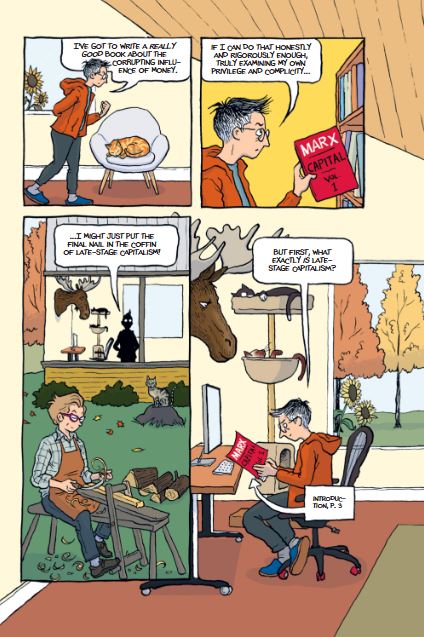
Then Alison has an idea for a book – or maybe a reality TV series – called $UM that will wean people off of capitalism. That creative journey is mirrored in Spent, which is composed of 12 “episodes” titled after Marxist terminology. Through Alison’s ageing hippie friends and their kids, Bechdel showcases alternative ways of living: a commune, a throuple, nonbinary identity, unpaid internships, Just Stop Oil demos, and the influencer lifestyle versus rejection of technology. It’s (auto)fiction exaggerated to the brink of absurdity, with details changed enough to mock but not enough to hide (e.g., she’s published by “Megalopub,” the hardware store is “Home Despot,” her show airs on “Schmamazon”).

Tiny details in the drawings reward close attention, such as Alison and Holly’s five cats’ antics during their morning routine, and a stuffed moose head rolling its eyes. It’s the funniest I can remember Bechdel being, with much broad humour derived from the outrageous screen mangling of her book – cannibalism, volcanoes and dragons come out of nowhere – and her middle-class friends’ hand-wringing over their liberal credentials. Even the throwaway phrases are hilarious. It’s a gleeful and zeitgeist-y satire, yet draws to a touching close as Alison has the epiphany that she can’t fix everything herself so must simply do what she can, “with a little help from her annoying, tender-hearted, and utterly luminous friends.”
Accessed as an e-book from Mariner Books. Published in the UK by Jonathan Cape (Penguin).
Insectopolis: A Natural History by Peter Kuper
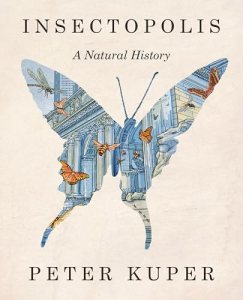 Nearly a decade ago, I reviewed Peter Kuper’s Ruins, which features monarch migration and has as protagonist a laid-off Natural History Museum entomologist. Here insects have even more of a starring role. The E. O. Wilson epigraph sets the stage: “If all mankind were to disappear, the world would regenerate back to the rich state of equilibrium that existed ten thousand years ago. If insects were to vanish, the environment would collapse into chaos.” We follow an African American brother-and-sister pair, the one dubious and the other eager, as they walk downtown to the New York Public Library. The sister, who holds a PhD in entomology, promises that its exhibition on insects is going to be amazing. But just before they reach the building, a red alert flashes up on every smartphone and sirens start blaring. A week later, the city is a ruin of overturned cabs and debris. Only insects remain and, group by group, they guide readers through the empty exhibit, interacting within and across species.


It’s a sly blend of science, history, stories and silliness. I loved the scenes of mosquitoes and ants railing against how they’ve been depicted as villainous, and dignified dung beetles resisting scatological jokes and standing up for their importance in ecosystems. There are interesting interludes about insects in literature (not just Kafka and Nabokov, but the Japanese graphic novel The Book of Human Insects by Osamu Tezuka), and unsung heroines of entomology get their moment in the sun. The pages in which Margaret Collins, an African American termite researcher in the 1950s, and Rachel Carson appear to a dragonfly as ghosts and tell their stories of being dismissed by male researchers were among my favourites. Informative and entertaining at once; what could be better? Welcome our insect overlords!
Accessed as an e-book from W. W. Norton & Company.
Ginseng Roots by Craig Thompson
 I’d read several of Thompson’s works and especially enjoyed his previous graphic memoir, Blankets, about his first love and loss of faith. When I read this blurb, I worried the niche subject couldn’t possibly sustain my attention for nearly 450 pages. But I was wrong; this is a vital book about everything, by way of ginseng. It begins with childhood summers working on American ginseng farms with his siblings in Marathon, Wisconsin. Theirs was a blue collar and highly religious family, but Thompson and his little brother Phil were allowed to spend their earnings from the back-breaking labour of weeding and picking rocks as they pleased. Each hour, each dollar, meant a new comic from the pharmacy. “Comics helped me survive my childhood. But what will help me survive my adulthood?” Thompson asks.

Together with Phil, he travels first to Midwest ginseng farms and festivals and then through China and Korea to learn about the plant’s history, cultivation practices, lore, and medicinal uses. As he meets producers – including a Hmong man whose early life mirrors his own – he feels sheepish about how he makes a living: “I carry this working-class guilt – what I do isn’t real work.” When his livelihood is threatened by worsening autoimmune conditions, he tries everything from acupuncture to psychotherapy to save his hands and his creativity.
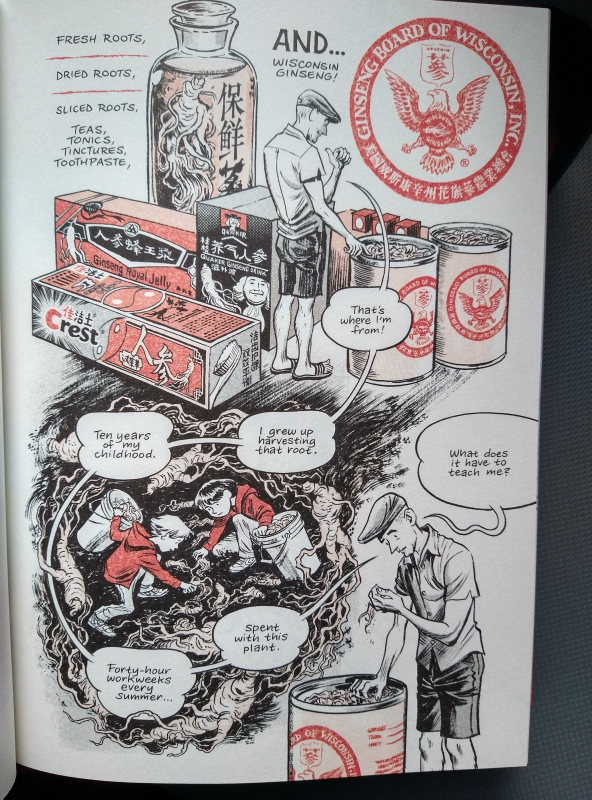
This chunky book has an appealing earth-tones palette and shifts smoothly between locations and styles, memories and research. When interviewing growers and Chinese medicine practitioners, the depictions are almost photorealistic, but there are also superhero pastiche panels and a cute ginseng mascot who pops up throughout the book. Like Spent, this pulls in class and economic issues in a lighthearted way and also explores its own composition process.
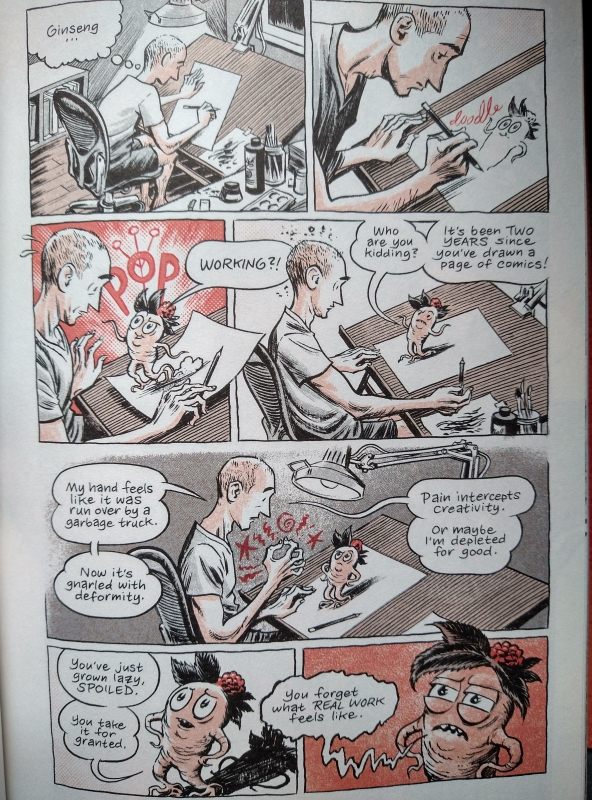
The story of ginseng is often sobering, involving the exploitation of immigrants (in the Notes, Thompson regrets that he was unable to speak with any of the Mexican migrant workers on whom the American ginseng harvest now depends), soil degradation, and pesticide pollution. The roots of the title are both literal and symbolic of the family story that unfolds in parallel. Both strands are captivating, but especially the autobiographical material: Thompson’s relationship with Phil, his new understanding but ongoing frustration with his parents, and the way all three siblings exhibit the damage of their upbringing – Phil’s marriage is crumbling; their sister Sarah, who has moved 26 times as an adult, wonders what she’s running from. A conversation with a Chinese herbal pharmacist gets to the heart of the matter: “I learned home is not WHERE I am. Home is HOW I am.”
Both expansive and intimate, this is a surprising gem from one of the best long-form graphic storytellers out there.
With thanks to Faber for the free copy for review. Published in the USA by Pantheon (Penguin).
Winter Reading, Part II: “Snow” Books by Coleman, Rice & Whittell
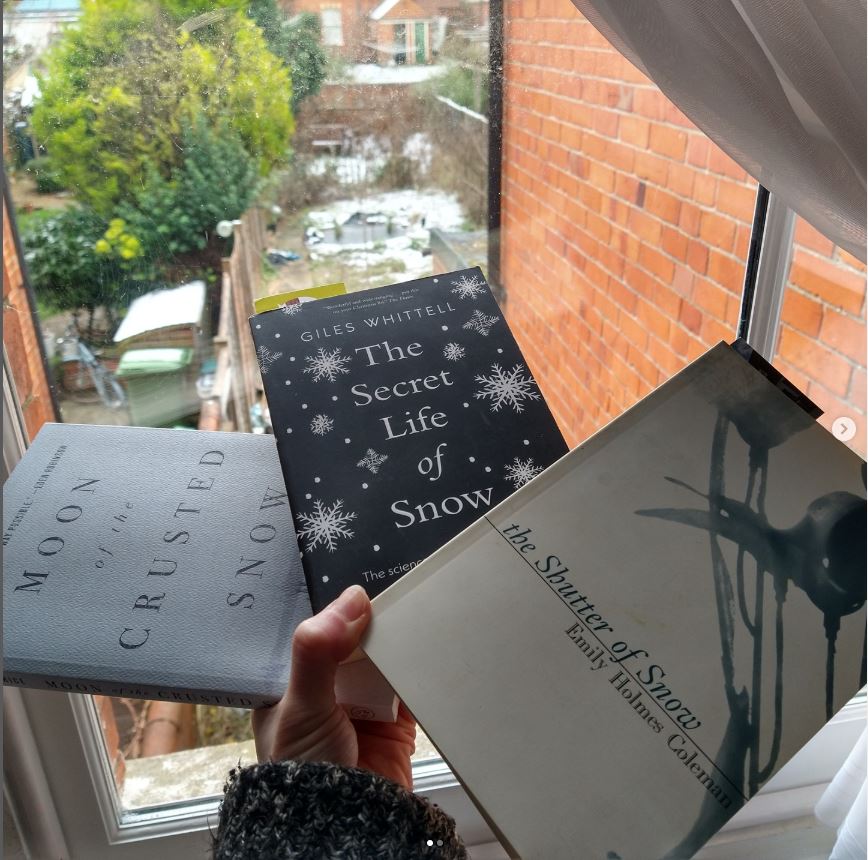
Here I am squeaking in on the day before the spring equinox – when it’s predicted to be warmer than Ibiza here in southern England, as headlines have it – with a few snowy reads that have been on my stack for much of the winter. I started reading this trio when we got a dusting back in January, in case (as proved to be true) it was our only snow of the year. I have an arresting work of autofiction that recreates a period of postpartum psychosis, a mildly dystopian novel by a First Nations Canadian, and a snow-lover’s compendium of science and trivia.
 As it happens, I’ll be starting the spring in the middle of We Do Not Part by Han Kang, which is austerely beautiful and eerily snowy: its narrator traverses a blizzard to rescue her friend’s pet bird; and the friend’s mother recalls a village massacre that left piles of snow-covered corpses. Here Kang muses on the power of snow:
Snow had an unreality to it. Was this because of its pace or its beauty? There was an accompanying clarity to snow as well, especially snow, drifting snow. What was and wasn’t important were made distinct. Certain facts became chillingly apparent. Pain, for one.
The Shutter of Snow by Emily Holmes Coleman (1930)
 Coleman (1899–1974), an expatriate American poet, was part of the Paris literary milieu in the 1920s and then the London scene of the 1930s. (She worked with T.S. Eliot on editing Djuna Barnes’s Nightwood, for instance.) This novella, her only published work of fiction, was based on her experience of giving birth to her son in 1924, suffering from puerperal fever and a mental breakdown, and being incarcerated in Rochester State Hospital. Although the portrait of Marthe Gail is in the omniscient third person, the stream-of-consciousness style – no speech marks or apostrophes, minimal punctuation – recalls unreliable first-person narration. Marthe believes she is Jesus Christ. Her husband Christopher visits occasionally, hoping she’ll soon be well enough to come home to their baby. It’s hard to believe this was written a century ago; I could imagine it being published tomorrow. It is absolutely worth rediscovering. While I admired the weird lyrical prose (“in his heart was growing a stern and ruddy pear … He would make of his heart a stolen marrow bone and clutch snow crystals in the night to his liking”; “This earth is made of tar and every morsel is stuck upon it to wither … there were orange peelings lying in the snow”), the interactions between patients, nurses and doctors got tedious. (Secondhand – Community Furniture Project, Newbury)
Moon of the Crusted Snow by Waubgeshig Rice (2018)
 A mysterious total power outage heralds not just the onset of winter or a temporary crisis but the coming of a new era. For this Anishinaabe community, it will require a return to ancient nomadic, hunter-gatherer ways. I was expecting a sinister dystopian; while there are rumours of a more widespread collapse, the focus is on adaptation versus despair, internal resilience versus external threats. Rice reiterates that Indigenous peoples have often had to rebuild their worlds: “Survival had always been an integral part of their culture. It was their history. The skills they needed to persevere in this northern terrain … were proud knowledge held close through the decades of imposed adversity.” As an elder remarks, apocalypse is nothing new. I was more interested in these ideas than in how they played out in the plot. Evan works snow-ploughs until, with food running short and many falling ill, he assumes the grim task of an undertaker. I was a little disappointed that it’s a white interloper breaks their taboos, but it is interesting how he is compared to the mythical windigo in a dream sequence. As short as this novel is, I found it plodding, especially in the first half. It does pick up from that point (and there is a sequel). I was reminded somewhat of Sherman Alexie. It was probably my first book by an Indigenous Canadian, which was reason enough to read it, though I wonder if I would warm more to his short stories. (Birthday gift from my wish list last year)
The Secret Life of Snow: The science and the stories behind nature’s greatest wonder by Giles Whittell (2018)
 This is so much like The Snow Tourist by Charlie English it was almost uncanny. Whittell, an English journalist who has written history and travel books, is a snow obsessive and hates that, while he may see a few more major snow events in his lifetime, his children probably won’t experience any in their adulthood. Topics in the chatty chapters include historical research into snowflakes, meteorological knowledge then and now and the ongoing challenge of forecasting winter storms, record-breaking snowfalls and the places still most likely to have snow cover, and the depiction of snow in medieval paintings (like English, he zeroes in on Bruegel) and Bond films. There’s a bit too much on skiing for my liking: it keeps popping up in segments on the Olympics, avalanches, and how famous snow spots are reckoning with their uncertain economic future. It’s a fun and accessible book with many an eye-popping statistic, but, coming as it did a decade after English’s, does sound the alarm more shrilly about the future of snow. As in, we’ll get maybe 15 more years (until 2040), before overall warming means it will only fall as rain. “That idea, like death, is hard to think about without losing your bearings, which is why, aware of my cowardice and moral abdication, I prefer to think of the snowy present and recent past rather than of the uncertain future.” (Secondhand – Community Furniture Project, Newbury)
Whittell’s mention of the U.S. East Coast “Snowmaggedon” of February 2010 had me digging out photos my mother sent me of the aftermath at our family home of the time.
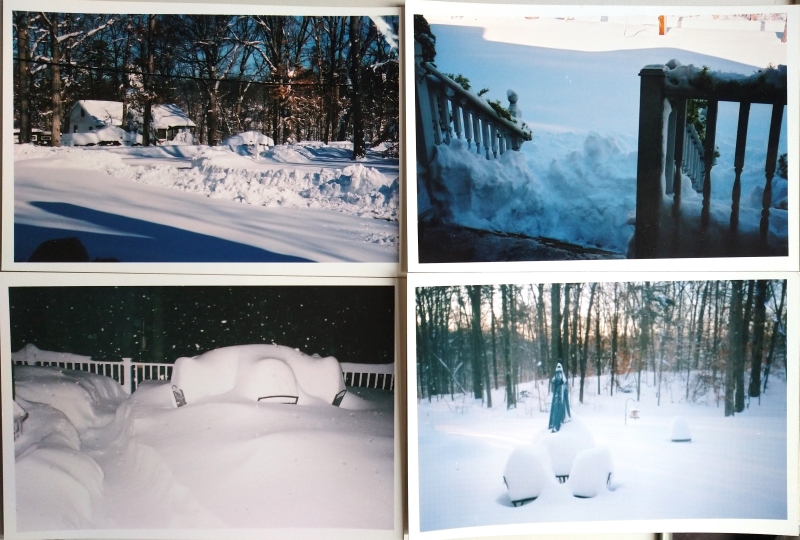
Any wintry reading (or weather) for you lately? Or is it looking like spring?
2025 Releases Read So Far, Including a Review of Aerth by Deborah Tomkins
I’ve gotten to 22 books with a 2025 publication date so far, most of them for paid reviews for Foreword Reviews or Shelf Awareness. I give review excerpts, links where available, and ratings below to pique your interest. (I’ll follow up on Friday with a list of my 25 Most Anticipated titles for the first half of the year!) First, though, it’s time to introduce you to the joint winner of the inaugural Weatherglass Novella Prize, as chosen by Ali Smith – I reviewed the other winner, Astraea by Kate Kruimink, as part of Novellas in November.
Aerth by Deborah Tomkins
At Weatherglass Books’ “The Future of the Novella” event in September (my write-up is here), I was intrigued to learn about this sci-fi novella in flash set on alternative Earths. The draft title was “First, Do No Harm,” referring to one of the five mantras for life on Aerth, a peaceful matriarchal planet that has been devastated by a pandemic. Magnus, the Everyman protagonist, is his parents’ only surviving offspring after their first nine children died of the virus. We meet Magnus in what seems an idyllic childhood of seasonal celebrations and his mother’s homemade cakes. But the weight of his parents’ expectations is too much, and after his relationship with Tilly disintegrates, he decides to fulfil a long-held ambition of becoming an astronaut and travelling to Urth. Here he starts off famous – a sought-after talking head in the media with the ear of the prime minister – but public opinion eventually turns against him.

Urth could be modelled on contemporary London: polluted, capitalist and celebrity-obsessed. But it would be oversimplifying to call Aerth a pre-industrial foil; although at first its lifestyle seems more wholesome, later revelations force us to question why it developed in this way. The planets are twins with potentially parallel environmental and societal trajectories and some exact counterparts; the hints about this “mirrorverse” are eerie. It all could have added up to an unsubtle allegory in which Aerth represents what we should aspire to and Urth symbolizes what we must resist, but Tomkins makes it more nuanced than that. Magnus’s homesickness when he fears he’s trapped on Urth is a heart-rending element, and the diverse styles and formats (such as lists, documents, and second-person sections) keep things interesting. The themes of parenting and loneliness are particularly potent.
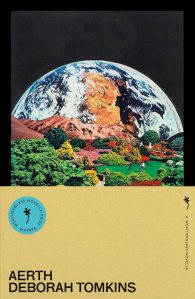 Tomkins first wrote this for the Bath Prize in 2018 and was longlisted. She initially sent the book out to science fiction publishers but was told that it wasn’t ‘sci-fi enough’. I can see how it could fall into the gap between literary fiction and genre fiction: though it’s set on other planets and involves space travel, its speculative nature is understated; it feels more realist. A memorable interrogation of longing and belonging, this novella ponders the value of individuals and their choices in the midst of inexorable planetary trajectories.
(Wowee, Aerth made it onto Eric of Lonesome Reader’s Top Ten list for 2024!)
With thanks to Weatherglass Books for the free copy for review. Aerth will be released on 25 January.
My top recommendations so far for 2025:
(in alphabetical order) All:
 Save Me, Stranger by Erika Krouse (Flatiron Books, January 21): These 12 first-person narratives are voiced by people in crisis, for whom encounters with strangers tender the possibility of transformation. In the title story, the narrator is taken hostage in a convenience store hold-up. Krouse frequently focuses on young women presented with dilemmas. In “The Pole of Cold,” Vera meets Theo, the son of the American weather researchers who died in the same Siberian plane crash that killed her reindeer herder father. Travel is a recurring element, with stories set in Thailand and Japan as well as various U.S. states. The book exhibits tremendous range, imagining a myriad places, minds, and situations. Krouse often eschews tidy endings, leaving characters on the brink and allowing readers to draw inferences about what they will decide. Fans of Danielle Evans and Lauren Groff have a treat in store.
 Immemorial by Lauren Markham (Transit Books, February 4): This outstanding book-length essay compares language, memorials, and rituals as strategies for coping with climate anxiety and grief. The dichotomies of the physical versus the abstract and the permanent versus the ephemeral are explored; the past, present, and future dance through the text. With language not changing at the pace of the climate, Markham turns to the “Bureau of Linguistical Reality” for help coining a new term for anticipatory ecological grief. The title is one candidate, “premation” another. Forthright, wistful, and determined, the book treats grief as a positive, as “fuel” or a “portal.” Hope is not theoretical in this setup, but solidified in action. In Markham’s case, becoming a parent embodied her trust in the future. Immemorial is an elegant meditation on memory and impermanence in an age of climate crisis.
 Y2K: How the 2000s Became Everything (Essays on the Future that Never Was) by Colette Shade (out today from Dey Street Books!): Shade’s debut collection contains 10 perceptive essays that contrast the promise and political pitfalls of “the Y2K Era” (1997–2008). The author was an adolescent at the turn of the millennium and recalls the thrill of early Internet use and celebrity culture. Consumerism was a fundamental doctrine but the financial crash prompted a loss of faith in progress. It’s a feast of millennial nostalgia but also a hard-hitting work of cultural criticism.
 Show Don’t Tell by Curtis Sittenfeld (Random House, February 25; Transworld, 27 February): Sittenfeld’s second collection features characters negotiating principles and privilege in midlife. The 12 stories spotlight everyday marital and parenting challenges. Dual timelines offer opportunities for hindsight on the events of decades ago. College and boarding school experiences, in particular, remain pivotal. The arbitrary nature of wealth and celebrity is a central theme. Warm, witty, and insightful.
Other 2025 releases:
(in publication date order)
 How Isn’t It Going? Conversations after October 7 by Delphine Horvilleur [trans. from the French by Lisa Appignanesi] (out today from Europa Editions!): There is by turns a stream of consciousness or folktale quality to the narrative as Horvilleur enacts 11 dialogues – some real and others imagined – with her late grandparents, her children, or even abstractions. She draws on history, scripture and her own life, wrestling with thoughts that come during insomniac early mornings. It’s a lament for the Jewish condition, and a warning of the continuing and insidious nature of antisemitism. But it’s not all mourning; there is sometimes a wry sense of humour that feels very Jewish.
 Cold Kitchen: A Year of Culinary Travels by Caroline Eden (Out in UK since May 2024; U.S. release: Bloomsbury, January 14): Eden cooks and writes in the basement kitchen of her Edinburgh apartment. When wanderlust strikes, she revisits favorite places via their cuisine. Her sumptuous fourth book journeys across Central Asia and Eastern Europe, harvesting memories and recipes. (Plus my Shelf Awareness interview)
 North of Ordinary by John Rolfe Gardiner (Bellevue Literary Press, January 14): I read 5 of 10 stories about young men facing life transitions and enjoyed the title one set at a thinly veiled Liberty University but found the rest dated in outlook; all have too-sudden endings.
 If Nothing by Matthew Nienow (Alice James Books, January 14): Straightforward poems about giving up addiction and seeking mental health help in order to be a good father.
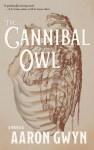 The Cannibal Owl by Aaron Gwyn (Belle Point Press, January 28): An orphaned boy is taken in by the Comanche in 1820s Texas in a brutal novella for fans of Cormac McCarthy.
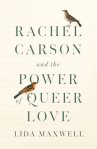 Rachel Carson and the Power of Queer Love by Lida Maxwell (Stanford University Press, January 28): Maxwell’s enthusiastic academic study reappraises scientist Rachel Carson’s motivations in light of ecological crisis and queer studies.
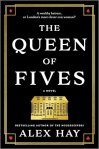 The Queen of Fives by Alex Hay (Graydon House, January 21; Headline, 30 January): Quinn Le Blanc, the latest in a dynasty of London con artists, resolves to pose as a debutante and marry a duke for his fortune – all in just five days in 1898. Like The Housekeepers, it’s a playful romp featuring strong female characters.
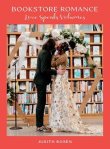 Bookstore Romance: Love Speaks Volumes by Judith Rosen (Brandeis University Press, February 1): A bibliophile’s time capsule and an enduring record of love and literary obsessions, this is a swoon-worthy coffee table book about couples who formalized their relationships in bookstores.
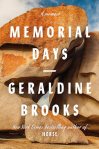 Memorial Days by Geraldine Brooks (Viking, February 4): This elegant bereavement memoir chronicles the sudden death of Brooks’s husband (journalist Tony Horwitz) in 2019 and her grief retreat to Flinders Island, Australia.
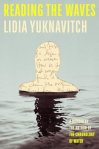 Reading the Waves by Lidia Yuknavitch (Riverhead, February 4): Yuknavitch’s bold memoir-in-essays focuses on pivotal scenes and repeated themes from her life as she reckons with trauma and commemorates key relationships. (A little too much repeated content from The Chronology of Water for me.)
 The Book of Flaco: The World’s Most Famous Bird by David Gessner (Blair, February 11): Gessner’s engaging nature book tells the story of the escaped Central Park Zoo Eurasian eagle-owl. It’s a touching tribute and a subtle challenge to reconsider human effects on wildlife.
 We Would Never by Tova Mirvis (Avid Reader Press, February 11): Mirvis’s fourth novel, inspired by real-life headlines, tells the taut story of an acrimonious divorce case gone horribly wrong. It explores the before and after of a murder, as the victim’s soon-to-be-ex-wife comes under suspicion and her family huddles around to protect her.
 The Café with No Name by Robert Seethaler [trans. from the German by Katy Derbyshire] (Europa Editions, 25 February): Set in 1960s and 1970s Vienna, where World War II still reverberates, this tender novel about a restaurateur’s interactions with acquaintances and customers meditates on the passage of time and bonds that last.
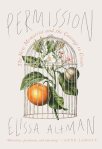 Permission: The New Memoirist and the Courage to Create by Elissa Altman (David R. Godine, March 4): Full of stories drawn from Altman’s life and other authors’ experience, this is an inspirational guide to defusing shame through self-disclosure and claiming the time and focus to write.
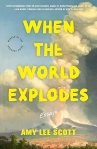 When the World Explodes: Essays by Amy Lee Scott (Mad Creek Books, March 6): Eleven inquisitive pieces set personal crises alongside natural disasters and gun violence. Scott was adopted as a baby from Korea; motherhood and adoption are potent themes across the book.
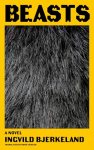 Beasts by Ingvild Bjerkeland [trans. from the Norwegian by Rosie Hedger] (Levine Querido, April 1): In this chilling young adult novella, a teenager tries to keep his little sister safe and reunite with their father in a hazardous postapocalyptic world.
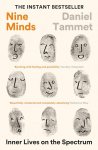 Nine Minds: Inner Lives on the Spectrum by Daniel Tammet (Out in UK since July 2024; U.S. release: The Experiment, April 1): A biographical mosaic of neurodivergence built of stories of individuals whose struggles and achievements defy the clichés surrounding autism. (Notable inclusions: actor Dan Aykroyd, novelist Naoise Dolan.)
Will you look out for one or more of these?
Any other 2025 reads you can recommend?
#SciFiMonth: A Simple Intervention (#NovNov24 and #GermanLitMonth) & Station Eleven Reread
It’s rare for me to pick up a work of science fiction but occasionally I’ll find a book that hits the sweet spot between literary fiction and sci-fi. Parable of the Sower by Octavia Butler, The Book of Strange New Things by Michel Faber and The Sparrow by Mary Doria Russell are a few prime examples. It was the comparisons to Margaret Atwood and Kazuo Ishiguro, masters of the speculative, that drew me to my first selection, a Peirene Press novella. My second was a reread, 10 years on, for book club, whose postapocalyptic content felt strangely appropriate for a week that delivered cataclysmic election results.

A Simple Intervention by Yael Inokai (2022; 2024)
[Translated from the German by Marielle Sutherland]
Meret is a nurse on a surgical ward, content in the knowledge that she’s making a difference. Her hospital offers a pioneering procedure that cures people of mental illnesses. It’s painless and takes just an hour.
The doctor had to find the affected area and put it to sleep, like a sick animal. That was his job. Mine was to keep the patients occupied. I was to distract them from what was happening and keep them interacting with me. As long as they stayed awake, we knew the doctor and his instruments had found the right place.
 The story revolves around Meret’s emotional involvement in the case of Marianne, a feisty young woman who has uneasy relationships with her father and brothers. The two play cards and share family anecdotes. Until the last few chapters, the slow-moving plot builds mostly through flashbacks, including to Meret’s affair with her fellow nurse, Sarah. This roommates-to-lovers thread reminded me of Learned by Heart by Emma Donoghue. When Marianne’s intervention goes wrong, Meret and Sarah doubt their vocation and plan an act of heroism.
Inokai invites us to ponder whether what we perceive as defects are actually valuable personality traits. More examples of interventions and their aftermath would be a useful point of comparison, though, and the pace is uneven, with a lot of unnecessary-seeming backstory about Meret’s family life. In the letter that accompanied my review copy, Inokai explained her three aims: to portray a nurse (her mother’s career) because they’re underrepresented in fiction, “to explore our yearning to cut out our ‘demons’,” and to offer “a queer love story that was hopeful.” She certainly succeeds with those first and third goals, but with the central subject I felt she faltered through vagueness.
Born in Switzerland, Inokai now lives in Berlin. This also counts as my first contribution to German Literature Month; another is on the way!
[187 pages]
With thanks to Peirene Press for the free copy for review.


Station Eleven by Emily St. John Mandel (2014)
For synopsis and analysis I can’t do better than when I reviewed this for BookBrowse a few months after its release, so I’d direct you to the full text here. (It’s slightly depressing for me to go back to old reviews and see that I haven’t improved; if anything, I’ve gotten lazier.) A couple book club members weren’t as keen, I think because they’d read a lot of dystopian fiction or seen many postapocalyptic films and found this vision mild and with a somewhat implausible setup and tidy conclusion. But for me this and Cormac McCarthy’s The Road have persisted as THE literary depictions of post-apocalypse life because they perfectly blend the literary and the speculative in an accessible and believable way (this was a National Book Award finalist and won the Arthur C. Clarke Award), contrasting a harrowing future with nostalgia for an everyday life that we can already see retreating into the past.
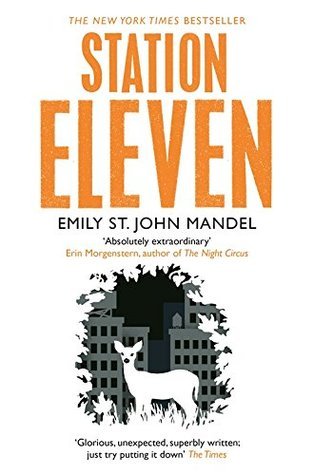 Station Eleven has become a real benchmark for me, against which I measure any other dystopian novel. On this reread, I was captivated by the different layers of the nonlinear story, from celebrity gossip to a rare graphic novel series, and enjoyed rediscovering the links between characters and storylines. I remembered a few vivid scenes and settings. Mandel also seeds subtle connections to later work, particularly The Glass Hotel (island off Vancouver, international shipping and finance) but also Sea of Tranquility (music, an airport terminal). I haven’t read her first three novels, but wouldn’t be surprised if they have additional links.
The two themes that most struck me this time were the enduring power of art and how societal breakdown would instantly eliminate the international – but compensate for it with the return of the extremely local. At a time when it feels difficult to trust central governments to have people’s best interests at heart, this is a rather comforting prospect. Just in my neighbourhood, I see how we implement this care on a small scale. In settlements of up to a few hundred, the remnants of Station Eleven create something like normal life by Year 20.
Book club members sniped that the characters could have better pooled skills, but we agreed that Mandel was wise to limit what could have been tedious details about survival. “Survival is insufficient,” as the Traveling Symphony’s motto goes (borrowed from Star Trek). Instead, she focuses on love, memory, and hunger for the arts. In some ways, this feels prescient of Covid-19, but even more so of the climate-related collapse I expect in my lifetime. I’ve rated this a little bit higher the second time for its lasting relevance. (Free from a neighbour) 
Some favourite passages:
the whole of Chapter 6, a bittersweet litany that opens “An incomplete list: No more diving into pools of chlorinated water lit green from below” and includes “No more pharmaceuticals,” “No more flight,” and “No more countries”
“what made it bearable were the friendships, of course, the camaraderie and the music and the Shakespeare, the moments of transcendent beauty and joy”
“The beauty of this world where almost everyone was gone. If hell is other people, what is a world with almost no people in it?”

Basket of Deplorables by Tom Rachman (2017)
“Basket of deplorables” is a term that Hillary Clinton applied to the xenophobic wing of Donald Trump’s supporters in a September 2016 campaign speech. Basket of Deplorables is Tom Rachman’s third of five books and I somehow had never heard of it until a good few years after its release. That surprised me because I’ve followed his career with interest and read his other works right at their publication.
Like Rachman’s The Imperfectionists and The Imposters, it’s a linked short story collection. The five stories are on the longish side but read quickly. In the opening title piece, a woman who went blind after an accident co-hosts a 2016 presidential election watch party with her husband in their Manhattan apartment. Their friends are uniformly left-wing and choke with disbelief as results start to filter through. In “Truth Is for Losers,” Glen agrees to stage a funeral for his billionaire brother Fleming, who has faked his own death. The memorial service is an opportunity for high farce, but I also warmed to Glen for his simple enthusiasm for his job as a Starbucks barista in Kalamazoo. This was my favourite of the stories; its depiction of the spread of fake news feels like a worthwhile analogy rather than a rehashing of headlines.
“Leakzilla” imagines the complications of Internet dating in an alternate world where would-be partners can scour each other’s e-mail history at will – and find out that someone masquerading as clued-in voted for Trump in 2016. “Sad! Wrong! Not Nice!” follows Fleming, a Trump-esque blowhard, into his new life in Italy. The backstory of a minor character explains a mysterious moment from the first piece, and the sister of the woman from “Leakzilla” is then the protagonist of “How the End Begins.” Here, Kelly discovers with quiet horror a website where you can input any person’s name and view their future cause of death. There is a grim dystopian edge to this final story.

Rachman gave the book the tagline (not quite a subtitle) of “Almost-true stories.” I suspect it was written quickly in response to Trump’s election and it is rather thin, aiming at obvious targets and exhibiting wholly reasonable yet unsubtle liberal outrage. I found it so depressing to see how history threatens to repeat itself less than a decade later:
“David’s worry is that Trump won’t accept his defeat, throwing the whole democratic process into chaos”
“More a boomerang of history, where we keep throwing out the bad bits, and they keep flying back, hitting us in the mouth.”
I can hardly bear to think about tomorrow’s election. The USA could elect the first woman president (of color, no less), or hand power back to a cretin – a convicted felon and probably the worst holder of the office in its nearly 250 years. It’s a choice between progress and regression. Between sanity and sleepwalking into destruction. And whatever happens at the polls, it seems inevitable that Trump will foment further violence and hatred.
 Did I do all I could? I sent in my postal vote several weeks ago, and donated to the Harris/Walz campaign (which means I now get seven e-mails a day from them, but that’s fine). The local Democrats Abroad branch didn’t reply to me over the summer, so I missed out on the chance to volunteer with them, whereas in 2020 I colored in postcards to send to Democrat-registered North Carolina voters in the UK to remind them to get their ballots.
My leanings are clear, then, and I’m sure pretty much all my readers will concur. That I didn’t enjoy this obscure Rachman work more is due to my low tolerance for satire in general and to the fact that these stories of division and deception are not almost true, but all too true. (Secondhand – gift from my wish list, Christmas 2023)
Carol Shields Prize Longlist Reads: Cocktail & Land of Milk and Honey
Two final reviews in advance of tomorrow’s shortlist announcement: a sophisticated, nostalgic short story collection and an intense future-set novel full of the pleasures of the flesh. Both make it onto my wish list at the end of this post.
Cocktail by Lisa Alward
The 12 stories of this debut collection brought to mind Tessa Hadley and Alice Munro for their look back at chic or sordid 1960s–1980s scenes and dysfunctional families or faltering marriages. They’re roughly half and half first-person and third-person (five versus seven). The title story opens the book with a fantastic line: “The problem with parties, my mother says, is people don’t drink enough.” Later, the narrator elaborates:
Her meaning is that if people drank more, they’d loosen up. Parties would be more fun, like they used to be. And I laugh along. Yes, I say, letting her top up my glass of Chardonnay. That’s it, not enough booze. But I’m thinking about Tom Collins.
 Not the drink, but an alias a party guest used when he stumbled into her bedroom looking for a toilet. She was about eleven at this point and she and her brother vaguely resented being shut away from their parents’ parties. While for readers this is an uncomfortable moment as we wonder if she’s about to be molested, in memory it’s taken on a rosy glow for her – a taste of adult composure and freedom that she has sought with every partner and every glass of booze since. This was a pretty much perfect story, with a knock-out ending to boot.
Dependence on alcohol recurs, and “Hawthorne Yellow,” is also about a not-quite affair, between a restless stay-at-home mother and the decorator who discovers antique sketches in the old servants’ quarters of her home. “Orlando, 1974” again contrasts childhood nostalgia with seedy reality: Disney World should have been an idyll, but the narrator mostly remembers a lot of vomiting. “Old Growth” and “Bear Country” have Ray renegotiating his relationship with his son after divorcing Gwyneth. “Hyacinth Girl,” too, is about complicated stepfamilies, while “Wise Men Say” looks back at cross-class romance. The protagonist of “Maeve” feels she can’t match the title character’s perfect parenting skills; the first-person plural in “Pomegranate” portrays a group of wild convent schoolgirls.
“Little Girl Lost” was the most Hadley-meets-Munro, with an alcoholic painter’s daughter seen first as a half-feral child and later as a hippie young woman. “How the Smoke Gets in Your Eyes” was the least essential with its elderly narrator piecing things together in the aftermath of a burglary. Along with the title story, the standout for me was “Bundle of Joy,” about a persnickety grandmother going to her daughter’s place to spend time with her new grandson. She disapproves of just about every decision Erin has made (leaving the dogs’ frozen turds in the backyard all winter, for instance), but her interference threatens to have lasting consequences. Not a dud in the dozen, and a very strong voice I’ll expect to read much more from. (Read via Edelweiss; published by Biblioasis)
Land of Milk and Honey by C Pam Zhang
We all die. We have only the choice, if we are privileged, of whether death comes with a whimper or a bang; of what worlds we taste before we go.
A real step up from How Much of These Hills Is Gold, which I read for book club last year – while it was interesting to see the queer, BIPOC spin Zhang put on the traditional Western, I found her Booker-longlisted debut bleak and strange in such a detached way that it was hard to care about. By contrast, I was fully involved in her sensuous and speculative second novel.
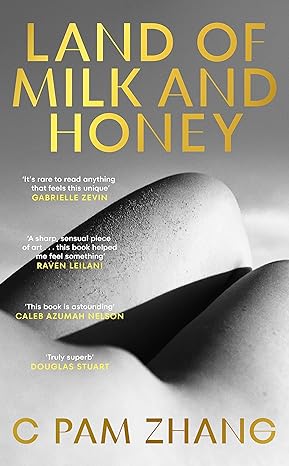 A 29-year-old Chinese American chef is exiled when the USA closes its borders while she’s working in London. On a smog-covered planet where 98% of crops have failed, scarcity reigns – but there is a world apart, a mountaintop settlement at the Italian border where money can buy any ingredient desired and threatened foods are cultivated in a laboratory setting. While peasants survive on mung bean flour, wealthy backers indulge in classic French cuisine. The narrator’s job is to produce lavish, evocative multi-course meals to bring investors on board. Foie gras, oysters, fine wines; heirloom vegetables; fruits not seen for years. But also endangered creatures and mystery meat wrested back from extinction. Her employer’s 21-year-old daughter, Aida, oversees the lab where these rarities are kept alive.
Ironically, surrounded with such delicacies, the chef loses her appetite for all but cigarettes – yet another hunger takes over. Her relationship with Aida is a passionate secret made all the more peculiar by the fact that the chef’s other role is to impersonate Aida’s dead mother, Eun-Young. It’s clear this precarious setup can’t last; ambition and technology keep moving on. The novel presents such a striking picture of desire at the end of the world. Each sentence is honed to flawlessness, with whole paragraphs of fulsome descriptions of meals. Zhang’s prose reminded me of Stephanie Danler’s and R.O. Kwon’s – no surprise, then, that they’re on the Acknowledgments list, as are a cornucopia of foods and other literary influences.
I’m not usually one for a dystopian novel, but the emotional territory keeps this one grounded even as the plot grows more sinister. My only complaint is that I would have left off the final chapter as I don’t think tracing the protagonist through four more decades of life adds much. I would rather have left this world in limbo than thought of the episode as a blip in a facile regeneration process – that’s the most unrealistic element of all. But this has still been my favourite read from the longlist so far. And there’s even a faithful pet cat, a “recalcitrant beast” that keeps coming back to the chef despite benign neglect. (Public library)
My ideal shortlist, based on what I’ve read and still want to read, would be:


Cocktail by Lisa Alward
Dances by Nicole Cuffey
Brotherless Night by V.V. Ganeshananthan
I Have Some Questions for You by Rebecca Makkai
Land of Milk and Honey by C Pam Zhang
I wouldn’t be averse to seeing The Future or Chrysalis on there either. (Just not Loot, please!)
See Laura’s post for a recap of her reviews and her wish list. Marcie has also been reading from the longlist; see her first write-up here.
Carol Shields Prize Longlist Reading: The Future and Chrysalis
My first two dedicated reads for our informal Carol Shields Prize shadowing project exhibit one main way in which the prize is different from the Women’s Prize for Fiction: works in translation and short story collections are eligible. I have one of each to review today. Laura and I did a buddy read of an atmospheric dystopian novel translated from the French, and I caught up on a magical, erotic story collection I’d had on my Kindle for a long time. These were both very good, but my minor misgivings are such that I’d rate them the same: 
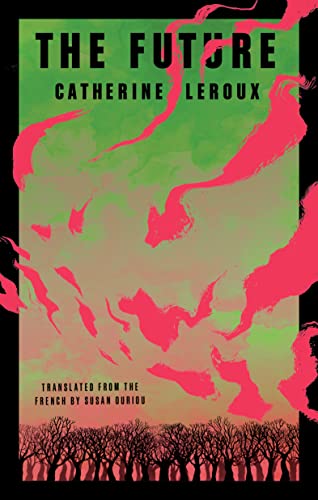
The Future by Catherine Leroux (2020; 2023)
[Translated from the French by Susan Ouriou]
For such a monolithic title, this has a limited stage: a few derelict districts of the ailing city we know as Detroit, Michigan – but in Leroux’s alternate version, it remained part of French Canada, with lingering Indigenous influence, and so is known as Fort Détroit. No doubt she was inspired by the many vacant properties that characterized Detroit in the 2010s; there’s even a ruins tour bus. In her Fort Détroit, a handful of determined adults cling on in their own homes, but the streets and parks have been abandoned to animals and to a gang of half-feral children who have developed their own nicknames (Adidas, Lego, Wolfpup), social hierarchy and vernacular. Worlds meet when Gloria determines to find her granddaughters Cassandra and Mathilda, who ran away after their addict mother Judith’s suspicious death. At the same time, her neighbour Eunice wants to find out who ran her father down in the street.
 Despite their fierce independence and acts of protest, the novel’s children still rely on the adult world. Ecosystems are awry and the river is toxic, but Gloria’s friend Solomon, a former jazz pianist, still manages to grow crops. He overlooks the children’s thefts from his greenhouse and eventually offers to help them grow their own food supply, and other adults volunteer to prepare a proper winter shelter to replace their shantytown. Puberty threatens their society, too: we learn that Fiji, the leader, has been binding her breasts to hide her age.
I expected to be reminded strongly of Station Eleven, and while there were elements that were reminiscent of Emily St John Mandel’s work, Leroux’s is a more consciously literary approach. The present-tense omniscient narration occupies many perspectives, including that of a dog, and the descriptions and musings are more lyrical than literal. Where another author would site high drama – sixtysomething Gloria’s night quest, a few children rafting down the river – Leroux moves on swiftly to other character interactions. What did bring Mandel to mind was the importance of art during societal collapse: the children spin nursery rhyme mash-ups and fairytales, Stutt rescues a makeshift library and insists on Huckleberry Finn going along on the river journey, and Solomon plays the piano again after decades.
The opening mysteries of death and disappearance are resolved before the end, but don’t seem to have been the point. The Future is more subtle and slippery than many dystopian novels I’ve read in that there’s not really a warning, or a message here. Instead, there’s an intriguing situation that opens out and alters slightly, but avoids resolution. It’s all about atmosphere and language – I was especially impressed by Ouriou’s rendering of Leroux’s made-up dialect via folksy slang (“She figgers she’s growed-up”). I loved the details and one-on-one moments more than the momentous scenes. On the whole, I found the story elegant but somewhat frustrating. You might be drawn to it if you enjoyed To Paradise or the MaddAddam books. (Read via Edelweiss; published by Biblioasis)
See also Laura’s review.
Chrysalis: Stories by Anuja Varghese (2023)
This debut collection of 15 stories brims with magic and horror, and teems with women of colour and queer people. Indeed, Varghese dedicates the book to “all the girls and women who don’t see themselves in most stories.” Most of the characters are of South Asian extraction. Adoption recurs in a couple of places. Two of the rarer realist stories, “Milk” and “Stories in the Language of the Fist,” have protagonists dealing with schoolgirl bullying and workplace microaggressions. More often, there are unexplained phenomena that position the players between life and death. “In the Bone Fields” focuses on the twin daughters of an Indian immigrant family on a Canadian farm. The house and the bone field behind are active and hungry, and only one twin will survive. (I got mild North Woods vibes.)
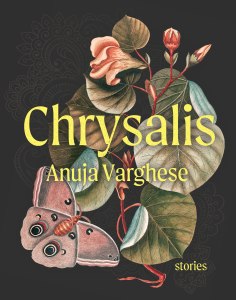 In the title story, Radhika visits her mother’s grave and wonders whether her life is here in Montreal with her lover or back in Toronto with her husband. Fangs and wings symbolize her desire for independence. Elsewhere, watery metaphors alternately evoke fear of drowning or sexual fluidity. “Midnight at the Oasis” charts the transformation of a trans woman and “Cherry Blossom Fever,” one of my two favourites, bounces between several POVs. Marjan is in love with Talia, but she’s married to Sunil, who’s also in love with Silas. “People do it — open their relationships and negotiate rules and write themselves into polyamorous fairy tales … Other people. Not brown people,” Talia sighs. They are better off, at least, than they would be back in India, where homophobia can be deadly (“The Vetala’s Song”).
My other favourite was “Bhupati,” about a man who sets up multiple Lakshmi figures in the backyard, hoping devotion will earn him and his wife a better future. The statues keep being burned up by lightning; we learn his wife may be petitioning for different things. “Chitra” is a straightforward Cinderella retelling whose title character lives with two mean stepsisters and works in food service at the mall. A Shoe Chateau BOGO closing sale gives her the chance to get a bargain – and catch the manager’s eye. Despite a striking ending signalled by the story’s subtitle, all I could conclude about this one was “cute.” The three flash horror stories (a murder hotel, ghosts in a basement, werewolves) were much the weakest for me.
There’s a pretty even split of third- and first-person stories (nine versus six) here, and the genre shifts frequently. The quality wasn’t as consistent as I’d hoped, but it was an engaging read. The overall blend of feminism and horror had me thinking of Her Body and Other Parties by Carmen Maria Machado, but I’d be most likely to recommend this to fans of Julia Armfield, Violet Kupersmith and Vauhini Vara. (Read via Edelweiss; published by House of Anansi Press)
Both of these are worthwhile books and it’s great that readers outside of Canada can discover them. I wouldn’t personally shortlist either, but the judges may well be dazzled enough to do so. I don’t yet have a sense of where they’d fit for me in the rankings.
Up next:
Cocktail by Lisa Alward (short story collection from Edelweiss)
A Council of Dolls by Mona Susan Power (buddy read with Laura)
Land of Milk and Honey by C Pam Zhang (from library)

I’m aiming for one or two more batches of reviews before the shortlist is announced on 9 April.
 Bookish Beck = Rebecca Foster. American transplant to England. Freelance proofreader and book reviewer.
 Bookish Beck