Book Serendipity, Mid-February to Mid-April
I call it “Book Serendipity” when two or more books that I read at the same time or in quick succession have something in common – the more bizarre, the better. This is a regular feature of mine every couple of months. Because I usually have 20–30 books on the go at once, I suppose I’m more prone to such incidents. People frequently ask how I remember all of these coincidences. The answer is: I jot them down on scraps of paper or input them immediately into a file on my PC desktop; otherwise, they would flit away!
The following are in roughly chronological order.
- The protagonist isn’t aware that they’re crying until someone tells them / they look in a mirror in The Remains of the Day by Kazuo Ishiguro and Three Days in June by Anne Tyler.
- A residential complex with primal scream therapy in Confessions by Catherine Airey and The Möbius Book by Catherine Lacey.
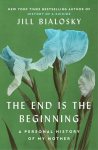
- Memories of wiping down groceries during the early days of the pandemic in The End Is the Beginning by Jill Bialosky and Human/Animal by Amie Souza Reilly.
- A few weeks before I read Maurice and Maralyn by Sophie Elmhirst, I’d finished reading the author’s husband’s debut novel (Going Home by Tom Lamont); I had no idea of the connection between them until I got to her Acknowledgements.
- A mention of the same emergency money passing between friends in Alligator Tears by Edgar Gomez ($20) and The Möbius Book by Catherine Lacey ($100).
- Autobiographical discussions of religiosity and anorexia in The Möbius Book by Catherine Lacey and Godstruck by Kelsey Osgood.
- The theme of the dark night sky in The Wild Dark by Craig Childs, followed almost immediately by Night Magic by Leigh Ann Henion.
- Last year I learned about Marina Abramović’s performance art where she and her ex trekked to China’s Great Wall from different directions, met in the middle, and continued walking away to dramatize their breakup in The Ritual Effect by Michael Norton. Recently I saw it mentioned again in The Möbius Book by Catherine Lacey. Abramović’s work is also mentioned in Human/Animal by Amie Souza Reilly and is the basis for the opening track on Anne-Marie Sanderson’s album Old Light, “Amethyst Shoes.”
- The idea of running towards danger appears in Alex Marzano-Lesnevich’s essay in Edge of the World, a queer travel anthology edited by Alden Jones; and the bibliography of The Möbius Book by Catherine Lacey.
- I then read another Alex Marzano-Lesnevich essay in quick succession (both were excellent, by the way) in What My Father and I Don’t Talk About, edited by Michele Filgate.
- A scene in which a woman goes to a police station and her concerns are dismissed because she has no evidence and the man/men’s behaviour isn’t ‘bad enough’ in I Am, I Am, I Am by Maggie O’Farrell and Human/Animal by Amie Souza Reilly.
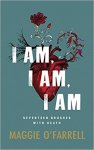
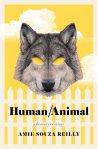
- Too many details as the sign of a lie in Dream Count by Chimamanda Ngozi Adichie and Three Days in June by Anne Tyler.
- Scenes of throwing all of a spouse’s belongings out on the yard/street in Old Soul by Susan Barker, How to Survive Your Mother by Jonathan Maitland, and Human/Animal by Amie Souza Reilly.
- Reading two lost American classics about motherhood and time spent in a mental institution at the same time: The Shutter of Snow by Emily Holmes Coleman and I Am Clarence by Elaine Kraf.
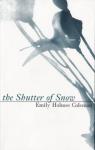
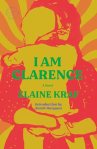
- Disorientation underwater: a literal experience in I Am, I Am, I Am by Maggie O’Farrell, then used as a metaphor for what it was like to be stuck in a blizzard on Annapurna in 2014 in The Secret Life of Snow by Giles Whittell.
- A teenager who has a job cleaning hotels in Old Soul by Susan Barker and I Am, I Am, I Am by Maggie O’Farrell. (In Stir-Fry by Emma Donoghue, Maria is also a teenaged cleaner, but of office buildings.)
- A vacuum cleaner bag splits in Stir-Fry by Emma Donoghue and one story of Are You Happy? by Lori Ostlund – in the latter it’s deliberate, searching for evidence of the character’s late son after cleaning his room.
- An ailing tree or trees that have to be cut down in one story of The Accidentals by Guadalupe Nettel and The Lost Trees of Willow Avenue by Mike Tidwell.
- Buchenwald was mentioned in one poem each in A God at the Door by Tishani Doshi and The Ghost Orchid by Michael Longley.
- A reference to Robin Wall Kimmerer’s Braiding Sweetgrass in To Have or to Hold by Sophie Pavelle and Human/Animal by Amie Souza Reilly.

- A mentally unwell woman deliberately burns her hands in I Am Clarence by Elaine Kraf and Every Day Is Mother’s Day by Hilary Mantel.
- A mention of the pollution caused by gas stoves in We Do Not Part by Han Kang and The Lost Trees of Willow Avenue by Mike Tidwell.
- An art installation involving part-buried trees was mentioned in Immemorial by Lauren Markham and then I encountered a similar project a few months later in We Do Not Part by Han Kang. Burying trees as a method of carbon storage is then discussed in The Lost Trees of Willow Avenue by Mike Tidwell.
- Imagining the lives of the people living in an apartment you didn’t end up renting in Scaffolding by Lauren Elkin and one story of The Accidentals by Guadalupe Nettel.
- The Anthropocene is mentioned in Scaffolding by Lauren Elkin and The Alternatives by Caoilinn Hughes.
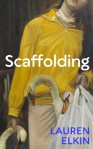
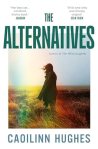
- I was reading three debut novels from the McKitterick Prize longlist at the same time, all of them with very similar page counts of 383, 387, and 389 (i.e., too long!).
- Being appalled at an institutionalized mother’s appearance in The End Is the Beginning by Jill Bialosky and Every Day Is Mother’s Day by Hilary Mantel.
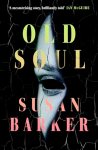 A remote artist’s studio and severed fingers in Old Soul by Susan Barker and We Do Not Part by Han Kang.
- A lesbian couple in New Mexico, the experience of being watched through a window, and the mention of a caftan/kaftan, in Old Soul by Susan Barker and one story of Are You Happy? by Lori Ostlund.
- Refusal to go to a hospital despite being in critical condition in I Am, I Am, I Am by Maggie O’Farrell and one story of Are You Happy? by Lori Ostlund.
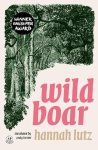
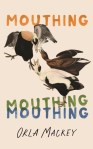
- It’s not a niche stylistic decision anymore; I was reading four novels with no speech marks at the same time: Old Soul by Susan Barker, Scaffolding by Lauren Elkin, The Alternatives by Caoilinn Hughes, and We Do Not Part by Han Kang. [And then, a bit later, three more: Wild Boar by Hannah Lutz, Mouthing by Orla Mackey, and How to Be Somebody Else by Miranda Pountney.]
 A lesbian couple is alarmed by the one partner’s family keeping guns in Spent by Alison Bechdel and one story of Are You Happy? by Lori Ostlund.
- Responding to the 2021 murder of eight Asian spa workers in Atlanta in Foreign Fruit by Katie Goh and Find Me as the Creature I Am by Emily Jungmin Yoon.
- Disposing of a late father’s soiled mattress in Mouthing by Orla Mackey and one story of Are You Happy? by Lori Ostlund.
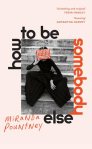 New York City tourist slogans in Apple of My Eye by Helene Hanff and How to Be Somebody Else by Miranda Pountney.
- A Jewish care home for the elderly in The End Is the Beginning by Jill Bialosky and Joanna Rakoff’s essay in What My Father and I Don’t Talk About (ed. Michele Filgate).
- A woman has no memory between leaving a bar and first hooking up with the man she’s having an affair with in If You Love It, Let It Kill You by Hannah Pittard and How to Be Somebody Else by Miranda Pountney.
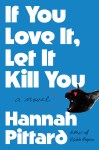 A stalker-ish writing student who submits an essay to his professor that seems inappropriately personal about her in one story of Are You Happy? by Lori Ostlund and If You Love It, Let It Kill You by Hannah Pittard.
- A pygmy goat as a pet (and a one-syllable, five-letter S title!) in Spent by Alison Bechdel and Sleep by Honor Jones.
- A Brooklyn setting and thirtysomething female protagonist in Sleep by Honor Jones, So Happy for You by Celia Laskey, and How to Be Somebody Else by Miranda Pountney.
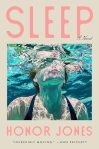
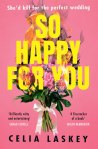
- A mention of the American Girl historical dolls franchise in Sleep by Honor Jones and If You Love It, Let It Kill You by Hannah Pittard, both of which I’m reviewing early for Shelf Awareness.
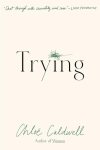 A writing professor knows she’s a hypocrite for telling her students what (not) to do and then (not) doing it herself in Trying by Chloé Caldwell and If You Love It, Let It Kill You by Hannah Pittard. These two books also involve a partner named B (or Bruce), metafiction, porch drinks with parents, and the observation that a random statement sounds like a book title.
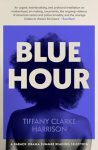
- The protagonist’s therapist asks her to find more precise words for her feelings in Blue Hour by Tiffany Clarke Harrison and So Happy for You by Celia Laskey.
- The protagonist “talks” with a dying dog or cat in The Möbius Book by Catherine Lacey and If You Love It, Let It Kill You by Hannah Pittard.
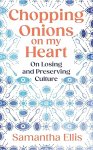 Shalimar perfume is mentioned in Scaffolding by Lauren Elkin and Chopping Onions on My Heart by Samantha Ellis.
- The Rapunzel fairytale is a point of reference in In the Evening, We’ll Dance by Anne-Marie Erickson and Secret Agent Man by Margot Singer, both of which I was reading early for Foreword Reviews.
What’s the weirdest reading coincidence you’ve had lately?
Most Anticipated Books of the First Half of 2025
As I said the other week, I sometimes wonder if designating a book as “Most Anticipated” is a curse – if the chosen books are doomed to fail to meet my expectations. Nonetheless, I can’t resist compiling such a list at least once each year.
Also on my radar: fiction by Claire Adam, Amy Bloom, Emma Donoghue, Sarah Hall, Michelle Huneven, Eowyn Ivey, Rachel Joyce, Heather Parry and Torrey Peters; nonfiction by Melissa Febos, Robert Macfarlane, Lucy Mangan, Suzanne O’Sullivan and Sophie Pavelle. (Further ahead, I’ll seek out I Want to Burn This Place Down: Essays by Maris Kreizman and The Girls Who Grew Big by Leila Mottley in July, The Savage Landscape by Cal Flyn in Oct. and Tigers between Empires by Jonathan C. Slaght in Nov.)
However, below I’ve narrowed it down to the 25 books I’m most looking forward to for the first half of 2025, 15 fiction and 10 nonfiction. I’m impressed that 4 are in translation! And 22/25 are by women (all the fiction is). In release date order, with UK publication info given first if available. The blurbs are adapted from Goodreads. I’ve taken the liberty of using whichever cover is my favourite (almost always the U.S. one).

Fiction
 Live Fast by Brigitte Giraud (trans. from the French by Cory Stockwell) [Feb. 11, Ecco]: I found out about this autofiction novella via an early Shelf Awareness review. It “follows one woman’s quest to comprehend the motorcycle accident that took the life of her partner Claude at age 41. The narrator … recounts the chain of events that led up to the fateful accident, tracing the tiny, maddening twists of fate that might have prevented its tragic outcome. Each chapter asks the rhetorical question, ‘what if’ … A sensitive elegy to her husband”.
 The Unworthy by Agustina Bazterrica (trans. from the Spanish by Sarah Moses) [13 Feb., Pushkin; March 4, Scribner]: I wasn’t enamoured of the Argentinian author’s short stories, but Tender Is the Flesh was awesome. This is a short dystopian horror set in a convent. “In the House of the Sacred Sisterhood, the unworthy live in fear of the Superior Sister’s whip. … Risking her life, one of the unworthy keeps a diary in secret. Slowly, memories surface from a time before the world collapsed, before the Sacred Sisterhood became the only refuge. Then Lucía arrives.” (PDF copy for Shelf Awareness review)
 Victorian Psycho by Virginia Feito [13 Feb., Fourth Estate; Feb. 4, Liveright]: Feito’s debut, Mrs March, was deliciously odd, and I love the (U.S.) cover for this one. It sounds like a bonkers horror take on Henry James’s The Turn of the Screw, “a gruesome and gleeful new novel that probes the psyche of a bloodthirsty governess. Winifred Notty arrives at Ensor House prepared to play the perfect Victorian governess—she’ll dutifully tutor her charges, Drusilla and Andrew, tell them bedtime stories, and only joke about eating children.”

Three Days in June by Anne Tyler [13 Feb., Chatto & Windus (Penguin) / Feb. 11, Knopf]: I’m not a Tyler completist, but she’s reliable and this is a novella! “It’s the day before her daughter’s wedding and things are not going well for Gail Baines. First …, she loses her job … Then her ex-husband Max turns up at her door expecting to stay for the festivities. He doesn’t even have a suit. Instead, he’s brought memories, a shared sense of humour – and a cat looking for a new home. … [And] daughter Debbie discovers her groom has been keeping a secret.” Susan vouches for this. (Edelweiss download / on order from library)
 The Swell by Kat Gordon [27 Feb., Manilla Press (Bonnier Books UK)]: I got vague The Mercies (Kiran Millwood Hargrave) vibes from the blurb. “Iceland, 1910. In the middle of a severe storm two sisters, Freyja and Gudrun, rescue a mysterious, charismatic man from a shipwreck near their remote farm. Sixty-five years later, a young woman, Sigga, is spending time with her grandmother when they learn a body has been discovered on a mountainside near Reykjavik, perfectly preserved in ice.” (NetGalley download)
 Dream Count by Chimamanda Ngozi Adichie [4 March, Fourth Estate/Knopf]: This is THE book I’m most looking forward to; I’ve read everything Adichie has published and Americanah was a 5-star read for me. So I did something I’ve never done before and pre-ordered the signed independent bookshop edition from my local indie, Hungerford Bookshop. “Chiamaka is a Nigerian travel writer living in America. Alone in the midst of the pandemic, she recalls her past lovers and grapples with her choices and regrets.” The focus is on four Nigerian American women “and their loves, longings, and desires.” (New purchase)
 Kate & Frida by Kim Fay [March 11, G.P. Putnam’s Sons]: “Frida Rodriguez arrives in Paris in 1991 … But then she writes to a bookshop in Seattle … A friendship begins that will redefine the person she wants to become. Seattle bookseller Kate Fair is transformed by Frida’s free spirit … [A] love letter to bookshops and booksellers, to the passion we bring to life in our twenties”. Sounds like a cross between The Paris Novel and 84 Charing Cross Road – could be fab; could be twee. We shall see! (Edelweiss download)
 The Antidote by Karen Russell [13 March, Chatto & Windus (Penguin) / March 11, Knopf]: I love Russell’s Swamplandia! but haven’t gotten on with her other work I’ve tried, so I’m only tentatively enthusiastic about the odd Wizard of Oz-inspired blurb: “a historic dust storm ravages the fictional town of Uz, Nebraska. But Uz is already collapsing—not just under the weight of the Great Depression … but beneath its own violent histories. The Antidote follows a ‘Prairie Witch,’ … a Polish wheat farmer …; his orphan niece, a … witch’s apprentice …; a voluble scarecrow; and a New Deal photographer”. (Requested from publisher)
 Elegy, Southwest by Madeleine Watts [13 March, ONE (Pushkin) / Feb. 18, Simon & Schuster]: Watts’s debut, The Inland Sea, was a hidden gem. Given the news from L.A., this seems all the more potent: “In November 2018, Eloise and Lewis rent a car in Las Vegas and take off on a two-week road trip across the American southwest … [w]hile wildfires rage. … Lewis, an artist working for a prominent land art foundation, is grieving the recent death of his mother, while Eloise is an academic researching the past and future of the Colorado River … [and] beginning to suspect she might be pregnant”. (Edelweiss download)
 O Sinners! by Nicole Cuffy [March 18, One World (Random House)]: Cuffy’s Dances, which was longlisted for the Carol Shields Prize, was very good. The length of this sophomore novel (464 pages) gives me pause, but I do generally gravitate towards stories of cults. “Faruq Zaidi, a young journalist reeling from the recent death of his father, a devout Muslim, takes the opportunity to embed in a cult called The Nameless [b]ased in the California redwoods and shepherded by an enigmatic [Black] Vietnam War veteran.”
 The Accidentals: Stories by Guadalupe Nettel (trans. from the Spanish by Rosalind Harvey) [10 April, Fitzcarraldo Editions / April 29, Bloomsbury]: I really enjoyed Nettel’s International Booker-shortlisted novel Still Born. “When an albatross strays too far from its home, or loses its bearings, it becomes an ‘accidental’, an unmoored wanderer. The protagonists of these eight stories each find the ordinary courses of their lives disrupted by an unexpected event. … Deft and disquieting, oscillating between the real and the fantastical”. (PDF copy for Shelf Awareness review)
 Ordinary Saints by Niamh Ni Mhaoileoin [24 April, Manilla Press (Bonnier Books UK)]: “Brought up in a devout household in Ireland, Jay is now living in London with her girlfriend, determined to live day to day and not think too much about either the future or the past. But when she learns that her beloved older brother, who died in a terrible accident, may be made into a Catholic saint, she realises she must at last confront her family, her childhood and herself.” Winner of the inaugural PFD Queer Fiction Prize and shortlisted for the Women’s Prize Discoveries Award.
 Heartwood by Amity Gaige [1 May, Fleet / April 1, Simon & Schuster]: I loved Gaige’s Sea Wife. “In the heart of the Maine woods, an experienced Appalachian Trail hiker goes missing. She is forty-two-year-old Valerie Gillis, who has vanished 200 miles from her final destination. … At the centre of the search is Beverly, the determined Maine State Game Warden tasked with finding Valerie, who is managing the search on the ground. While Beverly is searching, Lena, a seventy-six-year-old birdwatcher in a retirement community, becomes an unexpected armchair detective.”
 Are You Happy?: Stories by Lori Ostlund [May 6, Astra House]: Ostlund is not so well known, especially outside the USA, but I enjoyed her debut novel, After the Parade, back in 2015. “Nine masterful stories that explore class, desire, identity, and the specter of violence in America–and in American families–against women and the LGBTQ+ community. … [W]e watch Ostlund’s characters as they try—and often fail—to make peace with their pasts while navigating their present relationships and responsibilities.” (Edelweiss download)
 Ripeness by Sarah Moss [22 May, Picador / Sept. 9, Farrar, Straus and Giroux]: Though I was disappointed by her last two novels, I’ll read anything Moss publishes and hope for a return to form. “It is the [19]60s and … Edith finds herself travelling to rural Italy … to see her sister, ballet dancer Lydia, through the final weeks of her pregnancy, help at the birth and then make a phone call which will seal this baby’s fate, and his mother’s.” Promises to be “about migration and new beginnings, and about what it is to have somewhere to belong.”
Nonfiction
 The Forgotten Sense: The New Science of Smell by Jonas Olofsson [Out now! 7 Jan., William Collins / Mariner]: Part of a planned deep dive into the senses. “Smell is … one of our most sensitive and refined senses; few other mammals surpass our ability to perceive scents in the animal kingdom. Yet, as the millions of people who lost their sense of smell during the COVID-19 pandemic can attest, we too often overlook its role in our overall health. … For readers of Bill Bryson and Steven Pinker”. (On order from library)
 Bread and Milk by Karolina Ramqvist (trans. from the Swedish by Saskia Vogel) [13 Feb., Bonnier Books / Feb. 11, Coach House Books]: I think I first found about this via the early Foreword review. “Bread and Milk traces a life through food, from carefully restricted low-fat margarine to a bag of tangerines devoured in one sitting to the luxury of a grandmother’s rice pudding. In this radiant memoir from one of Northern Europe’s most notable literary stylists, we follow several generations of women and their daughters as they struggle with financial and emotional vulnerability, independence, and motherhood.”
 My Mother in Havana: A Memoir of Magic & Miracle by Rebe Huntman [Feb. 18, Monkfish]: I found out about this from Rebecca Moon Ruark and by the time the publisher offered it to me I’d already downloaded it. The themes of bereavement and religion are right up my street. “As she explores the memory of her own mother, interlacing it with her search for the sacred feminine, Huntman leads us into a world of séance and sacrifice, pilgrimage and sacred dance, which resurrect her mother and bring Huntman face to face with a larger version of herself.” (Edelweiss download)
 Mother Animal by Helen Jukes [27 Feb., Elliott & Thompson]: This may be the 2025 release I’ve known about for the longest. I remember expressing interest the first time the author tweeted about it; it’s bound to be a good follow-up to Lucy Jones’s Matrescence. “When Helen Jukes falls pregnant, … she widens her frame of reference, looking beyond humans to ask what motherhood looks like in other species. … As she enters the sleeplessness, chaos and intimate discoveries of life with a newborn, these animal stories become … companions and guides.” (Requested from publisher)
 Alive: An Alternative Anatomy by Gabriel Weston [6 March, Vintage (Penguin) / March 4, David R. Godine]: I’ve read Weston’s Direct Red and appreciate her perspective. “As she became a surgeon, a mother, and ultimately a patient herself, Weston found herself grappling with the gap between scientific knowledge and unfathomable complexity of human experience. … Focusing on our individual organs, not just under the intense spotlight of the operating theatre, but in the central role they play in the stories of our lives.”
 The Lost Trees of Willow Avenue: A Story of Climate and Hope on One American Street by Mike Tidwell [March 25, St. Martin’s Press]: A must-read for me because it’s set in Takoma Park, Maryland, where I was born. “A love letter to the magnificent oaks and other trees dying from record heat waves and bizarre rain, [activist] Tidwell’s story depicts the neighborhood’s battle to save the trees and combat climate change. … Tidwell chronicles people on his block sick with Lyme disease, a church struggling with floods, and young people anguishing over whether to have kids, … against the global backdrop of 2023’s record heat domes and raging wildfires and hurricanes.”
 Breasts: A Relatively Brief Relationship by Jean Hannah Edelstein [3 April, Phoenix (W&N)]: I loved Edelstein’s 2018 memoir This Really Isn’t About You, and I regularly read her Substack. “As [Edelstein] comes of age, she learns that breasts are a source of both shame and power. In early motherhood, she sees her breasts transform into a source of sustenance and a locus of pain. And then, all too soon, she is faced with a diagnosis and forced to confront what it means to lose and rebuild an essential part of yourself.”
 Poets Square: A Memoir in Thirty Cats by Courtney Gustafson [8 May, Fig Tree (Penguin) / April 29, Crown]: Gustafson became an Instagram and TikTok hit with her posts about looking after a feral cat colony in Tucson, Arizona. The money she raised via social media allowed her to buy her home and continue caring for animals. “[Gustafson] had no idea about the grief and hardship of animal rescue, the staggering size of the problem in neighborhoods across the country. And she couldn’t have imagined how that struggle … would help pierce a personal darkness she’d wrestled for with much of her life.” (Proof copy from publisher)
 Lifelines: Searching for Home in the Mountains of Greece by Julian Hoffman [15 May, Elliott & Thompson]: Hoffman’s Irreplaceable was my book of 2019. “In the summer of 2000, Julian Hoffman and his wife Julia found themselves disillusioned with city life. Overwhelmed by long commutes, they stumbled upon a book about Prespa, Greece – a remote corner of Europe filled with stone villages, snow-capped mountains and wildlife. What began as curiosity soon transformed into a life-changing decision: to make Prespa their home.” I know next to nothing about Greece and this is a part of it that doesn’t fit the clichés.
Spent: A Comic Novel by Alison Bechdel [22 May, Jonathan Cape (Penguin) / May 20, Mariner Books]: Bechdel’s Fun Home is an absolute classic of the graphic memoir. I’ve lost track of her career a bit but like the sound of this one. “A cartoonist named Alison Bechdel, running a pygmy goat sanctuary in Vermont, is existentially irked by a climate-challenged world and a citizenry on the brink of civil war.” After her partner’s wood-chopping video goes viral, she decides to create her own ethical-living reality TV show. Features cameos from some characters from her Dykes to Watch Out For series.
Other lists of anticipated books:
Clare – we overlap on a couple of our picks
Kate – one pick in common, plus I’ve already read a couple of her others
Laura – we overlap on a couple of our picks
Paul (mostly science and nature)
What catches your eye here? What other 2025 titles do I need to know about?
#WITMonth, Part I: de Beauvoir, Jansson, NDiaye
My first four reads for Women in Translation month were quite a varied selection: a sobering autobiographical essay about the loss of a mother, a characteristically impish children’s novel, a confoundingly elliptical family memoir, and a preview of a forthcoming Mexican novel about women’s friendships and handicraft. Another four coming up later in August.
A Very Easy Death by Simone de Beauvoir (1964; 1965)
[Translated from the French by Patrick O’Brian]
“When someone you love dies you pay for the sin of outliving her with a thousand piercing regrets.”
I’d read a lot about Simone de Beauvoir but not one of her own works until this reissue came my way. It was right up my street as a miniature bereavement memoir (just 84 pages) that doesn’t shy away from the physical details of decline or the emotional complications of a fraught mother–daughter relationship.
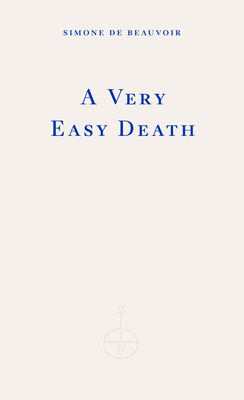 In October 1963, de Beauvoir was in Rome when she got a call informing her that her mother had had an accident. Expecting the worst, she was relieved – if only temporarily – to hear that it was a fall at home, resulting in a broken femur. But when Françoise de Beauvoir got to the hospital, what at first looked like peritonitis was diagnosed as stomach cancer with an intestinal obstruction. Her daughters knew that she was dying, but she had no idea (from what I’ve read, this paternalistic notion that patients must be treated like children and kept ignorant of their prognosis is more common on the Continent, and continues even today).
Over the next month, de Beauvoir and her sister Poupette took turns visiting. Initially alarmed by their mother’s condition, they soon grew used to the deterioration. “I was not worried by her nakedness any more: it was no longer my mother, but a poor tormented body.” They found her in varying states of awareness and discomfort. “In this race between pain and death we most earnestly hoped that death would come first.” Some nurses were better than others. De Beauvoir makes tantalizing references to the standoff between her and her mother about the Catholic faith Simone left behind. (I’ll need to read Memoirs of a Dutiful Daughter for more on that.) Even the hope of heaven didn’t fully neutralize self-pity and physical suffering for the dying woman because she feared her daughters wouldn’t be joining her.
The title is what a nurse told the grieving daughters: that their mother’s had been a very easy death in the end (and an upper-class one, de Beauvoir adds). The word used in French for easy, douce, can also be translated as “gentle,” a tie-in to the epigraph from Dylan Thomas’s “Do not go gentle into that good night.” Is it better for a loved one to die suddenly, or protractedly? I’ve debated this with myself and a few others since my mother’s death from a stroke in October. Ultimately, it’s pointless to ask; any death is an affront, hard to accept and adjust to no matter how much warning is given. I appreciated how matter-of-factly and concisely de Beauvoir’s essay encapsulates the duties and feelings surrounding a death. Frank and unshowy yet potent, this is a classic of the subgenre. 
Published as Fitzcarraldo Editions Classics No. 2 in June. With thanks to the publisher for the free copy for review.
(Books of Summer, #10)
Finn Family Moomintroll by Tove Jansson (1948; 1950)
[Translated from the Swedish by Elizabeth Portch]
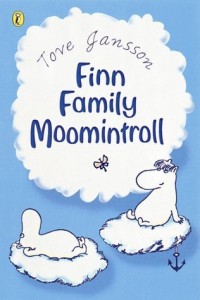 My sixth Moomins book, and ninth by Jansson overall. The novella’s gentle peril is set in motion by the discovery of the Hobgoblin’s Hat, which transforms anything placed within it. As spring moves into summer, this causes all kind of mild mischief until Thingumy and Bob, who speak in spoonerisms, show up with a suitcase containing something desired by both the Groke and the Hobgoblin, and make a deal that stops the disruptions.
As always, the creatures and events, conveyed by Jansson’s black-and-white drawings as much as by her words, are inventive and whimsical. There’s a cosy charm to the seasonal rituals, like the end-of-summer pancake party here. But what I value even more is the pointed accounts of the secondary characters’ neuroses. The Moomins are generally on a pretty even keel, though there is mention of Moominpappa’s sense of being hard done by because of childhood bullying and an enduring lack of respect. However, characters like the Muskrat and the Hemulen get a wry smile and shake of the head from me because their predicaments are so familiar: The Muskrat, terrified of mortifying situations, decides the life of a hermit might be preferable; the Hemulen gives up stamp collecting and switches to botanizing because there’s no joy in a finished quest, only in an ongoing search. The Moomins books offer the perfect combination of the familial and routine with the novel and adventurous. Even staid adults should give them a try. (Little Free Library)
Self-Portrait in Green by Marie NDiaye (2005; 2015)
[Translated from the French by Jordan Stump]
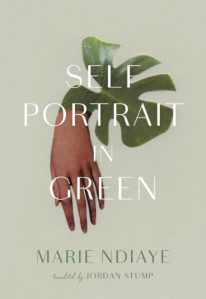 I tend to love a memoir that tries something new or experimental with the form (such as Constructing a Nervous System or In the Dream House), but this was a step too far for me; the self referred to in the title is almost wholly absent. NDiaye, a French–Senegalese author, opens in 2003 with the expected flooding of the Garonne in southwest France. Fragments of narrative from 2000–2003 chart her encounters with various women dressed in green, starting with one she thinks she sees under a banana tree (though her four children see nothing). Then there’s Katia Depetiteville, dead 10 years … NDiaye’s stepmother, once her childhood best friend; her friend Jenny’s rival for Ivan’s affection; and her mother, who now has a new family. What is a ‘woman in green’? The author explicitly associates the colour with cruelty, with presumably the usual connotation of jealousy as well. But it still feels arbitrary.
It’s all rather dreamlike, with poetic repetition, rhetorical questions and black-and-white photos that seem marginally relevant. “I’m saying to myself: Is all this really real?” NDiaye writes, and the reader will surely be asking the same. “I’m always interested in stories,” she adds, and while I’d agree, I need to know that they’re being told to build to some greater meaning. It was only in the last fifth of the book, when the author goes to a literary symposium in Ouagadougou and visits her father (a many-times-married former restaurateur and amateur architect now suffering from cataracts) and stepmother that I felt like there was a purpose: a bringing together of past and present for psychological clarity. I was relieved that this was only 112 pages. (Edelweiss) 
The 10th anniversary edition is being reissued by Two Lines Press next month.
And a bonus preview:
Cross-Stitch by Jazmina Barrera (2021; 2023)
[Translated from the Spanish by Christina MacSweeney]
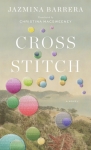 In the inventive debut novel by Mexican author Jazmina Barrera, a sudden death provokes an intricate examination of three young women’s years of shifting friendship. Their shared hobby of embroidery occasions a history of women’s handiwork, woven into a relationship study that will remind readers of works by Elena Ferrante and Deborah Levy. Citlali, Dalia, and Mila had been best friends since middle school. Mila, a writer with a young daughter, is blindsided by news that Citlali has drowned off Senegal. While waiting to be reunited with Dalia for Citlali’s memorial service, she browses her journal to revisit key moments from their friendship, especially travels in Europe and to a Mexican village. Cross-stitch becomes its own metaphorical language, passed on by female ancestors and transmitted across social classes. Reminiscent of Still Born and A Ghost in the Throat. (Edelweiss)
Coming out on 7 November from Two Lines Press. My full review for Shelf Awareness is pending.
Book Serendipity, Mid-February to Mid-April
I call it “Book Serendipity” when two or more books that I read at the same time or in quick succession have something in common – the more bizarre, the better. This is a regular feature of mine every couple of months. Because I usually have 20–30 books on the go at once, I suppose I’m more prone to such incidents. The following are in roughly chronological order.
Last time, my biggest set of coincidences was around books set in or about Korea or by Korean authors; this time it was Ghana and Ghanaian authors:
- Reading two books set in Ghana at the same time: Fledgling by Hannah Bourne-Taylor and His Only Wife by Peace Adzo Medie. I had also read a third book set in Ghana, What Napoleon Could Not Do by DK Nnuro, early in the year and then found its title phrase (i.e., “you have done what Napoleon could not do,” an expression of praise) quoted in the Medie! It must be a popular saying there.
- Reading two books by young Ghanaian British authors at the same time: Quiet by Victoria Adukwei Bulley and Maame by Jessica George.


And the rest:
- An overweight male character with gout in Where the God of Love Hangs Out by Amy Bloom and The Secret Diaries of Charles Ignatius Sancho by Paterson Joseph.
- I’d never heard of “shoegaze music” before I saw it in Michelle Zauner’s bio at the back of Crying in H Mart, but then I also saw it mentioned in Pulling the Chariot of the Sun by Shane McCrae.
- Sheila Heti’s writing on motherhood is quoted in Without Children by Peggy O’Donnell Heffington and In Vitro by Isabel Zapata. Before long I got back into her novel Pure Colour. A quote from another of her books (How Should a Person Be?) is one of the epigraphs to Lorrie Moore’s I Am Homeless If This Is Not My Home.


- Reading two Mexican books about motherhood at the same time: Still Born by Guadalupe Nettel and In Vitro by Isabel Zapata.
- Two coming-of-age novels set on the cusp of war in 1939: The Inner Circle by T.C. Boyle and Martha Quest by Doris Lessing.
- A scene of looking at peculiar human behaviour and imagining how David Attenborough would narrate it in a documentary in Notes from a Small Island by Bill Bryson and I Have Some Questions for You by Rebecca Makkai.
- The painter Caravaggio is mentioned in a novel (The Things We Do to Our Friends by Heather Darwent) plus two poetry books (The Fourth Sister by Laura Scott and Manorism by Yomi Sode) I was reading at the same time.


- Characters are plagued by mosquitoes in The Last Animal by Ramona Ausubel and Through the Groves by Anne Hull.
- Edinburgh’s history of grave robbing is mentioned in The Things We Do to Our Friends by Heather Darwent and Womb by Leah Hazard.
- I read a chapter about mayflies in Lev Parikian’s book Taking Flight and then a poem about mayflies later the same day in Ephemeron by Fiona Benson.
- Childhood reminiscences about playing the board game Operation and wetting the bed appear in Homesick by Jennifer Croft and Through the Groves by Anne Hull.

- Fiddler on the Roof songs are mentioned in Through the Groves by Anne Hull and We All Want Impossible Things by Catherine Newman.
- There’s a minor character named Frith in Shadow Girls by Carol Birch and Rebecca by Daphne du Maurier.
- Scenes of a female couple snogging in a bar bathroom in Through the Groves by Anne Hull and The Garnett Girls by Georgina Moore.

- The main character regrets not spending more time with her father before his sudden death in Maame by Jessica George and Pure Colour by Sheila Heti.
- The main character is called Mira in Birnam Wood by Eleanor Catton and Pure Colour by Sheila Heti, and a Mira is briefly mentioned in one of the stories in Before You Suffocate Your Own Fool Self by Danielle Evans.
- Macbeth references in Shadow Girls by Carol Birch and Birnam Wood by Eleanor Catton – my second Macbeth-sourced title in recent times, after Tomorrow and Tomorrow and Tomorrow by Gabrielle Zevin last year.


- A ‘Goldilocks scenario’ is referred to in Womb by Leah Hazard (the ideal contraction strength) and Taking Flight by Lev Parikian (the ideal body weight for a bird).
- Caribbean patois and mention of an ackee tree in the short story collection If I Survive You by Jonathan Escoffery and the poetry collection Cane, Corn & Gully by Safiya Kamaria Kinshasa.
- The Japanese folktale “The Boy Who Drew Cats” appeared in Our Missing Hearts by Celeste Ng, which I read last year, and then also in Enchantment by Katherine May.


- Chinese characters are mentioned to have taken part in the Tiananmen Square massacre/June 4th incident in Dear Chrysanthemums by Fiona Sze-Lorrain and Oh My Mother! by Connie Wang.
- Endometriosis comes up in What My Bones Know by Stephanie Foo and Womb by Leah Hazard.

What’s the weirdest reading coincidence you’ve had lately?
#ReadIndies and Review Catch-up: Hazrat, Nettel, Peacock, Seldon
Another four selections for Read Indies month. I’m particularly pleased that two from this latest batch are “just because” books that I picked up off my shelves; another two are catch-up review copies. A few more indie titles will appear in my February roundup on Tuesday. For today, I have a fun variety: a history of the exclamation point, a Mexican novel about choosing motherhood versus being childfree, a memoir of a decades-long friendship between two poets, and a posthumous poetry collection with themes of history, illness and nature.

An Admirable Point: A brief history of the exclamation mark by Florence Hazrat (2022)
I’m definitely a punctuation geek. (My favourite punctuation mark is the semicolon, and there’s a book about it, too: Semicolon: The Past, Present, and Future of a Misunderstood Mark by Cecelia Watson, which I have on my Kindle.) One might think that strings of exclamation points are a pretty new thing – rounding off phrases in (ex-)presidential tweets, for instance – but, in fact, Hazrat opens with a Boston Gazette headline from 1788 that decried “CORRUPTION AND BRIBERY!!!” in relation to the adoption of the new Constitution.
 The exclamation mark as we know it has been around since 1399, and by the 16th century its use for expression and emphasis had been codified. I was reminded of Gretchen McCulloch’s discussion of emoji in Because Internet, which also considers how written speech signifies tone, especially in the digital age. There have been various proposals for other “intonation points” over the centuries, but the question mark and exclamation mark are the two that have stuck. (Though I’m currently listening to an album called interrobang – ‽, that is. Invented by Martin Speckter in 1962; recorded by Switchfoot in 2021.)
I most enjoyed Chapter 3, on punctuation in literature. Jane Austen’s original manuscripts, replete with dashes, ampersands and exclamation points, were tidied up considerably before they made it into book form. She’s literature’s third most liberal user of exclamation marks, in terms of the number per 100,000 words, according to a chart Ben Blatt drew up in 2017, topped only by Tom Wolfe and James Joyce.
There are also sections on the use of exclamation points in propaganda and political campaigns – in conjunction with fonts, which brought to mind Simon Garfield’s Just My Type and the graphic novel ABC of Typography. It might seem to have a niche subject, but at just over 150 pages this is a cheery and diverting read for word nerds.
With thanks to Profile Books for the proof copy for review.
Still Born by Guadalupe Nettel (2020; 2022)
[Translated from the Spanish by Rosalind Harvey]
This was the Mexican author’s fourth novel; she’s also a magazine director and has published several short story collections. I’d liken it to a cross between Motherhood by Sheila Heti and (the second half of) No One Is Talking About This by Patricia Lockwood. Thirtysomething friends Laura and Alina veer off in different directions, yet end up finding themselves in similar ethical dilemmas. Laura, who narrates, is adamant that she doesn’t want children, and follows through with sterilization. However, when she becomes enmeshed in a situation with her neighbours – Doris, who’s been left by her abusive husband, and her troubled son Nicolás – she understands some of the emotional burden of motherhood. Even the pigeon nest she watches on her balcony presents a sort of morality play about parenthood.
 Meanwhile, Alina and her partner Aurelio embark on infertility treatment. Laura fears losing her friend: “Alina was about to disappear and join the sect of mothers, those creatures with no life of their own who, zombie-like, with huge bags under their eyes, lugged prams around the streets of the city.” They eventually have a daughter, Inés, but learn before her birth that brain defects may cause her to die in infancy or be severely disabled. Right from the start, Alina is conflicted. Will she cling to Inés no matter her condition, or let her go? And with various unhealthy coping mechanisms to hand, will her relationship with Aurelio stay the course?
Laura alternates between her life and her friends’ circumstances, taking on an omniscient voice on Nettel’s behalf – she recounts details she couldn’t possibly be privy to, at least not at the time (there’s a similar strategy in The Group by Lara Feigel). The question of what is fated versus what is chosen, also represented by Laura’s interest in tarot and palm-reading, always appeals to me. This was a wry and sharp commentary on women’s options. (Giveaway win from Bookish Chat on Twitter)
Still Born was published by Fitzcarraldo Editions in the UK and is forthcoming from Bloomsbury in the USA on August 8th.
A Friend Sails in on a Poem by Molly Peacock (2022)
I’ve read one of Peacock’s poetry collections, The Analyst, as well as her biography of Mary Delany, The Paper Garden. I was delighted when she got in touch to offer a review copy of her latest memoir, which reflects on her nearly half a century of friendship with fellow poet Phillis Levin. They met in a Johns Hopkins University writing seminar in 1976, and ever since have shared their work in progress over meals. They are seven years apart in age and their careers took different routes – Peacock headed up the Poetry Society of America’s subway poetry project and then moved to Toronto, while Levin taught at the University of Maryland – but over the years they developed “a sense of trust that really does feel familial … There is a weird way, in our conversations about poetry, that we share a single soul.” For a time they were both based in New York City and had the same therapist; more recently, they arranged annual summer poetry retreats in Cazenovia (recalled via diary entries), with just the two attendees. Jobs and lovers came and went, but their bond has endured.
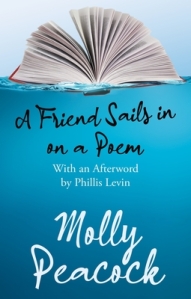 The book traces their lives but also their development as poets, through examples of their verse. Her friend is “Phillis” in real life, but “Levin” when it’s her work is being discussed – and her own poems are as written by “Peacock.” Both women became devoted to the sonnet, an unusual choice because at the time that they were graduate students free verse reigned and form was something one had to learn on one’s own time. Stanza means “room,” Peacock reminds readers, and she believes there is something about form that opens up space, almost literally but certainly metaphorically, to re-examine experience. She repeatedly tracks how traumatic childhood events, as much as everyday observations, were transmuted into her poetry. Levin did so, too, but with an opposite approach: intellectual and universal where Peacock was carnal and personal. That paradox of difference yet likeness is the essence of the friendships we sail on. What a lovely read, especially if you’re curious about ‘where poems come from’; I’d particularly recommend it to fans of Ann Patchett’s Truth and Beauty.
With thanks to Molly Peacock and Palimpsest Press for the free e-copy for review.
The Bright White Tree by Joanna Seldon (Worple Press, 2017)
This appeared the year after Seldon died of cancer; were it not for her untimely end and her famous husband Anthony (a historian and political biographer), I’m not sure it would have been published, as the poetry is fairly mediocre, with some obvious rhymes and twee sentiments. I wouldn’t want to speak ill of the dead, though, so think of this more like a self-published work collected in tribute, and then no problem. Some of the poems were written from the Royal Marsden Hospital, with “Advice” a useful rundown of how to be there for a friend undergoing cancer treatment (text to let them know you’re thinking of them; check before calling, or visiting briefly; bring sanctioned snacks; don’t be afraid to ask after their health).
 Seldon takes inspiration from history (the story of Kitty Pakenham, the bombing of the Bamiyan Buddhas), travels in England and abroad (“Robin in York” vs. “Tuscan Garden”), and family history. Her Jewish heritage is clear from poems about Israel, National Holocaust Memorial Day and Rosh Hashanah. Her own suffering is put into perspective in “A Cancer Patient Visits Auschwitz.” There are also ekphrastic responses to art and literature (a Gaugin, A Winter’s Tale, Jane Eyre, and so on). I particularly liked “Conker,” a reminder of a departed loved one “So is a good life packed full of doing / That may grow warm with others, even when / The many years have turned, and darkness filled / Places where memory shone bright and strong. / I feel the conker and feel he is here.” (New bargain book from Waterstones online sale with Christmas book token)
There are haikus dotted through the collection; here’s one perfect for the season:
“Snowdrops Haiku”
Maids demure, white tips to
Mob caps… Look now! They’ve
Splattered the lawn with snow
Have you discovered any new-to-you independent publishers recently?
 Bookish Beck = Rebecca Foster. American transplant to England. Freelance proofreader and book reviewer.
 Bookish Beck