2020 Reading Goals and Anticipated Releases
Review copies have started to feel like an obligation I don’t want. Almost as soon as one comes through the door, I regret having asked for or accepted it. (Now I have to read the danged thing, and follow through with a review!) So I’m going to cut back severely this year. The idea is to wait until late in 2020 to figure out which are the really worthwhile releases, and then only read those instead of wading through a lot of mediocre stuff.
“Until one has some kind of professional relationship with books one does not discover how bad the majority of them are. In much more than nine cases out of ten the only objectively truthful criticism would be ‘This book is worthless,’ while the truth about the reviewer’s own reaction would probably be ‘This book does not interest me in any way, and I would not write about it unless I were paid to’. … The best practice, it has always seemed to me, would be simply to ignore the great majority of books and to give very long reviews … to the few that seem to matter.” (from “Confessions of a Book Reviewer” in Books v. Cigarettes by George Orwell)
These are the January to May 2020 releases I own so far, with perhaps a few more on the way. I acquired a lot of these in September through November, before I made the decision to cut down on review copies.

I’m also looking forward to new books by Sebastian Barry, Susanna Clarke, Stephanie Danler, Anne Enright, Yaa Gyasi, John Irving, Daisy Johnson, Daniel Kehlmann, Sue Monk Kidd, Rebecca Dinerstein Knight, Maya Shanbhag Lang, Helen Macdonald, Hilary Mantel, David Mitchell, Sarah Moss, Mark O’Connell, Maggie O’Farrell, Anne Tyler, Abraham Verghese, Raynor Winn and Molly Wizenberg.
I can still access new/pre-release books via my public library and NetGalley/Edelweiss, especially fiction to review for BookBrowse and nonfiction for Kirkus and the TLS.
This resolution is not about denying or punishing myself, as bloggers’ book-buying bans sometimes seem to be, so if an unmissable book (e.g. HAMNET) is offered on Twitter or via my blog, I won’t consider it cheating to say yes. FOMO will likely be a chronic condition for me this year, but ultimately I hope to do myself a favor.
With the reading time I’m saving, I plan to make major inroads into those 440 print books I own and haven’t read yet, and to do a lot of re-reading (I only managed one and a bit rereads in 2019). I might well blog less often and only feature those books that have been exceptional for me. I’ve set aside this shelf of mostly fiction that I think deserves re-reading soon:

“I do not think we go back to the exciting books,—they do not usually leave a good taste in the mouth; neither to the dull books, which leave no taste at all in the mouth; but to the quiet, mildly tonic and stimulating books,—books that have the virtues of sanity and good nature, and that keep faith with us.” (from “On the Re-Reading of Books” in Literary Values by John Burroughs)
I hope (as always) to read more classics, literature in translation and doorstoppers. Travel and biography are consistently neglected categories for me. Though I won’t set specific goals for these genres, I will aim to see measurable progress. I will also take advantage of the Wellcome Book Prize being on hiatus this year to catch up on some of the previous winners and shortlisted books that I’ve never managed to read.
Mostly, I want to avoid any situations that make me feel guilty or mean (so no more books received direct from the author, and any review books that disappoint will be quietly dropped), follow my whims, and enjoy my reading.
What are some of your goals (reading-related or otherwise) for 2020?
Other 2019 Superlatives and Some Statistics
My best discoveries of the year: The poetry of Tishani Doshi; Penelope Lively and Elizabeth Strout (whom I’d read before but not fully appreciated until this year); also, the classic nature writing of Edwin Way Teale.


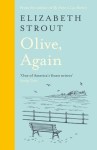
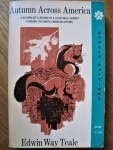
The authors I read the most by this year: Margaret Atwood and Janet Frame (each: 2 whole books plus parts of 2 more), followed by Doris Lessing (2 whole books plus part of 1 more), followed by Miriam Darlington, Paul Gallico, Penelope Lively, Rachel Mann and Ben Smith (each: 2 books).
Debut authors whose next work I’m most looking forward to: John Englehardt, Elizabeth Macneal, Stephen Rutt, Gail Simmons and Lara Williams.
My proudest reading achievement: A 613-page novel in verse (Mary Ann Sate, Imbecile by Alice Jolly) + 2 more books of over 600 pages (East of Eden by John Steinbeck and Cutting for Stone by Abraham Verghese).


Best book club selection: Red Dust Road by Jackie Kay was our first nonfiction book and received our highest score ever.
Some best first lines encountered this year:
 “What can you say about a twenty-five-year old girl who died?” (Love Story by Erich Segal)
- “The women of this family leaned towards extremes” (Away by Jane Urquhart)
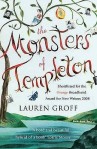
- “The day I returned to Templeton steeped in disgrace, the fifty-foot corpse of a monster surfaced in Lake Glimmerglass.” (from The Monsters of Templeton by Lauren Groff)
The downright strangest book I read this year: Lanny by Max Porter
The 2019 books everybody else loved (or so it seems), but I didn’t: Fleishman Is in Trouble by Taffy Brodesser-Akner, The Topeka School by Ben Lerner, Underland by Robert Macfarlane, The Boy, The Mole, The Fox and The Horse by Charlie Mackesy, Three Women by Lisa Taddeo and The Nickel Boys by Colson Whitehead
 The year’s major disappointments: Cape May by Chip Cheek, We Are the Weather: Saving the Planet Begins at Breakfast by Jonathan Safran Foer, Letters to the Earth: Writing to a Planet in Crisis, ed. Anna Hope et al., Bowlaway by Elizabeth McCracken, Rough Magic: Riding the World’s Loneliest Horse Race by Lara Prior-Palmer, The Lager Queen of Minnesota by J. Ryan Stradal, The Knife’s Edge by Stephen Westaby and Frankissstein by Jeanette Winterson
The worst book I read this year: Jonathan Livingston Seagull by Richard Bach
Some statistics on my 2019 reading:
Fiction: 45.4%
Nonfiction: 43.4%
Poetry: 11.2%
(As usual, fiction and nonfiction are neck and neck. I read a bit more poetry this year than last.)
Male author: 39.4%
Female author: 58.9%
Nonbinary author (the first time this category has been applicable for me): 0.85%
Multiple genders (anthologies): 0.85%
(I’ve said this the past three years: I find it interesting that female authors significantly outweigh male authors in my reading; I have never consciously set out to read more books by women.)
E-books: 10.3%
Print books: 89.7%
(My e-book reading has been declining year on year, partially because I’ve cut back on the reviewing gigs that involve only reading e-books and partially because I’ve done less traveling; also, increasingly, I find that I just prefer to sit down with a big stack of print books.)
Work in translation: 7.2%
(Lower than I’d like, but better than last year’s 4.8%.)
Where my books came from for the whole year:
- Free print or e-copy from publisher: 36.8%
- Public library: 21.3%
- Secondhand purchase: 13.8%
- Free (giveaways, The Book Thing of Baltimore, the free mall bookshop, etc.): 9.2%
- Downloaded from NetGalley, Edelweiss or Project Gutenberg: 7.8%
- Gifts: 4.3%
- University library: 2.9%
- New purchase (usually at a bargain price): 2.9%
- Church theological library: 0.8%
- Borrowed: 0.2%
(Review copies accounted for over a third of my reading; I’m going to scale way back on this next year. My library reading was similar to last year’s; my e-book reading decreased in general; I read more books that I either bought new or got for free.)
Number of unread print books in the house: 440
(Last thing I knew the figure was more like 300, so this is rather alarming. I blame the free mall bookshop, where I volunteer every Friday. Most weeks I end up bringing home at least a few books, but it’s often a whole stack. Surely you understand. Free books! No strings attached!)
Review Books Roundup: Blackburn, Bryson, Pocock, Setterwall, Wilson
I’m attempting to get through all my 2019 review books before the end of the year, so expect another couple of these roundups. Today I’m featuring a work of poetry about one of Picasso’s mistresses, a thorough yet accessible introduction to how the human body works, a memoir of personal and environmental change in the American West, Scandinavian autofiction about the sudden loss of a partner, and a novel about kids who catch on fire. You can’t say I don’t read a variety! See if one or more of these tempts you.
The Woman Who Always Loved Picasso by Julia Blackburn
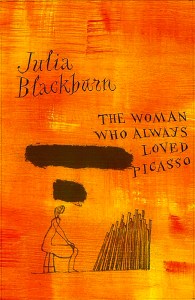 Something different from Blackburn: biographical snippets in verse about Marie-Thérèse Walter, one of Pablo Picasso’s many mistress-muses. When they met she was 17 and he was 46. She gave birth to a daughter, Maya – to his wife Olga’s fury. Marie-Thérèse’s existence was an open secret: he rented a Paris apartment for her to live in, and left his home in the South of France to her (where she committed suicide three years after his death), but unless their visits happened to overlap she was never introduced to his friends. “I lived in the time I was born into / and I kept silent, / acquiescing / to everything.”
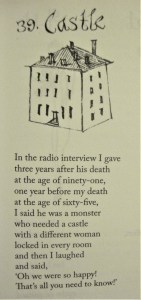 In Marie-Thérèse’s voice, Blackburn depicts Picasso as a fragile demagogue: in one of the poems that was a highlight for me, “Bird,” she describes how others would replace his caged birds when they died, hoping he wouldn’t notice – so great was his horror of death. I liked getting glimpses into a forgotten female’s life, and appreciated the whimsical illustrations by Jeffrey Fisher, but as poems these pieces don’t particularly stand out. (Plus, there are no page numbers! which doesn’t seem like it should make a big difference but ends up being annoying when you want to refer back to something. Instead, the poems are numbered.)
My rating: 
With thanks to Carcanet Press for the free copy for review. Published today.
The Body: A Guide for Occupants by Bill Bryson
 Shelve this next to Being Mortal by Atul Gawande in a collection of books everyone should read – even if you don’t normally choose nonfiction. Bryson is back on form here, indulging his layman’s curiosity. As you know, I read a LOT of medical memoirs and popular science. I’ve read entire books on organ transplantation, sleep, dementia, the blood, the heart, evolutionary defects, surgery and so on, but in many cases these go into more detail than I need and I can find my interest waning. That never happens here. Without ever being superficial or patronizing, the author gives a comprehensive introduction to every organ and body system, moving briskly between engaging anecdotes from medical history and encapsulated research on everything from gut microbes to cancer treatment.
Bryson delights in our physical oddities, and his sense of wonder is infectious. He loves a good statistic, and while this book is full of numbers and percentages, they are accessible rather than obfuscating, and will make you shake your head in amazement. It’s a persistently cheerful book, even when discussing illness, scientists whose work was overlooked, and the inevitability of death. Yet what I found most sobering was the observation that, having conquered many diseases and extended our life expectancy, we are now overwhelmingly killed by lifestyle, mostly a poor diet of processed and sugary foods and lack of exercise.
My rating: 
With thanks to Doubleday for the free copy for review.
Surrender: Mid-Life in the American West by Joanna Pocock
 Prompted by two years spent in Missoula, Montana and the disorientation felt upon a return to London, this memoir-in-essays varies in scale from the big skies of the American West to the smallness of one human life and the experience of loss and change. Then in her late forties, Pocock had started menopause and recently been through the final illnesses and deaths of her parents, but was also mother to a fairly young daughter. She explores personal endings and contradictions as a kind of microcosm of the paradoxes of the Western USA.
It’s a place of fierce independence and conservatism, but also mystical back-to-the-land sentiment. For an outsider, so much of the lifestyle is bewildering. The author attends a wolf-trapping course, observes a Native American buffalo hunt, meets a transsexual rewilding activist, attends an ecosexuality conference, and goes foraging. All are attempts to reassess our connection with nature and ask what role humans can play in a diminished planet.
This is an elegantly introspective work that should engage anyone interested in women’s life writing and the environmental crisis. There are also dozens of black-and-white photographs interspersed in the text. In 2018 Pocock won the Fitzcarraldo Editions Essay Prize for this work-in-progress. It came to me as an unsolicited review copy and hung around on my shelves for six months before I picked it up; I’m glad I finally did.
My rating: 
With thanks to Fitzcarraldo Editions for the free copy for review.
Let’s Hope for the Best by Carolina Setterwall
[Trans. from the Swedish by Elizabeth Clark Wessel]
 Although this is fiction, it very closely resembles the author’s own life. She wrote this debut novel to reflect on the sudden loss of her partner and how she started to rebuild her life in the years that followed. It quickly splits into two parallel story lines: one begins in April 2009, when Carolina first met Aksel at a friend’s big summer bash; the other picks up in October 2014, after Aksel’s death from cardiac arrest. The latter proceeds slowly, painstakingly, to portray the aftermath of bereavement. In the alternating timeline, we see Carolina and Aksel making their life together, with her always being the one to push the relationship forward.
Setterwall addresses the whole book in the second person to Aksel. When the two story lines meet at about the two-thirds point, it carries on into 2016 as she moves house, returns to work and resumes a tentative social life, even falling in love. This is a wrenching story reminiscent of In Every Moment We Are Still Alive by Tom Malmquist, and much of it resonated with my sister’s experience of widowhood. There are many painful moments that stick in the memory. Overall, though, I think it was too long by 100+ pages; in aiming for comprehensiveness, it lost some of its power. Page 273, for instance (the first anniversary of Aksel’s death, rather than the second, where the book actually ends), would have made a fine ending.
My rating: 
With thanks to Bloomsbury UK for the proof copy for review.
Nothing to See Here by Kevin Wilson
 I’d read a lot about this novel while writing a synopsis and summary of critical opinion for Bookmarks magazine – perhaps too much, as it felt familiar and offered no surprises. Lillian, a drifting twentysomething, is offered a job as a governess for her boarding school roommate Madison’s stepchildren. Madison’s husband is a Tennessee senator in the running for the Secretary of State position, so it’s imperative that they keep a lid on the situation with his 10-year-old twins, Bessie and Roland.
You see, when they’re upset these children catch on fire; flames destroy their clothes and damage nearby soft furnishings, but leave the kids themselves unharmed. Temporary, generally innocuous spontaneous combustion? Okay. That’s the setup. Wilson writes so well that it’s easy to suspend your disbelief about this, but harder to see a larger point, except perhaps creating a general allegory for the challenges of parenting. This was entertaining enough, mostly thanks to Lillian’s no-nonsense narration, but for me it didn’t soar.
My rating:
With thanks to Text Publishing UK for the PDF for review. This came out in the States in October and will be released in the UK on January 30th.
Would you be interested in reading one or more of these?
Novellas in November Wrap-Up and Mini-Reviews
Novellas in November is one of my favorite blogging challenges of the year. Earlier in the month I reviewed a first batch of five novellas. For this second and final installment I have 11 small books to feed back on: fiction, graphic novels, and miscellaneous nonfiction.

Classic of the Month
Giovanni’s Room by James Baldwin (1956)
[150 pages]
 This was my first taste of Baldwin’s fiction, and it was very good indeed. David, a penniless American, came to Paris to find himself. His second year there he meets Giovanni, an Italian barman. They fall in love and move in together. There’s a problem, though: David has a fiancée – Hella, who’s traveling in Spain. It seems that David had bisexual tendencies but went off women after Giovanni. “Much has been written of love turning to hatred, of the heart growing cold with the death of love.” We know from the first pages that David has fled to the south of France and Giovanni faces the guillotine in the morning, but all through Baldwin maintains the tension as we wait to hear why he is sentenced to death. Deeply sad, but also powerful and brave. I’ll make Go Tell It on the Mountain my next one by Baldwin.
Graphic Novels
 Garfield, Why Do You Hate Mondays? by Jim Davis (1982)
[128 pages]
This was like a trip back to childhood, as “Garfield” was always the first thing I would turn to in the Sunday comics section of the Washington Post. The story of the tubby, lasagna-stealing, dog-outsmarting ginger cat even managed to feel relevant to my life now, since our furball is on a perpetual diet – and it’s working, he’s actually lost most of a kilo this year! Most of the three-pane pages are stand-alones in which Garfield gets into scrapes or plays pranks. Fat jokes abound. There is actually a narrative in the latter half, though: Garfield stows away in Jon’s suitcase on a vacation to Hawaii and gets locked up in the local pound. He and a couple of other cats have to team up to escape. [To my amusement, two photos of a bust-up Nissan were being used as bookmarks in the copy that came into the free bookshop where I volunteer.]

Reading Quirks: Weird Things that Bookish Nerds Do! by The Wild Detectives (2019)
[96 pages]
 This is a collected comic strip that appeared on Instagram between 2016 and 2018 (you can view it in full here). The brainchild of bookstore/bar owners in Dallas, Texas, it highlights behaviors that many might find strange but that make total sense to a bibliophile: buying multiple copies of a book so that your less-careful partner doesn’t ruin yours or you don’t lose a friend when they fail to return a borrowed copy; being so glued to a book that you take it everywhere; buying a coat with an eye to whether the pockets accommodate a paperback; exulting at a broken leg for the extra reading time a temporary handicap could buy you; reading with a headtorch after a bedmate has gone to sleep; and so on. The simple four-pane comics usually contain just one or two colors. The captions add as much as the dialogue. Read this next if you enjoyed Book Love by Debbie Tung.

Other Fiction
Jonathan Livingston Seagull by Richard Bach (1972)
[93 pages]
 I was curious about this bestselling fable, but wish I’d left it to its 1970s oblivion. The title seagull stands out from the flock for his desire to fly higher and faster than seen before. He’s not content to be like all the rest; once he arrives in birdie heaven he starts teaching other gulls how to live out their perfect freedom. “We can lift ourselves out of ignorance, we can find ourselves as creatures of excellence and intelligence and skill.” Gradually comes the sinking realization that JLS is a Messiah figure. I repeat, the seagull is Jesus. (“They are saying in the Flock that if you are not the Son of the Great Gull Himself … then you are a thousand years ahead of your time.”) An obvious allegory, unlikely dialogue, dated metaphors (“like a streamlined feathered computer”), cringe-worthy New Age sentiments and loads of poor-quality soft-focus photographs: This was utterly atrocious.
Agatha by Anne Cathrine Bomann (2019)
[Trans. from the Danish by Caroline Waight; 147 pages]
 In late-1940s Paris, a psychiatrist counts down the days and appointments until his retirement. He’s so jaded that he barely listens to his patients anymore. “Was I just lazy, or was I genuinely so arrogant that I’d become bored by other people’s misery?” he asks himself. A few experiences awaken him from his apathy: learning that his longtime secretary’s husband has terminal cancer and visiting the man for some straight talk about death; discovering that the neighbor he’s never met, but only known via piano playing through the wall, is deaf, and striking up a friendship with him; and meeting Agatha, a new German patient with a history of self-harm, and vowing to get to the bottom of her trauma. This debut novel by a psychologist (and table tennis champion) is a touching, subtle and gently funny story of rediscovering one’s purpose late in life.
Agatha will be released on 12th December. With thanks to Sceptre for the proof copy for review.
The Dig by Cynan Jones (2014)
[156 pages]
 Daniel is a recently widowed farmer in rural Wales. On his own for the challenges of lambing, he hates who he’s become. “She would not have liked this anger in me. I was not an angry man.” In the meantime, a badger-baiter worries the police are getting wise to his nocturnal misdemeanors and looks for a new, remote locale to dig for badgers. I kept waiting for these two story lines to meet explosively, but instead they just fizzle out. I should have been prepared for the animal cruelty I’d encounter here, but it still bothered me. Even the descriptions of lambing, and of Daniel’s wife’s death, are brutal. Jones’s writing reminded me of Andrew Michael Hurley’s; while I did appreciate the observation that violence begets more violence in groups of men (“It was the gangness of it”), this was a tough read for me.
Nonfiction
Shelf Respect: A Book Lover’s Defence by Annie Austen (2019)
[183 pages, but with large type and not many words on a page]
 This seems destined to be in many a bibliophile’s Christmas stocking this year. It’s a collection of mini-essays, quotations and listicles on topics such as DNFing, merging your book collection with a new partner’s, famous bibliophiles and bookshelves from history, and how you choose to organize your library. It’s full of fun trivia. Two of my favorite factoids: Bill Clinton keeps track of his books via a computerized database, and the original title of Hemingway’s A Farewell to Arms was “I Have Committed Fornication but that Was in Another Country” (really?!). It’s scattered and shallow, but fun in the same way that Book Riot articles generally are. (I almost always click through to 2–5 articles in my Book Riot e-newsletters, so that’s no problem in my book.) I couldn’t find a single piece of information on ‘Annie Austen’, not even a photo – I sincerely doubt she’s that Kansas City lifestyle blogger, for instance – so I suspect she’s actually a collective of interns.

An illustration of Barack Obama’s summer 2016 reads.
With thanks to Sphere for the free copy for review.
Intoxicated by My Illness: And Other Writings on Life and Death by Anatole Broyard (1992)
[135 pages]
 This posthumous collection brings together essays Broyard wrote for the New York Times after being diagnosed with metastatic prostate cancer in 1989, journal entries, a piece he’d written after his father’s death from bladder cancer in 1954, and essays from the early 1980s about “the literature of death.” He writes to impose a narrative on his illness, expatiating on what he expects of his doctor and how he plans to live with style even as he’s dying. “If you have to die, and I hope you don’t, I think you should try to die the most beautiful death you can,” he charmingly suggests. It’s ironic that he laments a dearth of literature (apart from Susan Sontag) about illness and dying – if only he could have seen the flourishing of cancer memoirs in the last two decades! [An interesting footnote: in 2007 Broyard’s daughter Bliss published a memoir, One Drop: My Father’s Hidden Life—A Story of Race and Family Secrets, about finding out that her father was in fact black but had passed as white his whole life. I’ll be keen to read that.]
Sold for a Farthing by Clare Kipps (1953)
[72 pages]
 This was a random 50p find at the Hay-on-Wye market on our last trip. In July 1940 Kipps adopted a house sparrow that had fallen out of the nest – or, perhaps, been thrown out for having a deformed wing and foot. Clarence became her beloved pet, living for just over 12 years until dying of old age. A former professional musician, Kipps served as an air-raid warden during the war; she and Clarence had a couple of close shaves and had to evacuate London at one point. Clarence sang more beautifully than the average sparrow and could do a card trick and play dead. He loved to nestle inside Kipps’s blouse and join her for naps under the duvet. At age 11 he had a stroke, but vet attention (and champagne) kept him going for another year, though with less vitality. This is sweet but not saccharine, and holds interest for its window onto domesticated birds’ behavior. With photos, and a foreword by Julian Huxley.

A Year Lost and Found by Michael Mayne (1987)
[82 pages]
 Mayne was vicar at the university church in Cambridge when he came down with a mysterious, debilitating illness, only later diagnosed as myalgic encephalomyelitis or post-viral fatigue syndrome. During his illness he was offered the job of Dean of Westminster, and accepted the post even though he worried about his ability to carry out his duties. He writes of his frustration at not getting better and receiving no answers from doctors, but much of this short memoir is – unsurprisingly, I suppose – given over to theological musings on the nature of suffering, with lots of quotations (too many) from theologians and poets. Curiously, he also uses Broyard’s word, speaking of the “intoxication of convalescence.”
Ordinary Sacred: The Simple Beauty of Everyday Life by Kent Nerburn (2006)
[120 pages]
 The author has a PhD in religion and art and produced sculptures for a Benedictine abbey in British Columbia and the Peace Museum in Hiroshima. I worried this would be too New Agey for me, but at 20p from a closing-down charity shop, it was worth taking a chance on. Nerburn feels we are often too “busy with our daily obligations … to surround our hearts with the quiet that is necessary to hear life’s softer songs.” He tells pleasant stories of moments when he stopped to appreciate meaning and connection, like watching a man in a wheelchair fly a kite, setting aside his to-do list to have coffee with an ailing friend, and attending the funeral of a Native American man he once taught.
Total number of novellas read this month: 16 (compared to last year’s 26)
My overall favorite: Agatha by Anne Cathrine Bomann
Runners-up: Giovanni’s Room by James Baldwin, Intoxicated by My Illness by Anatole Broyard, and Hope in the Dark by Rebecca Solnit
What’s the best novella you’ve read recently? Do you like the sound of any of the ones I read?
Nonfiction Review Books Roundup: Hay, Hope et al., Lee, Long, McLaren, Zuckerman
I’m continuing with the Nonfiction November focus by catching up on six nonfiction review books I’ve been sent over the last half a year. We’ve got a record of elderly parents’ decline, letters and poems written about the climate crisis, a family memoir set between Taiwan and Canada, a widow’s mushroom-hunting quest, a work of ecotheology that reflects on travels in the Galápagos Islands, and a defense of an entirely secular basis for morality. You can’t say I don’t read a variety, even within nonfiction! See if one or more of these tempts you.
All Things Consoled: A Daughter’s Memoir by Elizabeth Hay
 Gordon and Jean Hay stumbled into their early nineties in an Ottawa retirement home starting in 2009. Elizabeth Hay is one of four children, but caregiving fell to her for one reason and another, and it was a fraught task because of her parents’ prickly personalities: Jean was critical and thrifty to the point of absurdity, spooning thick mold off apple sauce before serving it and needling Elizabeth for dumping perfectly good chicken juice a year before; Gordon had a terrible temper and a history of corporal punishment of his children and of his students when he was a school principal. Jean’s knee surgery and subsequent infection finally put paid to their independence; her mind was never the same and she could no longer paint.
There are many harsh moments in this memoir, but almost as many wry ones, with Hay picking just the right anecdotes to illustrate her parents’ behavior and the shifting family dynamic. She never looks away, no matter how hard it all gets. Her father’s rage against the dying of the light contrasts with her mother’s fade into confusion – lightened by the surprisingly poetic turns of phrase she came out with despite her dementia and aphasia. The title phrase, for instance, was her attempt at “all things considered.” I would wholeheartedly recommend this to readers of Hay’s novels, but anyone can appreciate the picture of complicated love and grief. (See also Susan’s review.)
With thanks to MacLehose Press for the free copy for review.
Letters to the Earth: Writing to a Planet in Crisis, edited by Anna Hope et al.
 Culture Declares Emergency launched in April to bring the arts into the conversation about the climate emergency. Letters to the Earth compiles 100 short pieces by known and unknown names alike. Alongside published authors, songwriters, professors and politicians are lots of ordinary folk, including children as young as seven. The brief was broad: to write a letter in response to environmental crisis, whether to or from the Earth, to future generations (there are wrenching pieces written to children: “What can I say, now that it’s too late? … that I’m sorry, that I tried,” writes Stuart Capstick), to the government or to other species.
There are certainly relatable emotions here, especially the feeling of helplessness. “We take the train, go vegan, refuse plastic, buy less and less. But that is tiny. We are tiny,” novelist Jo Baker writes. I loved retired bishop Richard Holloway’s wry letter calling the author of Genesis to account for unhelpful language of dominion, Rob Cowen’s poem to a starling, and Anna Hope’s essay about parenting in a time of uncertainty. Unfortunately, much of the rest is twee or haranguing, e.g. “Forest fires are scorching INNOCENT wildlife. Plastic is strangling INNOCENT turtles and dolphins,” a 12-year-old writes. This was put together in a matter of months, and it shows. There is not enough tonal variety, a lot of overwriting has crept through, and errors, especially in the kids’ work, remain uncorrected. Perhaps six to 10 pieces stood out to me overall. I’d recommend the Extinction Rebellion handbook instead.
With thanks to Alison Menzies / William Collins for the free copy for review.
Two Trees Make a Forest: On Memory, Migration and Taiwan by Jessica J. Lee
 I loved Turning, Lee’s 2017 memoir about swimming in one of Berlin’s lakes per week for a year, so I jumped at the chance to read her follow-up, which delves into her maternal line’s history in Taiwan. She travels to Taipei for three months to brush up on her Chinese, write and hike. Interspersed with the lush descriptions of her walks are reflections on Taiwan’s history and on the hidden aspects of her grandfather Gong’s past that only came to light after Lee’s grandmother, Po, died and she and her mother discovered an autobiographical letter he’d written before he drifted into dementia. Nature, language, history and memory flow together in a delicate blend of genres – “I moved from the human timescale of my family’s story through green and unfurling dendrological time,” she writes.
This has got to be one of the most striking title and cover combinations of the year. Along with Chinese characters, the book includes some looping text and Nico Taylor’s maps and illustrations of Taiwanese flora and fauna. While you will likely get more out of this if you have a particular interest in Asian history, languages and culture, it’s impressive how Lee brings the different strands of her story together to form a hybrid nature memoir that I hope will be recognized by next year’s Wainwright Prize and Young Writer of the Year Award shortlists. She’d also be a perfect New Networks for Nature speaker.
With thanks to Virago for the free copy for review.
The Way through the Woods: Of Mushrooms and Mourning by Long Lit Woon
 [Trans. from the Norwegian by Barbara J. Haveland]
I couldn’t resist the sound of a bereavement memoir crossed with a mushroom hunting guide. When Long met her husband, Eiolf Olsen, she was an 18-year-old Malaysian exchange student in Stavanger, Norway. Meeting Eiolf changed the whole course of her life, keeping her in Europe for good; decades later, her life changed forever once again when Eiolf dropped dead at work one morning. “If anyone had told me that mushrooms would be my lifeline, the thing that would help me back onto my feet and quite literally back onto life’s track, I would have rolled my eyes. What had mushrooms to do with mourning?” she writes.
 The answer to that rhetorical question is nothing much, at least not inherently, so this ends up becoming a book of two parts, with the bereavement strand (printed in green and in a different font – green is for grief? I suppose) engaging me much more than the mushroom-hunting one, which takes her to Central Park and the annual Telluride, Colorado mushroom festival as well as to Norway’s woods again and again – “In Norway, outdoor life is tantamount to a religion.” But the quest for wonder and for meaning is a universal one. In addition, if you’re a mushroom fan you’ll find gathering advice, tasting notes, and even recipes. I fancy trying the “mushroom bacon” made out of oven-dried shiitakes.
With thanks to Scribe for the free copy for review.
God Unbound: Theology in the Wild by Brian McLaren
 McLaren was commissioned to launch a series that was part travel guide, part spiritual memoir and part theological reflection. Specifically, he was asked to write about the Galápagos Islands because he’d been before and they were important to him. He joins a six-day eco-cruise that tours around the island chain off Ecuador, with little to do except observe the birds, tortoises and iguanas, and swim with fish and sea turtles. For him this is a peaceful, even sacred place that reminds him of the beauty that still exists in the world despite so much human desecration. Although he avoids using his phone except to quickly check in with his wife, modernity encroaches unhelpfully through a potential disaster with his laptop.
I was surprised to see that McLaren leaves the Galápagos at the midpoint – whatever could fill the rest of the book, I wondered? He starts by reassessing Darwin, so often painted as a villain by Evangelical Christianity but actually a model of close, loving attention to nature. He also recalls how some of his most intense spiritual experiences have arisen from time in nature. McLaren’s books have been pivotal to my spiritual journey as we’ve both gradually become more liberal and environmentalist. His definition of God might horrify traditionalists, but holds appeal for me: “a centering singularity whose gravity holds me in insistent orbit, pulling me deeper into mystery, pondering who I am and what my life means.” This is an unusual but gently entrancing book full of photos and quotes from other thinkers including John Muir, Pope Francis and Richard Rohr. It’s an ideal introduction to ecotheology.
With thanks to Canterbury Press for the free copy for review.
What It Means to Be Moral: Why Religion Is Not Necessary for Living an Ethical Life by Phil Zuckerman
 From one end of the spectrum (progressive Christianity) to the other (atheism). Here’s a different perspective from a sociology professor at California’s Pitzer College. Zuckerman’s central argument is that humanism and free choice can fuel ethical behavior; since there’s no proof of God’s existence and theists have such a wide range of beliefs, it’s absurd to slap a “because God says so” label on our subjective judgments. Morals maintain the small communities our primate ancestors evolved into, with specific views (such as on homosexuality) a result of our socialization. Alas, the in-group/out-group thinking from our evolutionary heritage is what can lead to genocide. Instead of thinking in terms of ‘evil’, though, Zuckerman prefers Dr. Simon Baron-Cohen’s term, “empathy erosion.”
To tackle violent crime, Zuckerman contends, we need a more equal society, with the Scandinavian countries a model of how to achieve that through higher taxes, social services and the rehabilitation of prisoners. He uses a lot of relatable examples from history and from his own experience, as well as theoretical situations, to think through practical morality. I found his indictment of American Christianity accurate – how does it make sense for people who say they follow the way of Jesus to fight against equality, tolerance and scientific advances and instead advocate guns, the death penalty and Trump? Well, indeed.
It might seem odd for me to recommend this alongside the McLaren, but there is much to be gained from both viewpoints. Zuckerman’s work overlaps a fair bit with another I’ve read on the topic, Richard Holloway’s Godless Morality – even a bishop agrees we needn’t take our societal ethics straight from the Bible! I can’t go along fully with Zuckerman because I think progressive religion has been and can continue to be a force for good, but I would agree that atheists can be just as moral as people of faith – and often more so.
With thanks to Counterpoint Press for sending a proof copy for review.
Would you be interested in reading one or more of these?
Women in the Polar Night: Christiane Ritter and Sigri Sandberg
I’m continuing a Nonfiction November focus with reviews of two recently (re-)released memoirs about women spending time in the Arctic north of Norway. I enjoy reading about survival in extreme situations – it’s the best kind of armchair traveling because you don’t have to experience the cold and privation for yourself.
A Woman in the Polar Night by Christiane Ritter (1938; English text, 1954)
[Translated by Jane Degras]
 In 1934, Ritter, an Austrian painter, joined her husband Hermann for a year in Spitsbergen. He’d participated in a scientific expedition and caught the Arctic bug, it seems, for he stayed on to fish and hunt. They shared a small, remote hut with a Norwegian trapper, Karl. Ritter was utterly unprepared for the daily struggle, having expected a year’s cozy retreat: “I could stay by the warm stove in the hut, knit socks, paint from the window, read thick books in the remote quiet and, not least, sleep to my heart’s content.” Before long she was disabused of her rosy vision. “It’s a ghastly country, I think to myself. Nothing but water, fog, and rain.” The stove failed. Dry goods ran out; they relied on fresh seal meat. Would they get enough vitamins? she worried. Every time Hermann and Karl set off hunting, leaving her alone in the hut, she feared they wouldn’t return. And soon the 132 straight days of darkness set in.
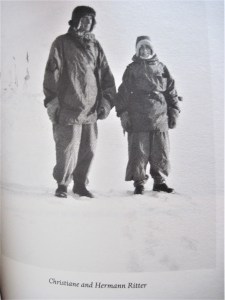 I was fascinated by the details of Ritter’s daily tasks, but also by how her perspective on the landscape changed. No longer a bleak wilderness, it became a tableau of grandeur. “A deep blue-green, the mountains rear up into a turquoise-coloured sky. From the mountaintops broad glaciers glittering in the sun flow down into the fjord.” She thought of the Arctic almost as a site of spiritual pilgrimage, where all that isn’t elemental falls away. “Forgotten are all externals; here everything is concerned with simple being.” The year is as if outside of time: she never reminisces about her life back home, and barely mentions their daughter. By the end you see that the experience has changed her: she’ll never fret over trivial things again. She lived to age 103 (only dying in 2000), so clearly the time in the Arctic did her no harm.
Ritter wrote only this one book. A travel classic, it has never been out of print in German but has been for 50 years in the UK. Pushkin Press is reissuing the English text on the 21st with a foreword by Sara Wheeler, a few period photographs and a hand-drawn map by Neil Gower.
My rating: 
With thanks to Pushkin Press for the free copy for review.
Notes: Michelle Paver drew heavily on this book when creating the setting for Dark Matter. (There’s even a bear post outside the Ritters’ hut.)
I found some photos of the Ritters’ hut here.
(Although I did not plan it this way, this book also ties in with German Literature Month!)
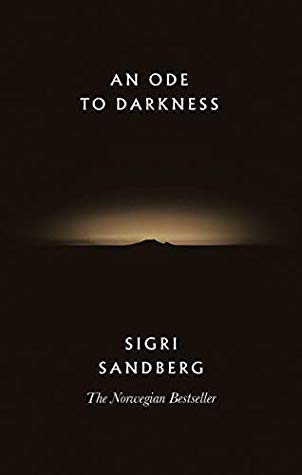
An Ode to Darkness by Sigri Sandberg (2019)
[Translated by Siân Mackie]
Ritter’s book is a jumping-off point for Norwegian journalist Sandberg’s investigation of darkness as both a physical fact and a cultural construct. She travels alone from her home in Oslo to her cabin in the mountains at Finse, 400 miles south of the Arctic Circle. Ninety percent of Norway’s wildlife sleeps through the winter, and she often wishes she could hibernate as well. Although she only commits to five days in the far north compared to Ritter’s year, she experiences the same range of emotions, starting with a primitive fear of nature and the dark.
It is a fundamental truth that darkness does not exist from an astronomical standpoint. Happy fact. I’m willing to accept this. I try to find it comforting, helpful. But I still struggle to completely believe that darkness does not actually exist. Because what does it matter to a small, poorly designed human whether darkness is real or perceived? And what about the black holes in the universe, what about dark matter, what about the night sky and the threats against it, and … and now I’m exhausted. I’m done for the day. I feel so small, and I’m tired of being afraid.
 Over the course of the book she talks to scientists about the human need for sleep and sunshine, discusses solitude and dark sky initiatives, and quotes from a number of poets, especially Jon Fosse, “Norway’s greatest writer,” who often employs metaphors of light and dark: “Deep inside me / … it was like the empty darkness was shining”.
In occasional passages labeled “Christiane” Sandberg also recounts fragments of Ritter’s experiences. I read Sandberg’s book first, so these served as a tantalizing introduction to A Woman in the Polar Night. “Is there anywhere as silent as a white winter plateau on a windless day? And how long can anyone spend alone before they start to feel, like Christiane did, as if their very being is disintegrating?”
This is just the sort of wide-ranging nonfiction I love; it intersperses biographical and autobiographical information with scientific and cultural observations.
 [Another recent book tries to do a similar thing but is less successful – partially due to the author’s youthful optimism, but also due to the rambly, shallow nature of the writing. (My
  review will be in the November 29th issue of the Times Literary Supplement.)]
My rating:
With thanks to Sphere for the free copy for review.
Related reading: This Cold Heaven: Seven Seasons in Greenland by Gretel Ehrlich
Do you like reading about polar exploration, or life’s extremes in general?
Humiliation: Stories by Paulina Flores
Paulina Flores, a young Chilean author and high school teacher, won the Roberto Bolaño Short Story Prize for the title story in her debut collection. These nine stories are about how we relate to the past, particularly our childhood – whether with nostalgia or regret – and about the pivotal moments that stand out in the memory. The first two, “Humiliation” and “Teresa,” I previewed in one of my Women in Translation Month posts. They feature young fathers and turn on a moment of surprise: An unemployed father takes his two daughters along to his audition; a college student goes home with a single father for a one-night stand.
 Of the rest, my favorites were “Talcahuano,” about teenage friends whose plan to steal musical instruments from the local evangelical church goes awry when there’s a crisis with the narrator’s father, a laid-off marine (readalike: Sweet Sorrow by David Nicholls); and “Forgetting Freddy,” in which a young woman who ends up back in her mother’s apartment after a breakup listens to the neighbors fighting and relives childhood fears during her long baths (readalike: History of Wolves by Emily Fridlund).
“American Spirit” recalls two friends’ time waitressing (readalike: Sweetbitter by Stephanie Danler), and in “Last Vacation” a young man recounts his last trip to La Serena with his aunt before everything went wrong for his family. “Laika” is a troubling one in that the protagonist remembers her childhood brush with pedophilia not with terror or disgust but with a sort of fondness. A number of the stories conclude that you can’t truly remake your life, nor can you escape the memories that have shaped you – even if you might like to.
A fairly common feature in story volumes is closing with a novella. Almost invariably, I like these long stories the least, and sometimes skip them. Here, the 72-page “Lucky Me” could easily be omitted. Denise, a librarian who watches porn and reads the Old Testament in her spare time (“what she needed was to feel something. She needed pleasure and spirituality”), lets the upstairs neighbor use her bedroom for sex; Nicole, a fourth-grader, has her world turned upside down when her best friend’s mother becomes their housekeeper. Although the story brings its strands, one in the first person and one in the third (giving the book an even 4.5/4.5 split), together in a satisfying manner, it was among my least favorites in the collection.
Overall, though, these are sharp and readable stories I can give a solid recommendation.
My rating:
Humiliation (2016; English translation by Megan McDowell, 2019) is published by Oneworld today, November 7th,; it came out on the 5th from Catapult in the USA. My thanks to Margot Weale for a proof copy for review.
Five Nonfiction Review Books: Hammond, Iorio, Rault, Riley & Rutt
A diagnosis of motor neurone disease; a father’s dispiriting experience of censorship trials. An illustrated history of fonts; an essay on grief; a cold weather-appropriate record of geese-watching. I gear up for Nonfiction November by catching up on five nonfiction review books I’ve been sent over the last couple of months. You can’t say that I don’t read a variety, even within nonfiction! See if one or more of these tempts you.
A Short History of Falling: Everything I Observed about Love whilst Dying by Joe Hammond
 Hammond, a playwright, takes a wry, clear-eyed approach to his diagnosis of motor neurone disease (ALS) and the knowledge that his physical capacities will only deteriorate from here on out. “New items arrive almost daily and I am unexpectedly becoming the curator of the Museum of my own Decline.” Yet he also freezes funnier moments, like blowing his nose on a slice of bread because he couldn’t reach a tissue box, or spending “six hours of my fiftieth birthday sat on this hospice toilet, with a bottle of good Scotch wedged between my knees.”
Still, Hammond regrets that he’s become like a third small child for his wife Gill to look after, joining his sons Tom and Jimmy, and that he won’t see his boys grow up. (This book arose from an article he wrote for the Guardian in 2018 about making 33 birthday cards for his sons to open in the years after his death.) Although I wasn’t as interested in the details of Hammond’s earlier life, or his relationship with his narcissistic father, I appreciated his quiet acceptance of disability, help and impending death.
Favorite lines:
“I’ve waited all my life to know this peace. To know that I am nothing more than this body.”
“my place in all of this is becoming smaller, historic and just the right size of important.”
With thanks to 4th Estate for the free copy for review.
An Author on Trial: The Story of a Forgotten Writer by Luciano Iorio
 The author’s father, Giuseppe Jorio, was a journalist and schoolteacher who wrote an infamous novel based on an affair he had in the 1930s. Using italicized passages from his father’s diary and letters to Tina, who was 19 when their affair started, Iorio reconstructs the sordid events and unexpected aftermath in fairly vivid detail. Tina fell pregnant and decided to abort the baby. Meanwhile, Giuseppe’s wife, Bruna, got the truth out of him and responded with more grace than might be expected. Giuseppe was devastated at the loss of his potential offspring, and realized he wanted to have a child with Bruna. He bid Tina farewell and the family moved to Rome, where the author was born in 1937.
Giuseppe’s novel inspired by the affair, Il Fuoco del Mondo (The Fire of the World) was rejected by all major publishers and accused of obscenity in a series of five trials that threatened his reputation and morale. It’s a less familiar echo of the Lady Chatterley’s Lover trial, and a poignant portrait of a man who felt he never lived up to his potential because of bad luck and societal disapproval. I enjoyed learning a bit about Italian literature. However, inconsistent use of tenses and shaky colloquial English (preposition issues, etc.) suggest that a co-writer or translator was needed to bring this self-published work up to scratch.
With thanks to the publicist for the free copy to review as part of a blog tour.
ABC of Typography by David Rault
[Translated from the French by Edward Gauvin]
 From cuneiform to Gutenberg to Comic Sans, this history of typography is delightful. Graphic designer David Rault wrote the whole thing, but each chapter has a different illustrator, so the resulting book is like a taster course in comics styles. As such, I would highly recommend it to those who are fairly new to graphic novels and want to see whose work appeals to them, as well as to anyone who enjoyed Simon Garfield’s book about fonts, Just My Type.
I found it fascinating to explore the technical characteristics (serif vs. sans serif, etc.) and aesthetic associations of various fonts. For instance, I didn’t realize that my mainstay – Times New Roman – is now seen as a staid choice: “Highly readable, but overexposed in the early days of the Internet, it took on a reputation for drabness that it hasn’t shed since the ’90s.” Nowadays, some newspapers and brands pay typeface creators to make a font for their exclusive use. Can you name the typeface that is used on German road signs, or in Barack Obama’s campaign materials? (You’ll be able to after you read this.)


With thanks to SelfMadeHero for the free copy for review.
Time Lived, Without Its Flow by Denise Riley
 What Virginia Woolf’s essay “On Being Ill” does for sickness, this does for bereavement. Specifically, Riley, whose son Jake died suddenly of a heart condition, examines how the experience of time changes during grief. “I’ll not be writing about death, but about an altered condition of life,” she opens. In short vignettes written from two weeks to three years after her son’s death, she reflects on how her thinking and feelings have morphed over time. She never rests with an easy answer when a mystery will do instead. “What if” questions and “as if” imaginings proliferate. Poetry – she has also written an exquisite book of poems, Say Something Back, responding to the loss of Jake – has a role to play in the acceptance of this new reality: “rhyme may do its minute work of holding time together.”
Max Porter provides a fulsome introduction to this expanded version of Riley’s essay, which first appeared in 2012. This small volume meant a lot more to him than it did to me; I preferred Riley’s poetic take on the same events. Still, this is sure to be a comfort for the bereaved.
Favorite passages:
“I’ll try to incorporate J’s best qualities of easy friendliness, warmth, and stoicism, and I shall carry him on in that way. Which is the only kind of resurrection of the dead that I know about.”
“I don’t experience him as in the least dead, but simply as ‘away’. Even if he’ll be away for my remaining lifetime. My best hope’s to have a hallucination of his presence when I’m dying myself.”
With thanks to Picador for the free copy for review.
Wintering: A Season with Geese by Stephen Rutt
 Rutt’s The Seafarers: A Journey among Birds, one of my favorite recent nature/travel books, came out in May. What have we done to deserve another publication from this talented young author just four months later?! I didn’t enjoy this as much as The Seafarers, yet it does a lot of the same things well: it provides stunning word portraits of individual bird species, explores the interaction between nature and one’s mental state, and gathers evidence of the cultural importance of birds through legends and classical writings.
Here the focus is on geese, which the author had mostly overlooked until the year he moved to southern Scotland. Suddenly they were impossible to ignore, and as he became accustomed to his new home these geese sightings were a way of marking the seasons’ turn. Ethical issues like hunting, foie gras and down production come into play, and, perhaps ironically, the author eats goose for Christmas dinner!
Rutt’s points of reference include Paul Gallico (beware plot spoilers!), Aldo Leopold, Mary Oliver and Peter Scott. The writing in this short book reminded me most of Horatio Clare (especially The Light in the Dark) and Jim Crumley (who’s written many short seasonal and single-species nature books) this time around.
A favorite passage (I sympathize with the feelings of nomadism and dislocation):
“I envy the geese their certainty, their habits of home. I am forever torn between multiple places that feel like home. Scotland where I live or Suffolk, Essex, Norfolk: the flatlands of golden evenings and reeds, mud and water and sand. The distant horizon and all the space in between I grew up with, which seems to lurk somewhere, subconsciously calling me back.”
[Neat aside: My husband and I both got quotes (about The Seafarers) on the press release for this book!]

With thanks to Elliott & Thompson for the free copy.
Would you be interested in reading one or more of these?
Women in Translation Month 2019, Part II: Almada and Fenollera
All Spanish-language choices this time: an Argentinian novella, a Spanish novel, and a couple of Chilean short stories to whet your appetite for a November release.
The Wind that Lays Waste by Selva Almada (2012; English translation, 2019)
[Translated by Chris Andrews]
 Selva Almada’s debut novella is also her first work to appear in English. Though you might swear this is set in the American South, it actually takes place in her native Argentina. The circadian narrative pits two pairs of characters against each other. On one hand we have the Reverend Pearson and his daughter Leni, itinerants who are driven ever onward by the pastor’s calling. On the other we have “The Gringo” Brauer, a mechanic, and his assistant, José Emilio, nicknamed “Tapioca.”
On his way to visit Pastor Zack, Reverend Pearson’s car breaks down. While the Gringo sets to work fixing the vehicle, the preacher tries witnessing to Tapioca. He senses something special in the boy, perhaps even recognizing a younger version of himself, and wants him to have more of a chance in life than he’s currently getting at the garage. As a violent storm comes up, we’re left to wonder how Leni’s cynicism, the Reverend’s zealousness, the Gringo’s suspicion, and Tapioca’s resolve will all play out.
Different as they are, there are parallels to be drawn between these characters, particularly Leni and Tapioca, who were both abandoned by their mothers. I particularly liked the Reverend’s remembered sermons, printed in italics, and Leni’s sarcastic thoughts about her father’s vocation: “They always ended up doing what her father wanted, or, as he saw it, what God expected of them” and “she admired the Reverend deeply but disapproved of almost everything her father did. As if he were two different people.”
The setup and characters are straight out of Flannery O’Connor. The book doesn’t go as dark as I expected; I’m not sure I found the ending believable, even if it was something of a relief.
My rating:
My thanks to Charco Press for the free copy for review. Last year I reviewed two Charco releases: Die, My Love and Fish Soup.
See also Susan’s review.
The Awakening of Miss Prim by Natalia Sanmartin Fenollera (2013; English translation, 2014)
[Translated by Sonia Soto]
 San Ireneo de Arnois is a generically European village that feels like it’s been frozen in about 1950: it’s the sort of place that people who are beaten down by busy city life retreat to so they can start creative second careers. Prudencia Prim comes here to interview for a job as a librarian, having read a rather cryptic job advertisement. Her new employer, The Man in the Wingchair (never known by any other name), has her catalogue his priceless collection of rare books, many of them theological treatises in Latin and Greek. She’s intrigued by this intellectual hermit who doesn’t value traditional schooling yet has the highest expectations for the nieces and nephews in his care.
In the village at large, she falls in with a group of women who have similarly ridiculous names like Hortensia and Herminia and call themselves feminists yet make their first task the finding of a husband for Prudencia. All of this is undertaken with the aid of endless cups of tea or hot chocolate and copious sweets. The village and its doings are, frankly, rather saccharine. No prizes for guessing who ends up being Prudencia’s chief romantic interest despite their ideological differences; you’ll guess it long before she admits it to herself at the two-thirds point.
As much as this tries to be an intellectual fable for bibliophiles (Prudencia insists that The Man in the Wingchair give Little Women to his niece to read, having first tried it himself despite his snobbery), it’s really just a thinly veiled Pride and Prejudice knock-off – and even goes strangely Christian-fiction in its last few pages. If you enjoyed The Readers of Broken Wheel Recommend and have a higher tolerance for romance and chick lit than I, you may well like this. It’s pleasantly written in an old-fashioned Pym-homage style, but ultimately it goes on my “twee” shelf and will probably return to a charity shop, from whence it came.
My rating: 
Humiliation by Paulina Flores (2016; English translation, 2019)
[Translated by Megan McDowell]
I’ve read the first two stories so far, “Humiliation” and “Teresa,” which feature young fathers and turn on a moment of surprise. An unemployed father takes his two daughters along to his audition; a college student goes home with a single father for a one-night stand. In both cases, what happens next is in no way what you’re expecting. These are sharp and readable, and I look forward to making my way through the rest over the next month or two.
My rating:
Humiliation will be published by Oneworld on November 7th. My thanks to Margot Weale for a proof copy. I will publish a full review closer to the time.
Did you do any special reading for Women in Translation month this year?
Women in Translation Month 2019, Part I: Ernaux and Poschmann
Two rather different books to start off #WITMonth: a brief (c. 70 pp.) account of a mother’s decline with dementia; and a haiku-inspired novel of the quest for life and death in disorienting modern Japan. Both are admirable but detached – a judgment I seem more likely to make about work in translation – so don’t earn my wholehearted recommendation. My rating for both:
I Remain in Darkness by Annie Ernaux (1997; English translation, 1999)
[Translated from the French by Tanya Leslie]
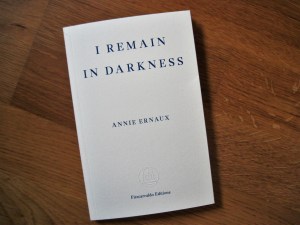 This is the second short, somewhat harrowing autobiographical work I’ve read by Ernaux this year (after Happening, her account of her abortion, in March). A collection of mostly present-tense fragments, it’s drawn from the journal she kept during her mother’s final years, 1983–6. “I Remain in Darkness” were the last words her mother wrote, in a letter to a friend (“Je ne suis pas sortie de ma nuit,” which more literally means “I have not left my night,” strikes me as cryptic and poetic, though maybe I’m missing a colloquialism). Slipping into Alzheimer’s, her mother spent these years in a long-term hospital geriatric ward. Ernaux could see her mother becoming like a child again:
This morning she got up and, in a timid voice, said: ‘I wet the bed. I couldn’t help it.’ The same words I would use when I was a child.
Now her room is on the third floor. A bunch of women circle us, addressing my mother with the familiar tu form: ‘You’re going to be in our group?’ They are like kids talking to the ‘new girl’ at school. When I take leave of her, she looks at me in panic and confusion: ‘You’re not leaving, are you?’
—and herself becoming like her mother: “It’s crystal-clear: she is me in old age and I can see the deterioration of her body threatening to take hold of me – the wrinkles on her legs, the creases in her neck”. Ernaux vacillates between guilt, fear and cruelty in how she approaches her mother. She tenderly shaves the older woman’s face every week when she visits, and buys her all manner of sweets. Food is one of her mother’s last remaining pleasures, though she often misses her mouth when she tries to eat the cakes her daughter brings.
Superficially, this is very similar to another book I’ve reviewed this year, Be With by Mike Barnes, a series of short letters written during his time as a caregiver to his mother, who also has Alzheimer’s. But where Barnes is reassuring and even humorous at times, Ernaux refuses to give any comfort, false or otherwise. This hospital is a bleak place that reeks of urine and is hiding excrement everywhere (really). A lazier reviewer than I generally try to be would brandish the word “unflinching.”
The entries from a few days after her mother’s death explain what the author is trying to do with her work, whether memoir or autofiction: “I am incapable of producing books that are not precisely that – an attempt to salvage part of our lives, to understand, but first to salvage … I’ll have to tell her story in order to ‘distance myself from it’.” That dual purpose, saving and distancing, makes her work honest yet unemotional, such that I have trouble warming to it.
This is easily read in a sitting. I may try again to get into Ernaux’s novel The Years, which, like the Poschmann (below), was on this past year’s Man Booker International Prize shortlist.
I Remain in Darkness will be released on September 18th. With thanks to Fitzcarraldo Editions for the free copy for review.
The Pine Islands by Marion Poschmann (2017; English translation, 2018)
[Translated from the German by Jen Calleja]
(Though I read this mostly in July, I finished it on August 1st, so I’m including it in my WIT Month coverage. It’s the first of the author’s books to be made available in English.)
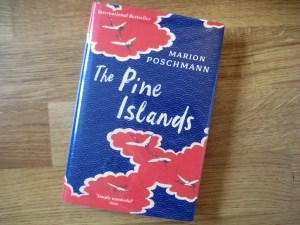 A man wakes up from a dream convinced that his wife is cheating on him, and sets off for Tokyo on a whim, where he embarks on a Bashō-inspired pilgrimage to the pine islands of Matsushima. This Gilbert Silvester, a beard historian, acquires an unlikely companion: a young man named Yosa, who’s looking for the best place to kill himself and takes Gilbert along to cliffs and forests famous for their suicide rates. Although there are still cherry blossoms and kabuki theatre, Gilbert soon learns that this isn’t Bashō’s Japan anymore.
From the haikus he composes and the letters he writes to Mathilda back home, we track his inward journey as it contrasts with the outward ones he undertakes. I enjoyed the surreal touches – Yosa says he once dated a woman who was actually a fox – and the Murakami setup (the wife’s adultery and the hair patterns are reminiscent of The Wind-Up Bird Chronicle).
Somehow, though, for me this is a book that succeeds more in its ideas (searching for the essence of a place but only finding the clichés; coniferous versus deciduous trees as a metaphor for what lasts in life versus what fades) than in its actual execution. It never all quite comes together, and the inconclusive ending makes you question how much of this has been a dream or a fantasy. It’s ambitious and intellectually impressive, but something about its dignified aloofness is hard to be enthusiastic about.
Do watch Lost in Translation, one of my favorite films, afterwards…
And a DNF: The Days of Abandonment by Elena Ferrante. The time has come to admit that I simply do not appreciate Ferrante’s work. I could only make it 25 pages into this one; I’ve read a different short novel of hers (The Lost Daughter), and skimmed another (My Brilliant Friend). While I enjoyed the narrator’s voice well enough, and loved the scene in which her errant husband finds broken glass in his dinner, I found that I had no interest in how this seemingly predictable story of the end of a marriage might play out.
Up next for Part II: The Wind that Lays Waste by Selva Almada, on its way from Charco Press, and The Awakening of Miss Prim by Natalia Sanmarin Fenollera.
 Bookish Beck = Rebecca Foster. American transplant to England. Freelance proofreader and book reviewer.
