20 Books of Summer, 17–20: Bennett, Davidson, Diffenbaugh, Kimmerer
As per usual, I’m squeezing in my final 20 Books of Summer reviews late on the very last day of the challenge. I’ll call it a throwback to the all-star procrastination of my high school and college years. This was a strong quartet to finish on: two novels, the one about (felling) trees and the other about communicating via flowers; and two nonfiction books about identifying trees and finding harmony with nature.
Tree-Spotting: A Simple Guide to Britain’s Trees by Ros Bennett; illus. Nell Bennett (2022)
Botanist Ros Bennett has designed this as a user-friendly guide that can be taken into the field to identify 52 of Britain’s most common trees. Most of these are native species, plus a few naturalized ones. “Walks in the countryside … take on a new dimension when you find yourself on familiar, first-name terms with the trees around you,” she encourages. She introduces tree families, basics of plant anatomy and chemistry, and the history of the country’s forests before moving into identification. Summer leaves make ID relatively easy with a three-step set of keys, explained in words as well as with impressively detailed black-and-white illustrations of representative species’ leaves (by her daughter, Nell Bennett).

Seasonality makes things trickier: “Identifying plants is not rocket science, though occasionally it does require lots of patience and a good hand lens. Identifying trees in winter is one of those occasions.” This involves a close look at details of the twigs and buds – a challenge I’ll be excited to take up on canalside walks later this year. The third section of the book gives individual profiles of each featured species, with additional drawings. I learned things I never realized I didn’t know (like how to pronounce family names, e.g., Rosaceae is “Rose-A-C”), and formalized other knowledge. For instance, I can recognize an ash tree by sight, but now I know you identify an ash by its 9–13 compound, opposite, serrated leaflets.

Some of the information was more academic than I needed (as with one of my earlier summer reads, The Ash Tree by Oliver Rackham), but it’s easy to skip any sections that don’t feel vital and come back to them another time. I most valued the approachable keys and their accompanying text, and will enjoy taking this compact naked hardback on autumn excursions. Bennett never dumbs anything down, and invites readers to delight in discovery. “So – go out, introduce yourself to your neighbouring trees and wonder at their beauty, ingenuity and variety.” 
With thanks to publicist Claire Morrison and Welbeck for the free copy for review.
Damnation Spring by Ash Davidson (2021)
When this would-be Great American Novel* arrived unsolicited through my letterbox last summer, I was surprised I’d not encountered the pre-publication buzz. The cover blurb is from Nickolas Butler, which gives you a pretty good sense of what you’re getting into: a gritty, working-class story set in what threatens to be an overwhelmingly male milieu. For generations, Rich Gundersen’s family has been involved in logging California’s redwoods. Davidson is from Arcata, California, and clearly did a lot of research to recreate an insider perspective and a late 1970s setting. There is some specialist vocabulary and slang (the loggers call the largest trees “big pumpkins”), but it’s easy enough to understand in context.
 What saves the novel from going too niche is the double billing of Rich and his wife, Colleen, who is an informal community midwife and has been trying to get pregnant again almost ever since their son Chub’s birth. She’s had multiple miscarriages, and their family and acquaintances have experienced alarming rates of infant loss and severe birth defects. Conservationists, including an old high school friend of Colleen’s, are attempting to stop the felling of redwoods and the spraying of toxic herbicides.
A major element, then, is people gradually waking up to the damage chemicals are doing to their waterways and, thereby, their bodies. The problem, for me, was that I realized this much earlier than any of the characters, and it felt like Davidson laid it on too thick with the many examples of human and animal deaths and deformities. This made the book feel longer and less subtle than, e.g., The Overstory. I started it as a buddy read with Marcie (Buried in Print) 11 months ago and quickly bailed, trying several more times to get back into the book before finally resorting to skimming to the end. Still, especially for a debut author, Davidson’s writing chops are impressive; I’ll look out for what she does next. 
*I just spotted that it’s been shortlisted for the $25,000 Mark Twain American Voice in Literature Award.
With thanks to Tinder Press for the proof copy for review.
The Language of Flowers by Vanessa Diffenbaugh (2011)
The cycle would continue. Promises and failures, mothers and daughters, indefinitely.
 The various covers make this look more like chick lit than it is. Basically, it’s solidly readable issues- and character-driven literary fiction, on the lighter side but of the caliber of any Oprah’s Book Club selection. It reminded me most of White Oleander by Janet Fitch, one of my 20 Books selections in 2018, because of the focus on the foster care system and a rebellious girl’s development in California, and the floral metaphors.
In Diffenbaugh’s debut, Victoria Jones ages out of foster care at 18 and leaves her group home for an uncertain future. She spends time homeless in San Francisco but her love of flowers, and particularly the Victorian meanings assigned to them, lands her work in a florist’s shop and reconnects her with figures from her past. Chapters alternate between her present day and the time she came closest to being adopted – by Elizabeth, who owned a vineyard and loved flowers, when she was nine. We see how estrangements and worries over adequate mothering recur, with Victoria almost a proto-‘Disaster Woman’ who keeps sabotaging herself. Throughout, flowers broker reconciliations.
I won’t say more about a plot that would be easy to spoil, but this was a delight and reminded me of a mini flower dictionary with a lilac cover and elaborate cursive script that I owned when I was a child. I loved the thought that flowers might have secret messages, as they do for the characters here. Whatever happened to that book?! (Charity shop)
Braiding Sweetgrass: Indigenous Wisdom, Scientific Knowledge and the Teachings of Plants by Robin Wall Kimmerer (2013)
I’d heard Kimmerer recommended by just about every nature writer around, North American or British, and knew I needed this on my shelf. Before I ever managed to read it, I saw her interviewed over Zoom by Lucy Jones in July 2021 about her other popular science book, Gathering Moss, which was first published 18 years ago but only made it to the UK last year. So I knew what a kind and peaceful person she is: she just emanates warmth and wisdom, even over a computer screen.
And I did love Braiding Sweetgrass nearly as much as I expected to, with the caveat that the tiny-print 400 pages of my paperback edition make the essays feel very dense. I could only read a handful of pages in a sitting. Also, after about halfway, it started to feel a bit much, like maybe she had given enough examples from her life, Native American legend and botany. The same points about gratitude for the gifts of the Earth, kinship with other creatures, responsibility and reciprocity are made over and over.
 However, I feel like this is the spirituality the planet needs now, so I’ll excuse any repetition (and the basket-weaving essay I thought would never end). “In a world of scarcity, interconnection and mutual aid become critical for survival. So say the lichens.” (She’s funny, too, so you don’t have to worry about the contents getting worthy.) She effectively wields the myth of the Windigo as a metaphor for human greed, essential to a capitalist economy based on “emptiness” and “unmet desires.”
I most enjoyed the shorter essays that draw on her fieldwork or her experience of motherhood. “The Gift of Strawberries” – “An Offering” – “Asters and Goldenrod” make a stellar three-in-a-row, and “Collateral Damage” is an excellent later one about rescuing salamanders from the road, i.e. doing the small thing that we can do rather than being overwhelmed by the big picture of nature in crisis. “The Sound of Silverbells” is one of the most well-crafted individual pieces, about taking a group of students camping when she lived in the South. At first their religiosity (creationism and so on) grated, but when she heard them sing “Amazing Grace” she knew that they sensed the holiness of the Great Smoky Mountains.
But the pair I’d recommend most highly, the essays that made me weep, are “A Mother’s Work,” about her time restoring an algae-choked pond at her home in upstate New York, and its follow-up, “The Consolation of Water Lilies,” about finding herself with an empty nest. Her loving attention to the time-consuming task of bringing the pond back to life is in parallel to the challenges of single parenting, with a vision of the passing of time being something good rather than something to resist.
Here are just a few of the many profound lines:
For all of us, becoming indigenous to a place means living as if your children’s future mattered, to take care of the land as if our lives, both material and spiritual, depended on it.
I’m a plant scientist and I want to be clear, but I am also a poet and the world speaks to me in metaphor.
Ponds grow old, and though I will too, I like the ecological idea of aging as progressive enrichment, rather than progressive loss.
This will be a book to return to time and again. (Gift from my wish list several years ago)
I also had one DNF from this summer’s list:
Human Croquet by Kate Atkinson: This reminded me of a cross between The Crow Road by Iain Banks and The Heavens by Sandra Newman, what with the teenage narrator and a vague time travel plot with some Shakespearean references. I put it on the pile for this challenge because I’d read it had a forest setting. I haven’t had much luck with Atkinson in the past and this didn’t keep me reading past page 60. (Little Free Library)
A Look Back at My 20 Books of Summer 2022
Half of my reads are pictured here. The rest were e-books (represented by the Kindle) or have already had to go back to the library.

My fiction standout was The Language of Flowers, reviewed above. Nonfiction highlights included Forget Me Not and Braiding Sweetgrass, with Tree-Spotting the single most useful book overall. I also enjoyed reading a couple of my selections on location in the Outer Hebrides. The hands-down loser (my only 1-star rating of the year so far, I think?) was Bonsai. As always, there are many books I could have included and wished I’d found the time for, like (on my Kindle) A House among the Trees by Julia Glass, This Is Your Mind on Plants by Michael Pollan and Finding the Mother Tree by Suzanne Simard.
At the start, I was really excited about my flora theme and had lots of tempting options lined up, some of them literally about trees/flowers and others more tangentially related. As the summer went on, though, I wasn’t seeing enough progress so scrambled to substitute in other things I was reading from the library or for paid reviews. This isn’t a problem, per se, but my aim with this challenge has generally been to clear TBR reads from my own shelves. Maybe I didn’t come up with enough short and light options (just two novella-length works and a poetry collection; only the Diffenbaugh was what I’d call a page-turner); also, even with the variety I’d built in, having a few plant quest memoirs got a bit samey.

Next year…
I’m going to skip having a theme and set myself just one simple rule: any 20 print books from my shelves (NOT review copies). There will then be plenty of freedom to choose and substitute as I go along.
Four for #WITMonth: Jansson, Lamarche, Lunde and Vogt
I’ve managed four novels for this year’s Women in Translation month: a nostalgic, bittersweet picture of island summers poised between childhood and old age; a brief, impressionistic account of domestic violence and rape; the third in a series looking at how climate change and species loss reverberate amid family situations; and a visceral meditation on women’s bodies and relationships. Two of these were review copies from the recently launched Héloïse Press, which “champions world-wide female talent”.

The Summer Book by Tove Jansson (1972; 1974)
[Translated from the Swedish by Thomas Teal]
It was just the same long summer, always, and everything lived and grew at its own pace.
 This was only the second time I’ve read one of Jansson’s books aimed at adults (as opposed to five from the Moomins series). Whereas A Winter Book didn’t stand out to me when I read it in 2012 – though I will try it again this winter, having acquired a free copy from a neighbour – this was a lovely read, so evocative of childhood and of languid summers free from obligation. For two months, Sophia and Grandmother go for mini adventures on their tiny Finnish island. Each chapter is almost like a stand-alone story in a linked collection. They make believe and welcome visitors and weather storms and poke their noses into a new neighbour’s unwanted construction.
Six-year-old Sophia, based on Jansson’s niece of the same name, is precocious and opinionated, liable to change her mind in an instant. In “The Cat,” one of my favourite stand-alone bits, she’s fed up with their half-feral pet who kills lots of birds and swaps him for a friend’s soppy lap cat, but then regrets it. She’s learning that logic and emotion sometimes contradict each other, which becomes clearer as she peppers Grandmother with questions about religion and superstition.
As is common to Jansson’s books, there’s a melancholy undercurrent here.
Everything was fine, and yet everything was overshadowed by a great sadness. It was August, and the weather was sometimes stormy and sometimes nice, but for Grandmother, no matter what happened, it was only time on top of time, since everything is vanity and a chasing after the wind.
Sophia’s mother died, and although her grandmother has the greater presence, Papa is also around, dealing with practicalities in the background. Death stalks around the edges, reminding Grandmother of her mortality through bouts of vertigo that have her grabbing for her heart medication. On just the second page we have this memento mori:
“When are you going to die?” the child asked.
And Grandmother answered, “Soon. But that is not the least concern of yours.”
And so it doesn’t feel like our concern either; the focus is on the now, on these beautiful little moments of connection across the generations – like in “Playing Venice,” when Grandmother stays up all night rebuilding Sophia’s model city that was washed away by the rain. (Public library)
The Memory of the Air by Caroline Lamarche (2014; 2022)
[Winner of an English PEN Award; translated from the French by Katherine Gregor]
 In a hypnotic monologue, a woman tells of her time with a violent partner (the man before, or “Manfore”) who thinks her reaction to him is disproportionate and all due to the fact that she has never processed being raped two decades ago. When she goes in for a routine breast scan, she shows the doctor her bruised arm, wanting there to be a definitive record of what she’s gone through. It’s a bracing echo of the moment she walked into a police station to report the sexual assault (and oh but the questions the male inspector asked her are horrible).
The novella opens with an image that returns in dreams but is almost more a future memory of what might have been: “I went down into a ravine and, at the bottom, found a dead woman. She was lying in a shroud, on a carpet of fallen leaves.” I read this in one sitting – er, yoga session – and it has stayed in my mind in intense flashes like that and the flounce of her red dress on the summer day that turned into a nightmare. At an intense 70 pages, this reminded me of Annie Ernaux’s concise autofiction (I’ve reviewed Happening and I Remain in Darkness). An introduction by Dr Dominique Carlini-Versini contextualizes the work by considering the treatment of rape in contemporary French women’s writing.
The Memory of the Air will be published on 26 September. With thanks to Héloïse Press for the proof copy for review.
The Last Wild Horses by Maja Lunde (2019; 2022)
[Translated from the Norwegian by Diane Oatley]
The third in Lunde’s “Climate Quartet,” with its recurring elements of migration, shortages and environmental collapse. Always, though, the overall theme is parent–child relationships and the love that might be the only thing that keeps us going in the face of unspeakable challenges. Here she returns to the tripartite structure of The History of Bees (much my favourite of the three): a historical strand, a near-contemporary one, and a dystopian future story line. The link between the three is Przewalski’s horses (aka takhi).
 In the early 1880s, Mikhail Alexandrovich Kovrov, assistant director of St. Petersburg Zoo, is brought the hide and skull of an ancient horse species assumed extinct. Although a timorous man who still lives with his mother, he becomes part of an expedition to Mongolia to bring back live specimens. In 1992, Karin, who has been obsessed with Przewalski’s horses since encountering them as a child in Nazi Germany, spearheads a mission to return the takhi to Mongolia and set up a breeding population. With her is her son Matthias, tentatively sober after years of drug abuse. In 2064 Norway, Eva and her daughter Isa are caretakers of a decaying wildlife park that houses a couple of wild horses. When a climate migrant comes to stay with them and the electricity goes off once and for all, they have to decide what comes next. This future story line engaged me the most.
I appreciated some aspects: queer and middle-aged romances, the return of a character from The End of the Ocean, the consideration across all three plots of what makes a good mother. However, the horses seemed neither here nor there. There are also many, many animal deaths. Perhaps an unsentimental attitude is necessary to reflect past and future values, and the apparent cruelty of natural processes, but it limits the book’s appeal to animal lovers. Maybe the tone fits the Norwegian prose, which the translator describes as lean.
The fourth book of the quartet, publishing in Norway next month, is called something like The Dream of a Tree; a focus on trees would be a draw for me. After the disappointment of Books 2 and 3, I’m unsure whether I want to bother with the final volume, but it makes sense to do so, if only to grasp Lunde’s full vision. (Public library)
What Concerns Us by Laura Vogt (2020; 2022)
[Translated from the German by Caroline Waight]
 Vogt’s Swiss-set second novel is about a tight-knit matriarchal family whose threads have started to unravel. For Rahel, motherhood has taken her away from her vocation as a singer. Boris stepped up when she was pregnant with another man’s baby and has been as much of a father to Rico as to Leni, the daughter they had together afterwards. But now Rahel’s postnatal depression is stopping her from bonding with the new baby, and she isn’t sure this quartet is going to make it in the long term.
Meanwhile, Rahel’s sister Fenna knows she’s pregnant but refuses a doctor’s care. When she comes to stay with Rahel, she confides that the encounter with her partner, Luc, that led to conception was odd, rough; maybe not consensual. And all this time, the women’s mother, Verena, has been undergoing treatment for breast cancer. All three characters appear to be matter-of-factly bisexual; Rahel and Fenna’s father has long been out of the picture, replaced in Verena’s affections by Inge.
As I was reading, I kept thinking of the declaration running through A Ghost in the Throat by Doireann Ní Ghríofa: “This is a female text.” Vogt’s vision is all breasts and eggs, genitals actual and metaphorical. I loved the use of food in the novel: growing up, the girls cherished “silly nights” when their mother prepared an egg feast and paired it with a feminist lecture on reproduction. Late on, there’s a wonderful scene when the three main characters gorge on preserved foodstuffs from the cellar and share their secrets. (Their language is so sexually frank; would anyone really talk to their mother and siblings in that way?!) As in the Lunde, the main question is what it means to be a mother, but negotiating their relationships with men stretches the bonds of this feminine trio. One for fans of Rachel Cusk and Sally Rooney.
With thanks to Héloïse Press for the proof copy for review.
May Releases: Barrera, Cornwell, Jones, Ruhl
Greetings from the English Channel! I’m putting this quick post together on an outdoor deck as we leave Plymouth harbour on the ferry to Spain. I’ve taken a seasickness pill and am wearing acupressure bracelets, and so far I’m feeling pretty well here taking in a sea breeze; fingers crossed that it will continue to be a smooth voyage.

Have a look at all the lovely May releases above. How I wish that I’d had a chance to read some of them this month! Alas, things have been so busy with our move that I have only cracked one open so far (the Shipstead), but I’m looking forward to reading the rest soon after we get back. For now, I’ll give snippets of early reviews I’ve published elsewhere: two memoirs of pregnancy and early motherhood (the one focusing on postnatal depression), a varied short story collection, and an accessible volume of poetry written during Covid lockdowns.
Linea Nigra: An Essay on Pregnancy and Earthquakes by Jazmina Barrera
(Translated from the Spanish by Christina MacSweeney)
 In a fragmentary work of autobiography and cultural commentary, the Mexican author investigates pregnancy as both physical reality and liminal state. The linea nigra is a stripe of dark hair down a pregnant woman’s belly. It’s a potent metaphor for the author’s matriarchal line: her grandmother was a doula; her mother is a painter. In short passages that dart between topics, Barrera muses on motherhood, monitors her health, and recounts her dreams. Her son, Silvestre, is born halfway through the book. She gives impressionistic memories of the delivery and chronicles her attempts to write while someone else watches the baby. This is both diary and philosophical appeal—for pregnancy and motherhood to become subjects for serious literature. (See my full review for Foreword.)
Birth Notes: A Memoir of Recovery by Jessica Cornwell
 It so happens that May is Maternal Mental Health Awareness Month. Cornwell comes from a deeply literary family; the late John le Carré was her grandfather. Her memoir shimmers with visceral memories of delivering her twin sons in 2018 and the postnatal depression and infections that followed. The details, precise and haunting, twine around a historical collage of words from other writers on motherhood and mental illness, ranging from Margery Kempe to Natalia Ginzburg. Childbirth caused other traumatic experiences from her past to resurface. How to cope? For Cornwell, therapy and writing went hand in hand. This is vivid and resolute, and perfect for readers of Catherine Cho, Sinéad Gleeson and Maggie O’Farrell. (See my full review for Shiny New Books.)
With thanks to Virago for the proof copy for review.
Antipodes: Stories by Holly Goddard Jones
 Jones’s fourth work of fiction contains 11 riveting stories of contemporary life in the American South and Midwest. Some have pandemic settings and others are gently magical; all are true to the anxieties of modern careers, marriage and parenthood. In the title story, the narrator, a harried mother and business school student in Kentucky, seeks to balance the opposing forces of her life and wonders what she might have to sacrifice. The ending elicits a gasp, as does the audacious inconclusiveness of “Exhaust,” a tense tale of a quarreling couple driving through a blizzard. Worry over environmental crises fuels “Ark,” about a pyramid scheme for doomsday preppers. Fans of Nickolas Butler and Lorrie Moore will find much to admire. (Read via Edelweiss. See my full review for Shelf Awareness.)
Love Poems in Quarantine by Sarah Ruhl
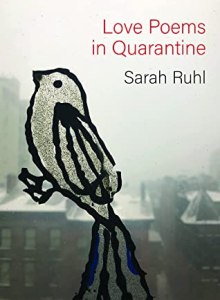 Having read Ruhl’s memoir Smile, I recognized the contours of her life and the members of her family. In early poems, cooking and laundry recur, everyday duties that mark time as she tries to write and supervises virtual learning for three children. “Let this all be poetry,” she incants. Part Two contains poems written after George Floyd’s murder, the structure mimicking how abrupt the change in focus was for a nation. Part Three moves into haiku and tanka, culminating in a series of poems reflecting on the seasons. Like Margaret Atwood’s Dearly, I would recommend this even to people who think they don’t like poetry. A welcome addition to the body of Covid-19 literature. (Read via Edelweiss. See my full review on Goodreads.)
Two favourite poems:
“Shelter”
To love a house
not because it’s perfect but because it shelters you
To love a body
not because it’s perfect but because it shelters you
“Quarantine in August, the overripe month”
I’m tired of summer. I crave fall. Luckily fall comes after summer.
And if I get tired of it all, winter will come, then spring.
Have you read anything from my tempting stack?
What other May releases can you recommend?
Book Serendipity, January to February 2022
This is a bimonthly feature of mine. I call it Book Serendipity when two or more books that I read at the same time or in quick succession have something in common – the more bizarre, the better. Because I usually 20–30 books on the go at once, I suppose I’m more prone to such incidents. (I’ve realized that, of course, synchronicity is really the more apt word, but this branding has stuck.) I always like hearing about your bookish coincidences, too!
The following are in roughly chronological order.
- The author takes Valium to cope with fear of flying in two memoirs I read at the same time, I Came All This Way to Meet You by Jami Attenberg and This Boy We Made by Taylor Harris.


- The fact that the Spanish brought wild horses to the USA is mentioned in the story “The Team” by Tommy Orange (in The Decameron Project) and the poetry collection Rise and Float by Brian Tierney – this also links back to a book I reread in late 2021, Misty of Chincoteague by Marguerite Henry.
- There are roaches in a New York City apartment in I Came All This Way to Meet You by Jami Attenberg and the story “Other People’s Lives” in Loss of Memory Is Only Temporary by Johanna Kaplan.
- The same Dostoevsky passage from The Brothers Karamazov, about loving everything (“Love all the earth, every ray of God’s light, every grain of sand or blade of grass, every living thing. If you love the earth enough, you will know the divine mystery” and so on), is quoted in Faith after Doubt by Brian McLaren and Reflections from the North Country by Sigurd Olson.

- A description of nicotine-stained yellow fingers in What I Wish People Knew About Dementia by Wendy Mitchell, The Cure for Sleep by Tanya Shadrick, and Free by Lea Ypi.
- Joni Mitchell’s music is mentioned in The Reactor by Nick Blackburn and The Cure for Sleep by Tanya Shadrick, two memoirs I was reading at the same time.
- From one summer camp story to another … I happened to follow up The Interestings by Meg Wolitzer with Honor Girl by Maggie Thrash.
- Audre Lorde’s definition of the erotic is quoted in Body Work by Melissa Febos and Heaven Is a Place on Earth by Adrian Shirk, both of which are March 15, 2022 nonfiction releases I’ve reviewed for Shelf Awareness.


- The 2017 white supremacist terrorist attack in Charlottesville, Virginia is mentioned in This Boy We Made by Taylor Harris (who lives there), Faith after Doubt by Brian McLaren (who was part of the clergy counterprotest group that day), and Heaven Is a Place on Earth by Adrian Shirk (she went there for a literary event a few months later).
- The Salvador Dalí painting The Persistence of Memory (that’s the one with the melting clock) is described in The Reactor by Nick Blackburn and This Boy We Made by Taylor Harris.
- On the same day, I came across the fact that Mary Shelley was pregnant while she wrote Frankenstein in two books: Linea Nigra by Jazmina Barrera and Smile by Sarah Ruhl.

- The fact that cysts in female organs can contain teeth comes up in Heaven Is a Place on Earth by Adrian Shirk and I Love You but I’ve Chosen Darkness by Claire Vaye Watkins.
- Reading two novels by Japanese-American authors who grew up in Hawaii at the same time: How High We Go in the Dark by Sequoia Nagamatsu and To Paradise by Hanya Yanagihara.

- Twins are everywhere! Including, just in a recent reading pile, in Hands by Lauren Brown (she’s a twin, so fair enough), Birth Notes by Jessica Cornwell, The Snow Collectors by Tina May Hall, Smile by Sarah Ruhl (this and the Cornwell are memoirs about birthing twins, so also fair enough), Ordinary Love by Jane Smiley, and The Priory by Dorothy Whipple. For as uncommon as they are in real life, they turn up way too often in fiction.
- Bell’s palsy AND giving birth to twins are elements in Birth Notes by Jessica Cornwell and Smile by Sarah Ruhl.
- There’s a no-nonsense maternity nurse in Birth Notes by Jessica Cornwell and The Priory by Dorothy Whipple.


- U.S. West Coast wolves (a particular one in each case, known by a tracking number) are the subject of a poem in Postcolonial Love Poem by Natalie Diaz and The Necessity of Wildfire by Caitlin Scarano.
- Herons appear and/or have metaphorical/symbolic meaning in Thorpeness by Alison Brackenbury, What Willow Says by Lynn Buckle, Maggie Blue and the Dark World by Anna Goodall, and The Priory by Dorothy Whipple.

- There’s a character named Edwin in Booth by Karen Joy Fowler and Sea of Tranquility by Emily St. John Mandel.

- The use of “hoard” where it should be “horde” in Maggie Blue and the Dark World by Anna Goodall and Acts of Desperation by Megan Nolan – both errors were encountered in the same evening.
- I read about Lindisfarne in Jini Reddy’s essay in Women on Nature (ed. Katharine Norbury) and The Interior Silence by Sarah Sands in the same evening.
- “Flitting” as a synonym for moving house in Thorpeness by Alison Brackenbury and Nature Cure by Richard Mabey.

- A brother named Paul in Tides by Sara Freeman and Sea of Tranquility by Emily St. John Mandel.
- A woman knows her lover is on the phone with his ex by his tone of voice in Tides by Sara Freeman and Acts of Desperation by Megan Nolan.
- In two novels I’ve read so far this year – but I won’t say which ones as it’s a spoiler – the big reveal, towards the very end, is that a woman was caught breastfeeding someone who was not her baby and it caused a relationship-destroying rupture.
- Reading a second memoir this year where the chapters are titled after pop songs: Dear Queer Self by Jonathan Alexander (for a Foreword review) and now This Will Only Hurt a Little by Busy Philipps.


- A second short novel entitled The Swimmers this year: the first was Julie Otsuka’s, recently reviewed for Shiny New Books; a proof copy is on the way to me of Chloe Lane’s, coming out from Gallic Books in May.
- Reading a second memoir this year whose author grew up in the Chicago suburbs of Illinois (Arlington Heights/Buffalo Grove vs. Oak Park): I Came All This Way to Meet You by Jami Attenberg and This Will Only Hurt a Little by Busy Philipps.
- The linea nigra (a stripe of dark hair down a pregnant woman’s belly) provides the title for Linea Nigra by Jazmina Barrera and is also mentioned in Birth Notes by Jessica Cornwell.
 The famous feminist text Our Bodies, Ourselves is mentioned in Birth Notes by Jessica Cornwell and I Love You but I’ve Chosen Darkness by Claire Vaye Watkins.
- Childbirth brings back traumatic memories of rape in Birth Notes by Jessica Cornwell and This Will Only Hurt a Little by Busy Philipps.
What’s the weirdest reading coincidence you’ve had lately?
Three on a Theme: Novels of Female Friendship
Friendship is a fairly common theme in my reading and, like sisterhood, it’s an element I can rarely resist. When I picked up a secondhand copy of Female Friends (below) in a charity shop in Hexham over the summer, I spied a chance for another thematic roundup. I limited myself to novels I’d read recently and to groups of women friends.
Before Everything by Victoria Redel (2017)
 I found out about this one from Susan’s review at A life in books (and she included it in her own thematic roundup of novels on friendship). “The Old Friends” have known each other for decades, since elementary school. Anna, Caroline, Helen, Ming and Molly. Their lives have gone in different directions – painter, psychiatrist, singer in a rock band and so on – but in March 2013 they’re huddling together because Anna is terminally ill. Over the years she’s had four remissions, but it’s clear the lymphoma won’t go away this time. Some of Anna’s friends and family want her to keep fighting, but the core group of pals is going to have to learn to let her die on her own terms. Before that, though, they aim for one more adventure.
Through the short, titled sections, some of them pages in length but others only a sentence or two, you piece together the friends’ history and separate struggles. Here’s an example of one such fragment, striking for the frankness and intimacy; how coyly those bald numbers conceal such joyful and wrenching moments:
Actually, for What It’s Worth
Between them there were twelve delivered babies. Three six- to eight-week abortions. Three miscarriages. One post-amniocentesis selective abortion. That’s just for the record.
While I didn’t like this quite as much as Talk Before Sleep by Elizabeth Berg, which is similar in setup, it’s a must-read on the theme. It’s sweet and sombre by turns, and has bite. I also appreciated how Redel contrasts the love between old friends with marital love and the companionship of new neighbourly friends. I hadn’t heard of Redel before, but she’s published another four novels and three poetry collections. It’d be worth finding more by her. The cover image is inspired by a moment late in a book when they find a photograph of the five of them doing handstands in a sprinkler the summer before seventh grade. (Public library) 
Female Friends by Fay Weldon (1974)
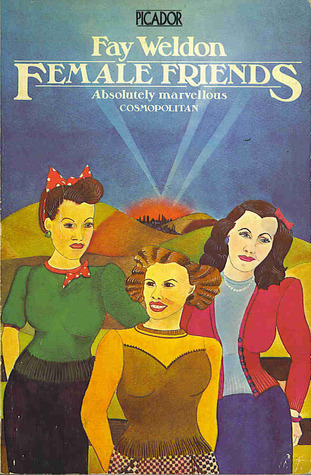 Like a cross between The Orchard on Fire by Shena Mackay and The Pumpkin Eater by Penelope Mortimer; this is the darkly funny story of Marjorie, Chloe and Grace: three Londoners who have stayed friends ever since their turbulent childhood during the Second World War, when Marjorie was sent to live with Grace and her mother. They have a nebulous brood of children between them, some fathered by a shared lover (a slovenly painter named Patrick). Chloe’s husband is trying to make her jealous with his sexual attentions to their French nanny. Marjorie, who works for the BBC, is the only one without children; she has a gynaecological condition and is engaged in a desultory search for her father.
The book is mostly in the third person, but some chapters are voiced by Chloe and occasional dialogues are set out like a film script. I enjoyed the glimpses I got into women’s lives in the mid-20th century via the three protagonists and their mothers. All are more beholden to men than they’d like to be. But there’s an overall grimness to this short novel that left me wincing. I’d expected more nostalgia (“they are nostalgic, all the same, for those days of innocence and growth and noise. The post-war world is drab and grey and middle-aged. No excitement, only shortages and work”) and warmth, but this friendship trio is characterized by jealousy and resentment. (Secondhand copy) 
The Weekend by Charlotte Wood (2019)
“It was exhausting, being friends. Had they ever been able to tell each other the truth?”
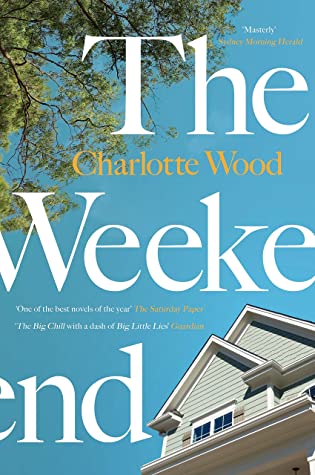 It’s the day before Christmas Eve as seventysomethings Jude, Wendy and Adele gather to clear out their late friend’s Sylvie’s house in a fictional coastal town in New South Wales. This being Australia, that means blazing hot weather and a beach barbecue rather than a cosy winter scene. Jude is a bristly former restaurateur who has been the mistress of a married man for many years. Wendy is a widowed academic who brings her decrepit dog, Finn, along with her. Adele is a washed-up actress who carefully maintains her appearance but still can’t find meaningful work.
They know each other so well, faults and all. Things they think they’ve hidden are beyond obvious to the others. And for as much as they miss Sylvie, they are angry at her, too. But there is also a fierce affection in the mix that I didn’t sense in the Weldon: “[Adele] remembered them from long ago, two girls alive with purpose and beauty. Her love for them was inexplicable. It was almost bodily.” Yet Wendy compares their tenuous friendship to the Great Barrier Reef coral, at risk of being bleached.
It’s rare to see so concerted a look at women in later life, as the characters think back and wonder if they’ve made the right choices. There are plenty of secrets and self-esteem struggles, but it’s all encased in an acerbic wit that reminded me of Emma Straub and Elizabeth Strout. Terrific stuff. (Twitter giveaway win) 
Some favourite lines:
“The past was striated through you, through your body, leaching into the present and the future.”
“Was this what getting old was made of? Routines and evasions, boring yourself to death with your own rigid judgements?”
On this theme, I have also read: The Other’s Gold by Elizabeth Ames, Catch the Rabbit by Lana Bastašić, The Group by Lara Feigel (and Mary McCarthy), My Brilliant Friend by Elena Ferrante, Expectation by Anna Hope, Conversations with Friends by Sally Rooney, and The Animators by Kayla Rae Whitaker.
If you read just one … The Weekend was the best of this bunch for me.
Have you read much on this topic?
Three on a Theme: Queer Family-Making
Several 2021 memoirs have given me a deeper understanding of the special challenges involved when queer couples decide they want to have children.
“It’s a fundamentally queer principle to build a family out of the pieces you have”
~Jennifer Berney
“That’s the thing[:] there are no accidental children born to homosexuals – these babies are always planned for, and always wanted.”
~Michael Johnson-Ellis
The Other Mothers by Jennifer Berney
Berney remembers hearing the term “test-tube baby” for the first time in a fifth-grade sex ed class taught by a lesbian teacher at her Quaker school. By that time she already had an inkling of her sexuality, so suspected that she might one day require fertility help herself.
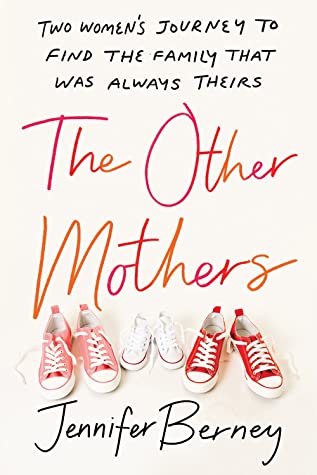 By the time she met her partner, Kellie, she knew she wanted to be a mother; Kellie was unsure. Once they were finally on the same page, it wasn’t an easy road to motherhood. They purchased donated sperm through a fertility clinic and tried IUI, but multiple expensive attempts failed. Signs of endometriosis had doctors ready to perform invasive surgery, but in the meantime the couple had met a friend of a friend (Daniel, whose partner was Rebecca) who was prepared to be their donor. Their at-home inseminations resulted in a pregnancy – after two years of trying to conceive – and, ultimately, in their son. Three years later, they did the whole thing all over again. Rebecca had sons at roughly the same time, too, giving their boys the equivalent of same-age cousins – a lovely, unconventional extended family.
It surprised me that the infertility business seemed entirely set up for heterosexual couples – so much so that a doctor diagnosed the problem, completely seriously, in Berney’s chart as “Male Factor Infertility.” This was in Washington state in c. 2008, before the countrywide legalization of gay marriage, so it’s possible the situation would be different now, or that the couple would have had a different experience had they been based somewhere like San Francisco where there is a wide support network and many gay-friendly resources.
Berney finds the joy and absurdity in their journey as well as the many setbacks. I warmed to the book as it went along: early on, it dragged a bit as she surveyed her younger years and traced the history of IVF and alternatives like international adoption. As the storyline drew closer to the present day, there was more detail and tenderness and I was more engaged. I’d read more from this author. (Published by Sourcebooks. Read via NetGalley) 
small: on motherhoods by Claire Lynch
A line from Berney’s memoir makes a good transition into this one: “I felt a sense of dread: if I turned out to be gay I believed my life would become unbearably small.” The word “small” is a sort of totem here, a reminder of the microscopic processes and everyday miracles that go into making babies, as well as of the vulnerability of newborns – and of hope.
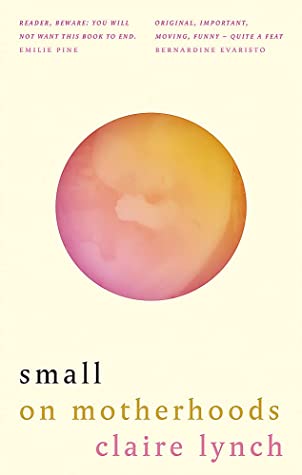
Lynch and her partner Beth’s experience in England was reminiscent of Berney’s in many ways, but with a key difference: through IVF, Lynch’s eggs were added to donor sperm to make the embryos implanted in Beth’s uterus. Mummy would have the genetic link, Mama the physical tie of carrying and birthing. It took more than three years of infertility treatment before they conceived their twin girls, born premature; they were followed by another daughter, creating a crazy but delightful female quintet. The account of the time when their daughters were in incubators reminded me of Francesca Segal’s Mother Ship.
There are two intriguing structural choices that make small stand out. The first you’d notice from opening the book at random, or to page 1. It is written in a hybrid form, the phrases and sentences laid out more like poetry. Although there are some traditional expository paragraphs, more often the words are in stanzas or indented. Here’s an example of what this looks like on the page. It also happens to be from one of the most ironically funny parts of the book, when Lynch is grouped in with the dads at an antenatal class:
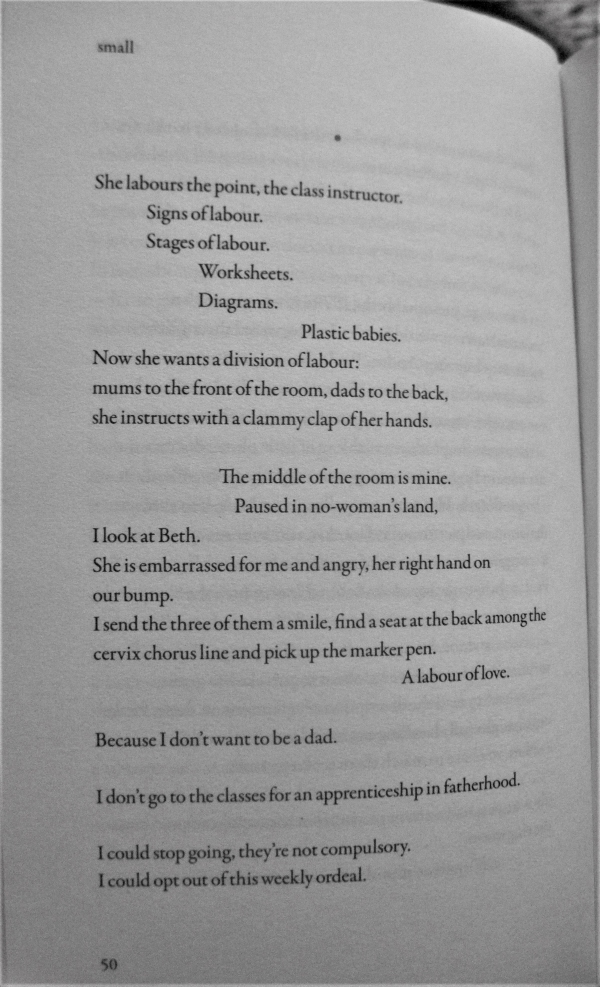
It’s a fast-flowing, artful style that may remind readers of Bernardine Evaristo’s work (and indeed, Evaristo gives one of the puffs). The second interesting decision was to make the book turn on a revelation: at the exact halfway mark we learn that, initially, the couple intended to have opposite roles: Lynch tried to get pregnant with Beth’s baby, but miscarried. Making this the pivot point of the memoir emphasizes the struggle and grief of this experience, even though we know that it had a happy ending.
With thanks to Brazen Books for the free copy for review.
How We Do Family by Trystan Reese
We mostly have Trystan Reese to thank for the existence of a pregnant man emoji. A community organizer who works on anti-racist and LGBTQ justice campaigns, Reese is a trans man married to a man named Biff. They expanded their family in two unexpected ways: first by adopting Biff’s niece and nephew when his sister’s situation of poverty and drug abuse meant she couldn’t take care of them, and then by getting pregnant in the natural (is that even the appropriate word?) way.
 All along, Reese sought to be transparent about the journey, with a crowdfunding project and podcast ahead of the adoption, and media coverage of the pregnancy. This opened the family up to a lot of online hatred. I found myself most interested in the account of the pregnancy itself, and how it might have healed or exacerbated a sense of bodily trauma. Reese was careful to have only in-the-know and affirming people in the delivery room so there would be no surprises for anyone. His doctor was such an ally that he offered to create a more gender-affirming C-section scar (vertical rather than horizontal) if it came to it. How to maintain a sense of male identity while giving birth? Well, Reese told Biff not to look at his crotch during the delivery, and decided not to breastfeed.
I realized when reading this and Detransition, Baby that my view of trans people is mostly post-op because of the only trans person I know personally, but a lot of people choose never to get surgical confirmation of gender (or maybe surgery is more common among trans women?). We’ve got to get past the obsession with genitals. As Reese writes, “we are just loving humans, like every human throughout all of time, who have brought a new life into this world. Nothing more than that, and nothing less. Just humans.”
This is a very fluid, quick read that recreates scenes and conversations with aplomb, and there are self-help sections after most chapters about how to be flexible and have productive dialogue within a family and with strangers. If literary prose and academic-level engagement with the issues are what you’re after, you’d want to head to Maggie Nelson’s The Argonauts instead, but I also appreciated Reese’s unpretentious firsthand view.
And here’s further evidence of my own bias: the whole time I was reading, I felt sure that Reese must be the figure on the right with reddish hair, since that looked like a person who could once have been a woman. But when I finished reading I looked up photos; there are many online of Reese during pregnancy. And NOPE, he is the bearded, black-haired one! That’ll teach me to make assumptions. (Published by The Experiment. Read via NetGalley)
Plus a bonus essay from the Music.Football.Fatherhood anthology, DAD:
“A Journey to Gay Fatherhood: Surrogacy – The Unimaginable, Manageable” by Michael Johnson-Ellis
 The author and his husband Wes had both previously been married to women before they came out. Wes already had a daughter, so they decided Johnson-Ellis would be the genetic father the first time. They then had different egg donors for their two children, but used the same surrogate for both pregnancies. I was astounded at the costs involved: £32,000 just to bring their daughter into being. And it’s striking both how underground the surrogacy process is (in the UK it’s illegal to advertise for a surrogate) and how exclusionary systems are – the couple had to fight to be in the room when their surrogate gave birth, and had to go to court to be named the legal guardians when their daughter was six weeks old. Since then, they’ve given testimony at the Houses of Parliament and become advocates for UK surrogacy.
(I have a high school acquaintance who has gone down this route with his husband – they’re about to meet their daughter and already have a two-year-old son – so I was curious to know more about it, even though their process in the USA might be subtly different.)
On the subject of queer family-making, I have also read: The Argonauts by Maggie Nelson ( ) and The Fixed Stars by Molly Wizenberg ().
If you read just one … Claire Lynch’s small was the one I enjoyed most as a literary product, but if you want to learn more about the options and process you might opt for Jennifer Berney’s The Other Mothers; if you’re particularly keen to explore trans issues and LGTBQ activism, head to Trystan Reese’s How We Do Family.
Have you read anything on this topic?
Short Stories in September, Part I: Byatt, Hildyard, Okorie, Simpson
Each September I make a special effort to read short stories, which otherwise tend to languish on my shelves unread. In 2020 I read eight collections for this challenge. This year I hope to outdo myself. I’m knee-deep in seven more collections at the moment, including a couple from the library and two from my set-aside-temporarily shelf. Here’s my first four.
Medusa’s Ankles: Selected Stories by A.S. Byatt (2021)
I’ve long considered Byatt my favourite author, and have read all of her published short story collections before. One I even reread last year. So when approaching this chronological selection of 18 stories, I skipped the couple I’d read recently, even though that includes perhaps my favourite stand-alone story of all time (“Medusa’s Ankles”), plus a few more that I’d read before. This time around, I found I wasn’t as interested in the historical stories in the Angels and Insects or Possession vein – chiefly “Precipice-Encurled,” a long story about Robert Browning from her first collection – and instead focused on stories where fantasy or horror breaks into everyday life, and writerly or metafictional ones.
As David Mitchell notes in his introduction, Byatt’s range, from fairy tales to historical realism, is almost overwhelming; it’s hard to do it justice in a short review, but I’ll highlight five brilliant stories beyond the title one. “The July Ghost,” an early story, is another that has stuck with me over the years, turning up in one of my Six Degrees posts. It’s a straight-up ghost story but also a tale within a tale being recounted by a man at a party, and blends sex and death in a creepy way. “Racine and the Tablecloth” pits a clever boarding school girl and her literature professor against each other in a tacit psychological conflict. “Who won, you will ask, Emily or Miss Crichton-Walker, since the Reader is mythical and detached?”

“A Lamia in the Cévennes,” about a seductive snake-spirit living in a painter’s swimming pool, provides a delicious lick of magic. I’m surprised I didn’t remember “Raw Material,” as it was a favourite on this reread. A working-class author teaches his creative writing students to write what they know and avoid melodrama. Yet most of them craft over-the-top graphic tales of torture and revenge. Only an unassuming octogenarian follows his instructions, spinning lovingly meticulous accounts of polishing stoves and washing laundry by hand in the old days. He is captivated by her stories, reading them aloud to an unappreciative class and even entering them into a competition. But the old woman’s life holds a sordid surprise. It’s mind-blowing how Byatt turns all our expectations for this story on their head and forces us to question nostalgia and the therapeutic value of writing fiction.
Five of the late stories were originally printed in other publications and had not previously been collected. Of these, I most liked “Dolls’ Eyes” (2013), which is available as a Comma Singles e-book and was in the anthology The New Uncanny. A schoolteacher who lives in a house full of dolls welcomes a new fellow teacher to be her lodger and trusts her with her love and her dolls, only to be betrayed and call down vengeance. “Sea Story,” which appeared in the Guardian, is a thoroughly depressing closer about the persistence of plastic (but how about that last line?!).
One of the things I most admire about Byatt is her use of colour, and visual detail in general. As Mitchell puts it, “It is not easy to think of another writer with so painterly and exact an eye for the colours, textures and appearances of things. The visual is in constant dialogue with the textual.” Witness in the autobiographical “Sugar” the descriptions of boiled sweets being made almost like blown glass in a grandfather’s factory, or the colourful minerals participating in the metamorphosis in “A Stone Woman.”
If you’re new to Byatt’s work, picking a handful of stories from this collection would be a great way of trying out her style and figuring out which of her full-length books you might like to read. Fans of Margaret Atwood, Julian Barnes and Michèle Roberts are specially invited to the feast. (Public library)
Some favourite lines:
“Such wonder, such amazement, are the opposite, the exact opposite, of boredom, and many people only know them after fear and loss. Once known, I believe, they cannot be completely forgotten; they cast flashes and floods of paradisal light in odd places and at odd times.”
“the world is full of light and life, and the true crime is not to be interested in it. You have a way in. Take it. It may incidentally be a way out, too, as all skills are.”
After that in-depth review, I’ll give just brief responses to the next three slim volumes.
Slaughter by Rosanna Hildyard (2021)
 A debut trio of raw stories set in the Yorkshire countryside. In “Offcomers,” the 2001 foot and mouth disease outbreak threatens the happiness of a sheep-farming couple. The effects of rural isolation on a relationship resurface in “Outside Are the Dogs.” In “Cull Yaw,” a vegetarian gets involved with a butcher who’s keen on marketing mutton and ends up helping him with a grisly project. This was the stand-out for me. I appreciated the clear-eyed look at where food comes from. At the same time, narrator Star’s mother is ailing: a reminder that decay is inevitable and we are all naught but flesh and blood. I liked the prose well enough, but found the characterization a bit thin. One for readers of Andrew Michael Hurley and Cynan Jones. (See also Annabel’s review.)
A favourite passage:
“his mother silently spoons out second helpings of beef lasagne. Outside, the lasagne’s sisters cavort in the paddock.”
This story pamphlet was released by Broken Sleep Books, an indie publisher in Wales, in March. My thanks to Annabel for passing on her review copy.
This Hostel Life by Melatu Uche Okorie (2018)
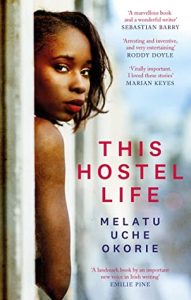 Okorie emigrated from Nigeria to Ireland in 2005. Her time living in a direct provision hostel for asylum seekers informed the title story about women queuing for and squabbling over food rations, written in an African pidgin. In “Under the Awning,” a Black woman fictionalizes her experiences of racism into a second-person short story her classmates deem too bleak. The Author’s Note reveals that Okorie based this one on comments she herself got in a writers’ group. “The Egg Broke” returns to Nigeria and its old superstition about twins.
Fans of Chimamanda Ngozi Adichie will find a similar voice here, and enough variety to distract from the low page count (the book is padded out with an essay on refugees in Ireland) and so-so writing. (Little Free Library)
Dear George and Other Stories by Helen Simpson (1995)
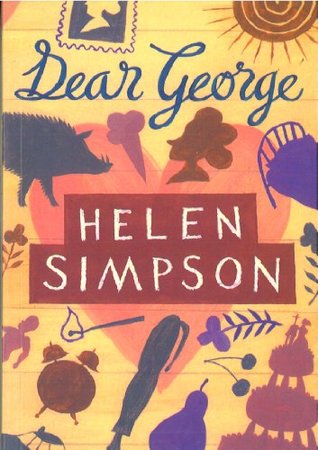 This is the third time Simpson has made it into one of my September features (after Four Bare Legs in a Bed in 2018 and In the Driver’s Seat in 2019); safe to say she’s becoming one of my favourite short story writers. Deciding to have children (or not) looms large. In “When in Rome,” Geraldine is relieved to get her period as her relationship limps to an end. In “Last Orders,” the heavily pregnant protagonist, now 12 days overdue, fears the transformation ahead of her. “To Her Unready Boyfriend,” echoing Andrew Marvell’s “To His Coy Mistress,” has the narrator warn him time runs short for babymaking.
I also liked “Bed and Breakfast,” about a young couple hoping not to turn into their boring parents; “Caput Apri” and its magical twist on the story behind “The Boar’s Head Carol” (a Christmas story or two is a trademark of Simpson’s collections, like the focus on motherhood); and “Heavy Weather,” in which parents of two small children have a manic Dorset holiday that takes in some beloved sites like Hardy’s cottage and marvel at the simultaneous joys and tyranny of childrearing.
The gentle absurdity of “The Immaculate Bridegroom” reminded me of a previous Simpson story in which a woman marries herself, and “Creative Writing” connects back to two of the other collections I’ve featured here with its writers’ workshop setting. (Secondhand purchase from Oxfam Books, Hexham)
Some favourite lines:
“You will not be you any more, her ego told her id. Not only will you have produced somebody else from inside you, someone quite different and separate, but you yourself will change into somebody quite different, overnight – a Mother.”
“Children were petal-skinned ogres, Frances realized, callous and whimsical, holding autocratic sway over lower, larger vassals like herself.”
Are you a short story fan? Read any good ones recently?
Review Book Catch-Up: Motherhood, Nature Essays, Pandemic, Poetry
July slipped away without me managing to review any current-month releases, as I am wont to do, so to those three I’m adding in a couple of other belated review books to make up today’s roundup. I have: a memoir-cum-sociological study of motherhood, poems of Afghan women’s experiences, a graphic novel about a fictional worst-case pandemic, seasonal nature essays from voices not often heard, and poetry about homosexual encounters.
(M)otherhood: On the choices of being a woman by Pragya Agarwal
“Mothering would be my biggest gesture of defiance.”
 Growing up in India, Agarwal, now a behavioural and data scientist, wished she could be a boy for her father’s sake. Being the third daughter was no place of honour in society’s eyes, but her parents ensured that she got a good education and expected her to achieve great things. Still, when she got her first period, it felt like being forced onto a fertility track she didn’t want. There was a dearth of helpful sex education, and Hinduism has prohibitions that appear to diminish women, e.g. menstruating females aren’t permitted to enter a temple.
Married and unexpectedly pregnant in 1996, Agarwal determined to raise her daughter differently. Her mother-in-law was deeply disappointed that the baby was a girl, which only increased her stubborn pride: “Giving birth to my daughter felt like first love, my only love. Not planned but wanted all along. … Me and her against the world.” No element of becoming a mother or of her later life lived up to her expectations, but each apparent failure gave a chance to explore the spectrum of women’s experiences: C-section birth, abortion, divorce, emigration, infertility treatment, and finally having further children via a surrogate.
While I enjoyed the surprising sweep of Agarwal’s life story, this is no straightforward memoir. It aims to be an exhaustive survey of women’s life choices and the cultural forces that guide or constrain them. The book is dense with history and statistics, veers between topics, and needed a better edit for vernacular English and smoothing out academic jargon. I also found that I wasn’t interested enough in the specifics of women’s lives in India.
With thanks to Canongate for the free copy for review.
Forty Names by Parwana Fayyaz
“History has ungraciously failed the women of my family”
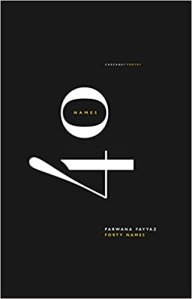 Have a look at this debut poet’s journey: Fayyaz was born in Kabul in 1990, grew up in Afghanistan and Pakistan, studied in Bangladesh and at Stanford, and is now, having completed her PhD, a research fellow at Cambridge. Many of her poems tell family stories that have taken on the air of legend due to the translated nicknames: “Patience Flower,” her grandmother, was seduced by the Khan and bore him two children; “Quietude,” her aunt, was a refugee in Iran. Her cousin, “Perfect Woman,” was due to be sent away from the family for infertility but gained revenge and independence in her own way.
Fayyaz is bold to speak out about the injustices women can suffer in Afghan culture. Domestic violence is rife; miscarriage is considered a disgrace. In “Roqeeya,” she remembers that her mother, even when busy managing a household, always took time for herself and encouraged Parwana, her eldest, to pursue an education and earn her own income. However, the poet also honours the wisdom and skills that her illiterate mother exhibited, as in the first three poems about the care she took over making dresses and dolls for her three daughters.
As in Agarwal’s book, there is a lot here about ideals of femininity and the different routes that women take – whether more or less conventional. “Reading Nadia with Eavan” was a favourite for how it brought together different aspects of Fayyaz’s experience. Nadia Anjuman, an Afghan poet, was killed by her husband in 2005; many years later, Fayyaz found herself studying Anjuman’s work at Cambridge with the late Eavan Boland. Important as its themes are, I thought the book slightly repetitive and unsubtle, and noted few lines or turns of phrase – always a must for me when assessing a poetry collection.
With thanks to Carcanet Press for the free copy for review.
Resistance by Val McDermid; illus. Kathryn Briggs
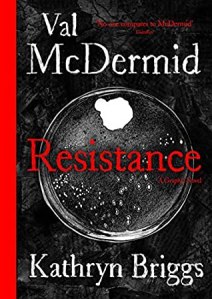 The second 2021 release I read in quick succession in which all but a small percentage of the human race (here, 2 million people) perishes in a pandemic – the other was Under the Blue. Like Aristide’s novel, this story had its origins in 2017 (in this case, on BBC Radio 4’s “Dangerous Visions”) but has, of course, taken on newfound significance in the time of Covid-19. McDermid imagines the sickness taking hold during a fictional version of Glastonbury: Solstice Festival in Northumberland. All the first patients, including a handful of rockstars, ate from Sam’s sausage sandwich van, so initially it looks like food poisoning. But vomiting and diarrhoea give way to a nasty rash, listlessness and, in many cases, death.
Zoe Beck, a Black freelance journalist who conducted interviews at Solstice, is friends with Sam and starts investigating the mutated swine disease, caused by an Erysipelas bacterium and thus nicknamed “the Sips.” She talks to the festival doctor and to a female Muslim researcher from the Life Sciences Centre in Newcastle, but her search for answers takes a backseat to survival when her husband and sons fall ill.
The drawing style and image quality – some panes are blurry, as if badly photocopied – let an otherwise reasonably gripping story down; the best spreads are collages or borrow a frame/backdrop (e.g. a medieval manuscript, NHS forms, or a 1910s title page).


SPOILER
{The ending, which has an immune remnant founding a new community, is VERY Parable of the Sower.}
With thanks to Profile Books/Wellcome Collection for the free copy for review.
Gifts of Gravity and Light: A Nature Almanac for the 21st Century, ed. Anita Roy and Pippa Marland
I hadn’t heard about this upcoming nature anthology when a surprise copy dropped through my letterbox. I’m delighted the publisher thought of me, as this ended up being just my sort of book: 12 autobiographical essays infused with musings on landscapes in Britain and elsewhere; structured by the seasons to create a gentle progression through the year, starting with the spring. Best of all, the contributors are mostly female, BIPOC (and Romany), working class and/or queer – all told, the sort of voices that are heard far too infrequently in UK nature writing. In momentous rites of passage, as in routine days, nature plays a big role.
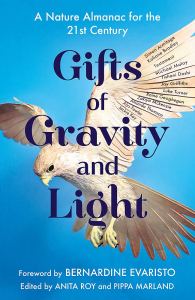 A few of my favourite pieces were by Kaliane Bradley, about her Cambodian heritage (the Wishing Dance associated with cherry blossom, her ancestors lost to genocide, the Buddhist belief that people can be reincarnated in other species); Testament, a rapper based in Leeds, about capturing moments through photography and poetry and about the seasons feeling awry both now and in March 2008, when snow was swirling outside the bus window as he received word of his uni friend’s untimely death; and Tishani Doshi, comparing childhood summers of freedom in Wales with growing up in India and 2020’s Covid restrictions.
Most of the authors hold two places in mind at the same time: for Michael Malay, it’s Indonesia, where he grew up, and the Severn estuary, where he now lives and ponders eels’ journeys; for Zakiya McKenzie, it’s Jamaica and England; for editor Anita Roy, it’s Delhi versus the Somerset field her friend let her wander during lockdown. Trees lend an awareness of time and animals a sense of movement and individuality. Alys Fowler thinks of how the wood she secretly coppices and lays on park paths to combat the mud will long outlive her, disintegrating until it forms the very soil under future generations’ feet.
A favourite passage (from Bradley): “When nature is the cuddly bunny and the friendly old hill, it becomes too easy to dismiss it as a faithful retainer who will never retire. But nature is the panic at the end of a talon, and it’s the tree with a heart of fire where lightning has struck. It is not our friend, and we do not want to make it our enemy.”
Also featured: Bernardine Evaristo (foreword), Raine Geoghegan, Jay Griffiths, Amanda Thomson, and Luke Turner.
With thanks to Hodder & Stoughton for the free copy for review.
Records of an Incitement to Silence by Gregory Woods
 Woods is an emeritus professor at Nottingham Trent University, where he was appointed the UK’s first professor of Gay & Lesbian Studies in 1998. Much of his sixth poetry collection is composed of unrhymed sonnets in two stanzas (eight lines, then six). The narrator is often a randy flâneur, wandering a city for homosexual encounters. One assumes this is Woods, except where the voice is identified otherwise, as in “[Walt] Whitman at Timber Creek” (“He gives me leave to roam / my idle way across / his prairies, peaks and canyons, my own America”) and “No Title Yet,” a long, ribald verse about a visitor to a stately home.
Other times the perspective is omniscient, painting a character study, like “Company” (“When he goes home to bed / he dare not go alone. … This need / of company defeats him.”), or of Frank O’Hara in “Up” (“‘What’s up?’ Frank answers with / his most unseemly grin, / ‘The sun, the Dow, my dick,’ / and saunters back to bed.”). Formalists are sure to enjoy Woods’ use of form, rhyme and meter. I enjoyed some of the book’s cheeky moments but had trouble connecting with its overall tone and content. That meant that it felt endless. I also found the end rhymes, when they did appear, over-the-top and silly (Demeter/teeter, etc.).
Two favourite poems: “An Immigrant” (“He turned away / to strip. His anecdotes / were innocent and his / erection smelled of soap.”) and “A Knot,” written for friends’ wedding in 2014 (“make this wedding supper all the sweeter / With choirs of LGBT cherubim”).
With thanks to Carcanet Press for the free copy for review.
Would you be interested in reading one or more of these?
Recommended May Releases: Adichie, Pavey and Unsworth
Three very different works of women’s life writing: heartfelt remarks on bereavement, a seasonal diary of stewarding four wooded acres in Somerset, and a look back at postnatal depression.
Notes on Grief by Chimamanda Ngozi Adichie
This slim hardback is an expanded version of an essay Adichie published in the New Yorker in the wake of her father’s death in June 2020. With her large family split across three continents and coronavirus lockdown precluding in-person get-togethers, they had a habit of frequent video calls. She had seen her father the day before on Zoom and knew he was feeling unwell and in need of rest, but the news of his death still came as a complete shock.
 Adichie anticipates all the unhelpful platitudes people could and did send her way: he lived to a ripe old age (he was 88), he had a full life and was well respected (he was Nigeria’s first statistics professor), he had a mercifully swift end (kidney failure). Her logical mind knows all of these facts, and her writer’s imagination has depicted grief many times. Still, this loss blindsided her.
She’d always been a daddy’s girl, but the anecdotes she tells confirm how special he was: wise and unassuming; a liberal Catholic suspicious of materialism and with a dry humour. I marvelled at one such story: in 2015 he was kidnapped and held in the boot of a car for three days, his captors demanding a ransom from his famous daughter. What did he do? Correct their pronunciation of her name, and contradict them when they said that clearly his children didn’t love him. “Grief has, as one of its many egregious components, the onset of doubt. No, I am not imagining it. Yes, my father truly was lovely.” With her love of fashion, one way she dealt with her grief was by designing T-shirts with her father’s initials and the Igbo words for “her father’s daughter” on them.
I’ve read many a full-length bereavement memoir, and one might think there’s nothing new to say, but Adichie writes with a novelist’s eye for telling details and individual personalities. She has rapidly become one of my favourite authors: I binged on most of her oeuvre last year and now have just one more to read, Purple Hibiscus, which will be one of my 20 Books of Summer. I love her richly evocative prose and compassionate outlook, no matter the subject. At £10, this 85-pager is pricey, but I was lucky to get it free with Waterstones loyalty points.
Favourite lines:
“In the face of this inferno that is sorrow, I am callow and unformed.”
“How is it that the world keeps going, breathing in and out unchanged, while in my soul there is a permanent scattering?”
Deeper Into the Wood by Ruth Pavey
 In 1999 Ruth Pavey bought four acres of scrubland at auction, happy to be returning to her family’s roots in the Somerset Levels and hoping to work alongside nature to restore some of her land to orchard and maintain the rest in good health. Her account of the first two decades of this ongoing project, A Wood of One’s Own, was published in 2017.
In this sequel, she gives peaceful snapshots of the wood throughout 2019, from first snowdrops to final apple pressing, but also faces up to the environmental degradation that is visible even in this pocket of the countryside. “I am sure there has been a falling off in numbers of insects, smaller birds and rabbits on my patch,” she insists. Without baseline data, it is hard to support this intuition, but she has botanical and bird surveys done, and invites an expert in to do a moth-trapping evening. The resulting species lists are included as appendices. In addition, Pavey weaves a backstory for her land. She meets a daffodil breeder, investigates the source of her groundwater, and visits the head gardener at the Bishop’s Palace in Wells, where her American black walnut sapling came from. She also researches the Sugg family, associated with the land (“Sugg’s Orchard” on the deed) from the 1720s.
 Pavey aims to treat this landscape holistically: using sheep to retain open areas instead of mowing the grass, and weighing up the benefits of the non-native species she has planted. She knows her efforts can only achieve so much; the pesticides standard to industrial-scale farming may still be reaching her trees on the wind, though she doesn’t apply them herself. “One sad aspect of worrying about the state of the natural world is that everything starts to look wrong,” she admits. Starting in that year’s abnormally warm January, it was easy for her to assume that the seasons can no longer be relied on.
Compared with her first memoir, this one is marked by its intellectual engagement with the principles and practicalities of rewilding. Clearly, her inner struggle is motivated less by the sense of ownership than by the call of stewardship. While this book is likely be of most interest to those with a local connection or a similar project underway, it offers a universal model of how to mitigate our environmental impact. Pavey’s black-and-white sketches of the flora and fauna on her patch, reminiscent of Quentin Blake, are a highlight.
With thanks to Duckworth for the proof copy for review. The book will be published tomorrow, the 27th of May.
After the Storm: Postnatal Depression and the Utter Weirdness of New Motherhood by Emma Jane Unsworth
The author’s son was born on the day Donald Trump won the U.S. presidential election. Six months later, she realized that she was deep into postnatal depression and finally agreed to get help. The breaking point came when, with her husband* away at a conference, she got frustrated with her son’s constant fussing and pushed him over on the bed. He was absolutely fine, but the guilty what-ifs proliferated, making this a wake-up call for her.
 In this succinct, wry and hard-hitting memoir, Unsworth exposes the conspiracies of silence that lead new mothers to lie and pretend that everything is fine. Since her son’s traumatic birth (which I first read about in Dodo Ink’s Trauma anthology), she hadn’t been able to write and was losing her sense of self. To add insult to injury, her baby had teeth at 16 weeks and bit her as he breastfed. She couldn’t even admit her struggles to her fellow mum friends. But “if a woman is in pain for long enough, and denied sleep for long enough, and at the same time feels as though she has to keep going and put a ‘brave’ face on, she’s going to crack.”
The book’s titled mini-essays give snapshots into the before and after, but particularly the agonizing middle of things. I especially liked the chapter “The Weirdest Thing I’ve Ever Done in a Hotel Room,” in which she writes about borrowing her American editor’s room to pump breastmilk. Therapy, antidepressants and hiring a baby nurse helped her to ease back into her old life and regain some part of the party girl persona she once exuded – enough so that she was willing to give it all another go (her daughter was born late last year).
While Unsworth mostly writes from experience, she also incorporates recent research and makes bold statements of how cultural norms need to change. “You are not monsters,” she writes to depressed mums. “You need more support. … Motherhood is seismic. It cracks open your life, your relationship, your identity, your body. It features the loss, grief and hardship of any big life change.” I can imagine this being hugely helpful to anyone going through PND (see also my Three on a Theme post on the topic), but I’m not a mother and still found plenty to appreciate (especially “We have to smash the dichotomy of mums/non-mums … being maternal has nothing to do with actually physically being a mother”).
I’m attending a Wellcome Collection online event with Unsworth and midwife Leah Hazard (author of Hard Pushed) this evening and look forward to hearing more from both authors.
*It took me no time at all to identify him from the bare facts: Brighton + doctor + graphic novelist = Ian Williams (author of The Lady Doctor)! I had no idea. What a fun connection.
With thanks to Profile Books/Wellcome Collection for the free copy for review.
What recent releases can you recommend?
Reading Ireland Month: Baume, Kennefick, Ní Ghríofa, O’Farrell
Reading Ireland Month is hosted each March by Cathy of 746 Books. This year I read works by four Irish women: a meditation on birds and craft, hard-hitting poems about body issues, autofiction that incorporates biography and translation to consider the shape of women’s lives across the centuries, and a novel that jets between Hong Kong and Scotland. Two of these were sent to me as part of the Rathbones Folio Prize shortlist. I have some Irish music lined up to listen to (Hallow by Duke Special, At Swim by Lisa Hannigan, Chop Chop by Bell X1, Magnetic North by Iain Archer) and I’m ready to tell you all about these four books.

handiwork by Sara Baume (2020)
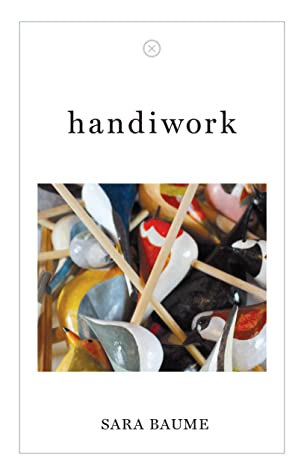 Back in February 2016, I reviewed Baume’s debut novel, Spill Simmer Falter Wither, for Third Way magazine. A dark story of a middle-aged loner and his adopted dog setting off on a peculiar road trip, it was full of careful nature imagery. “I’ve always noticed the smallest, quietest things,” the narrator, Ray, states. The same might be said of Baume, who is a visual artist as well as an author and put together this gently illuminating book over the course of 2018, at the same time as she was working on several sculptural installations. In short sections of a paragraph or two, or sometimes no more than a line, she describes her daily routines in her home workspaces: in the morning she listens to barely audible talk radio as she writes, while the afternoons are for carving and painting.
Working with her hands is a family tradition passed down from her grandfather and father, who died in the recent past – of lung cancer from particles he was exposed to at the sandstone quarry where he worked. Baume has a sense of responsibility for how she spends her time and materials. Concern about waste is at odds with a drive for perfection: she discarded her first 100 plaster birds before she was happy with the series used to illustrate this volume. Snippets of craft theory, family memories, and trivia about bird migration and behaviour are interspersed with musings on what she makes. The joy of holding a physical object in the hand somehow outweighs that of having committed virtual words to a hard drive.
Despite the occasional lovely line, this scattered set of reflections doesn’t hang together. The bird facts, in particular, feel shoehorned in for symbolism, as in Colum McCann’s Apeirogon. It’s a shame, as from the blurb I thought this book couldn’t be better suited to my tastes. Ultimately, as with Spill, Baume’s prose doesn’t spark much for me.
Favorite lines:
“Most of the time spent making is spent, in fact, in the approach.”
“I must stop once the boredom becomes intolerable, knowing that if I plunge on past this point I will risk arriving at resentment”
“What we all shared – me, my dad, his dad – was a suspicion of modern life, a loathing of fashion, a disappointment with the new technologies and a preference for the ad hoc contraptions of the past”
“The glorious, crushing, ridiculous repetition of life.”
With thanks to Tramp Press and FMcM Associates for the free copy for review. handiwork is on the Rathbones Folio Prize shortlist.
Eat or We Both Starve by Victoria Kennefick (2021)
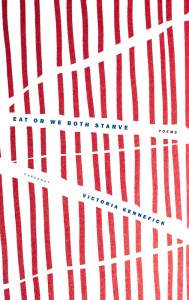 This audacious debut collection of fleshly poems is the best I’ve come across so far this year. The body is presented as a battleground: for the brain cancer that takes the poet’s father; for disordered eating that entwines with mummy issues; for the restructuring of pregnancy. Families break apart and fuse into new formations. Cannibalism and famine metaphors dredge up emotional states and religious doctrines.
Where did I start?
Yes, with the heart, enlarged,
its chambers stretched through caring.
[…]
Oh is it in defiance or defeat, I don’t know,
I eat it anyway, raw, still warm.
The size of my fist, I love it.
(from the opening poem, “Learning to Eat My Mother, where My Mother Is the Teacher”)
Meat avoidance goes beyond principled vegetarianism to become a phobia. Like the female saints, the speaker will deny herself until she achieves spiritual enlightenment.
The therapist taps my shoulders, my head, my knees,
tells me I was a nun once, very strict.
This makes sense; I know how cleanly I like
to punish myself.
(from “Alternative Medicine”)
The title phrase comes from “Open Your Mouth,” in which the god Krishna, as a toddler, nourishes his mother with clay. A child feeding its mother reverses the expected situation, which is described in one of the book’s most striking poems, “Researching the Irish Famine.” The site of an old workhouse divulges buried horrors: “Mothers exhausted their own bodies / to produce milk. […] The starving / human / literally / consumes / itself.”
Corpses and meals; body odour and graves. There’s a pleasingly morbid cast to this collection, but it also has its lighter moments: the sexy “Paris Syndrome,” the low-stakes anxiety over pleasing one’s mother in “Guest Room,” and the playful closer, “Prayer to Audrey Hepburn” (“O Blessed Audrey of the feline eye-flick, jutting / bones, slim-hipped androgyny of war-time rationing”). Rich with imagery and alliteration, this is just my kind of poetry. Verse readalikes would include The Air Year by Caroline Bird, Flèche by Mary Jean Chan, and Tongues of Fire by Seán Hewitt, while in prose I was also reminded of Milk Fed by Melissa Broder (review coming soon) and Sanatorium by Abi Palmer. 
With thanks to Carcanet Press for the free copy for review. This comes out on the 25th.
A Ghost in the Throat by Doireann Ní Ghríofa (2020)
 “This is a female text.” In an elegant loop, Ní Ghríofa begins and ends with this line, and uses it as a refrain throughout. What is the text? It is this book, yes, as well as the 18th-century Irish-language poem that becomes an obsession for the author/narrator, “The Keen for Art Ó Laoghaire” by Eibhlín Dubh Ní Chonaill; however, it is also the female body, its milk and blood just as significant for storytelling as any ink.
Because the protagonist’s name is the same as the author’s, I took her experiences at face value. As the narrative opens in 2012, Ní Ghríofa and her husband have three young sons and life for her is a list of repetitive household tasks that must be completed each day. She donates pumped breast milk for premature babies as a karmic contribution to the universe: something she can control when so much around her she feels she can’t, like frequent evictions and another pregnancy. Reading Eibhlín Dubh’s lament for her murdered husband, contemplating a new translation of it, and recreating her life from paltry archival fragments: these tasks broaden her life and give an intellectual component to complement the bodily one.
My weeks are decanted between the twin forces of milk and text, weeks that soon pour into months, and then into years. I make myself a life in which whenever I let myself sit, it is to emit pale syllables of milk, while sipping my own dark sustenance from ink. […] I skitter through chaotic mornings of laundry and lunchboxes and immunisations, always anticipating my next session at the breast-pump, because this is as close as I get to a rest. To sit and read while bound to my insatiable machine is to leave my lists behind and stroll instead through doors opened by Eibhlín Dubh.
Ní Ghríofa remembers other times in her life in an impressionistic stream: starting a premed course at university, bad behaviour that culminated in suicidal ideation, a near-collision on a highway, her daughter’s birth by emergency C-section, finally buying a house and making it a home by adopting a stray kitten and planting a bee-friendly garden. You can tell from the precision of her words that Ní Ghríofa started off as a poet, and I loved how she writes about her own life. I had little interest in Eibhlín Dubh’s story, but maybe it’s enough for her to be an example of women “cast once more in the periphery of men’s lives.” It’s a book about women’s labour – physical and emotional – and the traces of it that remain. I recommend it alongside I Am, I Am, I Am by Maggie O’Farrell and Mother Ship by Francesca Segal.
With thanks to Tramp Press and FMcM Associates for the free copy for review. A Ghost in the Throat is on the Rathbones Folio Prize shortlist.
The Distance Between Us by Maggie O’Farrell (2004)
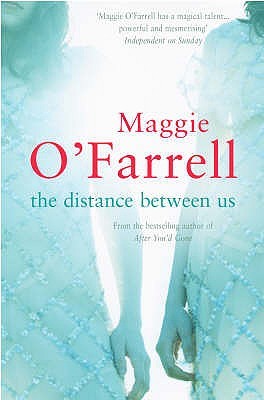 This is the earliest work of O’Farrell’s that I’ve read – it was her third novel, following After You’d Gone and My Lover’s Lover (I finally found those two at a charity shop last year and I’m saving them for a rainy day). It took me a long time to get into this one. It’s delivered in bitty sections that race between characters and situations, not generally in chronological order. It’s not until nearly the halfway point that you get a sense of how it all fits together.
Although there are many secondary characters, the two main strands belong to Jake, a young white filmmaker raised in Hong Kong by a bohemian mother, and Stella, a Scottish-Italian radio broadcaster. When a Chinese New Year celebration turns into a stampede, Jake and his girlfriend narrowly escape disaster and rush into a commitment he’s not ready for. In the meantime, Stella gets spooked by a traumatic flash from her childhood and flees London for a remote Scottish hotel. She’s very close to her older sister, Nina, who was deathly ill as a child (O’Farrell inserts a scene I was familiar with from I Am, I Am, I Am, when she heard a nurse outside her room chiding a noisy visitor, “There’s a little girl dying in there”), but now it’s Nina who will have to convince Stella to take the chance at happiness that life is offering.
In the end, this felt like a rehearsal for This Must Be the Place; it has the myriad settings (e.g., here, Italy, Wales and New Zealand are also mentioned) but not the emotional heft. With a setup like this, you sort of know where things are going, don’t you? Despite Stella’s awful secret, she is as flat a character as Jake. Simple boy-meets-girl story lines don’t hold a lot of appeal for me now, if they ever did. Still, the second half was a great ride.
Also, I’ve tried twice over the past year, but couldn’t get further than page 80 in The Wild Laughter by Caoilinn Hughes (2020), a black comedy about two brothers whose farmer father goes bankrupt and gets a terminal diagnosis. It’s a strangely masculine book (though in some particulars very similar to Scenes of a Graphic Nature) and I found little to latch on to. This was a disappointment as I’d very much enjoyed Hughes’s debut, Orchid & the Wasp, and this second novel is now on the Dylan Thomas Prize longlist.

 Bookish Beck = Rebecca Foster. American transplant to England. Freelance proofreader and book reviewer.
