#NovNov25 and #GermanLitMonth: Kästner, Kehlmann & Kracht
Our trip to Germany in September whetted my appetite to read more German-language fiction, and November also being German Literature Month (hosted this year by Caroline of Beauty Is a Sleeping Cat and Tony of Tony’s Reading List) was a perfect excuse. K names only this year, please. (Perhaps next year I’ll make it S and finally get to those Sebald and Seethaler novels I have on the shelf.) These three works – a children’s classic, a set of linked short stories about the writer’s craft, and a mother–son spending spree – have coy metafictional touches, plus there’s a connection I wasn’t expecting between the Kehlmann and Kracht. All: 

Emil and the Detectives by Erich Kästner (1929; 1931)
[Translated by Eileen Hall]
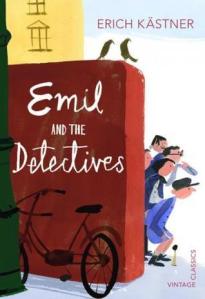 If only I’d realized this was set on a train to Berlin, I could have read it in the same situation! Instead, it was a random find while shelving in the children’s section of the library. Emil sets out on a slow train from Neustadt to stay with his aunt, grandmother and cousin in Berlin for a week’s holiday. His mother gives him £7 in an envelope he pins inside his coat for safekeeping. There are four adults in the carriage with him, but three get off early, leaving Emil alone with a man in a bowler hat. Much as he strives to stay awake, Emil drops off. No sooner has the train pulled into Berlin than he realizes the envelope is gone along with his fellow traveller. “There were four million people in Berlin at that moment, and not one of them cared what was happening to Emil Tischbein.” He’s sure he’ll have to chase the man in the bowler hat all by himself, but instead he enlists the help of a whole gang of boys, including Gustav who carries a motor-horn and poses as a bellhop, Professor with the glasses, and Little Tuesday who mans the phone lines. Together they get justice for Emil, deliver a wanted criminal to the police, and earn a hefty reward. This was a cute story and it was refreshing for children’s word to be taken seriously. There’s also the in-joke of the journalist who interviews Emil being Kästner. I’m sure as a kid I would have found this a thrilling adventure, but the cynical me of today deemed it unrealistic. (Public library) [153 pages]
Fame by Daniel Kehlmann (2009; 2010)
[Translated by Carol Brown Janeway]
 I’ve been equally enchanted by Kehlmann’s historical fiction (Measuring the World) and contemporary metafiction (F is one of my all-time favourites) in the past. These nine linked stories feature writers and their characters, actors and their look-alikes, and are about how life translates into – or is sometimes transformed by – art. Ralf Tanner starts to feel like he doesn’t exist when his calls gets diverted to someone else’s phone and an impersonator is more convincing at playing him than he is himself. Leo Richter’s new girlfriend is curiously similar to his most famous character, Lara Gaspard, a doctor working for a medical charity. Crime writer Maria Rubinstein takes Leo’s place on a cultural exchange to Central Asia and gets stuck in a Kafka-esque situation without a visa. Leo’s fan and Ralf’s call recipient are subjects of their own stories. References to Miguel Auristos Blanco’s spiritual self-help books recur and he, too, eventually becomes a character. I liked the pointed little jokes about what writers have to put up with (“Do you know how often I’ve been asked today where I get my ideas from? Fourteen. And nine times whether I work in the morning or the afternoon,” Leo complains). Mostly, these stories struck me as clever yet had me wondering what the point was. My favourite was “Rosalie Goes Off to Die,” in which Leo’s character travels to Zurich for an assisted death but he the writer decides to interfere before she can get her last wish. (Secondhand – Awesomebooks.com) [206 pages – but fairly large print]
Eurotrash by Christian Kracht (2021; 2024)
[Translated by Daniel Bowles]
 This was longlisted for the International Booker Prize and is the current Waterstones book of the month. The Swiss author’s seventh novel appears to be autofiction: the protagonist is named Christian Kracht and there are references to his previous works. Whether he actually went on a profligate road trip with his 80-year-old mother, who could say. I tend to think some details might be drawn from life – her physical and mental health struggles, her father’s Nazism, his father’s weird collections and sexual predilections – but brewed into a madcap maelstrom of a plot that sees the pair literally throwing away thousands of francs. Her fortune was gained through arms industry investment and she wants rid of it, so they hire private taxis and planes. If his mother has a whim to pick some edelweiss, off they go to find it. All the while she swigs vodka and swallows pills, and Christian changes her colostomy bags. I was wowed by individual lines (“This was the katabasis: the decline of the family expressed in the topography of her face”; “everything that does not rise into consciousness will return as fate”; “the glacial sun shone from above, unceasing and relentless, upon our little tableau vivant”) but was left chilly overall by the satire on the ultra-wealthy and those who seek to airbrush history. The fun connections: Like the Kehlmann, this involves arbitrary travel and happens to end in Africa. More than once, Kracht is confused for Kehlmann. (Little Free Library) [190 pages]
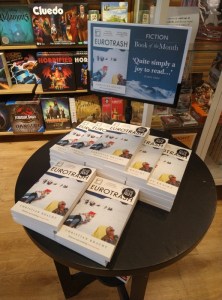
Spotted in my local Waterstones…

#1925Club: The Heart of a Dog by Mikhail Bulgakov
Simon and Kaggsy’s classics reading weeks always get me picking up older books. I found this unusual Russian novella on a giveaway pile a few years ago and it’s been on my #NovNov possibility shelf ever since, but now turned out to be the perfect time for it. This review also fits into the Hundred Years Hence challenge.
Sharik is an abused stray dog, living on scraps on the snowy streets of Moscow until Professor Philip Philipovich Preobrazhensky takes him in. The professor is a surgeon renowned for his rejuvenation procedures – implanting monkey ovaries into a middle-aged lady, for instance – and he has designs on the mutt. His new strategy is to take the pituitary gland and testicles of a just-deceased young man and transplant them into Sharik. The central chapter is composed of medical notes taken by Preobrazhensky’s assistant, Dr. Bormenthal. Gradually, a transformation is achieved: The dog’s bark becomes more of a human groan and his fur and tail fall off. Soon the new man is fully convincing: eating, dressing and conversing. Even in a matter-of-fact style, the doctor’s clinical observations are hilarious. “The dog[,] in the presence of Zina and myself, had called Prof. Preobrazhensky a ‘bloody bastard’. … Heard to ask for ‘another one, and make it a double.’” The scientists belatedly look into the history of the man whose glands they harvested and discover to their horror that he was an alcoholic petty thief who died in a bar fight. Sharikov follows suit as an inebriated boor who pesters women, wants to be known as Poligraph Poligraphovich – and still chases cats. Is it too late to reverse a Frankenstein-esque trial gone wrong?
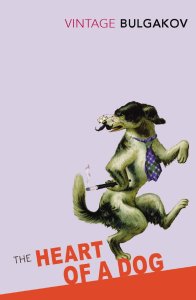 This was a fairly entertaining fable-like story, with whimsical fragments of narration from Sharik himself at the start and close. The blurb inside the jacket of my 1968 Harvill Press hardback suggests “The Heart of a Dog can be enjoyed solely as a comic story of splendid absurdity; it can also be read as a fierce parable about the Russian Revolution.” The allegorical meaning could easily have passed me by, being less overt than in Animal Farm. Reading a tiny bit of external information, I see that this has been interpreted as a satire on the nouveau riche during the Bolshevik era: Sharikov complains about how wealthy the professor is and proposes that he sacrifice some of his apartment-cum-office’s many rooms to others who have nowhere to live. But yes, I mostly stayed at the surface level and found an amusing mad-scientist cautionary tale. I’ll read more by Bulgakov – I’ve had a copy of The Master and Margarita for ages. Next year’s Reading the Meow week might be my excuse.
[Translated from Russian by Michael Glenny, 1968]
(Free from a neighbour, formerly part of Scarborough Public Library stock)
I also intended to read An American Tragedy by Theodore Dreiser from the university library, having a dim memory of a black-and-white film version starring Montgomery Clift (A Place in the Sun). But the catalogue’s promised 400-some pages was a lie; there are two volumes in one, totaling 840 pages. So that was a nonstarter.
But here are some other famous 1925 titles that I’ve read (I’m now at 7 out of the top 15 on the Goodreads list of the most popular books published in 1925):
The Great Gatsby by F. Scott Fitzgerald
The Trial by Franz Kafka
The Painted Veil by W. Somerset Maugham
Emily Climbs by L.M. Montgomery
Carry On, Jeeves by P.G. Wodehouse
Mrs. Dalloway by Virginia Woolf
I’ve previously participated in the 1920 Club, 1956 Club, 1936 Club, 1976 Club, 1954 Club, 1929 Club, 1940 Club, 1937 Club, 1970 Club, and 1952 Club.
The 2025 McKitterick Prize Winner & SoA Awards Ceremony
Yesterday the Society of Authors’ awards were announced and the prizes handed out at a ceremony in London. As a McKitterick Prize judge, I was asked last month to give a 50-word blurb on the shortlist as a whole—
Each of these six novels has a fully realized style. So confident and inviting are they that it’s hard to believe they are debuts. With nuanced characters and authentic settings and dilemmas, they engage the mind and delight the emotions. I will be following these authors’ careers with keen interest.
—and on each individual shortlisted title:
 Etymology and Shakespeare studies are the keys to solving a cold case in Susie Dent’s clever, engrossing mystery, Guilty by Definition.
 Psychoanalysis, motherhood, and violence against women are resounding themes in Lauren Elkin’s Scaffolding. As history repeats itself one sweltering Paris summer, the personal and political structures undergirding the protagonists’ parallel lives come into question. This fearless, sophisticated work ponders what to salvage from the past—and what to tear down.
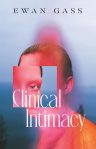 Clinical Intimacy’s mysterious antihero comes to life through interviews with his family, friends and clients. The brilliant oral history format builds a picture of isolation among vulnerable populations, only alleviated by care and touch—especially during Covid-19. Ewan Gass’s intricate story reminds us of the ultimate unknowability of other people.
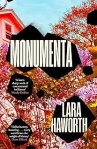
In Monumenta, Lara Haworth braids satire, magic realism, and metafiction into a compact and surprising meditation on how we seek to memorialise the tragedies of history.
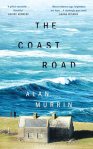
Set in small-town Ireland, The Coast Road is a subtle, compassionate novel in which the characters learn to write their own stories rather than bow to convention and fate. Alan Murrin is a must-read author for fans of Claire Keegan, Louise Kennedy, and Colm Tóibín.
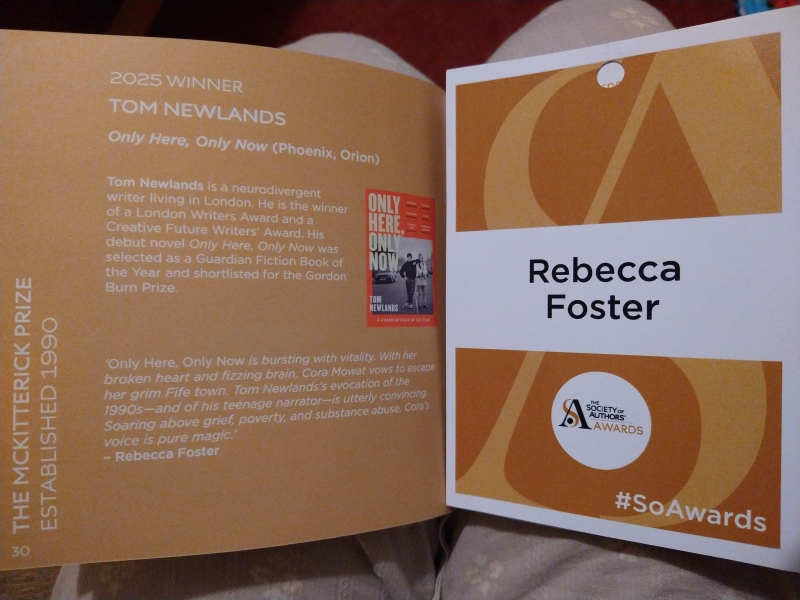
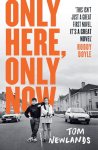 Only Here, Only Now is bursting with vitality. With her broken heart and fizzing brain, Cora Mowat vows to escape her grim Fife town. Tom Newlands’s evocation of the 1990s—and of his teenage narrator—is utterly convincing. Soaring above grief, poverty, and substance abuse, Cora’s voice is pure magic.
Our winner was Tom Newlands for Only Here, Only Now and our runner-up was Lauren Elkin for Scaffolding. (What an honour to have my blurb for the former used in the winners press release, the ceremony programme, and social media publicity.)


Newlands was also a runner-up for the ADCI Literary Prize “for a disabled or chronically ill writer, for an outstanding novel containing a disabled or chronically ill character or characters.” Here’s an excerpt from his statement for the press release:
To have my debut novel recognised in these two categories is particularly meaningful for me because they are linked by my experience. I didn’t start writing until the age of 40, in large part because growing up neurodivergent I didn’t feel my thought processes or methods of working were compatible with the production of a novel. There were no role models out there publishing stories like mine, and in the end, I wrote Only Here, Only Now because I couldn’t find the novel I wanted to read – a warm, vivid and funny story that examined poverty, disability and belonging, and that featured characters rarely found in British fiction.
Looking back to early on in this prize journey (which started back in November) … here was some of my early reading:
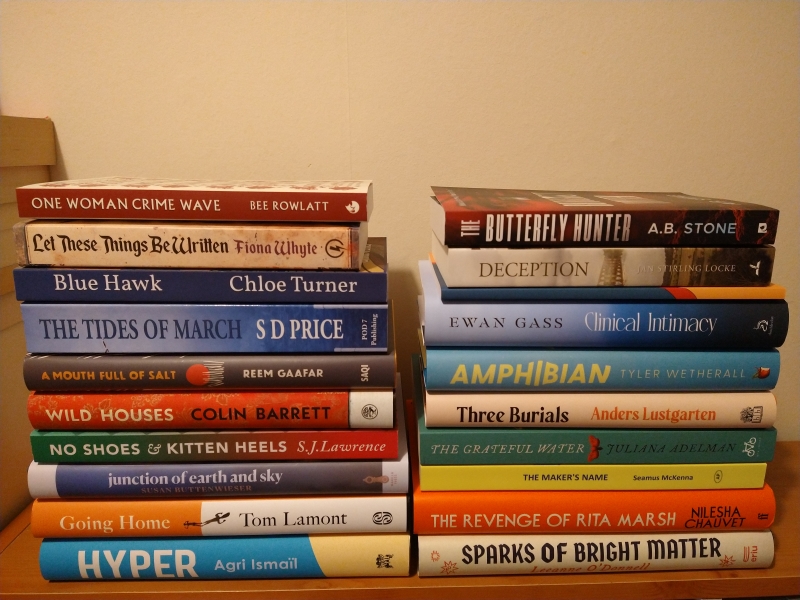
And our longlist:
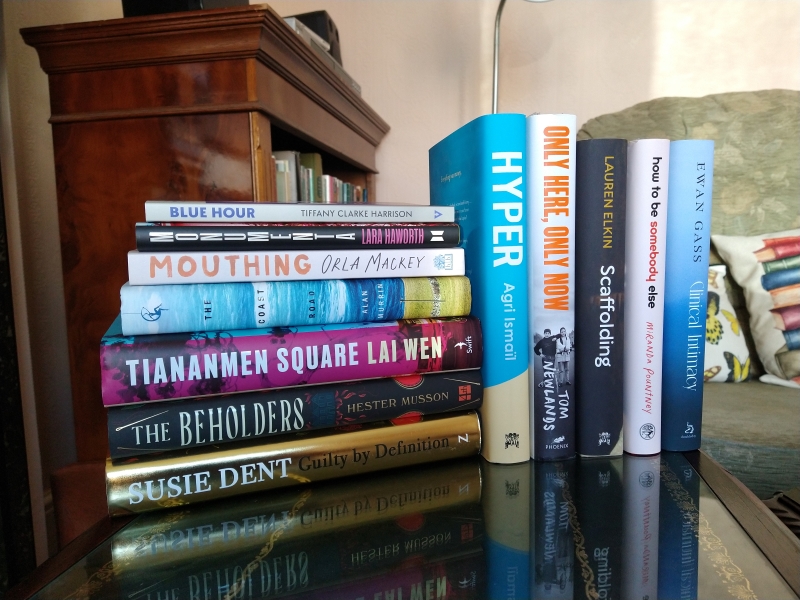
A couple of my favourite books from my reading that didn’t make the shortlist were:
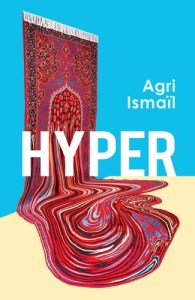 Hyper by Agri Ismaïl [I longlisted it – and then shortlisted it – but was outvoted]
Following a Kurdish family across several decades, this is a zeitgeist-y story that examines questions of national and personal autonomy. With its Dubai, Baghdad, London, and New York settings, it sets the second generation’s luxury, high finance, and fully online worlds against their parents’ bitter experience of exile after a failed independence movement. With its themes of dysfunction and failures and the long view of how we got here from there, it reminded me of Jonathan Franzen’s body of work.
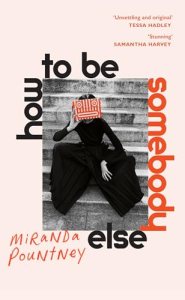 How to Be Somebody Else by Miranda Pountney [It had two votes to make the shortlist, but because it was so similar to Scaffolding in its basics (a thirtysomething woman in a big city, the question of motherhood, and pregnancy loss) we decided to cut it.]
This is the addictively readable story of Dylan, a late-thirties English woman who gives up her New York City advertising job and ponders authorship and motherhood while house-sitting an acquaintance’s apartment—and carrying on an affair with the married downstairs neighbour. As we see her interact with family and friends, we come to appreciate her not as some stereotypical ‘sad girl’ or ‘disaster woman’, but as an Everywoman seeking the time and space to become herself. It’s a sharp and witty novel for fans of Sally Rooney.
For the first time, I got to attend the SoA Awards ceremony in person yesterday. It was a hot day to be travelling in London, and after the oven of the Bakerloo line I was grateful to escape into the cool of Southwark Cathedral and its grounds. It was such a juxtaposition between the sleek City architecture and the ancient refuge of a church.
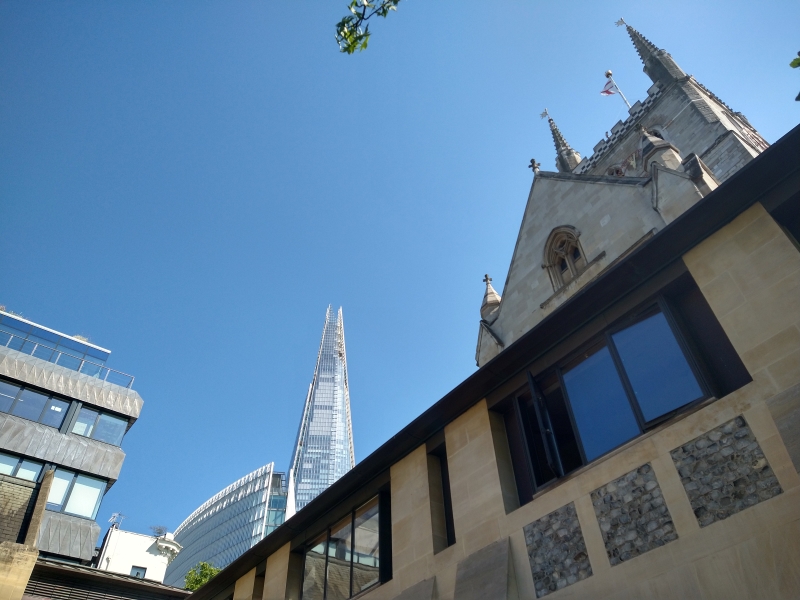
I worried that on such a warm and then busy day Hodge the cathedral cat wouldn’t show himself, but as I picked up my name badge he was asking to be let inside from the courtyard. He didn’t seem interested in strokes so I followed him at a respectful distance and let him settle in for a watchful rest.


Nominated authors and judges were treated to an exceptional afternoon tea, followed by the ceremony and drinks reception. It was lovely to meet my fellow judges Anietie Isong and Kathy O’Shaughnessy (author of the fantastic In Love with George Eliot, which won the SoA’s Paul Torday Memorial Prize) in the flesh as I’d only met them on Zoom before. We chatted a good bit with Lara Haworth, one of our shortlistees, and with Anne Booth, one of the Queen’s Knickers Award (children’s books) nominees, and also got to briefly meet Tom Newlands when he arrived for the ceremony. I always look out for literary ‘celebrities’ at such events and yesterday spotted Naomi Alderman, Caroline Bird, Joanne Harris and Alice Jolly.
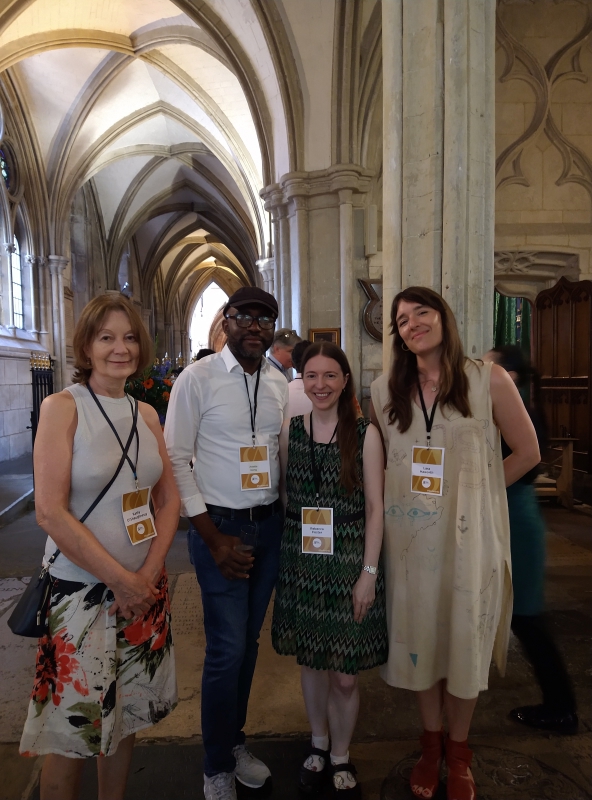


Dean Rev. Mark Oakley gave a welcome address via video, praising authors for bringing “resonance” rather than just “relevance.” He exhorted us, in the words of David Copperfield, to “read as if for life.” Joseph Coelho then gave a terrific keynote speech celebrating words written by humans (as opposed to an inaccurate AI-written bio of himself that he once encountered) and encouraging shortlistees, especially, to take time to bask in their achievement. Rejection is an ongoing, annual thing for him even at this stage of his career – he still remembers the £50 poetry gigs, changing in library toilets and school staff rooms; and the 12 years he spent trying to get published – even after he became the youngest-ever children’s laureate in 2022. “Wait for no one,” he challenged us: no one is going to give you permission or come save you, so go out there and do what you’re meant to do.
What an all-round fantastic experience this was! I’m so grateful to the Society of Authors for the opportunity.
Other notable winners announced yesterday included:
- Ashani Lewis (the only double winner): the Betty Trask Prize and Somerset Maugham award for Winter Animals
- Hisham Matar & Elif Shafak: the Gordon Bowker Volcano Prize (for a novel focusing on the experience of travel away from home), joint winners for My Friends and There Are Rivers in the Sky
May Graphic Novels by Alison Bechdel, Peter Kuper & Craig Thompson
May has been chock-full of new releases for me! For this first batch of reviews, I’m featuring three fantastic graphic novels that have made it onto my Best of 2025 (so far) list. I don’t read graphic books as often as I’d like to – my library tends to major on superhero comics and manga, which aren’t my cup of tea – but I sometimes get a chance to access them for paid review purposes. (The first two below are ones I was sent for potential Shelf Awareness reviews, but I missed the deadlines.) Reading these took me back to the early 2010s when I worked for a university library in South London and would walk to Lambeth Library on my lunch breaks to borrow huge piles of books, mostly taking advantage of their excellent graphic novel selection. That was where my education and fascination began.
Spent: A Comic Novel by Alison Bechdel
 I’ve read all but one of Bechdel’s works now. Fun Home was among the first graphic books I read and is a great choice if you’re new to this form of storytelling. It’s a family memoir about her father’s funeral home business and closeted lifestyle, which emerged shortly after her own coming-out – and shortly before his accidental death. In Spent, Alison and her handy wife Holly live on a Vermont pygmy goat farm. Alison has writer’s block and is struggling financially despite her famous memoir about her taxidermist father having been made into a successful TV series, Death & Taxidermy. Mostly, she’s consumed with anxiety about the state of the world, what with the ongoing pandemic, her sister’s right-wing opinions, and the litany of awful headlines. “Who can draw when the world is burning?” she exclaims.
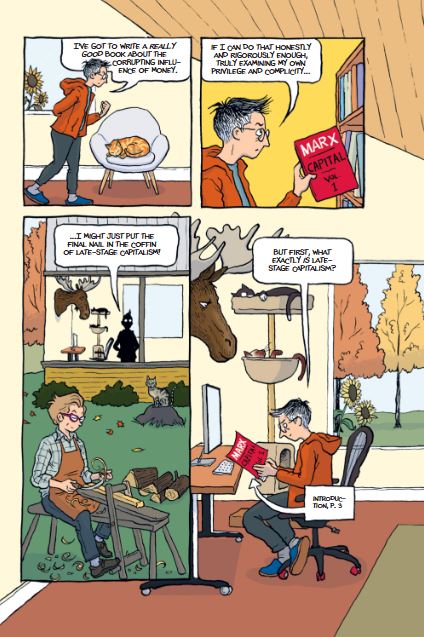
Then Alison has an idea for a book – or maybe a reality TV series – called $UM that will wean people off of capitalism. That creative journey is mirrored in Spent, which is composed of 12 “episodes” titled after Marxist terminology. Through Alison’s ageing hippie friends and their kids, Bechdel showcases alternative ways of living: a commune, a throuple, nonbinary identity, unpaid internships, Just Stop Oil demos, and the influencer lifestyle versus rejection of technology. It’s (auto)fiction exaggerated to the brink of absurdity, with details changed enough to mock but not enough to hide (e.g., she’s published by “Megalopub,” the hardware store is “Home Despot,” her show airs on “Schmamazon”).

Tiny details in the drawings reward close attention, such as Alison and Holly’s five cats’ antics during their morning routine, and a stuffed moose head rolling its eyes. It’s the funniest I can remember Bechdel being, with much broad humour derived from the outrageous screen mangling of her book – cannibalism, volcanoes and dragons come out of nowhere – and her middle-class friends’ hand-wringing over their liberal credentials. Even the throwaway phrases are hilarious. It’s a gleeful and zeitgeist-y satire, yet draws to a touching close as Alison has the epiphany that she can’t fix everything herself so must simply do what she can, “with a little help from her annoying, tender-hearted, and utterly luminous friends.”
Accessed as an e-book from Mariner Books. Published in the UK by Jonathan Cape (Penguin).
Insectopolis: A Natural History by Peter Kuper
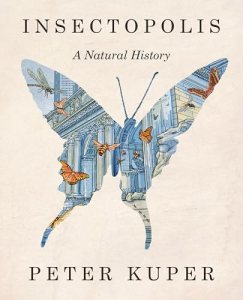 Nearly a decade ago, I reviewed Peter Kuper’s Ruins, which features monarch migration and has as protagonist a laid-off Natural History Museum entomologist. Here insects have even more of a starring role. The E. O. Wilson epigraph sets the stage: “If all mankind were to disappear, the world would regenerate back to the rich state of equilibrium that existed ten thousand years ago. If insects were to vanish, the environment would collapse into chaos.” We follow an African American brother-and-sister pair, the one dubious and the other eager, as they walk downtown to the New York Public Library. The sister, who holds a PhD in entomology, promises that its exhibition on insects is going to be amazing. But just before they reach the building, a red alert flashes up on every smartphone and sirens start blaring. A week later, the city is a ruin of overturned cabs and debris. Only insects remain and, group by group, they guide readers through the empty exhibit, interacting within and across species.


It’s a sly blend of science, history, stories and silliness. I loved the scenes of mosquitoes and ants railing against how they’ve been depicted as villainous, and dignified dung beetles resisting scatological jokes and standing up for their importance in ecosystems. There are interesting interludes about insects in literature (not just Kafka and Nabokov, but the Japanese graphic novel The Book of Human Insects by Osamu Tezuka), and unsung heroines of entomology get their moment in the sun. The pages in which Margaret Collins, an African American termite researcher in the 1950s, and Rachel Carson appear to a dragonfly as ghosts and tell their stories of being dismissed by male researchers were among my favourites. Informative and entertaining at once; what could be better? Welcome our insect overlords!
Accessed as an e-book from W. W. Norton & Company.
Ginseng Roots by Craig Thompson
 I’d read several of Thompson’s works and especially enjoyed his previous graphic memoir, Blankets, about his first love and loss of faith. When I read this blurb, I worried the niche subject couldn’t possibly sustain my attention for nearly 450 pages. But I was wrong; this is a vital book about everything, by way of ginseng. It begins with childhood summers working on American ginseng farms with his siblings in Marathon, Wisconsin. Theirs was a blue collar and highly religious family, but Thompson and his little brother Phil were allowed to spend their earnings from the back-breaking labour of weeding and picking rocks as they pleased. Each hour, each dollar, meant a new comic from the pharmacy. “Comics helped me survive my childhood. But what will help me survive my adulthood?” Thompson asks.

Together with Phil, he travels first to Midwest ginseng farms and festivals and then through China and Korea to learn about the plant’s history, cultivation practices, lore, and medicinal uses. As he meets producers – including a Hmong man whose early life mirrors his own – he feels sheepish about how he makes a living: “I carry this working-class guilt – what I do isn’t real work.” When his livelihood is threatened by worsening autoimmune conditions, he tries everything from acupuncture to psychotherapy to save his hands and his creativity.
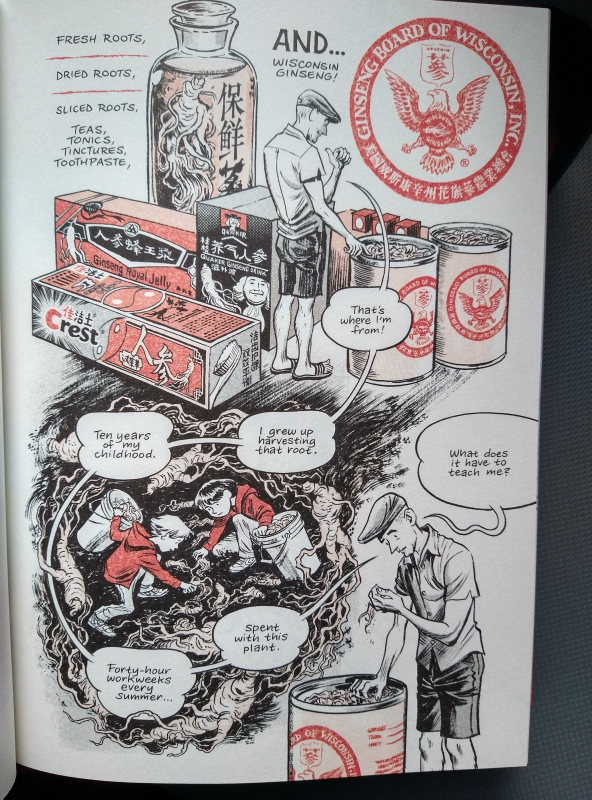
This chunky book has an appealing earth-tones palette and shifts smoothly between locations and styles, memories and research. When interviewing growers and Chinese medicine practitioners, the depictions are almost photorealistic, but there are also superhero pastiche panels and a cute ginseng mascot who pops up throughout the book. Like Spent, this pulls in class and economic issues in a lighthearted way and also explores its own composition process.
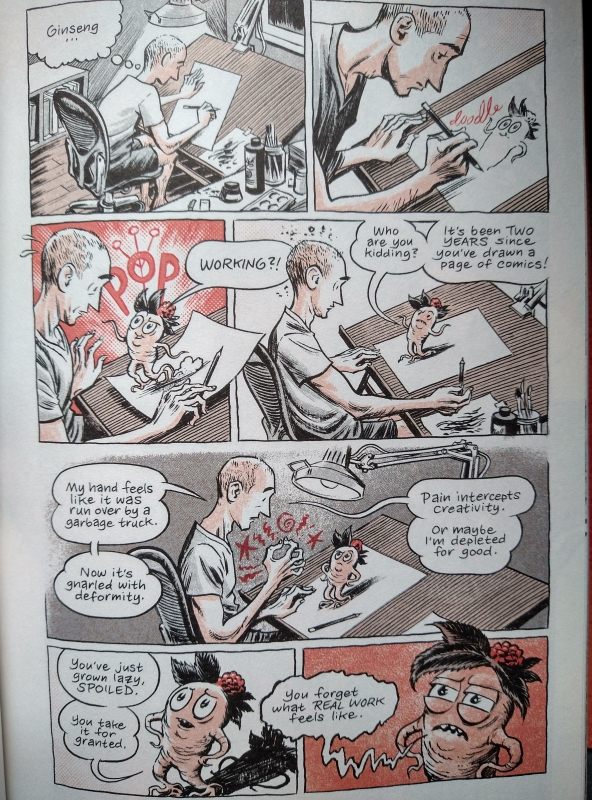
The story of ginseng is often sobering, involving the exploitation of immigrants (in the Notes, Thompson regrets that he was unable to speak with any of the Mexican migrant workers on whom the American ginseng harvest now depends), soil degradation, and pesticide pollution. The roots of the title are both literal and symbolic of the family story that unfolds in parallel. Both strands are captivating, but especially the autobiographical material: Thompson’s relationship with Phil, his new understanding but ongoing frustration with his parents, and the way all three siblings exhibit the damage of their upbringing – Phil’s marriage is crumbling; their sister Sarah, who has moved 26 times as an adult, wonders what she’s running from. A conversation with a Chinese herbal pharmacist gets to the heart of the matter: “I learned home is not WHERE I am. Home is HOW I am.”
Both expansive and intimate, this is a surprising gem from one of the best long-form graphic storytellers out there.
With thanks to Faber for the free copy for review. Published in the USA by Pantheon (Penguin).
Basket of Deplorables by Tom Rachman (2017)
“Basket of deplorables” is a term that Hillary Clinton applied to the xenophobic wing of Donald Trump’s supporters in a September 2016 campaign speech. Basket of Deplorables is Tom Rachman’s third of five books and I somehow had never heard of it until a good few years after its release. That surprised me because I’ve followed his career with interest and read his other works right at their publication.
Like Rachman’s The Imperfectionists and The Imposters, it’s a linked short story collection. The five stories are on the longish side but read quickly. In the opening title piece, a woman who went blind after an accident co-hosts a 2016 presidential election watch party with her husband in their Manhattan apartment. Their friends are uniformly left-wing and choke with disbelief as results start to filter through. In “Truth Is for Losers,” Glen agrees to stage a funeral for his billionaire brother Fleming, who has faked his own death. The memorial service is an opportunity for high farce, but I also warmed to Glen for his simple enthusiasm for his job as a Starbucks barista in Kalamazoo. This was my favourite of the stories; its depiction of the spread of fake news feels like a worthwhile analogy rather than a rehashing of headlines.
“Leakzilla” imagines the complications of Internet dating in an alternate world where would-be partners can scour each other’s e-mail history at will – and find out that someone masquerading as clued-in voted for Trump in 2016. “Sad! Wrong! Not Nice!” follows Fleming, a Trump-esque blowhard, into his new life in Italy. The backstory of a minor character explains a mysterious moment from the first piece, and the sister of the woman from “Leakzilla” is then the protagonist of “How the End Begins.” Here, Kelly discovers with quiet horror a website where you can input any person’s name and view their future cause of death. There is a grim dystopian edge to this final story.

Rachman gave the book the tagline (not quite a subtitle) of “Almost-true stories.” I suspect it was written quickly in response to Trump’s election and it is rather thin, aiming at obvious targets and exhibiting wholly reasonable yet unsubtle liberal outrage. I found it so depressing to see how history threatens to repeat itself less than a decade later:
“David’s worry is that Trump won’t accept his defeat, throwing the whole democratic process into chaos”
“More a boomerang of history, where we keep throwing out the bad bits, and they keep flying back, hitting us in the mouth.”
I can hardly bear to think about tomorrow’s election. The USA could elect the first woman president (of color, no less), or hand power back to a cretin – a convicted felon and probably the worst holder of the office in its nearly 250 years. It’s a choice between progress and regression. Between sanity and sleepwalking into destruction. And whatever happens at the polls, it seems inevitable that Trump will foment further violence and hatred.
 Did I do all I could? I sent in my postal vote several weeks ago, and donated to the Harris/Walz campaign (which means I now get seven e-mails a day from them, but that’s fine). The local Democrats Abroad branch didn’t reply to me over the summer, so I missed out on the chance to volunteer with them, whereas in 2020 I colored in postcards to send to Democrat-registered North Carolina voters in the UK to remind them to get their ballots.
My leanings are clear, then, and I’m sure pretty much all my readers will concur. That I didn’t enjoy this obscure Rachman work more is due to my low tolerance for satire in general and to the fact that these stories of division and deception are not almost true, but all too true. (Secondhand – gift from my wish list, Christmas 2023) 
Books of Summer, 3–4: Anthony Bourdain and Meron Hadero
Back to the foodie lit. A chef’s memoir of adventurous travel and eating, and a short story collection about Ethiopian American immigrants – for some of whom learning how to cook traditional American food is a sign of integration.
A Cook’s Tour: In Search of the Perfect Meal by Anthony Bourdain (2001)
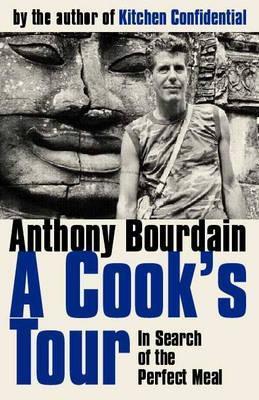 Anthony Bourdain also appeared on my summer reading list when I reviewed Kitchen Confidential in 2020; I have both books in an omnibus edition. The chef acknowledges there’s no such thing as a perfect dining experience as there are many subjective factors apart from the food, but a few of his meals here are pretty close to ideal. Others are horrific. But everywhere he goes, from England to Cambodia, he gives a fair try. Four interspersed chapters are set in Vietnam, a country he falls in love with, but the rest are like individual essays with a different destination each time: Spain, Russia, Morocco, Japan, Scotland…
Some places are chosen due to personal significance or professional connections. He goes back to where he spent childhood summers in France, but it doesn’t live up to expectations: “I’d thought everything would be instant magic. That the food would taste better because of all the memories. … But you can never be ten years old again.” His boss arranges a pig roast for him in Portugal; he travels to the state in Mexico where most of his kitchen staff come from. With several other chefs, he journeys to Thomas Keller’s The French Laundry in California for a 20-course tasting menu – the rundown of the dishes takes him several pages. The key ingredients of this and the other near-perfect meals seem to be excellent quality of food, innovative flavors, a variety of dishes, and a languid pace with the alcohol flowing.
Bourdain sheepishly confesses that his travels were documented for television; the Food Network made him agree to some filming opportunities he would otherwise have avoided. Vegetarians be warned: some of these involve slaughter, and/or eating exotic animals. Aside from the pig, there’s a whole lamb cooked over a fire in the desert in Morocco, a turkey he beheads, and rabbits he shoots. And while you might think he’d eat anything with pleasure, there are in fact a few meals that leave him feeling ill: iguana tamales, bird’s nest soup, and dishes that use up all parts of a cobra. A notorious vegetarian hater, he even agrees to attend a vegan potluck in Berkeley, but reports that “not one of them could cook a f***ing vegetable.”
This was fast-moving, brash and funny; just as good as Kitchen Confidential and something I’d recommend to anyone who enjoys cooking shows or stunt travel. (Free – swap shop) 
A Down Home Meal for These Difficult Times by Meron Hadero (2022)
Debut author Hadero won the Restless Books Prize for New Immigrant Writing for this work in progress, many of whose stories had been published in periodicals in 2015–20. The 15 stories are roughly half in the first person and half in the third person, and apart from a couple whose place or character origins aren’t specified, I think all are about Ethiopians or Ethiopian Americans. Often, the protagonist is a recent immigrant. Yohannes, in “Medallion,” is recruited by his taxi driver almost immediately upon his arrival in Los Angeles, but finds that his American dream never comes through. In “The Thief’s Tale,” an old Ethiopian man who speaks no English is lost in Prospect Park. When the man who holds him up at knifepoint realizes there is no watch or wallet to take, he lets him call his daughter from a payphone and, as they wait, the two strangers share their stories of failure and regret.
Sometimes Ethiopia is the setting instead. “The Suitcase” has Saba getting ready to return to the USA after a one-month visit to Addis Ababa, her bag 10 kilograms too heavy because of everything people are sending back with her. In “The Street Sweep,” Getu hopes to impress a departing NGO worker enough at his leaving party at the Addis Sheraton that he’ll get a life-changing job offer. This one was a standout, though distressing for how it rests on misunderstanding.
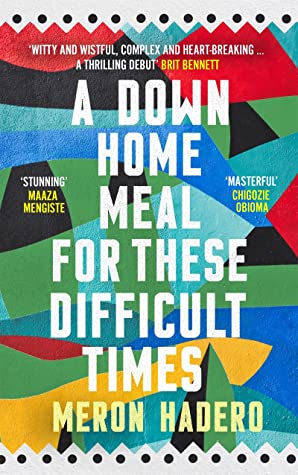 My favorites seem like they could be autobiographical for the author. “The Wall” is narrated by a man who immigrated to Iowa via Berlin at age 10 in the mid-1980s. At a potluck dinner, he met Professor Johannes Weill, who gave him free English lessons. Six years later, he heard of the Berlin Wall coming down and, though he’d lost touch with the professor, made a point of sending a note. The connection across age, race and country is touching. “Sinkholes” is a short, piercing one about the single Black student in a class refusing to be the one to write the N-word on the board during a lesson on Invisible Man. The teacher is trying to make a point about not giving a word power, but it’s clear that it does have significance whether uttered or not. “Swearing In, January 20, 2009” is a poignant flash story about an immigrant’s patriotic delight in Barack Obama’s inauguration, despite prejudice encountered.
The title story is the only foodie link, but it’s a sweet one. Two women who attend church Amharic classes in New York City admit that they can’t cook, but want to impress at the PTA bake sale, so go in search of a quintessential American cookbook, and in the years to come prepare dishes from The Good Housekeeping Illustrated Cookbook every time there is a crisis. “When Yeshi’s husband left her for a blonde waitress, they made Broiled Hamburg Steak, just the once. … When Jazarah’s credit cards were stolen and maxed out, they made trays of Corn Fritters.” Eventually, they start to make a living from their own food truck.
There were no bad stories here per se, but several too many, and not enough variety. I also didn’t warm to the couple of political satires involving manuscripts. “The Case of the Missing _______,” set in 2036 and counting backwards from Day 100, is a document full of erasure, produced by the Minnesota newspaper The Exile Gazeta and concerning an absent authoritarian leader. It made me think of Ella Minnow Pea, or perhaps novels by Jonathan Safran Foer and Hernan Diaz, and felt different to the rest, but not in a good way. It would be interesting to try a novel by Hadero someday. See also Liz’s review. (Other challenges this met: review catch-up, set-aside) 
With thanks to Canongate for the proof copy for review.
Being There by Jerzy Kosiński (#NovNov22 Short Classics Week)
I knew pretty much nothing about this when I went into it and that was for the best. Only after I’d finished reading it (in one sitting) did I remember that there’s a Peter Sellers film; I’m glad I wasn’t imagining him in my head the whole time.
If you keep in mind that this is a satire on certain American qualities – gullibility, the obsession with money and appearance – you can probably, like I did, excuse the thinness of the plot, the clichéd behaviour of the characters, and the sometimes dated feel (this is from 1970).
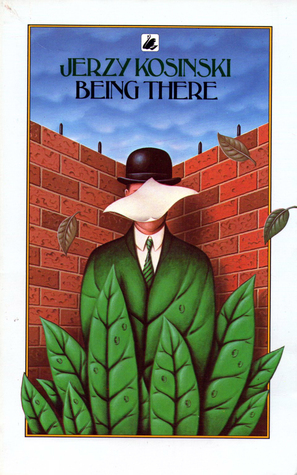 Chance is an utter innocent, an illiterate orphan; his whole history is a blank. Most of what he knows comes from television, which he watches devotedly. He lives in one half of a house; the Old Man in the other. Apart from one maid or another, he sees no one else and has never left the complex for any reason. Aside from TV, his only hobby is gardening. The house’s walled garden is his haven and his joy. When the Old Man dies, the lawyers can find no record of a hired gardener or other retainer so Chance, like Adam, is cast out of his Eden and into … suburban New York City. Where he’s promptly hit by a limo, then taken to recuperate at the home of the rich businessman’s wife who was riding in it, Elizabeth Eve (or EE) Rand.
With his gardening stories that everyone takes to be metaphorical, Chase soon wins over Wall Street and White House alike, and fields propositions from men and women just the same. He takes his cues for how to act in social situations from his extensive mental archive of TV programs. It all gets a bit silly, but the naïf at the heart of it is so sweet that I didn’t mind. He’s like Forrest Gump or any number of other simple characters who get drawn into current events (it seems like quite the Hollywood trope, in fact); just by going along with what people assume about him, he comes across as intelligent and wise. His name can’t be coincidental, with its connotations of risk, fate, or just seizing opportunities. Luckily, the satire doesn’t outstay its welcome. However, I felt that the book just stops, with no proper ending.
(Kosiński’s life story is its own stranger-than-fiction tale; the biographical essay in the back of my paperback is only about five pages long but there were many points where I wondered if it was a tongue-in-cheek appendix! The novella is autobiographical, it seems, in that the author was married to a rich American widow and moved in the kind of wealthy circles the Rands do.)
[105 pages] (Secondhand purchase) 

Short Stories in September, Part I: Nam Le, Deesha Philyaw, Dan Rhodes
Part of my annual project to read as many short story collections as possible in September. Here’s the first three.
The Boat by Nam Le (2008)
Le, who was born in Vietnam and raised in Australia, won the Dylan Thomas Prize for this collection of seven stories. The opener, “Love and Honor and Pity and Pride and Compassion and Sacrifice” – the title being William Faulkner’s advice for what authors should write about – knocked my socks off. It’s a crisp slice of autofiction about his father coming to visit him while he is a student at the Iowa Writers’ Workshop. Nam (the character) is ambivalent about whether to write about his family’s history of escaping Vietnam by boat, but as a deadline looms he decides to go for it, no matter what his father might think. There’s a coy remark here from one of his friends: “you could just write about Vietnamese boat people all the time. … You could totally exploit the Vietnamese thing. But instead, you choose to write about lesbian vampires [not in this collection!] and Colombian assassins, and Hiroshima orphans—and New York painters with hemorrhoids.”
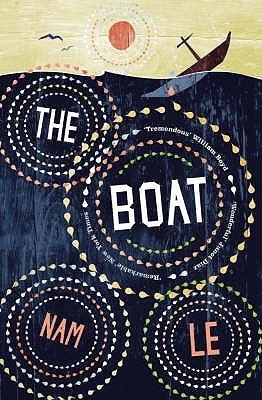 So there you have four of the story plots in a nutshell. “Cartagena” is an interesting enough inside look at a Colombian gang, but Le’s strategy for revealing that these characters would be operating in a foreign language is to repeatedly use the construction “X has Y years” for giving ages, which I found annoying. “Meeting Elise” is the painter-with-hemorrhoids one (though I would have titled it “A Big Deal”) and has Henry nervously awaiting his reunion with his teenage daughter, a cello prodigy. There’s a Philip Roth air to that one. “Hiroshima” is brief and dreamy, and works because of the dramatic irony between what readers know and the narrator does not. “The Boat,” the final story, is the promised Vietnam adventure, but took forever to get to. I skimmed/skipped two stories of 50+ pages, “Halflead Bay,” set among Australian teens, and “Tehran Calling.”
It’s a shame that the rest of the book didn’t live up to the first story. The settings and styles felt too disparate overall, with no linking theme. I know that authors are supposed to be able to write about whatever they want, rather than just sticking to their own heritage – a provincial attitude the above quote is mocking, surely – but I had to wonder why these stories mattered to the author, and thus why they should matter to me. As far as I can tell, this is all Le has published. He won another five awards for it, and landed on the National Book Foundation’s 5 under 35 list in 2008. What happened after that?? (Public library) 
The Secret Lives of Church Ladies by Deesha Philyaw (2020)
I’d heard such good things about this collection after its U.S. release (it was a National Book Award finalist and won a Los Angeles Times Book Prize, PEN/Faulkner Award and more), so was delighted to learn that it was coming to the UK earlier this year. These nine stories, mostly set among Black women in the Southern USA, are bold and sexy. The opening pair is a particularly provocative one-two punch. In “Eula,” two friends with benefits meet up in a hotel on New Year’s Eve 2000, as they do every year; narrator Caroletta is committed to this relationship, while Eula is only killing time until she can marry a man as everyone expects. In “Not-Daniel,” a man and woman have sex in a car parked behind a hospice to try to forget that their mothers are dying inside.
 “How to Make Love to a Physicist,” told in the second person, is about an art teacher scared to embark on a relationship with a seemingly perfect man she meets at a conference. “Dear Sister,” in the form of a long, gossipy letter, is about a tangled set of half-siblings. “Jael” alternates a young teen’s diary entries and her great-grandmother’s fretting over what to do with her wild ward. (The biblical title takes on delicious significance later on.) Multiple characters clash with authority figures about church attendance, with the decision to leave the fold coinciding with claiming autonomy or rejecting hypocrisy.
“Peach Cobbler” and “Snowfall” were my two favourites. In the former, reminiscent of Tayari Jones’s Silver Sparrow, Olivia’s mother has been having a long-term affair with the pastor, for whom she bakes a special dessert she denies her own daughter (“I’m not going to raise [my child] to go through life expecting it to be sweet, when for her, it ain’t going to be”). The latter has Arletha and Rhonda suffering through a Midwest winter and dreaming of a Southern crab boil, but fearing they can never go home to mothers who stubbornly refuse to acknowledge their bond as anything other than friendship (“like a beautiful quilt in summertime, my mother’s love was the suffocating kind”).
The insight into familial and romantic relationships, the frank bisexuality, the allusions to scripture and churchgoing traditions, and the folksy foods and metaphors all made this stand out for me. The collection tails off with two unmemorable stories, but the previous seven are more than compelling enough for me to recommend this to your attention.
With thanks to Pushkin Press (the ONE imprint) for the proof copy for review.
Anthropology: and a Hundred Other Stories by Dan Rhodes (2000)
 I should have known, after reading When the Professor Got Stuck in the Snow (an obvious satire on Richard Dawkins’s atheism) in 2017, that Dan Rhodes’s humour wasn’t for me. However, I generally love flash fiction so thought I might as well give these 101 stories – all about 100 words, or one paragraph, long – a go when I found a copy in a giveaway box across the street. Each has a one-word title, proceeding alphabetically from A to W, and many begin “My girlfriend…” as an unnamed bloke reflects on a relationship. Most of the setups are absurd; the girlfriends’ names (Foxglove, Miracle, Nightjar) tell you so, if nothing else.
There’s a kind of ‘nothing sacred’ approach here, with death, disability, race and gender the fodder for any number of gags. For example, in the title story the ex-girlfriend “went to Mongolia to study the gays. … It breaks my heart to think of her herding those yaks in the freezing hills, … nothing but a handlebar moustache to keep her top lip warm.” Or “Taxidermy”: “Columbine broke her neck by mistake. I took her to the taxidermist, and they delivered to my house a fortnight later. When I unwrapped the package I found the wrong girl.” I marked out a couple that I liked, “Beauty” and “Eggs,” but 2/101 is a poor return. Flippant, repetitive and ridiculous; best avoided. (Free from a neighbour) 
Currently reading: The Dinner Party by Joshua Ferris, Delicate Edible Birds by Lauren Groff, Hearts & Bones by Niamh Mulvey
Up next: The Quarry by Ben Halls, The High Places by Fiona McFarlane, Birds of America by Lorrie Moore
Three on a Theme for Mother’s Day
In advance of (American) Mother’s Day, I picked up two novels and a set of short stories that explore the bonds between mothers and their children, especially daughters. The relationships can be fraught or fractured, but always provide good fodder for psychologically astute fiction.
Mother for Dinner by Shalom Auslander (2020)
Hope: A Tragedy, Auslander’s 2012 debut, is among my absolute favorites, an outrageously funny novel that imagines Anne Frank is alive and dwelling in a suburban attic, frantically tapping out her endless magnum opus. Solomon Kugel, the sap blessed to have an icon sharing his home, has a deluded mother who actually grew up in Brooklyn but believes she survived the Holocaust and now hoards food and curses the Nazis who ruined her life.
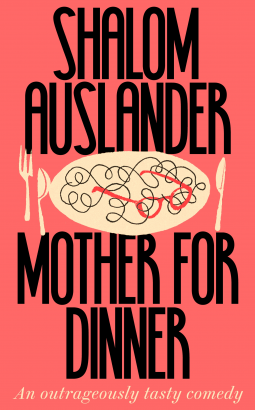 I start with that bit of synopsis because Mother for Dinner showcases rather analogous situations and attitudes, but ultimately didn’t come together as successfully for me. It’s a satire on the immigrant and minority experience in the USA – the American dream of ‘melting pot’ assimilation that we see contradicted daily by tribalism and consumerism. Seventh Seltzer works in Manhattan publishing and has to vet identity stories vying to be the next Great American Novel: “The Heroin-Addicted-Autistic-Christian-American-Diabetic one” and “the Gender-Neutral-Albino-Lebanese-Eritrean-American” one are two examples. But Seventh is a would-be writer himself, compelled to tell the Cannibal-American story.
For years Mudd, the Seltzer family matriarch, has been eating Whoppers for each meal in a customary fattening-up called the Cornucopiacation. She expects her 12 children, who are likely the last of the Cannibal kind, to carry on the tradition of eating her corpse after her death. It’s a way for ancestors to live on in their descendents. The Cannibal Guide, disguised as a deer processing manual, sets out the steps: Drain (within two hours), Purge, Partition, Consume (within 24 hours). Unclish, the Seltzers’ uncle, drilled the rules into them when they were kids through rhymes like “A bite and half / and you won’t need another, / whether it’s your father, your sister, / or even your mother.” From her deathbed, Mudd apportions her body parts to her offspring, some tenderly and some vengefully. Their inheritance – a Brooklyn dump that will still net $5.2 million – is conditional on them performing the ritual.
Interspersed with sections on the practicalities of butchering and cooking a morbidly obese woman are flashbacks to key moments of Cannibal history, which has turned into myth. In 1914, Julius Seltzer left the paradisiacal “Old Country” with his sister Julia, who pretended to be his wife and traveled with him to Detroit to work for Henry Ford. (An overt parody of Jeffrey Eugenides’ Middlesex.) Mudd is vocally intolerant of all other minority groups, from Blacks to homosexuals, and always chooses the version of history that reflects best on her own ancestors, while the Seltzers’ father was more willing to admit flaws.

My proof copy, with a joke on the cover, came with a napkin!
Auslander is pushing the boundary of what an author can get away with, not just with a literal cannibalism storyline but also with jokes about historical atrocities and the recent trend for outing beloved figures as reprehensible (what Seventh calls “Contemporary Assholization Studies”). He shares Lionel Shriver’s glee for tipping sacred cows. I did appreciate his picture of the pervasiveness of xenophobia – the “You’re Not Me” look that anyone can get when walking in an unfamiliar neighborhood – and his willingness to question the value of beliefs and ceremonies once they’ve stopped being reasonable or of use. But with all the siblings known by numbers, it’s hard to distinguish between them. The novel ends up heavy on ideas but light on characterization, and as a whole it leaves a bit of a bad taste in the mouth.
My rating:
With thanks to Picador for the proof copy for review.
The Mothers by Brit Bennett (2016)
{CONTAINS MILD SPOILERS.}
Like so many who were impressed with the Women’s Prize-shortlisted The Vanishing Half, I rushed to get hold of Bennett’s California-set first novel, which, while not as skillfully put together, is nearly as emotionally engaging. After her mother’s suicide, 17-year-old Nadia Turner only has her father, a Marine, but they are bolstered by their church family at Upper Room Chapel. Nadia is a bright girl headed to Michigan for college, but in her senior year she gets mixed up with Pastor Sheppard’s 21-year-old son, Luke, leading to a pregnancy and abortion that his parents swiftly cover up / pay for. Luke drops her at the clinic and hands over the money, but doesn’t pick her up; that looks the acrimonious end of their relationship.
But in the years to come, especially when Nadia takes a break from law school to care for her father, their lives will intersect again. Nadia’s best friend in that final year of high school was Aubrey Evans, who is estranged from her mother, who failed to protect the girl from sexual abuse at the hands of her own boyfriend. Now Aubrey wears a purity ring, enamored with the idea that faith will make her clean again. Once Nadia leaves, she starts dating Luke, ignorant of her best friend’s history with him. This sets up a love triangle mired in layers of secrets.
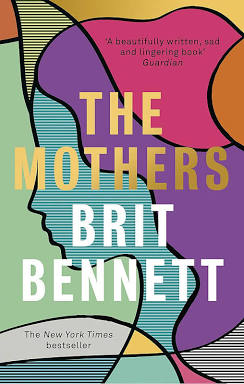 There is dramatic irony here between what the characters know about each other and what we, the readers, know – echoed by what “we,” the church Mothers, observe in the first-person plural sections that open most chapters. I love the use of a Greek chorus to comment on a novel’s action, and The Mothers reminded me of the elderly widows in the Black church I grew up attending. (I watched the video of a wedding that took place there early this month and there they were, perched on aisle seats in their prim purple suits and matching hats.)
Nadia and Aubrey are relatable characters, and Luke earns our sympathy after the cruel return of his football injury. (I was intrigued to see that Peter Ho Davies was one of Bennett’s teachers – his novel A Lie Someone Told You About Yourself is a rare picture of male grief after abortion, also present here.) Bennett explores multiple facets of motherhood: memories of a mother, the absence of a mother, the choice to become a mother, and people who act in the place of a mother by providing physical care or being a source of moral support.
The timeline is a bit too long, which makes the plot wander more than it needs to, but this is a warm and bittersweet novel that always held my interest. Bennett has produced two winners in a row, and I look forward to seeing what she’ll do next.
A favorite line: “Maybe mothers were inherently vast and unknowable.” (not literally vast like in the Auslander!)
Source: Birthday gift (secondhand) from my wishlist last year
My rating:
Close Company: Stories of Mothers and Daughters, ed. by Christine Park and Caroline Heaton (1987)
I read 14 of 25 stories, skipping to the ones that most interested me (by familiar names like Sue Miller, Sylvia Plath, and Jeanette Winterson), and will read the rest next year. The only story I’d encountered before was Margaret Atwood’s “Significant Moments in the Life of My Mother,” originally published in Bluebeard’s Egg. The title phrase comes from Jamaica Kincaid’s story. A recurring theme is women’s expectations for their daughters, who might repeat or reject their own experiences. As the editors quote from Simone de Beauvoir in the introduction, “the daughter is for the mother at once her double and another person.”
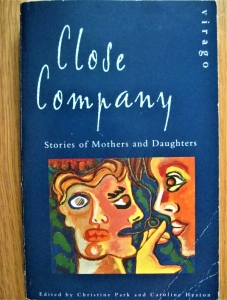 I particularly liked “The Pangs of Love” by Jane Gardam, a retelling of the Hans Christian Andersen fairy tale of “The Little Mermaid,” and “Swans” by Janet Frame, in which a mother takes her two little girls for a cheeky weekday trip to the beach. Fay and Totty are dismayed to learn that their mother is fallible: she chose the wrong beach, one without amenities, and can’t guarantee that all will be well on their return. A dusky lagoon full of black swans is an alluring image of peace, quickly negated by the unpleasant scene that greets them at home.
Two overall standouts thus far were “Everyday Use” by Alice Walker and “The Unnatural Mother” by Charlotte Perkins Gilman. In Walker’s story, which draws on the parable of the Prodigal Son, a hip Afro-wearing daughter returns to her mother’s rural home and covets the quilts and butter churn – to her this is quaint folk art that she wants to take away and display, but her mother and sister resent her condescension towards their ‘backward’ lives.
Gilman is best known for The Yellow Wallpaper, but this story has a neat connection with another classic work: the main character is named Esther Greenwood, which is also the protagonist’s name in Plath’s The Bell Jar (consider this a preview of my next Book Serendipity roundup!). A gossiping gaggle of women discuss Esther’s feral upbringing and blame it for her prioritizing altruism over her duty to her child. A perfect story.
Source: Free mall bookshop
My rating: (so far) 
If you read just one … Make it The Mothers. (But do also pick out at least a few stories from the Close Company anthology.)
Classics of the Month: Cold Comfort Farm and Crossing to Safety
These were terrific reads. A comic novel set on a Sussex farm and a look back at banner years in the friendship of two couples. Both:
Cold Comfort Farm by Stella Gibbons (1932)
 I’d heard so much about this over the years. It was one I had to be in just the right mood for, though – I’d picked up my secondhand copy and read the first few pages on four different occasions before it finally took. If you recognize the phrase “something nasty in the woodshed” or know of a fictional plant called sukebind, you’ll appreciate the extent to which the story has entered into popular culture.
When Flora Poste’s parents die of the “influenza or Spanish Plague” (oh dear), she’s left an orphan at age 20. Her best option seems to be moving in with relatives she’s never met: Aunt Ada Doom and the Starkadder cousins of Cold Comfort Farm in Howling, Sussex. They’re a delightful collection of eccentrics: mad Aunt Ada shut away in her room; her son Amos, a fire-and-brimstone preacher; cousin Seth, with his movie star looks and multiple children by the servant girl; cousin Elfine, a fey innocent in a secret relationship with the local landowner’s son, who’s dumb but rich; and so on.
Relying on her London sophistication and indomitable optimism, Flora sets out to improve everything and everyone at the crumbling farm. The blurb calls this a “parody of the melodramatic rural novels of the time,” but I thought of it more as a skewering of Victorian stereotypes, not least in that the farming folk speak like Thomas Hardy’s rustics (Reuben: “‘I ha’ scranleted two hundred furrows come five o’clock down i’ the bute.’ It was a difficult remark, Flora felt, to which to reply. Was it a complaint?”). Meanwhile, Mr. Mybug, with his obsession with sex, is a caricature of a D.H. Lawrence protagonist.
It may take a little while to adjust to the book’s sense of humor, which struck me as surprisingly edgy for its time. Gibbons expresses no great outrage about Seth’s illegitimate offspring, for instance; instead, the babies’ grandmother has the enterprising idea of training them up to be a jazz band. There is also plenty of pure silliness, like the cows being named Graceless, Pointless, Feckless and Aimless and one of them spontaneously losing legs. I especially liked that Flora’s London friend Mrs. Smiling collects brassieres and that Flora always samples novels to make sure they don’t contain a childbirth scene. This non sequitur also amused me at the same time as it puzzled me: Flora “liked Victorian novels. They were the only kind of novel you could read while you were eating an apple.”
Crossing to Safety by Wallace Stegner (1987)
 (A buddy read with Laila of Big Reading Life for her Classics Club challenge.) Right from the start, I was thoroughly invested in this lovely, bittersweet story of two faculty couples, Larry and Sally Morgan and Sid and Charity Lang. Much of the action is split between Wisconsin in the 1930s and Vermont in the 1970s, the novel’s present day. Larry, the narrator, had a brief academic career in Madison but moved on to write novels. Sid longed to be a poet but didn’t have the skill, so remained in academia despite a tiny publication record.
Charity is the quartet’s stubborn mother hen, organizing everyone and tailoring everything to her own plans (don’t we all have a friend like that?). The Langs have wealth and class on their side, whereas the Morgans are described as having the intellect and talent. I found it odd that Stegner gave Charity such an obviously metaphorical name – starting with a big dinner party, the Langs lavish gifts and money on the Morgans in the name of friendship.
The novel sets up various counterparts and doubles, so Sally’s polio in the 1930s finds a parallel in the 1970s story line, when a terminally ill Charity is orchestrating her grand farewell. For all its challenges, Larry describes that first year in Madison as an idyllic time with “Two Adams and two Eves, an improvement on God’s plan.” Later on they all take a glorious sabbatical year together in Florence, too. New England, the Midwest and Italy make for an attractive trio of settings. There are also some great sequences that happen to reveal a lot about the friends’ dynamic, including an ill-fated sailboat outing and a hiking trip.
Nostalgic and psychologically rich, this is a quiet, beautifully written character study that would suit fans of Elizabeth Hay and May Sarton (though she was writing a decade and more earlier, this reminded me a lot of her small-town novel Kinds of Love and, eventually, A Reckoning). I’ll try more by Stegner.
Favorite lines:
“a chilly Octoberish smell of cured leaves rose from the ground, the indescribable smell of fall and football weather and the new term that is the same almost everywhere in America.”
Sid and Charity as “the people who above any other two on earth made us feel good, wanted, loved, important, and happy.”
“she was the same old Charity. She saw objectives, not obstacles, and she did not let her uncomplicated confidence get clouded by other people’s doubts, or other people’s facts, or even other people’s feelings.”
See also Susan’s review.
 Bookish Beck = Rebecca Foster. American transplant to England. Freelance proofreader and book reviewer.
 Bookish Beck