#NovNov25 Final Statistics & Some 2026 Novellas to Look Out For (Chapman, Fennelly, Gremaud, Miles, Netherclift & Saunders)
Novellas in November 2025 was a roaring success: In total, we had 50 bloggers contributing 216 posts covering at least 207 books! The buddy read(s) had 14 participants. If you want to take a look back at the link parties, they’re all here. It was our best year yet – thank you.
*For those who are curious, our most reviewed book was The Wax Child by Olga Ravn (4 reviews), followed by The Most by Jessica Anthony (3). Authors covered three times: Franz Kafka and Christian Kracht. Authors with work(s) reviewed twice: Margaret Atwood, Nora Ephron, Hermann Hesse, Claire Keegan, Irmgard Keun, Thomas Mann, Patrick Modiano, Edna O’Brien, Clare O’Dea, Max Porter, Brigitte Reimann, Ivana Sajko, Georges Simenon, Colm Tóibín and Stefan Zweig.*

I read and reviewed 21 novellas in November. I happen to have already read six with 2026 release dates, some of them within November and others a bit earlier for paid reviews. I’ll give a quick preview of each so you’ll know which ones you want to look out for.
The Pass by Katriona Chapman
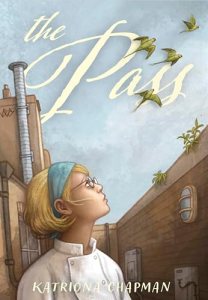 Claudia Grace is a rising star in the London restaurant world: in her early thirties, she’s head chef at Alley. But she and her small team, including sous chef Lisa, her best friend from culinary school; and Ben, the innovative Black bartender, face challenges. Lisa has a young son and disabled husband, while Ben is torn between his love of gardening and his commitment to Alley. Claudia is more stressed than ever as she prepares for a competition. All three struggle with their parents’ expectations. A financial crisis comes out of nowhere, but the greater threat is related to motivation. I was drawn to this graphic novel for the restaurant setting, but it’s more about families and romantic relationships than food. Several characters look too alike or much younger or older than they’re supposed to, while there’s a sudden ending that suggests a sequel might follow. (Fantagraphics, Jan. 20) [184 pages] (Read via Edelweiss)
The Irish Goodbye: Micro-Memoirs by Beth Ann Fennelly
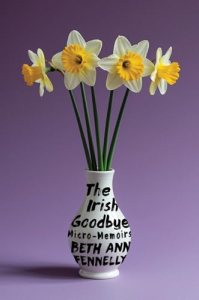 I’ve also read Fennelly’s previous collection of miniature autobiographical essays, Heating & Cooling. She takes the same approach as in flash fiction: some of these 45 pieces are as short as one sentence, remarking on life’s irony, poignancy or brevity. Again and again she loops back to her sister’s untimely death (the title reference: “without farewells, you slipped out the back door of the party of your life”); other major topics are her mother’s worsening dementia, her happy marriage, her continuing 28-year-old friendships with her college roommates, the pandemic, and her ageing body. Every so often, Fennelly experiments with third- or second-person narration, as when she recalls making a perfect gin and tonic for Tim O’Brien. One of the most in-depth pieces revisits a lonely stint teaching in Czechoslovakia in the early 1990s. Returning to the town recently, she is astounded that so many recognize her and that a time she experienced as bleak is the stuff of others’ fond memories. I also loved the long piece that closes the collection, “Dear Viewer of My Naked Body,” about being one of the 12 people in Oxford, Mississippi to pose nude for a painter in oils. Brilliant last phrase: “Enjoy the bunions.” (W.W. Norton & Company, Feb. 24) [144 pages] (Read via Edelweiss)
Generator by Rinny Gremaud (2023; 2026)
[Trans. from French by Holly James]
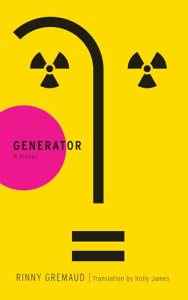 “I was born in 1977 at a nuclear power plant in the south of South Korea,” the unnamed narrator opens. She and her mother then moved to Switzerland with her stepfather. In 2017, news of Korea’s plans to decommission the Kori 1 reactor prompts her to trace her birth father, who was a Welsh engineer on the project. As a way of “walking my hypotheses,” she travels to Wales, Taiwan (where he had a wife and family), Korea, and Michigan, his last known abode. In parallel, she researches the history of nuclear power. By riffing on the possible definitions of generation, this lyrical autofiction comments on creation and legacy. Full Foreword review forthcoming. (Schaffner Press, Jan. 7) [197 pages] (PDF review copy)
Eradication: A Fable by Jonathan Miles
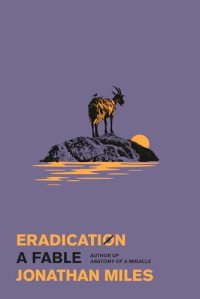 This taut, powerful fable pits an Everyman against seemingly insurmountable environmental and personal problems. Who wouldn’t take a job that involves “saving the world”? Adi, the antihero of Jonathan Miles’s fourth novel, is drawn to the listing not just for the noble mission but also for the chance at five weeks alone on a Pacific island. Santa Flora once teemed with endemic birds and reptiles, but many species have gone extinct because of the ballooning population of goats. He’s never fired a gun, but the mysterious “foundation” was so desperate it hired him anyway. It’s a taut parable reminiscent of T.C. Boyle’s When the Killing’s Done. My full Shelf Awareness review is here. (riverrun, 5 Feb. / Doubleday, Feb. 10) [176 pages] (Read via Edelweiss)
Vessel: The shape of absent bodies by Dani Netherclift
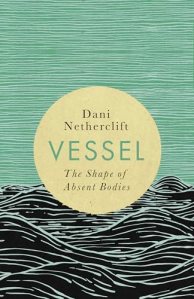 One scorching afternoon in 1993, the author’s father and brother drowned while swimming in an irrigation channel near their Australia home. A joint closed-casket funeral took place six days later. Eighteen at the time, Netherclift witnessed her relatives’ disappearance but didn’t see their bodies. Must one see the corpse to have closure? she wonders. “The presence of absence” is an overarching paradox. There are lacunae everywhere: in her police statement from the fateful day; in her journal and letters from that summer. The contradictions and ironies of the situation defy resolution. Full Foreword review forthcoming. (Assembly Press, Jan. 13) [184 pages] (PDF review copy)
Vigil by George Saunders
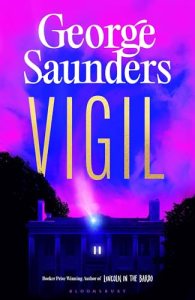 Impossible not to set this against the exceptional Lincoln in the Bardo, focused as both are on the threshold between life and death. Unfortunately, the comparison is not favourable to Vigil. A host of the restive dead visit the dying to offer comfort at the end. Jill Blaine’s life was cut short when she was murdered by a car bomb in a case of mistaken identity. Her latest “charge” is K.J. Boone, a Texas oil tycoon who not only contributed directly to climate breakdown but also deliberately spread anti-environmentalist propaganda through speeches and a documentary. As he lies dying of cancer in his mansion, he’s visited by, among others, the spirits of the repentant Frenchman who invented the engine and an Indian man whose family perished in a natural disaster. I expected a Christmas Carol-type reckoning with climate past and future; in resisting such a formula, Saunders avoids moralizing – oblivion comes for the just and the unjust. However, he instead subjects readers to a slog of repetitive, half-baked comedic monologues. I remain unsure what he hoped to achieve with the combination of an irredeemable character and an inexorable situation. All this does is reinforce randomness and hopelessness, whereas the few other Saunders works I’ve read have at least reassured with the sparkle of human ingenuity. YMMV. (Bloomsbury / Random House, 27 Jan.) [192 pages] (Read via NetGalley)
The BBC National Short Story Award 2025 Anthology
Another quick contribution to #ShortStorySeptember. I was delighted when Comma Press sent me a surprise copy of The BBC National Short Story Award 2025, which prints the five stories shortlisted for this year’s prize.
Now in its 20th year, the award has recognised established authors and newcomers alike – the roster of winners includes Lucy Caldwell, Sarah Hall (twice), Cynan Jones, James Lasdun, KJ Orr, Ingrid Persaud, Ross Raisin, Lionel Shriver and Naomi Wood – and the £15,000 prize money is very generous indeed for a single story.
This very evening, the winner will be announced live on the BBC Radio 4 Front Row programme (it starts at 7:15 p.m. if you’re in the UK). I’ll update my post later with news of the winner. For now, here are my brief thoughts on the five stories and which I hope will win.
“You Cannot Thread a Moving Needle” is an excerpt from Colwill Brown’s linked short story collection, We Pretty Pieces of Flesh. It’s in broad Doncaster dialect and written in the second person, thus putting the reader into the position of a young woman who is often pressured – by men and by the prevailing standards of beauty – into uncomfortable situations. It’s all drinking and sex and feeling in competition with other girls. ‘You’ grow up limited and bitter and wondering if revenge is possible. This was admirable for its gritty realism but not pleasant per se, and convinced me I don’t want to read the whole book.
“Little Green Man” by Edward Hogan begins with a classic scenario of two very different people being thrown together. Carrie stands out not just for being nearly six feet tall but also for being the only woman working for Parks and Gardens in Derby. One morning she’s assigned a temporary apprentice, Ryan, who is half her age and might be dismissed with one look as being no good (“lines shaved into his eyebrows … dyed blond hair” and a baby at home). But their interactions go beyond stereotypes as we learn of Ryan’s ambitions and his disapproving dad; and of Carrie’s ex, Bridget, who wanted more spontaneity. It’s a solid, feel-good story about not making your mind up about people, in the vein of Groundskeeping.

“Yair” by Emily Abdeni-Holman is another two-character drama, with the title figure an Israeli estate agent who takes the female narrator looking for an apartment in Jerusalem in 2018. Sexual tension and conflicting preconceived notions are crackling between them. A simple story with an autofiction feel, it reminded me of writing by Sigrid Nunez and Elizabeth Strout and exposes the falsity of facile us-and-them distinctions.
“Two Hands” by Caoilinn Hughes is a three-player comedy starring a married couple and their driving instructor. After a motorway crash in the beloved Fiat Panda they brought with them from Italy when they moved back to Ireland, Desmond and Gemma are in need of some renewed confidence behind the wheel. They talk about work – Des’s ancient archaeology research, Gemma’s translations – but not about the accident, which clearly is still affecting them both. Meanwhile, their late-seventies instructor is a War and Peace-reading calm presence whose compassion stretches only so far. I found this sharp, witty and original, just like Hughes’s Orchid & the Wasp.
Last but not least, “Rain: a history” by Andrew Miller is set in a sodden near-future English village. The protagonist has been having heart trouble and failing to connect with his traumatized teenage son. Nothing in his house or on his person ever feels dry. Their surroundings are menacing and desolate, yet still somehow beautiful. A letter came through the door last week, inviting everyone to meet in the parish church this evening. What can be done? Perhaps solidarity is as much as they, and we, can hope for. This was spare and haunting, and so much better than The Land in Winter.
I thoroughly enjoyed reading these entries and wouldn’t mind four out of the five winning. My sense of the spirit of the award is that it should go to a stand-alone story by an up-and-coming author. It’s hard to say what judges William Boyd, Lucy Caldwell, Ross Raisin, Kamila Shamsie and Di Speirs will go for: realism, novelty, subtlety, humour or prophecy? My personal favourite was “Yair,” but I have an inkling the award might go to Caoilinn Hughes and I would be very happy with that result as well.
With thanks to Comma Press for the free copy for review.
UPDATE: The winner was … the story I enjoyed the least, “You Cannot Thread a Moving Needle.” Nonetheless, I acknowledge that Colwill Brown has a distinctive voice.
#ShortStorySeptember: Stories by Katherine Heiny, Shena Mackay and Ian McEwan
Every September I enjoy focusing on short stories, which I seem to read at a rate of only one or two collections per month in the rest of a year. This year, Lisa of ANZ Lit Lovers is hosting Short Story September as a blogger challenge for the first time. She’s encouraging people to choose individual short stories they would recommend, so I’ll be centring all of my reviews around one particular story but also giving my reaction to the collections as a whole.
“Dark Matter”
from
Single, Carefree, Mellow by Katherine Heiny (2015)
“One week in late February, Rhodes and Gildas-Joseph told Maya the same come fact, that there was a movement to reinstate Plato’s status as a planet.”
Maya is engaged to Rhodes but also sleeping with Gildas-Joseph, the director of the university library where she works. She’s one of Heiny’s typical whip-smart, exasperated protagonists, irresistibly drawn to a man or two even though they seem like priggish or ridiculous bores (witness the “come fact” above – neither can stop himself from mansplaining after sex). Having an affair means always having to keep your wits about you. Maya bumps into her boss with his wife, Adèle, at a colleague’s cocktail party and in line for the movies, and one day her fiancé’s teenage sister, Magellan (seriously, what is up with these names?!), turns up at the coffee shop where she is supposed to be meeting Gildas-Joseph. Quick, act natural. By the end, Maya knows that she must decide between the two men.
 This is the middle of a trio of stories about Maya. They’re not in a row and I read the book over quite a number of months, so I was in danger of forgetting that we’d met this set of characters before. In the first, the title story, Maya has been with Rhodes for five years but is thinking of leaving him – and not just because she’s crushing on her boss. A health crisis with her dog leads her to rethink. In “Grendel’s Mother,” Maya is pregnant and hoping that she and her partner are on the same page.
This triptych of linked stories is evidence that Heiny was working her way towards a novel, and I certainly prefer Standard Deviation and Early Morning Riser. However, I really liked Heiny’s 2023 story collection, Games and Rituals, which has much more variety.
I like the second person as much as anyone but three instances of “You” narration is too much. The best of these was “The Rhett Butlers,” about a teenager whose history teacher uses famous character names as aliases when checking them into motels for trysts. The cover image is from this story: “The part of your life that contains him is too sealed off, like the last slice of cake under one of those glass domes.”
Although all of these stories are entertaining and have some of the insouciance and bittersweetness of Nora Ephron’s Heartburn, they are so overwhelmingly about adultery (the main theme of at least 8 of 11) that they feel one-note.
why have an affair if not to say bad things about your spouse?
She thought that was the essence of motherhood: acting like you knew what you were talking about when you didn’t. That, and looking at people’s rashes. It was probably why people had affairs.
I would recommend any of Heiny’s other books over this one, but I wanted to read everything she’s published and I wouldn’t say my time spent on this was a waste. (Secondhand – Awesomebooks.com) 
“All the Pubs in Soho”
from
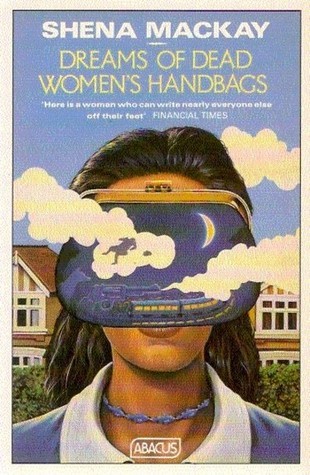
Dreams of Dead Women’s Handbags by Shena Mackay (1987)
“It was his father’s vituperation about ‘those bloody pansies at Old Hollow’ that had brought Joe to the cottage on this empty summer holiday afternoon.”
It’s 1956 in Kent and Joe is only eight years old, so it’s not too surprising that, ignorant of the slang, he shows up at Arthur and Guido’s expecting to find flowers dripping red. Their place becomes his haven from a home full of crying, excreting younger siblings and a conventional father who intends to send him to a private girls’ school in the autumn. That’s right, “Joe” is Josephine, who likes to wear boys’ clothes and insists on a male name. Mackay struck me as ahead of her time (rather like Rose Tremain with Sacred Country) in honouring Joe’s chosen pronouns and letting him imagine an adult future in which he’d keep company with Arthur and Guido’s bohemian, artistic set – the former is a poet, the latter a painter – and they’d take him round ‘all the pubs in Soho.’ But in a sheltered small town where everyone has a slur ready for the men, it is not to be. Things don’t end well, but thankfully not as badly as I was hoping, and Joe has plucked up the courage to resist his father. There’s all the emotional depth and character development of a novella in this 26-page story.
 I’ve had a mixed experience with Mackay, but the one novel of hers I got on well with, The Orchard on Fire, also dwells on the shattered innocence of childhood. By contrast, most of the stories in this collection are grimy ones about lonely older people – especially elderly women – reminding me of Barbara Comyns or Barbara Pym at her darkest. “Where the Carpet Ends,” about the long-term residents of a shabby hotel, recalls The Lonely Passion of Judith Hearne. In “Violets and Strawberries in the Snow,” a man in a mental institution awaits a holiday visit from his daughters. “What do we do now?” he asks a fellow inmate. “We could hang ourselves in the tinsel” is the reply. It’s very black comedy indeed. The same is true of a Halloween-set story that I’ll revisit next month.
The cover is so bad it’s good, amirite? In the title story, Susan Vigo is on her way by train to give a speech at a writers’ workshop and running through possible plots for her mystery novel in progress. “Slaves to the Mushroom” is another great one that takes place on a mushroom farm. Mackay’s settings are often surprising, her vocabulary precise, and her portraits of young people as cutting as those of the aged are pitiful. This would serve as a great introduction to her style. (Secondhand – Slightly Foxed Books, Berwick) 
“The Grown-up”
from
The Daydreamer by Ian McEwan (1994)
“The following morning Peter Fortune woke from troubled dreams to find himself transformed into a giant person, an adult.”
A much better Kafka homage, this, than that forgettable novella The Cockroach that McEwan published in 2019. Every story of this linked collection features Peter, a 10-year-old with a very active imagination. Three of the stories are straightforward body-swap narratives (with his sister’s mangled doll, his cat, or his baby cousin), whereas in this one he’s not trading with anyone else but still experiencing what it’s like to be someone else. In this case, a young man falling in love for the first time. Just the previous day, at the family’s holiday cottage in Cornwall, he’d been bemoaning how boring adults are: all they want to do is sit on the beach and chat or read, when there’s so much world out there to explore and turn into a personal playground. He never wants to be one of them. Now he realizes there are different ways to enjoy life; “he stopped and turned to look at the grown-ups one more time. … He felt differently about them now. There were things they knew and liked which for him were only just appearing, like shapes in a mist. There were adventures ahead of him after all.”
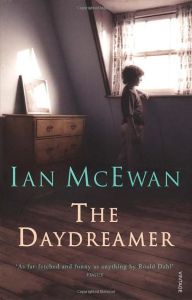 Of course, I also loved “The Cat,” which Eleanor mentioned when she read my review of Matt Haig’s To Be a Cat. At the time, I’d not heard of this and couldn’t believe McEwan had written something suitable for kids! These stories were ones he read aloud to his children as he composed them. There is a hint of gruesomeness in “The Dolls,” but most are just playful. “Vanishing Cream” is a cautionary tale about wanting your family to go away. In “The Bully,” Peter turns a bully into a tentative friend. “The Baby” sees him changing his mind about an annoying relative, while “The Burglar” has him imagining himself a hero who stops the spate of neighbourhood break-ins. Events are explained away as literal dreams, daydreams or a bit of magic. This was an offbeat gem. Try it for a very different taste of McEwan! (Secondhand – Community Furniture Project, Newbury)
20 Books of Summer, 19–20: Emily St. James and Abraham Verghese
Going out on a high! My last three books for the challenge (also including Beautiful Ruins) were particularly great, just the sort of absorbing and rewarding reading that I wish I could guarantee for all of my summer selections.
Woodworking by Emily St. James (2025)
Colloquially, “woodworking” is disappearing in plain sight; doing all you can to fade into the woodwork. Erica has only just admitted her identity to herself, and over the autumn of 2016 begins telling others she’s a woman – starting with her ex-wife Constance, who is now pregnant by her fiancé, John. To everyone else, Erica is still Mr. Skyberg, a 35-year-old English teacher at Mitchell High involved in local amateur dramatics. When Erica realizes that not only is there another trans woman in her small South Dakota town but that it’s one of her students, Abigail Hawkes, she lights up. Abigail may be half her age but is further along in her transition journey and has sassy confidence. But this foul-mouthed new mentor has problems of her own, starting with parents who refuse to refer to her by her chosen name. Abigail lives with her adult sister instead, and gains an unexpected surrogate family via her boyfriend Caleb, a Korean adoptee whose mother, Brooke Daniels, is directing Our Town. Brooke is surprisingly supportive given that she attends Isaiah Rose’s megachurch.
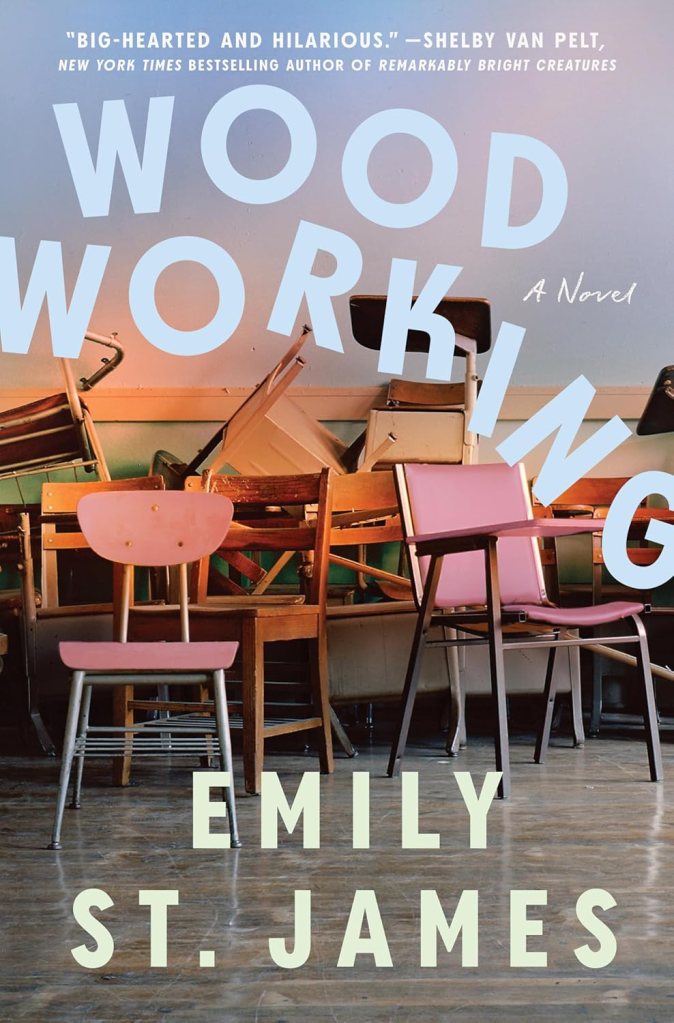
As Trump/Pence signs proliferate, a local election is heating up, too: Pastor Rose is running for State Congress on the Republican ticket, opposed by Helen Swee. Erica befriends Helen and becomes faculty advisor for the school’s Democrat club (which has all of two members: Abigail and her Leslie Knope-like friend Megan). The plot swings naturally between the personal and political, emphasizing how the personal business of 1% of the population has been made into a political football. Chapters alternate between Abigail in first person and Erica in third. The characters feel utterly real and the dialogue is as genuine as the narrative voices. The support group Erica and Abigail attend presents a range of trans experiences based on when one came of age. Some are still deep undercover. There’s a big reveal I couldn’t quite accept, though I can see its purpose. It’s particularly effective how St. James lets second- and third-person narration shade into first as characters accept their selves. Grey rectangles cover up deadnames all but once, making the point that even allies can get it wrong.
This was pure page-turning enjoyment with an important message to convey. It reminded me a lot of Under the Rainbow by Celia Laskey but also had the flavour of classic Tom Perrotta (Election). In the Author’s Note, St. James writes, “They say the single greatest determinant of whether someone will support and affirm trans people is if they know a trans person.” I feel lucky to count three trans people among my friends. It’s impossible to make detached pronouncements about bathrooms and slippery slopes if you care about people whose rights and very existence are being undermined. We should all be reading books by and about trans women. (New purchase from Bookshop.org)
The Covenant of Water by Abraham Verghese (2023)
All too often, I shy away from doorstoppers because they seem like too much of a time commitment. Why read 715 pages in one novel when I could read 3.5 of 200 pages each? Yet there’s something special about being lost in the middle of a great big book and trusting that wherever the story goes will be worthwhile. I let this review copy languish on the shelf for over TWO YEARS when I should have known that the author of the amazing Cutting for Stone couldn’t possibly let me down. Verghese’s second novel is very much in the same vein: a family saga that spans decades and in every generation focuses on medical issues. Verghese is a practicing doctor as well as a Stanford professor and you can tell he glories in the details of hand and brain surgeries, disability and rare diseases – and luckily, so do I.
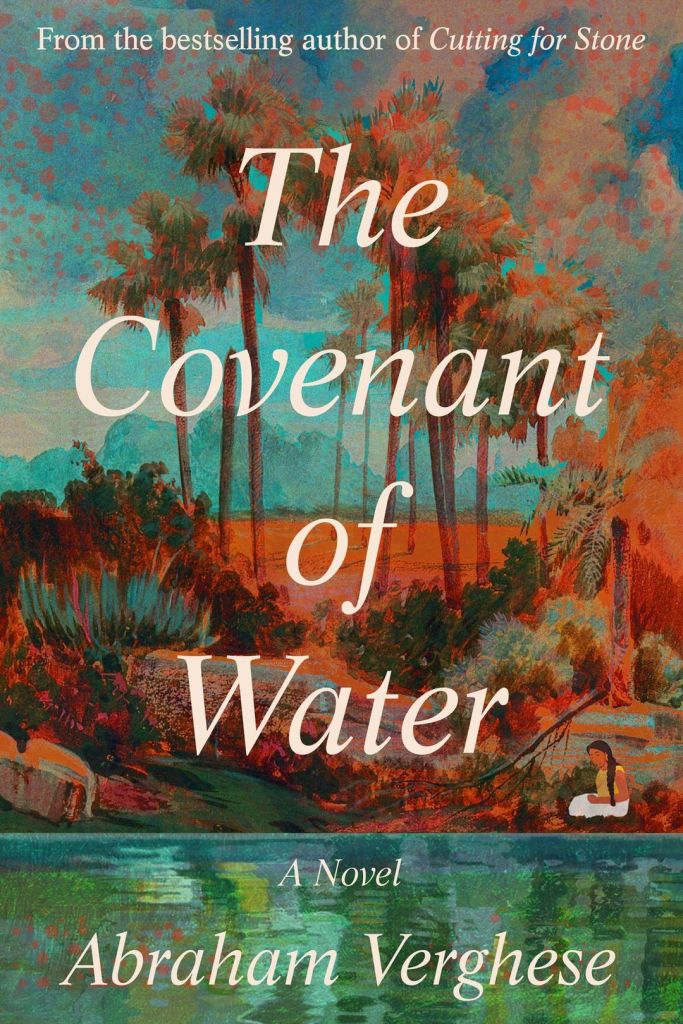
Wider events play out in the background (wars, partition, the fall of the caste system), but the focus is always on one family in Kerala, starting in 1900 when a 12-year-old girl is brought to the Parambil estate for her arranged marriage to a 40-year-old widower. One day she will be Big Ammachi, the matriarch of a family with a mysterious Condition: In every generation, someone drowns. As a result, they all avoid water, even if it requires going hours out of their way. Her son Philipose longs to be a scholar, but is so hard of hearing that his formal education is cut short. He becomes a columnist in a local newspaper and marries Elsie, a spirited artist. Their daughter, Mariamma, trains as a doctor. In parallel, we follow the story of Digby Kilgour, a Glaswegian surgeon whose career takes him to India. Through Digby and Mariamma’s interactions with colleagues, we watch colonial incompetence and sexism play out. Addiction and suicide recur across the years. Destiny and choice lock horns. I enjoyed the window onto the small community of St. Thomas Christians and felt fond of all the characters, including Damodaran the elephant. It’s also really clever how Verghese makes the Condition a cross between a mystical curse and a diagnosable ailment. An intellectual soap opera that makes you think about storytelling, purpose and inheritance, this is extraordinary. 
With thanks to Atlantic Books for the proof copy for review.

I read 10 of the books I selected in my initial planning post. I’m pleased that I picked off a couple of long-neglected review copies and several recent purchases. The rest were substituted at whim. There were two duds, but the overall quality was high, with 10 books I rated 4 stars or higher! Along with the above and Beautiful Ruins, Pet Sematary and Storm Pegs were overall highlights. I also managed to complete a row on the Bingo card, a fun add-on. And, bonus: I cleared 7 books from my shelves by reselling or giving them away after I read them.
April Releases by Chung, Ellis, Gaige, Lutz, McAlpine and Rubin
April felt like a crowded publishing month, though May looks to be twice as busy again. Adding this batch to my existing responses to books by Jean Hannah Edelstein & Emily Jungmin Yoon plus Richard Scott, I reviewed nine April releases. Today I’m featuring a real mix of books by women, starting with two foodie family memoirs, moving through a suspenseful novel about a lost hiker, a sparse Scandinavian novella, and a lovely poetry collection with themes of nature and family, and finishing up with a collection of aphorisms. I challenged myself to write just a paragraph on each for simplicity and readability.

Chinese Parents Don’t Say I Love You: A memoir of saying the unsayable with food by Candice Chung
“to love is to gamble, sometimes gastrointestinally … The stomach is a simple animal. But how do we settle the heart—a flailing, skittish thing?”
 I got Caroline Eden (Cold Kitchen) and Nina Mingya Powles (Tiny Moons) vibes from this vibrant essay collection spotlighting food and family. The focus is on 2019–2021, a time of huge changes for Chung. She’s from Hong Kong via Australia, and reconnects with her semi-estranged parents by taking them along on restaurant review gigs for a Sydney newspaper. Fresh from a 13-year relationship with “the psychic reader,” she starts dating again and quickly falls in deep with “the geographer.” Sharing meals in restaurants and at home kindles closeness and keeps their spirits up after Covid restrictions descend. But when he gets a job offer in Scotland, they have to make decisions about their relationship sooner than intended. Although there is a chronological through line, the essays range in time and style, including second-person advice column (“Faux Pas”) and choose-your-own adventure (“Self-Help Meal”) segments alongside lists, message threads and quotes from the likes of Deborah Levy. My favourite piece was “The Soup at the End of the Universe.” Chung delicately contrasts past and present, singleness and being partnered, and different mental health states. The essays meld to capture a life in transition and the tastes and bonds that don’t alter.
With thanks to Elliott & Thompson for the free copy for review.
Chopping Onions on My Heart: On Losing and Preserving Culture by Samantha Ellis
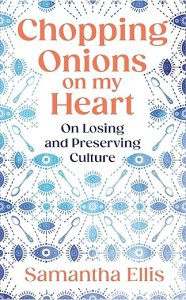 Ellis was distressed to learn that her refugee parents’ first language, Judeo-Iraqi Arabic, is in danger of extinction. Her own knowledge of it is piecemeal, mostly confined to its colourful food-inspired sayings – for example, living “eeyam al babenjan (in the days of the aubergines)” means that everything feels febrile and topsy-turvy. She recounts her family’s history with conflict and displacement, takes a Zoom language class, and ponders what words, dishes, and objects she would save on an imaginary “ark” that she hopes to bequeath to her son. Along the way, she reveals surprising facts about Ashkenazi domination of the Jewish narrative. “Did you know the poet [Siegfried Sassoon] was an Iraqi Jew?” His great-grandfather even invented a special variety of mango pickle. All of the foods described sound delicious, and some recipes are given. Ellis’s writing is enthusiastic and she braids the book’s various strands effectively. I wasn’t as interested in the niche history as I wanted to be, but I did appreciate learning about an endangered culture and language.
With thanks to Chatto & Windus (Vintage/Penguin) for the proof copy for review.
Heartwood by Amity Gaige
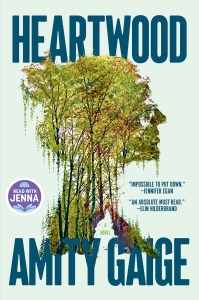 This was on my Most Anticipated list after how much I’d enjoyed Sea Wife when we read it for Literary Wives club. In July 2022, 42-year-old nurse Valerie Gillis, nicknamed “Sparrow,” goes missing in the Maine woods while hiking the Appalachian Trail. An increasingly desperate search ensues as the chances of finding her alive diminish with each day. The shifting formats – letters, transcripts, news reports, tip line messages – hold the interest. However, the chapters voiced by Lt. Bev, the warden who heads the mission, are much the most engaging, and it’s a shame that her delightful interactions with her sisters and nieces are so few and come so late. The third-person passages about Lena Kucharski in her Connecticut retirement home are intriguing but somehow feel like they belong in a different book. Gaige attempts to bring the threads together through three mother–daughter pairs, which struck me as heavy-handed. Mostly, this hits the sweet spot between mystery and literary fiction (apart from some red herrings), but because I wasn’t particularly invested in the characters, even Valerie, this fell a little short of my expectations. (Read via Edelweiss)
Wild Boar by Hannah Lutz (2016; 2025)
[Translated from Swedish by Andy Turner]
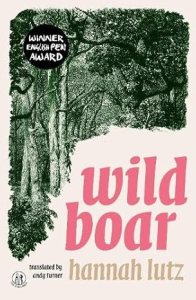 “I have seen them, the wild boar, they have found their way into my dreams!” Ritve travels from Finland to the forests of southern Sweden to track the creatures. Glenn, who appraises project applications for the council, has boar wander onto his property in the middle of the night. Mia, recipient of a council grant for her Recollections of a Sigga Child proposal, brings her ailing grandfather to record his memories for the local sound archive. As midsummer approaches, these three characters plus a couple of their partners will have encounters with the boar and with each other. Short sections alternate between their first-person perspectives. There is a strong sense of place and how migration poses challenges for both the human and more-than-human worlds. But it’s over before it begins. I found myself frustrated by how little happens, how stingily the characters reveal themselves, and how the boar, ultimately, are no more than a metaphor or plot device – a frequent complaint of mine when animals are central to a narrative. This might appeal to fans of Melissa Harrison’s fiction. In any case, I congratulate The Emma Press on their first novel, which won an English PEN Award.
With thanks to The Emma Press for the free copy for review.
Small Pointed Things by Erica McAlpine
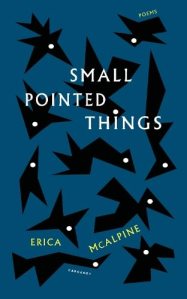 McAlpine is an associate professor of English at Oxford. Her second poetry collection is full of flora and fauna imagery. The title phrase comes from the opening poem, “Bats and Swallows” – in the “gloaming,” it’s hard to tell the difference between the flying creatures. The verse is bursting with alliteration and end rhymes, as just this first one shows (emphasis mine): “we couldn’t see / from where we stood in soft shadows / any signs that they were swallows // or bats”; “One seemed almost iridescent / as I tried to track / its crescent / flight across the hill.” Other poems consider moths, manatees, bees, swans and ladybirds; snowdrops and a cedar tree. Part II expands the view through conversations, theories and travel. What-ifs, consequences and regrets seep in. Parts III and IV incorporate mythical allusions, elegies and the concerns of motherhood. Sometimes the rhyme scheme adheres to a particular form. For instance, I loved “Triolet on My Mother’s 74th Birthday” – “You cannot imagine one season in another. … You cannot imagine life without your mother.” This is just my sort of poetry, sweet on the ear and rooted in nature and the everyday. A sample poem:
“Clementines”
New Year’s Day – another turning
of the sphere, with all we planned
in yesteryear as close to hand
as last night’s coals left unmanned
in the fire, still orange and burning.
It is the season for clementines
and citrus from Seville
and whatever brightness carries us until
leaves and petals once more fill
the treetops and the vines.
If ever you were to confess
some cold truth about love’s
dwindling, now would be the time – less
in order for things to improve
than for the half-bitter happiness
of peeling rinds
during mid-winter
recalling days that are behind
us and doors we cannot re-enter
and other doors we couldn’t find.
With thanks to Carcanet Press for the advanced e-copy for review.
Secrets of Adulthood: Simple Truths for Our Complex Lives by Gretchen Rubin
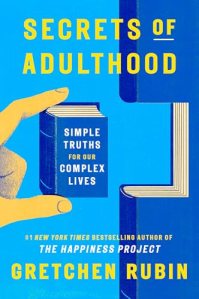 Rubin is one of the best self-help authors out there: Her books are practical, well-researched and genuinely helpful. She understands human nature and targets her strategies to suit different personality types. If you know her work, you’re likely aware of her fondness for aphorisms. “Sometimes, a single sentence can provide all the insight we need,” she believes. Here she collects her own pithy sayings relating to happiness, self-knowledge, relationships, work, creativity and decision-making. Some of the aphorisms were familiar to me through her previous books or her social media. They’re straightforward and sensible, distilling down to a few words truths we might be aware of but hadn’t truly absorbed. Like the great aphorists throughout history, Rubin relishes alliteration, repetition and contrasts. Some examples:
Accept yourself, and expect more from yourself.
I admire nature, and I am also nature. I resent traffic, and I am also traffic.
Work is the play of adulthood. If we’re not failing, we’re not trying hard enough.
Don’t wait until you have more free time. You may never have more free time.
This is not as meaty as her other work, and some parts feel redundant, but that’s the nature of the project. It would make a good bedside book for nibbles of inspiration. (Read via Edelweiss)
Which of these appeal to you?
Paul Auster Reading Week: Invisible (#ReadIndies) & Siri Hustvedt’s The Blindfold (#AusterRW25)
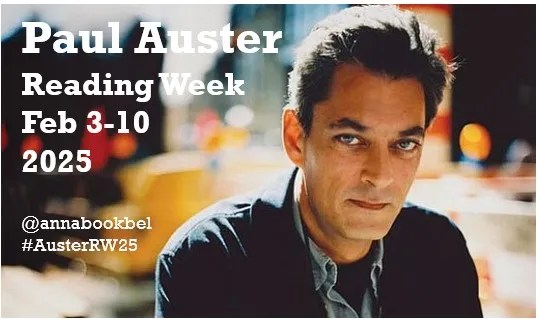
The first time Annabel ran a Paul Auster Reading Week, in 2020, it was a great excuse for me to read six of his books (Winter Journal and The New York Trilogy were amazing; I also really enjoyed Oracle Night). I won’t manage so many this time, but maybe three, as well as one by his widow, Siri Hustvedt. Auster would have been 78 today but died of lung cancer in 2024. As a buddy read, Annabel is inviting people to read his final novel, Baumgartner. I’m partway through that and have another of his novellas waiting in the wings in case I find time.
For now, I’m focusing on a novel that exemplifies some recurring elements of his fiction: a book within a book, fragmented narratives, differing perspectives, cryptic events and the inscrutability of memory and language. I’m pairing it with Hustvedt’s debut novel, which is – not coincidentally, I should think – similarly intricate, weird and unsettling.
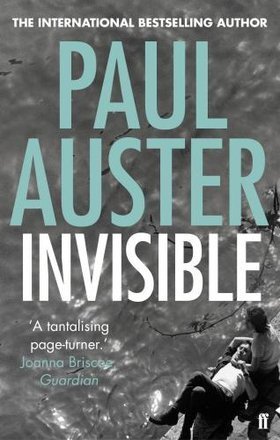
Invisible (2009)
To start with, I thought we were in autofiction territory, but Auster swiftly adopts a more typical metafictional approach. Adam Walker is a 20-year-old would-be poet studying at Columbia University in 1967. At a party he meets Rudolf Born, a visiting international affairs professor from Paris, and it seems a good omen: Born invests generously in Adam’s literary magazine and also seems open to sharing his beautiful girlfriend, Margot. But when the men are caught up in an attempted mugging, Adam turns against his idol.
 That’s at the heart of Part I (“Spring”). Across four sections, the perspective changes and the narrative is revealed to be 1967, a manuscript Adam began while dying of cancer. “Summer,” in the second person, shines a light on his relationship with his sister, Gwyn. “Fall,” adapted from Adam’s third-person notes by his college friend and fellow author, Jim Freeman, tells of Adam’s study abroad term in Paris. Here he reconnected with Born and Margot with unexpected results. Jim intends to complete the anonymized story with the help of a minor character’s diary, but the challenge is that Adam’s memories don’t match Gwyn’s or Born’s.
I can’t say more about the themes without giving too much away, but this is a provocative novel that makes you question how truth is created or preserved. Who has the right to tell the story, and will justice be done? I wouldn’t say I enjoyed it, but I certainly admired how it was constructed. Auster conjures such a sense of unease, and I always felt like I had no idea what might happen next. With no speech marks, it all flows together in a compulsively readable way. (Secondhand purchase – Awesomebooks.com) 
Faber, Auster’s longtime publisher, counts towards Reading Independent Publishers Month.
The Blindfold by Siri Hustvedt (1992)
“Strange, I thought. Everything is strange.”
I read Hustvedt (The Blazing World) well before I ever tried Auster, and wouldn’t have realized then how similar their books are; they almost seem part of the same body of work. Was Hustvedt a fan or a student of his before they married? I don’t actually know and am loath to dispel the mystery for myself by looking into it. Anyway, there are striking connections between this and Invisible: the narrator is fairly autobiographical and a Columbia University student, the novel is in four loosely connected parts, and the sordid content culminates in a sudden, odd ending. (There’s also the little Easter egg here of “I heard someone shout the name Paul.”) But overall, this is more reminiscent of The New York Trilogy in its surreal randomness and subtly symbolic naming (e.g., the landlord is Mr. Then).
 Iris Vegan (Hustvedt’s mother’s surname), like many an Auster character, is bewildered by what happens to her. An impoverished graduate student in literature, she takes on peculiar jobs. First Mr. Morning hires her to make audio recordings meticulously describing artefacts of a woman he’s obsessed with. Iris comes to believe this woman was murdered and rejects the work as invasive. Next she’s a photographer’s model but hates the resulting portrait and tries to take it off display. Then she’s hospitalized for terrible migraines and has upsetting encounters with a fellow patient, old Mrs. O. Finally, she translates a bizarre German novella and impersonates its protagonist, walking the streets in a shabby suit and even telling people her name is Klaus.
I worked out that the chronological order of the parts is 2 – 4 – 3 – 1, with 1 including a recap of the others. The sections feel like separate vignettes, perhaps reflecting Hustvedt’s previous experience with the short story form, and make a less than satisfying whole. I was most engaged with the segment on working for Mr. Morning and thought that might recur, but it doesn’t. Many of the secondary characters are grotesque, whereas Iris is the intellectual waif trying to make her way in the cruel city, almost like a Dickens or Gissing (anti)hero.
It’s refreshing to get a female take on the Bildungsroman and a little bit of gender-bending with the cross-dressing. (Iris reminds me of Lauren Elkin’s Flaneuse.) The title felt like an enigma to me until close to the end, when it’s revealed to be a tool of sexual sadism. Indeed, each of the sections, in its own way, addresses male exploitation of and violence against women. Disappointingly, Iris remains defined by her relationships with men. She deserves better. Heck, she deserves a sequel! It’s interesting to see where Hustvedt got her start, but I didn’t warm to this as I did to later novels including What I Loved. (Secondhand purchase – Community Furniture Project, Newbury)
Short, Soul-Soothing Reads for #NovNov24 & #NonfictionNovember: Barnes, Cognetti, Lende, Mann, Nouwen and Winner
After the catastrophic U.S. election results (which we’ve all managed to ignore or normalize so as to keep going with our lives) and a medical crisis with our dear old cat, I’ve been craving literary soul food. These six short nonfiction books have been good companions, promising love, meaning and transcendence in the midst of bereavement and daily routines.
Levels of Life by Julian Barnes (2013)
 Barnes was a favourite author in my twenties and thirties, though I’ve had less success with his recent work. He wrote a few grief-soaked books in the wake of the death of his wife, celebrated literary agent Pat Kavanagh*. I had this mistaken for a different one (Through the Window, I think?) that I had enjoyed more. No matter; it was still interesting to reread this triptych of auto/biographical essays. The final, personal piece, “The Loss of Depth,” is a classic of bereavement literature on par with C.S. Lewis’s A Grief Observed; I would happily take it as a standalone pamphlet. Its every word rings true, especially the sense of duty as the lost one’s “principal rememberer.” But the overarching ballooning metaphor, and links with early French aerial photographer Nadar and Colonel Fred Burnaby, aeronaut and suitor of Sarah Bernhardt, don’t convince. The strategy feels like a rehearsal for Richard Flanagan’s Baillie Gifford Prize-winning Question 7, a similar hybrid work that pulls it off better. (Little Free Library) [118 pages]
*In spring 2008, I attended a talk by John Irving at King’s College, London, where I worked in library services for five years. Barnes and Kavanagh were in the front row and embraced Irving before the start. I was floored to hear of Kavanagh’s death later that year because she’d looked so well. It was a fast-acting brain tumour that felled her just 37 days after diagnosis.
Without Ever Reaching the Summit by Paolo Cognetti (2018; 2020)
[Translated from the Italian by Stash Luczkiw]
 Part pilgrimage and part 40th birthday treat, Cognetti’s October 2017 Himalayan trek through Dolpo (a Nepalese plateau at the Tibetan border) would also somewhat recreate Peter Matthiessen’s The Snow Leopard. Cognetti struggles with altitude sickness and the fare: “I tried salted yak butter tea for the first time—nauseating if you thought you were drinking tea, good and refreshing if you thought you were drinking broth.” He and his companions fancifully decide that Kanjiroba, the lovable stray dog who joins their party, is a reincarnation of Matthiessen. I have limited tolerance for travel books’ episodic combinations of nature descriptions, anthropological observations, and the rigours of the nomadic lifestyle. The same was true here, but the slight spiritual aspect and references to The Snow Leopard lifted it. (Public library) [135 pages]
Find the Good: Unexpected Life Lessons from a Small-Town Obituary Writer by Heather Lende (2015)
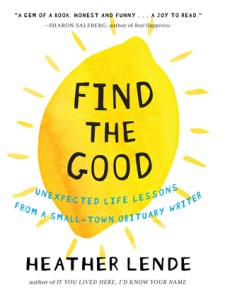 Lende is a journalist in isolated Haines, Alaska (population: 2,000). There’s a plucky motivational bent to these mini-essays about small-town life and death. In writing obituaries for normal, flawed people, she is reminded of what matters most: family (she’s a mother of five, one adopted, and a grandmother; she includes beloved pets in this category) and vocation. The title phrase is the motto she lives by. “I believe gratitude comes from a place in your soul that knows the story could have ended differently, and often does, and I also know that gratitude is at the heart of finding the good in this world—especially in our relationships with the ones we love.” The anecdotes and morals are sweet if not groundbreaking. The pocket-sized hardback might appeal to readers of Anne Lamott and Elizabeth Strout. (Birthday gift from my wish list, secondhand) [162 pages]
Do Not Be Afraid: The joy of waiting in a time of fear by Rachel Mann (2024)
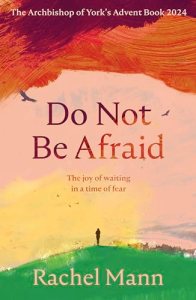 This is the Archbishop of York’s Advent Book 2024; I read it early because, pre-election, I yearned for its message of courage and patience. We need it all the more now. The bite-sized essays are designed to be read one per day from the first Sunday of Advent through to Christmas Day. Often they include a passage of scripture or poetry (including some of Mann’s own) for meditation, and each entry closes with a short prayer and a few questions for discussion or private contemplation. The topics are a real variety but mostly draw on the author’s own experiences of waiting and suffering: medical appointments and Covid isolation as well as the everyday loneliness of being single and the pain of coping with chronic illness. She writes about sitting with parishioners as they face death and bereavement. But there are also pieces inspired by popular culture – everything from Strictly to Quentin Tarantino.
Mann has written several previous Lent course books based on films. I’ve read her work in multiple genres (poetry: A Kingdom of Love and Eleanor Among the Saints; literary criticism: In the Bleak Midwinter; memoir: Dazzling Darkness; fiction: The Gospel of Eve); she is such a versatile writer, and with a fascinating story as a trans priest. Sombre yet hopeful, this is recommended seasonal reading. [114 pages]
With thanks to SPCK for the free copy for review.
The Inner Voice of Love: A Journey through Anguish to Freedom by Henri J. M. Nouwen (1997)
 Anguish is a strong word; I haven’t done any biographical digging to figure out what was going on in Nouwen’s life to prompt it, but apparently this secret journal came out of a lost relationship. (I wonder if it could have been a homosexual attachment. Nouwen was a Dutch Roman Catholic priest who became the pastor of a community for disabled adults in Canada.) He didn’t publish for another eight years but friends encouraged him to let his experience aid others. The one- or two-page reflections are written in the second person, so they feel like a self-help pep talk. The recurring themes are overcoming abandonment and rejection, relinquishing control, and trusting in God’s love and faithfulness. “You must stop being a pleaser and reclaim your identity as a free self.” The point about needing to integrate rather than sideline psychological pain is one I’m sure any therapist would affirm. Nouwen writes that a new spirituality of the body is necessary. This was a comforting bedside book with lots of passages that resonated. (Free – withdrawn from church theological library) [98 pages]
Mudhouse Sabbath: An Invitation to a Life of Spiritual Discipline by Lauren F. Winner (2003)
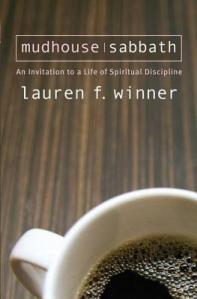 After Winner converted from Orthodox Judaism to Christianity, she found that she missed how Jewish rituals make routine events sacred. There are Christian sacraments, of course, but this book is about how the wisdom of another tradition might be applied in a new context. “Judaism offers opportunities for people to inhabit and sanctify bodies and bodily practices,” Winner writes. There are chapters on the concept of the Sabbath, wedding ceremonies, prayer and hospitality. Fasting is a particular sticking point for Winner, but her priest encourages her to see it as a way of demonstrating dependence on, and hunger for, God. I most appreciated the sections on mourning and ageing. “Perhaps the most essential insight of the Jewish approach to caring for one’s elderly is that this care is, indeed, an obligation. What Judaism understands is that obligations are good things. They are the very bedrock of the Jew’s relationship to God, and they govern some of the most fundamental human relationships”. By the way, Mudhouse is Winner’s local coffeehouse, so she believes these disciplines can be undertaken anywhere. (Secondhand – Awesomebooks.com) [142 pages]

My Year in Novellas (#NovNov24)
Here at the start of the month, we’re inviting you to tell us about the novellas you’ve read since last November.
I have a special shelf of short books that I add to throughout the year. When at secondhand bookshops, charity shops, a Little Free Library, or the public library where I volunteer, I’m always thinking about my piles for November. But I do read novellas at other times of year, too. Forty-four of them between December 2023 and now, according to my Goodreads shelves (last year it was 46, so it seems like that’s par for the course). I often choose to review books of novella length for BookBrowse, Foreword and Shelf Awareness. I’ve read a real mixture, but predominantly literature in translation and autobiographical works.


My favourites of the ones I’ve already covered on the blog would probably be (nonfiction) Alphabetical Diaries by Sheila Heti and (fiction) Aimez-vous Brahms by Françoise Sagan. My proudest achievements are: reading the short graphic novel Broderies by Marjane Satrapi in the original French at our Parisian Airbnb in December; and managing two rereads: Heartburn by Nora Ephron and Of Mice and Men by John Steinbeck.

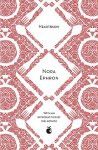

Of the short books I haven’t already reviewed here, I’ve chosen two gems, one fiction and one nonfiction, to spotlight in this post:
Fiction
Clear by Carys Davies
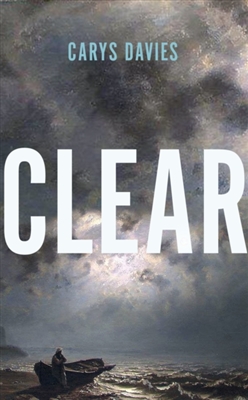 Clear depicts the Highland Clearances in microcosm though the experiences of one man, Ivar, the last resident of a remote Scottish island between Shetland and Norway. As in a play, there is a limited setting and cast. John is a minister sent by the landowner to remove Ivar, but an accident soon after his arrival leaves him beholden to Ivar for food and care. Mary, John’s wife, is concerned and sets off on the long journey from the mainland to rescue him. Davies writes vivid scenes and brings the island’s scenery to life. Flashbacks fill in the personal and cultural history, often via objects. The Norn language is another point of interest. The deceptively simple prose captures both the slow building of emotion and the moments that change everything. It seemed the trio were on course for tragedy, yet they are offered the grace of a happier ending.
In my book club, opinions differed slightly as to the central relationship and the conclusion, but we agreed that it was beautifully done, with so much conveyed in the concise length. This received our highest rating ever, in fact. I’d read Davies’ West and not appreciated it as much, although looking back I can see that it was very similar: one or a few character(s) embarked on unusual and intense journey(s); a plucky female character; a heavy sense of threat; and an improbably happy ending. It was the ending that seemed to come out of nowhere and wasn’t in keeping with the tone of the rest of the novella that made me mark West down. Here I found the writing cinematic and particularly enjoyed Mary as a strong character who escaped spinsterhood but even in marriage blazes her own trail and is clever and creative enough to imagine a new living situation. And although the ending is sudden and surprising, it nevertheless seems to arise naturally from what we know of the characters’ emotional development – but also sent me scurrying back to check whether there had been hints. One of my books of the year for sure. 
Nonfiction
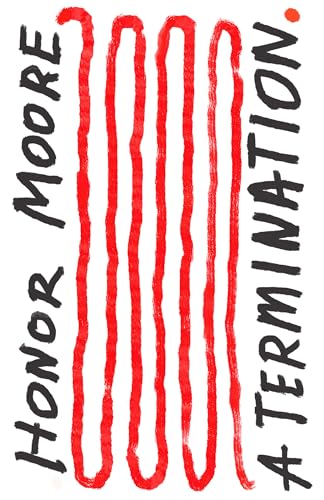
A Termination by Honor Moore
Poet and memoirist Honor Moore’s A Termination is a fascinatingly discursive memoir that circles her 1969 abortion and contrasts societal mores across her lifetime.
 During the spring in question, Moore was a 23-year-old drama school student. Her lover, L, was her professor. But she also had unwanted sex with a photographer. She did not know which man had impregnated her, but she did know she didn’t feel prepared to become a mother. She convinced a psychiatrist that doing so would destroy her mental health, and he referred her to an obstetrician for a hospital procedure. The termination was “my first autonomous decision,” Moore insists, a way of saying, “I want this life, not that life.”
Family and social factors put Moore’s experiences into perspective. The first doctor she saw refused Moore’s contraception request because she was unmarried. Her mother, however, bore nine children and declined to abort a pregnancy when advised to do so for medical reasons. Moore observes that she made her own decision almost 10 years before “the word choice replaced pro abortion.”
This concise work is composed of crystalline fragments. The stream of consciousness moves back and forth in time, incorporating occasional second- and third-person narration as well as highbrow art and literature references. Moore writes one scene as if it’s in a play and imagines alternative scenarios in which she has a son; though she is curious, she is not remorseful. The granular attention to women’s lives recalls Annie Ernaux, while the kaleidoscopic yet fluid approach is reminiscent of Sigrid Nunez’s work. It’s a stunning rendering of steps on her childfree path.
Reprinted with permission from Shelf Awareness.
I currently have four novellas underway and plan to start some more this weekend. I have plenty to choose from!
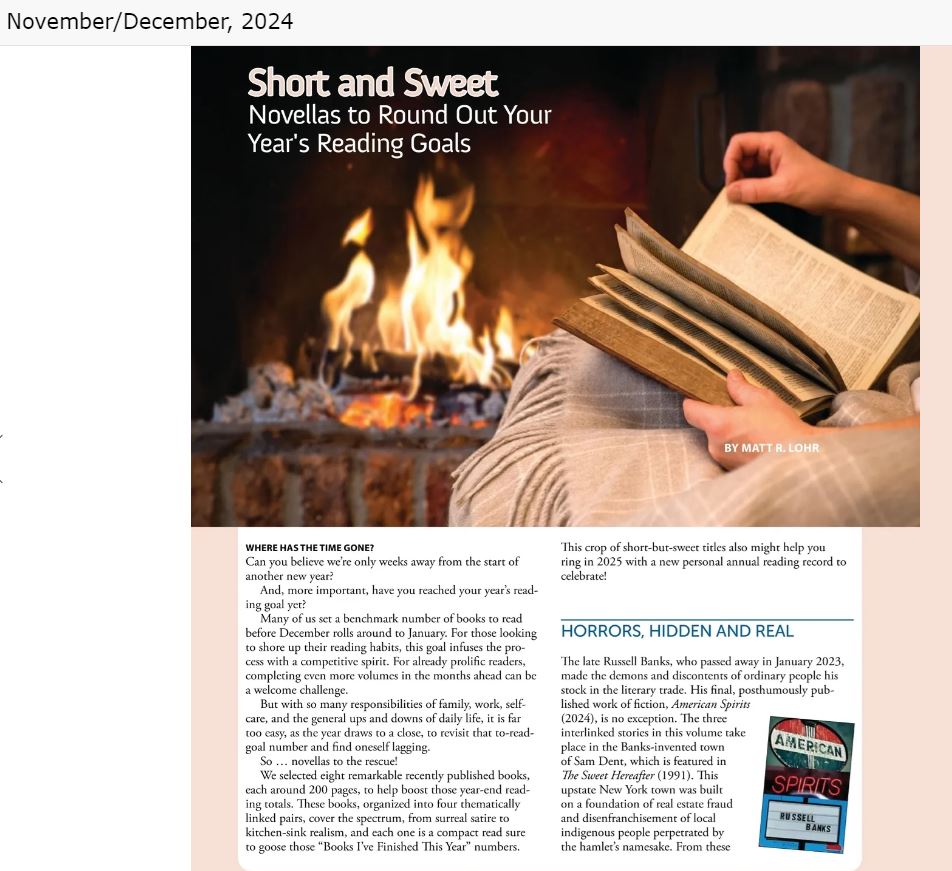
Everyone’s getting in on the act: there’s an article on ‘short and sweet books’ in the November/December issue of Bookmarks magazine, for which I’m an associate editor; Goodreads sent around their usual e-mail linking to a list of 100 books under 250 or 200 pages to help readers meet their 2024 goal. Or maybe you’d like to join in with Wafer Thin Books’ November buddy read, the Ugandan novella Waiting by Goretti Kyomuhendo (2007).
Why not share some recent favourite novellas with us in a post of your own?

August Releases: Sarah Manguso (Fiction), Sarah Moss (Memoir), and Carl Phillips (Poetry)
Today I feature a new-to-me poet and two women writers whose careers I’ve followed devotedly but whose latest books – forthright yet slippery; their genre categories could easily be reversed – I found very emotionally difficult to read. Gruelling, almost, but admirable. Many rambling thoughts ensue. Then enjoy a nice poem.
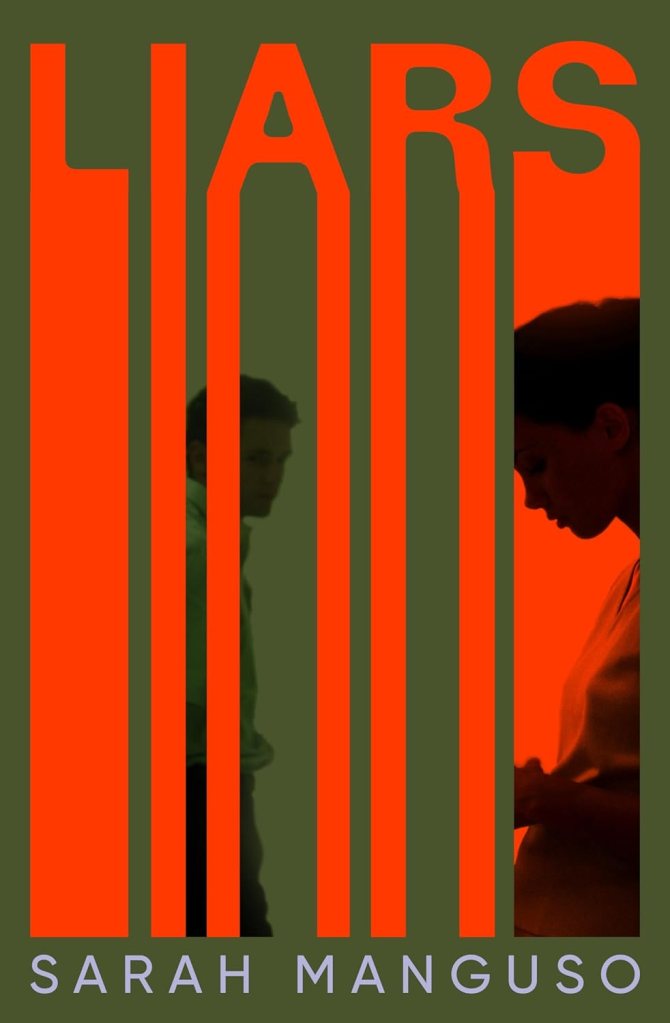
Liars by Sarah Manguso
As part of a profile of Manguso and her oeuvre for Bookmarks magazine, I wrote a synopsis and surveyed critical opinion; what follow are additional subjective musings. I’ve read six of her nine books (all but the poetry and an obscure flash fiction collection) and I esteem her fragmentary, aphoristic prose, but on balance I’m fonder of her nonfiction. Had Liars been marketed as a diary of her marriage and divorce, Manguso might have been eviscerated for the indulgence and one-sided presentation. With the thinnest of autofiction layers, is it art?
Jane recounts her doomed marriage, from the early days of her relationship with John Bridges to the aftermath of his affair and their split. She is a writer and academic who sacrifices her career for his financially risky artistic pursuits. Especially once she has a baby, every domestic duty falls to her, while he keeps living like a selfish stag and gaslights her if she tries to complain, bringing up her history of mental illness. The concise vignettes condense 14+ years into 250 pages, which is a relief because beneath the sluggish progression is such repetition of type of experiences that it could feel endless. John’s last name might as well be Doe: The novel presents him – and thus all men – as despicable and useless, while women are effortlessly capable and, by exhausting themselves, achieve superhuman feats. This is what heterosexual marriage does to anyone, Manguso is arguing. Indeed, in a Guardian interview she characterized this as a “domestic abuse novel,” and elsewhere she has said that motherhood can be unlinked from patriarchy, but not marriage.
Let’s say I were to list my every grievance against my husband from the last 17+ years: every time he left dirty clothes on the bedroom floor (which is every day); every time he loaded the dishwasher inefficiently (which is every time, so he leaves it to me); every time he failed to seal a packet or jar or Tupperware properly (which – yeah, you get the picture) – and he’s one of the good guys, bumbling rather than egotistical! And he’d have his own list for me, too. This is just what we put up with to live with other people, right? John is definitely worse (“The difference between John and a fascist despot is one of degree, not type”). But it’s not edifying, for author or reader. There may be catharsis to airing every single complaint, but how does it help to stew in bitterness? Look at everything I went through and validate my anger.
There are bright spots: Jane’s unexpected transformation into a doting mother (but why must their son only ever be called “the child”?), her dedication to her cat, and the occasional dark humour:
So at his worst, my husband was an arrogant, insecure, workaholic, narcissistic bully with middlebrow taste, who maintained power over me by making major decisions without my input or consent. It could still be worse, I thought.
Manguso’s aphoristic style makes for many quotably mordant sentences. My feelings vacillated wildly, from repulsion to gung-ho support; my rating likewise swung between extremes and settled in the middle. I felt that, as a feminist, I should wholeheartedly support a project of exposing wrongs. It’s easy to understand how helplessness leads to rage, and how, considering sunk costs, a partner would irrationally hope for a situation to improve. So I wasn’t as frustrated with Jane as some readers have been. But I didn’t like the crass sexual language, and on the whole I agreed with Parul Sehgal’s brilliant New Yorker review that the novel is so partial and the tone so astringent that it is impossible to love.
With thanks to Picador for the proof copy for review.
And a quote from the Moss memoir (below) to link the two books: “Homes are places where vulnerable people are subject to bullying, violence and humiliation behind closed doors. Homes are places where a woman’s work is never done and she is always guilty.”
20 Books of Summer, #19:
My Good Bright Wolf by Sarah Moss
I’ve reviewed this memoir for Shelf Awareness (it’s coming out in the USA from Farrar, Straus and Giroux on October 22nd) so will only give impressions, in rough chronological order:
Sarah Moss returns to nonfiction – YES!!!
Oh no, it’s in the second person. I’ve read too much of that recently. Fine for one story in a collection. A whole book? Not so sure. (Kirsty Logan got away with it, but only because The Unfamiliar is so short and meant to emphasize how matrescence makes you other.)
 The constant second-guessing of memory via italicized asides that question or refute what has just been said; the weird nicknames (her father is “the Owl” and her mother “the Jumbly Girl”) – in short, the deliberate artifice – at first kept me from becoming submerged. This must be deliberate and yet meant it was initially a chore to pick up. It almost literally hurt to read. And yet there are some breathtakingly brilliant set pieces. Oh! when her mother’s gay friend Keith buys her a chocolate éclair and she hides it until it goes mouldy.
Once she starts discussing her childhood reading – what it did for her then and how she views it now – the book really came to life for me. And she very effectively contrasts the would-be happily ever after of generally getting better after eight years of disordered eating with her anorexia returning with a vengeance at age 46 – landing her in A&E in Dublin. (Oh! when she reads War and Peace over and over on a hospital bed and defiantly uses the clean toilets on another floor.) This crisis is narrated in the third person before a return to second person.
The tone shifts throughout the book, so that what threatens to be slightly cloying in the childhood section turns academically curious and then, somehow, despite the distancing pronouns, intimate. So much so that I found myself weeping through the last chapters over this lovely, intelligent woman’s ongoing struggles. As an overly cerebral person who often thinks it’s pesky to have to live in a body, I appreciated her probing of the body/mind divide; and as she tracks where her food issues came from, I couldn’t help but think about my sister’s years of eating disorders and my mother’s fear that it was all her fault.
Beyond Moss’s usual readers, I’d also recommend this to fans of Laura Freeman’s The Reading Cure and Noreen Masud’s A Flat Place.
Overall: shape-shifting, devastating, staunchly pragmatic. I’m not convinced it all hangs together (and I probably would have ended it at p. 255), but it’s still a unique model for transmuting life into art.
With thanks to Picador for the free copy for review.
Scattered Snows, to the North by Carl Phillips
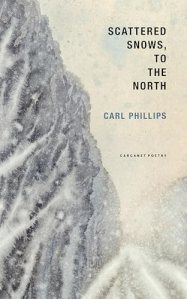 Phillips is a prolific poet I’d somehow never heard of. In fact, he won the Pulitzer Prize last year for his selected poetry volume. He’s gay and African American, and in his evocative verse he summons up landscapes and a variety of weather, including as a metaphor for emotions – guilt, shame, and regret. Looking back over broken relationships, he questions his memory.
Will I remember individual poems? Unlikely. But the sense of chilly, clear-eyed reflection, yes. (Sample poem below)
With thanks to Carcanet for the advanced e-copy for review.
Record of Where a Wind Was
Wave-side, snow-side,
little stutter-skein of plovers
lifting, like a mind
of winter—
We’d been walking
the beach, its unevenness
made our bodies touch,
now and then, at
the shoulders mostly,
with that familiarity
that, because it sometimes
includes love, can
become confused with it,
though they remain
different animals. In my
head I played a game with
the waves called Weapon
of Choice, they kept choosing
forgiveness, like the only
answer, as to them
it was, maybe. It’s a violent
world. These, I said, I choose
these, putting my bare hands
through the air in front of me.
Any other August releases you’d recommend?
Carol Shields Prize Reading: Coleman Hill and Between Two Moons
Two last Carol Shields Prize nominees today: from the shortlist, a gorgeous tapestry of African-American family history; and, from the longlist, a likable debut novel about Muslim twin sisters navigating the febrile summer of their high school graduation in Brooklyn.
Coleman Hill by Kim Coleman Foote
Is this family memoir or autofiction? I’ve shelved it as both on Goodreads; it’s a blend, one for which Foote borrows the term that Audre Lorde coined for Zami, “biomythography.” Like Edwidge Danticat, Jesmyn Ward and Jacqueline Woodson, Foote draws on personal stories but also invokes overarching narratives of Black migration and struggle. The result is magisterial, a debut novel that feels like oral history and a family scrapbook rolled into one.
During the First World War, the Coleman family were part of a mass exodus from the segregated South to the industrialized North. They hoped for a better life in New Jersey than they’d had under slavery and sharecropping in Alabama and Florida, but in fact many of the author’s ancestors became mired in ill-paid service roles (cleaner, maid, refuse collector) and, ironically, ended up having fewer opportunities for advancement than relatives who stayed behind and enrolled in Black educational institutions in the South.
Like a linked short story collection, the book pulls together 15 vignettes stretching from 1916 to 1989 and told in different styles and voices, including AAVE – I’m reliably informed that the audiobook is wonderful for that reason. A prologue in the first-person plural introduces the women who would become family matriarchs: “We wanted to go to school but couldn’t. The walk was too long. We was needed at home to plant and harvest. And boys could get more outta schooling, folks said, so it was our brothers who went.”

Other sections alternate first and third person. I especially admired the use of the second person for passages from the perspective of Celia Coleman, who develops a dependence on Four Roses whisky after being widowed. An interlude gives two poems from the point-of-view of cotton – crop failure was partly responsible for the initial relocation. There are also black-and-white photographs heading each chapter, and a family tree at the start. When I first heard about this book through its longlisting, the idea of family history told by nine characters sounded overwhelming (and potentially worthy). But the voices are so distinct that there is never a danger of getting lost, and the scenes are so vivid that you cringe from the beatings and cheer when a woman stands up to her meddling mother-in-law. There are echoes and reversals across the generations, as alcoholism and domestic abuse recur.
The core story is about Celia’s nastiness and resistance to her son Jeb’s marriage to Bertha Grimes. Bertha, battered by Jebbie and Celia alike, escapes to a brothel where she works as a cleaner. Celia ends up raising their children, along with another set of grandchildren, earning the nickname “Gra’ Coleman” and a reputation for meanness. (One excellent stand-alone story about the younger generation is titled “How to Kill Gra’ Coleman and Live to Tell About It (c. 1950).”) The inherited trauma is clear, yet I never found the content as bleak here as in A Council of Dolls; Foote weaves in enough counterbalancing lightness and love. There are so many strong female characters – Jeb’s older sisters, Bertha’s younger ones; their daughters – and plenty of humour and spirit despite the sometimes distressing subject matter. The family home, and the objects hoarded there, also play a major role.
It’s difficult to suggest the scope, as large and various as any American family’s history. An author’s note at the end details Foote’s approach – somewhere between “channeling spirits” and fictionalizing – to a novel that was many years in the gestation. I’d particularly recommend Coleman Hill to fans of Ayana Mathis and Toni Morrison. For me, there’s no contest; this should win the Carol Shields Prize for Fiction. 
With thanks to publicist Nicole Magas and SJP Lit (Zando) for the free e-copy for review.
Longlisted:
Between Two Moons by Aisha Abdel Gawad
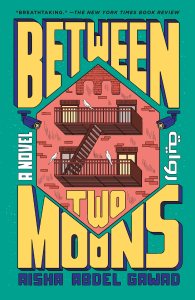 This debut novel is cleverly set within the month of Ramadan, a time of abstention. In this way, Gawad emphasizes the tension between faith and the temptations of alcohol and sex. Egyptian-American twin sisters Amira and Lina Emam are on the cusp, about to graduate from high school and go their separate ways. Lina wants to be a model and is dating a nightclub manager she hopes can make this a reality; Amira, ever the sensible one, is college-bound. But then she meets her first boyfriend, Faraj, and lets Lina drag her into a reckless partying lifestyle. “I was seized with that summertime desire of girls: to push my body to its limits.” Meanwhile, the girls’ older brother, Sami, just home from prison, is finding it a challenge to integrate back into the family and their Bay Ridge mosque, reeling from a raid on a Muslim-owned neighbourhood business and a senseless attack on the old imam.
I feared that a tired terrorism plot would surface and was relieved when this wasn’t the case, although there is a passionate message about the injustice of police surveillance of Muslim communities. I agree with Laura (see her review) that it does at times feel like an adult is producing YA fiction. It’s proficiently written and I enjoyed getting a glimpse into an unfamiliar world, but the novel never truly sparked into life for me. It also commits one of my pet peeves: inserting third-person segments to fill in events that the narrator could not have witnessed (while referring to the other characters as “the mother,” “the boy,” or “the other girl”). One to put on high school curricula but not on a prize list. 
With thanks to Laura for passing on her copy.
And a DNF:
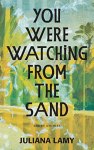 You Were Watching from the Sand by Juliana Lamy – I read the first 22% of this short fiction collection, which equated to a brief opener in the second person about a situation of abuse, followed by part of one endless-feeling story based around one apartment and bodega and featuring two young female family friends, one of whom accepts sexual favours in the supply closet from most male visitors. The voice and prose didn’t grab me, but of course I can’t say whether later stories would have been more to my taste. (Edelweiss)
Overall thoughts and prediction:
I’m grateful for the chance to have read most of the Carol Shields Prize longlist this year, thanks to the library, Edelweiss, and especially the publicist providing multiple books in digital format straight from the publishers. I’ve been introduced to a number of books and authors I might never have otherwise come across, and my reactions to what I expected to love or to dislike sometimes surprised me. It was also fun to do a few as buddy reads with Laura.
Here’s a recap of what I read, from favourite to least favourite:
Coleman Hill by Kim Coleman Foote – see above
Land of Milk and Honey by C Pam Zhang
Cocktail by Lisa Alward
I Have Some Questions for You by Rebecca Makkai (read last year)
Dances by Nicole Cuffy
Daughter by Claudia Dey
Chrysalis by Anuja Varghese
The Future by Catherine Leroux
Between Two Moons by Aisha Abdel Gawad – see above
Brotherless Night by V.V. Ganeshananthan (a skim)
A Council of Dolls by Mona Susan Power
You Were Watching from the Sand by Juliana Lamy (DNF) – see above
Birnam Wood by Eleanor Catton (skimmed last year)
Loot by Tania James (skim/DNF)
Thus, my ideal shortlist would have been the top five: Coleman Hill, Land of Milk and Honey, Cocktail, I Have Some Questions for You, and Dances.
It’s impossible to predict what the judges will pick from the actual shortlist. I never even attempted one of the finalists (A History of Burning by Janika Oza – Marcie’s comments made me confident it wouldn’t be for me) and only skimmed two others (Catton and Ganeshananthan). Sod’s law would suggest that one of those few will therefore win! I could see the case for any of the five, anyway. But I will have my fingers crossed for Coleman Hill.
The winner will be announced on Monday, 13 May.
Will you seek out something from the shortlist (or longlist)?
 Bookish Beck = Rebecca Foster. American transplant to England. Freelance proofreader and book reviewer.
 Bookish Beck