#ReadIndies Nonfiction Catch-Up: Ansell, Farrier, Febos, Hoffman, Orlean and Stacey
These are all 2025 releases; for some, it’s approaching a year since I was sent a review copy or read the book. Silly me. At last, I’ve caught up. Reading Indies month, hosted by Kaggsy in memory of her late co-host Lizzy Siddal, is the perfect time to feature books from five independent publishers. I have four works that might broadly be classed as nature writing – though their topics range from birdsong and technology to living in Greece and rewilding a plot in northern Spain – and explorations of celibacy and the writer’s profession.
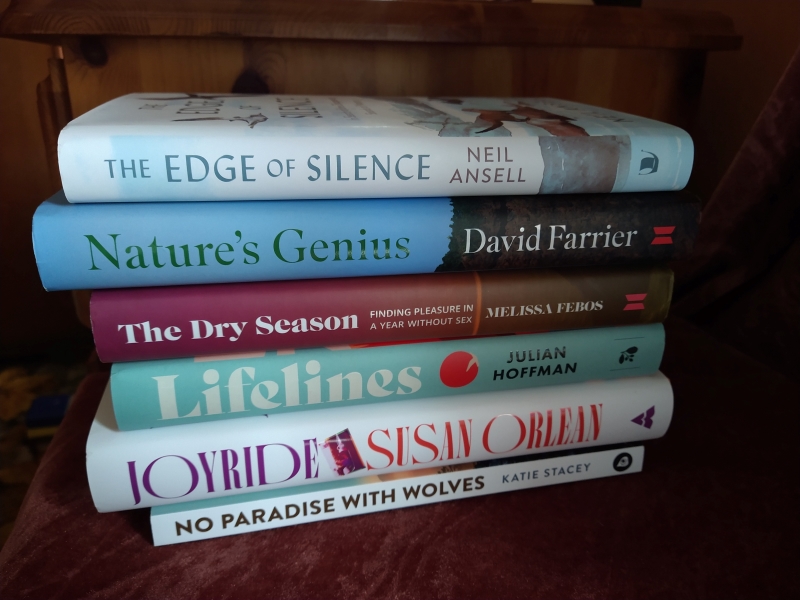
The Edge of Silence: In Search of the Disappearing Sounds of Nature by Neil Ansell
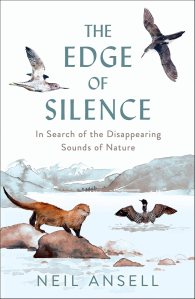 Ansell draws parallels between his advancing hearing loss and the biodiversity crisis. He puts together a wish list of species – mostly seabirds (divers, grebes), but also inland birds (nightjars) and a couple of non-avian representatives (otters) – that he wants to hear and sets off on public transport adventures to find them. “I must find beauty where I can, and while I still can,” he vows. From his home on the western coast of Scotland near the Highlands, this involves trains or buses that never align with the ferry timetables. Furthest afield for him are two nature reserves in northern England where his mission is to hear bitterns “booming” and natterjack toads croaking at night. There are also mountain excursions to locate ptarmigan, greenshank, and black grouse. His island quarry includes Manx shearwaters (Rum), corncrakes (Coll), puffins (Sanday), and storm petrels (Shetland).
Camping in a tent means cold nights, interrupted sleep, and clouds of midges, but it’s all worth it to have unrepeatable wildlife experiences. He has a very high hit rate for (seeing and) hearing what he intends to, even when they’re just on the verge of what he can decipher with his hearing aids. On the rare occasions when he misses out, he consoles himself with earlier encounters. “I shall settle for the memory, for it feels unimprovable, like a spell that I do not want to break.” I’ve read all of Ansell’s nature memoirs and consider him one of the UK’s top writers on the natural world. His accounts of his low-carbon travels are entertaining, and the tug-of-war between resisting and coming to terms with his disability is heartening. “I have spent this year in defiance of a relentless, unstoppable countdown,” he reflects. What makes this book more universal than niche is the deadline: we and all of these creatures face extinction. Whether it’s sooner or later depends on how we act to address the environmental polycrisis.
With thanks to Birlinn for the free copy for review.
Nature’s Genius: Evolution’s Lessons for a Changing Planet by David Farrier
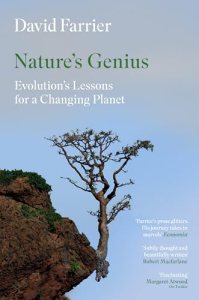 Farrier’s Footprints, which tells the story of the human impact on the Earth, was one of my favourite books of 2020. This contains a similar blend of history, science, and literary points of reference (Farrier is a professor of literature and the environment at the University of Edinburgh), with past changes offering a template for how the future might look different. “We are forcing nature to reimagine itself, and to avert calamity we need to do the same,” he writes. Cliff swallows have evolved blunter wings to better evade cars; captive breeding led foxes to develop the domesticated traits of pet dogs.
It’s not just other species that experience current evolution. Thanks to food abundance and a sedentary lifestyle, humans show a “consumer phenotype,” which superseded the Palaeolithic (95% of human history) and tends toward earlier puberty, autoimmune diseases, and obesity. Farrier also looks at notions of intelligence, language, and time in nature. Sustainable cities will have to cleverly reuse materials. For instance, The Waste House in Brighton is 90% rubbish. (This I have to see!)
There are many interesting nuggets here, and statements that are difficult to argue with, but I struggled to find an overall thread. Cool to see my husband’s old housemate mentioned, though. (Duncan Geere, for collaborating on a hybrid science–art project turning climate data into techno music.)
With thanks to Canongate for the free copy for review.
The Dry Season: Finding Pleasure in a Year without Sex by Melissa Febos
Febos considers but rejects the term “sex addiction” for the years in which she had compulsive casual sex (with “the Last Man,” yes, but mostly with women). Since her early teen years, she’d never not been tied to someone. Brief liaisons alternated with long-term relationships: three years with “the Best Ex”; two years that were so emotionally tumultuous that she refers to the woman as “the Maelstrom.” It was the implosion of the latter affair that led to Febos deciding to experiment with celibacy, first for three months, then for a whole year. “I felt feral and sad and couldn’t explain it, but I knew that something had to change.”
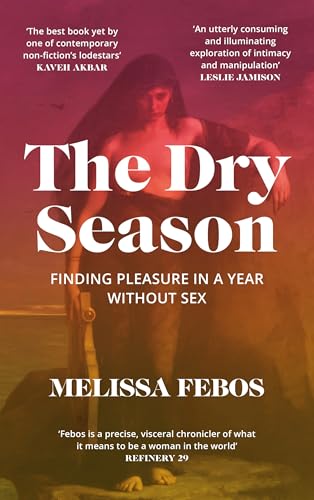 The quest involved some research into celibate movements in history, but was largely an internal investigation of her past and psyche. Febos found that she was less attuned to the male gaze. Having worn high heels almost daily for 20 years, she discovered she’s more of a trainers person. Although she was still tempted to flirt with attractive women, e.g. on an airplane, she consciously resisted the impulse to spin random meetings into one-night stands. (A therapist had stopped her short with the blunt observation, “you use people.”) With a new focus on the life of the mind, she insists, “My life was empty of lovers and more full than it had ever been.” (This reminded me of Audre Lorde’s writing on the erotic.) As Silvana Panciera, an Italian scholar on the beguines (a secular nun-like sisterhood), told her: “When you don’t belong to anyone, you belong to everyone. You feel able to love without limits.”
Intriguing that this is all a retrospective, reflecting on her thirties; Febos is now in her mid-forties and married to a woman (poet Donika Kelly). Clearly she felt that it was an important enough year – with landmark epiphanies that changed her and have the potential to help others – to form the basis for a book. For me, she didn’t have much new to offer about celibacy, though it was interesting to read about the topic from an areligious perspective. But I admire the depth of her self-knowledge, and particularly her ability to recreate her mindset at different times. This is another one, like her Girlhood, to keep on the shelf as a model.
With thanks to Canongate for the free copy for review.
Lifelines: Searching for Home in the Mountains of Greece by Julian Hoffman
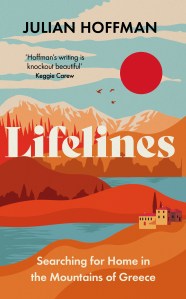 Hoffman’s Irreplaceable was my nonfiction book of 2019. Whereas that was a work with a global environmentalist perspective, Lifelines is more personal in scope. It tracks the author’s unexpected route from Canada via the UK to Prespa, a remote area of northern Greece that’s at the crossroads with Albania and North Macedonia. He and his wife, Julia, encountered Prespa in a book and, longing for respite from the breakneck pace of life in London, moved there in 2000. “Like the rivers that spill into these shared lakes, lifelines rarely flow straight. Instead, they contain bends, meanders and loops; they hold, at times, turns of extraordinary surprise.” Birdwatching, which Hoffman suggests is as “a way of cultivating attention,” had been their gateway into a love for nature developed over the next quarter-century and more, and in Greece they delighted in seeing great white and Dalmatian pelicans (which feature on the splendid U.S. cover. It would be lovely to have an illustrated edition of this.)
 One strand of this warm and fluent memoir is about making a home in Greece: buying and renovating a semi-derelict property, experiencing xenophobia and hospitality from different quarters, and finding a sense of belonging. They’re happy to share their home with nesting wrens, who recur across the book and connect to the tagline of “a story of shelter shared.” In probing the history of his adopted country, Hoffman comes to realise the false, arbitrary nature of borders – wildlife such as brown bears and wolves pay these no heed. Everything is connected and questions of justice are always intersectional. The Covid pandemic and avian influenza (which devastated the region’s pelicans) are setbacks that Hoffman addresses honestly. But the lingering message is a valuable one of bridging divisions and learning how to live in harmony with other people – and with other species.
With thanks to Elliott & Thompson for the free copy for review.
Joyride by Susan Orlean
As a long-time staff writer for The New Yorker, Orlean has had the good fortune to be able to follow her curiosity wherever it leads, chasing the subjects that interest her and drawing readers in with her infectious enthusiasm. She grew up in suburban Ohio, attended college in Michigan, and lived in Portland, Oregon and Boston before moving to New York City. Her trajectory was from local and alternative papers to the most enviable of national magazines: Esquire, Rolling Stone and Vogue. Orlean gives behind-the-scenes information on lots of her early stories, some of which are reprinted in an appendix. “If you’re truly open, it’s easy to fall in love with your subject,” she writes; maintaining objectivity could be difficult, as when she profiled an Indian spiritual leader with a cult following; and fended off an interviewee’s attachment when she went on the road with a Black gospel choir.
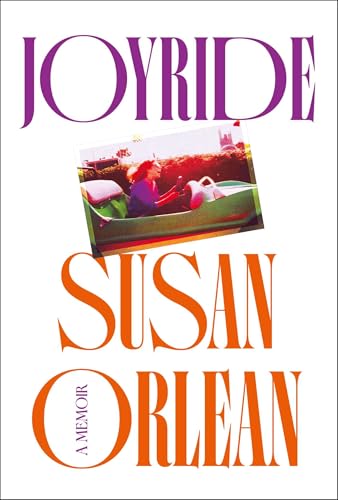 Her personal life takes a backseat to her career, though she is frank about the breakdown of her first marriage, her second chance at love and late motherhood, and a surprise bout with lung cancer. The chronological approach proceeds book by book, delving into her inspirations, research process and publication journeys. Her first book was about Saturday night as experienced across America. It was a more innocent time, when subjects were more trusting. Orlean and her second husband had farms in the Hudson Valley of New York and in greater Los Angeles, and she ended up writing a lot about animals, with books on Rin Tin Tin and one collecting her animal pieces. There was also, of course, The Library Book, about the wild history of the main Los Angeles public library. But it’s her The Orchid Thief – and the movie (not) based on it, Adaptation – that’s among my favourites, so the long section on that was the biggest thrill for me. There are also black-and-white images scattered through.
It was slightly unfortunate that I read this at the same time as Book of Lives – who could compete with Margaret Atwood? – but it is, yes, a joy to read about Orlean’s writing life. She’s full of enthusiasm and good sense, depicting the vocation as part toil and part magic:
“I find superhuman self-confidence when I’m working on a story. The bashfulness and vulnerability that I might otherwise experience in a new setting melt away, and my desire to connect, to observe, to understand, powers me through.”
“I like to do a gut check any time I dismiss or deplore something I don’t know anything about. That feels like reason enough to learn about it.”
“anything at all is worth writing about if you care about it and it makes you curious and makes you want to holler about it to other people”
With thanks to Atlantic Books for the free copy for review.
No Paradise with Wolves: A Journey of Rewilding and Resilience by Katie Stacey
I had the good fortune to visit Wild Finca, Luke Massey and Katie Stacey’s rewilding site in Asturias, while on holiday in northern Spain in May 2022, and was intrigued to learn more about their strategy and experiences. This detailed account of the first four years begins with their search for a property in 2018 and traces the steps of their “agriwilding” of a derelict farm: creating a vegetable garden and tending to fruit trees, but also digging ponds, training up hedgerows, and setting up rotational grazing. Their every decision went against the grain. Others focussed on one crop or type of livestock while they encouraged unruly variety, keeping chickens, ducks, goats, horses and sheep. Their neighbours removed brush in the name of tidiness; they left the bramble and gorse to welcome in migrant birds. New species turned up all the time, from butterflies and newts to owls and a golden fox.
Luke is a wildlife guide and photographer. He and Katie are conservation storytellers, trying to get people to think differently about land management. The title is a Spanish farmers’ and hunters’ slogan about the Iberian wolf. Fear of wolves runs deep in the region. Initially, filming wolves was one of the couple’s major goals, but they had to step back because staking out the animals’ haunts felt risky; better to let them alone and not attract the wrong attention. (Wolf hunting was banned across Spain in 2021.) There’s a parallel to be found here between seeing wolves as a threat and the mild xenophobia the couple experienced. Other challenges included incompetent house-sitters, off-lead dogs killing livestock, the pandemic, wildfires, and hunters passing through weekly (as in France – as we discovered at Le Moulin de Pensol in 2024 – hunters have the right to traverse private land in Spain).
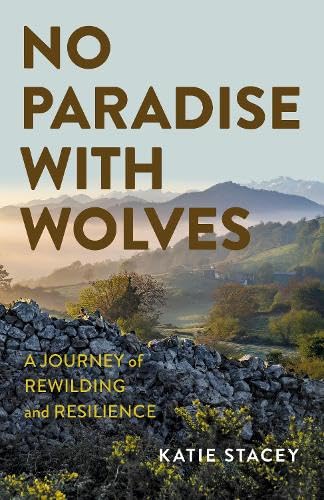
Luke and Katie hope to model new ways of living harmoniously with nature – even bears and wolves, which haven’t made it to their land yet, but might in the future – for the region’s traditional farmers. They’re approaching self-sufficiency – for fruit and vegetables, anyway – and raising their sons, Roan and Albus, to love the wild. We had a great day at Wild Finca: a long tour and badger-watching vigil (no luck that time) led by Luke; nettle lemonade and sponge cake with strawberries served by Katie and the boys. I was clear how much hard work has gone into the land and the low-impact buildings on it. With the exception of some Workaway volunteers, they’ve done it all themselves.
Katie Stacey’s storytelling is effortless and conversational, making this impassioned memoir a pleasure to read. It chimed perfectly with Hoffman’s writing (above) about the fear of bears and wolves, and reparation policies for farmers, in Europe. I’d love to see the book get a bigger-budget release complete with illustrations, a less misleading title, the thorough line editing it deserves, and more developmental work to enhance the literary technique – as in the beautiful final chapter, a present-tense recreation of a typical walk along The Loop. All this would help to get the message the wider reach that authors like Isabella Tree have found. “I want to be remembered for the wild spaces I leave behind,” Katie writes in the book’s final pages. “I want to be remembered as someone who inspired people to seek a deeper connection to nature.” You can’t help but be impressed by how much of a difference two people seeking to live differently have achieved in just a handful of years. We can all rewild the spaces available to us (see also Kate Bradbury’s One Garden against the World), too.
With thanks to Earth Books (Collective Ink) for the free copy for review.
Which of these do you fancy reading?
Best Books of 2025: The Runners-Up
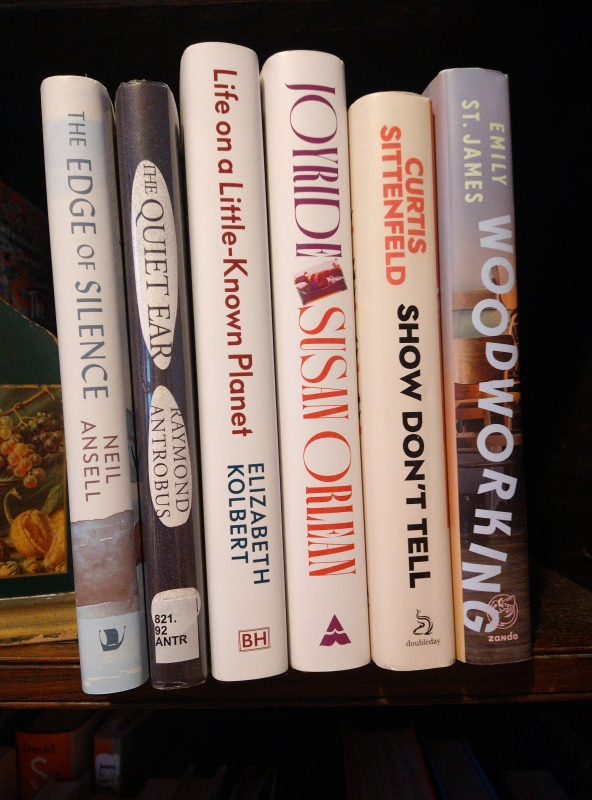
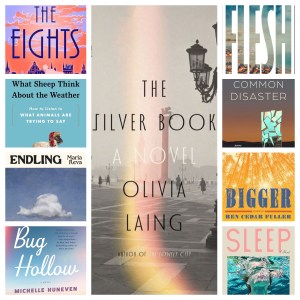
Coming up tomorrow: my list of the 15 best 2025 releases I’ve read. Here are 15 more that nearly made the cut. Pictured below are the ones I read / could get my hands on in print; the rest were e-copies or in-demand library books. Links are to my full reviews where available.
Fiction
 Bug Hollow by Michelle Huneven: A glistening portrait of a lovably dysfunctional California family beset by losses through the years but expanded through serendipity and friendship. Life changes forever for the Samuelsons (architect dad Phil; mom Sibyl, a fourth-grade teacher; three kids) when the eldest son, Ellis, moves into a hippie commune in the Santa Cruz Mountains. A rotating close third-person perspective spotlights each member. Fans of Jami Attenberg, Ann Patchett, and Anne Tyler need to try Huneven’s work pronto.
 Sleep by Honor Jones: A breathtaking character study of a woman raising young daughters and facing memories of childhood abuse. Margaret’s 1990s New Jersey upbringing seems idyllic, but upper-middle-class suburbia conceals the perils of a dysfunctional family headed by a narcissistic, controlling mother. Jones crafts unforgettable, crystalline scenes. There are subtle echoes throughout as the past threatens to repeat. Reminiscent of Sarah Moss and Evie Wyld, and astonishing for its psychological acuity, this promises great things from Jones.
 The Silver Book by Olivia Laing: Steeped in the homosexual demimonde of 1970s Italian cinema (Fellini and Pasolini films), with a clear antifascist message filtered through the coming-of-age story of a young Englishman trying to outrun his past. This offers the best of both worlds: the verisimilitude of true crime reportage and the intimacy of the close third person. Laing leavens the tone with some darkly comedic moments. Elegant and psychologically astute work from one of the most valuable cultural commentators out there.
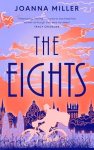 The Eights by Joanna Miller: Highly readable, book club-suitable fiction that is a sort of cross between In Memoriam and A Single Thread in terms of its subject matter: the first women to attend Oxford in the 1920s, the suffrage movement, and the plight of spare women after WWI. Different aspects are illuminated by the four central friends and their milieu. This debut has a good sense of place and reasonably strong characters. Despite some difficult subject matter, it remains resolutely jolly.
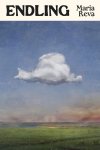 Endling by Maria Reva: What is worth doing, or writing about, in a time of war? That is the central question here, yet Reva brings considerable lightness to a novel also concerned with environmental devastation and existential loneliness. Yeva, a snail researcher in Ukraine, is contemplating suicide when Nastia and Sol rope her into a plot to kidnap 12 bride-seeking Western bachelors. The faux endings and re-dos are faltering attempts to find meaning when everything is breaking down. Both great fun to read and profound on many matters.
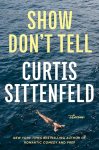 Show Don’t Tell by Curtis Sittenfeld: Sittenfeld’s second collection features characters negotiating principles and privilege in midlife. Split equally between first- and third-person perspectives, the 12 contemporary storylines spotlight everyday marital and parenting challenges. Dual timelines offer opportunities for hindsight on the events of decades ago. Nostalgic yet clear-eyed, these witty stories exploring how decisions determine the future are perfect for fans of Rebecca Makkai, Kiley Reid, and Emma Straub.
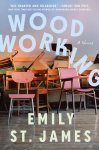 Woodworking by Emily St. James: When 35-year-old English teacher Erica realizes that not only is there another trans woman in her small South Dakota town but that it’s one of her students, she lights up. Abigail may be half her age but is further along in her transition journey and has sassy confidence. But this foul-mouthed mentor has problems of her own, starting with parents who refuse to refer to her by her chosen name. This was pure page-turning enjoyment with an important message, reminiscent of Celia Laskey and Tom Perrotta.
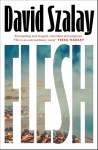 Flesh by David Szalay: Szalay explores modes of masculinity and channels, by turns, Hemingway; Fitzgerald and St. Aubyn; Hardy and McEwan. Unprocessed trauma plays out in Istvan’s life as violence against himself and others as he moves between England and Hungary and sabotages many of his relationships. He comes to know every sphere from prison to the army to the jet set. The flat affect and sparse style make this incredibly readable: a book for our times and all times and thus a worthy Booker Prize winner.
Nonfiction
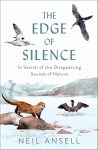 The Edge of Silence: In Search of the Disappearing Sounds of Nature by Neil Ansell: I owe this a full review. I’ve read all five of Ansell’s books and consider him one of the UK’s top nature writers. Here he draws lovely parallels between his advancing hearing loss and the biodiversity crisis we face because of climate breakdown. The world is going silent for him, but rare species may well become silenced altogether. His defiant, low-carbon adventures on the fringes offer one last chance to hear some of the UK’s beloved species, mostly seabirds.
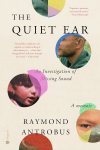 The Quiet Ear: An Investigation of Missing Sound by Raymond Antrobus: (Another memoir about being hard of hearing!) Antrobus’s first work of nonfiction takes up the themes of his poetry – being deaf and mixed-race, losing his father, becoming a parent – and threads them into an outstanding memoir that integrates his disability and celebrates his role models. This frank, fluid memoir of finding one’s way as a poet illuminates the literal and metaphorical meanings of sound. It offers an invaluable window onto intersectional challenges.
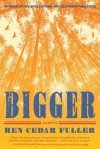 Bigger: Essays by Ren Cedar Fuller: Fuller’s perceptive debut work offers nine linked autobiographical essays in which she seeks to see herself and family members more clearly by acknowledging disability (her Sjögren’s syndrome), neurodivergence (she theorizes that her late father was on the autism spectrum), and gender diversity (her child, Indigo, came out as transgender and nonbinary; and she realizes that three other family members are gender-nonconforming). This openhearted memoir models how to explore one’s family history.
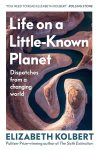 Life on a Little-Known Planet: Dispatches from a Changing World by Elizabeth Kolbert: These exceptional essays encourage appreciation of natural wonders and technological advances but also raise the alarm over unfolding climate disasters. There are travelogues and profiles, too. Most pieces were published in The New Yorker, whose generous article length allows for robust blends of research, on-the-ground experience, interviews, and in-depth discussion of controversial issues. (Review pending for the Times Literary Supplement.)
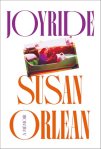 Joyride by Susan Orlean: Another one I need to review in the new year. As a long-time staff writer for The New Yorker (like Kolbert!), Orlean has had the good fortune to be able to follow her curiosity wherever it leads, chasing the subjects that interest her and drawing readers in with her infectious enthusiasm. She gives behind-the-scenes information on lots of her early stories and on each of her books. The Orchid Thief and the movie not-exactly-based on it, Adaptation, are among my favourites, so the long section on them was a thrill for me.
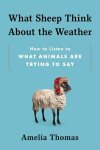 What Sheep Think About the Weather: How to Listen to What Animals Are Trying to Say by Amelia Thomas: A comprehensive yet conversational book that effortlessly illuminates the possibilities of human–animal communication. Rooted on her Nova Scotia farm but ranging widely through research, travel, and interviews, Thomas learned all she could from scientists, trainers, and animal communicators. Full of fascinating facts wittily conveyed, this elucidates science and nurtures empathy. (I interviewed the author, too.)
Poetry
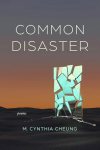 Common Disaster by M. Cynthia Cheung: Cheung is both a physician and a poet. Her debut collection is a lucid reckoning with everything that could and does go wrong, globally and individually. Intimate, often firsthand knowledge of human tragedies infuses the verse with melancholy honesty. Scientific vocabulary abounds here, with history providing perspective on current events. Ghazals with repeating end words reinforce the themes. These remarkable poems gild adversity with compassion and model vigilance during uncertainty.
September Releases, Part II: Antrobus, Attenberg, Strout and More
As promised yesterday, I give excerpts of the six (U.S.) September releases I reviewed for Shelf Awareness. But first, my thoughts on a compassionate sequel about a beloved ensemble cast.
Tell Me Everything by Elizabeth Strout
“People always tell you who they are if you just listen”
Alternative title ideas: “Oh Bob!” or “Talk Therapy in Small-Town Maine.” I’ve had a mixed experience with the Amgash novels, of which I’ve now read four. Last year’s Lucy by the Sea was my favourite, a surprisingly successful Covid novel with much to say about isolation, political divisions and how life translates into art. Oh William!, though shortlisted for the Booker, seemed a low point. It’s presented as Lucy’s published memoir about her first husband, but irked me with its precious, scatter-brained writing. For me, Tell Me Everything was closer to the latter. It continues Strout’s newer habit of bringing her various characters together in the same narrative. That was a joy of the previous book, but here it’s overdone and, along with the knowing first-person plural narration (“As we mentioned earlier, housing prices in Crosby, Maine, had been going through the roof since the pandemic”; “Oh Jim Burgess! What are we to do with you?”), feels affected and hokey.
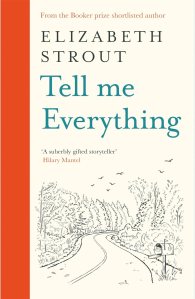
Strout makes it clear from the first line that this novel will mostly be devoted to Bob Burgess, who is not particularly interesting but perhaps a good choice of protagonist for that reason. A 65-year-old semi-retired lawyer, he’s a man of integrity who wins confidences because of his unassuming mien and willingness to listen and help where he can. One doesn’t read Strout for intrigue, but there is actually a mild murder mystery here. Bob ends up defending Matt Beach, a middle-aged man suspected of disposing of his mother’s body in a quarry. The Beaches are odd and damaged, with trauma threading through their history.
Sad stories are indeed the substance of the novel; Lucy trades in them. Literally: on her visits to Olive Kitteridge’s nursing home room, they swap bleak stories of the “unrecorded lives” they have observed or heard about. Lucy and Bob, who are clearly in love with each other, keep up a similar exchange of gloomy tales on their regular walks. Lucy asks Bob and Olive the point of these anecdotes, pondering the very meaning of life. Bob dismisses the question as immature; “as we have said, Bob was not a reflective fellow.” And because the book is filtered through Bob, we, too, feel this is just a piling up of depressing stories. Why should I care about Bob’s ex-wife’s alcoholism, his sister-in-law’s death from cancer, his nephew’s accident? Or any of the other unfortunate occurrences that make up a life. Bob and Lucy are appealingly ordinary characters, yet Strout suggests that they function as secular “sin-eaters,” accepting confessions. Forasmuch as they focus on others, they do each come to terms with childhood trauma and the reality of their marriages. Strout majors on emotional intelligence, but can be clichéd and soundbite-y. Such was my experience of this likable but diffuse novel.
With thanks to Viking (Penguin) for the proof copy for review.
Reviewed for Shelf Awareness:
Poetry:
 Signs, Music by Raymond Antrobus – The British-Jamaican poet’s intimate third collection contrasts the before and after of becoming a father—a transition that prompts him to reflect on his Deaf and biracial identity as well as the loss of his own father.
With thanks to Picador for the free copy for review.
 Want, the Lake by Jenny Factor – Factor’s long, intricate second poetry collection envisions womanhood as a tug of war between desire and constraint. “Elegy for a Younger Self” poems string together vivid reminiscences.
 Terminal Maladies by Okwudili Nebeolisa – The Iowa Writers’ Workshop graduate’s debut collection is a tender chronicle of the years leading to his mother’s death from cancer. Food and nature imagery chart the decline in Nkoli’s health and its effect on her family.
Fiction:
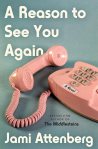 A Reason to See You Again by Jami Attenberg – Her tenth book evinces her mastery of dysfunctional family stories. From the Chicago-area Cohens, the circle widens and retracts as partners and friends enter and exit. Through estrangement and reunion, as characters grapple with sexuality and addictions, the decision is between hiding and figuring out who they are.
Nonfiction:
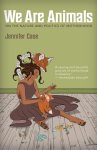 We Are Animals: On the Nature and Politics of Motherhood by Jennifer Case – Case’s second book explores the evolution, politics, and culture of contemporary parenthood in 15 intrepid essays. Science and statistics weave through in illuminating ways. This forthright, lyrical study of maternity is an excellent companion read to Lucy Jones’s Matrescence.
 Question 7 by Richard Flanagan – Ten years after his Booker Prize win for The Narrow Road to the Deep North, Richard Flanagan revisits his father’s time as a POW—the starting point but ultimately just one thread in this astonishing and uncategorizable work that combines family memoir, biography, and history to examine how love and memory endure. (Published in the USA on 17 September.)
With thanks to Emma Finnigan PR and Vintage (Penguin) for the proof copy for review.
Any other September releases you’d recommend?
Best Books from 2023
Keeping it simple again this year with one post covering all genres: the 24 (or, actually 26) current-year releases that stood out the most for me. (No rankings; anything from my Best of First Half that didn’t make it through can be considered a runner-up, along with The Librarianist.)


Fiction
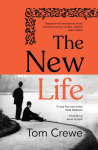 The New Life by Tom Crewe: Two 1890s English sex researchers (based on John Addington Symonds and Havelock Ellis) write a book called Sexual Inversion drawing on ancient Greek history and containing case studies of homosexual behaviour. Oscar Wilde’s trial puts everyone on edge; not long afterwards, their own book becomes the subject of an obscenity trial, and each man has to decide what he’s willing to give up in devotion to his principles. This is deeply, frankly erotic stuff, and, on the sentence level, just exquisite writing.
 The Vaster Wilds by Lauren Groff: Groff’s fifth novel combines visceral detail and magisterial sweep as it chronicles a runaway Jamestown servant’s struggle to endure the winter of 1610. Flashbacks to traumatic events seep into her mind as she copes with the harsh reality of life in the wilderness. The style is archaic and postmodern all at once. Evocative and affecting – and as brutal as anything Cormac McCarthy wrote. A potent, timely fable as much as a historical novel.
Counting as one this thematic trio of women’s true crime pastiches; I liked the Makkai best.
Penance by Eliza Clark: A compelling account of teenage feuds and bullying that went too far and ended in murder. It’s a pretty gruesome crime, but memorable, not least because it coincided with the day of the Brexit vote. I loved Clark’s portrait of Crow-on-Sea, a down-at-heel seaside town near Scarborough, and the depth of character that comes through via interviews and documents. She also nails teenage dialogue and social media use, podcasts, true crime obsession and so on.


 Bright Young Women by Jessica Knoll: An engrossing story of a Type A sorority president whose perfect life goes askew when a serial killer targets the house and kills two of her friends. She and the domestic partner of one of his previous victims are determined to see “the Defendant” brought to justice. 1970s Florida/Washington were interesting settings, and I liked the focus on the victims. The judge in the Defendant’s case lamented that such a bright young man would come to grief; think of the bright young women he extinguished instead.
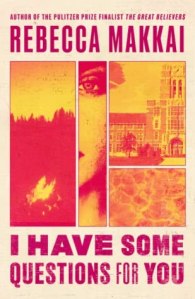
I Have Some Questions for You by Rebecca Makkai: When an invitation comes from her boarding school alma mater, Granby, to teach a two-week course on podcasting, Bodie indulges her obsession with the 1995 murder of her former roommate. Makkai has taken her cues from the true crime genre and constructed a convincing mesh of evidence and theories. She so carefully crafts her pen portraits, and so intimately involves us in Bodie’s psyche, that it’s impossible not to get invested. This is timely, daring, intelligent, enthralling storytelling.
 Sidle Creek by Jolene McIlwain: In this debut collection of 22 short stories, loosely linked by their location in the Appalachian hills in western Pennsylvania and a couple of recurring minor characters, McIlwain softens the harsh realities of addiction, poverty and violence with the tender bruises of infertility and lost love. Grief is a resonant theme in many of the stories, with pregnancy or infant loss a recurring element. At times harrowing, always clear-eyed, these stories are true to life and compassionate about human foibles and animal pain.
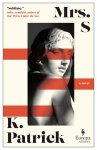 Mrs S by K Patrick: Patrick’s unnamed narrator is an early-twenties Australian butch lesbian who has come to England to be a matron at a girls’ boarding school. Mrs S is the headmaster’s wife, perhaps 20 years her senior. A heat wave gives a sultry atmosphere as hints of attraction between them give way to explicit scenes. Summer romances never last, but their intensity is legendary, and this feels like an instant standard. Not your average coming-of-age story, seduction narrative or cougar stereotype. It’s a new queer classic.
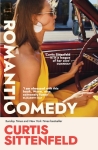 Romantic Comedy by Curtis Sittenfeld: Through her work as a writer for a sketch comedy show modelled on Saturday Night Live, Sally Milz meets Noah Brewster, a pop star with surfer-boy good looks. Plain Jane getting the hot guy – that never happens, right? In fact, Sally has a theory about this very dilemma… As always, Sittenfeld’s inhabiting of a first-person narrator is flawless, and Sally’s backstory and Covid-lockdown existence endeared her to me. Could this be called predictable? Well, what does one want from a romcom?
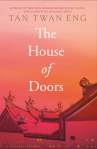 The House of Doors by Tan Twan Eng: In 1921, “Willie” Somerset Maugham and his secretary/lover, Gerald, stay with old friends Robert and Lesley Hamlyn in Penang, Malaysia. Willie’s marriage is floundering and he faces financial ruin. He needs a story that will sell and gets one when Lesley starts recounting the momentous events of 1910: volunteering at the party office of Dr Sun Yat Sen and trying to save her friend from a murder charge. Tan weaves it all into a Maugham-esque plot with sumptuous scene-setting and atmosphere.
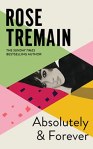 Absolutely and Forever by Rose Tremain: At age 15, Marianne falls in love. She imagines her romance with Simon as a grand adventure (and escape from her parents’ ordinariness), but his post-school life in Paris doesn’t have room for her. Much changes over the next 15 years, but never her attachment to her first love. This has the chic, convincing 1960s setting of Tessa Hadley’s work, and Marianne’s droll narration is a delight. It put me through an emotional wringer – no cheap tear-jerker but a tender depiction of love in all its forms.
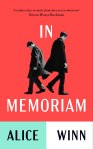 In Memoriam by Alice Winn: Heartstopper on the Western Front; swoon! Will Sidney Ellwood and Henry Gaunt both acknowledge that this is love and not just sex, as it is for so many teenage boys at their English boarding school? And will one or both survive the trenches of the First World War? Winn depicts the full horror of war, but in between there is banter, friendship and poetry. Some moments are downright jolly. This debut is obsessively researched, but Winn has a light touch with it. Engaging, thrilling, and, yes, romantic.
Nonfiction
 All My Wild Mothers by Victoria Bennett: A lovely memoir about grief and gardening, caring for an ill child and a dying parent. The book is composed of dozens of brief autobiographical, present-tense essays, each titled after a wildflower with traditional healing properties. The format realistically presents bereavement and caring as ongoing, cyclical challenges rather than one-time events. Sitting somewhere between creative nonfiction and nature essays, it’s a beautiful read for any fan of women’s life writing.
 Monsters by Claire Dederer: The question posed by this hybrid work of memoir and cultural criticism is “Are we still allowed to enjoy the art made by horrible people?” It begins, in the wake of #MeToo, by reassessing the work of film directors Roman Polanski and Woody Allen. The book is as compassionate as it is incisive. While there is plenty of outrage, there is also much nuance. Dederer’s prose is forthright and funny; lucid even when tackling thorny issues. Erudite, empathetic and engaging from start to finish.
 Womb by Leah Hazard: A wide-ranging and accessible study of the uterus, this casts a feminist eye over history and future alike. Blending medical knowledge and cultural commentary, it cannot fail to have both personal and political significance for readers of any gender. The thematic structure of the chapters also functions as a roughly chronological tour of how life with a uterus might proceed: menstruation, conception, pregnancy, labour, caesarean section, ongoing health issues, menopause. Inclusive and respectful of diversity.
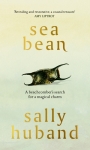 Sea Bean by Sally Huband: Stories of motherhood, the quest to find effective treatment in a patriarchal medical system, volunteer citizen science projects, and studying Shetland’s history and customs mingle in a fascinating way. Huband travels around the archipelago and further afield, finding vibrant beachcombing cultures. In many ways, this is about coming to terms with loss, and the author presents the facts about climate crisis with sombre determination. She writes with such poetic tenderness in this radiant debut memoir.
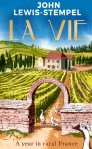 La Vie by John Lewis-Stempel: The author has written much about his Herefordshire haunts, but he’s now relocated permanently to southwest France (La Roche, in the Charente). He proudly calls himself a peasant farmer, growing what he can and bartering for much of the rest. La Vie chronicles a year in his quest to become self-sufficient. It opens one January and continues through the December, an occasional diary with recipes. It’s a peaceful, comforting read that’s attuned to the seasons and the land. Lewis-Stempel’s best book in an age.
 All of Us Together in the End by Matthew Vollmer: In 2019, Vollmer’s mother died of complications of Alzheimer’s and Parkinson’s. Months later, his father reported blinking lights in the woods near the family cemetery. Although Vollmer had left the Seventh-Day Adventist Church in college, his religious upbringing influenced his investigation, which overlapped with COVID-19. Grief, mysticism, and acceptance of the unexplained are resonant themes. An unforgettable record of “a collision with the ineffable.”
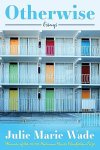 Otherwise by Julie Marie Wade: Nine intricate autobiographical essays reflect on risk, bodily autonomy, and poetry versus prose. A series of meditations composed across Wade’s thirties arranges snapshots of her growing frustration with gendered stereotypes. In particular, she interrogates her rosy childhood notions of marriage. As she explored feminism and accepted her lesbian identity—though not before leaving a man at the altar—she found ways to be “a secular humanist by day and a hopeless romantic by night.” Superb.
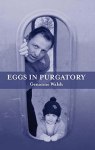 Eggs in Purgatory by Genanne Walsh: This autobiographical essay tells the story of the last few months of her father’s life. Aged 89, he lived downstairs from Walsh and her wife in San Francisco. He was quite the character: idealist, stubborn, outspoken; a former Catholic priest. Although he had no terminal conditions, he was sick of old age and its indignities and ready to exit. The task of a memoir is to fully mine the personal details of a situation but make of it something universal, and that’s just what she does here. Stunning.
Poetry
 More Sky by Joe Carrick-Varty: In this debut collection, the fact of his alcoholic father’s suicide is inescapable. The poet alternates between an intimate “you” address and third-person scenarios, auditioning coping mechanisms. His frame of reference is wide: football, rappers, Buddhist cosmology. The word “suicide” itself is repeated to the point where it becomes just a sibilant collection of syllables. The tone is often bitter, as is to be expected, but there is joy in the deft use of language.
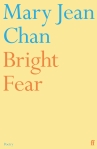 Bright Fear by Mary Jean Chan: This follow-up to Flèche takes up many of the same foundational subjects: race, family, language and sexuality. But this time, the pandemic is the lens through which all is filtered. At a time when Asian heritage merited extra suspicion, English was both a means of frank expression and a source of ambivalence. At the centre of the book, “Ars Poetica,” a multi-part collage incorporating lines from other poets, forms a kind of autobiography in verse. Chan also questions the lines between genres. Excellent.
 Lo by Melissa Crowe: This incandescent autobiographical collection delves into the reality of sexual abuse and growing up in rural poverty. Guns are insidious, used for hunting or mass shootings. Trauma lingers. “Maybe home is what gets on you and can’t / be shaken loose.” The collection is so carefully balanced in tone that it never feels bleak. In elegies and epithalamiums (poems celebrating marriage), Crowe honors family ties that bring solace. The collection has emotional range: sensuality, fear, and wonder at natural beauty.
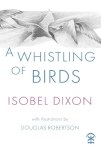 A Whistling of Birds by Isobel Dixon: I was drawn to this for its acknowledged debt to D.H. Lawrence’s Birds, Beasts and Flowers. Snakes, bees, bats and foxes are some of the creatures that scamper through the text. There are poems for marine life, fruit and wildflowers. You get a sense of the seasons turning, and the natural wonders to prize from each. Dixon’s poetry is formal yet playful, the structures and line and stanza lengths varying. There are portraits and elegies. The book is in collaboration with Scottish artist Douglas Robertson. A real gem.
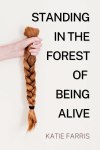 Standing in the Forest of Being Alive by Katie Farris: This debut collection addresses the symptoms and side effects of breast cancer treatment at age 36, but often in oblique or cheeky ways – it can be no mistake that “assistance” appears two lines before a mention of hemorrhoids, for instance, even though it closes an epithalamium distinguished by its gentle sibilance (Farris’s husband is Ukrainian American poet Ilya Kaminsky.) She crafts sensual love poems, and exhibits Japanese influences. (Discussed in my review essay for The Rumpus.)
 The House of the Interpreter by Lisa Kelly: Kelly is half-Danish and has single-sided deafness, and her second collection engages with questions of split identity. One section ends with the Deaf community’s outrage that the Prime Minister’s Covid briefings were not translated into BSL. Bizarre but delightful is the sequence of alliteration-rich poems about fungi, followed by a miscellany of autobiographical poems full of references to colour, language, nature and travel.
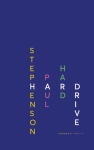 Hard Drive by Paul Stephenson: This wry, wrenching debut collection is an extended elegy for his partner, Tod Hartman, an American anthropologist who died of heart failure at 38. There’s every style, tone and structure imaginable here. Stephenson riffs on his partner’s oft-misspelled name (German for death), and writes of discovery, autopsy, sadmin and rituals. In “The Only Book I Took” he opens up Tod’s copy of Joan Didion’s The Year of Magical Thinking – which came from Wonder Book, the bookstore chain I worked at in Maryland!
Okay, twist my arm … if I had to pick my overall books of the year, I’d concur with the Times in picking The New Life. In nonfiction: Monsters. In poetry: Standing in the Forest of Being Alive.


Have you read any of my favourites? What 2023 releases do I need to catch up on right away?
The Best Books from the First Half of 2023
Yes, it’s that time of year already! It remains to be seen how many of these will make it onto my overall best-of year list, but for now, these are my 20 highlights. Plus, I sneakily preview another great novel that won’t release until September. (For now I’m highlighting 2023 releases, whereas at the end of the year I divide my best-of lists into current year and backlist. I’ve read 86 current-year releases so far and am working on another 20, so I’m essentially designating a top 20% here.) I give review excerpts and link to the full text from this site or elsewhere. Pictured below are the books I read in print; all the others were e-copies.

Fiction
 Shoot the Horses First by Leah Angstman: In 16 sumptuous historical stories, outsiders and pioneers face disability and prejudice with poise. The flash entries crystallize moments of realization, often about health. Longer pieces shine as their out-of-the-ordinary romances have space to develop. In the novella Casting Grand Titans, a botany professor in 1850s Iowa learns her salary is 6% of a male colleague’s. She strives for intellectual freedom, reporting a new-to-science species of moss, while working towards liberation for runaway slaves.
 The House Is on Fire by Rachel Beanland: Moving at a propulsive pace, Beanland’s powerful second novel rotates through the perspectives of these main characters – two men and two women; two white people and two enslaved Black people – caught up in the Richmond Theater Fire of 1811 (one of the deadliest events in early U.S. history) and its aftermath. Painstakingly researched and full of historical detail and full-blooded characters, it dramatizes the range of responses to tragedy and how people rebuild their lives.
The New Life by Tom Crewe: Two 1890s English sex researchers (based on John Addington Symonds and Havelock Ellis) write a book called Sexual Inversion drawing on ancient Greek history and containing case studies of homosexual behaviour. Oscar Wilde’s trial puts everyone on edge; not long afterwards, their own book becomes the subject of an obscenity trial, and each man has to decide what he’s willing to give up in devotion to his principles. This is deeply, frankly erotic stuff, and, on the sentence level, just exquisite writing.
 Daughters of Nantucket by Julie Gerstenblatt: (Yes, another historical fire novel, and I reviewed both for Shelf Awareness!) This engrossing debut explores the options for women in the mid-19th century. Metaphorical conflagrations blaze in the background in the days leading up to the great Nantucket fire of 1846: each of three female protagonists (a whaling captain’s wife, a museum curator, and a pregnant Black entrepreneur) holds a burning secret and longs for a more expansive, authentic life. Tense and sultry; for Sue Monk Kidd fans.
 I Have Some Questions for You by Rebecca Makkai: When an invitation comes from her boarding school alma mater, Granby, to teach a two-week course on podcasting, Bodie indulges her obsession with the 1995 murder of her former roommate. Makkai has taken her cues from the true crime genre and constructed a convincing mesh of evidence and theories. She so carefully crafts her pen portraits, and so intimately involves us in Bodie’s psyche, that it’s impossible not to get invested. This is timely, daring, intelligent, enthralling storytelling.
Sidle Creek by Jolene McIlwain: In this debut collection of 22 short stories, loosely linked by their location in the Appalachian hills in western Pennsylvania and a couple of recurring minor characters, McIlwain softens the harsh realities of addiction, poverty and violence with the tender bruises of infertility and lost love. Grief is a resonant theme in many of the stories, with pregnancy or infant loss a recurring element. At times harrowing, always clear-eyed, these stories are true to life and compassionate about human foibles and animal pain.
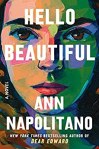 Hello Beautiful by Ann Napolitano: Oprah’s 100th book club pick. It’s a family story spanning three decades and focusing on the Padavanos, a working-class Italian American Chicago clan with four daughters. Julia meets melancholy basketball player William Waters while at Northwestern in the late 1970s. There is such warmth and intensity to the telling, and brave reckoning with bereavement, mental illness, prejudice and trauma. I love sister stories in general, and the subtle echoes of Leaves of Grass and Little Women add heft.
Romantic Comedy by Curtis Sittenfeld: Through her work as a writer for a sketch comedy show modelled on Saturday Night Live, Sally Milz meets Noah Brewster, a pop star with surfer-boy good looks. Plain Jane getting the hot guy – that never happens, right? In fact, Sally has a theory about this very dilemma… As always, Sittenfeld’s inhabiting of a first-person narrator is flawless, and Sally’s backstory and Covid-lockdown existence endeared her to me. Could this be called predictable? Well, what does one want from a romcom?
In Memoriam by Alice Winn: Heartstopper on the Western Front; swoon! Will Sidney Ellwood and Henry Gaunt both acknowledge that this is love and not just sex, as it is for so many teenage boys at their English boarding school? And will one or both survive the trenches of the First World War? Winn depicts the full horror of war, but in between there is banter, friendship and poetry. Some moments are downright jolly. This debut is obsessively researched, but Winn has a light touch with it. Engaging, thrilling, and, yes, romantic.
A bonus:
The Vaster Wilds by Lauren Groff (Riverhead/Hutchinson Heinemann, 12 September): Groff’s fifth novel combines visceral detail and magisterial sweep as it chronicles a runaway Jamestown servant’s struggle to endure the winter of 1610. Flashbacks to traumatic events seep into her mind as she copes with the harsh reality of life in the wilderness. The style is archaic and postmodern all at once. Evocative and affecting – and as brutal as anything Cormac McCarthy wrote. A potent, timely fable as much as a historical novel. (Review forthcoming for Shelf Awareness.)
Nonfiction
All My Wild Mothers by Victoria Bennett: A lovely memoir about grief and gardening, caring for an ill child and a dying parent. The book is composed of dozens of brief autobiographical, present-tense essays, each titled after a wildflower with traditional healing properties. The format realistically presents bereavement and caring as ongoing, cyclical challenges rather than one-time events. Sitting somewhere between creative nonfiction and nature essays, it’s a beautiful read for any fan of women’s life writing.
Monsters by Claire Dederer: The question posed by this hybrid work of memoir and cultural criticism is “Are we still allowed to enjoy the art made by horrible people?” It begins, in the wake of #MeToo, by reassessing the work of film directors Roman Polanski and Woody Allen. The book is as compassionate as it is incisive. While there is plenty of outrage, there is also much nuance. Dederer’s prose is forthright and droll; lucid even when tackling thorny issues. Erudite, empathetic and engaging from start to finish.
Womb by Leah Hazard: A wide-ranging and accessible study of the uterus, this casts a feminist eye over history and future alike. Blending medical knowledge and cultural commentary, it cannot fail to have both personal and political significance for readers of any gender. The thematic structure of the chapters also functions as a roughly chronological tour of how life with a uterus might proceed: menstruation, conception, pregnancy, labour, caesarean section, ongoing health issues, menopause. Inclusive and respectful of diversity.
Sea Bean by Sally Huband: Stories of motherhood, the quest to find effective treatment in a patriarchal medical system, volunteer citizen science projects, and studying Shetland’s history and customs mingle in a fascinating way. Huband travels around the archipelago and further afield, finding vibrant beachcombing cultures. In many ways, this is about coming to terms with loss, and the author presents the facts about climate crisis with sombre determination. She writes with such poetic tenderness in this radiant debut memoir.
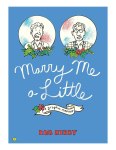 Marry Me a Little by Robert Kirby: Hopping around in time, this graphic memoir tells the story of how the author and his partner John decided to get married in 2013. The blue and red color scheme is effective at evoking a polarized America and the ebb and flow of emotions, with blue for calm, happy scenes and concentrated red for confusion or anger. This is political, for sure, but it’s also personal, and it balances those two aims well by tracing the history of gay marriage in the USA and memorializing his own relationship.
All of Us Together in the End by Matthew Vollmer: In 2019, Vollmer’s mother died of complications of Alzheimer’s and Parkinson’s. Months later, his father reported blinking lights in the woods near the family cemetery. Although Vollmer had left the Seventh-Day Adventist Church in college, his religious upbringing influenced his investigation, which overlapped with COVID-19. Grief, mysticism, and acceptance of the unexplained are resonant themes. An unforgettable record of “a collision with the ineffable.”
Eggs in Purgatory by Genanne Walsh: This autobiographical essay tells the story of the last few months of her father’s life. Aged 89, he lived downstairs from Walsh and her wife in San Francisco. He was quite the character: idealist, stubborn, outspoken; a former Catholic priest. Although he had no terminal conditions, he was sick of old age and its indignities and ready to exit. The task of a memoir is to fully mine the personal details of a situation but make of it something universal, and that’s just what she does here. Stunning.
Poetry
More Sky by Joe Carrick-Varty: In this debut collection, the fact of his alcoholic father’s suicide is inescapable. The poet alternates between an intimate “you” address and third-person scenarios, auditioning coping mechanisms. His frame of reference is wide: football, rappers, Buddhist cosmology. The word “suicide” itself is repeated to the point where it becomes just a sibilant collection of syllables. The tone is often bitter, as is to be expected, but there is joy in the deft use of language.
Lo by Melissa Crowe: This incandescent autobiographical collection delves into the reality of sexual abuse and growing up in rural poverty. Guns are insidious, used for hunting or mass shootings. Trauma lingers. “Maybe home is what gets on you and can’t / be shaken loose.” The collection is so carefully balanced in tone that it never feels bleak. In elegies and epithalamiums (poems celebrating marriage), Crowe honors family ties that bring solace. The collection has emotional range: sensuality, fear, and wonder at natural beauty.
Standing in the Forest of Being Alive by Katie Farris: This debut collection addresses the symptoms and side effects of breast cancer treatment at age 36, but often in oblique or cheeky ways – it can be no mistake that “assistance” appears two lines before a mention of haemorrhoids, for instance, even though it closes an epithalamium distinguished by its gentle sibilance (Farris’s husband is Ukrainian American poet Ilya Kaminsky.) She crafts sensual love poems, and exhibits Japanese influences. (Review forthcoming at The Rumpus.)
The House of the Interpreter by Lisa Kelly: Kelly is half-Danish and has single-sided deafness, and her second collection engages with questions of split identity. One section ends with the Deaf community’s outrage that the Prime Minister’s Covid briefings were not translated into BSL. Bizarre but delightful is the sequence of alliteration-rich poems about fungi, followed by a miscellany of autobiographical poems full of references to colour, nature and travel.
What are some of the best books you’ve read so far this year?
What 2023 releases should I catch up on right away?
Recent Poetry Releases by Allison Blevins, Kit Fan, Lisa Kelly and Laura Scott
I’m catching up on four 2023 poetry collections from independent publishers, three of them from Carcanet Press, which so graciously keeps me stocked up with work by contemporary poets. Despite the wide range of subject matter, style and technique, nature imagery and erotic musings are links. From each I’ve chosen one short poem as a representative.
Cataloguing Pain by Allison Blevins
 Last year I reviewed Allison Blevins’ Handbook for the Newly Disabled. This shares its autobiographical consideration of chronic illness and queer parenting. Specifically, she looks back to her MS diagnosis and three IVF pregnancies, and her spouse’s transition. Both partners were undergoing bodily transformations and coming into new identities, the one as disabled and the other as a man. In later poems she calls herself “The shell”, while “Elegy for My Wife,” which closes Part I, makes way for references to “my husband” in Part II.
“I won’t wail for your dead name. I don’t mean that violence. I wish for a word other than elegy to explain how some of this feels like goodbye.”
In unrhymed couplets or stanzas and bittersweet paragraphs, Blevins marshals metaphors from domestic life – colours, food, furniture, gardening – to chart the changes that pain and disability force onto their family’s everyday routines. “Fall Risk” and “Fly Season” are particular highlights. This is a potent and frankly sexual text for readers drawn to themes of health and queer family-making (see also my Three on a Theme post on that topic).

Published by YesYes Books on 19 April. With thanks to the author for the advanced e-copy for review.
The Ink Cloud Reader by Kit Fan
 Kit Fan was raised in Hong Kong and moved to the UK as an adult. This is his third collection of poetry. “Suddenly” tells a version of his life story in paragraphs or single lines that all incorporate the title word (with an ironic nod, through the epigraph, to Elmore Leonard’s writing ‘rule’ that “suddenly” should never be used). The “IF” statements of “Delphi” then ponder possible future events; a trip to hospital sees him contemplating his mortality (“Glück,” written as a miniature three-act play) and appreciating tokens of beauty (“Geraniums in May”). “Yew,” unusually, is a modified sonnet where every line rhymes.
As the collection’s title suggests, it is equally interested in the natural and the human. There are poems describing the cycles of the moon (the lines of “Moon Salutation” curve into a half-moon parabola) and the wind. Ink pulls together calligraphy, the Chinese zodiac and literature. “The Art of Reading,” which commemorates important moments, real and imaginary, of the poet’s reading life, was a favourite of mine, as was “Derek Jarman’s Garden.” Fan also writes of memory and travels – including to the underworld. His relationship with his husband is a subtle background subject. (“Even though we’ve lived together for nearly twenty years and are always reading sometimes I can’t read you at all which I guess is a good thing”). It’s an opulent and allusive work that has made me eager to try more by Fan. Luckily, I have his debut novel (passed on to me by Laura T.) on the shelf.
Readalike: Moving House by Theophilus Kwek

Published on 27 April. With thanks to Carcanet Press for the advanced e-copy for review.
The House of the Interpreter by Lisa Kelly
 Lisa Kelly’s concern with deafness is sure to bring to mind Raymond Antrobus and Ilya Kaminsky, but I prefer her work. Kelly is half-Danish and has single-sided deafness, and in Part I of this second collection, entitled “Chamber,” her poems engage with questions of split identity:
Is this what it is like for us all? Always having to relearn home
with a strange tongue and alien hands, prepared to open our mouths
as if to beg, to touch tongue-tip with fingertip to reveal ourselves?
The title poem relishes the absurdities of telephone communication, closing with:
In the House of the Interpreter,
Oralism and Manualism, like Passion and Patience,
are rewarded differently and at different times.
Hello, this is your Interpreter. What is your wishlist?
This section ends with “#WhereIsTheInterpreter,” about the Deaf community’s outrage that the Prime Minister’s Covid briefings were not simultaneously translated into BSL.
Bizarrely but delightfully, Kelly then moves onto “Oval Window,” a sequence of alliteration-rich poems about fungi. “Mycology Abecedarian” is a joyful list of species’ common names, while “Mycelium” notes how mushrooms show that different ways of evolution and reproduction are possible. “Darning Mushroom” even combines images of fungi and holey socks. Part III, “Canal,” is a miscellany of autobiographical poems and homages to Faith Ringgold, full of references to colour, language, nature and travel.
Readalike: In the Quaker Hotel by Helen Tookey
Published on 27 April. With thanks to Carcanet Press for the advanced e-copy for review.
The Fourth Sister by Laura Scott
 Back in 2019 I reviewed Laura Scott’s debut collection, So Many Rooms. Her second book reflects some of the same preoccupations: art, birds, colour and Russian literature. Chekhov is a recurring point of reference across the two; here, for instance, we have a found poem composed of excerpts from his letters. Scott also writes about the deaths of her parents, voicing resentment towards her father and remarking on life’s irony. As the title suggests, her family constellation includes sisters. Her godparents loom surprisingly large; her godmother was, apparently, a spy. My favourite of the poems, “Still Life,” imagines the whole of life being prized as a glass in an exhibit, appealingly pristine and praiseworthy in comparison to what we usually perceive: “the raggy sprawl of a life … the wrong turns and longing of it.” Elsewhere, metaphors are drawn from the theatre: performing lines, taking items from a wardrobe. I loved the way the pull of nostalgia is set up in opposition to the now.

Published on 23 February. With thanks to Carcanet Press for the advanced e-copy for review.
Read any good poetry recently?
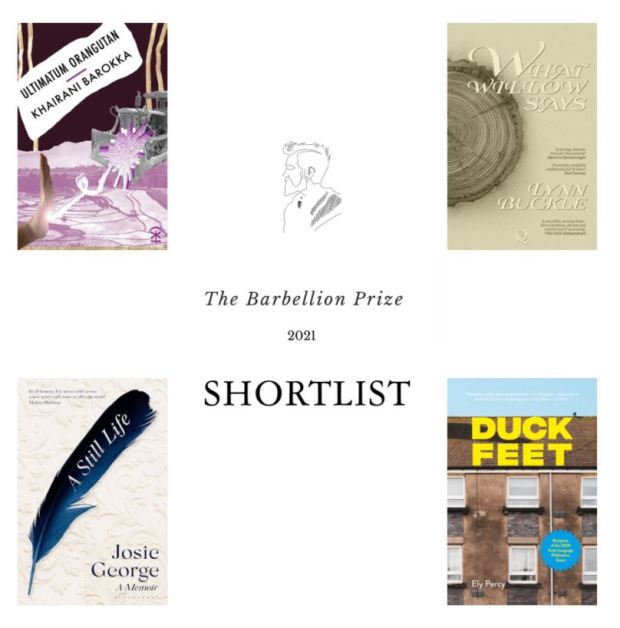
Barbellion Prize Shortlist Reviews: Ultimatum Orangutan & What Willow Says
The shortlist for the second annual Barbellion Prize was announced earlier this month. I had already read one of the books, and publishers have kindly sent me two of the others for review. Still in the running this year are two novels, a poetry collection and a memoir (you can read a bit more about the longlist here).
Ultimatum Orangutan by Khairani Barokka (2021)
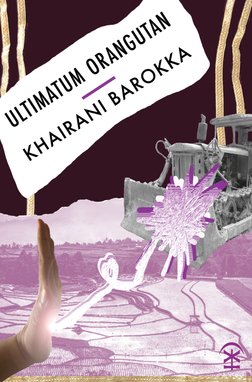 Barokka is an Indonesian poet and performance artist based in London. The topics of her second collection include chronic pain, the oppression of women, and the environmental crisis. While she’s distressed at the exploitation of nature, she sprinkles in humanist reminders of Indigenous peoples whose needs should also be valued. For instance, in the title poem, whose points of reference range from King Kong to palm oil plantations, she acknowledges that orangutans must be saved, but that people are also suffering in her native Indonesia. It’s a subtle plea for balanced consideration.
An early sequence about a visit to a Natural History Museum exemplifies the blend of themes. From her wheelchair, the poet ponders “the event” that killed the dinosaurs and human bias towards fellow vertebrates. Why can’t we appreciate a tiger for its own sake rather than its cultural and metaphorical associations? she asks in the following poem.
Medical realities aren’t as prominent as in some nominees – nowhere is it made clear what condition Okka has – but illness haunts certain lines: “my pills lie as armor with so many / glasses of water, upright and tensile / to save life against terrors by way / of circulatory relief” (from “on lying down, apocalyptic”). Concern about the environment also tips over into the apocalyptic in “situation report” and below:

“Fence and Repetition” sets out a palindrome of lines, and later on there are a golden shovel and an abecedarian, with tips of the hat to other poets. This more formal verse is in contrast with looser poems lacking capitalization or articles; in places the language even reads like pidgin. I found the phrasing unusual, forcing close attention to what’s actually going on. This wasn’t generally my cup of tea, but makes a striking entry on this year’s shortlist, and was a good chance to add my first Indonesian writer to my internal library.
With thanks to Nine Arches Press for the free copy for review.
What Willow Says by Lynn Buckle (2021)
 This is a delicate novella about the bond between a grandmother and her eight-year-old granddaughter, who is deaf. After the death of the girl’s mother, Grandmother has been her primary guardian. She raises her on Irish legends and a love of nature, especially their local trees. They mourn when they see hedgerows needlessly flailed, and the girl often asks what her grandmother hears the trees saying. Because Grandmother narrates in the form of journal entries, there is dramatic irony between what readers learn and what she is not telling the little girl; we ache to think about what might happen for her in the future.
Yet Buckle takes care not to let the mood get too sombre, even though there is disquiet aplenty: empty housing blocks from the aftermath of the Celtic Tiger, rage at the stereotypes and ableism that the granddaughter faces, and the darkness of the myths surrounding the peat bogs and those who drown. This is mostly thanks to the lyrical writing wrapped around the six months or so of the action. Focusing on the relationship between these two, a lot of what happens is quiet and seasonal, from a picnic in the park to preparations for Christmas, but there is also a sign language class that introduces some other characters.
At points I found the prose too thick – it’s rare for me to come across vocabulary I don’t know and, especially in such a short book, terms like “ombrogenous mires,” “chironomy” and “sestude” stood out, not necessarily in a good way. But, overall, I enjoyed this study of other forms of communication – with hands, in writing, between humans and more-than-human nature, and perhaps even beyond the grave.
A favourite passage:
We struggle to hear in our household. Age, degeneration, aural complications and congenital conditions. Ignorance. We have confusing discussions, mistaken arrangements, and fights over hearing aid batteries. Plus, the convenience of not hearing when it suits us. Now we are trying to listen, to each other, and to trees. There is so much that we have never heard, so little time to hear it.
With thanks to Époque Press for the free copy for review.
The other two books on the shortlist are:
 A Still Life: A Memoir by Josie George (Bloomsbury)
My TLS review excerpt: Chronic illness long ago reduced her territory to her home and garden. The magic of A Still Life is in how she finds joy and purpose despite extreme limitations. Opening on New Year’s Day and travelling from one winter to the next, the book is a window onto George’s quiet existence as well as the turning of the seasons.
Duck Feet by Ely Percy (Monstrous Regiment)
From the synopsis: “A coming-of-age novel, set in the mid-noughties in Renfrew and Paisley, Scotland. … This book is a celebration of youth in an ever-changing world. It uses humour to tackle hard-hitting subjects such as drugs, bullying, sexuality, and teenage pregnancy.”
I haven’t had a chance to read Duck Feet, so it’s hard to make any predictions about the winner. Last year a memoir by a woman won, so I’m not sure A Still Life will win, even though it’s my clear favourite of the three I’ve read. Perhaps it will be a novel this year?
The Barbellion Prize, awarded “to an author whose work has best represented the experience of chronic illness and/or disability,” will be announced on 12 February.
Do any of the shortlisted books appeal to you?
The Story of My Life by Helen Keller (#NovNov Nonfiction Buddy Read)
For nonfiction week of Novellas in November, our buddy read is The Story of My Life by Helen Keller (1903). You can download the book for free from Project Gutenberg here if you’d still like to join in.

Keller’s story is culturally familiar to us, perhaps from the William Gibson play The Miracle Worker, but I’d never read her own words. She was born in Alabama in 1880; her father had been a captain in the Confederate Army. An illness (presumed to be scarlet fever) left her blind and deaf at the age of 19 months, and she describes herself in those early years as mischievous and hot-tempered, always frustrated at her inability to express herself. The arrival of her teacher, Anne Sullivan, when Helen was six years old transformed her “silent, aimless, dayless life.”
I was fascinated by the glimpses into child development and education. Especially after she learned Braille, Keller loved books, but she believed she learned just as much from nature: “everything that could hum or buzz, or sing, or bloom, had a part in my education.” She loved to sit in the family orchard and would hold insects or fossils and track plant and tadpole growth. Her first trip to the ocean (Chapter 10) was a revelation, and rowing and sailing became two of her chief hobbies, along with cycling and going to the theatre and museums.

Helen Keller with Annie Sullivan. (Public domain, via Wikimedia Commons.)
At age 10 Keller relearned to speak – a more efficient way to communicate than her usual finger-spelling. She spent winters in Boston and eventually attended the Cambridge School for Young Ladies in preparation for starting college at Radcliffe. Her achievements are all the more remarkable when you consider that smell and touch – senses we tend to overlook – were her primary ones. While she used a typewriter to produce schoolwork, a teacher spelling into her hand was still her main way to intake knowledge. Specialist textbooks for mathematics and multiple languages were generally not available in Braille. Digesting a lesson and completing homework thus took her much longer than it did her classmates, but still she felt “impelled … to try my strength by the standards of those who see and hear.”
It was surprising to find, at the center of the book, a detailed account of a case of unwitting plagiarism (Chapter 14). Eleven-year-old Keller wrote a story called “The Frost King” for a beloved teacher at the Perkins Institution for the Blind. He was so pleased that he printed it in one of their publications, but it soon came to his attention that the plot was very similar to “The Frost Fairies” in Birdie and His Friends by Margaret T. Canby. The tale must have been read to Keller long ago but become so deeply buried in the compost of a mind’s memories that she couldn’t recall its source. Some accused Keller and Sullivan of conspiring, and this mistrust more than the incident itself cast a shadow over her life for years to come. I was impressed by Keller discussing in depth something that it would surely have been more comfortable to bury. (I’ve sometimes had the passing thought that if I wrote a memoir I would structure it around my regrets or most embarrassing moments. Would that be penance or masochism?)
This short memoir was first serialized in the Ladies’ Home Journal. Keller was only 23 and partway through her college degree at the time of publication. An initial chronological structure later turns more thematic and the topics are perhaps a little scattershot. I would attribute this, at least in part, to the method of composition: it would be difficult to make large-scale edits on a manuscript because everything she typed had to be spelled back to her for approval. Minor line edits would be easy enough, but not big structural changes. (I wonder if it’s similar with work that’s been dictated, like May Sarton’s later journals.)

Helen Keller in graduation cap and gown. (PPOC, Library of Congress. Public domain, via Wikimedia Commons.)
Keller went on to write 12 more books. It would be interesting to follow up with another one to learn about her travels and philanthropic work. For insight into a different aspect of her life – bearing in mind that it’s fiction – I recommend Helen Keller in Love by Rosie Sultan. In a couple of places Keller mentions Laura Bridgman, her less famous predecessor in the deaf–blind community; Kimberly Elkins’ 2014 What Is Visible is a stunning novel about Bridgman.
For such a concise book – running to just 75 pages in my Dover Thrift Editions paperback – this packs in so much. Indeed, I’ve found more to talk about in this review than I might have expected. The elements that most intrigued me were her early learning about abstractions like love and thought, and her enthusiastic rundown of her favorite books: “In a word, literature is my Utopia. Here I am not disenfranchised. No barrier of the senses shuts me out from the sweet, gracious discourse of my book-friends.”
It’s possible some readers will find her writing style old-fashioned. It would be hard to forget you’re reading a work from nearly 120 years ago, given the sentimentality and religious metaphors. But the book moves briskly between anecdotes, with no filler. I remained absorbed in Keller’s story throughout, and so admired her determination to obtain a quality education. I know we’re not supposed to refer to disabled authors’ work as “inspirational,” so instead I’ll call it both humbling and invigorating – a reminder of my privilege and of the force of the human will. (Secondhand purchase, Barter Books) 
Also reviewed by:
Keep in touch via Twitter (@bookishbeck / @cathy746books) and Instagram (@bookishbeck / @cathy_746books). We’ll add any of your review links in to our master posts. Feel free to use the terrific feature image Cathy made and don’t forget the hashtag #NovNov.
September Poetry & Nonfiction: Antrobus, Benning, Carey; Bowler, Lister
September is a major month for new releases. I’ve already reviewed two fiction titles that came out this month: Blank Pages and Other Stories by Bernard MacLaverty and Bewilderment by Richard Powers. I’m still working through the 500+ pages of Ruth Ozeki’s new novel, The Book of Form and Emptiness, and hope to report back on it before too long.
Today I have poetry volumes reckoning with race and disability and with modern farming on the Canadian prairie, as well as a centuries-spanning anthology; and, in nonfiction, memoirs of living with advanced cancer and adjusting to widowhood in one’s thirties.
All the Names Given by Raymond Antrobus
 Antrobus, a British-Jamaican poet, won the Rathbones Folio Prize, the Ted Hughes Award, and the Sunday Times Young Writer of the Year Award for his first collection, The Perseverance. I reviewed it for the Folio Prize blog tour in 2019 and was in attendance at the Young Writer ceremony when he won. Its themes carry over into this second full-length work: again, he reflects on biracial identity, deafness, family divisions, and the loss of his father. Specifically, he is compelled to dive into the history of his English mother’s ancient surname, Antrobus: associated with baronets, owners of Stonehenge, painters – and slavers.
Tell me if I’m closer
to the white painter
with my name than I am
to the black preacher,
his hands wide to the sky,
the mahogany rot
of heaven. Sorry,
but you know by now
that I can’t mention trees
without every shade
of my family
appearing and disappearing. (from “Plantation Paint”)
Other poems explore police and prison violence against Black and deaf people, and arise from his experiences teaching poetry to students and inmates. Captions in square brackets are peppered throughout, inspired by the work of Deaf sound artist Christine Sun Kim. These serve as counterparts to the sign language illustrations in The Perseverance. There are also unsentimental love poems written for his wife, Tabitha. This didn’t captivate me in the same way as his first book, but I always enjoy experiencing the work of contemporary poets and would recommend this to readers of Jason Allen-Paisant, Caleb Femi and Kei Miller.
With thanks to Picador for the free copy for review.
Field Requiem by Sheri Benning
Benning employs religious language to give structure to her solemn meditations on the degraded landscape of Saskatchewan, a place where the old ways have been replaced by impersonal, industrial-scale farming. Poems are titled “Plainsong,” “Minor Doxology,” “Intercession” and “Compline.” You can hear the rhythms of psalms and the echoes of the requiem mass in her verse.
 There’s a prophetic tone behind poems about animal casualties due to pesticides, with “We were warned” used as a refrain in “1 Zephaniah”:
Everything swept away.
Everything consumed. Sky bled dry
of midges. Locusts, bees, neurons frayed.
Antiseptic silence of canola
fields at dusk, muted
grasshopper thrum.
Alliteration pops out from the lists of crops and the prairie species their cultivation has pushed to the edge of extinction. This is deeply place based writing, with the headings of multipart poems giving coordinates. Elegies tell the stories behind the names in a local graveyard, including Ukrainian immigrants. Many of these are tragic tales of failure: “neck in the noose of profit margins and farm credit” (from “NE 10 36 22 W2ND”). Benning and her sister, Heather, who took the Ansel Adams-like black-and-white photographs that illustrate the book, toured derelict farms and abandoned homes:
pull yourself through the kitchen window,
glass shot out decades ago. Breathe the charnel reek,
the cracked-open casket of the nation’s turn-of-the-century bullshit-
promises, adipose gleam of barley and wheat. (from “SW 26 36 22 W2ND”)
I attended the online launch event last night and enjoyed hearing Benning read from the book and converse with Karen Solie about its origins. Benning’s parents were farmers up until the late 1990s, then returned to diversified farming in the late 2000s. Solie aptly referred to the book as “incantatory.” With its ecological conscience, personal engagement and liturgical sound, this is just my kind of poetry. If you’ve been thinking about the issues with land use and food production raised by the likes of Wendell Berry and James Rebanks, you shouldn’t miss it.
With thanks to Carcanet Press for the free copy for review.
100 Poets: A Little Anthology by John Carey
John Carey is among the UK’s most respected literary critics. I’ve read several of his books over the years, including his outstanding memoir, The Unexpected Professor. This anthology, a sort of follow-up to his A Little History of Poetry (2020), chooses 100 top poets and then opines on what he considers their best work. The book is organized chronologically, proceeding from Homer to Maya Angelou. Sticking mostly to English-language and American, British or Commonwealth poets (with just a handful of Continental selections, like Charles Baudelaire and Rainer Maria Rilke, in translation), Carey delivers mini-essays with biographical information and historical background.
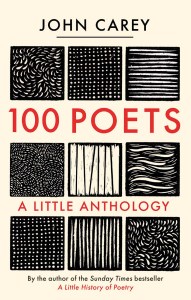 There is some inconsistency in terms of the amount of context and interpretation given, however. For some poets, there may be just a line or two of text, followed by a reprinted poem (Richard Wilbur, Les Murray); for others, there are paragraphs’ worth of explanations, interspersed with excerpts (Andrew Marvell, Thomas Gray). Some choices are obvious; others are deliberately obscure (e.g., eschewing Robert Frost’s and Philip Larkin’s better-known poems in favour of “Out, Out” and “The Explosion”). The diversity is fairly low, and you can see Carey’s age in some of his introductions: “Edward Lear was gay, and felt a little sad when friends got married”; “Alfred Edward Housman was gay, and he thought it unjust that he should be made to feel guilty about something that was part of his nature.” There’s way too much First and Second World War poetry here. And can a poet really be one of the 100 greatest ever when I’ve never heard of them? (May Wedderburn Cannan, anyone?)
Unsurprisingly, I was most engaged with the pieces on Victorian and Modernist poets since those are the periods I studied at university and still love the most, but there were a few individual poems I was glad to discover, such as Ben Jonson’s “On My First Sonne,” written upon his death from bubonic plague, and Edward Thomas’s “Old Man,” as well as many I was happy to encounter again. This would be a good introduction for literature students as well as laypeople wanting to brush up on their poetry.
With thanks to Yale University Press, London for the proof copy for review.
Nonfiction
No Cure for Being Human (And Other Truths I Need to Hear) by Kate Bowler
(Below is my Shelf Awareness review, reprinted with permission.)
 In her bittersweet second memoir, a religion professor finds the joys and ironies in a life overshadowed by advanced cancer.
When Kate Bowler, an associate professor at Duke Divinity School, was diagnosed with advanced colon cancer at age 35, her chances of surviving two years were just 14%. In No Cure for Being Human, her wry, touching follow-up to her 2018 memoir Everything Happens for a Reason (And Other Lies I’ve Loved) and its associated podcast, she continues to combat unhelpful religious/self-help mantras as she ponders what to do with the extra time medical breakthroughs have given her.
After multiple surgeries, a promising immunotherapy drug trial gave Bowler hope that she would live to see her 40th birthday and her young son starting kindergarten. Working on her bucket list, she found that small moments outshined large events: on a trip to the Grand Canyon, what stood out was a chapel in the ponderosa pinewoods where she added a prayer to those plastering the walls. In the Church calendar, “Ordinary Time” is where most of life plays out, so she encourages readers to live in an “eternal present.”
The chapters function like stand-alone essays, some titled after particular truisms (like “You Only Live Once”). The book’s bittersweet tone finds the humor as well as the tragedy in a cancer diagnosis. Witty recreated dialogue and poignant scenes show the type-A author learning to let go: “I am probably replaceable,” she acknowledges, but here in the shadow of death “the mundane has begun to sparkle.” These dispatches from the “lumpy middle” of life and faith are especially recommended to fans of Anne Lamott.
(If you’ve read her previous book, Everything Happens for a Reason, you may find, as I did, that there is a little too much repetition about her diagnosis and early treatment. The essays could also probably be structured more successfully. But it’s still well worth reading.)
With thanks to Rider Books for the free copy for review.
The Elements: A Widowhood by Kat Lister
 This story hit all too close to home to me: like Kat Lister, my sister was widowed in her thirties, her husband having endured gruelling years of treatment for brain cancer that caused seizures and memory loss. Lister’s husband, Pat Long, was a fellow journalist. Cancer was with them for the entire span of their short marriage, and infertility treatment didn’t succeed in giving them the children they longed for.
Although it moves back and forth in time, the memoir skims over the happy before and the torturous middle, mostly shining a light on the years after Pat died in 2018. Lister probes her emotional state and the ways in which she met or defied people’s expectations of a young widow. Even when mired in grief, she was able to pass as normal: to go to work, to attend social functions wearing leopard print. She writes of a return trip to Mexico, where she’d gone with Pat, and in some detail of the sexual reawakening she experienced after his death. But everyday demands could threaten to sink her even when life-or-death moments hadn’t.
Writing helped her process her feelings, and the Wellcome Library was a refuge where she met her predecessors in bereavement literature. While some of the literary points of reference are familiar (Joan Didion, Elisabeth Kübler-Ross, C.S. Lewis), others are unexpected, and the overall Fire–Water–Earth–Air structure creates thematic unity in a similar way as the constellations do in Molly Wizenberg’s The Fixed Stars. Giving shape and dignity to grief, this is a lovely, comforting read.
A favourite passage:
When I talk of my husband, I often speak of disparate worlds. Mine is inside time, his is supertemporal. I continue to age whilst my husband stays fixed in a past I am drifting further away from with every sentence that I type. And yet, like those luminous balls of plasma in the sky, we are still connected together, for all time is cyclical. I hold the elements within me.
With thanks to Icon Books for the free copy for review.
What recent releases can you recommend?
Snow and Winter Reads, Part II
Since I wrote about my first batch of wintry reads in early February, it’s turned much more spring-like here in southern England, with blue skies and the daffodils blooming. Still, temperatures continue chilly and some nights I’ve had trouble falling asleep because of the wind tearing down the street and flapping the bin lids. With meteorological spring due to start tomorrow, I’m bidding farewell to winter with a few more snow-covered reads: a children’s classic, a modern classic from the 1990s, and an implausible but enjoyably rollicking thriller.
The Wolves of Willoughby Chase by Joan Aiken (1962)
 Aiken’s books were not part of my childhood, but I was vaguely aware of this first book in a long series when I plucked it from a neighbor’s giveaway pile. The snowy scene on the cover and described in the first two paragraphs drew me in and the story, a Victorian-set fantasy with notes of Oliver Twist and Jane Eyre, soon did, too. In this alternative version of the 1830s, Britain already had an extensive railway network and wolves regularly used the Channel Tunnel (which did not actually open until 1994) to escape the Continent’s brutal winters for somewhat milder climes.
One winter, the orphaned Sylvia travels by train from London to the north of England to live with her cousin Bonnie and her parents, Sir Willoughby and Lady Green. But dodgy things are afoot at Willoughby Chase: Miss Slighcarp, a distant cousin, has been hired as the girls’ governess but, just as soon as Bonnie’s parents leave on a long trip, she sets about taking over the house. Bonnie and Sylvia, exiled to a workhouse, rely on a secret network of friends and servants to keep them safe and get them home via an intrepid journey.
Miss Slighcarp is just one of the novel’s Dickensian villains – balanced out by some equally Dickensian urchins and helpful adults, all of them with hearts of gold. There’s something perversely cozy about the plight of an orphan in children’s books: the characters call to the lonely child in all of us, and we rejoice to see how ingenuity and luck come together to defeat wickedness. There are charming passages here in which familiar smells and favorite foods offer comfort. I especially loved their friend Simon’s cave and his little rituals. This would make a perfect stepping stone from Roald Dahl to one of the actual Victorian classics.
My only quibble with the book overall would be that the wolves seem unnecessary: they only truly appear once, for a climactic scene during the train ride, and the rest of the time are just a background menace. From fairy tales onwards, wolves have gotten a bad rap, and we don’t need to perpetuate myths about how dangerous they are to humans. 
Snow Falling on Cedars by David Guterson (1994)
 My first 5-star read of the year! It certainly took a while, but I’m now on a roll with a bunch of 4.5- and 5-star ratings bunching together. I remember the buzz surrounding this novel, mostly because of the Ethan Hawke film version that came out when I was a teenager. Even though I didn’t see it, I was aware of it, as I was of other literary fiction that got turned into Oscar-worthy films at about that time, like The Shipping News and House of Sand and Fog.
The novel is set in 1954 on San Piedro, an island of 5,000 off the coast of Washington state. A decade on from the war, the community’s chickens come home to roost when a Japanese American man, Kabuo Miyamoto, is charged with murdering a fellow fisherman, Carl Heine. The men had been engaged in a dispute over some land – seven acres of strawberry fields that were seized from the Miyamoto family when, like the rest of the country’s Japanese population, they were rounded up in internment camps. Meanwhile, Ishmael Chambers, who runs the local newspaper and lost an arm in the war, stumbles on a piece of evidence that might turn the case around. Still in love with Hatsue, now Kabuo’s wife but once his teenage obsession, he is torn between winning her back and wanting to do what’s right.
Guterson alternates between trial scenes and flashbacks to war service or stolen afternoons Ishmael and Hatsue spent kissing in the shelter of massive cedar trees. The mystery element held me completely gripped – readers are just as in the dark as the jurors until very close to the end – but this is mostly a powerful picture of the lasting effects of racism. All the characters are well drawn, even minor ones like elderly defense attorney Nels Gudmundsson. Even though I only read 10 or 15 pages at a sitting over the course of a month, every time I picked up the book I was instantly immersed in the atmosphere, whether it was a warm courtroom with a snowstorm swirling outside or a troop ship entering the Pacific Theater. This has the epic feel of a doorstopper, though it’s only 400 pages. I can’t recommend it highly enough. 
The Quality of Silence by Rosamund Lupton (2015)
 Ten-year-old Ruby and her mother Yasmin have arrived in Alaska to visit Ruby’s dad, Matt, who makes nature documentaries. When they arrive, police inform them that the town where he was living has been destroyed by fire and he is presumed dead. But Yasmin won’t believe it and they set out on a 500-mile journey north to find her husband, first hitching a ride with a trucker and then going it alone in a stolen vehicle. All the time, with the weather increasingly brutal, they’re aware of someone following them – someone with malicious intent.
The narration is in short segments, alternating between Ruby’s first person and a third-person account from Yasmin’s point-of-view. There are many interesting elements here: Ruby is deaf so communicates via a combination of sign language, voice recognition software, blogs and social media, and describes things synesthetically; Yasmin is a physicist drawing metaphors to scientific concepts, but can’t explain her own mystical certainty that Matt is still alive; and there is an environmentalist message behind the fracking cover-up plot.
But starting with the first page, there are so many improbabilities in play, from a 10-year-old having a Twitter account to Yasmin managing to drive a big rig on ice roads in a foreign country. I knew from reviewing Three Hours last year that Lupton writes addictive thrillers. This one was perfectly readable, but not as good. It’s our book club read for early March, and I expect I won’t be the only one to find it hardly believable. 
Plus a skim:
Arctic Dreams by Barry Lopez (1986)
 This was my first time trying the late Lopez. It was supposed to be a buddy read with my husband because we ended up with two free copies, but he raced ahead while I limped along just a few pages at a time before admitting defeat and skimming to the end (it was the 20 pages on musk oxen that really did me in). For me, the reading experience was most akin to The Snow Leopard by Peter Matthiessen in that both are about a literal journey in an extreme environment, yet what stands out are the philosophical musings. Where Matthiessen was animated by Buddhist ideas about selfhood and loss, Lopez takes the secular long view of human life and responsibility in light of potential extinction. The epilogue, in particular, is endlessly quotable. It’s depressing to encounter books like this now, though: 30+ years ago, literary nature writers were issuing clarion calls about climate disaster, and we didn’t listen.
Some favorite passages:
“Whenever I met a collared lemming on a summer day and took its stare I would think: Here is a tough animal. Here is a valuable life. … If it could tell me of its will to survive, would I think of biochemistry, or would I think of the analogous human desire? If it could speak of the time since the retreat of the ice, would I have the patience to listen?”
“The cold view to take of our future is that we are therefore headed for extinction in a universe of impersonal chemical, physical, and biological laws. A more productive, certainly more engaging view, is that we have the intelligence to grasp what is happening, the composure not to be intimidated by its complexity, and the courage to take steps that may bear no fruit in our lifetimes.”
“One of the oldest dreams of mankind is to find a dignity that might include all living things. And one of the greatest of human longings must be to bring such dignity to one’s own dreams, for each to find his or her own life exemplary in some way. The struggle to do this is a struggle because an adult sensibility must find some way to include all the dark threads of life. A way to do this is to pay attention to what occurs in a land not touched by human schemes, where an original order prevails.”
 Bookish Beck = Rebecca Foster. American transplant to England. Freelance proofreader and book reviewer.
 Bookish Beck