The Barbellion Prize 2021 Longlist
This is the second year that the Barbellion Prize will be awarded “to an author whose work has best represented the experience of chronic illness and/or disability.” It was a joy to read the entire shortlist for the inaugural prize this past February and support the well-deserved win of Riva Lehrer for Golem Girl. I’ll be following the 2021–22 race with interest again, not least because one of the three judges is a long-time blogger friend of mine, Eleanor Franzen.
This year’s longlist looks fascinating: it contains fiction, poetry and memoir, and includes two works in translation. I happen to have already read the three nonfiction selections, but hadn’t heard of the other nominees.

Click on any title below for more information from the publisher website.
Ultimatum Orangutan by Khairani Barokka (Nine Arches Press)
From the synopsis: “Barokka’s second poetry collection is an intricate exploration of colonialism and environmental injustice … Through these defiant, potent verses, the body—particularly the disabled body—is centred as an ecosystem in its own right.”
What Willow Says by Lynn Buckle (Époque Press)
From the synopsis: “Sharing stories of myths, legends and ancient bogs, a deaf child and her grandmother experiment with the lyrical beauty of sign language. A poignant tale of family bonding and the quiet acceptance of change.”
 A Still Life: A Memoir by Josie George (Bloomsbury)
Excerpt from my TLS review: Chronic illness long ago reduced George’s territory to her home and garden. The magic of A Still Life is in how she finds joy and purpose despite extreme limitations. Opening on New Year’s Day and travelling from one winter to the next, the book is a window onto her quiet existence as well as the turning of the seasons. (One of my favourites of the year.) 
I Live a Life Like Yours: A Memoir by Jan Grue (Farrar, Straus and Giroux, and Pushkin Press). Translated by B. L. Crook
Excerpt from my Shelf Awareness review: The University of Oslo professor was diagnosed with spinal muscular atrophy at age three and relies on an electric wheelchair. In his powerful, matter-of-fact memoir, he alternates between his own story and others’, doctors’ reports and theorists’ quotations, mingling the academic and the intimate. 
Ill Feelings by Alice Hattrick (Fitzcarraldo Editions)
Excerpt from my blog review: Hattrick and their mother share a ME/CFS diagnosis. The book searches desultorily for medical answers but ultimately rests in mystery. Into a family story, Hattrick weaves the lives and writings of chronically ill women such as Elizabeth Barrett Browning, Alice James and Virginia Woolf.
The Coward by Jarred McGinnis (Canongate)
From the synopsis: “After a car accident Jarred discovers he’ll never walk again. … Add in a shoplifting habit, an addiction to painkillers and the fact that total strangers now treat him like he’s an idiot, it’s a recipe for self-destruction. How can he stop himself careering out of control?”
Duck Feet by Ely Percy (Monstrous Regiment)
From the synopsis: “A coming-of-age novel, set in the mid-noughties in Renfrew and Paisley, Scotland. … This book is a celebration of youth in an ever-changing world. It uses humour to tackle hard-hitting subjects such as drugs, bullying, sexuality, and teenage pregnancy.”
Elena Knows by Claudia Piñeiro (Charco Press). Translated by Frances Riddle
From the synopsis: “After Rita is found dead in the bell tower of the church she used to attend, the official investigation into the incident is quickly closed. Her sickly mother is the only person still determined to find the culprit.”
I’m most keen to read Ultimatum Orangutan (that title!), but would gladly read any of the new-to-me titles. The shortlist will be announced in January 2022.
Do any of the nominees appeal to you?
#NonFicNov Catch-Up 2: Abbs, Hattrick, Powles, DAD Anthology, Santhouse
I’m sneaking in with five more review books on the final day of Nonfiction November, after a first catch-up earlier on in the month. Today I have a sprightly travel book based on the journeys of female writers and artists, a probing account of repeated chronic illness in the family, an anthology of essays showcasing the breadth of fatherhood experiences, a lyrical memoir-in-essays exploring racial identity, and a psychiatrist’s case studies of how the mind influences what the body feels. My apologies to the publishers for the brief responses.
Windswept: Walking in the footsteps of remarkable women by Annabel Abbs
 After a fall landed her in hospital with a cracked skull, Abbs couldn’t wait to roam again and vowed all her future holidays would be walking ones. What time she had for pleasure reading while raising children was devoted to travel books; looking at her stacks, she realized they were all by men. Her challenge to self was to find the women and recreate their journeys. I was drawn to this because I’d enjoyed Abbs’s novel about Frieda Lawrence and knew she was the subject of the first chapter here. During research for Frieda, Abbs omitted the Lawrences’ six-week honeymoon in the German mountains, so now she makes it a family cycling holiday, imitating Frieda’s experience by walking in a skirt and sunbathing nude. Other chapters follow Welsh painter Gwen John in Bordeaux, Nan Shepherd in Scotland, Georgia O’Keeffe in the American Southwest, and so on. Questions of risk and compulsion recur as Abbs asks how these women sought to achieve liberation. The interplay between biographical information and travel narrative is carefully controlled, but somehow this never quite came together for me in the way that, for instance, Sara Wheeler’s O My America! did.
(Two Roads, June 2021.) With thanks to the publisher for the free copy for review.
Ill Feelings by Alice Hattrick
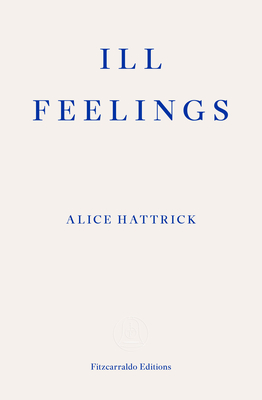 “My mother and I have symptoms of illness without any known cause,” Hattrick writes. When they showed signs of the ME/CFS their mother had suffered from since 1995, it was assumed there was imitation going on – that a “shared hysterical language” was fuelling their continued infirmity. It didn’t help that both looked well, so could pass as normal despite debilitating fatigue. Into their own family’s story, Hattrick weaves the lives and writings of chronically ill women such as Elizabeth Barrett Browning (see my review of Fiona Sampson’s biography, Two-Way Mirror), Alice James and Virginia Woolf. All these figures knew that what Hattrick calls “crip time” is different: more elastic; about survival rather than achievement.
The book searches desultorily for answers – could this have something to do with Giardiasis at age two? – but ultimately rests in mystery. ME/CFS patients rarely experience magical recovery, instead exhibiting repeated cycles of illness and being ‘well enough’. Hattrick also briefly considers long Covid as another form of postviral syndrome. My mother had fibromyalgia for years, so I’m always interested to read more about related illnesses. Earlier in the year I read Tracie White’s Waiting for Superman, and this also reminded me of Suzanne O’Sullivan’s books, though it’s literary and discursive rather than scientific.
(Fitzcarraldo Editions, August 2021.) With thanks to the publisher for the free copy for review.
Small Bodies of Water by Nina Mingya Powles
 I loved Powles’s bite-size food memoir, Tiny Moons. She won the inaugural Nan Shepherd Prize for underrepresented voices in nature writing for this work in progress, and I was eager to read more of her autobiographical essays. Watery metaphors are appropriate for a poet’s fluid narrative about moving between countries and identities. Powles grew up in a mixed-race household in New Zealand with a Malaysian Chinese mother and a white father, and now lives in London after time spent in Shanghai. Water has been her element ever since she learned to swim in a pool in Borneo, where her grandfather was a scholar of freshwater fish.
The book travels between hemispheres, seasons and languages, and once again food is a major point of reference. “I am the best at being alone when cooking and eating a soft-boiled egg,” she writes. Many of the essays are in short fragments – dated, numbered or titled. A foodstuff or water body (like the ponds at Hampstead Heath) might serve as a link: A kōwhai tree, on which the unofficial national flower of New Zealand grows, when encountered in London, collapses the miles between one home and another. Looking back months later (given I failed to take notes), this evades my grasp; it’s subtle, slippery but admirable.
(Canongate, August 2021.) With thanks to the publisher for the free copy for review.
DAD: Untold Stories of Fatherhood, Love, Mental Health and Masculinity, edited by Elliott Rae
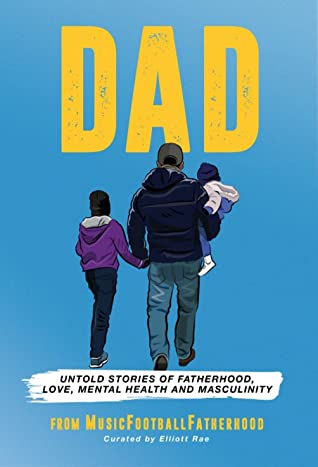 Music.Football.Fatherhood, a British equivalent of Mumsnet, brings dads together in conversation. These 20 essays by ordinary fathers run the gamut of parenting experiences: postnatal depression, divorce, single parenthood, a child with autism, and much more. We’re used to childbirth being talked about by women, but rarely by their partners, especially things like miscarriage, stillbirth and trauma. I’ve already written on Michael Johnson-Ellis’s essay on surrogacy; I also found particularly insightful R.P. Falconer’s piece on trying to be the best father he can be despite not having a particularly good role model in his own absent father, and Sam Draper’s on breaking the mould as a stay-at-home dad (“the bar for expectations regarding fathers is low, very low”) – I never understood how parental leave works in the UK before reading this. The book is full of genial and relatable stories and half or more of its authors are non-white. It could do with more rigorous editing to get the grammar and writing style up to the standard of traditionally published work, but even for someone like me who is not in the target audience it was an enjoyable set of everyday voices.
(Music.Football.Fatherhood, June 2021.) With thanks for the free copy for review.
Head First: A Psychiatrist’s Stories of Mind and Body by Alastair Santhouse
 Santhouse is a consultant psychiatrist at London’s Guy’s and Maudsley hospitals. This book was an interesting follow-up to Ill Feelings (above) in that the author draws an important distinction between illness as a subjective experience and disease as an objective medical reality. Like Abdul-Ghaaliq Lalkhen does in Pain, Santhouse adopts a biopsychosocial approach: “to focus solely on the scientific and neglect he social aspects of illness is a mistake that we continue to make,” he says. Using a patchwork of anonymous case studies, he delves into topics like depression, altruism, obesity, self-diagnosis, medical mysteries, evidence-based medicine, and preparation for death. A discussion of CFS again echoes the Hattrick. He brings the picture up to date with a final chapter on Covid-19. I’ve read so many doctors’ memoirs that this one didn’t stand out for me at all, but those less familiar with the subject matter could find it a good introduction to some ins and outs of mind–body medicine.
(Atlantic Books, July 2021.) With thanks to the publicist for the free copy for review.
Would you be interested in reading one or more of these?
#NovNov and #GermanLitMonth: The Pigeon and The Appointment
As literature in translation week of Novellas in November continues, I’m making a token contribution to German Literature Month as well. I’m aware that my second title doesn’t technically count towards the challenge because it was originally written in English, but the author is German, so I’m adding it in as a bonus. Both novellas feature an insular perspective and an unusual protagonist whose actions may be slightly difficult to sympathize with.

The Pigeon by Patrick Süskind (1987; 1988)
[Translated from the German by John E. Woods; 77 pages]
At the time the pigeon affair overtook him, unhinging his life from one day to the next, Jonathan Noel, already past fifty, could look back over a good twenty-year period of total uneventfulness and would never have expected anything of importance could ever overtake him again – other than death some day. And that was perfectly all right with him. For he was not fond of events, and hated outright those that rattled his inner equilibrium and made a muddle of the external arrangements of life.
 What a perfect opening paragraph! Taking place over about 24 hours in August 1984, this is the odd little tale of a man in Paris who’s happily set in his ways until an unexpected encounter upends his routines. Every day he goes to work as a bank security guard and then returns to his rented room, which he’s planning to buy from his landlady. But on this particular morning he finds a pigeon not a foot from his door, and droppings all over the corridor. Now, I love birds, so this was somewhat difficult for me to understand, but I know that bird phobia is a real thing. Jonathan is so freaked out that he immediately decamps to a hotel, and his day just keeps getting worse from there, in comical ways, until it seems he might do something drastic. The pigeon is both real and a symbol of irrational fears. The conclusion is fairly open-ended, leaving me feeling like this was a short story or unfinished novella. It was intriguing but also frustrating in that sense. There’s an amazing description of a meal, though! (University library)
(Also reviewed by Cathy and Naomi.)
The Appointment by Katharina Volckmer (2020)
[96 pages]
 This debut novella was longlisted for the Republic of Consciousness Prize – a mark of experimental style that would often scare me off, so I’m glad I gave it a try anyway. It’s an extended monologue given by a young German woman during her consultation with a Dr Seligman in London. As she unburdens herself about her childhood, her relationships, and her gender dysphoria, you initially assume Seligman is her Freudian therapist, but Volckmer has a delicious trick up her sleeve. A glance at the titles and covers of foreign editions, or even the subtitle of this Fitzcarraldo Editions paperback, would give the game away, so I recommend reading as little as possible about the book before opening it up. The narrator has some awfully peculiar opinions, especially in relation to Nazism (the good doctor being a Jew), but the deeper we get into her past the more we see where her determination to change her life comes from. This was outrageous and hilarious in equal measure, and great fun to read. I’d love to see someone turn it into a one-act play. (New purchase)
A favourite passage:
But then we are most passionate when we worship the things that don’t exist, like race, or money, or God, or, quite simply, our fathers. God, of course, was a man too. A father who could see everything, from whom you couldn’t even hide in the toilet, and who was always angry. He probably had a penis the size of a cigarette.
Review Books Roundup: Blackburn, Bryson, Pocock, Setterwall, Wilson
I’m attempting to get through all my 2019 review books before the end of the year, so expect another couple of these roundups. Today I’m featuring a work of poetry about one of Picasso’s mistresses, a thorough yet accessible introduction to how the human body works, a memoir of personal and environmental change in the American West, Scandinavian autofiction about the sudden loss of a partner, and a novel about kids who catch on fire. You can’t say I don’t read a variety! See if one or more of these tempts you.
The Woman Who Always Loved Picasso by Julia Blackburn
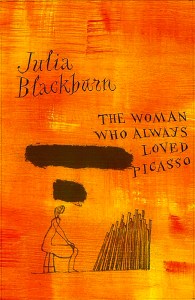 Something different from Blackburn: biographical snippets in verse about Marie-Thérèse Walter, one of Pablo Picasso’s many mistress-muses. When they met she was 17 and he was 46. She gave birth to a daughter, Maya – to his wife Olga’s fury. Marie-Thérèse’s existence was an open secret: he rented a Paris apartment for her to live in, and left his home in the South of France to her (where she committed suicide three years after his death), but unless their visits happened to overlap she was never introduced to his friends. “I lived in the time I was born into / and I kept silent, / acquiescing / to everything.”
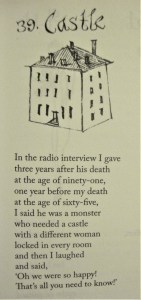 In Marie-Thérèse’s voice, Blackburn depicts Picasso as a fragile demagogue: in one of the poems that was a highlight for me, “Bird,” she describes how others would replace his caged birds when they died, hoping he wouldn’t notice – so great was his horror of death. I liked getting glimpses into a forgotten female’s life, and appreciated the whimsical illustrations by Jeffrey Fisher, but as poems these pieces don’t particularly stand out. (Plus, there are no page numbers! which doesn’t seem like it should make a big difference but ends up being annoying when you want to refer back to something. Instead, the poems are numbered.)
My rating:
With thanks to Carcanet Press for the free copy for review. Published today.
The Body: A Guide for Occupants by Bill Bryson
 Shelve this next to Being Mortal by Atul Gawande in a collection of books everyone should read – even if you don’t normally choose nonfiction. Bryson is back on form here, indulging his layman’s curiosity. As you know, I read a LOT of medical memoirs and popular science. I’ve read entire books on organ transplantation, sleep, dementia, the blood, the heart, evolutionary defects, surgery and so on, but in many cases these go into more detail than I need and I can find my interest waning. That never happens here. Without ever being superficial or patronizing, the author gives a comprehensive introduction to every organ and body system, moving briskly between engaging anecdotes from medical history and encapsulated research on everything from gut microbes to cancer treatment.
Bryson delights in our physical oddities, and his sense of wonder is infectious. He loves a good statistic, and while this book is full of numbers and percentages, they are accessible rather than obfuscating, and will make you shake your head in amazement. It’s a persistently cheerful book, even when discussing illness, scientists whose work was overlooked, and the inevitability of death. Yet what I found most sobering was the observation that, having conquered many diseases and extended our life expectancy, we are now overwhelmingly killed by lifestyle, mostly a poor diet of processed and sugary foods and lack of exercise.
My rating: 
With thanks to Doubleday for the free copy for review.
Surrender: Mid-Life in the American West by Joanna Pocock
 Prompted by two years spent in Missoula, Montana and the disorientation felt upon a return to London, this memoir-in-essays varies in scale from the big skies of the American West to the smallness of one human life and the experience of loss and change. Then in her late forties, Pocock had started menopause and recently been through the final illnesses and deaths of her parents, but was also mother to a fairly young daughter. She explores personal endings and contradictions as a kind of microcosm of the paradoxes of the Western USA.
It’s a place of fierce independence and conservatism, but also mystical back-to-the-land sentiment. For an outsider, so much of the lifestyle is bewildering. The author attends a wolf-trapping course, observes a Native American buffalo hunt, meets a transsexual rewilding activist, attends an ecosexuality conference, and goes foraging. All are attempts to reassess our connection with nature and ask what role humans can play in a diminished planet.
This is an elegantly introspective work that should engage anyone interested in women’s life writing and the environmental crisis. There are also dozens of black-and-white photographs interspersed in the text. In 2018 Pocock won the Fitzcarraldo Editions Essay Prize for this work-in-progress. It came to me as an unsolicited review copy and hung around on my shelves for six months before I picked it up; I’m glad I finally did.
My rating: 
With thanks to Fitzcarraldo Editions for the free copy for review.
Let’s Hope for the Best by Carolina Setterwall
[Trans. from the Swedish by Elizabeth Clark Wessel]
 Although this is fiction, it very closely resembles the author’s own life. She wrote this debut novel to reflect on the sudden loss of her partner and how she started to rebuild her life in the years that followed. It quickly splits into two parallel story lines: one begins in April 2009, when Carolina first met Aksel at a friend’s big summer bash; the other picks up in October 2014, after Aksel’s death from cardiac arrest. The latter proceeds slowly, painstakingly, to portray the aftermath of bereavement. In the alternating timeline, we see Carolina and Aksel making their life together, with her always being the one to push the relationship forward.
Setterwall addresses the whole book in the second person to Aksel. When the two story lines meet at about the two-thirds point, it carries on into 2016 as she moves house, returns to work and resumes a tentative social life, even falling in love. This is a wrenching story reminiscent of In Every Moment We Are Still Alive by Tom Malmquist, and much of it resonated with my sister’s experience of widowhood. There are many painful moments that stick in the memory. Overall, though, I think it was too long by 100+ pages; in aiming for comprehensiveness, it lost some of its power. Page 273, for instance (the first anniversary of Aksel’s death, rather than the second, where the book actually ends), would have made a fine ending.
My rating: 
With thanks to Bloomsbury UK for the proof copy for review.
Nothing to See Here by Kevin Wilson
 I’d read a lot about this novel while writing a synopsis and summary of critical opinion for Bookmarks magazine – perhaps too much, as it felt familiar and offered no surprises. Lillian, a drifting twentysomething, is offered a job as a governess for her boarding school roommate Madison’s stepchildren. Madison’s husband is a Tennessee senator in the running for the Secretary of State position, so it’s imperative that they keep a lid on the situation with his 10-year-old twins, Bessie and Roland.
You see, when they’re upset these children catch on fire; flames destroy their clothes and damage nearby soft furnishings, but leave the kids themselves unharmed. Temporary, generally innocuous spontaneous combustion? Okay. That’s the setup. Wilson writes so well that it’s easy to suspend your disbelief about this, but harder to see a larger point, except perhaps creating a general allegory for the challenges of parenting. This was entertaining enough, mostly thanks to Lillian’s no-nonsense narration, but for me it didn’t soar.
My rating:
With thanks to Text Publishing UK for the PDF for review. This came out in the States in October and will be released in the UK on January 30th.
Would you be interested in reading one or more of these?
Women in Translation Month 2019, Part I: Ernaux and Poschmann
Two rather different books to start off #WITMonth: a brief (c. 70 pp.) account of a mother’s decline with dementia; and a haiku-inspired novel of the quest for life and death in disorienting modern Japan. Both are admirable but detached – a judgment I seem more likely to make about work in translation – so don’t earn my wholehearted recommendation. My rating for both:
I Remain in Darkness by Annie Ernaux (1997; English translation, 1999)
[Translated from the French by Tanya Leslie]
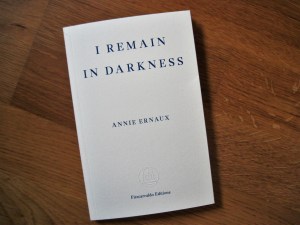 This is the second short, somewhat harrowing autobiographical work I’ve read by Ernaux this year (after Happening, her account of her abortion, in March). A collection of mostly present-tense fragments, it’s drawn from the journal she kept during her mother’s final years, 1983–6. “I Remain in Darkness” were the last words her mother wrote, in a letter to a friend (“Je ne suis pas sortie de ma nuit,” which more literally means “I have not left my night,” strikes me as cryptic and poetic, though maybe I’m missing a colloquialism). Slipping into Alzheimer’s, her mother spent these years in a long-term hospital geriatric ward. Ernaux could see her mother becoming like a child again:
This morning she got up and, in a timid voice, said: ‘I wet the bed. I couldn’t help it.’ The same words I would use when I was a child.
Now her room is on the third floor. A bunch of women circle us, addressing my mother with the familiar tu form: ‘You’re going to be in our group?’ They are like kids talking to the ‘new girl’ at school. When I take leave of her, she looks at me in panic and confusion: ‘You’re not leaving, are you?’
—and herself becoming like her mother: “It’s crystal-clear: she is me in old age and I can see the deterioration of her body threatening to take hold of me – the wrinkles on her legs, the creases in her neck”. Ernaux vacillates between guilt, fear and cruelty in how she approaches her mother. She tenderly shaves the older woman’s face every week when she visits, and buys her all manner of sweets. Food is one of her mother’s last remaining pleasures, though she often misses her mouth when she tries to eat the cakes her daughter brings.
Superficially, this is very similar to another book I’ve reviewed this year, Be With by Mike Barnes, a series of short letters written during his time as a caregiver to his mother, who also has Alzheimer’s. But where Barnes is reassuring and even humorous at times, Ernaux refuses to give any comfort, false or otherwise. This hospital is a bleak place that reeks of urine and is hiding excrement everywhere (really). A lazier reviewer than I generally try to be would brandish the word “unflinching.”
The entries from a few days after her mother’s death explain what the author is trying to do with her work, whether memoir or autofiction: “I am incapable of producing books that are not precisely that – an attempt to salvage part of our lives, to understand, but first to salvage … I’ll have to tell her story in order to ‘distance myself from it’.” That dual purpose, saving and distancing, makes her work honest yet unemotional, such that I have trouble warming to it.
This is easily read in a sitting. I may try again to get into Ernaux’s novel The Years, which, like the Poschmann (below), was on this past year’s Man Booker International Prize shortlist.
I Remain in Darkness will be released on September 18th. With thanks to Fitzcarraldo Editions for the free copy for review.
The Pine Islands by Marion Poschmann (2017; English translation, 2018)
[Translated from the German by Jen Calleja]
(Though I read this mostly in July, I finished it on August 1st, so I’m including it in my WIT Month coverage. It’s the first of the author’s books to be made available in English.)
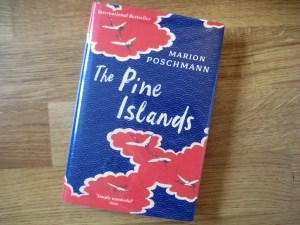 A man wakes up from a dream convinced that his wife is cheating on him, and sets off for Tokyo on a whim, where he embarks on a Bashō-inspired pilgrimage to the pine islands of Matsushima. This Gilbert Silvester, a beard historian, acquires an unlikely companion: a young man named Yosa, who’s looking for the best place to kill himself and takes Gilbert along to cliffs and forests famous for their suicide rates. Although there are still cherry blossoms and kabuki theatre, Gilbert soon learns that this isn’t Bashō’s Japan anymore.
From the haikus he composes and the letters he writes to Mathilda back home, we track his inward journey as it contrasts with the outward ones he undertakes. I enjoyed the surreal touches – Yosa says he once dated a woman who was actually a fox – and the Murakami setup (the wife’s adultery and the hair patterns are reminiscent of The Wind-Up Bird Chronicle).
Somehow, though, for me this is a book that succeeds more in its ideas (searching for the essence of a place but only finding the clichés; coniferous versus deciduous trees as a metaphor for what lasts in life versus what fades) than in its actual execution. It never all quite comes together, and the inconclusive ending makes you question how much of this has been a dream or a fantasy. It’s ambitious and intellectually impressive, but something about its dignified aloofness is hard to be enthusiastic about.
Do watch Lost in Translation, one of my favorite films, afterwards…
And a DNF: The Days of Abandonment by Elena Ferrante. The time has come to admit that I simply do not appreciate Ferrante’s work. I could only make it 25 pages into this one; I’ve read a different short novel of hers (The Lost Daughter), and skimmed another (My Brilliant Friend). While I enjoyed the narrator’s voice well enough, and loved the scene in which her errant husband finds broken glass in his dinner, I found that I had no interest in how this seemingly predictable story of the end of a marriage might play out.
Up next for Part II: The Wind that Lays Waste by Selva Almada, on its way from Charco Press, and The Awakening of Miss Prim by Natalia Sanmarin Fenollera.
Are you doing any special reading for Women in Translation month this year?
August’s Reading Plans: Too Many Projects!
My August is looking chock-full of reading projects – many of them self-imposed, to be fair.
20 Books of Summer: I’ve finished a few more books and just need to write them up; I’m in the middle of another nine, including Tisala as my doorstopper for the month.
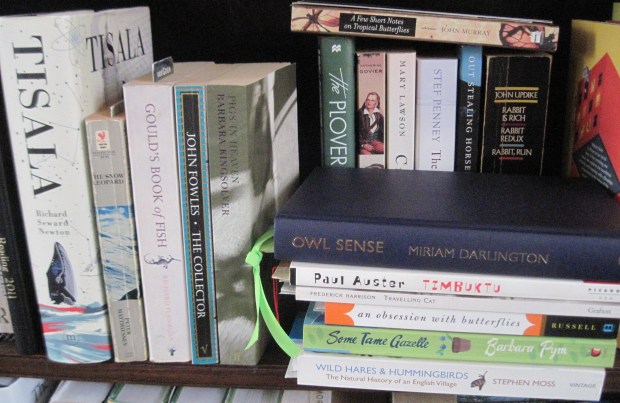
Summer theme: Books with summer/sun/shine in the title, and others set in summer, like The Go-Between by L.P. Hartley, my classic for the month.

Women in Translation month: I’ve started the Ferrante and also want to get to the Fenollera and start the Flores stories (all those Fs!), which are coming out from Oneworld in November. Also, in yesterday’s post I received a surprise copy of a forthcoming Fitzcarraldo Editions essay by Annie Ernaux about her mother’s dementia, so I will squeeze that in too.

Robertson Davies week: In the final week of August I’ll be joining in with Lory’s (The Emerald City Book Review) Robertson Davies readalong by starting Fifth Business, the first volume in The Deptford Trilogy.

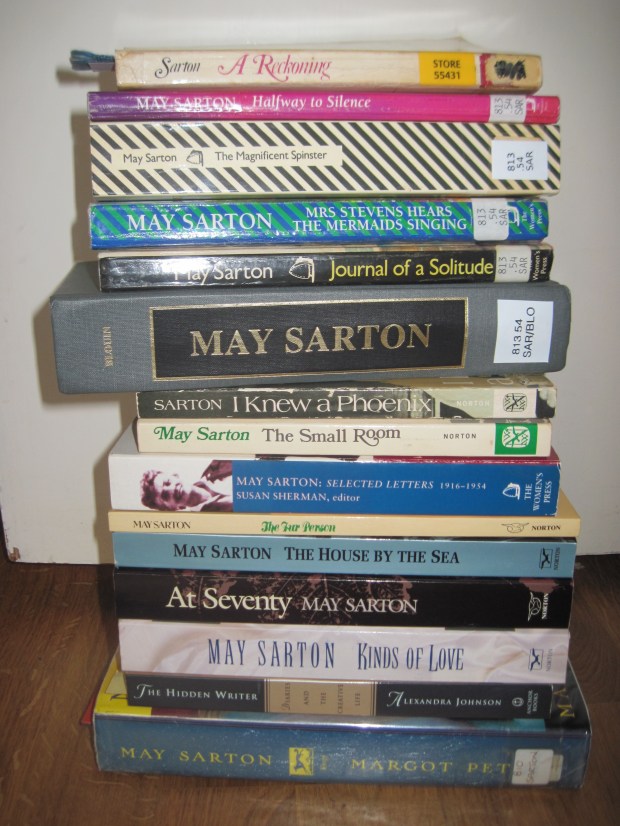
May Sarton article: I’m writing a profile for Bookmarks magazine this month, and am currently in the throes of research: finishing the Margot Peters biography I started last year and set aside for ages; reading another novel or two by Sarton; skimming back through various of the journals, novels and poems I’ve read before; and exploring other external sources. Luckily, my husband was able to forage for loads from his university library for me.
What’s keeping you busy this month?
Four Recent Review Books: Ernaux, Nunez, Rubin & Scharer
Two nonfiction books: a frank account of an abortion; clutter-busting techniques.
Two novels: amusing intellectual fare featuring a big dog or the Parisian Surrealists.
Happening by Annie Ernaux (2000; English translation, 2019)
[Translated from the French by Tanya Leslie]
 “I believe that any experience, whatever its nature, has the inalienable right to be chronicled,” Ernaux writes. In 1963, when she was 23 and living in a student residence in Rouen, she realized she was pregnant. An appointment with a gynecologist set out the facts starkly: “Pregnancy certificate of: Mademoiselle Annie Duchesne. Date of delivery: 8 July, 1964. I saw summer, sunshine. I tore up the certificate.” Abortion was illegal in France at that time. Ernaux tried to take things into her own hands – “plunging a knitting needle into a womb weighed little next to ruining one’s career” – but couldn’t go through with it. Instead she went to the home of a middle-aged nurse she’d heard about…
This very short book (just 60-some pages) is told in a matter-of-fact style – apart from the climactic moment when her pregnancy ends: “It burst forth like a grenade, in a spray of water that splashed the door. I saw a baby doll dangling from my loins at the end of a reddish cord.” It’s such a garish image, almost cartoonish, that I didn’t know whether to laugh or be horrified. Mostly, Ernaux reflects on memory and the reconstruction of events. I haven’t read many nonfiction accounts of abortion/miscarriage and for that reason found this interesting, but it was perhaps too brief and detached for me to be fully engaged.
My rating:
With thanks to Fitzcarraldo Editions for the free copy for review.
The Friend by Sigrid Nunez (2018)
 “Does something bad happen to the dog?” We animal lovers are wary when approaching a book about a pet. Nunez playfully anticipates that question as she has her unnamed female narrator reflect on her duty of care to her dead friend’s dog. The narrator is a writer and academic – like her late friend, a Bellovian womanizer who recently committed suicide, leaving behind two ex-wives, a widow, and Apollo the aging Great Dane. She addresses the friend directly as “you” for almost the whole book, which unfolds – in a similar style to Jenny Offill’s Department of Speculation – via quotations, aphorisms, and stories from literary history as well as mini-incidents from a life.
This won the 2018 National Book Award in the USA and is an unashamedly high-brow work whose intertextuality comes through in direct allusions to many classic works of autofiction (Coetzee, Knausgaard and Lessing) and/or doggy lit (Ackerley; Coetzee again – Disgrace). As Apollo starts to take up more physical, mental and emotional space in the narrator’s life, she waits for a miracle that will allow her to keep him despite an eviction notice and muses on lots of questions: Is all writing autobiographical? Why does animal suffering pain us so much (especially compared to human suffering)? I was impressed: it feels like Nunez has encapsulated everything she’s ever known or thought about, all in just over 200 pages, and alongside a heart-warming little plot. (Animal lovers need not fear.)
My rating:
With thanks to Virago for the free copy for review.
Outer Order, Inner Calm: Declutter and Organize to Make More Room for Happiness by Gretchen Rubin (2019)
 What with all the debate over Marie Kondo’s clutter-reducing tactics, the timing is perfect for this practical guide to culling and organizing all the stuff that piles up around us at home and at work. Unlike the rest of Rubin’s self-help books, this is not a narrative but a set of tips – 150 of them! It’s not so much a book to read straight through as one to keep at your bedside and read a few pages to summon up motivation for the next tidying challenge.
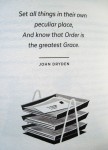 Famously, Kondo advises one to ask whether an item sparks joy. Rubin’s central questions are more down-to-earth: Do I need it? Do I love it? Do I use it? With no index, the book is a bit difficult to navigate; you just have to flip through until you find what you want. The advice seems in something of a random order and can be slightly repetitive. But since this is really meant as a book of inspiration, I think it will be a useful jumping-off point for anyone trying to get on top of clutter. I plan to work through the closet checklist before I pass the book to my sister – who’s dealing with a basement full of stuff after she and her second husband merged their households. If I could add one page, it would be a flowchart of what to do with unwanted stuff that corresponds to the latest green recommendations.
My rating:
With thanks to Two Roads for the free copy for review.
The Age of Light by Whitney Scharer (2019)
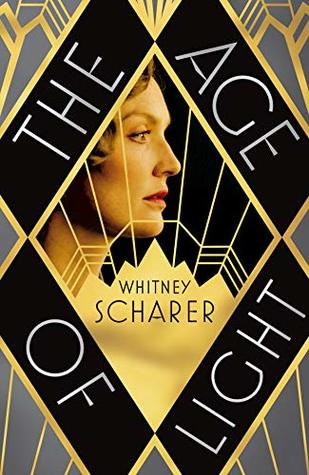 This novel about Lee Miller’s relationship with Man Ray is in the same vein as The Paris Wife, Z, Loving Frank and Frieda: all of these have sought to rescue a historical woman from the shadow of a celebrated, charismatic male and tell her own fascinating life story. Scharer captures the bohemian atmosphere of 1929–30 Paris in elegant but accessible prose. Along with the central pair we meet others from the Dada group plus Jean Cocteau, and get a glimpse of Josephine Baker. The novel is nearly 100 pages too long, I think, such that my interest in the politics of the central relationship – Man becomes too possessive and Lee starts to act out, longing for freedom again – started to wane.
Miller was a photographer as well as a model and journalist, and this is an appropriately visual novel that’s interested in appearances, lighting and what gets preserved for posterity. It’s also fairly sexually explicit for literary fiction, sometimes unnecessarily so, so keep that in mind if it’s likely to bother you. I especially enjoyed the brief flashes of Lee at other points in her life: in London during the Blitz, photographing the aftermath of the war in Germany (there’s a famous image of her in Hitler’s bathtub), and hoping she’s more than just a washed-up alcoholic in the 1960s. It would be a boon to have a prior interest in or some knowledge of the Surrealists.
My rating:
With thanks to Picador for the free copy for review.
Would you be interested in reading one or more of these?
Three Recent Review Books: Holmes, Tokarczuk & Whitaker
Where the Road Runs Out by Gaia Holmes (2018)
A gem of a poetry collection. Gaia Holmes is a creative writing tutor in Halifax, Yorkshire. This is her third volume of poetry. A major thread of the book is caring for her father at home and in the hospital as he was dying on the Orkney Islands – a time of both wonder and horror. It felt like she could never get anything right and kept angering him, as she recounts in “Feckless.” Even after his death, she continued to see him. I especially loved the food metaphors in “Kummerspeck” (a German term for emotional overeating; literally, “grief bacon”), where sweets, meat and salt cannot sate the cravings of ravenous grief.
 Other themes include pre-smartphone life (“Before All This” – not everything needed to be documented, you could live where you were and not rely on others’ constant approval), the lengths women will go to impress men (“The Audition”), being the only childless person in a room (“Ballast”) and a marriage falling apart (“Your Orange Raincoat”). Also notable are a multi-part tribute to the Chilean miners trapped in 2010 and an imagined outbreak of violence between runners and ramblers. Holmes channels Anne Sexton in “Angel of the Checkout,” with its wonderful repeated line “do you know the price of love?”, and Mary Oliver in the first stanza of “Wild Pigeons.”
There are no rhymes, just alliteration and plays on words, with a lot of seaside imagery. I would highly recommend this to poetry lovers and newbies alike.
A favorite passage:
I have no manual
for dying
so I do what I think
you’re supposed to do
in this situation.
I light the stub
of last night’s candle,
utter something holy
and stand
at your bedside
with the unfamiliar taste
of the Lord’s Prayer
clinging to my lips.
(from “The Lord’s Prayer”)
My rating: 
My thanks to Comma Press for the free copy for review.
Drive Your Plow over the Bones of the Dead by Olga Tokarczuk (2009; English translation, 2018)
[Translated from the Polish by Antonia Lloyd-Jones]
 What a bizarre novel! Janina Dusezjko is a delightfully twisted Miss Marple type who lives in a remote forest cabin in Poland, near the Czech border. She’s determined to learn the truth of what happened to her two beloved dogs, whom she calls her Little Girls. When four different men who were involved in local hunting – her unpleasant neighbor, a deer poacher whom she nicknamed Big Foot; a police commandant; a fox farm owner; and the president of the mushroom pickers’ association – are all found murdered, her theorizing runs wild. She believes the animals are taking revenge, and intends to use her astrology skills to glean more information about these untimely deaths. The police, meanwhile, dismiss her as a hysterical old crone.
The title comes from William Blake, whose writing is an undercurrent to the book: Dizzy, Janina’s former English pupil, is reading and translating Blake, and I reckon Janina’s nutty philosophy and capitalization of random words, especially abstractions, may be an homage to Blake. I probably missed some of the more intricate allusions, and my attention wandered for a while during the middle of the book, but this was an offbeat and mostly enjoyable read. I struggled with Flights, but I’m glad I tried Tokarczuk again.
A representative passage:
“We have this body of ours, a troublesome piece of luggage, we don’t really know anything about it and we need all sorts of Tools to find out about its most natural processes.”
My rating:
My thanks to Fitzcarraldo Editions for the free copy for review.
Chicken Unga Fever: Stories from the Medical Frontline by Dr. Phil Whitaker (2018)
This is a selection of Whitaker’s “Health Matters” columns from the New Statesman magazine. In his time as a GP he’s seen his fair share of common and unusual illnesses, and has so honed his diagnosing skills that he can start to figure out what’s wrong based on how someone stands up and walks towards his office from the waiting room. That’s why he’s a “meeter” (calling names in person and escorting patients down the hallway) rather than a “buzzer” (waiting for them to come to him, having being called via a digital screen).
 In digestible essays of 2.5 pages each, Whitaker discusses mental health sectioning, home visiting, the rise of technology and antibiotic resistance, the culture of complaint, zealous overscreening and overtreatment (he’d have an ally there in Barbara Ehrenreich: see her Natural Causes) and the tricky issue of getting consent from teenagers. He also recreates individual cases that have left an impression on him. When it comes to diagnoses, he recognizes that sometimes it’s a matter of luck – like when he landed on Cushing’s disease based on a rare combination of common symptoms – and that sometimes you have to admit you don’t know and turn to the Internet. That’s where the title comes from – an out-of-hours caller’s approximation of suspected chikungunya fever.
This is an enjoyable book for medically minded laymen to read a few pieces at a time, though I suspect its take on various issues could soon be outdated.
My rating:
My thanks to Salt Publishing for the free copy for review.
Omnibuses, Built-in Bookmarks, Deckle Edge: Book Traits I Love/Loathe
My reading has tipped more towards physical books than e-books recently, and my book acquisitions have been getting rather out of hand after some cheeky charity shopping and an influx of review copies. Plus this afternoon we’re off to Bookbarn International, one of my favorite secondhand bookstores, for an evening event – and naturally, we’ll fit in some shopping beforehand. It would be rude not to after traveling all that way.
With all this tempting reading material piling up, I’ve been thinking about some of the traits I most appreciate in books…
Omnibus editions: two to four books for the price of one. What could be better?
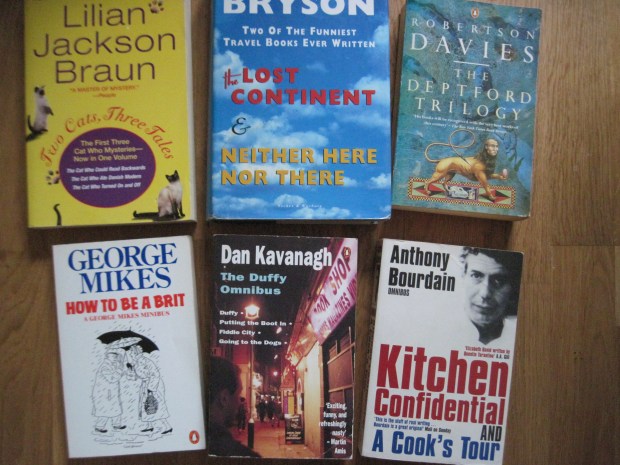
Built-in ribbon bookmarks: elegant as well as helpful. I also love how Peirene Press releases come with a matching paper bookmark for every three-book series.

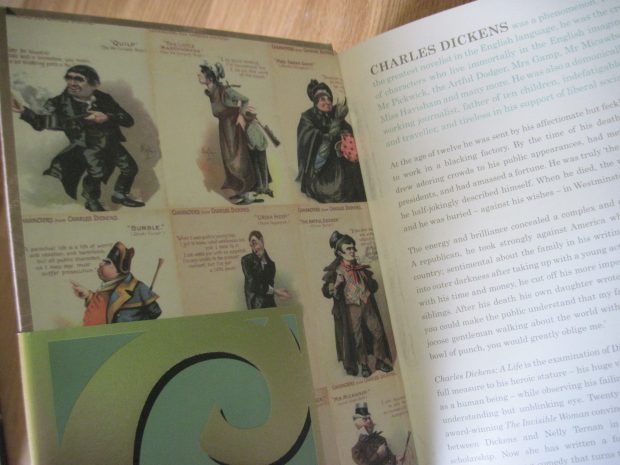
Everything about the hardback edition of Claire Tomalin’s Dickens biography is gorgeous, in fact. I especially love the vintage illustrations on the endpapers and the half-size dustjacket.
Deckle edge is one of my special loves. For the most part it’s unique to American books (over here I’ve heard it complained about as looking “unfinished”), and always makes me think nostalgically about borrowing books from the public library in my parents’ town.

It may sound shallow, but I love these four novels almost as much for their colorful covers as for their contents. (Is it any wonder one of my favorite tags to use on Instagram is #prettycovers?) Several of these covers have raised lettering as well.
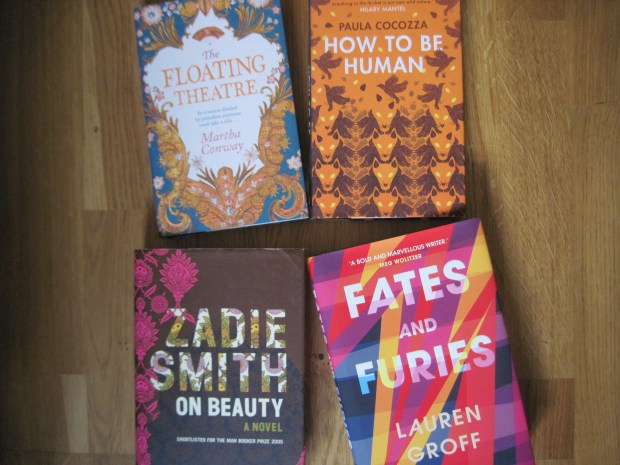
The History of Bees is one of the most attractive physical books I’ve acquired recently. The dustjacket has an embossed image; underneath it the book itself is just as striking, with a gold honeycomb pattern. There are also black-and-white bees dotted through the pages.


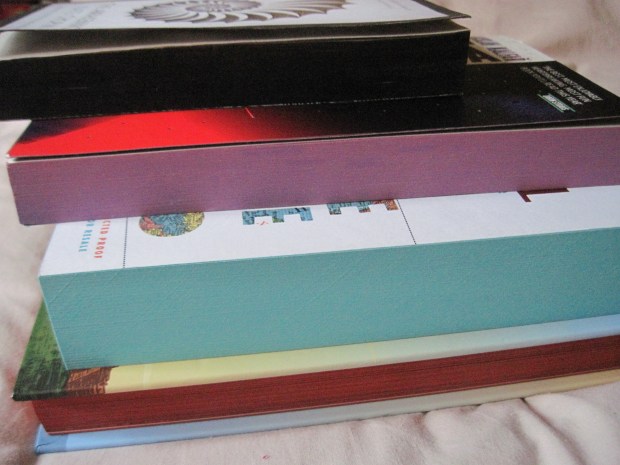
Colored text blocks (also called sprayed edges) are so unexpected and stylish.
And now for a few physical book traits I’m not as fond of. Perhaps my biggest pet peeve, impossible to photograph, is those matte covers that get permanent fingerprints on them no matter how gingerly you try to handle them.
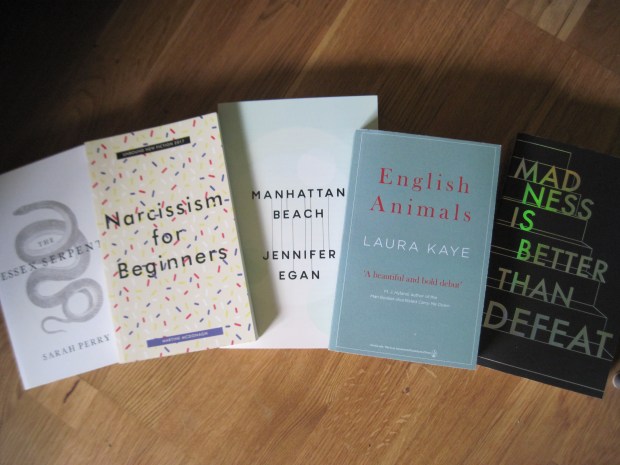
I wish proof copies didn’t often come in nondescript covers that don’t give a sense of what the finished book will look like. (No ice cream cone on Narcissism for Beginners; no leaping fox on English Animals.) However, keeping in mind that I’m lucky to be reading all these books early, I mustn’t be a greedy so-and-so.
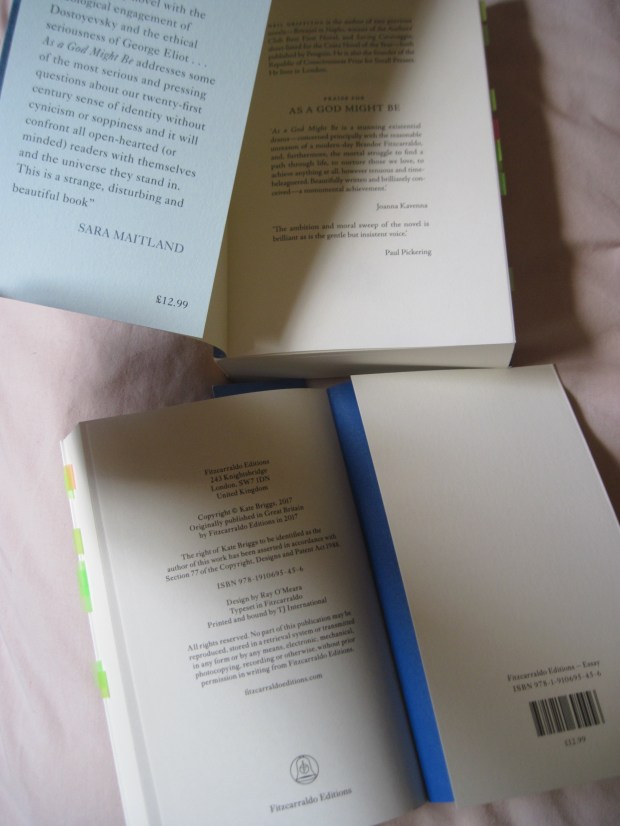
All Fitzcarraldo Editions books are paperbacks with French flaps. Another book I’m reading at the moment, As a God Might Be by Neil Griffiths (from Dodo Ink), also has French flaps. It’s not that I dislike them per se. I just wonder, what’s the point?
(See also two related posts: Books as Objects of Beauty and My (Tiny) Collection of Signed Copies.)
Okay, you opinionated book people: what are your favorite and least favorite book traits?
The Doll’s Alphabet: Stories by Camilla Grudova
Camilla Grudova lives in Toronto and has a degree in Art History and Germany from McGill University of Montreal. The Doll’s Alphabet, her debut collection, sets surreal tales of women’s inner lives against ruined cityscapes. These 13 stories are like perverted fairytales or fragmentary nightmares, full of strange recurring imagery and hazily dystopian setups. Flash fiction-length stories alternate with longer ones that move at a dizzying pace, and the book is roughly half third-person and half first-person – a balance I always appreciate.
 “Unstitching,” the two-page opener, introduces the metaphors and gender politics that form the backdrop for Grudova’s odd imagination. One day Greta realizes she can unstitch herself, removing an outer covering to reveal her true identity; “It brought great relief … like undoing one’s brassiere before bedtime or relieving one’s bladder after a long trip.” Her neighbor Maria does the same, but men – including Greta’s husband – find this intimidating, and are jealous because they don’t seem to have a deeper self to uncover. I was tickled by the idea of women having a secret life unshared by men, but had trouble grasping the actual mechanics of the unstitching: “She did not so much resemble a sewing machine as she was the ideal form on which a sewing machine was based. The closest thing she resembled in nature was an ant.” Huh? This is a case where keeping things vague might have been a better strategy.
Sewing machines keep popping up, along with mermaids, dolls, babies, zoos, factories, and old-fashioned or derelict shops. For example, the narrator of “The Mouse Queen” is a clerk in a doll’s house shop, while her husband Peter works in a graveyard. One night he brings home the corpse of an old dwarf woman, which the narrator decides to stow in the abandoned grocery store under their apartment. Um, naturally.
In “Waxy” (full text available on the Granta website) the narrator works at a sewing machine factory and unlawfully acquires a baby by her sub-par Man, Paul. The sexual violence in this one and in “Moth Emporium” is deeply unsettling: even in these off-kilter fictional worlds women’s bodies are considered a threat and pregnancy is never innocuous.
My two favorites were “Agata’s Machine” (full text available at The White Review) and “Notes from a Spider.” The former is perhaps indebted to D.H. Lawrence’s “The Rocking-Horse Winner” in its picture of obsessive and ultimately self-destructive activity. It features two Eastern European eleven-year-olds: the narrator is bullied, while her friend Agata is an aloof genius. In her attic room Agata keeps what looks like a sewing machine, but pushing its treadle creates flickering images of Pierrot (a clown) or an angel. This one has a chilling ending. The last story, “Notes from a Spider,” is told by a half-man, half-spider with eight legs. He keeps a zoo for vermin and opens – what else? – a sewing machine museum.
I’ve discovered that I have limited tolerance for outlandish tales like these. I’d be intrigued to find one of Grudova’s stories in an anthology, and I might be happy to read the best four or five of these. But because the same images and concepts keep repeating, the book feels twice as long as it needs to be. Ultimately this book was not for me, but I would not hesitate to recommend it to you if you have enjoyed the more fantastical of the feminist short stories by Karen Russell, Alexandra Kleeman and Helen Simpson.
The Doll’s Alphabet was published on February 14th by Fitzcarraldo Editions. With thanks to publicist Nicolette Praça for the review copy.
My rating:
London-based publisher Fitzcarraldo Editions produces elegantly simple volumes of long-form essays and niche contemporary fiction, with much of the latter appearing in English translation for the first time. I’ve enjoyed a number of Fitzcarraldo books – particularly On Immunity by Eula Biss, The Hatred of Poetry by Ben Lerner, and Second-Hand Time by Svetlana Alexievich – and even when the topics don’t hold any particular interest for me (as was the case with Football by Jean-Philippe Toussaint and Pretentiousness by Dan Fox), they are still thought-provoking, out-of-the-ordinary discourses on the topic at hand.

Coming up next from Fitzcarraldo (March 22nd) is French author Mathias Enard’s novel Compass, which won the 2015 Prix Goncourt. On one sleepless night in Vienna Franz Ritter, an ailing musicologist, entertains memories of travels in the Middle East and his unrequited love for Sarah. Here’s part of the first run-on paragraph as a preview of the hypnotic style:
We are two opium smokers each in his own cloud, seeing nothing outside, alone, never understanding each other we smoke, faces agonizing in a mirror, we are a frozen image to which time gives the illusion of movement, a snow crystal gliding over a ball of frost, the complexity of whose intertwinings no one can see, I am that drop of water condensed on the window of my living room, a rolling liquid pearl that knows nothing of the vapour that engendered it, nor of the atoms that still compose it but that, soon, will serve other molecules, other bodies, the clouds weighing heavy over Vienna tonight: over whose nape will this water stream, against what skin, on what pavement, towards what river, and this indistinct face on the glass is mine only for an instant, one of the millions of possible configurations of illusion …
 Bookish Beck = Rebecca Foster. American transplant to England. Freelance proofreader and book reviewer.
 Bookish Beck