R.I.P. Reads, Part I: Apostolides, Dahl, Harkness, Kingfisher & Kohda
Ghosts, witches, vampires, creepy underground things: It can only be Readers Imbibing Peril time of year! Here’s my first five reviews.
The Homecoming by Zoë Apostolides (2025)
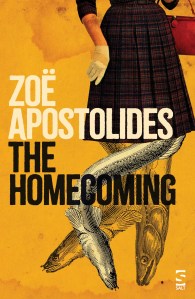 This debut novel dropped through my door as a total surprise: not only was it unsolicited, but I’d not heard about it. In this modern take on the traditional haunted house story, Ellen is a ghostwriter sent from London to Elver House, Northumberland, to work on the memoirs of its octogenarian owner, Catherine Carey. Ellen will stay in the remote manor house for a week and record 20 hours of audio interviews – enough to flesh out an autobiography. Miss Carey isn’t a forthcoming subject, but Ellen manages to learn that her father drowned in the nearby brook and that all Miss Carey did afterwards was meant to please her grieving mother and the strictures of the time. But as strange happenings in the house interfere with her task, Ellen begins to doubt she’ll come away with usable material. I was reminded of The Woman in Black, The Thirteenth Tale, and especially Wakenhyrst what with the local eel legends. The subplot about Ellen drifting apart from her best friend, a new mother, felt unnecessary, though I suppose was intended to bolster the main theme of women’s roles. There’s a twist that more seasoned readers of Gothic fiction and ghost stories might see coming. While I found this very readable and perfectly capably written, I didn’t get a sense of where the author hopes to fit in the literary market; she’s previously published a true crime narrative. Full disclosure: I once collaborated with Zoë on a Stylist assignment.
With thanks to Salt Publishing for the proof copy for review.
The Witches by Roald Dahl (1983)
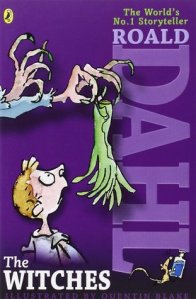 I’m sure I read all of Dahl’s major works when I was a child, though I had no specific memory of this one. After his parents’ death in a car accident, a boy lives in his family home in England with his Norwegian grandmother. She tells him stories from Norway and schools him in how to recognize and avoid witches. They wear wigs and special shoes to hide their baldness and square feet, and with their wide nostrils they sniff out children to turn them into hated creatures like slugs. When Grandmamma falls ill with pneumonia, she and the boy travel to a Bournemouth hotel for her recovery only to stumble upon a convention of witches under the guise of the Royal Society for the Prevention of Cruelty to Children. The Grand High Witch (Anjelica Huston, if you know the movie) has a new concoction that will transform children into mice at enough of a delay to occur the following morning at school. It’s up to the boy and his grandmother to save the day. I really enjoyed this caper, which I interpreted as being – like Tove Jansson’s The Summer Book – about imagination and making the most of one’s time with grandparents. But in the back of my mind was Jen Campbell’s objection to the stereotypical equating of disfigurement with villainy. The Grand High Witch also speaks with a heavy German accent. It would be understandable to dismiss this as dated and clichéd, but I still found it worthwhile. It also fit into my project to read books from my birth year. (Free from a neighbour)
The Black Bird Oracle by Deborah Harkness (2024)
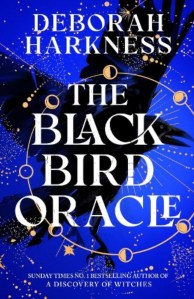 Somehow I’ve read this entire series even though none of the subsequent books lived up to A Discovery of Witches. What I loved about that first novel was how the author drew on her knowledge of the history of science to create a believable backdrop for a story of witches, vampires and other supernatural beings that took place largely in Oxford and its medieval libraries. Each sequel has elaborated further adventures for Diana Bishop, a witch; her vampire husband, Matthew de Clermont; and their family members and other hangers-on. Their twins, especially Becca, have inherited some of Diana’s power. I read the first half of this last year and finally skimmed to the end last week, so I haven’t retained much. Diana is summoned to the ancestral seat of the Bishops in Massachusetts and finds herself part of a community of gossipy, catty witches. (Dahl was right, they’re everywhere!) She has some fun, folksy interactions but things soon get more serious as she girds herself for a showdown with the darker implications of her gift. Overall, this didn’t add much to the ongoing narrative and the love scenes veered too close to romantasy for my liking. (Public library)
What Stalks the Deep by T. Kingfisher [Ursula Vernon] (2025)
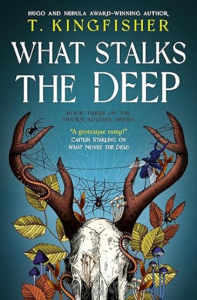 The third in the “Sworn Soldier” series, after What Moves the Dead and What Feasts at Night. Alex Easton is a witty, gender-nonconforming narrator, which is why I persist with these novellas even though I’m underwhelmed by the plots. Denton, the American doctor friend from the first book, begs Easton to come to West Virginia: his cousin Oscar has gone missing in a mine after sending a series of alarming letters about a red light he saw in the depths. Easton and their right-hand man, Angus, soon encounter claustrophobia-inducing cave systems, various kinds of bad air and siphonophore-like marine creatures that can assemble to imitate other beings. (Why aren’t these on the cover, huh?!) In other intriguing matters, Denton seems to have something going on with his friend John Ingold, an Indigenous scientist. Though, as Easton frequently reminds themself, that’s none of our business. There are some great set-pieces and funny, if anachronistic, asides (on learning how to flick a lighter just right: “I used to practice it for hours as a teenager, in hopes of impressing girls. Look, girls were more easily impressed in those days. Shut up.”) But my feeling with all three books is that they’re over before they’ve barely begun, and they never deliver the expected horror. Smart-ass, queer fantasy/horror: these will be some people’s perfect books, just not mine. If you’re intrigued, do at least try the first one, which riffs on Poe. (Read via Edelweiss)
Woman, Eating by Claire Kohda (2022)
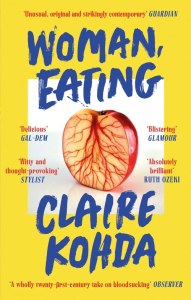 A very different sort of vampire novel. Twenty-three-year-old Lydia is half Japanese and half Malaysian; half human and half vampire. She’s trying to follow in her late father’s footsteps as an artist through an internship at a Battersea gallery, which comes with studio space where she’ll sleep to save money. But she can only drink blood like her mother, who turned her when she was a baby. Mostly she subsists on pig blood – which she can order dried if she can’t buy it fresh from a butcher – though, in one disturbing sequence, she brings home a duck carcass. When she falls for Ben, one of her studio-mates, she imagines what it would be like to be fully human: to make art together, to explore Asian cuisine, to bond over losing their mothers (his is dying of cancer; hers is in a care home with violence-tinged dementia). But Ben is already seeing someone, the internship is predictably dull, and a first attempt at consuming regular food goes badly wrong. There are a lot of promising threads in this debut. It’s fascinating how Lydia can intuit a creature’s whole life story by drinking their blood. She becomes obsessed with the Baba Yaga folk tale (and also mentions Malay vampire legends) and there’s a neat little bit of #MeToo revenge. But overall, it’s half-baked. Really, it’s just a disaster-woman book in disguise. The way Lydia’s identity determines her attitudes towards food and sex feels like a symbol of body dysmorphia. I’ll look out to see if Kohda does something more distinctive in future. (Secondhand – Awesomebooks.com)
More coming up on Halloween (thankfully, including books I liked better on average)!
Short Stories in September (and R.I.P.): The Secret Life of Insects by Bernardo Esquinca
For the ninth year in a row, I’m making a special effort to read short stories in September; otherwise, short fiction volumes tend to languish on my shelves (and e-readers) unread. In the past few years, I’ve managed to read 11 or 12 collections during the month of September.
I don’t consider myself a great short story fan, so I was surprised to see I’ve already read 20 collections this year. Several were via a spring rereading of Carol Shields’s complete stories with Marcie (Buried in Print). Some other highlights: Cocktail by Lisa Alward, longlisted for the Carol Shields Prize; Barcelona by Mary Costello; The Beggar Maid by Alice Munro; and a speculative trio: There Is a Rio Grande in Heaven by Ruben Reyes Jr. (reviewed for BookBrowse), The Man in the Banana Trees by Marguerite Sheffer (University of Iowa Press, 5 November; reviewed for Shelf Awareness), and How We Know Our Time Travelers by Anita Felicelli (WTAW Press, 3 December; forthcoming for Foreword Reviews).
First of my dedicated reviews for the month is a set of Mexican horror stories that happens to tie into R.I.P. (I always think that’s only in October, but it technically starts on 1 September):

The Secret Life of Insects by Bernardo Esquinca (2023)
[Translated from the Spanish by James D. Jenkins]
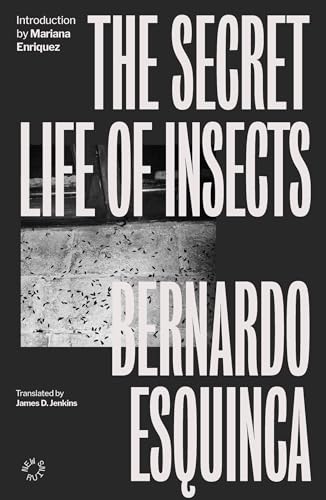
Esquinca channels classic horror authors such as H.P. Lovecraft and Edgar Allan Poe in these 14 creepy stories drawn from across his career. The settings include caves, forests and abandoned apartments; and octopi, cursed dolls and dreams are among the subjects. These characters are obsessed – or possessed. As in classic ghost stories, the protagonists tend to be researchers or writers whose absolute faith in logic is shaken by encounters with the supernatural. For instance, the narrator of the title story is a forensic entomologist who makes contact with his murdered wife; the undead feature in a couple of other stories, too.
 Mysterious manuscripts and therapy appointments also recur – there’s a scholarly Freudianism at play here. In the novella-length “Demoness,” friends at a twentieth high school reunion recount traumatic experiences from adolescence (not your average campfire fare). “Our traumas define us much more than our happy moments, [Ignacio, a Jesuit priest] thought. They’re the real revelations about ourselves.” Masturbation features heavily in this and in “Pan’s Noontide,” which has both of Arturo’s wives disappear in connection with an ecoterrorism cult. I occasionally found the content a bit macho and gross-out, and wished the women could be more than just sexualized supporting figures in male fantasies.
My favourite story was “Señor Ligotti” (no doubt in homage to American horror writer Thomas Ligotti), in which a struggling novelist unwittingly signs away more than he intended when the title character offers him an apartment and then a publishing deal. The Gothic black-and-white illustrations by Luis Perez Ochando are surreal or grotesque, and recall Bosch, Dalí and Hogarth. There is an introduction by Mariana Enriquez, whose stories I found more memorable in general, and I was also reminded slightly of Agustina Bazterrica. I’m by no means a regular horror reader yet found this book consistently engaging, though I concluded it had more style than soul. 
With thanks to New Ruins (Dead Ink) for the free copy for review.
Currently reading: I Can Outdance Jesus by Willie Davis, The Woman Who Gave Birth to Rabbits by Emma Donoghue, The Forester’s Daughter by Claire Keegan, The Souvenir Museum by Elizabeth McCracken, A New Day by Sue Mell, Ladies’ Lunch by Lore Segal
Resuming soon: The Secrets of a Fire King by Kim Edwards, The Best Short Stories 2023: The O. Henry Prize Winners (ed. Lauren Groff)
Up next: The Lone Ranger and Tonto Fistfight in Heaven by Sherman Alexie, The End of the World is a Cul de Sac by Louise Kennedy, Sinking Bell by Bojan Louis, Light Box by K.J. Orr, The Forgetters by Greg Sarris, The Long Swim by Terese Svoboda
Are you a short story fan? Read any good ones recently?
The Woman in Black, Train Dreams, and Absolutely & Forever (#NovNov23)
I’ve been slow off the mark this year, mostly because instead of reading a sensible one or two novellas at a time, I’ve had 10 or 15 on the go. It might mean I’ll read more overall, but from day to day it feels like crawling through loads of books, never to finish any. Except I did finally finish these three, all of which were great reads. After my thoughts on each, I’ll ponder this week’s prompt, “What Is a Novella?”
The Woman in Black by Susan Hill (1983)
This was a reread for me and our November book club book, as well as part of my casual project to read books from my birth year. I’ve generally been underwhelmed by Hill’s ghost stories, but I found this spookier than remembered and enjoyed spotting the nods to Victorian literature and to classic ghost story tropes. (Best of all, because it was so short, everyone actually read the book and came to the discussion. All 12 group members. I can’t recall the last time that happened!)
 Hill keeps the setting deliberately vague, but it seems that it might be the Lincolnshire Fens in the 1930s or so. Arthur Kipps is a young lawyer tasked with attending the funeral of old Mrs Drablow and sorting through her papers. Locals don’t envy him the time spent in Eel Marsh House, and when he starts seeing a wasting-away, smallpox-pocked woman dressed in black in the churchyard, he understands why. This place harbours a malevolent ghost, and from the empty nursery with its creaking rocking chair to the marsh’s treacherous mud, Arthur fears that it’s out to get him.
The rational male narrator who insists he doesn’t believe in ghosts until he can’t deny an experience of one is a feature of the traditional ghost story à la M.R. James – and indeed, one of the chapter titles here (“Whistle and I’ll Come to You”) is a direct adaptation of a James story title. A framing story has Kipps as an older man writing the ghost story to share with his stepchildren. Some secondary characters have Dickensian names and there’s a Bleak House-esque description of a thick fog. The novel’s title must be an homage to Wilkie Collins’s sensation novel The Woman in White, with which it shares the theme of debated parentage.
A few members of our book club had seen the play or one of two film versions. Curiously, it seems like both movies alter the ending. Why, when the last four pages are such a perfect kicker? I might have dismissed the whole as a bit dull were it not for the brilliant conclusion. (Public library) [160 pages] 
Train Dreams by Denis Johnson (2002)
This is Cathy’s example of a perfect novella. I picked it up on her recommendation and read it within a few days (though you could easily do so in one sitting). Robert Grainier is a manual labourer in the American West. His body shattered by logging before he turns 40 and his spirit nearly broken by the loss of his home to a forest fire, he looks for meaning in the tragedy and a purpose to the rest of his long life. Is he being punished for participating in the attempted lynching of a Chinese worker decried as a thief? Or for not helping an injured man he came across in the woods as a teenager?
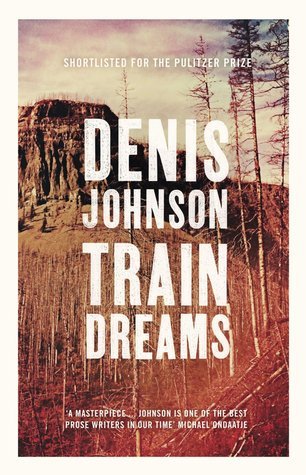 Although Grainier might appear to be a Job-like figure, his loneliness never shades into despair, lightened by comic dialogues and the mildest of supernatural interventions. He starts a haulage business and keeps dogs. There are rumours of a wolf-girl in the area, and, convinced that his dog’s new pups are part-wolf, he teaches them to howl – his own favourite way of letting off steam.
A couple of gratuitously bleak scenes (a confession of incest and an accidental death) made me think Cormac McCarthy would be a major influence, but the tone is lighter than that. Richard Brautigan came to mind, and I imagine many contemporary writers have found inspiration here: Carys Davies, Ash Davidson, Donald Ray Pollock, even Patrick deWitt.
Gritty yet light, this presents life as an arbitrary accumulation of error and incident, longing (“Pulchritude!”) and effort. Grainier is an effective Everyman, such that his story feels not just all-American but universal. (Free from a neighbour) [116 pages] 
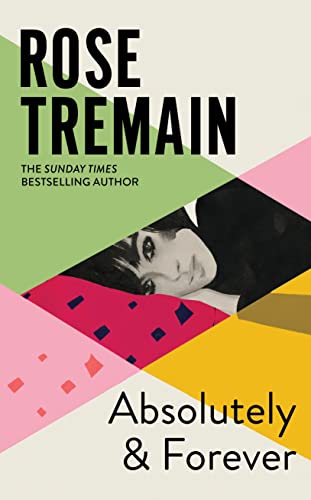
Absolutely and Forever by Rose Tremain (2023)
I had lost track of Tremain’s career a bit; I find her work hit and miss – perhaps too varied, though judging by her last five novels, she seems to have settled on historical fiction as her wheelhouse. I wasn’t sure what to expect from this latest book, but seeing that it was novella length, I was willing to give it a try. Tremain follows her heroine, Marianne Clifford, from the 1950s up to perhaps 1970. At age 15, she falls hopelessly in love with an 18-year-old aspiring writer, Simon Hurst, and loses her virginity in the back of his pale blue Morris Minor. She feels grown-up and sophisticated, and imagines their romance as a grand adventure that will whisk her away from her parents’ stultifying ordinariness –
when I thought about my future as Mrs Simon Hurst (riding a camel in Egypt, floating along in a gondola in Venice, driving through the Grand Canyon in an open-topped Cadillac, watching elephants drink from a waterhole in Africa) and about Mummy’s future (in the red-brick house in Berkshire with the shivery birch tree and the two white columns, playing Scrabble with Daddy and shopping at Bartlett’s of Newbury), I could see that my life was going to be more interesting than hers and that she might already be envious
 – but his new post-school life in Paris doesn’t have room for her. As she moves to London and trains for secretarial work, Marianne is bolstered by friendships with plain-speaking Scot Petronella (“Pet”) and Hugo Forster-Pellisier, her surfing and ping-pong partner on their parents’ Cornwall getaways. Forasmuch as her life changes over the next 15 years or so – taking on a traditional wife and homemaker role; her parents quietly declining – her attachment to her first love never falters.
This has the chic and convincing 1960s setting of Tessa Hadley’s work. Marianne’s narration is a delight, droll but not as blasé as she tries to appear. Tremain could have easily fallen into the trap of making her purely naïve (in the moment) or nostalgic (looking back), but instead she’s rendered her voice knowing yet compassionate, and made her a real wit (“I thought, Everything in Paris looks as if it’s practising the waltz, whereas quite a lot of things in London … appear as if they’ve just come out of hospital after a leg operation”). Pet is very funny, too. And it’s always fun for me to have nearby locations: Newbury, Reading, Marlborough. In imagining a different life for herself, Marianne resists repeating her mother’s mistakes and coincides with the rising feminist movement. There are two characters named Marianne, and two named Simon; the revelations about these doubles are breathtaking.
This really put me through an emotional wringer. It’s no cheap tear-jerker but a tender depiction of love in all its forms. I think, with Academy Street by Mary Costello, it may be my near-perfect novella. (Public library) [181 pages] 
Novellas in November, Week 2: What Is a Novella?
- Ponder the definition, list favourites, or choose ones you think best capture the ‘spirit’ of a novella.

A novella is defined by its length in words, but because that’s often difficult for readers to gauge, for this challenge we go by the number of pages instead, making 200 an absolute maximum – though some books with wide margins and spacing may top that but still seem slight enough to count (while those with tiny type can feel much longer than 160–200 pages).
Thematically, a novella is said to be concentrated on one character or small set of characters, with one plotline rather than several. This week I’ve been musing on a theory: a novella is to a novel what a memoir is to an autobiography. That is, if the latter is a comprehensive and often chronological story, the former focuses on a particular time or experience and shapes a narrative around it. What it potentially sacrifices in scope it makes up for with intensity.
But as soon as I’d formulated this hypothesis to myself, I started thinking of exceptions on either side. Train Dreams, like Silk by Alessandro Baricco and A Whole Life by Robert Seethaler, conveys a pretty complete life story. And no doubt there are many full-length novels that are almost claustrophobic in their adherence to one point of view and timeline.

The simplest way I’d put it is that a novella is a book that doesn’t outstay its welcome. I think it must be easier to write a doorstopper than a novella. Once you’ve arrived at a voice and a style, just keeping going can become a question of habit. But to continue paring back to get at the essence of a character and a situation – that takes real discipline. My other criterion would be that it has to portray the full range of human emotion, even if within a limited set of circumstances. Based on that, Train Dreams and Absolutely and Forever both triumph.
A few classic novellas that do this particularly well (links to my reviews):
Giovanni’s Room by James Baldwin
A Month in the Country by J. L. Carr
Miss Lonelyhearts by Nathanael West
Ethan Frome by Edith Wharton


A few more contemporary novellas that do this particularly well (links to my reviews):
A Lie Someone Told You about Yourself by Peter Ho Davies
Our Souls at Night by Kent Haruf
Foster by Claire Keegan
A Feather on the Breath of God by Sigrid Nunez


R.I.P., Part II: The Last House on Needless Street
My second contribution to this year’s Readers Imbibing Peril challenge (Part I is here), sliding in late on the final day. I’ve become quite the grump about the immense popularity of Halloween in the UK, even though I loved celebrating it as a kid in the States (dressing up and free candy, what’s not to like) and regularly came up with costumes until I was about 20. Year on year it has been turning into a huge thing over here. Creative outfits and pumpkin carving, fine. But instead it seems that all the worst aspects are on display: cheap plastic tat, misbehaving teenagers, unnecessary gore, wildlife-endangering fake cobwebs. Harrumph.
Anyway, I loved my two final R.I.P. selections, only one of which I managed to finish in time.
The Last House on Needless Street by Catriona Ward (2021)
 This came highly recommended by Annabel and Eleanor (and by my husband, who read it on his phone in less than 24 hours). Ted Bannerman lives the life of a hermit in the titular location, a creepy boarded-up house, with his tantrum-prone daughter, Lauren, and his precocious cat, Olivia, who happens to be highly religious and possibly lesbian. All three share narration duties, along with Dee after she moves into the neighbourhood determined to find out what happened to her little sister, Lulu, who disappeared from a local lake 11 years ago. She thinks Ted is the child abductor – or should that be serial killer? – responsible. As Ward sinks us deeper into Ted’s psyche and peculiar behaviours, we have to assume so, too. But, to put that suspense plot cliché to good use, nothing is what it seems here…
In an afterword, Ward describes this as “a book about survival, disguised as a book about horror.” It’s both, really. There is a touch of supernatural dread, what with the little references to the Breton myth of the death-bringing ankou, but the real horror is how damaged people inflict damage on others – and on themselves. (Content warnings for child abuse, self-harm and suicide.) It’s impressive how acutely Ward depicts mental health while still producing a rollicking story with memorable characters. How could you not love a book with the lines “If there’s anything better than a cat on the bed, I don’t know about it” and “Olivia is not a pet. She’s so much more than that. I expect everyone feels this about their cat”?! I’m not usually one for a psychological thriller, but I’d look out for more from Ward. (Public library)
 I’m also halfway through High Spirits: A Collection of Ghost Stories (1982) by Robertson Davies and enjoying it immensely. Davies was a Master of Massey College at the University of Toronto. These 18 stories, one for each year of his tenure, were his contribution to the annual Christmas party entertainment. They are short and slightly campy tales told in the first person by an intellectual who definitely doesn’t believe in ghosts – until one is encountered. The spirits are historic royals, politicians, writers or figures from legend. In a pastiche of the classic ghost story à la M.R. James, the pompous speaker is often a scholar of some esoteric field and gives elaborate descriptions. “When Satan Goes Home for Christmas” and “Dickens Digested” are particularly amusing. This will make a perfect bridge between Halloween and Christmas. (National Trust secondhand shop)
R.I.P., Part I: Michel Faber, Rebecca Green and Lize Meddings
For my first installment of this year’s Readers Imbibing Peril challenge, I have a highly undemanding selection of a novella, a picture book, and a teen graphic novel. And nothing here is nearly as scary as proper horror-fiction readers might be expecting.
The Hundred and Ninety-Nine Steps by Michel Faber (2001)
 One of my reads in Hay was this suspenseful novella set in Whitby. Faber was invited by the then artist in residence at Whitby Abbey to write a story inspired by the English Heritage archaeological excavation taking place there in the summer of 2000. His protagonist, Siân, is living in a hotel and working on the dig. She meets Magnus, a handsome doctor, when he comes to exercise the dog he inherited from his late father on the stone steps leading up to the abbey. Siân had been in an accident and is still dealing with the physical and mental after-effects. Each morning she wakes from a nightmare of a man with large hands slitting her throat. When Magnus brings her a centuries-old message in a bottle from his father’s house for her to open and decipher, another layer of intrigue enters: the crumbling document appears to be a murderer’s confession.
At first I worried Faber would turn this into a simple, predictable ghost story and milk expected sources of trauma. But the plot twists kept surprising me. The focus on women’s bodies and sexuality is appropriate for the town that gave us Dracula. This had hidden depths and at 116 pages could easily be a one-sitting read. Hadrian the dog is a great character, too, and this is even in my favourite font, Mrs Eaves, one that Canongate uses often. [Unfortunate error: Faber twice refers to Whitby as being Northumbrian. Although it was in the historical kingdom of Northumbria, it is actually in North Yorkshire rather than Northumberland.] (Secondhand – Bookcase, Carlisle)
How to Make Friends with a Ghost by Rebecca Green (2017)
 Here Green proposes a ghost as a lifelong, visible friend. The book has more words and more advanced ideas than much of what I pick up from the picture book boxes. It’s presented as almost a field guide to understanding the origins and behaviours of ghosts, or maybe a new parent’s or pet owner’s handbook telling how to approach things like baths, bedtime and feeding. What’s unusual about it is that Green takes what’s generally understood as spooky about ghosts and makes it cutesy through faux expert quotes, recipes, etc. She also employs Rowling-esque grossness, e.g. toe jam served on musty biscuits. Perhaps her aim was to tame and thus defang what might make young children afraid. I enjoyed the art more than the sometimes twee words. (Public library)
The Sad Ghost Club by Lize Meddings (2021)
 This is the simplest of comics. Sam or “SG” goes around wearing a sheet – a tangible depression they can’t take off. (Again, ghosts aren’t really scary here, just a metaphor for not fully living.) Anxiety about school assignments and lack of friends is nearly overwhelming, but at a party SG notices a kindred spirit also dressed in a sheet: Socks. They’re awkward with each other until they dare to be vulnerable, stop posing as cool, and instead share how much they’re struggling with their mental health. Just to find someone who says “I know exactly what you mean” and can help keep things in perspective is huge. The book ends with SG on a quest to find others in the same situation. The whole thing is in black-and-white and the setups are minimalist (houses, a grocery store, a party, empty streets, a bench in a wooded area where they overlook the town). Not a whole lot of art skill required to illustrate this one, but it’s sweet and well-meaning. I definitely don’t need to read the sequels, though. The tone is similar to the later Heartstopper books and the art is similar to in Sheets and Delicates by Brenna Thummler, all of which are much more accomplished as graphic novels go. (Public library)
Review Catch-up: Lost & Found and Briefly, A Delicious Life
Picador has become one of the most reliable publishers for me, whether it’s fiction or nonfiction. My ever more preposterous backlog won’t be diminishing much before the end of the year, but here are two 2022 Picador releases from my Most Anticipated list that I picked back up recently and enjoyed: a bereavement memoir turned love story, and a historical novel about a real writer–musician pair as observed by a centuries-dead ghost.
Lost & Found: A Memoir by Kathryn Schulz
Schulz is a staff writer for the New Yorker, and her 2010 book Being Wrong was my favourite kind of nonfiction: wide-ranging, erudite and uncategorizable. When I heard she’d written a bereavement memoir, I was beyond eager to read it. Her father, Isaac, was a scholarly and opinionated Polish Jew whose family emigrated from Israel via Germany to the USA in the early 1950s. Schulz grew up in the Cleveland suburbs of Ohio. Her father died at 74 after a decade of poor health. I read part of this book on the transatlantic flight to my mother’s funeral, and found the thoughts on grief so wise and true. “One of the many ways that loss instructs us is by correcting our sense of scale, showing us the world as it really is: so enormous, complex, and mysterious that there is nothing too large to be lost.”

But loss is not the end of this story; it overlaps with and is in some sense superseded by an unexpected romance. Introduced by mutual friends 18 months before her father’s death, Schulz and “C.” (fellow New Yorker writer Casey Cep) quickly fell in love and fashioned a life together on the Eastern Shore of Maryland, despite some significant differences in temperament and background – for instance, C. is a devout Lutheran while Schulz is a largely non-practicing Jew. She manages to braid this together with bereavement: “Love, like grief, has the properties of a fluid: it flows everywhere, fills any container, saturates everything.” My only slight frustration with the book was the amount of generic material on losing and finding and what other thinkers have had to say about these universal experiences – I tended to skip past it to get back to the narrative of her developing relationship with C.
Briefly, A Delicious Life by Nell Stevens
This is Stevens’s third book but her first novel; her previous books (Bleaker House and Mrs Gaskell & Me) were autofiction-ish but have tended to be classified as memoirs. That same playfulness with genre is here, turning what could have been a straightforward biographical novel about George Sand – in the vein of the underwhelming The Dream Lover by Elizabeth Berg – into something cheeky and magical.
George Sand spent the winter of 1838–9 on Mallorca with her children, Solange and Maurice, and her lover, composer Frédéric Chopin. Stevens imagines that the monastery where they stay is still haunted by Blanca, a teenager who died in childbirth (having been impregnated by one of the trainee monks) there in 1473. Sand and Chopin – between them “Godless foreign odd consumptive cross-dressers … strangers and strange and strangely insouciant about their strangeness” – are instantly unpopular with the locals.
Blanca draws readers along on a tour of own past and George’s. Like any benevolent ghost, she’s a fan of pranks, but also hopes that she might use her power of omniscience to reverse tragic trajectories. A lover of men in her lifetime, she’s now enamoured with women in the hereafter, and outraged at how, even centuries later, women’s rights and desire are still being ignored. This is an earthy, impish, sexy read. Though it starts to wear a little thin before the end, it’s still well worth the ride. 
With thanks to Picador for the proof copies for review.
Would you be interested in reading one or both of these? Do you have go-to/favourite publishers?
R.I.P. Reads, Part I: Ahlberg, Gaskell, Hinchcliffe and Watson
I don’t generally read horror or suspense, but the R.I.P. challenge is my annual excuse to pick up some slightly scarier material. For this first installment of super-short responses, I have a children’s book about a seriously problematic cat, a Victorian ghost story, and two recent Scotland-set novels about exiles haunted by the unexplained. (All: Public library)

The Improbable Cat by Allan Ahlberg (2003)
 I picked this up expecting a cute cat tale for children, only realizing afterwards that it’s considered horror. When a grey kitten wanders into their garden, Davy is less enamoured than the rest of the Burrell family. His suspicion mounts as the creature starts holding court in the lounge, expecting lavish meals and attention at all times. His parents and sister seem to be under the cat’s spell in some way, and it’s growing much faster than any young animal should. Davy and his pal George decide to do something about it. Since I’m a cat owner, I’m not big into evil cat stories (e.g., Cat out of Hell by Lynne Truss), and this one was so short as to feel underdeveloped.
 “The Old Nurse’s Story” by Elizabeth Gaskell (1852)
(collected in Gothic Tales (2000), ed. Laura Kranzler)
I had no idea that Gaskell had published short fiction, let alone ghost stories. Based on the Goodreads and blogger reviews, I chose one story to read. The title character tells her young charges about when their mother was a child and the ghost of a little girl tried to lure her out onto the Northumberland Fells one freezing winter. It’s predictable for anyone who reads ghost stories, but had a bit of an untamed Wuthering Heights feel to it.
Hare House by Sally Hinchcliffe (2022)
 The unnamed narrator is a disgraced teacher who leaves London for a rental cottage on the Hare House estate in Galloway. Her landlord, Grant Henderson, and his rebellious teenage sister, Cass, are still reeling from the untimely death of their brother. The narrator gets caught up in their lives even though her shrewish neighbour warns her not to. There was a lot that I loved about the atmosphere of this one: the southwest Scotland setting; the slow turn of the seasons as the narrator cycles around the narrow lanes and finds it getting dark earlier, and cold; the inclusion of shape-shifting and enchantment myths; the creepy taxidermy up at the manor house; and the peculiar fainting girls/mass hysteria episode that precipitated the narrator’s banishment and complicates her relationship with Cass. The further you get, the more unreliable you realize this narrator is, yet you keep rooting for her. There are a few too many set pieces involving dead animals, and, overall, perhaps more supernatural influences than are fully explored, but I liked Hinchcliffe’s writing enough to look out for what else she will write. (Readalikes: The Haunting of Hill House and Wakenhyrst)
Metronome by Tom Watson (2022)
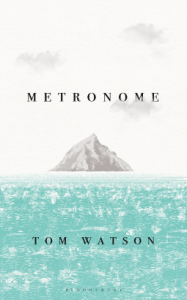 Ever since I read Blurb Your Enthusiasm, I’ve been paying more attention to jacket copy. This is an example of a great synopsis that really gives a sense of the plot: mysterious events, suspicion within a marriage, and curiosity about what else might be out there. Aina and Whitney believe they are the only people on their island. They live simply on a croft and hope that, 12 years after their exile, they’ll soon be up for parole. Whitney stubbornly insists they wait for the warden to rescue them, while Aina has given up thinking anyone will ever come. There’s a slight Beckettian air, then, to the first two-thirds of this dystopian novel. When someone does turn up, it’s not who they expect. The eventual focus on parenthood meant this reminded me a lot of The Road; there are also shades of The Water Cure and Doggerland (though, thankfully, the dual protagonists ensure a less overly male atmosphere than in the latter). This was an easy and reasonably intriguing read, but ultimately a bit vague and bleak for me, and not distinguished enough at the level of the prose (e.g., way too many uses of “onside”).
Women’s Prize Longlist Reviews (Erdrich, Mendelson, Ozeki) & Predictions
Tomorrow the Women’s Prize shortlist will be revealed. I’ve become much more invested in this prize over the past few years and will be following the 2022 race especially closely – look out for a related announcement soon. In recent years the nominees have tended to cluster thematically, which can feel redundant. This longlist has a notably high ghost quotient. Two novels I review below feature unquiet spirits, an appearance by the author, and the magical powers of books. The third is a straightforward contemporary dysfunctional family story.
The Sentence by Louise Erdrich
My second from Erdrich (I gave Love Medicine, her first novel, 5 stars in 2020). I will be revisiting this in June because it is our first pick for my tenure in the Literary Wives online book club. For that post I’ll focus on the relationship between Tookie and Pollux, which I won’t mention in this more general response. I was worried that a take on very recent events – this is set in Minneapolis between 2019 and 2020 and covers the first six months of the pandemic plus local protests following George Floyd’s murder – would seem either rushed or dated. I’m still unsure how I feel about encountering Covid-19 in fiction (vs. I’ve read 20 or more nonfiction records now), but I think this novel functions as a sturdy time capsule.
 Tookie, the narrator, has a tough exterior but a tender heart. When she spent 10 years in prison for a misunderstanding-cum-body snatching, books helped her survive, starting with the dictionary. Once she got out, she translated her love of words into work as a bookseller at Birchbark Books, Louise Erdrich’s Minnesota independent bookshop (Louise herself is an occasional character). Bibliophiles are sure to enjoy the mentions of the books she presses into customers’ hands; there’s also a fun appendix of recommendations on particular topics.
However, the central mystery about Flora, a dead customer who haunts the store until Tookie figures out why she died and how to exorcise her, struck me as silly. I only appreciated this storyline to the extent that it explores authenticity (Flora may have fabricated her Native heritage) and the inescapability of history. I preferred real life: Tookie getting locked down with her stepdaughter and baby grandson and filling book orders from a closed shop.
Erdrich weaves in Indigenous customs naturally and the banter between the characters, including young shop employees, makes this hip and lighthearted, even as it deals with serious subjects. I smiled at the bookish lingo, like Tookie’s division of her reading into a Lazy Stack and a Hard Stack (“books I would avoid reading until some wellspring of mental energy was uncapped” – my occasional and set-aside titles could comprise the latter) and the “cowbirds,” self-published titles secreted on the shelves that aren’t found until inventory day. There’s also an excellent passage on novellas that I’ll be bringing out in November.
Like a vintage armchair, this is a little overstuffed, but so comfortable you’ll want to stay a while. (See also Laura’s review.) (Public library)
The Exhibitionist by Charlotte Mendelson
~SPOILERS IN THIS ONE~
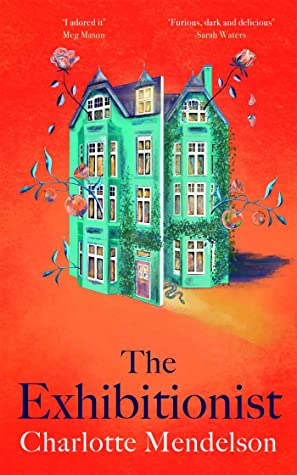 Artists, dysfunctional families, and limited settings (here, one crumbling London house and its environs; and about two days across one weekend) are irresistible elements for me, and I don’t mind a work being peopled with mostly unlikable characters. That’s just as well, because the narrative orbits Ray Hanrahan, a monstrous narcissist who insists that his family put his painting career above all else. His wife, Lucia, is a sculptor who has always sacrificed her own art to ensure Ray’s success. But now Lucia, having survived breast cancer, has the chance to focus on herself. She’s tolerated his extramarital dalliances all along; why not see where her crush on MP Priya Menon leads? What with fresh love and the offer of her own exhibition in Venice, maybe she truly can start over in her fifties.
Ray and Lucia’s three grown children, Leah, Patrick and Jess, are all home for Ray’s new exhibition. They’re mere sketches: Leah is Ray’s staunchest supporter and is infatuated with the no-show caterer; Patrick’s mental health is shaky, interfering with his job prospects; Jess, a teacher in Edinburgh, is pregnant but not sure she’s committed to her boyfriend long term. I wanted more depth from all the characters, but especially the offspring. I also expected a climactic late scene on Hampstead Heath to come to more.
Still, the build-up to the exhibit (followed by a laughably pitiful reveal) and Lucia’s inner life form an adequately strong foundation for Mendelson’s sardonic prose. The dialogue, full of interruptions, is true to life. This is her fifth novel and called to mind Jami Attenberg’s and Claire Fuller’s work. (Liz found shades of Iris Murdoch. Susan loved it, too.) I wouldn’t say I’m compelled to seek out more by Mendelson, but this was a solid read. (Public library)
The Book of Form and Emptiness by Ruth Ozeki
A Tale for the Time Being is one of my favourite novels of the century (and one of my most popular Goodreads reviews ever), My Year of Meats was a terrific backlist read a couple of summers ago, and I’m eager to catch up on All Over Creation. So I’d built up this fourth Ozeki novel in my head, thinking a library setting and magic realist elements presaged something deliciously Murakami-esque.
 What I actually found, having limped through it off and on for seven months, was something of a disappointment. A frank depiction of the mental health struggles of the Oh family? Great. A paean to how books and libraries can save us by showing us a way out of our own heads? A-OK. The problem is with the twee way that The Book narrates Benny’s story and engages him in a conversation about fate versus choice.
When Kenji Oh, a jazz musician, is run over by a chicken truck, Annabelle finds herself a single mother to Benny, a troubled teen who starts to hear everyday objects speaking to him. His voices and Annabelle’s hoarding habit jeopardize the viability of their household: Benny spends time on a psychiatric hospital ward for minors and Annabelle is threatened with eviction. For Benny, the library and the acquaintances he makes there – a fellow pedi-psych patient named Alice who calls herself The Aleph, an Eastern European philosopher who goes by The Bottleman (= Slavoj Žižek?), even the Ozeki figure tapping away on her laptop – may be his salvation; for Annabelle, it could be the book Tidy Magic (modelled on Marie Kondo’s work), written by a Buddhist nun. But until then, their stories get very dark indeed.
Concern for the principal pair and their relationship kept me reading even though this is too long and I wearied of Ozeki’s habit of literalizing metaphors (books speaking to people; being crushed by one’s belongings; crows playing a protective role). I’m still sympathetic to Ozeki’s aims, even if she doesn’t quite pull it all off here. If I pit the rather similar The Sentence and The Book of Form and Emptiness against each other, Erdrich comes out ahead.
With thanks to Canongate for the proof copy for review.
I’ve gotten to six books from the longlist so far and have a few more on order at the library. The others I’ve read, with ratings and links to my reviews, are:
Build Your House around My Body by Violet Kupersmith
Sorrow and Bliss by Meg Mason
I’m also partway through The Final Revival of Opal & Nev by Dawnie Walton, which is enjoyable enough but, alas, suffers in comparison to Daisy Jones and the Six, whose format (a composite oral history of a fictional 1960s/70s musical act) it repeats. The addition of the race issue doesn’t feel sufficient to call it original.
I’ve also DNFed a few from the longlist, two of them multiple times, so I have my fingers crossed that they don’t advance!
- The Paper Palace by Miranda Cowley Heller
- The Island of Missing Trees by Elif Shafak
- Great Circle by Maggie Shipstead
My attitude to the rest of the longlist is…
- The Bread the Devil Knead by Lisa Allen-Agostini – No plans to read.
- Salt Lick by Lulu Allison – I might read this from the library. I’m leery of dystopias, but I’m there for a chorus of cows.
- Careless by Kirsty Capes – No plans to read.
- Remote Sympathy by Catherine Chidgey – I would happily read it if it’s shortlisted, but at over 500 pages I fear it’ll be too dense.
- Flamingo by Rachel Elliott – Maybe. Sounds like pretty standard Sarah Winman-type stuff, but it could go down well with a book club.
- This One Sky Day by Leone Ross – No plans to read.
- Creatures of Passage by Morowa Yejidé – I was actually pretty keen to read this one, so I have it on reserve at the library. Egyptian mythology makes a change from the overdone Greeks, and the Washington, D.C. setting is a big draw. Laura’s review has tempered my expectations, but I might still give it a go.
My ideal shortlist (a wish list based on my reading and what I still want to read):
The Sentence by Louise Erdrich
Build Your House around My Body by Violet Kupersmith
Sorrow and Bliss by Meg Mason
The Exhibitionist by Charlotte Mendelson
The Final Revival of Opal & Nev by Dawnie Walton
Creatures of Passage by Morowa Yejidé
vs.
My predicted shortlist:
Remote Sympathy by Catherine Chidgey
The Sentence by Louise Erdrich
Sorrow and Bliss by Meg Mason
The Exhibitionist by Charlotte Mendelson
This One Sky Day by Leone Ross
The Island of Missing Trees by Elif Shafak
An overall winner? Gosh, it’s too early to tell. But maybe The Sentence, Sorrow and Bliss or The Island of Missing Trees.
See also Laura’s shortlist predictions.
What have you read from the longlist so far?
Which of these books are calling to you?
Review Catch-Up: Jhalak and Women’s Prize Nominees, Etc.
Another in an ongoing series as I catch up on the current and previous year releases I’ve been sent for review. Today I have four books by women: a poetry collection about living between countries and languages, a magic realist novel about vengeful spirits in Vietnam, a memoir in verse about the disabled body and queer parenting, and a novel set in gentrifying Puerto Rican neighbourhoods of New York City.
From the Jhalak Prize longlist:
Honorifics by Cynthia Miller (2021)
Miller is a Malaysian American poet currently living in Edinburgh. Honorifics was also shortlisted for the Forward Prize for Best First Collection. Its themes resonate with poetry I’ve read by other Asian women like Romalyn Ante and Jenny Xie and with the works of mixed-race authors such as Jessica J. Lee and Nina Mingya Powles: living between two or more countries and feeling like an exile versus finding a sense of home.
Nightly, you rosary American synonyms for success learned the hard way: suburb – 10-year visa – promotion – carpool – mortgage – parent-teacher conference – nuclear family – assimilation … Homecoming is the last, hardest thing you’ll ask yourself to do.
(from “Homecoming”)
 “Loving v. Virginia” celebrates interracial love: “Look at us, improper. Look at us, indecent. Look at us, incandescent and loving.” Food is a vehicle for memory, as are home videos. Like Ante, Miller has a poem based on her mother’s voicemail messages. “Glitch honorifics” gives the characters for different family relationships, comparing Chinese and Hokkien. The imagery is full of colour and light, plants and paintings. A terrific central section called “Bloom” contains 10 jellyfish poems (“We bloom like nuclear hydrangea … I’m an unwound chandelier, / a 150-foot-long coil of cilia, // made up of a million gelatinous foxgloves.”).
Miller incorporates a lot of unusual structures, some of them traditional forms (“Sonnet with lighthouses,” “Moon goddess ghazal,” “Persimmon abecedarian”) and others freer forms like a numbered list, columns, dictionary definitions or prose paragraphs. Six of the poems cite an inspiration; I could particularly see the influence in “The Home Office after Caroline Bird” – an absurdist take on government immigration policy.
There’s much variety here, and so many beautiful lines and evocative images. “Malaysiana,” a tour through everything she loves about the country of her birth, was my single favourite poem, and a couple more passages I loved were “the heart measuring breaths like levelling sugar / for a batter, the heart saying / why don’t you come in from the cold.” (from “The impossible physiology of the free diver”) and the last two stanzas of “Lupins”: “Some days / their purple spines // are the only things / holding me up.” Flora and fauna references plus a consideration of the expat life meant this was custom made for me, but I’d recommend it to anyone looking to try out different styles of contemporary poetry.
With thanks to Nine Arches Press for the free copy for review.
From the Women’s Prize longlist:
Build Your House around My Body by Violet Kupersmith (2021)
 Back in 2014, I reviewed Kupersmith’s debut collection, The Frangipani Hotel, for BookBrowse. I was held rapt by its ghostly stories of Vietnam, so I was delighted to hear that she had written a debut novel, and it was one of my few correct predictions for the Women’s Prize nominees. The main action takes place between when Winnie – half white and half Vietnamese – arrives in Saigon to teach English in 2010, and when she disappears from the house she shared with her boyfriend of three months, Long, in March 2011. But the timeline darts about to tell a much more expansive story, starting with the Japanese invasion of Vietnam in the 1940s. Each date is given as the number of months or years before or after Winnie’s disappearance.
Winnie starts off living with a great-aunt and cousins, and meets a family friend, Dr. Sang, who’s been experimenting on a hallucinogenic drug made from cobra venom. Long and his brother, Tan, a policeman, were childhood friends with a fearless young woman named Binh – now a vengeful ghost haunting them both. Meanwhile, the Saigon Spirit Eradication Company, led by the Fortune Teller, is called upon to eradicate a ghost – which from time to time seems to inhabit a small dog – from a snake-infested highland estate. These strands are bound to meet, and smoke and snakes wind their way through them all.
I enjoyed Kupersmith’s energetic writing, which reminded me by turns of Nicola Barker, Ned Beauman, Elaine Castillo and Naoise Dolan, and the glimpses of Cambodia and Vietnam we get through meals and motorbike rides. What happens with Belly the dog towards the end is fantastic. But the chronology feels needlessly complex, with the flashbacks to colonial history and even to Binh’s story not adding enough to the narrative. While I’d still like to see Kupersmith make the shortlist, I can recommend her short stories that bit more highly.
With thanks to Oneworld for the free copy for review.
Handbook for the Newly Disabled: A Lyric Memoir by Allison Blevins (2022)
 Allison Blevins, a poet, has published five chapbooks or collections and has another forthcoming. Based in Missouri and the director of an indie press, she tells her story of chronic illness and queer parenting in 10 “chapters” composed of multi-part poems. She moves through brain fog and commemorates pain and desire, which cannot always coexist (as in “How to F**k a Disabled Body”).
I’ll never
ride a bike again, hike, carry my children. I’m learning to number what I’ve lost.
Because of the pills, I no longer fall into sleep, I stop. I used to hate queer at 19
when I was a dyke. I can’t be disabled. I need a better word. I need a body that floats—
translucent and liquid—to my daughter’s bed, to cover her like cotton-red quilted stars.
(from “Brain Fog”)
Sometimes the title is enough: “My Neurologist (Who Doesn’t Have MS) Explains Pain Is Not a Symptom of MS.” Other times, what is left out, or erased (as in “Five by Five”) is what matters the most. For instance, the Photo Illustrations promised in the titles of two chapters are replaced by Accessibility Notes. That strategy reminded me of one Raymond Antrobus has used. Alliteration, synesthesia and the language of the body express the complexities of a friend’s cancer, having a trans partner, and coming to terms with sexuality (“I think now that being queer was easy, easy as forgetting / being born”). A really interesting work and an author I’d like to read more from.
Published by BlazeVOX [books] on 22 March. With thanks to the author for the e-copy for review.
Olga Dies Dreaming by Xóchitl González (2022)
 This was on my radar thanks to a starred Kirkus review. It would have been a good choice for the Women’s Prize longlist, with its bold heroine, Latinx and gay characters, and blend of literary and women’s fiction. The Puerto Rican immigrant community and gentrifying neighbourhoods of New York City are appealing locales, and Olga is a clever, gutsy protagonist. As the novel opens in 2017, she’s working out how best to fleece the rich families whose progeny’s weddings she plans. Today it’s embezzling napkins for her cousin Mabel’s wedding. Next: stockpiling cut-price champagne. Olga’s brother Prieto, a slick congressman inevitably nicknamed the “Latino Obama,” is a closeted gay man. Their late father was a drug addict; their mother left to be part of a revolutionary movement back in PR and sends her children occasional chiding letters when they appear to be selling out.
The aftermath of Hurricane Maria coincides with upheaval in Olga’s and Prieto’s personal and professional lives. The ins and outs of Puerto Rican politics went over my head somewhat, and the various schemes and conspiracy theories get slightly silly. The thread that most engaged me was Olga’s relationship with Matteo, a hoarder. I hoped that, following the satire of earlier parts (“Olga realized she’d allowed herself to become distracted from the true American dream—accumulating money—by its phantom cousin, accumulating fame. She would never make that mistake again”), there might be a message about the emptiness of the pursuit of wealth. So I ended up a little disappointed by a late revelation about Matteo.
However, I did appreciate the picture of how Olga is up against it as both a woman and a person of colour (“no person of color serious about being taken seriously was ever late to meet white people”). This debut was perhaps a little unsure of what it wanted to be, but the novelty of the main elements was enough to make it worth reading.
With thanks to Fleet for the free copy for review.
Would you be interested in reading one or more of these?
R.I.P. Reads for Halloween: Ashworth, Bazterrica, Hill, Machado & More
I don’t often read anything that could be classed as suspense or horror, so the R.I.P. challenge is a fun excuse to dip a toe into these genres each year. This year I have an eerie relationship study, a dystopian scenario where cannibalism has become the norm, some traditional ghost stories old and new, and a bonus story encountered in an unrelated anthology.

Ghosted: A Love Story by Jenn Ashworth (2021)
Laurie’s life is thrown off kilter when, after they’ve been together 15 years, her husband Mark disappears one day, taking nothing with him. She continues in her job as a cleaner on a university campus in northwest England. After work she visits her father, who is suffering from dementia, and his Ukrainian carer Olena. In general, she pretends that nothing has happened, caring little how odd it will appear that she didn’t call the police until Mark had been gone for five weeks. Despite her obsession with true crime podcasts, she can’t seem to imagine that anything untoward has happened to him. What happened to Mark, and what’s with that spooky spare room in their flat that Laurie won’t let anyone enter?
 If you find unreliable narrators delicious, you’re in the right place. The mood is confessional, yet Laurie is anything but confiding. Occasionally she apologizes for her behaviour: “I realise this does not sound very sane” is one of her concessions to readers’ rationality. So her drinking problem doesn’t become evident until nearly halfway through, and a bombshell is still to come. It’s the key to understanding our protagonist and why she’s acted this way.
Ghosted wasn’t what I expected. Its air of supernatural menace mellows; what is to be feared is much more ordinary. The subtitle should have been more of a clue for me. I appreciated the working class, northern setting (not often represented; Ashworth is up for this year’s Portico Prize) and the unusual relationships Laurie has with Olena, as well as with co-worker Eddie and neighbour Katrina. Reminiscent of Jo Baker’s The Body Lies and Sue Miller’s Monogamy, this story of a storm-tossed marriage was a solid introduction to Ashworth’s fiction – this is her fifth novel – but I’m not sure the payoff lived up to that amazing cover.
With thanks to Sceptre for the free copy for review.
Tender Is the Flesh by Agustina Bazterrica (2017; 2020)
[Translated from the Spanish by Sarah Moses]
 This sledgehammer of a short Argentinian novel has a simple premise: not long ago, animals were found to be infected with a virus that made them toxic to humans. During the euphemistic “Transition,” all domesticated and herd animals were killed and the roles they once held began to be filled by humans – hunted, sacrificed, butchered, scavenged, cooked and eaten. A whole gastronomic culture quickly developed around cannibalism.
Marcos is our guide to this horrific near-future world. Although he works in a slaughterhouse, he’s still uneasy with some aspects of the arrangement. The standard terminology is an attempt at dispassion: the “heads” are “processed” for their “meat.” Smarting from the loss of his baby son and with his father in a nursing home, Marcos still has enough compassion that when he’s gifted a high-quality female he views her as a person rather than potential cuts of flesh. His decisions from here on will call into question his loyalty to the new system.
I wondered if there would come a point where I was no longer physically able to keep reading. But it’s fiendishly clever how the book beckons you into analogical situations and then forces you to face up to cold truths. It’s impossible to avoid the animal-rights message (in a book full of gruesome scenes, the one that involves animals somehow hits hardest), but I also thought a lot about how human castes might work – dooming some to muteness, breeding and commodification, while others are the privileged overseers granted peaceful ends. Bazterrica also conflates sex and death in uncomfortable ways. In one sense, this was not easy to read. But in another, I was morbidly compelled to turn the pages. Brutal but brilliant stuff. (Public library/Edelweiss)
Fear: Tales of Terror and Suspense, selected by Roald Dahl (2017)
 I reviewed the five female-penned ghost stories for R.I.P. back in 2019. This year I picked out another five, leaving a final four for another year. (Review copy)
“W.S.” by L.P. Hartley: The only thing I’ve read of Hartley’s besides The Go-Between. Novelist Walter Streeter is confronted by one of his characters, to whom he gave the same initials. What’s real and what’s only going on in his head? Perfectly plotted and delicious.
“In the Tube” by E.F. Benson: The concept of time is called into question when someone witnesses a suicide on the London Underground some days before it could actually have happened. All recounted as a retrospective tale. Believably uncanny.
“Elias and the Draug” by Jonas Lie: A sea monster and ghost ship plague Norwegian fishermen.
“The Ghost of a Hand” by J. Sheridan Le Fanu: A disembodied hand wreaks havoc in an eighteenth-century household.
“On the Brighton Road” by Richard Middleton: A tramp meets an ill boy on a road in the Sussex Downs. A classic ghost story that pivots on its final line.
The Small Hand: A Ghost Story by Susan Hill (2010)
 This was my fourth of Hill’s classic ghost stories, after The Woman in Black, The Man in the Picture and Dolly. They’re always concise and so fluently written that the storytelling voice feels effortless. I wondered if this one might have been inspired by “The Ghost of a Hand” (above). It doesn’t feature a disembodied hand, per se, but the presence of a young boy who slips his hand into antiquarian book dealer Adam Snow’s when he stops at an abandoned house in the English countryside, and again when he goes to a French monastery to purchase a Shakespeare First Folio. Each time, Adam feels the ghost is pulling him to throw himself into a pond. When Adam confides in the monks and in his brother, he gets different advice. A pleasant and very quick read, if a little predictable. (Free from a neighbour)
And a bonus story:
 Carmen Maria Machado’s “The Lost Performance of the High Priestess of the Temple of Horror” appears in Kink (2021), a short story anthology edited by Garth Greenwell and R.O. Kwon. (I requested it from NetGalley just so I could read the stories by Machado and Brandon Taylor.) It opens “I would never forget the night I saw Maxa decompose before me.” A seamstress, obsessed with an actress, becomes her dresser. Set in the 19th-century Parisian theatre world, this pairs queer desire and early special effects and is over-the-top sensual in the vein of Angela Carter, with hints of the sadomasochism that got it a place here.
Sample lines: “Women seep because they occupy the filmy gauze between the world of the living and the dead.” & “Her body blotted out the moon. She was an ambulatory garden, a beacon in a dead season, life where life should not grow.”
Also counting the short stories by Octavia E. Butler and Bradley Sides, I did some great R.I.P. reading this year! I think the book that will stick with me the most is Tender Is the Flesh.
 Bookish Beck = Rebecca Foster. American transplant to England. Freelance proofreader and book reviewer.
 Bookish Beck