R.I.P. Reads, Part II: Feito, King, Link, Paver & Taylor
Soon it’ll be all novellas, all the time around here. But first I have a few more October reads to review.
A belated Happy Halloween! As a kid in the U.S. suburbs, I loved Halloween. It was such fun planning costumes – pumpkin, cowgirl and picnic table are a few memorable ones that I remember thanks to photographs – and my hoard of candy would last me for months. But these days, I tend to be pretty grumpy about the holiday. It never used to be a thing in the UK, but it has been creeping in year on year. I don’t mind a creatively carved jack o’ lantern, tasteful decoration or clever homemade costume. What does get my goat is plastic tat, gratuitous gore and the dozens of sodden sweets and wrappers littering the streets after last night’s rain and wind.
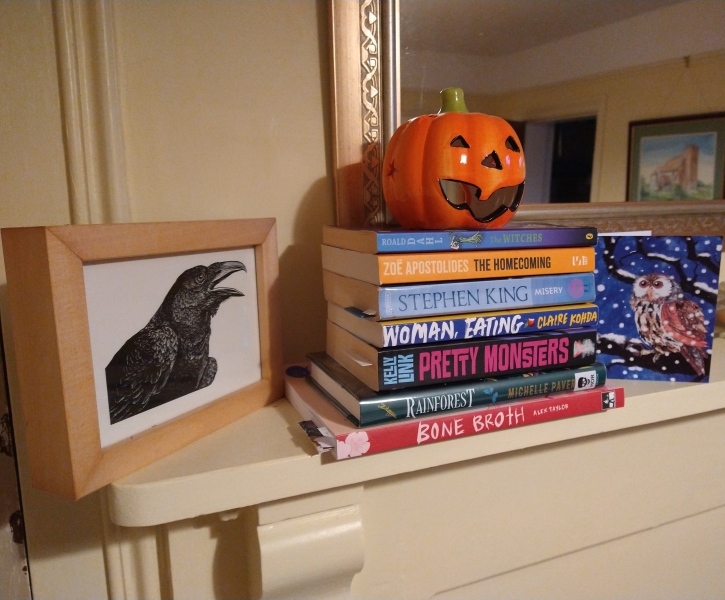
Anyway, we enjoyed the stormy evening because we spent it at friends’ having delicious autumnal lasagne and parkin, playing instruments and board games and eavesdropping on the trick-or-treaters. I had to laugh when J said “Take a couple” and one little girl replied, “That’s okay, I don’t really like sweeties.” These friends were keeping some ancient traditions alive: carving a turnip, wearing one’s clothes inside out and walking between two fires to ward off fairies. They also put potatoes in the treats bowl, which definitely confused the kids. (One did take a spud!)
I really leaned into the Readers Imbibing Peril reading this year. I had a somewhat lacklustre first batch, but these five were great!
Victorian Psycho by Virginia Feito (2025)
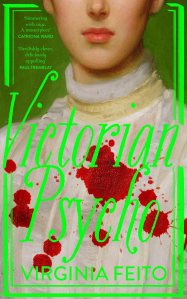 This was among my Most Anticipated titles of the year – for the bonkers blurb but also because of how much I’d enjoyed Feito’s debut, Mrs. March. Both novels go deep with mentally disturbed protagonists. The first channeled Patricia Highsmith with its stylish psychological suspense; here we have a full-on blend of slasher horror and sadistic humour, wrapped up in a Victorian pastiche. Winifred Notty (naughty girl indeed) is the new governess at Ensor House on the Yorkshire moors. She couldn’t care less about her charges, Andrew and Drusilla. No, she’s here to exact revenge on the master of the house, Mr. Pounds. But not before she’s dispatched many a random servant and baby. “Bodies pile up in the attic.” Her brutal fantasies are so realistic that at times it’s difficult to separate them from what she actually carries out. Miss Notty is also a highly sexual being whose fixations could certainly be interpreted in Freudian ways. Feito spins a traumatic backstory for her antiheroine but doesn’t make it any excuse for her gleeful reign of terror. It’s delicious fun, especially for a Victorianist, but don’t attempt if you’re squeamish. (Read via NetGalley)
Misery by Stephen King (1987)
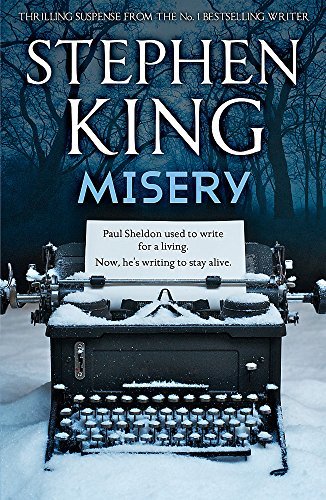 All these years I’d had two 1989–1990 films conflated: Misery and My Left Foot. I’ve not seen either but as an impressionable young’un I made a mental mash-up of the posters’ stills into a film featuring Daniel Day-Lewis as a paralyzed writer and Kathy Bates as a madwoman wielding an axe. (Turns out the left foot is relevant!)
Paul Sheldon wakes in a fog of pain, his legs shattered from a one-car accident on a snowy Colorado backroad. He’s famous for his historical potboilers about Misery Chastain but, like Arthur Conan Doyle with Sherlock Holmes, has killed off his most beloved character. Except now he’s in the home of Annie Wilkes, his rescuer and biggest fan, and she demands he resurrect Misery. Annie is a former nurse who left the profession after numerous suspicious deaths on her watch. She keeps Paul dependent on her – and on Novril, a fictional opiate. In a case of ‘Scheherazade complex’, he’ll be her prisoner until he’s completed a sequel that’s to her satisfaction. Compared to Pet Sematary, the only other King novel I’ve read, this was slow to draw me in because of the repetitive scenes in a claustrophobic setting, and I wearied of the excerpts from Paul’s manuscript. But eventually I was riveted, desperate to know how Paul was going to get out of this predicament and what the final showdown could be. Extremes of pain and obsession make this an intense study of the psychology of a wretched pair. (Public library)
Pretty Monsters by Kelly Link (2008)
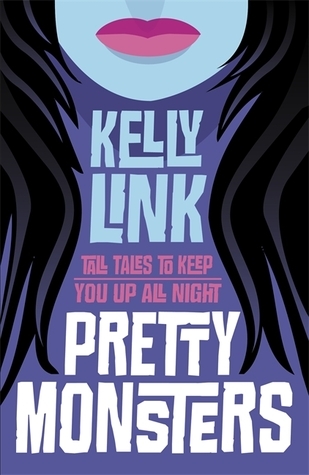 This is a reissue edition geared towards young adults. All but one of the 10 stories were originally published in literary magazines or anthologies. The stories are long, some approaching novella length, and took me quite a while to read. I got through the first three and will save the rest for next year. In “The Wrong Grave,” a teen decides to dig up his dead girlfriend’s casket to reclaim the poems he rashly buried with her last year – as did Dante Gabriel Rossetti, which Link makes a point of mentioning. A terrific blend of spookiness and comedy ensues.
“The Wizards of Perfil” and the title story are 50-some and 60-some pages, respectively, which allows a lot of space for intriguing weirdness and side plots. In the former, Onion’s cousin Halsa is purchased to be a servant to a wizard. The cousins both have the gift of foresight but can’t get the wizards to take them seriously when they beg that something to be done to prevent human disasters. It’s a brilliant allegory of the danger of waiting for an external force – God, the government, whatever – to solve everything versus getting on with it yourself. In the title story, a group of teens are obsessed with a mysterious Doctor Who-esque television show called The Library, which colours all their interactions. The main character Jeremy’s father is an eccentric sci-fi novelist named Gordon Strangle Mars who has written his son into his latest plot in a disturbing way. Jeremy recently inherited a gas station and phone box in Las Vegas and occasionally calls the phone box to air his grievances and solicit supernatural aid. My only other experience of Link was a standalone story I was once sent for review, “The Summer People,” which I didn’t get on with, so I was surprised to encounter such top-notch fantasy/horror tales. (Little Free Library)
Rainforest by Michelle Paver (2025)
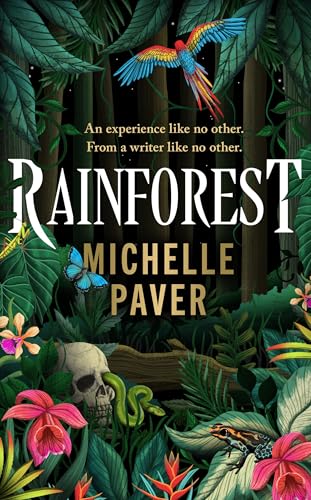 I’d read all three of Paver’s previous horror novels for adults (Thin Air, Dark Matter and Wakenhyrst) and found them easy, atmospheric reading but not nearly as scary as billed. This is her best yet. Set in 1973 on an expedition to Mexico, it has as its unreliable narrator Dr. Simon Corbett, an English entomologist. Adding to the findings of the archaeological dig he’s accompanying, he’ll be hunting for mantids (praying mantises, stick insects and the like) by fogging sacred trees with pesticides. He also experiments with taking a hallucinogenic plant extract used by the Indigenous shamans, hoping to be reunited with his lost love, Penelope.
We know that Corbett’s employment is tenuous and that he’s seeing a therapist. Paver authentically reproduces the casual racism and sexism of the time and seeds little hints that this protagonist may not be telling the whole truth about his relationship with Penelope. The long sequence where he’s lost in the jungle is fantastic. Corbett seems fated to repeat ancient masochistic rites, as if in penance for what he’s done wrong. My husband is an entomologist, so I was interested to read about period collecting practices. The novelty of the setting is a bonus to this high-quality psychological thriller and ghost story. (Public library)
Bone Broth by Alex Taylor (2025)
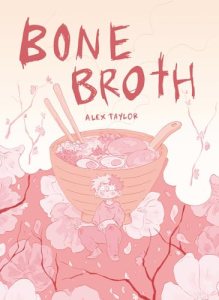 Ash is a trans man who starts working at a hole-in-the-wall ramen restaurant underneath a London railway arch. All he wants is to “pay for hormones, pay rent, [and] make enough to take a cutie on a date.” Bug’s Bones is run by an irascible elderly proprietor but staffed by a young multicultural bunch: Sock, Blue, Honey and Creamy. They quickly show Ash the ropes and within a month he’s turning out perfect bowls. He’s creeped out by the restaurant’s trademark bone broth, though, with its reminders of creatures turning into food. At the end of a drunken staff party, they find Bug lying dead and have to figure out what to do about it.
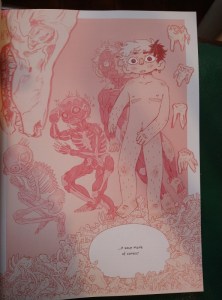 This storyline is in purple, whereas the alternating sequences of flashbacks are in a fleshy pinkish-red. As the two finally meet and meld, we see Ash trying to imitate the masculinity he sees on display while he waits for the surface to match what’s inside. I didn’t love the drawing style – though the full-page tableaux are a lot better than the high-school-sketchbook small panes – so that was an issue for me throughout, but this was an interesting, ghoulish take on the transmasc experience. Taylor won a First Graphic Novel Award.
With thanks to SelfMadeHero for the free copy for review.
And one DNF: Saltwash by Andrew Michael Hurley. (I was warned!) It had no menace or momentum at all…
Any stand-out creepy reading for you this year?
R.I.P. Reads, Part I: Apostolides, Dahl, Harkness, Kingfisher & Kohda
Ghosts, witches, vampires, creepy underground things: It can only be Readers Imbibing Peril time of year! Here’s my first five reviews.
The Homecoming by Zoë Apostolides (2025)
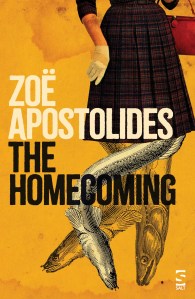 This debut novel dropped through my door as a total surprise: not only was it unsolicited, but I’d not heard about it. In this modern take on the traditional haunted house story, Ellen is a ghostwriter sent from London to Elver House, Northumberland, to work on the memoirs of its octogenarian owner, Catherine Carey. Ellen will stay in the remote manor house for a week and record 20 hours of audio interviews – enough to flesh out an autobiography. Miss Carey isn’t a forthcoming subject, but Ellen manages to learn that her father drowned in the nearby brook and that all Miss Carey did afterwards was meant to please her grieving mother and the strictures of the time. But as strange happenings in the house interfere with her task, Ellen begins to doubt she’ll come away with usable material. I was reminded of The Woman in Black, The Thirteenth Tale, and especially Wakenhyrst what with the local eel legends. The subplot about Ellen drifting apart from her best friend, a new mother, felt unnecessary, though I suppose was intended to bolster the main theme of women’s roles. There’s a twist that more seasoned readers of Gothic fiction and ghost stories might see coming. While I found this very readable and perfectly capably written, I didn’t get a sense of where the author hopes to fit in the literary market; she’s previously published a true crime narrative. Full disclosure: I once collaborated with Zoë on a Stylist assignment.
With thanks to Salt Publishing for the proof copy for review.
The Witches by Roald Dahl (1983)
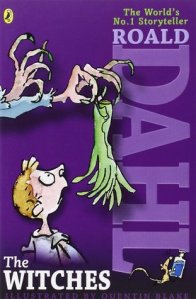 I’m sure I read all of Dahl’s major works when I was a child, though I had no specific memory of this one. After his parents’ death in a car accident, a boy lives in his family home in England with his Norwegian grandmother. She tells him stories from Norway and schools him in how to recognize and avoid witches. They wear wigs and special shoes to hide their baldness and square feet, and with their wide nostrils they sniff out children to turn them into hated creatures like slugs. When Grandmamma falls ill with pneumonia, she and the boy travel to a Bournemouth hotel for her recovery only to stumble upon a convention of witches under the guise of the Royal Society for the Prevention of Cruelty to Children. The Grand High Witch (Anjelica Huston, if you know the movie) has a new concoction that will transform children into mice at enough of a delay to occur the following morning at school. It’s up to the boy and his grandmother to save the day. I really enjoyed this caper, which I interpreted as being – like Tove Jansson’s The Summer Book – about imagination and making the most of one’s time with grandparents. But in the back of my mind was Jen Campbell’s objection to the stereotypical equating of disfigurement with villainy. The Grand High Witch also speaks with a heavy German accent. It would be understandable to dismiss this as dated and clichéd, but I still found it worthwhile. It also fit into my project to read books from my birth year. (Free from a neighbour)
The Black Bird Oracle by Deborah Harkness (2024)
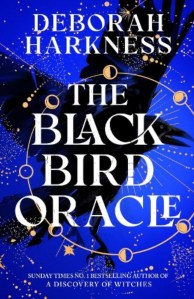 Somehow I’ve read this entire series even though none of the subsequent books lived up to A Discovery of Witches. What I loved about that first novel was how the author drew on her knowledge of the history of science to create a believable backdrop for a story of witches, vampires and other supernatural beings that took place largely in Oxford and its medieval libraries. Each sequel has elaborated further adventures for Diana Bishop, a witch; her vampire husband, Matthew de Clermont; and their family members and other hangers-on. Their twins, especially Becca, have inherited some of Diana’s power. I read the first half of this last year and finally skimmed to the end last week, so I haven’t retained much. Diana is summoned to the ancestral seat of the Bishops in Massachusetts and finds herself part of a community of gossipy, catty witches. (Dahl was right, they’re everywhere!) She has some fun, folksy interactions but things soon get more serious as she girds herself for a showdown with the darker implications of her gift. Overall, this didn’t add much to the ongoing narrative and the love scenes veered too close to romantasy for my liking. (Public library)
What Stalks the Deep by T. Kingfisher [Ursula Vernon] (2025)
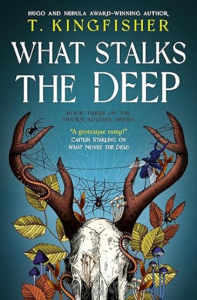 The third in the “Sworn Soldier” series, after What Moves the Dead and What Feasts at Night. Alex Easton is a witty, gender-nonconforming narrator, which is why I persist with these novellas even though I’m underwhelmed by the plots. Denton, the American doctor friend from the first book, begs Easton to come to West Virginia: his cousin Oscar has gone missing in a mine after sending a series of alarming letters about a red light he saw in the depths. Easton and their right-hand man, Angus, soon encounter claustrophobia-inducing cave systems, various kinds of bad air and siphonophore-like marine creatures that can assemble to imitate other beings. (Why aren’t these on the cover, huh?!) In other intriguing matters, Denton seems to have something going on with his friend John Ingold, an Indigenous scientist. Though, as Easton frequently reminds themself, that’s none of our business. There are some great set-pieces and funny, if anachronistic, asides (on learning how to flick a lighter just right: “I used to practice it for hours as a teenager, in hopes of impressing girls. Look, girls were more easily impressed in those days. Shut up.”) But my feeling with all three books is that they’re over before they’ve barely begun, and they never deliver the expected horror. Smart-ass, queer fantasy/horror: these will be some people’s perfect books, just not mine. If you’re intrigued, do at least try the first one, which riffs on Poe. (Read via Edelweiss)
Woman, Eating by Claire Kohda (2022)
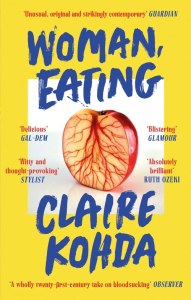 A very different sort of vampire novel. Twenty-three-year-old Lydia is half Japanese and half Malaysian; half human and half vampire. She’s trying to follow in her late father’s footsteps as an artist through an internship at a Battersea gallery, which comes with studio space where she’ll sleep to save money. But she can only drink blood like her mother, who turned her when she was a baby. Mostly she subsists on pig blood – which she can order dried if she can’t buy it fresh from a butcher – though, in one disturbing sequence, she brings home a duck carcass. When she falls for Ben, one of her studio-mates, she imagines what it would be like to be fully human: to make art together, to explore Asian cuisine, to bond over losing their mothers (his is dying of cancer; hers is in a care home with violence-tinged dementia). But Ben is already seeing someone, the internship is predictably dull, and a first attempt at consuming regular food goes badly wrong. There are a lot of promising threads in this debut. It’s fascinating how Lydia can intuit a creature’s whole life story by drinking their blood. She becomes obsessed with the Baba Yaga folk tale (and also mentions Malay vampire legends) and there’s a neat little bit of #MeToo revenge. But overall, it’s half-baked. Really, it’s just a disaster-woman book in disguise. The way Lydia’s identity determines her attitudes towards food and sex feels like a symbol of body dysmorphia. I’ll look out to see if Kohda does something more distinctive in future. (Secondhand – Awesomebooks.com)
More coming up on Halloween (thankfully, including books I liked better on average)!
20 Books of Summer, 6–7: Helen Dunmore and Stephen King
At least, I managed a pretty terrific pair, and completed half of my intended 4-in-a-row (the second row) on the Bingo card.


(Book featuring ice cream or summer foods)
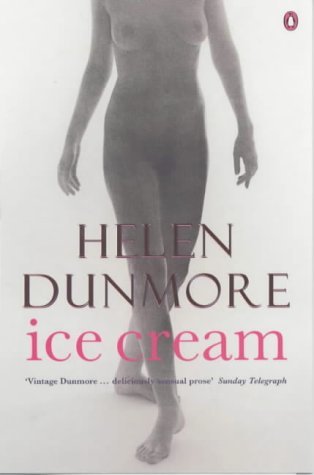
Ice Cream by Helen Dunmore (2000)
These 18 pieces are quite varied: a few have historical settings, two are written in the second person, and several return to the life of Ulli (a recurring character from Love of Fat Men), a Finnish teenager who faces an unexpected pregnancy. Even the slight-seeming ones are satisfying slices of fiction. The title story and its follow-up, “Be Vigilant, Rejoice, Eat Plenty” advocate sensual indulgence, which I guess is the reason for the cover image – which I couldn’t decide whether to hide or flaunt as I was reading it in public.
 Often, there is a hint of menace, whether the topic is salmon fishing, raspberry picking or the history of a lost ring. “The Clear and Rolling Water” has the atmosphere of a Scottish folk ballad, which made it perfect reading for our recent holiday to Scotland. “Leonardo, Michelangelo, SuperStork” and “Mason’s Mini-break” stand out for their dystopian and magic realist touches, respectively. In the former, couples are only allowed to conceive via state- sanctioned services; in the latter, an arrogant Booker Prize-winning author is patronizing when he meets a would-be writer while on holiday in Yorkshire.
Two of my favourites were “The Lighthouse Keeper’s Wife” and “Swimming into the Millennium,” which might have been written by Helen Simpson. All are of a high standard, and though they don’t fit together per se and mostly won’t stay with me, I really do rate Dunmore as a short story writer. (Secondhand – Community Furniture Project, Newbury) 
(Book from a genre you rarely read)
Pet Sematary by Stephen King (1983)
 I’d only ever read King’s On Writing and worried I wouldn’t be able to handle his fiction. I could never watch a horror film, but somehow the same content was okay in print. For half the length or more, it’s more of a mildly dread-laced, John Irving-esque novel about how we deal with the reality of death. Dr. Louis Creed and his family – wife Rachel, five-year-old daughter Ellie, two-year-old son Gage and cat Church (short for Winston Churchill) – have recently moved from Chicago to Maine for him to take up a post as head of University Medical Services. Their 83-year-old neighbour across the street, Judson Crandall, becomes a sort of surrogate father to Louis, warning them about the dangerous highway that separates their houses and initiating them with a tour of the pet cemetery and Micmac burial ground that happen to be on their property. Things start getting weird early on: Louis’s first day on the job sees a student killed by a car while jogging; the young man’s cryptic dying words are about the pet cemetery, and he then visits Louis in a particularly vivid dream.
The family surname is no coincidence. “I believe that we go on,” Louis says when Ellie asks him about what happens when we die. “But as to what it’s like, I have no opinion.” So King interrogates what it would be like for the dead to go on literally instead of just figuratively in the remembrance of loved ones. Would bringing the dead back be a cure for grief or a horrible mistake? This sleepy New England town harbours many cautionary tales, and the Creeds have more than their fair share of sorrow. Rachel witnessed her sister’s death from a long illness when she was just a child and has always repressed her memories of it.
Louis is a likable protagonist whose vortex of obsession and mental health (“He walked the balance-beam of rationality”) is gripping. As can be the case with genre fiction, King prioritizes readability over writing quality, though I did pick out an occasional glistening metaphor. It doesn’t get gruesome or schlocky until right towards the end. In the last quarter, which I read on the long train ride home from Edinburgh, I couldn’t get the book closer to my face or the pages turning any faster. It helped that it was a beat-up small-format paperback. When we arrived into London I was about six pages from the end and it was so frustrating to have to wait until I got on my next train to read the rest.


This also counted towards one of my low-key ongoing challenges: reading works published in my birth year. I could imagine the Eighties stylings of an adaptation, especially Rachel’s power suit and pumps when she’s on her race-against-the-clock flight and road trip. I did find the book dated in some of its Murakami-like descriptions (“The … double doors were set into a grassy rise of hill, a shape as natural and as attractive as the swell of a woman’s breast”) and cringey sex scenes, and I wondered if King would get away with using imagery of the Windigo these days. Still, on this evidence, I’ll seek out more of his classic horror – do give me your recommendations. So long as they’re this addictive (and no scarier), I’m game. Pet Sematary was sterling entertainment, but also surprisingly poignant. A message I took away: you just have to live with the pain of loss, not fight it or deny it. “When it started not to hurt, it started not to matter.” (Little Free Library) 
20 Books of Summer, 1–3: Chimamanda Ngozi Adichie, Daisy Johnson & Ruth Padel
It’s been a slow start to #20BooksofSummer2025 for me, but I’ll hope to do some catching up during our Scotland holiday and then once we’re home in July. So far, I’m sticking to the list I chose last month. These first few were slightly disappointing, to be honest, but I have no doubt I’ll find some gems among my original selections.
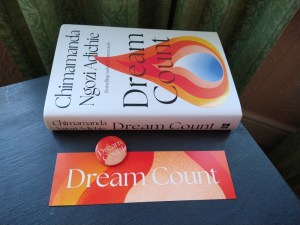
Dream Count by Chimamanda Ngozi Adichie (2025)
This was one of my Most Anticipated books of the year and had a lot to live up to as Adichie’s first novel since the amazing Americanah. When I first attempted to read it, I was dismayed by how much it felt like a rehashing of Americanah, with Chia (a travel writer in Maryland) and her cousin Omelogor (a feminist blogger) together reminiscent of Ifemelu. It did get more readable and somewhat more interesting as it went on. But instead of finding the narration and structure natural, I ended up full of questions about what Adichie intended.
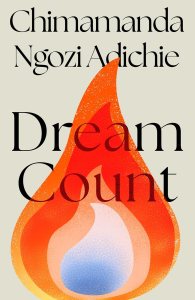 Why four main characters? Why is it the one non-Nigerian who’s poor, victimized, and less proficient in English? (That Kadiatou is based on a real person doesn’t explain enough. Her plight does at least provide what plot there is.) Why are the other three, to varying extents, rich and pretentious? Why are two narratives in the first person and two in the third person? Why in such long chunks instead of switching the POV more often? Why so many men, all of them more or less useless? (All these heterosexual relationships – so boring!) Why bring Covid into it apart from for verisimilitude? But why is the point in time important? What point is she trying to convey about pornography, the subject of Omelogor’s research?
It’s Adichie, so of course she writes solid prose with engaging characters, convincing dialogue, and provocative ideas. There’s a focus here on women’s experiences of attempted or actual motherhood (e.g., PMDD, fibroids, single parenthood or pressure to adopt), and, as per usual, a bit about race (specifically colorism, ethnic prejudice, and code-switching). But the characters’ connections seem weak, their coverage of the range of women’s experiences narrow. The title is, I suppose, the best clue to what Adichie wanted to do with the novel. Everyone dreams of finding, or preserving, love and family. Chia yearns for someone who will truly know her, and because she’s convinced this will be a romantic bond she devotes lockdown to a mental inventory of past relationships. Kadiatou dreams of peace more than of justice, and only in that she gets what she wants is there a happy ending of sorts. I wish I could be more positive, but this was a slog for me. (New purchase – Hungerford Bookshop)
The Hotel by Daisy Johnson (2024)
I’d really enjoyed Johnson’s two novels, Everything Under and Sisters, and have a copy of her previous short story collection, Fen, on the shelf. This completely passed my notice last year. I liked the idea of eerie linked short stories, but I wish I’d known this was originally written for radio as I think it accounts for how simplistic and insubstantial the 15 tales are.
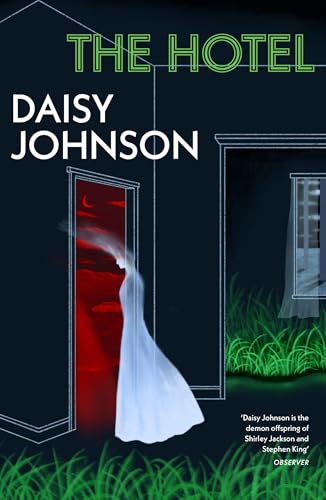 The Hotel is a fenland folly, built on the site of a pond where a suspected witch was drowned. Ever after, it is a cursed place. Those who build the hotel and stay in it are subject to violence, fear, and eruptions of the unexplained – especially if they go in Room 63. Anyone who visits once seems doomed to return. Most of the stories are in the first person, which makes sense for dramatic monologues. The speakers are guests, employees, and monsters. Some are BIPOC or queer, as if to tick off demographic boxes. Just before the Hotel burns down in 2019, it becomes the subject of an amateur student film like The Blair Witch Project.
Scary books don’t tend to work for me because I am often too aware of how they are constructed and so fail to give myself over to the reading experience and take them seriously. I can’t summon much enthusiasm for these stories, though I suppose the setting is rather atmospheric. My favourite was “Infestation,” about two girls – the one (not randomly) named Shirley – who think they discover something down in the laundry room in 1968. Only one of them makes it out alive. Okay, this one was creepy, but the rest left me unmoved. (Gift – purchased with Hungerford Bookshop with Christmas token) 
Girl by Ruth Padel (2024)
Padel is one of my favourite poets and a repeat appearance on my summer reading list; I reviewed her Emerald in 2021. I’ve read 12 of her books now. This collection is about girlhood, by way of personal history and myth.
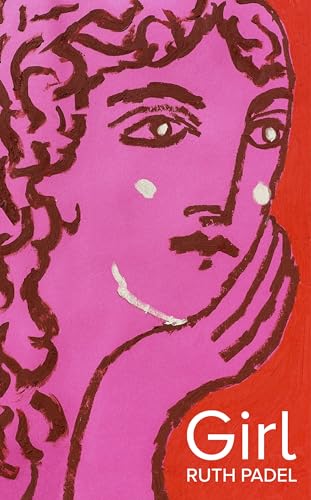 The first section, “When the Angel Comes for You,” is about the Virgin Mary, its 15 poems corresponding to the 15 Mysteries of the Rosary (as Padel explains in a note at the end; had she not, that would have gone over my head). The opening poem about the Annunciation is the most memorable its contemporary imagery emphasizing Mary’s youth and naivete: “a flood of real fear / and your heart / in the cowl-neck T-shirt from Primark / suddenly convulsed. But your old life // now seems dry as a stubbed / cigarette.” The third section, “Lady of the Labyrinth,” is about Ariadne, inspired by the snake goddess figurines in a museum on Crete. The message here is the same: “there is always the question of power / and girl is a trajectory / of learning how to deal with it”.
But the only poems that truly stood out to me are in the central autobiographical section arising from Padel’s own girlhood as well as her observations of her daughter and grandchild (setting up a Maiden–Mother–Crone triad). “Girl in a Forest” and “Tomboy and Panther” draw on the lure of the jungle to depict a wild child who chooses trousers over skirts. I loved “Fair Verona” for its traveler’s nostalgia but also for the hint of menace: so many tourists fondled the breast on a statue of Juliet that it had to be replaced. “How much touching // does it take for a bronze breast to crack?” the poet asks.
There’s some good alliteration throughout, and I warmed to the vision of girlhood as a time of promise and possibility: “the wonder / the where shall I go what new thing / will this day bring of being a girl.” Overall, though, I didn’t think the book had a lot of substance to convey about its theme. (Gift – purchased with Hungerford Bookshop with Christmas token)
Off to Scotland today. I’ve packed Ice Cream by Helen Dunmore and Pet Sematary by Stephen King from my 20 Books list, plus other books I may substitute in. I’m scheduling a few posts for while we’re away; forgive me if I don’t reply to comments until July.
Most Anticipated Books of the First Half of 2025
As I said the other week, I sometimes wonder if designating a book as “Most Anticipated” is a curse – if the chosen books are doomed to fail to meet my expectations. Nonetheless, I can’t resist compiling such a list at least once each year.
Also on my radar: fiction by Claire Adam, Amy Bloom, Emma Donoghue, Sarah Hall, Michelle Huneven, Eowyn Ivey, Rachel Joyce, Heather Parry and Torrey Peters; nonfiction by Melissa Febos, Robert Macfarlane, Lucy Mangan, Suzanne O’Sullivan and Sophie Pavelle. (Further ahead, I’ll seek out I Want to Burn This Place Down: Essays by Maris Kreizman and The Girls Who Grew Big by Leila Mottley in July, The Savage Landscape by Cal Flyn in Oct. and Tigers between Empires by Jonathan C. Slaght in Nov.)
However, below I’ve narrowed it down to the 25 books I’m most looking forward to for the first half of 2025, 15 fiction and 10 nonfiction. I’m impressed that 4 are in translation! And 22/25 are by women (all the fiction is). In release date order, with UK publication info given first if available. The blurbs are adapted from Goodreads. I’ve taken the liberty of using whichever cover is my favourite (almost always the U.S. one).

Fiction
 Live Fast by Brigitte Giraud (trans. from the French by Cory Stockwell) [Feb. 11, Ecco]: I found out about this autofiction novella via an early Shelf Awareness review. It “follows one woman’s quest to comprehend the motorcycle accident that took the life of her partner Claude at age 41. The narrator … recounts the chain of events that led up to the fateful accident, tracing the tiny, maddening twists of fate that might have prevented its tragic outcome. Each chapter asks the rhetorical question, ‘what if’ … A sensitive elegy to her husband”.
 The Unworthy by Agustina Bazterrica (trans. from the Spanish by Sarah Moses) [13 Feb., Pushkin; March 4, Scribner]: I wasn’t enamoured of the Argentinian author’s short stories, but Tender Is the Flesh was awesome. This is a short dystopian horror set in a convent. “In the House of the Sacred Sisterhood, the unworthy live in fear of the Superior Sister’s whip. … Risking her life, one of the unworthy keeps a diary in secret. Slowly, memories surface from a time before the world collapsed, before the Sacred Sisterhood became the only refuge. Then Lucía arrives.” (PDF copy for Shelf Awareness review)
 Victorian Psycho by Virginia Feito [13 Feb., Fourth Estate; Feb. 4, Liveright]: Feito’s debut, Mrs March, was deliciously odd, and I love the (U.S.) cover for this one. It sounds like a bonkers horror take on Henry James’s The Turn of the Screw, “a gruesome and gleeful new novel that probes the psyche of a bloodthirsty governess. Winifred Notty arrives at Ensor House prepared to play the perfect Victorian governess—she’ll dutifully tutor her charges, Drusilla and Andrew, tell them bedtime stories, and only joke about eating children.”

Three Days in June by Anne Tyler [13 Feb., Chatto & Windus (Penguin) / Feb. 11, Knopf]: I’m not a Tyler completist, but she’s reliable and this is a novella! “It’s the day before her daughter’s wedding and things are not going well for Gail Baines. First …, she loses her job … Then her ex-husband Max turns up at her door expecting to stay for the festivities. He doesn’t even have a suit. Instead, he’s brought memories, a shared sense of humour – and a cat looking for a new home. … [And] daughter Debbie discovers her groom has been keeping a secret.” Susan vouches for this. (Edelweiss download / on order from library)
 The Swell by Kat Gordon [27 Feb., Manilla Press (Bonnier Books UK)]: I got vague The Mercies (Kiran Millwood Hargrave) vibes from the blurb. “Iceland, 1910. In the middle of a severe storm two sisters, Freyja and Gudrun, rescue a mysterious, charismatic man from a shipwreck near their remote farm. Sixty-five years later, a young woman, Sigga, is spending time with her grandmother when they learn a body has been discovered on a mountainside near Reykjavik, perfectly preserved in ice.” (NetGalley download)
 Dream Count by Chimamanda Ngozi Adichie [4 March, Fourth Estate/Knopf]: This is THE book I’m most looking forward to; I’ve read everything Adichie has published and Americanah was a 5-star read for me. So I did something I’ve never done before and pre-ordered the signed independent bookshop edition from my local indie, Hungerford Bookshop. “Chiamaka is a Nigerian travel writer living in America. Alone in the midst of the pandemic, she recalls her past lovers and grapples with her choices and regrets.” The focus is on four Nigerian American women “and their loves, longings, and desires.” (New purchase)
 Kate & Frida by Kim Fay [March 11, G.P. Putnam’s Sons]: “Frida Rodriguez arrives in Paris in 1991 … But then she writes to a bookshop in Seattle … A friendship begins that will redefine the person she wants to become. Seattle bookseller Kate Fair is transformed by Frida’s free spirit … [A] love letter to bookshops and booksellers, to the passion we bring to life in our twenties”. Sounds like a cross between The Paris Novel and 84 Charing Cross Road – could be fab; could be twee. We shall see! (Edelweiss download)
 The Antidote by Karen Russell [13 March, Chatto & Windus (Penguin) / March 11, Knopf]: I love Russell’s Swamplandia! but haven’t gotten on with her other work I’ve tried, so I’m only tentatively enthusiastic about the odd Wizard of Oz-inspired blurb: “a historic dust storm ravages the fictional town of Uz, Nebraska. But Uz is already collapsing—not just under the weight of the Great Depression … but beneath its own violent histories. The Antidote follows a ‘Prairie Witch,’ … a Polish wheat farmer …; his orphan niece, a … witch’s apprentice …; a voluble scarecrow; and a New Deal photographer”. (Requested from publisher)
 Elegy, Southwest by Madeleine Watts [13 March, ONE (Pushkin) / Feb. 18, Simon & Schuster]: Watts’s debut, The Inland Sea, was a hidden gem. Given the news from L.A., this seems all the more potent: “In November 2018, Eloise and Lewis rent a car in Las Vegas and take off on a two-week road trip across the American southwest … [w]hile wildfires rage. … Lewis, an artist working for a prominent land art foundation, is grieving the recent death of his mother, while Eloise is an academic researching the past and future of the Colorado River … [and] beginning to suspect she might be pregnant”. (Edelweiss download)
 O Sinners! by Nicole Cuffy [March 18, One World (Random House)]: Cuffy’s Dances, which was longlisted for the Carol Shields Prize, was very good. The length of this sophomore novel (464 pages) gives me pause, but I do generally gravitate towards stories of cults. “Faruq Zaidi, a young journalist reeling from the recent death of his father, a devout Muslim, takes the opportunity to embed in a cult called The Nameless [b]ased in the California redwoods and shepherded by an enigmatic [Black] Vietnam War veteran.”
 The Accidentals: Stories by Guadalupe Nettel (trans. from the Spanish by Rosalind Harvey) [10 April, Fitzcarraldo Editions / April 29, Bloomsbury]: I really enjoyed Nettel’s International Booker-shortlisted novel Still Born. “When an albatross strays too far from its home, or loses its bearings, it becomes an ‘accidental’, an unmoored wanderer. The protagonists of these eight stories each find the ordinary courses of their lives disrupted by an unexpected event. … Deft and disquieting, oscillating between the real and the fantastical”. (PDF copy for Shelf Awareness review)
 Ordinary Saints by Niamh Ni Mhaoileoin [24 April, Manilla Press (Bonnier Books UK)]: “Brought up in a devout household in Ireland, Jay is now living in London with her girlfriend, determined to live day to day and not think too much about either the future or the past. But when she learns that her beloved older brother, who died in a terrible accident, may be made into a Catholic saint, she realises she must at last confront her family, her childhood and herself.” Winner of the inaugural PFD Queer Fiction Prize and shortlisted for the Women’s Prize Discoveries Award.
 Heartwood by Amity Gaige [1 May, Fleet / April 1, Simon & Schuster]: I loved Gaige’s Sea Wife. “In the heart of the Maine woods, an experienced Appalachian Trail hiker goes missing. She is forty-two-year-old Valerie Gillis, who has vanished 200 miles from her final destination. … At the centre of the search is Beverly, the determined Maine State Game Warden tasked with finding Valerie, who is managing the search on the ground. While Beverly is searching, Lena, a seventy-six-year-old birdwatcher in a retirement community, becomes an unexpected armchair detective.”
 Are You Happy?: Stories by Lori Ostlund [May 6, Astra House]: Ostlund is not so well known, especially outside the USA, but I enjoyed her debut novel, After the Parade, back in 2015. “Nine masterful stories that explore class, desire, identity, and the specter of violence in America–and in American families–against women and the LGBTQ+ community. … [W]e watch Ostlund’s characters as they try—and often fail—to make peace with their pasts while navigating their present relationships and responsibilities.” (Edelweiss download)
 Ripeness by Sarah Moss [22 May, Picador / Sept. 9, Farrar, Straus and Giroux]: Though I was disappointed by her last two novels, I’ll read anything Moss publishes and hope for a return to form. “It is the [19]60s and … Edith finds herself travelling to rural Italy … to see her sister, ballet dancer Lydia, through the final weeks of her pregnancy, help at the birth and then make a phone call which will seal this baby’s fate, and his mother’s.” Promises to be “about migration and new beginnings, and about what it is to have somewhere to belong.”
Nonfiction
 The Forgotten Sense: The New Science of Smell by Jonas Olofsson [Out now! 7 Jan., William Collins / Mariner]: Part of a planned deep dive into the senses. “Smell is … one of our most sensitive and refined senses; few other mammals surpass our ability to perceive scents in the animal kingdom. Yet, as the millions of people who lost their sense of smell during the COVID-19 pandemic can attest, we too often overlook its role in our overall health. … For readers of Bill Bryson and Steven Pinker”. (On order from library)
 Bread and Milk by Karolina Ramqvist (trans. from the Swedish by Saskia Vogel) [13 Feb., Bonnier Books / Feb. 11, Coach House Books]: I think I first found about this via the early Foreword review. “Bread and Milk traces a life through food, from carefully restricted low-fat margarine to a bag of tangerines devoured in one sitting to the luxury of a grandmother’s rice pudding. In this radiant memoir from one of Northern Europe’s most notable literary stylists, we follow several generations of women and their daughters as they struggle with financial and emotional vulnerability, independence, and motherhood.”
 My Mother in Havana: A Memoir of Magic & Miracle by Rebe Huntman [Feb. 18, Monkfish]: I found out about this from Rebecca Moon Ruark and by the time the publisher offered it to me I’d already downloaded it. The themes of bereavement and religion are right up my street. “As she explores the memory of her own mother, interlacing it with her search for the sacred feminine, Huntman leads us into a world of séance and sacrifice, pilgrimage and sacred dance, which resurrect her mother and bring Huntman face to face with a larger version of herself.” (Edelweiss download)
 Mother Animal by Helen Jukes [27 Feb., Elliott & Thompson]: This may be the 2025 release I’ve known about for the longest. I remember expressing interest the first time the author tweeted about it; it’s bound to be a good follow-up to Lucy Jones’s Matrescence. “When Helen Jukes falls pregnant, … she widens her frame of reference, looking beyond humans to ask what motherhood looks like in other species. … As she enters the sleeplessness, chaos and intimate discoveries of life with a newborn, these animal stories become … companions and guides.” (Requested from publisher)
 Alive: An Alternative Anatomy by Gabriel Weston [6 March, Vintage (Penguin) / March 4, David R. Godine]: I’ve read Weston’s Direct Red and appreciate her perspective. “As she became a surgeon, a mother, and ultimately a patient herself, Weston found herself grappling with the gap between scientific knowledge and unfathomable complexity of human experience. … Focusing on our individual organs, not just under the intense spotlight of the operating theatre, but in the central role they play in the stories of our lives.”
 The Lost Trees of Willow Avenue: A Story of Climate and Hope on One American Street by Mike Tidwell [March 25, St. Martin’s Press]: A must-read for me because it’s set in Takoma Park, Maryland, where I was born. “A love letter to the magnificent oaks and other trees dying from record heat waves and bizarre rain, [activist] Tidwell’s story depicts the neighborhood’s battle to save the trees and combat climate change. … Tidwell chronicles people on his block sick with Lyme disease, a church struggling with floods, and young people anguishing over whether to have kids, … against the global backdrop of 2023’s record heat domes and raging wildfires and hurricanes.”
 Breasts: A Relatively Brief Relationship by Jean Hannah Edelstein [3 April, Phoenix (W&N)]: I loved Edelstein’s 2018 memoir This Really Isn’t About You, and I regularly read her Substack. “As [Edelstein] comes of age, she learns that breasts are a source of both shame and power. In early motherhood, she sees her breasts transform into a source of sustenance and a locus of pain. And then, all too soon, she is faced with a diagnosis and forced to confront what it means to lose and rebuild an essential part of yourself.”
 Poets Square: A Memoir in Thirty Cats by Courtney Gustafson [8 May, Fig Tree (Penguin) / April 29, Crown]: Gustafson became an Instagram and TikTok hit with her posts about looking after a feral cat colony in Tucson, Arizona. The money she raised via social media allowed her to buy her home and continue caring for animals. “[Gustafson] had no idea about the grief and hardship of animal rescue, the staggering size of the problem in neighborhoods across the country. And she couldn’t have imagined how that struggle … would help pierce a personal darkness she’d wrestled for with much of her life.” (Proof copy from publisher)
 Lifelines: Searching for Home in the Mountains of Greece by Julian Hoffman [15 May, Elliott & Thompson]: Hoffman’s Irreplaceable was my book of 2019. “In the summer of 2000, Julian Hoffman and his wife Julia found themselves disillusioned with city life. Overwhelmed by long commutes, they stumbled upon a book about Prespa, Greece – a remote corner of Europe filled with stone villages, snow-capped mountains and wildlife. What began as curiosity soon transformed into a life-changing decision: to make Prespa their home.” I know next to nothing about Greece and this is a part of it that doesn’t fit the clichés.
 Spent: A Comic Novel by Alison Bechdel [22 May, Jonathan Cape (Penguin) / May 20, Mariner Books]: Bechdel’s Fun Home is an absolute classic of the graphic memoir. I’ve lost track of her career a bit but like the sound of this one. “A cartoonist named Alison Bechdel, running a pygmy goat sanctuary in Vermont, is existentially irked by a climate-challenged world and a citizenry on the brink of civil war.” After her partner’s wood-chopping video goes viral, she decides to create her own ethical-living reality TV show. Features cameos from some characters from her Dykes to Watch Out For series.
Other lists of anticipated books:
Clare – we overlap on a couple of our picks
Kate – one pick in common, plus I’ve already read a couple of her others
Laura – we overlap on a couple of our picks
Paul (mostly science and nature)
What catches your eye here? What other 2025 titles do I need to know about?
A Belated R.I.P., Part III: Hand, Hurley, Kingfisher and Meddings
I meant to post on Halloween but the day got away from me, so here’s my belated third contribution to the Readers Imbibing Peril challenge (the first two are here and here). It’s rare for me to borrow from the horror section of the library and even rarer for me to read sequels, yet here I am with two purple-spotted spines and three books that count as continuations. I’m a little surprised at myself for managing eight R.I.P. reviews this year, but five of those were of very short books or graphic novels so were quick reads. With the possible exception of the dystopian final chapter of the Hurley, none of my selections scared me.
A Haunting on the Hill by Elizabeth Hand (2023)
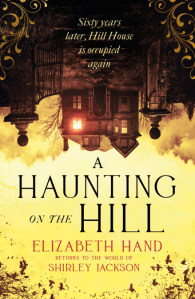 Hand was commissioned by Shirley Jackson’s estate to write a sequel to The Haunting of Hill House, which I read for R.I.P. in 2019 (my review). As in the original, four people gather at Hill House; artists rather than ghost-hunters, but they soon grasp the place’s supernatural malevolence. Holly has written a play about a historical witch – to be portrayed by Amanda, an actress of a certain age. Holly’s girlfriend, Nisa, provides music in the form of traditional murder ballads; actor Stevie makes up the quartet. Despite locals’ persistent admonitions, they take out a short-term rental on Hill House, thinking it will be atmospheric to finish the play and conduct read-throughs there. I was solidly engaged with the characters, whom Hand reinforces with traumatic backstories (Amanda’s proximity to an accidental death, Stevie’s molestation as a child actor), but couldn’t take the scary reveals seriously. A tablecloth suddenly soaked in blood? A black hare falling out of a chimney? Such moments just felt silly, plus Hand overplays the warnings versus the quartet’s blithe heedlessness. The ending is actually pretty chilling, but too much that came before strained belief. Do read the Jackson if you haven’t, though; it’s genuinely frightening. (Public library)
Barrowbeck by Andrew Michael Hurley (2024)
 I’ve read all of Hurley’s novels (The Loney, Devil’s Day and Starve Acre), the first two for previous R.I.P. events. Here again, he explores the arcane beliefs and practices of an isolated community: Barrowbeck, a fictional valley on the Yorkshire–Lancashire borders. The 13 chapters, rather like linked short stories, alight at moments along its timeline, from the medieval conflict of “First Footing” all the way through the near-future desolation of “A Valediction.” What connects the vignettes is more tonal than geographical, though, with suspicion, exclusion and the uncanny recurring. There are hints of deadly customs and communion with the departed. As is true of most collections, some stories are more memorable than others, and I felt that a few went too far towards pastiche (e.g., “Autumn Pastoral” of The Woman in Black by Susan Hill). I had a few favourites: “To Think of Sicily,” set after the 15th-century visit of an Italian man bearing mysterious olive oil, introduces the people’s seemingly congenital xenophobia. In “Hymns for Easter,” residents killed in the First World War still join their voices with the choir’s. “Sisters,” about B&B operators trying to get rid of their solitary guest before closing for the winter, was the best of all and reminiscent of the twins in Daniel Mason’s North Woods. You should like this if you’re a Daisy Johnson fan or enjoyed Private Rites by Julia Armfield, though ultimately I found more difference than continuity across the chapters.
With thanks to John Murray Press for the proof copy for review.
What Feasts at Night by T. Kingfisher (2024)
 The second book of the “Sworn Soldier” duology, after What Moves the Dead. Easton has returned from Paris to their native Gallacia to give Miss Potter a fungi-hunting holiday as thanks for helping with the previous adventure. But the caretaker is dead and the home abandoned, so Easton hires a local widow and her grandson, Bors, to look after the property. Bors is soon troubled by the moroi, a ghost-woman who comes in dreams to sit on people’s chests, crushing the breath out of them. She also seems to take the form of moths. And next she comes for Easton. You’d think with all the world-building she’d done in the first book, Kingfisher could pack lots of plot into this novella. But there’s really not much to it. It was over before it began. The winking humour of the first book was worn-out. And the more I thought about it, the more uneasy I was with the negative nature imagery I kept encountering in horror: fungi, moths, rabbits/hares. I understand this is often harkening back to ancient legends, but in a biodiversity crisis we need love rather than fear. (Public library)
The Sad Ghost Club 2 by Lize Meddings (2022)
 This teen comic series is not about literal ghosts but about mental health. Young people struggling with anxiety and intrusive thoughts recognize each other – they’ll be the ones wearing sheets with eye holes. In the first book, which I reviewed for R.I.P. last year, SG meets Socks and determines to start a society for people like them. In this sequel, Socks worries that he’s not cool enough for the club and that SG, especially after they meet Rue, will leave him behind. The message is about being there for people even when they think they just want to be alone. By the end, it looks like the club is going to grow further. This barely built on the first book and contained so little incident that it felt unnecessary. Never mind! (Little Free Library)
Rather a lackluster finish to the challenge there, but the Hurley at least is recommended.
R.I.P., Part II: Duy Đoàn, T. Kingfisher & Rachael Smith
A second installment for the Readers Imbibing Peril challenge (first was a creepy short story collection). Zombies link my first two selections, an experimental poetry collection and a historical novella that updates a classic, followed by a YA graphic novel about a medieval witch who appears in contemporary life to help a teen deal with her problems. I don’t really do proper horror; I’d characterize all three of these as more mischievous than scary.
Zombie Vomit Mad Libs by Duy Đoàn
 The Vietnamese American poet’s second collection strikes a balance between morbid – a pair of sonnets chants the names and years of poets who died by suicide – and playful. Multiple poems titled “Zombie” or “Zombies” are composed of just 1–3 cryptic lines. Other repeated features are blow-by-blow descriptions of horror movie scenes and the fill-in-the-blank Mad Libs format. There is an obsession with Leslie Cheung, a gay Hong Kong actor who also died by suicide, in 2003. Đoàn experiments linguistically as well as thematically, by adding tones (as used in Vietnamese) to English words. This was a startling collection I admired for its range and pluck, though I found little to personally latch on to. I was probably expecting something more like 36 Ways of Writing a Vietnamese Poem by Nam Le. But if you think poetry can’t get better than zombies + linguistics + suicides, boy have I got the collection for you! (Đoàn’s first book, We Play a Game, won the Yale Series of Younger Poets Prize and a Lambda Literary Award for bisexual poetry.)
To be published in the USA by Alice James Books on November 12. With thanks to the publisher for the advanced e-copy for review.
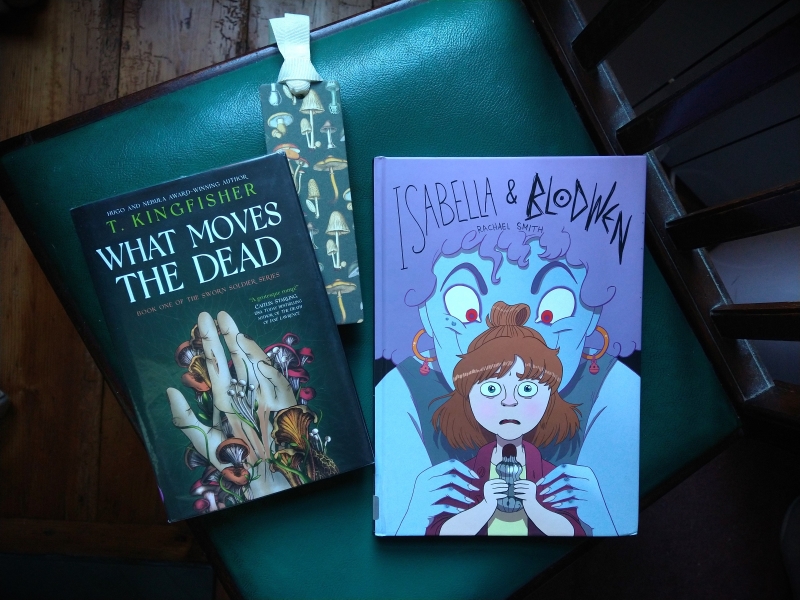
What Moves the Dead by T. Kingfisher (2022)
{MILD SPOILERS AHEAD}
 This first book in the “Sworn Soldier” duology is a retelling of Edgar Allan Poe’s “The Fall of the House of Usher.” Set in the 1890s, it’s narrated by Alex Easton, a former Gallacian soldier who learns that their childhood friend Madeline Usher is dying and goes to visit her at her and her brother Roderick’s home in Ruritania. Easton also meets the Ushers’ friend, the American doctor Denton, and Eugenia Potter, an amateur mycologist (and aunt of a certain Beatrix). Easton and Potter work out that what is making Madeline ill is the same thing that’s turning the local rabbits into zombies…
At first it seemed the author was awkwardly inserting a nonbinary character into history, but it’s more complicated than that. The sworn soldier tradition in countries such as Albania was a way for women, especially orphans or those who didn’t have brothers to advocate for them, to have autonomy in martial, patriarchal cultures. Kingfisher makes up European nations and their languages, as well as special sets of pronouns to refer to soldiers (ka/kan), children (va/van), etc. She doesn’t belabour the world-building, just sketches in the bits needed.
This was a quick and reasonably engaging read, though I wasn’t always amused by Kingfisher’s gleefully anachronistic tone (“Mozart? Beethoven? Why are you asking me? It was music, it went dun-dun-dun-DUN, what more do you want me to say?”). I wondered if the plot might have been inspired by a detail in Merlin Sheldrake’s Entangled Life, but it seems more likely it’s a half-conscious addition to a body of malevolent-mushroom stories (Mexican Gothic by Silvia Moreno-Garcia, various by Jeff VanderMeer, The Beauty by Aliya Whiteley). I was drawn in by Easton’s voice and backstory enough to borrow the sequel, about which more anon. (T. Kingfisher is the pen name of Ursula Vernon.) (Public library)
Isabella & Blodwen by Rachael Smith (2023)
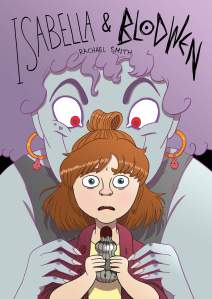 I’d reviewed Smith’s adult graphic memoirs Quarantine Comix (mental health during Covid) and Glass Half Empty (alcoholism and bereavement) for Foreword and Shelf Awareness, respectively. When I spotted this in the Young Adult section and saw it was about a witch, I mentally earmarked it for R.I.P. Isabella Maria Penwick-Wickam is a precocious 16-year-old student at Oxford. With her fixation on medieval history and folklore, she has the academic side of the university experience under control. But her social life is hopeless. She’s alienated flatmates and classmates alike with her rigid habits and judgemental comments. On a field trip to the Pitt Rivers Museum, where students are given a rare opportunity to handle artefacts, she accidentally drops a silver bottle into her handbag. Before she can return it, its occupant, a genie-like blowsy blue-and-purple witch named Blodwen, is released into the world. She wreaks much merry havoc, encouraging Issy to have some fun and make friends.
It’s a sweet enough story, but a few issues detracted from my enjoyment. Issy is often depicted more like a ten-year-old. I don’t love the blocky and exaggerated features Smith gives her characters, or the Technicolor hues. And I found myself rolling my eyes at how the book unnaturally inserts a sexual harassment theme – which Blodwen responds to in modern English, having spoken in archaic fashion up to that point, and with full understanding of the issue of consent. I can imagine younger teens enjoying this, though. (Public library)
The mini playlist I had going through my mind as I wrote this:
- “Running with Zombies” by The Bookshop Band (inspired by The Making of Zombie Wars by Aleksandar Hemon)
- “Flesh and Blood Dance” by Duke Special
- “Dead Alive” by The Shins
And to counterbalance the evil fungi of the Kingfisher novella, here’s Anne-Marie Sanderson employing the line “A mycelium network is listening to you” in a totally non-threatening way. It’s one of the multiple expressions of reassurance in her lovely song “All Your Atoms,” my current earworm from her terrific new album Old Light.
Short Stories in September (and R.I.P.): The Secret Life of Insects by Bernardo Esquinca
For the ninth year in a row, I’m making a special effort to read short stories in September; otherwise, short fiction volumes tend to languish on my shelves (and e-readers) unread. In the past few years, I’ve managed to read 11 or 12 collections during the month of September.
I don’t consider myself a great short story fan, so I was surprised to see I’ve already read 20 collections this year. Several were via a spring rereading of Carol Shields’s complete stories with Marcie (Buried in Print). Some other highlights: Cocktail by Lisa Alward, longlisted for the Carol Shields Prize; Barcelona by Mary Costello; The Beggar Maid by Alice Munro; and a speculative trio: There Is a Rio Grande in Heaven by Ruben Reyes Jr. (reviewed for BookBrowse), The Man in the Banana Trees by Marguerite Sheffer (University of Iowa Press, 5 November; reviewed for Shelf Awareness), and How We Know Our Time Travelers by Anita Felicelli (WTAW Press, 3 December; forthcoming for Foreword Reviews).
First of my dedicated reviews for the month is a set of Mexican horror stories that happens to tie into R.I.P. (I always think that’s only in October, but it technically starts on 1 September):

The Secret Life of Insects by Bernardo Esquinca (2023)
[Translated from the Spanish by James D. Jenkins]
Esquinca channels classic horror authors such as H.P. Lovecraft and Edgar Allan Poe in these 14 creepy stories drawn from across his career. The settings include caves, forests and abandoned apartments; and octopi, cursed dolls and dreams are among the subjects. These characters are obsessed – or possessed. As in classic ghost stories, the protagonists tend to be researchers or writers whose absolute faith in logic is shaken by encounters with the supernatural. For instance, the narrator of the title story is a forensic entomologist who makes contact with his murdered wife; the undead feature in a couple of other stories, too.
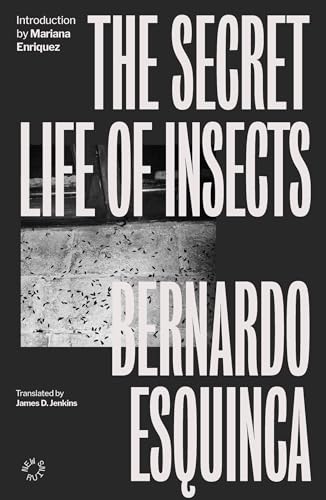 Mysterious manuscripts and therapy appointments also recur – there’s a scholarly Freudianism at play here. In the novella-length “Demoness,” friends at a twentieth high school reunion recount traumatic experiences from adolescence (not your average campfire fare). “Our traumas define us much more than our happy moments, [Ignacio, a Jesuit priest] thought. They’re the real revelations about ourselves.” Masturbation features heavily in this and in “Pan’s Noontide,” which has both of Arturo’s wives disappear in connection with an ecoterrorism cult. I occasionally found the content a bit macho and gross-out, and wished the women could be more than just sexualized supporting figures in male fantasies.
My favourite story was “Señor Ligotti” (no doubt in homage to American horror writer Thomas Ligotti), in which a struggling novelist unwittingly signs away more than he intended when the title character offers him an apartment and then a publishing deal. The Gothic black-and-white illustrations by Luis Perez Ochando are surreal or grotesque, and recall Bosch, Dalí and Hogarth. There is an introduction by Mariana Enriquez, whose stories I found more memorable in general, and I was also reminded slightly of Agustina Bazterrica. I’m by no means a regular horror reader yet found this book consistently engaging, though I concluded it had more style than soul. 
With thanks to New Ruins (Dead Ink) for the free copy for review.
Currently reading: I Can Outdance Jesus by Willie Davis, The Woman Who Gave Birth to Rabbits by Emma Donoghue, The Forester’s Daughter by Claire Keegan, The Souvenir Museum by Elizabeth McCracken, A New Day by Sue Mell, Ladies’ Lunch by Lore Segal
Resuming soon: The Secrets of a Fire King by Kim Edwards, The Best Short Stories 2023: The O. Henry Prize Winners (ed. Lauren Groff)
Up next: The Lone Ranger and Tonto Fistfight in Heaven by Sherman Alexie, The End of the World is a Cul de Sac by Louise Kennedy, Sinking Bell by Bojan Louis, Light Box by K.J. Orr, The Forgetters by Greg Sarris, The Long Swim by Terese Svoboda
Are you a short story fan? Read any good ones recently?
Carol Shields Prize Longlist Reading: The Future and Chrysalis
My first two dedicated reads for our informal Carol Shields Prize shadowing project exhibit one main way in which the prize is different from the Women’s Prize for Fiction: works in translation and short story collections are eligible. I have one of each to review today. Laura and I did a buddy read of an atmospheric dystopian novel translated from the French, and I caught up on a magical, erotic story collection I’d had on my Kindle for a long time. These were both very good, but my minor misgivings are such that I’d rate them the same:
The Future by Catherine Leroux (2020; 2023)
[Translated from the French by Susan Ouriou]
For such a monolithic title, this has a limited stage: a few derelict districts of the ailing city we know as Detroit, Michigan – but in Leroux’s alternate version, it remained part of French Canada, with lingering Indigenous influence, and so is known as Fort Détroit. No doubt she was inspired by the many vacant properties that characterized Detroit in the 2010s; there’s even a ruins tour bus. In her Fort Détroit, a handful of determined adults cling on in their own homes, but the streets and parks have been abandoned to animals and to a gang of half-feral children who have developed their own nicknames (Adidas, Lego, Wolfpup), social hierarchy and vernacular. Worlds meet when Gloria determines to find her granddaughters Cassandra and Mathilda, who ran away after their addict mother Judith’s suspicious death. At the same time, her neighbour Eunice wants to find out who ran her father down in the street.
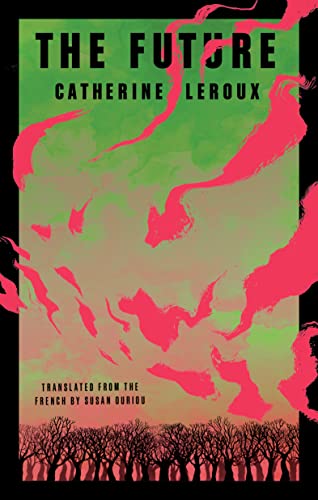 Despite their fierce independence and acts of protest, the novel’s children still rely on the adult world. Ecosystems are awry and the river is toxic, but Gloria’s friend Solomon, a former jazz pianist, still manages to grow crops. He overlooks the children’s thefts from his greenhouse and eventually offers to help them grow their own food supply, and other adults volunteer to prepare a proper winter shelter to replace their shantytown. Puberty threatens their society, too: we learn that Fiji, the leader, has been binding her breasts to hide her age.
I expected to be reminded strongly of Station Eleven, and while there were elements that were reminiscent of Emily St John Mandel’s work, Leroux’s is a more consciously literary approach. The present-tense omniscient narration occupies many perspectives, including that of a dog, and the descriptions and musings are more lyrical than literal. Where another author would site high drama – sixtysomething Gloria’s night quest, a few children rafting down the river – Leroux moves on swiftly to other character interactions. What did bring Mandel to mind was the importance of art during societal collapse: the children spin nursery rhyme mash-ups and fairytales, Stutt rescues a makeshift library and insists on Huckleberry Finn going along on the river journey, and Solomon plays the piano again after decades.
The opening mysteries of death and disappearance are resolved before the end, but don’t seem to have been the point. The Future is more subtle and slippery than many dystopian novels I’ve read in that there’s not really a warning, or a message here. Instead, there’s an intriguing situation that opens out and alters slightly, but avoids resolution. It’s all about atmosphere and language – I was especially impressed by Ouriou’s rendering of Leroux’s made-up dialect via folksy slang (“She figgers she’s growed-up”). I loved the details and one-on-one moments more than the momentous scenes. On the whole, I found the story elegant but somewhat frustrating. You might be drawn to it if you enjoyed To Paradise or the MaddAddam books. (Read via Edelweiss; published by Biblioasis)
See also Laura’s review.
Chrysalis: Stories by Anuja Varghese (2023)
This debut collection of 15 stories brims with magic and horror, and teems with women of colour and queer people. Indeed, Varghese dedicates the book to “all the girls and women who don’t see themselves in most stories.” Most of the characters are of South Asian extraction. Adoption recurs in a couple of places. Two of the rarer realist stories, “Milk” and “Stories in the Language of the Fist,” have protagonists dealing with schoolgirl bullying and workplace microaggressions. More often, there are unexplained phenomena that position the players between life and death. “In the Bone Fields” focuses on the twin daughters of an Indian immigrant family on a Canadian farm. The house and the bone field behind are active and hungry, and only one twin will survive. (I got mild North Woods vibes.)
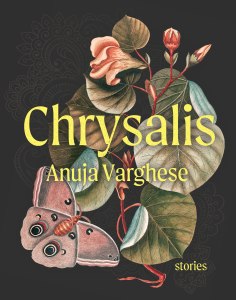 In the title story, Radhika visits her mother’s grave and wonders whether her life is here in Montreal with her lover or back in Toronto with her husband. Fangs and wings symbolize her desire for independence. Elsewhere, watery metaphors alternately evoke fear of drowning or sexual fluidity. “Midnight at the Oasis” charts the transformation of a trans woman and “Cherry Blossom Fever,” one of my two favourites, bounces between several POVs. Marjan is in love with Talia, but she’s married to Sunil, who’s also in love with Silas. “People do it — open their relationships and negotiate rules and write themselves into polyamorous fairy tales … Other people. Not brown people,” Talia sighs. They are better off, at least, than they would be back in India, where homophobia can be deadly (“The Vetala’s Song”).
My other favourite was “Bhupati,” about a man who sets up multiple Lakshmi figures in the backyard, hoping devotion will earn him and his wife a better future. The statues keep being burned up by lightning; we learn his wife may be petitioning for different things. “Chitra” is a straightforward Cinderella retelling whose title character lives with two mean stepsisters and works in food service at the mall. A Shoe Chateau BOGO closing sale gives her the chance to get a bargain – and catch the manager’s eye. Despite a striking ending signalled by the story’s subtitle, all I could conclude about this one was “cute.” The three flash horror stories (a murder hotel, ghosts in a basement, werewolves) were much the weakest for me.
There’s a pretty even split of third- and first-person stories (nine versus six) here, and the genre shifts frequently. The quality wasn’t as consistent as I’d hoped, but it was an engaging read. The overall blend of feminism and horror had me thinking of Her Body and Other Parties by Carmen Maria Machado, but I’d be most likely to recommend this to fans of Julia Armfield, Violet Kupersmith and Vauhini Vara. (Read via Edelweiss; published by House of Anansi Press)
Both of these are worthwhile books and it’s great that readers outside of Canada can discover them. I wouldn’t personally shortlist either, but the judges may well be dazzled enough to do so. I don’t yet have a sense of where they’d fit for me in the rankings.
Up next:
Cocktail by Lisa Alward (short story collection from Edelweiss)
A Council of Dolls by Mona Susan Power (buddy read with Laura)
Land of Milk and Honey by C Pam Zhang (from library)

I’m aiming for one or two more batches of reviews before the shortlist is announced on 9 April.
Review Catch-Up: Monica, Bibliomaniac, Family Meal, Fudge & More
I’m catching up with reviews of the many October releases I read, including these four sent by publishers…
- a genre-bending, Technicolor graphic novel in the form of short comics
- a book-addict’s memoir of an ambitious Covid-times tour of Britain’s bookshops
- an understated novel about queer men of colour coping with death and mental illness
- and a quirky contemporary poetry collection I read in one sitting.
Followed by a bonus list of October books I reviewed for Shelf Awareness, similarly varied in genre: autofiction, flash fiction, horror-tinged historical fiction, graphic memoirs and more.
Monica by Daniel Clowes
 Daniel Clowes is a respected American graphic novelist best known for Ghost World, which was adapted into a 2001 film starring Scarlett Johansson. I’m not sure what I was expecting of Monica. Perhaps something closer to a quiet life story like Alison by Lizzy Stewart? In any case, not this jumble of 1970s nostalgia and supernatural horror. The book is in nine loosely connected stories that make the head spin with their genre and tonal shifts; one thing that stays constant is Clowes’s drawing style, which combines vibrant, campy colour with exaggerated faces and blunt haircuts.
At first it seems there will be a straightforward linear narrative: the prologue, “Foxhole,” has two soldiers dreaming of what life will be like Vietnam, with the one looking forward to a simple life with his fiancée Penny. “Pretty Penny” shatters those illusions as we see that Penny has fully embraced sexual liberation while he’s been away. She rejects her mother and, in a countercultural decision, keeps the baby when she gets pregnant. Young Monica has a sequence of stepfather figures before Penny dumps her with her parents and goes AWOL.
To an extent, the rest of the book is about Monica’s search for her parents. We see her as a young college student communicating with her dead grandfather via a radio, as a successful entrepreneur selling candles, and as an older woman caretaking for a California Airbnb. But in between there are bizarre sci-fi/folk horror interludes – “The Glow Infernal” and “The Incident” – about unconnected characters, and Monica’s involvement with a cult inevitably turns strange. I couldn’t get past the distasteful story lines or grotesque style. Mostly, I wasn’t convinced that Clowes liked or cared about any of his own characters, so why should I? (This might be Tom Cox’s dream book, but not mine.) I suppose I might try a classic work by Clowes one day, but only if I can be assured that it has more plot and heart.
With thanks to Jonathan Cape (Penguin) for the free copy for review.
Bibliomaniac: An Obsessive’s Tour of the Bookshops of Britain by Robin Ince
Do you know anyone who can buy just one book? Do you know anyone who leaves a bookshop only with what they walked in to buy?
I understand that Robin Ince is a radio personality and comedian who, though holding no formal qualifications, often delivers presentations about science. He was meant to undertake a stadium tour with Professor Brian Cox in the autumn of 2021, but a Covid resurgence put paid to that. Not one for sitting around at home – he comes across as driven, antsy; positively allergic to boredom – he formulated Plan B: 100+ events, most of them in independent bookshops (the oddest venue was a Chinese restaurant; he was speaking to the Plymouth Humanists), over the course of two months, criss-crossing Britain and hitting many favourite places such as Hay-on-Wye, Hungerford (my local indie) and Wigtown. The topic of his previous book was curiosity, which gave him free rein to feature anything that interested him, so no two talks were the same and he incorporated lots of ad hoc book recommendations.
 Ince is not just a speaker at the bookshops but, invariably, a customer – as well as at just about every charity shop in a town. Even when he knows he’ll be carrying his purchases home in his luggage on the train, he can’t resist a browse. And while his shopping basket would look wildly different to mine (his go-to sections are science and philosophy, the occult, 1960s pop and alternative culture; alongside a wide but utterly unpredictable range of classic and contemporary fiction and antiquarian finds), I sensed a kindred spirit in so many lines:
“A bookshop with a proximity to an interesting graveyard is a fine combination.”
“I like charity bookshops, because I can delude myself into believing that I am committing an altruistic act by purchasing too many books. I am not satisfying my consumer lust – I am digging a well in Uganda.”
“This is one of the wonders of books: the delight of being a species that can chronicle and preserve. I pick up a book from a shelf, and someone who is no more than ash or bone can still change me.”
He’s also refreshingly open-minded, determined not to become a white male dinosaur: he once spent a wonderful year reading only women authors, and gratefully accepts the gift of a Black queer feminist work – at which he knows a younger version of himself would have scoffed. I took lots of notes on shops I hadn’t heard of, but also appreciated the witty asides on British ways and on the rigours and coincidences of the tour. If you liked White Spines, this will be right up your street, though to me this was universal where the Royle was too niche. And it didn’t matter a jot that I was previously unfamiliar with Ince as a public figure.
Bibliomaniac came out in paperback on 5 October. My thanks to Atlantic Books for the free copy for review.
Family Meal by Bryan Washington
After the verve of his linked short stories (Lot, which won the Dylan Thomas Prize) and the offbeat tenderness of his debut novel, Memorial, I couldn’t wait for Bryan Washington’s next book. While it’s set in the multicultural Houston of his first book and similarly peopled by young queer men of colour, Family Meal shares the more melancholy edge of Memorial with its focus on bereavement and the habits and relationships that help the characters to cope.
Cam has moved back to Houston from Los Angeles after the untimely death of his boyfriend Kai, who had a budding career as a translator and spent part of each year in Japan. Cam works in a failing gay bar, crashes with his boss and has mostly stopped eating. Although he still loves cooking Asian food for others, he rarely tastes it himself; his overpowering appetite now is for pills and sex, leading him to arrange as many as four hook-ups per day. Kai still appears and communicates to him. “Easier to spend time dwelling on death than it is to live, says Kai.” Is it to escape this spectre, or the memory of what happened to Kai, that Cam descends into his addictions? Meanwhile, his estranged friend TJ, with whom Cam grew up at TJ’s Korean American family’s bakery after the death of Cam’s parents, has his own history of loss and unhealthy relationships. But a connection with the bakery’s new nonbinary employee, Noel, seems like it might be different.
If you’ve read Washington before, you’ll know what to expect: no speech marks, obscenity-strewn dialogue, sexually explicit scenes that seem to be there for the sake of it (because sex is part of life, rather than because they particularly advance the plot). An issue I had here, like with Memorial, is that having multiple first-person narrators doesn’t add anything; Kai and TJ sound so much like Cam, who narrates roughly the first half, that it’s hard to tell their affectless accounts apart. Such interchangeable voices two books running suggests to me that Washington hasn’t yet managed to fully imagine himself outside of his own personality.

The novel has much to convey about found family, food as nurture, and how we try to fill the emptiness in our lives with things that aren’t good for us. However, it often delivers these messages through what wise secondary characters say, which struck me as unsubtle.
“You don’t have to do this alone, says TJ.”
(Kai:) “My mother would say, Cooking is care. The act is the care.”
“Love can be a lot of things though, says Noel. Right? It’s pleasure but it’s also washing the dishes and sorting medication and folding the laundry. It’s picking out what to eat for dinner three nights in a row, even if you don’t want to. And it’s knowing when to speak up, and when to stay quiet, and when, I think, to move on. But also when to fight for it.”
“Sometimes the best we can do is live for each other, she [Kai’s sister] says. It’s enough. Even if it seems like it isn’t.”
There’s no doubting how heartfelt this story is. It brought tears to my eyes at the beginning and end, but in between did not captivate me as much as I hoped. While intermittently poignant on the subject of bereavement, it is so mired in the characters’ unhealthy coping mechanisms that it becomes painful to read.
In my mind Washington and Brandon Taylor are in the same basket, though that may be reductive or unimaginative of me (young, gay Black authors from the American South who have published three books and tend to return to the same themes and settings). Before this year I would have said Taylor had the edge, but The Late Americans was so disappointingly similar to his previous work that Washington has taken the lead. I just hope that with his next work he challenges himself instead of coasting along in the groove he’s created thus far.
I wish I could get a copy of this into the hands of Sufjan Stevens…
With thanks to Atlantic Books for the free copy for review.
Fudge by Andrew Weatherhead
 I read this over a chilled-out coffee at the Globe bar in Hay-on-Wye (how perfect, then, to come across the lines “I know the secret of life / Is to read good books”). Weatherhead mostly charts the rhythms of everyday existence in pandemic-era New York City, especially through a haiku sequence (“The blind cat asleep / On my lap—and coffee / Just out of reach” – a situation familiar to any cat owner). His style is matter-of-fact and casually funny, juxtaposing random observations about hipster-ish experiences. From “Things the Photoshop Instructor Said and Did”: “Someone gasped when he increased the contrast / I feel like everyone here is named Taylor.”
The central piece, “Poem While on Hold with NBA League Pass Customer Support Nov. 17, 2018,” descends into the absurd, but his four hours lost on the phone are reclaimed through his musings on a sport he once played (“I had begun to find meaning in art and music / I was always too cerebral a player anyways … That feeling—of perfect grace and equanimity— / must be what we’re all searching for in this life”) and on life in general. This is poetry that doesn’t feel like poetry, if that makes sense. I have a hunch that it might appeal to readers of David Foster Wallace.
Published by Publishing Genius. With thanks to publicist Lori Hettler for the e-copy for review.
Reviewed for Shelf Awareness:
(Links to full text)
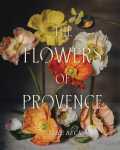
The Flowers of Provence by Jamie Beck (Gift books feature): A gorgeous book of photographs, perfect for gardeners, romantics, and armchair travelers. Her still lifes are as detailed and colorful as medieval paintings.
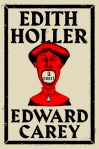
Edith Holler by Edward Carey (forthcoming): A dark fairy tale about a precocious girl confined to her family’s theatre in Norwich, England yet driven to reveal the truth behind her city’s child disappearances. Reminiscent of Dahl, Dickens, and Shakespeare at their goriest.
I Must Be Dreaming by Roz Chast: A laugh-out-loud-funny tour through her dream journal as well as a brief introduction to dream theory. Delightfully captures the randomness of dream topics and dialogues.
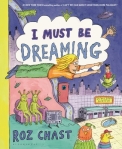

Tremor by Teju Cole: A kaleidoscopic work of autofiction that journeys between the US and Nigeria as it questions the ownership and meaning of Black art. The sophisticated structure is a highlight of this elegant study of art criticism, suffering, and subjectivity.
Our Strangers by Lydia Davis (Review and Q&A): In her ninth collection of mostly flash-length stories (a whopping 143 of them), an overarching theme is the mystery of human communication and connection. A real cornucopia of genres, structures, and voices. [Only available via Bookshop.org and independent bookstores.]
Lotería by Esteban Rodríguez: Lotería is a traditional Mexican game of chance. Each Spanish-language card is allotted a one-page poem in a creative, poignant recounting of his Mexican American family history.
Glass Half Empty by Rachael Smith: The British comics artist third graphic memoir is a refreshingly candid account of her recovery from alcoholism after her father’s death. In some panes, her adult self appears alongside her younger self, offering advice.


The Dead Peasant’s Handbook by Brian Turner: The final installment – after The Wild Delight of Wild Things and The Goodbye World Poem – in an intimate, autobiographical trilogy. Love is presented as the key to surviving bereavement and wartime trauma.
 Bookish Beck = Rebecca Foster. American transplant to England. Freelance proofreader and book reviewer.
 Bookish Beck