Territory of Light by Yuko Tsushima (#NovNov Translated Buddy Read)
With well over 100 posts, you all have already smashed last year’s totals for Novellas in November, and there’s still a week and a half to go! We’re grateful for your participation and hope some of you have been enjoying the buddy reads.
For literature in translation week, our readalong book has been Territory of Light by Yuko Tsushima. As much a linked short story collection as a novella, it first appeared in monthly instalments in the Japanese literary magazine Gunzō in 1978–9 but wasn’t translated into English (by Geraldine Harcourt) until 2018, two years after Tsushima’s death. The translation was critically acclaimed, earning nominations for the 2019 Kirkus Prize and the 2020 BTBA Best Translated Book Award for Fiction.
The apartment had windows on all sides. I spent a year there, with my little daughter, on the top floor of an old four-storey office building.
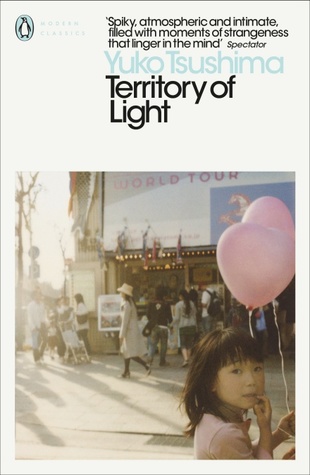 Dark and carefully chiselled, the chapters are like tiny diamonds that you have to hold up to the light to see the glitter. Newly separated from her husband, the unnamed narrator, who works at a music library, entrusts us with vignettes from her first year of single parenthood. She is honest about her bad behaviour – the nights she got falling down drunk and invited men back to the apartment; the mornings she missed the daycare dropoff deadline and let her two-year-old fend for herself while she stayed in bed. Alongside the custody battle with her ex are smaller feuds, like with her neighbour, who’s had enough of the little girl dropping things onto his roof from the windows above and gets the landlord to do something about it.
Her daughter is a typical toddler, stubborn and impetuous, yet there are moments of intimacy between them that make your breath catch. Sometimes their roles even become reversed: the daughter nurses her mother through a bout of fever, and after the neighbour incident comforts her with words she’s received: “Mommy…are you all right? Don’t cry, there’s a good girl.”
The narrator describes her dreams, employing the imagery of fire and flight to capture her occasional hopelessness and longing for escape. Cherry trees are blossoming as they move into the apartment, and by the time they’re ready to move on again the spring is coming back. Details of sound and light make her observations zing. The clean, precise style – no frills, no tricks – reminds me of other autofiction in translation I’ve read. Others mention Elena Ferrante as a readalike, but what came to mind for me was Tove Ditlevsen’s trilogy, especially Dependency with its addiction theme. No doubt Harcourt should also be thanked for her crystal-clear rendition. It’s such a beautiful book, though perhaps already slipping from my grasp; I’m glad Cathy suggested it as our buddy read. (New purchase) 
[122 pages]
Other reviews:
Keep in touch via Twitter (@bookishbeck / @cathy746books) and Instagram (@bookishbeck / @cathy_746books). We’ll add any of your review links in to our master posts. Feel free to use the terrific feature image Cathy made and don’t forget the hashtag #NovNov.
The Mystery of Henri Pick by David Foenkinos (Walter Presents Blog Tour)
A library populated entirely by rejected books? Such was Richard Brautigan’s brainchild in one of his novels, and after his suicide a fan made it a reality. Now based in Vancouver, Washington, the Brautigan Library houses what French novelist David Foenkinos calls “the world’s literary orphans.” In The Mystery of Henri Pick, he imagines what would have happened had a French librarian created its counterpart in a small town in Brittany and a canny editor discovered a gem of a bestseller among its dusty stacks.
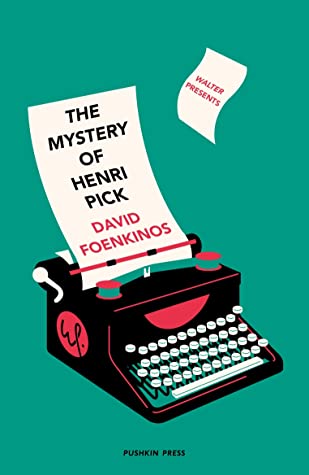 Delphine Despero is a rising Parisian editor who’s fallen in love with her latest signed author, Frédéric Koskas. Unfortunately, his novel The Bathtub is a flop, but he persists in writing a second, The Bed. On a trip home to Brittany so Frédéric can meet her parents, he and Delphine drop into the library of rejected books at Crozon and find a few amusing turkeys – but also a masterpiece. The Last Hours of a Love Affair is what it says on the tin, but also incorporates the death of Pushkin. The name attached to it is that of the late pizzeria owner in Crozon. His elderly widow and middle-aged daughter had no idea that their humble Henri had ever had literary ambitions, let alone that he had a copy of Eugene Onegin in the attic.
The Last Hours of a Love Affair becomes a publishing sensation – for its backstory more than its writing quality – yet there are those who doubt that Henri Pick could have been its author. The doubting faction is led by Jean-Michel Rouche, a disgraced literary critic who, having lost his job and his girlfriend, now has all the free time in the world to research the foundation of the Library of Rejects and those who deposited manuscripts there. Just when you think matters are tied up, Foenkinos throws a curveball.
This was such a light and entertaining read that I raced through. It has the breezy, mildly zany style I associate with films like Amélie. Despite the title, there’s not that much of a mystery here, but that suited me since I pretty much never pick up a crime novel. Foenkinos inserts lots of little literary in-jokes (not least: this is published by Pushkin Press!), and through Delphine he voices just the jaded but hopeful attitude I have towards books, especially as I undertake my own project of assessing unpublished manuscripts:
She had about twenty books to read during August, and they were all stored on her e-reader. [Her friends] asked her what those novels were about, and Delphine confessed that, most of the time, she was incapable of summarizing them. She had not read anything memorable. Yet she continued to feel excited at the start of each new book. Because what if it was good? What if she was about to discover a new author? She found her job so stimulating, it was almost like being a child again, hunting for chocolate eggs in a garden at Easter.
Great fun – give it a go!
My rating:
(Originally published in 2016. Translation from the French by Sam Taylor, 2020.)
My thanks to Poppy at Pushkin Press for arranging my e-copy for review.
(Walter Presents, a foreign-language drama streaming service, launched in the UK (on Channel 4) in 2016 and is also available in the USA, Australia, and various European countries.)
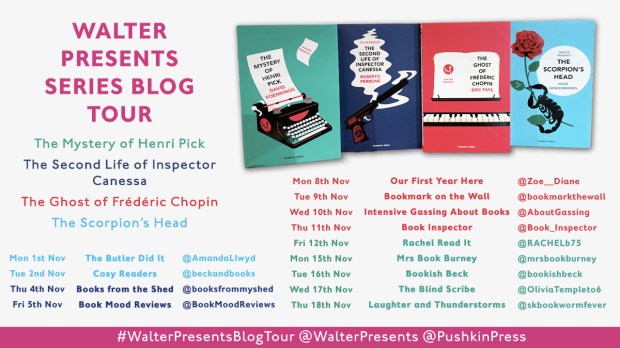
I was delighted to be part of the Walter Presents blog tour. See below for details of where other books and reviews have featured.
Short Stories in September, Part II: Tove Jansson, Brandon Taylor, Eley Williams
Each September I make a special effort to read short stories, which otherwise tend to languish on my shelves and TBR unread. After my first four reviewed last week, I have another three wonderfully different collections, ranging from bittersweet children’s fantasy in translation to offbeat, wordplay-filled love notes via linked stories suffused with desire and desperation.
Tales from Moominvalley by Tove Jansson (1962; 1963)
[Trans. from the Swedish by Thomas Warburton]
 I only discovered the Moomins in my late twenties, but soon fell in love with the quirky charm of Jansson’s characters and their often melancholy musings. Her stories feel like they can be read on multiple levels, with younger readers delighting in the bizarre creations and older ones sensing the pensiveness behind their quests. There are magical events here: Moomintroll discovers a dragon small enough to be kept in a jar; laughter is enough to bring a fearful child back from literal invisibility. But what struck me more was the lessons learned by neurotic creatures. In “The Fillyjonk who believed in Disasters,” the title character fixates on her belongings—
“we are so very small and insignificant, and so are our tea cakes and carpets and all those things, you know, and still they’re important, but always they’re threatened by mercilessness…”
—but when a gale and a tornado come and sweep it all away, she experiences relief and joy:
“the strange thing was that she suddenly felt quite safe. It was a very strange feeling, and she found it indescribably nice. But what was there to worry about? The disaster had come at last.”
My other favourite was “The Hemulen who loved Silence.” After years as a fairground ticket-taker, he can’t wait to retire and get away from the crowds and the noise, but once he’s obtained his precious solitude he realizes he needs others after all. The final story, “The Fir Tree,” is a lovely Christmas one in which the Moomins, awoken midway through their winter hibernation, get caught up in seasonal stress and experience the holiday for the first time. (Public library)
Filthy Animals by Brandon Taylor (2021)
Real Life was one of my five favourite novels of 2020, and we are in parallel fictional territory here. Lionel, the protagonist in four of the 11 stories, is similar to Wallace insomuch as both are gay African Americans at a Midwestern university who become involved with a (straight?) white guy. The main difference is that Lionel has just been released from hospital after a suicide attempt. A mathematician (rather than a biochemist like Wallace), he finds numbers soothingly precise in comparison to the muddle of his thoughts and emotions.
 In the opening story, “Potluck,” he meets Charles, a dancer who’s dating Sophie, and the three of them shuffle into a kind of awkward love triangle where, as in Real Life, sex and violence are uncomfortably intertwined. It’s a recurring question in the stories, even those focused around other characters: how does tenderness relate to desire? In the throes of lust, is there room for a gentler love? The troubled teens of the title story are “always in the thick of violence. It moves through them like the Holy Ghost might.” Milton, soon to be sent to boot camp, thinks he’d like to “pry open the world, bone it, remove the ugly hardness of it all.”
Elsewhere, young adults face a cancer diagnosis (“Mass” and “What Made Them Made You”); a babysitter is alarmed by her charge’s feral tendencies (“Little Beast”); and same-sex couples renegotiate their relationships (Simon and Hartjes in “As Though That Were Love” and Sigrid and Marta in “Anne of Cleves,” one of my favourites). While the longer Lionel/Charles/Sophie stories, “Potluck” and “Proctoring,” are probably the best and a few others didn’t make much of an impression, the whole book has an icy angst that resonates. Taylor is a confident orchestrator of scenes and conversations, and the slight detachment of the prose only magnifies his characters’ longing for vulnerability (Marta says to Sigrid before they have sex for the first time: “I’m afraid I’ll mess it up. I’m afraid you’ll see me.” To which Sigrid replies, “I see you. You’re wonderful.”). (New purchase, Forum Books)
 A bonus story: “Oh, Youth” was published in Kink (2021), an anthology edited by Garth Greenwell and R.O. Kwon. I requested this from NetGalley just so I could read the stories by Carmen Maria Machado and Brandon Taylor. All of Taylor’s work feels of a piece, such that his various characters might be rubbing shoulders at a party – which is appropriate because the centrepiece of Real Life is an excruciating dinner party, Filthy Animals opens at a potluck, and “Oh, Youth” is set at a dinner party.
Grisha is here with Enid and Victor, his latest summer couple. He’s been a boytoy for hire since his architecture professor, Nate, surprised him by inviting him into his open marriage with Brigid. “His life at the time was a series of minor discomforts that accumulated like grit in a socket until rotation was no longer possible.” The liaisons are a way to fund a more luxurious lifestyle and keep himself in cigarettes.
While Real Life brought to mind Virginia Woolf, Taylor’s stories recall E.M. Forster or Thomas Mann. In other words, he’s the real deal: a blazing talent, here to stay.
Attrib. and Other Stories by Eley Williams (2017)
 After enjoying her debut novel, The Liar’s Dictionary, this time last year, I was pleased to find Williams’s first book in a charity shop last year. Her stories are brief (generally under 10 pages) and 15 of the 17 are first-person narratives, often voiced by a heartbroken character looking for the words to describe their pain or woo back a departed lover. A love of etymology is patent and, as in Ali Smith’s work, the prose is enlivened by the wordplay.
The settings range from an art gallery to a beach where a whale has washed up, and the speakers tend to have peculiar careers like an ortolan chef or a trainer of landmine-detecting rats. My favourite was probably “Synaesthete, Would Like to Meet,” whose narrator is coached through online dating by a doctor.
 I found a number of the stories too similar and thin, and it’s a shame that the hedgehog featured on the cover of the U.S. edition has to embody human carelessness in “Spines,” which is otherwise one of the standouts. But the enthusiasm and liveliness of the language were enough to win me over. (Secondhand purchase from the British Red Cross shop, Hay-on-Wye – how fun, then, to find the line “Did you know Timbuktu is twinned with Hay-on-Wye?”)
I’ll have one more set of short story reviews coming up before the end of the month, with a few other collections then spilling into October for R.I.P.
Lana Bastašić for WIT Month 2021 & September Reading Plans
My literature in translation statistics for 2021 have been abysmal so far, but here’s my token contribution to Women in Translation Month: Catch the Rabbit by Lana Bastašić, originally published in 2018 and translated from the Serbo-Croatian by the author herself.
 Sara has made a new life for herself in Dublin, with a boyfriend and an avocado tree. She rarely thinks about her past in Bosnia or hears her mother tongue. It’s a rude awakening, then, when she gets a phone call from her childhood best friend, Lejla Begić. Her bold, brassy pal says she needs Sara to pick her up in Mostar and drive her to Vienna to find her brother, Armin. No matter that Sara and Lejla haven’t been in contact in 12 years. But Lejla still has such a hold over Sara that she books a plane ticket right away.
Alternating chapters, with the text enclosed in brackets, dive into the friends’ past: school days, losing their virginity, and burying Lejla’s pet white rabbit, Bunny. Sara often writes as if to Lejla: “I can’t beautify those days, I can’t give them some special, big meaning. You would despise me for it. Besides, I don’t know how to write those two kids: you keep shrinking and growing in my memory, like illusive land to desperate sailors.”
In the road trip scenes, we have to shake our heads at how outrageous Lejla is: peeing in a cornfield, throwing her used tampons out the window, and orchestrating a farcical situation when she lies and tells their host that Sara only speaks English. A lovable rogue, she drives the book’s action. Indeed, Sara realizes, “both the car and I were nothing but an extension of Lejla’s will, she moved us with her words, and we followed obediently.”
This offbeat novel struck me, bizarrely, as a cross between Asylum Road and When God Was a Rabbit. I sometimes find that work in translation, particularly Eastern European, has too much quirkiness for the sake of it. That’s probably true here, and although the nostalgia element was appealing the emotional payoff wasn’t enough to satisfy me. However, I did love a late scene where Sara gazes at Albrecht Dürer’s famous Young Hare painting, and keep an eye out for how the ending connects back to the beginning.
(Simon appreciated this European Union Prize for Literature winner more than I did: his review compares the picture of asymmetrical female friendship favourably to that in Elena Ferrante’s Neapolitan Novels.)
With thanks to Picador for the free copy for review.

Did you do any special reading for Women in Translation month this year?
September Reading Plans
Each September I make a bit more of an effort to read short stories, which otherwise tend to sit on my shelves and Kindle unread. Last year I managed to read eight collections for this challenge. How many will I get to this year?! Here’s my shelf of potential reads:

I’ll reread selections from the Byatt anthology (I’ve read all of her published short story collections before and own two of them, one of which I reread last year) and will otherwise focus on books by women. I’ve had good success with Amy Bloom and Helen Simpson stories in previous years, so I’ll definitely plan to read those plus Bloodchild by Octavia E. Butler (from the university library).
Since I own THREE unread collections by Alice Munro, it’s time to tackle one, probably Dear Life since I’ve owned it the longest – it’s a review copy that arrived before her Nobel Prize win and I’ve (oops) never reviewed it. The World Does Not Require You is also a long-languishing review copy, so might be my one male-penned title.
What are your September reading plans? Any short story collections you’ve read recently and would recommend to me?
Three on a Theme for Father’s Day: Auster, Knausgaard, Lewis
In advance of Father’s Day, I picked out a few short memoirs from my shelves that explore the bonds between fathers and their children.
The Invention of Solitude by Paul Auster (1982)
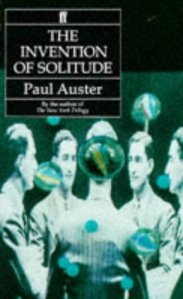 This was the nonfiction work of Auster’s I was most keen to read, and I thoroughly enjoyed its first part, “Portrait of an Invisible Man,” which includes a depiction of his late father, a discussion of his relationship with his son, and a brief investigation into his grandmother’s murder of his grandfather, which I’d first learned about from Winter Journal. Auster finds himself unable to cry and has to deal with all his father’s possessions. “There is nothing more terrible, I learned, than having to face the objects of a dead man … everything from a set of barbels to a broken toaster.” A personalized family photo album he finds is blank inside. That and the cover image, a trick photograph taken of his father at Atlantic City in the 1940s, feel like perfect symbols of an elusive heritage. I didn’t connect with the second, slightly longer half, though: “The Book of Memory” is more like Auster’s novels, describing the exploits of a lightly fictionalized character named “A.” and full of copious allusions to the likes of Flaubert, Freud and Tolstoy.
My rating: 
Fatherhood by Karl Ove Knausgaard (2009; 2013)
[Translated from the Norwegian by Don Bartlett]
 I assumed this was a stand-alone from Knausgaard; when it popped up during an author search on Awesomebooks.com and I saw how short it was, I thought why not? As it happens, this Vintage Minis paperback is actually a set of excerpts from A Man in Love, the second volume of his huge autofiction project, My Struggle (I’ve only read the first book, A Death in the Family). Knausgaard takes readers along on a few kiddie-oriented outings: a dinky circus, a children’s party, and baby rhyme time at the public library. His trademark granular detail gives a clear sense of all the characters involved. With him are his wife Linda and the three children they had by then, Vanja, Heidi and John; his friend Geir is his chief confidant.
It’s evident that he loves his children and delights in their individual personalities, but at the same time he feels his intellect assailed by the tedium of the repetitive tasks involved in parenting. He demands an hour to himself each afternoon to read and smoke in a café – even though he knows his wife doesn’t get such an allowance. Specifically, he writes that he feels feminized by carrying a baby or pushing a buggy. Recounting the children’s party, he recalls an earlier party when a heavily pregnant Linda got locked in a bathroom and not even a locksmith could get her out. He felt unmanned when a fellow guest (who happened to be a boxer) had to break down the door to free her. I didn’t know quite what to make of the fragile masculinity on display here, but was grateful to get some highlights from the second book.
My rating:
Home Game: An Accidental Guide to Fatherhood by Michael Lewis (2009)
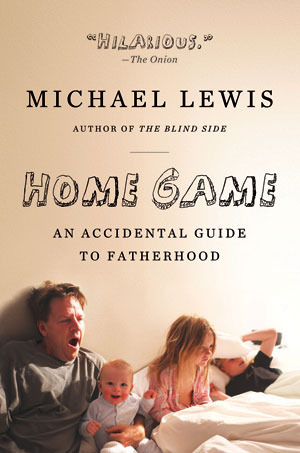 This was expanded from an occasional series of essays Lewis published in Slate in the 2000s, responding to the births of his three children, Quinn, Dixie and Walker, and exploring the modern father’s role, especially “the persistent and disturbing gap between what I was meant to feel and what I actually felt.” It took time for him to feel more than simply mild affection for each child; often the attachment didn’t arrive until after a period of intense care (as when his son Walker was hospitalized with RSV and he stayed with him around the clock). I can’t seem to find the exact line now, but Jennifer Senior (author of All Joy and No Fun) has said something to the effect of: you don’t take care of your children because you love them; you love them because you take care of them. And that indeed seems to encapsulate Lewis’s experience.
The family lived in Paris when Quinn was tiny, and the pieces on adjusting to the French parenting style reminded me of Pamela Druckerman’s French Children Don’t Throw Food / Bringing Up Bébé. His parenting adventures take him everywhere from the delivery room to a New Orleans racetrack at Mardi Gras to a Disneyland campground. He also, intriguingly, writes about a visit paid to Roald Dahl in the writer’s later years. Even when he’s exasperated, his writing is warm and funny. I especially laughed at the account of his post-Walker vasectomy. This maybe doesn’t break any new ground in terms of gender roles and equal responsibility for children’s needs, but I expect it’s still true to the experience of a lot of hapless males, and it was an entirely entertaining read.
[Postscript: My timing on this one was pretty ironic: I read it on the plane to the USA to visit my family and then handed it off to my brother-in-law as I think he’ll enjoy it too. My sister looked at the cover and said, “wait, didn’t his daughter just die in a car crash?!” She’d seen it on her phone’s news feed just hours earlier. I couldn’t believe that the sweet little girl with the squinchy face on the middle of the cover was gone! (Dixie, aged 19.)]
My rating: 
If you read just one … Make it Home Game.
Fathers seem to be a big theme in my recent and upcoming reading. There was Featherhood by Charlie Gilmour, a rare 5-star read for me, last month, and I have review copies of the thematically similar Will This House Last Forever? by Xanthi Barker as well as the essay collection DAD. I even pulled out another trio of father-themed memoirs from my shelves, but ended up running out of time to do a second set of three. There’s always next year!
Three May Graphic Novel Releases: Orwell, In, and Coma
These three terrific graphic novels all have one-word titles and were published on the 13th of May. Outwardly, they are very different: a biography of a famous English writer, the story of an artist looking for authentic connections, and a memoir of a medical crisis that had permanent consequences. The drawing styles are varied as well. But if the books share one thing, it’s an engagement with loneliness: It’s tempting to see the self as being pitted against the world, with illness an additional isolating force, but family, friends and compatriots are there to help us feel less alone and like we are a part of something constructive.
Orwell by Pierre Christin; illustrated by Sébastien Verdier
[Translated from the French by Edward Gauvin]
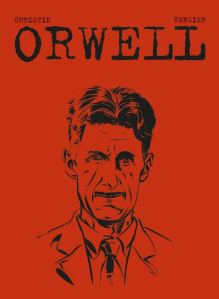 George Orwell was born Eric Blair in Bengal, where his father worked for the colonial government. As a boy, he loved science fiction and knew that he would become a writer. He had an unhappy time at prep school, where he was on reduced fees, and proceeded to Eton and then police training in Burma. Already he felt that “imperialism was an evil thing.” Among this book’s black-and-white panes, the splashes of colour – blood, a British flag – stand out, and guest artists contribute a two-page colour spread each, illustrating scenes from Orwell’s major works. His pen name commemorates a local river and England’s patron saint, marking his preoccupation with the essence of Englishness: something deeper than his hated militarism and capitalism. Even when he tried to ‘go native’ for embedded journalism (Down and Out in Paris and London and The Road to Wigan Pier), his accent marked him out as posh. He was opinionated and set out “rules” for clear writing and the proper making of tea.
The book’s settings range from Spain, where Orwell went to fight in the Civil War, via a bomb shelter in London’s Underground, to the island of Jura, where he retired after the war. I particularly loved the Scottish scenery. I also appreciated the notes on where his life story entered into his fiction (especially in A Clergyman’s Daughter and Keep the Aspidistra Flying). During World War II he joined the Home Guard and contributed to BBC broadcasting alongside T.S. Eliot. He had married Eileen, adopted a baby boy, and set up a smallholding. Even when hospitalized for tuberculosis, he wouldn’t stop typing (or smoking).
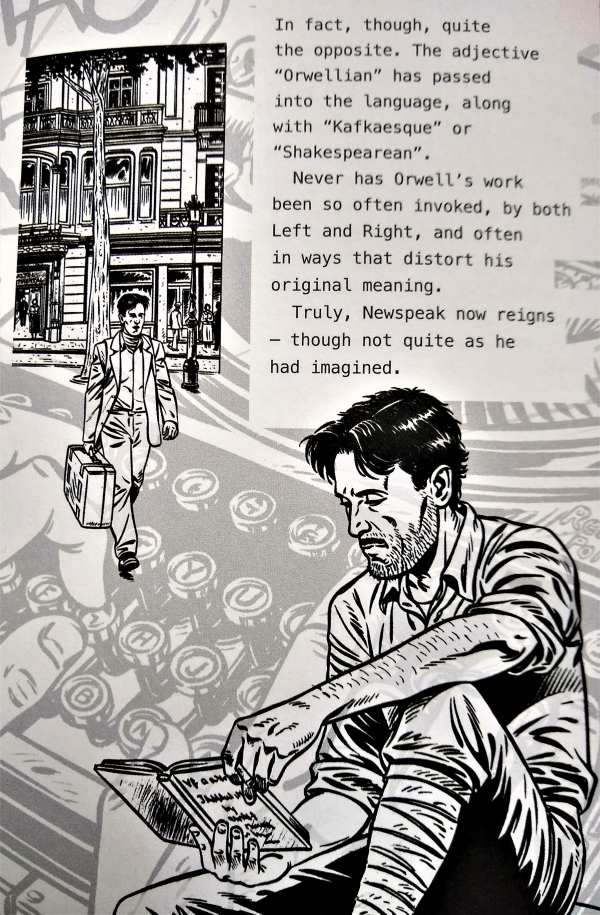 Christin creates just enough scenes to give a sense of the sweep of Orwell’s life, and incorporates plenty of the author’s own words in a typewriter font. He recognizes all the many aspects, sometimes contradictory, of his subject’s life. And in an afterword, he makes a strong case for Orwell’s ideas being more important now than ever before. My knowledge of Orwell’s oeuvre, apart from the ones everyone has read – Animal Farm and 1984 – is limited; luckily this is suited not just to Orwell fans but to devotees of life stories of any kind.
With thanks to SelfMadeHero for the free copy for review.
In by Will McPhail
Nick never knows the right thing to say. The bachelor artist’s well-intentioned thoughts remain unvoiced, such that all he can manage is small talk. Whether he’s on a subway train, interacting with his mom and sister, or sitting in a bar with a tongue-in-cheek name (like “Your Friends Have Kids” or “Gentrificchiato”), he’s conscious of being the clichéd guy who’s too clueless or pathetic to make a real connection with another human being. That starts to change when he meets Wren, a Black doctor who instantly sees past all his pretence.
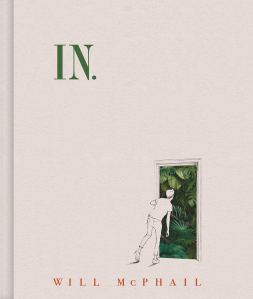 Like Orwell, In makes strategic use of colour spreads. “Say something that matters,” Nick scolds himself, and on the rare occasions when he does figure out what to say or ask – the magic words that elicit an honest response – it’s as if a new world opens up. These full-colour breakthrough scenes are like dream sequences, filled with symbols such as a waterfall, icy cliff, or half-submerged building with classical façade. Each is heralded by a close-up image on the other person’s eyes: being literally close enough to see their eye colour means being metaphorically close enough to be let in. Nick achieves these moments with everyone from the plumber to his four-year-old nephew.

Alternately laugh-out-loud funny and tender, McPhail’s debut novel is as hip as it is genuine. It’s a spot-on picture of modern life in a generic city. I especially loved the few pages when Nick is on a Zoom call with carefully ironed shirt but no trousers and the potential employers on the other end get so lost in their own jargon that they forget he’s there. His banter with Wren or with his sister reveals a lot about these characters, but there’s also an amazing 12-page wordless sequence late on that conveys so much. While I’d recommend this to readers of Alison Bechdel, Craig Thompson, and Chris Ware (and expect it to have a lot in common with Kristen Radtke’s forthcoming Seek You: A Journey through American Loneliness), it’s perfect for those brand new to graphic novels, too – a good old-fashioned story, with all the emotional range of Writers & Lovers. I hope it’ll be a wildcard entry on the Sunday Times Young Writer of the Year Award shortlist.
With thanks to Sceptre for the free copy for review.
Coma by Zara Slattery
In May 2013, Zara Slattery’s life changed forever. What started as a nagging sore throat developed into a potentially deadly infection called necrotising fascitis. She spent 15 days in a medically induced coma and woke up to find that one of her legs had been amputated. As in Orwell and In, colour is used to differentiate different realms. Monochrome sketches in thick crayon illustrate her husband Dan’s diary of the everyday life that kept going while she was in hospital, yet it’s the coma/fantasy pages in vibrant blues, reds and gold that feel more real.
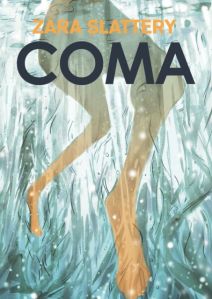 Slattery remembers, or perhaps imagines, being surrounded by nightmarish skulls and menacing animals. She feels accused and guilty, like she has to justify her continued existence. In one moment she’s a puppet; in another she’s in ancient China, her fate being decided for her. Some of the watery landscapes and specific images here happen to echo those in McPhail’s novel: a splash park, a sunken theatre; a statue on a plinth. There’s also a giant that reminded me a lot of one of the monsters in Spirited Away.
Meanwhile, Dan was holding down the fort, completing domestic tasks and reassuring their three children. Relatives came to stay; neighbours brought food, ran errands, and gave him lifts to the hospital. He addresses the diary directly to Zara as a record of the time she spent away from home and acknowledges that he doesn’t know if she’ll come back to them. A final letter from Zara’s nurse reveals how bad off she was, maybe more so than Dan was aware.


This must have been such a distressing time to revisit. In this interview, Slattery talks about the courage it took to read Dan’s diary even years after the fact. I admired how the book’s contrasting drawing styles recreate her locked-in mental state and her family’s weeks of waiting – both parties in limbo, wondering what will come next.
Brighton, where Slattery is based, is a hotspot of the Graphic Medicine movement spearheaded by Ian Williams (author of The Lady Doctor). Regular readers know how much I love health narratives, and with my keenness for graphic novels this series couldn’t be better suited to my interests.
With thanks to Myriad Editions for the free copy for review.
Read any graphic novels recently?
Recent BookBrowse & Shiny New Books Reviews, and Book Club Ado
Excerpts from and links to some of my recent online writing for other places:
BookBrowse
Three O’Clock in the Morning by Gianrico Carofiglio
 The quotation that gives Carofiglio’s tender novel its title is from F. Scott Fitzgerald’s The Crack-Up: “In a real dark night of the soul it is always three o’clock in the morning.” It lends an appropriate sense of time suspended, of earnest seeking and extreme circumstances: The main action of the book takes place over just a few days in June of 1983, when Italian teenager Antonio and his father are stranded in Marseilles while there for Antonio to be seen by an epilepsy specialist. The gift of this time outside of time allows them to get to know each other better, such that the memory of the trip will be precious to Antonio even decades later. I appreciated how the limited setting heightened this short novel’s emotions. Carofiglio invites readers to peer between the leisurely progression of events to see the bond that is being formed. (See my full review at BookBrowse. See also my related article on HarperVia, a new publishing imprint for international literature.)
The Dictionary of Lost Words by Pip Williams
 Inspired by the composition of the Oxford English Dictionary, this Australian debut novel explores the lives of the women on its fringes through the words that were omitted. The suffrage movement and World War I loom large as the storyline enters the 1910s. I most appreciated the relationships Esme has with the various women in her life. The main action spans the 40 years of the original composition of the OED. That scope means there is a lot of skipping forward in time. Especially in the first half, I longed for the narrative to slow down so I could spend more time with this character. Despite the first-person narration, I never felt I knew Esme very well. Women’s bonds and women’s words are strong themes in this forthrightly feminist novel that, despite its flaws, would make a great book club selection. (See my full review at BookBrowse. See also my reading list of books about dictionaries and lost words.)
Shiny New Books
Notes from Deep Time: The Hidden Stories of the Earth Beneath Our Feet by Helen Gordon
 To assess the place of humanity, we can look back to prehistory, but also forward to envision the “deep future.” (It was only in a late chapter on nuclear waste disposal sites and warning messages to the future that I found too much direct overlap with Footprints by David Farrier.) This engagingly blends both tactics, surveying the fields of geology and palaeontology and pondering the future traces of the Anthropocene. I most enjoyed the middle chapters, in which science meets wildlife and cultural studies. For instance, a chapter on ammonites leads into a profile of Mary Anning and the history of both fossil hunting and women in STEM careers. The prose is well pitched to the layman’s level. Interviews, travels, and snapshots from her own life generally keep the material from becoming too dry. An invigorating interdisciplinary tour. (See my full review at Shiny New Books.)
My book club has been meeting via Zoom since April 2020. This is a common state of affairs for book clubs around the world. Especially since we have 12 members (if everyone attends, which is rare), we haven’t been able to contemplate meeting in person as of yet. However, a subset of us meet midway between the monthly reads to discuss women’s classics like Marge Piercy’s Woman on the Edge of Time. For next week’s meeting on Mrs. Dalloway, we are going to attempt a six-person get-together in one member’s house.
 Anyway, a neat thing we did last month was a Zoom chat with the author: a BBC correspondent who happens to be the brother of one of our members. If you’re a news junkie in the UK, you may know the name Jon Sopel, though since I don’t have a telly or ever listen to radio, I hadn’t encountered him until this “in-person” meet-up. He has been the BBC’s North America Editor since 2014.
UnPresidented is the third book he wrote over the course of the Trump presidency. It started off as a diary of the 2020 election campaign, beginning in July 2019, but of course soon morphed into something slightly different: a chronicle of life in D.C. and London during Covid-19 and a record of the Trump mishandling of the pandemic. But as well as a farcical election process and a public health crisis, 2020’s perfect storm also included economic collapse and social upheaval – thanks to the murder of George Floyd and the subsequent Black Lives Matter protests worldwide plus isolated rioting.
UnPresidented served as a good reminder for me of the timeline of events and the full catalogue of outrages committed by Trump and his cronies. You just have to shake your head over the litany of ridiculous things he said and did, and got away with – any one of which might have sunk another president or candidate. The style is breezy and off-the-cuff, so the book reads quickly. There’s a good balance between world events and personal ones, with his family split across the UK and Australia. I appreciated the insight into differences from the British system. I thought it would be depressing reading back through the events of 2020, but for the most part the knowledge that everything turned out “right” allowed me to see the humour in it. Still, I found it excruciating reading about the four days following the election.

Sopel kindly gave us an hour of his time one Wednesday evening before he had to go on air and answered our questions about Biden, Harris, journalistic ethics, and more. He was charming and eloquent, as befits his profession.
Would any of these books interest you?
Painting Time by Maylis de Kerangal
Today I’m taking part in the “blog blast” for Painting Time by Maylis de Kerangal (translated from the French by Jessica Moore), which is published today by MacLehose Press.

This is the third novel I’ve read by de Kerangal, after her 2017 Wellcome Book Prize winner, Mend the Living, and 2019’s The Cook. Painting Time resembles the former in the way it revels in niche vocabulary and the latter in that it slowly builds up a portrait of the central character. But all three books could be characterized as deep dives into a particular subject – the human body, gastronomy, and painting, respectively.
The protagonist of Painting Time is Paula Karst, one of 20-some art students who arrive at the Institut de Peinture in Brussels in the autumn of 2007 to learn trompe l’oeil technique. They’re taught to painstakingly imitate every variety of wood and stone so their murals will look as convincing as the real thing. It’s a gruelling course, with many hours spent on their feet every day.
Years later, the only classmates Paula has kept up with are Jonas, her old flatmate, with whom she had a sort-of-almost-not-quite relationship, and their Scottish friend Kate. The novel opens with the three of them having a reunion in Paris. Given this setup, I expected de Kerangal to follow all three characters from 2007 to the near past, but the book sticks closely to Paula, such that the only secondary characters who come through clearly are her parents.
 It’s intriguing to see the work that comes Paula’s way after a degree in decorative painting, including painting backdrops for a Moscow-set film of Anna Karenina and the job of a lifetime: working on a full-scale replica of the prehistoric animal paintings of the Lascaux Caves (Lascaux IV). The final quarter of the novel delves into the history of Lascaux, which was discovered in 1940 and open to the public on and off until the late 1960s. Deep time abuts the troubled present as Paula contemplates what will last versus what is ephemeral.
As de Kerangal did with medical terminology in Mend the Living, so here she relishes art words: colours, tools, techniques; names for types of marble and timber (Paula’s own surname is a word for limestone caves). The long sentences accrete to form paragraphs that stretch across multiple pages. I confess to getting a bit lost in these, and wanting more juicy interactions than austere character study. However, the themes of art and history are resonant. If you’ve enjoyed de Kerangal’s prose before, you will certainly want to read this, too.
My thanks to MacLehose Press for access to an e-copy via NetGalley.
Spring Reading 2021: Birdsong, Cherry Blossom & More
It’s been a gorgeously sunny spring here – how about where you are? Although there have still been some frosty nights troubling the gardeners among us, it’s been warm in the daytime and the flowers and blossom are coming on apace.
Recently I’ve read a couple of books reflecting on the spring of 2020, specifically the opportunities it offered to reconnect with local nature at a time when we were isolated and couldn’t travel.
I’ve also been feeling nostalgic for Washington, D.C. and the Maryland suburbs, where I grew up. It’s been two years since my last trip back, but I’m holding out hope that I can make it over in June for a family wedding.
Rounding out my selection of “Spring” titles is an offbeat Japanese novella.
Looking back to the coronavirus spring:
On Thursday evening I watched “The Act of Nature Watching,” a special Earth Day Zoom talk for West Berkshire Libraries by local nature writer Nicola Chester, whose memoir is coming out in the autumn. The UK is one of the most nature-depleted countries, she lamented. We are hardwired to watch and love nature, she noted, yet have never been more alienated from it. Reading from her columns and anthology contributions (as well as the Lovatt, below) and giving tips on recognizing birdsong and mammal signs, she spoke of nature-watching as a form of mindfulness – an approach that chimed with the first three books I feature here.
Birdsong in a Time of Silence: An Awakening by Steven Lovatt (2021)
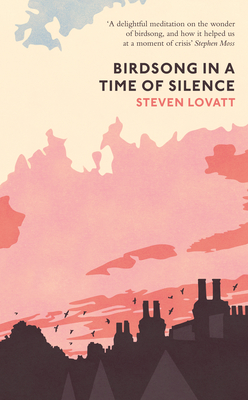 During the UK’s first lockdown, with planes grounded and cars stationary, many remarked on the quiet. All the better to hear birds going about their usual spring activities. For Lovatt, from Birmingham and now based in South Wales, it was the excuse he needed to return to his childhood birdwatching hobby. In between accounts of his spring walks, he tells lively stories of common birds’ anatomy, diet, lifecycle, migration routes, and vocalizations. (He even gives step-by-step instructions for sounding like a magpie.) Birdsong takes him back to childhood, but feels deeper than that: a cultural memory that enters into our poetry and will be lost forever if we allow our declining bird species to continue on the same trajectory.
Mentions of current events are sparse and subtle, so the spring feels timeless, as it should. I worried there might be too much overlap with A Sweet, Wild Note by Richard Smyth, but there’s room for both on your shelf. Lovatt’s writing is introspective and poetic, delighting in metaphors for sounds: “The song of a turtle dove is like the aural equivalent of a heat-haze, the gentlest corrugation of air, always just on the edge of your hearing.”
Skylarks with Rosie: A Somerset Spring by Stephen Moss (2021)
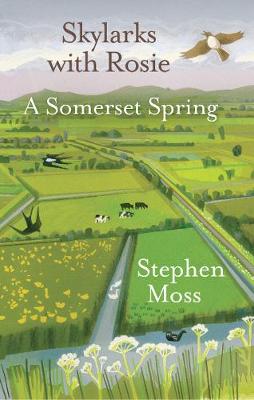 Lovatt must have been a pupil of Moss’s on the Bath Spa University MA degree in Travel and Nature Writing. The prolific Moss’s latest also reflects on the spring of 2020, but in a more overt diary format. Devoting one chapter to each of the 13 weeks of the first lockdown, he traces the season’s development alongside his family’s experiences and the national news. With four of his children at home, along with one of their partners and a convalescing friend, it’s a pleasingly full house. There are daily cycles or walks around “the loop,” a three-mile circuit from their front door, often with Rosie the Labrador; there are also jaunts to corners of the nearby Avalon Marshes. Nature also comes to him, with songbirds in the garden hedges and various birds of prey flying over during their 11:00 coffee breaks.
His speaking engagements and trips cancelled, Moss turns to online events instead. Twitter serves as a place for sharing outrage over UK politics and world events like George Floyd’s murder, but also as a welcoming community for sharing nature sightings. As the lockdown come to a close, he realizes that this time has had unexpected benefits: “Having to press the pause button … has made me rethink my life, in a good way.” He feels that, for once, he has truly appreciated the spring, “rediscovering the joys of wildlife-watching close to home”. This made for perfect reading in Somerset last week.
Also recommended: The Consolation of Nature by Marren, McCarthy and Mynott
Remembering springs back home:
Spring in Washington by Louis J. Halle (1947)
“The discovery of spring each year, after the winter’s hibernation, is like a rediscovery of the universe … knowledge of spring gives me the freedom of the world.”
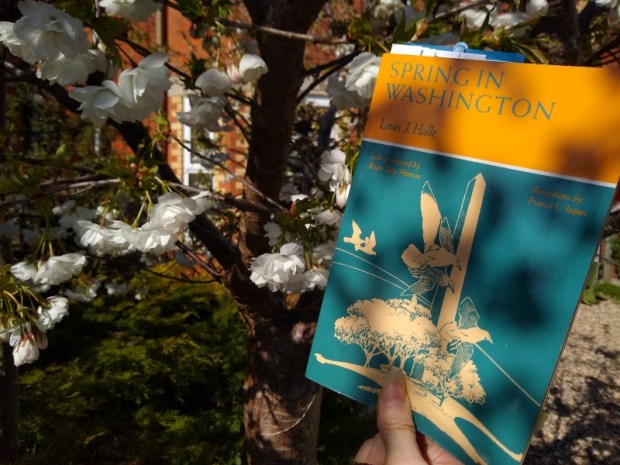 For Halle, who worked in the State Department, nature was an antidote to hours spent shuffling papers behind a desk. In this spring of 1945, there was plenty of wildfowl to see in central D.C. itself, but he also took long early morning bike rides along the Potomac or the C&O Canal, or in Rock Creek Park. From first migrant in February to last in June, he traces the spring mostly through the birds that he sees. More so than the specific observations of familiar places, though, I valued the philosophical outlook that makes Halle a forerunner of writers like Barry Lopez and Peter Matthiessen. He notes that those caught up in the rat race adapt the world to their comfort and convenience, prizing technology and manmade tidiness over natural wonders. By contrast, he feels he sees more clearly – literally as well as metaphorically – when he takes the long view of a landscape.
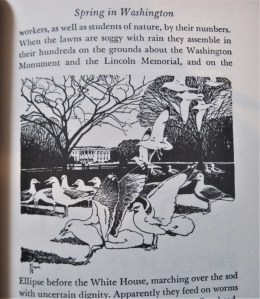 I marked so many passages of beautiful description. Halle had mastered the art of noticing. But he also sounds a premonitory note, one that was ahead of its time in the 1940s and needs heeding now more than ever: “When I see men able to pass by such a shining and miraculous thing as this Cape May warbler, the very distillate of life, and then marvel at the internal-combustion engine, I think we had all better make ourselves ready for another Flood.”
This was a lucky find at Hay Cinema Bookshop back in September. For me it was the ideal combination of thoughtful prose and vicarious travel, though I imagine it might not mean as much to those without a local connection. The black-and-white in-text illustrations by Francis L. Jaques are a particularly nice addition. 
Pussy cat, pussy cat, where have you been? I’ve been to Washington, and guess what I’ve seen… by Russell Punter and Dan Taylor (2019)
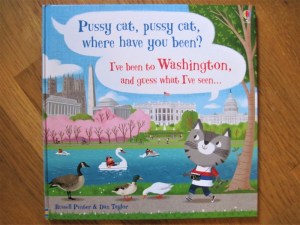 More cherry blossoms over tourist landmarks! This is part of a children’s series inspired by the 1805 English rhyme about London; other volumes visit New York City, Paris, and Rome. In rhyming couplets, he takes us from the White House to the Lincoln Memorial via all the other key sights of the Mall and further afield: museums and monuments, the Library of Congress, the National Cathedral, Arlington Cemetery, even somewhere I’ve never been – Theodore Roosevelt Island. Realism and whimsy (a kid-sized cat) together; lots of diversity in the crowd scenes. What’s not to like? (Titled Kitty cat, kitty cat… in the USA.)
And, as a bonus, some fiction in translation:
Spring Garden by Tomoka Shibasaki (2014; 2017)
[Translated from the Japanese by Polly Barton]
 Like a Murakami protagonist, Taro is a divorced man in his thirties, mildly interested in the sometimes peculiar goings-on in his vicinity. Rumor has it that his Tokyo apartment complex will be torn down soon, but for now the PR manager is happy enough here. “Avoiding bother was Taro’s governing principle.” But bother comes to find him in the form of a neighbor, Nishi, who is obsessed with a nearby house that was the backdrop for the art book Spring Garden, a collection of photographs of a married couple’s life. Her enthusiasm gradually draws Taro into the depicted existence of the TV commercial director and actress who lived there 25 years ago, as well as the young family who live there now. This Akutagawa Prize winner failed to hold my interest – like The Guest Cat, it’s oddly preoccupied with architectural detail, a Japanese fascination that doesn’t translate so well.
Have you been reading anything particularly appropriate for spring this year?
First Four in a Row: Márai, Maupin, McEwan, McKay
I announced a few new TBR reading projects back in May 2020, including a Four in a Row Challenge (see the ‘rules’, such as they are, in my opening post). It only took me, um, nearly 11 months to complete a first set! The problem was that I kept changing my mind on which four to include and acquiring more that technically should go into the sequence, e.g. McCracken, McGregor; also, I stalled on the Maupin for ages. But here we are at last. Debbie, meanwhile, took up the challenge and ran with it, completing a set of four novels – also by M authors, clearly a numerous and tempting bunch – back in October. Here’s hers.

I’m on my way to completing a few more sets: I’ve read one G, one and a bit H, and I selected a group of four L. I’ve not chosen a nonfiction quartet yet, but that could be an interesting exercise: I file by author surname even within categories like science/nature and travel, so this could throw up interesting combinations of topics. Do feel free to join in this challenge if, like me, you could use a push to get through more of the books on your shelves.
Embers by Sándor Márai (1942)
[Translated from the Hungarian by Carol Brown Janeway]
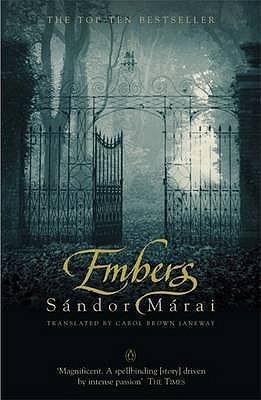 My first work of Hungarian literature.* This was a random charity shop purchase, simply because I’m always trying to read more international literature and had enjoyed translations by Carol Brown Janeway before. In 1940, two old men are reunited for the first time in 41 years at a gloomy castle, where they will dine by candlelight and, over the course of a long conversation, face up to the secret that nearly destroyed their friendship. This is the residence of 75-year-old Henrik, usually referred to as “the General,” who lives alone apart from Nini, his 91-year-old wet nurse. His wife, Krisztina, died 33 years ago.
Henrik was 10 when he met Konrad at an academy school. They were soon the best of friends, but two things came between them: first was the difference in their backgrounds (“each forgave the other’s original sin: wealth on the one hand and poverty on the other”); second was their love for the same woman.
I appreciated the different setup to this one – a male friendship, just a few very old characters, the probing of the past through memory and dialogue – but it was so languid that I struggled to stay engaged with the plot.
*My next will be Journey by Moonlight by Antal Szerb, another charity shop find.
Favourite lines:
“My homeland was a feeling, and that feeling was mortally wounded.”
“Life becomes bearable only when one has come to terms with who one is, both in one’s own eyes and in the eyes of the world.”
Tales of the City by Armistead Maupin (1978)
I’d picked this up from the free bookshop we used to have in the local mall (the source of my next two as well) and started it during Lockdown #1 because in The Novel Cure it is given as a prescription for Loneliness. Berthoud and Elderkin suggest it can make you feel like part of a gang of old friends, and it’s “as close to watching television as literature gets” due to the episodic format – the first four Tales books were serialized in the San Francisco Chronicle.
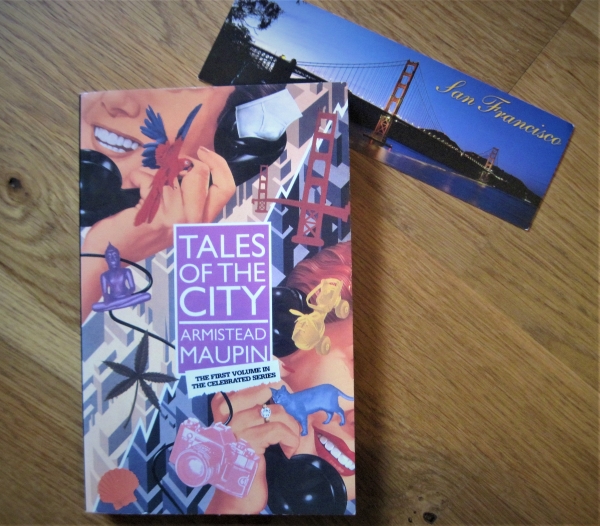
How I love a perfect book and bookmark combination!
The titled chapters are each about three pages long, which made it an ideal bedside book – I would read a chapter per night before sleep. The issue with this piecemeal reading strategy, though, was that I never got to know any of the characters; because I’d often only pick up the book once a week or so, I forgot who people were and what was going on. That didn’t stop individual vignettes from being entertaining, but meant it didn’t all come together for me.
Maupin opens on Mary Ann Singleton, a 25-year-old secretary who goes to San Francisco on vacation and impulsively decides to stay. She rooms at Anna Madrigal’s place on Barbary Lane and meets a kooky assortment of folks, many of them gay – including her new best friend, Michael Tolliver, aka “Mouse.” There are parties and affairs, a pregnancy and a death, all told with a light touch and a clear love for the characters; dialogue predominates. While it’s very much of its time, it manages not to feel too dated overall. I can see why many have taken the series to heart, but don’t think I’ll go further with Maupin’s work.
Note: Long before I tried the book, I knew about it through one of my favourite Bookshop Band songs, “Cleveland,” which picks up on Mary Ann’s sense of displacement as she ponders whether she’d be better off back in Ohio after all. Selected lyrics:
Quaaludes and cocktails
A story book lane
A girl with three names
A place, post-Watergate
Freed from its bird cage
Where the unafraid parade
[…]
Perhaps, we should all
Go back to Cleveland
Where we know what’s around the bend
[…]
Citizens of Atlantis
The Madrigal Enchantress cries
And we decide, to stay and bide our time
On this far-out, far-flung peninsula.
The Children Act by Ian McEwan (2014)
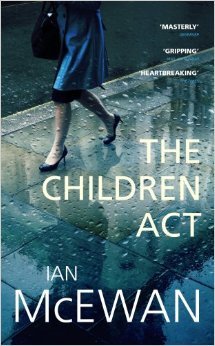 Although it’s good to see McEwan take on a female perspective – a rarer choice for him, though it has shown up in Atonement and On Chesil Beach – this is a lesser novel from him, only interesting insomuch as it combines elements from two of his previous works, The Child in Time (legislation around child welfare) and Enduring Love (a religious stalker). Fiona Maye, a High Court judge, has to decide whether 17-year-old Adam, a bright and musical young man with acute leukaemia, should be treated with blood transfusions despite his Jehovah’s Witness parents’ objection.
[SPOILERS FOLLOW]
She rules that the doctors should go ahead with the treatment. “He must be protected from his religion and from himself.” Adam, now better but adrift from the religion he was raised in, starts stalking Fiona and sending her letters and poems. Estranged from her husband, who wants her to condone his affair with a young colleague, and fond of Adam, Fiona spontaneously kisses the young man while traveling for work near Newcastle. But thereafter she ignores his communications, and when he doesn’t seek treatment for his recurring cancer and dies, she blames herself.
[END OF SPOILERS]
It’s worth noting that the AI in McEwan’s most recent full-length novel, Machines Like Me, is also named Adam, and in both books there’s uncertainty about whether the Adam character is supposed to be a child substitute. 
The Birth House by Ami McKay (2006)
Dora is the only daughter to be born into the Rare family of Nova Scotia’s Scots Bay in five generations. At age 17, she becomes an apprentice to Marie Babineau, a Cajun midwife and healer who relies on ancient wisdom and appeals to the Virgin Mary to keep women safe and grant them what they want, whether that’s a baby or a miscarriage. As the 1910s advance and the men of the village start leaving for the war, the old ways represented by Miss B. and Dora come to be seen as a threat. Dr. Thomas wants women to take out motherhood insurance and commit to delivering their babies at the new Canning Maternity Home with the help of chloroform and forceps. “Why should you ladies continue to suffer, most notably the trials of childbirth, when there are safe, modern alternatives available to you?” he asks.
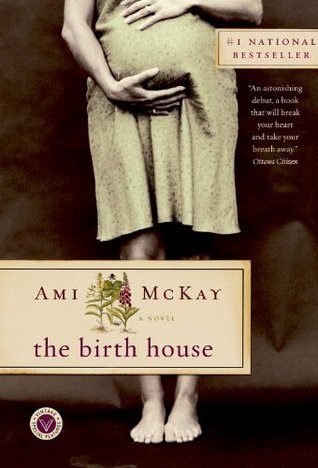 Encouraged into marriage at an early age, Dora has to put her vocation on hold to be a wife to Archer Bigelow, a drunkard with big plans for how he’s going to transform the area with windmills that generate electricity. Dora’s narration is interspersed with journal entries, letters, faux newspaper articles, what look like genuine period advertisements, and a glossary of herbal remedies – creating what McKay, in her Author’s Note, calls a “literary scrapbook.” I love epistolary formats, and there are so many interesting themes and appealing secondary characters here. Early obstetrics is not the only aspect of medicine included; there is also an exploration of “hysteria” and its treatment, and the Spanish flu makes a late appearance. Dora, away in Boston at the time, urges her friends from the Occasional Knitters’ Society to block the road to the Bay, make gauze masks, and wash their hands with hot water and soap.
There are a few places where the narrative is almost overwhelmed by all the (admittedly, fascinating) facts McKay, a debut author, turned up in her research, and where the science versus superstition dichotomy seems too simplistic, but for the most part this was just the sort of absorbing, atmospheric historical fiction that I like best. McKay took inspiration from her own home, an old birthing house in the Bay of Fundy.
 Bookish Beck = Rebecca Foster. American transplant to England. Freelance proofreader and book reviewer.
 Bookish Beck