Three Recent Review Books: Holmes, Tokarczuk & Whitaker
Where the Road Runs Out by Gaia Holmes (2018)
A gem of a poetry collection. Gaia Holmes is a creative writing tutor in Halifax, Yorkshire. This is her third volume of poetry. A major thread of the book is caring for her father at home and in the hospital as he was dying on the Orkney Islands – a time of both wonder and horror. It felt like she could never get anything right and kept angering him, as she recounts in “Feckless.” Even after his death, she continued to see him. I especially loved the food metaphors in “Kummerspeck” (a German term for emotional overeating; literally, “grief bacon”), where sweets, meat and salt cannot sate the cravings of ravenous grief.
 Other themes include pre-smartphone life (“Before All This” – not everything needed to be documented, you could live where you were and not rely on others’ constant approval), the lengths women will go to impress men (“The Audition”), being the only childless person in a room (“Ballast”) and a marriage falling apart (“Your Orange Raincoat”). Also notable are a multi-part tribute to the Chilean miners trapped in 2010 and an imagined outbreak of violence between runners and ramblers. Holmes channels Anne Sexton in “Angel of the Checkout,” with its wonderful repeated line “do you know the price of love?”, and Mary Oliver in the first stanza of “Wild Pigeons.”
There are no rhymes, just alliteration and plays on words, with a lot of seaside imagery. I would highly recommend this to poetry lovers and newbies alike.
A favorite passage:
I have no manual
for dying
so I do what I think
you’re supposed to do
in this situation.
I light the stub
of last night’s candle,
utter something holy
and stand
at your bedside
with the unfamiliar taste
of the Lord’s Prayer
clinging to my lips.
(from “The Lord’s Prayer”)
My rating: 
My thanks to Comma Press for the free copy for review.
Drive Your Plow over the Bones of the Dead by Olga Tokarczuk (2009; English translation, 2018)
[Translated from the Polish by Antonia Lloyd-Jones]
 What a bizarre novel! Janina Dusezjko is a delightfully twisted Miss Marple type who lives in a remote forest cabin in Poland, near the Czech border. She’s determined to learn the truth of what happened to her two beloved dogs, whom she calls her Little Girls. When four different men who were involved in local hunting – her unpleasant neighbor, a deer poacher whom she nicknamed Big Foot; a police commandant; a fox farm owner; and the president of the mushroom pickers’ association – are all found murdered, her theorizing runs wild. She believes the animals are taking revenge, and intends to use her astrology skills to glean more information about these untimely deaths. The police, meanwhile, dismiss her as a hysterical old crone.
The title comes from William Blake, whose writing is an undercurrent to the book: Dizzy, Janina’s former English pupil, is reading and translating Blake, and I reckon Janina’s nutty philosophy and capitalization of random words, especially abstractions, may be an homage to Blake. I probably missed some of the more intricate allusions, and my attention wandered for a while during the middle of the book, but this was an offbeat and mostly enjoyable read. I struggled with Flights, but I’m glad I tried Tokarczuk again.
A representative passage:
“We have this body of ours, a troublesome piece of luggage, we don’t really know anything about it and we need all sorts of Tools to find out about its most natural processes.”
My rating: 
My thanks to Fitzcarraldo Editions for the free copy for review.
Chicken Unga Fever: Stories from the Medical Frontline by Dr. Phil Whitaker (2018)
This is a selection of Whitaker’s “Health Matters” columns from the New Statesman magazine. In his time as a GP he’s seen his fair share of common and unusual illnesses, and has so honed his diagnosing skills that he can start to figure out what’s wrong based on how someone stands up and walks towards his office from the waiting room. That’s why he’s a “meeter” (calling names in person and escorting patients down the hallway) rather than a “buzzer” (waiting for them to come to him, having being called via a digital screen).
 In digestible essays of 2.5 pages each, Whitaker discusses mental health sectioning, home visiting, the rise of technology and antibiotic resistance, the culture of complaint, zealous overscreening and overtreatment (he’d have an ally there in Barbara Ehrenreich: see her Natural Causes) and the tricky issue of getting consent from teenagers. He also recreates individual cases that have left an impression on him. When it comes to diagnoses, he recognizes that sometimes it’s a matter of luck – like when he landed on Cushing’s disease based on a rare combination of common symptoms – and that sometimes you have to admit you don’t know and turn to the Internet. That’s where the title comes from – an out-of-hours caller’s approximation of suspected chikungunya fever.
This is an enjoyable book for medically minded laymen to read a few pieces at a time, though I suspect its take on various issues could soon be outdated.
My rating:
My thanks to Salt Publishing for the free copy for review.
This Year’s “Snow” and “Winter” Reads
Longtime readers will know how much I enjoy reading with the seasons. Although it’s just starting to feel like there’s a promise of spring here in the south of England, I understand that much of North America is still cold and snowy, so I hope these recent reads of mine will feel topical to some of you – and the rest of you might store some ideas away for next winter.
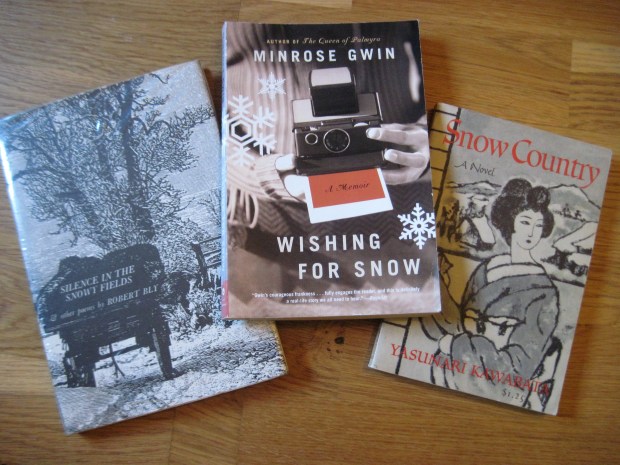
(The Way Past Winter has already gone back to the library.)
Silence in the Snowy Fields and Other Poems by Robert Bly (1967)
 Even when they’re in stanza form, these don’t necessarily read like poems; they’re often more like declaratory sentences, with the occasional out-of-place exclamation. But Bly’s eye is sharp as he describes the signs of the seasons, the sights and atmosphere of places he visits or passes through on the train (Ohio and Maryland get poems; his home state of Minnesota gets a whole section), and the small epiphanies of everyday life, whether alone or with friends. And the occasional short stanza hits like a wisdom-filled haiku, such as “There are palaces, boats, silence among white buildings, / Iced drinks on marble tops among cool rooms; / It is good also to be poor, and listen to the wind” (from “Poem against the British”).
Favorite wintry passages:
How strange to think of giving up all ambition!
Suddenly I see with such clear eyes
The white flake of snow
That has just fallen in the horse’s mane!
(“Watering the Horse” in its entirety)
The grass is half-covered with snow.
It was the sort of snowfall that starts in late afternoon,
And now the little houses of the grass are growing dark.
(the first stanza of “Snowfall in the Afternoon”)
My rating: 
Wishing for Snow: A Memoir by Minrose Gwin (2004)
 One of the more inventive and surprising memoirs I’ve read. Growing up in Mississippi in the 1920s–30s, Gwin’s mother wanted nothing more than for it to snow. That wistfulness, a nostalgia tinged with bitterness, pervades the whole book. By the time her mother, Erin Clayton Pitner, a published though never particularly successful poet, died of ovarian cancer in the late 1980s, their relationship was a shambles. Erin’s mental health was shakier than ever – she stole flowers from the church altar, frequently ran her car off the road, and lived off canned green beans – and she never forgave Minrose for having had her committed to a mental hospital. Poring over Erin’s childhood diaries and adulthood vocabulary notebook, photographs, the letters and cards that passed between them, remembered and imagined conversations and monologues, and Erin’s darkly observant unrhyming poems (“No place to hide / from the leer of the sun / searching out every pothole, / every dream denied”), Gwin asks of her late mother, “When did you reach the point that everything was in pieces?”
My rating: 
The Way Past Winter by Kiran Millwood Hargrave (2018)
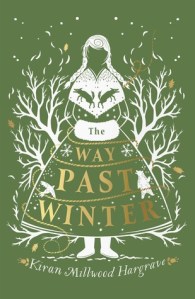 It has been winter for five years, and Sanna, Mila and Pípa are left alone in their little house in the forest – with nothing but cabbages to eat – when their brother Oskar is lured away by the same evil force that took their father years ago and has been keeping spring from coming. Mila, the brave middle daughter, sets out on a quest to rescue Oskar and the village’s other lost boys and to find the way past winter. Clearly inspired by the Chronicles of Narnia and especially Katherine Arden’s Winternight trilogy, this middle grade novel is set in an evocative, if slightly vague, Russo-Finnish past and has more than a touch of the fairy tale about it. I enjoyed it well enough, but wouldn’t seek out anything else by the author.
Favorite wintry passage:
“It was a winter they would tell tales about. A winter that arrived so sudden and sharp it stuck birds to branches, and caught the rivers in such a frost their spray froze and scattered down like clouded crystals on the stilled water. A winter that came, and never left.”
My rating:
Snow Country by Yasunari Kawabata (1937; English translation, 1956)
[Translated from the Japanese by Edward G. Seidensticker]
 The translator’s introduction helped me understand the book better than I otherwise might have. I gleaned two key facts: 1) The mountainous west coast of Japan is snowbound for months of the year, so the title is fairly literal. 2) Hot springs were traditionally places where family men travelled without their wives to enjoy the company of geishas. Such is the case here with the protagonist, Shimamura, who is intrigued by the geisha Komako. Her flighty hedonism seems a good match for his, but they fail to fully connect. His attentions are divided between Komako and Yoko, and a final scene that is surprisingly climactic in a novella so low on plot puts the three and their relationships in danger. I liked the appropriate atmosphere of chilly isolation; the style reminded me of what little I’ve read from Marguerite Duras. I also thought of Silk by Alessandro Baricco and Memoirs of a Geisha by Arthur Golden – perhaps those were to some extent inspired by Kawabata?
Favorite wintry passage:
“From the gray sky, framed by the window, the snow floated toward them in great flakes, like white peonies. There was something quietly unreal about it.”
My rating:
I’ve also been slowly working my way through The Snow Leopard by Peter Matthiessen, a spiritual quest memoir with elements of nature and travel writing, and skimming Francis Spufford’s dense book about the history of English exploration in polar regions, I May Be Some Time (“Heat and cold probably provide the oldest metaphors for emotion that exist.”).

On next year’s docket: The Library of Ice by Nancy Campbell (on my Kindle) and Snow Falling on Cedars by David Guterson
Last year I had a whole article on perfect winter reads published in the Nov/Dec issue of Bookmarks magazine. Buried in Print spotted it and sent this tweet. If you have access to the magazine via your local library, be sure to have a look!

Have you read any particularly wintry books recently?
No Place to Lay One’s Head by Françoise Frenkel (1945)
Fittingly, I finished reading this on Sunday, which was International Holocaust Remembrance Day. Even after seven decades, we’re still unearthing new Holocaust narratives, such as this one: rediscovered in a flea market in 2010, it was republished in French in 2015 and first became available in English translation in 2017.
 Born Frymeta Idesa Frenkel in Poland, the author (1889–1975) was a Jew who opened the first French-language bookstore in Berlin in 1921. After Kristallnacht and the seizure of her stock and furniture, she left for France and a succession of makeshift situations, mostly in Avignon and Nice. She lived in a hotel, a chateau, and the spare room of a sewing machinist whose four cats generously shared their fleas. All along, the Mariuses, a pair of hairdressers, were like guardian angels she could go back to between emergency placements.
This memoir showcases the familiar continuum of uneasiness blooming into downright horror as people realized what was going on in Europe. To start with one could downplay the inconveniences of having belongings confiscated and work permits denied, of squeezing onto packed trains and being turned back at closed borders. Only gradually, as rumors spread of what was happening to deported Jews, did Frenkel understand how much danger she was in.
The second half of the book is more exciting than the first, especially after Frenkel is arrested at the Swiss border. (Even though you know she makes it out alive.) Her pen portraits of her fellow detainees show real empathy as well as writing talent. Strangely, Frenkel never mentions her husband, who went into exile in France in 1933 and died in Auschwitz in 1942. I would also have liked to hear more about her 17 years of normal bookselling life before everything kicked off. Still, this is a valuable glimpse into the events of the time, and a comparable read to Władysław Szpilman’s The Pianist.
My rating:
No Place to Lay One’s Head (translated from the French by Stephanie Smee) is issued in paperback today, January 31st, by Pushkin Press. This edition includes a preface by Patrick Modiano and a dossier of documents and photos relating to Frenkel’s life. My thanks to the publisher for the free copy for review.
Doorstopper(s) of the Month: Julia Glass (& Umberto Eco)
The Whole World Over by Julia Glass (2006)
When I plucked this from the sidewalk clearance area of my favorite U.S. bookstore, all I knew about it was that it featured a chef and was set in New York City and New Mexico. Those facts were enough to get me interested, and my first taste of Julia Glass’s fiction did not disappoint. I started reading it in the States at the very end of December and finished it in the middle of this month, gobbling up the last 250 pages or so all in one weekend.
 Charlotte “Greenie” Duquette is happy enough with her life: a successful bakery in Greenwich Village, her psychiatrist husband Alan, and their young son George. But one February 29th – that anomalous day when anything might happen – she gets a call from the office of the governor of New Mexico, who tasted her famous coconut cake (sandwiched with lemon curd and glazed in brown sugar) at her friend Walter’s tavern and wants her to audition for a job as his personal chef at the governor’s mansion in Santa Fe. It’s just the right offer to shake up her stagnating career and marriage.
One thing you can count on from a doorstopper, from Dickens onward, is that most of the many characters will be connected (“a collection of invisibly layered lives” is how Glass puts it). So: Walter’s lover is one of Alan’s patients; Fenno, the owner of a local bookstore, befriends both Alan and Saga, a possibly homeless young woman with brain damage who volunteers in animal rescue – along with Walter’s dog-walker, who’s dating his nephew; and so on. The title refers to how migrating birds circumnavigate the globe but always find their way home, and the same is true of these characters: no matter how far they stray – even as Greenie and Alan separately reopen past romances – the City always pulls them back.
My only real complaint about the novel is that it’s almost overstuffed: with great characters and their backstories, enticing subplots, and elements that seemed custom-made to appeal to me – baking, a restaurant, brain injury, the relatively recent history of the AIDS crisis, a secondhand bookstore, rescue dogs and cats, and much more. I especially loved the descriptions of multi-course meals and baking projects. Glass spins warm, effortless prose reminiscent of what I’ve read by Louise Miller and Carolyn Parkhurst. I will certainly read her first, best-known book, Three Junes, which won the National Book Award. I was also delighted to recall that I have her latest on my Kindle: A House Among the Trees, based on the life of Maurice Sendak.
All told, this was quite the bargain entertainment at 95 cents! Two small warnings: 1) if you haven’t read Three Junes, try not to learn too much about it – Glass likes to use recurring characters, and even a brief blurb (like what’s on the final page of my paperback; luckily, I didn’t come across it until the end) includes a spoiler about one character. 2) Glass is deliberately coy about when her book is set, and it’s important to not know for as long as possible. So don’t glance at the Library of Congress catalog record, which gives it away.
Page count: 560
My rating:
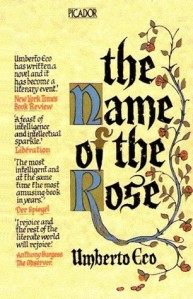 I started Umberto Eco’s The Name of the Rose (1983) with the best intentions of keeping up with Annabel’s buddy read. The first 50–100 pages really flew by and drew me into the mystery of a medieval abbey where monks keep getting murdered in hideous ways. I loved the Sherlockian shrewdness and tenacity of Brother William; the dutiful recording of his sidekick, narrator Adso of Melk; and the intertextual references to Borges’s idea of a library as a labyrinth. But at some point the historical and theological asides and the untranslated snippets of other languages (mostly Latin) began to defeat me, and I ended up just skimming most of the book. I’d recommend this if you liked Samantha Harvey’s The Western Wind, or if you fancy an astronomically more intelligent version of The Da Vinci Code.
A favorite passage: “Books are not made to be believed, but to be subjected to inquiry. When we consider a book, we mustn’t ask ourselves what it says but what it means”
My rating:
American Book Acquisitions and 2019 Reading Goals
We arrived in the UK on January 1, after an overnight flight from Baltimore. There was no midnight announcement, no complimentary champagne; nothing. Clearly I had my hopes too high. So we’re feeling a bit cheated out of our New Year’s Eve experience and will be doing a recreated countdown and toast when we have houseguests over for this Epiphany weekend.
It was a low-key, relaxing couple of weeks back in the States, the majority of it spent seeing family and friends. We also made it into D.C. to see the new Obama portraits. Mostly I enjoyed doing not a lick of work. And I acquired books, of course: a secondhand and remainder stack that, after my trade-in of some cast-off books, cost just $4; and a few ARCs I’m excited about.


2019 Goals
I’m feeling restless in my career, like if someone gave me permission to quit all my gigs I would do it tomorrow. But, of course, only a fool would do so with no plan to replace them with other remunerative work. The year is likely to involve a lot of rethinking for me as I evaluate which of my proofreading and writing jobs feel worthwhile, and what’s taking me in the direction I want to go (not that I currently know what that is).
Life is awfully hard to plan out. Reading is much easier! So here are my fairly modest reading goals for the year, some of them overlapping:
- I plan to reinstate the Classic and Doorstopper of the month features I ran in 2017, since otherwise I hardly ever read them. I’m starting with Annabel’s readalong of The Name of the Rose by Umberto Eco, which is just over 500 pages but also conveniently falls into one of the below categories.

The doorstoppers I have around to choose from.
- I’ll make a second attempt at getting through some of the travel books and biographies I own, though I won’t hold myself to any particular target. At least five of each would be nice.


- I’m determined to up my literature in translation ratio. These are all the books I own that were originally published in other languages – pitiful! – but I will get hold of more through the library and publishers.

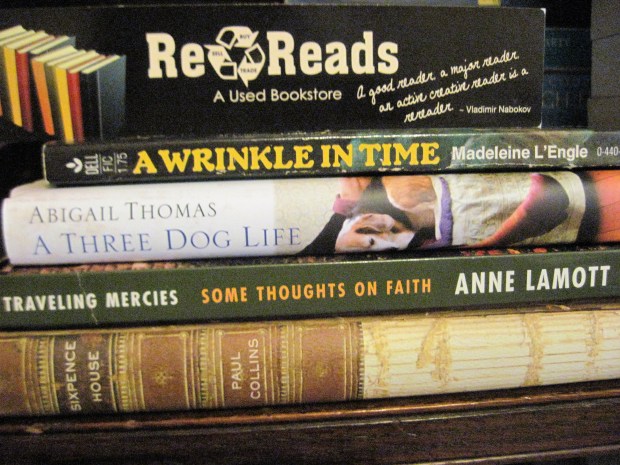
- Re-reading is something I undertake very reluctantly. I have friends who swear by it, but to me it can feel like a waste of time. Last year I re-read just four books: Little Women, Give Me Everything You Have, Crossing the Moon, and Diary of a Bookseller. In each case, on the second reading I rated the book a star lower. That suggests that, far from appreciating books more on a second reading, I have less patience with them and find more flaws! All the same, I’ve chosen four books to re-read in 2019. The Collins is a longtime favorite about moving to Hay-on-Wye; the Thomas is one of the books that first got me into reading memoirs. I’ve been let down by Lamott’s latest three books so wanted to go back to one of her spiritual classics; I’ve gotten into L’Engle’s writing for adults and want to revisit her most famous children’s book (which I don’t think I comprehended at age nine or whatever I was).
- I have a bad habit of racing through self-help and theology books rather than taking my time mulling over them and fully exploring how I might apply them in my life. This was especially true of The Artist’s Way, one of my bibliotherapy prescriptions. I started out with the aim of completing the daily “morning pages” of free writing (though for me they were ‘evening pages’; I’m not a morning person) and each chapter’s self-knowledge exercises. But soon I’d given up on the writing and contemplation and begun just reading the book straight through, which is not the point of it at all. So this year I mean to go back through the Cameron and Rubin books more mindfully, and use the McLaren devotional as it is intended, reading the recommended Bible passages alongside the weekly reflections.

What are some of your goals (reading-related or otherwise) for 2019?
Final 2018 Statistics and Where My Books Came From
My most prolific year yet! (I’m sure I said the same last year, but really, this is a number I will most likely never top and shouldn’t attempt to.) People sometimes joke to me, “why not shoot for a book a day?!” but that’s not how I do things. Instead of reading one book from start to finish, I almost always have 10 to 20 books on the go at a time, and I tend to start and finish books in batches – I’m addicted to starting new books, but also to finishing them.

The breakdown:
Fiction: 44.9%
Nonfiction: 45.8%
Poetry: 9.3%
(I think this is the first time nonfiction has surpassed fiction! They’re awfully close, though. I read a bit less poetry this year than last.)
Male author: 38.1%
Female author: 61.9%
(Roughly the same thing has happened the last two years, which I find interesting because I have never consciously set out to read more books by women.)
E-books: 15.7%
Print books: 84.3%
(In 2016 I read one-third e-books; in 2017 it was one-quarter. For some reason I seem to find e-books less and less appealing. They are awfully useful for traveling. However, I’ve been cutting back on the reviewing gigs that rely on me reading only e-books.)
Works in translation: 4.8%
(Ouch – my reading in translation almost halved compared to last year. I’m going to have to make a point of reading more translated work next year.)
Where my books came from for the whole year:
- Free print or e-copy from publisher: 28.7%
- Public library: 20.8%
- Secondhand purchase: 20.6%
- Downloaded from NetGalley or Edelweiss: 14.9%
- Gifts: 5%
- Free (giveaways, GET Free Bookshop, Book Thing of Baltimore, etc.): 3.8%
- University library: 3.2%
- New purchase (usually at a bargain): 1.5%
- Kindle purchase: 0.9%
- Borrowed: 0.6%
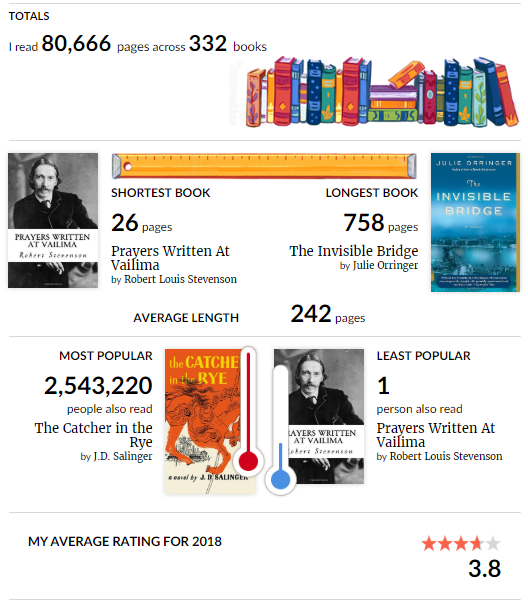
Some interesting additional statistics courtesy of Goodreads:
How did 2018 turn out for you reading-wise?
Happy New Year!
Recent Bylines: Glamour, Shiny New Books, Etc.
Following up on my post from June, here are excerpts from and links to some of my recent online writing for places that aren’t my blog.
Review essay of Gross Anatomy by Mara Altman for Glamour UK
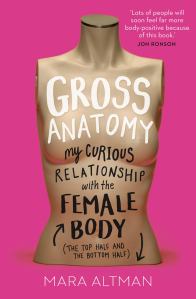 The female body has been a source of deep embarrassment for Altman, but here she swaps shame for self-deprecating silliness and cringing for chuckling. Through a snappy blend of personal anecdotes and intensive research, she exposes the cultural expectations that make us dislike our bodies, suggesting that a better knowledge of anatomy might help us feel normal. While 11 of her 15 topics aren’t exclusive to women’s anatomy—birthmarks, hemorrhoids, warts and more apply to men, too—she always presents an honest account of the female experience. This is one of my favorite books of the year and one I’d recommend to women of any age. It’s funny, it’s feminist, and it’s a cracking good read. (My full review is complete with embarrassing personal revelations!)
Essay on two books about “wasting time” for the Los Angeles Review of Books
In Praise of Wasting Time by Alan Lightman  &
&
 The Art of the Wasted Day by Patricia Hampl: A poet’s delight in lyricism and free association is in evidence here. The book blends memoir with travel and biographical information about some of Hampl’s exemplars of solitary, introspective living, and it begins, quite literally, with daydreaming.
 Hampl and Lightman start from the same point of frazzled frustration and arrive at many of the same conclusions about the necessity of “wasted” time but go about it in entirely different ways. Lightman makes a carefully constructed argument and amasses a sufficient weight of scientific and anecdotal evidence; Hampl drifts and dreams through seemingly irrelevant back alleys of memory and experience. The latter is a case of form following function: her book wanders along with her mind, in keeping with her definition of memoir as “lyrical quest literature,” where meaning always hovers above the basics of plot.
Book list for OZY on the refugee crisis & another coming up on compassion in medicine.
Pittsburgh Post-Gazette reviews
(Their website is not available outside the USA, so the links may not work for you).
Slave Old Man by Patrick Chamoiseau
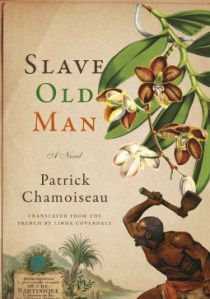 Chamoiseau is a social worker and author from the Caribbean island of Martinique. Translator Linda Coverdale has chosen to leave snippets of Martinican Creole in this text, creating a symphony of languages. The novel has an opening that might suit a gloomy fairytale: “In slavery times in the sugar isles, once there was an old black man.” The novel’s language is full of delightfully unexpected verbs and metaphors. At not much more than 100 pages, it is a nightmarish novella that alternates between feeling like a nebulous allegory and a realistic escaped slave narrative. It can be a disorienting experience: like the slave, readers are trapped in a menacing forest and prone to hallucinations. The lyricism of the writing and the brief glimpse back from the present day, in which an anthropologist discovers the slave’s remains and imagines the runaway back into life, give this book enduring power.
Lake Success by Gary Shteyngart
 Barry Cohen, a conceited hedge fund manager under SEC investigation for insider trading, sets out on a several-month picaresque road trip in the second half of 2016. The ostensible aim is to find his college girlfriend, but he forms fleeting connections with lots of ordinary folks along the way. Barry may be a figure of fun, but it’s unpleasant to spend so much time with his chauvinism (“he never remembered women’s names” but gets plenty of them to sleep with him), which isn’t fully tempered by alternating chapters from his wife’s perspective. Pitched somewhere between the low point of “Make America Great Again” and the loftiness of the Great American novel, Lake Success may not achieve the profundity it’s aiming for, but it’s still a biting portrait of an all-too-recognizable America where money is God and villains gets off easy.
Shiny New Books reviews
(Upcoming: Nine Pints by Rose George and Under the Rock by Benjamin Myers.) Latest:
The Immeasurable World: Journeys in Desert Places by William Atkins
 Atkins has produced an appealing blend of vivid travel anecdotes, historical background and philosophical musings. He is always conscious that he is treading in the footsteps of earlier adventurers. He has no illusions about being a pioneer here; rather, he eagerly picks up the thematic threads others have spun out of desert experience and runs with them – things like solitude, asceticism, punishment for wrongdoing and environmental degradation. The book is composed of seven long chapters, each set in a different desert. In my favorite segment, the author rents a cabin in the Sonoran Desert of Arizona for $100 a week. My interest waxed and waned from chapter to chapter, but readers of travelogues should find plenty to enjoy. Few of us would have the physical or emotional fortitude to repeat Atkins’s journeys, but we get the joy of being armchair travelers instead.
Mrs Gaskell & Me: Two Women, Two Love Stories, Two Centuries Apart by Nell Stevens
 I was ambivalent about the author’s first book (Bleaker House), but for a student of the Victorian period this was unmissable, and the meta aspect was fun and not off-putting this time. Stevens has a light touch, and flits between Gaskell’s story and her own in alternating chapters. One strand covers the last decade of Gaskell’s life, but what makes it so lively and unusual is that Stevens almost always speaks of Gaskell as “you.” The intimacy of that address ensures her life story is anything but dry. The other chapters are set between 2013 and 2017 and narrated in the present tense, which makes Stevens’s dilemmas feel pressing. For much of the first two years her PhD takes a backseat to her love life. She’s obsessed with Max, a friend and unrequited crush from her Boston University days who is now living in Paris. This is a whimsical, sentimental, wry book that will ring true for anyone who’s ever been fixated on an idea or put too much stock in a relationship that failed to thrive.
Times Literary Supplement reviews
I’ve recently submitted my sixth and seventh for publication. All of them have been behind a paywall so far, alas. (Upcoming: Face to Face: True stories of life, death and transformation from my career as a facial surgeon by Jim McCaul; On Sheep: Diary of a Swedish Shepherd by Axel Lindén.) Latest:
How To Build A Boat: A Father, his Daughter, and the Unsailed Sea by Jonathan Gornall
 Gornall’s genial memoir is the story of a transformation and an adventure, as a fifty-something freelance journalist gets an unexpected second chance at fatherhood and decides to build his daughter, Phoebe, a boat. It was an uncharacteristic resolution for “a man who [had] never knowingly wielded a plane or a chisel,” yet in a more metaphorical way it made sense: the sea was in his family’s blood. Gornall nimbly conveys the precarious financial situation of the freelancer, as well as the challenges of adjusting to new parenthood late in life. This is a refreshingly down-to-earth account. The nitty-gritty details of the construction will appeal to some readers more than to others, but one can’t help admiring the combination of craftsmanship and ambition. (Full review in September 7th issue.)
Three Reads for Women in Translation Month 2018
An offer of the latest Latin American import from Charco Press prompted me to scour my shelves and see what other books I might add for #WITMonth. I dug out two novella-length books I’d bought secondhand over the past year to make it a trio. My rating for all: 
The Lost Daughter by Elena Ferrante
[Translated from the Italian by Ann Goldstein]
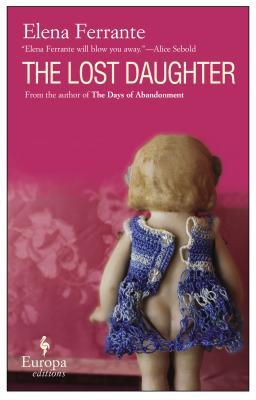 Leda is a 47-year-old teacher on holiday in southern Italy. She mostly sits on the beach, minding her own business, but still gets drawn into the minor daily dramas of a large Neapolitan family. One woman is pregnant; another has a small child named Elena who is devastated at losing her doll. Their mother–daughter dynamic takes Leda back to the time when she abandoned her own daughters and didn’t see them for three years. She temporarily found it impossible to reconcile motherhood with her career and her general sense of herself. Leda sees herself as part of a “chain of mute or angry women” – “I seemed to be falling backward toward my mother, my grandmother.”
I was definitely on board for the memories of motherly guilt. Where Ferrante lost me was when Leda steals the doll the child left behind and takes it up to her room to care for it – washing it, buying it new clothes, etc. Every time she sets out to give the doll back or at least leave it somewhere it will be found, she finds another excuse to put it off. Leda herself is unsure why she’s fixated on the doll; “The hardest things to talk about are the ones we ourselves can’t understand,” she says early on.
Most likely the doll could be interpreted as a symbol of Leda’s desire to be part of a functional family, to get a second chance at perfection with her daughters. But the book was a little too strange for me, and I never really engaged with the Neapolitan characters. After this and a skim of My Brilliant Friend a couple years back, I doubt I’ll pick up anything else by Ferrante. The themes and style of this one reminded me of Rachel Cusk’s Outline trilogy, A Separation by Katie Kitamura, and Hot Milk by Deborah Levy.
Favorite passage:
“Life can have an ironic geometry. Starting from the age of thirteen or fourteen I had aspired to a bourgeois decorum, proper Italian, a good life, cultured and reflective. Naples had seemed a wave that would drown me. I didn’t think the city could contain life forms different from those I had known as a child, violent or sensually lazy, tinged with sentimental vulgarity or obtusely fortified in defense of their own wretched degradation. I didn’t even look for them, those forms, in the past or in a possible future. I had run away like a burn victim who, screaming, tears off the burned skin, believing that she is tearing off the burning itself.”
Fish Soup by Margarita García Robayo
[Translated from the Spanish by Charlotte Coombe]
 Fish Soup contains two novellas (one of them, Sexual Education, was previously unpublished) separated by a set of seven short stories, and marks the first time the Colombian author Margarita García Robayo’s work has appeared in English. I especially liked the title story, in which a widower starts to smell his dead wife Helena’s fish soup in the bar that he owns and goes to investigate, all the while mixing up his dreams and memories with what’s really happening.
My other favorite piece was the opening novella, Waiting for a Hurricane, in which the narrator longs for escape from her seaside home, wanting nothing more than to be a “foreigner.” She starts a law degree but gives it up to become an air hostess, making flights to and from Miami and elsewhere. From her childhood onward, Gustavo has been a major presence in her life, teaching her to prepare fish and telling her stories, but there’s an uncomfortable element to their relationship that’s never really addressed. The mixture of quirky happenings and darker material reminded me of Swallowing Mercury, while the cancer theme of the story “Like a Pariah” recalls Hair Everywhere.
One of my frequent issues with short fiction is a preponderance of inconclusive endings that make you wonder what the point could be. I experienced that a few times with this collection, especially at the close of Waiting for a Hurricane. Judging by the title, though, the main message I drew from the novella is that you can’t just go around waiting for momentous things to happen to you, for your ‘real’ life to start; you have to recognize that this is life, here and now: in storytelling, in spicy stews, in everyday moments with friends and family.
With thanks to Charco Press for the free copy for review.
Sky Burial: An Epic Love Story of Tibet by Xinran
[Translated from the Chinese by Julia Lovell and Esther Tyldesley]
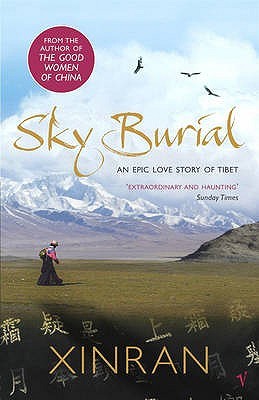 In 1994 Xinran, a Chinese journalist who later moved to London, met a woman whose story captured her imagination. Shu Wen received word that her husband, Kejun, had died just months into their marriage. A doctor in the People’s Liberation Army, he’d been sent into Tibet in the 1960s after its ‘liberation’. With no details or body to confirm his demise, though, Wen refused to believe Kejun was gone, and traveled to Tibet to find him. She stayed there for over 30 years – more than half her life – living with a Tibetan family and adjusting to their culture and rituals as she sought word of her husband. The gender roles surprised her: men did the sewing and women had multiple husbands. It was a land of lamas and temples; “the whole of Tibet was one great monastery,” she felt.
Wen does eventually learn the truth of what happened to her husband (whew!), and after decades of living as a superstitious Buddhist in primitive conditions has to readjust to life in a new China, having completely missed the Cultural Revolution. She clings to words of wisdom from a military official: “Whatever happens, remember one thing: just staying alive is a victory” and “Writing can be a source of strength.” He then gave her a diary that she filled with letters to Kejun over the years.
It’s a pleasant, short book made up of layers of tales: the legends and history lessons Wen hears from Tibetans; what she conveys to Xinran during their two intense days together; and the resulting narrative Xinran spent nearly a decade imagining herself into. Kejun’s fate is worth waiting around to hear about (but if you know what the title refers to you might consider it a spoiler), though this is something of a thin story overall. I’ve seen it referred to as a novel, though I consider it more of a stylized biography.
Did you do any special reading for Women in Translation month this year?
Two “Summer” Reads: Knausgaard and Trevor
Last year at about this time I reviewed Jonathan Smith’s Summer in February and Elizabeth Taylor’s In a Summer Season, two charming English novels about how love can upend ordinary life. This month I read my first William Trevor novel, Love and Summer, which is very much in that vein. My other selection, Karl Ove Knausgaard’s last of four seasonal installments written for his young daughter, is a mostly nonfiction hybrid.
Summer by Karl Ove Knausgaard (2016; English translation, 2018)

Illustrated by German artist Anselm Kiefer.
I’ve now read three volumes from the Seasons Quartet – all but Spring. The series started with Knausgaard addressing his fourth child in utero. By now she’s two years old but still the recipient of his nostalgic, slightly didactic essays on seasonal topics, as well as the “you” some of his journal entries are written to. I wasn’t so keen on Autumn, but Winter and Summer are both brilliant for how they move from tangibles – ice cream cones, camping, fruit flies, seagulls, butterflies and the circus – into abstract notions of thought, memory, identity and meaning. That fluidity is especially notable here when Knausgaard drifts in and out of the imagined experience of an elderly woman of his grandfather’s acquaintance who fell in love with an Austrian soldier and abandoned her children during World War II.
I especially enjoyed two stories: traveling with his son to Brazil for a literary festival where he ran into English surgeon Henry Marsh, and fainting at an overcrowded publisher party in London. He’s always highly aware of himself (he never gives open-mouthed smiles because of his awful teeth) and of others (this woman at the party is desperate to appear young). But more so than these stand-out events and his memories of childhood, he gives pride of place to everyday life, things like chauffeuring his three older children to their various activities and shopping at the supermarket for barbecue food. “By writing it I reveal that not only do I think about it, I attach importance to it. … I love repetition. Repetitions turn time into a place, turn the days into a house.” I highlighted dozens of passages in the Kindle book. I’ll need to catch up on Spring, and then perhaps return to the My Struggle books; I only ever read the first.
My rating:
Love and Summer by William Trevor (2009)
 Trevor (1928–2016) was considered a writer’s writer and a critic’s dream for the simple profundity of his prose. I had long meant to try his work. This short novel is set over the course of one summer in a small Irish town in the 1950s, and opens on the day of the funeral of old Mrs. Connulty. A stranger is seen taking photographs around town, and there is much murmuring about who he might be. He is Florian Kilderry, who recently inherited his Anglo-Italian artist parents’ crumbling country house. It’s impossible to pay the debts and keep the house going, so he plans to sell it and its contents as soon as possible and move abroad, perhaps to Scandinavia.
But he hasn’t passed through Rathmoye without leaving ripples. Ellie Dillahan, a young farmer’s wife who was raised by nuns and initially moved to Dillahan’s as his housekeeper, falls in love with the stranger almost before she meets him, and they embark on a short-lived liaison. Blink and you’ll miss that the relationship is actually sexual; Trevor only uses the word “embraced” twice, I think. That reticence keeps it from being a torrid affair, yet we do get a sense of how wrenching the thought of Florian leaving becomes for Ellie. Trevor often moves from descriptions of nature or farm chores straight into Ellie’s thoughts, or vice versa.
“In the crab-apple orchard she scattered grain and the hens came rushing to her. She hadn’t been aware that she didn’t love her husband. Love hadn’t come into it”
“He [Florian] would be gone, as the dead are gone, and that would be there all day, in the kitchen and in the yard, when she brought in anthracite for the Rayburn, when she scalded the churns, while she fed the hens and stacked the turf.”
This is quietly beautiful writing – perhaps too quiet for me, despite the quirky secondary characters around the town (including the busybody Connulty daughter and the madman Orpen Wren) – but I would recommend Trevor to readers of Mary Costello and Colm Tóibín. I would also like to try Trevor’s short stories, for which he was particularly known; I think in small doses his subtle relationship studies and gentle writing would truly shine.
My rating:
Summery reading options for next year: The Heat of the Day by Elizabeth Bowen, One Summer: America, 1927 by Bill Bryson, and The Go-Between by L. P. Hartley (set over a long, hot summer). I may also get Sunburn by Laura Lippman and Heat Wave by Penelope Lively out from the library.
Have you read any “Summer” books lately?
Die, My Love by Ariana Harwicz
This intense Argentinian novella, originally published in 2012 and nominated for this year’s Republic of Consciousness and Man Booker International Prizes, is an inside look at postpartum depression as it shades into what looks like full-blown psychosis. We never learn the name of our narrator, just that she’s a foreigner living in France (like Harwicz herself) and has a husband and young son. The stream-of-consciousness chapters are each composed of a single paragraph that stretches over two or more pages. From the first page onwards, we get the sense that this character is on the edge: as she’s hanging laundry outside, she imagines a sun shaft as a knife in her hand. But for now she’s still in control. “I wasn’t going to kill them. I dropped the knife and went to hang out the washing like nothing had happened.”
 Not a lot happens over the course of the book; what’s more important is to be immersed in this character’s bitter and perhaps suicidal or sadistic outlook. But there are a handful of concrete events. Her father-in-law has recently died, so she tells of his funeral and what she perceives as his sad little life. Her husband brings home a stray dog that comes to a bad end. Their son attends a children’s party and they take along a box of pastries that melt in the heat.
The only escape from this woman’s mind is a chapter from the point of view of a neighbor, a married radiologist with a disabled daughter who passes her each day on his motorcycle and desires her. With such an unreliable narrator, though, it’s hard to know whether the relationship they strike up is real. This woman is racked by sexual fantasies, but doesn’t seem to be having much sex; when she does, it’s described in disturbing terms: “He opened my legs. He poked around with his calloused hands. Desire is the last thing there is in my cries.”
The language is jolting and in-your-face, but often very imaginative as well. Harwicz has achieved the remarkable feat of showing a mind in the process of cracking up. It’s all very strange and unnerving, and I found that the reading experience required steady concentration. But if you find the passages below intriguing, you’ll want to seek out this top-class translation from new Edinburgh-based publisher Charco Press. It’s the first book in what Harwicz calls “an involuntary trilogy” and has earned her comparisons to Virginia Woolf.
“My mind is somewhere else, like I’ve been startled awake by a nightmare. I want to drive down the road and not stop when I reach the irrigation ditch.”
“I take off my sleep costume, my poisonous skin. I recover my sense of smell and my eyelashes, go back to pronouncing words and swallowing. I look at myself in the mirror and see a different person to yesterday. I’m not a mother.”
“The look I’m going for is Zelda Fitzgerald en route to Switzerland, and not for the chocolate or watches, either.”
My rating:
Translated from the Spanish by Sarah Moses and Carolina Orloff. My thanks to the publisher for the free copy for review.
 Bookish Beck = Rebecca Foster. American transplant to England. Freelance proofreader and book reviewer.
 Bookish Beck