Spring Reads, Part II: Blossomise, Spring Chicken & Cold Spring Harbor
Our garden is an unruly assortment of wildflowers, rosebushes, fruit trees and hedge plants, along with an in-progress pond, and we’ve made a few half-hearted attempts at planting vegetable seeds and flower bulbs. It felt more like summer earlier in May, before we left for France; as the rest of the spring plays out, we’ll see if the beetroot, courgettes, radishes and tomatoes amount to anything. The gladioli have certainly been shooting for the sky!
I recently encountered spring (if only in name) through these three books, a truly mixed bag: a novelty poetry book memorable more for the illustrations than for the words, a fascinating popular account of the science of ageing, and a typically depressing (if you know the author, anyway) novel about failing marriages and families. Part I of my Spring Reading was here.
Blossomise by Simon Armitage; illus. Angela Harding (2024)
 Armitage has been the Poet Laureate for yonks now, but I can’t say his poetry has ever made much of an impression on me. That’s especially true of this slim volume commissioned by the National Trust: it’s 3 stars for Angela Harding’s lovely if biologically inaccurate (but I’ll be kind and call them whimsical) engravings, and 2 stars for the actual poems, which are light on content. Plum, cherry, apple, pear, blackthorn and hawthorn blossom loom large. It’s hard to describe spring without resorting to enraptured clichés, though: “Planet Earth in party mode, / petals fizzing and frothing / like pink champagne.” The haiku (11 of 21 poems) feel particularly tossed-off: “The streets are learning / the language of plum blossom. / The trees have spoken.” But others are sure to think more of this than I did.
A favourite passage: “Scented and powdered / she’s staging / a one-tree show / with hi-viz blossoms / and lip-gloss petals; / she’ll season the pavements / and polished stones / with something like snow.” (Public library) 
Spring Chicken: Stay Young Forever (or Die Trying) by Bill Gifford (2015)
 Gifford was in his mid-forties when he undertook this quirky journey into the science and superstitions of ageing. As a starting point, he ponders the differences between his grandfather, who swam and worked his orchard until his death from infection at 86, and his great-uncle, not so different in age, who developed Alzheimer’s and died in a nursing home at 74. Why is the course of ageing so different for different people? Gifford suspects that, in this case, it had something to do with Uncle Emerson’s adherence to the family tradition of Christian Science and refusal to go to the doctor for any medical concern. (An alarming fact: “The Baby Boom generation is the first in centuries that has actually turned out to be less healthy than their parents, thanks largely to diabetes, poor diet, and general physical laziness.”) But variation in healthspan is still something of a mystery.
Over the course of the book, Gifford meets all number of researchers and cranks as he attends conferences, travels to spend time with centenarians and scientists, and participates in the Baltimore Longitudinal Study of Aging. There have been some truly zany ideas about how to pause or reverse aging, such as self-dosing with hormones (Suzanne Somers is one proponent), but long-term use is discouraged. Some things that do help, to an extent, are calorie restriction and periodic fasting plus, possibly, red wine, coffee and aspirin. But the basic advice is nothing we don’t already know about health: don’t eat too much and exercise, i.e., avoid obesity. The layman-interpreting-science approach reminded me of Mary Roach’s. There was some crossover in content with Mark O’Connell’s To Be a Machine and various books I’ve read about dementia. Fun and enlightening. (New purchase – bargain book from Dollar Tree, Bowie, MD) 
Cold Spring Harbor by Richard Yates (1986)
 Cold Spring Harbor is a Long Island hamlet whose name casts an appropriately chilly shadow over this slim novel about families blighted by alcoholism and poor decisions. Evan Shepard, only in his early twenties, already has a broken marriage behind him after a teenage romance led to an unplanned pregnancy. Mary and their daughter Kathleen seem to be in the rearview mirror as he plans to return to college for an engineering degree. One day he accompanies his father into New York City for an eye doctor appointment and the car breaks down. The men knock on a random door and thereby become entwined with the Drakes: Gloria, the unstable, daytime-drinking mother; Rachel, her beautiful daughter; and Phil, her earnest but unconfident adolescent son.
Evan and Rachel soon marry and agree to Gloria’s plan of sharing a house in Cold Spring Harbor, where the Shepards live (Evan’s mother is also an alcoholic, but less functional; she hides behind the “invalid” label). Take it from me: living with your in-laws is never a good idea! As the Second World War looms, and with Evan and Rachel expecting a baby, it’s clear something will have to give with this uneasy family arrangement, but the dramatic break I was expecting – along the lines of a death or accident – never arrived. Instead, there’s just additional slow crumbling, and the promise of greater suffering to come. Although Yates’s character portraits are as penetrating as in Easter Parade, I found the plot a little lacklustre here. (Secondhand – Clutterbooks, Sedbergh) 
Any ‘spring’ reads for you recently?
Carol Shields Prize Reading: Daughter and Dances
Two more Carol Shields Prize nominees today: from the shortlist, the autofiction-esque story of a father and daughter, both writers, and their dysfunctional family; and, from the longlist, a debut novel about the physical and emotional rigours of being a Black ballet dancer.
Daughter by Claudia Dey
Like her protagonist, Mona Dean, Dey is a playwright, but the Canadian author has clearly stated that her third novel is not autofiction, even though it may feel like it. (Fragmentary sections, fluidity between past and present, a lack of speech marks; not to mention that Dey quotes Rachel Cusk and there’s even a character named Sigrid.) Mona’s father, Paul, is a serial adulterer who became famous for his novel Daughter and hasn’t matched that success in the 20 years since. He left Mona and Juliet’s mother, Natasha, for Cherry, with whom he had another daughter, Eva. There have been two more affairs. Every time Mona meets Paul for a meal or a coffee, she’s returned to a childhood sense of helplessness and conflict.
I had a sordid contract with my father. I was obsessed with my childhood. I had never gotten over my childhood. Cherry had been cruel to me as a child, and I wanted to get back at Cherry, and so I guarded my father’s secrets like a stash of weapons, waiting for the moment I could strike.
It took time for me to warm to Dey’s style, which is full of flat, declarative sentences, often overloaded with character names. The phrasing can be simple and repetitive, with overuse of comma splices. At times Mona’s unemotional affect seems to be at odds with the melodrama of what she’s recounting: an abortion, a rape, a stillbirth, etc. I twigged to what Dey was going for here when I realized the two major influences were Hemingway and Shakespeare.
 Mona’s breakthrough play is Margot, based on the life of one Hemingway granddaughter, and she’s working on a sequel about another. There are four women in Paul’s life, and Mona once says of him during a period of writer’s block, “He could not write one true sentence.” So Paul (along with Mona, along with Dey) may be emulating Hemingway.
And then there’s the King Lear setup. (I caught on to this late, perhaps because I was also reading a more overt Lear update at the time, Private Rites by Julia Armfield.) The larger-than-life father; the two older daughters and younger half-sister; the resentment and estrangement. Dey makes the parallel explicit when Mona, musing on her Hemingway-inspired oeuvre, asks, “Why had Shakespeare not called the play King Lear’s Daughters?”
Were it not for this intertextuality, it would be a much less interesting book. And, to be honest, the style was not my favourite. There were some lines that really irked me (“The flowers they were considering were flamboyant to her eye, she wanted less flamboyant flowers”; “Antoine barked. He was barking.”; “Outside, it sunned. Outside, it hailed.”). However, rather like Sally Rooney, Dey has prioritized straightforward readability. I found that I read this quickly, almost as if in a trance, inexorably drawn into this family’s drama. 
Related reads: Monsters by Claire Dederer, The Wren, The Wren by Anne Enright, The Wife by Meg Wolitzer, Mrs. Hemingway by Naomi Wood
With thanks to publicist Nicole Magas and Farrar, Straus and Giroux for the free e-copy for review.
Also from the shortlist:
 Brotherless Night by V.V. Ganeshananthan – The only novel that is on both the CSP and Women’s Prize shortlists. I dutifully borrowed a copy from the library, but the combination of the heavy subject matter (Sri Lanka’s civil war and the Tamil Tigers resistance movement) and the very small type in the UK hardback quickly defeated me, even though I was enjoying Sashi’s quietly resolute voice and her medical training to work in a field hospital. I gave it a brief skim. The author researched this second novel for 20 years, and her narrator is determined to make readers grasp what went on: “You must understand: that word, terrorist, is too simple for the history we have lived … You must understand: There is no single day on which a war begins.” I know from Laura and Marcie that this is top-class historical fiction, never mawkish or worthy, so I may well try it some other time when I have the fortitude.
Longlisted:
Dances by Nicole Cuffy
This was a buddy read with Laura (see her review); I think we both would have liked to see it on the shortlist as, though we’re not dancers ourselves, we’re attracted to the artistry and physicality of ballet. It’s always a privilege to get an inside glimpse of a rarefied world, and to see people at work, especially in a field that requires single-mindedness and self-discipline. Cuffy’s debut novel focuses on 22-year-old Celine Cordell, who becomes the first Black female principal in the New York City Ballet. Cece marvels at the distance between her Brooklyn upbringing – a single mother and drug-dealing older brother, Paul – and her new identity as a celebrity who has brand endorsements and gets stopped on the street for selfies.
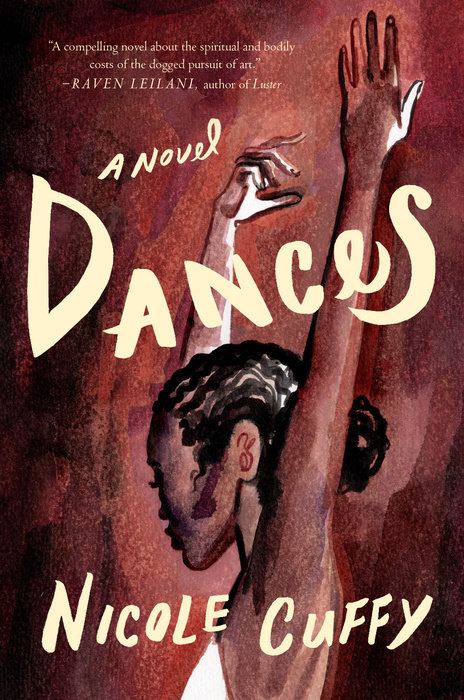
Even though Kaz, the director, insists that “Dance has no race,” Cece knows it’s not true. (And Kaz in some ways exaggerates her difference, creating a role for her in a ballet based around Gullah folklore from South Carolina.) Cece has always had to work harder than the others in the company to be accepted:
Ballet has always been about the body. The white body, specifically. So they watched my Black body, waited for it to confirm their prejudices, grew ever more anxious as it failed to do so, again and again.
A further complication is her relationship with Jasper, her white dance partner. It’s an open secret in the company that they’re together, but to the press they remain coy. Cece’s friends Irine and Ryn support her through rocky times, and her former teachers, Luca and Galina, are steadfast in their encouragement. Late on, Cece’s search for Paul, who has been missing for five years, becomes a surprisingly major element. While the sibling bond helps the novel stand out, I most enjoyed the descriptions of dancing. All of the sections and chapters are titled after ballet terms, and even when I was unfamiliar with the vocabulary or the music being referenced, I could at least vaguely picture all the moves in my head. It takes real skill to render other art forms in words. I’ll look forward to following Cuffy’s career. 
With thanks to publicist Nicole Magas and One World for the free e-copy for review.
Currently reading:
(Shortlist) Coleman Hill by Kim Coleman Foote
(Longlist) Between Two Moons by Aisha Abdel Gawad
Up next:
(Longlist) You Were Watching from the Sand by Juliana Lamy
I’m aiming for one more batch of reviews (and a prediction) before the winner is announced on 13 May.
March Releases by Akbar, Bosker, García Márquez, and Wrenn
I’m catching up after a busy end to last month. Today I have an uneven debut novel from a poet whose work I’ve enjoyed before, a journalist’s jaunty submersion in the world of modern art, a posthumous novella from a famous Colombian author I’d not previously read, and a (literally) trippy memoir about C-PTSD, coral, climate breakdown, queerness and more. I can pinpoint a couple of elements that some or all of them have in common: beauty (whether in art or in nature) and dead mothers.
Martyr! by Kaveh Akbar
I’d read the Iranian American poet’s two full-length collections and particularly admired Pilgrim Bell, one of my favourite books of 2021. That was enough for me to put this on my Most Anticipated list for 2024, even though based on the synopsis I wrote: “His debut novel sounds kind of unhinged, but I figure it’s worth a try.” Here’s an excerpt from the publisher’s blurb: “When Cyrus’s obsession with the lives of the martyrs – Bobby Sands, Joan of Arc – leads him to a chance encounter with a dying artist, he finds himself drawn towards the mysteries of an uncle who rode through Iranian battlefields dressed as the Angel of Death; and toward his [late] mother, who may not have been who or what she seemed.”
 Cyrus Shams is an Iranian American aspiring poet who grew up in Indiana with a single father, his mother Roya having died in a passenger aircraft mistakenly shot down by a U.S. Navy missile cruiser (this really happened: Iran Air Flight 655, on 3 July 1988). He continues to lurk around the Keady University campus, working as a medical actor at the hospital, but his ambition is to write. During his shaky recovery from drug and alcohol abuse, he undertakes a project that seems divinely inspired: “Tired of interventionist pyrotechnics like burning bushes and locust plagues, maybe God now worked through the tired eyes of drunk Iranians in the American Midwest”. By seeking the meaning in others’ deaths, he hopes his modern “Book of Martyrs” will teach him how to cherish his own life.
This document, which we see in fragments, sets up hypothetical dialogues between figures real and imaginary, dead and living, and intersperses them with poems and short musings. But when a friend tells Cyrus about the Brooklyn Museum installation “DEATH-SPEAK,” which has terminally ill Iranian artist Orkideh living out her last days in public, he spies an opportunity to move the work beyond theory and into the physical realm. So he flies to New York City with his best friend (and occasional f**kbuddy), bartender Zee Novak, and visits Orkideh every day until the installation’s/artist’s end.
This is a wildly original but unruly novel with a few problems. One: Akbar has clung too obviously to his own story and manner of speaking with Cyrus (e.g., “I honestly actually do worry about that, no joke. Being a young Iranian man making a book about martyrdom, going around talking to people about becoming a martyr. It’s not inert, you know?”). Another is that the poems, and poetic descriptions, are much the best material. The only exception might be a zany scene where Zee and Cyrus chop wood while high. But the main issue I had is that the plot turns on a twist 50 pages from the end, a huge coincidence that feels unearned. I admire the ambition Akbar had for this – a seething, open-hearted enquiry into addiction, love, suicide and queerness – but look forward to him getting back to poetry.
With thanks to Picador for the proof copy for review.
Get the Picture: A Mind-Bending Journey among the Inspired Artists and Obsessive Art Fiends Who Taught Me How to See by Bianca Bosker
I was a big fan of Bosker’s Cork Dork (2017), her deep dive into the world of fine wine. Her second book is similarly constructed and equally fun: more personal than authoritative, light yet substantial, and accessible to the uninitiated as well as those with an existing interest in the subject. She begins as a complete novice, wondering if she’ll ever know what art is, let alone what it means and whether it’s any good (“the familiar feeling that everyone got the punch line except me”). By the end, she has discovered that, like the love of wine, art appreciation can be a way of expanding and savouring one’s life.
The aim was to get the broadest experience possible, generally through voluntary placements. She started out as an assistant at Jack Barrett’s 315 Gallery, where one of her tasks was to paint a wall white; she failed miserably to meet his expectations even for this simple task. He never lost his fundamental distrust of her, a writer and outsider, as one of “the enemy.” It was expected that she would attend as many art shows and openings as possible per week. “Talking shit was essentially a job requirement.” Bosker might not have known what to make of the art, but others were gossipy, snobbish and opinionated enough to make up for it. When she was tasked with writing a press release for an exhibit, a gallerist taught her the clichéd shorthand: “Every f**king artist allegedly transforms the familiar into the unfamiliar, or vice versa.”

In the course of the book, the New York City-based author also:
- attends the Art Basel Miami Beach contemporary art fair and sells photographs on behalf of Denny Dimin Gallery;
- befriends performance artist and “ass influencer” Mandy AllFIRE, who – ahem – sits on Bosker’s face as part of a temporary installment;
- serves as a studio assistant for French painter Julie Curtiss, whose work is selling for alarmingly high amounts at auction (not actually what a painter wants, as it tends to signal bad things for a career);
- meets a pair of North Dakota collectors known as “the Icy Gays”; and
- works as a Guggenheim Museum guard.
This last was my favourite episode. Forty-minute placements on particular ramps gave her time to focus on one chosen artwork – for instance, an abstract sculpture. She challenged herself to stay with it for that whole time, doing as one artist advised and simply noticing five things about the work. Before, her “default approach to art had just been to plant myself in front of a piece and wait for the epiphany to wash over me.” Now, she worked at it. In fact, she counsels newcomers to not read a caption because many people take a title at face value and an interpretation as gospel, and so don’t experience the art for themselves.
At times I found the book slightly scattered in the way that it zigzags from one challenge to another. There’s differing attention to various experiences; a week-long art school merits just one paragraph. And there’s no getting past the fact that some art she encounters sounds outlandish or just plain silly. (Is it any surprise that she mistakes part of a wall, and a mousetrap, for art pieces?) Ultimately, I think it’s best if you have at least a modicum of appreciation for modern art, which I don’t; whereas I do enjoy drinking wine even if I don’t have a trained palate.
Even so, Bosker’s writing has such verve (“artists were coyly evasive about their work and treated my questions like I was a cactus running after their balloon”; “a hazy daydream of an idea solidified into a yappy, un-shut-uppable chihuahua of want”) that you’ll be glad you went along for the ride. She concludes that taste is subjective, but “Beauty … pulls you close.” Art is valuable because it “knocks us off our well-worn pathways” into something uncharted, a tantalizing prospect.
With thanks to Allen & Unwin (Grove Press) for the free copy for review.
{SPOILERS IN THIS NEXT ONE}
Until August by Gabriel García Márquez
[Translated from the Spanish by Anne McLean]
A posthumous ‘lost’ novella was not a good place for me to have started with this celebrated author. García Márquez okayed the fifth draft of the text in 2004, 10 years before his death. By this time he was already suffering with memory loss that interfered with his creativity. His sons got the message that he didn’t think the book worked and should be destroyed. But they didn’t do his bidding and, revisiting the book nearly a decade on from his death, decided it wasn’t that bad, if not up to the standard of his best work, and that it should see the light of day after all.
Every August 16th, Ana Magdalena Bach travels to the island where her mother is buried to visit the grave and lay gladioli on it. (My review book came with a bag of three gladioli bulbs and a mini Colombian chocolate bar.) Each year she takes a different lover for the one night at a hotel. The first time, the man leaves her a $20 bill and she feels ashamed, but it doesn’t stop her doing the same thing again for the next four years in a row. Once it’s a long-ago school friend whom she runs into on the ferry. Another time, by golly, it’s a bishop.

It’s refreshing to have a woman in middle age as protagonist and for her to claim sexual freedom. However, the setup is formulaic and repetitive, the sex scenes are somewhat excruciating, and the hypocrisy of her gleefully having one-night stands while fretting over her husband’s potential infidelity is grating. I did like the ending – Ana hears that an anonymous elderly gentleman has been paying to have gladioli laid on her mother’s grave year-round and she wonders if she is in a sense following in her mother’s footsteps all along without knowing it; and decides she’s had enough and exhumes her mother’s remains, returning to her husband with a bag of bones (gruesome!).
But nothing about the plot or the writing – fluid enough bar one awkward sentence (“She listened to him worried that he meant it, but she had the strength not to appear as easy a woman as he might think”) – suggested to me a master at work. At best, this might be reminiscent of the late work of misogynist-leaning authors like Coetzee or Updike.
In my mind García Márquez is linked with magic realism, so I’d be better off trying one of his more representative works. I have several of his earlier novellas on the shelf (received as review copies as part of the same recent marketing push), and if I get on better with those then I’ll be sure to try one of the most famous full-length novels. 
With thanks to Viking (Penguin) for the free copy for review.
Mothership: A Memoir of Wonder and Crisis by Greg Wrenn
Wrenn is an associate English professor teaching environmental literature at James Madison University. He has also been exploring coral reefs for 25 years, with a love of marine wildlife sparked by growing up in Florida. But all along, he’s been trying (much like Cyrus Shams) to come to terms with addiction, queerness, suicidal inclinations, and especially his mother’s place in his life. She made him feel dirty, that he would never be good enough; she hit him with a wooden spoon and bathed him until he was 17. Though he never found out for sure, he suspects his mother was sexually abused by her father and repeated the cycle of molestation.
 This is the third C-PTSD memoir I’ve read (after What My Bones Know and A Flat Place), and has a lot in common with I’m Glad My Mom Died, which features a co-dependent relationship with an abusive mother. After Wrenn’s parents’ divorce, he and his mother remained close. “I had been her therapist, confessor, girlfriend, and punching bag.” He helped care for her after a stroke but eventually had to throw up his hands at her stubborn refusal to follow doctors’ orders. Drawing on the Greek etymology of ecology (oikos means house or family), Wrenn insists on a parallel between the personal and the environmental here: “What we’re facing amounts to global C-PTSD” as “Mother” Earth turns against us. On each trip to Raja Ampat, he knows the coral reef is dying, his carbon footprint only accelerating it.
There’s a lot in this short memoir. Even the summary had me shaking my head in disbelief. For me, though, the tone and style were too erratic. Wrenn can be wry, sorrowful, or campy; he includes scientific data, letters to Adrienne Rich and an imagined descendent, a chapter riffing on “Otters” (the animal and the gay stereotype), flashbacks, and E.T. metaphors. The final third of the book then takes a left turn as he experiments with therapeutic psychedelics via ayahuasca ceremonies in South America, and ditches dating apps and casual sex to try to find a long-term relationship. The drug literally alters his brain, allowing him to feel trust and love. Add on nature and a husband and that’s why he’s still here rather than dead by suicide.
Like Akbar, Wrenn published poetry before switching genre. Their books are both amazing in premise but wobbly in execution. Still, I’d say both authors are laudable for their effort to depict lives wrenched back from extremity. 
With thanks to Regalo Press (USA) for the proof copy for review.
Reading Ireland Month: Seán Hewitt, Maggie O’Farrell
Reading Ireland Month is hosted each year by Cathy of 746 Books. I’m wishing you all well on St. Patrick’s Day with this first of two planned tie-in posts. Today I have a poetry collection that sets grief and queer longing amid nature, and my last unread novel – a somewhat middling one, unfortunately – by one of my favourite authors.

Rapture’s Road by Seán Hewitt (2024)
 The points of reference are so similar to his 2020 debut collection, Tongues of Fire, that parts of what I wrote about that one are fully applicable here: “Sex and grief, two major themes, are silhouetted against the backdrop of nature. Fields and forests are loci of meditation and epiphany, but also of clandestine encounters between men.” Perhaps inevitably, then, this felt less fresh, but there was still much to enjoy. I particularly loved two poems about moths (the merveille du jour as an “art-deco mint-green herringbone. Soft furred little absinthe warrior”), “To Autumn,” and “Alcyone,” which likens a kingfisher to “a rip / in the year’s old fabric”.
In “Two Apparitions,” the poet’s late father seems visible again. Many of the scenes take place at dusk or dark. There’s a layer of menace to “Night-Scented Stock,” about an abusive relationship, and the account of a slaughter in “Pig.” But the stand-out is “We Didn’t Mean to Kill Mr Flynn,” based on the 1982 murder of a gay man in a Dublin park. Hewitt drew lines from court proceedings and periodicals in the Irish Queer Archive at the National Library of Ireland, where he was poet in residence. He voices first the gang of killers, then Flynn himself. The trial kickstarted Ireland’s Pride movement.
More favourite lines:
Come out, make a verb of me, let
my body do your speaking tonight —
(from “A Strain of the Earth’s Sweet Being”)
awestruck, bright,
a child in the bell-tower of beauty —
(from “Skylarks”)
Love, the world is failing:
come and fail with me.
(from “Nightfall”)
With thanks to Jonathan Cape (Penguin) for the free copy for review.
My Lover’s Lover by Maggie O’Farrell (2002)
I was so excited, a few years ago, to find battered copies of this and After You’d Gone in a local charity shop for 50 pence each, even though it appears a mouse had a nibble on one corner here. They were her first two books, but the last that I managed to source. Whereas After You’d Gone is a surprisingly confident and elegant debut novel about a woman in a coma and the family and romantic relationships that brought her to this point, My Lover’s Lover ultimately felt like a pretty run-of-the-mill story about two women finding out that (some) men are dogs and they need to break free.
 Lily meets Marcus, an architect, at a party and almost before she knows it has moved into the spare room of his apartment, a Victorian factory space he renovated himself, and become his lover. But there’s an uncomfortable atmosphere in the flat: She can still smell perfume from Marcus’s ex, Sinead; one of her dresses hangs in the closet. We, along with Lily, get the impression Sinead has died. She haunts not just the flat but also the streets of London. It becomes Lily’s obsession to find out what happened to Sinead and why Marcus is so morose. Part Two gives Sinead’s side of things, in a mix of third person/present tense and first person/past tense, before we return to Lily to see what she’ll do with her new knowledge.
As in some later novels, there are multiple locales (here, NYC, the Australian desert, and China – a country O’Farrell often revisits in fiction) and complicated point-of-view shifts, but I felt the sophisticated craft was rather wasted on a book that boils down to a self-explanatory maxim: past relationships always have an effect on current ones. I also found the writing overmuch in places (“the grass swooshing, sussurating, cleaving open to her steps”; “letting fall a box of cereal into its [a shopping trolley’s] chrome meshing”; “her fingertips meeting the ceraceous, heated skin of his cheek”). However, this was an engrossing read – I read most of it in two days. It’s bottom-tier O’Farrell, though, along with The Distance Between Us and Hamnet – sorry, I know many adore it. (If you’re interested: middle tier = The Vanishing Act of Esme Lennox, Instructions for a Heatwave, her two children’s books, and The Marriage Portrait; top tier = After You’d Gone, The Hand that First Held Mine, This Must Be the Place, and I Am, I Am, I Am.)
I’ve gotten in the habit of reading one of Maggie O’Farrell’s works per year, so I will just have to reread my favourites until we get a new one. I’m already tapping a foot in impatience. (Secondhand from Bas, Newbury) 
Have you read any Irish literature this month?
Literary Wives Club: Mrs. March by Virginia Feito (2021)
{SPOILERS IN THIS REVIEW!}
What a deliciously odd debut novel, reminiscent of Patricia Highsmith’s work for how it places a neurotic outsider at the heart of an unlikely murder investigation. George March is a popular author whose latest novel stars Johanna, a prostitute so ugly that men feel sorry for her and can’t bear to sleep with her. Meanwhile, the news cycle is consumed with the strangling of a young woman named Sylvia Gibbler in Gentry, Maine, where George goes on hunting trips with his editor. Mrs. March takes two misconceptions – that George modeled Johanna on her, and that he was somehow involved in Sylvia’s death because he kept newspaper clippings about it on his desk – and runs with them, to catastrophic effect.
Mrs. March’s usual milieu is the New York City apartment she shares with George and their son, Jonathan. Martha, the housekeeper, keeps the daily details under control, leaving Mrs. March with little to do. She doesn’t seem very interested in her son, and resents George. Each morning she walks to the bakery to buy olive bread. Every so often she’ll host an extravagant dinner party. But there is plenty of time in between to fill with flashbacks to shameful memories (having an imaginary friend, wetting the bed, her mother’s favoritism towards her sister, being raped in Cádiz) and hallucinations (a dead pigeon in the bathtub, cockroaches scuttling around the apartment). She decides to travel to Maine herself to investigate Sylvia’s death; it’s not what she finds there but what she returns to that changes things forever.

There are so many intriguing factors. One is the nebulous time period: what with Mrs. March’s fur coat and head scarf, the train cars and payphone calls, it could be the 1950s; but then there are more modern references (a washing machine, holiday flights) that made me inclined to point to the 1980s. It couldn’t be the present day unless Feito is deliberately setting the story in an alternative world without much tech. As in Highsmith, we get mistaken identity and disguises. Feito really ramps up the psychological elements, interrogating how trauma, paranoia and extreme body issues may have led to dissociation in her protagonist. Mrs. March is both obsessed with and repulsed by bodily realities. It’s only through other characters’ reactions, though, that we see just how mentally disturbed she is. Worryingly, patterns seem to be repeating with her son, who is suspended for ‘doing something’ to a girl.
I can see how this would be a divisive read: the characters are thoroughly unlikable and it can be difficult to decide what is real and what is not. Incidents I took at face value may well be symbolic, or psychological manifestations of trauma. But I found it morbidly fascinating. I never knew what was going to happen next. (Public library/NetGalley) 
The main question we ask about the books we read for Literary Wives is:
What does this book say about wives or about the experience of being a wife?
In terms of Literary Wives reads, this reminded me most of The Harpy by Megan Hunter because of its eventual focus on adultery and revenge. Notably, until the very last sentence, we only know Mrs. March’s identity through her relationship to her husband. (Her first name is finally revealed to be Agatha, which of course made me think of Agatha Christie and detection, but its meaning is “good” or “honorable” – there was a martyred saint by the name.) What I took from that is that defining oneself primarily through marriage is dangerous because personality and control can be lost. This character was in need of a wider purpose to take her outside of her home and family – though those would always be her refuge to return to. Even setting Mrs. March’s mental problems aside, it is frighteningly easy to indulge in delusions about oneself or one’s spouse, so getting a reality check via communication is key.
See Kay’s and Naomi’s reviews, too!
We’ve recently acquired a new member – welcome to Kate of Books Are My Favourite and Best! – and chosen our books for the next two and a bit years. Anyone is welcome to join us in reading them. Here’s the club page on Kay’s blog, and our schedule through the end of 2026:
June 2024 Recipe for a Perfect Marriage by Karma Brown
Sept. 2024 Their Eyes Were Watching God by Zora Neale Hurston
Dec. 2024 Euphoria by Elin Culhed
March 2025 Lessons in Chemistry by Bonnie Garmus
June 2025 The Constant Wife by W. Somerset Maugham
Sept. 2025 Novel about My Wife by Emily Perkins
Dec. 2025 The Soul of Kindness by Elizabeth Taylor
March 2026 Mrs. Bridge by Evan S. Connell
June 2025 Interpreter of Maladies by Jhumpa Lahiri
Sept. 2026 Family Family by Laurie Frankel
Dec. 2026 The Eden Test by Adam Sternbergh
February Releases by Hess, Kim, Sides (#ReadIndies); Atwood and Shah
I’m pleased to have, between this post and yesterday’s review catch-up, featured 9 books from 8 independent publishers for Read Indies this month. (I have also done some indie reading from my shelves, which I’ll summarize early in March.) Three of the books in my February review stacks were indie releases. I’ve got a hybrid memoir that blends poetic exploration of scripture with personal psychological reflections; an out-of-the-ordinary mystery about a father’s disappearance that comments on disability, racism and much more; and a terrific set of fabulist short stories. My two bonus (non-indie) February books are an unconvincing collaborative novel and a counselling-focussed bibliotherapy guide.

When Fragments Make a Whole: A Personal Journey through Healing Stories in the Bible by Lory Widmer Hess
 Some of you may know Lory, who is training as a spiritual director, from her blog, Enter Enchanted. It was so kind of her to get in touch offering her first book for review. It’s a unique combination of poetry, scriptural exegesis, and fragments of memoir. Each chapter considers a different healing story from the Gospels. As in the lectio divina I learned from college Christian fellowships, the idea with the verse retellings from the Bible is to imagine oneself into a character’s position and consider the crises that led to seeking Jesus’ help. I especially liked the poem “Talitha, Koum,” which links the stories of the woman with the issue of blood and the resurrection of Jairus’ daughter. In both, faith reverses a seemingly hopeless situation.
The short sections of commentary draw in a lot of context as well as etymology from the Greek. The autobiographical essays chart a history of physical and mental challenges, including dissociation, low self-esteem and shame, and offer openness to healing as its own miracle when there are no easy answers. They are notable for their vulnerability, especially when discussing marital problems. The outlook is intellectual and psychological rather than the spiritualizing I’m used to from my evangelical background – Lory comes from the anthroposophy tradition, which I don’t claim to fully understand but (I think) eschews dogma like original sin and atonement and instead makes the spiritual journey a matter of human reconnection with God through free will and the intellect. This is nicely balanced, though, by her work with developmentally disabled adults in residential homes in New England and Switzerland, which reminds her “there is a truth beyond intellectual knowledge, a language beyond words”. It is a calm, honest, methodical book that will intrigue anyone interested in thinking through how the Bible is applicable to the challenges of daily life.
With thanks to the author and Floris Books (Edinburgh) for the free copy for review.
Happiness Falls by Angie Kim
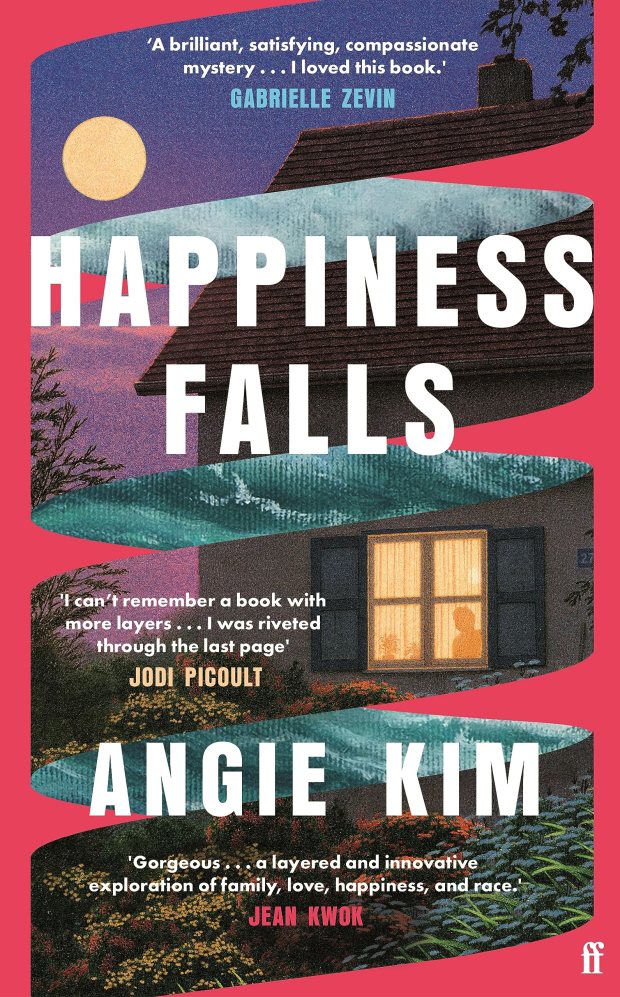
Buzz from across the pond about Kim’s novels led me to request this even though I don’t typically read mysteries. The bulk is set over 2.5 days in June 2020 as the Korean American Parkson family investigates, on their own and with the help of police and various local tip-offs, what happened to the father, Adam, who’d been at River Falls Park with the severely disabled 14-year-old son, Eugene, who is autistic and has mosaic Angelman syndrome. Mother Hannah and 20-year-old twins Mia and John, home from college for the lockdown, quickly realise something is wrong when Eugene, who has blood on his shirt and under his nails, stumbles home on his own and Adam is unreachable by phone. There’s more to the setup than that, and many complicated side-tracks to the investigation, but the basic questions remain for 300+ pages: What happened to Adam? and What was Eugene’s part in it?
Mia narrates, and it’s a pleasure spending time with her quick, systematic brain as she runs through all the options and deals with each new theory and red herring. She clearly gets it from her father, whose recovered notebook is full of amateur experimentation on the “Happiness Quotient”. Her wit and garrulousness (sample aside: “I’m sorry, but I don’t care how much you love fun fonts—you cannot talk about prison rape in Comic Sans”) spills over into footnotes as if in effusive counterpoint to Eugene, who is nonspeaking.
The pandemic setting places interesting constraints on the official proceedings, and the prospect of a new communication method (involving painstaking spelling with a letter stencil) revolutionizes this family as they grasp that Eugene is far from nonverbal and has been ‘locked in’ all along. The account a therapist elicits from him seems to clinch the case, but uncertainty lingers.
This is like a blend of Celeste Ng’s Everything I Never Told You, Rebecca Makkai’s I Have Some Questions for You, and Naoki Higashida’s The Reason I Jump; if you’ve liked one or more of these, I would strongly recommend it. Mystery readers may lack patience for the digressions. The solution is eclipsed by the many issues – prejudice based on race and disability, how one’s circumstances affect contentment, nuances of communication, sibling relationships and twin ESP – explored along the way. Because I am not a crime reader, the pace was no problem for me. My annoyances were with the preponderance of hindsight (“I wish I’d said something,” “It didn’t occur to me until much later”) and the fact that Mia says “begs the question” for raising a question (misuse of a rhetorical term) several times. I found personal meaning in the book because of the Washington, DC-area locales and my severely disabled, nonverbal goddaughter. What if there really is something going on in her mind, and we could find out what it was… I mused. I’ll be keen to read Kim’s debut, Miracle Creek.
With thanks to Faber for the free copy for review.
Crocodile Tears Didn’t Cause the Flood by Bradley Sides
 These 17 flash fiction stories fully embrace the possibilities of magic and weirdness, particularly to help us reconnect with the dead. Brad and I are literary acquaintances from our time working on (the now defunct) Bookkaholic web magazine in 2014–15. I liked this even more than his first book, Those Fantastic Lives (2021), although the contours are very similar. Young people, animals and monsters abound – and sometimes the lines between those identities are unclear. There’s a lot of experimentation with form: a choose-your-own-adventure narrative, a police transcript, a two-truths-and-a-lie challenge, a story all in questions, an English exam, and a letter. A few of my favorite stories were “The Guide to King George,” about an amusement farm’s resident pond monster; “Claire & Hank,” in which a paleontologist’s unearthed Pteranodon becomes a sister to his motherless son; and “Dying at Allium Farm,” whose sassy undead owners think they’re fooling their Tennessee customers. And can you imagine a better title and cover combination?!
With thanks to Montag Press and publicist Lori Hettler for the e-copy for review.
And a couple of bonus February releases that are not from indie publishers:
Fourteen Days, ed. Margaret Atwood and Douglas Preston
This Authors Guild Foundation collaborative project is a Covid-era Decameron update in which the residents of an increasingly derelict New York City apartment complex meet on the rooftop every evening for two early lockdown weeks to clap for healthcare workers, indulge in adult beverages, and swap random stories. The tenants all go by nicknames like “Hello Kitty,” “Florida” and “Vinegar.” The frame narrative has the building superintendent (Yessie, a lesbian of Romanian heritage) worrying over her father’s wellbeing in a care home and surreptitiously recording the oral stories on her phone to later transcribe into the “bible” kept by the previous super. We’re told up front that the manuscript ends up in police custody.
 I had a misconception that each chapter would be written by a different author. I think that would actually have been the more interesting approach. Instead, each character is voiced by a different author, and sometimes by multiple authors across the 14 chapters (one per day) – a total of 36 authors took part. I soon wearied of the guess-who game. I most enjoyed the frame story, which was the work of Douglas Preston, a thriller author I don’t otherwise know.
There was a promising idea here, but problems with the execution. One is that, for the most part, the stories are pointless. The characters get hung up on whether they’re ‘true’ or not, but for readers it’s all made up and, while one or two individual tales might be amusing, they do nothing to build a plot and so I found myself mostly skipping over them to get back to the interactions on the roof and the super’s commentary. Another is that, to stand out from an ensemble cast, a voice needs to be really distinctive, and only “Eurovision” (flamboyantly gay) was that for me – based on my love for his rabbit story in particular, I should be reading Joseph Cassara. And finally, the book culminates with an annoying twist that made me cross.
With thanks to Chatto & Windus (Penguin) for the proof copy for review.
Bibliotherapy: The Healing Power of Reading by Bijal Shah
Bibliotherapy is one of my niche bookish interests (see my write-up of my bibliotherapy appointment with Ella Berthoud at the School of Life), so I was delighted to be offered a copy of another relevant book. Bijal Shah grew up in an East African Indian community before moving to the UK with her family as a teenager. When she was in training as a psychodynamic counsellor and attended therapy sessions herself, she realised how helpful literature was in helping her think through traumatic experiences from her past, such as sexism, colourism and a painful break-up. “I have lived half my life in the pages of books,” she observes, “relying on them to put my real life into perspective.” I feel the same way.

The emphasis is very much on therapy here, as Shah elaborates on practices such as literary journaling, recording audio notes, writing poetry, and focusing on gratitude. About half of the book is given over to anonymized sample case studies where she looks at the reasons why a client might come to her for bibliotherapy, the books and exercises she prescribed them, and the sorts of realizations people came to when reflecting on their own lives in relation to what they read. I suspect that the majority of readers, unless they have a vested interest in counselling, will, like me, most enjoy browsing the A–Z list of book prescriptions in the final 20% of the book (with more on Shah’s website). There is good variety to these in terms of author diversity, new vs. backlist reads, and both YA and adult fiction, though most of the recommendations are nonfiction, particularly psychology and self-help: these are much more literal (and, generally, obvious) prescriptions than Berthoud and Elderkin’s playful take.
With thanks to the author and Piatkus (Hachette) for the free copy for review.
Three “Love” or “Heart” Books for Valentine’s Day: Ephron, Lischer and Nin
Every year I say I’m really not a Valentine’s Day person and yet put together a themed post featuring books that have “Love” or a similar word in the title. This is the eighth year in a row, in fact (after 2017, 2018, 2019, 2020, 2021, 2022, and 2023)! Today I’m looking at two classic novellas, one of them a reread and the other my first taste of a writer I’d expected more from; and a wrenching, theologically oriented bereavement memoir.
Heartburn by Nora Ephron (1983)
I’d already pulled this out for my planned reread of books published in my birth year, so it’s pleasing that it can do double duty here. I can’t say it better than my original 2013 review:
The funniest book you’ll ever read about heartbreak and betrayal, this is full of wry observations about the compromises we make to marry – and then stay married to – people who are very different from us. Ephron readily admitted that her novel is more than a little autobiographical: it’s based on the breakdown of her second marriage to investigative journalist Carl Bernstein (All the President’s Men), who had an affair with a ludicrously tall woman – one element she transferred directly into Heartburn.
Ephron’s fictional counterpart is Rachel Samstad, a New Yorker who writes cookbooks or, rather, memoirs with recipes – before that genre really took off. Seven months pregnant with her second child, she has just learned that her second husband is having an affair. What follows is her uproarious memories of life, love and failed marriages. Indeed, as Ephron reflected in a 2004 introduction, “One of the things I’m proudest of is that I managed to convert an event that seemed to me hideously tragic at the time to a comedy – and if that’s not fiction, I don’t know what is.”
As one might expect from a screenwriter, there is a cinematic – that is, vivid but not-quite-believable – quality to some of the moments: the armed robbery of Rachel’s therapy group, her accidentally flinging an onion into the audience during a cooking demonstration, her triumphant throw of a key lime pie into her husband’s face in the final scene. And yet Ephron was again drawing on experience: a friend’s therapy group was robbed at gunpoint, and she’d always filed the experience away in a mental drawer marked “Use This Someday” – “My mother taught me many things when I was growing up, but the main thing I learned from her is that everything is copy.” This is one of celebrity chef Nigella Lawson’s favorite books ever, for its mixture of recipes and rue, comfort food and folly. It’s a quick read, but a substantial feast for the emotions.
 Sometimes I wonder why I bother when I can’t improve on reviews I wrote over a decade ago (see also another upcoming reread). What I would add now, without disputing any of the above, is that there’s more bitterness to the tone than I’d recalled, even though Ephron does, yes, play it for laughs. But also, some of the humour hasn’t aged well, especially where based on race/culture or sexuality. I’d forgotten that Rachel’s husband isn’t the only cheater here; pretty much every couple mentioned is currently working through the aftermath of an affair or has survived one in the past. In one of these, the wife who left for a woman is described not as a lesbian but by another word, each time, which felt unkind rather than funny.
Still, the dialogue, the scenes, the snarky self-portrayal: it all pops. This was autofiction before that was a thing, but anyone working in any genre could learn how to write readable content by studying Ephron. “‘I don’t have to make everything into a joke,’ I said. ‘I have to make everything into a story.’ … I think you often have that sense when you write – that if you can spot something in yourself and set it down on paper, you’re free of it. And you’re not, of course; you’ve just managed to set it down on paper, that’s all.” (Little Free Library)
My original rating (2013):
My rating now:
Stations of the Heart: Parting with a Son by Richard Lischer (2013)
“What we had taken to be a temporary unpleasantness had now burrowed deep into the family pulp and was gnawing us from the inside out.” Like all life writing, the bereavement memoir has two tasks: to bear witness and to make meaning. From a distance that just happens to be Mary Karr’s prescribed seven years, Lischer opens by looking back on the day when his 33-year-old son Adam called to tell him that his melanoma, successfully treated the year before, was back. Tests revealed that the cancer’s metastases were everywhere, including in his brain, and were “innumerable,” a word that haunted Lischer and his wife, their daughter, and Adam’s wife, who was pregnant with their first child.
 The next few months were a Calvary of sorts, and Lischer, an emeritus professor at Duke Divinity School, draws deliberate parallels with the biblical and liturgical preparations for Good Friday that feel appropriate for this Ash Wednesday. Lischer had no problem with Adam’s late-life conversion from Protestantism to Catholicism, whose rites he followed with great piety in his final summer. He traces Adam and Jenny’s daily routines as well as his own helpless attendance at hospital appointments. Doped up on painkillers, Adam attended one last Father’s Day baseball game with him; one last Fourth of July picnic. Everyone so desperately wanted him to keep going long enough to meet his baby girl. To think that she is now a young woman and has opened all the presents Adam bought to leave behind for her first 18 birthdays.
The facts of the story are heartbreaking enough, but Lischer’s prose is a perfect match: stately, resolute and weighted with spiritual allusion, yet never morose. He approaches the documenting of his son’s too-short life with a sense of sacred duty: “I have acquired a new responsibility: I have become the interpreter of his death. God, I must do a better job. … I kissed his head and thanked him for being my son. I promised him then that his death would not ruin my life.” This memoir brought back so much about my brother-in-law’s death from brain cancer in 2015, from the “TEAM [ADAM/GARNET]” T-shirts to Adam’s sister’s remark, “I never dreamed this would be our family’s story.” We’re not alone. (Remainder book from the Bowie, Maryland Dollar Tree) 
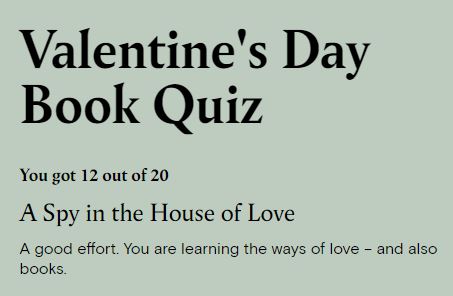
A Spy in the House of Love by Anaïs Nin (1954)
 I’d heard Nin spoken of in the same breath as D.H. Lawrence, so thought I might similarly appreciate her because of, or despite, comically overblown symbolism around sex. I think I was also expecting something more titillating? (I guess I had this confused for Delta of Venus, her only work that would be shelved in an Erotica section.) Many have tried to make a feminist case for this novella about Sabina, an early liberated woman in New York City who has extramarital sex with four other men who appeal to her for various not particularly good reasons (the traumatized soldier whom she comforts like a mother; the exotic African drummer – “Sabina did not feel guilty for drinking of the tropics through Mambo’s body”). She herself states, “I want to trespass boundaries, erase all identifications, anything which fixes one permanently into one mould, one place without hope of change.” The most interesting aspect of the book was Sabina’s questioning of whether she inherited her promiscuity from her father (it’s tempting to read this autobiographically as Nin’s own father left the family for another woman, a foundational wound in her life).
Come on, though, “fecundated,” “fecundation” … who could take such vocabulary seriously? Or this sex writing (snort!): “only one ritual, a joyous, joyous, joyous impaling of woman on a man’s sensual mast.” I charge you to use the term “sensual mast” wherever possible in the future. (Secondhand – Oxfam, Newbury) 
But hey, check out my score for the Faber Valentine’s quiz!
Recent Releases by Nathan Hill, Hisham Matar, Sigrid Nunez and More
One key way in which 2024’s reading has already differed from previous years’ is that I no longer avoid doorstoppers. I now classify any book with over 400 pages as a doorstopper, and by that definition I have already gotten through three this year: The Tidal Year plus two of the below, with Wellness standing out as the true whopper at 597 small-print pages. January offered a set of releases full of variety: gritty yet funny flash fiction; a novel of big ideas and big empathy for its flawed characters; an exile’s elegant love letter to Libya from London; a coy pandemic-era reflection on connection and creation; and a tour of nature close to home.
Universally Adored and Other One Dollar Stories by Elizabeth Bruce
 This was a great collection of 33 stories, all of them beginning with the words “One Dollar” and most of flash fiction length. Bruce has a knack for quickly introducing a setup and protagonist. The voice and setting vary enough that no two stories sound the same. What is the worth of a dollar? In some cases, where there’s a more contemporary frame of reference, a dollar is a sign of desperation (for the man who’s lost house, job and wife in “Little Jimmy,” for the coupon-cutting penny-pincher whose unbroken monologue makes up the whole of “Grocery List”), or maybe just enough for a small treat for a child (as in “Mouse Socks” or “Boogie Board”). In the historical stories, a dollar can buy a lot more. It’s a tank of gas – and a lesson on the evils of segregation – in “Gas Station”; it’s a huckster’s exorbitant charge for a mocked-up relic in “The Grass Jesus Walked On.”
The tone ranges from black comedy (“Festus”) to high tragedy (“Votive Candle”), but the book mostly falls within the realm of dirty realism with the attention to working-class country folk, so I’d recommend the collection to fans of authors who perch on the lighter side of that subgenre, such as Barbara Kingsolver or Denis Johnson. A few of my favorite stories, in addition to the above, were “Ice-Cold Water,” which I appreciated for the Washington D.C. setting and the way that an assumption about who would be racist was overturned by a moment of simple compassion; “Dolores,” in which a slick humanitarian fundraiser meets a waitress who has his number; and “Boiling the Buggers,” a window onto Covid-exacerbated mental illness. (Read via BookSirens)
Wellness by Nathan Hill
Somehow nearly eight years have passed since Hill’s debut novel, The Nix, which I dubbed “a rich, multi-layered story about family curses and failure.” I admired it as much for its prose as for its ideas, and Wellness is just as effervescent and insightful. It’s a state-of-the-nation novel filtered through one Chicago family: experimental photographer and underperforming academic Jack; his wife Elizabeth, a placebo researcher at Wellness; and their YouTube-obsessed son Toby. They’ve recently invested their life savings in a new condo and are considering trendy features like open shelves and separate master bedrooms. It would be oversimplifying, but true, to say that this couple is experiencing midlife and marital crises. Their nineties college romance – and a time of life when everything felt open and possible – is so remote now. When Elizabeth suggests they join a friend at a swingers’ club and a patient of hers who’s also a parent at Toby’s school sees them outside, chaos ensues.
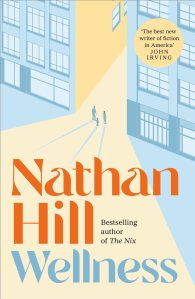
Some elements from The Nix carry over, such as campus politics, the American Midwest, and mother–son relationships, but also broader questions of authenticity, purpose and nurture. Is love itself a placebo? The novel spends time with Jack and Elizabeth at the dawn of their relationship and in the present day, but also looks back to their early careers and first years of parenthood. Hill is clearly fascinated with the sort of psychological experimentation Elizabeth engages in (there’s a whole bibliography of scientific papers consulted) but also turns it to humorous effect, as when Elizabeth subjects Toby to the marshmallow test. A lot of information is conveyed through dialogue, yet it never feels forced. A couple of long asides, on Elizabeth’s family history and the algorithms guiding Jack’s interactions with his conspiracy theorist father, tried my patience, but I loved a four-page chapter on a funeral supper where every sentence starts “There was.” Sooooo many quotable lines throughout.
The only fault in an addictive and spot-on novel (how did he know?! you’ll find yourself thinking about your own attitude to work/marriage/children) is that Hill is so committed to excavating these characters’ backstory of stunted emotion – Jack estranged from his religious Kansas farmer parents after a traumatic incident you feel right in the gut; Elizabeth glad to jettison her father’s wealth with his anger – that he hurries through the denouement. Still, this is sure to be a fiction highlight of my year. It’s one for readers of Jonathan Franzen, sure, but I also thought it reminiscent of Katherine Heiny’s Standard Deviation and Meg Wolitzer’s The Interestings.
With thanks to Picador for the proof copy for review.
My Friends by Hisham Matar
“Benghazi was the one place I longed for the most, it was also the place I most feared to return to.”
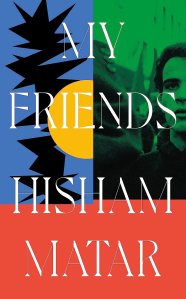 Taking a long walk through London one day, Khaled looks back from midlife on the choices he and his two best friends have made. He first came to the UK as an eighteen-year-old student at Edinburgh University. Everything that came after stemmed from one fateful day. Matar places Khaled and his university friend Mustafa at a real-life demonstration outside the Libyan embassy in London in 1984, which ended in a rain of bullets and the accidental death of a female police officer. Khaled’s physical wound is less crippling than the sense of being cut off from his homeland and his family. As he continues his literary studies and begins teaching, he decides to keep his injury a secret from them, as from nearly everyone else in his life. On a trip to Paris to support a female friend undergoing surgery, he happens to meet Hosam, a writer whose work enraptured him when he heard it on the radio back home long ago. Decades pass and the Arab Spring prompts his friends to take different paths.
I’d previously only read Matar’s short nonfiction work A Month in Siena. The slow, meditative style I enjoyed so much there didn’t translate well into doorstopper length; by the 300-page mark I found myself skimming to see if anything else might happen. Despite the title, we come to know Mustafa and Hosam much less well than we do Khaled. I would happily have had the book’s plot and sentiment concentrated into a taut 200 pages. However, I’m still interested in trying other books by Matar. In the Country of Men is significantly shorter and available from the backroom storage area of my library, and his Folio Prize-winning memoir The Return, too, is on shelf and I reckon will be right up my street.
With thanks to Viking (Penguin) for the proof copy for review.
The Vulnerables by Sigrid Nunez
I’m a huge Nunez fan after reading The Friend, What Are You Going Through, and especially A Feather on the Breath of God. Her last three books have been very much of a piece: autofiction voiced by an unnamed woman who has a duty of care towards a friend or a friend’s pet and ponders, in wry meta fashion, the nature of autobiographical writing and the meaning of life and death at a time of climate breakdown. Alas, The Vulnerables seems like no more than a rehashing of The Friend, with flanking main characters chosen at random from central casting: a parrot named Eureka and a mentally ill college drop-out called Vetch. This quirky trio is thrown together in a lavish New York City apartment during lockdown and nothing much happens but conversation brings them closer.
 A second problem: Covid-19 stories feel dated. For the first two years of the pandemic I read obsessively about it, mostly nonfiction accounts from healthcare workers or ordinary people looking for community or turning to nature in a time of collective crisis. But now when I come across it as a major element in a book, it feels like an out-of-place artefact; I’m almost embarrassed for the author: so sorry, but you missed your moment. My disappointment may primarily be because my expectations were so high. I’ve noted that two blogger friends new to Nunez were enthusiastic about this (but so was Susan, who’d enjoyed her before). That’s not to say this wasn’t a pleasantly fluid and incisive read, even if its message of essential human vulnerability is an obvious one. Anyway, I’ll take Nunez musing on familiar subjects over most other contemporary writers any day:
“Never write ‘I don’t remember,’ Editor says; it undermines your authority. But write as if you remember everything and Reader will smell a rat.”
“You can start with fiction or start with documentary, according to Jean-Luc Goddard. Either way, you will inevitably find the other.”
“I like this clarification by the narrator of a book by Stendhal: ‘It is not out of egotism that I say “I”; it is simply the quickest way to tell the story.’)”
(À propos of the doorstoppers above)
“Does that mean a long novel is easier to write than a short one? / Um, no. But, to borrow from a certain critic, in almost every long book I read I see a short one shirking its job.”
With thanks to Virago for the proof copy for review.
And a bonus work of nonfiction:
Local: A Search for Nearby Nature and Wildness by Alastair Humphreys
Lev Parikian alerted me to this amiable record of weekly discoveries of the nature on one’s home turf. Humphreys has been an international adventure traveller and written many books about his exploits. Here, by contrast, he zooms the lens in about as far as it will go, ordering a custom-made 20-km-square OS map that has his house at the centre and choosing one surrounding grid square per week (so 52 out of a total of 400) to cycle to and explore. He’s chosen to leave his town unnamed so this can function as an Everyman’s journey through edgelands. And his descriptions and black-and-white photographs really do present an accurate microcosm of modern England: fields, woods, waterways, suburban streets.
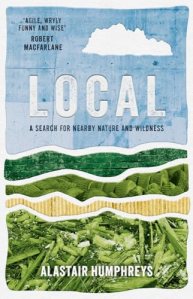 From one November to the next, he watches the seasons advance and finds many magical spaces with everyday wonders to appreciate. “This project was already beginning to challenge my assumptions of what was beautiful or natural in the landscape,” he writes in his second week. True, he also finds distressing amounts of litter, no-access signs and evidence of environmental degradation. But curiosity is his watchword: “The more I pay attention, the more I notice. The more I notice, the more I learn.”
Each week’s observations send him down a research rabbit hole, with topics including caves, land management, mudlarking, plant species, and much more. The nature of the short chapters means that there can only ever be a cursory look at huge issues like rewilding and veganism, but Humphreys is nimble in weaving in the brief, matter-of-fact discussions. His eagerness is irrepressible. “How you look, what you see, and the way all this makes you feel: a single map and the best of all possible worlds.” (See also: Paul’s review.)
With thanks to the author for the free copy for review.
Review Catch-Up: Monica, Bibliomaniac, Family Meal, Fudge & More
I’m catching up with reviews of the many October releases I read, including these four sent by publishers…
- a genre-bending, Technicolor graphic novel in the form of short comics
- a book-addict’s memoir of an ambitious Covid-times tour of Britain’s bookshops
- an understated novel about queer men of colour coping with death and mental illness
- and a quirky contemporary poetry collection I read in one sitting.
Followed by a bonus list of October books I reviewed for Shelf Awareness, similarly varied in genre: autofiction, flash fiction, horror-tinged historical fiction, graphic memoirs and more.
Monica by Daniel Clowes
 Daniel Clowes is a respected American graphic novelist best known for Ghost World, which was adapted into a 2001 film starring Scarlett Johansson. I’m not sure what I was expecting of Monica. Perhaps something closer to a quiet life story like Alison by Lizzy Stewart? In any case, not this jumble of 1970s nostalgia and supernatural horror. The book is in nine loosely connected stories that make the head spin with their genre and tonal shifts; one thing that stays constant is Clowes’s drawing style, which combines vibrant, campy colour with exaggerated faces and blunt haircuts.
At first it seems there will be a straightforward linear narrative: the prologue, “Foxhole,” has two soldiers dreaming of what life will be like Vietnam, with the one looking forward to a simple life with his fiancée Penny. “Pretty Penny” shatters those illusions as we see that Penny has fully embraced sexual liberation while he’s been away. She rejects her mother and, in a countercultural decision, keeps the baby when she gets pregnant. Young Monica has a sequence of stepfather figures before Penny dumps her with her parents and goes AWOL.
To an extent, the rest of the book is about Monica’s search for her parents. We see her as a young college student communicating with her dead grandfather via a radio, as a successful entrepreneur selling candles, and as an older woman caretaking for a California Airbnb. But in between there are bizarre sci-fi/folk horror interludes – “The Glow Infernal” and “The Incident” – about unconnected characters, and Monica’s involvement with a cult inevitably turns strange. I couldn’t get past the distasteful story lines or grotesque style. Mostly, I wasn’t convinced that Clowes liked or cared about any of his own characters, so why should I? (This might be Tom Cox’s dream book, but not mine.) I suppose I might try a classic work by Clowes one day, but only if I can be assured that it has more plot and heart.
With thanks to Jonathan Cape (Penguin) for the free copy for review.
Bibliomaniac: An Obsessive’s Tour of the Bookshops of Britain by Robin Ince
Do you know anyone who can buy just one book? Do you know anyone who leaves a bookshop only with what they walked in to buy?
I understand that Robin Ince is a radio personality and comedian who, though holding no formal qualifications, often delivers presentations about science. He was meant to undertake a stadium tour with Professor Brian Cox in the autumn of 2021, but a Covid resurgence put paid to that. Not one for sitting around at home – he comes across as driven, antsy; positively allergic to boredom – he formulated Plan B: 100+ events, most of them in independent bookshops (the oddest venue was a Chinese restaurant; he was speaking to the Plymouth Humanists), over the course of two months, criss-crossing Britain and hitting many favourite places such as Hay-on-Wye, Hungerford (my local indie) and Wigtown. The topic of his previous book was curiosity, which gave him free rein to feature anything that interested him, so no two talks were the same and he incorporated lots of ad hoc book recommendations.
 Ince is not just a speaker at the bookshops but, invariably, a customer – as well as at just about every charity shop in a town. Even when he knows he’ll be carrying his purchases home in his luggage on the train, he can’t resist a browse. And while his shopping basket would look wildly different to mine (his go-to sections are science and philosophy, the occult, 1960s pop and alternative culture; alongside a wide but utterly unpredictable range of classic and contemporary fiction and antiquarian finds), I sensed a kindred spirit in so many lines:
“A bookshop with a proximity to an interesting graveyard is a fine combination.”
“I like charity bookshops, because I can delude myself into believing that I am committing an altruistic act by purchasing too many books. I am not satisfying my consumer lust – I am digging a well in Uganda.”
“This is one of the wonders of books: the delight of being a species that can chronicle and preserve. I pick up a book from a shelf, and someone who is no more than ash or bone can still change me.”
He’s also refreshingly open-minded, determined not to become a white male dinosaur: he once spent a wonderful year reading only women authors, and gratefully accepts the gift of a Black queer feminist work – at which he knows a younger version of himself would have scoffed. I took lots of notes on shops I hadn’t heard of, but also appreciated the witty asides on British ways and on the rigours and coincidences of the tour. If you liked White Spines, this will be right up your street, though to me this was universal where the Royle was too niche. And it didn’t matter a jot that I was previously unfamiliar with Ince as a public figure.
Bibliomaniac came out in paperback on 5 October. My thanks to Atlantic Books for the free copy for review.
Family Meal by Bryan Washington
After the verve of his linked short stories (Lot, which won the Dylan Thomas Prize) and the offbeat tenderness of his debut novel, Memorial, I couldn’t wait for Bryan Washington’s next book. While it’s set in the multicultural Houston of his first book and similarly peopled by young queer men of colour, Family Meal shares the more melancholy edge of Memorial with its focus on bereavement and the habits and relationships that help the characters to cope.
Cam has moved back to Houston from Los Angeles after the untimely death of his boyfriend Kai, who had a budding career as a translator and spent part of each year in Japan. Cam works in a failing gay bar, crashes with his boss and has mostly stopped eating. Although he still loves cooking Asian food for others, he rarely tastes it himself; his overpowering appetite now is for pills and sex, leading him to arrange as many as four hook-ups per day. Kai still appears and communicates to him. “Easier to spend time dwelling on death than it is to live, says Kai.” Is it to escape this spectre, or the memory of what happened to Kai, that Cam descends into his addictions? Meanwhile, his estranged friend TJ, with whom Cam grew up at TJ’s Korean American family’s bakery after the death of Cam’s parents, has his own history of loss and unhealthy relationships. But a connection with the bakery’s new nonbinary employee, Noel, seems like it might be different.
If you’ve read Washington before, you’ll know what to expect: no speech marks, obscenity-strewn dialogue, sexually explicit scenes that seem to be there for the sake of it (because sex is part of life, rather than because they particularly advance the plot). An issue I had here, like with Memorial, is that having multiple first-person narrators doesn’t add anything; Kai and TJ sound so much like Cam, who narrates roughly the first half, that it’s hard to tell their affectless accounts apart. Such interchangeable voices two books running suggests to me that Washington hasn’t yet managed to fully imagine himself outside of his own personality.

The novel has much to convey about found family, food as nurture, and how we try to fill the emptiness in our lives with things that aren’t good for us. However, it often delivers these messages through what wise secondary characters say, which struck me as unsubtle.
“You don’t have to do this alone, says TJ.”
(Kai:) “My mother would say, Cooking is care. The act is the care.”
“Love can be a lot of things though, says Noel. Right? It’s pleasure but it’s also washing the dishes and sorting medication and folding the laundry. It’s picking out what to eat for dinner three nights in a row, even if you don’t want to. And it’s knowing when to speak up, and when to stay quiet, and when, I think, to move on. But also when to fight for it.”
“Sometimes the best we can do is live for each other, she [Kai’s sister] says. It’s enough. Even if it seems like it isn’t.”
There’s no doubting how heartfelt this story is. It brought tears to my eyes at the beginning and end, but in between did not captivate me as much as I hoped. While intermittently poignant on the subject of bereavement, it is so mired in the characters’ unhealthy coping mechanisms that it becomes painful to read.
In my mind Washington and Brandon Taylor are in the same basket, though that may be reductive or unimaginative of me (young, gay Black authors from the American South who have published three books and tend to return to the same themes and settings). Before this year I would have said Taylor had the edge, but The Late Americans was so disappointingly similar to his previous work that Washington has taken the lead. I just hope that with his next work he challenges himself instead of coasting along in the groove he’s created thus far.
I wish I could get a copy of this into the hands of Sufjan Stevens…
With thanks to Atlantic Books for the free copy for review.
Fudge by Andrew Weatherhead
 I read this over a chilled-out coffee at the Globe bar in Hay-on-Wye (how perfect, then, to come across the lines “I know the secret of life / Is to read good books”). Weatherhead mostly charts the rhythms of everyday existence in pandemic-era New York City, especially through a haiku sequence (“The blind cat asleep / On my lap—and coffee / Just out of reach” – a situation familiar to any cat owner). His style is matter-of-fact and casually funny, juxtaposing random observations about hipster-ish experiences. From “Things the Photoshop Instructor Said and Did”: “Someone gasped when he increased the contrast / I feel like everyone here is named Taylor.”
The central piece, “Poem While on Hold with NBA League Pass Customer Support Nov. 17, 2018,” descends into the absurd, but his four hours lost on the phone are reclaimed through his musings on a sport he once played (“I had begun to find meaning in art and music / I was always too cerebral a player anyways … That feeling—of perfect grace and equanimity— / must be what we’re all searching for in this life”) and on life in general. This is poetry that doesn’t feel like poetry, if that makes sense. I have a hunch that it might appeal to readers of David Foster Wallace.
Published by Publishing Genius. With thanks to publicist Lori Hettler for the e-copy for review.
Reviewed for Shelf Awareness:
(Links to full text)
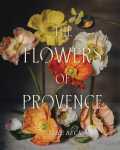
The Flowers of Provence by Jamie Beck (Gift books feature): A gorgeous book of photographs, perfect for gardeners, romantics, and armchair travelers. Her still lifes are as detailed and colorful as medieval paintings.
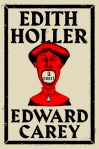
Edith Holler by Edward Carey (forthcoming): A dark fairy tale about a precocious girl confined to her family’s theatre in Norwich, England yet driven to reveal the truth behind her city’s child disappearances. Reminiscent of Dahl, Dickens, and Shakespeare at their goriest.
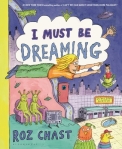
I Must Be Dreaming by Roz Chast: A laugh-out-loud-funny tour through her dream journal as well as a brief introduction to dream theory. Delightfully captures the randomness of dream topics and dialogues.

Tremor by Teju Cole: A kaleidoscopic work of autofiction that journeys between the US and Nigeria as it questions the ownership and meaning of Black art. The sophisticated structure is a highlight of this elegant study of art criticism, suffering, and subjectivity.
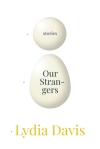
Our Strangers by Lydia Davis (Review and Q&A): In her ninth collection of mostly flash-length stories (a whopping 143 of them), an overarching theme is the mystery of human communication and connection. A real cornucopia of genres, structures, and voices. [Only available via Bookshop.org and independent bookstores.]
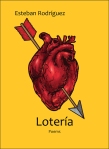
Lotería by Esteban Rodríguez: Lotería is a traditional Mexican game of chance. Each Spanish-language card is allotted a one-page poem in a creative, poignant recounting of his Mexican American family history.
Glass Half Empty by Rachael Smith: The British comics artist third graphic memoir is a refreshingly candid account of her recovery from alcoholism after her father’s death. In some panes, her adult self appears alongside her younger self, offering advice.


The Dead Peasant’s Handbook by Brian Turner: The final installment – after The Wild Delight of Wild Things and The Goodbye World Poem – in an intimate, autobiographical trilogy. Love is presented as the key to surviving bereavement and wartime trauma.
October Reading Plans
My plans for the rest of the month’s reading, in pictures.
A handful of October releases (not counting the ones I’ve reviewed in advance for Shelf Awareness et al., one for a blog tour, or what I’ll be reading for November deadlines).


I turn 40 on the 14th, so have made a halfhearted attempt to gather my last four unread from The Novel Cure’s books to read in your thirties before that milestone passes. Whether I’ll actually read them, I’m less sure about. I’ve owned this copy of The Jungle for decades; I’ve not enjoyed Trollope since my student days. Time runs short, anyway, but I’ll see how I get on with the Sinclair at least, and perhaps skim the Trollope to get a sense of why Berthoud and Elderkin chose it for that list.
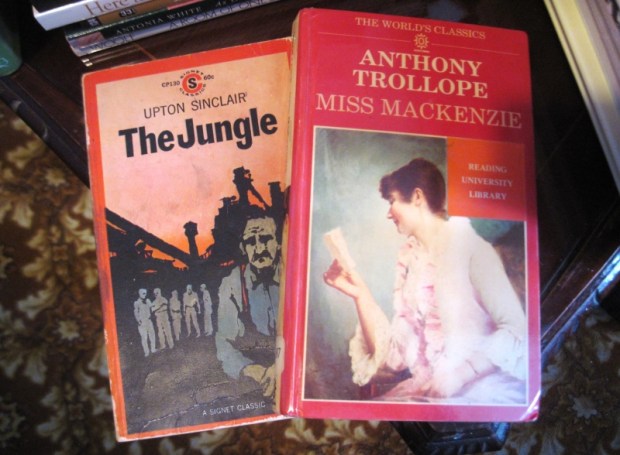
[The others are London Fields by Martin Amis, which is on loan just as I need it, and The Best of It All by Rona Jaffe, which I borrowed once and didn’t get far in; now it appears to have been withdrawn from the system. (My DNF review from 2018: “I read the first chapter and had a weird reverse case of déjà vu: this is awfully similar to Mad Men, Suzanne Rindell’s Three-Martini Lunch, and A.J. Pearce’s Dear Mrs Bird, though of course they would have been based on Jaffe’s novel rather than the other way round. Caroline Bender, fresh out of a broken engagement, arrives for her first day as a typist at a New York City publishing house and has to adjust to the catty office politics. I think I’ll truly enjoy this, but I need to find another time when I can give it my full attention. It’s nearly 450 pages of small print, so I need a chunk of time when I can really sink into it, like a flight or a long train ride.)]
Also in conjunction with that big birthday, I’ve collected some notable 1983 releases, including 5 out of the 10 most popular on Goodreads’ list. (The Ephron and Hill would be rereads for me.) I’ll work on them in these last few months of the year.
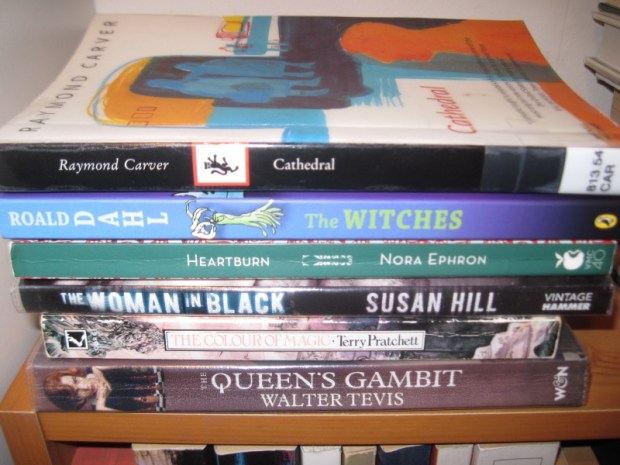
A lesser-known Margaret Drabble novel for our women’s classics book club subgroup; Pale Fire for 1962 Club; two potential books for AusReading Month.

Some spooky or death-themed R.I.P. options (I know the challenge technically starts in September, but I only ever think to read such books as Halloween approaches).
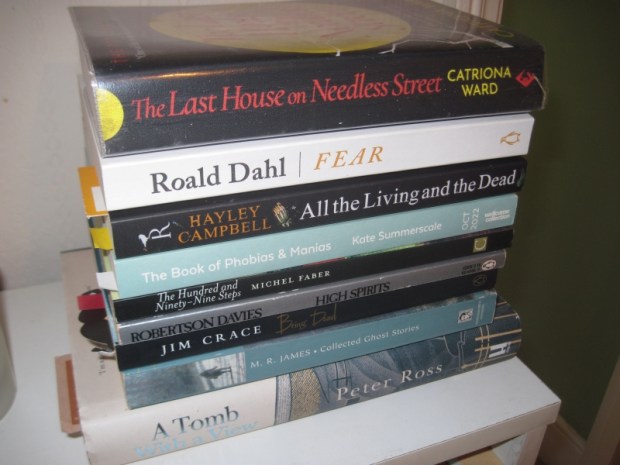
I’ll be spending my birthday weekend in Hay-on-Wye, one of my special places. Here’s my Wales-themed and/or Hay-related pile. I’ll take all of these and probably many of the above as well; I like to have lots to choose from!

 Bookish Beck = Rebecca Foster. American transplant to England. Freelance proofreader and book reviewer.
