#ReadIndies Wrap-Up: February Releases (Jukes, Spence) & Review Catch-Up (Buttery, Foust)
Good riddance to February, which added insult to injury on its final day when my in-laws’ neighbour reversed into the car we were borrowing from a book club friend and smashed the driver’s-side window. The blue skies and crocuses of recent days have been most welcome. The best I can say for the month just departed is that I managed to review 15 books for Kaggsy and Lizzy Siddal’s Reading Independent Publishers Month challenge. These came from 10 splendid publishers: Atlantic Books, Backbone Press, Carcanet Press, Counterpoint, Elliott & Thompson, The Emma Press, Faber, Icon Books, Saraband and Sort Of Books.
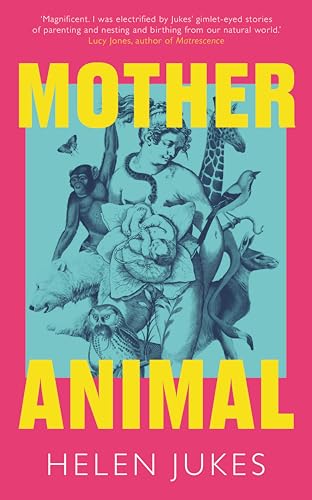
Mother Animal by Helen Jukes
When she found out she was pregnant, Jukes (author of A Honeybee Heart Has Five Openings) lost herself in research, looking for parallels in the natural world. A friend had told her that “childbirth puts you more in touch with your animal side.” Her daughter was born at the start of the pandemic and so early motherhood was perhaps more than usually isolated and emotionally challenging for her. She had an unexpected C-section after the placenta failed to nourish her daughter sufficiently, and then struggled to breastfeed. “I was, I realised, a little afraid of the baby. I’d expected to feel a sense of recognition – to see in her face some sign of familiarity,” but that wasn’t the case. “She was so … other.”
The long thematic chapters present Jukes’s experiences in parallel to those of other mothering creatures with pregnancy, birth, lactation, making a home (nesting) and enlisting the help of the community. Peppered throughout are trivia she shares with boyfriend, baby and readers. Such as that burying beetles lay eggs on a carcass so their babies feed on carrion from day one. That bonobo females attend births, acting as midwives for each other. That Madrid’s storks have started eating and lining their nests with what they find in landfill instead of migrating to Africa. The “Did you know?” litany quickly becomes precious. The details are not that interesting in themselves, and not sufficiently synthesized to be meaningful. The same factoid about leopard tree iguanas is repeated seven pages apart. A significant amount of information comes from Bitch by Lucy Cooke, which I would recommend instead.
As hybrid scientific memoirs of motherhood go, Lucy Jones’s Matrescence can’t be beat. For its social and political engagement, Jennifer Case’s We Are Animals is a valuable companion. Jukes’s offering pales by comparison because her story – not having the delivery she wanted, struggling to connect with her baby, her relationship with the father falling apart – is all too common, and she doesn’t have the scientific bona fides for readers to accept her as a valid source of zoological facts.
I would make an exception, though, for the central chapter, “Forever Milk,” which might be condensed and published in a big-name newspaper as a Rachel Carson-like exposé about endocrine disruptors and forever chemicals. Like any mother, Jukes wants nothing more than to protect her daughter, but how can she when household products (waterproof clothing, non-stick pans, cleaning sprays) contain toxic chemicals and her breastmilk is sure to be contaminated? Add in microplastics and the situation is bleak. We don’t know singly, let alone collectively, what these pollutants are doing to species in the long term, but most likely they interfere with reproduction and alter behaviour. The central message of this chapter, and the book as a whole, is that animals are amazing but vulnerable. “What is this world if nowhere is separate – nowhere safe?” If you think about this stuff much, you can’t bear it. Yet it’s a truth we all have to live with. It’s a brave author who dares sit with the unthinkable.
With thanks to Elliott & Thompson for the free copy for review.
Daughter of the Sun by Rachel Spence
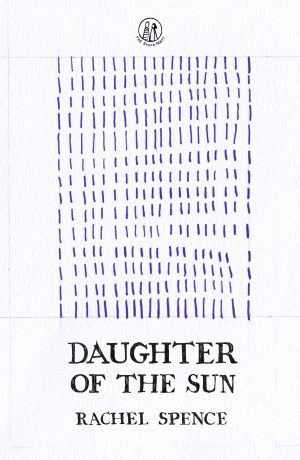 The Emma Press has published poetry pamphlets before, but this is their inaugural full-length work. Rachel Spence’s second collection is in two parts: first is “Call & Response,” a sonnet sequence structured as a play and considering her relationship with her mother. Act 1 starts in 1976 and zooms forward to key moments when they fell out and then reversed their estrangement. The next section finds them in the new roles of patient and carer. “Your final check-up. August. Nimbus clouds / prised open by Delft blue. Waiting is hard.” In Act 3, death is near; “in that quantum hinge, we made / an alphabet from love’s ungrammared stutter.” The poems of the last act are dated precisely, not just to a month and year as earlier but down to the very day, hour and minute. Whether in Ludlow or Venice, Spence crystallizes moments from the ongoingness of grief, drawing images from the natural world.
The second part of the book, “Medea’s Song,” is looser in style and more dispersed across the page. It’s a feminist reinterpretation that refuses to make of Medea a simple murderess, instead redeeming her as a wise woman. “Do not call them seers or sisters // They are the owls of history // nightfliers outliers”. I’m not drawn to Greek myth updates but I expect this would be rewarding for fans of similar projects by Fiona Benson and Anne Carson. Some of the specific vocabulary from the first section recurs, linking the two in a satisfying way.
With thanks to The Emma Press for the free copy for review.
I’m also catching up on two 2024 releases from indie publishers that I was sent for review:
Knead to Know: A History of Baking by Neil Buttery
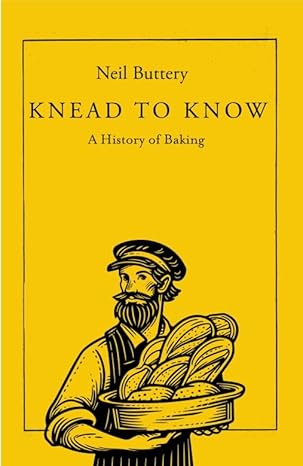 Not only the pun-tastic title, but also the excellent nominative determinism of chef and food historian Dr Neil Buttery’s name, earned this a place in my 2024 Superlatives post. In not quite 240 pages, it achieves the improbable, producing an exhaustive history of baked goods through miniature essays about every conceivable subcategory. Although the focus is on British baking, the story begins in ancient times with the first grains and the earliest cooking technique of making griddlecakes on a hearthstone. (Speaking of which, make sure you’re prepared for Pancake Day, aka Shrove Tuesday, this week!) Across multi-part chapters about bread, biscuits and cakes, pies and puddings, and patisserie, Buttery spotlights regional specialties, many of them familiar (Cornish pasties and Eccles cakes); a few have fallen into obscurity (Gloucester pancakes and Yorkshire Christmas pyes). Some dishes’ origin stories are apocryphal, while others can be traced back to historical cookbooks.
I was fascinated by the evolution of traditional holiday bakes. “The long tapering shape of the stollen is supposed to represent the infant Christ wrapped in His swaddling.” In general, there is just the right amount of chemistry, and while in places the writing is shaky or at least poorly edited (“populous” instead of populace!), there are good quips, too: “dried fruit haters do have a miserable time at Christmas to be fair.” I read the book in bites across a number of months, which felt appropriate because it’s more a reference text for the kitchen shelf than a narrative to read straight through. Good for picking up now and then over a cup of tea.
With thanks to Icon Books for the free copy for review.
You Are Leaving the American Sector: Love Poems by Rebecca Foust
 Foust’s fifth collection – at 41 pages, the length of a long chapbook – is in conversation with the language and storyline of 1984. George Orwell’s classic took on new prescience for her during Donald Trump’s first presidential term, a period marked by a pandemic as well as by corruption, doublespeak and violence. “Rally Insurrection” is a clever erasure poem illustrating how a propagandist might rebrand the storming of the Capitol on 6 January 2021: instead of “a mob came to Washington to / disrupt the peaceful transfer of power,” the Ministry of Truth bulletin would read “a crowd came to Washington to fight / for their country”. “Language Matters” insists that “language / is the most dangerous weapon in any totalitarian arsenal” and warns “A dictator / might do these things, but surely not // a president.” How much more strongly does this resonate in 2025.
The second and third sections engage directly with the story of Julia and Winston – the collection takes its seemingly inapt subtitle from Foust’s appreciation of 1984’s “idea of love as a subversive act affirming free will, expression, and personal privacy”. Her bold verse also confronts the repeal of abortion rights (“Breaking News”) and toxic masculinity (“Consent: A Primer”). There are some internal rhymes and slant rhymes, as well as a few end rhymes all the more striking for their rarity. I only wish this had been published a few years sooner, when its message might have seemed timelier – though, unfortunately, it is still apropos.
Some favorite lines:
“How can a future exist if we can erase or revise the past?”
“2016, dark year / of the ascension / of our Lord the Mad Clown”
“It’s happening now, / somewhere. Not here, // not yet. But so long as Big Brother is out there— / & he will always be out there—it could, // & one day, maybe it will.”
Published by Backbone Press in the USA. With thanks to the author for the e-copy for review.
Which of these appeal to you? What indie publishers have you read from recently?
Literary Wives Club: Euphoria by Elin Cullhed (2021)
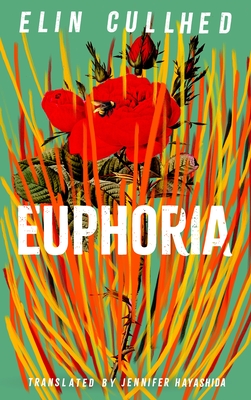
Swedish author Elin Cullhed won the August Prize and was a finalist for the Strega European Prize with this first novel for adults. Euphoria is a recreation of Sylvia Plath’s state of mind in the last year of her life. It opens on 7 December 1962 in Devon with a list headed “7 REASONS NOT TO DIE,” most of which centre on her children, Frieda and Nick. She enumerates the pleasures of being in a physical body and enjoying coastal scenery. But she also doesn’t want to give her husband, poet Ted Hughes, the satisfaction of having his prophecies about her mental illness come true.
 Flash back to the year before, when Plath is heavily pregnant with Nick during a cold winter and trying to steal moments to devote to writing. She feels gawky and out of place in encounters with the vicar and shopkeeper of their English village. “Who was I, who had let everything become a compromise between Ted’s Celtic chill and my grandiose American bluster?” She and Hughes have an intensely physical bond, but jealousy of each other’s talents and opportunities – as well as his serial adultery and mean and controlling nature – erodes their relationship. The book ends in possibility, with Plath just starting to glimpse success as The Bell Jar readies for publication and a collection of poems advances. Readers are left with that dramatic irony.
Cullhed seems to hew to biographical detail, though I’m not particularly familiar with the Hughes–Plath marriage. Scenes of their interactions with neighbours, Plath’s mother, and Ted’s lover Assia Wevill make their dynamic clear. The prose grows more nonstandard; run-on sentences and all-caps phrases indicate increasing mania. There are also lovely passages that seem apt for a poet: “Ted’s crystalline sly little mint lozenge eyes. Narrow foxish. Thin hard. His eyes, so embittered.” The use of language is effective at revealing Plath’s maternal ambivalence and shaky mental health. Somehow, though, I found this quite tedious by the end. Not among my favourite biographical novels, but surely a must-read for Plath fans. 
Translated from the Swedish by Jennifer Hayashida in 2022 – our first read in translation, I think? And what a brilliant cover.
With thanks to Canongate for the free copy for review.
The main question we ask about the books we read for Literary Wives is:
What does this book say about wives or about the experience of being a wife?
Marriage is claustrophobic here, as in so many of the books we read. Much as she loves her children, Plath finds the whole wifehood–motherhood complex to be oppressive and in direct conflict with her ambitions as an author. Sharing a vocation with her husband, far from helping him understand her, only makes her more bitter that he gets the time and exposure she so longs for. More than 60 years later, Plath’s death still echoes, a tragic loss to literature.
See Kate’s, Kay’s and Naomi’s reviews, too!
Coming up next, in March: Lessons in Chemistry by Bonnie Garmus – I’ve read this before but will plan to skim back through a copy from the library.
#WITMonth, Part I: Novellas by Eva Baltasar and Françoise Sagan
I’m starting off my Women in Translation month coverage with mini responses to two novellas: one Catalan and one French; both about disaffected women trying to work out what they want from life.
Mammoth by Eva Baltasar (2022; 2024)
[Translated from the Catalan by Julia Sanches]
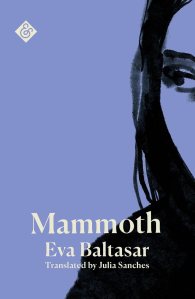 I’d been vaguely attracted by descriptions of the Spanish poet’s novels Permafrost and Boulder, which are also about lesbians in odd situations. Mammoth is the third book in a loose trilogy. Its 24-year-old narrator is so desperate for a baby that she’s decided to have unprotected sex with men until a pregnancy results. In the meantime, her sociology project at nursing homes comes to an end and she moves from Barcelona to a remote farm where she develops subsistence skills and forms an interdependent relationship with the gruff shepherd. “I’d been living in a drowning city, and I need this – the restorative silence of a decompression chamber. … my past is meaningless, and yet here, in this place, there is someone else’s past that I can set up and live in awhile.” For me this was a peculiar combination of distinguished writing (“The city pounces on the still-pale light emerging from the deep sea and seizes it with its lucrative forceps”) but absolutely repellent story, with a protagonist whose every decision makes you want to throttle her. An extended scene of exterminating feral cats certainly didn’t help matters. I’d be wary of trying Baltasar again.
With thanks to And Other Stories for the proof copy for review.
Aimez-vous Brahms… by Françoise Sagan (1959; 1960)
[Translated from the French by Peter Wiles]
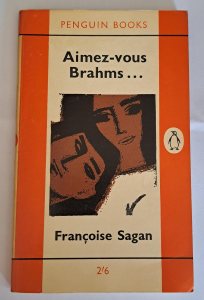 At age 39, divorced interior decorator Paule is “passionately concerned with her beauty and battling with the transition from young to youngish woman”. (Ouch. But true.) It’s an open secret that her partner Roger is always engaged in a liaison with a young woman; people pity her and scorn Roger for his infidelity. But when Paule has a dalliance with a client’s son, 25-year-old lawyer Simon, a double standard emerges: “they had never shown her the mixture of contempt and envy she was going to arouse this time.” Simon is an idealist, accusing her of “letting love go by, of neglecting your duty to be happy”, but he’s also indolent and too fond of drink. Paule wonders if she’s expected too much from an affair. “Everyone advised a change of air, and she thought sadly that all she was getting was a change of lovers: less bother, more Parisian, so common”.
I was by turns reminded of Chéri by Colette, In a Summer Season by Elizabeth Taylor, and even The Graduate (“Mrs. Robinson,” anyone?). Simon asks the title question to invite Paule to a concert; that she has to ponder it carefully tells her she’s “losing herself, losing track of herself”. But it’s all too easy for the status quo to be reinstated after a brave act. Middle-aged woman makes bid for freedom but ultimately nothing changes: same plot as The Funeral Cryer and any number of other books, but this was so much better. How did Sagan manage such insight at age 24 (and this was her fourth book)?! While not quite as memorable as Bonjour Tristesse, this is another incisive slice of fiction that has aged well apart from using “sodomite” and “Negress” as matter-of-fact terms for bit players. I’d read anything else I can find by Sagan. (Secondhand – Community Furniture Project, Newbury)
July Releases, I: Books by Nina Lohman and Ricky Ray for Disability Pride Month
The Wellcome Book Prize (for health- and medicine-related books) and the Barbellion Prize (for representations of disability and/or chronic illness) are much missed, but I continue to be drawn to their highlighted themes in my reading. This is the first year that I’ve been aware of July as Disability Pride Month, though it’s been a thing since 1990 in the USA and 2015 in the UK. My first set of July releases – I have reviews of three novels coming up tomorrow – consists of a nonlinear memoir interrogating life with chronic pain and a chronically ill poet’s collection in which an old dog is an example of grace through suffering.
The Body Alone: A Lyrical Articulation of Chronic Pain by Nina Lohman
For well over a decade, Nina Lohman has endured Chronic Daily Headaches – when a doctor presented her with this phrase, she remarks, it was not so much a diagnosis as a description. Having a clinical term for her extreme pain did nothing to solve it; no treatment she has tried has helped much either, from pharmaceuticals to acupuncture. (Doctors think they’re breaking new ground if they suggest ice packs or elevating her neck.) Like Meghan O’Rourke’s The Invisible Kingdom, this documents a quest with no natural end. Lohman’s health fluctuates, and medical professionals and family and friends minimize her pain because she is able to pass as well, to carry out the daily tasks of raising two children.
The subtitle is apt for a work that is fragmentary and not driven by chronology. Had Cataloguing Pain not already been taken (by Allison Blevins), it might have been a perfect title. Some of Lohman’s short pieces read like poems, including erasure poems based on her medical notes. Repeated headings demonstrate a desire to organise her illness so as to make sense of it: “A Primer,” “Classifications” and “Perhaps” musings. She dwells on the names of things – shades of colours, groups of animals – while she longs for a vocabulary tailored to her own circumstances. Imagined monologues by doctors, friends and her husband (“He”) show pain has not turned her insular; she has empathy even when people act in hurtful ways.

One aspect of the book that I found particularly interesting is that Lohman, though not raised with Christian beliefs, studied theology at university level. Doctrines of the Fall bringing anguish and the Cross offering atonement are logical to her yet feel irrelevant to her situation. She bristles when a religious friend suggests that pain might be “her cross to bear.” Lohman admits she has given up hope on ever being free of pain, so finds resonance with poet Christian Wiman, who has been living with cancer for decades and whose work is equally infused with pain and faith.
It’s a journalistic as well as personal narrative, in the tradition of Anne Boyer, Sinéad Gleeson and Susan Sontag, shifting between modes and registers as Lohman gives a history of opiates, records of her pregnancies, and précis of philosophical understandings of suffering. “Theorizing can only take me so far,” she acknowledges, toward comprehending bodily experiences that defy language. And yet she employs words exquisitely, marshalling metaphors though they’re inadequate. The tone flows from enraged to resigned to cynical and back as she depicts the helplessness of women in a medical system that ignores their pain. Especially if you have enjoyed work by any of the authors I mention above, I highly recommend this debut: it’s sure to be one of my books of the year.
Published by the University of Iowa Press. With thanks to Nectar Literary for the free advanced e-copy for review.
The Soul We Share: Life with Earth and an Old Brown Dog by Ricky Ray
New England poet Ricky Ray describes himself as an “eco-mystic” and is the author of several previous works. Maura Dooley chose this as the Aryamati Collection Prize winner in 2023. As in Birds Knit My Ribs Together by Phil Barnett, nature is a source of comfort in a life complicated by chronic illness. In “Pain: 8 on a Scale out of 10,” Ray explains how “Some days, I never make it out of my head, / that coal-eyed melon … The impinged nerves crack their whips / within my animal pelt”. An accidental overdose and depression are matter-of-fact components of the poet’s history. While uxorious, he regrets that he may never become a father. And yet this couplet expresses deep pleasure in life:
(Dis)ability
Some days, my body is so beautiful
I can’t believe I get to live here.

His elderly rescue dog Addie is his beloved companion, and the delight she takes in physical existence despite advancing cancer is a model to him: “she still has a lot / to teach me about aging, about ignoring it, about how to throw my body— / even when it fails me, even when it hurts like hell—headlong into joy.” Multiple poems remember particular walks with her, such as in a Connecticut forest. He even gets a tutorial from her in how to dig a hole. Later on, he remarks as if to her, “Forgive me, I’m human, / we’re slow to learn, quick to forget— / it could be said we live too long / to appreciate each drop of time in the heart’s well.”
If his primary engagement with the nonhuman world is via a pet, Ray also widens the scope to include environmental plight: “you look up and extinction’s / already guzzling half the bestiary, / You think, / God, what have I done? / And the God in you answers: / harm, now what will you do?” This sense of responsibility meeting resolution echoes throughout the book. Ache is a spur to seek remedies; “I learned that hurt inducts all painfolk as conspirators // in the craft of healing.” The prose poems were a bit long and ranty for me (e.g., “Identity Earth: A Brief Biography of Our Planetary Self” goes on for more than six pages) and overall I found the book a little sentimental and New Age-adjacent. However, the poems about Addie are undeniably touching, and perfect for fans of Mary Oliver’s Dog Songs.
With thanks to Fly on the Wall Press for the free copy for review.
Have you read anything to tie into Disability Pride Month?
Literary Wives Club: Recipe for a Perfect Wife by Karma Brown (2019)
{SPOILERS IN THIS REVIEW!}
Canadian author Karma Brown’s fifth novel features two female protagonists who lived in the same house in different decades. The dual timeline, which plays out in alternating chapters, contrasts the mid-1950s and late 2010s to ask 1) whether the situation of women has really improved and 2) if marriage is always and inevitably an oppressive force.
Nellie Murdoch loves cooking and gardening – great skills for a mid-twentieth-century housewife – but can’t stay pregnant, which provokes the anger of her abusive husband, Richard. To start with, Alice Hale can’t cook or garden for toffee and isn’t sure she wants a baby at all, but as she reads through Nellie’s unsent letters and recipes, interspersed with Ladies’ Home Journal issues in the boxes in the basement, she starts to not just admire Nellie but emulate her. She’s keeping several things from her husband Nate: she was fired from her publicist job after a pre-#MeToo scandal involving a handsy male author, she’s had an IUD fitted, and she’s made zero progress on the novel she’s supposed to be writing. But Nellie’s correspondence reveals secrets that inspire Alice to compose Recipe for a Perfect Wife.
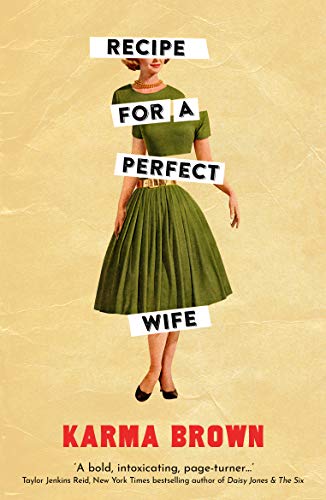
The chapter epigraphs, mostly from period etiquette and relationship guides for young wives, provide ironic commentary on this pair of not-so-perfect marriages. Brown has us wondering how closely Alice will mirror Nellie’s trajectory (aborting her pregnancy? poisoning her husband?). There were clichéd elements, such as Richard’s adultery, glitzy New York City publishing events, Alice’s quirky-funny friend, and each woman having a kindly elderly (maternal) neighbour who looks out for her and gives her valuable advice. I felt uncomfortable with how Nellie’s mother’s suicide makes it seem like Nellie’s radical acts are borne out of inherited mental illness rather than a determination to make her own path.
Often, I felt Brown was “phoning it in,” if that phrase means anything to you. In other words, playing it safe and taking an easy and previously well-trodden path. Parallel stories like this can be clever, or can seem too simple and coincidental. However, I can affirm that the novel is highly readable and has vintage charm. I always enjoy epistolary inclusions like letters and recipes, and it was intriguing to see how Nellie uses her garden herbs and flowers for pharmaceutical uses. Our first foxglove just came into flower – eek! (Kindle purchase)
The main question we ask about the books we read for Literary Wives is:
What does this book say about wives or about the experience of being a wife?
- Being a wife does not have to mean being a housewife. (It also doesn’t have to mean being a mother, if you don’t want to be one.)
- Secrets can be lethal to a marriage. Even if they aren’t literally so, they’re a really bad idea.
This was, overall, a very bleak picture of marriage. In the 1950s strand there is a scene of marital rape – one of two I’ve read recently, and I find these particularly difficult to take. Alice’s marriage might not have blown up as dramatically, but still doesn’t appear healthy. She forced Nate to choose between her and the baby, and his job promotion in California. The fallout from that ultimatum is not going to make for a happy relationship. I almost thought that Nellie wields more power. However, both women get ahead through deception and manipulation. I think we are meant to cheer for what they achieve, and I did for Nellie’s revenge at Richard’s vileness, but Alice I found brattish and calculating.
See Kate’s, Kay’s and Naomi’s reviews, too!
Coming up next, in September: Their Eyes Were Watching God by Zora Neale Hurston.
Reading about Mothers and Motherhood: Cosslett, Cusk, Emma Press Poetry, Heti, and Pachico
It was (North American) Mother’s Day at the weekend, an occasion I have complicated feelings about now that my mother is gone. But I don’t think I’ll ever stop reading and writing about mothering. At first I planned to divide my recent topical reads (one a reread) into two sets, one for ambivalence about becoming a mother and the other for mixed feelings about one’s mother. But the two are intertwined – especially in the poetry anthology I consider below – such that they feel more like facets of the same experience. I also review two memoirs (one classic; one not so much) and two novels (autofiction vs. science fiction).

The Year of the Cat: A Love Story by Rhiannon Lucy Cosslett (2023)
This was on my Most Anticipated list last year. A Covid memoir that features adopting a cat and agonizing over the question of whether to have a baby sounded right up my street. And in the earlier pages, in which Cosslett brings Mackerel the kitten home during the first lockdown and interrogates the stereotype of the crazy cat lady from the days of witches’ familiars onwards, it indeed seemed to be so. But the further I got, the more my pace through the book slowed to a limp; it took me 10 months to read, in fits and starts.
 I’ve struggled to pinpoint what I found so off-putting, but I have a few hypotheses: 1) By the time I got hold of this, I’d tired of Covid narratives. 2) Fragmentary narratives can seem like profound reflections on subjectivity and silences. But Cosslett’s strategy of bouncing between different topics – worry over her developmentally disabled brother, time working as an au pair in France, PTSD from an attempted strangling by a stranger in London and being in Paris on the day of the Charlie Hebdo terrorist attack – with every page or even every paragraph, feels more like laziness or arrogance. Of course the links are there; can’t you see them?
3) Cosslett claims to reject clichéd notions about pets being substitutes for children, then goes right along with them by presenting Mackerel as an object of mothering (“there is something about looking after her that has prodded the carer in me awake”) and setting up a parallel between her decision to adopt the kitten and her decision to have a child. “Though I had all these very valid reasons not to get a cat, I still wanted one,” she writes early on. And towards the end, even after she’s considered all the ‘very valid reasons’ not to have a baby, she does anyway. “I need to find another way of framing it, if I am to do it,” she says. So she decides that it’s an expression of bravery, proof of overcoming trauma. I was unconvinced. When people accuse memoirists of being navel-gazing, this is just the sort of book they have in mind. I wonder if those familiar with her Guardian journalism would agree. (Public library)
A Life’s Work: On Becoming a Mother by Rachel Cusk (2001)
 When this was first published, Cusk was vilified for “hating” her child – that is, for writing honestly about the bewilderment and misery of early motherhood. We’ve moved on since then. Now women are allowed to admit that it’s not all cherubs and lullabies. I suspect what people objected to was the unemotional tone: Cusk writes like an anthropologist arriving in a new land. The style is similar to her novels’ in that she can seem detached because of her dry wit, elevated diction and frequent literary allusions.
I understand that crying, being the baby’s only means of communication, has any number of causes, which it falls to me, as her chief companion and link to the world, to interpret.
Have you taken her to toddler group, the health visitor enquired. I had not. Like vaccinations and mother and baby clinics, the notion instilled in me a deep administrative terror.
We [new parents] are heroic and cruel, authoritative and then servile, cleaving to our guesses and inspirations and bizarre rituals in the absence of any real understanding of what we are doing or how it should properly be done.
She approaches mumsy things as an outsider, clinging to intellectualism even though it doesn’t seem to apply to this new world of bodily obligation, “the rambling dream of feeding and crying that my life has become.” By the end of the book, she does express love for and attachment to her daughter, built up over time and through constant presence. But she doesn’t downplay how difficult it was. “For the first year of her life work and love were bound together, fiercely, painfully.” This is a classic of motherhood literature, and more engaging than anything else I’ve read by Cusk. (Secondhand purchase – Awesomebooks.com)
The Emma Press Anthology of Motherhood, ed. by Rachel Piercey and Emma Wright (2014)
There’s a great variety of subject matter and tone here, despite the apparently narrow theme. There are poems about pregnancy (“I have a comfort house inside my body” by Ikhda Ayuning Maharsi), childbirth (“The Tempest” by Melinda Kallismae) and new motherhood, but also pieces imagining the babies that never were (“Daughters” by Catherine Smith) or revealing the complicated feelings adults have towards their mothers.
“All My Mad Mothers” by Jacqueline Saphra depicts a difficult bond through absurdist metaphors: “My mother was so hard to grasp: once we found her in a bath / of olive oil, or was it sesame, her skin well-slicked / … / to ease her way into this world. Or out of it.” I also loved her evocation of a mother–daughter relationship through a rundown of a cabinet’s contents in “My Mother’s Bathroom Armoury.”
 In “My Mother Moves into Adolescence,” Deborah Alma expresses exasperation at the constant queries and calls for help from someone unconfident in English. “This, then, is how you should pray” by Flora de Falbe cleverly reuses the structure of the Lord’s Prayer as she sees her mother returning to independent life and a career as her daughter prepares to leave home. “I will hold you / as you held me / my mother – / yours are the bathroom catalogues / and the whole of a glorious future.”
I connected with these perhaps more so than the poems about becoming a mother, but there are lots of strong entries and very few unmemorable ones. Even within the mothers’ testimonials, there is ambivalence: the visceral vocabulary in “Collage” by Anna Kisby is rather morbid, partway to gruesome: “You look at me // like liver looks at me, like heart. You are familiar as innards. / In strip-light I clean your first shit. I’m not sure I do it right. / It sticks to me like funeral silk. … There is a window // guillotined into the wall. I scoop you up like a clod.”
A favourite pair: “Talisman” by Anna Kirk and “Grasshopper Warbler” by Liz Berry, on facing pages, for their nature imagery. “Child, you are grape / skins stretched over fishbones. … You are crab claws unfurling into cabbage leaves,” Kirk writes. Berry likens pregnancy to patient waiting for an elusive bird by a reedbed. (Free copy – newsletter giveaway)
Motherhood by Sheila Heti (2018)
I first read this nearly six years ago (see my original review), when I was 34; I’m now 40 and pretty much decided against having children, but FOMO is a lingering niggle. Even though I already owned it in hardback, I couldn’t resist picking up a nearly new paperback I saw going for 50 pence in a charity shop, if only for the Leanne Shapton cover – her simple, elegant watercolour style is instantly recognizable. Having a different copy also provided some novelty for my reread, which is ongoing; I’m about 80 pages from the end.
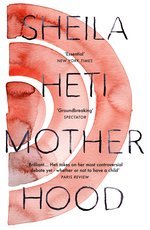 I’m not finding Heti’s autofiction musings quite as profound this time around, and I can’t deny that the book is starting to feel repetitive, but I’ve still marked more than a dozen passages. Pondering whether to have children is only part of the enquiry into what a woman artist’s life should be. The intergenerational setup stands out to me again as Heti compares her Holocaust survivor grandmother’s short life with her mother’s practical career and her own creative one.
For the past month or so, I’ve also been reading Alphabetical Diaries, so you could say that I’m pretty Heti-ed out right now, but I do so admire her for writing exactly what she wants to and sticking to no one else’s template. People probably react against Heti’s work as self-indulgent in the same way I did with Cosslett’s, but the former’s shtick works for me. (Secondhand purchase – Bas Books & Home, Newbury)
A few of the passages that have most struck me on this second reading:
I think that is how childbearing feels to me: a once-necessary, now sentimental gesture.
I don’t want ‘not a mother’ to be part of who I am—for my identity to be the negative of someone else’s positive identity.
The whole world needs to be mothered. I don’t need to invent a brand new life to give the warming effect to my life I imagine mothering will bring.
I have to think, If I wanted a kid, I already would have had one by now—or at least I would have tried.
Jungle House by Julianne Pachico (2023)
{BEWARE SPOILERS}
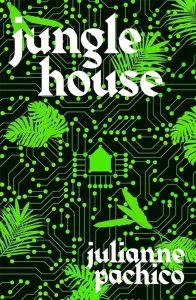 Pachico’s third novel is closer to sci-fi than I might have expected. Apart from Lena, the protagonist, all the major characters are machines or digital recreations: AI, droids, a drone, or a holograph of the consciousness of a dead girl. “Mother” is the AI security system that controls Jungle House, the Morel family’s vacation home in a country that resembles Colombia, where Pachico grew up and set her first two books. Lena, as the human caretaker, is forever grateful to Mother for rescuing her as a baby after the violent death of her parents, who were presumed rebels.
Mother is exacting but mercurial, strict about cleanliness yet apt to forget or overlook things during one of her “spells.” Lena pushes the boundaries of her independence, believing that Mother only wants to protect her but still longing to explore the degraded wilderness beyond the compound.
Mother was right, because Mother was always right about these kinds of things. The world was a complicated place, and Mother understood it much better than she did.
In the house, there was no privacy. In the house, Mother saw all.
Mother was Lena’s world. And Lena, in turn, was hers. No matter how angry they got at each other, no matter how much they fought, no matter the things that Mother did or didn’t do … they had each other.
It takes a while to work out just how tech-reliant this scenario is, what the repeated references to “the pit bull” are about, and how Lena emulated and resented Isabella, the Morel daughter, in equal measure. Even creepier than the satellites’ plan to digitize humans is the fact that Isabella’s security drone, Anton, can fabricate recorded memories. This reminded me a lot of Klara and the Sun. Tech themes aren’t my favourite, but I ultimately thought of this as an allegory of life with a narcissistic mother and the child’s essential task of breaking free. It’s not clinical and contrived, though; it’s a taut, subtle thriller with an evocative setting. (Public library)
See also: “Three on a Theme: Matrescence Memoirs”
Does one or more of these books take your fancy?
Buddy Reads: Kilmeny of the Orchard by L.M. Montgomery & The Waterfall by Margaret Drabble
Buddy reading and other coordinated challenges are a good excuse to read the sort of books one doesn’t always get to, especially the more obscure classics. This was my third Lucy Maud Montgomery novel within a year and a bit, and my first contribution to Ali’s ongoing year with Margaret Drabble.
{SPOILERS IN BOTH OF THE FOLLOWING REVIEWS}
Kilmeny of the Orchard by L. M. Montgomery (1910)
I’ve participated in Canadian bloggers Naomi of Consumed by Ink and Sarah Emsley’s readalongs of three Montgomery works now. The previous two were Jane of Lantern Hill and The Story Girl. This sweet but rather outdated novella reminded me more of the latter (no surprise as it was published just a year before it) because of the overall sense of lightness and the male perspective, which isn’t what those familiar with the Anne and Emily books might expect from Montgomery.
 Eric Marshall travels to Prince Edward Island one May to be the temporary schoolmaster in Lindsay, filling in for an ill friend. At his graduation from Queenslea College, his cousin David Baker had teased him about his apparent disinterest in girls. He arrives on the island to an early summer idyll and soon wanders into an orchard where a beautiful young woman is playing a violin.
This is, of course, Kilmeny Gordon, her first name from a Scottish ballad by James Hogg, and it’s clear she will be the love interest. However, there are a couple of impediments to the romance. One is resistance from Kilmeny’s guardians, the strict aunt and uncle who have cared for her since her wronged mother’s death. But the greater obstacle is Kilmeny’s background – illegitimacy plus a disability that everyone bar Eric views as insuperable: she is mute (or, as the book has it, “dumb”). She hears and understands perfectly well, but communicates via writing on a slate.
There is interesting speculation as to whether her condition is psychological or magically inherited from her late mother, who had taken a vow of silence. Conveniently, cousin David is a doctor specializing in throat and voice problems, so assures Eric and the Gordons that nothing is physically preventing Kilmeny from speech. But she refuses to marry Eric until she can speak. The scene in which she fears for his life and calls out to save him is laughably contrived. The language around disability is outmoded. It’s also uncomfortable that the story’s villain, an adopted Gordon cousin, is characterized only by his Italian heritage.
Like The Story Girl, I found this fairly twee, with an unfortunate focus on beauty (“‘Kilmeny’s mouth is like a love-song made incarnate in sweet flesh,’ said Eric enthusiastically”), and marriage as the goal of life. But it was still a pleasant read, especially for the descriptions of a Canadian spring. (Downloaded from Project Gutenberg) #ReadingKilmeny
The Waterfall by Margaret Drabble (1969)
 This was Drabble’s fourth novel; I’ve read the previous three and preferred two of them to this (A Summer Bird-Cage is fab). The setup is similar to The Garrick Year, which I read last year for book club, in that the focus is on a young mother of two who embarks on an affair. When we meet Jane Gray she is awaiting the birth of her second child. Her husband, Malcolm, walked out a few weeks ago, but she has the midwife and her cousin Lucy to rely on. Lucy and her husband, James, trade off staying over with Jane as she recovers from childbirth. James is particularly solicitous and, one night, joins Jane in bed.
At this point there is a stark shift from third person to first person as Jane confesses that she’s been glossing over the complexities of the situation; sleeping with one’s cousin’s husband is never going to be without emotional fallout. “It won’t, of course, do: as an account, I mean, of what took place”; “Lies, lies, it’s all lies. A pack of lies.” The novel continues to alternate between first and third person as Jane gives us glimpses into her uneasy family-making. I found myself bored through much of it, only perking back up for the meta stuff and the one climactic event. In a way it’s a classic tale of free will versus fate, including the choice of how to frame what happens.
I am no longer capable of inaction – then I will invent a morality that condones me.
It wasn’t so, it wasn’t so. I am getting tired of all this Freudian family nexus, I want to get back to that schizoid third-person dialogue.
The narrative tale. The narrative explanation. That was it, or some of it. I loved James because he was what I had never had: because he drove too fast: because he belonged to my cousin: because he was kind to his own child
(What intriguing punctuation there!) The fast driving and obsession with cars is unsubtle foreshadowing: James nearly dies in a car accident on the way to the ferry to Norway. Jane and her children, Laurie and baby Bianca, are in the car but unhurt. This was the days when seatbelts weren’t required, apparently. “It would have been so much simpler if he had been dead: so natural a conclusion, so poetic in its justice.” The Garrick Year, too, has a near-tragedy involving a car. Like many an adultery story, both novels ask whether an affair changes everything, or nothing. Infidelity and the parenting of young children together don’t amount to the most scintillating material, but it is appealing to see Drabble experimenting with how to tell a story. See also Ali’s review. (Secondhand – Alnwick charity shopping)
April Releases by Brownrigg, Ernaux, O’Connor, Waterman and Wood
Family history is a common element for the first four of these review books: a multi-generational story (incorporating autofiction in places) about Anglo-American writers and the legacy of suicide; a brief slice of memoir about the loss of a mother; a historical novella inspired by family stories and set on an island at the cusp of war; and a poetry collection drawing on a father’s death as well as on local folklore. Addiction and dementia are specific links between pairs. And to round off, a set of short stories about pregnancy and motherhood.
The Whole Staggering Mystery: A Story of Fathers Lost and Found by Sylvia Brownrigg
“The dead don’t come back, but they are not as far away as you think.”
I knew Brownrigg’s name as a novelist thanks to Susan’s blog (see her review of Pages for Her), but when I read about this family memoir it piqued my interest more than her fiction might have. The Brownrigg clan are nobility (really – her brother has the title “Baronet”) but have rejected conventional Englishness over the past century. First her grandfather, Gawen, separated from his wife and moved to Nairobi to work as a journalist. He also published two obscure novels before dying at age 27. The empty bottle of Nembutal and recent changes to his will suggested suicide, though his mother resisted the notion vociferously. Gawen’s son, Nicholas, was raised in California by his mother, Lucia, and became an alcoholic who lived off-grid on a ranch and had an unpublished Beats-influenced novel.
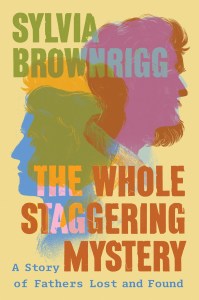 After Nicholas’s death in 2018, Brownrigg was compelled to trace her family’s patterns of addiction and creativity. It’s a complex network of relatives and remarriages here. The family novels and letters were her primary sources, along with a scrapbook her great-grandmother Beatrice made to memorialize Gawen for Nicholas. Certain details came to seem uncanny. For instance, her grandfather’s first novel, Star Against Star, was about, of all things, a doomed lesbian romance – and when Brownrigg first read it, at 21, she had a girlfriend.
Along with the more traditional memoir sections, there are the documents that speak for themselves and extended passages of autofiction. I loved an imaginary letter by Gawen’s older brother, who died in young childhood, and a third-person segment about Beatrice’s life in England during the Second World War. But I mostly skipped over the 90 lightly fictionalized pages about the author’s (“Sophie’s”) life with her father in California. You might view this as a showcase of possible methods for engaging with family history, some of which work better than others. All of it is fascinating material, though.
Published by Counterpoint in the USA. With thanks to Nectar Literary for the advanced e-copy for review.
A Woman’s Story by Annie Ernaux (1988; 2024)
[Translated from the French by Tanya Leslie]
 This memoir of Ernaux’s mother’s life and death is, at 58 pages, little more than an extended (auto)biographical essay. Confusingly, it covers the same period she wrote about in I Remain in Darkness (originally published nine years later), a diary of her mother’s final years with dementia; I even remembered two specific events and quotes. Why not combine the two into a full-length biographical recollection? Or pair it with A Man’s Place, Ernaux’s memoir of her father, in one volume? Perhaps her works will be repackaged in the future. But this came first: Ernaux started writing just a couple of weeks after her mother’s death, and spent 10 months over it. It’s clear she was determined to salvage what she could of her mother’s life:
It’s a difficult undertaking. For me, my mother has no history. She has always been there. When I speak of her, my first impulse is to ‘freeze’ her in a series of images unrelated to time … This book can be seen as a literary venture as its purpose is to find out the truth about my mother, a truth that can be conveyed only by words. … I believe I am writing about my mother because it is my turn to bring her into the world.
Ernaux opens with news of the death, and the funeral. But soon she’s pushing back into the past. Her mother grew up in poverty near Rouen and worked in a factory before her marriage, when she and her husband took on a grocery store and café. The Second World War was in some romantic way the great drama of her life. She was exacting of her daughter: “Her overriding concern was to give me everything she hadn’t had. But this involved so much work, so much worrying about money”. In her widowhood she came to live with Ernaux, who was then divorced with two sons, and tried to find a middle way between independence and connection. Eventually, though, her memory loss required admission to a nursing home.
I’ve felt the same about all three short works I’ve read by Ernaux so far: though precisely observed, they conceal themselves behind emotional distance. So while this might seem similar to A Very Easy Death by Simone de Beauvoir, I found the latter more engaging.
With thanks to Fitzcarraldo Editions for the free copy for review.
Whale Fall by Elizabeth O’Connor
 The remote Welsh island setting of O’Connor’s debut novella was inspired by several real-life islands that were depopulated in the twentieth century due to a change in climate and ways of life: Bardsey, St Kilda, the Blasket Islands, and the Aran Islands. (A letter accompanying my review copy explained that the author’s grandmother was a Welsh speaker from North Wales and her Irish grandfather had relatives on the Blasket Islands.)
Eighteen-year-old Manod Llan is the older daughter of a lobster fisherman. Her sweetheart recently left to find work in a mainland factory. It’s 1938 and there are vague rumbles about war, but more pressing is the arrival of strangers here to study a vanishing culture. Anthropologists Edward and Joan learn snatches of Welsh and make recordings of local legends and songs, which are interspersed with the fragmentary narrative. Manod, star-struck, seeks the English researchers’ approval as she helps with translation and other secretarial duties, but becomes disillusioned with their misinterpretations and fascist leanings.
The gradual disintegration of a beached whale casts a metaphorical shadow of decay over the slow-burning story. I kept waiting for momentous events that never came. More definitive consequences? Something to do with Manod’s worries for her little sister, Llinos? A flash-forward to the abandoned island’s after-years? Or to Manod’s future? As it is, the sense of being stuck at a liminal time makes it all feel like prologue. But O’Connor’s writing is quite lovely (“The milk had formed a film over the surface and puckered, like a strange kiss”; “All of my decisions felt like trying to catch a fish that did not exist until I caught it”) and the book is strong on atmosphere and tension. I’ll look out for her next work.
With thanks to Picador for the free copy for review.
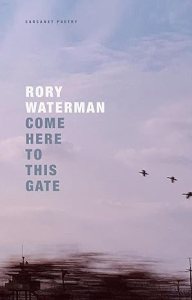
Come Here to This Gate by Rory Waterman
I was most drawn to the poems in Part I, “All but Forgotten,” about his father’s last year or so.
The titles participate in telling the story: “Alcoholic Dementia,” followed by “Twin Oaks Nursing Home.”
The sheep-tracks of your mind were worn to trenches.
…
Then what you’ve turned yourself into – half there
on one side of a final single bed
you might not leave till the rest of you has left –
starts, stares through me, says ‘I’m being held
against my will!’, tells a nurse to ‘Just fuck off’
then thanks her. Old boy, when did you get like this?
The sheep-tracks of my mind are worn to trenches.
Then they moved you to a home
that still wasn’t home. ‘Why
am I in this fucking place?
Nothing’s wrong with me.’
So I’d tell you all over again,
but only the easy part (‘You’re
not remembering things well
at present.’ ‘Yes I fucking am’)
and you relearned that you’d
never learn – mindless torture,
until I stopped it. Your
silences were trains departing.
From the miscellany of Part II, I plucked out “Gooseberries” and “Perennials,” both of which conceal emotion among plants. Then Part III, “Lincolnshire Folk Tales,” turns the tone mischievous, with the ABCB end-rhymes of “Yallery Brown,” “The Metheringham Lass,” “The Lincoln Imp,” and “Nanny Rutt” (I felt I’d stumbled on a limerick with its rhythm: “Math Wood is a small plot of trees south of Bourne, / next to McDonald’s and Lidl. / It’s privately owned, full of shot-gun shells, pheasants – / but still, a bit of an idyll”). Plenty of good stuff, then, but it doesn’t all seem to fit together in the same collection.
With thanks to Carcanet Press for the advanced e-copy for review.
This Is Why We Can’t Have Nice Things by Naomi Wood
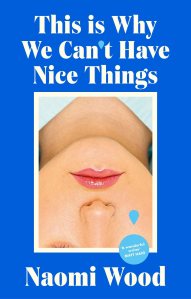 I requested this because a) I had enjoyed Wood’s novels Mrs. Hemingway and The Hiding Game and b) I couldn’t resist the title. These nine contemporary stories (five in the first person and four in the third person) all feature women who are pregnant and/or mothers of young children. Three dwell on work–life balance in particular, with the female protagonists of “Lesley, in Therapy” and “Dracula at the Movies” an animator and a filmmaker, respectively. The third, “Hurt Feelings,” in which a medical emergency forces a choice between career and motherhood, was my favourite. Claudia is working on an advertising campaign for a large pharmaceutical company whose newest product targets chronic pain. Although she suspects it’s a placebo, she knows how valuable it is for these people to have their pain acknowledged given it’s as invisible as her history of pregnancy loss.
Other highlights included “Peek-a-Boo,” in which pregnant twin sisters fly to Italy to remonstrate with their father, who refuses to cede a holiday flat to the next renters; and “Wedding Day,” about a woman bitter enough to try to sabotage her ex’s big day by demanding he bring their daughter, the flower girl, home by bedtime. “Flatten the Curve” is about restrictions and desires during Covid lockdown. Family, neighbour, and co-worker dynamics fuel the drama. In a few cases, Wood imagined promising situations but didn’t deliver on them. I could hardly believe “Comorbidities,” about a mother who films a sex tape with her husband to distract from her eco-anxiety, won the 2023 BBC National Short Story Award. If Wood was aiming for edgy, she landed on peevish instead. “Dino Moms,” the final story, was worst, with its absurd dinosaur-vet reality-TV setup. Overall, the collection is too one-note because of the obsession with motherhood (“It is not very interesting to be in love with your child; it’s commonplace, this sacrificial love”). Back to novels soon, please.
With thanks to Phoenix (Orion) for the free copy for review.
Does one of these catch your eye? What April releases can you recommend?
#ReadIndies Catch-up: Ansell, Kinard, McNaught, Ponce, Toews and Vara
At last, my first dedicated selections for Read Indies month, two of which have been languishing on the shelf since 2022! A few more indie titles will appear in my February roundup tomorrow. I’ve got a huge variety here: an extended essay comparing life among the unhoused in London in the 1980s with the freedom of the open road and the island of Jura; gospel-saturated poems of queer African American life; an exposé of spiritual abuse in a Pentecostal church with branches in England and Nigeria; an Ecuadorian novella obsessed with bodies and sex; a funny yet heartbreaking novel about a zany family trying not to fall apart; and short stories about siblings, adolescence, memory, death and much more. I name the publishers and other books I have on the docket from each one.

Deer Island by Neil Ansell (2013)
 My last unread book by Ansell (whose Deep Country, The Last Wilderness, and The Circling Sky I’ve loved) and one that had been out of print for many years, so it was great to hear that Little Toller was reissuing it. Ansell has visited most countries; pressed for a favourite place, he names the Scottish isle of Jura. In memory he returns to a place he hadn’t been in over 20 years. In the early 1980s he lived in London and volunteered with The Simon Community, a homeless charity, for three years. Later that decade, he found himself in the same situation as those he served, squatting in chaotic multi-occupancy London properties. But in between he’d had a magical jaunt to Jura by hitchhiking and motorbike with a girlfriend. And later, when his only sentimental keepsake was stolen from his squat bedroom, he left that lifestyle behind and fled to Jura, haunt of golden eagles and otters; refuge for George Orwell, who experienced his fair share of squalor – Down and Out in Paris and London gets a mention, but Ansell doesn’t belabour a comparison he more than earns. It’s a shame this is so short, but it’s a carefully crafted slice of life, and illustrates a sobering truth: “Security is an illusion.”
With thanks to Little Toller Books for the free copy for review. Deer Island came out in paperback on 27 February.
Little Toller
Also read recently: brother. do. you. love. me. by Manni Coe
Currently reading: The Long Field by Pamela Petro
Orders of Service by Willie Lee Kinard III (2023)
 At a confluence of Southern, Black and gay identities, Kinard writes of matriarchal families, of congregations and choirs, of the descendants of enslavers and enslaved living side by side. The layout mattered more than I knew, reading an e-copy: often it is white text on a black page; words form rings or an infinity symbol; erasure poems gray out much of what has come before. “Boomerang” interludes imagine a chorus of fireflies offering commentary – just one of numerous insect metaphors. Mythology also plays a role. “A Tangle of Gorgons,” a sample poem I’d read before, wends its serpentine way across several pages. “Catalog of My Obsessions or Things I Answer to” presents an alphabetical list. For the most part, the poems were longer, wordier and more involved (four pages of notes on the style and allusions) than I tend to prefer, but I could appreciate the religious frame of reference and the alliteration.
Two favorite passages:
Ma taught me how to change a tire
the fall before it got real cold one October,
on the plot of dirt the pole beans we call Babel
spiral from, where our boozy station wagon
sat after hobbling home & passing out
in the backyard
(from “Work”)
I left before the door was closed.
I built myself of drowning hymns.
I stole every one to fly.
(from “Icarus Confesses”)
With thanks to Alice James Books for the advanced e-copy for review.
Alice James Books
Also read recently: Theophanies by Sarah Ghazal Ali
Immanuel by Matthew McNaught (2022)
 “Immanuel was the centre of the world once. Long after it imploded, its gravitational pull remains.” McNaught grew up in an evangelical church in Winchester, England, but by the time he left for university he’d fallen away. Meanwhile, some peers left for Nigeria to become disciples at charismatic preacher TB Joshua’s Synagogue Church of All Nations in Lagos. It’s obvious to outsiders that this was a cult, but not so to those caught up in it. It took years and repeated allegations for people to wake up to faked healings, sexual abuse, and the ceding of control to a megalomaniac who got rich off of duping and exploiting followers. This book won the inaugural Fitzcarraldo Editions Essay Prize. I admired its blend of journalistic and confessional styles: research, interviews with friends and strangers alike, and reflection on the author’s own loss of faith. He gets to the heart of why people stayed: “A feeling of holding and of being held. A sense of fellowship and interdependence … the rare moments of transcendence … It was nice to be a superorganism.” This gripped me from page one, but its wider appeal strikes me as limited. For me, it was the perfect chance to think about how I might write about traditions I grew up in and spurned.
With thanks to Fitzcarraldo Editions for the proof copy for review.
Fitzcarraldo Editions
Currently reading: Intervals by Marianne Brooker
Up next: Alphabetical Diaries by Sheila Heti
Blood Red by Gabriela Ponce (2020; 2024)
[Translated from the Spanish by Sarah Booker]
 Like other short works I’ve read by Hispanic women authors (Die, My Love, September and the Night, In Vitro), this Ecuadorian novella is intense, fragmentary, and obsessed with the female body and psyche. The unnamed narrator, a woman separated from her husband and freed from inhibitions, gives in to her substance and sex addictions – “For me, anything that isn’t falling in love has never merited much attention. That giddiness from proximity or bodies”. I was reminded of A Spy in the House of Love in that she flits compulsively from one lover to another, but Ponce is much more explicit than Nin. At least at the start, the sex scenes are almost constant and described in graphic detail. The narrator meets her lovers in warehouses and caves. Literal holes/orifices and blood are profuse, but also symbolically weighty, with fear of pregnancy also featuring heavily. I was impressed at how Booker rendered the stream-of-consciousness approach, which involves several-page paragraphs and metaphors of moths and moss. I wouldn’t say this was a pleasant book to spend time with, but the style and vocabulary made it worthy of note.
With thanks to Dead Ink for the free copy for review. Blood Red was first published in English by Restless Books in the USA in 2022.
Dead Ink
Up next: Sinking Bell by Bojan Louis
Fight Night by Miriam Toews (2022)
 I knew from All My Puny Sorrows that Canadian author Miriam Toews has a knack for combining humour and heartbreak. I can’t believe it took me since 2015 to read another of her novels. Once again, there seems to be a strong autobiographical element and suicide in the family is part of the backstory. Although abandonment and failure haunt these three female generations, we see everything through a child’s point-of-view, which turns life into a jolly adventure. Swiv’s mother, an underemployed actress, is heavily pregnant with “Gord”; her father is out of the picture. Swiv has been expelled, which gives her plenty of time with Grandma Elvira, who makes friends with everyone she meets but, alas, is crumbling physically. Luckily, Swiv knows just how to keep her going with nitro spray and compression socks and pills rescued from the floor. Before Gord arrives, Grandma wants one last adventure: a flight from Canada to Fresno, California to see her remaining family. Their trip is a disaster, in hilarious ways. Child narrators are tough to pull off, so kudos to Toews for making eight-year-old Swiv almost completely believable (though a bit too precocious). These characters are all foul-mouthed fighters, with a quick wit and the determination to make their stories matter. You’ll laugh and cry.
With thanks to Faber for the proof copy for review.
Faber
Also read recently: Happiness Falls by Angie Kim
Currently reading: Places I’ve Taken My Body by Molly McCully Brown
This Is Salvaged by Vauhini Vara (2023)
 The epigraph is from the two pages of laughter (“Ha!”) in “Real Estate,” one of the stories of Birds of America by Lorrie Moore. Vara shares Moore’s themes, which are the stuff of literary fiction generally – adolescence, friendship, ageing, memory, romantic relationships – but also her tone of dark comedy. The death of a sibling recurs. In “The Irates,” teenage Swati, whose brother died of cancer, and her friend Lydia get phone sales jobs through the Chinese restaurant where they go for egg rolls. In “I, Buffalo,” Sheila tries to hide her alcoholism when her sister Priya comes for a visit with Sheila’s brother-in-law and niece. “The girl” in “You Are Not Alone” is delighted to spend her eighth birthday in Florida with her estranged father, but less so when she learns there’s a stepmother figure in the picture. The women of “Sibyls” look after an elderly neighbour with dementia. The querulous child in “Unknown Unknowns” reminded me of Good Talk by Mira Jacob. My two favourites were the title story, about building a Noah’s Ark replica, and “What Next,” about a woman accompanying her teenage daughter to meet her father for the first time. A few stories didn’t stand out, and while I liked the writing, this didn’t necessarily feel like a cohesive collection.
With thanks to Grove Press UK for the free copy for review. This Is Salvaged came out in paperback in the UK on 1 February.
Grove Atlantic
Up next: Get the Picture by Bianca Bosker, Home/Land by Rebecca Mead, We Play Ourselves by Jen Silverman
Have you discovered any new-to-you independent publishers recently?
New Poetry Releases by Phil Barnett, Victoria Kennefick and Rachel Mann
I was slow off the mark this month, but finally managed to finish a first batch of review copies. The rest from January will be coming up soon.
Birds link the first and second poetry collections below, and the trans experience the second and third. Other themes include chronic illness, miscarriage, motherhood, history, prayer and praise.
Birds Knit My Ribs Together by Phil Barnett
What an evocative title – reminiscent of last year’s You Bury the Birds in My Pelvis by Kelly Weber – and powerful image of how nature has bolstered the author through chronic illness.

The title phrase comes from the poem “Trepanning,” which imagines different species keeping him company in pain. If they’re sometimes held figuratively responsible, they’re also part of the solution; openness to experience means vulnerability, but also solidarity:
a woodpecker bored my skull
in trepanation
drummed a hole and wasps flew out
goldcrests’ needle-calls put punctures
all along the kidney’s line
swallow’s flightlines skywrote my ill
when thrushes sang it out loud
I appreciated the alliteration, the out-of-the-ordinary verbs, and the everyday metaphors. When spring finds Barnett unable to go further than his garden, the birds come to him, inviting him into “a prosecco world, still all winter / stirred in March, shaken in April”. There is highly visual and aural language throughout the book. In “Unsprung,” a dead heron becomes, in an echo of T.S. Eliot, the “still point at the centre of a wheeling world”. Though a pretty niche collection, it’s a lovely little one that nature-lovers should take a chance on.
With thanks to Arachne Press for the free copy for review.
Carcanet have set the bar high for 2024 poetry with these next two releases:
Egg/Shell by Victoria Kennefick
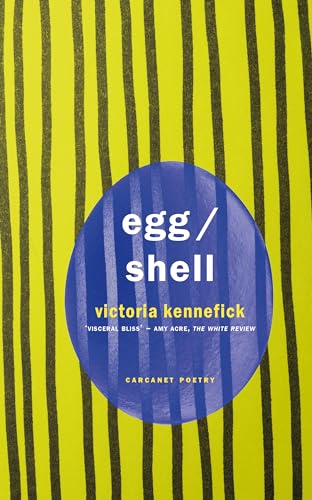 I was blown away by Kennefick’s 2021 debut, Eat or We Both Starve, which I described as “audacious,” “fleshly,” and “pleasingly morbid.” Her sophomore collection is just as strong, with motherhood and the body continuing as overarching themes. The speaker is, by turns, pregnant and mother to a daughter. She experiences multiple miscarriages and names her lost children after plants. Becoming a mother is a metamorphosis all its own (see my recent post on matrescence), while the second long section is about her husband transitioning. This is not actually the first book I’ve read about the changes in a marriage precipitated by a spouse transitioning, and the welter of emotions that it provokes; there’s also Some Body to Love by Alexandra Heminsley in memoir and Cataloguing Pain by Allison Blevins in poetry.
As in Barnett’s collection, bird metaphors are inescapable. “The Wild Swans at the Wetland Centre” must be a nod to W.B. Yeats (his were at Coole). Here, the recurring chickens and swans are the poet’s familiars, and their eggs her totems – ideal vessels, but so easily broken. The same is true of “Cup,” whose lines form the shape of a teacup perched on a saucer. The structure varies throughout: columns, stanzas; a list, a recipe. Amid the sadness, there is a lot of self-deprecation and dark humour in the poem titles (“Victoria Re-Enacts the Stations of the Cross,” falling and spilling coffee all over herself) and one-line poems that act as rejoinders. (“Orientation: A Tragedy” reads “I am so straight I give myself paper cuts.”)
If you’re wondering how life can be captured in achingly beautiful poetry, look no further. I doubt I’ll come across a better collection this year.
More favourite lines:
I get sad as earth becomes sea. I get sad
that in showing you this sinking world
I teach you how to say goodbye.
(from “On Being Two in the Anthropocene”)
I want people
to know me, and to hide.
(from “Le Cygne, My Spirit Animal”)
I want to write down the names of all my dead relatives.
How are they not here anymore? How are yours absent too?
What do we do with them, their names? Is there a box for grief?
(from “Census Night Poem”)
With thanks to Carcanet Press for the free copy for review. Coming out on 29 February.
Eleanor Among the Saints by Rachel Mann
 This is Mann’s second collection, after A Kingdom of Love. In reviewing that book I remarked on the psalm-like cadence, the anatomical and allusive language, and the contrast of past and present. All are elements here as well. The first long section was inspired by Eleanor/John Rykener, a 14th-century seamstress and sex worker whom some have claimed as a trans pioneer. Little is known about her life or self-identification, so Mann does not attempt biography here, but rather is thinking alongside the character. “Construct me weird and kind, leave it to me / To strip off when I’m ready. I shall run wild, / Naked as I dare, out into sober streets.”
Three later poems share the title “A Charm to Change Sex,” each numbered and in two columns – you have a choice of whether to read them across or down the page. Either way, they land somewhere between a spell and a prayer (and there are many other prayers in the table of contents): “Hidden: transfix / Invisible made visible … oh so holy, words lead everywhere / inside become out”. Bodies are as provisional as speech (“All text is stitched, / Body too only subset of making, a stored magic”), and inescapably frail, as evidenced by a father’s illness and death, the subject of several poems.
Repetition and wordplay (“razed/raised”) sometimes tail off into faltering phrases – “#TDOR” is most notable for this. And “Seven Proof Texts on a Transitioned Body” is, by itself, worth buying the book for, with alliteration and slang pushing back at medical and scriptural vocabulary. Mann is an incredibly versatile writer: I’ve read a memoir, a work of literary appreciation, and an academic thriller by her as well as her published poetry. And while I found less that resonated in this collection, I still admired its rigorous engagement with history, theology, and the facts of a life.
With thanks to Carcanet Press for the free copy for review.
 Bookish Beck = Rebecca Foster. American transplant to England. Freelance proofreader and book reviewer.
