This Year’s Summer-Themed Reading: Lippman, Lively, Nicholls & More
Sun, warmth and rival feelings of endlessness and evanescence: here were three reads that were perfect fits for the summer setting.
Sunburn by Laura Lippman (2018)
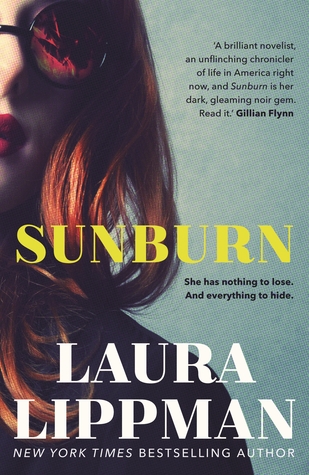 While on a beach vacation in 1995, a woman walks away from her husband and daughter and into a new life as an unattached waitress in Belleville, Delaware. Polly has been known by many names, and this isn’t the first time she’s left a family and started over. She’s the (literal) femme fatale of this film noir-inspired piece, as bound by her secrets as is Adam Bosk, the investigator sent to trail her. He takes a job as a chef at the diner where Polly works, and falls in love with her even though he may never fully trust her. Insurance scams and arson emerge as major themes.
I liked the fact that I recognized many of the Maryland/Delaware settings, and that the setup is a tip of the hat to Anne Tyler’s excellent Ladder of Years, which was published in the year this is set. It is a quick and enjoyable summer read that surprised me with its ending, but I generally don’t find mysteries a particularly worthwhile use of my reading time. Put it down to personal taste and/or literary snobbery. 
Heat Wave by Penelope Lively (1996)
 My fourth Lively book, and the most enjoyable thus far. Pauline, a freelance copyeditor (“Putting commas into a novel about unicorns”) in her fifties, has escaped from London to spend a hot summer at World’s End, the Midlands holiday cottage complex she shares with her daughter Teresa, Teresa’s husband Maurice, and their baby son Luke. Maurice is writing a history of English tourism and regularly goes back to London for meetings or receives visits from his publishers, James and Carol. Pauline, divorced from a philandering husband, recognizes the signs of Maurice’s adultery long before Teresa does, and uneasily ponders how much to hint and how much to say outright.
The last line of the first chapter coyly promises an “agreeable summer of industry and companionship,” but the increasing atmospheric threats (drought or storms; combine harvesters coming ever nearer) match the tensions in the household. I expected this to be one of those subtle relationship studies where ultimately nothing happens. That’s not the case, though; if you’ve been paying good attention to the foreshadowing you’ll see that the ending has been on the cards.
I loved the city versus country setup of the novel, especially the almost Van Gogh-like descriptions of the blue sky and the golden wheat, and recognized myself in Pauline’s freelancer routines. Her friendships with bookseller Hugh and her client, novelist Chris Rogers, might be inconsequential to the plot but give Pauline a life wider than the confines of the cottage, and the frequent flashbacks to her marriage to Harry show what she had to overcome to earn a life of her own.
This was a compulsive read that was perfect for reading during the hottest week of our English summer. I’d recommend it to fans of Tessa Hadley, Susan Hill and Polly Sansom. 
Sweet Sorrow by David Nicholls (2019)
 The title is a snippet from Romeo and Juliet, which provides the setup and subject matter for this novel about first love during the golden summer of 1997, when Charlie Lewis and Fran Fisher are 16. Charlie thinks he’s way too cool for the thespians, but if he wants to keep seeing Fran he has to join the Full Fathom Five Theatre Co-operative for the five weeks of rehearsals leading up to performances. Besides, he doesn’t have anything better to do – besides watching his dad get drunk on the couch and scamming the petrol station where he works nights. Charlie starts off as the most robotic Benvolio imaginable, but Fran helps bring him up to scratch with her private tutoring (which is literal as well as a euphemism).
Glimpses of the present day are an opportunity for nostalgia and regret, as Charlie/Nicholls coyly insists that first love means nothing: “love is boring. Love is familiar and commonplace for anyone not taking part, and first love is just a gangling, glandular incarnation of the same. … first love wasn’t real love anyway, just a fraught and feverish, juvenile imitation of it.” I enjoyed the teenage boy perspective and the theatre company shenanigans well enough, but was bored with the endless back story about Charlie’s family: his father’s record shops went bankrupt; his mother left him for another golf club colleague and took his sister; he and his depressed father are slobby roommates subsisting on takeaways and booze; blah blah blah.
It’s possible that had I read or seen R&J more recently, I would have spotted some clever parallels. Honestly? I’d cut 100+ pages (it should really be closer to 300 pages than 400) and repackage this as YA fiction. If you’re looking for lite summer fare reminiscent of Rachel Joyce and, yes, One Day, this will slip down easily, but I feel like I need to get better about curating my library stack and weeding out new releases that will be readable but forgettable. I really liked Us, which explains why I was willing to take another chance on Nicholls.
Note: There is a pretty bad anachronism here: a reference to watching The Matrix, which wasn’t released until 1999 (p. 113, “Cinnamon” chapter). Also a reference to Hobby Lobby, which as far as I know doesn’t exist in the UK (here it’s Hobbycraft) (p. 205, “Masks” chapter). I guess someone jumped the gun trying to get this ready for its U.S. release.
Favorite summery passage: “This summer’s a bastard, isn’t it? Sun comes out, sky’s blue if you’re lucky and suddenly there are all these preconceived ideas of what you should be doing, lying on a beach or jumping off a rope swing into the river or having a picnic with all your amazing mates, sitting on a blanket in a meadow and eating strawberries and laughing in that mad way, like in the adverts. It’s never like that, it’s just six weeks of feeling like you’re in the wrong place … and you’re missing out. That’s why summer’s so sad – because you’re meant to be so happy. Personally, I can’t wait to get my tights back on, turn the central heating up. At least in winter you’re allowed to be miserable” (Fran)
Plus a couple of skims:
The Sun Does Shine: How I Found Life and Freedom on Death Row by Anthony Ray Hinton with Lara Love Hardin (2018)
 I’d heard about Hinton’s case: he spent nearly 30 years on death row in Alabama for crimes he didn’t commit. In 1985 he was convicted of two counts of robbery and murder, even though he’d been working in a locked warehouse 15 miles away at the time the restaurant managers were shot. His mother’s gun served as the chief piece of evidence, even though it didn’t match the bullets found at the crime scenes. “My only crime was … being born black in Alabama,” Hinton concludes. He was a convenient fall guy, and his every appeal failed until Bryan Stevenson of the Equal Justice Initiative (and author of Just Mercy, which I’d like to read) took on his case.
It took another 16 years and an appeal to the U.S. Supreme Court, but Hinton was finally released and now speaks out whenever he can about justice for those on death row, guilty or innocent. Almost the most heartbreaking thing about the book is that his mother, who kept the faith for so many years, died in 2012 and didn’t get to see her son walk free. I love the role that literature played: Hinton started a prison book club in which the men read Go Tell It on the Mountain and To Kill a Mockingbird and discussed issues of race and injustice. Although he doesn’t say very much about his life post-prison, I did note how big of an adjustment 30 years’ worth of technology was for him.
I don’t set a lot of stock by ghostwritten or co-written books, and found the story much more interesting than the writing here (though Hardin does a fine job of recreating the way a black man from the South speaks), so I just skimmed the book for the basics. I was impressed by how Hinton avoided bitterness and, from the very beginning, chose to forgive those who falsely accused him and worked to keep him in prison. “I was afraid every single day on death row. And I also found a way to find joy every single day. I learned that fear and joy are both a choice.” The book ends with a sobering list of all those currently on death row in the United States: single-spaced, in three columns, it fills nine pages. Lord, have mercy.
The Last Supper: A Summer in Italy by Rachel Cusk (2009)
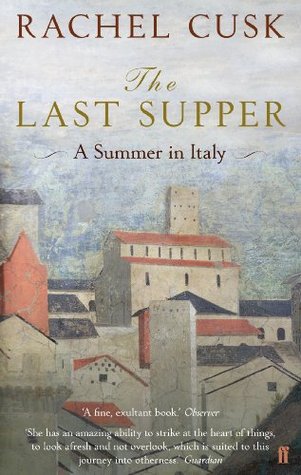 Having moved away from Bristol, Cusk and her family (a husband and two children) decided to spend a summer in Italy before deciding where to go next. They took the boat to France then drove, made a stop in Lucca, and settled into a rented house on the eastern edge of Tuscany. It proceeded to rain for 10 days. Cusk learns to speak the vernacular of football and Catholicism – but Italian eludes her: “I too feel humbled, feel childlike and impotent. It is hard to feel so primitive, so stupid.” They glory in the food, elemental and unpretentious; they try a whole spectrum of gelato flavors. And they experience as much culture as they can: “we will learn to fillet an Italian city of its artworks with the ruthless efficiency of an English aristocrat de-boning a Dover sole.” A number of these masterpieces are reproduced in the text in black and white. In the grip of a heatwave, they move on to Rome, Naples and Capri.
If I’d been able to get hold of this for my trip to Milan (it was on loan at the time), I might have enjoyed it enough to read the whole thing. As it is, I just had a quick skim through. Cusk can write evocatively when she wishes to (“We came here over the white Apuan mountains, leaving behind the rose-coloured light of the coast … up and up into regions of dazzling ferocity where we wound among deathly white peaks scarred with marble quarries, along glittering chasms where the road fell away into nothingness and we clung to our seats in terror”), but more often resorts to flat descriptions of where they went and what they did. I’m pretty sure Transit was a one-off and I’ll never warm to another Cusk book.
DNFs: Alas, One Summer: America, 1927 by Bill Bryson and The Go-Between by L. P. Hartley were total non-starters. Maybe some other day (make that year).
See also my 2017 and 2018 “summer” reads, all linked by the season appearing in the title.
Have you read any summer-appropriate books lately?
20 Books of Summer, #11–13: Harrison, Pym, Russell
It’s cats and butterflies in the spotlight this time, adding in a gazelle as a metaphor for Freddie Mercury’s somebody to love.
Travelling Cat: A Journey round Britain with Pugwash by Frederick Harrison (1988)
If Tom Cox had been born 20 years earlier, this is the sort of book he might have written. In 1987, saddened more by his cat Podey being run over than by the end of his marriage, Harrison set out from South London in his Ford Transit van for a seven-month drive around the country. He decided to take Pugwash, one of his local (presumably ownerless) cats, along as a companion.
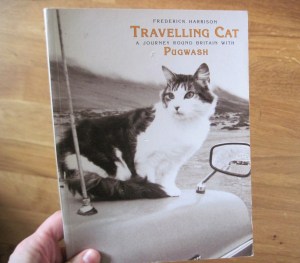 They encountered Morris dancers, gypsies, hippies at Stonehenge for the Summer Solstice, sisters having a double wedding, and magic mushroom collectors. They went to a county fair and beaches in Suffolk and East Yorkshire, and briefly to Hay-on-Wye. And on the way back they collected Podey, whom he’d had stuffed. Harrison muses on the English “vice” of nostalgia for a past that probably never existed; Pugwash does what cats do, and very well.
It’s all a bit silly and dated and lightweight, but enjoyable nonetheless. Plus there are tons of black-and-white photos of “Pugs” and other feline friends. This was a secondhand purchase from The Bookshop, Wigtown.
Favorite lines:
“Cats hate to make prats of themselves. But then, don’t we all?”
(last lines) “Warm, fed, contented, unemployable, and entirely at peace with the world. Yes indeed. Cats certainly know something we don’t.”
Some Tame Gazelle by Barbara Pym (1950)
(An example of a book that just happens to have an animal in the title.) I’d only read one other Pym novel, Quartet in Autumn, a late and fairly melancholy story of four lonely older people. With her first novel I’m in more typical territory, I take it. The middle-aged Bede sisters are pillars of the church in their English village. Harriet takes each new curate under her wing, making of them a sort of collection, and fends off frequent marriage proposals from the likes of a celebrity librarian and an Italian count.
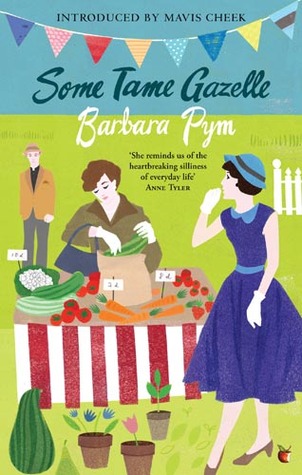 Belinda, on the other hand, only has eyes for one man: Archdeacon Hochleve, whom she’s known and loved for 30 years. They share a fondness for quoting poetry, the more obscure the better (like the title phrase, taken from “Some tame gazelle, or some gentle dove: / Something to love, oh, something to love!” by Thomas Haynes Bayly). The only problem is that the archdeacon is happily married. So single-minded is Belinda that she barely notices her own marriage proposal when it comes: a scene that reminded me of Mr. Collins’s proposal to Lizzie in Pride and Prejudice. Indeed, Pym is widely recognized as an heir to Jane Austen, what with her arch studies of relationships in a closed community.
There were a handful of moments that made me laugh, like when the seamstress finds a caterpillar in her cauliflower cheese and has to wipe with a Church Times newspaper when the Bedes run out of toilet paper (such mild sacrilege!). This is enjoyable, if fluffy; it was probably a mistake to have read one of Pym’s more serious books first: I expected too much of this one. If you’re looking for a quick, gentle and escapist read in which nothing awful will happen, though, it would make a good choice. Knowing most of her books are of a piece, I wouldn’t read more than one of the remainder – it’ll most likely be Excellent Women.
An Obsession with Butterflies: Our Long Love Affair with a Singular Insect by Sharman Apt Russell (2003)
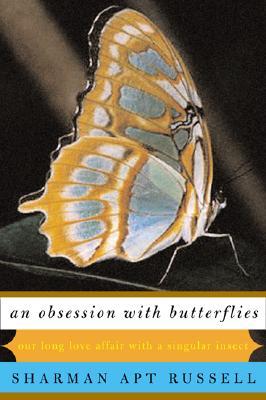 This compact and fairly rollicking book is a natural history of butterflies and of the scientists and collectors who have made them their life’s work. There are some 18,000 species and, unlike, say, beetles, they are generally pretty easy to tell apart because of their bold, colorful markings. Moth and butterfly diversity may well be a synecdoche for overall diversity, making them invaluable indicator species. Although the history of butterfly collecting was fairly familiar to me from Peter Marren’s Rainbow Dust, I still learned or was reminded of a lot, such as the ways you can tell moths and butterflies apart (and it’s not just about whether they fly in the night or the day). And who knew that butterfly rape is a thing?
The final third of the book was strongest for me, including a trip to London’s Natural History Museum; another to Costa Rica’s butterfly ranches, an example of successful ecotourism; and a nicely done case study of the El Segundo Blue butterfly, which was brought back from the brink of extinction by restoration of its southern California dunes habitat. Russell, a New Mexico-based author of novels and nonfiction, also writes about butterflies’ cultural importance: “No matter our religious beliefs, we accept the miracle of metamorphosis. One thing becomes another. … Butterflies wake us up.”
 I also recently read the excellent title story from John Murray’s 2003 collection A Few Short Notes on Tropical Butterflies. Married surgeons reflect on their losses, including the narrator’s sister in a childhood accident and his wife Maya’s father to brain cancer. In the late 1800s, the narrator’s grandfather, an amateur naturalist in the same vein as Darwin, travelled to Papua New Guinea to collect butterflies. The legends from his time, and from family trips to Cape May to count monarchs on migration in the 1930s, still resonate in the present day for these characters. The treatment of themes like science, grief and family inheritance, and the interweaving of past and present, reminded me of work by Andrea Barrett and A.S. Byatt.
(I’ve put the book aside for now but will go back to it in September as I focus on short stories.)
Other butterfly-themed books I have reviewed:
- Four Wings and a Prayer: Caught in the Mystery of the Monarch Butterfly by Sue Halpern (one of last year’s 20 Books of Summer)
- Ruins by Peter Kuper (a graphic novel set in Mexico, this also picks up on monarch migration)
- Magdalena Mountain by Robert Michael Pyle (a novel about butterfly researchers in Colorado)
A Week in Italy and What I Read
We’re relieved to be back in the balmy UK after a sweltering week in northern Italy. Though our sixth-floor Airbnb apartment in Milan suited our needs perfectly, it was a challenge to keep it minimally comfortable. Eventually we worked out that it was essential to get up by 6:30 a.m. to close the balcony doors and shutter. The bedroom happened to be shaded, so I could set up my laptop in there and work until noon, when it was time to close out the heat of the day on that side. In the afternoons I read and napped on the divan, and then sometime between 6 and 10 p.m., depending on how sunny it had been during the day, we could fling the windows and doors wide open again. Fans helped, but we still passed some horribly muggy nights.


My husband was at his conference for four of the days, so we only braved the city centre itself on Monday morning, touring the Duomo and climbing the steps to the roof. This was well worth doing for views over the city. Afterwards we walked through the associated museum (mostly underground, and blissfully cool with air conditioning) and Galleria Vittorio Emanuele II, a luxurious nineteenth-century shopping arcade filled with designer fashions.


Two day trips by train got us out of the city and into slightly cooler temperatures: on Wednesday we explored Varenna and Bellagio on Lake Como, and on Saturday we took a bus and cable car from Lecco into the mountains at Piani d’Erna. We took full advantage of one-euro espressos and glasses of wine, and ate lots of pizza, pasta and gelato.

After much deliberation, this is the book stack I actually packed for our trip. I got through the first half of the Orwell, an excellent account of working as a dishwasher in Paris hotels and having to scrape together enough money to ward off starvation. I’ll be writing it up as my Classic of the Month in a couple of weeks. I also read Sunburn by Laura Lippman, which I’ll hold in reserve for a summer-themed post, and (on Kindle) So Many Rooms by Laura Scott, a debut poetry collection coming out in October that I’ll review here at a later date.
Two of my other Kindle reads ended up being perfect for the setting:
From Scratch: A Memoir of Love, Sicily, and Finding Home by Tembi Locke: This was the perfect book for me to read during the week in Italy. Not only is it set largely in Sicily, but it ticks a lot of boxes in terms of my reading interests: food, travel, bereavement, and the challenges of being an American overseas. During a semester abroad in Florence, Locke (an actress I was previously unfamiliar with) met and fell in love with Saro Gullo, an Italian chef. His parents could hardly accept him marrying someone from outside of Sicily, let alone a black woman from Texas, and refused to attend their wedding. But as the years passed they softened towards Locke, who gradually became accepted in Saro’s hometown of Aliminusa.
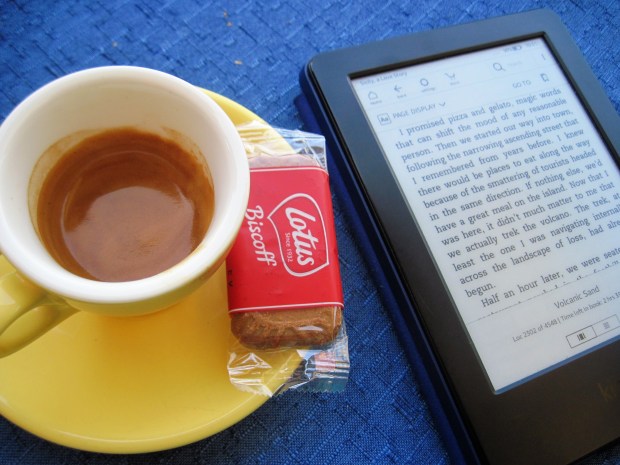
In fact, after Saro’s death from bone cancer in 2012, she became like a second daughter to Saro’s mother. The book focuses on the three summers in a row when she and her adopted daughter Zoela traveled to the family home in Sicily to stay with Nonna. I particularly appreciated the exploration of what it’s like to live between countries and cultures. This is one of three Reese Witherspoon book club books I’ve read so far (along with Where the Crawdads Sing and Daisy Jones and the Six), and all have been great – Reese’s recommendations are proving as reliable as Oprah’s.
 A mudslide blocked the route we should have taken back from Milan to Paris, so we rebooked onto trains via Switzerland. This plus the sub-Alpine setting for our next-to-last day made the perfect context for racing through Where the Hornbeam Grows: A Journey in Search of a Garden by Beth Lynch in just two days. Lynch moved from England to Switzerland when her husband took a job in Zurich. Suddenly she had to navigate daily life, including frosty locals and convoluted bureaucracy, in a second language. The sense of displacement was exacerbated by her lack of access to a garden. Gardening had always been a whole-family passion, and after her parents’ death their Sussex garden was lost to her. Two years later she and her husband moved to a cottage in western Switzerland and cultivated a garden idyll, but it wasn’t enough to neutralize their loneliness.
Much of what Lynch has to say about trying to find genuine connections as an expatriate rang true for me. Paradise Lost provides an unexpected frame of reference as Lynch asks what it means for a person or a plant to be transplanted somewhere new, and what it takes to thrive. Her elegant writing reminded me of Diana Athill’s and Penelope Lively’s, and the exploration of the self through gardens is reminiscent of Allan Jenkins’s Plot 29.
Other successful reads:
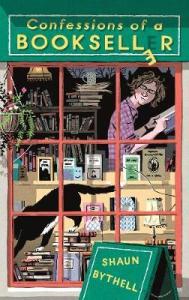 Confessions of a Bookseller by Shaun Bythell: This picks up right where The Diary of a Bookseller left off and carries through the whole of 2015. Again it’s built on the daily routines of buying and selling books, including customers’ and colleagues’ quirks, and of being out and about in a small town. I wished I was in Wigtown instead of Milan! Because of where I was reading the book, I got particular enjoyment out of the characterization of Emanuela (soon known as “Granny” for her poor eyesight and myriad aches and gripes), who comes over from Italy to volunteer in the bookshop for the summer. Bythell’s break-up with “Anna” is a recurring theme in this volume, I suspect because his editor/publisher insisted on an injection of emotional drama.
 City of Girls by Elizabeth Gilbert: There’s a fun, saucy feel to this novel set mostly in 1940s New York City. Twenty-year-old Vivian Morris comes to sew costumes for her Aunt Peg’s rundown theatre and falls in with a disreputable lot of actors and showgirls. When she does something bad enough to get her in the tabloids and jeopardize her future, she retreats in disgrace to her parents’ – but soon the war starts and she’s called back to help with Peg’s lunchtime propaganda shows at the Brooklyn Navy Yard. The quirky coming-of-age narrative reminded me a lot of classic John Irving, while the specifics of the setting made me think of Wise Children, All the Beautiful Girls and Manhattan Beach. The novel takes us to 2010, when Vivian is 90 and still brazenly independent. I was somewhat underwhelmed – while it’s a fairly touching story of how to absorb losses and make an unconventional family, I wondered if it had all meant much. I’ll be expanding this into a Shiny New Books review.
 Judgment Day by Sandra M. Gilbert: English majors will know Gilbert best for her landmark work of criticism, The Madwoman in the Attic (co-written with Susan Gubar). I had no idea that she writes poetry. This latest collection has a lot of interesting reflections on religion, food and art, as well as elegies to those she’s lost. Raised Catholic, Gilbert married a Jew, and the traditions of Judaism still hold meaning for her after husband’s death even though she’s effectively an atheist. “Pompeii and After,” a series of poems describing food scenes in paintings, from da Vinci to Hopper, is particularly memorable.
Not-so-successful reads:
 Vintage 1954 by Antoine Laurain: Dreadful! I would say: avoid this sappy time-travel novel at all costs. I thought the setup promised a gentle dose of fantasy, and liked the fact that the characters could meet their ancestors and Paris celebrities during their temporary stay in 1954. But the characters are one-dimensional stereotypes, and the plot is far-fetched and silly. I know many others have found this delightful, so consider me in the minority…
As well as a few DNFs…
What Dementia Teaches Us about Love by Nicci Gerard: I’ve read a lot of books about dementia, both clinical and anecdotal, and this doesn’t add anything new. (11%)
The Great Railway Bazaar by Paul Theroux: I read the first 32 pages, up to when Theroux arrives in northern Italy. He mostly describes his fellow passengers, as well as the details of meals and sleeping arrangements on trains. The writing struck me as old-fashioned, and I couldn’t imagine getting through another nearly 350 pages of it.
Out of the Woods by Luke Turner: Attempts to fuse nature and sexuality in a way that’s reminiscent of Hidden Nature by Alys Fowler. The writing didn’t draw me in at all. (5%)
20 Books of Summer, #1–4: Alexis, Haupt, Rutt, Tovey
I was slow to launch into my 20 Books of Summer reading, but have now finally managed to get through my first four books. These include two substitutes: a review copy I hadn’t realized fit in perfectly with my all-animals challenge, and a book I’d started earlier in the year but set aside and wanted to get back into. Three of the four were extremely rewarding; the last was somewhat insubstantial, though I always enjoy reading about cat antics. All have been illuminating about animal intelligence and behavior, and useful for thinking about our place in and duty towards the more-than-human world. Not all of my 20 Books of Summer will have such an explicit focus on nature – some just happen to have an animal in the title or pictured on the cover – but this first batch had a strong linking theme so was a great start.
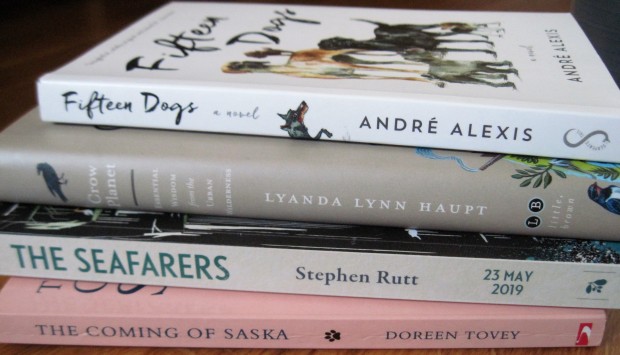
Fifteen Dogs by André Alexis (2015)
In this modern folk tale with elements of the Book of Job, the gods Apollo and Hermes, drinking in a Toronto tavern, discuss the nature of human intelligence and ponder whether it’s inevitably bound up with suffering. They decide to try an experiment, and make a wager on it. They’ll bestow human intelligence on a set of animals and find out whether the creatures die unhappy. Apollo is willing to bet two years’ personal servitude that they will be even unhappier than humans. Their experimental subjects are the 15 dogs being boarded overnight at a nearby veterinary clinic.
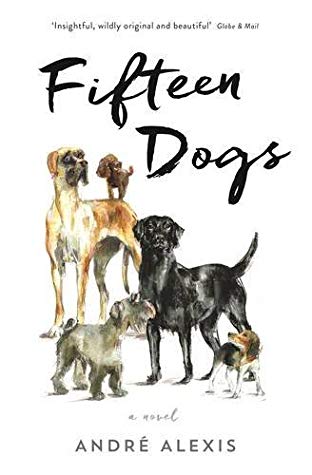 The setup means we’re in for an And Then There Were None type of picking-off of the 15, and some of the deaths are distressing. But strangely – and this is what the gods couldn’t foresee – knowledge of their approaching mortality gives the dogs added dignity. It gives their lives and deaths the weight of Shakespearean tragedy. Although they still do doggy things like establishing dominance structures and eating poop, they also know the joys of language and love. A mutt called Prince composes poetry and jokes. Benjy the beagle learns English well enough to recite the first paragraph of Vanity Fair. A poodle named Majnoun forms a connection with his owner that lasts beyond the grave. The dogs work out who they can trust; they form and dissolve bonds; they have memories and a hope that lives on.
It’s a fascinating and inventive novella, and a fond treatment of the relationship between dogs and humans. When I read in the Author’s Note that the poems all included dogs’ names, I went right back to the beginning to scout them out. I’m intrigued by the fact that this Giller Prize winner is a middle book in a series, and keen to explore the rest of the Trinidanian-Canadian author’s oeuvre.
These next two have a lot in common. For both authors, paying close attention to the natural world – birds, in particular – is a way of coping with environmental and mental health crises.
Crow Planet: Essential Wisdom from the Urban Wilderness by Lyanda Lynn Haupt (2009)
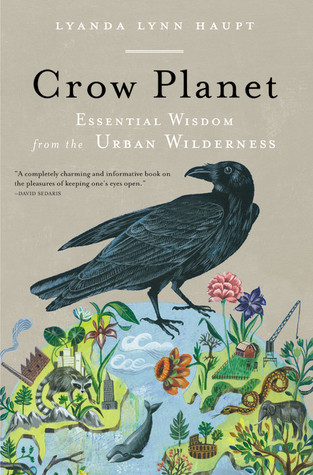 Lyanda Lynn Haupt has worked in bird research and rehabilitation for the Audubon Society and other nature organizations. (I read her first book, Rare Encounters with Ordinary Birds, quite a few years ago.) During a bout of depression, she decided to start paying more attention to the natural world right outside her suburban Seattle window. Crows were a natural place to start. From then on she took binoculars everywhere she went, even on walks to Target. She spent time watching crows’ behavior from a distance or examining them up close – devoting hours to studying a prepared crow skin. She even temporarily took in a broken-legged fledgling she named Charlotte and kept a close eye on the injured bird’s progress in the months after she released it.
Were this simply a charming and keenly observed record of bird behavior and one woman’s gradual reawakening to the joys of nature, I would still have loved it. Haupt is a forthright and gently witty writer. But what takes it well beyond your average nature memoir is the bold statement of human responsibility to the environment. I’ve sat through whole conference sessions that try to define what nature is, what the purpose of nature writing is, and so on. Haupt can do it in just a sentence, concisely and effortlessly explaining how to be a naturalist in a time of loss and how to hope even when in possession of all the facts. 
A few favorite passages:
“an intimate awareness of the continuity between our lives and the rest of life is the only thing that will truly conserve the earth … When we allow ourselves to think of nature as something out there, we become prey to complacency. If nature is somewhere else, then what we do here doesn’t really matter.”
“I believe strongly that the modern naturalist’s calling includes an element of activism. Naturalists are witnesses to the wild, and necessary bridges between ecological and political ways of knowing. … We join the ‘cloud of witnesses’ who refuse to let the more-than-human world pass unnoticed.”
“here we are, intricate human animals capable of feeling despair over the state of the earth and, simultaneously, joy in its unfolding wildness, no matter how hampered. What are we to do with such a confounding vision? The choices appear to be few. We can deny it, ignore it, go insane with its weight, structure it into a stony ethos with which we beat our friends and ourselves to death—or we can live well in its light.”
The Seafarers: A Journey among Birds by Stephen Rutt (2019)
 In 2016 Rutt left his anxiety-inducing life in London in a search for space and silence. He found plenty of both on the Orkney Islands, where he volunteered at the North Ronaldsay bird observatory for seven months. In the few years that followed, the young naturalist travelled the length and breadth of the British Isles – from Skomer to Shetland – courting encounters with seabirds. He’s surrounded by storm petrels one magical night at Mousa Broch; he runs from menacing skuas; he watches eider and terns and kittiwakes along the northeast coast; he returns to Orkney to marvel at gannets and fulmars. Whether it’s their beauty, majesty, resilience, or associations with freedom, such species are for him a particularly life-enhancing segment of nature to spend time around.
Discussion of the environmental threats that hit seabirds hardest, such as plastic pollution, makes for a timely tie-in to wider conservation issues. Rutt also sees himself as part of a long line of bird-loving travellers, including James Fisher and especially R.M. Lockley, whose stories he weaves in. This is one of the best nature/travel books I’ve read in a long time, especially enjoyable because I’ve been to a lot of the island locations and the elegantly evocative writing, making particularly effective use of varied sentence lengths, brought back to me just what it’s like to be in the far north of Scotland in the midst of an endless summer twilight, a humbled observer as a whole whirlwind of bird life carries on above you. 
A favorite passage:
“Gannets nest on the honeycombs of the cliff, in their thousands. They sit in pairs, pointing to the sky, swaying heads. They stir. The scent of the boat’s herring fills the air. They take off, tessellating in a sky that is suddenly as much bird as light. The great skuas lurk.”
My husband also reviewed this, from a birder’s perspective.
With thanks to Elliott & Thompson for the proof copy for review.
The Coming of Saska by Doreen Tovey (1977)
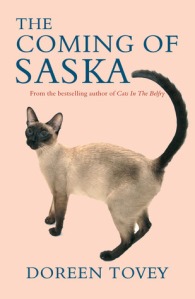 I’ve read four of Tovey’s quaint Siamese cat books now; this was the least worthwhile. It’s partially a matter of false advertising: Saska only turns up for the last 15 pages, as a replacement of sorts for Seeley, who disappeared one morning a year earlier and was never seen again. Over half of the book, in fact, is about a trip Tovey and her husband Charles took to Edmonton, Canada. The Canadian government sponsored them to come over for the Klondike Days festivities, and they also rented a camper and went looking for bears and moose. Mildly amusing mishaps, close shaves, etc. ensue. They then come back and settle into everyday life with their pair of Siamese half-siblings; Saska had the same father as Shebalu. Entertaining enough, but slight, and with far too many ellipses.
Upcoming Reading Plans: Milan Trip and Summer Books
“Centre of fashion, business and finance,” “muggy and mosquito-ridden in summer” – from the guidebook descriptions it could hardly sound less like our kind of place, and yet Milan is where we’re off to tomorrow. While it wouldn’t be our first-choice destination, my husband is attending a landscape ecology conference there and presenting a paper; I’m going along for the week to have a holiday. It’s Italy. Why not?! I doubt the northern plain will be as much to our taste as Tuscany, which we explored on a wonderfully memorable trip in April 2014 (on which I first drank coffee), but there will still be history and culture around every corner, and we plan on eating very well and getting out of the city to see some of the Lakes region, too.
We’re traveling the slow way: a train to London; the Eurostar to Paris, where we’ll stay for one night; and a seven-hour train ride to Milan the following day. If the weather remains as hot as it has been in Continental Europe (e.g. 40°C / 105°F in Paris this week – ugh!), I’m not sure I’ll be up for a lot of solo sightseeing. I’ll put in a much-reduced work load for the week, but for much of the rest of the time when my husband is at the conference I may just lounge around our Airbnb, with a stack of print books, in front of the USB-powered fan I’ve ordered.
So of course I’ve been having great fun thinking about what reading material I might pack. I’ve assembled a main stack, and a subsidiary stack, of books that seem appropriate for one or more reasons.
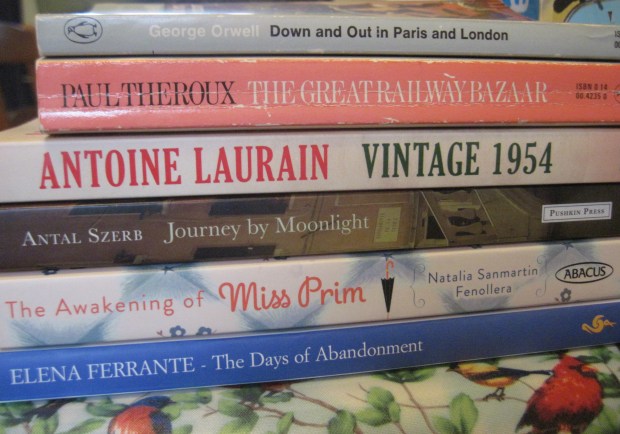
Down and Out in Paris and London, George Orwell – To read on the Eurostar between London and Paris. Orwell’s first book and my first try with his nonfiction: an account of the living conditions of the poor in two world cities.
Bonus goal it fulfills: Classic of the month
Vintage 1954, Antoine Laurain – For a Nudge review; to read en route to and in Paris. Drinking a 1954 Beaujolais transports a Parisian and his neighbors – including an Airbnb guest – back to the 1950s. Sounds like good fun.
Bonus goal it fulfills: Lit in translation
The Great Railway Bazaar, Paul Theroux – To read on the long train ride to Milan. Theroux travels from London to Tokyo on trains, then returns via the Trans-Siberian Express. I’ve always meant to try his work.
Bonus goal it fulfills: Travel classics
Journey by Moonlight, Antal Szerb – A Hungarian novel set on an Italian honeymoon. Try to resist these first lines: “On the train everything seemed fine. The trouble began in Venice, with the back-alleys.”
Bonus goals it fulfills: Lit in translation; 20 Books of Summer substitute (horse on the cover)
The Awakening of Miss Prim, Natalia Sanmarin Fenollera – Promises to be a cozy, fluffy novel about what happens when librarian Prudencia Prim arrives in a small village. I had the feeling it was set in Italy, but maybe it’s actually Spain? I’ll find out.
Bonus goal it fulfills: Lit in translation
The Days of Abandonment, Elena Ferrante – I’ve tried two Ferrante novels and not been too impressed, yet still I keep trying. This one’s set during a heat wave. Maybe I’ll get on with it better than I did with My Brilliant Friend or The Lost Daughter?
Bonus goal it fulfills: Lit in translation
The extra stack:
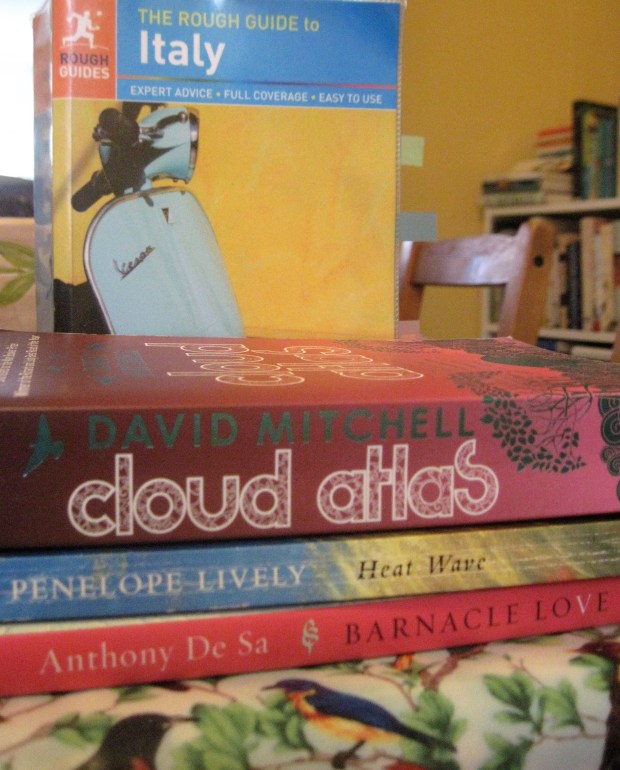
Heat Wave, Penelope Lively – The title says it all.
Bonus goal it fulfills: Reading with the seasons
Barnacle Love, Anthony De Sa – An extra animal book for 20 Books of Summer.
Cloud Atlas, David Mitchell – A novel I’ve meant to read for years. I’ve earmarked it for our super-long day of travel back to the UK.
Bonus goal it fulfills: Doorstopper of the Month
Considering getting from the library:
The Last Supper, Rachel Cusk – I’ve only made it through one of the three Cusk books I’ve attempted, but perhaps a travel memoir is a more surefire selection?
On my Kindle:
 The Fourth Shore, Virginia Baily – There’s an Italian flavor to this WWII novel, as there was to Baily’s previous one, Early One Morning. However, I’ve heard that this is mostly set in Tripoli, so I won’t make it a priority.
From Scratch, Tembi Locke – An actress’s memoir of falling in love with an Italian chef and her trips to his family home in Sicily with their adopted daughter. (Foodie and bereavement themes!)
I’ll read the first few pages of lots of these to make sure they ‘take’ and will try to pack a sensible number. (Which probably means all but one or two!) We’ll be packing light in general, since there’s only so many clothes one can wear in such heat, so I don’t mind carrying a backpack full of books – I’m used to it from weekly treks to the library and flights to America, and I know that I don’t find reading on Kindle as satisfying, though it certainly is convenient for when you’re on the go.
If you’d like to put in a good word for any of the above options, or want to dissuade me from a book I might not find worthwhile, let me know.
Meanwhile, I’ve been slow out of the gate with my 20 Books of Summer, but I finally have a first set of mini-reviews coming up tomorrow.
Other summer-themed books that I have on hand or will get from the library soon include One Summer: America, 1927 by Bill Bryson, The Go-Between by L.P. Hartley, The Sun Does Shine by Anthony Ray Hinton, The Summer Book by Tove Jansson, and Sunburn by Laura Lippman.
How’s your summer reading going?
Will you do any reading ‘on location’ this year?
Reading Ireland Month 2019: Nonfiction – Lynn Enright and Emilie Pine
It’s my second time participating in Reading Ireland Month, run each March by Cathy of 746 Books and Niall of Raging Fluff. For this week’s nonfiction theme, I’ve put together reviews of two hard-hitting feminist books I happen to have read recently.

Vagina: A Re-education by Lynn Enright (2019)
 Sex education is poor and lacking in many parts of the world, Enright argues, including the Ireland she grew up in in the 1980s. We need better knowledge about gender, anatomy (including the range of what’s ‘normal’) and issues of consent, she insists. To that end, she sets out to bust myths about the hymen, clitoris, female orgasm, menstruation, gynecological problems, infertility, pregnancy and menopause. Her just-the-facts approach is especially helpful in her rundown of the female anatomy. She also encourages women not to take no for an answer from doctors who try to deny or minimize their pain.
This is a confident book sometimes marred by TMI (all in the name of openness and honesty, but still…) and repetitive writing. For me, there was too much overlap with other books I’ve read over the last five years or so: Vagina: A New Biography by Naomi Wolf, The Wonder Down Under: A user’s guide to the vagina by two female Norwegian medical students, Gross Anatomy by Mara Altman (waxing), Notes to Self by Emilie Pine (see below! rape, menstruation and infertility) and the upcoming Constellations by Sinéad Gleeson (women’s pain). Thus, after about page 50 I just skimmed this one. If you haven’t read anything like Vagina before, though, it would serve as a wonderfully comprehensive introduction.
Some favorite lines:
“With vaginas, it seems, we doubt what we know. With vaginas, we listen to the lies, more than we listen to the truth. … We perpetuate the unsureness with our silences – and with our acceptance of lies.”
“Pregnancy, abortion, miscarriage and birth are common but extraordinary – each story is unique. Women benefit when those stories are told – and listened to.”
My rating:
With thanks to Allen & Unwin for the free copy for review.
Notes to Self: Essays by Emilie Pine (2018)
 Originally released by Ireland’s Tramp Press, this won the An Post Irish Book Award and has now been re-released by Penguin and other major publishers. You expect the average essay collection to contain 10 or 12 pieces, so the fact that there are only six here accounts for why they drag at a certain point. While I think most could be made snappier, they remain bold, accessible feminist takes on the body and expectations for women’s lives.
I especially liked “Notes on Intemperance,” the first essay, about her alcoholic father’s health crisis and the poor chances of him getting adequate treatment on Corfu, where he lived. She had to beg his nurses to wear gloves. When she learned that staff had to buy such disposables out of their own salaries, she understood – but was still appalled. Just being there was a miracle given there was no love lost between father and daughter.
Other essays are about infertility, the early breakdown of their parents’ marriage, menstruation and body hair, her wild teenage years and being raped, and the working woman’s constant struggle to be ambitious yet vulnerable without coming across as bitchy or oversensitive. The writing style is not flashy, but it doesn’t need to be. This is relatable straight talk, like you might get if you were to sit down with girlfriends of various backgrounds and experiences and actually discuss things that matter.
A favorite passage:
“It is hard to love an addict. Not only practically difficult, in the picking up after them and the handling of those aspects of life they’re not able [to] for themselves, but metaphysically hard. It feels like bashing yourself against a wall, not just your head, but your whole self. It makes your heart hard. … It took years of refusing him empathy before I realised that the only person I was hurting was myself.”
My rating:
I read an e-copy via NetGalley.
 I’ve also started a travel classic by Dervla Murphy, Full Tilt: Ireland to India with a Bicycle (1965), but travel books are such slow reads for me that I’ll likely be working on this one for months. Where I’ve got to now, she’s between Tehran and Afghanistan and nursing a bad sunburn. Already she’s eternally grateful that she brought a gun with her: she’s used it once to fend off wolves, once to deter a would-be rapist, and once to prevent bike thieves. Exciting stuff!
American Book Acquisitions and 2019 Reading Goals
We arrived in the UK on January 1, after an overnight flight from Baltimore. There was no midnight announcement, no complimentary champagne; nothing. Clearly I had my hopes too high. So we’re feeling a bit cheated out of our New Year’s Eve experience and will be doing a recreated countdown and toast when we have houseguests over for this Epiphany weekend.
It was a low-key, relaxing couple of weeks back in the States, the majority of it spent seeing family and friends. We also made it into D.C. to see the new Obama portraits. Mostly I enjoyed doing not a lick of work. And I acquired books, of course: a secondhand and remainder stack that, after my trade-in of some cast-off books, cost just $4; and a few ARCs I’m excited about.


2019 Goals
I’m feeling restless in my career, like if someone gave me permission to quit all my gigs I would do it tomorrow. But, of course, only a fool would do so with no plan to replace them with other remunerative work. The year is likely to involve a lot of rethinking for me as I evaluate which of my proofreading and writing jobs feel worthwhile, and what’s taking me in the direction I want to go (not that I currently know what that is).
Life is awfully hard to plan out. Reading is much easier! So here are my fairly modest reading goals for the year, some of them overlapping:
- I plan to reinstate the Classic and Doorstopper of the month features I ran in 2017, since otherwise I hardly ever read them. I’m starting with Annabel’s readalong of The Name of the Rose by Umberto Eco, which is just over 500 pages but also conveniently falls into one of the below categories.

The doorstoppers I have around to choose from.
- I’ll make a second attempt at getting through some of the travel books and biographies I own, though I won’t hold myself to any particular target. At least five of each would be nice.


- I’m determined to up my literature in translation ratio. These are all the books I own that were originally published in other languages – pitiful! – but I will get hold of more through the library and publishers.

- Re-reading is something I undertake very reluctantly. I have friends who swear by it, but to me it can feel like a waste of time. Last year I re-read just four books: Little Women, Give Me Everything You Have, Crossing the Moon, and Diary of a Bookseller. In each case, on the second reading I rated the book a star lower. That suggests that, far from appreciating books more on a second reading, I have less patience with them and find more flaws! All the same, I’ve chosen four books to re-read in 2019. The Collins is a longtime favorite about moving to Hay-on-Wye; the Thomas is one of the books that first got me into reading memoirs. I’ve been let down by Lamott’s latest three books so wanted to go back to one of her spiritual classics; I’ve gotten into L’Engle’s writing for adults and want to revisit her most famous children’s book (which I don’t think I comprehended at age nine or whatever I was).
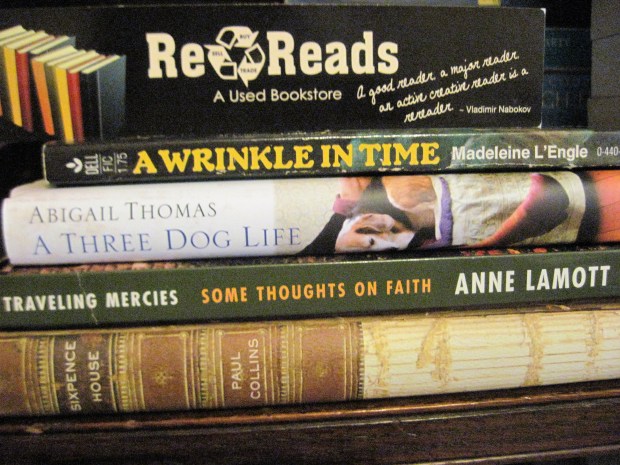
- I have a bad habit of racing through self-help and theology books rather than taking my time mulling over them and fully exploring how I might apply them in my life. This was especially true of The Artist’s Way, one of my bibliotherapy prescriptions. I started out with the aim of completing the daily “morning pages” of free writing (though for me they were ‘evening pages’; I’m not a morning person) and each chapter’s self-knowledge exercises. But soon I’d given up on the writing and contemplation and begun just reading the book straight through, which is not the point of it at all. So this year I mean to go back through the Cameron and Rubin books more mindfully, and use the McLaren devotional as it is intended, reading the recommended Bible passages alongside the weekly reflections.

What are some of your goals (reading-related or otherwise) for 2019?
Recent Bylines: Glamour, Shiny New Books, Etc.
Following up on my post from June, here are excerpts from and links to some of my recent online writing for places that aren’t my blog.
Review essay of Gross Anatomy by Mara Altman for Glamour UK
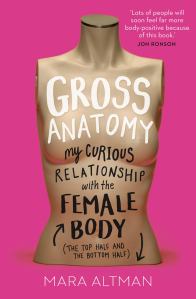 The female body has been a source of deep embarrassment for Altman, but here she swaps shame for self-deprecating silliness and cringing for chuckling. Through a snappy blend of personal anecdotes and intensive research, she exposes the cultural expectations that make us dislike our bodies, suggesting that a better knowledge of anatomy might help us feel normal. While 11 of her 15 topics aren’t exclusive to women’s anatomy—birthmarks, hemorrhoids, warts and more apply to men, too—she always presents an honest account of the female experience. This is one of my favorite books of the year and one I’d recommend to women of any age. It’s funny, it’s feminist, and it’s a cracking good read. (My full review is complete with embarrassing personal revelations!)
Essay on two books about “wasting time” for the Los Angeles Review of Books
In Praise of Wasting Time by Alan Lightman  &
&
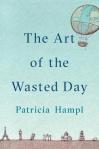 The Art of the Wasted Day by Patricia Hampl: A poet’s delight in lyricism and free association is in evidence here. The book blends memoir with travel and biographical information about some of Hampl’s exemplars of solitary, introspective living, and it begins, quite literally, with daydreaming.
 Hampl and Lightman start from the same point of frazzled frustration and arrive at many of the same conclusions about the necessity of “wasted” time but go about it in entirely different ways. Lightman makes a carefully constructed argument and amasses a sufficient weight of scientific and anecdotal evidence; Hampl drifts and dreams through seemingly irrelevant back alleys of memory and experience. The latter is a case of form following function: her book wanders along with her mind, in keeping with her definition of memoir as “lyrical quest literature,” where meaning always hovers above the basics of plot.
Book list for OZY on the refugee crisis & another coming up on compassion in medicine.
Pittsburgh Post-Gazette reviews
(Their website is not available outside the USA, so the links may not work for you).
Slave Old Man by Patrick Chamoiseau
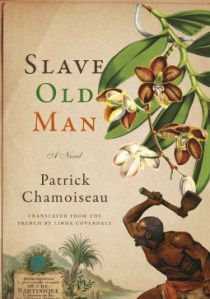 Chamoiseau is a social worker and author from the Caribbean island of Martinique. Translator Linda Coverdale has chosen to leave snippets of Martinican Creole in this text, creating a symphony of languages. The novel has an opening that might suit a gloomy fairytale: “In slavery times in the sugar isles, once there was an old black man.” The novel’s language is full of delightfully unexpected verbs and metaphors. At not much more than 100 pages, it is a nightmarish novella that alternates between feeling like a nebulous allegory and a realistic escaped slave narrative. It can be a disorienting experience: like the slave, readers are trapped in a menacing forest and prone to hallucinations. The lyricism of the writing and the brief glimpse back from the present day, in which an anthropologist discovers the slave’s remains and imagines the runaway back into life, give this book enduring power.
Lake Success by Gary Shteyngart
 Barry Cohen, a conceited hedge fund manager under SEC investigation for insider trading, sets out on a several-month picaresque road trip in the second half of 2016. The ostensible aim is to find his college girlfriend, but he forms fleeting connections with lots of ordinary folks along the way. Barry may be a figure of fun, but it’s unpleasant to spend so much time with his chauvinism (“he never remembered women’s names” but gets plenty of them to sleep with him), which isn’t fully tempered by alternating chapters from his wife’s perspective. Pitched somewhere between the low point of “Make America Great Again” and the loftiness of the Great American novel, Lake Success may not achieve the profundity it’s aiming for, but it’s still a biting portrait of an all-too-recognizable America where money is God and villains gets off easy.
Shiny New Books reviews
(Upcoming: Nine Pints by Rose George and Under the Rock by Benjamin Myers.) Latest:
The Immeasurable World: Journeys in Desert Places by William Atkins
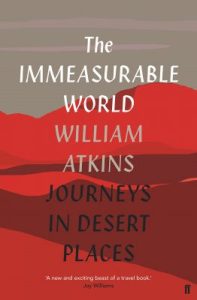 Atkins has produced an appealing blend of vivid travel anecdotes, historical background and philosophical musings. He is always conscious that he is treading in the footsteps of earlier adventurers. He has no illusions about being a pioneer here; rather, he eagerly picks up the thematic threads others have spun out of desert experience and runs with them – things like solitude, asceticism, punishment for wrongdoing and environmental degradation. The book is composed of seven long chapters, each set in a different desert. In my favorite segment, the author rents a cabin in the Sonoran Desert of Arizona for $100 a week. My interest waxed and waned from chapter to chapter, but readers of travelogues should find plenty to enjoy. Few of us would have the physical or emotional fortitude to repeat Atkins’s journeys, but we get the joy of being armchair travelers instead.
Mrs Gaskell & Me: Two Women, Two Love Stories, Two Centuries Apart by Nell Stevens
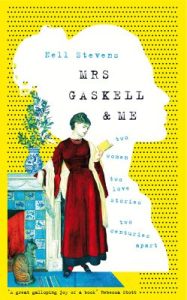 I was ambivalent about the author’s first book (Bleaker House), but for a student of the Victorian period this was unmissable, and the meta aspect was fun and not off-putting this time. Stevens has a light touch, and flits between Gaskell’s story and her own in alternating chapters. One strand covers the last decade of Gaskell’s life, but what makes it so lively and unusual is that Stevens almost always speaks of Gaskell as “you.” The intimacy of that address ensures her life story is anything but dry. The other chapters are set between 2013 and 2017 and narrated in the present tense, which makes Stevens’s dilemmas feel pressing. For much of the first two years her PhD takes a backseat to her love life. She’s obsessed with Max, a friend and unrequited crush from her Boston University days who is now living in Paris. This is a whimsical, sentimental, wry book that will ring true for anyone who’s ever been fixated on an idea or put too much stock in a relationship that failed to thrive.
Times Literary Supplement reviews
I’ve recently submitted my sixth and seventh for publication. All of them have been behind a paywall so far, alas. (Upcoming: Face to Face: True stories of life, death and transformation from my career as a facial surgeon by Jim McCaul; On Sheep: Diary of a Swedish Shepherd by Axel Lindén.) Latest:
How To Build A Boat: A Father, his Daughter, and the Unsailed Sea by Jonathan Gornall
 Gornall’s genial memoir is the story of a transformation and an adventure, as a fifty-something freelance journalist gets an unexpected second chance at fatherhood and decides to build his daughter, Phoebe, a boat. It was an uncharacteristic resolution for “a man who [had] never knowingly wielded a plane or a chisel,” yet in a more metaphorical way it made sense: the sea was in his family’s blood. Gornall nimbly conveys the precarious financial situation of the freelancer, as well as the challenges of adjusting to new parenthood late in life. This is a refreshingly down-to-earth account. The nitty-gritty details of the construction will appeal to some readers more than to others, but one can’t help admiring the combination of craftsmanship and ambition. (Full review in September 7th issue.)
Heart and Mind: New Nonfiction by Sandeep Jauhar and Jan Morris
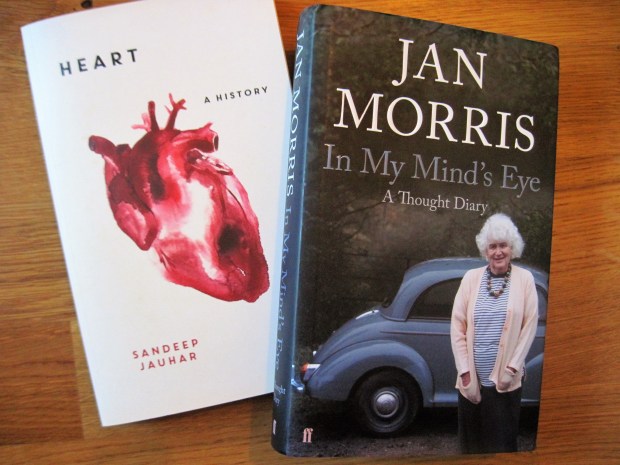
Heart: A History, by Sandeep Jauhar
There could hardly be an author better qualified to deliver this thorough history of the heart and the treatment of its problems. Sandeep Jauhar is the director of the Heart Failure Program at Long Island Medical Center. His family history – both grandfathers died of sudden cardiac events in India, one after being bitten by a snake – prompted an obsession with the heart, and he and his brother both became cardiologists. As the book opens, Jauhar was shocked to learn he had up to a 50% blockage of his own coronary vessels. Things had really gotten personal.
Cardiovascular disease has been the #1 killer in the West since 1910 and, thanks to steady smoking rates and a continuing rise in obesity and sedentary lifestyles, will still affect 60% of Americans. However, the key is that fewer people will now die of heart disease thanks to the developments of the last six decades in particular. These include the heart–lung machine, cardiac catheterization, heart transplantation, and artificial hearts.
 Along the timeline, Jauhar peppers in bits of his own professional and academic experience, like experimenting on frogs during high school in California and meeting his first cadaver at medical school. My favorite chapter was the twelfth, “Vulnerable Heart,” which is about how trauma can cause heart arrhythmias; it opens with an account of the author’s days cataloguing body parts in a makeshift morgue as a 9/11 first responder. I also particularly liked his account of being called out of bed to perform an echocardiogram, which required catching a taxi at 3 a.m. and avoiding New York City’s rats.
Maybe I’ve read too much surgical history this year (The Butchering Art by Lindsey Fitzharris and Face to Face by Jim McCaul), though, because I found myself growing fairly impatient with the medical details in the long Part II, which centers on the heart as a machine, and was drawn more to the autobiographical material in the first and final sections. Perhaps I would prefer Jauhar’s first book, Intern: A Doctor’s Initiation.
In terms of readalikes, I’d mention Siddhartha Mukherjee’s The Gene, in which the personal story also takes something of a backseat to the science, and Gavin Francis’s Shapeshifters, which exhibits a similar interest in the metaphors applied to the body. While I didn’t enjoy this quite as much as two other heart-themed memoirs I’ve read, The Sanctuary of Illness by Thomas Larson and Echoes of Heartsounds by Martha Weinman Lear, I still think it’s a strong contender for next year’s Wellcome Book Prize (the judging panel is announced tomorrow!).
Some favorite lines:
“it is increasingly clear that the biological heart is extraordinarily sensitive to our emotional system—to the metaphorical heart, if you will.”
“Who but the owner can say what lies inside a human heart?”“As a heart-failure specialist, I’d experienced enough death to fill up a lifetime. At one time, it was difficult to witness the grief of loved ones. But my heart had been hardened, and this was no longer that time.”
My rating:
Heart is published in the UK today, September 27th, by Oneworld. My thanks to the publisher for the proof copy for review.
In My Mind’s Eye: A Thought Diary, by Jan Morris
I’ve been an admirer of Jan Morris’s autobiographical and travel writing for 15 years or more. In this diary covering 2017 into early 2018, parts of which were originally published in the Financial Times and the Welsh-language literary newspaper O’r Pedwar Gwynt, we get a glimpse into her life in her early nineties. It was a momentous time in the world at large but a fairly quiet and reflective span for her personally. Though each day’s headlines seem to herald chaos and despair, she’s a blithe spirit – good-natured about the ravages of old age and taking delight in the routines of daily one-mile walks down the lane and errands in local Welsh towns with her beloved partner Elizabeth, who’s in the early stages of dementia.
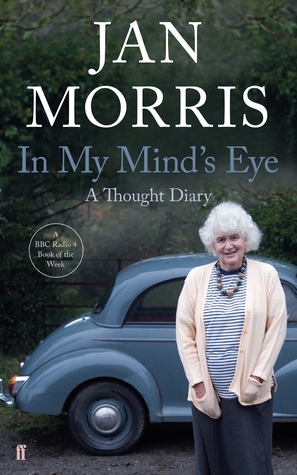 There are thrilling little moments, though, when a placid domestic life (a different kind of marmalade with breakfast each day of the week!) collides with exotic past experiences, and suddenly we’re plunged into memories of travels in Swaziland and India. Back when she was still James, Morris served in World War II, was the Times journalist reporting from the first ascent of Everest, and wrote a monolithic three-volume history of the British Empire. She took her first airplane flight 70 years ago, and is nostalgic for the small-town America she first encountered in the 1950s. Hold all that up against her current languid existence among the books and treasures of Trefan Morys and it seems she’s lived enough for many lifetimes.
There’s a good variety of topics here, ranging from current events to Morris’s love of cats; I particularly liked the fragments of doggerel. However, as is often the case with diaries, read too many entries in one go and you may start to find the sequence of (non-)events tedious. Each piece is only a page or two, so I tried never to read many more than 10 pages at a time. Even so, I noticed that the plight of zoo animals, clearly a hobby-horse, gets mentioned several times. It seemed to me a strange issue to get worked up about, especially as enthusiastic meat-eating and killing mice with traps suggest that she’s not applying a compassionate outlook consistently.
In the end, though, kindness is Morris’s cardinal virtue, and despite minor illness, telephone scams and a country that looks to be headed to the dogs, she’s encouraged by the small acts of kindness she meets with from friends and strangers alike. Like Diana Athill (whose Alive, Alive Oh! this resembles), I think of Morris as a national treasure, and I was pleased to spend some time seeing things from her perspective.
Some favorite lines:
“If I set out in the morning for my statutory thousand daily paces up the lane, … I enjoy the fun of me, the harmless conceit, the guileless complexity and the merriment. When I go walking in the evening, on the other hand, … I shall recognize what I don’t like about myself – selfishness, self-satisfaction, foolish self-deceit and irritability. Morning pride, then, and evening shame.” (from Day 99)
“Good or bad, virile or senile, there’s no life like the writer’s life.” (from Day 153)
My rating:
In My Mind’s Eye was published by Faber & Faber on September 6th. My thanks to the publisher for the free copy for review.
20 Books of Summer, #1–3: Hadley, Timms & Tyler
I’ve been reading sophisticated short stories, a food/travel memoir, and a prize-winning slice of cozy Americana.
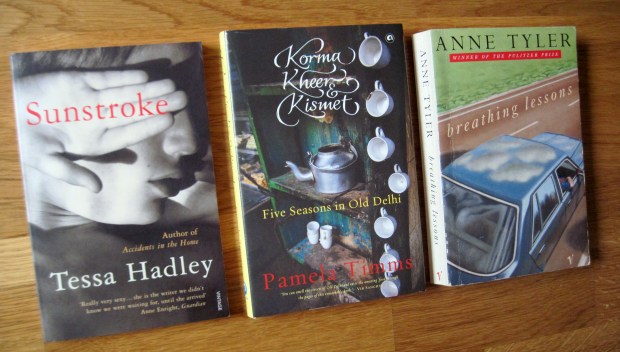
Sunstroke and Other Stories by Tessa Hadley (2007)
Everything is running away so fast; your deepest responsibility is to snatch at all the living you can.
Here’s a little something I wrote as an introduction to a review of Hadley’s most recent short story collection: “When I think of Tessa Hadley’s books, I picture a certain quality of light. I see piercing yellow shafts of sunlight filling airy, wood-floored rooms and lowering over suburban English gardens to create languid summer evenings. I think of childhood’s sense of possibility and adolescence’s gently scary feeling of new freedoms opening up. And, even when the story lines are set in the present day, I imagine the calm sophistication of 1950s–70s fashions: smart sweater sets and skirts, or flowing hippie dresses.” This volume is from a decade earlier and is not quite as strong, but that distinct atmosphere is still there.
 Each story pivots on a particular relationship: A mother fends off her son’s spurned lover; a teenager helps her older sister recover from a miscarriage; a woman hosts her former brother-in-law. Several stories revisit the same place or situation decades later. Claudia flirted with Graham when he was a teenager and she a grown woman; in “Phosphorescence” he tests whether there’s still any power in that connection 25 years later. In “A Card Trick” Gina goes back to a writer’s home she visited with family friends 25 years ago and reflects on how life has failed to live up to expectations. In “Matrilineal” Nia shares the comfort of a bed with her mother twice: once as a little girl the night they run away from her father, and again 40 years later in a hotel in New York City.
My two favorites were “The Surrogate,” in which a young woman falls for her professor – and for a pub customer who happens to look like him; and “Exchanges,” about two women on the cusp of middle age whose lives have diverged.
Korma, Kheer and Kismet: Five Seasons in Old Delhi by Pamela Timms (2014)
The only diary I’ve ever religiously maintained is my food journal.
 Timms is a Scottish journalist and food blogger who moved to India in 2005 when her husband got a job as a foreign correspondent. She delights in the street food stalls of Old Delhi, where you can get a hearty and delicious meal of mutton curry or fried vegetable dumplings for very little money. Often the snacks are simple – the first roasted sweet potatoes of the season or a big bowl of rice pudding made with buffalo milk and flavored with cardamom – but something about snatching sustenance while you’re on the go can make it the best thing you’ve ever tasted. It takes some searching to avoid the “pizza-fication” of Indian cuisine and discover an authentic hole-in-the-wall. Timms relies on local knowledge to locate hidden treasures and probes the owners until she gets recipes to recreate at home.
There isn’t a strong narrative to the book, but the food descriptions are certainly mouth-watering. Timms also captures the “magnificent mayhem of the spice market” and the extremes of the climate – a Delhi summer is like “being trapped inside a tandoor for three months of the year.” I reckon “Mr Naseem’s Sheer Khurma” will be fairly easy and so worth trying as a light dessert to follow a curry feast. Made with whole milk, ground rice, dried fruits and nuts, it’s a sweet custard traditionally used to break the Ramadan fast.
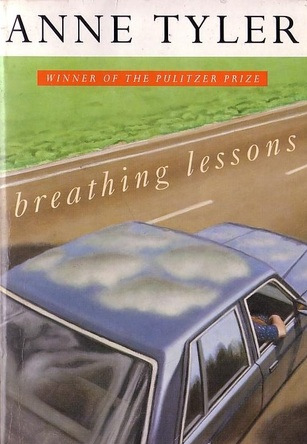
Breathing Lessons by Anne Tyler (1988)
“Was there a certain conscious point in your life when you decided to settle for being ordinary?”
Tyler won the Pulitzer Prize for this one. I’d rate it third out of the seven of her novels I’ve read so far, after Dinner at the Homesick Restaurant and The Accidental Tourist. (In general I seem to like her 1980s work the best.) The main action takes place all on one day, as Maggie Moran and her husband Ira travel from Baltimore up to Pennsylvania to attend the funeral of her childhood friend’s husband and pay a visit to their son’s ex-wife and their granddaughter.
 Of course, circadian narratives are so clever because they manage to interleave sufficient flashbacks to fill in the background. So we learn how 48-year-old Maggie – a precursor of Rebecca Davitch from Back When We Were Grown-ups and Abby Whitshank from A Spool of Blue Thread and the epitome of the exuberant, slightly ditzy, do-gooding heroine – has always meant well but through a combination of misunderstandings and fibs has botched things. She settled on Ira almost out of embarrassment: she’d heard a rumor he’d been killed in military training and sent his father an effusive condolence letter. When their son Jesse got Fiona pregnant, Maggie convinced Fiona to give him a chance based on a sentimental story about him that she perhaps half believed, and now, years later, she’s trying to do the same.
I loved the funeral scene itself – Serena is determined to recreate her wedding to Max, note for note – but I wearied of a sequence in which Maggie and Ira help an older African-American gentleman with car trouble. This is very much the Maggie show, so your reaction to the novel will largely depend on how well you’re able to tolerate her irksome habits. (Really, does she have to confuse the brake and the accelerator TWICE in one day?) Ira is the usual Tylerian standoffish husband, and Jesse the standard layabout progeny. What I found strangest was how little Tyler bothers to develop the character of the Moran daughter, Daisy.
Still, I enjoyed this. It’s a story about the mistakes we make, the patterns we get stuck in, and the ways we try to put things right. Sometimes it works; sometimes it doesn’t. Ultimately, we’re all making up this life business as we go along.
(I’ll also be reviewing Anne Tyler’s new novel, Clock Dance, on July 12th.)
 Bookish Beck = Rebecca Foster. American transplant to England. Freelance proofreader and book reviewer.
 Bookish Beck