Book Serendipity, September to October 2021
I call it Book Serendipity when two or more books that I read at the same time or in quick succession have something pretty bizarre in common. Because I have so many books on the go at once (usually 20–30), I suppose I’m more prone to such incidents. I’ve realized that, of course, synchronicity is really the more apt word, but this branding has stuck. This used to be a quarterly feature, but to keep the lists from getting too unwieldy I’ve shifted to bimonthly.
The following are in roughly chronological order.
- Young people studying An Inspector Calls in Somebody Loves You by Mona Arshi and Heartstoppers, Volume 4 by Alice Oseman.
- China Room (Sunjeev Sahota) was immediately followed by The China Factory (Mary Costello).


- A mention of acorn production being connected to the weather earlier in the year in Light Rains Sometimes Fall by Lev Parikian and Noah’s Compass by Anne Tyler.
- The experience of being lost and disoriented in Amsterdam features in Flesh & Blood by N. West Moss and Yearbook by Seth Rogen.
- Reading a book about ravens (A Shadow Above by Joe Shute) and one by a Raven (Fox & I by Catherine Raven) at the same time.


- Speaking of ravens, they’re also mentioned in The Elements by Kat Lister, and the Edgar Allan Poe poem “The Raven” was referred to and/or quoted in both of those books plus 100 Poets by John Carey.
- A trip to Mexico as a way to come to terms with the death of a loved one in This Party’s Dead by Erica Buist (read back in February–March) and The Elements by Kat Lister.
- Reading from two Carcanet Press releases that are Covid-19 diaries and have plague masks on the cover at the same time: Year of Plagues by Fred D’Aguiar and 100 Days by Gabriel Josipovici. (Reviews of both coming up soon.)


- Descriptions of whaling and whale processing and a summary of the Jonah and the Whale story in Fathoms by Rebecca Giggs and The Woodcock by Richard Smyth.
 An Irish short story featuring an elderly mother with dementia AND a particular mention of her slippers in The China Factory by Mary Costello and Blank Pages and Other Stories by Bernard MacLaverty.
- After having read two whole nature memoirs set in England’s New Forest (Goshawk Summer by James Aldred and The Circling Sky by Neil Ansell), I encountered it again in one chapter of A Shadow Above by Joe Shute.
- Cranford is mentioned in Corduroy by Adrian Bell and Cut Out by Michèle Roberts.
- Kenneth Grahame’s life story and The Wind in the Willows are discussed in On Gallows Down by Nicola Chester and The Elements by Kat Lister.


- Reading two books by a Jenn at the same time: Ghosted by Jenn Ashworth and The Other Mothers by Jenn Berney.
- A metaphor of nature giving a V sign (that’s equivalent to the middle finger for you American readers) in On Gallows Down by Nicola Chester and Light Rains Sometimes Fall by Lev Parikian.
- Quince preserves are mentioned in The Book of Difficult Fruit by Kate Lebo and Light Rains Sometimes Fall by Lev Parikian.
- There’s a gooseberry pie in Talking to the Dead by Helen Dunmore and The Book of Difficult Fruit by Kate Lebo.


- The ominous taste of herbicide in the throat post-spraying shows up in On Gallows Down by Nicola Chester and Damnation Spring by Ash Davidson.
- People’s rude questioning about gay dads and surrogacy turns up in The Echo Chamber by John Boyne and the DAD anthology from Music.Football.Fatherhood.
- A young woman dresses in unattractive secondhand clothes in The Echo Chamber by John Boyne and Beautiful World, Where Are You by Sally Rooney.

- A mention of the bounty placed on crop-eating birds in medieval England in Orchard by Benedict Macdonald and Nicholas Gates and A Shadow Above by Joe Shute.
- Hedgerows being decimated, and an account of how mistletoe is spread, in On Gallows Down by Nicola Chester and Orchard by Benedict Macdonald and Nicholas Gates.
 Ukrainian secondary characters in Ghosted by Jenn Ashworth and The Echo Chamber by John Boyne; minor characters named Aidan in the Boyne and Beautiful World, Where Are You by Sally Rooney.
- Listening to a dual-language presentation and observing that the people who know the original language laugh before the rest of the audience in The Book of Difficult Fruit by Kate Lebo and Beautiful World, Where Are You by Sally Rooney.
- A character imagines his heart being taken out of his chest in Tender Is the Flesh by Agustina Bazterrica and The Book of Form and Emptiness by Ruth Ozeki.

- A younger sister named Nina in Talking to the Dead by Helen Dunmore and Sex Cult Nun by Faith Jones.
- Adulatory words about George H.W. Bush in The Echo Chamber by John Boyne and Thinking Again by Jan Morris.
- Reading three novels by Australian women at the same time (and it’s rare for me to read even one – availability in the UK can be an issue): Sorrow and Bliss by Meg Mason, The Performance by Claire Thomas, and The Weekend by Charlotte Wood.


- There’s a couple who met as family friends as teenagers and are still (on again, off again) together in Sorrow and Bliss by Meg Mason and Beautiful World, Where Are You by Sally Rooney.
- The Performance by Claire Thomas is set during a performance of the Samuel Beckett play Happy Days, which is mentioned in 100 Days by Gabriel Josipovici.
 Human ashes are dumped and a funerary urn refilled with dirt in Tender Is the Flesh by Agustina Bazterrica and Public Library and Other Stories by Ali Smith.
- Nicholas Royle (whose White Spines I was also reading at the time) turns up on a Zoom session in 100 Days by Gabriel Josipovici.
- Richard Brautigan is mentioned in both The Mystery of Henri Pick by David Foenkinos and White Spines by Nicholas Royle.


- The Wizard of Oz and The Railway Children are part of the plot in The Book Smugglers (Pages & Co., #4) by Anna James and mentioned in Public Library and Other Stories by Ali Smith.
What’s the weirdest reading coincidence you’ve had lately?
September Poetry & Nonfiction: Antrobus, Benning, Carey; Bowler, Lister
September is a major month for new releases. I’ve already reviewed two fiction titles that came out this month: Blank Pages and Other Stories by Bernard MacLaverty and Bewilderment by Richard Powers. I’m still working through the 500+ pages of Ruth Ozeki’s new novel, The Book of Form and Emptiness, and hope to report back on it before too long.
Today I have poetry volumes reckoning with race and disability and with modern farming on the Canadian prairie, as well as a centuries-spanning anthology; and, in nonfiction, memoirs of living with advanced cancer and adjusting to widowhood in one’s thirties.
All the Names Given by Raymond Antrobus
 Antrobus, a British-Jamaican poet, won the Rathbones Folio Prize, the Ted Hughes Award, and the Sunday Times Young Writer of the Year Award for his first collection, The Perseverance. I reviewed it for the Folio Prize blog tour in 2019 and was in attendance at the Young Writer ceremony when he won. Its themes carry over into this second full-length work: again, he reflects on biracial identity, deafness, family divisions, and the loss of his father. Specifically, he is compelled to dive into the history of his English mother’s ancient surname, Antrobus: associated with baronets, owners of Stonehenge, painters – and slavers.
Tell me if I’m closer
to the white painter
with my name than I am
to the black preacher,
his hands wide to the sky,
the mahogany rot
of heaven. Sorry,
but you know by now
that I can’t mention trees
without every shade
of my family
appearing and disappearing. (from “Plantation Paint”)
Other poems explore police and prison violence against Black and deaf people, and arise from his experiences teaching poetry to students and inmates. Captions in square brackets are peppered throughout, inspired by the work of Deaf sound artist Christine Sun Kim. These serve as counterparts to the sign language illustrations in The Perseverance. There are also unsentimental love poems written for his wife, Tabitha. This didn’t captivate me in the same way as his first book, but I always enjoy experiencing the work of contemporary poets and would recommend this to readers of Jason Allen-Paisant, Caleb Femi and Kei Miller.
With thanks to Picador for the free copy for review.
Field Requiem by Sheri Benning
Benning employs religious language to give structure to her solemn meditations on the degraded landscape of Saskatchewan, a place where the old ways have been replaced by impersonal, industrial-scale farming. Poems are titled “Plainsong,” “Minor Doxology,” “Intercession” and “Compline.” You can hear the rhythms of psalms and the echoes of the requiem mass in her verse.
 There’s a prophetic tone behind poems about animal casualties due to pesticides, with “We were warned” used as a refrain in “1 Zephaniah”:
Everything swept away.
Everything consumed. Sky bled dry
of midges. Locusts, bees, neurons frayed.
Antiseptic silence of canola
fields at dusk, muted
grasshopper thrum.
Alliteration pops out from the lists of crops and the prairie species their cultivation has pushed to the edge of extinction. This is deeply place based writing, with the headings of multipart poems giving coordinates. Elegies tell the stories behind the names in a local graveyard, including Ukrainian immigrants. Many of these are tragic tales of failure: “neck in the noose of profit margins and farm credit” (from “NE 10 36 22 W2ND”). Benning and her sister, Heather, who took the Ansel Adams-like black-and-white photographs that illustrate the book, toured derelict farms and abandoned homes:
pull yourself through the kitchen window,
glass shot out decades ago. Breathe the charnel reek,
the cracked-open casket of the nation’s turn-of-the-century bullshit-
promises, adipose gleam of barley and wheat. (from “SW 26 36 22 W2ND”)
I attended the online launch event last night and enjoyed hearing Benning read from the book and converse with Karen Solie about its origins. Benning’s parents were farmers up until the late 1990s, then returned to diversified farming in the late 2000s. Solie aptly referred to the book as “incantatory.” With its ecological conscience, personal engagement and liturgical sound, this is just my kind of poetry. If you’ve been thinking about the issues with land use and food production raised by the likes of Wendell Berry and James Rebanks, you shouldn’t miss it.
With thanks to Carcanet Press for the free copy for review.
100 Poets: A Little Anthology by John Carey
John Carey is among the UK’s most respected literary critics. I’ve read several of his books over the years, including his outstanding memoir, The Unexpected Professor. This anthology, a sort of follow-up to his A Little History of Poetry (2020), chooses 100 top poets and then opines on what he considers their best work. The book is organized chronologically, proceeding from Homer to Maya Angelou. Sticking mostly to English-language and American, British or Commonwealth poets (with just a handful of Continental selections, like Charles Baudelaire and Rainer Maria Rilke, in translation), Carey delivers mini-essays with biographical information and historical background.
 There is some inconsistency in terms of the amount of context and interpretation given, however. For some poets, there may be just a line or two of text, followed by a reprinted poem (Richard Wilbur, Les Murray); for others, there are paragraphs’ worth of explanations, interspersed with excerpts (Andrew Marvell, Thomas Gray). Some choices are obvious; others are deliberately obscure (e.g., eschewing Robert Frost’s and Philip Larkin’s better-known poems in favour of “Out, Out” and “The Explosion”). The diversity is fairly low, and you can see Carey’s age in some of his introductions: “Edward Lear was gay, and felt a little sad when friends got married”; “Alfred Edward Housman was gay, and he thought it unjust that he should be made to feel guilty about something that was part of his nature.” There’s way too much First and Second World War poetry here. And can a poet really be one of the 100 greatest ever when I’ve never heard of them? (May Wedderburn Cannan, anyone?)
Unsurprisingly, I was most engaged with the pieces on Victorian and Modernist poets since those are the periods I studied at university and still love the most, but there were a few individual poems I was glad to discover, such as Ben Jonson’s “On My First Sonne,” written upon his death from bubonic plague, and Edward Thomas’s “Old Man,” as well as many I was happy to encounter again. This would be a good introduction for literature students as well as laypeople wanting to brush up on their poetry.
With thanks to Yale University Press, London for the proof copy for review.
Nonfiction
No Cure for Being Human (And Other Truths I Need to Hear) by Kate Bowler
(Below is my Shelf Awareness review, reprinted with permission.)
 In her bittersweet second memoir, a religion professor finds the joys and ironies in a life overshadowed by advanced cancer.
When Kate Bowler, an associate professor at Duke Divinity School, was diagnosed with advanced colon cancer at age 35, her chances of surviving two years were just 14%. In No Cure for Being Human, her wry, touching follow-up to her 2018 memoir Everything Happens for a Reason (And Other Lies I’ve Loved) and its associated podcast, she continues to combat unhelpful religious/self-help mantras as she ponders what to do with the extra time medical breakthroughs have given her.
After multiple surgeries, a promising immunotherapy drug trial gave Bowler hope that she would live to see her 40th birthday and her young son starting kindergarten. Working on her bucket list, she found that small moments outshined large events: on a trip to the Grand Canyon, what stood out was a chapel in the ponderosa pinewoods where she added a prayer to those plastering the walls. In the Church calendar, “Ordinary Time” is where most of life plays out, so she encourages readers to live in an “eternal present.”
The chapters function like stand-alone essays, some titled after particular truisms (like “You Only Live Once”). The book’s bittersweet tone finds the humor as well as the tragedy in a cancer diagnosis. Witty recreated dialogue and poignant scenes show the type-A author learning to let go: “I am probably replaceable,” she acknowledges, but here in the shadow of death “the mundane has begun to sparkle.” These dispatches from the “lumpy middle” of life and faith are especially recommended to fans of Anne Lamott.
(If you’ve read her previous book, Everything Happens for a Reason, you may find, as I did, that there is a little too much repetition about her diagnosis and early treatment. The essays could also probably be structured more successfully. But it’s still well worth reading.)
With thanks to Rider Books for the free copy for review.
The Elements: A Widowhood by Kat Lister
 This story hit all too close to home to me: like Kat Lister, my sister was widowed in her thirties, her husband having endured gruelling years of treatment for brain cancer that caused seizures and memory loss. Lister’s husband, Pat Long, was a fellow journalist. Cancer was with them for the entire span of their short marriage, and infertility treatment didn’t succeed in giving them the children they longed for.
Although it moves back and forth in time, the memoir skims over the happy before and the torturous middle, mostly shining a light on the years after Pat died in 2018. Lister probes her emotional state and the ways in which she met or defied people’s expectations of a young widow. Even when mired in grief, she was able to pass as normal: to go to work, to attend social functions wearing leopard print. She writes of a return trip to Mexico, where she’d gone with Pat, and in some detail of the sexual reawakening she experienced after his death. But everyday demands could threaten to sink her even when life-or-death moments hadn’t.
Writing helped her process her feelings, and the Wellcome Library was a refuge where she met her predecessors in bereavement literature. While some of the literary points of reference are familiar (Joan Didion, Elisabeth Kübler-Ross, C.S. Lewis), others are unexpected, and the overall Fire–Water–Earth–Air structure creates thematic unity in a similar way as the constellations do in Molly Wizenberg’s The Fixed Stars. Giving shape and dignity to grief, this is a lovely, comforting read.
A favourite passage:
When I talk of my husband, I often speak of disparate worlds. Mine is inside time, his is supertemporal. I continue to age whilst my husband stays fixed in a past I am drifting further away from with every sentence that I type. And yet, like those luminous balls of plasma in the sky, we are still connected together, for all time is cyclical. I hold the elements within me.
With thanks to Icon Books for the free copy for review.
What recent releases can you recommend?
Review Book Catch-Up: Motherhood, Nature Essays, Pandemic, Poetry
July slipped away without me managing to review any current-month releases, as I am wont to do, so to those three I’m adding in a couple of other belated review books to make up today’s roundup. I have: a memoir-cum-sociological study of motherhood, poems of Afghan women’s experiences, a graphic novel about a fictional worst-case pandemic, seasonal nature essays from voices not often heard, and poetry about homosexual encounters.
(M)otherhood: On the choices of being a woman by Pragya Agarwal
“Mothering would be my biggest gesture of defiance.”
 Growing up in India, Agarwal, now a behavioural and data scientist, wished she could be a boy for her father’s sake. Being the third daughter was no place of honour in society’s eyes, but her parents ensured that she got a good education and expected her to achieve great things. Still, when she got her first period, it felt like being forced onto a fertility track she didn’t want. There was a dearth of helpful sex education, and Hinduism has prohibitions that appear to diminish women, e.g. menstruating females aren’t permitted to enter a temple.
Married and unexpectedly pregnant in 1996, Agarwal determined to raise her daughter differently. Her mother-in-law was deeply disappointed that the baby was a girl, which only increased her stubborn pride: “Giving birth to my daughter felt like first love, my only love. Not planned but wanted all along. … Me and her against the world.” No element of becoming a mother or of her later life lived up to her expectations, but each apparent failure gave a chance to explore the spectrum of women’s experiences: C-section birth, abortion, divorce, emigration, infertility treatment, and finally having further children via a surrogate.
While I enjoyed the surprising sweep of Agarwal’s life story, this is no straightforward memoir. It aims to be an exhaustive survey of women’s life choices and the cultural forces that guide or constrain them. The book is dense with history and statistics, veers between topics, and needed a better edit for vernacular English and smoothing out academic jargon. I also found that I wasn’t interested enough in the specifics of women’s lives in India.
With thanks to Canongate for the free copy for review.
Forty Names by Parwana Fayyaz
“History has ungraciously failed the women of my family”
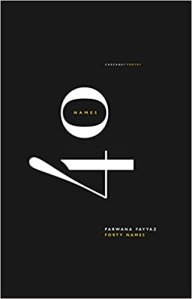 Have a look at this debut poet’s journey: Fayyaz was born in Kabul in 1990, grew up in Afghanistan and Pakistan, studied in Bangladesh and at Stanford, and is now, having completed her PhD, a research fellow at Cambridge. Many of her poems tell family stories that have taken on the air of legend due to the translated nicknames: “Patience Flower,” her grandmother, was seduced by the Khan and bore him two children; “Quietude,” her aunt, was a refugee in Iran. Her cousin, “Perfect Woman,” was due to be sent away from the family for infertility but gained revenge and independence in her own way.
Fayyaz is bold to speak out about the injustices women can suffer in Afghan culture. Domestic violence is rife; miscarriage is considered a disgrace. In “Roqeeya,” she remembers that her mother, even when busy managing a household, always took time for herself and encouraged Parwana, her eldest, to pursue an education and earn her own income. However, the poet also honours the wisdom and skills that her illiterate mother exhibited, as in the first three poems about the care she took over making dresses and dolls for her three daughters.
As in Agarwal’s book, there is a lot here about ideals of femininity and the different routes that women take – whether more or less conventional. “Reading Nadia with Eavan” was a favourite for how it brought together different aspects of Fayyaz’s experience. Nadia Anjuman, an Afghan poet, was killed by her husband in 2005; many years later, Fayyaz found herself studying Anjuman’s work at Cambridge with the late Eavan Boland. Important as its themes are, I thought the book slightly repetitive and unsubtle, and noted few lines or turns of phrase – always a must for me when assessing a poetry collection.
With thanks to Carcanet Press for the free copy for review.
Resistance by Val McDermid; illus. Kathryn Briggs
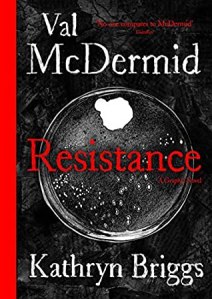 The second 2021 release I read in quick succession in which all but a small percentage of the human race (here, 2 million people) perishes in a pandemic – the other was Under the Blue. Like Aristide’s novel, this story had its origins in 2017 (in this case, on BBC Radio 4’s “Dangerous Visions”) but has, of course, taken on newfound significance in the time of Covid-19. McDermid imagines the sickness taking hold during a fictional version of Glastonbury: Solstice Festival in Northumberland. All the first patients, including a handful of rockstars, ate from Sam’s sausage sandwich van, so initially it looks like food poisoning. But vomiting and diarrhoea give way to a nasty rash, listlessness and, in many cases, death.
Zoe Beck, a Black freelance journalist who conducted interviews at Solstice, is friends with Sam and starts investigating the mutated swine disease, caused by an Erysipelas bacterium and thus nicknamed “the Sips.” She talks to the festival doctor and to a female Muslim researcher from the Life Sciences Centre in Newcastle, but her search for answers takes a backseat to survival when her husband and sons fall ill.
The drawing style and image quality – some panes are blurry, as if badly photocopied – let an otherwise reasonably gripping story down; the best spreads are collages or borrow a frame/backdrop (e.g. a medieval manuscript, NHS forms, or a 1910s title page).


SPOILER
{The ending, which has an immune remnant founding a new community, is VERY Parable of the Sower.}
With thanks to Profile Books/Wellcome Collection for the free copy for review.
Gifts of Gravity and Light: A Nature Almanac for the 21st Century, ed. Anita Roy and Pippa Marland
I hadn’t heard about this upcoming nature anthology when a surprise copy dropped through my letterbox. I’m delighted the publisher thought of me, as this ended up being just my sort of book: 12 autobiographical essays infused with musings on landscapes in Britain and elsewhere; structured by the seasons to create a gentle progression through the year, starting with the spring. Best of all, the contributors are mostly female, BIPOC (and Romany), working class and/or queer – all told, the sort of voices that are heard far too infrequently in UK nature writing. In momentous rites of passage, as in routine days, nature plays a big role.
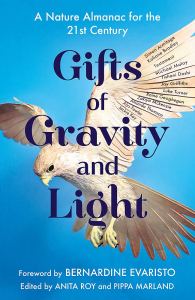 A few of my favourite pieces were by Kaliane Bradley, about her Cambodian heritage (the Wishing Dance associated with cherry blossom, her ancestors lost to genocide, the Buddhist belief that people can be reincarnated in other species); Testament, a rapper based in Leeds, about capturing moments through photography and poetry and about the seasons feeling awry both now and in March 2008, when snow was swirling outside the bus window as he received word of his uni friend’s untimely death; and Tishani Doshi, comparing childhood summers of freedom in Wales with growing up in India and 2020’s Covid restrictions.
Most of the authors hold two places in mind at the same time: for Michael Malay, it’s Indonesia, where he grew up, and the Severn estuary, where he now lives and ponders eels’ journeys; for Zakiya McKenzie, it’s Jamaica and England; for editor Anita Roy, it’s Delhi versus the Somerset field her friend let her wander during lockdown. Trees lend an awareness of time and animals a sense of movement and individuality. Alys Fowler thinks of how the wood she secretly coppices and lays on park paths to combat the mud will long outlive her, disintegrating until it forms the very soil under future generations’ feet.
A favourite passage (from Bradley): “When nature is the cuddly bunny and the friendly old hill, it becomes too easy to dismiss it as a faithful retainer who will never retire. But nature is the panic at the end of a talon, and it’s the tree with a heart of fire where lightning has struck. It is not our friend, and we do not want to make it our enemy.”
Also featured: Bernardine Evaristo (foreword), Raine Geoghegan, Jay Griffiths, Amanda Thomson, and Luke Turner.
With thanks to Hodder & Stoughton for the free copy for review.
Records of an Incitement to Silence by Gregory Woods
 Woods is an emeritus professor at Nottingham Trent University, where he was appointed the UK’s first professor of Gay & Lesbian Studies in 1998. Much of his sixth poetry collection is composed of unrhymed sonnets in two stanzas (eight lines, then six). The narrator is often a randy flâneur, wandering a city for homosexual encounters. One assumes this is Woods, except where the voice is identified otherwise, as in “[Walt] Whitman at Timber Creek” (“He gives me leave to roam / my idle way across / his prairies, peaks and canyons, my own America”) and “No Title Yet,” a long, ribald verse about a visitor to a stately home.
Other times the perspective is omniscient, painting a character study, like “Company” (“When he goes home to bed / he dare not go alone. … This need / of company defeats him.”), or of Frank O’Hara in “Up” (“‘What’s up?’ Frank answers with / his most unseemly grin, / ‘The sun, the Dow, my dick,’ / and saunters back to bed.”). Formalists are sure to enjoy Woods’ use of form, rhyme and meter. I enjoyed some of the book’s cheeky moments but had trouble connecting with its overall tone and content. That meant that it felt endless. I also found the end rhymes, when they did appear, over-the-top and silly (Demeter/teeter, etc.).
Two favourite poems: “An Immigrant” (“He turned away / to strip. His anecdotes / were innocent and his / erection smelled of soap.”) and “A Knot,” written for friends’ wedding in 2014 (“make this wedding supper all the sweeter / With choirs of LGBT cherubim”).
With thanks to Carcanet Press for the free copy for review.
Would you be interested in reading one or more of these?
Three June Releases: Allen-Paisant, Cowen and Mosse
Two poetry offerings and a short memoir this month. A similar strategy is at work in both verse volumes: Jason Allen-Paisant contrasts Jamaica and England via the medium of trees, and Rob Cowen comments on current events through the prism of the natural world. In Kate Mosse’s first nonfiction book, she reflects on bereavement and caregiving.
Thinking with Trees by Jason Allen-Paisant
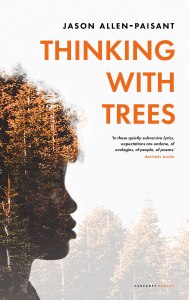 Allen-Paisant, from Jamaica and now based in Leeds, describes walking in the forest as an act of “reclamation.” For people of colour whose ancestors were perhaps sent on forced marches, hiking may seem strange, purposeless (the subject of “Black Walking”). Back in Jamaica, the forest was a place of utility rather than recreation:
In Porus life was un-
pastoral
The woodland was there
not for living in going for walks
or thinking
Trees were answers to our needs
not objects of desire
woodfire
But “I give myself permission / to go outside,” he writes, to notice the turning of the seasons, to commune with trees and birds, even if “there is nobody else like me / around here”. Explicitly calling into question Wordsworth’s model of privileged wandering, he injects a hint of threat into his interactions with nature. Most often this is symbolized by the presence of dogs. Even the most idyllic of scenes harbours the possibility of danger.
beware of spring
believe you are
a sprout of grass
and love all you see
but come out of the woods
before the white boys
with pitbulls
come
The poet cites George Floyd and Christian Cooper, the Central Park birder a white woman called the police on, as proof that being Black outdoors is inherently risky. There’s no denying this is an important topic, but I found the poems repetitive, especially the references to dogs. These felt like overkill. While there is some interesting enjambment, as in the first extended quote above, as well as internal and half-rhymes, I tend to prefer more formal poetry that uses more sonic techniques and punctuation. Still, I would be likely to direct fans of Kei Miller’s work to this collection.
With thanks to Carcanet Press for the free copy for review.
The Heeding by Rob Cowen
This poetry and art collaboration arose out of a “pact to pay attention” during a year of lockdown in the UK and record observations of nature, current events, and everyday life. Cowen is drawn to the moors near his home in Yorkshire, but also yearns to spend time with his friends again. He watches hawks and blue tits, notices the insects that fill his garden, and celebrates the way that allotment gardening brings together all sorts of people.
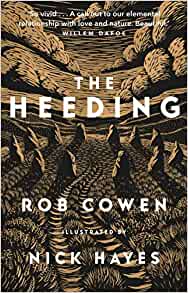 The emotional scope of the poems is broad: the author fondly remembers his brick-making ancestors and his honeymoon; he sombrely imagines the last moments of an old man dying in a hospital; he expresses guilt over accidentally dismembering an ant, yet divulges that he then destroyed the ants’ nest deliberately. There are even a couple of cheeky, carnal poems, one about a couple of teenagers he caught copulating in the street and one, “The Hottest Day of the Year,” about a longing for touch. “Matter,” in ABAB stanzas, is on the theme of racial justice by way of the Black Lives Matter movement.
My two favourites were “Sunday School,” about the rules for life he’s lived by since leaving religion behind, and “The End of This (Drinking Poem),” which serves as a good-riddance farewell to 2020: “Let me shake off / this year the way the otter / slips out of fast, rising water / and makes the holt just in time … / Let me rid my days of caution and fear, / these protocols and tiers / and Zoom funerals for people I love / and will never see again.” The book is worth the price of admission for the latter alone, and Nick Hayes’s black-and-white woodcut-style engravings are a plus.
However, in general I felt that the balance of current events and nature was off, especially compared to books like The Consolation of Nature, and ultimately I was not convinced that this needed to be in verse at all. “Starling,” especially, feels like a straight knockoff of Robert Macfarlane’s The Lost Words (“We forget that you once shimmered through frozen air, ripple bird. / Shape-shifter, dusk-dancer. Murmurer, sky-writer”). Judging from Cowen’s Common Ground, this would have been more successful as a book of short prose diary entries with a few poems dotted through.
With thanks to Elliott & Thompson for the proof copy for review.
An Extra Pair of Hands: A Story of Caring, Ageing and Everyday Acts of Love by Kate Mosse
Mosse’s parents and mother-in-law all moved in to live with her and her husband in their Chichester home when they reached old age. Her father had Parkinson’s and died in 2011, her mother survived him by a few years, and Granny Rosie is still going (reasonably) strong at the age of 90. This is a compact and relatable account of a daughter’s experiences of caregiving and grief, especially with the recent added complications of a pandemic.
 What came through particularly clearly for me was the older generation’s determination to not be a burden: living through the Second World War gave them a sense of perspective, such that they mostly did not complain about their physical ailments and did not expect heroic measures to be made to help them. (Her father knew his condition was “becoming too much” to deal with, and Granny Rosie would sometimes say, “I’ve had enough of me.”) In her father’s case, this was because he held out hope of an afterlife. Although Mosse does not share his religious beliefs, she is glad that he had them as a comfort.
The author recognizes the ways in which she has been lucky: as a full-time writer, she works from home and has the time and energy to devote to caring for elderly parents, whereas for many – generally middle-aged women, who may still have children at home – it is a huge struggle to balance caregiving with the rest of life. What is more, money is no issue for her. Repeating some of the statistics from Madeleine Bunting’s Labours of Love, she acknowledges that the situation is much more challenging for the average person.
I can see how this could serve as a great introduction for someone who hasn’t previously read much about bereavement, caregiving or old age, and I imagine it will especially appeal to existing fans of Mosse’s writing, whereas I was new to her work. I’ve read so much around these topics, including most of the works included in the bibliography, that the book did not offer me anything new, though it was a perfectly pleasant read.
Readalikes I have reviewed:
Notes on Grief by Chimamanda Ngozi Adichie
Be With by Mike Barnes
All Things Consoled by Elizabeth Hay
The Fragments of My Father by Sam Mills
With thanks to Profile Books/Wellcome Collection for the free copy for review.
What recent releases can you recommend?
Reading Ireland Month: Baume, Kennefick, Ní Ghríofa, O’Farrell
Reading Ireland Month is hosted each March by Cathy of 746 Books. This year I read works by four Irish women: a meditation on birds and craft, hard-hitting poems about body issues, autofiction that incorporates biography and translation to consider the shape of women’s lives across the centuries, and a novel that jets between Hong Kong and Scotland. Two of these were sent to me as part of the Rathbones Folio Prize shortlist. I have some Irish music lined up to listen to (Hallow by Duke Special, At Swim by Lisa Hannigan, Chop Chop by Bell X1, Magnetic North by Iain Archer) and I’m ready to tell you all about these four books.

handiwork by Sara Baume (2020)
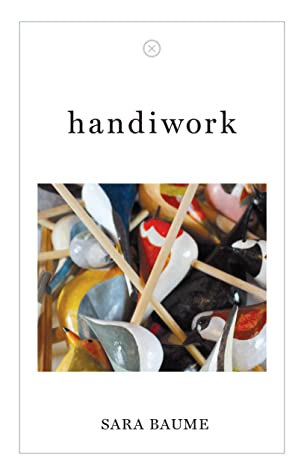 Back in February 2016, I reviewed Baume’s debut novel, Spill Simmer Falter Wither, for Third Way magazine. A dark story of a middle-aged loner and his adopted dog setting off on a peculiar road trip, it was full of careful nature imagery. “I’ve always noticed the smallest, quietest things,” the narrator, Ray, states. The same might be said of Baume, who is a visual artist as well as an author and put together this gently illuminating book over the course of 2018, at the same time as she was working on several sculptural installations. In short sections of a paragraph or two, or sometimes no more than a line, she describes her daily routines in her home workspaces: in the morning she listens to barely audible talk radio as she writes, while the afternoons are for carving and painting.
Working with her hands is a family tradition passed down from her grandfather and father, who died in the recent past – of lung cancer from particles he was exposed to at the sandstone quarry where he worked. Baume has a sense of responsibility for how she spends her time and materials. Concern about waste is at odds with a drive for perfection: she discarded her first 100 plaster birds before she was happy with the series used to illustrate this volume. Snippets of craft theory, family memories, and trivia about bird migration and behaviour are interspersed with musings on what she makes. The joy of holding a physical object in the hand somehow outweighs that of having committed virtual words to a hard drive.
Despite the occasional lovely line, this scattered set of reflections doesn’t hang together. The bird facts, in particular, feel shoehorned in for symbolism, as in Colum McCann’s Apeirogon. It’s a shame, as from the blurb I thought this book couldn’t be better suited to my tastes. Ultimately, as with Spill, Baume’s prose doesn’t spark much for me. 
Favorite lines:
“Most of the time spent making is spent, in fact, in the approach.”
“I must stop once the boredom becomes intolerable, knowing that if I plunge on past this point I will risk arriving at resentment”
“What we all shared – me, my dad, his dad – was a suspicion of modern life, a loathing of fashion, a disappointment with the new technologies and a preference for the ad hoc contraptions of the past”
“The glorious, crushing, ridiculous repetition of life.”
With thanks to Tramp Press and FMcM Associates for the free copy for review. handiwork is on the Rathbones Folio Prize shortlist.
Eat or We Both Starve by Victoria Kennefick (2021)
 This audacious debut collection of fleshly poems is the best I’ve come across so far this year. The body is presented as a battleground: for the brain cancer that takes the poet’s father; for disordered eating that entwines with mummy issues; for the restructuring of pregnancy. Families break apart and fuse into new formations. Cannibalism and famine metaphors dredge up emotional states and religious doctrines.
Where did I start?
Yes, with the heart, enlarged,
its chambers stretched through caring.
[…]
Oh is it in defiance or defeat, I don’t know,
I eat it anyway, raw, still warm.
The size of my fist, I love it.
(from the opening poem, “Learning to Eat My Mother, where My Mother Is the Teacher”)
Meat avoidance goes beyond principled vegetarianism to become a phobia. Like the female saints, the speaker will deny herself until she achieves spiritual enlightenment.
The therapist taps my shoulders, my head, my knees,
tells me I was a nun once, very strict.
This makes sense; I know how cleanly I like
to punish myself.
(from “Alternative Medicine”)
The title phrase comes from “Open Your Mouth,” in which the god Krishna, as a toddler, nourishes his mother with clay. A child feeding its mother reverses the expected situation, which is described in one of the book’s most striking poems, “Researching the Irish Famine.” The site of an old workhouse divulges buried horrors: “Mothers exhausted their own bodies / to produce milk. […] The starving / human / literally / consumes / itself.”
Corpses and meals; body odour and graves. There’s a pleasingly morbid cast to this collection, but it also has its lighter moments: the sexy “Paris Syndrome,” the low-stakes anxiety over pleasing one’s mother in “Guest Room,” and the playful closer, “Prayer to Audrey Hepburn” (“O Blessed Audrey of the feline eye-flick, jutting / bones, slim-hipped androgyny of war-time rationing”). Rich with imagery and alliteration, this is just my kind of poetry. Verse readalikes would include The Air Year by Caroline Bird, Flèche by Mary Jean Chan, and Tongues of Fire by Seán Hewitt, while in prose I was also reminded of Milk Fed by Melissa Broder (review coming soon) and Sanatorium by Abi Palmer. 
With thanks to Carcanet Press for the free copy for review. This comes out on the 25th.
A Ghost in the Throat by Doireann Ní Ghríofa (2020)
 “This is a female text.” In an elegant loop, Ní Ghríofa begins and ends with this line, and uses it as a refrain throughout. What is the text? It is this book, yes, as well as the 18th-century Irish-language poem that becomes an obsession for the author/narrator, “The Keen for Art Ó Laoghaire” by Eibhlín Dubh Ní Chonaill; however, it is also the female body, its milk and blood just as significant for storytelling as any ink.
Because the protagonist’s name is the same as the author’s, I took her experiences at face value. As the narrative opens in 2012, Ní Ghríofa and her husband have three young sons and life for her is a list of repetitive household tasks that must be completed each day. She donates pumped breast milk for premature babies as a karmic contribution to the universe: something she can control when so much around her she feels she can’t, like frequent evictions and another pregnancy. Reading Eibhlín Dubh’s lament for her murdered husband, contemplating a new translation of it, and recreating her life from paltry archival fragments: these tasks broaden her life and give an intellectual component to complement the bodily one.
My weeks are decanted between the twin forces of milk and text, weeks that soon pour into months, and then into years. I make myself a life in which whenever I let myself sit, it is to emit pale syllables of milk, while sipping my own dark sustenance from ink. […] I skitter through chaotic mornings of laundry and lunchboxes and immunisations, always anticipating my next session at the breast-pump, because this is as close as I get to a rest. To sit and read while bound to my insatiable machine is to leave my lists behind and stroll instead through doors opened by Eibhlín Dubh.
Ní Ghríofa remembers other times in her life in an impressionistic stream: starting a premed course at university, bad behaviour that culminated in suicidal ideation, a near-collision on a highway, her daughter’s birth by emergency C-section, finally buying a house and making it a home by adopting a stray kitten and planting a bee-friendly garden. You can tell from the precision of her words that Ní Ghríofa started off as a poet, and I loved how she writes about her own life. I had little interest in Eibhlín Dubh’s story, but maybe it’s enough for her to be an example of women “cast once more in the periphery of men’s lives.” It’s a book about women’s labour – physical and emotional – and the traces of it that remain. I recommend it alongside I Am, I Am, I Am by Maggie O’Farrell and Mother Ship by Francesca Segal. 
With thanks to Tramp Press and FMcM Associates for the free copy for review. A Ghost in the Throat is on the Rathbones Folio Prize shortlist.
The Distance Between Us by Maggie O’Farrell (2004)
 This is the earliest work of O’Farrell’s that I’ve read – it was her third novel, following After You’d Gone and My Lover’s Lover (I finally found those two at a charity shop last year and I’m saving them for a rainy day). It took me a long time to get into this one. It’s delivered in bitty sections that race between characters and situations, not generally in chronological order. It’s not until nearly the halfway point that you get a sense of how it all fits together.
Although there are many secondary characters, the two main strands belong to Jake, a young white filmmaker raised in Hong Kong by a bohemian mother, and Stella, a Scottish-Italian radio broadcaster. When a Chinese New Year celebration turns into a stampede, Jake and his girlfriend narrowly escape disaster and rush into a commitment he’s not ready for. In the meantime, Stella gets spooked by a traumatic flash from her childhood and flees London for a remote Scottish hotel. She’s very close to her older sister, Nina, who was deathly ill as a child (O’Farrell inserts a scene I was familiar with from I Am, I Am, I Am, when she heard a nurse outside her room chiding a noisy visitor, “There’s a little girl dying in there”), but now it’s Nina who will have to convince Stella to take the chance at happiness that life is offering.
In the end, this felt like a rehearsal for This Must Be the Place; it has the myriad settings (e.g., here, Italy, Wales and New Zealand are also mentioned) but not the emotional heft. With a setup like this, you sort of know where things are going, don’t you? Despite Stella’s awful secret, she is as flat a character as Jake. Simple boy-meets-girl story lines don’t hold a lot of appeal for me now, if they ever did. Still, the second half was a great ride.
Also, I’ve tried twice over the past year, but couldn’t get further than page 80 in The Wild Laughter by Caoilinn Hughes (2020), a black comedy about two brothers whose farmer father goes bankrupt and gets a terminal diagnosis. It’s a strangely masculine book (though in some particulars very similar to Scenes of a Graphic Nature) and I found little to latch on to. This was a disappointment as I’d very much enjoyed Hughes’s debut, Orchid & the Wasp, and this second novel is now on the Dylan Thomas Prize longlist.
What have you been picking up for Reading Ireland Month?

August Releases: Fiction Advocate, Kingsolver Poetry, Sarah Moss & More
My five new releases for August include two critical responses to contemporary classics; two poetry books, one a debut collection from Carcanet Press and the other by an author better known for fiction; and a circadian novel by one of my favorite authors.
I start with two of the latest releases from Fiction Advocate’s “Afterwords” series. The tagline is “Essential Readings of the New Canon,” and the idea is that “acclaimed writers investigate the contemporary classics.” (I reviewed the monographs on Blood Meridian, Fun Home, and The Year of Magical Thinking in this post.)
Dear Knausgaard: Karl Ove Knausgaard’s My Struggle by Kim Adrian
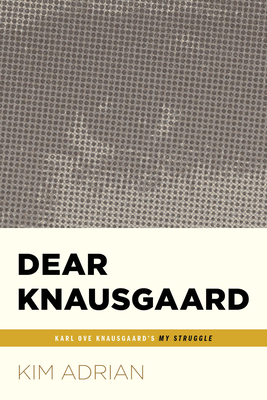 Karl Ove Knausgaard turned his pretty ordinary life into thousands of pages of autofiction that many readers have found addictive. Adrian valiantly grapples with his six-volume exploration of identity, examining the treatment of time and the dichotomies of intellect versus emotions, self versus other, and life versus fiction. She marvels at the ego that could sustain such a project, and at the seemingly rude decision to use all real names (whereas in her own family memoir she assigned aliases to most major figures). At many points she finds the character of “Karl Ove” insufferable, especially when he’s a teenager in Book 4, and the books’ prose dull. Knausgaard’s focus on male novelists and his stereotypical treatment of feminine qualities, here and in his other work, frequently madden her.
So why is My Struggle compelling nonetheless? It occupies her mind and her conversations for years. Is it something about the way that Knausgaard extracts meaning from seemingly inconsequential details? About how he stretches and compresses time in a Proustian manner to create a personal highlights reel? She frames her ambivalent musings as a series of letters written as if to Knausgaard himself (or “KOK,” as she affectionately dubs him) between February and September 2019. Cleverly, she mimics his style in both the critical enquiry and the glimpses into her own life, including all its minutiae – the weather, daily encounters, what she sees out the window and what she thinks about it all. It’s bold, playful and funny, and, all told, I enjoyed it more than Knausgaard’s own writing.
(I myself have only read Book 1, A Death in the Family, and wasn’t planning on continuing with My Struggle, but I think I will make an exception for Book 3 because of my recent fascination with childhood memoirs. I had better luck with Knausgaard’s Seasons Quartet, of which I’ve read all but Spring. I’ve reviewed Summer and Winter.)
My rating: 
My thanks to Fiction Advocate for the free e-copy for review.
The Wanting Was a Wilderness: Cheryl Strayed’s Wild and the Art of Memoir by Alden Jones
Hiking is boring, yet Cheryl Strayed turned it into a beloved memoir. Jones explores how Wild works: how Strayed the author creates “Cheryl,” likeable despite her drug use and promiscuity; how the fixation on the boots and the backpack that carry her through her quest reflect the obsession over the loss of her mother; how the flashbacks break up the narrative and keep you guessing about whether she’ll reach her literal and emotional destinations.
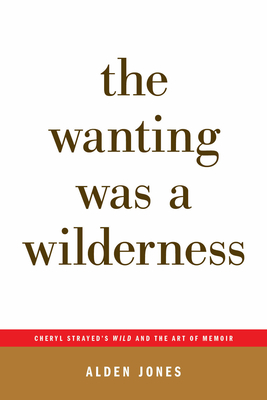 Jones also considers the precedents of wilderness literature and the 1990s memoir boom that paved the way for Wild. I most enjoyed this middle section, which, like Mary Karr’s The Art of Memoir, surveys some of the key publications from a burgeoning genre. Another key point of reference is Vivian Gornick, who draws a distinction between “the situation” (the particulars or context) and “the story” (the message) – sometimes the map or message comes first, and sometimes you only discover it as you go along.
I was a bit less interested in Jones’s reminiscences of her own three-month wilderness experience during college, when, with Outward Bound, she went to North Carolina and Mexico and hiked part of the Appalachian Trail and a volcano. This was the trip on which she faced up to her sexuality and had a short-lived relationship with a fellow camper, Melissa. But working out that she was bisexual and marrying a woman were both, as presented here, false endings. The real ending was her decision to leave her marriage – even though they had three children; even though the relationship was often fine. She attributes her courage to go, believing something better was possible, to Strayed’s work. And that’s the point of this series: rereading a contemporary classic until it becomes part of your own story.
My rating: 
My thanks to Fiction Advocate for the free e-copy for review.
Two poetry releases:
Growlery by Katherine Horrex
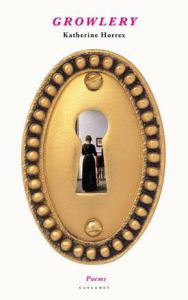 As in Red Gloves by Rebecca Watts, released by Carcanet in June, I noted the juxtaposition of natural and industrial scenes. Horrex’s “Four Muses” include a power plant and a steelworks, and she writes about pottery workers and the Manchester area, but she also explores Goat Fell on foot. Two of my favorite poems were nature-based: “Omen,” about corpse flowers, and “Wood Frog.” Alliteration, metaphors and smells are particularly effective in the former. Though I quailed at the sight of an entry called “Brexit,” it’s a subtle offering that depicts mistrust and closed minds – “People personable as tents zipped shut”. By contrast, “House of Other Tongues” revels in the variety of languages and foods in an international student dorm. A few poems circle around fertility and pregnancy. The linking themes aren’t very strong across the book, but there are a few gems.
My rating:
My thanks to Carcanet Press for the free e-copy for review.
How to Fly (in Ten Thousand Easy Lessons) by Barbara Kingsolver
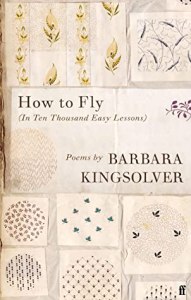 Kingsolver may not be well known for her poetry, but this is actually her second collection of verse after the bilingual Another America/Otra America (1992). The opening segment, “How to Fly,” is full of folk wisdom from nature and the body’s intuitive knowledge. “Pellegrinaggio” is a set of travel poems about accompanying her Italian mother-in-law back to her homeland. “This Is How They Come Back to Us” is composed of elegies for the family’s dead; four shorter remaining sections are inspired by knitting, literature, daily life, and concern for the environment. As with The Undying by Michel Faber, the book’s themes are stronger than its poetic techniques, but Kingsolver builds striking natural imagery and entrancing rhythms.
Two favorite passages to whet your appetite:
How to drink water when there is wine— / Once I knew all these brick-shaped things, / took them for the currency of survival. / Now I have lived long and I know better.
Tiptoe past the dogs of the apocalypse / asleep in the shade of your future. / Pay at the window. You’ll be surprised: you / can pass off hope like a bad check. You still / have time, that’s the thing. To make it good.
(To be reviewed in full, in conjunction with other recent/upcoming poetry releases, including Dearly by Margaret Atwood, for Shiny New Books.)
My rating:
I read an advanced e-copy via Edelweiss. (I’m unsure of the line breaks above because of the formatting.)
And finally, a much-anticipated release – bonus points for it having “Summer” in the title!
Summerwater by Sarah Moss
This is nearly as compact as Moss’s previous novella, Ghost Wall, yet contains a riot of voices. Set on one long day at a Scottish holiday park, it moves between the minds of 12 vacationers disappointed by the constant rain – “not that you come to Scotland expecting sun but this is a really a bit much, day after day of it, torrential” – and fed up with the loud music and partying that’s come from the Eastern Europeans’ chalet several nights this week. In the wake of Brexit, the casual xenophobia espoused by several characters is not surprising, but still sobering, and paves the way for a climactic finale that was not what I expected after some heavy foreshadowing involving a teenage girl going off to the pub through the woods.
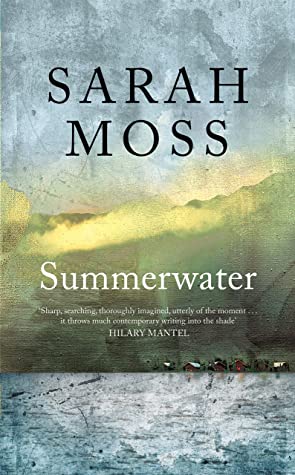 The day starts at 5 a.m. with Justine going for a run, despite a recent heart health scare, and spends time with retirees, an engaged couple spending most of their time in bed, a 16-year-old kayaker, a woman with dementia, and more. We see different aspects of family dynamics as we revisit a previous character’s child, spouse or sibling. I had to laugh at Milly picturing Don Draper during sex with Josh, and at Claire getting an hour to herself without the kids and having no idea what to do with it beyond clean up and make a cup of tea. Moss gets each stream-of-consciousness internal monologue just right, from a frantic mum to a sarcastic teen.
Yet I had to wonder what it all added up to; this feels like a creative writing student exercise, with the ending not worth waiting for. Cosmic/nature interludes are pretentious à la Reservoir 13. It’s not the first time this year that I’ve been disappointed by the latest from a favorite author (see also Hamnet). But my previous advice stands: If you haven’t read Sarah Moss, do so immediately.
My rating:
My thanks to Picador for the free copy for review.
What August releases can you recommend?
Recommended July Releases: Donoghue, Maizes, Miller, Parikian, Trethewey
My five new releases for July include historical pandemic fiction, a fun contemporary story about a father-and-daughter burglar team, a new poetry collection from Carcanet Press, a lighthearted nature/travel book, and a poetic bereavement memoir about a violent death.
The Pull of the Stars by Emma Donoghue
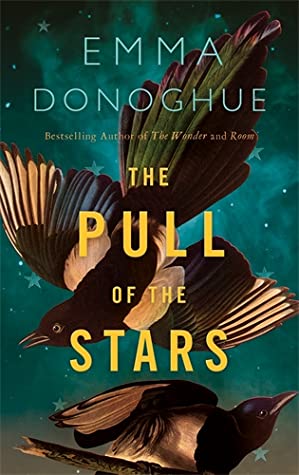 Donoghue’s last two novels, The Wonder and Akin, were big hits with me. Less than a year after the contemporary-set Akin, she’s back to a historical setting – and an uncannily pertinent pandemic theme – with her latest. In 1918, Julia Power is a nurse on a Dublin maternity ward. It’s Halloween and she is about to turn 30, making her a spinster for her day; she lives with her mute, shell-shocked veteran brother, Tim, and his pet magpie.
Because she’s already had “the grip” (influenza), she is considered immune and is one of a few staff members dealing with the flu-ridden expectant mothers in quarantine in her overcrowded hospital. Each patient serves as a type, and Donoghue whirls through all the possible complications of historical childbirth: stillbirth, obstructed labor, catheterization, forceps, blood loss, transfusion, maternal death, and so on.
It’s not for the squeamish, and despite my usual love of medical reads, I felt it was something of a box-ticking exercise, with too much telling about medical procedures and recent Irish history. Because of the limited time frame – just three days – the book is far too rushed. We simply don’t have enough time to get to know Julia through and through, despite her first-person narration; the final 20 pages, in particular, are so far-fetched and melodramatic it’s hard to believe in a romance you’d miss if you blinked. And the omission of speech marks just doesn’t work – it’s downright confusing with so many dialogue-driven scenes.
Donoghue must have been writing this well before Covid-19, but I wouldn’t be surprised if the publication was hurried forward to take advantage of the story’s newfound relevance. It shows: what I read in May and June felt like an unpolished draft, with threads prematurely tied up to meet a deadline. This was an extremely promising project that, for me, was let down by the execution, but it’s still a gripping read that I wouldn’t steer you away from if you find the synopsis appealing. (Some more spoiler-y thoughts here.)
Prescient words about pandemics:
“All over the globe … some flu patients are dropping like flies while others recover, and we can’t solve the puzzle, nor do a blasted thing about it. … There’s no rhyme or reason to who’s struck down.”
“Doctor Lynn went on, As for the authorities, I believe the epidemic will have run its course before they’ve agreed to any but the most feeble action. Recommending onions and eucalyptus oil! Like sending beetles to stop a steamroller.”
Why the title?
Flu comes from the phrase “influenza delle stelle” – medieval Italians thought that illness was fated by the stars. There’s also one baby born a “stargazer” (facing up) and some literal looking up at the stars in the book.
My rating:
My thanks to Picador for the proof copy for review.
Other People’s Pets by R.L. Maizes
 This is Maizes’ debut novel, after her 2019 short story collection We Love Anderson Cooper. Louise “La La” Fine and her father, Zev, share an unusual profession: While outwardly they are a veterinary student and a locksmith, respectively, for many years they broke into homes and sold the stolen goods. Despite close shaves, they’ve always gotten away with it – until now. When Zev is arrested, La La decides to return to her criminal ways just long enough to raise the money to post bail for him. But she doesn’t reckon on a few complications, like her father getting fed up with house arrest, her fiancé finding out about her side hustle, and her animal empathy becoming so strong that when she goes into a house she not only pilfers valuables but also cares for the needs of ailing pets inside.
Flashbacks to La La’s growing-up years, especially her hurt over her mother leaving, take this deeper than your average humorous crime caper. The way the plot branches means that for quite a while Zev and La La are separated, and I grew a bit weary of extended time in Zev’s company, but this was a great summer read – especially for animal lovers – that never lost my attention. The magic realism of the human‒pet connection is believable and mild enough not to turn off readers who avoid fantasy. Think The Twelve Lives of Samuel Hawley meets Hollow Kingdom.
My rating:
My thanks to the author and Celadon Books for the free e-copy for review.
The Long Beds by Kate Miller
 Here and there; now and then: the poems in Miller’s second collection enlarge such dichotomies by showcasing the interplay of the familiar and the foreign. A scientist struggles to transcribe birdsong, and a poppy opens in slow motion. “Flag” evokes the electric blue air and water of a Greek island, while “The Quarters” is set in the middle of the night in a French village. A few commissions, including “Waterloo Sunrise,” stick close to home in London or other southern England locales.
Various poems, including the multi-part “Album Without Photographs,” are about ancestor Muriel Miller’s experiences in India and Britain in the 1910s-20s. “Keepers of the States of Sleep and Wakefulness, fragment from A Masque,” patterned after “The Second Masque” by Ben Jonson, is an up-to-the-minute one written in April that names eight nurses from the night staff at King’s College Hospital (and the short YouTube film based on it is dedicated to all NHS nurses).
My two favorites were “Outside the Mind Shop,” in which urban foxes tear into bags of donations outside a charity shop one night while the speaker lies awake, and “Knapsack of Parting Gifts” a lovely elegy to a lost loved one. I spotted a lot of alliteration and assonance in the former, especially. Thematically, the collection is a bit scattered, but there are a lot of individual high points.
My rating:
My thanks to Carcanet Press for the free e-copy for review.
Into the Tangled Bank: In Which Our Author Ventures Outdoors to Consider the British in Nature by Lev Parikian
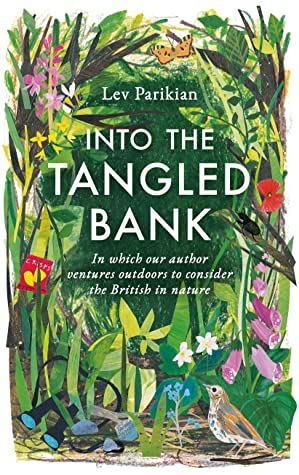 In the same way that kids sometimes write their address by going from the specific to the cosmic (street, city, country, continent, hemisphere, planet, galaxy), this book, a delightfully Bryson-esque tour, moves ever outwards, starting with the author’s own home and garden and proceeding to take in his South London patch and his journeys around the British Isles before closing with the wonders of the night sky. By slowing down to appreciate what is all around us, he proposes, we might enthuse others to engage with nature.
With the zeal of a recent convert, he guides readers through momentous sightings and everyday moments of connection. As they were his gateway, many of these memories involve birds: looking for the year’s first swifts, trying to sketch a heron and realizing he’s never looked at one properly before, avoiding angry terns on the Farne Islands, ringing a storm petrel on Skokholm, and seeing white-tailed eagles on the Isle of Skye. He brings unique places to life, and pays tribute to British naturalists who paved the way for today’s nature-lovers by visiting the homes of Charles Darwin, Gilbert White, Peter Scott, and more.
I was on the blog tour for Parikian’s previous book, Why Do Birds Suddenly Disappear?, in 2018. While the books are alike in levity (pun intended!), being full of self-deprecation and witty asides along with the astute observations, I think I enjoyed this one that little bit more for its all-encompassing approach to the experience of nature. I fully expect to see it on next year’s Wainwright Prize longlist (speaking of the Wainwright Prize, in yesterday’s post I correctly predicted four on the UK nature shortlist and two on the global conservation list!).
Readalikes (that happen to be from the same publisher): Under the Stars by Matt Gaw and The Seafarers by Stephen Rutt
My rating:
My thanks to Elliott & Thompson for the free copy for review.
Memorial Drive: A Daughter’s Memoir by Natasha Trethewey
 Trethewey grew up in 1960s Mississippi with a Black mother and a white Canadian father, at a time when interracial marriage remained illegal in parts of the South. After her parents’ divorce, she and her mother, Gwen, moved to Georgia to start a new life, but her stepfather Joel was physically and psychologically abusive. Gwen’s murder opens and closes the book. Trethewey only returned to that Atlanta apartment on Memorial Drive after 30 years had passed. The blend of the objective (official testimonies and transcripts) and the subjective (interpreting photographs, and rendering dream sequences in poetic language) makes this a striking memoir, as delicate as it is painful. I recommend it highly to readers of Elizabeth Alexander and Dani Shapiro. (Full review forthcoming at Shiny New Books.)
My rating: 
My thanks to Bloomsbury for the proof copy for review.

 I’m reading two more July releases, Mostly Dead Things by Kristen Arnett (Corsair, 2 July; for Shiny New Books review), about a family taxidermy business in Florida, and The Liar’s Dictionary by Eley Williams (William Heinemann, 2 July), about an unusual dictionary being compiled in the Victorian period and digitized in the present day.
What July releases can you recommend?
Four June Releases (Fiction & Poetry): Bennett, Gabrielsen, Kwek and Watts
(A rare second post in a day from me, to make way for tomorrow’s list of the best books of the first half of the year.) My four new releases for June are a novel about the complications of race and sexuality in 1950s–80s America, a novella in translation about a seabird researcher struggling through a time of isolation, and two new poetry books from Carcanet Press. As a bonus just in time for Pride Month, I finish with a mini write-up of The Book of Queer Prophets, an anthology of autobiographical essays that was published late last month.
The Vanishing Half by Brit Bennett
 Like some lost mid-career gem from Toni Morrison, this novel is meaty with questions of racial and sexual identity and seems sure to follow in the footsteps of Ruby and An American Marriage with a spot in Oprah’s book club and on Barack Obama’s summer reading list.
It’s the story of light-skinned African American twins Stella and Desiree Vignes, and how their paths divide in 1954. Both are desperate to escape from Mallard, Louisiana, where their father was lynched and their mother cleans white people’s houses. Desiree works in fingerprinting for the FBI in Washington, D.C., but in 1968 leaves an abusive marriage to return to Mallard with her dark-skinned daughter, Jude Winston. Stella, on the other hand, has been passing as white for over a decade. She was a secretary for the man who became her husband, Blake Sanders, and now lives a life of comfort in a Los Angeles subdivision.
The twins’ decisions affect the next generation, too. Both have one daughter. Jude goes to college in L.A., where she meets and falls in love with photographer Reese (born Therese), who is, in a different sense, “passing” until he can afford the surgery that will align his body with his gender. In a coincidence that slightly strains belief, Jude runs into Stella’s daughter, Kennedy, and over the next seven years the cousins – one a medical student; the other an actress – continue to meet occasionally, marvelling at how two family lines that started in Mallard, a tiny town that doesn’t even exist anymore, could have diverged so dramatically.
This is Bennett’s second novel, after The Mothers, which I’m keen to read. It’s perceptive and beautifully written, with characters whose struggles feel genuine and pertinent. Though its story line ends in the late 1980s, it doesn’t feel passé at all. The themes of self-reinvention and running from one’s past resonate. I expected certain characters to be forced into moments of reckoning, but the plot is a little messier than that – and that’s more like real life. A shoo-in for next year’s Women’s Prize list.
My rating:
My thanks to Dialogue Books for the free copy for review.
Ankomst by Gøhril Gabrielsen (2017)
[Translated from the Norwegian by Deborah Dawkin]
 The unnamed narrator of Gabrielsen’s fifth novel is a 36-year-old researcher working towards a PhD on the climate’s effects on populations of seabirds, especially guillemots. During this seven-week winter spell in the far north of Norway, she’s left her three-year-old daughter behind with her ex, S, and hopes to receive a visit from her lover, Jo, even if it involves him leaving his daughter temporarily. In the meantime, they connect via Skype when signal allows. Apart from that and a sea captain bringing her supplies, she has no human contact.
Daily weather measurements and bird observations still leave too much time alone in a cramped cabin, and this starts to tell in the protagonist’s mental state: she’s tormented by sexual fantasies, by memories of her life with S, and by the thought of a local family, the Berthelsens, who experienced a disastrous house fire in 1870. More and more frequently, she finds herself imagining what happened to Olaf and Borghild Berthelsen. Solitude and this growing obsession with ghosts of the past make her start to lose her grip on reality.
I’d encountered an unreliable narrator and claustrophobic setting before from Gabrielsen with her second novel, The Looking-Glass Sisters. Extreme weather and isolation account for this being paired with Snow, Dog, Foot by Claudio Morandini as the first two books in Peirene’s 2020 “Closed Universe” trilogy. I was also reminded of Sarah Moss’s Night Waking. However, I found this novella’s metaphorical links – how seabirds and humans care for their young; physical and emotional threats; lowering weather and existential doom – too obvious.
My rating:
My thanks to Peirene Press for the free copy for review.
Moving House by Theophilus Kwek
 This is the first collection of the Chinese Singaporean poet’s work to be published in the UK. Infused with Asian history, his elegant verse ranges from elegiac to romantic in tone. Many of the poems are inspired by historical figures and real headlines. There are tributes to soldiers killed in peacetime training and accounts of high-profile car accidents; “The Passenger” is about the ghosts left behind after a tsunami. But there are also poems about the language and experience of love. I also enjoyed the touches of art and legend: “Monologues for Noh Masks” is about the Pitt-Rivers Museum collection, while “Notes on a Landscape” is about Iceland’s geology and folk tales. In most places alliteration and enjambment produce the sonic effects, but there are also a handful of rhymes and half-rhymes, some internal.
My individual favorite poems included “Prognosis,” “Sophia” (made up of two letters Sir Thomas Stamford Raffles writes home to his wife while surveying in Singapore), and “Operation Thunderstorm.” As an expat and something of a nomad, I especially loved the title poem, which comes last and explains the cover image: “every house has a skeleton – / while the body learns it must carry less / from place to place, a kind of tidiness / that builds, hardens. Some call it fear, // of change, or losing what we cannot keep. / Others, experience.” Recommended to fans of Mary Jean Chan, Nausheen Eusuf, Kei Miller and Ocean Vuong.
My rating:
My thanks to Carcanet Press for the PDF copy for review.
Red Gloves by Rebecca Watts
 I noted the recurring comparison of natural and manmade spaces; outdoors (flowers, blackbirds, birds of prey, the sea) versus indoors (corridors, office life, even Emily Dickinson’s house in Massachusetts). The style shifts from page to page, ranging from prose paragraphs to fragments strewn across the layout. Most of the poems are in recognizable stanzas, though these vary in terms of length and punctuation. Alliteration and repetition (see, as an example of the latter, her poem “The Studio” on the TLS website) take priority over rhymes. I was reminded of Elizabeth Bishop in places, while “Whereas” had me thinking of Stephen Dunn’s collection of that name (Layli Long Soldier also has a poetry book of the same title). A few of my individual favorite poems were “Surveillance,” “Building” and “Admission” (on a medical theme: “What am I afraid of? / The breaching of skin. / Violation of laws that / separate outside from in. / Liquidation of the thing / I call me.”).
My rating:
My thanks to Carcanet Press for the PDF copy for review.
And a bonus for Pride Month:
The Book of Queer Prophets: 24 Writers on Sexuality and Religion, edited by Ruth Hunt
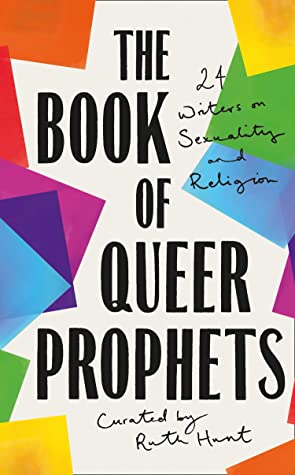 There isn’t, or needn’t be, a contradiction between faith and queerness, as the authors included in this anthology would agree. Many of them are stalwarts at Greenbelt, a progressive Christian summer festival – Church of Scotland minister John L. Bell even came out there, in his late sixties, in 2017. I’m a lapsed regular attendee, so a lot of the names were familiar to me, including those of poets Rachel Mann and Padraig O’Tuama.
Most of the contributors are Christian, then, including ordained priests like Desmond Tutu’s daughter, Mpho, and LGBT ally Kate Bottley, but we also hear from Michael Segalov, a gay Jewish man in London, and from Amrou Al-Kahdi (author of Unicorn: The Memoir of a Muslim Drag Queen), who describes the affirmation they found in the Sufi tradition. Dustin Lance Black tells of the exclusion LGBT Mormons still encounter.
Jarel Robinson-Brown addresses his lament on mistreatment to his nephew, as James Baldwin did in “My Dungeon Shook” (in The Fire Next Time). Tamsin Omond recounts getting married to Melissa on a London bridge in the middle of an Extinction Rebellion protest. Erin Clark, though bisexual, knows she can pass as straight because she’s marrying a man – so is she ‘gay enough?’ Two trans poets write of the way cathedrals drew them into faith. The only weaker pieces are by Jeanette Winterson (there’s nothing new if you’ve read her memoir) and Juno Dawson (entirely throwaway; ‘I’m an atheist, but it’s okay to be religious, too’).
Again and again, these writers voice the certainty that they are who God means them to be. A few of them engage with particular passages from the Bible, offering contextual critiques or new interpretations, but most turn to scripture for its overall message of love and justice. Self-knowledge is a key component of their search for truth. And the truth sets people free.
My rating:
I read an e-copy via NetGalley.
What recent releases can you recommend?
Review Books Roundup: Blackburn, Bryson, Pocock, Setterwall, Wilson
I’m attempting to get through all my 2019 review books before the end of the year, so expect another couple of these roundups. Today I’m featuring a work of poetry about one of Picasso’s mistresses, a thorough yet accessible introduction to how the human body works, a memoir of personal and environmental change in the American West, Scandinavian autofiction about the sudden loss of a partner, and a novel about kids who catch on fire. You can’t say I don’t read a variety! See if one or more of these tempts you.
The Woman Who Always Loved Picasso by Julia Blackburn
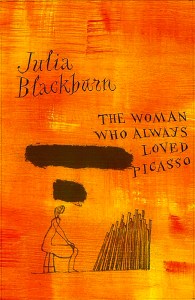 Something different from Blackburn: biographical snippets in verse about Marie-Thérèse Walter, one of Pablo Picasso’s many mistress-muses. When they met she was 17 and he was 46. She gave birth to a daughter, Maya – to his wife Olga’s fury. Marie-Thérèse’s existence was an open secret: he rented a Paris apartment for her to live in, and left his home in the South of France to her (where she committed suicide three years after his death), but unless their visits happened to overlap she was never introduced to his friends. “I lived in the time I was born into / and I kept silent, / acquiescing / to everything.”
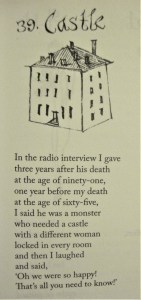 In Marie-Thérèse’s voice, Blackburn depicts Picasso as a fragile demagogue: in one of the poems that was a highlight for me, “Bird,” she describes how others would replace his caged birds when they died, hoping he wouldn’t notice – so great was his horror of death. I liked getting glimpses into a forgotten female’s life, and appreciated the whimsical illustrations by Jeffrey Fisher, but as poems these pieces don’t particularly stand out. (Plus, there are no page numbers! which doesn’t seem like it should make a big difference but ends up being annoying when you want to refer back to something. Instead, the poems are numbered.)
My rating:
With thanks to Carcanet Press for the free copy for review. Published today.
The Body: A Guide for Occupants by Bill Bryson
 Shelve this next to Being Mortal by Atul Gawande in a collection of books everyone should read – even if you don’t normally choose nonfiction. Bryson is back on form here, indulging his layman’s curiosity. As you know, I read a LOT of medical memoirs and popular science. I’ve read entire books on organ transplantation, sleep, dementia, the blood, the heart, evolutionary defects, surgery and so on, but in many cases these go into more detail than I need and I can find my interest waning. That never happens here. Without ever being superficial or patronizing, the author gives a comprehensive introduction to every organ and body system, moving briskly between engaging anecdotes from medical history and encapsulated research on everything from gut microbes to cancer treatment.
Bryson delights in our physical oddities, and his sense of wonder is infectious. He loves a good statistic, and while this book is full of numbers and percentages, they are accessible rather than obfuscating, and will make you shake your head in amazement. It’s a persistently cheerful book, even when discussing illness, scientists whose work was overlooked, and the inevitability of death. Yet what I found most sobering was the observation that, having conquered many diseases and extended our life expectancy, we are now overwhelmingly killed by lifestyle, mostly a poor diet of processed and sugary foods and lack of exercise.
My rating:
With thanks to Doubleday for the free copy for review.
Surrender: Mid-Life in the American West by Joanna Pocock
 Prompted by two years spent in Missoula, Montana and the disorientation felt upon a return to London, this memoir-in-essays varies in scale from the big skies of the American West to the smallness of one human life and the experience of loss and change. Then in her late forties, Pocock had started menopause and recently been through the final illnesses and deaths of her parents, but was also mother to a fairly young daughter. She explores personal endings and contradictions as a kind of microcosm of the paradoxes of the Western USA.
It’s a place of fierce independence and conservatism, but also mystical back-to-the-land sentiment. For an outsider, so much of the lifestyle is bewildering. The author attends a wolf-trapping course, observes a Native American buffalo hunt, meets a transsexual rewilding activist, attends an ecosexuality conference, and goes foraging. All are attempts to reassess our connection with nature and ask what role humans can play in a diminished planet.
This is an elegantly introspective work that should engage anyone interested in women’s life writing and the environmental crisis. There are also dozens of black-and-white photographs interspersed in the text. In 2018 Pocock won the Fitzcarraldo Editions Essay Prize for this work-in-progress. It came to me as an unsolicited review copy and hung around on my shelves for six months before I picked it up; I’m glad I finally did.
My rating:
With thanks to Fitzcarraldo Editions for the free copy for review.
Let’s Hope for the Best by Carolina Setterwall
[Trans. from the Swedish by Elizabeth Clark Wessel]
 Although this is fiction, it very closely resembles the author’s own life. She wrote this debut novel to reflect on the sudden loss of her partner and how she started to rebuild her life in the years that followed. It quickly splits into two parallel story lines: one begins in April 2009, when Carolina first met Aksel at a friend’s big summer bash; the other picks up in October 2014, after Aksel’s death from cardiac arrest. The latter proceeds slowly, painstakingly, to portray the aftermath of bereavement. In the alternating timeline, we see Carolina and Aksel making their life together, with her always being the one to push the relationship forward.
Setterwall addresses the whole book in the second person to Aksel. When the two story lines meet at about the two-thirds point, it carries on into 2016 as she moves house, returns to work and resumes a tentative social life, even falling in love. This is a wrenching story reminiscent of In Every Moment We Are Still Alive by Tom Malmquist, and much of it resonated with my sister’s experience of widowhood. There are many painful moments that stick in the memory. Overall, though, I think it was too long by 100+ pages; in aiming for comprehensiveness, it lost some of its power. Page 273, for instance (the first anniversary of Aksel’s death, rather than the second, where the book actually ends), would have made a fine ending.
My rating: 
With thanks to Bloomsbury UK for the proof copy for review.
Nothing to See Here by Kevin Wilson
 I’d read a lot about this novel while writing a synopsis and summary of critical opinion for Bookmarks magazine – perhaps too much, as it felt familiar and offered no surprises. Lillian, a drifting twentysomething, is offered a job as a governess for her boarding school roommate Madison’s stepchildren. Madison’s husband is a Tennessee senator in the running for the Secretary of State position, so it’s imperative that they keep a lid on the situation with his 10-year-old twins, Bessie and Roland.
You see, when they’re upset these children catch on fire; flames destroy their clothes and damage nearby soft furnishings, but leave the kids themselves unharmed. Temporary, generally innocuous spontaneous combustion? Okay. That’s the setup. Wilson writes so well that it’s easy to suspend your disbelief about this, but harder to see a larger point, except perhaps creating a general allegory for the challenges of parenting. This was entertaining enough, mostly thanks to Lillian’s no-nonsense narration, but for me it didn’t soar.
My rating:
With thanks to Text Publishing UK for the PDF for review. This came out in the States in October and will be released in the UK on January 30th.
Would you be interested in reading one or more of these?
Recent and Upcoming Poetry Releases from Carcanet Press
Many thanks to the publisher for free print or e-copies of these three books for review.
In Nearby Bushes by Kei Miller
 “Are there stories you have heard about Jamaica? / Well here are the stories underneath.” The last two lines of “The Understory” reveal Miller’s purpose in this, his fifth collection of poetry. The title is taken from Jamaican crime reports, which often speak of a victim’s corpse being dumped in, or perpetrators escaping to, “nearby bushes.” It’s a strange euphemism that calls to mind a dispersed underworld where bodies are devalued. Miller persistently contrasts a more concrete sense of place with that iniquitous nowhere. Most of the poems in the first section open with the word “Here,” which is also often included in their titles and repeated frequently throughout Part I. Jamaica is described with shades of green: a fertile, feral place that’s full of surprises, like an escaped colony of reindeer.
As usual, Miller slips in and out of dialect as he reflects on the country’s colonial legacy and the precarious place of homosexuals (“A Psalm for Gay Boys” is a highlight). Although I enjoyed this less than the other books I’ve read by Miller, I highly recommend his work in general; the collection The Cartographer Tries to Map a Way to Zion is a great place to start.
Some favorite lines:
“Here that cradles the earthquakes; / they pass through the valleys // in waves, a thing like grief, / or groaning that can’t be uttered.” (from “Hush”)
“We are insufficiently imagined people from an insufficiently imagined place.” (from “Sometimes I Consider the Names of Places”)
“Cause woman is disposable as that, / and this thing that has happened is … common as stone and leaf and breadfruit tree. You should have known.” (from “In Nearby Bushes” XIII.III)
My rating:
In Nearby Bushes was published on 29th August.
So Many Rooms by Laura Scott
 Art, Greek mythology, the seaside, the work of Tolstoy, death, birds, fish, love and loss: there are lots of repeating themes and images in this debut collection. While there are a handful of end rhymes scattered through, what you mostly notice is alliteration and internal rhyming. The use of color is strong, and not just in the poems about paintings. A few of my favorites were “Mulberry Tree” (“My mother made pudding with its fruit, / white bread drinking / colour just as the sheets waited / for the birds to stain them purple.”), “Direction,” and “A Different Tune” (“oh my heavy heart how can I / make you light again so I don’t have to // lug you through the years and rooms?”). There weren’t loads of poems that stood out to me here, but I’ll still be sure to look out for more of Scott’s work.
My rating:
So Many Rooms was published on 29th August.
A Kingdom of Love by Rachel Mann
Rachel Mann, a transgender Anglican priest, was Poet-in-Residence at Manchester Cathedral from 2009 to 2017 and is now a Visiting Fellow in Creative Writing and English at Manchester Metropolitan University. Her poetry is full of snippets of scripture and liturgy (both English and Latin), and the cadence is often psalm-like. The final five poems are named after some of the daily offices, and “Christening” and “Extreme Unction” are two stand-outs that describe performing rituals for the beginning and end of life. The poet draws on Greek myth as well as on the language of Christian classics from St. Augustine to R.S. Thomas.
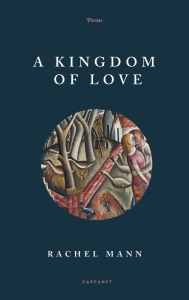 Human fragility is an almost comforting undercurrent (“Be dust with me”), with the body envisioned as the site of both sin and redemption. A focus on words leads to a preoccupation with mouths and the physical act of creating and voicing language. There is surprisingly anatomical vocabulary in places: the larynx, the palate. Mann also muses on Englishness, and revels in the contradictions of ancient and modern life: Chaucer versus a modern housing development, “Reading Ovid on the Underground.” She undertakes a lot of train rides and writes of passing through stations, evoking the feeling of being in transit(ion).
You wouldn’t know the poet had undergone a sex change unless you’d already read about it in the press materials or found other biographical information, but knowing the context one finds extra meaning in “Dress,” about an eight-year-old coveting a red dress (“To simply have known it was mine / in those days”) and “Give It a Name,” about the early moments of healing from surgery.
This is beautiful, incantatory free verse that sparkles with alliteration and allusions that those of a religious background will be sure to recognize. It’s sensual as well as headily intellectual. Doubt, prayer and love fuel many of my favorite lines:
“Love should taste of something, / The sea, I think, brined and unsteady, / Of scale and deep and all we crawled out from.” (from “Collect for Purity”)
“I don’t know what ‘believe in’ means / In the vast majority of cases, / Which is to say I think it enough // To acknowledge glamour of words – / Relic, body, bone – I think / Mystery is laid in syllables, syntax” (from “Fides Quarens”)
“Offer the fact of prayer – a formula, / And more: the compromise of centuries / Made valid.” (from “A Kingdom of Love (2)”)
Particularly recommended for readers of Malcolm Guite and Christian Wiman.
My rating:
Official release date: September 26th – but already available from the Carcanet website.
 Bookish Beck = Rebecca Foster. American transplant to England. Freelance proofreader and book reviewer.
 Bookish Beck