Miscellaneous for #ReadIndies: Grenville & Holman-Hunt, Trans History & Travel Poetry, Kathleen Jamie & Kristen Zory King
Squeaking in some more reviews on the last day of a challenge, as is my wont. Today I have mini-responses to a wide selection: a graphic novel companion to LGBTQ history, an exposé that will have you checking the ingredients lists on all your toiletries and other household cleaning products, a memoir of an eccentric Edwardian childhood, poems about modes of travel and the states of mind they produce, superb nature essays blending personal and environmental writing, and a mini collection of flash fiction about young women.
Trans History: From Ancient Times to the Present Day by Alex L. Combs and Andrew Eakett (2025)
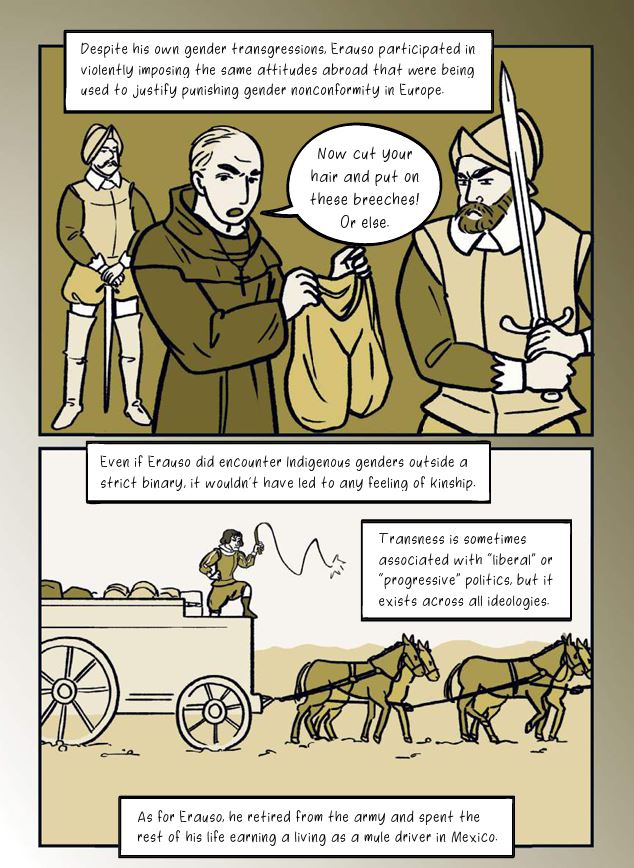
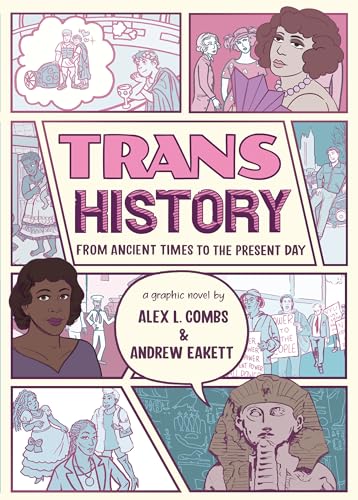 Queer people of all varieties have always been with us; they just might have understood their experience or talked about it in different terms. So while Combs and Eakett are careful not to apply labels retrospectively, they feature a plethora of people who lived as a different gender to that assigned at birth. Apart from a few familiar names like Lili Elbe and Marsha P. Johnson, most were new to me. For every heartening story of an emperor, monk or explorer who managed to live out their true identity in peace, there are three distressing ones of those forced to conform. Many Indigenous cultures held a special place for gender-nonconforming individuals; colonizers would have seen this as evidence of desperate need of civilizing. Even doctors who were willing to help with early medical transitions retained primitive ideas about gender and its connection to genitals. The structure is chronological, with a single colour per chapter. Panes reenact scenes and feature talking heads explaining historical developments and critical theory. A final section is devoted to modern-day heroes campaigning for trans rights and seeking to preserve an archive of queer history. This was a little didactic, but ideal for teens, I think, and certainly not just one for gender studies students.
Readalike: Meg-John Barker’s Sexuality: A Graphic Guide
 (Read via Edelweiss) [Candlewick Press]
The Case Against Fragrance by Kate Grenville (2017)
 File this with other surprising nonfiction books by well-known novelists. In 2015, Grenville started struggling while on a book tour: everything from a taxi’s air freshener and a hotel’s cleaning products to a fellow passenger’s perfume was giving her headaches. She felt like a diva for stipulating she couldn’t be around fragrances, but as she started looking into it she realized she wasn’t alone. I thought this was just going to be about perfume, but it covers all fragranced products, which can list “parfum” on their ingredients without specifying what that is – trade secrets. The problem is, fragrances contain any of thousands of synthetic chemicals, most of which have never been tested and thus are unregulated. Even those found to be carcinogens or endocrine disruptors in rodent studies might be approved for humans because it’s not taken into account how these products are actually used. Prolonged or repeat contact has cumulative effects. The synthetic musks in toiletries and laundry detergents are particularly bad, acting as estrogen mimics and likely associated with prostate and breast cancer. I tend to buy whatever’s on offer in Boots, but as soon as my Herbal Essences bottle is empty I’m going back to Faith in Nature (look for plant extracts). The science at the core of the book is a little repetitive, but eased by the social chapters to either side, and you can tell from the footnotes that Grenville really did her research.
Readalike: Chris van Tulleken’s Ultra-Processed People
 (Secondhand – gift from my wish list) [Text Publishing]
My Grandmothers and I by Diana Holman-Hunt (1960)
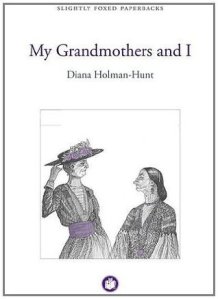 The author was the granddaughter of Pre-Raphaelite painter William Holman Hunt (The Light of the World et al.). While her father was away in India, she was shunted between two homes: Grandmother and Grandfather Freeman’s Sussex estate, and the mausoleum-cum-gallery her paternal grandmother, “Grand,” maintained in Kensington. The grandparents have very different ideas about the sorts of foodstuffs and activities that are suitable for little girls. Both households have servants, but Grand only has the one helper, Helen. Grand probably has a lot of money tied up in property and paintings but lives like a penniless widow. Grand encourages abstemious habits – “Don’t be ruled by Brother Ass, he’s only your body and a nuisance” – and believes in boiled milk and margarine. The single egg she has Helen serve Diana in the morning often smells off. “Food is only important as fuel; whether we like it or not is quite immaterial,” Grand insists. Diana might more naturally gravitate to the pleasures of the Freeman residence, but when it comes time to give a tour of the Holman Hunt oeuvre, she does so with pride. There are some funny moments, such as Diana asking where babies come from after one of the Freemans’ maids gives birth, but this felt so exaggerated and fictionalized – how could she possibly remember details and conversations at the distance of several decades? – that I lost interest by the midpoint.
Readalike: Gwen Raverat’s Period Piece
 (Secondhand – Community Furniture Project) [Slightly Foxed]
In Transit: Poems of Travel, ed. Sarah Jackson and Tim Youngs (2018)
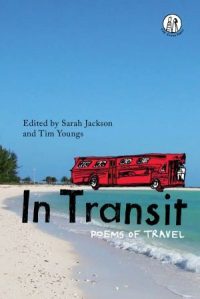 Some methods of transport are just more romantic than others. The editors’ introduction notes that “Trains were by far the most popular … followed by aeroplanes and then boats.” Walks and car journeys were surprisingly scarce, they observed, though there are a couple of poems about wandering in New York City. Often, the language is of maps, airports, passports and long flights; of trading one place for another as exile, expatriate or returnee. The collection circuits the globe: China, the Middle East, Greece, Scandinavia, the bayous of the American South. France and Berlin show up more than once. The Emma Press anthologies vary and this one had fewer standout entries than average. However, a few favourites were Nancy Campbell’s “Reading the Water,” about a boy launching out to sea in a kayak; Simon Williams’s “Aboard the Grey Ghost,” about watching for dolphins on a wartime voyage from England to the USA; and Vicky Sparrow’s “Dual Gauge,” which follows a train of thought – about humans as objects moving, perhaps towards death – during a train ride.
(New purchase from publisher) [The Emma Press]
Findings by Kathleen Jamie (2005)
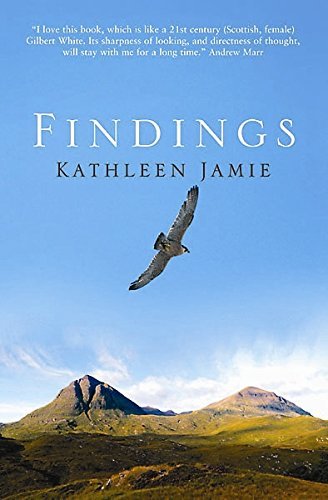 As I found when I reread Sightlines in 2022, Jamie’s topics couldn’t be better suited to my interests: Scottish islands, seabirds, medical history, and the meaning we derive from mortality. She visits the Orkney Islands just before the winter solstice, which draws a faithful few to the tomb of Maes Howe. From her attic room in Fife, she watches peregrine falcons on a cliff face. A gannet’s skull is her prized souvenir from a boat tour to an uninhabited Hebridean island. Vigilance pays off when she hears, then sees, corncrake on the Isle of Coll. Although she has a penchant for empty places, she also writes about cityscapes and hospitals. “Skylines” looks out over Edinburgh, also the setting for “Surgeons’ Hall,” about the pathology museum on the Royal College of Surgeons campus (my 2018 visit). In “Fever” her husband has a scary bout of pneumonia. Jamie is one of our wisest writers on nature and human culture. She asks whether any creatures are truly wild given the pervasiveness of human influence. Even as she seeks out the ancient, she knows we are all ephemeral. “Sabbath” is the best single essay, combining a visit to Lewis with her worry for her mother, who’s had a stroke, and her grandmother, who is to move into a care home. She explores the island “relishing the movement of my body, its own small continuing strength. It wouldn’t last forever – that was the truth of it – but today I could cycle along a road, to see where it led.”
(University library) [Sort Of Books]
My rating in 2012:
My rating now: 
Ladies, Ladies, Ladies by Kristen Zory King (2025)
 I’d never encountered “chapbook” being used for prose rather than poetry, but it’s an apt term for this 61-page paperback containing 18 stories. It’s remarkable how much King can pack into just a few pages: a voice, a character, a setting and situation, an incident, a salient backstory, and some kind of epiphany or resolution. Fifteen of the pieces focus on one named character, with another three featuring a set (“Ladies,” hence the title). Laura-Jean wonders whether it was a mistake to tell her ex’s mother what she really thinks about him in a Christmas card. A love of ice cream connects Margot’s past and present. A painting in a museum convinces Paige to reconnect with her estranged sister. Alice is sure she sees her double wandering around, and Mary contemplates stealing other people’s cats. The women are moved by rage or lust; stymied by loneliness or nostalgia. Is salvation to be found in scripture or poetry? Each story is distinctive, with no words wasted. I’ll look out for future work by King.
(Duplicate copy passed on by Marcie – thank you!) [Stanchion Books]
Which of these do you fancy reading?
Six more indie publishers spotlighted, for a total of 19 books and 18 publishers this month – job done!
Also covered:
Ansell, Farrier, Febos, Hoffman, Orlean, Stacey
Chevillard, Hopkins & Bateman, McGrath, Richardson
Victorian-Themed Novels by Annie Elliot and Livi Michael
There are plenty more indie books that I’m in the middle of, or picked out but didn’t get to in February. As much as possible, I’ll continue reading (indie) books from my shelves this year.
#ReadIndies Review Catch-Up: Chevillard, Hopkins & Bateman, McGrath, Richardson
Quick thoughts on some more review catch-up books, most of them from 2025. It’s a miscellaneous selection today: absurdist flash fiction by a prolific French author, a self-help graphic novel about surviving heartbreak, a blend of bird photography and poetry, and a debut poetry collection about life and death as encountered by a parish priest.
Museum Visits by Éric Chevillard (2024)
[Trans. from French by David Levin Becker]
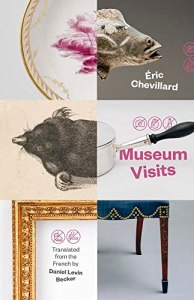 I’d not heard of Chevillard, even though he’s published 22 novels and then some. This appealed to me because it’s a collection of micro-essays and short stories, many of them witty etymological or historical riffs. “The Guide,” a tongue-in-cheek tour of places where things may have happened, reminded me of Julian Barnes: “So, right here is where Henri IV ran a hand through his beard, here’s where a raindrop landed on Dante’s forehead, this is where Buster Keaton bit into a pancake” and so on. It’s a clever way of questioning what history has commemorated and whether it matters. Some pieces elaborate on a particular object – Hegel’s cap, a chair, stones, a mass attendance certificate. A concertgoer makes too much of the fact that they were born in the same year as the featured harpsichordist. “Autofiction” had me snorting with laughter, though it’s such a simple conceit. All Chevillard had to do in this authorial rundown of a coming of age was replace “write” with “ejaculate.” This leads to such ridiculous statements as “It was around this time that I began to want to publicly share what I was ejaculating” and “I ejaculate in all the major papers.” There are some great pieces about animals. Others outstayed their welcome, however, such as “Faldoni.” Most feel like intellectual experiments, which isn’t what you want all the time but is interesting to try for a change, so you might read one or two mini-narratives between other things.
With thanks to the University of Yale Press for the free copy for review.
What to Do When You Get Dumped: A Guide to Unbreaking Your Heart by Suzy Hopkins; illus. Hallie Bateman (2025)
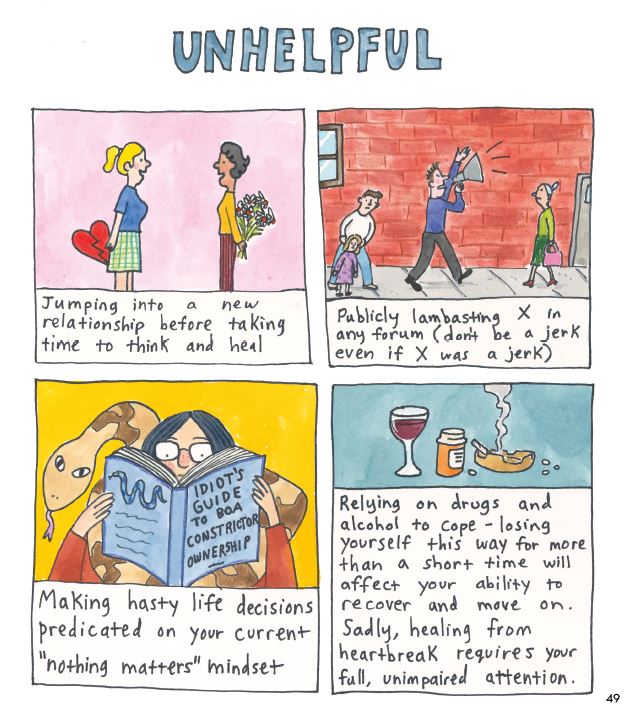
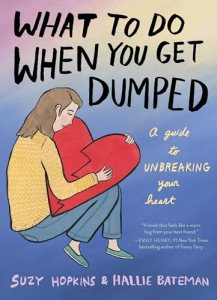 Discovered through Molly Wizenberg’s excellent author interview (she did a series on her Substack, “I’ve Got a Feeling”) with illustrator Hallie Bateman. It’s a mother–daughter collaboration – their second, after What to Do When I’m Gone, a funny advice guide that’s been likened to Roz Chast’s work (I’ve gotta get that one!). Hopkins’s husband of 30 years left her for an ex-girlfriend. (Ironic yet true: the girlfriend was a marriage counselor.) Composed while deep in grief, this is a frank look at the flood of emotions that accompany a breakup and gives wry but heartfelt suggestions for what might help: journaling, telling someone what happened, cleaning, making really easy to-do lists. Hopkins interviewed six others who had been dumped to get some extra perspective. Bateman describes her mother’s writing process: she made notes and stuck them in a shoebox with a hole in the lid, then went on a retreat to combine it all into a draft. At this point Bateman started illustrating. It was complicated for her, of course, because the dumper is her dad. She notes in the interview that she couldn’t just say “He’s an asshole” and dismiss him. But she could still position herself as a girlfriend to her mother, listening and commiserating. The vignettes are structured as a countdown starting with day 1,582 – it took over four years for Hopkins to come to terms with her loss and embrace a new life. This is a cute and gentle book that I wish had been around for my mom; it’s a heck of a lot cheaper than therapy.
With thanks to Bloomsbury for the free e-copy for review.
The Beauty of Vultures by Wendy McGrath; photos by Danny Miles (2025)
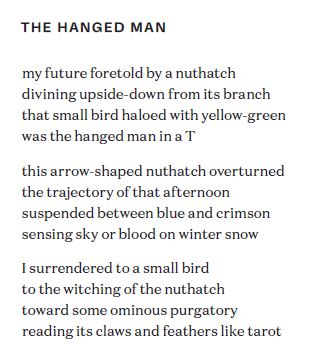
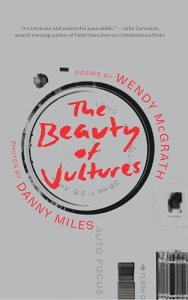 I enjoyed McGrath’s Santa Rosa trilogy and was keen to try her poetry, so I’m pleased that Marcie’s review pointed me here. McGrath came to collaborate with Miles, a musician, after her son told her of Miles’s newfound love of bird photography. She writes in her introduction that she wanted to go “beyond a simple call-and-response,” to instead use the photos as “portals” into art, history, memory, mythology, wordplay. The form varies to suit the topic: “sonnet, pantoum, acrostic, ghazal, concrete poem, … even a mini-play.” (I didn’t identify all of these on a first read, to be honest.) One poem imitates a matchbox cover and another is printed sideways. Most of the images are black-and-white close-ups, with a handful in colour. There are a few mammals as well as birds. One notable flash of colour is the recipient of the first poem, the sassy rebuttal “A Message from the Peahen to the Peacock.” The hen tells him to quit with the fancy displays and get real: “I’ve seen that gaudy display too often.”
Other poems describe birds, address them directly, or take on their perspectives. Birds are a reassuring presence (cf. Ted Hughes on swifts): “I counted on our robins to return every spring” as a balm, the anxious speaker reports in “Air raid siren.” A nest of gape-mouthed baby swallows in an outhouse is the prize at the end of a long countryside walk. With its alliteration and repetition, “The Goldfinch Charm” feels like an incantation. Birds model grace (or at least the appearance of grace):
Assume a buoyancy, lightness, as though you were about to fly.
That yellow rubber duck is my surreal mythology.
Head above water. Stay calm. Paddle like crazy.
They link the natural world and the human in these gorgeous poems that interact with the images in ways that both lead and illuminate.
A female swan is a pen and eyes open
I try to write this dream:
a moment stolen or given.
Published by NeWest Press. With thanks to the author for the free e-copy for review.
Dirt Rich by Graeme Richardson (2026)
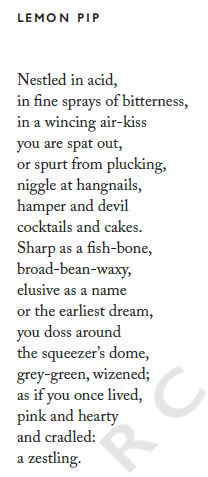
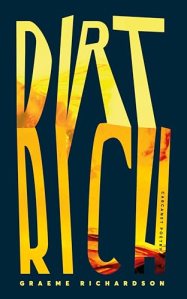 Dirt poor? Nah. Miners, gravediggers and archaeologists will tell you that dirt is precious. It’s where lots of our food and minerals come from; it’s what we’ll return to – our bodies as well as the material traces of what we loved and cared for. Richardson, the poetry critic for the Sunday Times, comes from Nottinghamshire mining country and has worked as a chaplain and parish priest. He writes of church interiors and cemeteries, funerals and crumbling faith. There’s a harsh reminder of life’s unpredictability in the juxtaposition of “For the Album,” about the photographic evidence of a wedding day; and, beginning on the facing page, “After the Death of a Child.” It opens with “A Pastoral Heckle”: “The dead live on in memory? Not true. / They lodge there dead, and yours not theirs the hell.” Richardson now lives in Germany, so there are continental scenes as well as ecclesial English ones. The elegiac tone of standouts such as “Last of the Coalmine Choirboys” (with its words drawn from scripture and hymns) is tempered by the chaotic joy of multiple poems about parenthood in the final section. Throughout, the imagery and language glisten. I loved the slant rhyme, assonance and sibilance in “Rewilding the Churchyard”: “Cedars and self-seeders link / with the storm-forked sycamore.” I highly recommend this debut collection.
With thanks to Carcanet Press for the advanced e-copy for review.
Which of these do you fancy reading?
#NovNov25 Final Statistics & Some 2026 Novellas to Look Out For (Chapman, Fennelly, Gremaud, Miles, Netherclift & Saunders)
Novellas in November 2025 was a roaring success: In total, we had 50 bloggers contributing 216 posts covering at least 207 books! The buddy read(s) had 14 participants. If you want to take a look back at the link parties, they’re all here. It was our best year yet – thank you.
*For those who are curious, our most reviewed book was The Wax Child by Olga Ravn (4 reviews), followed by The Most by Jessica Anthony (3). Authors covered three times: Franz Kafka and Christian Kracht. Authors with work(s) reviewed twice: Margaret Atwood, Nora Ephron, Hermann Hesse, Claire Keegan, Irmgard Keun, Thomas Mann, Patrick Modiano, Edna O’Brien, Clare O’Dea, Max Porter, Brigitte Reimann, Ivana Sajko, Georges Simenon, Colm Tóibín and Stefan Zweig.*

I read and reviewed 21 novellas in November. I happen to have already read six with 2026 release dates, some of them within November and others a bit earlier for paid reviews. I’ll give a quick preview of each so you’ll know which ones you want to look out for.
The Pass by Katriona Chapman
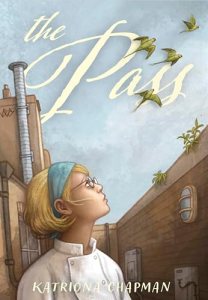 Claudia Grace is a rising star in the London restaurant world: in her early thirties, she’s head chef at Alley. But she and her small team, including sous chef Lisa, her best friend from culinary school; and Ben, the innovative Black bartender, face challenges. Lisa has a young son and disabled husband, while Ben is torn between his love of gardening and his commitment to Alley. Claudia is more stressed than ever as she prepares for a competition. All three struggle with their parents’ expectations. A financial crisis comes out of nowhere, but the greater threat is related to motivation. I was drawn to this graphic novel for the restaurant setting, but it’s more about families and romantic relationships than food. Several characters look too alike or much younger or older than they’re supposed to, while there’s a sudden ending that suggests a sequel might follow. (Fantagraphics, Jan. 20) [184 pages] (Read via Edelweiss)
The Irish Goodbye: Micro-Memoirs by Beth Ann Fennelly
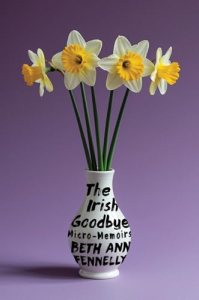 I’ve also read Fennelly’s previous collection of miniature autobiographical essays, Heating & Cooling. She takes the same approach as in flash fiction: some of these 45 pieces are as short as one sentence, remarking on life’s irony, poignancy or brevity. Again and again she loops back to her sister’s untimely death (the title reference: “without farewells, you slipped out the back door of the party of your life”); other major topics are her mother’s worsening dementia, her happy marriage, her continuing 28-year-old friendships with her college roommates, the pandemic, and her ageing body. Every so often, Fennelly experiments with third- or second-person narration, as when she recalls making a perfect gin and tonic for Tim O’Brien. One of the most in-depth pieces revisits a lonely stint teaching in Czechoslovakia in the early 1990s. Returning to the town recently, she is astounded that so many recognize her and that a time she experienced as bleak is the stuff of others’ fond memories. I also loved the long piece that closes the collection, “Dear Viewer of My Naked Body,” about being one of the 12 people in Oxford, Mississippi to pose nude for a painter in oils. Brilliant last phrase: “Enjoy the bunions.” (W.W. Norton & Company, Feb. 24) [144 pages] (Read via Edelweiss)
Generator by Rinny Gremaud (2023; 2026)
[Trans. from French by Holly James]
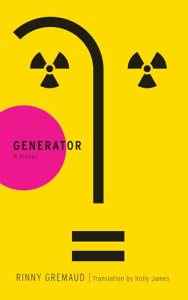 “I was born in 1977 at a nuclear power plant in the south of South Korea,” the unnamed narrator opens. She and her mother then moved to Switzerland with her stepfather. In 2017, news of Korea’s plans to decommission the Kori 1 reactor prompts her to trace her birth father, who was a Welsh engineer on the project. As a way of “walking my hypotheses,” she travels to Wales, Taiwan (where he had a wife and family), Korea, and Michigan, his last known abode. In parallel, she researches the history of nuclear power. By riffing on the possible definitions of generation, this lyrical autofiction comments on creation and legacy. Full Foreword review forthcoming. (Schaffner Press, Jan. 7) [197 pages] (PDF review copy)
Eradication: A Fable by Jonathan Miles
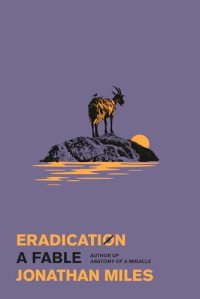 This taut, powerful fable pits an Everyman against seemingly insurmountable environmental and personal problems. Who wouldn’t take a job that involves “saving the world”? Adi, the antihero of Jonathan Miles’s fourth novel, is drawn to the listing not just for the noble mission but also for the chance at five weeks alone on a Pacific island. Santa Flora once teemed with endemic birds and reptiles, but many species have gone extinct because of the ballooning population of goats. He’s never fired a gun, but the mysterious “foundation” was so desperate it hired him anyway. It’s a taut parable reminiscent of T.C. Boyle’s When the Killing’s Done. My full Shelf Awareness review is here. (riverrun, 5 Feb. / Doubleday, Feb. 10) [176 pages] (Read via Edelweiss)
Vessel: The shape of absent bodies by Dani Netherclift
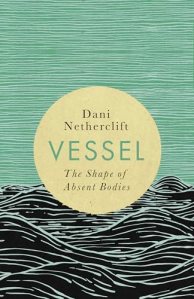 One scorching afternoon in 1993, the author’s father and brother drowned while swimming in an irrigation channel near their Australia home. A joint closed-casket funeral took place six days later. Eighteen at the time, Netherclift witnessed her relatives’ disappearance but didn’t see their bodies. Must one see the corpse to have closure? she wonders. “The presence of absence” is an overarching paradox. There are lacunae everywhere: in her police statement from the fateful day; in her journal and letters from that summer. The contradictions and ironies of the situation defy resolution. Full Foreword review forthcoming. (Assembly Press, Jan. 13) [184 pages] (PDF review copy)
Vigil by George Saunders
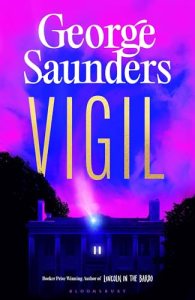 Impossible not to set this against the exceptional Lincoln in the Bardo, focused as both are on the threshold between life and death. Unfortunately, the comparison is not favourable to Vigil. A host of the restive dead visit the dying to offer comfort at the end. Jill Blaine’s life was cut short when she was murdered by a car bomb in a case of mistaken identity. Her latest “charge” is K.J. Boone, a Texas oil tycoon who not only contributed directly to climate breakdown but also deliberately spread anti-environmentalist propaganda through speeches and a documentary. As he lies dying of cancer in his mansion, he’s visited by, among others, the spirits of the repentant Frenchman who invented the engine and an Indian man whose family perished in a natural disaster. I expected a Christmas Carol-type reckoning with climate past and future; in resisting such a formula, Saunders avoids moralizing – oblivion comes for the just and the unjust. However, he instead subjects readers to a slog of repetitive, half-baked comedic monologues. I remain unsure what he hoped to achieve with the combination of an irredeemable character and an inexorable situation. All this does is reinforce randomness and hopelessness, whereas the few other Saunders works I’ve read have at least reassured with the sparkle of human ingenuity. YMMV. (Bloomsbury / Random House, 27 Jan.) [192 pages] (Read via NetGalley)
Short Story Catch-Up: Carver, Cunningham, Park, Polders, Racket, Schweblin, Williams (& Heti Stand-Alone)
I actually read 15 collections in total for Short Story September. I’m finally catching up on reviews, though I’m aware that I’ve missed out on Lisa’s link-up. (My other reviews: Heiny, Mackay, McEwan; the BBC National Short Story Award 2025 anthology; Donoghue, Grass, Isherwood, Mansfield as part of my Germany reading.) To keep it simple and get the basics across before I forget any more about these books, I’ll post some shorthand notes under headings.
Cathedral by Raymond Carver (1983)
Why I read it:
- I’d really enjoyed What We Talk about When We Talk about Love.
- This fits into my project to read books from my birth year.
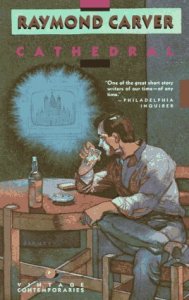 Stats: 12 stories (6 x 1st-person, 6 x 3rd-person)
Themes: alcoholism, adultery, fatherhood, crap jobs, crumbling families
Tone: melancholy, laconic
File under: grit-lit
For fans of: John Cheever, Ernest Hemingway, Denis Johnson
Caveat(s): It doesn’t match What We Talk about When We Talk about Love.
If you read just one story, make it: “A Small, Good Thing”
(University library)
A Wild Swan and Other Tales by Michael Cunningham (2015)
Why I read it:
- I have a vague plan to read through Cunningham’s whole oeuvre.
- This one is different to his others, and beautifully illustrated by Yuko Shimizu.
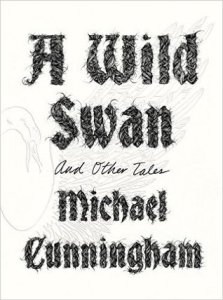 Stats: 11 stories (3 x 2nd-person, 8 x 3rd-person)
Themes: coming of age, longing, loss, bargaining
Tone: witty, knowing
File under: fairy tale updates
For fans of: Margaret Atwood, Neil Gaiman
Caveat(s): For the most part, he doesn’t do anything interesting with the story lines.
If you read just one story, make it: “Little Man” (the Rumpelstiltskin remake)
(Secondhand – Awesomebooks.com)
An Oral History of Atlantis by Ed Park (2025)
Why I read it:
- I’d heard buzz, probably because Park was a Pulitzer Prize finalist for his novel.
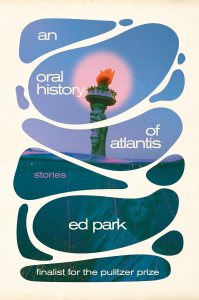 Stats: 16 stories (12 x 1st-person, 1 x 1st-person plural, 1 x 2nd-person, 2 x 3rd-person)
Themes: the Asian American and university experience, writing, translation, aphorisms
Tone: jokey, nostalgic
File under: dystopian fiction, metafiction
For fans of: George Saunders
Caveat(s): There’s more intellectual experimentation than emotional engagement.
If you read just one story, make it: “An Accurate Account”
(Read via NetGalley)
Woman of the Hour by Clare Polders (2025)
Why I read it:
- I always like to sneak at least one flash fiction collection in for this challenge.
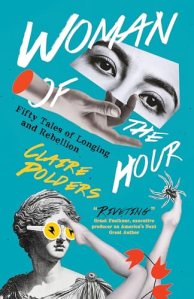 Stats: 50 stories, a mixture of 1st- and 3rd-person
Themes: childhood, sexuality, motherhood, choices vs. fate
Tone: sharp, matter-of-fact
File under: feminist, satire
For fans of: Claire Fuller, Terese Svoboda
Caveat(s): There’s too many stories to keep track of and not enough stand-outs.
If you read just one story, make it: “Woman of the Hour”
(BookSirens)
Racket: New Writing Made in Newfoundland, ed. Lisa Moore (2015)
Why I read it:
- Naomi’s blog always whets my appetite for Atlantic Canadian fiction, but I’m rarely able to find it over here.
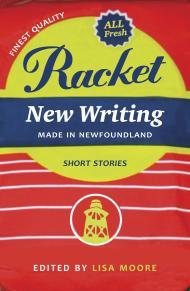 Stats: 11 stories, mostly by Memorial University creative writing graduates (7 x 1st-person, 1 x 2nd-person, 3 x 3rd-person)
Themes: mental health, bereavement, tragic accidents
Tone: jaunty, reflective
File under: voice-y early-2000s lit-fic
For fans of: Sharon Bala (her story is among the best here), Jonathan Safran Foer; hockey
Caveat(s): I wouldn’t say I’m now a fan of any of the writers I hadn’t heard of before.
If you read just one story, make it: “23 Things I Hate in No Particular Order” by Gary Newhook
(Little Free Library)
Good and Evil and Other Stories by Samanta Schweblin (2025)
[Translated from Spanish by Megan McDowell]
Why I read it:
- I thought it would be good to add in another title in translation.
- I’d read Schweblin before (but I wish I’d remembered that I rated Fever Dream 2*.)
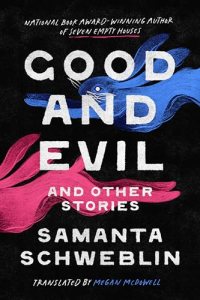 Stats: 6 stories (5 x 1st-person, 1 x 3rd-person)
Themes: near-misses, grief, memory, suicidal ideation
Tone: introspective, jaded
File under: Latin American weirdness (some mild magic realism)
For fans of: Guadalupe Nettel (The Accidentals is very similar but a bit better)
Caveat(s): A couple of the stories are overlong and none of them are particularly memorable.
If you read just one story, make it: “William in the Window”
(Read via NetGalley) 
The Doctor Stories by William Carlos Williams, compiled by Robert Coles (1939)
Why I read it:
- I’m not sure how I came across it; perhaps through another doctor–author such as Gavin Francis or Atul Gawande?
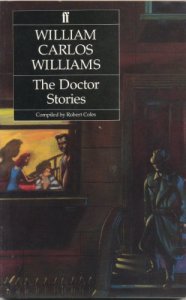 Stats: 14 stories (plus a handful of poems and an autobiographical fragment), all 1st-person
Themes: addiction, childbirth, immigrants, poverty, the randomness of suffering
Tone: hardboiled, dedicated
File under: autofiction, dirty realism
For fans of: Raymond Carver, Gabriel Weston
Caveat(s): The descriptions of immigrants’ appearance/behaviour/speech is not always kind.
If you read just one story, make it: “Old Doc Rivers”
(University library)
And a stand-alone story:
“The St. Alwynn Girls at Sea” by Sheila Heti (New Yorker, 2025)
To my knowledge, this is the only short fiction Heti has published. I’m generally a big fan of her bizarre autofiction – though Pure Colour was a step too far for me – and was fascinated to see on Eleanor’s blog that this is historical fiction, a genre Heti hasn’t attempted before. Or is it historical? The students of a girls’ boarding school have been sent out on a ship for their safety during a conflict. With news of a planned meet-up with a boys’ boat for a talent show and calls to knit socks for soldiers, it seems it must be the Second World War. But then there are references to headphones, Prince and Kurt Vonnegut. So it’s an alternative Cold War fantasy? Or a dystopian future scenario with retro elements? As in Motherhood, the characters appeal to an Oracle (here, a photograph of a departed girl called Audrey) when stymied by confusion. But the actual plot is just girls wanting men to love them – Dani obsesses about Sebastien, with whom she’s exchanging letters; Flora can’t stop thinking about her father’s infidelity – a common Heti theme, but the teenage perspective feels glib, indulgent; it’s YA without the heart or commitment. So I was somewhat aghast to learn this is from Heti’s novel in progress.
2025 Releases Read So Far, Including a Review of Aerth by Deborah Tomkins
I’ve gotten to 22 books with a 2025 publication date so far, most of them for paid reviews for Foreword Reviews or Shelf Awareness. I give review excerpts, links where available, and ratings below to pique your interest. (I’ll follow up on Friday with a list of my 25 Most Anticipated titles for the first half of the year!) First, though, it’s time to introduce you to the joint winner of the inaugural Weatherglass Novella Prize, as chosen by Ali Smith – I reviewed the other winner, Astraea by Kate Kruimink, as part of Novellas in November.
Aerth by Deborah Tomkins
At Weatherglass Books’ “The Future of the Novella” event in September (my write-up is here), I was intrigued to learn about this sci-fi novella in flash set on alternative Earths. The draft title was “First, Do No Harm,” referring to one of the five mantras for life on Aerth, a peaceful matriarchal planet that has been devastated by a pandemic. Magnus, the Everyman protagonist, is his parents’ only surviving offspring after their first nine children died of the virus. We meet Magnus in what seems an idyllic childhood of seasonal celebrations and his mother’s homemade cakes. But the weight of his parents’ expectations is too much, and after his relationship with Tilly disintegrates, he decides to fulfil a long-held ambition of becoming an astronaut and travelling to Urth. Here he starts off famous – a sought-after talking head in the media with the ear of the prime minister – but public opinion eventually turns against him.

Urth could be modelled on contemporary London: polluted, capitalist and celebrity-obsessed. But it would be oversimplifying to call Aerth a pre-industrial foil; although at first its lifestyle seems more wholesome, later revelations force us to question why it developed in this way. The planets are twins with potentially parallel environmental and societal trajectories and some exact counterparts; the hints about this “mirrorverse” are eerie. It all could have added up to an unsubtle allegory in which Aerth represents what we should aspire to and Urth symbolizes what we must resist, but Tomkins makes it more nuanced than that. Magnus’s homesickness when he fears he’s trapped on Urth is a heart-rending element, and the diverse styles and formats (such as lists, documents, and second-person sections) keep things interesting. The themes of parenting and loneliness are particularly potent.
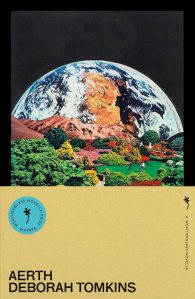 Tomkins first wrote this for the Bath Prize in 2018 and was longlisted. She initially sent the book out to science fiction publishers but was told that it wasn’t ‘sci-fi enough’. I can see how it could fall into the gap between literary fiction and genre fiction: though it’s set on other planets and involves space travel, its speculative nature is understated; it feels more realist. A memorable interrogation of longing and belonging, this novella ponders the value of individuals and their choices in the midst of inexorable planetary trajectories.
(Wowee, Aerth made it onto Eric of Lonesome Reader’s Top Ten list for 2024!)
With thanks to Weatherglass Books for the free copy for review. Aerth will be released on 25 January.
My top recommendations so far for 2025:
(in alphabetical order) All:
 Save Me, Stranger by Erika Krouse (Flatiron Books, January 21): These 12 first-person narratives are voiced by people in crisis, for whom encounters with strangers tender the possibility of transformation. In the title story, the narrator is taken hostage in a convenience store hold-up. Krouse frequently focuses on young women presented with dilemmas. In “The Pole of Cold,” Vera meets Theo, the son of the American weather researchers who died in the same Siberian plane crash that killed her reindeer herder father. Travel is a recurring element, with stories set in Thailand and Japan as well as various U.S. states. The book exhibits tremendous range, imagining a myriad places, minds, and situations. Krouse often eschews tidy endings, leaving characters on the brink and allowing readers to draw inferences about what they will decide. Fans of Danielle Evans and Lauren Groff have a treat in store.
 Immemorial by Lauren Markham (Transit Books, February 4): This outstanding book-length essay compares language, memorials, and rituals as strategies for coping with climate anxiety and grief. The dichotomies of the physical versus the abstract and the permanent versus the ephemeral are explored; the past, present, and future dance through the text. With language not changing at the pace of the climate, Markham turns to the “Bureau of Linguistical Reality” for help coining a new term for anticipatory ecological grief. The title is one candidate, “premation” another. Forthright, wistful, and determined, the book treats grief as a positive, as “fuel” or a “portal.” Hope is not theoretical in this setup, but solidified in action. In Markham’s case, becoming a parent embodied her trust in the future. Immemorial is an elegant meditation on memory and impermanence in an age of climate crisis.
 Y2K: How the 2000s Became Everything (Essays on the Future that Never Was) by Colette Shade (out today from Dey Street Books!): Shade’s debut collection contains 10 perceptive essays that contrast the promise and political pitfalls of “the Y2K Era” (1997–2008). The author was an adolescent at the turn of the millennium and recalls the thrill of early Internet use and celebrity culture. Consumerism was a fundamental doctrine but the financial crash prompted a loss of faith in progress. It’s a feast of millennial nostalgia but also a hard-hitting work of cultural criticism.
 Show Don’t Tell by Curtis Sittenfeld (Random House, February 25; Transworld, 27 February): Sittenfeld’s second collection features characters negotiating principles and privilege in midlife. The 12 stories spotlight everyday marital and parenting challenges. Dual timelines offer opportunities for hindsight on the events of decades ago. College and boarding school experiences, in particular, remain pivotal. The arbitrary nature of wealth and celebrity is a central theme. Warm, witty, and insightful.
Other 2025 releases:
(in publication date order)
 How Isn’t It Going? Conversations after October 7 by Delphine Horvilleur [trans. from the French by Lisa Appignanesi] (out today from Europa Editions!): There is by turns a stream of consciousness or folktale quality to the narrative as Horvilleur enacts 11 dialogues – some real and others imagined – with her late grandparents, her children, or even abstractions. She draws on history, scripture and her own life, wrestling with thoughts that come during insomniac early mornings. It’s a lament for the Jewish condition, and a warning of the continuing and insidious nature of antisemitism. But it’s not all mourning; there is sometimes a wry sense of humour that feels very Jewish.
 Cold Kitchen: A Year of Culinary Travels by Caroline Eden (Out in UK since May 2024; U.S. release: Bloomsbury, January 14): Eden cooks and writes in the basement kitchen of her Edinburgh apartment. When wanderlust strikes, she revisits favorite places via their cuisine. Her sumptuous fourth book journeys across Central Asia and Eastern Europe, harvesting memories and recipes. (Plus my Shelf Awareness interview)
 North of Ordinary by John Rolfe Gardiner (Bellevue Literary Press, January 14): I read 5 of 10 stories about young men facing life transitions and enjoyed the title one set at a thinly veiled Liberty University but found the rest dated in outlook; all have too-sudden endings.
 If Nothing by Matthew Nienow (Alice James Books, January 14): Straightforward poems about giving up addiction and seeking mental health help in order to be a good father.
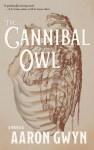 The Cannibal Owl by Aaron Gwyn (Belle Point Press, January 28): An orphaned boy is taken in by the Comanche in 1820s Texas in a brutal novella for fans of Cormac McCarthy.
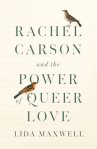 Rachel Carson and the Power of Queer Love by Lida Maxwell (Stanford University Press, January 28): Maxwell’s enthusiastic academic study reappraises scientist Rachel Carson’s motivations in light of ecological crisis and queer studies.
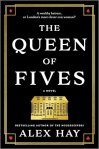 The Queen of Fives by Alex Hay (Graydon House, January 21; Headline, 30 January): Quinn Le Blanc, the latest in a dynasty of London con artists, resolves to pose as a debutante and marry a duke for his fortune – all in just five days in 1898. Like The Housekeepers, it’s a playful romp featuring strong female characters.
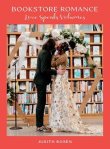 Bookstore Romance: Love Speaks Volumes by Judith Rosen (Brandeis University Press, February 1): A bibliophile’s time capsule and an enduring record of love and literary obsessions, this is a swoon-worthy coffee table book about couples who formalized their relationships in bookstores.
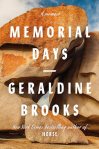 Memorial Days by Geraldine Brooks (Viking, February 4): This elegant bereavement memoir chronicles the sudden death of Brooks’s husband (journalist Tony Horwitz) in 2019 and her grief retreat to Flinders Island, Australia.
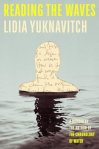 Reading the Waves by Lidia Yuknavitch (Riverhead, February 4): Yuknavitch’s bold memoir-in-essays focuses on pivotal scenes and repeated themes from her life as she reckons with trauma and commemorates key relationships. (A little too much repeated content from The Chronology of Water for me.)
 The Book of Flaco: The World’s Most Famous Bird by David Gessner (Blair, February 11): Gessner’s engaging nature book tells the story of the escaped Central Park Zoo Eurasian eagle-owl. It’s a touching tribute and a subtle challenge to reconsider human effects on wildlife.
 We Would Never by Tova Mirvis (Avid Reader Press, February 11): Mirvis’s fourth novel, inspired by real-life headlines, tells the taut story of an acrimonious divorce case gone horribly wrong. It explores the before and after of a murder, as the victim’s soon-to-be-ex-wife comes under suspicion and her family huddles around to protect her.
 The Café with No Name by Robert Seethaler [trans. from the German by Katy Derbyshire] (Europa Editions, 25 February): Set in 1960s and 1970s Vienna, where World War II still reverberates, this tender novel about a restaurateur’s interactions with acquaintances and customers meditates on the passage of time and bonds that last.
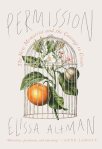 Permission: The New Memoirist and the Courage to Create by Elissa Altman (David R. Godine, March 4): Full of stories drawn from Altman’s life and other authors’ experience, this is an inspirational guide to defusing shame through self-disclosure and claiming the time and focus to write.
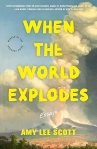 When the World Explodes: Essays by Amy Lee Scott (Mad Creek Books, March 6): Eleven inquisitive pieces set personal crises alongside natural disasters and gun violence. Scott was adopted as a baby from Korea; motherhood and adoption are potent themes across the book.
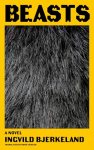 Beasts by Ingvild Bjerkeland [trans. from the Norwegian by Rosie Hedger] (Levine Querido, April 1): In this chilling young adult novella, a teenager tries to keep his little sister safe and reunite with their father in a hazardous postapocalyptic world.
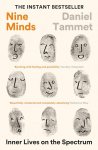 Nine Minds: Inner Lives on the Spectrum by Daniel Tammet (Out in UK since July 2024; U.S. release: The Experiment, April 1): A biographical mosaic of neurodivergence built of stories of individuals whose struggles and achievements defy the clichés surrounding autism. (Notable inclusions: actor Dan Aykroyd, novelist Naoise Dolan.)
Will you look out for one or more of these?
Any other 2025 reads you can recommend?
Short Stories in September Roundup: Alexie, Donoghue, Groff Anthology, Houston, McCracken, Moore, Svoboda, Walker
I gave myself an extra week to finish up the story collections I was in the middle of, so I’ve managed to read 13 during this challenge to self (including my first and second posts). Again I’m borrowing Marcie’s five-sentence review format to keep things simple.
The Lone-Ranger and Tonto Fistfight in Heaven by Sherman Alexie (1993)
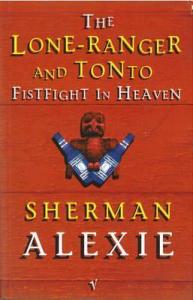 There are 22 stories in this fairly short book, so most top out at no more than 10 pages: little slices of life on and around the reservation at Spokane, Washington. Some central characters recur, such as Victor, Thomas Builds-the-Fire and James Many Horses, but there are so many tales that I couldn’t keep track of them across the book even though I read it quickly. My favourite was “This Is What It Means to Say Phoenix, Arizona,” in which Victor and Thomas fly out to collect the ashes of Victor’s father. Some of the longer titles give a sense of the tone: “Because My Father Always Said He Was the Only Indian Who Saw Jimi Hendrix Play ‘The Star-Spangled Banner’ at Woodstock” and “Jesus Christ’s Half-Brother Is Alive and Well on the Spokane Indian Reservation.” I couldn’t help but think of it as a so-so rehearsal for The Absolutely True Diary of a Part-Time Indian because a similar cast of drunks, jokers, relatives and basketball players populates the stories and a comparable voice prevails. (University library)
The Woman Who Gave Birth to Rabbits by Emma Donoghue (2002)
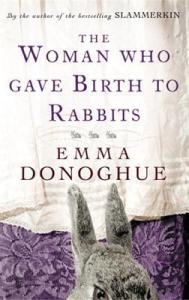 The title story is about Mary Toft – I thought of making her hoax the subject of a Three on a Theme post because I actually have two novels about her downloaded from NetGalley and Edelweiss (Mary and the Rabbit Dream by Noémi Kiss-Deáki and Mary Toft; or, The Rabbit Queen by Dexter Palmer), but the facts as conveyed here don’t seem like nearly enough to fuel a whole book, so I doubt I’ll read those. Donoghue has a good eye for historical curios and incidents and an academic’s gift for research, yet not many of these 17 stories, most of which are in the third person, rise above the novelty. Many protagonists are British or Irish women who were a footnote in the historical record: an animal rights activist, a lord’s daughter, a cult leader, a blind poet, a medieval rioter, a suspected witch. There are mild homoerotic touches, too. I enjoyed “Come, Gentle Night,” about John Ruskin’s honeymoon, and “Cured,” which reveals a terrifying surgical means of controlling women’s moods but, as I found with Astray and Learned by Heart, Donoghue sometimes lets documented details overwhelm other elements of a narrative. (Secondhand – Awesomebooks.com)
The Best Short Stories 2023: The O. Henry Prize Winners, ed. Lauren Groff (2023)
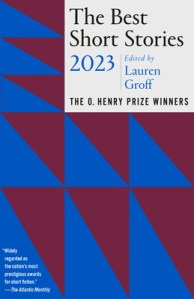 Hard to convey the variety of this 20-story anthology in a concise way because they run the gamut from realist (Nigerian homosexuality in “Happy Is a Doing Word” by Arinze Ifeakandu; Irish gangsters in “The Blackhills” by Eamon McGuinness) to absurd (Ling Ma’s “Office Hours” has academics passing through closet doors into a dream space; the title of Catherine Lacey’s “Man Mountain” is literal; “Ira and the Whale” is Rachel B. Glaser’s gay version of the Jonah legend). Also difficult to encapsulate my reaction, because for every story I would happily have seen expanded into a novel (the gloomy character study “The Locksmith” by Grey Wolfe LaJoie, the teenage friends’ coming-of-age in “After Hours at the Acacia Park Pool” by the marvellous Kirstin Valdez Quade), there was another I thought might never end (“Dream Man” by Cristina Rivera-Garza and “Temporary Housing” by Kathleen Alcott). Three are in translation. I admired Lisa Taddeo’s tale of grief and revenge, “Wisconsin,” and Naomi Shuyama-Gómez’s creepy Colombian-set “The Commander’s Teeth.” But my two favourites were probably “Me, Rory, and Aurora” by Jonas Eika (Danish), which combines an uneasy threesome, the plight of the unhoused and a downright chilling Ishiguro-esque ending; and “Xífù,” K-Ming Chang’s funny, morbid take on daughter/mother-in-law relations in China. (PDF review copy)
Waltzing the Cat by Pam Houston (1998)
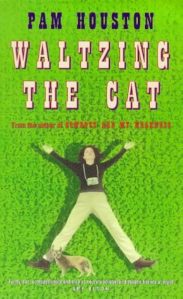 The novel-in-stories is about Lucy, a photographer in her early thirties with a penchant for falling for the wrong men – alcoholics or misogynists or ones who aren’t available. When she’s not working she’s thrill-seeking: rafting in Colorado, travelling in the Amazon, sailing in the Caribbean, or gliding. “Everything good I’ve gotten in life I’ve gotten by plunging in,” she boasts, to which a friend replies, “Sure, and everything bad you’ve gotten in your life you’ve gotten by plunging in.” Ultimately she ‘settles down’ on the Colorado ranch she inherits from her grandmother with a dog, making this – based on what I learned from the autobiographical essays in Deep Creek – even more autofiction for Houston than her debut, Cowboys Are My Weakness, was. Although the final magic realist touch of having her child-self come to her with a box of photographs of traumatic memories is overdone, the themes of accepting vulnerability, seeking to freeze time and creating a home for yourself resonated, and the title story, about the death of Lucy’s mother, is a brilliant and heart-wrenching standalone. (Secondhand – British Red Cross, Berwick)
The Souvenir Museum by Elizabeth McCracken (2021)
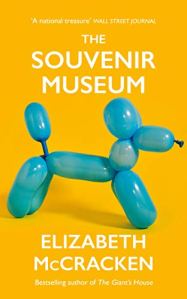 McCracken is terrific in short forms: The Hero of This Book, a novella, was one of my top books of 2022, and I also loved her previous story collection, Thunderstruck. Five of these dozen stories are taken from different points in the lives of Jack and Sadie, English and American academics (who I inevitably read as McCracken and her husband, Edward Carey) who come from large-family zaniness versus claustrophobic mother–daughter melancholy. I kept thinking that McCracken’s are just the sorts of scenarios Lucy and Olive would have told stories about in Tell Me Everything: accidents, misfortunes; random connections. Travel is a major element in many of the stories, including to Denmark (in the title story) and Amsterdam. I couldn’t decide whether I preferred the Jack-and-Sadie material or the rest, but I had a favourite from each: “The Irish Wedding” cracked me up as much as it did Sadie with the accidental use of crass American slang, while “Proof,” about a man communing with his father despite his early dementia, is set on a boat trip I’ve made (in 2004!) to see puffins on the Treshnish islands of Scotland. (Secondhand – Dogs Trust charity shop, Marlborough)
Like Life by Lorrie Moore (1990)
 Compared to Birds of America, this feels a little dated and the plots are overall less memorable. Still, the eight stories of Moore’s second collection are chewy with insight into relationships and the mindsets of youngish and middle-aged women, and there’s an effortless wry wit to her turns of phrase. Her exasperated would-be feminist characters remind me of Helen Simpson’s, while the cheese-selling protagonist of “Joy” made me think of an early Carol Shields story; and who knew a “cute meet” (aka a meet-cute) was a thing back then? New York City contrasts with the Midwest, most notably in “You’re Ugly, Too” and “The Jewish Hunter.” The title story, which comes last, crafts a weirdly muted dystopia built around shortages and marital misery; I preferred the (comparative lightness) of “Vissi d’Arte,” about a lonely playwright, and “Places to Look for Your Mind,” in which an empty-nest entrepreneur hosts an aimless young Englishman her daughter met on her study abroad year. (Secondhand – Bark charity shop, Berwick)
The Long Swim by Terese Svoboda (2023)
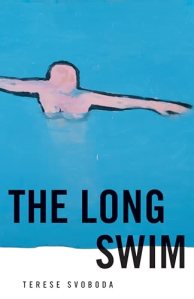 These 44 stories, mostly of flash fiction length, combine the grit of Denis Johnson with the bite of Flannery O’Connor. Siblings squabble over a late parent’s effects or wishes, marriages go wrong, the movie business isn’t as glittering as it’s cracked up to be, and drugs and alcohol complicate everything. The settings range through North America and the Caribbean, with a couple of forays to Europe. There are no speech marks and, whether the narrative is in first person or third, all the voices are genuine and distinctive yet flow together admirably. Svoboda has a poet-like talent for compact, zingy lines; two favourites were “my laziness is born of generalized-looking-to-get-specific grief, like an atom trying to make salt” (“Niagara”) and “Ditziness, a kind of Morse code of shriek-and-stop, erupts around the girls” (“Orphan Shop”).
Winner of the Juniper Prize for Fiction. Published by University of Massachusetts Press. With thanks to the author for the free PDF copy for review.
In Love and Trouble by Alice Walker (1973)
 I’d only ever read The Color Purple, so when I spotted this in a bookshop on our Northumberland holiday it felt like a good excuse to try something else by Walker. I had actually encountered one of the stronger stories before: “Everyday Use” is in the Close Company Virago anthology. In these Southern scenes (“a hate-filled state complete with magnolias, tornadoes and broken-tongued field hands”), Black women oppressed by fathers and partners gain what few advantages they can through deception or folk medicine. I liked “Entertaining God,” which opens with a boy abducting a gorilla from a zoo, and “To Hell with Dying,” about a friendship with an elderly neighbour in cotton country. Setting, style, characters; nothing drew me to any of the others or made me think I’ll read Walker again in the future. (Secondhand – Berrydin Books, Berwick)
Which of these would you read?
Currently reading: I’m not good at picking up short stories in the rest of the year, but I’ve discovered that I really enjoy reviewing them for Shelf Awareness – the length and format of their reviews really suits essay and story collections. So I’m now partway through Save Me, Stranger by Erika Krouse (2025) for an early Shelf Awareness review. Another book I started in Northumberland, Dreams of Dead Women’s Handbags by Shena Mackay, I didn’t finish in time for this challenge but will either continue or set aside and pick back up next year. Both are fantastic!
Short Stories in September, II: Willie Davis, Gerald Durrell, Sue Mell and Lore Segal
Four more collections down. Two of them blend fictional and autobiographical modes. Two are set primarily in New York City, with another hanging out in Kentucky and the fourth touring Europe. Three of the authors were new to me and one is an old favourite. I’m borrowing Marcie’s five-sentence review format to keep things simple.
I Can Outdance Jesus by Willie Davis (2024)
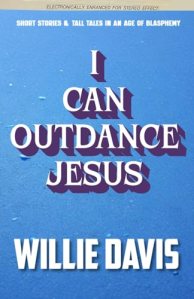 I don’t often take a look at unsolicited review copies, but I couldn’t resist the title of this and I’m glad I gave it a try. Davis’s 10 stories, several of flash length, take place in small-town Kentucky and feature a lovable cast of pranksters, drunks, and spinners of tall tales. The title phrase comes from one of the controversial songs the devil-may-care narrator of “Battle Hymn” writes. My two favourites were “Kid in a Well,” about one-upmanship and storytelling in a local bar, and “The Peddlers,” which has two rogues masquerading as Mormon missionaries. I got vague Denis Johnson vibes from this sassy, gritty but funny collection; Davis is a talent!
Published by Cowboy Jamboree Press. With thanks to publicist Lori Hettler for the free e-copy for review.
The Picnic and Suchlike Pandemonium by Gerald Durrell (1979)
 If you’ve read his autobiographical trilogy or seen The Durrells, you’ll be familiar with the quirky, chaotic family atmosphere that reigns in the first two pieces: “The Picnic,” about a luckless excursion in Dorset, and “The Maiden Voyage,” set on a similarly disastrous sailing in Greece (“Basically, the rule in Greece is to expect everything to go wrong and to try to enjoy it whether it does or not”). No doubt there’s some comic exaggeration at work here, especially in “The Public School Education,” about running into a malapropism-prone ex-girlfriend in Venice, and “The Havoc of Havelock,” in which Durrell, like an agony uncle, lends volumes of the sexologist’s work to curious hotel staff in Bournemouth. The final two France-set stories, however, feel like pure fiction even though they involve the factual framing device of hearing a story from a restaurateur or reading a historical manuscript that friends inherited from a French doctor. “The Michelin Man” is a cheeky foodie one with a surprisingly gruesome ending; “The Entrance” is a full-on dose of horror worthy of R.I.P. I wouldn’t say this is essential reading for Durrell fans, but it was a pleasant way of passing the time. (Secondhand – Lions Bookshop, Alnwick, 2021)
A New Day by Sue Mell (2024)
 Three suites of linked stories focus on young women whose choices in the 1980s have ramifications decades later. Chance meetings, addictions, ill-considered affairs, and random events all take their toll. Emma house-sits and waitresses while hoping in vain for her acting career to take off; “all she felt was a low-grade mourning for what she’d lost and hadn’t attained.” My favourite pair was about Nina, who is a photographer’s assistant in “Single Lens Reflex” and 13 years later, in “Photo Finish,” bumps into the photographer again in Central Park. With wistful character studies and nostalgic snapshots of changing cities, this is a stylish and accomplished collection.
Published by She Writes Press on September 3. With thanks to publicist Caitlin Hamilton Summie for the free e-copy for review.
Ladies’ Lunch and Other Stories by Lore Segal (2023)
 The first section contains nine linked stories about a group of five elderly female friends. Bessie jokes that “wakes and funerals are the cocktail parties of the old,” and Ruth indeed mistakes a shivah for a party and meets a potential beau who never quite successfully invites her on a date. One of their members leaves the City for a nursing home; “Sans Teeth, Sans Taste” is a good example of the morbid sense of humour. A few unrelated stories draw on Segal’s experience being evacuated from Vienna to London by Kindertransport; “Pneumonia Chronicles” is one of several autobiographical essays that bring events right up to the Covid era – closing with the bonus story “Ladies’ Zoom.” The ladies’ stories are quite amusing, but the book as a whole feels like an assortment of minor scraps; it was published when Segal, a New Yorker contributor, was 95. (Secondhand – National Trust bookshop, 2023)
Postscript: Segal died on 7 October 2024, aged 96.
I’ll have a couple more reviews roundups between now and early October.
Currently reading: The Lone-Ranger and Tonto Fistfight in Heaven by Sherman Alexie, The Skeleton in the Cupboard by Lilija Berzinska; The Woman Who Gave Birth to Rabbits by Emma Donoghue; The Best Short Stories 2023: The O. Henry Prize Winners, ed. Lauren Groff; Waltzing the Cat by Pam Houston; Dreams of Dead Women’s Handbags by Shena Mackay; How to Disappear by Tara Masih; The Souvenir Museum by Elizabeth McCracken; Like Life by Lorrie Moore; The Long Swim by Teresa Svoboda; In Love and Trouble by Alice Walker
Get Ready for Novellas in November!
Novellas: “all killer, no filler,” as Joe Hill said. Hard to believe, but it’s now the FIFTH year that Cathy of 746 Books and I have been co-hosting Novellas in November as a month-long blogger/social media challenge celebrating the art of the short book. A novella is a book of 20,000 to 40,000 words, but because that’s hard for a reader to gauge, we tend to say anything under 200 pages (even nonfiction). I’m going to make it a personal challenge to limit myself to books of ~150 pages or less.

We’re keeping it simple this year with just the one buddy read, Orbital by Samantha Harvey. (Though we chose it weeks ago, its shortlisting for the Booker Prize is all the more reason to read it!) The UK hardback has 144 pages. Here’s part of the blurb to entice you:
“Six astronauts rotate in their spacecraft above the earth. … Together they watch their silent blue planet, circling it sixteen times, spinning past continents and cycling through seasons, taking in glaciers and deserts, the peaks of mountains and the swells of oceans. Endless shows of spectacular beauty witnessed in a single day. Yet although separated from the world they cannot escape its constant pull. News reaches them of the death of a mother, and with it comes thoughts of returning home. … They begin to ask, what is life without earth? What is earth without humanity?”

Please join us in reading it at any time between now and the end of November!
We won’t have any official themes or prompts, but you might want to start off the month with a My Year in Novellas retrospective looking at any novellas you have read since last NovNov, and finish it with a New to My TBR list based on what novellas others have tempted you to try in the future.
It’s always a busy month in the blogging world, what with Nonfiction November, German Literature Month, Margaret Atwood Reading Month and SciFi Month. Why not search your shelves and/or local library for novellas that could count towards multiple challenges?
From 1 November there will be a pinned post on my site from which you can join the link-up. Keep in touch via Twitter (@bookishbeck / @cathy746books) and Instagram (@bookishbeck / @cathy_746books), and feel free to use the terrific feature images Cathy has made plus our new hashtag, #NovNov24.
“The Future of the Novella”
On the 11th, at Foyles in London, I attended a perfect event to get me geared up for Novellas in November. Indie publisher Weatherglass Books and judge Ali Smith introduced us to the two winners she chose for the inaugural Weatherglass Novella Prize: Kate Kruimink’s Astraea (set on a 19th-century Australian convict ship), out now, and Deborah Tomkins’ Aerth (a sci-fi novella in flash set on alternative earths), coming out in January.

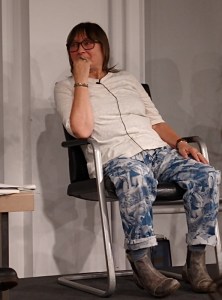
Ali Smith
We heard readings from both novellas, and Neil Griffiths and Damian Lanigan of Weatherglass told us some more about what they publish and the process of reading the prize submissions (blind!). Lanigan called the novella “a form for our times” and put this down not just to modern attention spans but to focus – the glimpse of something essential. He and Smith mentioned F. Scott Fitzgerald, Claire Keegan, Françoise Sagan and Muriel Spark as some of the masters of the novella form.
The effortlessly cool Smith spoke about the delight of spending weekend mornings – she writes during the week but gives herself the weekends off to read – in bed with a pot of coffee and a Weatherglass novella. She particularly enjoyed going into each book from the shortlist without any context and lamented that blurbs mean the story has to be, to some extent, given away to the reader. She said the ending of a novella has to land “like a cat, on its feet” (Griffiths then appended that it must also be ambiguous).
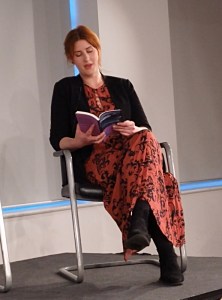
Kate Kruimink
Kruimink, who edits short stories for a magazine, explained that she thinks of Astraea as a long short story. She wrote it especially for this prize, within two months and for Ali Smith, as it were (she mentioned how formative How to Be Both was for her as a writer). Due to time and word limit constraints, she deliberately crafted a small character arc and didn’t do loads of research, though she had been looking into ships’ surgeons’ journals at the time. She has Irish convict ancestry but noted that this is not uncommon in Tasmania. Astraea is a “sneaky prequel” to her first novel, which has been published in Australia.
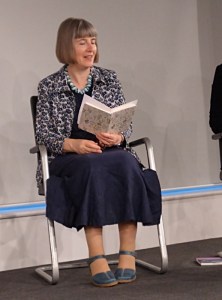
Deborah Tomkins
Aerth was originally titled First, Do No Harm, which had the potential to confuse those looking for a medical read. Aerth and Urth are different planets with parallels to our own. The novella tells the story of Magnus, an Everyman on a deeply forested planet heading into an Ice Age. Tomkins first wrote it for the Bath Prize in 2018 and was longlisted, then added to it. She initially sent the book to sci-fi publishers but was told it was not ‘sci-fi enough’.
Griffiths remarked that the shortlist was all-female and that the two winners show how a novella can do many different things: Astraea is at the low end of the word count at 22,000 words and takes place over just 36 hours; Aerth is towards the upper limit at 36,000 words and spans about 40 years.
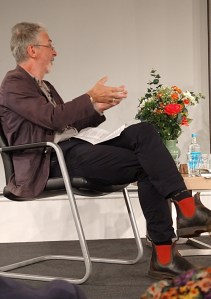
Neil Griffiths
All the panellists dismissed the idea of a hierarchy with the full-length novel at the top. Griffiths said that the constraints of the novella, to need to discard and discard, make it stand out.
A further title from the 2024 shortlist, We Hexed the Moon by Mollyhall Seeley, will also be published by Weatherglass next year, and submissions are now open for the Weatherglass Novella Prize 2025.
Many thanks for my free ticket to a great event. Weatherglass has also kindly offered to send Cathy and me copies of the two novellas to review over the course of #NovNov. I’m looking forward to reading both winners!
February Releases by Hess, Kim, Sides (#ReadIndies); Atwood and Shah
I’m pleased to have, between this post and yesterday’s review catch-up, featured 9 books from 8 independent publishers for Read Indies this month. (I have also done some indie reading from my shelves, which I’ll summarize early in March.) Three of the books in my February review stacks were indie releases. I’ve got a hybrid memoir that blends poetic exploration of scripture with personal psychological reflections; an out-of-the-ordinary mystery about a father’s disappearance that comments on disability, racism and much more; and a terrific set of fabulist short stories. My two bonus (non-indie) February books are an unconvincing collaborative novel and a counselling-focussed bibliotherapy guide.

When Fragments Make a Whole: A Personal Journey through Healing Stories in the Bible by Lory Widmer Hess
 Some of you may know Lory, who is training as a spiritual director, from her blog, Enter Enchanted. It was so kind of her to get in touch offering her first book for review. It’s a unique combination of poetry, scriptural exegesis, and fragments of memoir. Each chapter considers a different healing story from the Gospels. As in the lectio divina I learned from college Christian fellowships, the idea with the verse retellings from the Bible is to imagine oneself into a character’s position and consider the crises that led to seeking Jesus’ help. I especially liked the poem “Talitha, Koum,” which links the stories of the woman with the issue of blood and the resurrection of Jairus’ daughter. In both, faith reverses a seemingly hopeless situation.
The short sections of commentary draw in a lot of context as well as etymology from the Greek. The autobiographical essays chart a history of physical and mental challenges, including dissociation, low self-esteem and shame, and offer openness to healing as its own miracle when there are no easy answers. They are notable for their vulnerability, especially when discussing marital problems. The outlook is intellectual and psychological rather than the spiritualizing I’m used to from my evangelical background – Lory comes from the anthroposophy tradition, which I don’t claim to fully understand but (I think) eschews dogma like original sin and atonement and instead makes the spiritual journey a matter of human reconnection with God through free will and the intellect. This is nicely balanced, though, by her work with developmentally disabled adults in residential homes in New England and Switzerland, which reminds her “there is a truth beyond intellectual knowledge, a language beyond words”. It is a calm, honest, methodical book that will intrigue anyone interested in thinking through how the Bible is applicable to the challenges of daily life.
With thanks to the author and Floris Books (Edinburgh) for the free copy for review.
Happiness Falls by Angie Kim
Buzz from across the pond about Kim’s novels led me to request this even though I don’t typically read mysteries. The bulk is set over 2.5 days in June 2020 as the Korean American Parkson family investigates, on their own and with the help of police and various local tip-offs, what happened to the father, Adam, who’d been at River Falls Park with the severely disabled 14-year-old son, Eugene, who is autistic and has mosaic Angelman syndrome. Mother Hannah and 20-year-old twins Mia and John, home from college for the lockdown, quickly realise something is wrong when Eugene, who has blood on his shirt and under his nails, stumbles home on his own and Adam is unreachable by phone. There’s more to the setup than that, and many complicated side-tracks to the investigation, but the basic questions remain for 300+ pages: What happened to Adam? and What was Eugene’s part in it?
Mia narrates, and it’s a pleasure spending time with her quick, systematic brain as she runs through all the options and deals with each new theory and red herring. She clearly gets it from her father, whose recovered notebook is full of amateur experimentation on the “Happiness Quotient”. Her wit and garrulousness (sample aside: “I’m sorry, but I don’t care how much you love fun fonts—you cannot talk about prison rape in Comic Sans”) spills over into footnotes as if in effusive counterpoint to Eugene, who is nonspeaking.
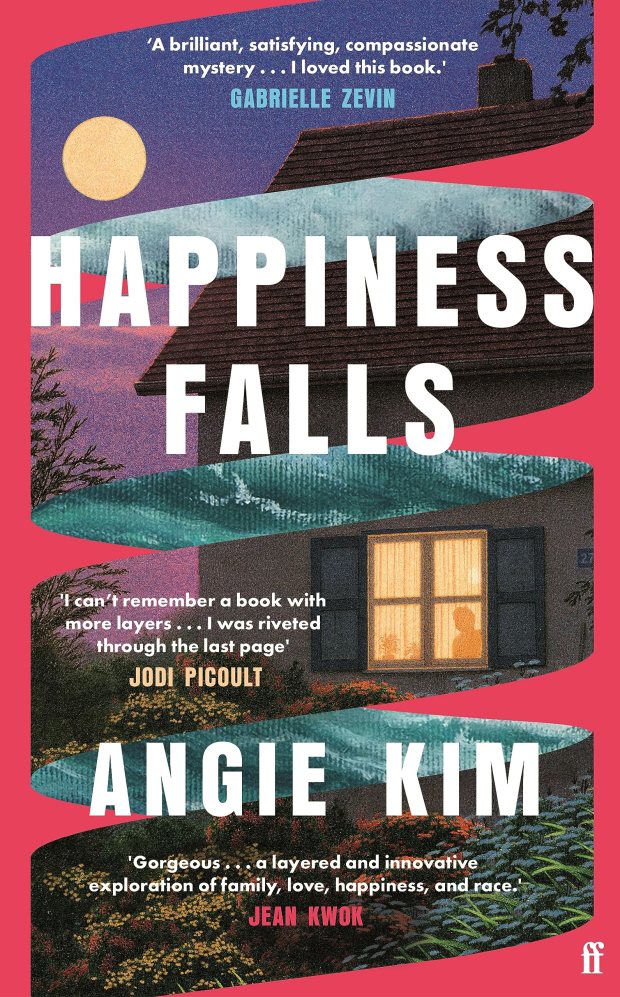
The pandemic setting places interesting constraints on the official proceedings, and the prospect of a new communication method (involving painstaking spelling with a letter stencil) revolutionizes this family as they grasp that Eugene is far from nonverbal and has been ‘locked in’ all along. The account a therapist elicits from him seems to clinch the case, but uncertainty lingers.
This is like a blend of Celeste Ng’s Everything I Never Told You, Rebecca Makkai’s I Have Some Questions for You, and Naoki Higashida’s The Reason I Jump; if you’ve liked one or more of these, I would strongly recommend it. Mystery readers may lack patience for the digressions. The solution is eclipsed by the many issues – prejudice based on race and disability, how one’s circumstances affect contentment, nuances of communication, sibling relationships and twin ESP – explored along the way. Because I am not a crime reader, the pace was no problem for me. My annoyances were with the preponderance of hindsight (“I wish I’d said something,” “It didn’t occur to me until much later”) and the fact that Mia says “begs the question” for raising a question (misuse of a rhetorical term) several times. I found personal meaning in the book because of the Washington, DC-area locales and my severely disabled, nonverbal goddaughter. What if there really is something going on in her mind, and we could find out what it was… I mused. I’ll be keen to read Kim’s debut, Miracle Creek.
With thanks to Faber for the free copy for review.
Crocodile Tears Didn’t Cause the Flood by Bradley Sides
 These 17 flash fiction stories fully embrace the possibilities of magic and weirdness, particularly to help us reconnect with the dead. Brad and I are literary acquaintances from our time working on (the now defunct) Bookkaholic web magazine in 2014–15. I liked this even more than his first book, Those Fantastic Lives (2021), although the contours are very similar. Young people, animals and monsters abound – and sometimes the lines between those identities are unclear. There’s a lot of experimentation with form: a choose-your-own-adventure narrative, a police transcript, a two-truths-and-a-lie challenge, a story all in questions, an English exam, and a letter. A few of my favorite stories were “The Guide to King George,” about an amusement farm’s resident pond monster; “Claire & Hank,” in which a paleontologist’s unearthed Pteranodon becomes a sister to his motherless son; and “Dying at Allium Farm,” whose sassy undead owners think they’re fooling their Tennessee customers. And can you imagine a better title and cover combination?!
With thanks to Montag Press and publicist Lori Hettler for the e-copy for review.
And a couple of bonus February releases that are not from indie publishers:
Fourteen Days, ed. Margaret Atwood and Douglas Preston
This Authors Guild Foundation collaborative project is a Covid-era Decameron update in which the residents of an increasingly derelict New York City apartment complex meet on the rooftop every evening for two early lockdown weeks to clap for healthcare workers, indulge in adult beverages, and swap random stories. The tenants all go by nicknames like “Hello Kitty,” “Florida” and “Vinegar.” The frame narrative has the building superintendent (Yessie, a lesbian of Romanian heritage) worrying over her father’s wellbeing in a care home and surreptitiously recording the oral stories on her phone to later transcribe into the “bible” kept by the previous super. We’re told up front that the manuscript ends up in police custody.
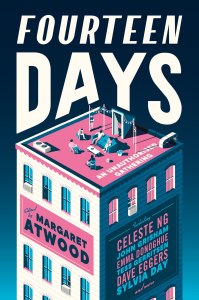 I had a misconception that each chapter would be written by a different author. I think that would actually have been the more interesting approach. Instead, each character is voiced by a different author, and sometimes by multiple authors across the 14 chapters (one per day) – a total of 36 authors took part. I soon wearied of the guess-who game. I most enjoyed the frame story, which was the work of Douglas Preston, a thriller author I don’t otherwise know.
There was a promising idea here, but problems with the execution. One is that, for the most part, the stories are pointless. The characters get hung up on whether they’re ‘true’ or not, but for readers it’s all made up and, while one or two individual tales might be amusing, they do nothing to build a plot and so I found myself mostly skipping over them to get back to the interactions on the roof and the super’s commentary. Another is that, to stand out from an ensemble cast, a voice needs to be really distinctive, and only “Eurovision” (flamboyantly gay) was that for me – based on my love for his rabbit story in particular, I should be reading Joseph Cassara. And finally, the book culminates with an annoying twist that made me cross.
With thanks to Chatto & Windus (Penguin) for the proof copy for review.
Bibliotherapy: The Healing Power of Reading by Bijal Shah
Bibliotherapy is one of my niche bookish interests (see my write-up of my bibliotherapy appointment with Ella Berthoud at the School of Life), so I was delighted to be offered a copy of another relevant book. Bijal Shah grew up in an East African Indian community before moving to the UK with her family as a teenager. When she was in training as a psychodynamic counsellor and attended therapy sessions herself, she realised how helpful literature was in helping her think through traumatic experiences from her past, such as sexism, colourism and a painful break-up. “I have lived half my life in the pages of books,” she observes, “relying on them to put my real life into perspective.” I feel the same way.

The emphasis is very much on therapy here, as Shah elaborates on practices such as literary journaling, recording audio notes, writing poetry, and focusing on gratitude. About half of the book is given over to anonymized sample case studies where she looks at the reasons why a client might come to her for bibliotherapy, the books and exercises she prescribed them, and the sorts of realizations people came to when reflecting on their own lives in relation to what they read. I suspect that the majority of readers, unless they have a vested interest in counselling, will, like me, most enjoy browsing the A–Z list of book prescriptions in the final 20% of the book (with more on Shah’s website). There is good variety to these in terms of author diversity, new vs. backlist reads, and both YA and adult fiction, though most of the recommendations are nonfiction, particularly psychology and self-help: these are much more literal (and, generally, obvious) prescriptions than Berthoud and Elderkin’s playful take.
With thanks to the author and Piatkus (Hachette) for the free copy for review.
Recent Releases by Nathan Hill, Hisham Matar, Sigrid Nunez and More
One key way in which 2024’s reading has already differed from previous years’ is that I no longer avoid doorstoppers. I now classify any book with over 400 pages as a doorstopper, and by that definition I have already gotten through three this year: The Tidal Year plus two of the below, with Wellness standing out as the true whopper at 597 small-print pages. January offered a set of releases full of variety: gritty yet funny flash fiction; a novel of big ideas and big empathy for its flawed characters; an exile’s elegant love letter to Libya from London; a coy pandemic-era reflection on connection and creation; and a tour of nature close to home.
Universally Adored and Other One Dollar Stories by Elizabeth Bruce
 This was a great collection of 33 stories, all of them beginning with the words “One Dollar” and most of flash fiction length. Bruce has a knack for quickly introducing a setup and protagonist. The voice and setting vary enough that no two stories sound the same. What is the worth of a dollar? In some cases, where there’s a more contemporary frame of reference, a dollar is a sign of desperation (for the man who’s lost house, job and wife in “Little Jimmy,” for the coupon-cutting penny-pincher whose unbroken monologue makes up the whole of “Grocery List”), or maybe just enough for a small treat for a child (as in “Mouse Socks” or “Boogie Board”). In the historical stories, a dollar can buy a lot more. It’s a tank of gas – and a lesson on the evils of segregation – in “Gas Station”; it’s a huckster’s exorbitant charge for a mocked-up relic in “The Grass Jesus Walked On.”
The tone ranges from black comedy (“Festus”) to high tragedy (“Votive Candle”), but the book mostly falls within the realm of dirty realism with the attention to working-class country folk, so I’d recommend the collection to fans of authors who perch on the lighter side of that subgenre, such as Barbara Kingsolver or Denis Johnson. A few of my favorite stories, in addition to the above, were “Ice-Cold Water,” which I appreciated for the Washington D.C. setting and the way that an assumption about who would be racist was overturned by a moment of simple compassion; “Dolores,” in which a slick humanitarian fundraiser meets a waitress who has his number; and “Boiling the Buggers,” a window onto Covid-exacerbated mental illness. (Read via BookSirens)
Wellness by Nathan Hill
Somehow nearly eight years have passed since Hill’s debut novel, The Nix, which I dubbed “a rich, multi-layered story about family curses and failure.” I admired it as much for its prose as for its ideas, and Wellness is just as effervescent and insightful. It’s a state-of-the-nation novel filtered through one Chicago family: experimental photographer and underperforming academic Jack; his wife Elizabeth, a placebo researcher at Wellness; and their YouTube-obsessed son Toby. They’ve recently invested their life savings in a new condo and are considering trendy features like open shelves and separate master bedrooms. It would be oversimplifying, but true, to say that this couple is experiencing midlife and marital crises. Their nineties college romance – and a time of life when everything felt open and possible – is so remote now. When Elizabeth suggests they join a friend at a swingers’ club and a patient of hers who’s also a parent at Toby’s school sees them outside, chaos ensues.
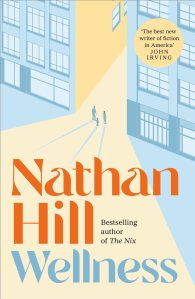
Some elements from The Nix carry over, such as campus politics, the American Midwest, and mother–son relationships, but also broader questions of authenticity, purpose and nurture. Is love itself a placebo? The novel spends time with Jack and Elizabeth at the dawn of their relationship and in the present day, but also looks back to their early careers and first years of parenthood. Hill is clearly fascinated with the sort of psychological experimentation Elizabeth engages in (there’s a whole bibliography of scientific papers consulted) but also turns it to humorous effect, as when Elizabeth subjects Toby to the marshmallow test. A lot of information is conveyed through dialogue, yet it never feels forced. A couple of long asides, on Elizabeth’s family history and the algorithms guiding Jack’s interactions with his conspiracy theorist father, tried my patience, but I loved a four-page chapter on a funeral supper where every sentence starts “There was.” Sooooo many quotable lines throughout.
The only fault in an addictive and spot-on novel (how did he know?! you’ll find yourself thinking about your own attitude to work/marriage/children) is that Hill is so committed to excavating these characters’ backstory of stunted emotion – Jack estranged from his religious Kansas farmer parents after a traumatic incident you feel right in the gut; Elizabeth glad to jettison her father’s wealth with his anger – that he hurries through the denouement. Still, this is sure to be a fiction highlight of my year. It’s one for readers of Jonathan Franzen, sure, but I also thought it reminiscent of Katherine Heiny’s Standard Deviation and Meg Wolitzer’s The Interestings.
With thanks to Picador for the proof copy for review.
My Friends by Hisham Matar
“Benghazi was the one place I longed for the most, it was also the place I most feared to return to.”
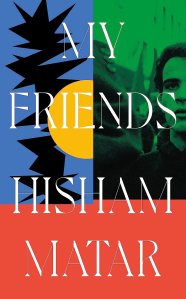 Taking a long walk through London one day, Khaled looks back from midlife on the choices he and his two best friends have made. He first came to the UK as an eighteen-year-old student at Edinburgh University. Everything that came after stemmed from one fateful day. Matar places Khaled and his university friend Mustafa at a real-life demonstration outside the Libyan embassy in London in 1984, which ended in a rain of bullets and the accidental death of a female police officer. Khaled’s physical wound is less crippling than the sense of being cut off from his homeland and his family. As he continues his literary studies and begins teaching, he decides to keep his injury a secret from them, as from nearly everyone else in his life. On a trip to Paris to support a female friend undergoing surgery, he happens to meet Hosam, a writer whose work enraptured him when he heard it on the radio back home long ago. Decades pass and the Arab Spring prompts his friends to take different paths.
I’d previously only read Matar’s short nonfiction work A Month in Siena. The slow, meditative style I enjoyed so much there didn’t translate well into doorstopper length; by the 300-page mark I found myself skimming to see if anything else might happen. Despite the title, we come to know Mustafa and Hosam much less well than we do Khaled. I would happily have had the book’s plot and sentiment concentrated into a taut 200 pages. However, I’m still interested in trying other books by Matar. In the Country of Men is significantly shorter and available from the backroom storage area of my library, and his Folio Prize-winning memoir The Return, too, is on shelf and I reckon will be right up my street.
With thanks to Viking (Penguin) for the proof copy for review.
The Vulnerables by Sigrid Nunez
I’m a huge Nunez fan after reading The Friend, What Are You Going Through, and especially A Feather on the Breath of God. Her last three books have been very much of a piece: autofiction voiced by an unnamed woman who has a duty of care towards a friend or a friend’s pet and ponders, in wry meta fashion, the nature of autobiographical writing and the meaning of life and death at a time of climate breakdown. Alas, The Vulnerables seems like no more than a rehashing of The Friend, with flanking main characters chosen at random from central casting: a parrot named Eureka and a mentally ill college drop-out called Vetch. This quirky trio is thrown together in a lavish New York City apartment during lockdown and nothing much happens but conversation brings them closer.
 A second problem: Covid-19 stories feel dated. For the first two years of the pandemic I read obsessively about it, mostly nonfiction accounts from healthcare workers or ordinary people looking for community or turning to nature in a time of collective crisis. But now when I come across it as a major element in a book, it feels like an out-of-place artefact; I’m almost embarrassed for the author: so sorry, but you missed your moment. My disappointment may primarily be because my expectations were so high. I’ve noted that two blogger friends new to Nunez were enthusiastic about this (but so was Susan, who’d enjoyed her before). That’s not to say this wasn’t a pleasantly fluid and incisive read, even if its message of essential human vulnerability is an obvious one. Anyway, I’ll take Nunez musing on familiar subjects over most other contemporary writers any day:
“Never write ‘I don’t remember,’ Editor says; it undermines your authority. But write as if you remember everything and Reader will smell a rat.”
“You can start with fiction or start with documentary, according to Jean-Luc Goddard. Either way, you will inevitably find the other.”
“I like this clarification by the narrator of a book by Stendhal: ‘It is not out of egotism that I say “I”; it is simply the quickest way to tell the story.’)”
(À propos of the doorstoppers above)
“Does that mean a long novel is easier to write than a short one? / Um, no. But, to borrow from a certain critic, in almost every long book I read I see a short one shirking its job.”
With thanks to Virago for the proof copy for review.
And a bonus work of nonfiction:
Local: A Search for Nearby Nature and Wildness by Alastair Humphreys
Lev Parikian alerted me to this amiable record of weekly discoveries of the nature on one’s home turf. Humphreys has been an international adventure traveller and written many books about his exploits. Here, by contrast, he zooms the lens in about as far as it will go, ordering a custom-made 20-km-square OS map that has his house at the centre and choosing one surrounding grid square per week (so 52 out of a total of 400) to cycle to and explore. He’s chosen to leave his town unnamed so this can function as an Everyman’s journey through edgelands. And his descriptions and black-and-white photographs really do present an accurate microcosm of modern England: fields, woods, waterways, suburban streets.
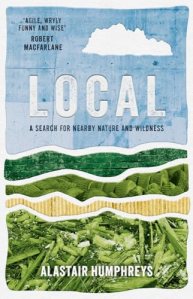 From one November to the next, he watches the seasons advance and finds many magical spaces with everyday wonders to appreciate. “This project was already beginning to challenge my assumptions of what was beautiful or natural in the landscape,” he writes in his second week. True, he also finds distressing amounts of litter, no-access signs and evidence of environmental degradation. But curiosity is his watchword: “The more I pay attention, the more I notice. The more I notice, the more I learn.”
Each week’s observations send him down a research rabbit hole, with topics including caves, land management, mudlarking, plant species, and much more. The nature of the short chapters means that there can only ever be a cursory look at huge issues like rewilding and veganism, but Humphreys is nimble in weaving in the brief, matter-of-fact discussions. His eagerness is irrepressible. “How you look, what you see, and the way all this makes you feel: a single map and the best of all possible worlds.” (See also: Paul’s review.)
With thanks to the author for the free copy for review.
 Bookish Beck = Rebecca Foster. American transplant to England. Freelance proofreader and book reviewer.
 Bookish Beck