My Year in Short Stories (#ShortStorySeptember)
The Short Story September link-up is open (see my pinned post). At the start of the month, I’m inviting you to tell about the short stories you’ve already read this year, especially any that you’ve particularly enjoyed.

I don’t consider myself a great short story reader, so I was surprised to look back and find that I’ve already read 17 collections this year. I include in that four books that I consider to be linked short story collections, even though they were all published as novels rather than stories. (I’m sure Susan is right when she theorizes that this is about marketing – what’s expected to sell.) The best have been Brawler by Lauren Groff and Nightjar by Emily Ruskovich, which are actually quite similar.
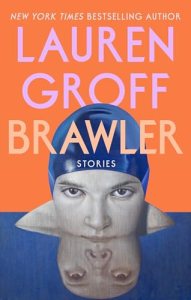
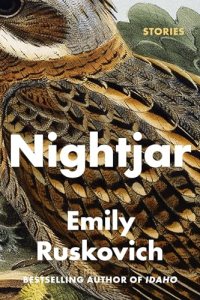
Some other favourites were:
 The Daffodil Days by Helen Bain: A slantwise biographical portrait of Sylvia Plath through her interactions in the last years of her life. The 16 chapters adopt the points-of-view of various secondary characters (e.g., Plath’s housekeeper, riding teacher, and brother), but the kernel of each is an encounter with Plath that illuminates her personality and state of mind. (Reviewed for Shelf Awareness)
Strange Weather in Tokyo by Hiromi Kawakami: Tsukiko is a lonely barfly in her late thirties when she bumps into a secondary school teacher again. She calls him “Sensei,” and they start meeting up for low-key adventures. Kawakami infuses the book with attention to the seasons’ changes and everyday sensual pleasures like food. A lovely, subtle romance.
 Ladies, Ladies, Ladies by Kristen Zory King: A “chapbook” containing 18 flash stories. It’s remarkable how much is packed into a few pages: a voice, a character, a setting and situation, an incident, a salient backstory, and some kind of epiphany or resolution. Fifteen of the pieces focus on one named character. Each story is distinctive, with no words wasted.
 Interpreter of Maladies by Jhumpa Lahiri: Lahiri won the Pulitzer for this debut. Her characters tend to be Indian or Bengali immigrants in New England. Relationship studies trade off with accounts of encounters with strangers across generations and/or cultures. Often, food is a reminder of home. An overall theme is denying or affirming common humanity.
 Luna, Phoenix, Queen by Julie Orringer: In Orringer’s wonderful third novel, the secrets between two literature professors and the adoption of a remarkable dog fuel an absorbing story of love, memory, and connection beyond words. Chapters take on different characters’ perspectives. (Review forthcoming for Shelf Awareness)
 The Typing Lady and Other Fictions by Ruth Ozeki: Ozeki is up to her usual auto/metafiction tricks here, blurring the lines between fact and fiction, life and death. Themes include memory, creativity, language, ageing and cross-generation connections. The stories are playful without being twee, and represent a real return to form.
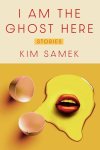 I Am the Ghost Here by Kim Samek: The television producer’s inventive debut recalls Ed Park and George Saunders with its focus on the mixed blessing of technology. Her speculative short stories’ protagonists deal with grief or new motherhood, often while also struggling with their health. Samek sets up unusual situations with knock-out first lines. (Reviewed for BookBrowse)
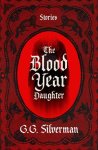 The Blood Year Daughter by G.G. Silverman: A remarkable collection that mixes feminist horror and twisted fairy tales into potent concoctions. Women’s bodies are imperiled by sadistic men and acts of self-sacrifice. Blood is a symbol of desire or power. Motherhood and sisterhood are vital bonds. Among bleak storylines come flashes of morbid humor. (Reviewed for Foreword Reviews)
All by women!
And the rest:
- Love Invents Us by Amy Bloom
- Baby in a Box by Sarah Braunstein (Reviewed for BookBrowse)
- A Calendar of Love and Other Stories by George Mackay Brown
- Museum Visits by Éric Chevillard
- Lesser Known Monsters of the 21st Century by Kim Fu
- It Will Come Back to You: Collected Stories by Sigrid Nunez
- The Book of Mating by Laksmi Pamuntjak [trans. from Indonesian by Annie Tucker] (Review forthcoming for Foreword Reviews)
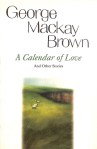
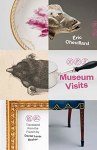
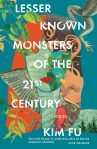
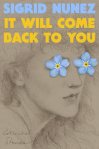
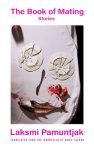
(All but two by women!)
What are some of your recent favorite experiences with short fiction?
20 Books of Summer, 17–20: Jaouad, Kim, Merwin, Piñeiro (#WITMonth)
It’s time to draw a line under 20 Books of Summer so I can focus on hosting Short Story September. I’m technically not quite finished with these first two I’m technically not quite finished with these first two [70 pages to go in the Jaouad and 46 in the Kim], but I’ve read enough to form an opinion and will pop back later to add in final thoughts and ratings. My final four are a memoir of cancer in young adulthood; a page-turning courtroom drama about experimental autism treatment gone wrong; gorgeous nature poems; and a novella in translation that comments on disability, motherhood and mental health issues. Skip to the end for my one DNF of the challenge and a look back at some stats plus my most successful reads.
Between Two Kingdoms: What Almost Dying Taught Me about Living by Suleika Jaouad (2021)
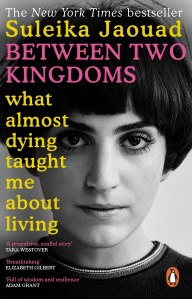
{Updated on 7 September} Jaouad wrote a New York Times column about going through leukaemia treatment in her early twenties and what came next. After months of itching and fatigue, she fell properly ill while working her first postgraduate job in Paris and her blood test results were so bad that she flew home to New York. She would be in and out of hospital for the next five years, enduring multiple rounds of chemo and a bone marrow transplant from her brother. It’s a terrific granular account of the physical and emotional rigours of illness, as well as the strain it put on her relationships – being her primary caregiver was too much for her boyfriend, Will. But she also found a community of young cancer patients, many (like Max Ritvo) now dead. After 60% of the book’s length, as the title – its metaphor taken from Susan Sontag – suggests, the new challenge for Jaouad was resuming life. “I’ve spent the past fifteen hundred days working tirelessly toward a single goal—survival. And now that I’ve survived, I’m realizing I don’t know how to live.” She decides to undertake a cross-country road trip punctuated by visits to people who wrote to her through her column: fellow cancer survivors, a mother who lost a son to suicide, a man on death row in Texas. At first I thought this content felt tacked on and should have been a sequel, but ultimately it illustrates why she wouldn’t edit out her illness if she had it all to do again. I hadn’t heard of Jaouad before I stumbled on this book; from Instagram, I learned she’s now (at age 38) weathered cancer three times. (Little Free Library) 
Miracle Creek by Angie Kim (2019)
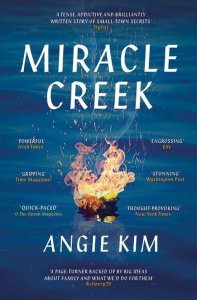
{Updated on 7 September} After enjoying Happiness Falls so much, I wanted to go back to Kim’s debut, for which she won an Edgar Award. (There’s an autistic boy and discussion of therapies in that second book as well.) The bulk of the novel is set during the four days of an August 2009 trial. It’s been a year since a horrific accident at Pak Yoo’s “Miracle Submarine,” a rural Virginia hyperbaric oxygen chamber where regulars came for twice-daily treatment of autism, cerebral palsy, and infertility. Meanwhile, protesters gathered outside to draw attention to what they believed to be a dangerous and unproven technique, the equivalent of child abuse. Someone with Camel cigarettes and matches from a local 7-11 set a small fire under an oxygen tank; the resulting explosion killed two and seriously injured two more. The mother of one of the autistic boys was arrested for suspected arson and attempted murder, but as the trial goes on suspicion seems to shift to members of the Korean American family who ran the HBOT operation. There’s a lot to sink the teeth into here. Each character has secrets, and little revelations are emerging all the time, such that the prosecutor and defence lawyer are always having to adjust their approach. Like I’ve experienced with Kim before, this was intelligent, thought-provoking, and absorbing. It’s just the sort of crime-adjacent fiction I like. An author Q&A at the end reveals a couple of autobiographical inspirations: working in her immigrant parents’ convenience store near Baltimore as a teenager, and taking one of her sons, who had neurological deafness and chronic illnesses, for HBOT. (Gift from my wish list)
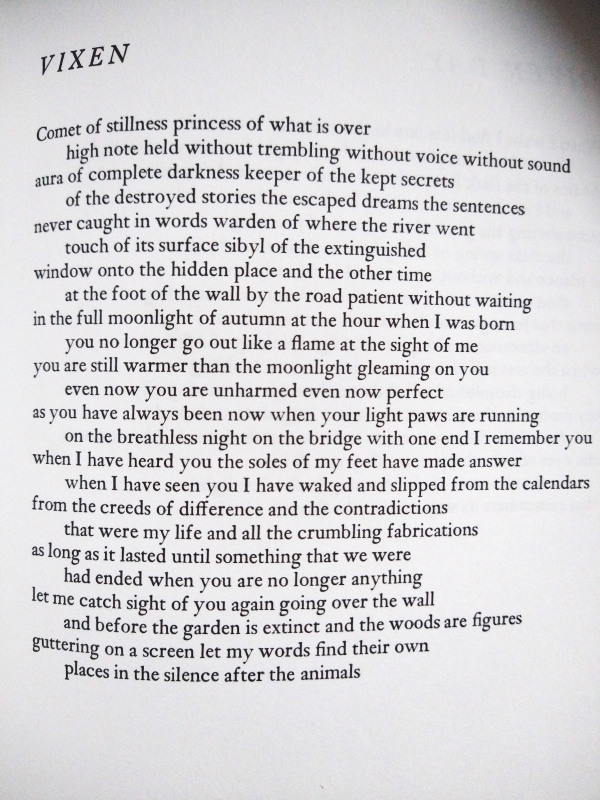
The Vixen by W.S. Merwin (1996)
it seems that the world is made of a single
summer as it always has been (from “Entry”)
 I took this off the shelf because Merwin was one of the POV characters in The Daffodil Days, Helen Bain’s excellent novel about Sylvia Plath’s final years. I had no idea what to expect, and it took me a while to get used to his entirely unpunctuated verse. Only by reading aloud or in my head was I able to split the text blocks into meaning-rich phrases. The fox is a revenant flitting through many of these poems as they pinpoint natural rhythms and human traces across the seasons and centuries. A lot reference summer, in particular, so this was a perfect choice for the challenge. There are a few historical portraits but most of the pieces feel timeless, evoking a countryside locale where the speaker returns to find derelict dwellings given over to birds and trees. Mostly it feels like this could be England, but sometimes a dry aridity suggests the Mediterranean. There is a strong sense of temporality, especially of afterness – the close of a day, the tail end of a season, the still-resonant emptiness after life has left or activity has finished. But there is also the hint of an eternal present:
Seen from afterward the time appears to have been
all of a piece which of course it was but how seldom
it seemed that way when it was still happening (from “Completion”)
In a long book (~65 pieces), there were only a few poems that washed over me without making any impression. The run-on pace, alliteration, and close attention to the natural world made this utterly mesmerizing. I’ll be sure to read more by Merwin. (Secondhand – Bridport Old Books) 
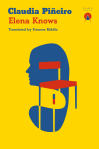
Elena Knows by Claudia Piñeiro (2007; 2021)
[Translated from Spanish by Frances Riddle]
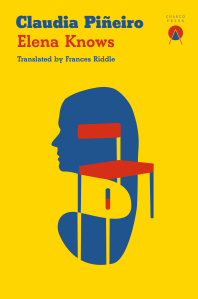 Piñeiro is an Argentinian author known for infusing her detective novels with a political conscience. Elena Knows is a mystery of sorts, in which the title character devotes herself to investigating her daughter’s death (Rita was found hanging in the belfry of a church). But several elements make this atypical for crime fiction: Elena has Parkinson’s disease – “that f—ing whore illness,” she calls it; refuses to accept the police’s conclusion that Rita died by suicide – she would never have gone there in the rain, she insists; and drags her uncooperative body across Buenos Aires to confront an acquaintance she thinks might be able to shed some light. It’s a circadian narrative, divided into sections by Elena’s pill schedule, but expands its timeline through flashbacks to consider the complications of the mother–daughter relationship as Elena became more physically dependent. The eventual encounter with Isabel presents a contrast in the form of a woman who didn’t want to become a mother but had to because of a prohibition on abortion, which was only legalized in Argentina in 2020. While the approach and themes were appealing, I found this repetitive and the long blocks of dialogue in italics were challenging to read. This was shortlisted for the International Booker Prize, though I thought it had a better chance in that year’s Barbellion Prize race (returning this year!). (Gift from my wish list)
And a DNF:
Blonde by Joyce Carol Oates (2000)
Her problem wasn’t she was a dumb blonde, it was she wasn’t a blonde and she wasn’t dumb.
Sigh. Between February and July I read about 200 pages, then skimmed another 100 or so, then finally gave up. (My third Oates DNF. I don’t think she and I are meant to be, though I seem to have better luck with her short stories and own another couple of her books to try.) I engaged most with the early pages about her childhood with a vain, neglectful mother who ends up in a mental hospital; and then with her teenage marriage to Bucky Glazer and involvement in the war effort.
She was a sweet kid but so emotional. Wanting love all the time. She was immature and unreliable and I guess so was I; we were too young. If she’d been a better cook and not so emotional, it might’ve worked out.
Except that people were dying and being injured and the world filling up with smoldering rubble, Norma Jeane liked the War. The War was as steady and reliable as hunger or sleep. Always, the War was there.
 In the part that I skimmed, she is starting to become known in Hollywood, with a nude photo shoot (for which she only earned $50), bit parts in films, and her famous stage name.
In the introductory Author’s Note, Oates writes, “for all its length, synecdoche is the principle of appropriation.” So, for instance, instead of multiple foster families, we just get one. Always, there was unwanted male attention, including molestation. I was surprised to find that the pick-and-choose, fact–fiction hybrid approach became a problem for me. I wanted to know if she really married a man named Bucky and wrote poetry. Yet I didn’t want to have to be verifying every fact either.
Oates’s kitchen-sink style involves imagined scenes and dialogue plus retrospective commentary and knowing asides; long, looping sentences and short ones; direct and indirect speech; lots of exclamation points. Lots of everything. The repetition will be deliberate, for effect, but I kept longing for a streamlined version that cut, say, three of every five sentences.
Anyway, this was certainly a project worth undertaking for Oates; you can see why it was irresistible to unearth the reality behind a legend. Norma Jeane is intriguing for her simultaneous childlike innocence and cultivated sensuality. (Secondhand – Awesomebooks.com)
20 Books Statistics:
14 fiction
4 nonfiction
2 poetry
7 by BIPOC
3 towards WIT Month (for which I reviewed 8 in total, with library reads and Foreword reviews)
3 rereads
I’ve learned this year that it’s important, momentum-wise, to build in a number of shorter books (6 of novella length + 2 poetry collections) and best to avoid doorstoppers. I was wise to pick some addictive, undemanding novels that tread the line between popular and literary fiction (Kim, Mantel, O’Farrell, Reid, Sullivan); anything that feels like hard work (Oates!) is definitely not a summer read.
I only read a risible 4 of the specific books I set out as options in my planning post, plus 1 of my additional ideas. (It’s ironic that I struggled to finish this set of 20 when I could have labelled anything from my shelves part of the challenge – in total, I read 39 of my own books this summer.)
My favourites of the 20 were Strange Weather in Tokyo, Prodigal Summer & The Vanishing Act of Esme Lennox (both rereads), and The Vixen. But What Belongs to You, Miracle Creek, Mitz, The Employees, Commencement, and Flush were also great reads. To be able to single out half of the books equals a huge success!
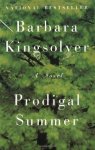
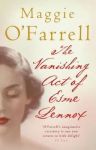
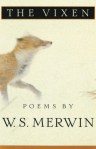
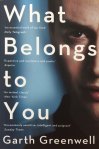
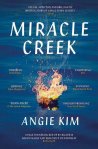
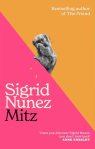

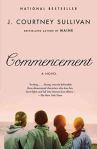
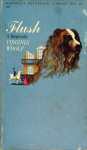
I also completed a 4-book diagonal on the Bingo card!
- Summer in the title (PRODIGAL SUMMER)
- A classic you’ve been meaning to (RE-)read (FLUSH)
- Features a family holiday (MITZ)
- Published in summer (ELENA KNOWS – July 2021)
Summer Reads, Part II: Ellis, Faulkner (Reread), Groskop, Ruskovich
Thankfully, since I last wrote about summer, we’ve had abundant rainfall – a cosy wet weekend after nearly two months of drought. Our pond is looking full again and our apple tree is perking up, but it will take much more to fill the country’s coffers. I’ve spent significantly less time outdoors than usual this summer, taking refuge indoors from the unremitting heat and sun. Luckily, there have been plenty of books to keep me company.
Book 2 of The Summerhouse Trilogy
The Skeleton in the Cupboard by Alice Thomas Ellis (1988)
Summer was a dull season. In spring things were growing; in autumn they were harvested; in winter they were waiting. Summer was pointless, designed for idleness. An inbred Yorkshire Puritanism led me to despise it.
{SPOILERS IN THIS ONE}
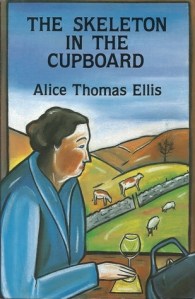 After The Clothes in the Wardrobe (1987), this novella felt conventional and superfluous. Repeating the run-up to Margaret and Syl’s wedding from the perspective of Margaret’s mother-in-law-to-be, Mrs Monro, is only worthwhile in that it allows for two key revelations: one, that Margaret was molested by her father, which goes some way toward explaining her flat affect and inability to love Syl; and two, that Lili also slept with Syl’s father in the summerhouse, long before she bedded Syl himself there on the morning of the wedding. Otherwise, this is a collection of sad and somewhat clichéd meditations on the loneliness of alcoholism-prone older age and widowhood. Provided it doesn’t simply reproduce stereotypes of the seductress, I’m hoping the third volume, from Lili’s perspective, will end up being the most interesting; the middle book of a trilogy always kinda sucks, right? I’ll read Book 3 for one last seasonal instalment before the autumn equinox. (Secondhand – Regent Books, Wantage)
Light in August by William Faulkner (1932)
Memory believes before knowing remembers.
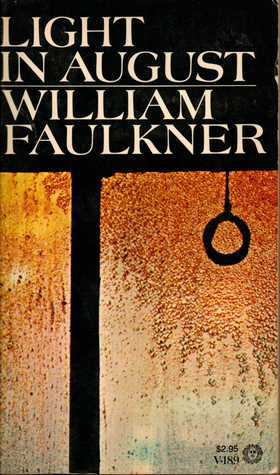 In my second year as a college English major, I took a senior elective on Faulkner & Morrison. Ever since, I’ve remembered this and Song of Solomon as my favourite from each author – the books I’d read again even without them being assigned. For several of the last few Augusts I’ve meant to pick this up, but when I finally did I found Faulkner’s style oppressive and only succeeded in a quick skim. The one thing I’d remembered beforehand is that there is a mixed-race character named Joe Christmas. But the first character we’re introduced to is the indomitable Lena Grove, who’s heavily pregnant and has hitchhiked from Alabama to Mississippi to find her baby daddy. She still believes he’ll do right by her and their child, but the fact that he’s living under an assumed name is our clue that he has no intention of taking responsibility. The plot is set in motion by a misunderstanding: she’s looking for Lucas Burch, but others know there’s a Byron Bunch nearby, and he takes a shine to Lena.
Meanwhile, Burch is going by Joe Brown and rooming with the sadistic Joe Christmas, who gets caught up in bootlegging and murder and goes on the run. The language about his “black blood” driving him to do things, and what happens to him, is awful, but true to its time as well as to Faulkner’s vision of tragic inevitability. I only got the bare bones from a skim, but did love how the novel feels epic yet only spans about a month; it completes a full circle as Lena and her baby move on again, this time to Tennessee. I also liked the neologism in the description of a town’s “garland of Augusttremulous lights.” All told, I’m unlikely to read Faulkner again; he’s like a darker version of Steinbeck, who I’d recommend instead. (Secondhand – Wonder Book and Video)
My original rating:
My rating now:
One Ukrainian Summer: A memoir about falling in love and coming of age in the former USSR by Viv Groskop (2024)
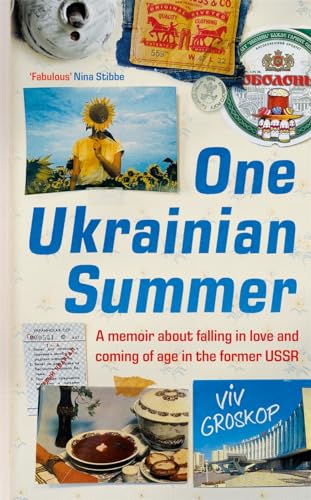 As part of her Russian degree course at Cambridge, Groskop spent a year abroad in St Petersburg, where she also conducted English lessons for adults. She arrived in September 1993 and the next month, in a nightclub, met Bogdan Bogdanovich (“God’s Gift, Son of God’s Gift”), a young man whose rock band called itself “Ukraine answer to Red Hot Chili Pepper.” She would be the solitary groupie on their tour the following summer, but first she had to get through a freezing winter of too much alcohol, too many cigarettes, and turbulent living situations. Her pen portraits of friends and acquaintances are quite amusing. There’s an appealing blend of self-deprecation and nostalgia to her outlook: “I was a clueless, lovesick, pedantic linguist. But I held the future of Ukrainian rock ’n’ roll in my hands.” I never got a particular sense of any of the cities she visits, but the long train ride from Moscow to Kiev is evocative. Each chapter is headed by a vocabulary word, given in Russian and then in the (very similar) Ukrainian. There are lots of Slavic phrases in the text, too, rendered in Roman script. I enjoyed reading them to myself in my head, but none of them has stuck. Let’s see if I can commit this one to memory: “Babine leto” (Ukr.) = “grandmother’s summer,” the equivalent of an Indian summer. Kudos to Groskop and her agents, all of whom donated their proceeds/fees to PEN International, which supports writers at risk. (Public library)
Nightjar: Stories by Emily Ruskovich (2026)
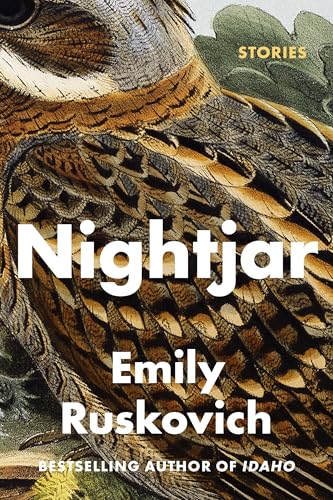 I abandoned Ruskovich’s 2018 debut novel, Idaho, early on, but will absolutely go back to it now because these stories are phenomenal. There are only five, so they tread the border between short story and novella at ~50 pages each and reminded me in their intricacy and depth of short fiction by Lauren Groff and Alice Munro. All are set in the American West and circle themes of loss and remembrance, and they often feature animals prominently. “Victor’s Room” sees a young wife become obsessed with exposing her husband’s false memory of the Oregon house where his brother died in childhood. In “Owl,” the only first-person, historical story, the narrator’s wife is accidentally shot by boys who mistake her for an owl in the night; as she convalesces, her old life lures her back. “Round Lake,” probably my favourite, finds violinist Jade adrift in Tokyo, where she agreed to meet a love interest. There’s water in her ears from an Idaho lake, which she only learned after her swim was where her mother drowned. “Petty Creek Road,” about middle-aged brothers, introduces a subtle note of magic realism (through Will’s premonitions of danger) that is echoed in the final, title story in the tangible reflections that Tess finds each morning in a bucket of water. Jade keeps orphaned hedgehogs, Jane feeds stray cats in “Owl,” and Tess communes with a goat named Panic Boy. The writing and character development are extraordinary, and the question of how memories become stories, or take on physical weight, truly resonated with me.
I’ve included this in my summer round-up because, for me, nightjars are synonymous with warm evenings on Newtown Common, where we go once a year to catch up with nightjars (not the same species as Tess encounters in Montana). This small scrubby nature reserve never fails to turn up several nightjars: unearthly with their gaping mouths, alternating churring and yipping, and jerky flaps against the gathering dusk. We made our annual pilgrimage on 15 July and it didn’t disappoint. (Edelweiss) 
I have a few more summery reads lined up to take me through what I sincerely hope is this season’s last gasp. I’m looking forward to getting out my corduroy coat, wearing hoodies and lap blankets around the house, and eating autumnal goodies based around squash and apples.
20 Books of Summer, 14–16: Danticat, Ravn (#WITMonth) & Woolf
Today I have a tender Haitian American bereavement memoir, a shocking slice of Danish sci-fi about humans and robot hybrids aboard a spacecraft, and a reread of a delightful and rather overlooked classic. I’ll spend the rest of the weekend scrambling to finish my last few books to review on Monday!
Brother, I’m Dying by Edwidge Danticat (2007)
But isn’t death, no matter how or when it takes place, always solitary?
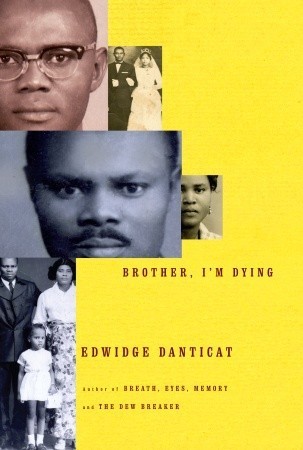 I’d read and enjoyed a novel and a short story collection by Danticat, so when I learned there was a bereavement memoir in her back catalogue I knew I had to have it. It opens with, and continues in the vein of, the conjunction of life and death: on the same day in 2004, Danticat found out she was pregnant with her daughter and her father was diagnosed with end-stage pulmonary fibrosis. She spent a year moving between her home in Miami and her parents’ in New York City. At the same time, her uncle, a pastor who raised her and her brothers for eight years back in Haiti after her parents left to set up the family’s new life in America, was in crisis. Gang warfare was rife in his neighbourhood and there had been threats against his church and against him personally. Aged 81, he flew to Miami, confident he would be accepted as a political refugee because his life was in danger. Instead, he was taken to a detention centre and denied his medications; he subsequently fell ill and died in a local hospital. All this happened in a few days. Danticat’s father outlived his brother, but only long enough to meet his granddaughter and namesake, Mira. I got a bit lost in details of family history and military coups, while my interest was piqued in her uncle’s earlier trip to the US for throat cancer treatment (thereafter his Kreol came through an electronic voicebox). This is an understated work that lets the awful facts speak for themselves. Ron Charles says of her new novel, Dèy, which takes on U.S. gun violence, that it exhibits the same “tempered outrage” as much of her work; maybe too mild for me. (Secondhand – gift from my wish list)
The Employees: a workplace novel of the 22nd century by Olga Ravn (2018; 2020)
[Translated from Danish by Martin Aitken]
Maybe the humans are that very element of chaos that keeps the world alive.
 I knew about this from its International Booker Prize shortlisting. It took me nearly a third of the book to figure out what was going on because I’d avoided reading the blurb, but once I got it I was hooked into something like a sharper, horror-tinged version of Orbital. The novella is structured as a series of 100+ statements, in semi-random order, collected as part of an 18-month workplace tribunal. Each is about a page in length. All are voiced by crew members of the Six-Thousand Ship. Part of Statement 067 reads: “There’s humans, and then there’s humanoids. Those who were born and those who were made. Those who are going to die and those who aren’t.” It’s not always clear who is who. A trove of “objects” (I never quite decided what these are) the spacecraft takes on at a planet stop prompts musings about memory and emotions, loyalty and freedom. The humanoids, grown in a two-year process, are perfect workers from day 1. It’s their “responsibility to make sure the human section of the crew don’t buckle under to nostalgia and become catatonic” – like those who only want to spend time with holograms of their children. The humanoids have had longings implanted in them, to “move in with someone, get married, bake cookies, push a pram, learn to play an instrument, dance a waltz. I think I’ve seen all this in your educational material, is that right? What are cookies?” There’s humour here, but also a growing air of menace. When violence breaks out, it doesn’t just derail the mission, but threatens the whole future. My jaw dropped at the dark turn of events and the bleak but profound phrases it engenders:
I don’t think we as a category are going to survive.
I got the strong feeling that we have failed, and that our time is over.
How can we live with the knowledge that none of these days will be remembered by anyone, not even ourselves?
With the lines so blurred, we’re forced to ask what is essential to humanity. Mysterious and sobering, this is both a meditation on identity and autonomy and an elegy for life on Earth. (Secondhand – Hungerford Bookshop)
Flush: A Biography by Virginia Woolf (1933)
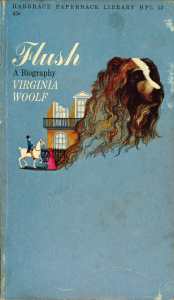 Woolf’s novels are so demanding that it’s good to be reminded she also knew how to have fun. Flush is a cheeky short ‘biography’ of Elizabeth Barrett Browning’s cocker spaniel, spanning the dog’s whole life but even (in a few prologue-like pages) dipping back into prehistory when his ancestors hunted rabbits in Spain. I was tickled to discover that Flush’s first owner was Mary Russell Mitford of Three Mile Cross near Reading – I know of her as a local author and have a copy of her book Our Village. Only because the Mitfords were desperate for money was she willing to sell him to her invalid friend, Miss Barrett. And so in 1842, Flush, used to chasing pheasants in the countryside, has to adjust to life as a city lapdog. He witnesses Miss Barrett’s compulsive letter-writing (“she would lie hour after hour passing her hand over a white page with a black stick”), Robert Browning’s courtship, and their preparations for moving to Italy and welcoming a baby with a mixture of ignorance and alarm. His dignity comes under attack by fleas, and by thieves who hold him to ransom for five days in a London slum – a thrilling central chapter in an otherwise serene narrative. As in Mitz by Sigrid Nunez, which is an homage to Flush, there is dramatic irony between what readers understand and a pet cannot. He mostly experiences the world through the senses, and there are lovely passages where Woolf rhapsodizes about what Flush smells and feels: “He knew Florence in its marmoreal smoothness and in its gritty and cobbled roughness.” Whether you’re a Woolf (or Barrett/Browning) fan, or dog lover, or not, this is an offbeat charmer. (Secondhand – Wonder Book and Video)
My original rating (2013):
My rating now:
20 Books of Summer, 12–13: Strange Weather in Tokyo (#WITMonth) & Mitz
Two terrific novellas I’m belatedly writing up today, one my first selection for Women in Translation month and the other a contribution to Virago’s “Summer of Sigrid.” Both:
Strange Weather in Tokyo by Hiromi Kawakami (2001; 2012)
[Translated from Japanese by Allison Markin Powell]
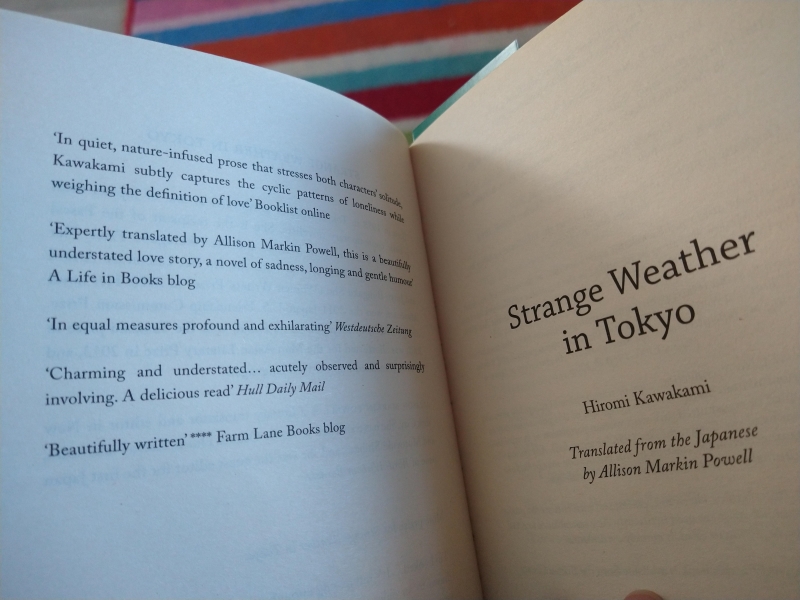
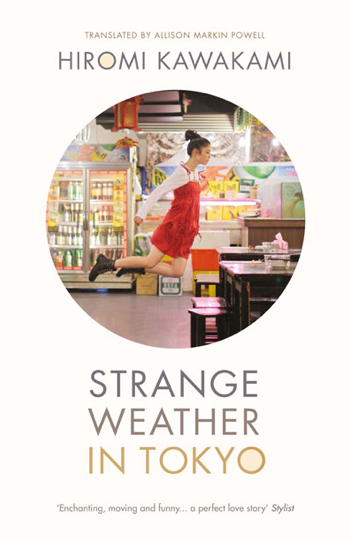 Tsukiko is a lonely barfly in her late thirties when she bumps into her secondary school Japanese teacher, Harutsuna Matsumoto, again. She calls him simply “Sensei,” and they start meeting up for low-key adventures: sharing tofu and saké at Satoru’s bar, marking annual holidays, and leaving the city to forage for mushrooms and visit his late wife’s island grave. Sensei quotes poetry and, ever the teacher, gently corrects his former pupil’s language. Tsukiko is an impassive young woman who never seemed to grow up (“I … still might not be considered a proper adult. … I just wasn’t able to ally myself with time”) and is prone to drinking too much, but finally starts to get a grip on her emotions thanks to this new connection.
Each chapter is discrete, building into a linked short story collection. The erratic (non)use of speech marks somehow didn’t bother me as it seems to suit Tsukiko’s slight disorientation. Kawakami infuses the book with attention to the seasons’ changes and everyday sensual pleasures like food. A drunk at the bar speaks for us readers when he asks the main characters, “You two, just what are you?” The nature of their bond is hard to pin down. Tsukiko is also courted by Kojima, a more age-appropriate boyfriend, but she feels nothing for him. Instead, a May–December relationship unfolds like cherry blossom, ever so gradually, from friendship into something deeper. Powell manages to fit some wordplay into her translation, as in this gently erotic passage:
At some point, sitting beside Sensei, I began to notice the heat that radiated from his body. Through his starched shirt, there came a sense of Sensei. A feeling of nostalgia. This sense of Sensei retained the shape of him. It was dignified, yet tender, like Sensei.
From the title and cover image, I might have expected the magic realism so common to Japanese literature, but this is something different: a lovely, subtle romance. It’s a reminder that it doesn’t have to be torrid passion to be true love. “Even a chance meeting is the result of a karmic connection,” as Sensei quotes. Susan (A life in books), whose review is excerpted in my paperback copy, is quite right. Kawakami was a great new discovery and I’ve got my eye on several more of her books: The Nakano Thrift Shop from the library and Record of a Night Too Brief and Far from Everywhere (forthcoming in February) on my e-reader. (Secondhand – Community Furniture Project, Newbury)
Mitz: The Marmoset of Bloomsbury by Sigrid Nunez (1998)
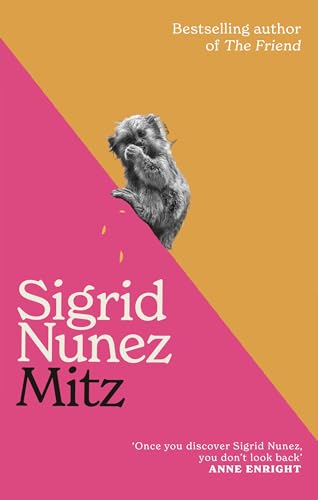 What a fun little book from Nunez’s back catalogue! On the one hand, a fictional mini-biography of the Woolfs by way of their pet marmoset might seem like a random choice of topic; on the other hand, you can see the seeds of her future autofiction in which human–animal connection is a starting point for wide-ranging meditations on life and death (a dog in The Friend; a parrot in The Vulnerables; and even, to a lesser extent, the cat in What Are You Going Through).
Mitz is a small monkey who induces strong, conflicting reactions: “You looked at her and thought, How grotesque. And the very next instant, How adorable. And then, How grotesque, again.” She takes a shine to Leonard on a visit the Woolfs pay to their friends the Rothschilds in 1934, and before long they’ve offered to take Mitz home to share their London and Sussex life, along with Pinka and Sally, the spaniels they had in succession. Mitz’s favourite spot thereafter was sat on Leonard’s shoulders, or napping on his feet. She accompanied the couple on their travels, too, so distracting people in Germany that Virginia would write in a letter that “the marmoset saved us from Hitler” (Leonard was Jewish). Visitors were less enamoured, thinking Mitz dirty and bad-tempered.
In any case, the creature was a lucky accessory to genius, and Nunez makes her our eyewitness to the composition of works such as Roger Fry and The Years:
From a distance, then, Mitz observed Virginia. And she saw how this mysterious activity that could bring such a flush to Virginia’s cheek could also have quite the opposite effect: Virginia was as white as her own writing paper. She scribbled and slashed; she muttered and she groaned and she cursed. She jumped up from the chair and wandered in circles about the room.
How much Mitz understands of ageing, death, and conflict, can never be known. These were tumultuous pre-war years, during which Virginia lost a nephew and fascism loomed large. Nunez sets personal cataclysms against international ones, imagining Mitz’s journey from a Brazilian forest, via a hellish ship, to the London junk shop where she was made to sit in a draughty window to drum up business. That she spent her last five years so loved and cosseted was a stroke of good fortune. Her death ends up feeling like a more general omen, as in the book’s final line: “It was Christmas Day, the last year of peace.”
I was reminded of the complications of keeping an exotic pet in My Animals and Other Family by Julia Blackburn, in which she buys Congo the bushbaby from Harrods (and there is also a family spaniel). As part of the backmatter of this reissue, a thank-you letter from Nigel Nicolson to Nunez and a 2019 afterword by Peter Cameron note the undeniable inspiration of Virginia Woolf’s Flush, a playful short biography of Elizabeth Barrett Browning’s cocker spaniel (for whom Pinka, a gift from Vita Sackville-West, was a model). I fancied rereading Flush so have picked that up as one of my substitute Books of Summer and am enjoying discovering the connections between it and Mitz. More anon.
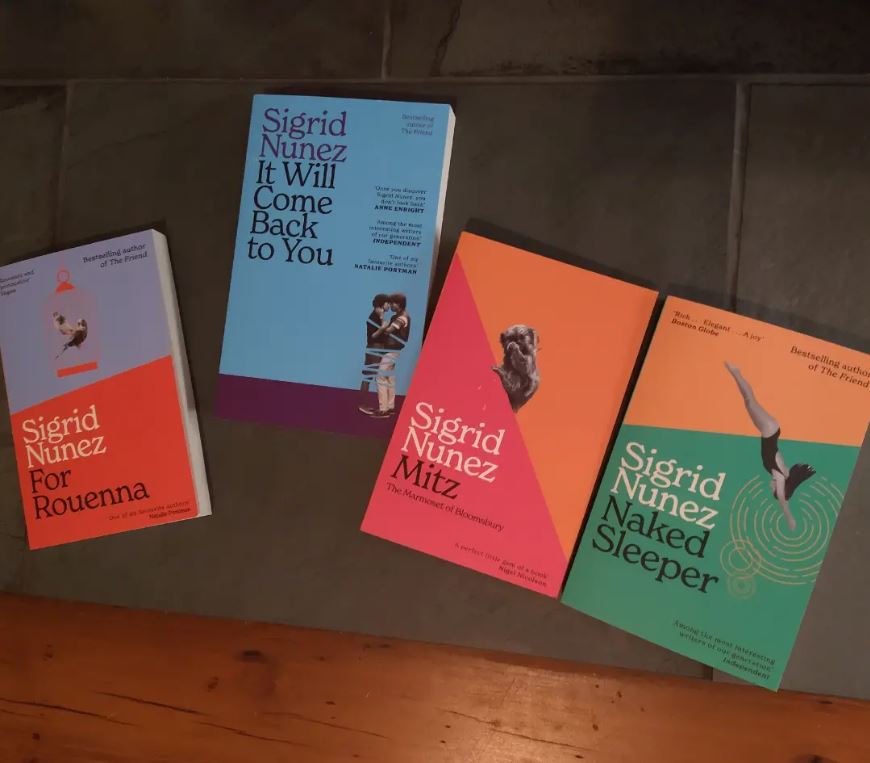
With thanks to Virago for the free copy for review, one of several matching reissues they sent me as part of their “Summer of Sigrid.”
20 Books of Summer, 11: The Singer’s Gun by Emily St. John Mandel
After a strong start, I reeeeaaaalllly slowed down on the summer reading. I’ll review a few more books this week and have another four on the go (I’ve substituted a few shorter ones into the stack already!), so I just need to decide on a final two and should make it by the end of the month.
 I earmarked The Singer’s Gun (2010), Emily St. John Mandel’s second novel, for the challenge because I’d heard that her new one coming out in September, Exit Party, was a sequel of sorts – more on that later. You can see signs of the intricate literary suspense she would become known for, but this has a comparatively simple plot. After his Italian honeymoon, Anton Waker makes the baffling choice to stay on Ischia rather than returning to New York with his bride. He’s left behind a corporate job he got under false pretences to live and work in an island hotel. Small-time crime is a family legacy: his parents’ antique business is a front for stolen goods; and with his cousin, Aria, he sold fake passports to immigrants. (His clients included Elena, who was from the Arctic North of Canada and later became his secretary.) He’s promised to do one last job for Aria on Ischia, for a cool $18,000, and then he’s out.
Of course, it’s never going to be that simple. For one thing, the stakes have escalated – Aria is being investigated for people trafficking – and for another, the title object, like Chekhov’s, is bound to cause unforeseen consequences. It’s a compact story with just a handful of major characters. The other is Alex Broden, a State Department detective who rarely makes it home for her little girl’s bedtime because she’s obsessed with solving a couple of people-trafficking cases. I felt Mandel was tempted to turn this into a sort of police procedural, yet Broden gets too little page time for readers to develop much of an interest in her. Anton is a bit of a blank as well; a rare detail that makes him sympathetic is that he misses his one-eyed cat, Jim, so much that he has him catnapped and flown over to Italy.
 The shipping industry and a hotel setting prefigure elements of The Glass Hotel (2020), which is Mandel’s finest work. As for the sequel: Exit Party is described as being about one “Ari Waker” in 2031 Los Angeles. It has a postapocalyptic setup (like Station Eleven) and the Moon is a setting (like in Sea of Tranquillity). I’m guessing that Ari is Aria, 20 years later. I’ll find out when I read Exit Party in September! This was an easy and relatively engaging read, but probably not a necessary trip into Mandel’s back catalogue unless you’re a completist. (New purchase – Awesomebooks.com)
Paris in July, III: Dundy, Maugham, Sarton Novels; Nonfiction by Durand & Carles, Gopnik
All in all, I’ve reviewed 13 books (a mix of fiction and nonfiction) for #ParisInJuly2026; see also Part I and Part II. It’s been such a fun escapist project for the summer – thanks to Emma of Words and Peace for hosting! I’m squeaking in at the last minute with a final set of five made up of a few obscure classics and two sets of essays that veer between autobiographical reflection and social observation, with a bit of self-help thrown in. A shared theme this time is differences between the USA (or England) and France. Here’s a quick paragraph on each.

Fiction
The Dud Avocado by Elaine Dundy (1958)
“The world is wide, wide, wide and I am young, young, young, and we’re all going to live forever!”
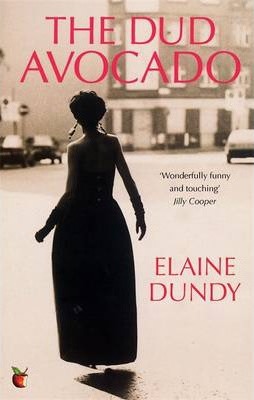 Sally Jay Gorce is determined to live it up in Paris. After all, now that she’s lost her passport, it doesn’t look like she’ll be going back to the States any time soon. With her dyed-pink hair, self-deprecating sense of humour, and heavily notched bedpost, she’s an endearing and impulsive protagonist. She’s always falling in and out of love and embarking on new projects, from acting on stage or as a film extra to posing as a painter’s model. I found her turns of phrase amusing – “To my chagrin, I found all my clothes … splitting themselves resolutely up into three categories: Tyrolean Peasant, Bar Girl, and Dreaded Librarian”; “It was dessert now, and I was deserting” – but did weary a bit of the meandering plot. This work of autofiction seems ahead of its time what with the protagonist’s promiscuity. I’ve always been intrigued about the title and learned that it arises from a love interest’s likening of American girls to avocados (“A hard centre with the tender meat all wrapped up in a shiny casing … so eternally green”) plus his mishearing of Sally Jay’s “dead” for “dud.” Somewhere on a continuum between I Capture the Castle and Nina Stibbe, this comic novel was a pleasant distraction. (Secondhand – Community Furniture Project, Newbury)
A linking passage: “Boy, we met a real nut on the beach today. A skinny young American with a fierce black moustache called Hugo McCarthy. He’d just left the South of France a couple of days ago, where he’d been kicked out of Somerset Maugham’s villa in Cap Ferrat for the third time.”
The Magician by W. Somerset Maugham (1908)
“There’s no place like Paris for meeting queer folk.”
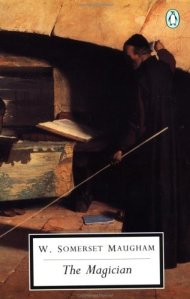 Who knew Maugham tried his hand at supernatural horror? The nearest thing I’d read from him before was Up at the Villa, a suspense novella. An autobiographical fragment preceding the text explains that Oliver Haddo, the villain of the piece, was inspired by a poet Maugham met in Paris, Aleister Crowley, who dabbled in Satanism and the occult. Arthur Burdon, an English surgeon in Paris, is engaged to marry Margaret Dauncey. Margaret’s roommate, Susie Boyd, is fascinated by Haddo, who looms large in personality and body. Margaret, on the other hand, says, “I’ve never met a man who filled me with such loathing.” Arthur and others of their acquaintance don’t know whether to take him seriously or not. This means that they underestimate the threat he poses to their happiness – and perhaps their lives. It’s rare to encounter a story of demon possession these days, and hard to know quite what to make of it. I found this reasonably compelling but melodramatic, plus it felt distasteful how Haddo’s weight increases to match his evil. Do read Maugham if you haven’t yet – he is reliably readable and a number of his works are short – but maybe not this one first. (Secondhand – 2nd & Charles)
Shadow of a Man by May Sarton (1950)
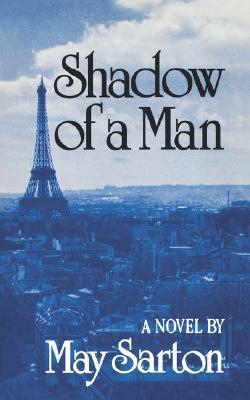 I’d not heard of Sarton’s third novel before I picked it up at random in a used bookstore. For those of us who discovered Sarton through her journals or poetry, I suspect her fiction will always fall short. The psychology of her characters’ relationships tends to lack subtlety, and plotting isn’t always her forté. I enjoyed this one well enough, probably because I could relate to the main character’s feeling of being adrift after his mother’s sudden death. After the funeral is over and done with, twenty-six-year-old Francis Chabrier decides to spend the summer in Paris. He’s half-French and thinks some time away from Boston might do him good. Except when he gets there he promptly falls in love with a family friend, Solange, and that’s complicated because she’s a 45-year-old widow whose late husband was shattered by his time in a concentration camp. It’s clear their romance will be short-lived. Francis’s stepfather, Alan, describes the young man as “a comet on the loose,” and the purpose of the months in Paris seems to be to set him on a more stable course. It grated that Solange is portrayed as almost an old lady (I’m only just over two years off her age now!), and that their affair only serves as a prelude to a more sensible relationship back home. However, the Paris setting (and coastal Maine later on) is delicious, and I marked out plenty of lines about Francis and his mother’s family dynamic. (Secondhand – Wonder Book & Video, Hagerstown)
Nonfiction
Pardon Our French: Parisian Lessons for a Happier Life by Alex Durand and Tom Carles with Allie Kingsley Baker (2026)
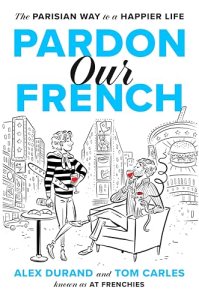 Durand and Carles moved to the USA to play college soccer and went viral on social media for their “AT Frenchies” videos about French language and culture. (I’ve not actually seen any.) Although they’ve come to admire aspects of the American lifestyle, such as ambition and individualism, they still prize traditionally French values of curiosity, privacy and a more relaxed approach to time management. Chapters on romance, food, style, friendships, green living, the arts and rituals bring out the best of what France has to offer. “L’histoire d’Alex” and “L’histoire de Tom” memoir sections alternate with more generic self-help advice. I expect Baker had a lot to do with the vernacular prose, which can be slick and clichéd. Still, it’s a good-natured, chatty book and it’s always worthwhile to be reminded to live in the moment, savour small pleasures, and insist on quality.
To be published by Penguin Life on September 8. (Read via Edelweiss)
Paris to the Moon by Adam Gopnik (2000)
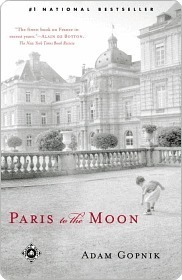 Longtime New Yorker writer Gopnik lived in Paris in 1995–2000 with his wife and young son; their daughter was born just before they left to return to New York City. Like other New Yorker regulars such as Elizabeth Kolbert and Susan Orlean, he is an excellent essayist. His book on French cuisine is a favourite of mine, and on this reread I most appreciated the pieces on food, and the general observations on being an expat:
Fish and plugs are the two great differences, the two things that are never quite alike from country to country. … This can shake you up, this business of things almost but not quite being the same. A pharmacy is not quite a drugstore; a brasserie is not quite a coffee shop
We have a beautiful existence in Paris, but not a full life, and in New York we have a full life and an unbeautiful existence. (= his wife’s conclusion)
everything about moving to France has been wonderful, and everything about emigrating to France difficult.
That summary of French bureaucracy, so at odds with the cultural experience of living in Paris, reminds me of what David Lebovitz has to say on the subject. There is too much about politics and sports in this book for me, but I loved his close attention to his son’s development and the customs they create around Christmas but also in the everyday, such as an ongoing bedtime story about a baseball player (“The Rookie”) and cake and hot chocolate after swimming. (Secondhand – 2nd & Charles)
My original rating (2016):
My rating now:
Some apt quotes about Paris I encountered this month:
Adam Gopnik: “Paris in July is pretty much left to the tourists and the people who look after them” & “Perhaps in the end this is why Paris is ‘romantic.’ It marries both the voluptuous and restricted.”
David Lebovitz: “Like New Yorkers, Parisians have a complicated relationship to their city. They appreciate the beauty and excitement, but as Romain told me, Paris is dur (hard). That things aren’t easy—l’administration, the neighbors, the brusqueness, the fact that it’s not a perfect place—is what he likes about Paris.”
May Sarton: “I think Paris makes everyone wise … All Americans fall in love with Paris. It’s the coup de foudre.”

Overall favourites: the whole of my first batch!
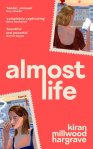
- Almost Life by Kiran Millwood Hargrave
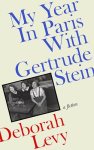
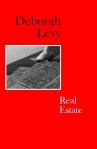
- My Year in Paris with Gertrude Stein & Real Estate by Deborah Levy
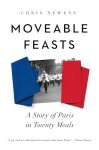
- Moveable Feasts by Chris Newens
July Releases by Carson, Du Bois, Humphreys, Nolen & Watkins
This month I have novels set in the Mojave Desert and a Northern Ireland that never was; poetry about food and cross-cultural identity / adolescent boys and self-harm; and a short nonfiction book offering ideas for how to reconnect with nature. Repeated themes include environmental damage, Bible imagery and toxic masculinity.
Few and Far Between by Jan Carson
“So this is all true.”
“Historically true or made-up true?”
“What’s the difference?”
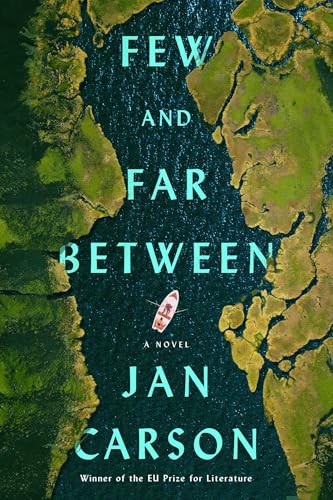 This was my first from Carson – and her U.S. debut – though she’s well known in Northern Ireland for her novels and short story collections. (Our own Cathy of 746 Books gets a mention in the Acknowledgements!) Her fourth novel is a work of alternative history with subtle magic realist touches. In 1958, Terrence O’Neill (shortly to be elected Prime Minister) proposed draining Lough Neagh to give Northern Ireland a seventh county. That never happened, but in the world of Carson’s novel it did, creating “the Ark,” an archipelago of islands in the large lake. It was primarily a refuge for people fleeing the Troubles – and also happens to provide a nice raft of allusions to the Book of Genesis. In 2017, middle-aged siblings Marion and Robert-John Connolly are two of the last few remaining residents of the Ark, working as caretakers. They grew up here with their overbearing anthropologist father and German mother. Rumour has it that the government will soon flood the lake to deal with an algae bloom. The Connollys hope that the arrival of Alex Anderson, a homegrown academic writing a history of the Ark, will be their chance to defend their home.
Carson has given careful attention to her worldbuilding here. Along with the previously inhabited islands are four on the “Far Side” that seem more metaphorical: Middle Flat houses “the Sleepers,” who are in a coma due to trauma (cf. Suzanne O’Sullivan’s The Sleeping Beauties); Church Flat is a sort of bardo for the “Almost Dead”; Tom’s Hard is a suicide spot; and Eglish Flat is where people go to bury things they don’t want anyone to know about. Except, like the return of the repressed made physical, all that detritus has been resurfacing. Excerpts from Alex’s manuscript in progress treat this all matter-of-factly, and before long it all feels completely natural. Flashbacks to the 1970s and 1990s fill in backstories for the oddball central characters, whose off-kilter upbringing keeps them tied to an island chain that harbours as many bad memories as good ones. This was intriguing for its blend of realism and fabulist elements; I never knew what was going to happen next. I’ll read more by Carson for sure.
With thanks to Scribner for the proof copy for review.
Eating Air by Suyin Du Bois
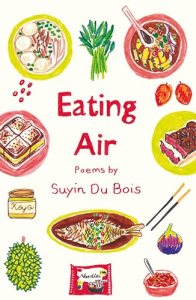 In this yummy debut poetry pamphlet, food is wrapped up with memory and serves as tokens of a mixed Chinese-Malaysian and Belgian identity. Sometimes when Du Bois is travelling in Asia, people assume that she is a total foreigner and bring her a fork instead of chopsticks, or remark on her bravery in trying dishes that are an acquired taste. In fact, she’s up for eating anything, no matter how spicy or unusual. Food can be about travel and adventure, but also about comfort and a sense of home. Family chats and celebrations revolve around good meals and drink: “We sate silence with stories / of firm favourites and elusive treats we long for”. A trip to London’s Chinatown entails more of that delicious alliteration and sibilance: “a pile of slender leaves serenades me with its many names: / eng chai, ong choy, kangkong, water spinach, morning glory.” I particularly loved the clever blend of cookery and family tradition in “Ode to Kaya,” where the quest for the perfect egg jam made with palm sugar and coconut milk brings back memories of a departed relative: “Goh Ee Poh has long since condensed / into photographs, so I sweeten my never-asked / regret, trace down someone else’s heirloom recipe.” These 19 poems are a feast, ranging widely across places, languages and cuisines.
With thanks to The Emma Press for the free copy for review.
Unwilded: Finding Our Way Back to Nature by Alastair Humphreys
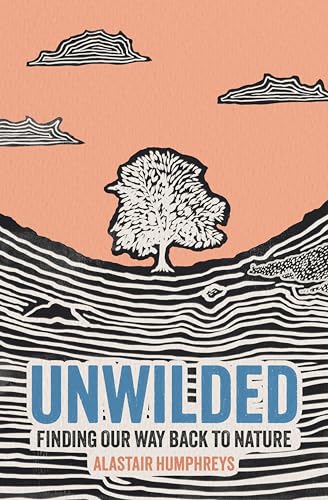 I discovered Humphreys’ work through his previous book, the Wainwright Prize-longlisted Local (and he’s now a judge for this year’s nature writing race). His wry, sometimes silly tone is reminiscent of Lev Parikian, and the two authors share a clear passion for the natural world and for enthusing others about its everyday wonders here in England. Humphreys opens with two recent events that reassured him that people care about nature: the public outcry that greeted the illegal cutting down of the famous Sycamore Gap tree at Hadrian’s Wall, and the joyful (if competitive) response to sightings of the Aurora Borealis. The former also serves as a cautionary tale of what happens when people are disconnected from nature: The two men convicted for the Sycamore Gap incident retorted that it was “just a tree.”
Humphreys doesn’t point fingers but acknowledges that the issue is systemic and affects all of us, even avowed countryside-lovers: “Our busy indoor lives, the moth-like lure of bright screens and shopping centres, and restricted access to much of our remaining green space all combine to make us more disconnected from the natural world than any previous generation.” Short chapters give strategies for various activities that, in as little as 15 minutes, could get people more engaged with the outdoors: litter picking, photographing the same tree every week for a year, foraging for blackberries, testing the water quality in a local stream, wild swimming, planting trees, and joining in a parkrun. I liked his idea of marking each full moon by enjoying a different spot by night. He also worked outdoors for one hour per day for a week, and dabbled in performance art through graffiti reading “15 Minutes to Nature” with an arrow or “NOTICE THIS TREE.” It’s easy to become disheartened by the scale of environmental problems, but Humphreys suggests choosing five to focus on, and then joining up with other local concerned citizens to work towards five corresponding mitigating actions. This is a readable and practical book written with a light touch. Like Lucy Jones’s Losing Eden, it ends with a utopian epilogue imagining humans living in harmony with a restored natural world. Let’s all keep living in hope, and doing our bit to make it a reality.
With thanks to the author and Eye Books for the free copy for review.
Afterlight by Caleb Nolen
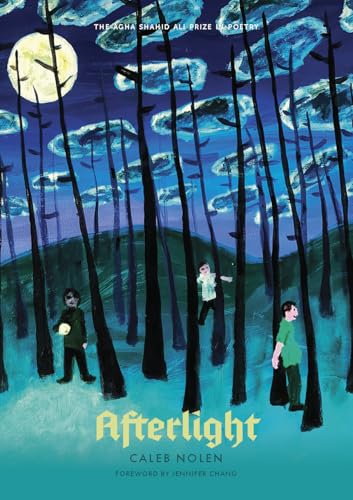 Nolen’s debut collection won the Agha Shahid Ali Prize in Poetry (the same award that my old blogger friend Carolyn Oliver won for her first book, Inside the Storm I Want to Touch the Tremble). It reflects on an early life marked by male friendship, addiction and other self-destructive behaviours, including suicidal ideation. The poet barely knew his father, who had a new wife and kids and treated meetings with his older sons as begrudged obligations. He and his high school friends snuck beer, weed and prescription pills. There were other even more dangerous things around, too –
from “First Gun”
A pistol, wrapped in an old shirt, hidden behind a panel
in his parents’ basement. When he brought it out to show us,
he held it carefully in both hands.
I was reading this collection at the same time as Michael Amherst’s The Boyhood of Cain, and the two chimed for their equation of expected masculinity with violence –
from “Letter to Cain”
My first consolation, my first friend,
tell me what you learned when the blood cried out:
who are we the keepers of, we who were not kept?
Nolen is 40, too young to have four dead friends – Bobby, Mike, Jonathan and Troy – threading through his memory. The book is rife with biblical references (“Jonah Years,” “Killing the Fattened Calf”), including letters addressed to particular figures: Abel, Job, the Woman Taken in Adultery, Paul the Apostle, Judas, the Man Possessed by Demons. Personal and religious history mesh, such that the quartet of departed friends are included alongside Mary of Oignies and the like in an Appendix of Hagiographies.
You’re making a life out of scribbling
the names of your dead friends.
This is a sombre collection that looks back with pain rather than nostalgia. Gentle alliteration and glimpses of nature help to make the vision of the past endurable.
With thanks to the University of Utah Press for the advanced e-copy for review.
Yellow Pine by Claire Vaye Watkins
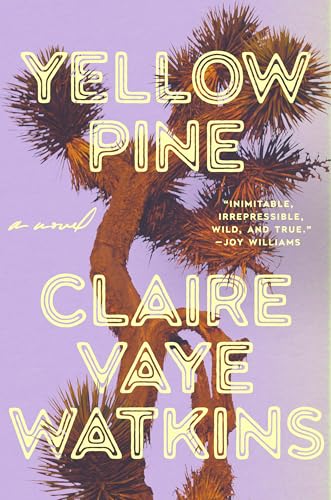 Watkins’s fourth work of fiction exudes love for a distinctive and endangered landscape: the deserts of the American West. Rose has worked for the Sierra Club and has a preteen daughter, Juniper, who lives with her father back east. The book opens with Miles, a former lover, returning to Rose’s life. Approaching age 40 and grieving her alcoholic mother’s untimely death, she finds herself yearning for a baby even though she feels it’s morally questionable to have children in a time of climate breakdown. If Miles won’t commit, she has a backup plan called “The Swirl” whereby male acquaintances will be invited to inseminate her after signing away parental rights. (Just the sperm, thanks; Rose will take care of the rest.) Meanwhile, she’s part of a loose group based at the Yellow Pine encampment, protesting the construction of a solar farm that would devastate local tortoise populations. The defenders’ impassioned conversations about how to work toward good in a time of corporation-driven extinctions are a highlight. It’s a bold, kooky, horny novel in the same vein as Melissa Broder’s Death Valley and Miranda July’s All Fours, but still manages an intellectual rigour and felicity of prose that I perhaps wasn’t expecting. Some sample lines:
It was surprisingly nice to be named a friend by the man who’d once poured salt on the slug of her heart
Rose and Miles sallied forth, trying again in Indian summer in a low-key failed state on a dying planet.
Love laid down a new layer. Rose’s despair patinaed with faith.
“I’m trying to be unapocalyptic. I’m trying to be practical.”
I’ve been reading Watkins since her debut story collection, Battleborn, won the Dylan Thomas Prize, though it’s her first novel, Gold Fame Citrus, to which I’m most partial. Her third book, I Love You but I’ve Chosen Darkness, went too far off the rails for me, whereas this one is a return to form. The outlook is a little bit woo-woo and I appreciated the environmental theme more than the indulgent autofiction framework. Still, it feels realistic and up-to-the-minute, positing human connection and purposeful collective action as antidotes to hopelessness. (“It wasn’t enough to be anti … You had to be for something.”)
With thanks to riverrun/John Murray (Hachette) for the free copy for review.
Which of these July releases have you read, or will you seek out now?
What am I missing out on?
Summer Reads, Part I: Buti, Ellis, C. Foster (Reread), Itami, Thomson
The less said about the summer of 2026, the better. It feels like the heat wave will never end. We’ve had 4 mm of rain the whole month. Drought imperils so much. But it’s not right to complain when wildfires rage not so far away. One glance at the news headlines and there’s no avoiding the signs of climate breakdown everywhere. I can’t bear it. I just keep reading.
Year of the Drought by Roland Buti (2015; 2017)
[Translated from French by Charlotte Mandell]
How exhausting was that summer of 1976, always beating down on our heads!
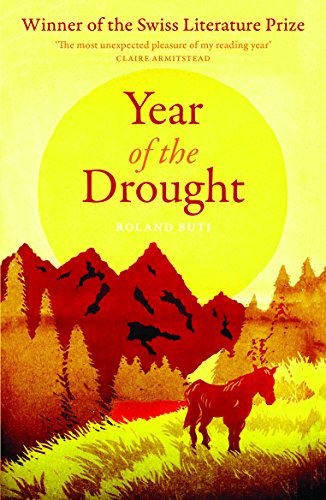 This Swiss novella takes place during the infamous European heat wave that people still talk about half a century later. It’s a perfect febrile setting for 13-year-old Gus’s coming-of-age, which includes a sexual awakening and the dawning realisation that his parents aren’t perfect; that in fact his family is falling apart. The Sutters’ operations embody the move from family smallholding to an industrial model. They keep a small number of cattle but are also experimenting with large-scale henhouses holding thousands of birds. In contrast with that vast flock, about whose welfare the characters seem indifferent, is an injured white dove that Gus finds and keeps as a pet. (A wise choice by Buti: it’s easier to feel compassion for an individual, such as the dove or the old farm horse, Bagatelle, than for a faceless mass.) Helping Gus and his father on the farm is distant cousin Rudy, who has Down’s syndrome; disrupting their routines is Cécile, Gus’s mother’s friend, who has come to stay with them.
Because of the drought, our minds were full of dreams of coolness and moisture
Dreams of rain, dreams of love, dreams of preserving some mythical family happiness that maybe never existed. Like the weather, everything goes wrong – in tragic ways. It’s all so awful I recoiled. Buti jumps ahead several decades to offer a longer view of the land, but I couldn’t ignore how casually the teenage Gus adopted his father’s violent, misogynistic ways. None of what happens bodes well for the future. The one laugh I got out of the experience was the charity shop accidentally labelling the book “Romance fiction.” (Secondhand – BHF, Newbury)
Book 1 of The Summerhouse Trilogy
The Clothes in the Wardrobe by Alice Thomas Ellis (1987)
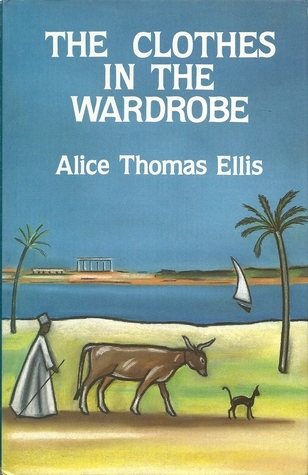 I hadn’t had great luck with Ellis, fiction and nonfiction, before, but I’m so glad I was tempted by this omnibus edition and tried her again. This melancholy, introspective novella was right up my street. Margaret’s yearning for her Egyptian upbringing isn’t the only reason I reached for Moon Tiger as a readalike; Ellis’s tone reminded me of Barbara Comyns and Penelope Lively for its mix of cynicism and nostalgia. Margaret is soon to marry Sylvester, though she doesn’t love him at all and he’s closer to her mother’s age as well as a known womanizer. Perhaps the engagement was her mother’s idea more than her own? The title is an apt symbol for living to someone else’s expectations: “my life fitted me as ill as a garment designed for somebody else,” Margaret thinks. It’s no coincidence that she’s to be married in her mother’s old wedding dress. There are also sartorial metaphors around memory (“Did the elderly have minds like old wardrobes stuffed to overflowing…”) and resistance to ageing. I marked out so many shrewd observations and witty conversations. I empathized with Margaret’s feeling of being trapped in a life she hasn’t chosen.
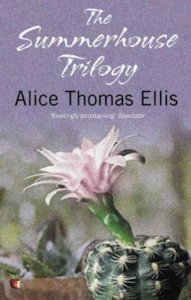 It seems like one of those books where nothing will happen, but there’s actually a surprise ending that looks set to move Margaret onto a different track. As I understand it, the other two volumes repeat the weeks leading up to the wedding from other perspectives: Margaret’s staid mother-in-law-to-be; and her mother’s bohemian friend Lili, who was her bridesmaid back in Egypt and arrives in time to shake things up. I love that premise. The omnibus cover seems random, but the question of whether the cactus in the summerhouse will flower as good luck for the wedding becomes an important plot point. I’ll jump right into Book 2. (Secondhand – Regent Books, Wantage)
The Screaming Sky by Charles Foster (2021)
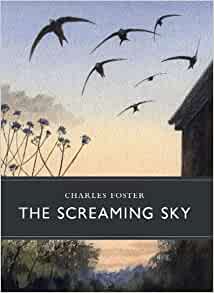 The only thing that has redeemed these dry, scorching days is the swifts screeching across the sky. How can it be that I was once unaware of them? How is it possible for people not to look up for these noisy acrobats whenever they’re outdoors? Somehow, I was oblivious until maybe 10–15 years ago. Now, I always have at least one eye on the sky during these crucial few months. And although this year swifts have been with me since early April (first in Portugal and then in our neighbourhood), I’m already dreading their departure for Africa in a few weeks. They’re still here! I trill to myself each morning. But soon that won’t be true. And with populations in freefall, there may come a day when they don’t return to the UK at all.
Charles Foster is a kindred spirit who sets similar emotional store by the presence or absence of the common swift (Apus apus). I appreciated this when I first read it five years ago (my review), but all the more so now. The monograph takes us through one year with swifts. In the summer, he needs travel no further than his own street in Oxford, but the rest of the time he has to chase them down in continental Europe and central and southern Africa. It’s an old-fashioned quest, a romantic pursuit, a hopeless attempt to keep hold of creatures as fast and elusive as the wind. Foster salts his narrative with all the salient facts but acknowledges that, for all we claim to know about them, these birds retain an essential magic and mystery. “Their power, freedom and joy are the way that everything really is – though we don’t usually see it. It is just that when the swifts scream through the sky, you can’t miss it. That’s how everything, all the time, is meant to be.” (Review copy from Little Toller Books)
My original rating:
My rating now:
Bonus content:
From Robert Macfarlane’s The Book of Birds (illus. Jackie Morris):
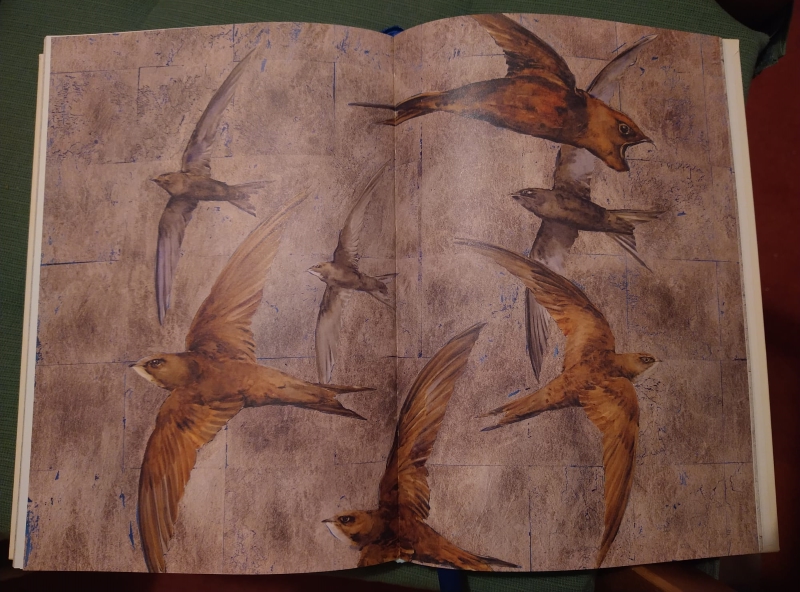
From the Spell Songs album Let the Light In: “Swifts”
& My current earworm, also featuring Kris Drever: a more general reassurance – or at least philosophical acceptance – that change is the one constant in life, in perfect pop song form (“Change”)
And from Ugandan poet Nick Makoha’s The New Carthaginians: “in the first part of the night, I saw the coastal villages, men arguing / about the price of oil and swifts darting into shadows.” (from “Codex© of Birds”)
Kakigori Summer by Emily Itami (2025)
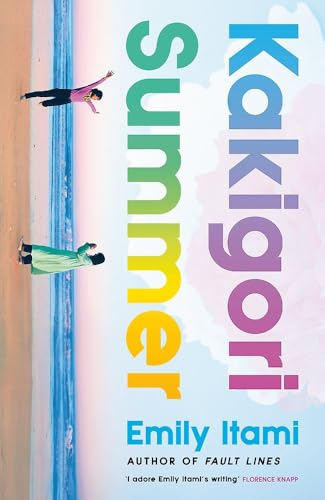 Itami was shortlisted for a Costa Award for her enjoyable 2021 debut, Fault Lines. Kakigori is a flavoured shaved-ice dessert and it’s a great choice of title for this bittersweet – but mostly sweet – story of three sisters raised between Tokyo and London who reunite in Japan to spend a summer together with their prickly great-grandmother, Obaachan, who’s nearing 100. Narration alternates between Rei, the oldest, who has a high-flying finance job and keeps everyone in line; Kiki, who’s a single mother and works in a care home for the elderly; and Ai, a flighty pop star now in disgrace for her affair with a married man. Although there is much joy in their banter, little Hikaru’s antics, and the pursuit of the finest culinary treats, a shadow over it all is their mother’s unexplained death. She went for a swim one day when they were girls and never came back, nor was a body ever found; they have to suspect suicide. (“Well, that’s that, then. Nothing will be all right ever again.”) This easy-reading novel affirms the goodness of life despite the reality of death. Its typically Japanese feasts and funerary rites brought to mind Bryan Washington’s similarly well-balanced Memorial. My only note would be that I’m not sure the voices were distinctive enough to warrant three first-person narrators; third person rotating would probably have done the job. (Public library)
Saltwater: A Midsummer Ghost Story by Elaine Thomson (2026)
“The dead are closer than we think.”
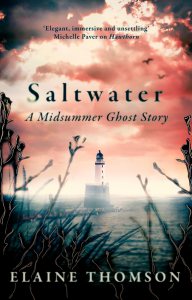 I hadn’t heard of the Scottish island of Stroma, so assumed it was made up. In fact, it’s real, lying between Orkney and the north coast of Caithness on mainland Scotland, but uninhabited as of 1962. Tom Torrance travels by train and boat from Edinburgh a few days before midsummer to oversee the last steps in the construction of the island’s lighthouse and meet with Mr Stevenson (of the famous lighthouse-building clan, which included novelist Robert Louis Stevenson). With him is his brother Jamie; he’s not of much practical help, but they cling to each other because they lost their mother to tuberculosis a week ago. The travelling minister Tom meets on the train gives him a rowan-wood amulet and cautions him that midsummer is a liminal time when the spirit world is close at hand. Tom doesn’t heed the warning. He arrives to find a disaster-prone construction project that has entailed serious injuries and broken machinery. Flora Christie and her grandmother, Thrawn Jean, are local women with healing powers who are treated with suspicion: women, especially those with red hair, are considered bad luck around boats. The men want to seal a “witch bottle” into the wall for good luck. He dismisses their superstitions but at the same time keeps seeing hallucinations of the dead in the waves and on the in-construction edifice. Is it grief, Flora’s special whisky, or a real taste of the supernatural?
This was highly reminiscent of Michelle Paver’s work. The typical Victorian-pastiche ghost story bores me because it’s always just the same: the narrator is a dignified gentleman who can’t possibly be seeing such things, yet documents them and his own horror with great precision. Thomson set herself an interesting challenge, writing a quartet of Scottish ghost stories set at turning points of the year. (This is the second, after Hawthorn.) I probably won’t try the others unless my library acquires them. (Public library)
Paris in July, II: Beauvais, Brown, Elkin and Lebovitz
July has been one long heat wave here in southern England. Luckily, it’s a bit cooler than it was earlier in the month, and we’re developing strategies for coping with what seems to be the new normal – until it gets worse again. My main tactic has been doing very little on most days apart from sitting on the couch or reclining on a mattress with a stack of books to hand. So it’s been good for one thing (maybe two): finishing books – and watching swifts. Following on from my first set of four Paris reads, I have another four (and five more coming up before the end of the month): a teen novel about overcoming peers’ prejudice, an essay anthology about the enduring appeal of the city for authors, a fragmentary memoir composed on a phone during a bus commute, and a record of a chef’s home renovation journey from hell.
Piglettes by Clémentine Beauvais (2014; 2017)
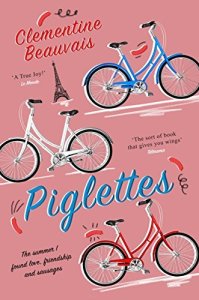 This was my second YA novel by Beauvais (after In Paris with You); she translated both herself and her proficiency in both languages allowed her to include wordplay that might have been lost otherwise (“I finally get what it means to have l’esprit de l’escalier, when I scream to her, from the bottom of the staircase…”). Mireille LaPlanche’s former friend Malo introduced a cruel annual tradition at their high school: a “Pig Pageant” in which classmates pick the fattest, ugliest girls – including her. She decides to team up with two other finalists, Astrid and Hakima, and show their persecutors what they can do. After a period of planning and training, they undertake a week-long cycle ride from their home in Bourg-en-Bresse to Paris, timed so that they’ll arrive on Bastille Day and crash the president’s garden party. Hakima’s older brother, Kader, who lost his legs in the Iraq War and uses a wheelchair, is their chaperone. They’ve dubbed themselves the “Three Little Piglettes” and tow a trailer full of sausages that they cook and sell at each stop. Soon they’re a social media phenomenon. This sweet, funny Cinderella story about defusing fatphobia includes good diversity rep and touches on lots of issues including anxiety, bullying, and unrequited love – all with an unmistakably French enthusiasm for wine, cheese and philosophy. (Edelweiss)
A Paris All Your Own: Bestselling Women Writers on the City of Light, ed. Eleanor Brown (2017)
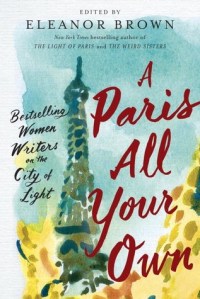 A reread that I started shortly after our trip to Paris in December 2023 but left half-finished on a shelf until this month. The roster of 18 contributors leans very much towards women’s fiction. While I probably most enjoyed the third of the book that was by authors I’d read and liked before – J. Courtney Sullivan, Susan Vreeland, Paula McLain, Julie Powell, Therese Anne Fowler and Maggie Shipstead – all of the pieces are cosy and undemanding. They tell of time spent living, working or travelling in the city. Sometimes it meets expectations; other times, mishaps and faux pas create disillusionment until a future visit grants a second chance. There are favourite foods and language struggles, art treasures and magical spots to discover, and stereotypes to confirm or overturn. The experience of Paris can vary based on who the travel companion is – an enthusiastic child, a needy parent or a soon-to-be ex. Fowler made her research trip before writing a biographical novel about Zelda Fitzgerald, while McLain only saw Hemingway’s haunts after she’d written The Paris Wife. Each essay finishes with a quickfire list of favourite Paris moments, books, sites, songs, etc. Not a bad substitute for being there! (Secondhand – 2nd & Charles)
My original rating (2017):
My rating now:
No. 91/92: Notes on a Parisian Commute by Lauren Elkin (2021)
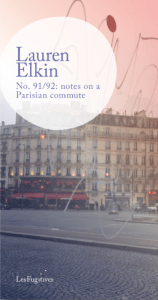 Just imagine keeping a diary of your bus journeys in the Notes app of your phone for seven months and getting a book out of it. Elkin’s mostly unedited observations are based on people-watching and her own swirling thoughts in 2014–15. She covers obnoxious behaviours on public transport (the same the world over, it seems: “Oi. Manspreader. Bouge ton cul”); her teaching work; overheard conversations; and Paris as seen in different seasons. Her mind wanders across history and theory. The bus is a melting pot: She’s thrown into false intimacy with people she’s never seen before and hopes never to encounter again. Nothing much happens until it does. First it’s the Charlie Hebdo attacks. Then she falls pregnant but it’s ectopic and she loses the baby. And, after she’s switched to Métro commuting, the Hypercacher attacks. In the prologue and epilogue, Elkin talks about only understanding major events in retrospect. She also cites lockdown diaries as being a new subgenre her project fit into. But let’s be honest: if she’d not already made a name for herself as a cultural critic, this would never have been published. While it has some value as an in-the-moment historical document, I didn’t find it nearly as profound as, say Deborah Levy’s autobiography. (Secondhand – Awesomebooks.com with SellItBack voucher)
L’appart: The Delights and Disasters of Making My Paris Home by David Lebovitz (2017)
Lebovitz is a San Francisco pastry chef who moved to Paris a couple of decades ago. We get a lot of ideas from his dessert cookbook and extensive blog archive. Like The Sweet Life in Paris, this contains lighthearted musings about cultural differences between France and the US and many tantalizing recipes (most of them sweet but also a few savoury) that I am actually likely to make. But it’s primarily about the several-year saga of buying and restoring an apartment. Lebovitz had a grand plan for the kitchen, especially: a huge space with American-style appliances that would ease his cookbook writing and testing. French bureaucracy made the purchase difficult enough as the property had to be officially reregistered as residential rather than commercial, and the seller and realtor were both antagonistic.
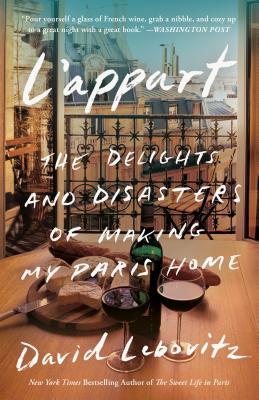 But that was nothing compared to the nightmare of the renovation. To start with, Lebovitz was friendly with his contractor and his workers. In fact, too friendly, his partner, Romain, warned. He called the builders “tu,” brought fresh-baked treats for them, and always paid their bills promptly. They started taking liberties: hardly ever showing up, failing to meet deadlines, replying to every concern with “pas de problème” but never fixing the issues. The shoddiness and incompetence are truly astounding: counters at the wrong height, an unusable faucet, melted fuses, an electricity leak, buckled floorboards, askew windows, an upside-down water softener. Every mistake cost time and money, such that the whole job was three times longer and more expensive than projected. (A lawyer dissuaded Lebovitz from suing because in the French legal system it could take five years and not even go his way.)
Depending on your own experience, this might be cathartic, or too close to home, or a cautionary tale. (We’d already long decided we won’t do any major building projects because we can’t tolerate noise, disruption or strangers and our house is good enough for our needs.) Keep in mind that Lebovitz dealt with all this in a second language and his fortitude is impressive. Scenes at Ikea and conversations with his contractor are amusingly surreal. But I confess I did find this a little overlong and repetitive, and every setback made me cringe for him. I’ll have to bake some frangipane plum-raspberry gratins and try to forget the pain. (Secondhand – Better World Books with Little Free Library voucher)
 Bookish Beck = Rebecca Foster. American transplant to England. Freelance proofreader and book reviewer.
