Women’s Prize Longlist Reviews (Erdrich, Mendelson, Ozeki) & Predictions
Tomorrow the Women’s Prize shortlist will be revealed. I’ve become much more invested in this prize over the past few years and will be following the 2022 race especially closely – look out for a related announcement soon. In recent years the nominees have tended to cluster thematically, which can feel redundant. This longlist has a notably high ghost quotient. Two novels I review below feature unquiet spirits, an appearance by the author, and the magical powers of books. The third is a straightforward contemporary dysfunctional family story.
The Sentence by Louise Erdrich
My second from Erdrich (I gave Love Medicine, her first novel, 5 stars in 2020). I will be revisiting this in June because it is our first pick for my tenure in the Literary Wives online book club. For that post I’ll focus on the relationship between Tookie and Pollux, which I won’t mention in this more general response. I was worried that a take on very recent events – this is set in Minneapolis between 2019 and 2020 and covers the first six months of the pandemic plus local protests following George Floyd’s murder – would seem either rushed or dated. I’m still unsure how I feel about encountering Covid-19 in fiction (vs. I’ve read 20 or more nonfiction records now), but I think this novel functions as a sturdy time capsule.
 Tookie, the narrator, has a tough exterior but a tender heart. When she spent 10 years in prison for a misunderstanding-cum-body snatching, books helped her survive, starting with the dictionary. Once she got out, she translated her love of words into work as a bookseller at Birchbark Books, Louise Erdrich’s Minnesota independent bookshop (Louise herself is an occasional character). Bibliophiles are sure to enjoy the mentions of the books she presses into customers’ hands; there’s also a fun appendix of recommendations on particular topics.
However, the central mystery about Flora, a dead customer who haunts the store until Tookie figures out why she died and how to exorcise her, struck me as silly. I only appreciated this storyline to the extent that it explores authenticity (Flora may have fabricated her Native heritage) and the inescapability of history. I preferred real life: Tookie getting locked down with her stepdaughter and baby grandson and filling book orders from a closed shop.
Erdrich weaves in Indigenous customs naturally and the banter between the characters, including young shop employees, makes this hip and lighthearted, even as it deals with serious subjects. I smiled at the bookish lingo, like Tookie’s division of her reading into a Lazy Stack and a Hard Stack (“books I would avoid reading until some wellspring of mental energy was uncapped” – my occasional and set-aside titles could comprise the latter) and the “cowbirds,” self-published titles secreted on the shelves that aren’t found until inventory day. There’s also an excellent passage on novellas that I’ll be bringing out in November.
Like a vintage armchair, this is a little overstuffed, but so comfortable you’ll want to stay a while. (See also Laura’s review.) (Public library) 
The Exhibitionist by Charlotte Mendelson
~SPOILERS IN THIS ONE~
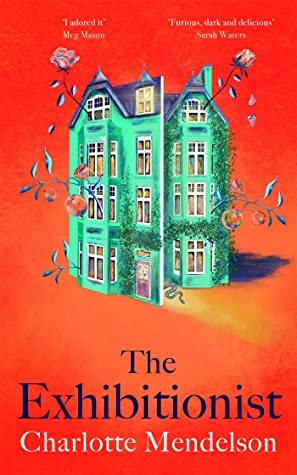 Artists, dysfunctional families, and limited settings (here, one crumbling London house and its environs; and about two days across one weekend) are irresistible elements for me, and I don’t mind a work being peopled with mostly unlikable characters. That’s just as well, because the narrative orbits Ray Hanrahan, a monstrous narcissist who insists that his family put his painting career above all else. His wife, Lucia, is a sculptor who has always sacrificed her own art to ensure Ray’s success. But now Lucia, having survived breast cancer, has the chance to focus on herself. She’s tolerated his extramarital dalliances all along; why not see where her crush on MP Priya Menon leads? What with fresh love and the offer of her own exhibition in Venice, maybe she truly can start over in her fifties.
Ray and Lucia’s three grown children, Leah, Patrick and Jess, are all home for Ray’s new exhibition. They’re mere sketches: Leah is Ray’s staunchest supporter and is infatuated with the no-show caterer; Patrick’s mental health is shaky, interfering with his job prospects; Jess, a teacher in Edinburgh, is pregnant but not sure she’s committed to her boyfriend long term. I wanted more depth from all the characters, but especially the offspring. I also expected a climactic late scene on Hampstead Heath to come to more.
Still, the build-up to the exhibit (followed by a laughably pitiful reveal) and Lucia’s inner life form an adequately strong foundation for Mendelson’s sardonic prose. The dialogue, full of interruptions, is true to life. This is her fifth novel and called to mind Jami Attenberg’s and Claire Fuller’s work. (Liz found shades of Iris Murdoch. Susan loved it, too.) I wouldn’t say I’m compelled to seek out more by Mendelson, but this was a solid read. (Public library)
The Book of Form and Emptiness by Ruth Ozeki
A Tale for the Time Being is one of my favourite novels of the century (and one of my most popular Goodreads reviews ever), My Year of Meats was a terrific backlist read a couple of summers ago, and I’m eager to catch up on All Over Creation. So I’d built up this fourth Ozeki novel in my head, thinking a library setting and magic realist elements presaged something deliciously Murakami-esque.
 What I actually found, having limped through it off and on for seven months, was something of a disappointment. A frank depiction of the mental health struggles of the Oh family? Great. A paean to how books and libraries can save us by showing us a way out of our own heads? A-OK. The problem is with the twee way that The Book narrates Benny’s story and engages him in a conversation about fate versus choice.
When Kenji Oh, a jazz musician, is run over by a chicken truck, Annabelle finds herself a single mother to Benny, a troubled teen who starts to hear everyday objects speaking to him. His voices and Annabelle’s hoarding habit jeopardize the viability of their household: Benny spends time on a psychiatric hospital ward for minors and Annabelle is threatened with eviction. For Benny, the library and the acquaintances he makes there – a fellow pedi-psych patient named Alice who calls herself The Aleph, an Eastern European philosopher who goes by The Bottleman (= Slavoj Žižek?), even the Ozeki figure tapping away on her laptop – may be his salvation; for Annabelle, it could be the book Tidy Magic (modelled on Marie Kondo’s work), written by a Buddhist nun. But until then, their stories get very dark indeed.
Concern for the principal pair and their relationship kept me reading even though this is too long and I wearied of Ozeki’s habit of literalizing metaphors (books speaking to people; being crushed by one’s belongings; crows playing a protective role). I’m still sympathetic to Ozeki’s aims, even if she doesn’t quite pull it all off here. If I pit the rather similar The Sentence and The Book of Form and Emptiness against each other, Erdrich comes out ahead. 
With thanks to Canongate for the proof copy for review.
I’ve gotten to six books from the longlist so far and have a few more on order at the library. The others I’ve read, with ratings and links to my reviews, are:
Build Your House around My Body by Violet Kupersmith
Sorrow and Bliss by Meg Mason 
I’m also partway through The Final Revival of Opal & Nev by Dawnie Walton, which is enjoyable enough but, alas, suffers in comparison to Daisy Jones and the Six, whose format (a composite oral history of a fictional 1960s/70s musical act) it repeats. The addition of the race issue doesn’t feel sufficient to call it original.
I’ve also DNFed a few from the longlist, two of them multiple times, so I have my fingers crossed that they don’t advance!
- The Paper Palace by Miranda Cowley Heller
- The Island of Missing Trees by Elif Shafak
- Great Circle by Maggie Shipstead
My attitude to the rest of the longlist is…
- The Bread the Devil Knead by Lisa Allen-Agostini – No plans to read.
- Salt Lick by Lulu Allison – I might read this from the library. I’m leery of dystopias, but I’m there for a chorus of cows.
- Careless by Kirsty Capes – No plans to read.
- Remote Sympathy by Catherine Chidgey – I would happily read it if it’s shortlisted, but at over 500 pages I fear it’ll be too dense.
- Flamingo by Rachel Elliott – Maybe. Sounds like pretty standard Sarah Winman-type stuff, but it could go down well with a book club.
- This One Sky Day by Leone Ross – No plans to read.
- Creatures of Passage by Morowa Yejidé – I was actually pretty keen to read this one, so I have it on reserve at the library. Egyptian mythology makes a change from the overdone Greeks, and the Washington, D.C. setting is a big draw. Laura’s review has tempered my expectations, but I might still give it a go.
My ideal shortlist (a wish list based on my reading and what I still want to read):
The Sentence by Louise Erdrich
Build Your House around My Body by Violet Kupersmith
Sorrow and Bliss by Meg Mason
The Exhibitionist by Charlotte Mendelson
The Final Revival of Opal & Nev by Dawnie Walton
Creatures of Passage by Morowa Yejidé
vs.
My predicted shortlist:
Remote Sympathy by Catherine Chidgey
The Sentence by Louise Erdrich
Sorrow and Bliss by Meg Mason
The Exhibitionist by Charlotte Mendelson
This One Sky Day by Leone Ross
The Island of Missing Trees by Elif Shafak
An overall winner? Gosh, it’s too early to tell. But maybe The Sentence, Sorrow and Bliss or The Island of Missing Trees.
See also Laura’s shortlist predictions.
What have you read from the longlist so far?
Which of these books are calling to you?
Review Catch-Up: Capildeo, Castillo, Nagamatsu & Wedlich
A second catch-up for April. Today I have a sprightly poetry collection about history, language and nature; a linked short story collection that imagines funerary rituals and human meaning in a post-pandemic future; and a wide-ranging popular science book about the diverse connotations and practical uses of slime. As a bonus, I have a preview essay from a forthcoming collection about how reading promotes empathy and social justice.
Like a Tree, Walking by Vahni Capildeo (2021)
 Capildeo is a nonbinary Trinidadian Scottish poet and the current University of York writer in residence. Their fourth collection is richly studded with imagery of the natural world, especially birds and trees. “In Praise of Birds” makes a gorgeous start:
“In praise of high-contrast birds, purple bougainvillea thicketing the golden oriole. … In praise of grackles quarrelling on the lawn. / In praise of unbeautiful birds abounding in Old Norse, language of scavenging ravens, thought and memory, a treacherous duo”
and finds a late echo in “In Praise of Trees”: “If I could have translated piano practice into botany, the lichen is that Mozart phrase my left hand trialled endlessly.”
The title section (named after a moment from the book of Mark) draws on several numbered series – “Walk #2,” “Nocturne #1,” “Lullaby 4,” and so on – that appeared in a pamphlet they published last year. These are not uncomplicated idylls, though. Walks might involve dull scenery and asthma-inducing dust, as well as danger: “If nobody has abducted you, I’ll double back to meet you. … Before raper-man corner and the gingerbread house.” Lullabies wish for good sleep despite lawnmowers and a neighbour shooting his guns. There’s more bold defiance of expectations in phrases like “This is the circus for dead horses only”.
Language is a key theme, with translations from the French of Eugène Ionesco, and of Pierre de Ronsard into Trini patois. There are also dual-language erasure poems after Dame Julian of Norwich (Middle English) and Simone Weil (French). Much of the work is based on engagement with literature, or was written in collaboration with performers.
“Death is a thief in a stationery shop. He strolls out. The shopkeeper, a poor man, runs after, shouting. – I saw you! Give that back! – Give back what? Death says, strolling out. Hermes is a tram attendant who holds your coffee, helping you find the coin you dropped; it rolls underfoot.” (from “Odyssey Response”)
“Windrush Reflections” impresses for its research into the situation of Caribbean immigrants to Britain. It’s one of a number of long, multipart pieces, some of them prose poems. The verse relies mostly on alliteration and anaphora for its sonic qualities. Along with history, there is reflection on current events, as in “Plague Poems.” Experiences of casual racism fuel one of my favourite passages:
“the doorbell was ringing / the downstairs american oxford neighbours / wanted to check / by chatting on the intercom / if i was doing terrorism / i was doing transcriptions” (from “Violent Triage”)
Honorifics by Cynthia Miller, which I reviewed last week, had more personal resonance for me, but these are both powerful collections – alive to the present moment and revelling in language and in flora and fauna. However, only Capildeo progressed from the Jhalak Prize longlist onto the shortlist, which was announced yesterday.
With thanks to Carcanet Press for the free e-copy for review.
How High We Go in the Dark by Sequoia Nagamatsu (2022)
“Things are bad in every generation. But we still have to live our life.”
This linked short story collection was one of my most anticipated books of the year. Like two of its fellow entries on that list, Sea of Tranquility by Emily St. John Mandel and To Paradise by Hanya Yanagihara, it’s just the right blend of literary fiction and science fiction – an Octavia E. Butler level of the latter that I can handle. Opening in 2031 and stretching another 70 years into the future, it imagines how a pandemic reshapes the world and how communication and connection might continue after death. In the first story, Cliff is on the ground at the start of the Arctic plague, which emerges from a thawing Siberia (the same setup as in Under the Blue!), where his late daughter, Clara, had been part of a research group that discovered a 30,000-year-old Neanderthal girl they named Annie.
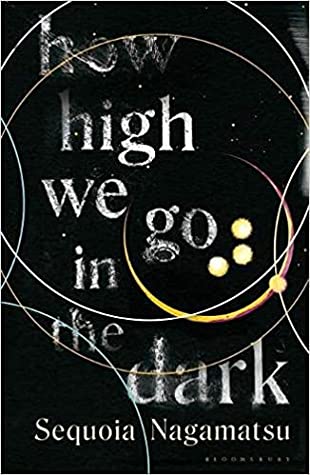 The virus is highly transmissible and deadly, and later found to mostly affect children. In the following 13 stories (most about Asian Americans in California, plus a few set in Japan), the plague is a fact of life but has also prompted a new relationship to death – a major thread running through is the funerary rites that have arisen, everything from elegy hotels to “resomation.” In the stand-out story, the George Saunders-esque “City of Laughter,” Skip works at a euthanasia theme park whose roller coasters render ill children unconscious before stopping their hearts. He’s proud of his work, but can’t approach it objectively after he becomes emotionally involved with Dorrie and her son Fitch, who arrives in a bubble.
All but one of these stories are in the first person, so they feel like intimate testimonies of how a pandemic transforms existence. Almost all of the characters have experienced a bereavement, or are sick themselves. Relatives or acquaintances become protagonists in later stories. For instance, in “Pig Son,” Dorrie’s ex, David, is a scientist growing organs for transplantation. Bereavement coordinator Dennis and his doctor brother Bryan narrate #5 and #8, respectively. Six years on, Cliff’s wife Miki takes their granddaughter on a space mission. My other two favourites were “Through the Garden of Memory,” in which patients on a plague ward build a human pyramid and plot a sacrifice, and “Songs of Your Decay,” about a researcher at a forensic body farm who bonds with her one live donor over rock music.
Some stories are weaker or less original than others, but this is one case where the whole is definitely greater than the sum of its parts. The focus on illness and death, but also on the love that survives, made this a winner for me. I’d be especially likely to recommend it to fans of Kazuo Ishiguro and Karen Russell.
With thanks to Bloomsbury for the free copy for review.
Slime: A Natural History by Susanne Wedlich (2021)
[Translated from the German by Ayça Türkoğlu]
 This is just the sort of wide-ranging popular science book that draws me in. Like Entangled Life by Merlin Sheldrake, a work I’ve had many opportunities to recommend even to those who don’t normally pick up nonfiction, it incorporates many weird and wonderful facts about life forms we tend to overlook. Wedlich, a freelance science journalist in Germany, starts off at the Hunterian Museum in Glasgow, where she seeks a sample of the “primordial slime” collected by the HMS Challenger in 1876. “It seems to be an unwritten rule of horror: slime sells!” she remarks – from H. P. Lovecraft to Ghostbusters, it has provoked disgust. Jellyfish, snails, frogs and carnivorous plants – you’re in for a sticky tour of the natural world.
The technical blanket term for slimy substances is “hydrogels,” which are 99% water and held together by polymers. Biological examples have been inspiring new technologies, like friction reducers (e.g. in fire hoses) modelled on fish mucus, novel adhesives to repair organs and seal wounds, and glue traps to remove microplastics. Looking to nature to aid our lives is nothing new, of course: Wedlich records that slugs were once used to lubricate cart wheels.
The book branches off in a lot of directions. You’ll hear about writers who were spellbound or terrified by marine life (Patricia Highsmith kept snails, while Jean-Paul Sartre was freaked out by sea creatures), the Victorian fascination with underwater life, the importance of the microbiome and the serious medical consequences of its dysfunction, and animals such as amphibians that live between land and water. At times it felt like the narrative jumped from one topic to another, especially between the biological and the cultural, without following a particular plan, but there are enough remarkable nuggets to hold the interest.
With thanks to Granta for the free copy for review.
And a bonus:
 I was delighted to be sent a preview pamphlet containing the author’s note and title essay of How to Read Now by Elaine Castillo, coming from Atlantic in August. This guide to cultural criticism – how to read anything, not just a book – is alive to the biased undertones of everyday life. “Anyone who is perfectly comfortable with keeping the world just as it is now and reading it the way they’ve always read it … cannot be trusted”. Castillo writes that it is not the job of people of colour to enlighten white people (especially not through “the gooey heart-porn of the ethnographic” – war, genocide, tragedy, etc.); “if our stories primarily serve to educate, console and productively scold a comfortable white readership, then those stories will have failed their readers”. This is bold, provocative stuff. I’m sure to learn a lot.
Would you be interested in reading one or more of these?
Winter Reads, Part II: Au, Glück, Hall, Rautiainen, Slaght
In the week before Christmas I reviewed a first batch of wintry reads. We’ve had hardly any snowfall here in southern England this season, so I gave up on it in real life and sought winter weather on the page. After we’ve seen the back of Storm Franklin (it’s already moved on from Eunice!), I hope it will feel appropriate to start right in on some spring reading. But for today I have a Tokyo-set novella, sombre poems, an OTT contemporary Gothic novel, historical fiction in translation from the Finnish, and – the cream of the crop – a real-life environmentalist adventure in Russia.
Cold Enough for Snow by Jessica Au (2022)
 This slim work will be released in the UK by Fitzcarraldo Editions on the 23rd and came out elsewhere this month from New Directions and Giramondo. I actually read it in December during my travel back from the States. It’s a delicate work of autofiction – it reads most like a Chloe Aridjis or Rachel Cusk novel – about a woman and her Hong Kong-raised mother on a trip to Tokyo. You get a bit of a flavour of Japan through their tourism (a museum, a temple, handicrafts, trains, meals), but the real focus is internal as Au subtly probes the workings of memory and generational bonds.
The woman and her mother engage in surprisingly deep conversations about the soul and the meaning of life, but these are conveyed indirectly rather than through dialogue: “she said that she believed that we were all essentially nothing, just series of sensations and desires, none of it lasting. … The best we could do in this life was to pass through it, like smoke through the branches”. Though I highlighted a fair few passages, I find that no details have stuck with me. This is just the sort of spare book I can admire but not warm to. (NetGalley)
Winter Recipes from the Collective by Louise Glück (2021)
 The only other poetry collection of Glück’s that I’d read was Vita Nova. This, her first release since her Nobel Prize win, was my final read of 2021 and my shortest, at 40-some pages; it’s composed of just 15 poems, a few of which stretch to five pages or more. “The Denial of Death,” a prose piece with more of the feel of an autobiographical travel essay, was a standout; the title poem, again in prose paragraphs, and the following one, “Winter Journey,” about farewells, bear a melancholy chill. Memories and dreams take pride of place, with the poet’s sister appearing frequently. “How heavy my mind is, filled with the past.” There are also multiple references to Chinese concepts and characters (as on the cover). The overall style is more aphoristic and reflective than expected. Few individual lines or images stood out to me.
With thanks to Carcanet Press for the e-copy for review.
The Snow Collectors by Tina May Hall (2020)
 Henna is alone in the world since her parents and twin sister disappeared in a boating accident. She lives a solitary existence with her sister’s basset hound Rembrandt in a New England village, writing encyclopaedia entries on the Arctic, until she stumbles on a corpse and embarks on an amateur investigation involving scraps of 19th-century correspondence. The dead woman asked inconvenient questions about a historical cover-up; if she takes up the thread, Henna could be a target, too. Her collaboration with the police chief, Fletcher, turns into a flirtation. After her house burns down, she ends up living with him – and his mother and housekeeper – in a Gothic mansion stuffed with birds of prey and historical snow samples. She’s at the mercy of this quirky family and the weather, wearing ancient clothing from Fletcher’s great-aunts and tramping through blizzards looking for answers.
This is a kitchen-sink novel with loads going on, as if Hall couldn’t decide which of her interests to include so threw them all in. Yet at only 221 pages, it might actually have been expanded a little to flesh out the backstory and mystery plot. It gets more than a bit ridiculous in places, but its Victorian fan fiction vibe is charming escapism nonetheless. What with the historical fiction interludes about the Franklin expedition, this reminded me most of The Still Point, but also of The World Before Us and The Birth House. I’d happily read Hall’s 2010 short story collection, too. (Christmas gift) 
Land of Snow and Ashes by Petra Rautiainen (2022)
[Translated from the Finnish by David Hackston]
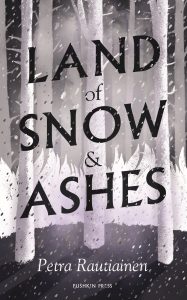 In the middle years of World War II, Finland was allied with Nazi Germany against Russia, a mutual enemy. After the Moscow Armistice, the Germans retreated in disgrace, burning as many buildings and planting as many landmines as they could (“the Lapland War”). I gleaned this helpful background information from Hackston’s preface. The story that follows is in two strands: one is set in 1944 and told via diary entries from Väinö Remes, a Finnish soldier called up to interpret at a Nazi prison camp in Inari. The other, in third person, takes place between 1947 and 1950, the early years of postwar reconstruction. Inkeri, a journalist, has come to Enontekiö to find out what happened to her husband. An amateur photographer, she teaches art to the local Sámi children and takes on one girl, Bigga-Marja, as her protégée.
Collusion and secrets; escaped prisoners and physical measurements being taken of the Sámi: there are a number of sinister hints that become clearer as the novel goes on. I felt a distance from the main characters that I could never quite overcome, such that the reveals didn’t land with as much power as I think was intended. Still, this has the kind of forthright storytelling and precise writing that fans of Hubert Mingarelli should appreciate. For another story of the complexities of being on the wrong side of history, see The Women in the Castle by Jessica Shattuck.
With thanks to Pushkin Press for the proof copy for review.
Winter words:
“Fresh snow has fallen, forming drifts across the terrain. White. Grey. Undulating. The ice has cracked here and there, raising its head in the thawed sections of the river. There is only a thin layer of ice left.”
Owls of the Eastern Ice: The Quest to Find and Save the World’s Largest Owl by Jonathan C. Slaght (2020)
Slaght has become an expert on the Blakiston’s fish owl during nearly two decades of fieldwork in the far east of Russia – much closer to Korea and Japan than to Moscow, the region is also home to Amur tigers. For his Master’s and PhD research at the University of Minnesota, he plotted the territories of breeding pairs of owls and fit them with identifying bands and data loggers to track their movements over the years. He describes these winter field seasons as recurring frontier adventures. Now, I’ve accompanied my husband on fieldwork from time to time, and I can tell you it would be hard to make it sound exciting. Then again, gathering beetles from English fields is pretty staid compared to piloting snowmobiles over melting ice, running from fire, speeding to avoid blockaded logging roads, and being served cleaning-grade ethanol when the vodka runs out.
 The sorts of towns Slaght works near are primitive places where adequate food and fuel is a matter of life and death. He and his assistants rely on the hospitality of Anatoliy the crazy hermit and also stay in huts and caravans. Tracking the owls is a rollercoaster experience, with expensive equipment failures and trial and error to narrow down the most effective trapping methods. His team develops a new low-tech technique involving a tray of live fish planted in the river shallows under a net. They come to know individuals and mourn their loss: the Sha-Mi female he’s holding in his author photo was hit by a car four years later.
Slaght thinks of Russia as his second home, and you can sense his passion for the fish owl and for conservation in general. He boils down complicated data and statistics into the simple requirements for this endangered species (fewer than 2000 in the wild): valleys containing old-growth forest with large trees and rivers that don’t fully freeze over. There are only limited areas with these characteristics. These specifications and his ongoing research – Slaght is now the Northeast Asia Coordinator for the Wildlife Conservation Society – inform the policy recommendations given to logging companies and other bodies.
Amid the science, this is just a darn good story, full of bizarre characters like Katkov, a garrulous assistant exiled for his snoring. (“He fueled his monologue with sausage and cheese, then belched zeppelins of aroma into that confined space.”) Slaght himself doesn’t play much of a role in the book, so don’t expect a soul-searching memoir. Instead, you get top-notch nature and travel writing, and a ride along on a consequential environmentalist quest. This is the kind of science book that, like Lab Girl and Entangled Life, I’d recommend even if you don’t normally pick up nonfiction. (Christmas gift) 
And a bonus children’s book:
If Winter Comes, Tell It I’m Not Here by Simona Ciraolo (2020)

 The little boy loves nothing more than to spend hours at the swimming pool and then have an ice cream cone. His big sister warns him the carefree days of summer will be over soon; it will turn cold and dark and he’ll be cooped up inside. Her words come to pass, yet the boy realizes that every season has its joys and he has to take advantage of them while they last. Cute and colourful, though the drawing style wasn’t my favourite. And a correction is in order: as President Biden would surely tell you, ice cream is a year-round treat! (Public library)
Any snowy or icy reading (or weather) for you lately?
Reading Across the Seasons: England in All Weathers
Recently, I toured multiple seasons via these three pleasantly meandering books for Anglophiles. All: 
Orchard by Benedict Macdonald and Nicholas Gates (2020)
 Bristol friends and BBC colleagues Ben Macdonald and Nick Gates set out to chronicle a year in the life of a traditional Herefordshire orchard that has been managed differently from the industrial norm. Operations are designed to maximize wildlife as well as production, so the orchard has become a bastion for birds and insects. After a brief history of apple cultivation and orchard design, it’s straight into a month-by-month rundown of what can be seen and heard on this particular patch. For the most part, the co-authors trade off chapters. They observe and describe the kinds of behaviours that most of us never get to see. A central section of remarkable photographs, some of them by the authors, illustrates the year as vividly as the passionate prose. (See my full review at Shiny New Books.)
With thanks to William Collins for the free copy for review.
Light Rains Sometimes Fall by Lev Parikian (2021)
It was only 2018 that I read Why Do Birds Suddenly Disappear? but since then we’ve had another three books from Lev Parikian. It’s now hard to imagine a year without one of his genial nature books. Here he adapts Japan’s famous 72 microseasons to an English year, with every five days or so taking on a slightly different character and welcoming in the subtle changes that add up to big ones. Given the Japanese inspiration, it’s appropriate that his entries sometimes read like haikus. Here’s one from the start of 2–7 September: “The streets. Rumble of traffic. Gentle wind in trees. Soft chrrr of blue tit. Furious cawing, stage left.”
 Parikian’s patch is South London, specifically his local cemetery – which, since the book starts in February 2020, was closed off to him for a short time a month later when the first UK lockdown hit. This only served to increase his appreciation for the place when it reopened. (Cemeteries are amazing places for wildlife in general, especially the more park-like ones: I can remember seeing muntjac at Cemetery Junction in Reading, and red-tailed hawks perched in the trees in Mount Auburn Cemetery in Cambridge, Massachusetts.) Here, his star sighting was an occasional peregrine on the church tower.
The idea behind this book of mini nature essays is to try to see things again as if for the first time. In the pandemic year, he finds that time is elastic: it seems both fast and slow, and paying close attention is a way of valuing nature and experience. After all, as Parikian quotes from Confucius, “Everything has beauty, but not everyone can see it.” This reminded me particularly of Birdsong in a Time of Silence, but the tone is refreshingly light, as readers will have come to expect of Parikian.
Controversially, because I picked this up in September, I started reading it from the first September chapter, carried on to the end and then began again at the beginning and caught myself up, a strategy I have only ever taken with Mark Cocker’s Claxton (another month-by-month nature diary-type narrative) before. Initially, it was a nice way of following along with the seasons. I kept this as a bedside book and would read a chapter before bed. Most of us live in cities or suburbs, so I particularly appreciated the enthusiastic advocacy for the value of urban spaces for nature. I recommend this one for reading your way slowly and attentively through the seasons.
With thanks to Elliott & Thompson for the proof copy for review.
England for All Seasons by Susan Allen Toth (1997)
A reread. As I was getting ready to go overseas for the first time in the summer of 2003, Toth’s trilogy of memoirs whetted my appetite for travel in Britain. (They’re on my Landmark Books in My Life, Part II list.) I loved how warmly she invites readers to join her itineraries and shares tips for lesser-known destinations.
 This was her third set of England essays, prompted by a question she frequently got from friends and readers: when is the best time to go? Her answer would be to go whenever you can, as often as you can, because rain can be delightful and in the off season you’ll have special places to yourself. I can see that I have this book to thank for the memorable Cornwall vacation I had with my mom and sister in April 2004, midway through my study abroad year: two of the sites she highlights here, St. Ives and the seal sanctuary at Gweek (part of the “Touring England’s Ark” chapter) were among our chosen stops.
Toth is a particular fan of gardens and literary sites, but loves London museums and theatres as much as windswept coastal and island scenery. When in England she lets herself sample multiple desserts from the sweet trolley, fill her suitcase with secondhand books, and pepper her speech with exclamations of “Lovely!” and “Brilliant!” I was relieved to be reminded of her suggested one-hour time limit for any museum – “depart without guilt, as soon as your eyes droop or your feet hurt or your heavy shoulder bag sinks to the floor. When you begin wondering if it is too early for lunch, head for the door.” (I poop out at museums very quickly.) The practical information she includes at the end of each chapter is probably entirely out of date, but her ideas are solid, and a quick web search will update any details.
The final essay, “Travel Time,” perfectly captures the holiday spirit: “Because our travel time is so densely filled, with intense if often quiet experiences, I am always astonished at what has happened—or rather, what has not happened—when we return home. After two weeks of living so vividly, newness in each hour, I feel as if I must have changed in significant ways.” (Free from The Book Thing of Baltimore)
Territory of Light by Yuko Tsushima (#NovNov Translated Buddy Read)
With well over 100 posts, you all have already smashed last year’s totals for Novellas in November, and there’s still a week and a half to go! We’re grateful for your participation and hope some of you have been enjoying the buddy reads.
For literature in translation week, our readalong book has been Territory of Light by Yuko Tsushima. As much a linked short story collection as a novella, it first appeared in monthly instalments in the Japanese literary magazine Gunzō in 1978–9 but wasn’t translated into English (by Geraldine Harcourt) until 2018, two years after Tsushima’s death. The translation was critically acclaimed, earning nominations for the 2019 Kirkus Prize and the 2020 BTBA Best Translated Book Award for Fiction.
The apartment had windows on all sides. I spent a year there, with my little daughter, on the top floor of an old four-storey office building.
 Dark and carefully chiselled, the chapters are like tiny diamonds that you have to hold up to the light to see the glitter. Newly separated from her husband, the unnamed narrator, who works at a music library, entrusts us with vignettes from her first year of single parenthood. She is honest about her bad behaviour – the nights she got falling down drunk and invited men back to the apartment; the mornings she missed the daycare dropoff deadline and let her two-year-old fend for herself while she stayed in bed. Alongside the custody battle with her ex are smaller feuds, like with her neighbour, who’s had enough of the little girl dropping things onto his roof from the windows above and gets the landlord to do something about it.
Her daughter is a typical toddler, stubborn and impetuous, yet there are moments of intimacy between them that make your breath catch. Sometimes their roles even become reversed: the daughter nurses her mother through a bout of fever, and after the neighbour incident comforts her with words she’s received: “Mommy…are you all right? Don’t cry, there’s a good girl.”
The narrator describes her dreams, employing the imagery of fire and flight to capture her occasional hopelessness and longing for escape. Cherry trees are blossoming as they move into the apartment, and by the time they’re ready to move on again the spring is coming back. Details of sound and light make her observations zing. The clean, precise style – no frills, no tricks – reminds me of other autofiction in translation I’ve read. Others mention Elena Ferrante as a readalike, but what came to mind for me was Tove Ditlevsen’s trilogy, especially Dependency with its addiction theme. No doubt Harcourt should also be thanked for her crystal-clear rendition. It’s such a beautiful book, though perhaps already slipping from my grasp; I’m glad Cathy suggested it as our buddy read. (New purchase)
[122 pages]
Other reviews:
Keep in touch via Twitter (@bookishbeck / @cathy746books) and Instagram (@bookishbeck / @cathy_746books). We’ll add any of your review links in to our master posts. Feel free to use the terrific feature image Cathy made and don’t forget the hashtag #NovNov.
Recent Online Literary Events with George Saunders and Kazuo Ishiguro
I’ve been taking advantage of various free and inexpensive literary events – a bonus of our temporarily virtual-only world. I have five of them stored up to write about, but to keep this post from getting absurdly long I’ll focus on two for now and feature the rest another time.
George Saunders in Conversation with Max Porter
(5×15 event)
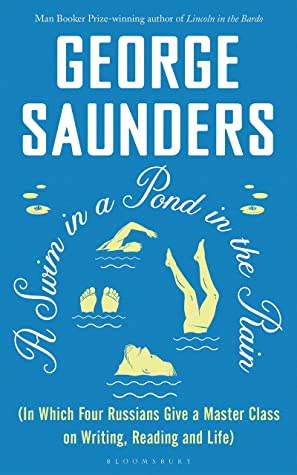 Saunders’s latest book, A Swim in a Pond in the Rain, is a written version of the graduate-level masterclass in the Russian short story that he offers at Syracuse University, where he has taught in the Creative Writing Program since 1997. His aim here was to “elevate the short story form,” he said. While the book reprints and discusses just seven stories (three by Anton Chekhov, two by Leo Tolstoy, and one each by Nikolai Gogol and Ivan Turgenev), in the class he and his students tackle more like 40. He wants people to read a story, react to the story, and trust that reaction – even if it’s annoyance. “Work with it,” he suggested. “I am bringing you an object to consider” on the route to becoming the author you are meant to be – such is how he described his offer to his students, who have already overcome 1 in 100 odds to be on the elite Syracuse program but might still need to have their academic egos tweaked.
The book is, thus, not just a set of essays on the Russian masters but also a guide to how to write well. It was clear there was mutual admiration between Saunders and Max Porter, who interviewed him. They discussed the revision process as an accumulation of micro-decisions that make the work better. For instance, Saunders compared two Tolstoy stories, “The Snowstorm” and “Master and Man” (written 20 years later), and noted that, though they are thematically similar, the later one is more organized.
Saunders spoke about writing as a dual process of intuition and iteration; a bunch of different “yous” have acted on a text by the time it’s done. Early on in his career, he thought that he had to choose which writer he wanted to be (e.g., Hemingway or Kerouac), but as he aged he realized that the mind is never fixed. He went surprisingly deep into Buddhism at this point, likening writing to meditation – both are practices pursued with intensity. To his younger self, he would say to keep going: improving is simply a matter of time (i.e., that 10,000 hours figure that’s bandied about as necessary for developing expertise).

The only drawback to this event was that Saunders was speaking from his snow-encased upstate New York basement and had a horrible Internet connection; often his voice was faint and delayed, while his image stayed static. We and Porter could only stare gormlessly and wait for his face to move to match his words! I think the book would be too niche for me – I’ve hardly read anything by the Russians, and since I don’t write fiction I’m not in need of a guide to those kinds of writing decisions – but it was nice to ‘meet’ Saunders ‘in person’.
An Evening with Kazuo Ishiguro
(Faber Members / Guardian Live event)
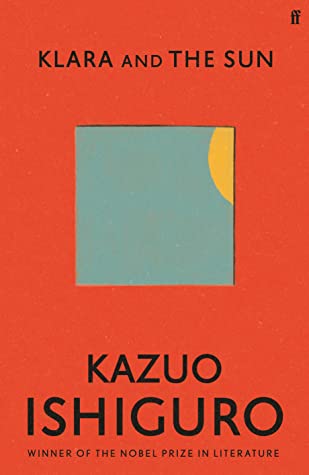 Ishiguro’s new novel, Klara and the Sun, was published by Faber yesterday. This conversation with Alex Clark also functioned as its launch event. It’s one of my most anticipated books of the year, so I pre-ordered a signed copy along with my ticket and look forward to it arriving soon. Klara is an Artificial Intelligence “friend” purchased to combat teenage loneliness. A childlike figure, she is cheerful and treats the sun like a god. Ishiguro said that the book developed from a story he wrote for children aged five to six, about a little girl who takes a doll home – except his daughter, author Naomi Ishiguro, told him no way was it suitable for young children, being far too dark. He likes “displaced or alien narrators, fish out of water,” he said, because the limited perspective allows him to focus on oddness.
In addition to Clark’s questions, a few pre-recorded questions from literary celebs (Daisy Johnson, Bernardine Evaristo, and David Mitchell) encouraged Ishiguro to create a tripartite schema for his novels, reflect on his writing about Japan, and look back at the devices he has used. Asked by Johnson about the connections between his novels, he admitted that his first three novels all retread the same ground: a man who has made a mess of his life or career picks over the past. Then his mid period is set in dreamscapes, while his most recent three novels are dystopian fantasies (though he does not see Klara as set in a dystopian world).
In response to Evaristo’s question about whether he felt an obligation to write about Japan, he said that with his early work he was conscious of needing to represent a group of people who even then (due to World War II) were viewed with suspicion or antipathy. He left Japan at age five so the country didn’t seem entirely real to him. What he knew was based on very early memories, what his mother told him, comic books sent by his grandparents, etc. As he stated in his Nobel Prize acceptance speech, writing about Japan in his twenties therefore felt like “an act of preservation.” Still, he wants his characters and situations to be universal.

Replying to Mitchell’s three questions (cheeky!), he explained that his first ambition was to be a singer/songwriter, and he wrote 100+ songs. Songwriting taught him minimalism. “You can say a huge amount by what you don’t say,” he noted. He hopes to create spaces, or rather vacuums that suck in the reader’s attention. Unlike Mitchell, he always knows the ending of a book before he begins, and his decisions are all about wanting to lodge in the reader’s brain. Thus, memorable endings are a priority for him, whereas they might not be for other writers. I was struck by his characterization of his own life: when he looks back, he doesn’t see a clear path that arose from his choices; instead, he sees a “weird, incoherent mess.” For this reason, he’s turned against the reflective device of his first three books. If he can come up with a theme, he’s hankering to write a book about hitchhikers in the north of England.
Towards the end of the (overlong) discussion, he mentioned that he has been questioning the novelist’s role due to the events of the past year: wondering about the meaning of fiction when so many have died and so many believe fake news. It was a melancholy but realistic point to end on. While I’m not an Ishiguro completist (The Unconsoled doesn’t appeal to me at all and I’m not sure I can be bothered with When We Were Orphans, but I will try The Buried Giant; I’ve read the rest), the event whetted my appetite to read his new book. (See also this Goodreads interview. I loved the anecdotes about learning he’d won the Nobel!)
Bookish online events coming up soon: The Rathbones Folio Prize announcement on the 24th and Claire Fuller’s book launch for Unsettled Ground on the 25th.
Have you attended any online literary events recently?
Two Recent Reviews for BookBrowse
The Bell in the Lake by Lars Mytting
 A legend from Mytting’s hometown tells of two centuries-old church bells that, like conjoined twins, were never meant to be separated. Inspired by that story and by the real-life move of a stave church from Norway to what is now Poland, he embarked on a trilogy in which history and myth mingle to determine the future of the isolated village of Butangen. The novel is constructed around compelling dichotomies. Astrid Hekne, a feminist ahead of her time, is in contrast with the local pastor’s conventional views on gender roles. She also represents the village’s unlearned folk; Deborah Dawkin successfully captures Mytting’s use of dialect in her translation, making Astrid sound like one of Thomas Hardy’s rustic characters.
- See my full review at BookBrowse.
- See also my related article on stave churches.
- One of the coolest things I did during the first pandemic lockdown in the UK was attend an online book club meeting on The Bell in the Lake, run by MacLehose Press, Mytting’s UK publisher. It was so neat to see the author and translator speak “in person” via a Zoom meeting and to ask him a couple of questions in the chat window.
- A readalike (and one of my all-time favorite novels) is Carsten Jensen’s We, the Drowned.
Memorial by Bryan Washington
 In Washington’s debut novel, set in Houston and Osaka, two young men reassess their commitments to their families and to each other. The narration is split between Benson and Mike, behind whose apparent lack of affect is a quiet seam of emotion. Both young men are still shaken by their parents’ separations, and haunted by patterns of abuse and addiction. Flashbacks to how they met create a tender backstory for a limping romance. Although the title (like most of the story titles in Lot) refers to a Houston neighborhood, it has broader significance, inviting readers to think about the place our loved ones have in our memories. Despite the tough issues the characters face, their story is warm-hearted rather than grim. Memorial is a candid, bittersweet work from a talented young writer whose career I will follow with interest.
- See my full review at BookBrowse.
- See also my related article on the use of quotation marks (or not!) to designate speech.
 I enjoyed this so much that I immediately ordered Lot with my birthday money. I’d particularly recommend it if you want an earthier version of Brandon Taylor’s Booker-shortlisted Real Life (which I’m halfway through and enjoying, though I can see the criticisms about its dry, slightly effete prose).
- This came out in the USA from Riverhead in late October, but UK readers have to wait until January 7th (Atlantic Books).
20 Books of Summer: Bourdain, Ozeki and More
Over halfway through the summer and my numbers are looking poor. It’s not that I’m not reading a ton – in general, I am – it’s just that I’m having trouble finishing any foodie books. I’m in the middle of two food-related memoirs plus Cakes and Ale by W. Somerset Maugham, and have recently started buddy-reading Mother’s Milk by Edward St Aubyn with Annabel, so more reviews will be along eventually, but I predict August will be a scramble.
Today I review an in-your-face tell-all about the life of a chef, and a novel set between Japan and the United States that exposes the seamy side of meat production. A lite road trip and an iffy California classic follow as bonuses.
Kitchen Confidential: Adventures in the Culinary Underbelly by Anthony Bourdain (2000)
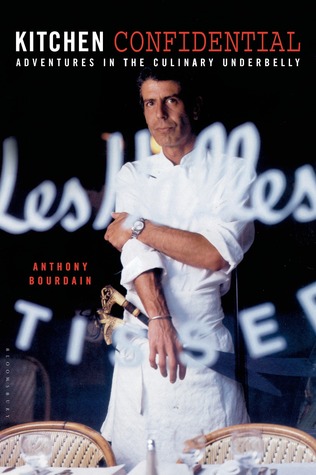 (20 Books of Summer, #5) “Get that dried crap away from my bird!” That random line about herbs is one my husband and I remember from a Bourdain TV program and occasionally quote to each other. It’s a mild curse compared to the standard fare in this flashy memoir about what really goes on in restaurant kitchens. His is a macho, vulgar world of sex and drugs. In the “wilderness years” before he opened his Les Halles restaurant, Bourdain worked in kitchens in Baltimore and New York City and was addicted to heroin and cocaine. Although he eventually cleaned up his act, he would always rely on cigarettes and alcohol to get through ridiculously long days on his feet.
From “Appetizer” to “Coffee and a Cigarette,” the book is organized like a luxury meal. Bourdain charts his development as a chef, starting with a childhood summer in France during which he ate vichyssoise and oysters for the first time and learned that food “could be important … an event” and describing his first cooking job in Provincetown and his time at the Culinary Institute of America. He also discusses restaurant practices and hierarchy, and home cook cheats and essentials. (I learned that you should never order fish in a restaurant on a Monday – it’ll be left over from Thursday’s order.) The pen portraits of his crazy sous-chef and baker are particularly amusing; other subjects include a three-star chef he envies and the dedicated Latino immigrants who are the mainstay of his kitchen staff.
My dad is not a reader but he is a foodie, and he has read Bourdain’s nonfiction (and watched all his shows), so I felt like I was continuing a family tradition in reading this. I loved my first taste of Bourdain’s writing: he’s brash, passionate, and hilariously scornful of celebrity chefs and vegetarianism (“the enemy of everything good and decent in the human spirit, an affront to all I stand for, the pure enjoyment of food”). Being in charge of a restaurant sounds manic, yet you can see why some would find it addictive. How ironic, though, to find a whole seven references to suicide in this book. Sometimes he’s joking; sometimes he’s talking about chefs he’s heard about who couldn’t take the pressure. Eighteen years after this came out, he, too, would kill himself.
(See also this article about rereading Bourdain in the 20th anniversary year of Kitchen Confidential.)
Source: Local swap shop (free)
My rating:
(These two are linked by a late chapter in the Bourdain, “Mission to Tokyo,” in which he advises on a new Les Halles offshoot in Japan and gorges himself on seafood delights.)
My Year of Meats by Ruth Ozeki (1998)
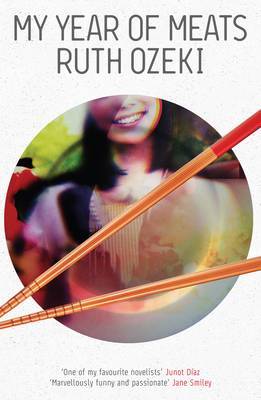 (20 Books of Summer, #6) I don’t know what took me so long to read another novel by Ruth Ozeki after A Tale for the Time Being, one of my favorite books of 2013. This is nearly as fresh, vibrant and strange. Set in 1991, it focuses on the making of a Japanese documentary series, My American Wife, sponsored by a beef marketing firm. Japanese American filmmaker Jane Takagi-Little is tasked with finding all-American families and capturing their daily lives – and best meat recipes. The traditional values and virtues of her two countries are in stark contrast, as are Main Street/Ye Olde America and the burgeoning Walmart culture.
There is a clear message here about cheapness and commodification, but Ozeki filters it through the wrenching stories of two women with fertility problems: Jane, whose reproductive system was damaged by DES, a synthetic estrogen her mother took during pregnancy to prevent a miscarriage; and Akiko, the wife of Jane’s boss, who struggles with an eating disorder and domestic violence.
Jane starts sneaking controversial subjects into her shoots: a lesbian couple, a family formed by interracial adoption, and a five-year-old who has already undergone puberty due to the hormones used on her family’s cattle feedlot. What is “natural,” and what gets branded alien or invasive? From the kudzu that strangles the South to a murdered Japanese exchange student, Ozeki probes the related issues of nativism and racism. Her two protagonists’ stories – one in the first person; the other in the third person – come together in a surprising manner as Jane decides that she has a more pressing obligation than creating a diverting television show.
This is a bold if at times discomforting novel. At first it brought to mind the exaggerated comedy of Julian Barnes’s England, England and Jane Smiley’s Moo, but as it grew darker it reminded me more of Han Kang’s The Vegetarian. It’s tricky, when a work of fiction tackles ethical or environmental matters, to balance storytelling and consciousness-raising, but Ozeki pulls it off with style. The only aspect that didn’t mean much to me, perhaps simply because of my unfamiliarity, was the excerpts from The Pillow Book of Shōnagon. How sad to think that I only have one more Ozeki awaiting me, All Over Creation. She averages a book every 5‒10 years; we can only hope that another is on the way soon.
Source: Charity shop
My rating: 
I picked up another two food-adjacent books that didn’t work for me, though I ended up skimming them to the end.
America Unchained: A Freewheeling Roadtrip in Search of Non-Corporate USA by Dave Gorman (2008)
 (20 Books of Summer, #7) I read the first couple of chapters, in which he plans his adventure, and then started skimming. I expected this to be a breezy read I would race through, but the voice was neither inviting nor funny. I also hoped to find more about non-chain supermarkets and restaurants – that’s why I put this on the pile for my foodie challenge in the first place – but, from a skim, it mostly seemed to be about car trouble, gas stations and fleabag motels. The only food-related moments are when Gorman (a vegetarian) downs three fast food burgers and orders of fries in 10 minutes and, predictably, vomits them all back up; and when he stops at an old-fashioned soda fountain for breakfast.
Source: Free bookshop
Tortilla Flat by John Steinbeck (1935)
 (20 Books of Summer, #8) I read the first 25 pages and then started skimming. This is a story of a group of friends – paisanos, of mixed Mexican, Native American and Caucasian blood – in Monterey, California. During World War I, Danny serves as a mule driver and Pilon is in the infantry. When discharged from the Army, they return to Tortilla Flat, where Danny has inherited two houses. He lives in one and Pilon is his tenant in the other (though Danny will never see a penny in rent). They’re a pair of loveable scamps, like Huck Finn all grown up, stealing wine and chickens left and right.
Steinbeck novels seem to fall into two camps for me. This is one of his inconsequential, largely unlikable novellas (like The Pearl and The Red Pony, which I studied in school – I’m lucky they didn’t put me off Steinbeck forever), whereas The Grapes of Wrath and East of Eden are masterful. It may also have something to do with the slight air of condescension towards characters of a different race: Steinbeck renders their speech with “thee” and “thou,” trying to imitate a Romance language’s informal pronouns, but it feels dated and alienating.
Source: Free bookshop
Japanese Literature Challenge: Murakami’s A Wild Sheep Chase (1982)
 I was utterly entranced by my first two Haruki Murakami novels, The Wind-Up Bird Chronicle and Kafka on the Shore; both are so richly layered, dreamlike and bizarre. For Japanese Literature Challenge 13, run by Meredith of Dolce Belezza, I decided to pick up another of his books. First I tried Norwegian Wood, but, ironically, it was so normal (from the little I read, a standard, nostalgic coming-of-age novel set on a college campus) that I felt disoriented and set it down after 20 pages – I’ll keep it on the shelf for some other time. Instead I read A Wild Sheep Chase, a fairly short one for Murakami at just under 300 pages.
I loved the zany premise: the unnamed narrator, who works for a small advertising firm, gets a threatening visit one day. A PR bulletin his company created happens to feature a photo his friend The Rat sent him of a traditional Hokkaido landscape with sheep, among which is visible one particular sheep – “the third sheep from the right in the front row” – with a distinctive brown star-shaped birthmark. “The Boss” and his emissary give the narrator an ultimatum: he has two months to find this sheep, or he’ll be driven out of business.
So, along with his girlfriend, who has psychic powers and unbelievably seductive ears, he sets off by train in search of typical mountains-and-fields scenery. She chooses, seemingly at random, a hotel that turns out to be the former headquarters of the Hokkaido Ovine Association; its owner’s father, who lives like a hermit upstairs, is the Sheep Professor. Not just an expert on sheep, he believes he was at one time possessed by the star-marked sheep.
 As the narrator makes his way to The Rat’s mountain hideaway, an hour and a half from the nearest town, he’s moving further from rational explanations and deeper into solitude and communion with ghosts. There’s some trademark Murakami strangeness, but the book is too short to give free rein to the magic realist plot, and I felt like there were too many loose ends after his return from The Rat’s, especially around his girlfriend’s disappearance.
Also, after just three and a bit of his novels (I DNFed Killing Commendatore in 2018), I’m already noticing a lazy reliance on the same setup: a directionless thirtysomething man whose marriage has recently fallen apart starts a new and pretty peculiar life. There are also a couple of specific failings that I’m noticing for the second or third time now: a slow, pointless start (the first 40 pages here could easily be shaved off) and slight misogyny: “Women with their clothes off have a frightening similarity. Always throws me for a loop.”
I appreciate the imagination that went into this, and enjoyed some specific witty metaphors (“the effect was unpalatable. Like serving sherbet and broccoli on the same silver platter” and “The elevator shook like a large dog with lung disease”) and observant lines (“Age certainly hasn’t conferred any smarts on me. Character maybe, but mediocrity is a constant”), but overall the novel was a letdown. Can anyone recommend me another surefire Murakami?
My rating: 
Note: This was Murakami’s first novel to be translated into English, in 1989. I had no idea that it’s actually the third book out of four in a series called “The Rat.”
Women in Translation Month 2019, Part I: Ernaux and Poschmann
Two rather different books to start off #WITMonth: a brief (c. 70 pp.) account of a mother’s decline with dementia; and a haiku-inspired novel of the quest for life and death in disorienting modern Japan. Both are admirable but detached – a judgment I seem more likely to make about work in translation – so don’t earn my wholehearted recommendation. My rating for both: 
I Remain in Darkness by Annie Ernaux (1997; English translation, 1999)
[Translated from the French by Tanya Leslie]
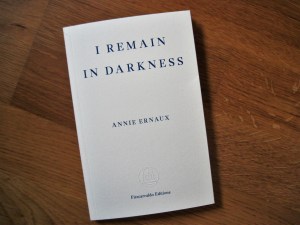 This is the second short, somewhat harrowing autobiographical work I’ve read by Ernaux this year (after Happening, her account of her abortion, in March). A collection of mostly present-tense fragments, it’s drawn from the journal she kept during her mother’s final years, 1983–6. “I Remain in Darkness” were the last words her mother wrote, in a letter to a friend (“Je ne suis pas sortie de ma nuit,” which more literally means “I have not left my night,” strikes me as cryptic and poetic, though maybe I’m missing a colloquialism). Slipping into Alzheimer’s, her mother spent these years in a long-term hospital geriatric ward. Ernaux could see her mother becoming like a child again:
This morning she got up and, in a timid voice, said: ‘I wet the bed. I couldn’t help it.’ The same words I would use when I was a child.
Now her room is on the third floor. A bunch of women circle us, addressing my mother with the familiar tu form: ‘You’re going to be in our group?’ They are like kids talking to the ‘new girl’ at school. When I take leave of her, she looks at me in panic and confusion: ‘You’re not leaving, are you?’
—and herself becoming like her mother: “It’s crystal-clear: she is me in old age and I can see the deterioration of her body threatening to take hold of me – the wrinkles on her legs, the creases in her neck”. Ernaux vacillates between guilt, fear and cruelty in how she approaches her mother. She tenderly shaves the older woman’s face every week when she visits, and buys her all manner of sweets. Food is one of her mother’s last remaining pleasures, though she often misses her mouth when she tries to eat the cakes her daughter brings.
Superficially, this is very similar to another book I’ve reviewed this year, Be With by Mike Barnes, a series of short letters written during his time as a caregiver to his mother, who also has Alzheimer’s. But where Barnes is reassuring and even humorous at times, Ernaux refuses to give any comfort, false or otherwise. This hospital is a bleak place that reeks of urine and is hiding excrement everywhere (really). A lazier reviewer than I generally try to be would brandish the word “unflinching.”
The entries from a few days after her mother’s death explain what the author is trying to do with her work, whether memoir or autofiction: “I am incapable of producing books that are not precisely that – an attempt to salvage part of our lives, to understand, but first to salvage … I’ll have to tell her story in order to ‘distance myself from it’.” That dual purpose, saving and distancing, makes her work honest yet unemotional, such that I have trouble warming to it.
This is easily read in a sitting. I may try again to get into Ernaux’s novel The Years, which, like the Poschmann (below), was on this past year’s Man Booker International Prize shortlist.
I Remain in Darkness will be released on September 18th. With thanks to Fitzcarraldo Editions for the free copy for review.
The Pine Islands by Marion Poschmann (2017; English translation, 2018)
[Translated from the German by Jen Calleja]
(Though I read this mostly in July, I finished it on August 1st, so I’m including it in my WIT Month coverage. It’s the first of the author’s books to be made available in English.)
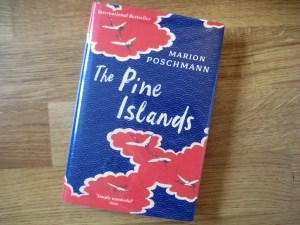 A man wakes up from a dream convinced that his wife is cheating on him, and sets off for Tokyo on a whim, where he embarks on a Bashō-inspired pilgrimage to the pine islands of Matsushima. This Gilbert Silvester, a beard historian, acquires an unlikely companion: a young man named Yosa, who’s looking for the best place to kill himself and takes Gilbert along to cliffs and forests famous for their suicide rates. Although there are still cherry blossoms and kabuki theatre, Gilbert soon learns that this isn’t Bashō’s Japan anymore.
From the haikus he composes and the letters he writes to Mathilda back home, we track his inward journey as it contrasts with the outward ones he undertakes. I enjoyed the surreal touches – Yosa says he once dated a woman who was actually a fox – and the Murakami setup (the wife’s adultery and the hair patterns are reminiscent of The Wind-Up Bird Chronicle).
Somehow, though, for me this is a book that succeeds more in its ideas (searching for the essence of a place but only finding the clichés; coniferous versus deciduous trees as a metaphor for what lasts in life versus what fades) than in its actual execution. It never all quite comes together, and the inconclusive ending makes you question how much of this has been a dream or a fantasy. It’s ambitious and intellectually impressive, but something about its dignified aloofness is hard to be enthusiastic about.
Do watch Lost in Translation, one of my favorite films, afterwards…
And a DNF: The Days of Abandonment by Elena Ferrante. The time has come to admit that I simply do not appreciate Ferrante’s work. I could only make it 25 pages into this one; I’ve read a different short novel of hers (The Lost Daughter), and skimmed another (My Brilliant Friend). While I enjoyed the narrator’s voice well enough, and loved the scene in which her errant husband finds broken glass in his dinner, I found that I had no interest in how this seemingly predictable story of the end of a marriage might play out.
Up next for Part II: The Wind that Lays Waste by Selva Almada, on its way from Charco Press, and The Awakening of Miss Prim by Natalia Sanmarin Fenollera.
 Bookish Beck = Rebecca Foster. American transplant to England. Freelance proofreader and book reviewer.
 Bookish Beck