The Poet by Louisa Reid (Blog Tour Review)
The Poet lured me with the prospect of a novel in verse (Girl, Woman, Other and Mary Ann Sate, Imbecile are two others I would recommend) and the theme of a female poet caught up in a destructive relationship with her former professor. Emma Eliot published a poetry collection at age 21 before embarking on an abandoned PhD on Charlotte Mew. Tom Abbot, a charming Oxford don in his early forties, left his wife and daughters for her, but Emma has found that the housewife existence doesn’t suit her and longs to return to academia. Tom relies on Emma to boost his ego, play stepmum and help him with his publications, but scorns her working-class upbringing and can’t conceive of her having her own life and desires.

Tom’s students and ex-wife commiserate with Emma over his arrogance, but in the end it’s up to her whether she’ll break free. She tells her story of betrayal, gaslighting and the search for revenge in free verse that flows effortlessly. Sometimes her words are addressed to Tom:
Miles of misunderstanding waver
between us
Anything would be better than the stink
of your
superiority.
– and other times to the reader.
Give me the confidence of a mediocre white man
who thinks he has the right to
a woman’s work –
her words
and womb –
and everything else.
if the bed seems too big
then perhaps that is because I have shrunk
to fit the space,
or am lost in the wasteland of what was.
There are a few poetry in-jokes like that one, with Emma quoting Emily Dickinson and Tom likening her early work to Sylvia Plath’s. Usually this feels like reading fiction rather than poetry, though the occasional passage where alliteration and internal rhymes bloom remind you that Emma is meant to be an accomplished poet.
I wanted to sit in a book-lined room
wombed in words.
I didn’t see the tomb that waited
for the woman
who underrated herself.
That said, I didn’t particularly rate this qua poetry, and the storytelling style wasn’t really enough to make a rather thin story stand out. Still, I’d recommend it to poetry-phobes, as well as to readers of The Wife by Meg Wolitzer and especially Here Is the Beehive by Sarah Crossan (who, like Reid, wrote YA fiction before producing an adult novel in verse).
My thanks to Doubleday and Anne Cater of Random Things Tours for my proof copy for review.
I was delighted to be part of the blog tour for The Poet. See below for details of where other reviews have appeared or will be appearing soon.
20 Books of Summer, 1–3: Hargrave, Powles & Stewart
Plants mirror minds,
Healing, harming powers
Growing green thoughts.
(First stanza of “Plants Mirror Minds” from The Facebook of the Dead by Valerie Laws)
Here are my first three selections for my flora-themed summer reading. I hope to get through more of my own books, as opposed to library books and review copies, as the months go on. Today I have one of each from fiction, nonfiction and poetry, with the settings ranging from 16th-century Alsace to late-20th-century Spain.
The Dance Tree by Kiran Millwood Hargrave (2022)
 Kiran Millwood Hargrave is one of my favourite new voices in historical fiction (she had written fiction for children and young adults before 2020’s The Mercies). Both novels hit the absolute sweet spot between the literary and women’s fiction camps, choosing a lesser-known time period and incident and filling in the background with sumptuous detail and language. Both also consider situations in which women, queer people and other cultural minorities were oppressed, and imagine characters pushing against those boundaries in affirming but authentic-feeling ways.
The setting is Strasbourg in the sweltering summer of 1518, when a dancing plague (choreomania) hit and hundreds of women engaged in frenzied public dancing, often until their feet bled or even, allegedly, until 15 per day dropped dead. Lisbet observes this all at close hand through her sister-in-law and best friend, who get caught up in the dancing. In the final trimester of pregnancy at last after the loss of many pregnancies and babies, Lisbet tends to the family beekeeping enterprise while her husband is away, but gets distracted when two musicians (brought in to accompany the dancers; an early strategy before the council cracked down), one a Turk, lodge with her and her mother-in-law. The dance tree, where she commemorates her lost children, is her refuge away from the chaos enveloping the city. She’s a naive point-of-view character who quickly has her eyes opened about different ways of living. “It takes courage, to love beyond what others deem the right boundaries.”
This is likely to attract readers of Hamnet; I was also reminded of The Sleeping Beauties, in that the author’s note discusses the possibility that the dancing plagues were an example of a mass hysteria that arose in response to religious restrictions. (Public library) 
Magnolia by Nina Mingya Powles (2020)
 (Powles also kicked off my 2020 food-themed summer reading.) This came out from Nine Arches Press and a small New Zealand press two years ago but is being published in the USA by Tin House in August. I’ve reviewed it for Shelf Awareness in advance of that release. Those who are new to Powles’s work should enjoy her trademark blend of themes in this poetry collection. She’s mixed race and writes about crossing cultural and language boundaries – especially trying to express herself in Chinese and Hakka. Often, food is her way of embodying split loyalties and love for her heritage. I noted the alliteration in “Layers of silken tofu float in the shape of a lotus slowly opening under swirls of soy sauce.” Magnolia is the literal translation of “Mulan,” and that Disney movie and a few other films play a major role here, as do writers Eileen Chang and Robin Hyde. My issue with the book is that it doesn’t feel sufficiently different from her essay collections that I’ve read – the other is Small Bodies of Water – especially given that many of the poems are in prose paragraphs. [Update: I dug out my copy of Small Bodies of Water from a box and found that, indeed, one piece had felt awfully familiar for a reason: that book contains a revised version of “Falling City” (about Eileen Chang’s Shanghai apartment), which first appeared here.] (Read via Edelweiss)
A Parrot in the Pepper Tree by Chris Stewart (2002)
 It’s at least 10 years ago, probably nearer 15, that I read Driving over Lemons, the first in Stewart’s eventual trilogy about buying a remote farm in Andalusia. His books are in the Peter Mayle vein, low-key and humorous: an Englishman finds the good life abroad and tells amusing anecdotes about the locals and his own mishaps.
This sequel stood out for me a little more than the previous book, if only because I mostly read it in Spain. It’s in discrete essays, some of which look back on his earlier life. He was a founding member of Genesis and very briefly the band’s drummer; and to make some cash for the farm he used to rent himself out as a sheep shearer, including during winters in Sweden.
To start with, they were really very isolated, such that getting a telephone line put in revolutionized their lives. By this time, his first book had become something of a literary sensation, so he reflects on its composition and early reception, remembering when the Mail sent a clueless reporter out to find him. Spanish bureaucracy becomes a key element, especially when it looks like their land might be flooded by the building of a dam. Despite that vague sense of dread, this was good fun. (Public library) 

10 Days in Spain (or at Sea) and What I Read
(Susan is the queen of the holiday travel and reading post – see her latest here.)
We spent the end of May in Northern Spain, with 20+-hour ferry rides across the English Channel either way. Thank you for your good thoughts – we were lucky to have completely flat crossings, and the acupressure bracelets that I wore seemed to do the job, such that not only did I not feel sick, but I even had an appetite for a meal in the ship’s café each day.

Not a bad day to be at sea. (All photos in this post are by Chris Foster.)
With no preconceived ideas of what the area would be like and zero time to plan, we went with the flow and decided on hikes each morning based on the weather. After a chilly, rainy start, we had warm but not uncomfortable temperatures by the end of the week. My mental picture of Spain was of hot beaches, but the Atlantic climate of the north is more like that of Britain’s. Green gorse-covered, livestock-grazed hills reminded us of parts of Wales. Where we stayed near Potes (reached by a narrow road through a gorge) was on the edge of Picos de Europa national park. The mountain villages and wildflower-rich meadows we passed on walks were reminiscent of places we’ve been in Italy or the Swiss and Austrian Alps.


The flora and fauna were an intriguing mix of the familiar (like blackbirds and blue tits) and the exotic (black kites, Egyptian vultures; some different butterflies; evidence of brown bears, wolves and wild boar, though no actual sightings, of course). One special thing we did was visit Wild Finca, a regenerative farming project by a young English couple; we’d learned about it from their short film shown at New Networks for Nature last year. We’d noted that the towns have a lot of derelicts and properties for sale, which is rather sad to see. They told us farm abandonment is common: those who inherit a family farm and livestock might just leave the animals on the hills and move to a city apartment to have modern conveniences.


I was especially taken by this graffiti-covered derelict restaurant and accommodation complex. As I explored it I was reminded of Cal Flyn’s Islands of Abandonment. It’s a wonder no one has tried to make this a roadside eatery again; it has a fantastic view!


It so happens that we were there for the traditional weekend when cattle are moved to new pastures. A cacophony of cowbells alerted us to herds going past our cottage window a couple of times, and once we were stopped on the road to let a small group through. We enjoyed trying local cheese and cider and had two restaurant meals, one at a trendy place in Potes and one at a roadside diner where we tried the regional speciality fabada, a creamy bean stew with sausage chunks.
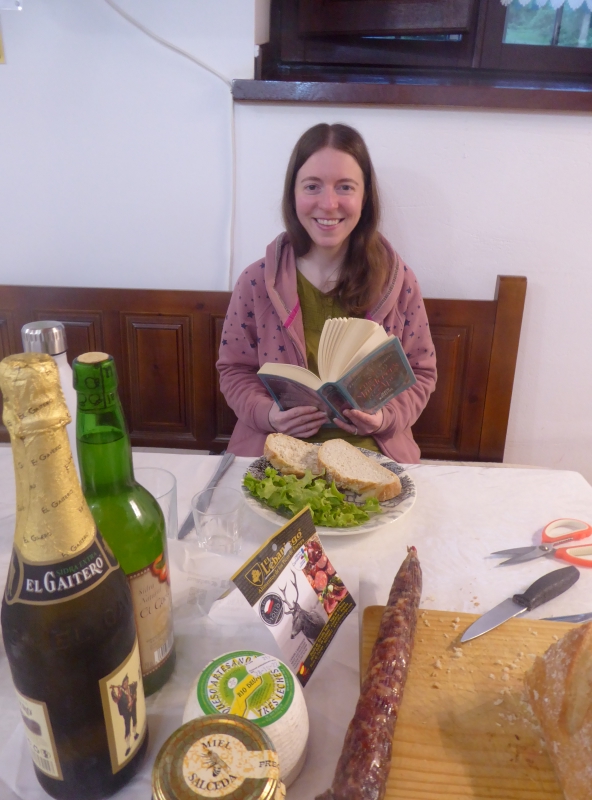
Sampling local products and reading The Murderer’s Ape.
With our meager Spanish we just about got by. I used a phrase book so old it still referred to pesetas to figure out how to ask for roundtrip tickets, while my husband had learned a few useful restaurant-going phrases from the Duolingo language-learning app. For communicating with the cottage owner, though, we had to resort to Google Translate.
A highlight of our trip was the Fuente Dé cable car to 1900 meters / ~6200 feet above sea level, where we found snowbanks, Alpine choughs, and trumpet gentians. That was a popular spot, but on most of our other walks we didn’t see another human soul. We felt we’d found the real, hidden Spain, with a new and fascinating landscape around every corner. We didn’t make it to any prehistoric caves, alas – we would probably have had to book that well in advance – but otherwise experienced a lot of the highlights of the area.


On our way back to Santander for the ferry, we stopped in two famous towns: Comillas, known for its modernist architecture and a palace designed by Gaudí; and Santillana del Mar, which Jean-Paul Sartre once called the most beautiful town in Spain. We did not manage any city visits – Barcelona was too far and there was no train service; that will have to be for another trip. It was a very low-key, wildlife-filled and relaxing time, just what we needed before plunging back into work and DIY.
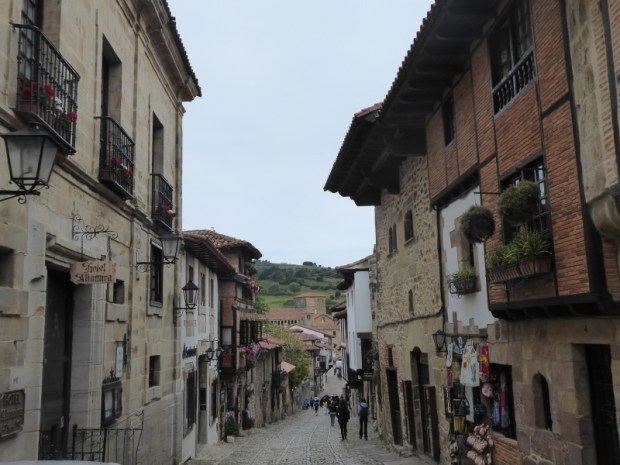
Santillana del Mar
What I Read
On the journey there and in the early part of the trip:
 The Murderer’s Ape by Jakob Wegelius (translated from the Swedish by Peter Graves): Sally Jones is a ship’s engineer who journeys from Portugal to India to clear her captain’s name when he is accused of murder. She’s also a gorilla. Though she can’t speak, she understands human language and communicates via gestures and simple written words. This was the perfect rip-roaring adventure story to read at sea; the twisty plot and larger-than-life characters who aid or betray Sally Jones kept the nearly 600 pages turning quickly. I especially loved her time repairing accordions with an instrument maker. This is set in the 1920s or 30s, I suppose, with early airplanes and maharajahs, but still long-distance sea voyages. Published by Pushkin Children’s, it’s technically a teen novel and the middle book in a trilogy, but neither fact bothered me at all.
& to see me through the rest of the week:
The Feast by Margaret Kennedy: Originally published in 1950, this was reissued by Faber in 2021 with a foreword by Cathy Rentzenbrink – had she not made much of it, I’m not sure how well I would have recognized the allegorical framework of the Seven Deadly Sins. In August 1947, we learn, a Cornish hotel was buried under a fallen cliff, and with it seven people. Kennedy rewinds a month to let us watch the guests arriving, and to plumb their interactions and private thoughts. We have everyone from a Lady to a lady’s maid; I particularly liked the neglected Cove children. It took me until the very end to work out precisely who died and which sin each one represented. The characters and dialogue glisten. This is intelligent, literary yet light, and so makes great vacation/beach reading.

 Book of Days by Phoebe Power: A set of autobiographical poems about walking the Camino pilgrimage route. Power writes about the rigours of the road – what she carried in her pack; finding places to stay and food to eat – but also gives tender pen portraits of her fellow walkers, who have come from many countries and for a variety of reasons: to escape an empty nest, to make amends, to remember a departed lover. Whether the pilgrim is religious or not, the Camino seems like a compulsion. Often the text feels more like narrative prose, though there are some sections laid out in stanzas or forming shapes on the page to remind you it is verse. I think what I mean to say is, it doesn’t feel that it was essential for this to be poetry. Short vignettes in a diary may have been more to my taste.
Two favourite passages:
into cobbled elegance; it’s opening time for shops
selling vegetables and pan and gratefully I present my
Spanish and warmth so far collected, and receive in return
smiles, interest, tomatoes, cheese.
We are resolute, though unknowing
if we will succeed at this.
We are still children here –
arriving, not yet grown
up.
With thanks to Carcanet Press for the free copy for review.
 I’d also downloaded from Edelweiss the recent travel memoir The Way of the Wild Goose by Beebe Bahrami, in which she walks sections of the Camino in France and Spain and reflects on why the path keeps drawing her back. It’s been a probing, beautiful read so far – I think this is the mild, generically spiritual quest feel Jini Reddy was trying to achieve with Wanderland.
Plus, I read a few e-books for paid reviews and parts of other library books, including a trio of Spain-appropriate memoirs: As I Walked Out One Midsummer Morning by Laurie Lee, Homage to Catalonia by George Orwell, and A Parrot in the Pepper Tree by Chris Stewart – more about this last one in my first 20 Books of Summer post, coming up on Sunday.
Our next holiday, to the Outer Hebrides of Scotland, is just two weeks away! It’ll be very different, but no doubt equally welcome and book-stuffed.
May Releases: Barrera, Cornwell, Jones, Ruhl
Greetings from the English Channel! I’m putting this quick post together on an outdoor deck as we leave Plymouth harbour on the ferry to Spain. I’ve taken a seasickness pill and am wearing acupressure bracelets, and so far I’m feeling pretty well here taking in a sea breeze; fingers crossed that it will continue to be a smooth voyage.

Have a look at all the lovely May releases above. How I wish that I’d had a chance to read some of them this month! Alas, things have been so busy with our move that I have only cracked one open so far (the Shipstead), but I’m looking forward to reading the rest soon after we get back. For now, I’ll give snippets of early reviews I’ve published elsewhere: two memoirs of pregnancy and early motherhood (the one focusing on postnatal depression), a varied short story collection, and an accessible volume of poetry written during Covid lockdowns.
Linea Nigra: An Essay on Pregnancy and Earthquakes by Jazmina Barrera
(Translated from the Spanish by Christina MacSweeney)
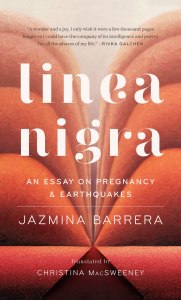 In a fragmentary work of autobiography and cultural commentary, the Mexican author investigates pregnancy as both physical reality and liminal state. The linea nigra is a stripe of dark hair down a pregnant woman’s belly. It’s a potent metaphor for the author’s matriarchal line: her grandmother was a doula; her mother is a painter. In short passages that dart between topics, Barrera muses on motherhood, monitors her health, and recounts her dreams. Her son, Silvestre, is born halfway through the book. She gives impressionistic memories of the delivery and chronicles her attempts to write while someone else watches the baby. This is both diary and philosophical appeal—for pregnancy and motherhood to become subjects for serious literature. (See my full review for Foreword.)
Birth Notes: A Memoir of Recovery by Jessica Cornwell
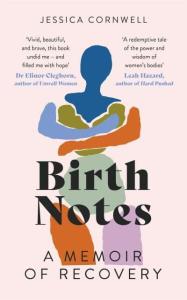 It so happens that May is Maternal Mental Health Awareness Month. Cornwell comes from a deeply literary family; the late John le Carré was her grandfather. Her memoir shimmers with visceral memories of delivering her twin sons in 2018 and the postnatal depression and infections that followed. The details, precise and haunting, twine around a historical collage of words from other writers on motherhood and mental illness, ranging from Margery Kempe to Natalia Ginzburg. Childbirth caused other traumatic experiences from her past to resurface. How to cope? For Cornwell, therapy and writing went hand in hand. This is vivid and resolute, and perfect for readers of Catherine Cho, Sinéad Gleeson and Maggie O’Farrell. (See my full review for Shiny New Books.)
With thanks to Virago for the proof copy for review.
Antipodes: Stories by Holly Goddard Jones
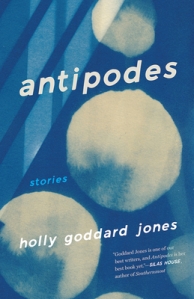 Jones’s fourth work of fiction contains 11 riveting stories of contemporary life in the American South and Midwest. Some have pandemic settings and others are gently magical; all are true to the anxieties of modern careers, marriage and parenthood. In the title story, the narrator, a harried mother and business school student in Kentucky, seeks to balance the opposing forces of her life and wonders what she might have to sacrifice. The ending elicits a gasp, as does the audacious inconclusiveness of “Exhaust,” a tense tale of a quarreling couple driving through a blizzard. Worry over environmental crises fuels “Ark,” about a pyramid scheme for doomsday preppers. Fans of Nickolas Butler and Lorrie Moore will find much to admire. (Read via Edelweiss. See my full review for Shelf Awareness.)
Love Poems in Quarantine by Sarah Ruhl
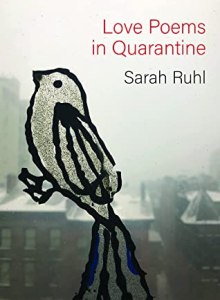 Having read Ruhl’s memoir Smile, I recognized the contours of her life and the members of her family. In early poems, cooking and laundry recur, everyday duties that mark time as she tries to write and supervises virtual learning for three children. “Let this all be poetry,” she incants. Part Two contains poems written after George Floyd’s murder, the structure mimicking how abrupt the change in focus was for a nation. Part Three moves into haiku and tanka, culminating in a series of poems reflecting on the seasons. Like Margaret Atwood’s Dearly, I would recommend this even to people who think they don’t like poetry. A welcome addition to the body of Covid-19 literature. (Read via Edelweiss. See my full review on Goodreads.)
Two favourite poems:
“Shelter”
To love a house
not because it’s perfect but because it shelters you
To love a body
not because it’s perfect but because it shelters you
“Quarantine in August, the overripe month”
I’m tired of summer. I crave fall. Luckily fall comes after summer.
And if I get tired of it all, winter will come, then spring.
Have you read anything from my tempting stack?
What other May releases can you recommend?
Reviews: de Jongh, Eipe, Parker and Scull
Today’s roundup includes a graphic novel set during the U.S. Dust Bowl, a Dylan Thomas Prize-shortlisted poetry collection infused with Islamic imagery, a book about adaptive technologies for the disabled, and a set of testimonies from the elderly and terminally ill.
Days of Sand by Aimée de Jongh (2021; 2022)
[Translated from the Dutch by Christopher Bradley]
Dust can drive people mad.
 This terrific Great Depression-era story was inspired by the real-life work of photographers such as Dorothea Lange who were sent by the Farm Security Administration, a new U.S. federal agency, to document the privations of the Dust Bowl in the Midwest. John Clark, 22, is following in his father’s footsteps as a photographer, leaving New York City to travel to the Oklahoma panhandle. He quickly discovers that struggling farmers are believed to have brought the drought on themselves through unsustainable practices. Many are fleeing to California. The locals are suspicious of John as an outsider, especially when they learn that he is working to a checklist (“Orphaned children”, “Family packing car to leave”).
“The best photos have an instant impact. Right away, they grab our attention. They tell a story, or deliver a message. The question is: how do you make that happen?” one of his employers had asked. John grows increasingly uncomfortable with being part of what is essentially a propaganda campaign when he develops a personal fondness for Cliff, a little boy who offers to be his assistant, and Betty, a pregnant widow whose runaway horse he finds. The deprivation and death he sees at close hand bring back memories of his father’s funeral four years ago.
Whether a cityscape or the midst of a dust storm, de Jongh’s scenes are stark and evocative. Each chapter opens with a genuine photograph from the period (de Jongh travelled to the USA for archival and on-the-ground research thanks to a grant from the Dutch Foundation for Literature), and some panes mimic B&W photos the FSA team took. It’s rare for me to find the story and images equally powerful in a graphic novel, but that’s definitely the case here.


With thanks to SelfMadeHero for the free copy for review.
Auguries of a Minor God by Nidhi Zak/Aria Eipe (2021)
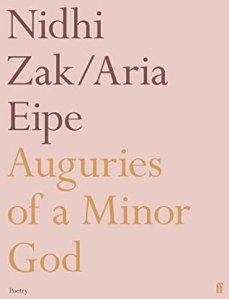 This debut poetry collection is on the Dylan Thomas Prize shortlist. I’ve noted that recent winners – such as Lot by Bryan Washington and Luster by Raven Leilani – have in common a distinctive voice and use of language, which chimes with what Thomas was known for (see my recent review of Under Milk Wood) and clarifies what the judges are looking for.
The placement of words on the page seems to be very important in this volume – spread out or bunched together, sometimes descending vertically, a few in grey. It’s unfortunate, then, that I read an e-copy, as most of the formatting was lost when I put it on my Nook. The themes of the first part include relationships, characterized by novelty or trauma; tokens of home experienced in a new land; myths; and nature. Section headings are in Malayalam.
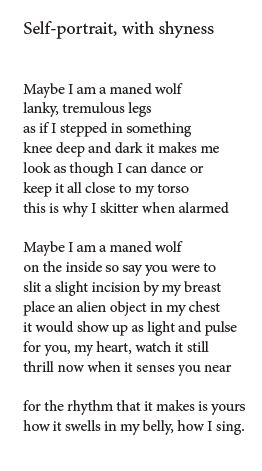
The book culminates in a lengthy, astonishingly nimble abecedarian in which a South Asian single father shepherds his children through English schooling as best he can while mired in grief over their late mother. This bubbles over in connection with her name, Noor, followed by a series of “O” apostrophe statements, some addressed to God and others exhorting fellow believers. Each letter section gets progressively longer. I was impressed at how authentically the final 30-page section echoes scriptural rhythms and content – until I saw in the endnotes that it was reproduced from a 1997 translation of the Quran, and felt a little cheated. Still, “A is for…” feels like enough to account for this India-born poet’s shortlisting. (The Prize winner will be announced on Thursday the 12th.)
With thanks to Midas PR for the free e-copy for review.
Hybrid Humans: Dispatches from the Frontiers of Man and Machine by Harry Parker (2022)
 I approached this as a companion to To Be a Machine by Mark O’Connell and that is precisely what I found, with Parker’s personal insight adding a different angle to the discussion of how technology corrects and transcends flawed bodies. Parker was a captain in the British Army in Afghanistan when an IED took his legs. Now he wears prostheses that make him roughly 12% machine. “Being a hybrid human means expensive kit – you have to pay for the privilege of leading a normal life.” He revisits the moments surrounding his accident and his adjustment to prostheses, and meets fellow amputees like Jack, who was part of a British medical trial on osseointegration (where titanium implants come out of the stump for a prosthesis to attach to) that enabled him to walk much better. Other vets they know had to save up and travel to Australia to have this done because the NHS didn’t cover it.
Travelling to the REHAB trade fair in Karlsruhe, Parker learns that disability, too, can be the mother of invention. Virtual reality and smartphone technology are invaluable, with an iPhone able to replace up to 11 single-purpose devices. Yet he also encounters disabled people who are happy with their lot and don’t look to tech to improve it, such as Jamie, who’s blind and relies only on a cane. And it’s not as if tools to compensate for disability are new; the book surveys medical technologies that have been with us for decades or even centuries: from glass eyes to contact lenses; iron lungs, cochlear implants and more.
Pain management, PTSD, phantom limbs, foreign body rejection, and deep brain stimulation for Parkinson’s disease are other topics in this wide-ranging study that is at the juncture of the personal and political. “A society that doesn’t look after the vulnerable isn’t looking after anyone – I’d learnt first-hand that we’re all just a moment from becoming vulnerable,” Parker concludes. I’ll hope to see this one on next year’s Barbellion Prize longlist.
With thanks to Profile Books/Wellcome Collection for the free copy for review.
Regrets of the Dying: Stories and Wisdom that Remind Us How to Live by Georgina Scull (2022)
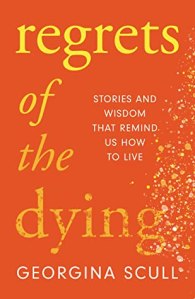 A medical crisis during pregnancy that had her minutes from death was a wake-up call for Scull, leading her to rethink whether the life she was living was the one she wanted. She spent the next decade interviewing people in her New Zealand and the UK about what they learned when facing death. Some of the pieces are like oral histories (with one reprinted from a blog), while others involve more of an imagining of the protagonist’s past and current state of mind. Each is given a headline that encapsulates a threat to contentment, such as “Not Having a Good Work–Life Balance” and “Not Following Your Gut Instinct.” Most of her subjects are elderly or terminally ill. She also speaks to two chaplains, one a secular humanist working in a hospital and the other an Anglican priest based at a hospice, who recount some of the regrets they hear about through patients’ stories.
Recurring features are not spending enough time with family and staying too long in loveless or unequal relationships. Two accounts that particularly struck me were Anthea’s, about the tanning bed addiction that gave her melanoma, and Millicent’s, guilty that she never went to the police about a murder she witnessed as a teenager in the 1930s (with a NZ family situation that sounds awfully like Janet Frame’s). Scull closes with 10 things she’s learned, such as not to let others’ expectations guide your life and to appreciate the everyday. These are readable narratives, capably captured, but there isn’t much here that rises above cliché.
With thanks to publicist Claire Morrison and Welbeck for the free copy for review.
Would you be interested in reading one or more of these?
Book Serendipity, March to April 2022
This is a bimonthly feature of mine. I call it Book Serendipity when two or more books that I read at the same time or in quick succession have something in common – the more bizarre, the better. Because I usually 20–30 books on the go at once, I suppose I’m more prone to such incidents. The following are in roughly chronological order.
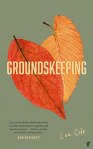
(I always like hearing about your bookish coincidences, too! Laura had what she thought must be the ultimate Book Serendipity when she reviewed two novels with the same setup: Groundskeeping by Lee Cole and Last Resort by Andrew Lipstein.)
- The same sans serif font is on Sea State by Tabitha Lasley and Lean Fall Stand by Jon McGregor – both released by 4th Estate. I never would have noticed had they not ended up next to each other in my stack one day. (Then a font-alike showed up in my TBR pile, this time from different publishers, later on: What Strange Paradise by Omar El Akkad and When We Were Birds by Ayanna Lloyd Banwo.)


- Kraftwerk is mentioned in The Facebook of the Dead by Valerie Laws and How High We Go in the Dark by Sequoia Nagamatsu.
- The fact that bacteria sometimes form biofilms is mentioned in Hybrid Humans by Harry Parker and Slime by Susanne Wedlich.
- The idea that when someone dies, it’s like a library burning is repeated in The Reactor by Nick Blackburn and In the River of Songs by Susan Jackson.
- Espresso martinis are consumed in If Not for You by Georgina Lucas and Wahala by Nikki May.
- Prosthetic limbs turn up in Groundskeeping by Lee Cole, The Book of Form and Emptiness by Ruth Ozeki, and Hybrid Humans by Harry Parker.
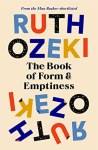
- A character incurs a bad cut to the palm of the hand in After You’d Gone by Maggie O’Farrell and The Book of Form and Emptiness by Ruth Ozeki – I read the two scenes on the same day.
- Catfish is on the menu in Groundskeeping by Lee Cole and in one story of Antipodes by Holly Goddard Jones.
 Reading two novels with “Paradise” in the title (and as the last word) at the same time: Paradise by Toni Morrison and To Paradise by Hanya Yanagihara.
- Reading two books by a Davidson at once: Damnation Spring by Ash and Tracks by Robyn.
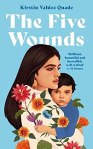
- There’s a character named Elwin in The Five Wounds by Kirstin Valdez Quade and one called Elvin in The Two Lives of Sara by Catherine Adel West.

- Tea is served with lemon in The Beginning of Spring by Penelope Fitzgerald and The Two Lives of Sara by Catherine Adel West.
- There’s a Florence (or Flo) in Go Tell It on the Mountain by James Baldwin, These Days by Lucy Caldwell and Pictures from an Institution by Randall Jarrell. (Not to mention a Flora in The Sentence by Louise Erdrich.)
 There’s a hoarder character in Olga Dies Dreaming by Xóchitl González and The Book of Form and Emptiness by Ruth Ozeki.
- Reading at the same time two memoirs by New Yorker writers releasing within two weeks of each other (in the UK at least) and blurbed by Jia Tolentino: Home/Land by Rebecca Mead and Lost & Found by Kathryn Schulz.
- Three children play in a graveyard in Falling Angels by Tracy Chevalier and Build Your House Around My Body by Violet Kupersmith.


- Shalimar perfume is worn in These Days by Lucy Caldwell and The Five Wounds by Kirstin Valdez Quade.
- A relative is described as “very cold” and it’s wondered what made her that way in Very Cold People by Sarah Manguso and one of the testimonies in Regrets of the Dying by Georgina Scull.
 Cherie Dimaline’s Empire of Wild is mentioned in The Sentence by Louise Erdrich, which I was reading at around the same time. (As is The Beginning of Spring by Penelope Fitzgerald, which I’d recently finished.)
- From one poetry collection with references to Islam (Bless the Daughter Raised by a Voice in Her Head by Warsan Shire) to another (Auguries of a Minor God by Nidhi Zak/Aria Eipe).
- Two children’s books featuring a building that is revealed to be a theatre: Moominsummer Madness by Tove Jansson and The Unadoptables by Hana Tooke.
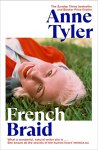
- Reading two “braid” books at once: Braiding Sweetgrass by Robin Wall Kimmerer and French Braid by Anne Tyler.

- Protests and teargas in The Sentence by Louise Erdrich and The Book of Form and Emptiness by Ruth Ozeki.
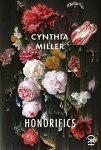
- Jellyfish poems in Honorifics by Cynthia Miller and Love Poems in Quarantine by Sarah Ruhl.
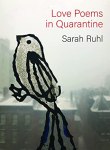
- George Floyd’s murder is a major element in The Sentence by Louise Erdrich and Love Poems in Quarantine by Sarah Ruhl.
What’s the weirdest reading coincidence you’ve had lately?
Review Catch-Up: Capildeo, Castillo, Nagamatsu & Wedlich
A second catch-up for April. Today I have a sprightly poetry collection about history, language and nature; a linked short story collection that imagines funerary rituals and human meaning in a post-pandemic future; and a wide-ranging popular science book about the diverse connotations and practical uses of slime. As a bonus, I have a preview essay from a forthcoming collection about how reading promotes empathy and social justice.
Like a Tree, Walking by Vahni Capildeo (2021)
 Capildeo is a nonbinary Trinidadian Scottish poet and the current University of York writer in residence. Their fourth collection is richly studded with imagery of the natural world, especially birds and trees. “In Praise of Birds” makes a gorgeous start:
“In praise of high-contrast birds, purple bougainvillea thicketing the golden oriole. … In praise of grackles quarrelling on the lawn. / In praise of unbeautiful birds abounding in Old Norse, language of scavenging ravens, thought and memory, a treacherous duo”
and finds a late echo in “In Praise of Trees”: “If I could have translated piano practice into botany, the lichen is that Mozart phrase my left hand trialled endlessly.”
The title section (named after a moment from the book of Mark) draws on several numbered series – “Walk #2,” “Nocturne #1,” “Lullaby 4,” and so on – that appeared in a pamphlet they published last year. These are not uncomplicated idylls, though. Walks might involve dull scenery and asthma-inducing dust, as well as danger: “If nobody has abducted you, I’ll double back to meet you. … Before raper-man corner and the gingerbread house.” Lullabies wish for good sleep despite lawnmowers and a neighbour shooting his guns. There’s more bold defiance of expectations in phrases like “This is the circus for dead horses only”.
Language is a key theme, with translations from the French of Eugène Ionesco, and of Pierre de Ronsard into Trini patois. There are also dual-language erasure poems after Dame Julian of Norwich (Middle English) and Simone Weil (French). Much of the work is based on engagement with literature, or was written in collaboration with performers.
“Death is a thief in a stationery shop. He strolls out. The shopkeeper, a poor man, runs after, shouting. – I saw you! Give that back! – Give back what? Death says, strolling out. Hermes is a tram attendant who holds your coffee, helping you find the coin you dropped; it rolls underfoot.” (from “Odyssey Response”)
“Windrush Reflections” impresses for its research into the situation of Caribbean immigrants to Britain. It’s one of a number of long, multipart pieces, some of them prose poems. The verse relies mostly on alliteration and anaphora for its sonic qualities. Along with history, there is reflection on current events, as in “Plague Poems.” Experiences of casual racism fuel one of my favourite passages:
“the doorbell was ringing / the downstairs american oxford neighbours / wanted to check / by chatting on the intercom / if i was doing terrorism / i was doing transcriptions” (from “Violent Triage”)
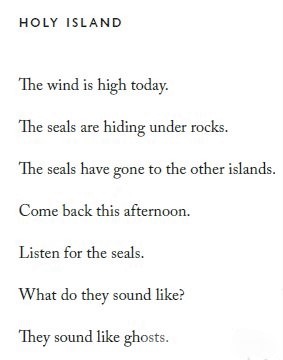
Honorifics by Cynthia Miller, which I reviewed last week, had more personal resonance for me, but these are both powerful collections – alive to the present moment and revelling in language and in flora and fauna. However, only Capildeo progressed from the Jhalak Prize longlist onto the shortlist, which was announced yesterday.
With thanks to Carcanet Press for the free e-copy for review.
How High We Go in the Dark by Sequoia Nagamatsu (2022)
“Things are bad in every generation. But we still have to live our life.”
This linked short story collection was one of my most anticipated books of the year. Like two of its fellow entries on that list, Sea of Tranquility by Emily St. John Mandel and To Paradise by Hanya Yanagihara, it’s just the right blend of literary fiction and science fiction – an Octavia E. Butler level of the latter that I can handle. Opening in 2031 and stretching another 70 years into the future, it imagines how a pandemic reshapes the world and how communication and connection might continue after death. In the first story, Cliff is on the ground at the start of the Arctic plague, which emerges from a thawing Siberia (the same setup as in Under the Blue!), where his late daughter, Clara, had been part of a research group that discovered a 30,000-year-old Neanderthal girl they named Annie.
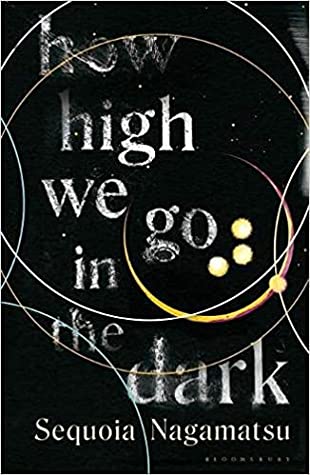 The virus is highly transmissible and deadly, and later found to mostly affect children. In the following 13 stories (most about Asian Americans in California, plus a few set in Japan), the plague is a fact of life but has also prompted a new relationship to death – a major thread running through is the funerary rites that have arisen, everything from elegy hotels to “resomation.” In the stand-out story, the George Saunders-esque “City of Laughter,” Skip works at a euthanasia theme park whose roller coasters render ill children unconscious before stopping their hearts. He’s proud of his work, but can’t approach it objectively after he becomes emotionally involved with Dorrie and her son Fitch, who arrives in a bubble.
All but one of these stories are in the first person, so they feel like intimate testimonies of how a pandemic transforms existence. Almost all of the characters have experienced a bereavement, or are sick themselves. Relatives or acquaintances become protagonists in later stories. For instance, in “Pig Son,” Dorrie’s ex, David, is a scientist growing organs for transplantation. Bereavement coordinator Dennis and his doctor brother Bryan narrate #5 and #8, respectively. Six years on, Cliff’s wife Miki takes their granddaughter on a space mission. My other two favourites were “Through the Garden of Memory,” in which patients on a plague ward build a human pyramid and plot a sacrifice, and “Songs of Your Decay,” about a researcher at a forensic body farm who bonds with her one live donor over rock music.
Some stories are weaker or less original than others, but this is one case where the whole is definitely greater than the sum of its parts. The focus on illness and death, but also on the love that survives, made this a winner for me. I’d be especially likely to recommend it to fans of Kazuo Ishiguro and Karen Russell.
With thanks to Bloomsbury for the free copy for review.
Slime: A Natural History by Susanne Wedlich (2021)
[Translated from the German by Ayça Türkoğlu]
 This is just the sort of wide-ranging popular science book that draws me in. Like Entangled Life by Merlin Sheldrake, a work I’ve had many opportunities to recommend even to those who don’t normally pick up nonfiction, it incorporates many weird and wonderful facts about life forms we tend to overlook. Wedlich, a freelance science journalist in Germany, starts off at the Hunterian Museum in Glasgow, where she seeks a sample of the “primordial slime” collected by the HMS Challenger in 1876. “It seems to be an unwritten rule of horror: slime sells!” she remarks – from H. P. Lovecraft to Ghostbusters, it has provoked disgust. Jellyfish, snails, frogs and carnivorous plants – you’re in for a sticky tour of the natural world.
The technical blanket term for slimy substances is “hydrogels,” which are 99% water and held together by polymers. Biological examples have been inspiring new technologies, like friction reducers (e.g. in fire hoses) modelled on fish mucus, novel adhesives to repair organs and seal wounds, and glue traps to remove microplastics. Looking to nature to aid our lives is nothing new, of course: Wedlich records that slugs were once used to lubricate cart wheels.
The book branches off in a lot of directions. You’ll hear about writers who were spellbound or terrified by marine life (Patricia Highsmith kept snails, while Jean-Paul Sartre was freaked out by sea creatures), the Victorian fascination with underwater life, the importance of the microbiome and the serious medical consequences of its dysfunction, and animals such as amphibians that live between land and water. At times it felt like the narrative jumped from one topic to another, especially between the biological and the cultural, without following a particular plan, but there are enough remarkable nuggets to hold the interest.
With thanks to Granta for the free copy for review.
And a bonus:
 I was delighted to be sent a preview pamphlet containing the author’s note and title essay of How to Read Now by Elaine Castillo, coming from Atlantic in August. This guide to cultural criticism – how to read anything, not just a book – is alive to the biased undertones of everyday life. “Anyone who is perfectly comfortable with keeping the world just as it is now and reading it the way they’ve always read it … cannot be trusted”. Castillo writes that it is not the job of people of colour to enlighten white people (especially not through “the gooey heart-porn of the ethnographic” – war, genocide, tragedy, etc.); “if our stories primarily serve to educate, console and productively scold a comfortable white readership, then those stories will have failed their readers”. This is bold, provocative stuff. I’m sure to learn a lot.
Would you be interested in reading one or more of these?
Review Catch-Up: Jhalak and Women’s Prize Nominees, Etc.
Another in an ongoing series as I catch up on the current and previous year releases I’ve been sent for review. Today I have four books by women: a poetry collection about living between countries and languages, a magic realist novel about vengeful spirits in Vietnam, a memoir in verse about the disabled body and queer parenting, and a novel set in gentrifying Puerto Rican neighbourhoods of New York City.
From the Jhalak Prize longlist:
Honorifics by Cynthia Miller (2021)
Miller is a Malaysian American poet currently living in Edinburgh. Honorifics was also shortlisted for the Forward Prize for Best First Collection. Its themes resonate with poetry I’ve read by other Asian women like Romalyn Ante and Jenny Xie and with the works of mixed-race authors such as Jessica J. Lee and Nina Mingya Powles: living between two or more countries and feeling like an exile versus finding a sense of home.
Nightly, you rosary American synonyms for success learned the hard way: suburb – 10-year visa – promotion – carpool – mortgage – parent-teacher conference – nuclear family – assimilation … Homecoming is the last, hardest thing you’ll ask yourself to do.
(from “Homecoming”)
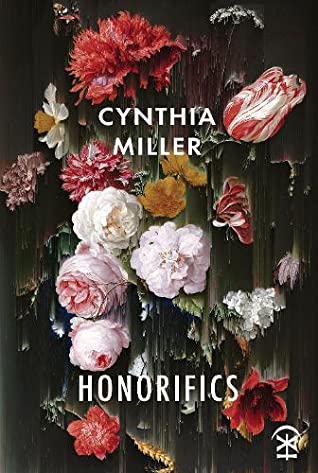 “Loving v. Virginia” celebrates interracial love: “Look at us, improper. Look at us, indecent. Look at us, incandescent and loving.” Food is a vehicle for memory, as are home videos. Like Ante, Miller has a poem based on her mother’s voicemail messages. “Glitch honorifics” gives the characters for different family relationships, comparing Chinese and Hokkien. The imagery is full of colour and light, plants and paintings. A terrific central section called “Bloom” contains 10 jellyfish poems (“We bloom like nuclear hydrangea … I’m an unwound chandelier, / a 150-foot-long coil of cilia, // made up of a million gelatinous foxgloves.”).
Miller incorporates a lot of unusual structures, some of them traditional forms (“Sonnet with lighthouses,” “Moon goddess ghazal,” “Persimmon abecedarian”) and others freer forms like a numbered list, columns, dictionary definitions or prose paragraphs. Six of the poems cite an inspiration; I could particularly see the influence in “The Home Office after Caroline Bird” – an absurdist take on government immigration policy.
There’s much variety here, and so many beautiful lines and evocative images. “Malaysiana,” a tour through everything she loves about the country of her birth, was my single favourite poem, and a couple more passages I loved were “the heart measuring breaths like levelling sugar / for a batter, the heart saying / why don’t you come in from the cold.” (from “The impossible physiology of the free diver”) and the last two stanzas of “Lupins”: “Some days / their purple spines // are the only things / holding me up.” Flora and fauna references plus a consideration of the expat life meant this was custom made for me, but I’d recommend it to anyone looking to try out different styles of contemporary poetry.
With thanks to Nine Arches Press for the free copy for review.
From the Women’s Prize longlist:
Build Your House around My Body by Violet Kupersmith (2021)
 Back in 2014, I reviewed Kupersmith’s debut collection, The Frangipani Hotel, for BookBrowse. I was held rapt by its ghostly stories of Vietnam, so I was delighted to hear that she had written a debut novel, and it was one of my few correct predictions for the Women’s Prize nominees. The main action takes place between when Winnie – half white and half Vietnamese – arrives in Saigon to teach English in 2010, and when she disappears from the house she shared with her boyfriend of three months, Long, in March 2011. But the timeline darts about to tell a much more expansive story, starting with the Japanese invasion of Vietnam in the 1940s. Each date is given as the number of months or years before or after Winnie’s disappearance.
Winnie starts off living with a great-aunt and cousins, and meets a family friend, Dr. Sang, who’s been experimenting on a hallucinogenic drug made from cobra venom. Long and his brother, Tan, a policeman, were childhood friends with a fearless young woman named Binh – now a vengeful ghost haunting them both. Meanwhile, the Saigon Spirit Eradication Company, led by the Fortune Teller, is called upon to eradicate a ghost – which from time to time seems to inhabit a small dog – from a snake-infested highland estate. These strands are bound to meet, and smoke and snakes wind their way through them all.
I enjoyed Kupersmith’s energetic writing, which reminded me by turns of Nicola Barker, Ned Beauman, Elaine Castillo and Naoise Dolan, and the glimpses of Cambodia and Vietnam we get through meals and motorbike rides. What happens with Belly the dog towards the end is fantastic. But the chronology feels needlessly complex, with the flashbacks to colonial history and even to Binh’s story not adding enough to the narrative. While I’d still like to see Kupersmith make the shortlist, I can recommend her short stories that bit more highly.
With thanks to Oneworld for the free copy for review.
Handbook for the Newly Disabled: A Lyric Memoir by Allison Blevins (2022)
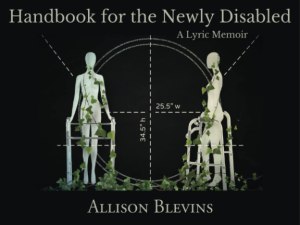 Allison Blevins, a poet, has published five chapbooks or collections and has another forthcoming. Based in Missouri and the director of an indie press, she tells her story of chronic illness and queer parenting in 10 “chapters” composed of multi-part poems. She moves through brain fog and commemorates pain and desire, which cannot always coexist (as in “How to F**k a Disabled Body”).
I’ll never
ride a bike again, hike, carry my children. I’m learning to number what I’ve lost.
Because of the pills, I no longer fall into sleep, I stop. I used to hate queer at 19
when I was a dyke. I can’t be disabled. I need a better word. I need a body that floats—
translucent and liquid—to my daughter’s bed, to cover her like cotton-red quilted stars.
(from “Brain Fog”)
Sometimes the title is enough: “My Neurologist (Who Doesn’t Have MS) Explains Pain Is Not a Symptom of MS.” Other times, what is left out, or erased (as in “Five by Five”) is what matters the most. For instance, the Photo Illustrations promised in the titles of two chapters are replaced by Accessibility Notes. That strategy reminded me of one Raymond Antrobus has used. Alliteration, synesthesia and the language of the body express the complexities of a friend’s cancer, having a trans partner, and coming to terms with sexuality (“I think now that being queer was easy, easy as forgetting / being born”). A really interesting work and an author I’d like to read more from.
Published by BlazeVOX [books] on 22 March. With thanks to the author for the e-copy for review.
Olga Dies Dreaming by Xóchitl González (2022)
 This was on my radar thanks to a starred Kirkus review. It would have been a good choice for the Women’s Prize longlist, with its bold heroine, Latinx and gay characters, and blend of literary and women’s fiction. The Puerto Rican immigrant community and gentrifying neighbourhoods of New York City are appealing locales, and Olga is a clever, gutsy protagonist. As the novel opens in 2017, she’s working out how best to fleece the rich families whose progeny’s weddings she plans. Today it’s embezzling napkins for her cousin Mabel’s wedding. Next: stockpiling cut-price champagne. Olga’s brother Prieto, a slick congressman inevitably nicknamed the “Latino Obama,” is a closeted gay man. Their late father was a drug addict; their mother left to be part of a revolutionary movement back in PR and sends her children occasional chiding letters when they appear to be selling out.
The aftermath of Hurricane Maria coincides with upheaval in Olga’s and Prieto’s personal and professional lives. The ins and outs of Puerto Rican politics went over my head somewhat, and the various schemes and conspiracy theories get slightly silly. The thread that most engaged me was Olga’s relationship with Matteo, a hoarder. I hoped that, following the satire of earlier parts (“Olga realized she’d allowed herself to become distracted from the true American dream—accumulating money—by its phantom cousin, accumulating fame. She would never make that mistake again”), there might be a message about the emptiness of the pursuit of wealth. So I ended up a little disappointed by a late revelation about Matteo.
However, I did appreciate the picture of how Olga is up against it as both a woman and a person of colour (“no person of color serious about being taken seriously was ever late to meet white people”). This debut was perhaps a little unsure of what it wanted to be, but the novelty of the main elements was enough to make it worth reading.
With thanks to Fleet for the free copy for review.
Would you be interested in reading one or more of these?
Reading Ireland Month: Erskine, O’Farrell, Quinn and Tóibín
Reading Ireland Month is hosted each year by Cathy of 746 Books. I’m sneaking in on the final day of March (there’s a surprise snow squall out the window as I write this) with four short reviews and feeling rather smug that my post covers lots of bases: short stories, a novel, a book of autobiographical pieces, and a poetry collection.
Dance Move by Wendy Erskine (2022)
 The 11 stories in Erskine’s second collection do just what short fiction needs to: dramatize an encounter, or moment, that changes life forever. Her characters are ordinary, moving through the dead-end work and family friction that constitute daily existence, until something happens, or rises up in the memory, that disrupts the tedium.
Erskine being from Belfast, evidence of the Troubles is never far away. In “Nostalgie,” a washed-up rocker is asked to perform his hit song at a battalion’s party. A woman and her lodger are welded together by a violent secret in “Bildungsroman,” which reminded me of a tale from Bernard MacLaverty’s Blank Pages and Other Stories. “Gloria and Max” struck me most of all: a drive to a film festival becomes a traumatic flashback when they’re first on the scene of an accident.
Erskine’s writing is blunt and edgy, the kind that might be stereotyped as male but nowadays is also, inevitably for Irish authors, associated with Sally Rooney: matter-of-fact; no speech marks, flat dialogue and slang. A couple of other favourites: “Mathematics,” in which a cleaner finds an abandoned child in a hotel room and tries to do right by her; and “Memento Mori,” about two deaths, one drawn out and one sudden; both equally unexpected; and only enough compassion to cope with one. (Public library) 
After You’d Gone by Maggie O’Farrell (2000)
 In form this is similar to O’Farrell’s The Distance Between Us, one of my Reading Ireland selections from last year: short sections of a few pages flit between times and perspectives. (There’s also an impulsive trip from London to Scotland in both.) But whereas in her third novel I found the jump cuts confusing and unnecessary, here they just work, and elegantly, to build a portrait of Alice Raikes, in a coma after what may have been a suicide attempt. That day she’d taken a train from London to Edinburgh at the last minute, met her sisters at the station, seen something that threw her, and gotten right on a return train. Back in London and on the way to the shop for cat food, she stepped off the kerb and into the path of a car.
Scenes from Alice’s childhood in Scotland are interspersed with her love affairs; her parents’ disappointing marriage serves as a counterpoint to her great passion for John. The setup of three female generations in North Berwick and the question of sexual autonomy reminded me strongly of Evie Wyld’s The Bass Rock.
This is a bold debut novel, refusing to hold readers’ hands through shifts from now to near past to further ago, from third to second to first person (even Alice from her coma: “my body still clings to life, and I find myself suspended like Persephone between two states … I am somewhere. Drifting. Hiding.”). Loss, secrets and family inheritance may be familiar themes, but when this was published at the millennium it must have seemed thrillingly fresh; it still does now.
I only have one unread O’Farrell novel awaiting me now, My Lover’s Lover. I’ll be saving that up, maybe for this time next year. Having not much enjoyed Hamnet, I’m disappointed that her forthcoming novel will also be historical and will probably skip it; I miss her stylish contemporary commentary. (Secondhand from a charity shop)
A Portrait of the Artist as a Young Girl, ed. John Quinn (1986)
 These autobiographical essays were compiled by Quinn based on interviews he conducted with nine women writers for an RTE Radio series in 1985. I’d read bits of Dervla Murphy’s and Edna O’Brien’s work before, but the other authors were new to me (Maeve Binchy, Clare Boylan, Polly Devlin, Jennifer Johnston, Molly Keane, Mary Lavin and Joan Lingard). The focus is on childhood: what their family was like, what drove these women to write, and what fragments of real life have made it into their books.
I read the first couple of pieces but then started to find the format repetitive and didn’t want to read out-of-context illustrative passages from novels I’d never heard of, so only skimmed through the rest. You can work out what Quinn’s questions were based on how the essays spin out: What is your earliest memory? What was your relationship with your parents? What was your schooling? Were you lonely? What part did books and writing play in your childhood? Distant fathers, a strict Catholic upbringing, solitude/boredom and escaping into novels are common elements. Some had happier childhoods than others, but all are grateful for the life of the mind: A solid base of familial love and the freedom to explore were vital.
The best passage comes from Seamus Heaney’s foreword: “The woman writer, like everybody else, is in pursuit of coherence, attempting to bring into significant alignment the creature she was and the being she is striving to become.” (Secondhand from Bookbarn International)
Vinegar Hill by Colm Tóibín (2022)
 I didn’t realize when I started it that this was Tóibín’s debut collection; so confident is his verse that I assumed he’s been publishing poetry for decades. He’s one of those polymaths who’s written in many genres – contemporary fiction, literary criticism, travel memoir, historical fiction – and impresses in all. I’ve been finding his recent Folio Prize winner, The Magician, a little too dry and biography-by-rote for someone with no particular interest in Thomas Mann (I’ve only ever read Death in Venice), so I will likely just skim it before returning it to the library, but I can highly recommend his poems as an alternative.
There’s such a range of tone, structures and topics here. Bereavements and chemotherapy are part of a relatable current events background, as in “Lines Written After the Second Moderna Vaccine at Dodgers’ Stadium Los Angeles, 27 February 2021.” Irish-Catholic nostalgia animates the very witty sequence from “The Nun” to “Vatican II.” You can come along on some armchair travels: “In Washington DC,” “In San Clemente,” “Canal Water” (Venice), “Jericho,” and so on. The poems are based around anecdotes or painterly observations; there are both short phrases and prose paragraphs. The line breaks are unfailingly fascinating (any other enjambment geeks out there?). I particularly loved “Kennedy in Wexford,” “In the White House,” “Eccles Street” and “Eve.”

With thanks to Carcanet Press for the e-copy for review.
Have you read any Irish literature this month?
Review Catch-Up: Brackenbury, McLaren, Wellcome Collection
As usual, I have a big backlog of 2021–22 releases I’m working my way through. I’ll get there eventually! Today I’m reporting on a poetry collection about English ancestry and wildlife, a vision of post-doubt Christian faith, and a set of essays on connection to nature, specifically flora. (I also take a brief look at some autofiction that didn’t work for me.)
Thorpeness by Alison Brackenbury (2022)
 I’m familiar with Brackenbury from her appearance at New Networks for Nature in 2016 and her latest selected poems volume, Gallop. This, her tenth stand-alone collection, features abundant imagery of animals and the seasons, as in “Cucu” and “Postcard,” which marks the return of swifts. Alliteration is prominent, but there is also a handful of rhymes, like in “Fern.” Family history and the perhaps-idyllic rural underpin the verse set in Lincolnshire and Gloucestershire as Brackenbury searches for ancestral graves and delivers elegies.
I especially loved “Aunt Margaret’s Pudding,” a multipart poem about her grandmother’s life as a professional cook and then a mother of four, and “My Grandmother Waits for Christmas,” about a simple link between multiple generations’ Christmases: a sugar mouse. Caring for horses is another recurring theme; a 31-year-old blind pony receives a fond farewell.
There are also playful meetings between historical figures (“Purple Haze,” a dialogue between George Frideric Handel and Jimi Hendrix, who saw the composer’s ghost in their shared London home) and between past and contemporary, like “Thomas Hardy sends an email” (it opens “I need slide no confessions under doors”). “Charles Dickens at Home” was another favourite of mine. The title is the never-to-be-reached destination in the final poem, “Shingle.” A number of these poems were first broadcast on BBC Radio.
With thanks to Carcanet Press for the e-copy for review.
Faith after Doubt: Why Your Beliefs Stopped Working and What to Do about It by Brian McLaren (2021)
I’ve explained before how McLaren’s books were pivotal to my spiritual journey, even before I attended the church he founded in Maryland. (I’ve also reviewed his previous book, God Unbound). His progressive, environmentalist theology is perfect for continuing searchers like me. At one of last year’s online Church Times Festival events, I saw him introduce the schema that underpins this book. He proposes that the spiritual life (not just Christian) has four stages that may overlap or repeat: simplicity, complexity, perplexity and harmony. The first stage is for new zealots who draw us–them divisions and are most concerned with orthodoxy. In the second, practitioners are more concerned with practicalities: what works, what makes life better. Perplexity is provoked by cynicism about injustice and hypocrisy, while harmony moves beyond dualism and into connection with other people and with nature.
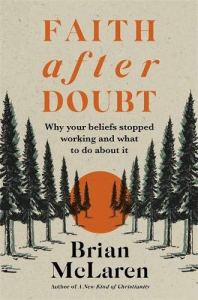 McLaren suggest that honest doubting, far from being a problem, might present an opportunity for changing in the right direction, getting us closer to the “revolutionary love” at the heart of the gospel. He shares stories from his own life, in and out of ministry, and from readers who have contacted him remotely or come up to him after events, caught in dilemmas about what they believe and whether they want to raise their children into religion. Though he’s fully aware of the environmental crisis and doesn’t offer false hope that we as a species will survive it, he isn’t ready to give up on religion; he believes that a faith seasoned by doubt and matured into an understanding of the harmony of all things can be part of a solution.
It’s possible some would find McLaren’s ideas formulaic and his prose repetitive. His point of view always draws me in and gives me much to think about. I’ve been stuck in perplexity for, ooh, 20 years? I frequently ask myself why I persist in going to church when it’s so boring and so often feels like a social club for stick-in-the-mud white people instead of a force for change. But books like this and Robin Wall Kimmerer’s Braiding Sweetgrass, my current soul food, encourage me to keep pursuing spiritual connection as a worthwhile path. I’ll be seeking out his forthcoming book (due out in May), Do I Stay Christian?, too.
Some favourite lines:
“only doubt can save the world. Only doubt will open a doorway out of hostile orthodoxies – whether religious, cultural, economic or political. Only through the difficult passage of doubt can we emerge into a new stage of faith and a new regenerative way of life. Everything depends on making this passage.”
“Among all the other things doubt is – loss, loneliness, crisis, doorway, descent, dissent [these are each the subject of individual chapters early on in the book] – it is also this: a crossroads. At the crossroads of doubt, we either become better or bitter. We either break down or break through. We become cynics or sages, hollow or holy. We choose love or despair.”
“Blessed are the wonderers, for they shall find what is wonderful. … Blessed are the doubters, for they shall see through false gods. Blessed are the lovers, for they shall see God everywhere.”
With thanks to Hodder & Stoughton for the free copy for review.
This Book Is a Plant: How to Grow, Learn and Radically Engage with the Natural World (2022)
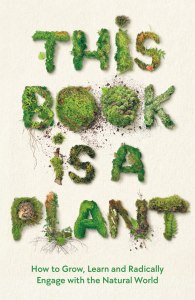 This collection of new essays and excerpts from previously published volumes accompanies the upcoming Wellcome Collection exhibition Rooted Beings (a collaboration with La Casa Encendida, Madrid, it’s curated by Bárbara Rodríguez Muñoz and Emily Sargent and will run from 24 March to 29 August). The overarching theme is our connection with plants and fungi, and the ways in which they communicate. Some of the authors are known for their nature writing – there’s an excerpt from Merlin Sheldrake’s Entangled Life, Jessica J. Lee (author of Turning and Two Trees Make a Forest) contributes an essay on studying mosses, and a short section from Kimmerer’s Braiding Sweetgrass closes the book – while others are better known in other fields, like Susie Orbach and Abi Palmer (author of Sanatorium).
I especially enjoyed novelist Rowan Hisayo Buchanan’s “Wilder Flowers,” which is about landscape painting, balcony gardening in pots, and what’s pretty versus what’s actually good for nature. (Wildflowers aren’t the panacea we are sometimes sold.) I was also interested to learn about quinine, which comes from the fever tree, in Kim Walker and Nataly Allasi Canales’ “Bitter Barks.” Sheila Watt-Cloutier’s essay on the Western influence on Inuit communities in northern Canada, reprinted from Granta, is one of the best individual pieces – forceful and with a unique voice, it advocates reframing the climate change debate in terms of human rights as opposed to the economy – but has nothing to do with plants specifically. There are also a couple of pieces that go strangely mystical, such as one on plant metaphors in the Kama Sutra. So, a mixed bag that jumbles science, paganism and postcolonial thought, but if you haven’t already encountered the Kimmerer and Sheldrake (or, e.g., Rooted by Lyanda Lynn Haupt and Losing Eden by Lucy Jones) you might find this a good primer.
With thanks to Profile Books / Wellcome Collection for the free copy for review.
And one that really didn’t work for me; my apologies to the author and publisher.
I Love You but I’ve Chosen Darkness by Claire Vaye Watkins (2021)
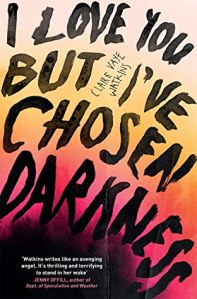 What a letdown after Gold Fame Citrus, one of my favourite novels of 2015. I’d also read Watkins’s debut short story collection, Battleborn, which won the Dylan Thomas Prize. Despite the amazing title and promising setup – autofiction that reflects on postpartum depression and her Mojave Desert upbringing as a daughter of one of the Manson Family cult members – this is indulgent, misguided, and largely unreadable.
A writer named Claire Vaye Watkins flies to Nevada to give a lecture and leaves her husband and baby daughter behind – for good? To commemorate her mother Martha, who died of an opiate overdose, she reprints Martha’s 1970s letters, which are unspeakably boring. I feel like Watkins wanted to write a memoir but didn’t give herself permission to choose nonfiction, so tried to turn her character Claire’s bad behaviour into a feminist odyssey of sexual freedom and ended up writing such atrocious lines as the below:
“I mostly boinked millennial preparers of beverages and schlepped to book festivals to hook up with whatever adequate rando lurked at the end of my signing line. This was what our open marriage looked like”
“‘Psychedelics tend to find me when I need them,’ she said, sending a rush of my blood to my vulva.”
Her vagina dentata (a myth, or a real condition?!) becomes a bizarre symbol of female power and rage. I could only bear to skim this. 
Some lines I liked:
Listen: I am a messenger from the future. I am you in ten years. Pay attention! Don’t fetishize marriage and babies. Don’t succumb to the axial tilt of monogamy! I don’t pretend to know the details of your…situation, but I guarantee you, you’re as free as you’ll ever be. Have sex with anyone you want. Enjoy the fact that it might happen any minute. You could have sex with a man, a woman, both—tonight!
I went from being raised by a pack of coyotes to a fellowship at Princeton where I sat next to John McPhee at a dinner and we talked about rocks and he wasn’t at all afraid of me.
With thanks to riverrun for the proof copy for review.
 Bookish Beck = Rebecca Foster. American transplant to England. Freelance proofreader and book reviewer.
 Bookish Beck