Three for the First Day of Spring: Renkl, Sukegawa and Tucker
I suppose the best kind of spring morning is the best weather God has to offer.
~I Capture the Castle by Dodie Smith
Happy spring! (Although the blossom is fading and, going by the temperature the past few days, you might think it was early summer here.) When I borrowed the psychological thriller The First Day of Spring from the library, I decided to consider that my built-in review deadline. As is my wont, I’ve turned it into a trio with two books more laterally related to spring: a lovely book of miniature autobiographical essays about interactions with family and the natural world, and a short Japanese novel about misfits who find belonging at a pancake restaurant.
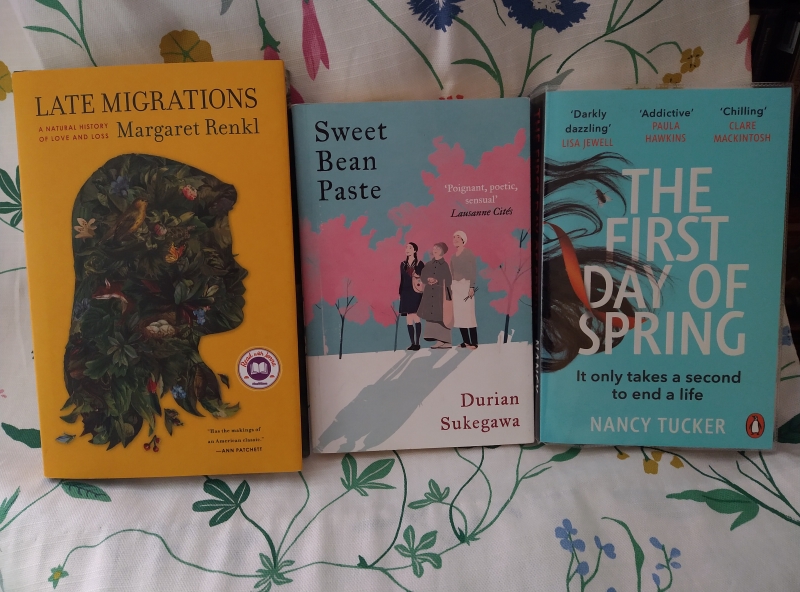
Late Migrations: A Natural History of Love and Loss by Margaret Renkl (2019)
My favorite season is spring—until fall arrives, and then my favorite season is fall: the seasons of change, the seasons that tell me to wake up, to remember that every passing moment of every careening day is always the last moment, always the very last time, always the only instant I will ever take that precise breath or watch that exact cloud scud across that particular blue of the sky.
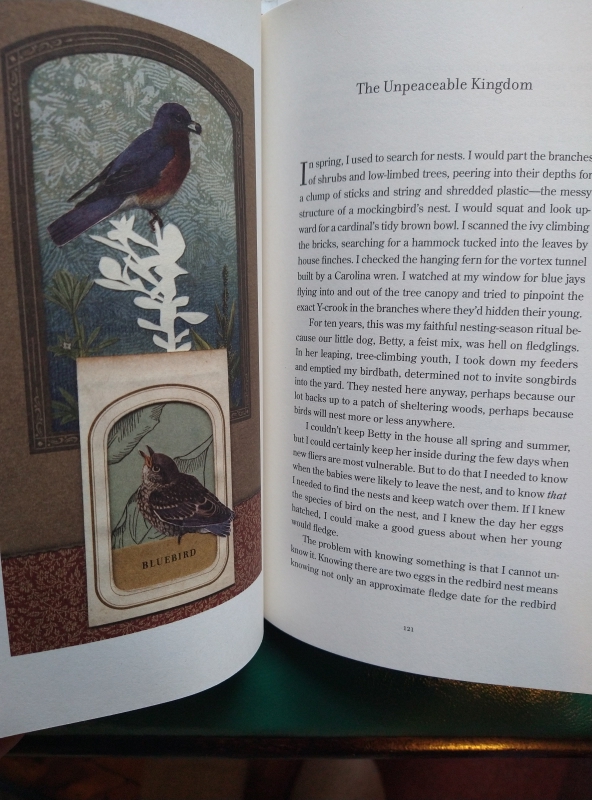
 The memoir in flash essays is one of my favourite niche forms. (Beth-Ann Fennelly and Abigail Thomas also do it exceptionally well.) It took me a long time to promote this book from occasional bedside reading pile to daytime stack, but at a certain point it became impossible to let it out of my hands for very long. I had to smell it and browse her brother Billy’s collage artworks. Each piece is somewhere between a paragraph and several pages long, and they make up a rough chronology of a life, from her grandmother’s memories of the 1930s onward (the passages in italics are interview transcripts) through to the present day.
Renkl grew up in Alabama in the 1960s–70s, in the sort of mildly dysfunctional family that most of us probably have. She contrasts what she knew as a child with what she didn’t. It was a happy childhood but. (Her mother’s recurring mental health problems and racial tensions in the South would be two ways to finish that sentence.) There were hounds and porch seats and three kids in the backseat on vacations. There were funerals and old love songs and Bible verses and playing in the woods. Grandmother tells of births and deaths, and Renkl remembers life’s transitions: getting her first period, being so homesick that she couldn’t finish college in Philadelphia, adjusting to early motherhood and then to an empty nest – an appropriate metaphor because many of the essays are about birds Renkl watches feeding and nesting. She isn’t naïve; she knows nature is cruel. Not every fledgling will survive and majestic hawks will kill equally beautiful songbirds. She realizes how dire the situation is for monarch butterflies, too, but keeps planting milkweed at her Nashville home.
This balancing of appreciation for life and acceptance of death is at its finest in the late pieces on her parents’ death. Her mother, like mine, died suddenly after a stroke, and her words on that loss are exquisite as well as painful. Still, she asserts, “Human beings are creatures made for joy. Against all evidence, we tell ourselves that grief and loneliness and despair are tragedies, unwelcome variations from the pleasure and calm and safety that in the right way of the world would form the firm ground of our being.”
Like Ross Gay and Aimee Nezhukumatathil, Renkl brings a poet’s eye for language and an amateur’s awe at the natural world to her micro-essays. She calls a cedar waxwing “An operatic aria of a bird. A flying jungle flower. A weightless coalescence of air and light and animation.” This is a book to cherish and learn from and reread. (Birthday gift from my sister from my wish list) 
{SPOILERS IN THESE NEXT TWO REVIEWS}
Sweet Bean Paste by Durian Sukegawa (2013; 2017)
[Translated from Japanese by Alison Watts]
 It was the colours (especially that wash of cherry-blossom pink) that first attracted me to this book, and the foodie theme that kept me reading. Sentaro manages a small shop on Cherry Blossom Street, Doraharu, which sells dorayaki – pancakes filled with sweet bean paste (“during cherry-blossom season petals sometimes drifted in, falling into the pancakes as they cooked”). He takes little pride in the work; it’s just a way to keep busy and pay off his debts from the time he was in prison for drug-dealing. When an elderly woman named Tokue offers to make the sweet bean paste for a pittance, he decides to give her a trial even though he usually orders it in bulk. Tokue’s homemade is so much better that the shop is soon making record profits. She trains Sentaro up in the art of making the perfect paste, which to her is a mystical process that involves listening to the beans. Not only does Tokue have new ideas for the menu, but she also makes troubled teenage customers such as Wakana welcome with friendly conversation. Along with Marvy the canary, these three form a fragile little family.
But then rumours start spreading about Tokue and her health, and Doraharu’s owner threatens to shut the place down if Sentaro doesn’t let her go. It turns out that she had Hansen’s disease (the preferred term for leprosy) and lives in a sanatorium. Even though she has long since been cured, there is still a stigma, and when she was young she could only find love and community among her fellow patients. In an Author’s Note, Sukegawa explains that the legislation keeping Hansen’s patients isolated was only repealed in 1996. His philosophy, made explicit in the letters Tokue writes to Sentaro after leaving the shop, is that one doesn’t have to be useful to have a meaningful life; simply being alive and observing is enough. I found Tokue saccharine: too wise, good and all-forgiving. This is easy reading, yet the dialogue felt stiff, the characterization thin, the letters unsubtle, and the detail of confectionery-making too technical. Secondhand – public library book sale) 
The First Day of Spring by Nancy Tucker (2021)
I’d very much admired Tucker’s first two books – The Time in Between, a memoir of her childhood anorexia; and especially That Was When People Started to Worry, case studies of young women’s mental health – so asked my library to purchase her debut novel. Tucker is a trainee clinical psychiatrist. The psychological insight she’s developed professionally and through writing about herself and others served her well in crafting this portrait of a deprived girl who murders other children. I could have included it in my Mother’s Day post because, as in the similarly dark Like Mother (by Jenny Diski), it’s the lack of a mother’s love that leaves the protagonist numb and unsure of how to bring up her own daughter.
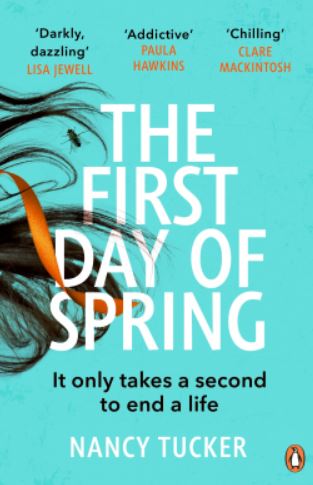 It’s no whodunit because eight-year-old Chrissie admits in the novel’s first line, “I killed a little boy today.” The mystery is why, and how she’s ultimately caught. It’s the first day of spring when she commits that first murder, of a toddler who lives on the same rough housing estate. Her house isn’t much of a home with no money for electricity, no food in the cupboards, an emotionally absent mother and a father who comes and goes without warning. Chrissie is always hungry, always craving. She couldn’t stand that Steven was loved and coddled while she had nothing. Harbouring “a delicious secret” gives her a “belly-fizzing feeling … like sherbet exploding in my guts. … That was all it took for me to feel like I had all the power in the world.” She wants to tell people what she’s done, but knows she mustn’t.
It’s also the first day of spring when five-year-old Molly falls from a seawall and breaks her wrist. Her mum, Julia, panics when she gets a call from child social services. It becomes clear by the second chapter that Julia is the new name Chrissie was given when she left the residential home for child offenders to start a new life. Sure that they’ll blame her and take Molly away, she gets on a train back to her old neighbourhood to see Mam and her childhood best friend, Linda. “I remembered this in Mam – the pull and push, cling and reject.” The subject matter might have become unbearable had Tucker emphasized the salacious details. Instead, she casts a compassionate eye on generational patterns of neglect and incompetence – patterns that can be broken through hard work. It’s riveting reading, and Julia’s love for Molly and Linda’s enduring friendship brought tears to my eyes. (Public library) 
Victorian-Themed Novels by Annie Elliot and Livi Michael (#ReadIndies)
I’m going back to my roots as a Victorianist (I completed an MA in Victorian Literature at the University of Leeds in 2006) with these two new novels, the one about Charles Dickens’s turbulent marriage and the other about the real-life inspiration for Elizabeth Gaskell’s Ruth. Both redress the balance of Victorian literature by placing women at the centre of the action, and both were comfortably in the 200–300-page range: turns out that’s how I like my Victoriana these days; none of your triple-decker nonsense.
Mr & Mrs Charles Dickens: Her Story by Annie Elliot
I used to proclaim Dickens my favourite author yet haven’t managed to read one of his novels in 15+ years; I seem to be allergic to all that verbiage. He managed to write all those millions of words thanks to his increasing status and wealth, but also thanks to his long-suffering wife, Catherine. Kate sacrificed her health and ambitions to bear and raise his nine children (along with one who died) and – along with sisters and servants – keep a house calm and quiet enough to enable his work.
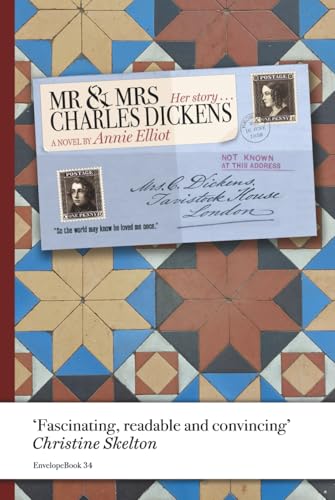 On her deathbed, Kate begged her daughter to give her love letters from Charles to the British Museum “so the world may know he loved me once.” Annie Elliot has used that phrase as the tagline for her absorbing and vigilantly researched debut novel. The structure perfectly mimics romantic illusions ceding to disenchantment. The framing story is set on 10 June 1870 – the day Kate, the estranged wife, learns of Charles’s death. Sections alternate between the bereaved Kate’s fragile state of mind (depicted in the third person) and first-person flashbacks to their relationship, from first meeting in 1834 to infamous separation in 1858.
It’s all narrated in the present tense, which creates an eternal now: nothing can be dated when it’s all happening at once for Kate. To start with, the Dickens marriage seems to be based on real love and physical passion. But before long it’s clear that he’s using Kate as ego boost and sexual outlet. She walks on eggshells lest anything shake his confidence. While the death of their baby daughter Dora nearly breaks her, he keeps up a frenzy of writing, travel, property acquisition, and new ventures such as public speaking and the theatre. And, of course, it’s through dramatics that he meets young Nelly Ternan and finds his excuse to push Kate aside.
Though much of this material was familiar to me from Claire Tomalin’s biographies as well as Gaynor Arnold’s novel about Kate, Girl in a Blue Dress, I appreciated the recreation of Kate’s perspective, the glimpses of their children’s lives, and the flashes of humour such as the proliferation of Pickwick memorabilia and a visit from Hans Christian Andersen. This is – yes, still – a necessary corrective to Dickens’s image as the dutiful husband and paterfamilias. And such a beautifully presented book, too. I wish Elliot well for next year’s McKitterick Prize race.
To be published on 1 March. With thanks to the author and EnvelopeBooks for the free copy for review.
Elizabeth and Ruth by Livi Michael
The Manchester of 1849 is a sordid complex of sweatshops, brothels and workhouses – if you’re Pasley, an Irish teenager abandoned by her mother and shunted from one bad situation to another. Or the Manchester of 1849 is a rarefied colloquium of forward-thinking authors, ministers and politicians – if you’re Elizabeth Gaskell, who’s been revealed as the mind behind the anonymously published sensation Mary Barton.
The two worlds collide when Elizabeth visits Pasley at the New Bailey Prison. She feels for this young woman who’s been a victim of deception, trafficking, and rape and narrowly escaped death by suicide only to end up imprisoned for theft when she made a desperate bid for freedom. There’s only so much that Pasley can bear to tell Mrs Gaskell on these short visits, though; her past would shock a preacher’s wife. Through euphemisms and evasions, Pasley is able to convey that she was taken advantage of by a doctor. Elizabeth suspects that there was a baby, but only readers know the whole truth.
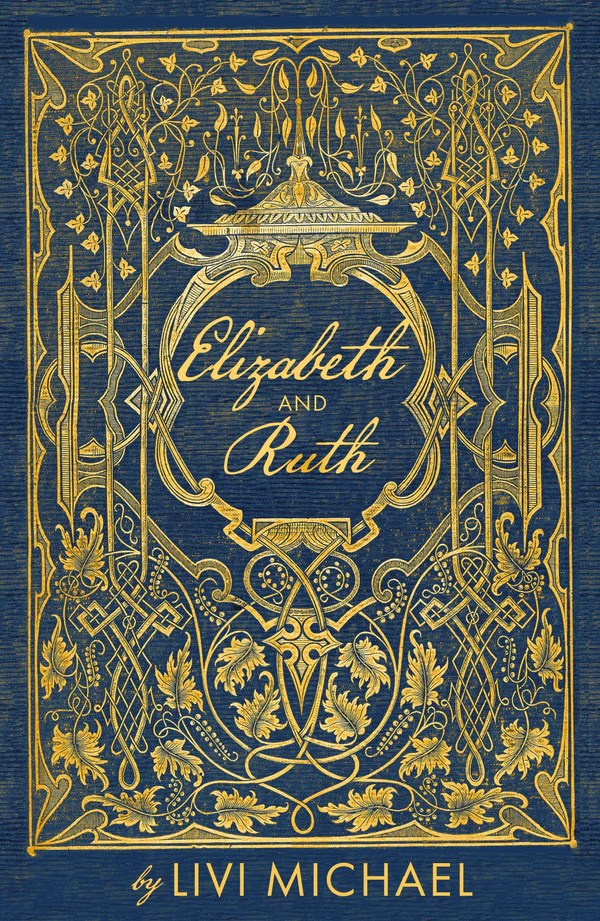
Chapters alternate between Elizabeth’s experience – in an omniscient third person cleverly reminiscent of Victorian prose – and Pasley’s first-person recollections. Elizabeth wants to follow through on her do-gooder reputation and truly help Pasley, who reminds her of her own infant and pregnancy losses. Achieving justice for the girl would be a bonus. All she knows to do is use her pen to change hearts and minds, as she has before (including for Dickens’s magazine) to draw attention to the plight of the poor. Thus, Ruth was born.
This is a riveting and touching novel about the rigidity of convention and the limits of compassion. Livi Michael is a prolific author of whom I’d not heard before Salt sent me this surprise, perfectly suited parcel. Her vivid scenes bring the two-tiered Manchester society to life and reminded me of my visit to the Gaskell House in 2015. My only small complaint would be that the blurb makes it sound as if Gaskell’s correspondence with Dickens will be a central element, when in fact it only appears once, two-thirds of the way through, with one cameo appearance by Dickens right at the end. He’s the better-known author, but after reading this you’ll agree that Gaskell was the subtler, more elegant chronicler.
Published on 9 February. With thanks to Salt Publishing for the proof copy for review.
Seascraper by Benjamin Wood (#NovNov25 Buddy Read)
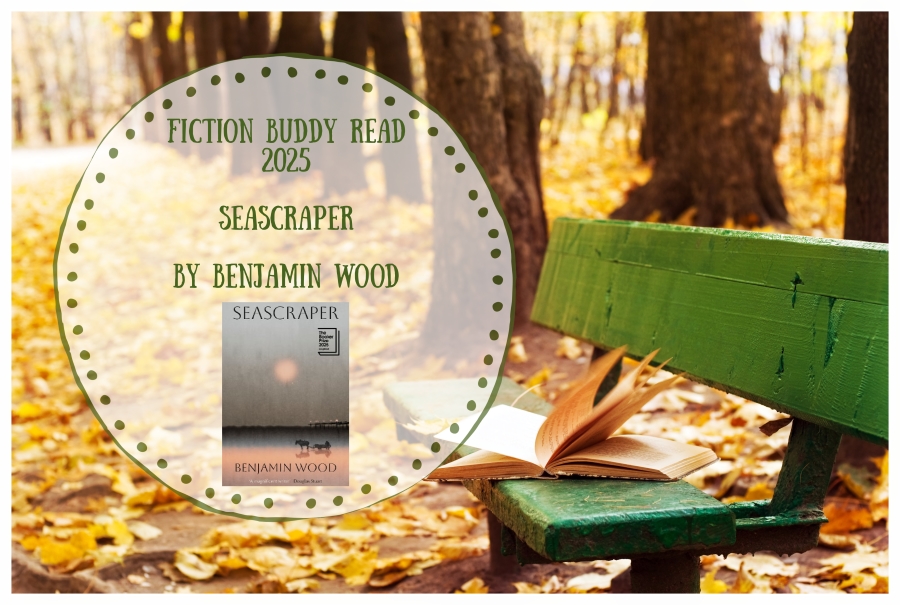
Seascraper is set in what appears to be the early 1960s yet could easily be a century earlier because of the protagonist’s low-tech career. Thomas Flett lives with his mother in fictional Longferry in northwest England and carries on his grandfather’s tradition of fishing with a horse and cart. Each day he trawls the seabed for shrimp – sometimes twice a day when the tide allows – and sells his catch to local restaurants. At around 20 years old, Thomas still lives with his mother, who is disabled by obesity and chronic pain. He’s the sole breadwinner in the household and there’s an unusual dynamic between them in that his mother isn’t all that many years older, having fallen pregnant by a teacher while she was still in school.
Their life is just a mindless trudge of work with cosy patterns of behaviour in between … He wants to wake up every morning with a better purpose.
It’s a humdrum, hardscrabble existence, and Thomas longs for a bigger and more creative life, which he hopes he might achieve through his folk music hobby – or a chance encounter with an American filmmaker. Edgar Acheson is working on a big-screen adaptation of a novel; to save money, it will be filmed here in Merseyside rather than in coastal Maine where it’s set. One day he turns up at the house asking Thomas to be his guide to the sands. Thomas reluctantly agrees to take Edgar out one evening, even though it will mean missing out on an open mic night. They nearly get lost in the fog and the cart starts to sink into quicksand. What follows is mysterious, almost like a hallucination sequence. When Thomas makes it back home safely, he writes an autobiographical song, “Seascraper” (you can listen to a recording on Wood’s website).
After this one pivotal and surprising day, Thomas’s fortunes might just change. This atmospheric novella contrasts subsistence living with creative fulfillment. There is the bitterness of crushed dreams but also a glimmer of hope. Its The Old Man and the Sea-type setup emphasizes questions of solitude, obsession and masculinity. Thomas wishes he had a father in his life; Edgar, even in so short a time frame, acts as a sort of father figure for him. And Edgar is a father himself – he shows Thomas a photo of his daughter. We are invited to ponder what makes a good father and what the absence of one means at different stages in life. Mental and physical health are also crucial considerations for the characters.

That Wood packs all of this into a compact circadian narrative is impressive. My admiration never crossed into warmth, however. I’ve read four of Wood’s five novels and still love his debut, The Bellwether Revivals, most, followed by his second, The Ecliptic. I’ve also read The Young Accomplice, which I didn’t care for as much, so I’m only missing out on A Station on the Path to Somewhere Better now. Wood’s plot and character work is always at a high standard, but his books are so different from each other that I have no clear sense of him as a novelist. Still, I’m pleased that the Booker longlisting has introduced him to many new readers.
Also reviewed by:
Annabel (AnnaBookBel)
Anne (My Head Is Full of Books)
Brona (This Reading Life)
Cathy (746 Books)
Davida (The Chocolate Lady’s Book Review Blog)
Eric (Lonesome Reader)
Jane (Just Reading a Book)
Helen (She Reads Novels)
Kate (Books Are My Favourite and Best)
Kay (What? Me Read?)
Nancy (The Literate Quilter)
Rachel (Yarra Book Club)
Susan (A life in books)
Check out this written interview with Wood (and this video one with Eric of Lonesome Reader) as well as a Q&A on the Booker Prize website in which Wood talks about the unusual situation in which he wrote the book.
(Public library)
[163 pages]

#ReadingtheMeow2025, Part I: Books by Gustafson, Inaba, Tomlinson and More
It’s the start of the third annual week-long Reading the Meow challenge, hosted by Mallika of Literary Potpourri! For my first set of reviews, I have two lovely memoirs of life with cats, and a few cute children’s books.

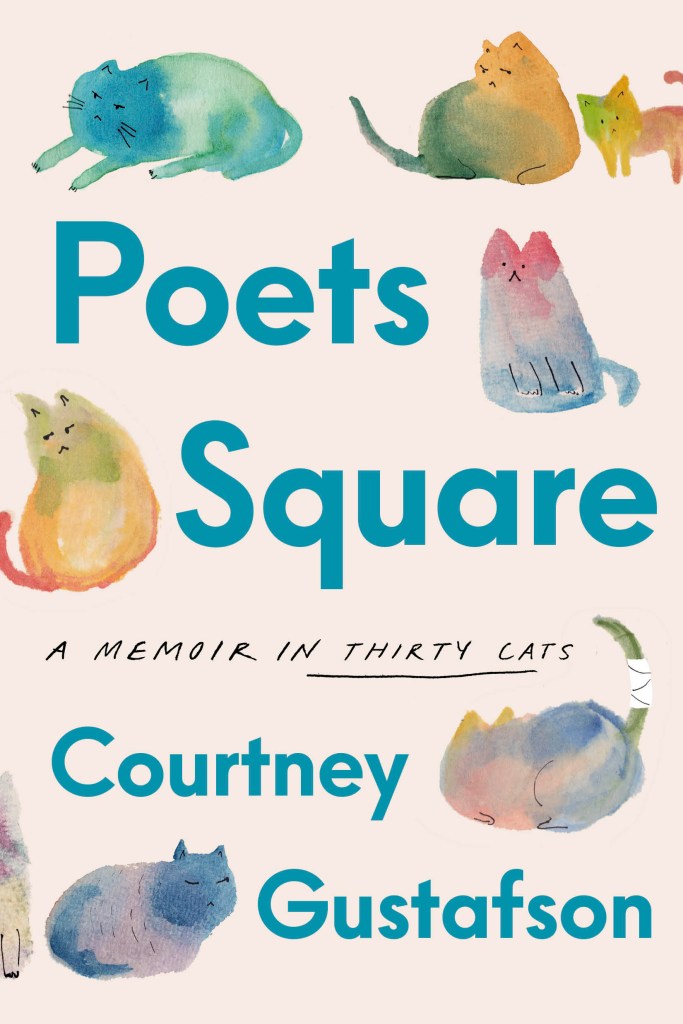
Poets Square: A Memoir in Thirty Cats by Courtney Gustafson (2025)
This was on my Most Anticipated list and surpassed my expectations. Because I’m a snob and knew only that the author was a young influencer, I was pleasantly surprised by the quality of the prose and the depth of the social analysis. After Gustafson left academia, she became trapped in a cycle of dead-end jobs and rising rents. Working for a food bank, she saw firsthand how broken systems and poverty wear people down. She’d recently started feeding and getting veterinary care for the 30 feral cats of a colony in her Poets Square neighbourhood in Tucson, Arizona. They all have unique personalities and interactions, such as Sad Boy and Lola, a loyal bonded pair; and MK, who made Georgie her surrogate baby. Gustafson doled out quirky names and made the cats Instagram stars (@PoetsSquareCats). Soon she also became involved in other local trap, neuter and release initiatives.
That the German translation is titled “Cats and Capitalism” gives an idea of how the themes are linked here: cat colonies tend to crop up where deprivation prevails. Stray cats, who live short and difficult lives, more reliably receive compassion than struggling people for whom the same is true. TNR work takes Gustafson to places where residents are only just clinging on to solvency or where hoarding situations have gotten out of control. I also appreciated a chapter that draws a parallel between how she has been perceived as a young woman and how female cats are deemed “slutty.” (Having a cat spayed so she does not undergo constant pregnancies is a kindness.) She also interrogates the “cat mom” stereotype through an account of her relationship with her mother and her own decision not to have children.
Gustafson knows how lucky she is to have escaped a paycheck-to-paycheck existence. Fame came seemingly out of nowhere when a TikTok video she posted about preparing a mini Thanksgiving dinner for the cats went viral. Social media and cat rescue work helped a shy, often ill person be less lonely, giving her “a community, a sense of rootedness, a purpose outside myself.” (Moreover, her Internet following literally ensured she had a place to live: when her rental house was being sold out from under her, a crowdfunding campaign allowed her to buy the house and save the cats.) However, they have also made her aware of a “constant undercurrent of suffering.” There are multiple cat deaths in the book, as you might expect. The author has become inured over time; she allows herself five minutes to cry, then moves on to help other cats. It’s easy to be overwhelmed or succumb to despair, but she chooses to focus on the “small acts of care by people trying hard” that can reduce suffering.
With its radiant portraits of individual cats and its realistic perspective on personal and collective problems, this is both a cathartic memoir and a probing study of how we build communities of care in times of hardship.
With thanks to Fig Tree (Penguin) for the proof copy for review.
Mornings without Mii by Mayumi Inaba (1999; 2024)
[Translated from Japanese by Ginny Tapley Takemori]
Inaba (1950–2014) was an award-winning novelist and poet. I can’t think why it took 25 years for this to be translated into English but assume it was considered a minor work of hers and was brought out to capitalize on the continuing success of cat-themed Japanese literature from The Guest Cat onward. Interestingly, it’s titled Mornings with Mii in the UK, which shifts the focus and is truer to the contents. Yes, by the end, Inaba is without Mii and dreading the days ahead, but before that she got 20 years of companionship. One day in the summer of 1977, Inaba heard a kitten’s cries on the breeze and finally located it, stuck so high in a school fence that someone must have left her there deliberately. The little fleabitten calico was named after the sound of her cry and ever after was afraid of heights.
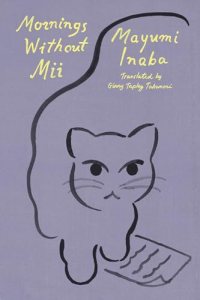 Inaba traces the turning of the seasons and the passing of the years through the changes they brought for her and for Mii. When she separated, moved to a new part of Tokyo, and started devoting her evenings to writing in addition to her full-time job, Mii was her closest friend. The new apartment didn’t have any green space, so instead of wandering in the woods Mii had to get used to exercising in the corridors. There were some scares: a surprise pregnancy nearly killed her, and once she went missing. And then there was the inevitable decline. Mii’s intestinal issues led to incontinence. For four years, Inaba endured her home reeking of urine. Many readers may, like me, be taken aback by how long Inaba kept Mii alive. She manually assisted the cat with elimination for years; 20 days passed between when Mii stopped eating and when she died. On the plus side, she got a “natural” death at home, but her quality of life in these years is somewhat alarming. I cried buckets through these later chapters, thinking of the friendship and intimate communion I had with Alfie. I can understand why Inaba couldn’t bear to say goodbye to Mii any earlier, especially because she’d lived alone since her divorce.
This memoir really captures the mixture of joy and heartache that comes with loving a pet. It’s an emotional connection that can take over your life in a good way but leave you bereft when it’s gone. There is nostalgia for the good days with Mii, but also regret and a heavy sense of responsibility. A number of the chapters end with a poem about Mii, but the prose, too, has haiku-like elegance and simplicity. It’s a beautiful book I can strongly recommend. (Read via Edelweiss)
let’s sleep
So as not to hear your departing footsteps
She won’t be here next year I know
I know we won’t have this time again
On this bright afternoon overcome with an unfathomable sadness
The greenery shines in my cat’s gentle eyes
I didn’t have any particular faith, but the one thing I did believe in was light. Just being in warm light, I could be with the people and the cat I had lost from my life. My mornings without Mii would start tomorrow. … Mii had returned to the light, and I would still be able to meet her there hundreds, thousands of times again.
The Cat Who Wanted to Go Home by Jill Tomlinson (1972)
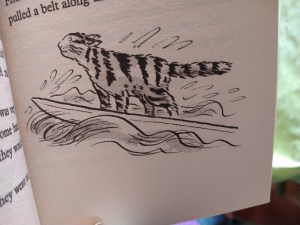
 Suzy the cat lives in a French seaside village with a fisherman and his family of four sons. One day, she curls up to sleep in a basket only to wake up airborne – it’s a hot air balloon, taking her to England! Here the RSPCA place her with old Auntie Jo, who feeds her well, but Suzy longs to get back home. “Chez-moi” is her constant cry, which everyone thinks is an awfully funny way to say miaow (“She purred in French, [too,] but purring sounds the same all over the world”). Each day she hops into the basket of Auntie Jo’s bike for a ride to town to try a new route over the sea: in a kayak, on a surfboard, paddling alongside a Channel swimmer, and so on. Each attempt fails and she returns to her temporary lodgings: shared with a parrot named Biff and comfortable, yet not quite right. Until one day… This is a sweet little story (a 77-page paperback) for new readers to experience along with a parent, with just enough repetition to be soothing and a reassuring message about the benevolence of strangers. Susan Hellard’s illustrations are charming. (Secondhand – local library book sale)
And a couple of other children’s books:
 Mittens for Kittens and Other Rhymes about Cats, ed. Lenore Blegvad; illus. Erik Blegvad (1974) – A selection of traditional English and Scottish nursery rhymes, a few of them true to the nature of cats but most of them just nonsensical. You’ve got to love the drawings, though. (Secondhand – Hay Castle honesty shelves)


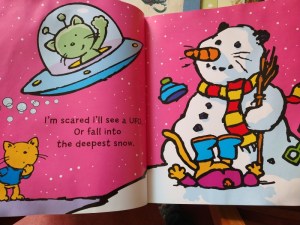
 Scaredy Cat by Stuart Trotter (2007) – Rhyming couplets about everyday childhood fears and what makes them better. I thought it unfortunate that the young cat is afraid of other creatures; to be afraid of dogs is understandable, but three pages about not liking invertebrates is the wrong message to be sending. (Little Free Library)
Assisted Dying: Intervals by Marianne Brooker; Wendy Mitchell; and a Local Panel Discussion
Intervals by Marianne Brooker is on the longlist for the inaugural Women’s Prize for Non-Fiction, which my book club has applied to shadow. I’ve now read three of the nominees, the others being Matrescence and A Flat Place (review coming up tomorrow). Unsurprisingly, I’ve gravitated towards the ones based around a personal narrative – although all three are also political and incorporate research and cultural critique. Brooker’s is an extended essay about her mother’s protracted death with multiple sclerosis and the issues it brought up around disability, poverty, and inequality of access to medical care and services.

Specifically, Brooker decries the injustice of the wealthy having the option of travelling to Dignitas in Switzerland for an assisted death (current cost: £15,000), whereas her single mother, who lived in rented accommodation and had long been disabled and unable to work, apart from crafting and reading tarot, had so such relief in sight. Instead, she resorted to refusing life-sustaining nourishment. VSED, or voluntarily stopping eating and drinking, was a topic much on my mind anyway because of Wendy Mitchell’s death last month.
 Mitchell was diagnosed with early-onset Alzheimer’s in her fifties and was an energetic campaigner for dementia education and research for the last decade of her life. With a co-author, she wrote three books that give a valuable insider’s view of life with dementia: Somebody I Used to Know, What I Wish People Knew About Dementia, and One Last Thing, in which she specifically discusses VSED. She was determined to live independently. For her, a dignified life was being able to meet her own daily physical needs. She did not want to be in a care home, or to exist past the point where she could no longer recognise her daughters. So when, in January, she fell and broke both wrists, giving her a taste of dependency and derailing her plans to travel to Dignitas, she knew that the time had come. VSED was her way out. You can read her farewell message here.
Is wilful starvation a good death? I don’t really know. It’s peaceful, at least; a person simply gets weaker and weaker, spending more and more time asleep until they fade out, at home. But it can take two weeks to die in this way. Should loved ones have to watch this process?
Denied a liveable life and a legal right to die, my mum made a choice within and between the lines of the law. A decade after her diagnosis, when she was forty-nine and I was twenty-six, she decided to stop eating and drinking to end her suffering and her life. Her MS symptoms were barely treatable and certainly incurable: severe pain, incontinence, fatigue, the gradual but intensifying loss of mobility, vision and speech. But these medical symptoms were compounded by social conditions: isolation, stress, debt and fear of a future in which she would not be able to live or die in her chosen home. We were caught in a perfect storm.
Brooker’s description of the vigil of these last days, like her account of her vivacious mother’s life, is both tender and unflinching. It’s almost like a counterpoint to Simone de Beauvoir’s A Very Easy Death, but with the same incisive attention and emotional transfer between mother and daughter. The book also incorporates political commentary and quotations from psychologists and cultural critics. This somewhat distances the reader; it feels less like a bereavement memoir and more like an impassioned, personally inspired treatise. But that’s not to say there isn’t some levity. She remembers good times from their earlier life together, and reckons with her new role as her mother’s memorial and archivist in a way that really rang true for me. I wish the title was more evocative so as to draw the right readers to this book.
With thanks to Fitzcarraldo Editions for the free copy for review.
Also on this topic, I have read In Love by Amy Bloom, That One Patient by Ellen de Visser, The Inevitable by Katie Engelhart, Darke Matter by Rick Gekoski, and Wild and Precious Life by Deborah Ziegler.
Last night I attended a local panel discussion put on by the Campaign for Dignity in Dying. It wasn’t a debate in that 3.5 of the 4 members on the panel were pro-assisted dying, and I would guess more than four-fifths of the audience as well. In fact, the only anti- voice of the evening was from a young Catholic man during question time. I knew about the event because one panelist attends my church: George Carey, a former archbishop of Canterbury.
The Anglican Church’s line – the religious response in general – is to uphold the sanctity of life and thus to oppose assisted suicide, so for Lord Carey to do otherwise is noteworthy. He changed his mind in 2014, he explained, after the high-profile case of Tony Nicklinson, who was paralysed after a stroke and lost his appeal over the right to die. “There is no theological contradiction between valuing life and wanting a good death,” Carey insisted. Jesus showed mercy to the ill and dying, and so should we. (He also, more facetiously, described King Saul’s mercy killing by an enemy soldier in 2 Samuel as an assisted death.)
The other panelists were a lawyer, a retired doctor, and a Member of Parliament. Lawyer Graham Wood noted that the 1961 Suicide Act, under which anyone who assists a suicide can be prosecuted, would have to be abolished, and that there would also need to be a negotiation regarding Article 2 of the European Convention on Human Rights, which protects the “right to life.” He was the most wary of the speakers, warning of the danger of undue influence being exerted by relatives when money and assets are involved – he said he sees the worst of humanity in his line of work.

Dr Barry Newman pinned his support for assisted dying to compassion and autonomy, two overriding values of a liberal society. He acknowledged the current professional risk for doctors, and noted that the UK’s main medical bodies remain neutral. However, he brought up a loophole, “double effect,” administering a medication that might end life but whose intent is to alleviate suffering, e.g., a high dose of morphine to an end-stage cancer patient.
Kit Malthouse, Conservative MP for northwest Hampshire, co-chairs a group on end-of-life and has campaigned for assisted dying. (American readers may be surprised by a conservative politician having liberal views on an ethical matter. In the UK, morality is not in lockstep with religions and/or political parties as it is in the USA. This was something it took me a while to get used to: I have Christian friends who vote for four different political parties.) He was disappointed that a members’ bill on assisted dying failed in 2015, but has hope that multiple recent cases (e.g., Esther Rantzen) will put it back on the agenda and believes support in the Commons is sufficient to push legislation through in six months.
“It’s coming,” he assured, not least because many of the UK’s European neighbours and other allies have introduced assisted dying. The UK bill does not go as far as the Dutch legislation, about which all the panelists expressed doubt, and can be tailored to this country’s health system. The status quo, Malthouse cautioned, is people suffering. We know from Oregon that the current proposal will work well, he said; there is vanishingly little abuse of the system in any of the places that have instituted assisted dying legislation.
It was all preaching to the choir as far as I was concerned. Indeed, the spontaneous applause and affirming subvocalizations reminded me of a Pentecostal church service. Clearly, many from the audience had witnessed loved ones dying in horrible ways (a few of these stories came out during question time, such as a woman whose husband went to Dignitas and another who had to fight for her terminally ill sister’s wishes when she was mistakenly resuscitated by paramedics after a suicide attempt). Malthouse observed that supporters of assisted dying have often been through horrific experiences with relatives or spouses.
I was already firmly in support so last night didn’t sway me in any way, but I was encouraged that so many people are thinking and talking about these issues. Maybe by the time I face such a crisis myself, or on someone else’s behalf, a compassionate law will be in place.
Reviewing Two Books by Cancelled Authors
I don’t have anything especially insightful to say about these authors’ reasons for being cancelled, although in my review of the Clanchy I’ve noted the textual examples that have been cited as problematic. Alexie is among the legion of male public figures to have been accused of sexual misconduct in recent years. I’m not saying those aren’t serious allegations, but as Claire Dederer wrestled with in Monsters, our judgement of a person can be separate from our response to their work. So that’s the good news: I thought these were both fantastic books. They share a theme of education.
The Absolutely True Diary of a Part-Time Indian by Sherman Alexie (illus. Ellen Forney) (2007)
 Alexie is to be lauded for his contributions to the flourishing of both Indigenous literature and YA literature. This was my first of his books and I don’t know a thing about him or the rest of his work. But I feel like this must have groundbreaking for its time (or maybe a throwback to Adrian Mole et al.), and I suspect it’s more than a little autobiographical.
It reads exactly like a horny 14-year-old boy’s diary, but “Junior” (Arnold Spirit, Jr.) is also self-deprecating and sweetly vulnerable; Alexie’s tone is spot on. Junior has had a tough life on a Spokane reservation in Washington, being bullied for his poor eyesight and speech impediments that resulted from brain damage at birth and ongoing seizures. Poverty, alcoholism, casinos: they don’t feel like clichés of Indian reservations here because Alexie writes from experience and presents them matter-of-factly. Junior’s parents never got to pursue their dreams and his sister has run away to Montana, but he has a chance to change the trajectory. A rez teacher says his only hope for a bright future is to transfer to the elite high school in Reardan. So he does, even though it often requires hitch-hiking or walking miles.
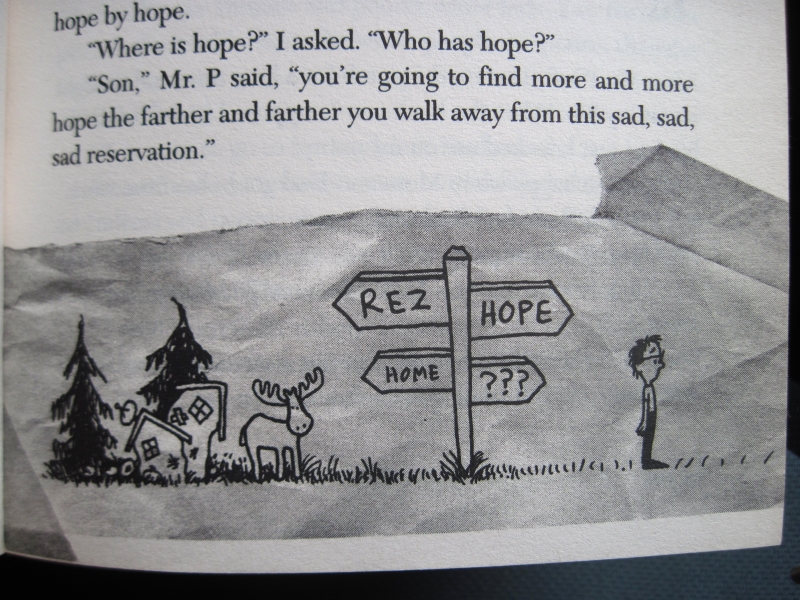
Junior soon becomes adept at code-switching: “Traveling between Reardan and Wellpinit, between the little white town and the reservation, I always felt like a stranger. I was half Indian in one place and half white in the other.” He gets a white girlfriend, Penelope, but has to work hard to conceal how impoverished he is. His best friend, Rowdy, is furious with him for abandoning his people. That resentment builds all the way to a climactic basketball match between Reardan and Wellpinit that also functions as a symbolic battle between the parts of Junior’s identity. Along the way, there are multiple tragic deaths in which alcohol, inevitably, plays a role. “I’m fourteen years old and I’ve been to forty-two funerals,” he confides. “Jeez, what a sucky life. … I kept trying to find the little pieces of joy in my life. That’s the only way I managed to make it through all of that death and change.”
One of those joys, for him, is cartooning. Describing his cartoons to his new white friend, Gordy, he says, “I use them to understand the world.”

Forney’s black-and-white illustrations make the cartoons look like found objects – creased scraps of notebook paper sellotaped into a diary. This isn’t a graphic novel, but most of the short chapters include several illustrations. There’s a casual intimacy to the whole book that feels absolutely authentic. Bridging the particular and universal, it’s a heartfelt gem, and not just for teens. (University library) 
Some Kids I Taught and What They Taught Me by Kate Clanchy (2019)
If your Twitter sphere and mine overlap, you may remember the controversy over the racialized descriptions in this Orwell Prize-winning memoir of 30 years of teaching – and the fact that, rather than issuing a humbled apology, Clanchy, at least initially, doubled down and refuted all objections, even when they came from BIPOC. It wasn’t a good look. Nor was it the first time I’ve found Clanchy to be prickly. (She is what, in another time, might have been called a formidable woman.) Anyway, I waited a few years for the furore to die down before trying this for myself.
I know vanishingly little about the British education system because I don’t have children and only experienced uni here at a distance, through my junior year abroad. So there may be class-based nuances I missed – for instance, in the chapter about selecting a school for her oldest son and comparing it with the underprivileged Essex school where she taught. But it’s clear that a lot of her students posed serious challenges. Many were refugees or immigrants, and she worked for a time on an “Inclusion Unit,” which seems to be more in the business of exclusion in that it’s for students who have been removed from regular classrooms. They came from bad family situations and were more likely to end up in prison or pregnant. To get any of them to connect with Shakespeare, or write their own poetry, was a minor miracle.

Clanchy is also a poet and novelist – I’ve read one of her novels, and her Selected Poems – and did much to encourage her students to develop a voice and the confidence to have their work published (she’s produced anthologies of student work). In many cases, she gave them strategies for giving literary shape to traumatic memories. The book’s engaging vignettes have all had the identifying details removed, and are collected under thematic headings that address the second part of the title: “About Love, Sex, and the Limits of Embarrassment” and “About Nations, Papers, and Where We Belong” are two example chapters. She doesn’t avoid contentious topics, either: the hijab, religion, mental illness and so on.
You get the feeling that she was a friend and mentor to her students, not just their teacher, and that they could talk to her about anything and rely on her support. Watching them grow in self-expression is heart-warming; we come to care for these young people, too, because of how sincerely they have been created from amalgams. Indeed, Clanchy writes in the introduction that “I have included nobody, teacher or pupil, about whom I could not write with love.”
And that is, I think, why she was so hurt and disbelieving when people pointed out racism in her characterization:
I was baffled when a boy with jet-black hair and eyes and a fine Ashkenazi nose named David Marks refused any Jewish heritage
her furry eyebrows, her slanting, sparking black eyes, her general, Mongolian ferocity. [but she’s Afghan??]
(of girls in hijabs) I never saw their (Asian/silky/curly?) hair in eight years.
They’re a funny pair: Izzat so small and square and Afghan with his big nose and premature moustache; Mo so rounded and mellow and Pakistani with his long-lashed eyes and soft glossy hair.
There are a few other ill-advised passages. She admits she can’t tell the difference between Kenyan and Somali faces; she ponders whether being a Scot in England gave her some taste of the prejudice refugees experience. And there’s this passage about sexuality:
Are we all ‘fluid’ now? Perhaps. It is commonplace to proclaim oneself transsexual. And to actually be gay, especially if you are as pretty as Kristen Stewart, is positively fashionable. A couple of kids have even changed gender, a decision … deliciously of the moment
My take: Clanchy wanted to craft affectionate pen portraits that celebrated children’s uniqueness, but had to make them anonymous, so resorted to generalizations. Doing this on a country or ethnicity basis was the mistake. Journalistic realism doesn’t require a focus on appearances (I would hope that, if I were ever profiled, someone could find more interesting things to say about me than that I am short and have a large nose). She could have just introduced the students with ‘facts,’ e.g., “Shakila, from Afghanistan, wore a hijab and was feisty and outspoken.” Note to self: white people can be clueless, and we need to listen and learn. The book was reissued in 2022 by independent publisher Swift Press, with offending passages removed (see here for more info). I’d be keen to see the result and hope that the book will find more readers because, truly, it is lovely. (Little Free Library) 
Ferdinand, the Man with the Kind Heart by Irmgard Keun (#NovNov23 and #GermanLitMonth)
My second contribution to German Literature Month, hosted by Lizzy Siddal, after Last House Before the Mountain by Monika Helfer. I spotted this in a display of new acquisitions at my library earlier in the year and was attracted by the pointillist-modernist style of its cover (Man with a Tulip by Robert Delaunay, 1906) featuring the image of a dandyish yet slightly melancholy young man. I had never heard of the author and assumed it was a man. In fact, Irmgard Keun (1905–82) was a would-be actress who wrote five novels and fled Germany when blacklisted by the Nazis. She was then, variously, a fugitive (returning to Germany only after a false report of her suicide in The Telegraph), a lover of Joseph Roth, a single mother, and an alcoholic. (I love it when a potted author biography reads like a mini-novel!)

Ferdinand (1950) was her last novel and is a curious confection, silly and sombre to equal degrees. It draws on her experiences living by her journalism in bombed-out postwar Cologne. Ferdinand Timpe is a former soldier and POW from a large, eccentric family. His tiny rented room is actually a corridor infested by his landlady Frau Stabhorn’s noisy grandchildren. He’s numb, stumbling from one unsuitable opportunity to another, never choosing his future but letting it happen to him. He once inherited a secondhand bookshop and ran it for a while (I wish we’d heard more about this). Now he’s been talked into writing articles for a weekly paper – it turns out the editor confused him with another Ferdinand. Later he’s hired as a “cheerful adviser” who mostly listens to women complain about their husbands. He is not quite sure how he acquired his own fiancée, Luise, but hopes to weasel out of the engagement.
Each chapter feels like a self-contained story, many of them focusing on particular relatives or friends. There’s his beautiful but immoral cousin, Johanna; his ruthless businessman cousin Magnesius; his lovely but lazy mother, Laura. His descriptions are hilarious, and Keun’s vocabulary really sparkles:
“Like many businesspeople, Magnesius is a jovial and generous party animal, only to emerge as even icier and stonier later. He damascenes himself. To heighten the mood, he has jammed a green monocle in one eye, and pulled a yellow silk stocking over his head. Just now I saw him kissing the hand of a woman unknown to me and offering to buy her a brand-new Mercedes.”
“Luise is a nice girl, and I’ve got nothing against her, but her presence has something oppressive about it for me. I have examined myself and established that this feeling of oppression is not love, and is no prerequisite for marriage, not even an unhappy one. I suppose I should tell her. But I can’t.”

Our antihero gets himself into ridiculous situations, like when he’s down on his luck and pays an impromptu visit to a former professor, Dr Muck, perhaps hoping for a handout; finding him away, he has to await his return for hours while the wife hosts a ladies’ poetry evening:
I was desperate not to fall asleep. Seven times I tiptoed out to the lavatory to take a sip from my flask. In the hall I walked into a sideboard and knocked over a large china ornament – I think it may have been a wood grouse. I broke off a piece of its beak. These things are always happening to me when I’m trying to be especially careful.
Hidden beneath Ferdinand’s hapless and frivolous exterior (he wears a jerkin made from a lady’s coat; Johanna says it makes him looks like “a hurdy-gurdy man’s monkey”), however, is psychological damage. “I feel so deep-frozen. I wonder if I’ll ever thaw out in this life. … Sometimes I feel like wandering on through the entire world. Maybe eventually I’ll run into a place or a person who will make me say yes, this is it, I’ll stay here, this is my home.” His feeling of purposelessness is understandable. Wartime hardship has dented his essential optimism, and external signs of progress – currency reform, denazification – can’t blot out the memory.
There’s a heartbreaking little sequence where he traces his rapid descent into poverty and desperation through cigarettes. He once shuddered at people saving their butts, but then started doing so himself. The same happened with salvaging strangers’ fag-ends from ashtrays. And then, worst of all, rescuing butts from the gutter. “So I never even noticed that one day there was no smoker in the world so degenerate that I could look down on him. I stood so low that no one could stand below me.”
I tend to lose patience with aimless picaresque plots, but this one was worth sticking with for the language and the narrator’s amusing view of the world. I’d happily read another book by Keun if I came across one. Her best known, from the 1930s, are Gilgi and The Artificial Silk Girl.
(Penguin Modern Classics series, 2021. Translated from the German by Michael Hofmann. Public library) [172 pages] 

#NovNov23 Week 4, “The Short and the Long of It”: W. Somerset Maugham & Jan Morris
Hard to believe, but it’s already the final full week of Novellas in November and we have had 109 posts so far! This week’s prompt is “The Short and the Long of It,” for which we encourage you to pair a novella with a nonfiction book or novel that deals with similar themes or topics. The book pairings week of Nonfiction November is always a favourite (my 2023 contribution is here), so think of this as an adjacent – and hopefully fun – project. I came up with two pairs: one fiction and one nonfiction. In the first case, the longer book led me to read a novella, and it was vice versa for the second.

W. Somerset Maugham
The House of Doors by Tan Twan Eng (2023)
&
Liza of Lambeth by W. Somerset Maugham (1897)
I wasn’t a huge fan of The Garden of Evening Mists, but as soon as I heard that Tan Twan Eng’s third novel was about W. Somerset Maugham, I was keen to read it. Maugham is a reliably readable author; his books are clearly classic literature but don’t pose the stylistic difficulties I now experience with Dickens, Trollope et al. And yet I know that Booker Prize followers who had neither heard of nor read Maugham have enjoyed this equally. I’m surprised it didn’t make it past the longlist stage, as I found it as revealing of a closeted gay writer’s life and times as The Master (shortlisted in 2004) but wider in scope and more rollicking because of its less familiar setting, true crime plot and female narration.
The main action is set in 1921, as “Willie” Somerset Maugham and his secretary, Gerald, widely known to be his lover, rest from their travels in China and the South Seas via a two-week stay with Robert and Lesley Hamlyn at Cassowary House in Penang, Malaysia. Robert and Willie are old friends, and all three men fought in the First World War. Willie’s marriage to Syrie Wellcome (her first husband was the pharmaceutical tycoon) is floundering and he faces financial ruin after a bad investment. He needs a good story that will sell and gets one when Lesley starts recounting to him the momentous events of 1910, including a crisis in her marriage, volunteering at the party office of Chinese pro-democracy revolutionary Dr Sun Yat Sen, and trying to save her friend Ethel Proudlock from a murder charge.

It’s clever how Tan weaves all of this into a Maugham-esque plot that alternates between omniscient third-person narration and Lesley’s own telling. The glimpses of expat life and Asia under colonial rule are intriguing, and the scene-setting and atmosphere are sumptuous – worthy of the Merchant Ivory treatment. I was left curious to read more by and about Maugham, such as Selina Hastings’ biography. (Public library) 
But for now I picked up one of the leather-bound Maugham books I got for free a few years ago. Amusingly, the novella-length Liza of Lambeth is printed in the same volume with the travel book On a Chinese Screen, which Maugham had just released when he arrived in Penang.
{SPOILERS AHEAD}
This was Maugham’s debut novel and drew on his time as a medical intern in the slums of London. In tone and content it falls almost perfectly between Dickens and Hardy, because on the one hand Liza Kemp and her neighbours are cheerful paupers even though they work in factories, have too many children and live in cramped quarters; on the other hand, alcoholism and domestic violence are rife, and the wages of sexual sin are death. All seems light to start with: an all-village outing to picnic at Chingford; pub trips; and harmless wooing as Liza rebuffs sweet Tom in favour of a flirtation with married Jim Blakeston.
 At the halfway point, I thought we were going full Tess of the d’Urbervilles – how is this not a rape scene?! Jim propositions her four times, ignoring her initial No and later quiet. “‘Liza, will yer?’ She still kept silence, looking away … Suddenly he shook himself, and closing his fist gave her a violent, swinging blow in the belly. ‘Come on,’ he said. And together they slid down into the darkness of the passage.” So starts their affair, which leads to Liza getting beaten up by Mrs Blakeston in the street and then dying of an infection after a miscarriage. The most awful character is Mrs Kemp, who spends the last few pages – while Liza is literally on her deathbed – complaining of her own hardships, congratulating herself on insuring her daughter’s life, and telling a blackly comic story about her husband’s corpse not fitting in his oak coffin and her and the undertaker having to jump on the lid to get it to close.
Liza isn’t entirely the stereotypical whore with the heart of gold, but she is a good-time girl (“They were delighted to have Liza among them, for where she was there was no dullness”) and I wonder if she could even have been a starting point for Eliza Doolittle in Pygmalion. Maugham’s rendering of the cockney accent is over-the-top –
“‘An’ when I come aht,’ she went on, ‘’oo should I see just passin’ the ’orspital but this ’ere cove, an’ ’e says to me, ‘Wot cheer,’ says ’e, ‘I’m goin’ ter Vaux’all, come an’ walk a bit of the wy with us.’ ‘Arright,’ says I, ‘I don’t mind if I do.’”
– but his characters are less caricatured than Dickens’s. And, imagine, even then there was congestion in London:
“They drove along eastwards, and as the hour grew later the streets became more filled and the traffic greater. At last they got on the road to Chingford, and caught up numbers of other vehicles going in the same direction—donkey-shays, pony-carts, tradesmen’s carts, dog-carts, drags, brakes, every conceivable kind of wheeled thing, all filled with people”
In short, this was a minor and derivative-feeling work that I wouldn’t recommend to those new to Maugham. He hadn’t found his true style and subject matter yet. Luckily, there’s plenty of other novels to try. (Free mall bookshop) [159 pages] 
Jan Morris
Conundrum by Jan Morris (1974)
&
Jan Morris: Life from Both Sides, A Biography by Paul Clements (2022)

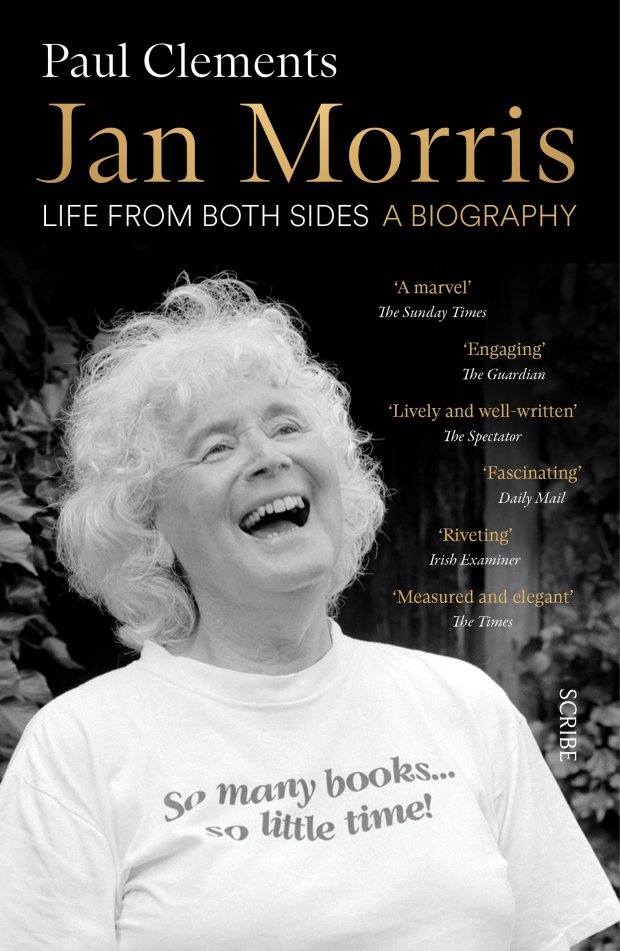
Back in 2021, I reread and reviewed Conundrum during Novellas in November. It’s a short memoir that documents her spiritual journey towards her true identity – she was a trans pioneer and influential on my own understanding of gender. In his doorstopper of a biography, Paul Clements is careful to use female pronouns throughout, even when this is a little confusing (with Morris a choirboy, a soldier, an Oxford student, a father, and a member of the Times expedition that first summited Everest). I’m just over a quarter of the way through the book now. Morris left the Times before the age of 30, already the author of several successful travel books on the USA and the Middle East. I’ll have to report back via Love Your Library on what I think of this overall. At this point I feel like it’s a pretty workaday biography, comprehensive and drawing heavily on Morris’s own writings. The focus is on the work and the travels, as well as how the two interacted and influenced her life.
Last House Before the Mountain by Monika Helfer (#NovNov23 and #GermanLitMonth)
This Austrian novella, originally published in German in 2020, also counts towards German Literature Month, hosted by Lizzy Siddal. It is Helfer’s fourth book but first to become available in English translation. I picked it up on a whim from a charity shop.
“Memory has to be seen as utter chaos. Only when a drama is made out of it is some kind of order established.”
A family saga in miniature, this has the feel of a family memoir, with the author frequently interjecting to say what happened later or who a certain character would become, yet the focus on climactic scenes – reimagined through interviews with her Aunt Kathe – gives it the shape of autofiction.
Josef and Maria Moosbrugger live on the outskirts of an alpine village with their four children. The book’s German title, Die Bagage, literally means baggage or bearers (Josef’s ancestors were itinerant labourers), but with the connotation of riff-raff, it is applied as an unkind nickname to the impoverished family. When Josef is called up to fight in the First World War, life turns perilous for the beautiful Maria. Rumours spread about her entertaining men up at their remote cottage, such that Josef doubts the parentage of the next child (Grete, Helfer’s mother) conceived during one of his short periods of leave. Son Lorenz resorts to stealing food, and has to defend his mother against the mayor’s advances with a shotgun.

If you look closely at the cover, you’ll see it’s peopled with figures from Pieter Bruegel’s Children’s Games. Helfer was captivated by the thought of her mother and aunts and uncles as carefree children at play. And despite the challenges and deprivations of the war years, you do get the sense that this was a joyful family. But I wondered if the threats were too easily defused. They were never going to starve because others brought them food; the fending-off-the-mayor scenes are played for laughs even though he very well could have raped Maria.
Helfer’s asides (“But I am getting ahead of myself”) draw attention to how she took this trove of family stories and turned them into a narrative. I found that the meta moments interrupted the flow and made me less involved in the plot because I was unconvinced that the characters really did and said what she posits. In short, I would probably have preferred either a straightforward novella inspired by wartime family history, or a short family memoir with photographs, rather than this betwixt-and-between document.
(Bloomsbury, 2023. Translated from the German by Gillian Davidson. Secondhand purchase from Bas Books and Home, Newbury.) [175 pages] 
Six Degrees of Separation: Romantic Comedy to Wild Fell
This is a fun meme I take part in every few months.
For August we begin with Romantic Comedy by Curtis Sittenfeld, one of my top 2023 releases so far. (See Kate’s opening post.)
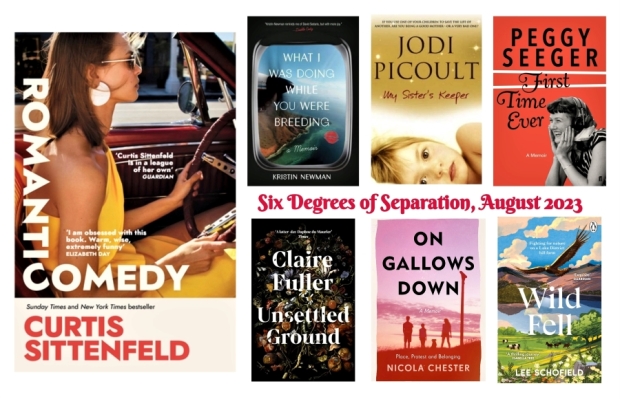
 #1 Sittenfeld’s protagonist, Sally Milz, writes TV comedy, as does Kristin Newman (That ’70s Show, How I Met Your Mother, etc.), author of What I Was Doing While You Were Breeding, a lighthearted record of her travels and romantic conquests. (She even has a passage that reminds me of Sally’s Danny Horst Rule: “I looked like a thirty-year-old writer. Not like a twenty-year-old model or actress or epically legged songstress, which is a category into which an alarmingly high percentage of Angelenas fall. And, because the city is so lousy with these leggy aliens, regular- to below-average-looking guys with reasonable employment levels can actually get one, another maddening aspect of being a woman in this city.”)
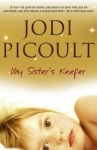 #2 I didn’t realize when I picked it up in a charity shop that my copy smelled strongly of cigarette smoke. I aired it in kitty litter, then by scented candles, and it still reeks. I reckon I can tolerate the smell long enough to finish it and put it in the Little Free Library, which gets good ventilation. A novel I acquired from the free bookshop we used to have in the mall in town was the only book I can remember having to get rid of before reading because it just smelled too bad (also of cigarettes in that case): My Sister’s Keeper by Jodi Picoult.
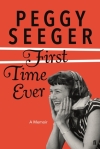 #3 So I didn’t read that, but I have read another Picoult novel, Sing You Home. The author is known for picking a central issue to address in each work, and in that one it was sexuality. Zoe, a music therapist, is married to Max but leaves him for Vanessa – and then decides to sue him for the use of the embryos they created together via IVF. It was the first book I’d read with that dynamic (a previously straight woman enters into a lesbian partnership), but by no means the last. Later came Untamed by Glennon Doyle, Hidden Nature by Alys Fowler, The Fixed Stars by Molly Wizenberg … and one you maybe weren’t expecting: the fantastic memoir First Time Ever by Peggy Seeger. The authors vary in how they account for it. They were gay all along but didn’t realize it? Their orientation changed? Or they just happened to fall in love with someone of the same gender? Seeger doesn’t explain at all, simply records how head-over-heels she was for Ewan MacColl … and then for Irene Pyper Scott.
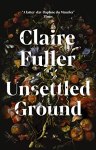 #4 Peggy Seeger is one of my heroes these days. I first got into her music through the lockdown livestreams put together by Folk on Foot and have since seen her live and acquired several of her albums, including a Smithsonian Folkways collection of her best-loved folk standards. One of these is, of course, “I’m Gonna Be an Engineer,” which was one of the inspirations for Claire Fuller’s Unsettled Ground.
 #5 Unsettled Ground, an unusual story of rural poverty and illiteracy, is set in a fictional village modelled on Inkpen, where Nicola Chester lives. Her memoir On Gallows Down, which held particular local interest for me, was shortlisted for the Wainwright Prize last year.
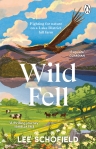 #6 Also shortlisted that year was Wild Fell by Lee Schofield, about his work at RSPB Haweswater. Like Chester, he’s been mired in the struggle to balance sustainable farming with conservation at a beloved place. And like a fellow Lakeland farmer (and previous Wainwright Prize winner for English Pastoral), James Rebanks, he’s trying to be respectful of tradition while also restoring valuable habitats. My husband and I each took a library copy of Wild Fell along to Cumbria last week (about which more anon) and packed it in a backpack for an on-location photo during our wild walk at the very atmospheric Haweswater.

Where will your chain take you? Join us for #6Degrees of Separation! (Hosted on the first Saturday of each month by Kate W. of Books Are My Favourite and Best.) Next month’s starting book is Wifedom by Anna Funder.
Have you read any of my selections? Tempted by any you didn’t know before?
 Bookish Beck = Rebecca Foster. American transplant to England. Freelance proofreader and book reviewer.
 Bookish Beck