Hard-Hitting Nonfiction I Read for #NovNov24: Hammad, Horvilleur, Houston & Solnit
I often play it safe with my nonfiction reading, choosing books about known and loved topics or ones that I expect to comfort me or reinforce my own opinions rather than challenge me. I wasn’t sure if I could bear to read about Israel/Palestine, or sexual violence towards women, but these four works were all worthwhile – even if they provoked many an involuntary gasp of horror (and mild expletives).
Recognising the Stranger: On Palestine and Narrative by Isabella Hammad (2024)
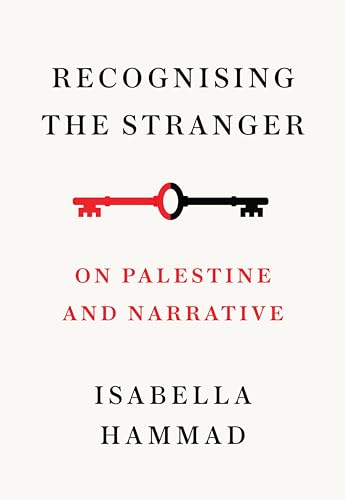 This is the text of the Edward W. Said Memorial Lecture that Hammad delivered at Columbia University on September 28, 2023. She posits that, in a time of crisis, storytelling can be a way of finding things out. Characters’ epiphanies, from Oedipus onward, see them encountering an Other but learning something about themselves in the process. In turning her great-grandfather’s life into her first novel, The Parisian, Hammad knew she had to avoid the pitfalls of nostalgia and unreliable memory. Fiction is always subjective, a matter of perspectives, and history is too. Sometimes the turning points will only be understood retrospectively.
Edward Said (1935–2003) was a Palestinian American academic and theorist who helped found the field of postcolonial studies. Hammad writes that, for him, being Palestinian was “a condition of chronic exile.” She takes his humanist ideology as a model of how to “dismantle the consoling fictions of fixed identity, which make it easier to herd into groups.” About half of the lecture is devoted to the Israel/Palestine situation. She recalls meeting an Israeli army deserter a decade ago who told her how a naked Palestinian man holding the photograph of a child had approached his Gaza checkpoint; instead of shooting the man in the leg as ordered, he fled. It shouldn’t take such epiphanies to get Israelis to recognize Palestinians as human, but Hammad acknowledges the challenge in a “militarized society” of “state propaganda.”
This was, for me, more appealing than Hammad’s Enter Ghost. Though the essay might be better aloud as originally intended, I found it fluent and convincing. It was, however, destined to date quickly. Less than two weeks later, on October 7, there was a horrific Hamas attack on Israel (see Horvilleur, below). The print version of the lecture includes an afterword written in the wake of the destruction of Gaza. Hammad does not address October 7 directly, which seems fair (Hamas ≠ Palestine). Her language is emotive and forceful. She refers to “settler colonialism and ethnic cleansing” and rejects the argument that it is a question of self-defence for Israel – that would require “a fight between two equal sides,” which this absolutely is not. Rather, it is an example of genocide, supported by other powerful nations.
The present onslaught leaves no space for mourning
To remain human at this juncture is to remain in agony
It will be easy to say, in hindsight, what a terrible thing
The Israeli government would like to destroy Palestine, but they are mistaken if they think this is really possible … they can never complete the process, because they cannot kill us all.
(Read via Edelweiss) [84 pages] 
How Isn’t It Going? Conversations after October 7 by Delphine Horvilleur (2025)
[Translated from the French by Lisa Appignanesi]
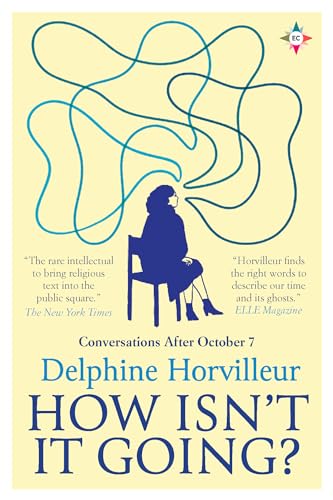 Horvilleur is one of just five female rabbis in France and is the leader of the country’s Liberal Jewish Movement. Earlier this year, I reviewed her essay collection Living with Our Dead, about attitudes toward death as illustrated by her family history, Jewish traditions and teachings, and funerals she has conducted. It is important to note that she expresses sorrow for Palestinians’ situation and mentions that she has always favoured a two-state solution. Moreover, she echoes Hammad with her final line, which hopes for “a future for those who think of the other, for those who engage in dialogue one with another, and with the humanity within them.” However, this is a lament for the Jewish condition, and a warning of the continuing and insidious nature of antisemitism. Who am I to judge her lived experience and say, “she’s being paranoid” or “it’s not really like that”? My job as reader is simply to listen.
There is by turns a stream of consciousness or folktale quality to the narrative as Horvilleur enacts 11 dialogues – some real and others imagined – with her late grandparents, her children, or even abstractions (“Conversation with My Pain,” “Conversation with the Messiah”). She draws on history, scripture and her own life, wrestling with the kinds of thoughts that come to her during insomniac early mornings. It’s not all mourning; there is sometimes a wry sense of humour that feels very Jewish. While it was harder for me to relate to the point of view here, I admired the author for writing from her own ache and tracing the repeated themes of exile and persecution. It felt important to respect and engage. [125 pages] 
With thanks to Europa Editions for the advanced e-copy for review.
Without Exception: Reclaiming Abortion, Personhood, and Freedom by Pam Houston (2024)
 If you’re going to read a polemic, make sure it’s as elegantly written and expertly argued as this one. Houston responds to the overturning of Roe v. Wade with 60 micro-essays – one for each full year of her life – about what it means to be in a female body in a country that seeks to control and systematically devalue women. Roe was in force for 49 years, corresponding almost exactly to her reproductive years. She had three abortions and believes “childlessness might turn out to be the single greatest gift of my life.” Facts could serve as explanations: her grandmother died giving birth to her mother; her mother always said having her ruined her life; she was raped by her father from early childhood until she left home as a young adult; she is gender-fluid; she loves her life of adventure travel, spontaneity and chosen solitude; she adores the natural world and sees how overpopulation threatens it. But none are presented as causes or excuses. Houston is committed to nuance, recognizing individuality of circumstance and the primacy of choice.
Many of the book’s vignettes are autobiographical, but others recount statistics, track American cultural and political shifts, and reprint excerpts from the 2022 joint dissent issued by the Supreme Court. The cycling of topics makes for an exquisite structure. Houston has done extensive research on abortion law and health care for women. A majority of Americans actually support abortion’s legality, and some states have fought back by protecting abortion rights through referenda. (I voted for Maryland’s. I’ve come a long way since my Evangelical, vociferously pro-life high school and college days.) I just love Houston’s work. There are far too many good lines here to quote. She is among my top recommendations of treasured authors you might not know. I’ve read her memoir Deep Creek and her short story collections Cowboys Are My Weakness and Waltzing the Cat, and I’m already sad that I only have four more books to discover. (Read via Edelweiss) [170 pages] 
Men Explain Things to Me by Rebecca Solnit (2014)
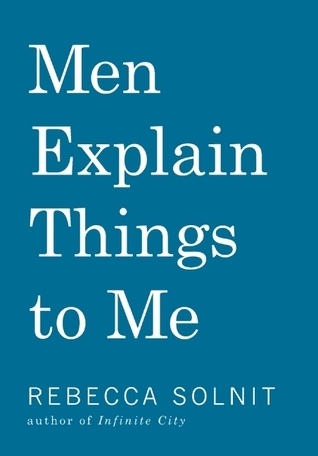 Solnit did not coin the term “mansplaining,” but it was created not long after the title essay’s publication in 2008 and was definitely inspired by her depiction of a male know-it-all. She was at a party in Aspen in 2003 when a man decided to tell her all about an important new book he’d heard of about Eadweard Muybridge. A friend had to interrupt him and say, “That’s her book.” A funny story, yes, but illustrative of a certain male arrogance that encourages a woman’s “belief in her superfluity, an invitation to silence” and imagines her “in some sort of obscene impregnation metaphor, an empty vessel to be filled with their wisdom and knowledge.”
This segues perfectly into “The Longest War,” about sexual violence against women, including rape and domestic violence. As in the Houston, there are some absolutely appalling statistics here. Yes, she acknowledges, it’s not all men, and men can be feminist allies, but there is a problem with masculinity when nearly all domestic violence and mass shootings are committed by men. There is a short essay on gay marriage and one (slightly out of place?) about Virginia Woolf’s mental health. The other five repeat some of the same messages about rape culture and believing women, so it is not a wholly classic collection for me, but the first two essays are stunners. (University library) [154 pages]
Have you read any of these authors? Or something else on these topics?
Literary Wives Club: Recipe for a Perfect Wife by Karma Brown (2019)
{SPOILERS IN THIS REVIEW!}
Canadian author Karma Brown’s fifth novel features two female protagonists who lived in the same house in different decades. The dual timeline, which plays out in alternating chapters, contrasts the mid-1950s and late 2010s to ask 1) whether the situation of women has really improved and 2) if marriage is always and inevitably an oppressive force.
Nellie Murdoch loves cooking and gardening – great skills for a mid-twentieth-century housewife – but can’t stay pregnant, which provokes the anger of her abusive husband, Richard. To start with, Alice Hale can’t cook or garden for toffee and isn’t sure she wants a baby at all, but as she reads through Nellie’s unsent letters and recipes, interspersed with Ladies’ Home Journal issues in the boxes in the basement, she starts to not just admire Nellie but emulate her. She’s keeping several things from her husband Nate: she was fired from her publicist job after a pre-#MeToo scandal involving a handsy male author, she’s had an IUD fitted, and she’s made zero progress on the novel she’s supposed to be writing. But Nellie’s correspondence reveals secrets that inspire Alice to compose Recipe for a Perfect Wife.
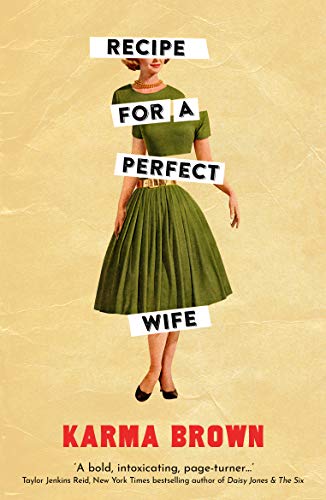
The chapter epigraphs, mostly from period etiquette and relationship guides for young wives, provide ironic commentary on this pair of not-so-perfect marriages. Brown has us wondering how closely Alice will mirror Nellie’s trajectory (aborting her pregnancy? poisoning her husband?). There were clichéd elements, such as Richard’s adultery, glitzy New York City publishing events, Alice’s quirky-funny friend, and each woman having a kindly elderly (maternal) neighbour who looks out for her and gives her valuable advice. I felt uncomfortable with how Nellie’s mother’s suicide makes it seem like Nellie’s radical acts are borne out of inherited mental illness rather than a determination to make her own path.
Often, I felt Brown was “phoning it in,” if that phrase means anything to you. In other words, playing it safe and taking an easy and previously well-trodden path. Parallel stories like this can be clever, or can seem too simple and coincidental. However, I can affirm that the novel is highly readable and has vintage charm. I always enjoy epistolary inclusions like letters and recipes, and it was intriguing to see how Nellie uses her garden herbs and flowers for pharmaceutical uses. Our first foxglove just came into flower – eek! (Kindle purchase) 
The main question we ask about the books we read for Literary Wives is:
What does this book say about wives or about the experience of being a wife?
- Being a wife does not have to mean being a housewife. (It also doesn’t have to mean being a mother, if you don’t want to be one.)
- Secrets can be lethal to a marriage. Even if they aren’t literally so, they’re a really bad idea.
This was, overall, a very bleak picture of marriage. In the 1950s strand there is a scene of marital rape – one of two I’ve read recently, and I find these particularly difficult to take. Alice’s marriage might not have blown up as dramatically, but still doesn’t appear healthy. She forced Nate to choose between her and the baby, and his job promotion in California. The fallout from that ultimatum is not going to make for a happy relationship. I almost thought that Nellie wields more power. However, both women get ahead through deception and manipulation. I think we are meant to cheer for what they achieve, and I did for Nellie’s revenge at Richard’s vileness, but Alice I found brattish and calculating.
See Kate’s, Kay’s and Naomi’s reviews, too!
Coming up next, in September: Their Eyes Were Watching God by Zora Neale Hurston.
Carol Shields Prize Reading: Coleman Hill and Between Two Moons
Two last Carol Shields Prize nominees today: from the shortlist, a gorgeous tapestry of African-American family history; and, from the longlist, a likable debut novel about Muslim twin sisters navigating the febrile summer of their high school graduation in Brooklyn.
Coleman Hill by Kim Coleman Foote
Is this family memoir or autofiction? I’ve shelved it as both on Goodreads; it’s a blend, one for which Foote borrows the term that Audre Lorde coined for Zami, “biomythography.” Like Edwidge Danticat, Jesmyn Ward and Jacqueline Woodson, Foote draws on personal stories but also invokes overarching narratives of Black migration and struggle. The result is magisterial, a debut novel that feels like oral history and a family scrapbook rolled into one.
During the First World War, the Coleman family were part of a mass exodus from the segregated South to the industrialized North. They hoped for a better life in New Jersey than they’d had under slavery and sharecropping in Alabama and Florida, but in fact many of the author’s ancestors became mired in ill-paid service roles (cleaner, maid, refuse collector) and, ironically, ended up having fewer opportunities for advancement than relatives who stayed behind and enrolled in Black educational institutions in the South.
Like a linked short story collection, the book pulls together 15 vignettes stretching from 1916 to 1989 and told in different styles and voices, including AAVE – I’m reliably informed that the audiobook is wonderful for that reason. A prologue in the first-person plural introduces the women who would become family matriarchs: “We wanted to go to school but couldn’t. The walk was too long. We was needed at home to plant and harvest. And boys could get more outta schooling, folks said, so it was our brothers who went.”

Other sections alternate first and third person. I especially admired the use of the second person for passages from the perspective of Celia Coleman, who develops a dependence on Four Roses whisky after being widowed. An interlude gives two poems from the point-of-view of cotton – crop failure was partly responsible for the initial relocation. There are also black-and-white photographs heading each chapter, and a family tree at the start. When I first heard about this book through its longlisting, the idea of family history told by nine characters sounded overwhelming (and potentially worthy). But the voices are so distinct that there is never a danger of getting lost, and the scenes are so vivid that you cringe from the beatings and cheer when a woman stands up to her meddling mother-in-law. There are echoes and reversals across the generations, as alcoholism and domestic abuse recur.
The core story is about Celia’s nastiness and resistance to her son Jeb’s marriage to Bertha Grimes. Bertha, battered by Jebbie and Celia alike, escapes to a brothel where she works as a cleaner. Celia ends up raising their children, along with another set of grandchildren, earning the nickname “Gra’ Coleman” and a reputation for meanness. (One excellent stand-alone story about the younger generation is titled “How to Kill Gra’ Coleman and Live to Tell About It (c. 1950).”) The inherited trauma is clear, yet I never found the content as bleak here as in A Council of Dolls; Foote weaves in enough counterbalancing lightness and love. There are so many strong female characters – Jeb’s older sisters, Bertha’s younger ones; their daughters – and plenty of humour and spirit despite the sometimes distressing subject matter. The family home, and the objects hoarded there, also play a major role.
It’s difficult to suggest the scope, as large and various as any American family’s history. An author’s note at the end details Foote’s approach – somewhere between “channeling spirits” and fictionalizing – to a novel that was many years in the gestation. I’d particularly recommend Coleman Hill to fans of Ayana Mathis and Toni Morrison. For me, there’s no contest; this should win the Carol Shields Prize for Fiction. 
With thanks to publicist Nicole Magas and SJP Lit (Zando) for the free e-copy for review.
Longlisted:
Between Two Moons by Aisha Abdel Gawad
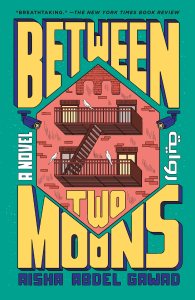 This debut novel is cleverly set within the month of Ramadan, a time of abstention. In this way, Gawad emphasizes the tension between faith and the temptations of alcohol and sex. Egyptian-American twin sisters Amira and Lina Emam are on the cusp, about to graduate from high school and go their separate ways. Lina wants to be a model and is dating a nightclub manager she hopes can make this a reality; Amira, ever the sensible one, is college-bound. But then she meets her first boyfriend, Faraj, and lets Lina drag her into a reckless partying lifestyle. “I was seized with that summertime desire of girls: to push my body to its limits.” Meanwhile, the girls’ older brother, Sami, just home from prison, is finding it a challenge to integrate back into the family and their Bay Ridge mosque, reeling from a raid on a Muslim-owned neighbourhood business and a senseless attack on the old imam.
I feared that a tired terrorism plot would surface and was relieved when this wasn’t the case, although there is a passionate message about the injustice of police surveillance of Muslim communities. I agree with Laura (see her review) that it does at times feel like an adult is producing YA fiction. It’s proficiently written and I enjoyed getting a glimpse into an unfamiliar world, but the novel never truly sparked into life for me. It also commits one of my pet peeves: inserting third-person segments to fill in events that the narrator could not have witnessed (while referring to the other characters as “the mother,” “the boy,” or “the other girl”). One to put on high school curricula but not on a prize list. 
With thanks to Laura for passing on her copy.
And a DNF:
 You Were Watching from the Sand by Juliana Lamy – I read the first 22% of this short fiction collection, which equated to a brief opener in the second person about a situation of abuse, followed by part of one endless-feeling story based around one apartment and bodega and featuring two young female family friends, one of whom accepts sexual favours in the supply closet from most male visitors. The voice and prose didn’t grab me, but of course I can’t say whether later stories would have been more to my taste. (Edelweiss)
Overall thoughts and prediction:
I’m grateful for the chance to have read most of the Carol Shields Prize longlist this year, thanks to the library, Edelweiss, and especially the publicist providing multiple books in digital format straight from the publishers. I’ve been introduced to a number of books and authors I might never have otherwise come across, and my reactions to what I expected to love or to dislike sometimes surprised me. It was also fun to do a few as buddy reads with Laura.
Here’s a recap of what I read, from favourite to least favourite:
Coleman Hill by Kim Coleman Foote – see above
Land of Milk and Honey by C Pam Zhang
Cocktail by Lisa Alward
I Have Some Questions for You by Rebecca Makkai (read last year)
Dances by Nicole Cuffy
Daughter by Claudia Dey
Chrysalis by Anuja Varghese
The Future by Catherine Leroux
Between Two Moons by Aisha Abdel Gawad – see above
Brotherless Night by V.V. Ganeshananthan (a skim)
A Council of Dolls by Mona Susan Power
You Were Watching from the Sand by Juliana Lamy (DNF) – see above
Birnam Wood by Eleanor Catton (skimmed last year)
Loot by Tania James (skim/DNF)
Thus, my ideal shortlist would have been the top five: Coleman Hill, Land of Milk and Honey, Cocktail, I Have Some Questions for You, and Dances.
It’s impossible to predict what the judges will pick from the actual shortlist. I never even attempted one of the finalists (A History of Burning by Janika Oza – Marcie’s comments made me confident it wouldn’t be for me) and only skimmed two others (Catton and Ganeshananthan). Sod’s law would suggest that one of those few will therefore win! I could see the case for any of the five, anyway. But I will have my fingers crossed for Coleman Hill.
The winner will be announced on Monday, 13 May.
Will you seek out something from the shortlist (or longlist)?
#NovNov23 Week 4, “The Short and the Long of It”: W. Somerset Maugham & Jan Morris
Hard to believe, but it’s already the final full week of Novellas in November and we have had 109 posts so far! This week’s prompt is “The Short and the Long of It,” for which we encourage you to pair a novella with a nonfiction book or novel that deals with similar themes or topics. The book pairings week of Nonfiction November is always a favourite (my 2023 contribution is here), so think of this as an adjacent – and hopefully fun – project. I came up with two pairs: one fiction and one nonfiction. In the first case, the longer book led me to read a novella, and it was vice versa for the second.

W. Somerset Maugham
The House of Doors by Tan Twan Eng (2023)
&
Liza of Lambeth by W. Somerset Maugham (1897)
I wasn’t a huge fan of The Garden of Evening Mists, but as soon as I heard that Tan Twan Eng’s third novel was about W. Somerset Maugham, I was keen to read it. Maugham is a reliably readable author; his books are clearly classic literature but don’t pose the stylistic difficulties I now experience with Dickens, Trollope et al. And yet I know that Booker Prize followers who had neither heard of nor read Maugham have enjoyed this equally. I’m surprised it didn’t make it past the longlist stage, as I found it as revealing of a closeted gay writer’s life and times as The Master (shortlisted in 2004) but wider in scope and more rollicking because of its less familiar setting, true crime plot and female narration.
The main action is set in 1921, as “Willie” Somerset Maugham and his secretary, Gerald, widely known to be his lover, rest from their travels in China and the South Seas via a two-week stay with Robert and Lesley Hamlyn at Cassowary House in Penang, Malaysia. Robert and Willie are old friends, and all three men fought in the First World War. Willie’s marriage to Syrie Wellcome (her first husband was the pharmaceutical tycoon) is floundering and he faces financial ruin after a bad investment. He needs a good story that will sell and gets one when Lesley starts recounting to him the momentous events of 1910, including a crisis in her marriage, volunteering at the party office of Chinese pro-democracy revolutionary Dr Sun Yat Sen, and trying to save her friend Ethel Proudlock from a murder charge.

It’s clever how Tan weaves all of this into a Maugham-esque plot that alternates between omniscient third-person narration and Lesley’s own telling. The glimpses of expat life and Asia under colonial rule are intriguing, and the scene-setting and atmosphere are sumptuous – worthy of the Merchant Ivory treatment. I was left curious to read more by and about Maugham, such as Selina Hastings’ biography. (Public library) 
But for now I picked up one of the leather-bound Maugham books I got for free a few years ago. Amusingly, the novella-length Liza of Lambeth is printed in the same volume with the travel book On a Chinese Screen, which Maugham had just released when he arrived in Penang.
{SPOILERS AHEAD}
This was Maugham’s debut novel and drew on his time as a medical intern in the slums of London. In tone and content it falls almost perfectly between Dickens and Hardy, because on the one hand Liza Kemp and her neighbours are cheerful paupers even though they work in factories, have too many children and live in cramped quarters; on the other hand, alcoholism and domestic violence are rife, and the wages of sexual sin are death. All seems light to start with: an all-village outing to picnic at Chingford; pub trips; and harmless wooing as Liza rebuffs sweet Tom in favour of a flirtation with married Jim Blakeston.
 At the halfway point, I thought we were going full Tess of the d’Urbervilles – how is this not a rape scene?! Jim propositions her four times, ignoring her initial No and later quiet. “‘Liza, will yer?’ She still kept silence, looking away … Suddenly he shook himself, and closing his fist gave her a violent, swinging blow in the belly. ‘Come on,’ he said. And together they slid down into the darkness of the passage.” So starts their affair, which leads to Liza getting beaten up by Mrs Blakeston in the street and then dying of an infection after a miscarriage. The most awful character is Mrs Kemp, who spends the last few pages – while Liza is literally on her deathbed – complaining of her own hardships, congratulating herself on insuring her daughter’s life, and telling a blackly comic story about her husband’s corpse not fitting in his oak coffin and her and the undertaker having to jump on the lid to get it to close.
Liza isn’t entirely the stereotypical whore with the heart of gold, but she is a good-time girl (“They were delighted to have Liza among them, for where she was there was no dullness”) and I wonder if she could even have been a starting point for Eliza Doolittle in Pygmalion. Maugham’s rendering of the cockney accent is over-the-top –
“‘An’ when I come aht,’ she went on, ‘’oo should I see just passin’ the ’orspital but this ’ere cove, an’ ’e says to me, ‘Wot cheer,’ says ’e, ‘I’m goin’ ter Vaux’all, come an’ walk a bit of the wy with us.’ ‘Arright,’ says I, ‘I don’t mind if I do.’”
– but his characters are less caricatured than Dickens’s. And, imagine, even then there was congestion in London:
“They drove along eastwards, and as the hour grew later the streets became more filled and the traffic greater. At last they got on the road to Chingford, and caught up numbers of other vehicles going in the same direction—donkey-shays, pony-carts, tradesmen’s carts, dog-carts, drags, brakes, every conceivable kind of wheeled thing, all filled with people”
In short, this was a minor and derivative-feeling work that I wouldn’t recommend to those new to Maugham. He hadn’t found his true style and subject matter yet. Luckily, there’s plenty of other novels to try. (Free mall bookshop) [159 pages]
Jan Morris
Conundrum by Jan Morris (1974)
&
Jan Morris: Life from Both Sides, A Biography by Paul Clements (2022)

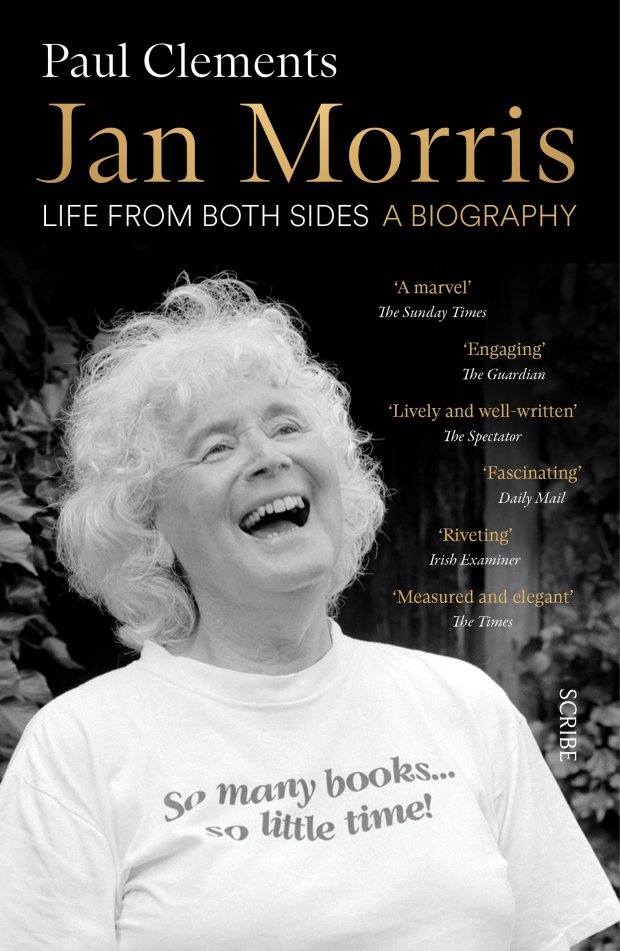
Back in 2021, I reread and reviewed Conundrum during Novellas in November. It’s a short memoir that documents her spiritual journey towards her true identity – she was a trans pioneer and influential on my own understanding of gender. In his doorstopper of a biography, Paul Clements is careful to use female pronouns throughout, even when this is a little confusing (with Morris a choirboy, a soldier, an Oxford student, a father, and a member of the Times expedition that first summited Everest). I’m just over a quarter of the way through the book now. Morris left the Times before the age of 30, already the author of several successful travel books on the USA and the Middle East. I’ll have to report back via Love Your Library on what I think of this overall. At this point I feel like it’s a pretty workaday biography, comprehensive and drawing heavily on Morris’s own writings. The focus is on the work and the travels, as well as how the two interacted and influenced her life.

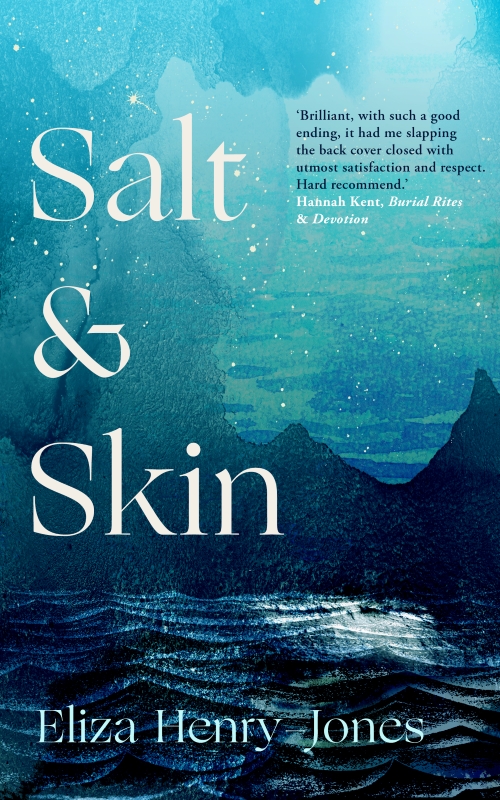
Salt & Skin by Eliza Henry-Jones (Blog Tour)
I was drawn to Eliza Henry-Jones’s fifth novel, Salt & Skin (2022), by the setting: the remote (fictional) island of Seannay in the Orkneys. It tells the dark, intriguing story of an Australian family lured in by magic and motivated by environmentalism. History overshadows the present as they come to realize that witch hunts are not just a thing of the past. This was exactly the right evocative reading for me to take on my trip to some other Scottish islands late last month. The setup reminded me of The Last Animal by Ramona Ausubel, while the novel as a whole is reminiscent of The Night Ship by Jess Kidd and Night Waking by Sarah Moss.
Only a week after the Managans – photographer Luda, son Darcy, 16, and daughter Min, 14 – arrive on the island, they witness a hideous accident. A sudden rockfall crushes a little girl, and Luda happens to have captured it all. The photos fulfill her task of documenting how climate change is affecting the islands, but she earns the locals’ opprobrium for allowing them to be published. It’s not the family’s first brush with disaster. The kids’ father died recently; whether in an accident or by suicide is unclear. Nor is it the first time Luda’s camera has gotten her into trouble. Darcy is still angry at her for selling a photograph she took of him in a dry dam years before, even though it raised a lot of money and awareness about drought.
The family live in what has long been known as “the ghost house,” and hints of magic soon seep in. Luda’s archaeologist colleague wants to study the “witch marks” at the house, and Darcy is among the traumatized individuals who can see others’ invisible scars. Their fate becomes tied to that of Theo, a young man who washed up on the shore ten years ago as a web-fingered foundling rumoured to be a selkie. Luda becomes obsessed with studying the history of the island’s witches, who were said to lure in whales. Min collects marine rubbish on her deep dives, learning to hold her breath for improbable periods. And Darcy fixates on Theo, who also attracts the interest of a researcher seeking to write a book about his origins.
It’s striking how Henry-Jones juxtaposes the current and realistic with the timeless and mystical. While the climate crisis is important to the framework, it fades into the background as the novel continues, with the focus shifting to the insularity of communities and outlooks. All of the characters are memorable, including the Managans’ elderly relative, Cassandra (calling to mind a prophetic figure from Greek mythology), though I found Father Lee, the meddlesome priest, aligned too readily with clichés. While the plot starts to become overwrought in later chapters, I appreciated the bold exploration of grief and discrimination, the sensitive attention to issues such as addiction and domestic violence, and the frank depictions of a gay relationship and an ace character. I wouldn’t call this a cheerful read by any means, but its brooding atmosphere will stick with me. I’d be keen to read more from Henry-Jones.
With thanks to Random Things Tours and September Publishing for the free copy for review.
Buy Salt & Skin from the Bookshop UK site. [affiliate link]
or
Pre-order Salt & Skin (U.S. release: September 5) from Bookshop.org. [affiliate link]
I was delighted to help kick off the blog tour for Salt & Skin on its UK publication day. See below for details of where other reviews have appeared or will be appearing soon.

Literary Wives Club: The Harpy by Megan Hunter
(My fifth read with the Literary Wives online book club; see also Kay’s and Naomi’s reviews.)
Megan Hunter’s second novella, The Harpy (2020), treads familiar ground – a wife discovers evidence of her husband’s affair and questions everything about their life together – but somehow manages to feel fresh because of the mythological allusions and the hint of how female rage might reverse familial patterns of abuse.
Lucy Stevenson is a mother of two whose husband Jake works at a university. One day she opens a voicemail message on her phone from a David Holmes, saying that he thinks Jake is having an affair with his wife, Vanessa. Lucy vaguely remembers meeting the fiftysomething couple, colleagues of Jake’s, at the Christmas party she hosted the year before.
As further confirmation arrives and Lucy tries to carry on with everyday life (another Christmas party, a pirate-themed birthday party for their younger son), she feels herself transforming into a wrathful, ravenous creature – much like the harpies she was obsessed with as a child and as a Classics student before she gave up on her PhD.

Like the mythical harpy, Lucy administers punishment. At first, it’s something of a joke between her and Jake: he offers that she can ritually harm him three times. Twice it takes physical form; once it’s more about reputational damage. The third time, it goes farther than either of them expected. It’s clever how Hunter presents this formalized violence as an inversion of the domestic abuse of which Lucy’s mother was a victim.
Lucy also expresses anger at how women are objectified, and compares three female generations of her family in terms of how housewifely duties were embraced or rejected. She likens the grief she feels over her crumbling marriage to contractions or menstrual cramps. It’s overall a very female text, in the vein of A Ghost in the Throat. You feel that there’s a solidarity across time and space of wronged women getting their own back. I enjoyed this so much more than Hunter’s debut, The End We Start From. (Birthday gift from my wish list) 
The main question we ask about the books we read for Literary Wives is:
What does this book say about wives or about the experience of being a wife?
“Marriage and motherhood are like death … no one comes back unchanged.”
So much in life can remain unspoken, even in a relationship as intimate as a marriage. What becomes routine can cover over any number of secrets; hurts can be harboured until they fuel revenge. Lucy has lost her separate identity outside of her family relationships and needs to claw back a sense of self.
I don’t know that this book said much that is original about infidelity, but I sympathized with Lucy’s predicament. The literary and magical touches obscure the facts of the ending, so it’s unclear whether she’ll stay with Jake or not. Because we’re mired in her perspective, it’s hard to see Jake or Vanessa clearly. Our only choice is to side with Lucy.
Next book: Sea Wife by Amity Gaige in September
Four for #WITMonth: Jansson, Lamarche, Lunde and Vogt
I’ve managed four novels for this year’s Women in Translation month: a nostalgic, bittersweet picture of island summers poised between childhood and old age; a brief, impressionistic account of domestic violence and rape; the third in a series looking at how climate change and species loss reverberate amid family situations; and a visceral meditation on women’s bodies and relationships. Two of these were review copies from the recently launched Héloïse Press, which “champions world-wide female talent”.

The Summer Book by Tove Jansson (1972; 1974)
[Translated from the Swedish by Thomas Teal]
It was just the same long summer, always, and everything lived and grew at its own pace.
 This was only the second time I’ve read one of Jansson’s books aimed at adults (as opposed to five from the Moomins series). Whereas A Winter Book didn’t stand out to me when I read it in 2012 – though I will try it again this winter, having acquired a free copy from a neighbour – this was a lovely read, so evocative of childhood and of languid summers free from obligation. For two months, Sophia and Grandmother go for mini adventures on their tiny Finnish island. Each chapter is almost like a stand-alone story in a linked collection. They make believe and welcome visitors and weather storms and poke their noses into a new neighbour’s unwanted construction.
Six-year-old Sophia, based on Jansson’s niece of the same name, is precocious and opinionated, liable to change her mind in an instant. In “The Cat,” one of my favourite stand-alone bits, she’s fed up with their half-feral pet who kills lots of birds and swaps him for a friend’s soppy lap cat, but then regrets it. She’s learning that logic and emotion sometimes contradict each other, which becomes clearer as she peppers Grandmother with questions about religion and superstition.
As is common to Jansson’s books, there’s a melancholy undercurrent here.
Everything was fine, and yet everything was overshadowed by a great sadness. It was August, and the weather was sometimes stormy and sometimes nice, but for Grandmother, no matter what happened, it was only time on top of time, since everything is vanity and a chasing after the wind.
Sophia’s mother died, and although her grandmother has the greater presence, Papa is also around, dealing with practicalities in the background. Death stalks around the edges, reminding Grandmother of her mortality through bouts of vertigo that have her grabbing for her heart medication. On just the second page we have this memento mori:
“When are you going to die?” the child asked.
And Grandmother answered, “Soon. But that is not the least concern of yours.”
And so it doesn’t feel like our concern either; the focus is on the now, on these beautiful little moments of connection across the generations – like in “Playing Venice,” when Grandmother stays up all night rebuilding Sophia’s model city that was washed away by the rain. (Public library)
The Memory of the Air by Caroline Lamarche (2014; 2022)
[Winner of an English PEN Award; translated from the French by Katherine Gregor]
 In a hypnotic monologue, a woman tells of her time with a violent partner (the man before, or “Manfore”) who thinks her reaction to him is disproportionate and all due to the fact that she has never processed being raped two decades ago. When she goes in for a routine breast scan, she shows the doctor her bruised arm, wanting there to be a definitive record of what she’s gone through. It’s a bracing echo of the moment she walked into a police station to report the sexual assault (and oh but the questions the male inspector asked her are horrible).
The novella opens with an image that returns in dreams but is almost more a future memory of what might have been: “I went down into a ravine and, at the bottom, found a dead woman. She was lying in a shroud, on a carpet of fallen leaves.” I read this in one sitting – er, yoga session – and it has stayed in my mind in intense flashes like that and the flounce of her red dress on the summer day that turned into a nightmare. At an intense 70 pages, this reminded me of Annie Ernaux’s concise autofiction (I’ve reviewed Happening and I Remain in Darkness). An introduction by Dr Dominique Carlini-Versini contextualizes the work by considering the treatment of rape in contemporary French women’s writing.
The Memory of the Air will be published on 26 September. With thanks to Héloïse Press for the proof copy for review.
The Last Wild Horses by Maja Lunde (2019; 2022)
[Translated from the Norwegian by Diane Oatley]
The third in Lunde’s “Climate Quartet,” with its recurring elements of migration, shortages and environmental collapse. Always, though, the overall theme is parent–child relationships and the love that might be the only thing that keeps us going in the face of unspeakable challenges. Here she returns to the tripartite structure of The History of Bees (much my favourite of the three): a historical strand, a near-contemporary one, and a dystopian future story line. The link between the three is Przewalski’s horses (aka takhi).
 In the early 1880s, Mikhail Alexandrovich Kovrov, assistant director of St. Petersburg Zoo, is brought the hide and skull of an ancient horse species assumed extinct. Although a timorous man who still lives with his mother, he becomes part of an expedition to Mongolia to bring back live specimens. In 1992, Karin, who has been obsessed with Przewalski’s horses since encountering them as a child in Nazi Germany, spearheads a mission to return the takhi to Mongolia and set up a breeding population. With her is her son Matthias, tentatively sober after years of drug abuse. In 2064 Norway, Eva and her daughter Isa are caretakers of a decaying wildlife park that houses a couple of wild horses. When a climate migrant comes to stay with them and the electricity goes off once and for all, they have to decide what comes next. This future story line engaged me the most.
I appreciated some aspects: queer and middle-aged romances, the return of a character from The End of the Ocean, the consideration across all three plots of what makes a good mother. However, the horses seemed neither here nor there. There are also many, many animal deaths. Perhaps an unsentimental attitude is necessary to reflect past and future values, and the apparent cruelty of natural processes, but it limits the book’s appeal to animal lovers. Maybe the tone fits the Norwegian prose, which the translator describes as lean.
The fourth book of the quartet, publishing in Norway next month, is called something like The Dream of a Tree; a focus on trees would be a draw for me. After the disappointment of Books 2 and 3, I’m unsure whether I want to bother with the final volume, but it makes sense to do so, if only to grasp Lunde’s full vision. (Public library)
What Concerns Us by Laura Vogt (2020; 2022)
[Translated from the German by Caroline Waight]
 Vogt’s Swiss-set second novel is about a tight-knit matriarchal family whose threads have started to unravel. For Rahel, motherhood has taken her away from her vocation as a singer. Boris stepped up when she was pregnant with another man’s baby and has been as much of a father to Rico as to Leni, the daughter they had together afterwards. But now Rahel’s postnatal depression is stopping her from bonding with the new baby, and she isn’t sure this quartet is going to make it in the long term.
Meanwhile, Rahel’s sister Fenna knows she’s pregnant but refuses a doctor’s care. When she comes to stay with Rahel, she confides that the encounter with her partner, Luc, that led to conception was odd, rough; maybe not consensual. And all this time, the women’s mother, Verena, has been undergoing treatment for breast cancer. All three characters appear to be matter-of-factly bisexual; Rahel and Fenna’s father has long been out of the picture, replaced in Verena’s affections by Inge.
As I was reading, I kept thinking of the declaration running through A Ghost in the Throat by Doireann Ní Ghríofa: “This is a female text.” Vogt’s vision is all breasts and eggs, genitals actual and metaphorical. I loved the use of food in the novel: growing up, the girls cherished “silly nights” when their mother prepared an egg feast and paired it with a feminist lecture on reproduction. Late on, there’s a wonderful scene when the three main characters gorge on preserved foodstuffs from the cellar and share their secrets. (Their language is so sexually frank; would anyone really talk to their mother and siblings in that way?!) As in the Lunde, the main question is what it means to be a mother, but negotiating their relationships with men stretches the bonds of this feminine trio. One for fans of Rachel Cusk and Sally Rooney.
With thanks to Héloïse Press for the proof copy for review.
Surviving Home by Katerina Canyon & B: A Year in Plagues and Pencils by Edward Carey
Catching up on two recent review books today: a hard-hitting volume of poems about family dysfunction and racism; and the pandemic year as captured in black-and-white illustrations and short autobiographical essays.
Surviving Home by Katerina Canyon
 Katerina Canyon is from Los Angeles and now lives in Seattle. This is her second collection. As the poem “Involuntary Endurance” makes clear, you survive an upbringing like hers only because you have to. This autobiographical collection is designed to earn the epithet “unflinching,” with topics including domestic violence, parental drug abuse, and homelessness. When you hear that her father once handcuffed and whipped her autistic brother, you understand why “No More Poems about My Father” ends up breaking its title’s New Year’s resolution!
Threatening forces are everywhere: bears and sharks recur, and beet juice mimics blood. (Though there’s a nice cornbread metaphor, it, too, holds menace: “I have no trust in humanity / I lost that when I was 3 / It was baked in a pan of / Cornbread and eaten by // Demons.”)
Canyon also has anti-Trump material, and the poems about the ongoing effects of racism reminded me of some of Natasha Trethewey’s work. I particularly liked a poem structured around words and phrases coined in the year of the poet’s birth. There’s plenty of noteworthy language and images here, but the tough subject matter may limit the audience.
With thanks to Kelsay Books and the publicist for the free e-copy for review.
B: A Year in Plagues and Pencils by Edward Carey
 I was a huge fan of Edward Carey’s Little. His black-and-white sketches kept turning up on my Twitter timeline throughout 2020. He sent the first, “A determined young man,” into the world on March 19, 2020, vowing to make a drawing a day until the pandemic was over. Perhaps a rash thing to agree to, and at times he regretted it, but he kept his promise for 500 days and wore out many a B pencil in the process.
This book covers the first 365 days of the project and also provides a rough recap of the turbulent year that was 2020. Carey’s subjects include politicians (his leanings are clear from his unflattering caricatures of Trump and other Republicans), writers, actors, birds and family members. Some were by request; others marked a public figure’s death. You can track the vaccine’s progress and outrage over the deaths of George Floyd, Breonna Taylor and other victims of institutional racism. As an Englishman in Texas, Carey feels he doesn’t understand the country he lives in (though he loves its wildlife) and finds himself missing London.
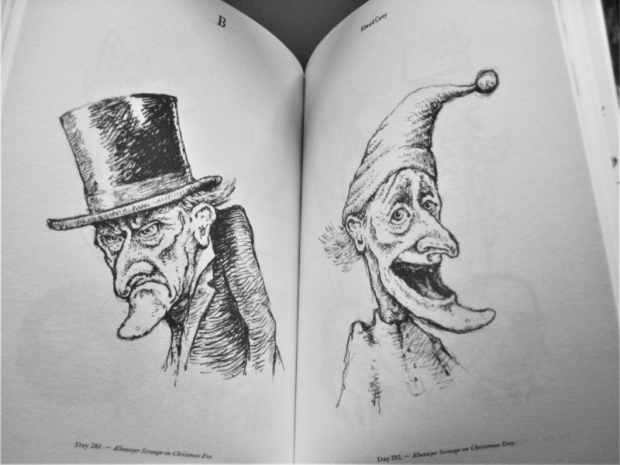
Carey’s style veers towards the grotesque, so is best suited to fictional characters and those with distinctive features. I particularly liked a drawing of Rudy Guiliani dripping hair dye, the two-part spread of Ebenezer Scrooge on Christmas Eve versus Christmas Day, and a farewell to 2020 as a wizened ogre opposite a hello to 2021 as a cheerful baby.
I was also delighted to see a drawing of W.N.P. Barbellion to mark the inaugural Barbellion Prize. In general, though, I doubt the value of simple reproductions of well-known paintings and photographs. If the goal was lifelike versions of real people, some of these miss the mark; the features are simply off. And Carey is not always great at rendering non-white people.
The pleasure of this collection is in seeing the variety from one page to the next: a laughing Albert Einstein, William Shakespeare, a capybara, and so on. There are one to four of the drawings printed per page, with short reflections from Carey interspersed between sections. In these mini-essays he talks about his process, where he got his ideas, and lockdown life with his family (his wife is author Elizabeth McCracken; they have two children and a cat).
One day noses will be permissible again. And then there will be mouths, too. And chins, likewise, shall be popular. … I’m forgetting faces. I miss people, of course, terribly. Yet every day out of the window there are still people there. I see these individuals walking up and down the street. Can’t see their faces. Only their eyes and the top of their heads. Like a new breed of human, with no nose, no mouth, no chin. Who are they? Don’t get too close. Everyone’s keeping their distance.
The drawings were a way of marking time, so the book serves as a time capsule of sorts. The text is perhaps an afterthought, and yet the random assemblage of illustrations couldn’t stand without it (I tried to imagine them filling an exhibit, but extensive captioning would be required). I feel a bit uncharitable for criticizing the artwork, given the constraints and the fact that I couldn’t produce even one sketch of nearly this quality. This was a perfectly pleasant and quick read, just not one that will stay with me. I think the same is true of a number of the other Covid diaries I’ve read: they feel ephemeral. However, it’s an attractive small-format hardback that should make it into many a Christmas stocking this year.
With thanks to Gallic Books for the free copy for review.
P.S. This is my 1,000th post!
Review Book Catch-Up: Motherhood, Nature Essays, Pandemic, Poetry
July slipped away without me managing to review any current-month releases, as I am wont to do, so to those three I’m adding in a couple of other belated review books to make up today’s roundup. I have: a memoir-cum-sociological study of motherhood, poems of Afghan women’s experiences, a graphic novel about a fictional worst-case pandemic, seasonal nature essays from voices not often heard, and poetry about homosexual encounters.
(M)otherhood: On the choices of being a woman by Pragya Agarwal
“Mothering would be my biggest gesture of defiance.”
 Growing up in India, Agarwal, now a behavioural and data scientist, wished she could be a boy for her father’s sake. Being the third daughter was no place of honour in society’s eyes, but her parents ensured that she got a good education and expected her to achieve great things. Still, when she got her first period, it felt like being forced onto a fertility track she didn’t want. There was a dearth of helpful sex education, and Hinduism has prohibitions that appear to diminish women, e.g. menstruating females aren’t permitted to enter a temple.
Married and unexpectedly pregnant in 1996, Agarwal determined to raise her daughter differently. Her mother-in-law was deeply disappointed that the baby was a girl, which only increased her stubborn pride: “Giving birth to my daughter felt like first love, my only love. Not planned but wanted all along. … Me and her against the world.” No element of becoming a mother or of her later life lived up to her expectations, but each apparent failure gave a chance to explore the spectrum of women’s experiences: C-section birth, abortion, divorce, emigration, infertility treatment, and finally having further children via a surrogate.
While I enjoyed the surprising sweep of Agarwal’s life story, this is no straightforward memoir. It aims to be an exhaustive survey of women’s life choices and the cultural forces that guide or constrain them. The book is dense with history and statistics, veers between topics, and needed a better edit for vernacular English and smoothing out academic jargon. I also found that I wasn’t interested enough in the specifics of women’s lives in India.
With thanks to Canongate for the free copy for review.
Forty Names by Parwana Fayyaz
“History has ungraciously failed the women of my family”
 Have a look at this debut poet’s journey: Fayyaz was born in Kabul in 1990, grew up in Afghanistan and Pakistan, studied in Bangladesh and at Stanford, and is now, having completed her PhD, a research fellow at Cambridge. Many of her poems tell family stories that have taken on the air of legend due to the translated nicknames: “Patience Flower,” her grandmother, was seduced by the Khan and bore him two children; “Quietude,” her aunt, was a refugee in Iran. Her cousin, “Perfect Woman,” was due to be sent away from the family for infertility but gained revenge and independence in her own way.
Fayyaz is bold to speak out about the injustices women can suffer in Afghan culture. Domestic violence is rife; miscarriage is considered a disgrace. In “Roqeeya,” she remembers that her mother, even when busy managing a household, always took time for herself and encouraged Parwana, her eldest, to pursue an education and earn her own income. However, the poet also honours the wisdom and skills that her illiterate mother exhibited, as in the first three poems about the care she took over making dresses and dolls for her three daughters.
As in Agarwal’s book, there is a lot here about ideals of femininity and the different routes that women take – whether more or less conventional. “Reading Nadia with Eavan” was a favourite for how it brought together different aspects of Fayyaz’s experience. Nadia Anjuman, an Afghan poet, was killed by her husband in 2005; many years later, Fayyaz found herself studying Anjuman’s work at Cambridge with the late Eavan Boland. Important as its themes are, I thought the book slightly repetitive and unsubtle, and noted few lines or turns of phrase – always a must for me when assessing a poetry collection.
With thanks to Carcanet Press for the free copy for review.
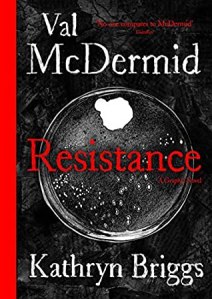
Resistance by Val McDermid; illus. Kathryn Briggs
 The second 2021 release I read in quick succession in which all but a small percentage of the human race (here, 2 million people) perishes in a pandemic – the other was Under the Blue. Like Aristide’s novel, this story had its origins in 2017 (in this case, on BBC Radio 4’s “Dangerous Visions”) but has, of course, taken on newfound significance in the time of Covid-19. McDermid imagines the sickness taking hold during a fictional version of Glastonbury: Solstice Festival in Northumberland. All the first patients, including a handful of rockstars, ate from Sam’s sausage sandwich van, so initially it looks like food poisoning. But vomiting and diarrhoea give way to a nasty rash, listlessness and, in many cases, death.
Zoe Beck, a Black freelance journalist who conducted interviews at Solstice, is friends with Sam and starts investigating the mutated swine disease, caused by an Erysipelas bacterium and thus nicknamed “the Sips.” She talks to the festival doctor and to a female Muslim researcher from the Life Sciences Centre in Newcastle, but her search for answers takes a backseat to survival when her husband and sons fall ill.
The drawing style and image quality – some panes are blurry, as if badly photocopied – let an otherwise reasonably gripping story down; the best spreads are collages or borrow a frame/backdrop (e.g. a medieval manuscript, NHS forms, or a 1910s title page).


SPOILER
{The ending, which has an immune remnant founding a new community, is VERY Parable of the Sower.}
With thanks to Profile Books/Wellcome Collection for the free copy for review.
Gifts of Gravity and Light: A Nature Almanac for the 21st Century, ed. Anita Roy and Pippa Marland
I hadn’t heard about this upcoming nature anthology when a surprise copy dropped through my letterbox. I’m delighted the publisher thought of me, as this ended up being just my sort of book: 12 autobiographical essays infused with musings on landscapes in Britain and elsewhere; structured by the seasons to create a gentle progression through the year, starting with the spring. Best of all, the contributors are mostly female, BIPOC (and Romany), working class and/or queer – all told, the sort of voices that are heard far too infrequently in UK nature writing. In momentous rites of passage, as in routine days, nature plays a big role.
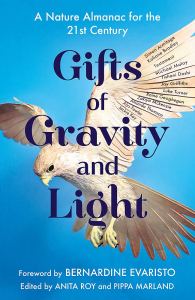 A few of my favourite pieces were by Kaliane Bradley, about her Cambodian heritage (the Wishing Dance associated with cherry blossom, her ancestors lost to genocide, the Buddhist belief that people can be reincarnated in other species); Testament, a rapper based in Leeds, about capturing moments through photography and poetry and about the seasons feeling awry both now and in March 2008, when snow was swirling outside the bus window as he received word of his uni friend’s untimely death; and Tishani Doshi, comparing childhood summers of freedom in Wales with growing up in India and 2020’s Covid restrictions.
Most of the authors hold two places in mind at the same time: for Michael Malay, it’s Indonesia, where he grew up, and the Severn estuary, where he now lives and ponders eels’ journeys; for Zakiya McKenzie, it’s Jamaica and England; for editor Anita Roy, it’s Delhi versus the Somerset field her friend let her wander during lockdown. Trees lend an awareness of time and animals a sense of movement and individuality. Alys Fowler thinks of how the wood she secretly coppices and lays on park paths to combat the mud will long outlive her, disintegrating until it forms the very soil under future generations’ feet.
A favourite passage (from Bradley): “When nature is the cuddly bunny and the friendly old hill, it becomes too easy to dismiss it as a faithful retainer who will never retire. But nature is the panic at the end of a talon, and it’s the tree with a heart of fire where lightning has struck. It is not our friend, and we do not want to make it our enemy.”
Also featured: Bernardine Evaristo (foreword), Raine Geoghegan, Jay Griffiths, Amanda Thomson, and Luke Turner.
With thanks to Hodder & Stoughton for the free copy for review.
Records of an Incitement to Silence by Gregory Woods
 Woods is an emeritus professor at Nottingham Trent University, where he was appointed the UK’s first professor of Gay & Lesbian Studies in 1998. Much of his sixth poetry collection is composed of unrhymed sonnets in two stanzas (eight lines, then six). The narrator is often a randy flâneur, wandering a city for homosexual encounters. One assumes this is Woods, except where the voice is identified otherwise, as in “[Walt] Whitman at Timber Creek” (“He gives me leave to roam / my idle way across / his prairies, peaks and canyons, my own America”) and “No Title Yet,” a long, ribald verse about a visitor to a stately home.
Other times the perspective is omniscient, painting a character study, like “Company” (“When he goes home to bed / he dare not go alone. … This need / of company defeats him.”), or of Frank O’Hara in “Up” (“‘What’s up?’ Frank answers with / his most unseemly grin, / ‘The sun, the Dow, my dick,’ / and saunters back to bed.”). Formalists are sure to enjoy Woods’ use of form, rhyme and meter. I enjoyed some of the book’s cheeky moments but had trouble connecting with its overall tone and content. That meant that it felt endless. I also found the end rhymes, when they did appear, over-the-top and silly (Demeter/teeter, etc.).
Two favourite poems: “An Immigrant” (“He turned away / to strip. His anecdotes / were innocent and his / erection smelled of soap.”) and “A Knot,” written for friends’ wedding in 2014 (“make this wedding supper all the sweeter / With choirs of LGBT cherubim”).
With thanks to Carcanet Press for the free copy for review.
Would you be interested in reading one or more of these?
Snow and Winter Reads, Part I
We’ve only had a couple of inches of snow, plus another afternoon of flurries, so far this winter, but January was the UK’s coldest month since 2013. As usual, I’m charting the season’s passage through books as well as by taking walks and looking out the window. I have a few more wintry books on the go that I’ll hope to report on at the end of the month. Today I have a few short works, ranging from poetry to nonfiction, plus a novel set partly in frigid Nebraska.

“The Snows of Kilimanjaro” by Ernest Hemingway (1936)
 During a laughably basic New Testament class in college, a friend and I passed endless notes back and forth, discussing everything but the Bible. I found these the last time I was back in the States going through boxes. My friend’s methodical cursive looked so much more grown-up than my off-topic scrawls. Though she was only two years older, I saw her as a kind of mentor, and when she told me the gist of this Hemingway story I took heed. We must have been comparing our writing ambitions, and I confessed a lack of belief in my ability. She summed up the point of this story more eloquently than Hem himself: if you waited until you were ready to write something perfectly, you’d never write it at all. Well, 19 years later and I’m still held back by lack of confidence, but I have, finally, read the story itself. It’s about a writer on safari in Africa who realizes he is going to die of this gangrene in his leg.
Now he would never write the things that he had saved to write until he knew enough to write them well. Well, he would not have to fail at trying to write them either. Maybe you could never write them, and that was why you put them off and delayed the stating. Well, he would never know, now.
he had always thought that he would write it finally. There was so much to write. He had seen the world change; not just the events; although he had seen many of them and had watched the people, but he had seen the subtler change and he could remember how the people were at different times. He had been in it and he had watched it and it was his duty to write of it; but now he never would.
This duty: to be a witness, to crystallize your perspective and experience as a way of giving back to the world that has sustained you – it’s a compelling vision. Of course, Hemingway was a chauvinist and so the protagonist is annoyingly dismissive of the woman in his life; she might as well be a servant. I still found this everyday tragedy affecting. I couldn’t, however, be bothered to read any further in the volume (mostly Nick Adams autobiographical stories).
The World Before Snow by Tim Liardet (2015)
 I couldn’t resist the title and creepy Magritte cover, so added this to my basket during the Waterstones online sale at the start of the year. Liardet’s name was unfamiliar to me, though this was the Bath University professor’s tenth poetry collection. Most of the unusual titles begin with “Self-Portrait” – for instance, “Self-Portrait as the Nashua Girl’s Reverse Nostalgia” and “Self-Portrait with Blind-Hounding Viewed in Panoramic Lens.” Apparently there is a throughline here, but if it weren’t for the blurb I would have missed it entirely. (“During a record-breaking blizzard in Boston, two poets met, one American and one English. This meeting marked the beginning of a life-transforming love affair.”) There were some turns of phrase and alliteration I liked, but overall I preferred the few poems that were not part of that pretentious central plot, e.g. “Ommerike” (part I) about mysterious mass deaths of birds and fish, “Nonagenaria,” a portrait of an old woman, and “The Guam Fever,” voiced by an ill soldier.
The Magician’s Assistant by Ann Patchett (1997)
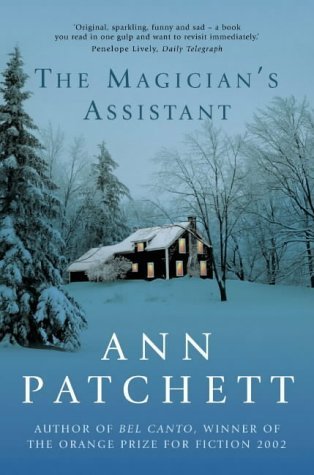 I’d only seen covers with a rabbit and top hat, so was confused that the secondhand copy I ordered with a birthday voucher featured a lit-up farmhouse set back into snowy woods. The first third of the novel takes place in Los Angeles, where Sabine lived with her husband Parsifal, the magician she assisted for 20 years, but the rest is set in winter-encased Nebraska. The contrast between the locations forms a perfect framework for a story of illusions versus reality.
SPOILERS FOLLOW – impossible to avoid them.
Patchett opens with the terrific lines “Parsifal is dead. That is the end of the story.” Ironically, his brain aneurysm burst while he was inside a hospital MRI machine, but it’s a mercy that he died quickly; he could have lingered for years with AIDS – like his lover, Phan, who died 14 months before. You see, while Parsifal while Sabine’s best friend, and in some ways the love of her life, their marriage was only a formality so that she could receive his assets. She knows little of his past; in taking on the name and persona of Parsifal the magician, he created a new life for himself. Only after his death does she learn from the will that his real name was Guy Fetters and that he has a mother, Dot, and sisters, Kitty and Bertie, back in Nebraska.
Dot and Bertie come out to L.A. to see how Guy lived and pay their respects at the cemetery, and then Sabine, lost without a magician to assist, flies out to Nebraska to stay with them for the week leading up to Bertie’s wedding. There is a tacit understanding among the family that Guy was gay, and Sabine assumes that’s why he was sent off to a boys’ reformatory. In fact, it’s because he was involved in his father’s accidental death. This kitchen has seen more than its fair share of climactic events.
END OF SPOILERS
The long section set in Nebraska went in directions I wasn’t expecting. It’s mostly based around late-night kitchen table and bedroom conversations; it’s a wonder it doesn’t become tedious. Patchett keeps the tension high as revelations emerge about what went on in this family. There are two moments when threat looks poised to spill into outright violence, in an echo of previous domestic violence.
For a long time I didn’t know what to make of the novel. It’s odd that all the consequential events happened before the first page and that we never truly meet Parsifal. Yet I loved the way that Sabine’s dreams and flashbacks widen the frame. Magic initially appears to be an arbitrary career choice, but gradually becomes a powerful metaphor of deception and control. Parsifal’s family are obsessed with a Johnny Carson performance he and Sabine once gave: they watch the video recording nightly, longing for the magic to be real. Maybe it is in the end?
Snow by Marcus Sedgwick (2016)
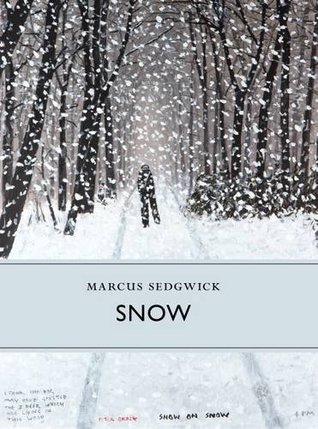 This Little Toller book is, at just over 100 pages, the perfect read for a wintry afternoon. It’s a lot like The Snow Tourist by Charlie English, though that book is travel-based, whereas for this one Sedgwick stayed put at his home in the Haute-Savoie, an alpine region of eastern France (and was even snowed in for part of the time), and wandered in his memory instead.
He writes that snow is “a form of nostalgia” for him, bringing back childhood days off school when he could just stay home and play – he loves it for “the freedom it represented.” He asks himself, “did it snow more when I was young, or is it just my desire and recreated memory?” Looking at weather statistics from Kent, he is able to confirm that, yes, it really did snow more in the 1960s and 70s.
Sedgwick briefly considers the science, history, art, and literature of snow, including polar expeditions and film, music, and paintings as well as Thomas Mann’s The Magic Mountain et al. He also likens the blank page to a snow-covered field, such that writers should not be daunted by it but excited by the possibility of creation.
In the Winter Dark by Tim Winton (1988)
 A taut early novella (just 110 pages) set in an Australian valley called the Sink. Animals have been disappearing: a pet dog snatched from its chain; livestock disemboweled. Four locals are drawn together by fear of an unidentified killer. Maurice Stubbs is the only one given a first-person voice, but passages alternate between his perspective and those of his wife Ida, Murray Jaccob, and Veronica, a pregnant teen. These are people on the edge, reckless and haunted by the past. The malevolent force comes to take on a vengeful nature. I was reminded of Andrew Michael Hurley’s novels. My first taste of Winton’s fiction has whetted my appetite to read more by him – I have Cloudstreet on the shelf.
 Bookish Beck = Rebecca Foster. American transplant to England. Freelance proofreader and book reviewer.
 Bookish Beck