#ShortStorySeptember: Stories by Katherine Heiny, Shena Mackay and Ian McEwan
Every September I enjoy focusing on short stories, which I seem to read at a rate of only one or two collections per month in the rest of a year. This year, Lisa of ANZ Lit Lovers is hosting Short Story September as a blogger challenge for the first time. She’s encouraging people to choose individual short stories they would recommend, so I’ll be centring all of my reviews around one particular story but also giving my reaction to the collections as a whole.
“Dark Matter”
from
Single, Carefree, Mellow by Katherine Heiny (2015)
“One week in late February, Rhodes and Gildas-Joseph told Maya the same come fact, that there was a movement to reinstate Plato’s status as a planet.”
Maya is engaged to Rhodes but also sleeping with Gildas-Joseph, the director of the university library where she works. She’s one of Heiny’s typical whip-smart, exasperated protagonists, irresistibly drawn to a man or two even though they seem like priggish or ridiculous bores (witness the “come fact” above – neither can stop himself from mansplaining after sex). Having an affair means always having to keep your wits about you. Maya bumps into her boss with his wife, Adèle, at a colleague’s cocktail party and in line for the movies, and one day her fiancé’s teenage sister, Magellan (seriously, what is up with these names?!), turns up at the coffee shop where she is supposed to be meeting Gildas-Joseph. Quick, act natural. By the end, Maya knows that she must decide between the two men.
 This is the middle of a trio of stories about Maya. They’re not in a row and I read the book over quite a number of months, so I was in danger of forgetting that we’d met this set of characters before. In the first, the title story, Maya has been with Rhodes for five years but is thinking of leaving him – and not just because she’s crushing on her boss. A health crisis with her dog leads her to rethink. In “Grendel’s Mother,” Maya is pregnant and hoping that she and her partner are on the same page.
This triptych of linked stories is evidence that Heiny was working her way towards a novel, and I certainly prefer Standard Deviation and Early Morning Riser. However, I really liked Heiny’s 2023 story collection, Games and Rituals, which has much more variety.
I like the second person as much as anyone but three instances of “You” narration is too much. The best of these was “The Rhett Butlers,” about a teenager whose history teacher uses famous character names as aliases when checking them into motels for trysts. The cover image is from this story: “The part of your life that contains him is too sealed off, like the last slice of cake under one of those glass domes.”
Although all of these stories are entertaining and have some of the insouciance and bittersweetness of Nora Ephron’s Heartburn, they are so overwhelmingly about adultery (the main theme of at least 8 of 11) that they feel one-note.
why have an affair if not to say bad things about your spouse?
She thought that was the essence of motherhood: acting like you knew what you were talking about when you didn’t. That, and looking at people’s rashes. It was probably why people had affairs.
I would recommend any of Heiny’s other books over this one, but I wanted to read everything she’s published and I wouldn’t say my time spent on this was a waste. (Secondhand – Awesomebooks.com) 
“All the Pubs in Soho”
from
Dreams of Dead Women’s Handbags by Shena Mackay (1987)
“It was his father’s vituperation about ‘those bloody pansies at Old Hollow’ that had brought Joe to the cottage on this empty summer holiday afternoon.”
It’s 1956 in Kent and Joe is only eight years old, so it’s not too surprising that, ignorant of the slang, he shows up at Arthur and Guido’s expecting to find flowers dripping red. Their place becomes his haven from a home full of crying, excreting younger siblings and a conventional father who intends to send him to a private girls’ school in the autumn. That’s right, “Joe” is Josephine, who likes to wear boys’ clothes and insists on a male name. Mackay struck me as ahead of her time (rather like Rose Tremain with Sacred Country) in honouring Joe’s chosen pronouns and letting him imagine an adult future in which he’d keep company with Arthur and Guido’s bohemian, artistic set – the former is a poet, the latter a painter – and they’d take him round ‘all the pubs in Soho.’ But in a sheltered small town where everyone has a slur ready for the men, it is not to be. Things don’t end well, but thankfully not as badly as I was hoping, and Joe has plucked up the courage to resist his father. There’s all the emotional depth and character development of a novella in this 26-page story.
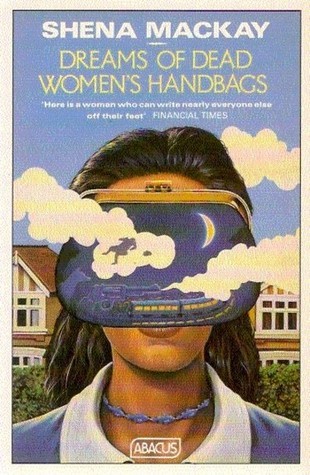 I’ve had a mixed experience with Mackay, but the one novel of hers I got on well with, The Orchard on Fire, also dwells on the shattered innocence of childhood. By contrast, most of the stories in this collection are grimy ones about lonely older people – especially elderly women – reminding me of Barbara Comyns or Barbara Pym at her darkest. “Where the Carpet Ends,” about the long-term residents of a shabby hotel, recalls The Lonely Passion of Judith Hearne. In “Violets and Strawberries in the Snow,” a man in a mental institution awaits a holiday visit from his daughters. “What do we do now?” he asks a fellow inmate. “We could hang ourselves in the tinsel” is the reply. It’s very black comedy indeed. The same is true of a Halloween-set story that I’ll revisit next month.
The cover is so bad it’s good, amirite? In the title story, Susan Vigo is on her way by train to give a speech at a writers’ workshop and running through possible plots for her mystery novel in progress. “Slaves to the Mushroom” is another great one that takes place on a mushroom farm. Mackay’s settings are often surprising, her vocabulary precise, and her portraits of young people as cutting as those of the aged are pitiful. This would serve as a great introduction to her style. (Secondhand – Slightly Foxed Books, Berwick) 
“The Grown-up”
from
The Daydreamer by Ian McEwan (1994)
“The following morning Peter Fortune woke from troubled dreams to find himself transformed into a giant person, an adult.”
A much better Kafka homage, this, than that forgettable novella The Cockroach that McEwan published in 2019. Every story of this linked collection features Peter, a 10-year-old with a very active imagination. Three of the stories are straightforward body-swap narratives (with his sister’s mangled doll, his cat, or his baby cousin), whereas in this one he’s not trading with anyone else but still experiencing what it’s like to be someone else. In this case, a young man falling in love for the first time. Just the previous day, at the family’s holiday cottage in Cornwall, he’d been bemoaning how boring adults are: all they want to do is sit on the beach and chat or read, when there’s so much world out there to explore and turn into a personal playground. He never wants to be one of them. Now he realizes there are different ways to enjoy life; “he stopped and turned to look at the grown-ups one more time. … He felt differently about them now. There were things they knew and liked which for him were only just appearing, like shapes in a mist. There were adventures ahead of him after all.”
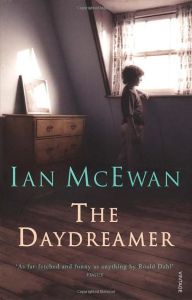 Of course, I also loved “The Cat,” which Eleanor mentioned when she read my review of Matt Haig’s To Be a Cat. At the time, I’d not heard of this and couldn’t believe McEwan had written something suitable for kids! These stories were ones he read aloud to his children as he composed them. There is a hint of gruesomeness in “The Dolls,” but most are just playful. “Vanishing Cream” is a cautionary tale about wanting your family to go away. In “The Bully,” Peter turns a bully into a tentative friend. “The Baby” sees him changing his mind about an annoying relative, while “The Burglar” has him imagining himself a hero who stops the spate of neighbourhood break-ins. Events are explained away as literal dreams, daydreams or a bit of magic. This was an offbeat gem. Try it for a very different taste of McEwan! (Secondhand – Community Furniture Project, Newbury)
#WITMonth, II: Bélem, Blažević, Enríquez, Lebda, Pacheco and Yu (#17 of 20 Books)
Catching up with my Women in Translation month coverage, which concluded (after Part I, here) with five more short novels ranging from historical realism to animal-oriented allegory, plus a travel book.
The Rarest Fruit, or The Life of Edmond Albius by Gaëlle Bélem (2023; 2025)
[Translated from French by Hildegarde Serle]
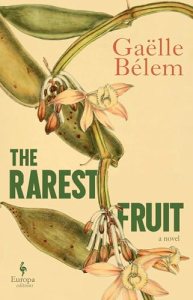 A fictionalized biography, from infancy to deathbed, of the Black botanist who introduced the world to vanilla – then a rare and expensive flavour – by discovering that the plant can be hand-pollinated in the same way as pumpkins. In 1829, the island colony of Bourbon (now the French overseas department Réunion) has just been devastated by a cyclone when widowed landowner Ferréol Bellier-Beaumont is brought the seven-week-old orphaned son of one of his sister’s enslaved women. Ferréol, who once hunted rare orchids, raises the boy as his ward. From the start, Edmond is most at home in the garden and swears he will follow in his guardian’s footsteps as a botanist. Bélem also traces Ferréol’s history and the origins of vanilla in Mexico. The inclusion of Creole phrases and the various uses of plants, including for traditional healing, chimed with Jason Allen-Paisant’s Jamaica-set The Possibility of Tenderness, and I was reminded somewhat of the historical picaresque style of Slave Old Man (Patrick Chamoiseau) and The Secret Diaries of Charles Ignatius Sancho (Paterson Joseph). The writing is solid but the subject matter so niche that this was a skim for me.
With thanks to Europa Editions, who sent an advanced e-copy for review.
In Late Summer by Magdalena Blažević (2022; 2025)
[Translated from Croatian by Anđelka Raguž]
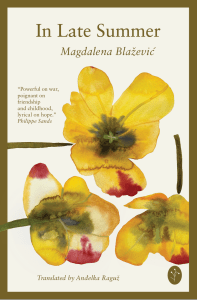 “My name is Ivana. I lived for fourteen summers, and this is the story of my last.” Blažević’s debut novella presents the before and after of one extended family, and of the Bosnian countryside, in August 1993. In the first half, few-page vignettes convey the seasonality of rural life as Ivana and her friend Dunja run wild. Mother and Grandmother slaughter chickens, wash curtains, and treat the children for lice. Foodstuffs and odours capture memory in that famous Proustian way. I marked out the piece “Camomile Flowers” for its details of the senses: “Sunlight and the scent of soap mingle. … The pantry smells like it did before, of caramel, lemon rind and vanilla sugar. Like the period leading up to Christmas. … My hair dries quickly in the sun. It rustles like the lace, dry snow from the fields.” The peaceful beauty of it all is shattered by the soldiers’ arrival. Ivana issues warnings (“Get ready! We’re running out of time. The silence and summer lethargy will not last long”) and continues narrating after her death. As in Sara Nović’s Girl at War, the child perspective contrasts innocence and enthusiasm with the horror of war. I found the first part lovely but the whole somewhat aimless because of the bitty structure.
With thanks to Linden Editions for the free copy for review.
Somebody Is Walking on Your Grave: My Cemetery Journeys by Mariana Enríquez (2013; 2025)
[Translated from Spanish by Megan McDowell]
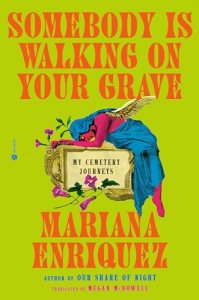 This made it onto my Most Anticipated list for the second half of the year due to my love of graveyards. Because of where Enríquez is from, a lot of the cemeteries she features are in Argentina (six) or other Spanish-speaking countries (another six including Chile, Cuba, Mexico, Peru and Spain). There are 10 more locations besides, and her journeys go back as far as 1997 in Genoa, when she was 25 and had sex with Enzo up against a gravestone. I took the most interest in those I have been to (Edinburgh) or could imagine myself travelling to someday (New Orleans and Savannah; Highgate in London and Montparnasse in Paris), but thought that every chapter got bogged down in research. Enríquez writes horror, so she is keen to visit at night and relay any ghost stories she’s heard. But the pages after pages of history were dull and outweighed the memoir and travel elements for me, so after a few chapters I ended up just skimming. I’ll keep this on my Kindle in case I go to one of her other destinations in the future and can read individual essays on location. (Edelweiss download)
Voracious by Małgorzata Lebda (2016; 2025)
[Translated from Polish by Antonia Lloyd-Jones]
Like the Blažević, this is an impressionistic, pastoral work that contrasts vitality and decay in short chapters of one to three pages. The narrator is a young woman staying in her grandmother’s house and caring for her while she is dying of cancer; “now is not the time for life. Death – that’s what fills my head. I’m at its service. Grandma is my child. I am my grandmother’s mother. And that’s all right, I think.” The house has just four inhabitants – the narrator, Grandma Róża, Grandpa, and Ann – and seems permeable: to the cold, to nature. Animals play a large role, whether pets, farmed or wild. There’s Danube the hound, the cows delivered to the nearby slaughterhouse, and a local vixen with whom the narrator identifies.
 Lebda is primarily known as a poet, and her delight in language is evident. One piece titled “Opioid,” little more than a paragraph long, revels in the power of language: “Grandma brings a beautiful word home … the word not only resonates, but does something else too – it lets light into the veins.” The wind is described as “the conscience of the forest. It’s the circulatory system. It’s the litany. It’s scented. It sings.”
In all three Linden Editions books I’ve read, the translator’s afterword has been particularly illuminating. I thought I was missing something, but Lloyd-Jones reassured me it’s unclear who Ann is: sister? friend? lover? (I was sure I spotted some homoerotic moments.) Lloyd-Jones believes she’s the mirror image of the narrator, leaning toward life while the narrator – who has endured sexual molestation and thyroid problems – tends towards death. The animal imagery reinforces that dichotomy.
The narrator and Ann remark that it feels like Grandma has been ill for a million years, but they also never want this time to end. The novel creates that luminous, eternal present. It was the best of this bunch.
With thanks to Linden Editions for the free copy for review.
Full review forthcoming for Foreword Reviews:
Pandora by Ana Paula Pacheco (2023; 2025)
[Translated from Portuguese by Julia Sanches]
 The Brazilian author’s bold novella is a startling allegory about pandemic-era hazards to women’s physical and mental health. Since the death of her partner Alice to Covid-19, Ana has been ‘married’ to a pangolin and a seven-foot-tall bat. At a psychiatrist’s behest, she revisits her childhood and interrogates the meanings of her relationships. The form varies to include numbered sections, the syllabus for Ana’s course “Is Literature a personal investment?”, journal entries, and extended fantasies. Depictions of animals enable commentary on economic inequalities and gendered struggles. Playful, visceral, intriguing.
#17 of my 20 Books of Summer:
Invisible Kitties by Yu Yoyo (2021; 2024)
[Translated from Chinese by Jeremy Tiang]
 Yu is the author of four poetry collections; her debut novel blends autofiction and magic realism with its story of a couple adjusting to the ways of a mysterious cat. They have a two-bedroom flat on a high-up floor of a complex, and Cat somehow fills the entire space yet disappears whenever the woman goes looking for him. Yu’s strategy in most of these 60 mini-chapters is to take behaviours that will be familiar to any cat owner and either turn them literal through faux-scientific descriptions, or extend them into the fantasy realm. So a cat can turn into a liquid or gaseous state, a purring cat is boiling an internal kettle, and a cat planted in a flowerbed will produce more cats. Some of the stories are whimsical and sweet, like those imagining Cat playing extreme sports, opening a massage parlour, and being the god of the household. Others are downright gross and silly: Cat’s removed testicles become “Cat-Ball Planets” and the narrator throws up a hairball that becomes Kitten. Mixed feelings, then. (Passed on by Annabel – thank you!)
I’m really pleased with myself for covering a total of 8 books for this challenge, each one translated from a different language!
Which of these would you read?
The 2025 McKitterick Prize Winner & SoA Awards Ceremony
Yesterday the Society of Authors’ awards were announced and the prizes handed out at a ceremony in London. As a McKitterick Prize judge, I was asked last month to give a 50-word blurb on the shortlist as a whole—
Each of these six novels has a fully realized style. So confident and inviting are they that it’s hard to believe they are debuts. With nuanced characters and authentic settings and dilemmas, they engage the mind and delight the emotions. I will be following these authors’ careers with keen interest.
—and on each individual shortlisted title:
 Etymology and Shakespeare studies are the keys to solving a cold case in Susie Dent’s clever, engrossing mystery, Guilty by Definition.
 Psychoanalysis, motherhood, and violence against women are resounding themes in Lauren Elkin’s Scaffolding. As history repeats itself one sweltering Paris summer, the personal and political structures undergirding the protagonists’ parallel lives come into question. This fearless, sophisticated work ponders what to salvage from the past—and what to tear down.
 Clinical Intimacy’s mysterious antihero comes to life through interviews with his family, friends and clients. The brilliant oral history format builds a picture of isolation among vulnerable populations, only alleviated by care and touch—especially during Covid-19. Ewan Gass’s intricate story reminds us of the ultimate unknowability of other people.
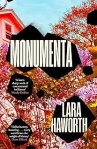
In Monumenta, Lara Haworth braids satire, magic realism, and metafiction into a compact and surprising meditation on how we seek to memorialise the tragedies of history.
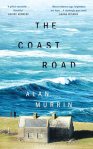
Set in small-town Ireland, The Coast Road is a subtle, compassionate novel in which the characters learn to write their own stories rather than bow to convention and fate. Alan Murrin is a must-read author for fans of Claire Keegan, Louise Kennedy, and Colm Tóibín.
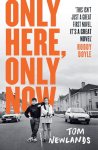 Only Here, Only Now is bursting with vitality. With her broken heart and fizzing brain, Cora Mowat vows to escape her grim Fife town. Tom Newlands’s evocation of the 1990s—and of his teenage narrator—is utterly convincing. Soaring above grief, poverty, and substance abuse, Cora’s voice is pure magic.
Our winner was Tom Newlands for Only Here, Only Now and our runner-up was Lauren Elkin for Scaffolding. (What an honour to have my blurb for the former used in the winners press release, the ceremony programme, and social media publicity.)


Newlands was also a runner-up for the ADCI Literary Prize “for a disabled or chronically ill writer, for an outstanding novel containing a disabled or chronically ill character or characters.” Here’s an excerpt from his statement for the press release:
To have my debut novel recognised in these two categories is particularly meaningful for me because they are linked by my experience. I didn’t start writing until the age of 40, in large part because growing up neurodivergent I didn’t feel my thought processes or methods of working were compatible with the production of a novel. There were no role models out there publishing stories like mine, and in the end, I wrote Only Here, Only Now because I couldn’t find the novel I wanted to read – a warm, vivid and funny story that examined poverty, disability and belonging, and that featured characters rarely found in British fiction.
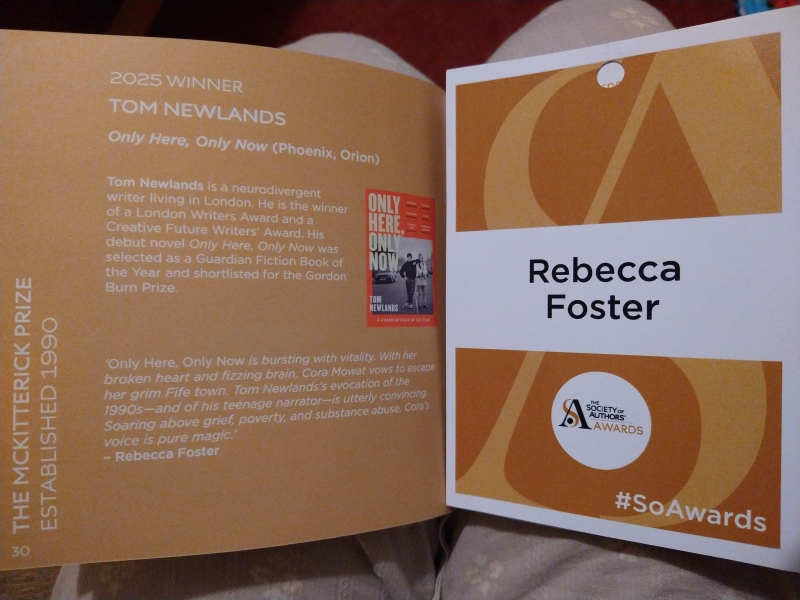
Looking back to early on in this prize journey (which started back in November) … here was some of my early reading:
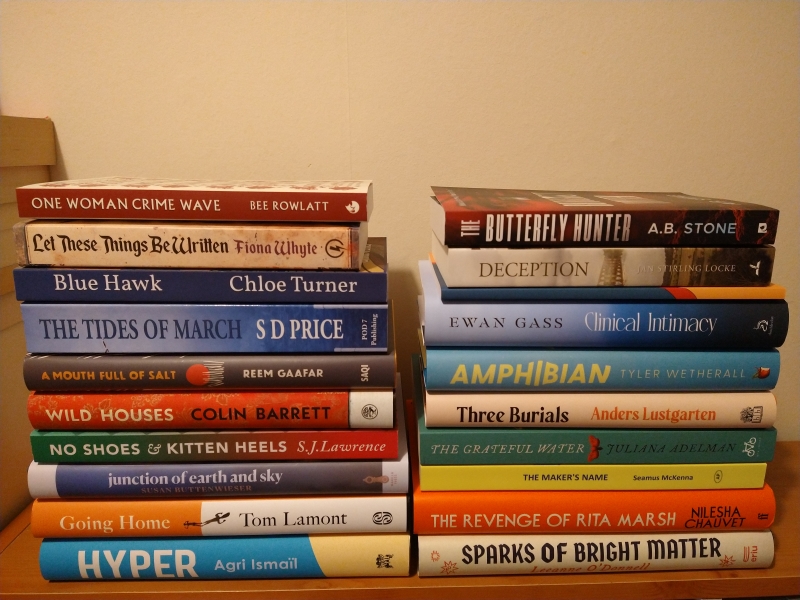
And our longlist:
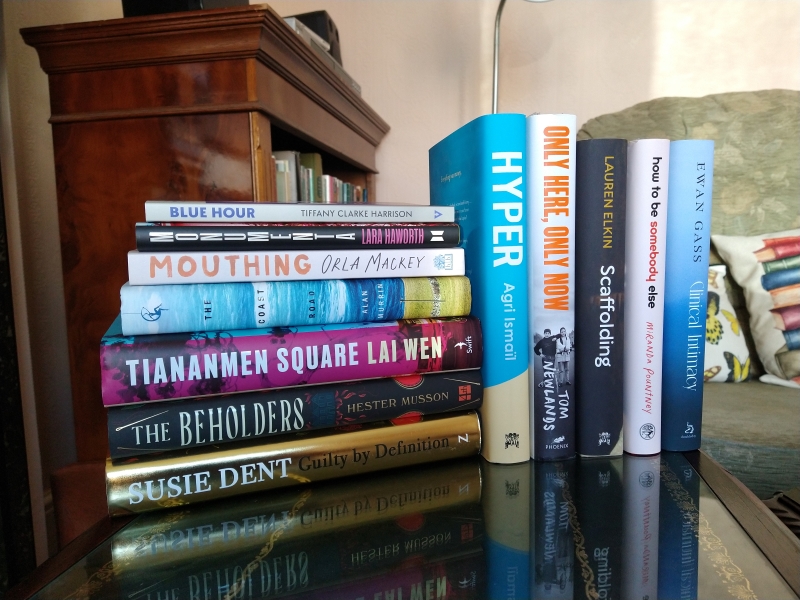
A couple of my favourite books from my reading that didn’t make the shortlist were:
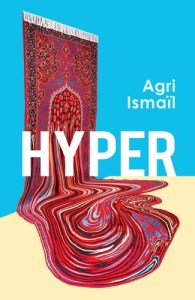 Hyper by Agri Ismaïl [I longlisted it – and then shortlisted it – but was outvoted]
Following a Kurdish family across several decades, this is a zeitgeist-y story that examines questions of national and personal autonomy. With its Dubai, Baghdad, London, and New York settings, it sets the second generation’s luxury, high finance, and fully online worlds against their parents’ bitter experience of exile after a failed independence movement. With its themes of dysfunction and failures and the long view of how we got here from there, it reminded me of Jonathan Franzen’s body of work.
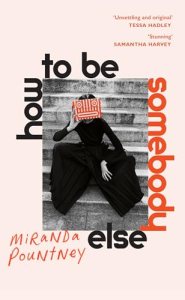 How to Be Somebody Else by Miranda Pountney [It had two votes to make the shortlist, but because it was so similar to Scaffolding in its basics (a thirtysomething woman in a big city, the question of motherhood, and pregnancy loss) we decided to cut it.]
This is the addictively readable story of Dylan, a late-thirties English woman who gives up her New York City advertising job and ponders authorship and motherhood while house-sitting an acquaintance’s apartment—and carrying on an affair with the married downstairs neighbour. As we see her interact with family and friends, we come to appreciate her not as some stereotypical ‘sad girl’ or ‘disaster woman’, but as an Everywoman seeking the time and space to become herself. It’s a sharp and witty novel for fans of Sally Rooney.
For the first time, I got to attend the SoA Awards ceremony in person yesterday. It was a hot day to be travelling in London, and after the oven of the Bakerloo line I was grateful to escape into the cool of Southwark Cathedral and its grounds. It was such a juxtaposition between the sleek City architecture and the ancient refuge of a church.
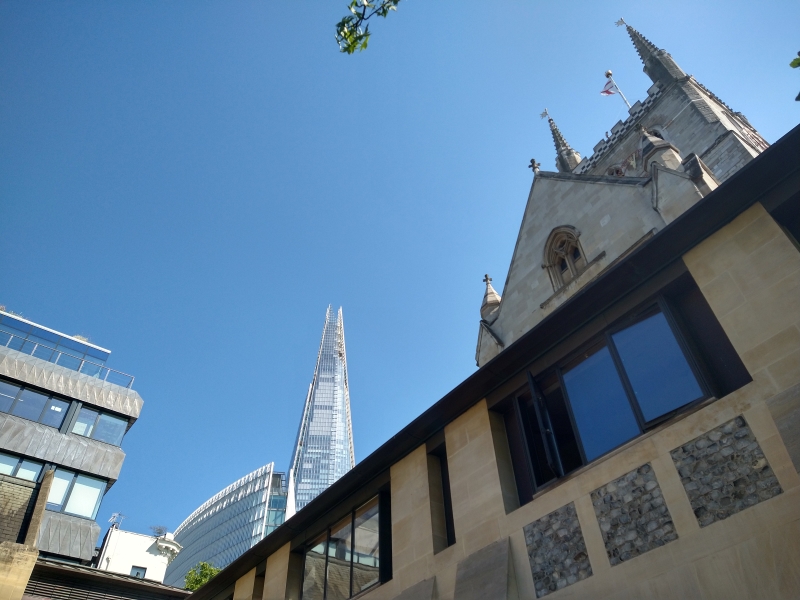
I worried that on such a warm and then busy day Hodge the cathedral cat wouldn’t show himself, but as I picked up my name badge he was asking to be let inside from the courtyard. He didn’t seem interested in strokes so I followed him at a respectful distance and let him settle in for a watchful rest.


Nominated authors and judges were treated to an exceptional afternoon tea, followed by the ceremony and drinks reception. It was lovely to meet my fellow judges Anietie Isong and Kathy O’Shaughnessy (author of the fantastic In Love with George Eliot, which won the SoA’s Paul Torday Memorial Prize) in the flesh as I’d only met them on Zoom before. We chatted a good bit with Lara Haworth, one of our shortlistees, and with Anne Booth, one of the Queen’s Knickers Award (children’s books) nominees, and also got to briefly meet Tom Newlands when he arrived for the ceremony. I always look out for literary ‘celebrities’ at such events and yesterday spotted Naomi Alderman, Caroline Bird, Joanne Harris and Alice Jolly.
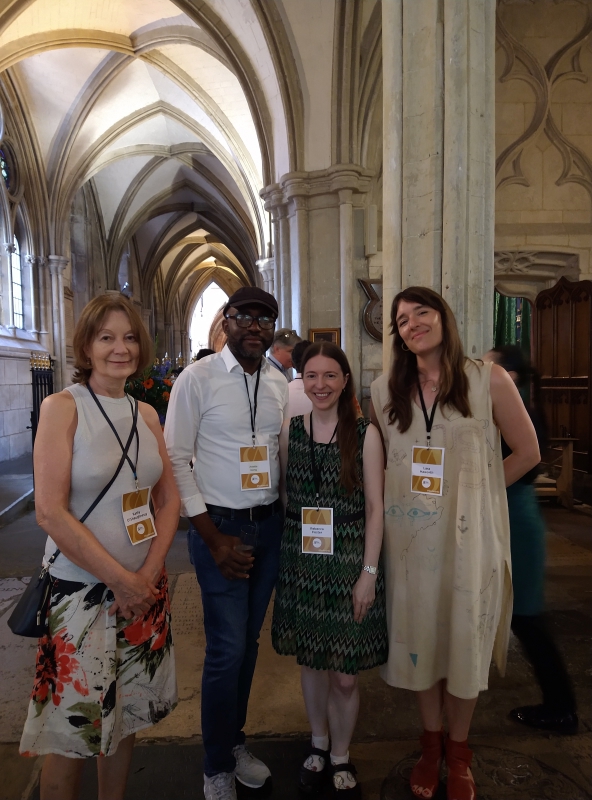


Dean Rev. Mark Oakley gave a welcome address via video, praising authors for bringing “resonance” rather than just “relevance.” He exhorted us, in the words of David Copperfield, to “read as if for life.” Joseph Coelho then gave a terrific keynote speech celebrating words written by humans (as opposed to an inaccurate AI-written bio of himself that he once encountered) and encouraging shortlistees, especially, to take time to bask in their achievement. Rejection is an ongoing, annual thing for him even at this stage of his career – he still remembers the £50 poetry gigs, changing in library toilets and school staff rooms; and the 12 years he spent trying to get published – even after he became the youngest-ever children’s laureate in 2022. “Wait for no one,” he challenged us: no one is going to give you permission or come save you, so go out there and do what you’re meant to do.
What an all-round fantastic experience this was! I’m so grateful to the Society of Authors for the opportunity.
Other notable winners announced yesterday included:
- Ashani Lewis (the only double winner): the Betty Trask Prize and Somerset Maugham award for Winter Animals
- Hisham Matar & Elif Shafak: the Gordon Bowker Volcano Prize (for a novel focusing on the experience of travel away from home), joint winners for My Friends and There Are Rivers in the Sky
Most Anticipated Books of the First Half of 2025
As I said the other week, I sometimes wonder if designating a book as “Most Anticipated” is a curse – if the chosen books are doomed to fail to meet my expectations. Nonetheless, I can’t resist compiling such a list at least once each year.
Also on my radar: fiction by Claire Adam, Amy Bloom, Emma Donoghue, Sarah Hall, Michelle Huneven, Eowyn Ivey, Rachel Joyce, Heather Parry and Torrey Peters; nonfiction by Melissa Febos, Robert Macfarlane, Lucy Mangan, Suzanne O’Sullivan and Sophie Pavelle. (Further ahead, I’ll seek out I Want to Burn This Place Down: Essays by Maris Kreizman and The Girls Who Grew Big by Leila Mottley in July, The Savage Landscape by Cal Flyn in Oct. and Tigers between Empires by Jonathan C. Slaght in Nov.)
However, below I’ve narrowed it down to the 25 books I’m most looking forward to for the first half of 2025, 15 fiction and 10 nonfiction. I’m impressed that 4 are in translation! And 22/25 are by women (all the fiction is). In release date order, with UK publication info given first if available. The blurbs are adapted from Goodreads. I’ve taken the liberty of using whichever cover is my favourite (almost always the U.S. one).

Fiction
 Live Fast by Brigitte Giraud (trans. from the French by Cory Stockwell) [Feb. 11, Ecco]: I found out about this autofiction novella via an early Shelf Awareness review. It “follows one woman’s quest to comprehend the motorcycle accident that took the life of her partner Claude at age 41. The narrator … recounts the chain of events that led up to the fateful accident, tracing the tiny, maddening twists of fate that might have prevented its tragic outcome. Each chapter asks the rhetorical question, ‘what if’ … A sensitive elegy to her husband”.
 The Unworthy by Agustina Bazterrica (trans. from the Spanish by Sarah Moses) [13 Feb., Pushkin; March 4, Scribner]: I wasn’t enamoured of the Argentinian author’s short stories, but Tender Is the Flesh was awesome. This is a short dystopian horror set in a convent. “In the House of the Sacred Sisterhood, the unworthy live in fear of the Superior Sister’s whip. … Risking her life, one of the unworthy keeps a diary in secret. Slowly, memories surface from a time before the world collapsed, before the Sacred Sisterhood became the only refuge. Then Lucía arrives.” (PDF copy for Shelf Awareness review)
 Victorian Psycho by Virginia Feito [13 Feb., Fourth Estate; Feb. 4, Liveright]: Feito’s debut, Mrs March, was deliciously odd, and I love the (U.S.) cover for this one. It sounds like a bonkers horror take on Henry James’s The Turn of the Screw, “a gruesome and gleeful new novel that probes the psyche of a bloodthirsty governess. Winifred Notty arrives at Ensor House prepared to play the perfect Victorian governess—she’ll dutifully tutor her charges, Drusilla and Andrew, tell them bedtime stories, and only joke about eating children.”

Three Days in June by Anne Tyler [13 Feb., Chatto & Windus (Penguin) / Feb. 11, Knopf]: I’m not a Tyler completist, but she’s reliable and this is a novella! “It’s the day before her daughter’s wedding and things are not going well for Gail Baines. First …, she loses her job … Then her ex-husband Max turns up at her door expecting to stay for the festivities. He doesn’t even have a suit. Instead, he’s brought memories, a shared sense of humour – and a cat looking for a new home. … [And] daughter Debbie discovers her groom has been keeping a secret.” Susan vouches for this. (Edelweiss download / on order from library)
 The Swell by Kat Gordon [27 Feb., Manilla Press (Bonnier Books UK)]: I got vague The Mercies (Kiran Millwood Hargrave) vibes from the blurb. “Iceland, 1910. In the middle of a severe storm two sisters, Freyja and Gudrun, rescue a mysterious, charismatic man from a shipwreck near their remote farm. Sixty-five years later, a young woman, Sigga, is spending time with her grandmother when they learn a body has been discovered on a mountainside near Reykjavik, perfectly preserved in ice.” (NetGalley download)
 Dream Count by Chimamanda Ngozi Adichie [4 March, Fourth Estate/Knopf]: This is THE book I’m most looking forward to; I’ve read everything Adichie has published and Americanah was a 5-star read for me. So I did something I’ve never done before and pre-ordered the signed independent bookshop edition from my local indie, Hungerford Bookshop. “Chiamaka is a Nigerian travel writer living in America. Alone in the midst of the pandemic, she recalls her past lovers and grapples with her choices and regrets.” The focus is on four Nigerian American women “and their loves, longings, and desires.” (New purchase)
 Kate & Frida by Kim Fay [March 11, G.P. Putnam’s Sons]: “Frida Rodriguez arrives in Paris in 1991 … But then she writes to a bookshop in Seattle … A friendship begins that will redefine the person she wants to become. Seattle bookseller Kate Fair is transformed by Frida’s free spirit … [A] love letter to bookshops and booksellers, to the passion we bring to life in our twenties”. Sounds like a cross between The Paris Novel and 84 Charing Cross Road – could be fab; could be twee. We shall see! (Edelweiss download)
 The Antidote by Karen Russell [13 March, Chatto & Windus (Penguin) / March 11, Knopf]: I love Russell’s Swamplandia! but haven’t gotten on with her other work I’ve tried, so I’m only tentatively enthusiastic about the odd Wizard of Oz-inspired blurb: “a historic dust storm ravages the fictional town of Uz, Nebraska. But Uz is already collapsing—not just under the weight of the Great Depression … but beneath its own violent histories. The Antidote follows a ‘Prairie Witch,’ … a Polish wheat farmer …; his orphan niece, a … witch’s apprentice …; a voluble scarecrow; and a New Deal photographer”. (Requested from publisher)
 Elegy, Southwest by Madeleine Watts [13 March, ONE (Pushkin) / Feb. 18, Simon & Schuster]: Watts’s debut, The Inland Sea, was a hidden gem. Given the news from L.A., this seems all the more potent: “In November 2018, Eloise and Lewis rent a car in Las Vegas and take off on a two-week road trip across the American southwest … [w]hile wildfires rage. … Lewis, an artist working for a prominent land art foundation, is grieving the recent death of his mother, while Eloise is an academic researching the past and future of the Colorado River … [and] beginning to suspect she might be pregnant”. (Edelweiss download)
 O Sinners! by Nicole Cuffy [March 18, One World (Random House)]: Cuffy’s Dances, which was longlisted for the Carol Shields Prize, was very good. The length of this sophomore novel (464 pages) gives me pause, but I do generally gravitate towards stories of cults. “Faruq Zaidi, a young journalist reeling from the recent death of his father, a devout Muslim, takes the opportunity to embed in a cult called The Nameless [b]ased in the California redwoods and shepherded by an enigmatic [Black] Vietnam War veteran.”
 The Accidentals: Stories by Guadalupe Nettel (trans. from the Spanish by Rosalind Harvey) [10 April, Fitzcarraldo Editions / April 29, Bloomsbury]: I really enjoyed Nettel’s International Booker-shortlisted novel Still Born. “When an albatross strays too far from its home, or loses its bearings, it becomes an ‘accidental’, an unmoored wanderer. The protagonists of these eight stories each find the ordinary courses of their lives disrupted by an unexpected event. … Deft and disquieting, oscillating between the real and the fantastical”. (PDF copy for Shelf Awareness review)
 Ordinary Saints by Niamh Ni Mhaoileoin [24 April, Manilla Press (Bonnier Books UK)]: “Brought up in a devout household in Ireland, Jay is now living in London with her girlfriend, determined to live day to day and not think too much about either the future or the past. But when she learns that her beloved older brother, who died in a terrible accident, may be made into a Catholic saint, she realises she must at last confront her family, her childhood and herself.” Winner of the inaugural PFD Queer Fiction Prize and shortlisted for the Women’s Prize Discoveries Award.
 Heartwood by Amity Gaige [1 May, Fleet / April 1, Simon & Schuster]: I loved Gaige’s Sea Wife. “In the heart of the Maine woods, an experienced Appalachian Trail hiker goes missing. She is forty-two-year-old Valerie Gillis, who has vanished 200 miles from her final destination. … At the centre of the search is Beverly, the determined Maine State Game Warden tasked with finding Valerie, who is managing the search on the ground. While Beverly is searching, Lena, a seventy-six-year-old birdwatcher in a retirement community, becomes an unexpected armchair detective.”
 Are You Happy?: Stories by Lori Ostlund [May 6, Astra House]: Ostlund is not so well known, especially outside the USA, but I enjoyed her debut novel, After the Parade, back in 2015. “Nine masterful stories that explore class, desire, identity, and the specter of violence in America–and in American families–against women and the LGBTQ+ community. … [W]e watch Ostlund’s characters as they try—and often fail—to make peace with their pasts while navigating their present relationships and responsibilities.” (Edelweiss download)
 Ripeness by Sarah Moss [22 May, Picador / Sept. 9, Farrar, Straus and Giroux]: Though I was disappointed by her last two novels, I’ll read anything Moss publishes and hope for a return to form. “It is the [19]60s and … Edith finds herself travelling to rural Italy … to see her sister, ballet dancer Lydia, through the final weeks of her pregnancy, help at the birth and then make a phone call which will seal this baby’s fate, and his mother’s.” Promises to be “about migration and new beginnings, and about what it is to have somewhere to belong.”
Nonfiction
 The Forgotten Sense: The New Science of Smell by Jonas Olofsson [Out now! 7 Jan., William Collins / Mariner]: Part of a planned deep dive into the senses. “Smell is … one of our most sensitive and refined senses; few other mammals surpass our ability to perceive scents in the animal kingdom. Yet, as the millions of people who lost their sense of smell during the COVID-19 pandemic can attest, we too often overlook its role in our overall health. … For readers of Bill Bryson and Steven Pinker”. (On order from library)
 Bread and Milk by Karolina Ramqvist (trans. from the Swedish by Saskia Vogel) [13 Feb., Bonnier Books / Feb. 11, Coach House Books]: I think I first found about this via the early Foreword review. “Bread and Milk traces a life through food, from carefully restricted low-fat margarine to a bag of tangerines devoured in one sitting to the luxury of a grandmother’s rice pudding. In this radiant memoir from one of Northern Europe’s most notable literary stylists, we follow several generations of women and their daughters as they struggle with financial and emotional vulnerability, independence, and motherhood.”
 My Mother in Havana: A Memoir of Magic & Miracle by Rebe Huntman [Feb. 18, Monkfish]: I found out about this from Rebecca Moon Ruark and by the time the publisher offered it to me I’d already downloaded it. The themes of bereavement and religion are right up my street. “As she explores the memory of her own mother, interlacing it with her search for the sacred feminine, Huntman leads us into a world of séance and sacrifice, pilgrimage and sacred dance, which resurrect her mother and bring Huntman face to face with a larger version of herself.” (Edelweiss download)
 Mother Animal by Helen Jukes [27 Feb., Elliott & Thompson]: This may be the 2025 release I’ve known about for the longest. I remember expressing interest the first time the author tweeted about it; it’s bound to be a good follow-up to Lucy Jones’s Matrescence. “When Helen Jukes falls pregnant, … she widens her frame of reference, looking beyond humans to ask what motherhood looks like in other species. … As she enters the sleeplessness, chaos and intimate discoveries of life with a newborn, these animal stories become … companions and guides.” (Requested from publisher)
 Alive: An Alternative Anatomy by Gabriel Weston [6 March, Vintage (Penguin) / March 4, David R. Godine]: I’ve read Weston’s Direct Red and appreciate her perspective. “As she became a surgeon, a mother, and ultimately a patient herself, Weston found herself grappling with the gap between scientific knowledge and unfathomable complexity of human experience. … Focusing on our individual organs, not just under the intense spotlight of the operating theatre, but in the central role they play in the stories of our lives.”
 The Lost Trees of Willow Avenue: A Story of Climate and Hope on One American Street by Mike Tidwell [March 25, St. Martin’s Press]: A must-read for me because it’s set in Takoma Park, Maryland, where I was born. “A love letter to the magnificent oaks and other trees dying from record heat waves and bizarre rain, [activist] Tidwell’s story depicts the neighborhood’s battle to save the trees and combat climate change. … Tidwell chronicles people on his block sick with Lyme disease, a church struggling with floods, and young people anguishing over whether to have kids, … against the global backdrop of 2023’s record heat domes and raging wildfires and hurricanes.”
 Breasts: A Relatively Brief Relationship by Jean Hannah Edelstein [3 April, Phoenix (W&N)]: I loved Edelstein’s 2018 memoir This Really Isn’t About You, and I regularly read her Substack. “As [Edelstein] comes of age, she learns that breasts are a source of both shame and power. In early motherhood, she sees her breasts transform into a source of sustenance and a locus of pain. And then, all too soon, she is faced with a diagnosis and forced to confront what it means to lose and rebuild an essential part of yourself.”
 Poets Square: A Memoir in Thirty Cats by Courtney Gustafson [8 May, Fig Tree (Penguin) / April 29, Crown]: Gustafson became an Instagram and TikTok hit with her posts about looking after a feral cat colony in Tucson, Arizona. The money she raised via social media allowed her to buy her home and continue caring for animals. “[Gustafson] had no idea about the grief and hardship of animal rescue, the staggering size of the problem in neighborhoods across the country. And she couldn’t have imagined how that struggle … would help pierce a personal darkness she’d wrestled for with much of her life.” (Proof copy from publisher)
 Lifelines: Searching for Home in the Mountains of Greece by Julian Hoffman [15 May, Elliott & Thompson]: Hoffman’s Irreplaceable was my book of 2019. “In the summer of 2000, Julian Hoffman and his wife Julia found themselves disillusioned with city life. Overwhelmed by long commutes, they stumbled upon a book about Prespa, Greece – a remote corner of Europe filled with stone villages, snow-capped mountains and wildlife. What began as curiosity soon transformed into a life-changing decision: to make Prespa their home.” I know next to nothing about Greece and this is a part of it that doesn’t fit the clichés.
 Spent: A Comic Novel by Alison Bechdel [22 May, Jonathan Cape (Penguin) / May 20, Mariner Books]: Bechdel’s Fun Home is an absolute classic of the graphic memoir. I’ve lost track of her career a bit but like the sound of this one. “A cartoonist named Alison Bechdel, running a pygmy goat sanctuary in Vermont, is existentially irked by a climate-challenged world and a citizenry on the brink of civil war.” After her partner’s wood-chopping video goes viral, she decides to create her own ethical-living reality TV show. Features cameos from some characters from her Dykes to Watch Out For series.
Other lists of anticipated books:
Clare – we overlap on a couple of our picks
Kate – one pick in common, plus I’ve already read a couple of her others
Laura – we overlap on a couple of our picks
Paul (mostly science and nature)
What catches your eye here? What other 2025 titles do I need to know about?
#NovNov24 Catch-Up, II: Ingalls; Boas, Lindbergh, Toth
Thanks for indulging me as I assemble a final catch-up of the novella-length works I started in November and didn’t manage to review until now. In fiction, I have a surreal modern classic. And in nonfiction, two books of open-hearted and witty writing on the approach of death, and a memoir with a unique framework.
Mrs Caliban by Rachel Ingalls (1982)
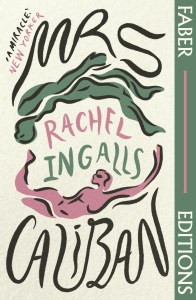 Dorothy Caliban is a California housewife whose unhappy marriage to Fred has been strained by the death of their young son (an allergic reaction during routine surgery) and a later miscarriage. When we read that Dorothy believes the radio has started delivering personalized messages to her, we can’t then be entirely sure if its news report about a dangerous creature escaped from an oceanographic research centre is real or a manifestation of her mental distress. Even when the 6’7” frog-man, Larry, walks into her kitchen and becomes her lover and secret lodger, I had to keep asking myself: is he ever independently seen by another character? Can these actions be definitively attributed to him? So perhaps this is a novella to experience on two levels. Take it at face value and it’s a lighthearted caper of duelling adulterers and revenge, with a pointed message about the exploitation of the Other. Or interpret it as a midlife fantasy of sexual rejuvenation and an attentive partner (“[Larry] said that he enjoyed housework. He was good at it and found it interesting”):
Dorothy still felt like a teenager. At the time when her hope and youth and adventurousness had left her, she had believed herself cheated of those early years when nothing had happened to her, although it might have. Later still, she realized that if she had made an effort, she herself could have made things happen. But now it didn’t matter. Here she was.
I thought of it as a waystation between Bear by Marian Engel and something like Melissa Broder’s novels or All Fours by Miranda July. I enjoyed it well enough but didn’t wholly see what the fuss was all about. (New bargain purchase from Faber) [117 pages]
A Beginner’s Guide to Dying by Simon Boas (2024)
 I hadn’t heard of the author but picked this up from the Bestseller display in my library. It’s a posthumous collection of writings, starting with a few articles Boas wrote for his local newspaper, the Jersey Evening Post, about his experience of terminal illness. Diagnosed late on with incurable throat cancer, Boas spent his last year smoking and drinking Muscadet. Looking back at the privilege and joys of his life, he knew he couldn’t complain too much about dying at 46. He had worked in charitable relief in wartorn regions, finishing his career as director of Jersey Overseas Aid. The articles are particularly witty. After learning his cancer had metastasized to his lungs, he wrote, “The prognosis is not quite ‘Don’t buy any green bananas’, but it’s pretty close to ‘Don’t start any long books’.” While I admired the perspective and equanimity of the other essays, most of their topics were overly familiar for me (gratitude, meditation, therapy, what (not) to do/say to the dying). His openness to religion and use of psychedelics were a bit more interesting. It’s hard to write anything original about dying, and his determined optimism – to the extent of downplaying the environmental crisis – grated. (Public library) [138 pages]
No More Words: A Journal of My Mother, Anne Morrow Lindbergh by Reeve Lindbergh (2001)
 I’ve reviewed one of Anne Morrow Lindbergh’s books for a previous NovNov: Gift from the Sea. She was also a poet and aviator. Reeve Lindbergh’s memoir focuses on the last year and a half of her mother’s life, 1999–2001. At this point she was in her early nineties and mostly nonverbal after a series of mini-strokes. She moved to live with her daughter on a Vermont farm and had carers to attend to her daily needs. It’s painful for the whole family to watch someone who was so fond of words gradually lose the ability to communicate. There are still moments of connection and possible memory, as when she reads her mother’s work aloud to her, and even humour, as they eat the messiest possible strawberry shortcake. It is an easy dying: her nurses are gentle and respectful, and she lives significantly longer than anyone predicted. Along the way, we get glimpses of the running of the farm, such as bottle-feeding an abandoned lamb, and of repeated tragedies from the family’s history: the Charles Lindberghs’ first child died in a botched kidnapping attempt at age one, and Reeve also lost a son at a similar age. “It is good just to sit next to my mother, whom I have known and loved for so long,” she writes. These low-key thoughts on age, infirmity and anticipatory grief were nicely done, but won’t likely stay with me. (Secondhand – Barter Books, 2024) [174 pages]
Leaning into the Wind: A Memoir of Midwest Weather by Susan Allen Toth (2003)
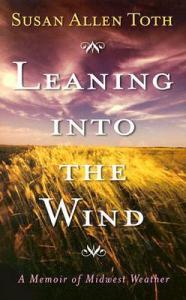 I was always going to read this because I’m a big fan of Susan Allen Toth’s work, including her trilogy of cosy travel books about Great Britain. I’m a memoir junkie in general, but I especially like ones that view the self through a particular filter, e.g., garments sewn (Bound by Maddie Ballard), houses lived in (My Life in Houses by Margaret Forster) and train journeys taken (The Lost Properties of Love by Sophie Ratcliffe). Toth grew up in Iowa and, barring stints on the coasts for her degrees, always lived in the Midwest, chiefly Minnesota. “The weather, I have happily discovered, does not grow old” – a perennial conversation starter and source of novel, cyclical experiences. She remembers huddling in a basement during tornado warnings and welcoming the peace of a first snow. Squalls seen out the window seemed to mirror her turbulent first marriage. She would fret over her daughter driving in thunderstorms until her safe arrival home. Fending off insects is a drawback to summer, and keeping a garden is an alloyed joy. I especially liked the essays on the metaphorical use of weather words and the temptation of ascribing meteorological events to divine activity. Not a squeak about climate change, though at the time the general public was aware of it; there could be an update chapter on shifts in seasonality and the increased frequency of extreme weather events. (Birthday gift from my wish list in 2021) [124 pages]
Final statistics
For this year’s Novellas in November, I reviewed a total of 30 short books, so I achieved my goal of reading the equivalent of one short book for each day of the month! The standouts were (nonfiction) Without Exception by Pam Houston and (fiction) On Chesil Beach by Ian McEwan, which was a reread for me. Other highlights included The House of Dolls by Barbara Comyns, Recognising the Stranger by Isabella Hammad, and Island by Julian Hanna. I also reviewed a film based on a novella, Small Things Like These.
It was great to get involved with Weatherglass Books in the inaugural year of their Novella Prize by attending their “The Future of the Novella” event in London, reviewing Astraea, and interviewing Neil Griffiths. I’ll review Aerth soon, too.
Collectively, we had 46 participants contributing 188 posts covering 160+ books. If you want to take a look back at the link parties, they’re all here. Another fantastic year – thank you again!

#NovNov24 Catch-Up, I: Comyns, Figes, McEwan, Radcliffe, Thériault
Still more to finish reading and/or belatedly review this week before the Novellas in November link-up closes – another, er, nine books after this, I think! I’ll save the short nonfiction for a couple of other posts. For now I have five novellas that range from black comedy to utter heartbreak and from quotidian detail to magic realism.
The House of Dolls by Barbara Comyns (1989)
 What a fantastic opening line: “Amy Doll, are you telling me that all those old girls upstairs are tarts?” Amy is a respectable widow and single mother to Hetty; no one would guess her boarding house is a brothel where gentlemen of a certain age engage the services of Berti, Evelyn, Ivy and the Señora. When a policeman starts courting Amy, she feels it’s time to address her lodgers’ profession and Hetty’s truancy. The older women disperse: move, marry or seek new employment. Sequences where Berti, who can barely boil an egg, tries to pass as a cook for a highly exacting couple, and Evelyn gets into the gin while babysitting, are hilarious. But there is pathos to the spinsters’ plight as well. “The thing that really upset [Berti] was her hair, long wisps of white with blazing red ends which she kept hidden under a scarf. The fact that she was penniless, and with no prospects, had become too terrible to contemplate.” She and Evelyn take to attending the funerals of strangers for the free buffet and booze. Comyns’ last novel (I’d only previously read Who Was Changed and Who Was Dead) is typically dark, but the wit counteracts the morbid nature. It reminded me of Beryl Bainbridge, late Barbara Pym, Lore Segal, and Muriel Spark. (Passed on by Liz – thank you! Even with the hideous cover.) [156 pages]
Light by Eva Figes (1983)
 I read this as part of my casual ongoing project to read books from my birth year. This was recently reissued and I can see why it is considered a lost classic and was much admired by Figes’ fellow authors. A circadian novel, it presents Claude Monet and his circle of family, friends and servants at home in Giverny. The perspective shifts nimbly between characters and the prose is appropriately painterly: “The water lilies had begun to open, layer upon layer of petals folded back to the sky, revealing a variety of colour. The shadow of the willow lost depth as the sun began to climb, light filtering through a forest of long green fingers. A small white cloud, the first to be seen on this particular morning, drifted across the sky above the lily pond”. There are also neat little hints about the march of time: “‘Telephone poles are ruining my landscapes,’ grumbled Claude”. But this story takes plotlessness to a whole new level, and I lost patience far before the end, despite the low page count, and so skimmed half or more. If you are a lover of lyrical writing and can tolerate stasis, it may well be your cup of tea. (Secondhand – Community Furniture Project?) [91 pages]
On Chesil Beach by Ian McEwan (2007)
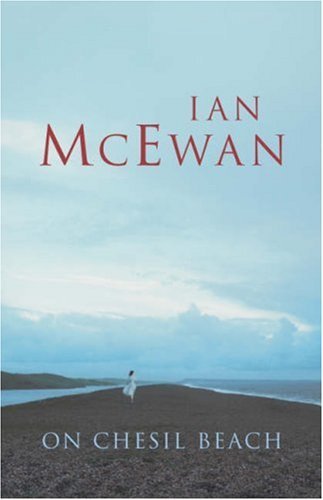 “They were young, educated, and both virgins on this, their wedding night, and they lived in a time when a conversation about sexual difficulties was plainly impossible.” Another stellar opening line to what I think may be a perfect novella. Its core is the night in July 1962 when Edward and Florence attempt to consummate their marriage in a Dorset hotel, but it stretches back to cover everything we need to know about this couple – their family dynamics, how they met, what they want from life – and forward to see their lives diverge. Is love enough? “And what stood in their way? Their personalities and pasts, their ignorance and fear, timidity, squeamishness, lack of entitlement or experience or easy manners, then the tail end of a religious prohibition, their Englishness and class, and history itself. Nothing much at all.” I had forgotten the sources of trauma: Edward’s mother’s brain injury, perhaps a hint that Florence was sexually abused by her father? (But she also says things that would today make us posit asexuality.) I knew when I read this at its release that it was a superior McEwan, but it’s taken the years since – perhaps not coincidentally, the length of my own marriage – to realize just how special. It’s a maturing of the author’s vision: the tragedy is not showy and grotesque like in his early novels and stories, but quiet, hinging on the smallest of actions, or the words not said. This absolutely flayed me emotionally on a reread. (Little Free Library) [166 pages]
The Old Haunts by Allan Radcliffe (2023)
 I was sent this earlier in the year in a parcel containing the 2024 McKitterick Prize shortlist. It’s been instructive to observe the variety just in that set of six (and so much the more in the novels I’m assessing for the longlist now). The short, titled chapters feel almost like linked flash stories that switch between the present day and scenes from art teacher Jamie’s past. Both of his parents having recently died, Jamie and his boyfriend, a mixed-race actor named Alex, get away to remote Scotland. His parents were older when they had him; growing up in the flat above their newsagent’s shop in Edinburgh, Jamie felt the generational gap meant they couldn’t quite understand him or his art. Uni in London was his chance to come out and make supportive friends, but being honest with his parents seemed a step too far. When Alex is called away for an audition, Jamie delves deeper into his memories. Kit, their host at the cottage, has her own story. Some lovely, low-key vignettes and passages (“A smell of soaked fruit. Christmas cake. My mother liked to be organised. She was here, alive, only yesterday.”), but overall a little too soft for the grief theme to truly pierce through. [158 pages]
With thanks to the Society of Authors for the free copy for review.
The Peculiar Life of a Lonely Postman by Denis Thériault (2005; 2008)
[Translated from the French by Liedewy Hawke]
 {BEWARE SPOILERS} Like many, I was drawn in by the quirky title and Japan-evoking cover. To start with, it’s the engaging story of Bilodo, a Montreal postman with a naughty habit of steaming open various people’s mail. He soon becomes obsessed with the haiku exchange between a certain Gaston Grandpré and his pen pal in Guadeloupe, Ségolène. When Grandpré dies a violent death, Bilodo decides to impersonate him and take over the correspondence. He learns to write poetry – as Thériault had to, to write this – and their haiku (“the art of the snapshot, the detail”) and tanka grow increasingly erotic and take over his life, even supplanting his career. But when Ségolène offers to fly to Canada, Bilodo panics. I had two major problems with this: the exoticizing of a Black woman (why did she have to be from Guadeloupe, of all places?), and the bizarre ending, in which Bilodo, who has gradually become more like Grandpré, seems destined for his fate as well. I imagine this was supposed to be a psychological fable, but it was just a little bit silly for me, and the way it’s marketed will probably disappoint readers who are looking for either Harold Fry heart warming or cute Japanese cat/phone box adventures. (Public library) [108 pages]
Which of these catches your eye?
Short Stories in September Roundup: Alexie, Donoghue, Groff Anthology, Houston, McCracken, Moore, Svoboda, Walker
I gave myself an extra week to finish up the story collections I was in the middle of, so I’ve managed to read 13 during this challenge to self (including my first and second posts). Again I’m borrowing Marcie’s five-sentence review format to keep things simple.
The Lone-Ranger and Tonto Fistfight in Heaven by Sherman Alexie (1993)
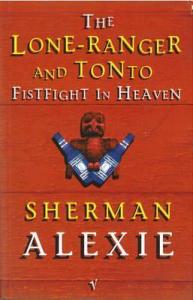 There are 22 stories in this fairly short book, so most top out at no more than 10 pages: little slices of life on and around the reservation at Spokane, Washington. Some central characters recur, such as Victor, Thomas Builds-the-Fire and James Many Horses, but there are so many tales that I couldn’t keep track of them across the book even though I read it quickly. My favourite was “This Is What It Means to Say Phoenix, Arizona,” in which Victor and Thomas fly out to collect the ashes of Victor’s father. Some of the longer titles give a sense of the tone: “Because My Father Always Said He Was the Only Indian Who Saw Jimi Hendrix Play ‘The Star-Spangled Banner’ at Woodstock” and “Jesus Christ’s Half-Brother Is Alive and Well on the Spokane Indian Reservation.” I couldn’t help but think of it as a so-so rehearsal for The Absolutely True Diary of a Part-Time Indian because a similar cast of drunks, jokers, relatives and basketball players populates the stories and a comparable voice prevails. (University library)
The Woman Who Gave Birth to Rabbits by Emma Donoghue (2002)
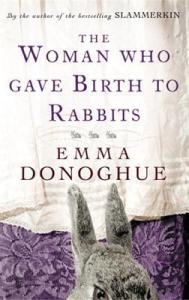 The title story is about Mary Toft – I thought of making her hoax the subject of a Three on a Theme post because I actually have two novels about her downloaded from NetGalley and Edelweiss (Mary and the Rabbit Dream by Noémi Kiss-Deáki and Mary Toft; or, The Rabbit Queen by Dexter Palmer), but the facts as conveyed here don’t seem like nearly enough to fuel a whole book, so I doubt I’ll read those. Donoghue has a good eye for historical curios and incidents and an academic’s gift for research, yet not many of these 17 stories, most of which are in the third person, rise above the novelty. Many protagonists are British or Irish women who were a footnote in the historical record: an animal rights activist, a lord’s daughter, a cult leader, a blind poet, a medieval rioter, a suspected witch. There are mild homoerotic touches, too. I enjoyed “Come, Gentle Night,” about John Ruskin’s honeymoon, and “Cured,” which reveals a terrifying surgical means of controlling women’s moods but, as I found with Astray and Learned by Heart, Donoghue sometimes lets documented details overwhelm other elements of a narrative. (Secondhand – Awesomebooks.com)
The Best Short Stories 2023: The O. Henry Prize Winners, ed. Lauren Groff (2023)
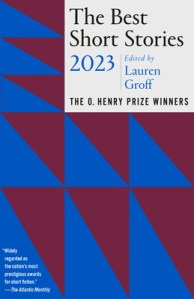 Hard to convey the variety of this 20-story anthology in a concise way because they run the gamut from realist (Nigerian homosexuality in “Happy Is a Doing Word” by Arinze Ifeakandu; Irish gangsters in “The Blackhills” by Eamon McGuinness) to absurd (Ling Ma’s “Office Hours” has academics passing through closet doors into a dream space; the title of Catherine Lacey’s “Man Mountain” is literal; “Ira and the Whale” is Rachel B. Glaser’s gay version of the Jonah legend). Also difficult to encapsulate my reaction, because for every story I would happily have seen expanded into a novel (the gloomy character study “The Locksmith” by Grey Wolfe LaJoie, the teenage friends’ coming-of-age in “After Hours at the Acacia Park Pool” by the marvellous Kirstin Valdez Quade), there was another I thought might never end (“Dream Man” by Cristina Rivera-Garza and “Temporary Housing” by Kathleen Alcott). Three are in translation. I admired Lisa Taddeo’s tale of grief and revenge, “Wisconsin,” and Naomi Shuyama-Gómez’s creepy Colombian-set “The Commander’s Teeth.” But my two favourites were probably “Me, Rory, and Aurora” by Jonas Eika (Danish), which combines an uneasy threesome, the plight of the unhoused and a downright chilling Ishiguro-esque ending; and “Xífù,” K-Ming Chang’s funny, morbid take on daughter/mother-in-law relations in China. (PDF review copy)
Waltzing the Cat by Pam Houston (1998)
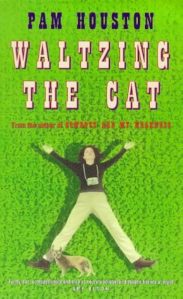 The novel-in-stories is about Lucy, a photographer in her early thirties with a penchant for falling for the wrong men – alcoholics or misogynists or ones who aren’t available. When she’s not working she’s thrill-seeking: rafting in Colorado, travelling in the Amazon, sailing in the Caribbean, or gliding. “Everything good I’ve gotten in life I’ve gotten by plunging in,” she boasts, to which a friend replies, “Sure, and everything bad you’ve gotten in your life you’ve gotten by plunging in.” Ultimately she ‘settles down’ on the Colorado ranch she inherits from her grandmother with a dog, making this – based on what I learned from the autobiographical essays in Deep Creek – even more autofiction for Houston than her debut, Cowboys Are My Weakness, was. Although the final magic realist touch of having her child-self come to her with a box of photographs of traumatic memories is overdone, the themes of accepting vulnerability, seeking to freeze time and creating a home for yourself resonated, and the title story, about the death of Lucy’s mother, is a brilliant and heart-wrenching standalone. (Secondhand – British Red Cross, Berwick)
The Souvenir Museum by Elizabeth McCracken (2021)
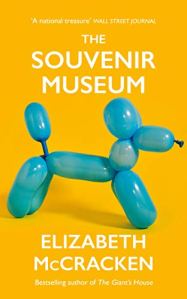 McCracken is terrific in short forms: The Hero of This Book, a novella, was one of my top books of 2022, and I also loved her previous story collection, Thunderstruck. Five of these dozen stories are taken from different points in the lives of Jack and Sadie, English and American academics (who I inevitably read as McCracken and her husband, Edward Carey) who come from large-family zaniness versus claustrophobic mother–daughter melancholy. I kept thinking that McCracken’s are just the sorts of scenarios Lucy and Olive would have told stories about in Tell Me Everything: accidents, misfortunes; random connections. Travel is a major element in many of the stories, including to Denmark (in the title story) and Amsterdam. I couldn’t decide whether I preferred the Jack-and-Sadie material or the rest, but I had a favourite from each: “The Irish Wedding” cracked me up as much as it did Sadie with the accidental use of crass American slang, while “Proof,” about a man communing with his father despite his early dementia, is set on a boat trip I’ve made (in 2004!) to see puffins on the Treshnish islands of Scotland. (Secondhand – Dogs Trust charity shop, Marlborough)
Like Life by Lorrie Moore (1990)
 Compared to Birds of America, this feels a little dated and the plots are overall less memorable. Still, the eight stories of Moore’s second collection are chewy with insight into relationships and the mindsets of youngish and middle-aged women, and there’s an effortless wry wit to her turns of phrase. Her exasperated would-be feminist characters remind me of Helen Simpson’s, while the cheese-selling protagonist of “Joy” made me think of an early Carol Shields story; and who knew a “cute meet” (aka a meet-cute) was a thing back then? New York City contrasts with the Midwest, most notably in “You’re Ugly, Too” and “The Jewish Hunter.” The title story, which comes last, crafts a weirdly muted dystopia built around shortages and marital misery; I preferred the (comparative lightness) of “Vissi d’Arte,” about a lonely playwright, and “Places to Look for Your Mind,” in which an empty-nest entrepreneur hosts an aimless young Englishman her daughter met on her study abroad year. (Secondhand – Bark charity shop, Berwick)
The Long Swim by Terese Svoboda (2023)
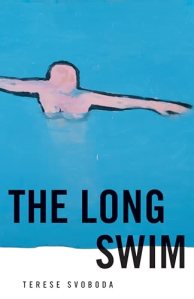 These 44 stories, mostly of flash fiction length, combine the grit of Denis Johnson with the bite of Flannery O’Connor. Siblings squabble over a late parent’s effects or wishes, marriages go wrong, the movie business isn’t as glittering as it’s cracked up to be, and drugs and alcohol complicate everything. The settings range through North America and the Caribbean, with a couple of forays to Europe. There are no speech marks and, whether the narrative is in first person or third, all the voices are genuine and distinctive yet flow together admirably. Svoboda has a poet-like talent for compact, zingy lines; two favourites were “my laziness is born of generalized-looking-to-get-specific grief, like an atom trying to make salt” (“Niagara”) and “Ditziness, a kind of Morse code of shriek-and-stop, erupts around the girls” (“Orphan Shop”).
Winner of the Juniper Prize for Fiction. Published by University of Massachusetts Press. With thanks to the author for the free PDF copy for review.
In Love and Trouble by Alice Walker (1973)
 I’d only ever read The Color Purple, so when I spotted this in a bookshop on our Northumberland holiday it felt like a good excuse to try something else by Walker. I had actually encountered one of the stronger stories before: “Everyday Use” is in the Close Company Virago anthology. In these Southern scenes (“a hate-filled state complete with magnolias, tornadoes and broken-tongued field hands”), Black women oppressed by fathers and partners gain what few advantages they can through deception or folk medicine. I liked “Entertaining God,” which opens with a boy abducting a gorilla from a zoo, and “To Hell with Dying,” about a friendship with an elderly neighbour in cotton country. Setting, style, characters; nothing drew me to any of the others or made me think I’ll read Walker again in the future. (Secondhand – Berrydin Books, Berwick)
Which of these would you read?
Currently reading: I’m not good at picking up short stories in the rest of the year, but I’ve discovered that I really enjoy reviewing them for Shelf Awareness – the length and format of their reviews really suits essay and story collections. So I’m now partway through Save Me, Stranger by Erika Krouse (2025) for an early Shelf Awareness review. Another book I started in Northumberland, Dreams of Dead Women’s Handbags by Shena Mackay, I didn’t finish in time for this challenge but will either continue or set aside and pick back up next year. Both are fantastic!
Carol Shields Prize Longlist: A Council of Dolls by Mona Susan Power
my doll is a collector of tragedy … the device I use to hide from something I already know
Mona Susan Power’s fourth novel, A Council of Dolls, is an Indigenous saga that draws on her own family history. Through first-person narratives by three generations of Dakhóta and Lakhóta women, she explores the ongoing effects of trauma resulting from colonialist oppression. The journey into the past begins with Sissy, a little girl in racist 1960s Chicago with an angry, physically abusive mother, Lillian. This section sets up the book’s pattern of ascribing voice and agency to characters’ dolls. Specifically, Sissy dissociates from her own emotions and upsetting experiences by putting them onto Ethel, her Black doll. Power relies on the dramatic irony between Sissy’s childhood perspective and readers’ understanding.
Moving backward: In 1930s North Dakota, we see Lillian coping with her father’s alcohol-fuelled violence by pretending she is being directed in a play. She loses her Shirley Temple doll, Mae, in an act of charity towards a sickly girl in the community. Lillian and her sister, Blanche, attend an Indian school in Bismarck. Run by nuns, it’s even crueller than the institution their parents, Cora and Jack, attended: the infamous Carlisle Indian Industrial School in Pennsylvania (also a setting in Wandering Stars by Tommy Orange). Cora’s beautifully introspective journal from the 1910s reveals the systematic cultural annihilation that took place there. Her doll, Winona, rescued from a massacre in the time of Sitting Bull, was on the pyre of precious belongings – tribal costumes, instruments, medals, sacred feathers – burned on students’ arrival. But her stone heart survives as a totem of resilience.

This is a powerful but harrowing story. The characterization and narration are strong, and the nesting-dolls structure means we get glimpses into the future for all three protagonists. However, I was disappointed by a number of Power’s decisions. It appeared that a fourth and final narrator close to the present day would introduce another aspect, but in fact Jesse is a new name that Sissy chose for herself. Now a 50-year-old academic and writer, she becomes a medium for the dolls’ accounts – but this ends up repeating material we’d already encountered. The personification of familial tragedy in the figure of “the injured woman” who appears to Cora verges on mawkish, and the touches of magic realism to do with the dolls sit uneasily beside clinical discussions of trauma. In Jesse’s section, there is something unsubtle about how this forms the basis of a conversation between her and her friend Izzy:
(Jesse thinks) “I wanted that chance to break the chain of passing on harmful inner scripts, the self-loathing that comes from brutally effective colonization.”
(Izzy says) “whoo, that’s a big fat pipe full of misery … Our people have been pathologized from the very beginning. Still are.”
It’s possible I would have responded to this with more enthusiasm had it been packaged as a family memoir. As it is, I was unsure about the hybridization of autofiction and magic realism and wondered what white readers coming to the novel should conclude. I kept in mind Elaine Castillo’s essay “How to Read Now,” about her sense of BIPOC writers’ job: “if our stories primarily serve to educate, console and productively scold a comfortable white readership, then those stories will have failed their readers”. Perhaps Power’s novel was not primarily intended to serve in that way.
I’ll let her have the last word, via the Author’s Note: “outrageously prejudiced depictions of my ancestors and our people are one reason I became a writer. From childhood I felt an urgent need to speak my truth, which was long suppressed. Writing this book was a healing endeavor. May it support the healing of others.”
With thanks to publicist Nicole Magas and Mariner Books for the free e-copy for review.
This was a buddy read with Laura; see her review here.
Before the shortlist is announced on 9 April, I plan to review my two current reads, Cocktail by Lisa Alward and Land of Milk and Honey by C Pam Zhang, and concoct a personal wish list.
Carol Shields Prize Longlist Reading: The Future and Chrysalis
My first two dedicated reads for our informal Carol Shields Prize shadowing project exhibit one main way in which the prize is different from the Women’s Prize for Fiction: works in translation and short story collections are eligible. I have one of each to review today. Laura and I did a buddy read of an atmospheric dystopian novel translated from the French, and I caught up on a magical, erotic story collection I’d had on my Kindle for a long time. These were both very good, but my minor misgivings are such that I’d rate them the same:
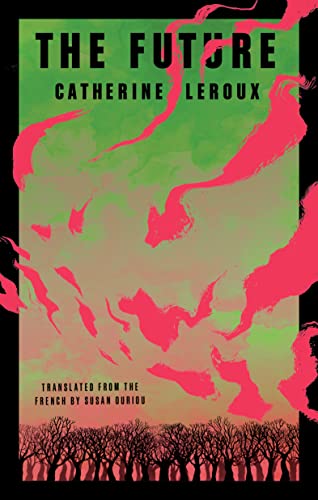
The Future by Catherine Leroux (2020; 2023)
[Translated from the French by Susan Ouriou]
For such a monolithic title, this has a limited stage: a few derelict districts of the ailing city we know as Detroit, Michigan – but in Leroux’s alternate version, it remained part of French Canada, with lingering Indigenous influence, and so is known as Fort Détroit. No doubt she was inspired by the many vacant properties that characterized Detroit in the 2010s; there’s even a ruins tour bus. In her Fort Détroit, a handful of determined adults cling on in their own homes, but the streets and parks have been abandoned to animals and to a gang of half-feral children who have developed their own nicknames (Adidas, Lego, Wolfpup), social hierarchy and vernacular. Worlds meet when Gloria determines to find her granddaughters Cassandra and Mathilda, who ran away after their addict mother Judith’s suspicious death. At the same time, her neighbour Eunice wants to find out who ran her father down in the street.
 Despite their fierce independence and acts of protest, the novel’s children still rely on the adult world. Ecosystems are awry and the river is toxic, but Gloria’s friend Solomon, a former jazz pianist, still manages to grow crops. He overlooks the children’s thefts from his greenhouse and eventually offers to help them grow their own food supply, and other adults volunteer to prepare a proper winter shelter to replace their shantytown. Puberty threatens their society, too: we learn that Fiji, the leader, has been binding her breasts to hide her age.
I expected to be reminded strongly of Station Eleven, and while there were elements that were reminiscent of Emily St John Mandel’s work, Leroux’s is a more consciously literary approach. The present-tense omniscient narration occupies many perspectives, including that of a dog, and the descriptions and musings are more lyrical than literal. Where another author would site high drama – sixtysomething Gloria’s night quest, a few children rafting down the river – Leroux moves on swiftly to other character interactions. What did bring Mandel to mind was the importance of art during societal collapse: the children spin nursery rhyme mash-ups and fairytales, Stutt rescues a makeshift library and insists on Huckleberry Finn going along on the river journey, and Solomon plays the piano again after decades.
The opening mysteries of death and disappearance are resolved before the end, but don’t seem to have been the point. The Future is more subtle and slippery than many dystopian novels I’ve read in that there’s not really a warning, or a message here. Instead, there’s an intriguing situation that opens out and alters slightly, but avoids resolution. It’s all about atmosphere and language – I was especially impressed by Ouriou’s rendering of Leroux’s made-up dialect via folksy slang (“She figgers she’s growed-up”). I loved the details and one-on-one moments more than the momentous scenes. On the whole, I found the story elegant but somewhat frustrating. You might be drawn to it if you enjoyed To Paradise or the MaddAddam books. (Read via Edelweiss; published by Biblioasis)
See also Laura’s review.
Chrysalis: Stories by Anuja Varghese (2023)
This debut collection of 15 stories brims with magic and horror, and teems with women of colour and queer people. Indeed, Varghese dedicates the book to “all the girls and women who don’t see themselves in most stories.” Most of the characters are of South Asian extraction. Adoption recurs in a couple of places. Two of the rarer realist stories, “Milk” and “Stories in the Language of the Fist,” have protagonists dealing with schoolgirl bullying and workplace microaggressions. More often, there are unexplained phenomena that position the players between life and death. “In the Bone Fields” focuses on the twin daughters of an Indian immigrant family on a Canadian farm. The house and the bone field behind are active and hungry, and only one twin will survive. (I got mild North Woods vibes.)
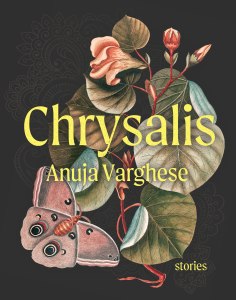 In the title story, Radhika visits her mother’s grave and wonders whether her life is here in Montreal with her lover or back in Toronto with her husband. Fangs and wings symbolize her desire for independence. Elsewhere, watery metaphors alternately evoke fear of drowning or sexual fluidity. “Midnight at the Oasis” charts the transformation of a trans woman and “Cherry Blossom Fever,” one of my two favourites, bounces between several POVs. Marjan is in love with Talia, but she’s married to Sunil, who’s also in love with Silas. “People do it — open their relationships and negotiate rules and write themselves into polyamorous fairy tales … Other people. Not brown people,” Talia sighs. They are better off, at least, than they would be back in India, where homophobia can be deadly (“The Vetala’s Song”).
My other favourite was “Bhupati,” about a man who sets up multiple Lakshmi figures in the backyard, hoping devotion will earn him and his wife a better future. The statues keep being burned up by lightning; we learn his wife may be petitioning for different things. “Chitra” is a straightforward Cinderella retelling whose title character lives with two mean stepsisters and works in food service at the mall. A Shoe Chateau BOGO closing sale gives her the chance to get a bargain – and catch the manager’s eye. Despite a striking ending signalled by the story’s subtitle, all I could conclude about this one was “cute.” The three flash horror stories (a murder hotel, ghosts in a basement, werewolves) were much the weakest for me.
There’s a pretty even split of third- and first-person stories (nine versus six) here, and the genre shifts frequently. The quality wasn’t as consistent as I’d hoped, but it was an engaging read. The overall blend of feminism and horror had me thinking of Her Body and Other Parties by Carmen Maria Machado, but I’d be most likely to recommend this to fans of Julia Armfield, Violet Kupersmith and Vauhini Vara. (Read via Edelweiss; published by House of Anansi Press)
Both of these are worthwhile books and it’s great that readers outside of Canada can discover them. I wouldn’t personally shortlist either, but the judges may well be dazzled enough to do so. I don’t yet have a sense of where they’d fit for me in the rankings.
Up next:
Cocktail by Lisa Alward (short story collection from Edelweiss)
A Council of Dolls by Mona Susan Power (buddy read with Laura)
Land of Milk and Honey by C Pam Zhang (from library)

I’m aiming for one or two more batches of reviews before the shortlist is announced on 9 April.
Three on a Theme: Tiger Novels (Polly Clark, Tania James, Téa Obreht)
I was sent Loot for review, picked The Tiger’s Wife – a reread for me – as our February book club book, and then couldn’t resist making it a trio with Tiger as it was also a good excuse to pick up a book that had sat on my shelves unread for several years. In all three, the tiger is an emblem of wildness and mystery – and often of danger, too (“you must rid us of this devil in his fiery pajamas,” the village priest begs the hunter in The Tiger’s Wife).
Tiger by Polly Clark (2019)
 I was fully engaged with the 150 or so pages of Part I, which is narrated by Dr Frieda Bloom, a zookeeper knowledgeable about and fascinated by bonobos. She’s also a morphine addict who continues to justify using at work (not to mention stealing from the veterinary supplies) until she is caught and fired. It’s all in response to a random act of violence: a man attacked her outside a Tube station late one night and she was lucky to have survived the head injury. In ignominy, she moves from a prestigious research institute to a rundown local zoo where the star new acquisition is an injured tiger named Luna. She develops an amazing rapport with Luna, even spending time in the enclosure with her. Meanwhile, the macho behaviour of her colleague Gabriel makes it seem like Frieda could be a victim again at any time.
But then we jump back in time and to the Russian taiga to meet, through third-person segments, a conservationist who hears about a mighty Siberian tigress, and a mother and daughter who encounter her for themselves. This turns out to be “the Countess,” Luna’s mother, and Frieda, a few years on now, travels to Russia herself to bring back one of Luna’s cubs. The focus, as the title signals, is on the tiger herself, but my interest was only ever in Frieda, and it was a little confusing how quickly she switches allegiance from primates to tigers. More first-person narration might have kept me engaged, or maybe a different order to the sections? Anything to keep me latching onto Frieda and missing her for most of the book. (Instagram giveaway win) 
Loot by Tania James (2023)
A halfhearted skim. It’s a shame that when I was offered this for review I didn’t remember I’d read something by Tania James before. The Tusk that Did the Damage, from 2016, is a composite picture of the state of wildlife conservation in India told from three perspectives: an elephant named The Gravedigger, a poacher, and a documentary filmmaker. That was a book I had to force myself through because of the lacklustre storytelling and character development, and I found the same here. Historical fiction can be tedious when it assumes that an unusual setting and intriguing incident are enough to maintain reader interest. Abbas, a woodcarver, is only 17 when he is taken to the sultan’s palace to be apprenticed to a French clockmaker. Together, they create the real-life automaton known as Tippoo’s Tiger and held at the V&A Museum. When the automaton is plundered, Abbas sets out on a quest to rescue it. I never warmed to any of the characters here, even though du Leze’s adopted daughter Jehanne is a promising one. If it’s automata that intrigue you, read The Weather Woman instead. 

[Now on the Carol Shields Prize for Fiction longlist]
With thanks to Harvill Secker for the free copy for review.
The Tiger’s Wife by Téa Obreht (2011)
What I remembered: a wartime Eastern European (Bosnian?) story that incorporated legends.
What I rediscovered:
Natalia, a medical worker in a war-ravaged country, learns of her grandfather’s death away from home. The only one who knew the secret of his cancer, she sneaks away from an orphanage vaccination program to reclaim his personal effects, hoping they’ll reveal something about why he went on this final trip. Something is missing from his belongings: his beloved copy of The Jungle Book, which sparked a lifelong fascination with tigers. When war broke out mid-century and a tiger escaped from the zoo, he was nine years old. He and the butcher’s wife, a pregnant, deaf-mute Muslim woman with whom he communicated by scratching images in the dirt, were thrilled by the tiger’s nocturnal skulking rather than frightened like the rest of the villagers. Her outcast status led people to ignore the fact that she was a victim of domestic violence and to spin tales about her unnatural connection with the tiger, spreading rumours about the child she was carrying (“The Tiger’s Wife”).
 In the years to come, during Natalia’s grandfather’s career as a doctor, he had several encounters with Gavran Gailé, “The Deathless Man,” a troubadour who seemed, vampire- or zombie-like, to survive every attempt on his life. In service to his uncle, Gavran Gailé read people’s coffee grounds to inform them of their impending death, but his own cup was bare and unbreakable. Natalia’s grandfather, a man of science, didn’t believe Gavran Gailé’s claims and agreed to a wager. Gavran Gailé would walk into a lake, tied up in chains attached to cement blocks, and pull on a rope when he started drowning. His pledge was his cup; the doctor’s was The Jungle Book, his most treasured possession. But as promised, Gavran Gailé spent an hour underwater and emerged from the lake none the worse the wear.
Natalia knows her grandfather’s final journey must have been to meet The Deathless Man, who collected on his pledge. She’ll have her own encounter with him before the end.
This is a demanding read, in that there are not a lot of orienting details and the several storylines surge in and out through flashbacks and oral storytelling. It takes effort and commitment to keep reading in the hope that everything will come together. This was a flop for my book club in that only three people had read it so we decided it wasn’t worth meeting. One who did finish it commented that it felt like three separate stories, and I see what she means. Obreht could certainly have made the links and chronology more obvious. Instead, each chapter is such a honed and self-contained narrative, often focused on a different peripheral character, that the book almost reads like a set of linked short stories. On this reread I was absolutely entranced, especially by the sections about The Deathless Man. I had forgotten the medical element, which of course I loved.
It can be depressing looking back at amateur reviews I wrote in my pre-freelancing days because I have not notably advanced since then. This response I wrote when I read the brand-new book in 2011 is allusive, opinionated, and admirably absent of dull plot summary. Could I do any better now if I tried? (Though I think I maybe misunderstood the ending back then.)
Had I reread this sooner, it would have been tough to choose between it and Larry’s Party, my ultimate selection, for the Women’s Prize Winners 25th anniversary reader vote. Were I to vote again today, I’d join Laura in choosing The Tiger’s Wife instead. (Public library)
My original rating (2011): 
My rating now: 
Eleanor recently reviewed it, too.
There was a clear winner here: The Tiger’s Wife!
See also Laura’s fab series on tiger novels from her old blog. This is the first post and there are more listed in the right-hand sidebar.
I searched my Goodreads library for others I’ve read and the only books she didn’t cover were Nick Harkaway’s Tigerman, a disappointment after Angelmaker; and (nonfiction) Margaux Fragoso’s Tiger, Tiger (title from a William Blake line), a memoir of childhood sexual abuse, and Ruth Padel’s Tigers in Red Weather, a travelogue – it happens to share a title with Liza Klausmann’s novel, which is likewise named after a line in the Wallace Stevens poem “Disillusionment of Ten O’Clock.”
 Bookish Beck = Rebecca Foster. American transplant to England. Freelance proofreader and book reviewer.
 Bookish Beck