20 Books of Summer, 7–9: Furies, The Earthquake Bird, and Greta & Valdin
It might seem that I’m very behind on 20 Books of Summer, and I am, but that’s mostly because I’ve done my usual trick of starting loads of books at once so that I’m currently in the middle of another nine with no prospect of finishing any particularly soon. I will eventually review more, but probably all in a rush and on the later side. It doesn’t help that quite a few happen to be lacklustre reads, such that I have to push myself through them instead of enjoying spending time with the stack. For today, though, I have a pretty readable trio made up of feminist short stories, a mild Japan-set mystery, and a highly random queer dysfunctional family novel that rose from indie obscurity in New Zealand. (Also a DNF.)
Furies: Stories of the Wicked, Wild and Untamed (2023)
It was my second attempt at this Virago anthology; I borrowed it from the library last year but never opened it, as far as I can remember. Each story is named after a synonym for “virago,” so the focus is on strong and unconventional women, but given that brief there is huge variety, including memoir (Ali Smith’s “Spitfire,” about her late mother’s WAAF service), historical research (CN Lester on sexology and early trans figures, Emma Donoghue on early-twentieth-century activist and lesbian Kathlyn Oliver, Stella Duffy on menopause) and even one graphic short, the mother–daughter horror story “She-Devil” by comics artist Eleanor Crewes.
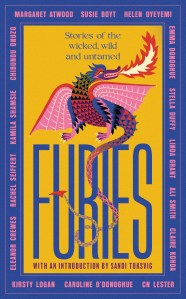 As with any anthology, some pieces stand out more than others. Caroline O’Donoghue, Helen Oyeyemi and Kamila Shamsie’s contributions were unlikely to convert me into a fan. Margaret Atwood is ever sly and accessible, with “Siren” opening with the line “Today’s Liminal Beings Knitting Circle will now be called to order.” I was surprised to get on really well with Kirsty Logan’s “Wench,” about girls ostracized by their religious community because of their desire for each other – I’ll have to read Now She Is Witch, as it’s set in the same fictional world – and Chibundu Onuzo’s “Warrior,” about Deborah, an Israelite leader in the book of Judges. And while I doubt I need to read a whole novel by Rachel Seiffert, I did enjoy “Fury,” about a group of Polish women who fended off Nazi invaders.
A few of my favourites were “Harridan” by Linda Grant, about an older woman who frightens the young couple who share her flat’s garden during lockdown (“this old lady, this hag she sees, this bitter travesty of her celestial youth and beauty is not her. Inside she’s a flame, she’s a pistol”); “Muckraker” by Susie Boyt, in which a woman makes conquests of breast cancer widowers; and “Tygress” by Claire Kohda, where the stereotype of the Asian ‘tiger mother’ turns literal. Duffy’s “Dragon” closes the collection with a very interesting blend of autofiction, interviews and medical reportage about different experiences of objectification in youth and invisibility in ageing. It brings the whole together nicely: “Tell me your tale and, in the telling, feel it all drop away. You are, and you are not, your story. Keep what serves you now, make space for new maybes.” (Free from a neighbour) 
The Earthquake Bird: A Novel of Mystery by Susanna Jones (2001)
 Susanna Jones’s When Nights Are Cold is one of my favourite novels that no one else has ever heard of, so I jumped at the chance to buy a bargain copy of her debut back in 2020. Lucy Fly has lived in Tokyo for ten years, working as a translator of machinery manuals. She wanted to get as far away as possible from her conventional family of six brothers, so she’s less than thrilled to meet fellow Yorkshire lass Lily Bridges, a nurse new to the country and looking for someone to help her find an apartment and learn some basic Japanese. Lucy is a prickly loner with only a few friends – and a lover, photographer Teiji – but she reluctantly agrees to be Lily’s guide.
We know from the start that Lucy is in custody being questioned about events leading up to Lily’s murder. She refuses to tell the police anything, but what we are reading is her confession, in which she does eventually tell all. We learn that there have already been three accidental deaths among her family and acquaintances – she seems cursed to attract them – and that her feelings about Lily changed over the months she showed the woman around. This short and reasonably compelling book gives glimpses of mountain scenery, noodle bars, and spartan apartments. Perhaps inevitably, it reminded me a bit of Murakami. It’s hard to resist an unreliable narrator. However, I felt Jones’s habit of having Lucy speak of herself in the third person was overdone. (Secondhand – Broad Street Book Centre, Hay-on-Wye) 
Greta & Valdin by Rebecca K Reilly (2021; 2024)
 The title characters are a brother and sister in their late twenties who share a flat and a tendency to sabotage romantic relationships. Both are matter-of-factly queer and biracial (Māori/Russian). The novel flips back and forth between their present-tense first-person narration with each short chapter. It takes quite a while to pick up on who is who in the extended Vladisavljevic clan and their New Zealand university milieu (their father is a science professor and Greta an English department PhD and tutor), so I was glad of the character list at the start.
I was expecting a breezy, snarky read and to an extent that’s what I got. Not a whole lot happens; situations advance infinitesimally through quirky dialogue thick with pop culture references. There are some quite funny one-liners, but the plot is so meandering and the voices so deadpan that I struggled to remain engaged. (On her website, Reilly, who is Māori, ascribes the book’s randomness to her neurodivergence.)
The protagonists seem so affectedly cynical that when they exhibit strong feelings for new partners, you’re a bit taken aback. Really, Reilly can do serious? One of the siblings is reunited with a former partner and starts to think about settling down and even adopting a child. This is the last novel I would have expected to end with a wedding, but so it does. If you’re a big fan of Elif Batuman and Naoise Dolan, this might be up your street. Below are some sample lines that should help you make up your mind (quotes unattributed to minimize spoilers).
I don’t really feel like anything these days, just a beautiful husk filled with opinions about globalism and a strong desire to go out for dinner.
I don’t think you’re the weirdest person I’ve ever met even though you do sometimes talk like a philosophical narrator in an independent film.
I’m trying to write my wedding speech, so I don’t go off on a tangent and start listing my favourite Arnold Schwarzenegger movies. I was thinking I could write an acrostic poem, but I’ve made the foolish decision of marrying someone whose name begins with X.
With thanks to Hutchinson Heinemann (Penguin Random House) for the free copy for review.
And a DNF:
 The Lost Love Songs of Boysie Singh by Ingrid Persaud – I thought Persaud’s debut novel, Love after Love, was fantastic, but I was right to be daunted by the length of this follow-up. The strategy is similar to that in Mrs. Hemingway by Naomi Wood: giving sideways looks at a famous man through the women he collected around him. John Boysie Singh was a real-life Trinidadian gangster who was hanged for his crimes in 1957 (as the article reprinted on the first page reveals). The major problem here is that all four of the dialect voices sound much the same, so I couldn’t tell them apart. Each time I opened the book, I had to look back at the blurb to be reminded that Popo was his prostitute mistress while Mana Lala was the mother of his son Chunksee. In the 103 pages I read (less than one-fifth of the total), there were so few chapters by Doris and Rosie that I never got a handle on who they were. Nor did I come to understand, or care about, Boysie. The editor needed to make drastic changes to this to ensure widespread readability. (Signed copy won in a Faber Instagram giveaway)
Nine Days in France and What I Read
Who would have predicted that the South of France would be colder and rainier than the England we left behind? Nonetheless, we had a pleasant, low-key week at the Limousin–Dordogne border. We stayed in a gîte at Le Moulin de Pensol, a complex run by an English couple who keep horses, donkeys and chickens but are otherwise rewilding their land (similar to the Wild Finca project we visited in Spain two years ago). Their site is known for butterflies, including multiple almost indistinguishable fritillary species, so there was plenty of insect and bird watching for my husband in brief bursts of sunshine between showers. When it was too wet to go out, we played board games, drank wine and read books.
-

- Our gite. Photos by Chris Foster.
-
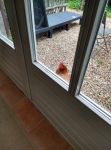
- The chickens wanted in!
-

- Wandering the meadows
-

- Butterfly watching
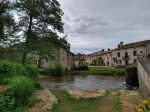
However, we did manage a few short outings: the Trou de Philippou gorge; a peek at a Saturday morning repair café (I’m a volunteer doing admin and publicity for our local repair café, which started in February) and its “recyclerie” charity shop in a nearby village; and St-Jean-de-Côle, “one of the loveliest villages in the Dordogne” according to the Rough Guide. We were taken by the main square’s church, castle and screaming swift parties – so much bigger than back home – which we’d likewise watched circling the château in the attractive medieval town of Saumur on the Loire, where we stopped for a night on the way down. There were also fresh cheeses and produce, including the most delicious strawberries ever (the “Charlotte” variety), from the two closest markets. Piégut’s is the largest market in southwest France but we had to use our imaginations as the downpour kept plenty of sellers away.


-

- St-Jean-de-Cole’s main square
-
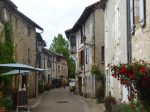
- Photo by Chris Foster.
The highlight of the trip was a visit to Grotte de Villars, a cave network with spectacular stalactites and stalagmites. Less well known than Lascaux, which is now inaccessible to visitors except via a reproduction, it too has prehistoric cave paintings of horses and bison, and 20,000-year-old bear claw marks. The paintings are gradually disappearing behind the constant calcite-creating drips; I pondered whether they will vanish before the human race does. We were lucky to find it so quiet that we got a private English-language tour. Proprietors were also so kind as to speak English to us when we shopped at a nano-brewery and did a tasting at a cider and calvados producer in Normandy on our way back to the ferry. Otherwise, we muddled through with the bare minimum of French at shops and eateries.
-

- Abbaye de Nouaillé-Maupertuis (lunch stop en route)
-

- (Photo at left by Chris Foster.)
-

- Saumur castle
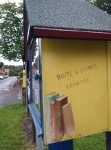
My other highlight was finding two Little Free Libraries, a walk-in one that we happened to pass in Saint-Martin-l’Ars on our initial drive down south and another in Abjat-sur-Bandiat. I felt slightly bad about taking a book at the first because of its insistence on returning or replacing once you’d read it, so I made up for it by donating Cold Spring Harbor to the book exchange box in Abjat when we returned to its crêperie for our one meal out of the holiday.
-
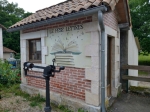
- Le Pese Lettres, Saint-Martin-l’Ars
-
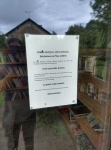
- Stricter than the usual LFL policy
-
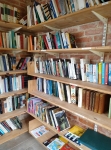
- Several English-language shelves
-
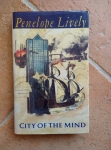
- My chosen book
-

- Abjat-sur-Bandiat book exchange box
-

- Cute cat mural in Abjat
What I Read
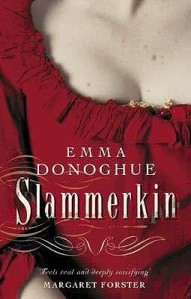 Slammerkin by Emma Donoghue (2000): A slammerkin was, in eighteenth-century parlance, a loose gown or a loose woman. Donoghue was inspired by the bare facts about Mary Saunders, a historical figure. In her imagining, Mary is thrown out by her family at age 14 and falls into prostitution in London. Within a couple of years, she decides to reform her life by becoming a dressmaker’s assistant in her mother’s hometown of Monmouth, but her past won’t let her go. The close third person narration shifts to depict the constrained lives of the other women in the household: the mistress, Mrs Jones, who has lost multiple children and pregnancies; governess Mrs Ash, whose initial position as a wet nurse was her salvation after her husband left her; and Abi, an enslaved Black woman. This was gripping throughout, like a cross between Alias Grace and The Crimson Petal and the White. The only thing that had me on the back foot was that, it being Donoghue, I expected lesbianism. (Secondhand purchase – Awesomebooks.com)
 Paris Trance by Geoff Dyer (1998): Only my second novel from Dyer, an annoyingly talented author who writes whatever he wants, in any genre, inimitably. This reminded me of Jeff in Venice, Death in Varanasi for its hedonistic travels. Luke and Alex, twentysomething Englishmen, meet as factory workers in Paris and quickly become best mates. With their girlfriends, Nicole and Sahra, they form what seems an unbreakable quartet. The couples carouse, dance in nightclubs high on ecstasy, and have a lot of sex. A bit more memorable are their forays outside the city for Christmas and the summer. The first-person plural perspective resolves into a narrator who must have fantasized the other couple’s explicit sex scenes; occasional flash-forwards reveal that only one pair is destined to last. This is nostalgic for the heady days of youth in the same way as Sweetbitter. I was intrigued to learn that random lines were sampled from Fiesta; though it is lad lit, I wouldn’t have expected a Hemingway homage from the style. (Secondhand purchase – Awesomebooks.com)
 Sanctuary in the South: The Cats of Mas des Chats by Margaret Reinhold (1993): Reinhold (still alive at 96?!) is a South African psychotherapist who relocated from London to Provence, taking her two cats with her and eventually adopting another eight, many of whom had been neglected by owners in the vicinity. This sweet and meandering book of vignettes about her pets’ interactions and hierarchy is generally light in tone, but with the requisite sadness you get from reading about animals ageing, falling ill or meeting with accidents, and (in two cases) being buried on the property. “Les chats sont difficiles,” as a local shop owner observes to her. But would we cat lovers have it any other way? Reinhold often imagines what her cats would say to her. Like Doreen Tovey, whose books this closely resembles, she is as fascinated by human foibles as by feline antics. One extended sequence concerns her doomed attempts to hire a live-in caretaker for the cats. She never learned her lesson about putting a proper contract in place; several chancers tried the role and took advantage of her kindness. (Secondhand purchase – Community Furniture Project)
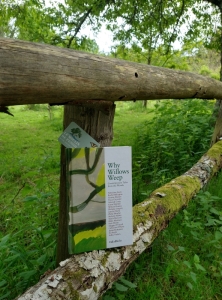
Why Willows Weep: Contemporary Tales from the Woods, ed. Tracy Chevalier and Simon Prosser (2011): These 19 short fictions, rather like Rudyard Kipling’s Just-So Stories, imagine how certain tree species developed their particular characteristics. I wasn’t expecting the fable setup and probably would have preferred a miscellany of essays and various fictional approaches. However, there is a run of great stories in the middle: from Susan Elderkin on “How the Blackthorn Got Its Flowers” to Terence Blacker on “Why Elms Die Young.” The stand-outs for me were by Rachel Billington and Maria McCann. It was a cute touch to have each author’s mini-bio end with their favourite tree, except, um, bamboo isn’t one (it’s a giant grass). I’ll probably keep this for the randomness of where I found it and the Leanne Shapton illustrations. (Secondhand purchase – La Monnerie recyclerie)
 And the first two-thirds of Daughters of the House by Michèle Roberts (1993): Thérèse and Léonie are cousins: the one French and the other English but making visits to her relatives in Normandy every summer. In the slightly forbidding family home, the adolescent girls learn about life, loss and sex. Each short chapter is named after a different object in the house. That Thérèse seems slightly otherworldly can be attributed to her inspiration, which Roberts reveals in a prefatory note: Saint Thérèse, aka The Little Flower. Roberts reminds me of A.S. Byatt and Shena Mackay; her work is slightly austere and can be slow going, but her ideas always draw me in. (Secondhand – Newbury charity shop)
A DNF: Claudine at School by Colette (a free download), which was dull and in way too small a print on my e-reader.
Plus portions of: various e-books for paid reviews, two May review books, and several library books including Moominpappa at Sea by Tove Jansson and The Invention of Hugo Cabret by Brian Selznick.


I’m happy to be home with my cat and canal, the two things I miss most when we’re away.
April Releases by Brownrigg, Ernaux, O’Connor, Waterman and Wood
Family history is a common element for the first four of these review books: a multi-generational story (incorporating autofiction in places) about Anglo-American writers and the legacy of suicide; a brief slice of memoir about the loss of a mother; a historical novella inspired by family stories and set on an island at the cusp of war; and a poetry collection drawing on a father’s death as well as on local folklore. Addiction and dementia are specific links between pairs. And to round off, a set of short stories about pregnancy and motherhood.
The Whole Staggering Mystery: A Story of Fathers Lost and Found by Sylvia Brownrigg
“The dead don’t come back, but they are not as far away as you think.”
I knew Brownrigg’s name as a novelist thanks to Susan’s blog (see her review of Pages for Her), but when I read about this family memoir it piqued my interest more than her fiction might have. The Brownrigg clan are nobility (really – her brother has the title “Baronet”) but have rejected conventional Englishness over the past century. First her grandfather, Gawen, separated from his wife and moved to Nairobi to work as a journalist. He also published two obscure novels before dying at age 27. The empty bottle of Nembutal and recent changes to his will suggested suicide, though his mother resisted the notion vociferously. Gawen’s son, Nicholas, was raised in California by his mother, Lucia, and became an alcoholic who lived off-grid on a ranch and had an unpublished Beats-influenced novel.
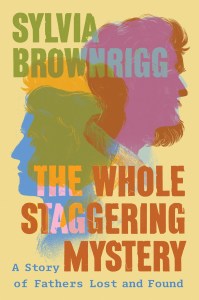 After Nicholas’s death in 2018, Brownrigg was compelled to trace her family’s patterns of addiction and creativity. It’s a complex network of relatives and remarriages here. The family novels and letters were her primary sources, along with a scrapbook her great-grandmother Beatrice made to memorialize Gawen for Nicholas. Certain details came to seem uncanny. For instance, her grandfather’s first novel, Star Against Star, was about, of all things, a doomed lesbian romance – and when Brownrigg first read it, at 21, she had a girlfriend.
Along with the more traditional memoir sections, there are the documents that speak for themselves and extended passages of autofiction. I loved an imaginary letter by Gawen’s older brother, who died in young childhood, and a third-person segment about Beatrice’s life in England during the Second World War. But I mostly skipped over the 90 lightly fictionalized pages about the author’s (“Sophie’s”) life with her father in California. You might view this as a showcase of possible methods for engaging with family history, some of which work better than others. All of it is fascinating material, though.
Published by Counterpoint in the USA. With thanks to Nectar Literary for the advanced e-copy for review.
A Woman’s Story by Annie Ernaux (1988; 2024)
[Translated from the French by Tanya Leslie]
 This memoir of Ernaux’s mother’s life and death is, at 58 pages, little more than an extended (auto)biographical essay. Confusingly, it covers the same period she wrote about in I Remain in Darkness (originally published nine years later), a diary of her mother’s final years with dementia; I even remembered two specific events and quotes. Why not combine the two into a full-length biographical recollection? Or pair it with A Man’s Place, Ernaux’s memoir of her father, in one volume? Perhaps her works will be repackaged in the future. But this came first: Ernaux started writing just a couple of weeks after her mother’s death, and spent 10 months over it. It’s clear she was determined to salvage what she could of her mother’s life:
It’s a difficult undertaking. For me, my mother has no history. She has always been there. When I speak of her, my first impulse is to ‘freeze’ her in a series of images unrelated to time … This book can be seen as a literary venture as its purpose is to find out the truth about my mother, a truth that can be conveyed only by words. … I believe I am writing about my mother because it is my turn to bring her into the world.
Ernaux opens with news of the death, and the funeral. But soon she’s pushing back into the past. Her mother grew up in poverty near Rouen and worked in a factory before her marriage, when she and her husband took on a grocery store and café. The Second World War was in some romantic way the great drama of her life. She was exacting of her daughter: “Her overriding concern was to give me everything she hadn’t had. But this involved so much work, so much worrying about money”. In her widowhood she came to live with Ernaux, who was then divorced with two sons, and tried to find a middle way between independence and connection. Eventually, though, her memory loss required admission to a nursing home.
I’ve felt the same about all three short works I’ve read by Ernaux so far: though precisely observed, they conceal themselves behind emotional distance. So while this might seem similar to A Very Easy Death by Simone de Beauvoir, I found the latter more engaging.
With thanks to Fitzcarraldo Editions for the free copy for review.
Whale Fall by Elizabeth O’Connor
 The remote Welsh island setting of O’Connor’s debut novella was inspired by several real-life islands that were depopulated in the twentieth century due to a change in climate and ways of life: Bardsey, St Kilda, the Blasket Islands, and the Aran Islands. (A letter accompanying my review copy explained that the author’s grandmother was a Welsh speaker from North Wales and her Irish grandfather had relatives on the Blasket Islands.)
Eighteen-year-old Manod Llan is the older daughter of a lobster fisherman. Her sweetheart recently left to find work in a mainland factory. It’s 1938 and there are vague rumbles about war, but more pressing is the arrival of strangers here to study a vanishing culture. Anthropologists Edward and Joan learn snatches of Welsh and make recordings of local legends and songs, which are interspersed with the fragmentary narrative. Manod, star-struck, seeks the English researchers’ approval as she helps with translation and other secretarial duties, but becomes disillusioned with their misinterpretations and fascist leanings.
The gradual disintegration of a beached whale casts a metaphorical shadow of decay over the slow-burning story. I kept waiting for momentous events that never came. More definitive consequences? Something to do with Manod’s worries for her little sister, Llinos? A flash-forward to the abandoned island’s after-years? Or to Manod’s future? As it is, the sense of being stuck at a liminal time makes it all feel like prologue. But O’Connor’s writing is quite lovely (“The milk had formed a film over the surface and puckered, like a strange kiss”; “All of my decisions felt like trying to catch a fish that did not exist until I caught it”) and the book is strong on atmosphere and tension. I’ll look out for her next work.
With thanks to Picador for the free copy for review.
Come Here to This Gate by Rory Waterman
I was most drawn to the poems in Part I, “All but Forgotten,” about his father’s last year or so.
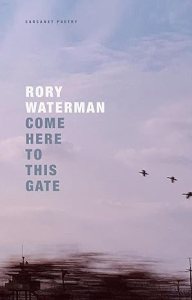
The titles participate in telling the story: “Alcoholic Dementia,” followed by “Twin Oaks Nursing Home.”
The sheep-tracks of your mind were worn to trenches.
…
Then what you’ve turned yourself into – half there
on one side of a final single bed
you might not leave till the rest of you has left –
starts, stares through me, says ‘I’m being held
against my will!’, tells a nurse to ‘Just fuck off’
then thanks her. Old boy, when did you get like this?
The sheep-tracks of my mind are worn to trenches.
Then they moved you to a home
that still wasn’t home. ‘Why
am I in this fucking place?
Nothing’s wrong with me.’
So I’d tell you all over again,
but only the easy part (‘You’re
not remembering things well
at present.’ ‘Yes I fucking am’)
and you relearned that you’d
never learn – mindless torture,
until I stopped it. Your
silences were trains departing.
From the miscellany of Part II, I plucked out “Gooseberries” and “Perennials,” both of which conceal emotion among plants. Then Part III, “Lincolnshire Folk Tales,” turns the tone mischievous, with the ABCB end-rhymes of “Yallery Brown,” “The Metheringham Lass,” “The Lincoln Imp,” and “Nanny Rutt” (I felt I’d stumbled on a limerick with its rhythm: “Math Wood is a small plot of trees south of Bourne, / next to McDonald’s and Lidl. / It’s privately owned, full of shot-gun shells, pheasants – / but still, a bit of an idyll”). Plenty of good stuff, then, but it doesn’t all seem to fit together in the same collection.
With thanks to Carcanet Press for the advanced e-copy for review.
This Is Why We Can’t Have Nice Things by Naomi Wood
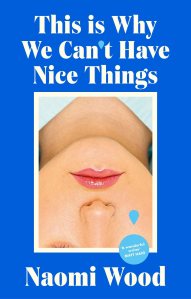 I requested this because a) I had enjoyed Wood’s novels Mrs. Hemingway and The Hiding Game and b) I couldn’t resist the title. These nine contemporary stories (five in the first person and four in the third person) all feature women who are pregnant and/or mothers of young children. Three dwell on work–life balance in particular, with the female protagonists of “Lesley, in Therapy” and “Dracula at the Movies” an animator and a filmmaker, respectively. The third, “Hurt Feelings,” in which a medical emergency forces a choice between career and motherhood, was my favourite. Claudia is working on an advertising campaign for a large pharmaceutical company whose newest product targets chronic pain. Although she suspects it’s a placebo, she knows how valuable it is for these people to have their pain acknowledged given it’s as invisible as her history of pregnancy loss.
Other highlights included “Peek-a-Boo,” in which pregnant twin sisters fly to Italy to remonstrate with their father, who refuses to cede a holiday flat to the next renters; and “Wedding Day,” about a woman bitter enough to try to sabotage her ex’s big day by demanding he bring their daughter, the flower girl, home by bedtime. “Flatten the Curve” is about restrictions and desires during Covid lockdown. Family, neighbour, and co-worker dynamics fuel the drama. In a few cases, Wood imagined promising situations but didn’t deliver on them. I could hardly believe “Comorbidities,” about a mother who films a sex tape with her husband to distract from her eco-anxiety, won the 2023 BBC National Short Story Award. If Wood was aiming for edgy, she landed on peevish instead. “Dino Moms,” the final story, was worst, with its absurd dinosaur-vet reality-TV setup. Overall, the collection is too one-note because of the obsession with motherhood (“It is not very interesting to be in love with your child; it’s commonplace, this sacrificial love”). Back to novels soon, please.
With thanks to Phoenix (Orion) for the free copy for review.
Does one of these catch your eye? What April releases can you recommend?
Dressing Up for the Carnival by Carol Shields (Buddy Reread)
Marcie of Buried in Print and I have spent the first few months or so of 2024 rereading Carol Shields’s short stories: one volume per month from the Collected Stories. (Previous reviews: Various Miracles (1985) and The Orange Fish (1989).) Dressing Up for the Carnival was a late collection, published in 2000 – just a few years before the author’s death. Like Various Miracles, it’s a long book; in fact, at 22 stories, it’s the longest of the three. And, just like the other two, it opens with the title story, which is itself akin to “Various Miracles” with its pile-up of seemingly random happenings. All the examples are of how the things that people wear, or carry, create a persona. I noted pleasing symmetry in that “Dressing Up for the Carnival” opens the book, while the final story is “Dressing Down,” about a married couple divided by the husband’s devotion to naturism for one month out of each year.
 I hadn’t realized that Unless, Shields’s final, Booker-shortlisted novel, arose from one of these stories: “A Scarf.” It took me just two paragraphs to figure it out, based on her narrator’s punning novel title (My Thyme Is Up). I’d also forgotten about the fun Shields pokes at literary snobbishness through her protagonist winning the Offenden Prize, which “recognizes literary quality and honors accessibility”. (There is actually a UK prize that rewards ease of reading, the Goldsboro Books Glass Bell Award.)
Many main characters throughout Shields’s work are artists, musicians, writers or poets. When windows are subject to an exorbitant tax, two painters decide to create their own, a joint project that brings the couple closer (in “Windows”). The elevated diction and proliferating French phrases skewer the narrator’s pretensions. Edging towards surrealism is another custom of Shields’s, seen here in “Weather,” where meteorological phenomena – or the lack thereof – are literal and a metaphor for marriage. This one finds an echo in “Stop!”, a fable about a queen who avoids all risk and change and thus disallows weather.
A number of the flash-length stories are similarly allegorical, or linguistic experiments, e.g., “Absence,” which is lipogrammatic (no “I”). “Flatties: their Various Forms and Uses” is a faux-anthropological one about flatbreads that reminded me of “Today Is the Day.” “The Harp” looks at the aftermath of the freak accident of a harp falling from the sky. “Keys” is a daisy-chain type of story (like “Home” et al.), with the keys symbolic of access, ownership, secrets, home, and more. Academia is another frequent subject for Shields. “Ilk” has the same academic jargon (“narrativity is ovarian, not ejaculatory”) and mockery of a predominantly male preserve as in “The Metaphor Is Dead–Pass It On” and “Salt.”
A topic shared with The Orange Fish is the biographer’s art. I loved “Edith-Esther,” about a biographer who becomes so obsessed with the expression of spirituality in his subject’s works that he completely skews her life story towards it, even though she tells him flat out she doesn’t believe in God. What a nightmare for an author to be so misunderstood; it’s no accident, of course, that it’s a male critic doing it to a female writer. “Invention” imagines creation scenarios for everything from steering wheel covers to daydreaming.
 In “Dying for Love,” an early standout for me, three wronged women consider suicide. The vocabulary quickly alerts the reader to a change of time period after each section break. All three decide “Life is a thing to be cherished”. My three favourites, though, were the final three – all slightly cheeky with the focus on sex (and naturism). They were together an excellent way to close the volume, and the Collected Stories. In “The Next Best Kiss,” single mother Sandy meets a new paramour at a conference. She and Todd share garrulousness, and a sexual connection. But he doesn’t’ see the appeal of her biography’s subject, a Gregor Mendel-meets-John Clare type, and she is aghast to learn that he still lives with his mother.
“Eros,” set at a sexually charged dinner party (and you know from Larry’s Party that Shields is brilliant at party scenes), spools back through Ann’s erotic life, all the way to childhood ignorance and curiosity. “Everyone knew this awful secret which was everywhere suggested but which for Ann lay, still, a quarter-inch out of reach.” That Ann has lost a breast to cancer treatment made me ponder whether this story reflected Shields’s own experience – she died in 2003 of a recurrence of breast cancer.
There were a few too many second-tier stories here compared to The Orange Fish, but several gems; and I always appreciate Shields’s wordplay and insider’s satire on being an academic and/or a writer.
My original rating (c. 2008):
My rating now:
Bonus
Shields’s final short story, “Segue,” is printed first in the Collected Stories. Dutiful Marcie read it first, whereas I saved it for last to try to preserve a sense of chronological order. Max Sexton writes novels, the latest of which sounds exactly like The Corrections – a 2001 publication, and Shields also references 9/11. Jane Sexton, the narrator, writes sonnets (“little sounds”) and thinks about ageing, routine, and the transmutation of life into art. A sonnet typically involves a “turn,” which I suppose is the origin of the title. Coming to the end of her life, did Shields think of herself primarily as a poet? This line did strike me as autobiographical: “Forget you are a sixty-seven-year-old woman with a girlish white pageboy.” The Oak Park, Illinois setting inevitably reminded me of Hemingway, but Shields, too, was from Chicago. The final line captures the bittersweet nature of so much of her work: “if it weren’t for my particular circumstances I would be happy.”
Rereading Shields is a habit I plan to keep up. For my next reread, I fancy Mary Swann.
Carol Shields Prize Longlist Reads: Cocktail & Land of Milk and Honey
Two final reviews in advance of tomorrow’s shortlist announcement: a sophisticated, nostalgic short story collection and an intense future-set novel full of the pleasures of the flesh. Both make it onto my wish list at the end of this post.
Cocktail by Lisa Alward
The 12 stories of this debut collection brought to mind Tessa Hadley and Alice Munro for their look back at chic or sordid 1960s–1980s scenes and dysfunctional families or faltering marriages. They’re roughly half and half first-person and third-person (five versus seven). The title story opens the book with a fantastic line: “The problem with parties, my mother says, is people don’t drink enough.” Later, the narrator elaborates:
Her meaning is that if people drank more, they’d loosen up. Parties would be more fun, like they used to be. And I laugh along. Yes, I say, letting her top up my glass of Chardonnay. That’s it, not enough booze. But I’m thinking about Tom Collins.
 Not the drink, but an alias a party guest used when he stumbled into her bedroom looking for a toilet. She was about eleven at this point and she and her brother vaguely resented being shut away from their parents’ parties. While for readers this is an uncomfortable moment as we wonder if she’s about to be molested, in memory it’s taken on a rosy glow for her – a taste of adult composure and freedom that she has sought with every partner and every glass of booze since. This was a pretty much perfect story, with a knock-out ending to boot.
Dependence on alcohol recurs, and “Hawthorne Yellow,” is also about a not-quite affair, between a restless stay-at-home mother and the decorator who discovers antique sketches in the old servants’ quarters of her home. “Orlando, 1974” again contrasts childhood nostalgia with seedy reality: Disney World should have been an idyll, but the narrator mostly remembers a lot of vomiting. “Old Growth” and “Bear Country” have Ray renegotiating his relationship with his son after divorcing Gwyneth. “Hyacinth Girl,” too, is about complicated stepfamilies, while “Wise Men Say” looks back at cross-class romance. The protagonist of “Maeve” feels she can’t match the title character’s perfect parenting skills; the first-person plural in “Pomegranate” portrays a group of wild convent schoolgirls.
“Little Girl Lost” was the most Hadley-meets-Munro, with an alcoholic painter’s daughter seen first as a half-feral child and later as a hippie young woman. “How the Smoke Gets in Your Eyes” was the least essential with its elderly narrator piecing things together in the aftermath of a burglary. Along with the title story, the standout for me was “Bundle of Joy,” about a persnickety grandmother going to her daughter’s place to spend time with her new grandson. She disapproves of just about every decision Erin has made (leaving the dogs’ frozen turds in the backyard all winter, for instance), but her interference threatens to have lasting consequences. Not a dud in the dozen, and a very strong voice I’ll expect to read much more from. (Read via Edelweiss; published by Biblioasis)
Land of Milk and Honey by C Pam Zhang
We all die. We have only the choice, if we are privileged, of whether death comes with a whimper or a bang; of what worlds we taste before we go.
A real step up from How Much of These Hills Is Gold, which I read for book club last year – while it was interesting to see the queer, BIPOC spin Zhang put on the traditional Western, I found her Booker-longlisted debut bleak and strange in such a detached way that it was hard to care about. By contrast, I was fully involved in her sensuous and speculative second novel.
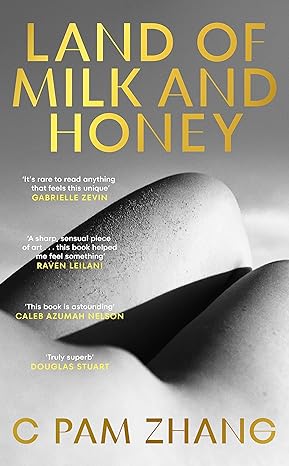 A 29-year-old Chinese American chef is exiled when the USA closes its borders while she’s working in London. On a smog-covered planet where 98% of crops have failed, scarcity reigns – but there is a world apart, a mountaintop settlement at the Italian border where money can buy any ingredient desired and threatened foods are cultivated in a laboratory setting. While peasants survive on mung bean flour, wealthy backers indulge in classic French cuisine. The narrator’s job is to produce lavish, evocative multi-course meals to bring investors on board. Foie gras, oysters, fine wines; heirloom vegetables; fruits not seen for years. But also endangered creatures and mystery meat wrested back from extinction. Her employer’s 21-year-old daughter, Aida, oversees the lab where these rarities are kept alive.
Ironically, surrounded with such delicacies, the chef loses her appetite for all but cigarettes – yet another hunger takes over. Her relationship with Aida is a passionate secret made all the more peculiar by the fact that the chef’s other role is to impersonate Aida’s dead mother, Eun-Young. It’s clear this precarious setup can’t last; ambition and technology keep moving on. The novel presents such a striking picture of desire at the end of the world. Each sentence is honed to flawlessness, with whole paragraphs of fulsome descriptions of meals. Zhang’s prose reminded me of Stephanie Danler’s and R.O. Kwon’s – no surprise, then, that they’re on the Acknowledgments list, as are a cornucopia of foods and other literary influences.
I’m not usually one for a dystopian novel, but the emotional territory keeps this one grounded even as the plot grows more sinister. My only complaint is that I would have left off the final chapter as I don’t think tracing the protagonist through four more decades of life adds much. I would rather have left this world in limbo than thought of the episode as a blip in a facile regeneration process – that’s the most unrealistic element of all. But this has still been my favourite read from the longlist so far. And there’s even a faithful pet cat, a “recalcitrant beast” that keeps coming back to the chef despite benign neglect. (Public library) 
My ideal shortlist, based on what I’ve read and still want to read, would be:

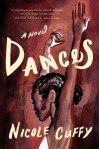
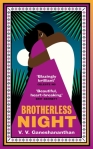

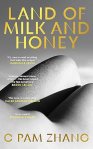
Cocktail by Lisa Alward
Dances by Nicole Cuffey
Brotherless Night by V.V. Ganeshananthan
I Have Some Questions for You by Rebecca Makkai
Land of Milk and Honey by C Pam Zhang
I wouldn’t be averse to seeing The Future or Chrysalis on there either. (Just not Loot, please!)
See Laura’s post for a recap of her reviews and her wish list. Marcie has also been reading from the longlist; see her first write-up here.
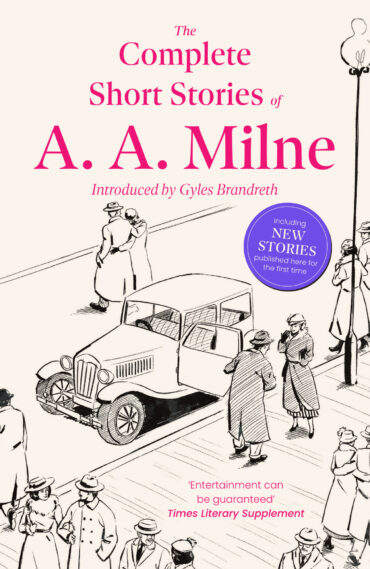
The Complete Short Stories of A. A. Milne (Blog Tour)
Like many readers, I only knew A. A. Milne (1882–1956) for his Winnie-the-Pooh stories and had no idea of how much he wrote for adults: novels, plays, journalism, screenplays, and yes, short stories. This doorstopper of a collection includes some never-before-published material – undated and fragmentary stories. The stories span virtually his entire career, from 1914 to 1953.
I was daunted by the heft of the book when it arrived so got in touch with Simon Thomas (Stuck in a Book) because I remembered that Milne is his favourite author. With his direction, I decided to focus on the later stories originally published in the volume The Birthday Party and Other Stories (some of which originally had different titles).
Even within this subset, I found a lot of variety. One of my favourites was “In Vino Veritas,” a tricksy mystery story for fans of classic crime whether Sherlock Holmes, Agatha Christie or Raymond Chandler. The narrator is a writer of detective stories which are often inspired by cases recounted to him by his police superintendent friend Frederick Mortimer. Mortimer tells him of a murder accomplished using a poisoned bottle of wine. But “I could almost feel the murderer behind us, pushing us along the way he wanted us to go,” Mortimer says. The evidence seemed almost too neat, and a replication plus a couple of switchbacks reveal that everything was not as it appeared for the superintendent, or for our narrator.
Milne plays with genre and history here. “The Secret” is a skewed fairy tale that even opens with “Once upon a time.” “The Lost Diary of Shakespeare” turns the authorship controversy on its head. “The General Takes off his Helmet” inhabits the time of Hannibal. “A.V. and R.V.” has a little girl distressed at a biblical account of mass death and her mother parroting an unsatisfactory mainline interpretation about punishment for sin and the need for faith; then we parachute into King David’s court and see him conspiring to blame it all on a woman.
But the stand-out for me was “The Birthday Party.” William Henry Baker, brimming with emotion after the birth of his first child, David Alistair Shawn, early one April morning, sets off by train for his office in the City. His wife has told him to have a good dinner and drink to the baby’s health, so after keeping his happy secret from his colleagues all day, he heads to the Savoy for a blowout meal. Just as he’s worried that he won’t be able to pay the large bill, a pair of diners takes him under their wing to form part of a harmless deception. He’s carried out Maggie’s instructions, but perhaps not in the way she might have imagined. Setting aside the injustice of his shell-shocked wife having to stay at home with an infant while he gets on with his normal life and has a luxurious meal (it was 1948, after all), this was a sweet straight-man-in-bizarre-circumstances story, the kind that might spark a screwball comedy.
There’s so much to discover just in this volume, and five other Milne titles have also been reissued in the last year or so. Soon adult readers will be saying, Winnie the who?
With thanks to Random Things Tours and Farrago (Duckworth Books) for the free copy for review.
Buy The Complete Short Stories of A. A. Milne from Bookshop.org [affiliate link]
I was happy to be part of the blog tour for the release of this book. See below for details of where other reviews have appeared or will be appearing soon.

Carol Shields Prize Longlist Reading: The Future and Chrysalis
My first two dedicated reads for our informal Carol Shields Prize shadowing project exhibit one main way in which the prize is different from the Women’s Prize for Fiction: works in translation and short story collections are eligible. I have one of each to review today. Laura and I did a buddy read of an atmospheric dystopian novel translated from the French, and I caught up on a magical, erotic story collection I’d had on my Kindle for a long time. These were both very good, but my minor misgivings are such that I’d rate them the same:
The Future by Catherine Leroux (2020; 2023)
[Translated from the French by Susan Ouriou]
For such a monolithic title, this has a limited stage: a few derelict districts of the ailing city we know as Detroit, Michigan – but in Leroux’s alternate version, it remained part of French Canada, with lingering Indigenous influence, and so is known as Fort Détroit. No doubt she was inspired by the many vacant properties that characterized Detroit in the 2010s; there’s even a ruins tour bus. In her Fort Détroit, a handful of determined adults cling on in their own homes, but the streets and parks have been abandoned to animals and to a gang of half-feral children who have developed their own nicknames (Adidas, Lego, Wolfpup), social hierarchy and vernacular. Worlds meet when Gloria determines to find her granddaughters Cassandra and Mathilda, who ran away after their addict mother Judith’s suspicious death. At the same time, her neighbour Eunice wants to find out who ran her father down in the street.
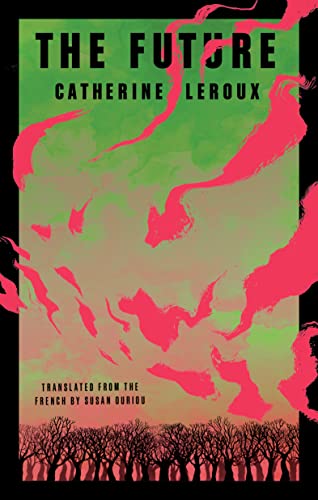 Despite their fierce independence and acts of protest, the novel’s children still rely on the adult world. Ecosystems are awry and the river is toxic, but Gloria’s friend Solomon, a former jazz pianist, still manages to grow crops. He overlooks the children’s thefts from his greenhouse and eventually offers to help them grow their own food supply, and other adults volunteer to prepare a proper winter shelter to replace their shantytown. Puberty threatens their society, too: we learn that Fiji, the leader, has been binding her breasts to hide her age.
I expected to be reminded strongly of Station Eleven, and while there were elements that were reminiscent of Emily St John Mandel’s work, Leroux’s is a more consciously literary approach. The present-tense omniscient narration occupies many perspectives, including that of a dog, and the descriptions and musings are more lyrical than literal. Where another author would site high drama – sixtysomething Gloria’s night quest, a few children rafting down the river – Leroux moves on swiftly to other character interactions. What did bring Mandel to mind was the importance of art during societal collapse: the children spin nursery rhyme mash-ups and fairytales, Stutt rescues a makeshift library and insists on Huckleberry Finn going along on the river journey, and Solomon plays the piano again after decades.
The opening mysteries of death and disappearance are resolved before the end, but don’t seem to have been the point. The Future is more subtle and slippery than many dystopian novels I’ve read in that there’s not really a warning, or a message here. Instead, there’s an intriguing situation that opens out and alters slightly, but avoids resolution. It’s all about atmosphere and language – I was especially impressed by Ouriou’s rendering of Leroux’s made-up dialect via folksy slang (“She figgers she’s growed-up”). I loved the details and one-on-one moments more than the momentous scenes. On the whole, I found the story elegant but somewhat frustrating. You might be drawn to it if you enjoyed To Paradise or the MaddAddam books. (Read via Edelweiss; published by Biblioasis)
See also Laura’s review.
Chrysalis: Stories by Anuja Varghese (2023)
This debut collection of 15 stories brims with magic and horror, and teems with women of colour and queer people. Indeed, Varghese dedicates the book to “all the girls and women who don’t see themselves in most stories.” Most of the characters are of South Asian extraction. Adoption recurs in a couple of places. Two of the rarer realist stories, “Milk” and “Stories in the Language of the Fist,” have protagonists dealing with schoolgirl bullying and workplace microaggressions. More often, there are unexplained phenomena that position the players between life and death. “In the Bone Fields” focuses on the twin daughters of an Indian immigrant family on a Canadian farm. The house and the bone field behind are active and hungry, and only one twin will survive. (I got mild North Woods vibes.)
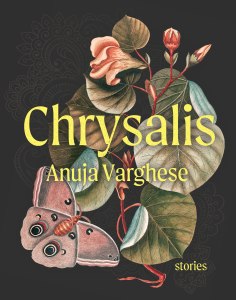 In the title story, Radhika visits her mother’s grave and wonders whether her life is here in Montreal with her lover or back in Toronto with her husband. Fangs and wings symbolize her desire for independence. Elsewhere, watery metaphors alternately evoke fear of drowning or sexual fluidity. “Midnight at the Oasis” charts the transformation of a trans woman and “Cherry Blossom Fever,” one of my two favourites, bounces between several POVs. Marjan is in love with Talia, but she’s married to Sunil, who’s also in love with Silas. “People do it — open their relationships and negotiate rules and write themselves into polyamorous fairy tales … Other people. Not brown people,” Talia sighs. They are better off, at least, than they would be back in India, where homophobia can be deadly (“The Vetala’s Song”).
My other favourite was “Bhupati,” about a man who sets up multiple Lakshmi figures in the backyard, hoping devotion will earn him and his wife a better future. The statues keep being burned up by lightning; we learn his wife may be petitioning for different things. “Chitra” is a straightforward Cinderella retelling whose title character lives with two mean stepsisters and works in food service at the mall. A Shoe Chateau BOGO closing sale gives her the chance to get a bargain – and catch the manager’s eye. Despite a striking ending signalled by the story’s subtitle, all I could conclude about this one was “cute.” The three flash horror stories (a murder hotel, ghosts in a basement, werewolves) were much the weakest for me.
There’s a pretty even split of third- and first-person stories (nine versus six) here, and the genre shifts frequently. The quality wasn’t as consistent as I’d hoped, but it was an engaging read. The overall blend of feminism and horror had me thinking of Her Body and Other Parties by Carmen Maria Machado, but I’d be most likely to recommend this to fans of Julia Armfield, Violet Kupersmith and Vauhini Vara. (Read via Edelweiss; published by House of Anansi Press)
Both of these are worthwhile books and it’s great that readers outside of Canada can discover them. I wouldn’t personally shortlist either, but the judges may well be dazzled enough to do so. I don’t yet have a sense of where they’d fit for me in the rankings.
Up next:
Cocktail by Lisa Alward (short story collection from Edelweiss)
A Council of Dolls by Mona Susan Power (buddy read with Laura)
Land of Milk and Honey by C Pam Zhang (from library)

I’m aiming for one or two more batches of reviews before the shortlist is announced on 9 April.
Thoughts on the Women’s Prize and Carol Shields Prize Longlists
Yesterday was my 9th blog anniversary! I love that it coincides with International Women’s Day.

It’s traditionally also been the day of the Women’s Prize longlist announcement, but the past two years they’ve brought it forward to pre-empt news of the Carol Shields Prize for Fiction longlist. It’s hard not to see these prizes as being in competition, though the CSP is only for U.S. and Canadian residents; also considers short story collections, graphic novels, and work in translation; and is more deliberate about including trans and nonbinary authors.
Like last year, their lists are extremely different. In 2023 there was no crossover; this year only one novel appears on both (Brotherless Night). Although it’s easier for me to feel engaged with the WP, I’m drawn to reading much more from the CSP list.
Women’s Prize
Of my predictions, only 1 was correct, compared to last year’s 4. I got none of my personal wishes, as in 2023. I guess making a wish list is a kiss of death! Once again, we have a mix of new and established authors, with a full half of the list being debut work. Nine of the authors are BIPOC. I’ve read 2 of the nominees and would be agreeable to reading up to 6 more. My library always buys the entire longlist, so I’ll eventually get the chance to read them, but not soon enough to add to the conversation.

Read:
 The Wren, The Wren by Anne Enright (CORRECT PREDICTION): Enright’s astute eighth novel traces the family legacies of talent and trauma through the generations descended from a famous Irish poet. The novel switches between Nell’s funny, self-deprecating narration and third-person vignettes about her mother, Carmel. Cycles of abandonment and abuse characterize the McDaraghs. Enright convincingly pinpoints the narcissism and codependency behind their love-hate relationships.
 Western Lane by Chetna Maroo: Easy to warm to even if you’ve never played and know nothing about squash. A debut novella that is illuminating on what is expected of young Gujarati women in England; on sisterhood and a bereaved family’s dynamic; but especially on what it is like to feel sealed off from life by grief. This offbeat, delicate coming-of-age story eschews literary fireworks. In place of stylistic flair is the sense that each word and detail has been carefully placed.
Will read:
Enter Ghost by Isabella Hammad – requested from the library
8 Lives of a Century-Old Trickster by Mirinae Lee – on my Kindle from NetGalley
Interested in reading:
In Defence of the Act by Effie Black – queer novella, suicide theme
And Then She Fell by Alicia Elliott – Indigenous Canadian, postpartum depression theme
Soldier Sailor by Claire Kilroy – Irish author, new motherhood theme
The Blue, Beautiful World by Karen Lord – Black sci-fi author
Maybe:
Brotherless Night by V.V. Ganeshananthan – see below
Not interested in reading:
Hangman by Maya Binyam – meh
The Maiden by Kate Foster – not keen on historical mysteries, and this looks very commercial
Restless Dolly Maunder by Kate Grenville – will read more Grenville, but not this one any time soon
River East, River West by Aube Rey Lescure – have read mixed reviews
Nightbloom by Peace Adzo Medie – disliked her debut novel
Ordinary Human Failings by Megan Nolan – enjoyed her first novel, but DNFed this
A Trace of Sun by Pam Williams – nah
See also the reactions posts from Eric and Laura.
Predictions:
I’d expect to see two or three of the Irish writers on the shortlist, plus probably Western Lane, Enter Ghost, and a couple of other wildcards (but not the SF novel). Enter Ghost, set in Palestine, would certainly be a timely winner…
What comes next:
Shortlist (6 titles) on 24 April and winner on 13 June.
Carol Shields Prize
After I badgered the administrators for six months about Q&A responses that never materialized, they kindly offered me digital review copies of any of the nominees that I’m not able to easily access in the UK. This is, in general, a more rigorous list of highbrow literary fiction, with some slight genre diversity thanks to Catton and Makkai (plus a mixture of historical and contemporary fiction, three story collections, and one book in translation); 10 of 15 authors are BIPOC. There are further details about all the nominees on the website.

Read:
 I Have Some Questions for You by Rebecca Makkai – When an invitation comes from her boarding school alma mater, Granby, to teach a two-week course on podcasting, Bodie indulges her obsession with the 1995 murder of her former roommate. Makkai has taken her cues from the true crime genre and constructed a convincing mesh of evidence and theories. She so carefully crafts her pen portraits, and so intimately involves us in Bodie’s psyche, that it’s impossible not to get invested. This is timely, daring, intelligent, enthralling storytelling. (Delighted to see this nominated as I hoped the WP would recognize it last year.)
Skimmed and didn’t care for:
Birnam Wood by Eleanor Catton
Loot by Tania James
Will read:
Land of Milk and Honey by C. Pam Zhang – requested from the library
Know little or nothing about but will happily read if I get a chance:
Cocktail: Stories by Lisa Alward
Dances by Nicole Cuffy
Daughter by Claudia Dey
Between Two Moons by Aisha Abdel Gawad
You Were Watching from the Sand: Short Stories by Juliana Lamy
The Future by Catherine Leroux, translated by Susan Ouriou – has just won Canada Reads
A Council of Dolls by Mona Susan Power
Chrysalis: Stories by Anuja Varghese
Less interested in reading:
Brotherless Night by V. V. Ganeshananthan – Sri Lankan civil war setting
Coleman Hill by Kim Coleman Foote – Fictionalized family memoir with 9 POVs
A History of Burning by Janika Oza – Big Indian-Ugandan multigenerational story
Predictions:
Not the first clue. Come back to me after I’ve read a few more.
What comes next:
Shortlist (5 titles) on 9 April and winner on 13 May.
What have you read, or might you read, from the longlists?
February Releases by Hess, Kim, Sides (#ReadIndies); Atwood and Shah
I’m pleased to have, between this post and yesterday’s review catch-up, featured 9 books from 8 independent publishers for Read Indies this month. (I have also done some indie reading from my shelves, which I’ll summarize early in March.) Three of the books in my February review stacks were indie releases. I’ve got a hybrid memoir that blends poetic exploration of scripture with personal psychological reflections; an out-of-the-ordinary mystery about a father’s disappearance that comments on disability, racism and much more; and a terrific set of fabulist short stories. My two bonus (non-indie) February books are an unconvincing collaborative novel and a counselling-focussed bibliotherapy guide.

When Fragments Make a Whole: A Personal Journey through Healing Stories in the Bible by Lory Widmer Hess
 Some of you may know Lory, who is training as a spiritual director, from her blog, Enter Enchanted. It was so kind of her to get in touch offering her first book for review. It’s a unique combination of poetry, scriptural exegesis, and fragments of memoir. Each chapter considers a different healing story from the Gospels. As in the lectio divina I learned from college Christian fellowships, the idea with the verse retellings from the Bible is to imagine oneself into a character’s position and consider the crises that led to seeking Jesus’ help. I especially liked the poem “Talitha, Koum,” which links the stories of the woman with the issue of blood and the resurrection of Jairus’ daughter. In both, faith reverses a seemingly hopeless situation.
The short sections of commentary draw in a lot of context as well as etymology from the Greek. The autobiographical essays chart a history of physical and mental challenges, including dissociation, low self-esteem and shame, and offer openness to healing as its own miracle when there are no easy answers. They are notable for their vulnerability, especially when discussing marital problems. The outlook is intellectual and psychological rather than the spiritualizing I’m used to from my evangelical background – Lory comes from the anthroposophy tradition, which I don’t claim to fully understand but (I think) eschews dogma like original sin and atonement and instead makes the spiritual journey a matter of human reconnection with God through free will and the intellect. This is nicely balanced, though, by her work with developmentally disabled adults in residential homes in New England and Switzerland, which reminds her “there is a truth beyond intellectual knowledge, a language beyond words”. It is a calm, honest, methodical book that will intrigue anyone interested in thinking through how the Bible is applicable to the challenges of daily life.
With thanks to the author and Floris Books (Edinburgh) for the free copy for review.
Happiness Falls by Angie Kim
Buzz from across the pond about Kim’s novels led me to request this even though I don’t typically read mysteries. The bulk is set over 2.5 days in June 2020 as the Korean American Parkson family investigates, on their own and with the help of police and various local tip-offs, what happened to the father, Adam, who’d been at River Falls Park with the severely disabled 14-year-old son, Eugene, who is autistic and has mosaic Angelman syndrome. Mother Hannah and 20-year-old twins Mia and John, home from college for the lockdown, quickly realise something is wrong when Eugene, who has blood on his shirt and under his nails, stumbles home on his own and Adam is unreachable by phone. There’s more to the setup than that, and many complicated side-tracks to the investigation, but the basic questions remain for 300+ pages: What happened to Adam? and What was Eugene’s part in it?
Mia narrates, and it’s a pleasure spending time with her quick, systematic brain as she runs through all the options and deals with each new theory and red herring. She clearly gets it from her father, whose recovered notebook is full of amateur experimentation on the “Happiness Quotient”. Her wit and garrulousness (sample aside: “I’m sorry, but I don’t care how much you love fun fonts—you cannot talk about prison rape in Comic Sans”) spills over into footnotes as if in effusive counterpoint to Eugene, who is nonspeaking.
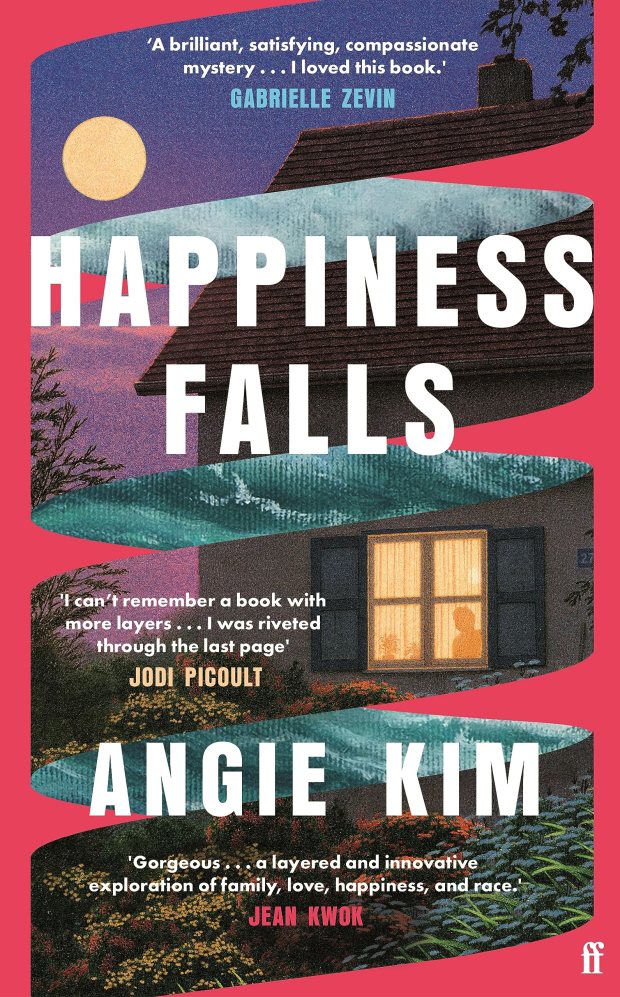
The pandemic setting places interesting constraints on the official proceedings, and the prospect of a new communication method (involving painstaking spelling with a letter stencil) revolutionizes this family as they grasp that Eugene is far from nonverbal and has been ‘locked in’ all along. The account a therapist elicits from him seems to clinch the case, but uncertainty lingers.
This is like a blend of Celeste Ng’s Everything I Never Told You, Rebecca Makkai’s I Have Some Questions for You, and Naoki Higashida’s The Reason I Jump; if you’ve liked one or more of these, I would strongly recommend it. Mystery readers may lack patience for the digressions. The solution is eclipsed by the many issues – prejudice based on race and disability, how one’s circumstances affect contentment, nuances of communication, sibling relationships and twin ESP – explored along the way. Because I am not a crime reader, the pace was no problem for me. My annoyances were with the preponderance of hindsight (“I wish I’d said something,” “It didn’t occur to me until much later”) and the fact that Mia says “begs the question” for raising a question (misuse of a rhetorical term) several times. I found personal meaning in the book because of the Washington, DC-area locales and my severely disabled, nonverbal goddaughter. What if there really is something going on in her mind, and we could find out what it was… I mused. I’ll be keen to read Kim’s debut, Miracle Creek.
With thanks to Faber for the free copy for review.
Crocodile Tears Didn’t Cause the Flood by Bradley Sides
 These 17 flash fiction stories fully embrace the possibilities of magic and weirdness, particularly to help us reconnect with the dead. Brad and I are literary acquaintances from our time working on (the now defunct) Bookkaholic web magazine in 2014–15. I liked this even more than his first book, Those Fantastic Lives (2021), although the contours are very similar. Young people, animals and monsters abound – and sometimes the lines between those identities are unclear. There’s a lot of experimentation with form: a choose-your-own-adventure narrative, a police transcript, a two-truths-and-a-lie challenge, a story all in questions, an English exam, and a letter. A few of my favorite stories were “The Guide to King George,” about an amusement farm’s resident pond monster; “Claire & Hank,” in which a paleontologist’s unearthed Pteranodon becomes a sister to his motherless son; and “Dying at Allium Farm,” whose sassy undead owners think they’re fooling their Tennessee customers. And can you imagine a better title and cover combination?!
With thanks to Montag Press and publicist Lori Hettler for the e-copy for review.
And a couple of bonus February releases that are not from indie publishers:
Fourteen Days, ed. Margaret Atwood and Douglas Preston
This Authors Guild Foundation collaborative project is a Covid-era Decameron update in which the residents of an increasingly derelict New York City apartment complex meet on the rooftop every evening for two early lockdown weeks to clap for healthcare workers, indulge in adult beverages, and swap random stories. The tenants all go by nicknames like “Hello Kitty,” “Florida” and “Vinegar.” The frame narrative has the building superintendent (Yessie, a lesbian of Romanian heritage) worrying over her father’s wellbeing in a care home and surreptitiously recording the oral stories on her phone to later transcribe into the “bible” kept by the previous super. We’re told up front that the manuscript ends up in police custody.
 I had a misconception that each chapter would be written by a different author. I think that would actually have been the more interesting approach. Instead, each character is voiced by a different author, and sometimes by multiple authors across the 14 chapters (one per day) – a total of 36 authors took part. I soon wearied of the guess-who game. I most enjoyed the frame story, which was the work of Douglas Preston, a thriller author I don’t otherwise know.
There was a promising idea here, but problems with the execution. One is that, for the most part, the stories are pointless. The characters get hung up on whether they’re ‘true’ or not, but for readers it’s all made up and, while one or two individual tales might be amusing, they do nothing to build a plot and so I found myself mostly skipping over them to get back to the interactions on the roof and the super’s commentary. Another is that, to stand out from an ensemble cast, a voice needs to be really distinctive, and only “Eurovision” (flamboyantly gay) was that for me – based on my love for his rabbit story in particular, I should be reading Joseph Cassara. And finally, the book culminates with an annoying twist that made me cross.
With thanks to Chatto & Windus (Penguin) for the proof copy for review.
Bibliotherapy: The Healing Power of Reading by Bijal Shah
Bibliotherapy is one of my niche bookish interests (see my write-up of my bibliotherapy appointment with Ella Berthoud at the School of Life), so I was delighted to be offered a copy of another relevant book. Bijal Shah grew up in an East African Indian community before moving to the UK with her family as a teenager. When she was in training as a psychodynamic counsellor and attended therapy sessions herself, she realised how helpful literature was in helping her think through traumatic experiences from her past, such as sexism, colourism and a painful break-up. “I have lived half my life in the pages of books,” she observes, “relying on them to put my real life into perspective.” I feel the same way.

The emphasis is very much on therapy here, as Shah elaborates on practices such as literary journaling, recording audio notes, writing poetry, and focusing on gratitude. About half of the book is given over to anonymized sample case studies where she looks at the reasons why a client might come to her for bibliotherapy, the books and exercises she prescribed them, and the sorts of realizations people came to when reflecting on their own lives in relation to what they read. I suspect that the majority of readers, unless they have a vested interest in counselling, will, like me, most enjoy browsing the A–Z list of book prescriptions in the final 20% of the book (with more on Shah’s website). There is good variety to these in terms of author diversity, new vs. backlist reads, and both YA and adult fiction, though most of the recommendations are nonfiction, particularly psychology and self-help: these are much more literal (and, generally, obvious) prescriptions than Berthoud and Elderkin’s playful take.
With thanks to the author and Piatkus (Hachette) for the free copy for review.
#ReadIndies Catch-up: Ansell, Kinard, McNaught, Ponce, Toews and Vara
At last, my first dedicated selections for Read Indies month, two of which have been languishing on the shelf since 2022! A few more indie titles will appear in my February roundup tomorrow. I’ve got a huge variety here: an extended essay comparing life among the unhoused in London in the 1980s with the freedom of the open road and the island of Jura; gospel-saturated poems of queer African American life; an exposé of spiritual abuse in a Pentecostal church with branches in England and Nigeria; an Ecuadorian novella obsessed with bodies and sex; a funny yet heartbreaking novel about a zany family trying not to fall apart; and short stories about siblings, adolescence, memory, death and much more. I name the publishers and other books I have on the docket from each one.
Deer Island by Neil Ansell (2013)
 My last unread book by Ansell (whose Deep Country, The Last Wilderness, and The Circling Sky I’ve loved) and one that had been out of print for many years, so it was great to hear that Little Toller was reissuing it. Ansell has visited most countries; pressed for a favourite place, he names the Scottish isle of Jura. In memory he returns to a place he hadn’t been in over 20 years. In the early 1980s he lived in London and volunteered with The Simon Community, a homeless charity, for three years. Later that decade, he found himself in the same situation as those he served, squatting in chaotic multi-occupancy London properties. But in between he’d had a magical jaunt to Jura by hitchhiking and motorbike with a girlfriend. And later, when his only sentimental keepsake was stolen from his squat bedroom, he left that lifestyle behind and fled to Jura, haunt of golden eagles and otters; refuge for George Orwell, who experienced his fair share of squalor – Down and Out in Paris and London gets a mention, but Ansell doesn’t belabour a comparison he more than earns. It’s a shame this is so short, but it’s a carefully crafted slice of life, and illustrates a sobering truth: “Security is an illusion.”
With thanks to Little Toller Books for the free copy for review. Deer Island came out in paperback on 27 February.
Little Toller
Also read recently: brother. do. you. love. me. by Manni Coe
Currently reading: The Long Field by Pamela Petro
Orders of Service by Willie Lee Kinard III (2023)
 At a confluence of Southern, Black and gay identities, Kinard writes of matriarchal families, of congregations and choirs, of the descendants of enslavers and enslaved living side by side. The layout mattered more than I knew, reading an e-copy: often it is white text on a black page; words form rings or an infinity symbol; erasure poems gray out much of what has come before. “Boomerang” interludes imagine a chorus of fireflies offering commentary – just one of numerous insect metaphors. Mythology also plays a role. “A Tangle of Gorgons,” a sample poem I’d read before, wends its serpentine way across several pages. “Catalog of My Obsessions or Things I Answer to” presents an alphabetical list. For the most part, the poems were longer, wordier and more involved (four pages of notes on the style and allusions) than I tend to prefer, but I could appreciate the religious frame of reference and the alliteration.
Two favorite passages:
Ma taught me how to change a tire
the fall before it got real cold one October,
on the plot of dirt the pole beans we call Babel
spiral from, where our boozy station wagon
sat after hobbling home & passing out
in the backyard
(from “Work”)
I left before the door was closed.
I built myself of drowning hymns.
I stole every one to fly.
(from “Icarus Confesses”)
With thanks to Alice James Books for the advanced e-copy for review.
Alice James Books
Also read recently: Theophanies by Sarah Ghazal Ali
Immanuel by Matthew McNaught (2022)
 “Immanuel was the centre of the world once. Long after it imploded, its gravitational pull remains.” McNaught grew up in an evangelical church in Winchester, England, but by the time he left for university he’d fallen away. Meanwhile, some peers left for Nigeria to become disciples at charismatic preacher TB Joshua’s Synagogue Church of All Nations in Lagos. It’s obvious to outsiders that this was a cult, but not so to those caught up in it. It took years and repeated allegations for people to wake up to faked healings, sexual abuse, and the ceding of control to a megalomaniac who got rich off of duping and exploiting followers. This book won the inaugural Fitzcarraldo Editions Essay Prize. I admired its blend of journalistic and confessional styles: research, interviews with friends and strangers alike, and reflection on the author’s own loss of faith. He gets to the heart of why people stayed: “A feeling of holding and of being held. A sense of fellowship and interdependence … the rare moments of transcendence … It was nice to be a superorganism.” This gripped me from page one, but its wider appeal strikes me as limited. For me, it was the perfect chance to think about how I might write about traditions I grew up in and spurned.
With thanks to Fitzcarraldo Editions for the proof copy for review.
Fitzcarraldo Editions
Currently reading: Intervals by Marianne Brooker
Up next: Alphabetical Diaries by Sheila Heti
Blood Red by Gabriela Ponce (2020; 2024)
[Translated from the Spanish by Sarah Booker]
 Like other short works I’ve read by Hispanic women authors (Die, My Love, September and the Night, In Vitro), this Ecuadorian novella is intense, fragmentary, and obsessed with the female body and psyche. The unnamed narrator, a woman separated from her husband and freed from inhibitions, gives in to her substance and sex addictions – “For me, anything that isn’t falling in love has never merited much attention. That giddiness from proximity or bodies”. I was reminded of A Spy in the House of Love in that she flits compulsively from one lover to another, but Ponce is much more explicit than Nin. At least at the start, the sex scenes are almost constant and described in graphic detail. The narrator meets her lovers in warehouses and caves. Literal holes/orifices and blood are profuse, but also symbolically weighty, with fear of pregnancy also featuring heavily. I was impressed at how Booker rendered the stream-of-consciousness approach, which involves several-page paragraphs and metaphors of moths and moss. I wouldn’t say this was a pleasant book to spend time with, but the style and vocabulary made it worthy of note.
With thanks to Dead Ink for the free copy for review. Blood Red was first published in English by Restless Books in the USA in 2022.
Dead Ink
Up next: Sinking Bell by Bojan Louis
Fight Night by Miriam Toews (2022)
 I knew from All My Puny Sorrows that Canadian author Miriam Toews has a knack for combining humour and heartbreak. I can’t believe it took me since 2015 to read another of her novels. Once again, there seems to be a strong autobiographical element and suicide in the family is part of the backstory. Although abandonment and failure haunt these three female generations, we see everything through a child’s point-of-view, which turns life into a jolly adventure. Swiv’s mother, an underemployed actress, is heavily pregnant with “Gord”; her father is out of the picture. Swiv has been expelled, which gives her plenty of time with Grandma Elvira, who makes friends with everyone she meets but, alas, is crumbling physically. Luckily, Swiv knows just how to keep her going with nitro spray and compression socks and pills rescued from the floor. Before Gord arrives, Grandma wants one last adventure: a flight from Canada to Fresno, California to see her remaining family. Their trip is a disaster, in hilarious ways. Child narrators are tough to pull off, so kudos to Toews for making eight-year-old Swiv almost completely believable (though a bit too precocious). These characters are all foul-mouthed fighters, with a quick wit and the determination to make their stories matter. You’ll laugh and cry.
With thanks to Faber for the proof copy for review.
Faber
Also read recently: Happiness Falls by Angie Kim
Currently reading: Places I’ve Taken My Body by Molly McCully Brown
This Is Salvaged by Vauhini Vara (2023)
 The epigraph is from the two pages of laughter (“Ha!”) in “Real Estate,” one of the stories of Birds of America by Lorrie Moore. Vara shares Moore’s themes, which are the stuff of literary fiction generally – adolescence, friendship, ageing, memory, romantic relationships – but also her tone of dark comedy. The death of a sibling recurs. In “The Irates,” teenage Swati, whose brother died of cancer, and her friend Lydia get phone sales jobs through the Chinese restaurant where they go for egg rolls. In “I, Buffalo,” Sheila tries to hide her alcoholism when her sister Priya comes for a visit with Sheila’s brother-in-law and niece. “The girl” in “You Are Not Alone” is delighted to spend her eighth birthday in Florida with her estranged father, but less so when she learns there’s a stepmother figure in the picture. The women of “Sibyls” look after an elderly neighbour with dementia. The querulous child in “Unknown Unknowns” reminded me of Good Talk by Mira Jacob. My two favourites were the title story, about building a Noah’s Ark replica, and “What Next,” about a woman accompanying her teenage daughter to meet her father for the first time. A few stories didn’t stand out, and while I liked the writing, this didn’t necessarily feel like a cohesive collection.
With thanks to Grove Press UK for the free copy for review. This Is Salvaged came out in paperback in the UK on 1 February.
Grove Atlantic
Up next: Get the Picture by Bianca Bosker, Home/Land by Rebecca Mead, We Play Ourselves by Jen Silverman
Have you discovered any new-to-you independent publishers recently?
 Bookish Beck = Rebecca Foster. American transplant to England. Freelance proofreader and book reviewer.
 Bookish Beck