#WITMonth, II: Bélem, Blažević, Enríquez, Lebda, Pacheco and Yu (#17 of 20 Books)
Catching up with my Women in Translation month coverage, which concluded (after Part I, here) with five more short novels ranging from historical realism to animal-oriented allegory, plus a travel book.
The Rarest Fruit, or The Life of Edmond Albius by Gaëlle Bélem (2023; 2025)
[Translated from French by Hildegarde Serle]
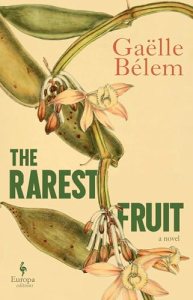 A fictionalized biography, from infancy to deathbed, of the Black botanist who introduced the world to vanilla – then a rare and expensive flavour – by discovering that the plant can be hand-pollinated in the same way as pumpkins. In 1829, the island colony of Bourbon (now the French overseas department Réunion) has just been devastated by a cyclone when widowed landowner Ferréol Bellier-Beaumont is brought the seven-week-old orphaned son of one of his sister’s enslaved women. Ferréol, who once hunted rare orchids, raises the boy as his ward. From the start, Edmond is most at home in the garden and swears he will follow in his guardian’s footsteps as a botanist. Bélem also traces Ferréol’s history and the origins of vanilla in Mexico. The inclusion of Creole phrases and the various uses of plants, including for traditional healing, chimed with Jason Allen-Paisant’s Jamaica-set The Possibility of Tenderness, and I was reminded somewhat of the historical picaresque style of Slave Old Man (Patrick Chamoiseau) and The Secret Diaries of Charles Ignatius Sancho (Paterson Joseph). The writing is solid but the subject matter so niche that this was a skim for me.
With thanks to Europa Editions, who sent an advanced e-copy for review.
In Late Summer by Magdalena Blažević (2022; 2025)
[Translated from Croatian by Anđelka Raguž]
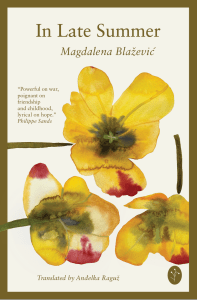 “My name is Ivana. I lived for fourteen summers, and this is the story of my last.” Blažević’s debut novella presents the before and after of one extended family, and of the Bosnian countryside, in August 1993. In the first half, few-page vignettes convey the seasonality of rural life as Ivana and her friend Dunja run wild. Mother and Grandmother slaughter chickens, wash curtains, and treat the children for lice. Foodstuffs and odours capture memory in that famous Proustian way. I marked out the piece “Camomile Flowers” for its details of the senses: “Sunlight and the scent of soap mingle. … The pantry smells like it did before, of caramel, lemon rind and vanilla sugar. Like the period leading up to Christmas. … My hair dries quickly in the sun. It rustles like the lace, dry snow from the fields.” The peaceful beauty of it all is shattered by the soldiers’ arrival. Ivana issues warnings (“Get ready! We’re running out of time. The silence and summer lethargy will not last long”) and continues narrating after her death. As in Sara Nović’s Girl at War, the child perspective contrasts innocence and enthusiasm with the horror of war. I found the first part lovely but the whole somewhat aimless because of the bitty structure.
With thanks to Linden Editions for the free copy for review.
Somebody Is Walking on Your Grave: My Cemetery Journeys by Mariana Enríquez (2013; 2025)
[Translated from Spanish by Megan McDowell]
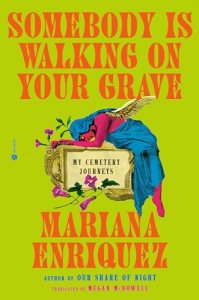 This made it onto my Most Anticipated list for the second half of the year due to my love of graveyards. Because of where Enríquez is from, a lot of the cemeteries she features are in Argentina (six) or other Spanish-speaking countries (another six including Chile, Cuba, Mexico, Peru and Spain). There are 10 more locations besides, and her journeys go back as far as 1997 in Genoa, when she was 25 and had sex with Enzo up against a gravestone. I took the most interest in those I have been to (Edinburgh) or could imagine myself travelling to someday (New Orleans and Savannah; Highgate in London and Montparnasse in Paris), but thought that every chapter got bogged down in research. Enríquez writes horror, so she is keen to visit at night and relay any ghost stories she’s heard. But the pages after pages of history were dull and outweighed the memoir and travel elements for me, so after a few chapters I ended up just skimming. I’ll keep this on my Kindle in case I go to one of her other destinations in the future and can read individual essays on location. (Edelweiss download)
Voracious by Małgorzata Lebda (2016; 2025)
[Translated from Polish by Antonia Lloyd-Jones]
Like the Blažević, this is an impressionistic, pastoral work that contrasts vitality and decay in short chapters of one to three pages. The narrator is a young woman staying in her grandmother’s house and caring for her while she is dying of cancer; “now is not the time for life. Death – that’s what fills my head. I’m at its service. Grandma is my child. I am my grandmother’s mother. And that’s all right, I think.” The house has just four inhabitants – the narrator, Grandma Róża, Grandpa, and Ann – and seems permeable: to the cold, to nature. Animals play a large role, whether pets, farmed or wild. There’s Danube the hound, the cows delivered to the nearby slaughterhouse, and a local vixen with whom the narrator identifies.
 Lebda is primarily known as a poet, and her delight in language is evident. One piece titled “Opioid,” little more than a paragraph long, revels in the power of language: “Grandma brings a beautiful word home … the word not only resonates, but does something else too – it lets light into the veins.” The wind is described as “the conscience of the forest. It’s the circulatory system. It’s the litany. It’s scented. It sings.”
In all three Linden Editions books I’ve read, the translator’s afterword has been particularly illuminating. I thought I was missing something, but Lloyd-Jones reassured me it’s unclear who Ann is: sister? friend? lover? (I was sure I spotted some homoerotic moments.) Lloyd-Jones believes she’s the mirror image of the narrator, leaning toward life while the narrator – who has endured sexual molestation and thyroid problems – tends towards death. The animal imagery reinforces that dichotomy.
The narrator and Ann remark that it feels like Grandma has been ill for a million years, but they also never want this time to end. The novel creates that luminous, eternal present. It was the best of this bunch.
With thanks to Linden Editions for the free copy for review.
Full review forthcoming for Foreword Reviews:
Pandora by Ana Paula Pacheco (2023; 2025)
[Translated from Portuguese by Julia Sanches]
 The Brazilian author’s bold novella is a startling allegory about pandemic-era hazards to women’s physical and mental health. Since the death of her partner Alice to Covid-19, Ana has been ‘married’ to a pangolin and a seven-foot-tall bat. At a psychiatrist’s behest, she revisits her childhood and interrogates the meanings of her relationships. The form varies to include numbered sections, the syllabus for Ana’s course “Is Literature a personal investment?”, journal entries, and extended fantasies. Depictions of animals enable commentary on economic inequalities and gendered struggles. Playful, visceral, intriguing.
#17 of my 20 Books of Summer:
Invisible Kitties by Yu Yoyo (2021; 2024)
[Translated from Chinese by Jeremy Tiang]
 Yu is the author of four poetry collections; her debut novel blends autofiction and magic realism with its story of a couple adjusting to the ways of a mysterious cat. They have a two-bedroom flat on a high-up floor of a complex, and Cat somehow fills the entire space yet disappears whenever the woman goes looking for him. Yu’s strategy in most of these 60 mini-chapters is to take behaviours that will be familiar to any cat owner and either turn them literal through faux-scientific descriptions, or extend them into the fantasy realm. So a cat can turn into a liquid or gaseous state, a purring cat is boiling an internal kettle, and a cat planted in a flowerbed will produce more cats. Some of the stories are whimsical and sweet, like those imagining Cat playing extreme sports, opening a massage parlour, and being the god of the household. Others are downright gross and silly: Cat’s removed testicles become “Cat-Ball Planets” and the narrator throws up a hairball that becomes Kitten. Mixed feelings, then. (Passed on by Annabel – thank you!)
I’m really pleased with myself for covering a total of 8 books for this challenge, each one translated from a different language!
Which of these would you read?
#WITMonth, Part I: Susanna Bissoli, Jente Posthuma and More
I’m starting off my Women in Translation month coverage with two short novels: one Italian and one Dutch; both about women navigating loss, family relationships, physical or mental illness, and the desire to be a writer.
Struck by Susanna Bissoli (2024; 2025)
[Translated from Italian by Georgia Wall]
Vera has been diagnosed a second time with breast cancer – the same disease that felled her mother a decade ago. “I’m fed up with feeling like a problem to be taken care of,” she thinks. Even as her treatment continues, she determines to find routes to a bigger life not defined by her illness. Writing is the solution. When she moves in with her grouchy octogenarian father, Zeno Benin, she discovers he’s secretly written a novel, A Lucky Man. The almost entirely unpunctuated document is handwritten across 51 notebooks Vera undertakes to type up and edit alongside her father as his health declines.
At the same time, she becomes possessed by the legend of local living ‘saint’ Annamaria Bigani, who has been visited multiple times by the Virgin Mary and learned her date of death. Wondering if there is a story here that she needs to tell, Vera interviews Bigani, then escapes to Greece for time and creative space. “Do they save us, stories? Or is it our job to save them? I believe writing that story, day in and day out for years, saved my father’s life. But I’m sorry, I don’t have time to save his story: I need to write my own. The saint, or so I thought.” In the end, we learn, Struck – the very novel we are reading – is Vera’s book.

The title comes from a scientific study conducted on people struck by lightning at a country festival in France. How did they survive, and what were the lasting effects? The same questions apply to Vera, who avoids talking about her cancer but whose relationship with her sister Nora is still affected by choices made while their mother was alive. There are many delightful small conversations and incidents here, often involving Vera’s niece Alice. Vera’s relationship with Franco, a doctor who works with asylum seekers, is a steady part of the background. A translator’s afterword helped me understand the thought that went into how to reproduce Vera and others’ use of dialect (La Bassa Veronese vs. standard Italian) through English vernacular – so Vera and her sister say “Mam” and her father uses colourful idioms.
Though I know nothing of Bissoli’s biography, this second novel has the feeling of autofiction. Despite its wrenching themes of illness and the inevitability of death, it’s a lighthearted family story with free-flowing prose that I can enthusiastically recommend to readers of Elizabeth Berg and Catherine Newman.
This was my introduction to new (est. 2023) independent publisher Linden Editions, which primarily publishes literature in translation. I have two more of their books underway for another WIT Month post later this month. And a nice connection is that I corresponded with translator Georgia Wall when she was the publishing manager for The Emma Press.
With thanks to Linden Editions for the free copy for review.
People with No Charisma by Jente Posthuma (2016; 2025)
[Translated from Dutch by Sarah Timmer Harvey]
 Dutch writer Jente Posthuma’s quirky, bittersweet first novel traces the ripples that grief and mental ill health send through a young woman’s life. The narrator’s mother was an aspiring actress; her father runs a mental hospital. A dozen episodic short chapters present snapshots from a neurotic existence as she grows from a child to a thirtysomething starting a family of her own. Some highlights include her moving to Paris to write a novel, and her father – a terrible driver – taking her on a road trip through France. Despite the deadpan humor, there’s heartfelt emotion here and the prose and incidents are idiosyncratic. (Full review forthcoming for Shelf Awareness)
& Reviewed for Foreword Reviews a couple of years ago:
What I Don’t Want to Talk About by Jente Posthuma (2020; 2023)
[Translated from Dutch by Sarah Timmer Harvey]
 A young woman bereft after her twin brother’s suicide searches for the seeds of his mental illness. The past resurges, alternating with the present in the book’s few-page vignettes. Their father leaving when they were 11 was a significant early trauma. Her brother came out at 16, but she’d intuited his sexuality when they were eight. With no speech marks, conversations blend into cogitation and memories here. A wry tone tempers the bleakness. (Shortlisted for the European Union Prize for Literature and the International Booker Prize.)
Both featured an unnamed narrator and a similar sense of humor. I concluded that Posthuma excels at exploring family dynamics and the aftermath of bereavement.
I got caught out when I reviewed The Appointment, too: Volckmer doesn’t technically count towards this challenge because she writes in English (and lives in London), but as she’s German, I’m adding in a teaser of my review as a bonus. Oddly, this novella did first appear in another language, French, in 2024, under the title Wonderf*ck. [The full title below was given to the UK edition.]
Calls May Be Recorded [for Training and Monitoring Purposes] by Katharina Volckmer (2025)
 Volckmer’s outrageous, uproarious second novel features a sex-obsessed call center employee who negotiates body and mommy issues alongside customer complaints. “Thank you for waiting. My name is Jimmie. How can I help you today?” each call opens. The overweight, homosexual former actor still lives with his mother. His customers’ situations are bizarre and his replies wildly inappropriate; it’s only a matter of time until he faces disciplinary action. As in her debut, Volckmer fearlessly probes the psychological origins of gender dysphoria and sexual behavior. Think of it as an X-rated version of The Office. (Full review forthcoming for Shelf Awareness)
#MoominWeek & #WITMonth, II: Moominpappa at Sea by Tove Jansson
My first two reads for Women in Translation month were Catalan and French novellas. With this third one I’m tying in with Moomin Week, hosted by Chris and Mallika in honour of Paula of Book Jotter. Happy nuptials to Paula! Not a blogger I’ve interacted with before, but I welcomed the excuse to finish a book I started a few months ago. I’ve actually reviewed five Moomin books here before: Moominvalley in November, Moominland Midwinter, Tales from Moominvalley, Moominsummer Madness, and Finn Family Moomintroll. (It’s also the third year in a row that I’ve reviewed something by Jansson for WIT Month.)

Appropriate reading at sea (on a ferry to France)
I didn’t grow up with the Moomins, but as an adult I’ve come to love the series for how it lovingly depicts everyday disasters and neuroses and, beneath the whimsical adventures, offers an extra level of thoughtfulness for adult readers. The setting of this one was particularly appropriate. Here’s the opening paragraph:
One afternoon at the end of August, Moominpappa was walking about in his garden feeling at a loss. He had no idea what to do with himself, because it seemed everything there was to be done had already been done or was being done by somebody else.
 The sense of being ‘all at sea’ persists for Pappa and the other characters even after they sail to ‘his’ island in the Gulf of Finland, drawn to see in person the lighthouse he has kept as a model on the shelf. They arrive to find the island mysteriously empty and the facilities derelict. Moomintroll goes exploring alone and meets intriguing “sea-horses” that look more equine than marine. Nature is alive and resistant to ‘improvements’ such as Moominmamma trying to tame the wildness with her rose bushes and apple trees. The forest also seems to be retreating from the sea; everything fears it, in fact. The sullen fisherman is no help, and the hulking Groke seems to be a metaphor for depression as well as a literal monster.
There is a sense of everything being awry, and by the close that’s only partially rectified. Pappa ends with conflicting feelings towards the island: proprietary yet timorous. I imagine this is based on Jansson’s own experiences living on a Finnish island (see also The Summer Book). This wasn’t among my favourite Moomin books, but I always appreciate the juxtaposition of the domestic and wild, the cosy and the melancholy. Just two more for me to find now (I’ve read them all in random order): The Moomins and the Great Flood and Moominpappa’s Memoirs.
[Translated from the Swedish by Kingsley Hart] (University library) 


#WITMonth, Part I: Novellas by Eva Baltasar and Françoise Sagan
I’m starting off my Women in Translation month coverage with mini responses to two novellas: one Catalan and one French; both about disaffected women trying to work out what they want from life.
Mammoth by Eva Baltasar (2022; 2024)
[Translated from the Catalan by Julia Sanches]
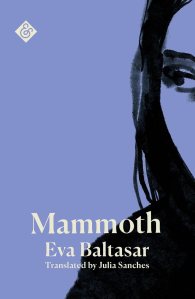 I’d been vaguely attracted by descriptions of the Spanish poet’s novels Permafrost and Boulder, which are also about lesbians in odd situations. Mammoth is the third book in a loose trilogy. Its 24-year-old narrator is so desperate for a baby that she’s decided to have unprotected sex with men until a pregnancy results. In the meantime, her sociology project at nursing homes comes to an end and she moves from Barcelona to a remote farm where she develops subsistence skills and forms an interdependent relationship with the gruff shepherd. “I’d been living in a drowning city, and I need this – the restorative silence of a decompression chamber. … my past is meaningless, and yet here, in this place, there is someone else’s past that I can set up and live in awhile.” For me this was a peculiar combination of distinguished writing (“The city pounces on the still-pale light emerging from the deep sea and seizes it with its lucrative forceps”) but absolutely repellent story, with a protagonist whose every decision makes you want to throttle her. An extended scene of exterminating feral cats certainly didn’t help matters. I’d be wary of trying Baltasar again.
With thanks to And Other Stories for the proof copy for review.
Aimez-vous Brahms… by Françoise Sagan (1959; 1960)
[Translated from the French by Peter Wiles]
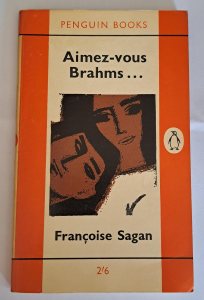 At age 39, divorced interior decorator Paule is “passionately concerned with her beauty and battling with the transition from young to youngish woman”. (Ouch. But true.) It’s an open secret that her partner Roger is always engaged in a liaison with a young woman; people pity her and scorn Roger for his infidelity. But when Paule has a dalliance with a client’s son, 25-year-old lawyer Simon, a double standard emerges: “they had never shown her the mixture of contempt and envy she was going to arouse this time.” Simon is an idealist, accusing her of “letting love go by, of neglecting your duty to be happy”, but he’s also indolent and too fond of drink. Paule wonders if she’s expected too much from an affair. “Everyone advised a change of air, and she thought sadly that all she was getting was a change of lovers: less bother, more Parisian, so common”.
I was by turns reminded of Chéri by Colette, In a Summer Season by Elizabeth Taylor, and even The Graduate (“Mrs. Robinson,” anyone?). Simon asks the title question to invite Paule to a concert; that she has to ponder it carefully tells her she’s “losing herself, losing track of herself”. But it’s all too easy for the status quo to be reinstated after a brave act. Middle-aged woman makes bid for freedom but ultimately nothing changes: same plot as The Funeral Cryer and any number of other books, but this was so much better. How did Sagan manage such insight at age 24 (and this was her fourth book)?! While not quite as memorable as Bonjour Tristesse, this is another incisive slice of fiction that has aged well apart from using “sodomite” and “Negress” as matter-of-fact terms for bit players. I’d read anything else I can find by Sagan. (Secondhand – Community Furniture Project, Newbury)
#WITMonth, Part II: Wioletta Greg, Dorthe Nors, Almudena Sánchez and More
My next four reads for Women in Translation month (after Part I here) were, again, a varied selection: a mixed volume of family history in verse and fragmentary diary entries, a set of nature/travel essays set mostly in Denmark, a memoir of mental illness, and a preview of a forthcoming novel about Mary Shelley’s inspirations for Frankenstein. One final selection will be coming up as part of my Love Your Library roundup on Monday.
(20 Books of Summer, #13)
Finite Formulae & Theories of Chance by Wioletta Greg (2014)
[Translated from the Polish by Marek Kazmierski]
 I loved Greg’s Swallowing Mercury so much that I jumped at the chance to read something else of hers in English translation – plus this was less than half price AND a signed copy. I had no sense of the contents and might have reconsidered had I known a few things: the first two-thirds is family wartime history in verse, the rest is a fragmentary diary from eight years in which Greg lived on the Isle of Wight, and the book is a bilingual edition, with Polish and English on facing pages (for the poems) or one after the other (for the diary entries). I’m not sure what this format adds for English-language readers; I can’t know whether Kazmierski has rendered anything successfully. I’ve always thought it must be next to impossible to translate poetry, and it’s certainly hard to assess these as poems. They are fairly interesting snapshots from her family’s history, e.g., her grandfather’s escape from a stalag, and have quite precise vocabulary for the natural world. There’s also been an attempt to create or reproduce alliteration. I liked the poem the title phrase comes from, “A Fairytale about Death,” and “Readers.” The short diary entries, though, felt entirely superfluous. (New purchase – Waterstones bargain, 2023)
(20 Books of Summer, #14)
A Line in the World: A Year on the North Sea Coast by Dorthe Nors (2021; 2022)
[Translated from the Danish by Caroline Waight]
 Nors’s first nonfiction work is a surprise entry on this year’s Wainwright Prize nature writing shortlist. I’d be delighted to see this work in translation win, first because it would send a signal that it is not a provincial award, and secondly because her writing is stunning. Like Patrick Leigh Fermor, Aldo Leopold or Peter Matthiessen, she doesn’t just report what she sees but thinks deeply about what it means and how it connects to memory or identity. I have a soft spot for such philosophizing in nature and travel writing.
You carry the place you come from inside you, but you can never go back to it.
I longed … to live my brief and arbitrary life while I still have it.
This eternal, fertile and dread-laden stream inside us. This fundamental question: do you want to remember or forget?
Nors lives in rural Jutland – where she grew up, before her family home was razed – along the west coast of Denmark, the same coast that reaches down to Germany and the Netherlands. In comparison to Copenhagen and Amsterdam, two other places she’s lived, it’s little visited and largely unknown to foreigners. This can be both good and bad. Tourists feel they’re discovering somewhere new, but the residents are insular – Nors is persona non grata for at least a year and a half simply for joking about locals’ exaggerated fear of wolves.
Local legends and traditions, bird migration, reliance on the sea, wanderlust, maritime history, a visit to church frescoes with Signe Parkins (the book’s illustrator), the year’s longest and shortest days … I started reading this months ago and set it aside for a time, so now find it difficult to remember what some of the essays are actually about. They’re more about the atmosphere, really: the remote seaside, sometimes so bleak as to seem like the ends of the earth. (It’s why I like reading about Scottish islands.) A bit more familiarity with the places Nors writes about would have pushed my rating higher, but her prose is excellent throughout. I also marked the metaphors “A local woman is standing there with a hairstyle like a wolverine” and “The sky looks like dirty mop-water.” 
With thanks to Pushkin Press for the proof copy for review.
Pharmakon by Almudena Sánchez (2021; 2023)
[Translated from the Spanish by Katie Whittemore]
 This is a memoir in micro-essays about the author’s experience of mental illness, as she tries to write herself away from suicidal thoughts. She grew up on Mallorca, always feeling like an outsider on an island where she wasn’t a native. Did her depression stem from her childhood, she wonders? She is also a survivor of ovarian cancer, diagnosed when she was 16. As her mind bounces from subject to subject, “trying to analyze a sick brain,” she documents her doctor visits, her medications, her dreams, her retweets, and much more. She takes inspiration from famous fellow depressives such as William Styron and Virginia Woolf. Her household is obsessed with books, she says, and it’s mostly through literature that she understands her life. The writing can be poetic, but few pieces stand out on the whole. My favourite opens: “Living in between anxiety and apathy has driven me to flowerpot decorating.”
With thanks to Fum d’Estampa Press for the free copy for review.
And a bonus preview:
Mary and the Birth of Frankenstein by Anne Eekhout (2021; 2023)
[Translated from the Dutch by Laura Watkinson]
 Anne Eekhout’s fourth novel and English-language debut is an evocative recreation of two momentous periods in Mary Shelley’s life that led – directly or indirectly – to the composition of her 1818 masterpiece. Drawing parallels between the creative process and motherhood and presenting a credibly queer slant on history, the book is full of eerie encounters and mysterious phenomena that replicate the Gothic science fiction tone of Frankenstein itself. The story lines are set in the famous “Year without a Summer” of 1816 (the storytelling challenge with Lord Byron) and during a period in 1812 that she spent living in Scotland with the Baxter family; Mary falls in love with the 17-year-old daughter, Isabella.
Coming out on 3 October from HarperVia. My full review for Shelf Awareness is pending.
#WITMonth, Part I: de Beauvoir, Jansson, NDiaye
My first four reads for Women in Translation month were quite a varied selection: a sobering autobiographical essay about the loss of a mother, a characteristically impish children’s novel, a confoundingly elliptical family memoir, and a preview of a forthcoming Mexican novel about women’s friendships and handicraft. Another four coming up later in August.
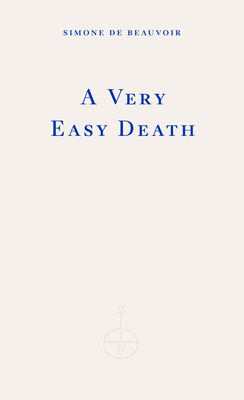
A Very Easy Death by Simone de Beauvoir (1964; 1965)
[Translated from the French by Patrick O’Brian]
“When someone you love dies you pay for the sin of outliving her with a thousand piercing regrets.”
I’d read a lot about Simone de Beauvoir but not one of her own works until this reissue came my way. It was right up my street as a miniature bereavement memoir (just 84 pages) that doesn’t shy away from the physical details of decline or the emotional complications of a fraught mother–daughter relationship.
 In October 1963, de Beauvoir was in Rome when she got a call informing her that her mother had had an accident. Expecting the worst, she was relieved – if only temporarily – to hear that it was a fall at home, resulting in a broken femur. But when Françoise de Beauvoir got to the hospital, what at first looked like peritonitis was diagnosed as stomach cancer with an intestinal obstruction. Her daughters knew that she was dying, but she had no idea (from what I’ve read, this paternalistic notion that patients must be treated like children and kept ignorant of their prognosis is more common on the Continent, and continues even today).
Over the next month, de Beauvoir and her sister Poupette took turns visiting. Initially alarmed by their mother’s condition, they soon grew used to the deterioration. “I was not worried by her nakedness any more: it was no longer my mother, but a poor tormented body.” They found her in varying states of awareness and discomfort. “In this race between pain and death we most earnestly hoped that death would come first.” Some nurses were better than others. De Beauvoir makes tantalizing references to the standoff between her and her mother about the Catholic faith Simone left behind. (I’ll need to read Memoirs of a Dutiful Daughter for more on that.) Even the hope of heaven didn’t fully neutralize self-pity and physical suffering for the dying woman because she feared her daughters wouldn’t be joining her.
The title is what a nurse told the grieving daughters: that their mother’s had been a very easy death in the end (and an upper-class one, de Beauvoir adds). The word used in French for easy, douce, can also be translated as “gentle,” a tie-in to the epigraph from Dylan Thomas’s “Do not go gentle into that good night.” Is it better for a loved one to die suddenly, or protractedly? I’ve debated this with myself and a few others since my mother’s death from a stroke in October. Ultimately, it’s pointless to ask; any death is an affront, hard to accept and adjust to no matter how much warning is given. I appreciated how matter-of-factly and concisely de Beauvoir’s essay encapsulates the duties and feelings surrounding a death. Frank and unshowy yet potent, this is a classic of the subgenre.
Published as Fitzcarraldo Editions Classics No. 2 in June. With thanks to the publisher for the free copy for review.
(Books of Summer, #10)
Finn Family Moomintroll by Tove Jansson (1948; 1950)
[Translated from the Swedish by Elizabeth Portch]
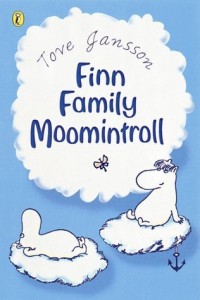 My sixth Moomins book, and ninth by Jansson overall. The novella’s gentle peril is set in motion by the discovery of the Hobgoblin’s Hat, which transforms anything placed within it. As spring moves into summer, this causes all kind of mild mischief until Thingumy and Bob, who speak in spoonerisms, show up with a suitcase containing something desired by both the Groke and the Hobgoblin, and make a deal that stops the disruptions.
As always, the creatures and events, conveyed by Jansson’s black-and-white drawings as much as by her words, are inventive and whimsical. There’s a cosy charm to the seasonal rituals, like the end-of-summer pancake party here. But what I value even more is the pointed accounts of the secondary characters’ neuroses. The Moomins are generally on a pretty even keel, though there is mention of Moominpappa’s sense of being hard done by because of childhood bullying and an enduring lack of respect. However, characters like the Muskrat and the Hemulen get a wry smile and shake of the head from me because their predicaments are so familiar: The Muskrat, terrified of mortifying situations, decides the life of a hermit might be preferable; the Hemulen gives up stamp collecting and switches to botanizing because there’s no joy in a finished quest, only in an ongoing search. The Moomins books offer the perfect combination of the familial and routine with the novel and adventurous. Even staid adults should give them a try. (Little Free Library)
Self-Portrait in Green by Marie NDiaye (2005; 2015)
[Translated from the French by Jordan Stump]
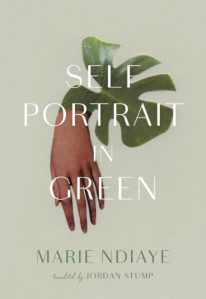 I tend to love a memoir that tries something new or experimental with the form (such as Constructing a Nervous System or In the Dream House), but this was a step too far for me; the self referred to in the title is almost wholly absent. NDiaye, a French–Senegalese author, opens in 2003 with the expected flooding of the Garonne in southwest France. Fragments of narrative from 2000–2003 chart her encounters with various women dressed in green, starting with one she thinks she sees under a banana tree (though her four children see nothing). Then there’s Katia Depetiteville, dead 10 years … NDiaye’s stepmother, once her childhood best friend; her friend Jenny’s rival for Ivan’s affection; and her mother, who now has a new family. What is a ‘woman in green’? The author explicitly associates the colour with cruelty, with presumably the usual connotation of jealousy as well. But it still feels arbitrary.
It’s all rather dreamlike, with poetic repetition, rhetorical questions and black-and-white photos that seem marginally relevant. “I’m saying to myself: Is all this really real?” NDiaye writes, and the reader will surely be asking the same. “I’m always interested in stories,” she adds, and while I’d agree, I need to know that they’re being told to build to some greater meaning. It was only in the last fifth of the book, when the author goes to a literary symposium in Ouagadougou and visits her father (a many-times-married former restaurateur and amateur architect now suffering from cataracts) and stepmother that I felt like there was a purpose: a bringing together of past and present for psychological clarity. I was relieved that this was only 112 pages. (Edelweiss) 
The 10th anniversary edition is being reissued by Two Lines Press next month.
And a bonus preview:
Cross-Stitch by Jazmina Barrera (2021; 2023)
[Translated from the Spanish by Christina MacSweeney]
 In the inventive debut novel by Mexican author Jazmina Barrera, a sudden death provokes an intricate examination of three young women’s years of shifting friendship. Their shared hobby of embroidery occasions a history of women’s handiwork, woven into a relationship study that will remind readers of works by Elena Ferrante and Deborah Levy. Citlali, Dalia, and Mila had been best friends since middle school. Mila, a writer with a young daughter, is blindsided by news that Citlali has drowned off Senegal. While waiting to be reunited with Dalia for Citlali’s memorial service, she browses her journal to revisit key moments from their friendship, especially travels in Europe and to a Mexican village. Cross-stitch becomes its own metaphorical language, passed on by female ancestors and transmitted across social classes. Reminiscent of Still Born and A Ghost in the Throat. (Edelweiss)
Coming out on 7 November from Two Lines Press. My full review for Shelf Awareness is pending.
Four for #WITMonth: Jansson, Lamarche, Lunde and Vogt
I’ve managed four novels for this year’s Women in Translation month: a nostalgic, bittersweet picture of island summers poised between childhood and old age; a brief, impressionistic account of domestic violence and rape; the third in a series looking at how climate change and species loss reverberate amid family situations; and a visceral meditation on women’s bodies and relationships. Two of these were review copies from the recently launched Héloïse Press, which “champions world-wide female talent”.

The Summer Book by Tove Jansson (1972; 1974)
[Translated from the Swedish by Thomas Teal]
It was just the same long summer, always, and everything lived and grew at its own pace.
 This was only the second time I’ve read one of Jansson’s books aimed at adults (as opposed to five from the Moomins series). Whereas A Winter Book didn’t stand out to me when I read it in 2012 – though I will try it again this winter, having acquired a free copy from a neighbour – this was a lovely read, so evocative of childhood and of languid summers free from obligation. For two months, Sophia and Grandmother go for mini adventures on their tiny Finnish island. Each chapter is almost like a stand-alone story in a linked collection. They make believe and welcome visitors and weather storms and poke their noses into a new neighbour’s unwanted construction.
Six-year-old Sophia, based on Jansson’s niece of the same name, is precocious and opinionated, liable to change her mind in an instant. In “The Cat,” one of my favourite stand-alone bits, she’s fed up with their half-feral pet who kills lots of birds and swaps him for a friend’s soppy lap cat, but then regrets it. She’s learning that logic and emotion sometimes contradict each other, which becomes clearer as she peppers Grandmother with questions about religion and superstition.
As is common to Jansson’s books, there’s a melancholy undercurrent here.
Everything was fine, and yet everything was overshadowed by a great sadness. It was August, and the weather was sometimes stormy and sometimes nice, but for Grandmother, no matter what happened, it was only time on top of time, since everything is vanity and a chasing after the wind.
Sophia’s mother died, and although her grandmother has the greater presence, Papa is also around, dealing with practicalities in the background. Death stalks around the edges, reminding Grandmother of her mortality through bouts of vertigo that have her grabbing for her heart medication. On just the second page we have this memento mori:
“When are you going to die?” the child asked.
And Grandmother answered, “Soon. But that is not the least concern of yours.”
And so it doesn’t feel like our concern either; the focus is on the now, on these beautiful little moments of connection across the generations – like in “Playing Venice,” when Grandmother stays up all night rebuilding Sophia’s model city that was washed away by the rain. (Public library)
The Memory of the Air by Caroline Lamarche (2014; 2022)
[Winner of an English PEN Award; translated from the French by Katherine Gregor]
 In a hypnotic monologue, a woman tells of her time with a violent partner (the man before, or “Manfore”) who thinks her reaction to him is disproportionate and all due to the fact that she has never processed being raped two decades ago. When she goes in for a routine breast scan, she shows the doctor her bruised arm, wanting there to be a definitive record of what she’s gone through. It’s a bracing echo of the moment she walked into a police station to report the sexual assault (and oh but the questions the male inspector asked her are horrible).
The novella opens with an image that returns in dreams but is almost more a future memory of what might have been: “I went down into a ravine and, at the bottom, found a dead woman. She was lying in a shroud, on a carpet of fallen leaves.” I read this in one sitting – er, yoga session – and it has stayed in my mind in intense flashes like that and the flounce of her red dress on the summer day that turned into a nightmare. At an intense 70 pages, this reminded me of Annie Ernaux’s concise autofiction (I’ve reviewed Happening and I Remain in Darkness). An introduction by Dr Dominique Carlini-Versini contextualizes the work by considering the treatment of rape in contemporary French women’s writing.
The Memory of the Air will be published on 26 September. With thanks to Héloïse Press for the proof copy for review.
The Last Wild Horses by Maja Lunde (2019; 2022)
[Translated from the Norwegian by Diane Oatley]
The third in Lunde’s “Climate Quartet,” with its recurring elements of migration, shortages and environmental collapse. Always, though, the overall theme is parent–child relationships and the love that might be the only thing that keeps us going in the face of unspeakable challenges. Here she returns to the tripartite structure of The History of Bees (much my favourite of the three): a historical strand, a near-contemporary one, and a dystopian future story line. The link between the three is Przewalski’s horses (aka takhi).
 In the early 1880s, Mikhail Alexandrovich Kovrov, assistant director of St. Petersburg Zoo, is brought the hide and skull of an ancient horse species assumed extinct. Although a timorous man who still lives with his mother, he becomes part of an expedition to Mongolia to bring back live specimens. In 1992, Karin, who has been obsessed with Przewalski’s horses since encountering them as a child in Nazi Germany, spearheads a mission to return the takhi to Mongolia and set up a breeding population. With her is her son Matthias, tentatively sober after years of drug abuse. In 2064 Norway, Eva and her daughter Isa are caretakers of a decaying wildlife park that houses a couple of wild horses. When a climate migrant comes to stay with them and the electricity goes off once and for all, they have to decide what comes next. This future story line engaged me the most.
I appreciated some aspects: queer and middle-aged romances, the return of a character from The End of the Ocean, the consideration across all three plots of what makes a good mother. However, the horses seemed neither here nor there. There are also many, many animal deaths. Perhaps an unsentimental attitude is necessary to reflect past and future values, and the apparent cruelty of natural processes, but it limits the book’s appeal to animal lovers. Maybe the tone fits the Norwegian prose, which the translator describes as lean.
The fourth book of the quartet, publishing in Norway next month, is called something like The Dream of a Tree; a focus on trees would be a draw for me. After the disappointment of Books 2 and 3, I’m unsure whether I want to bother with the final volume, but it makes sense to do so, if only to grasp Lunde’s full vision. (Public library)
What Concerns Us by Laura Vogt (2020; 2022)
[Translated from the German by Caroline Waight]
 Vogt’s Swiss-set second novel is about a tight-knit matriarchal family whose threads have started to unravel. For Rahel, motherhood has taken her away from her vocation as a singer. Boris stepped up when she was pregnant with another man’s baby and has been as much of a father to Rico as to Leni, the daughter they had together afterwards. But now Rahel’s postnatal depression is stopping her from bonding with the new baby, and she isn’t sure this quartet is going to make it in the long term.
Meanwhile, Rahel’s sister Fenna knows she’s pregnant but refuses a doctor’s care. When she comes to stay with Rahel, she confides that the encounter with her partner, Luc, that led to conception was odd, rough; maybe not consensual. And all this time, the women’s mother, Verena, has been undergoing treatment for breast cancer. All three characters appear to be matter-of-factly bisexual; Rahel and Fenna’s father has long been out of the picture, replaced in Verena’s affections by Inge.
As I was reading, I kept thinking of the declaration running through A Ghost in the Throat by Doireann Ní Ghríofa: “This is a female text.” Vogt’s vision is all breasts and eggs, genitals actual and metaphorical. I loved the use of food in the novel: growing up, the girls cherished “silly nights” when their mother prepared an egg feast and paired it with a feminist lecture on reproduction. Late on, there’s a wonderful scene when the three main characters gorge on preserved foodstuffs from the cellar and share their secrets. (Their language is so sexually frank; would anyone really talk to their mother and siblings in that way?!) As in the Lunde, the main question is what it means to be a mother, but negotiating their relationships with men stretches the bonds of this feminine trio. One for fans of Rachel Cusk and Sally Rooney.
With thanks to Héloïse Press for the proof copy for review.
Bookish Bits and Bobs
It’s felt like a BIG week for prize news. First we had the Booker Prize longlist, about which I’ve already shared some thoughts. My next selection from it is Trust by Hernan Diaz, which I started reading last night. The shortlist comes out on 6 September. We have our book club shadowing application nearly ready to send off – have your fingers crossed for us!
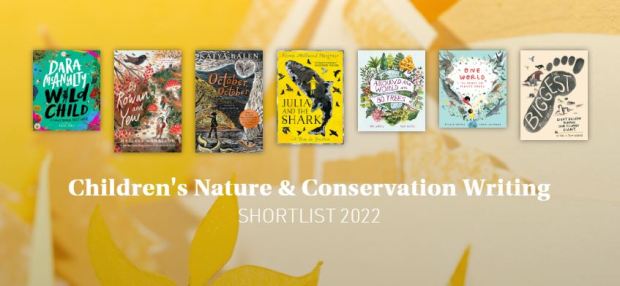
Then on Friday the three Wainwright Prize shortlists (I gave my reaction to the longlists last month) were announced: one for nature writing, one for conservation writing, and – new this year – one for children’s books on either.
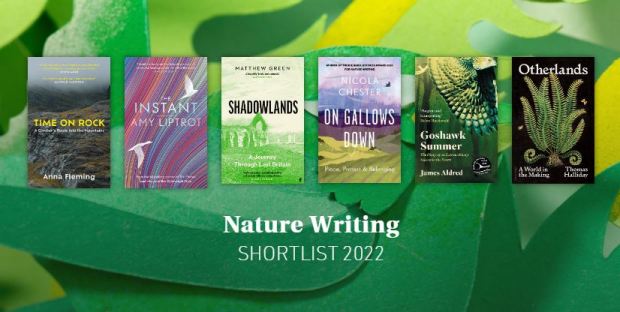
 I’m delighted that my top two overall picks, On Gallows Down by Nicola Chester and Silent Earth by Dave Goulson, are still in the running. I’ve read half of the nature list and still intend to read Shadowlands, which is awaiting me at the library. I’d happily read any of the remaining books on the conservation list and have requested the few that my library system owns. Of the children’s nominees, I’m currently a third of the way through Julia and the Shark and also have the Davies out from the library to read.
As if to make up for the recent demise of the Costa Awards, the Folio Prize has decided to split into three categories: fiction, nonfiction and poetry; the three finalists will then go head-to-head to compete for the overall prize. I’ve always wondered how the Folio judges pit such different books against each other. This makes theirs an easier job, I guess?
Speaking of prize judging, I’ve been asked to return as a manuscript judge for the 2023 McKitterick Prize administered by the Society of Authors, the UK trade union for writers. (Since 1990, the McKitterick Prize has been awarded to a debut novelist aged 40+. It’s unique in that it considers unpublished manuscripts as well as published novels – Political Quarterly editor Tom McKitterick, who endowed the Prize, had an unpublished novel at the time of his death.) Although I’d prefer to be assessing ‘real’ books, the fee is welcome. Submissions close in October, and I’ll spend much of November–December on the reading.
Somehow, it’s August. Which means:
- Less than a month left for the remaining 10 of my 20 Books of Summer. I’m actually partway through another 12 books that would be relevant to my flora theme, so I just have to make myself finish and review 10 of them.
- It’s Women in Translation month! I’m currently reading The Last Wild Horses by Maja Lunde and have The Summer Book by Tove Jansson out from the library. I also have review copies of two short novels from Héloïse Press, and have placed a library hold on The Disaster Tourist by Yun Ko-eun. We’ll see how many of these I get to.

 Marcie (Buried in Print) and I have embarked on a buddy read of Cloudstreet by Tim Winton. I’ve never read any of his major works and I’m enjoying this so far.
Goodreads, ever so helpfully, tells me I’m currently 37 books behind schedule on my year’s reading challenge. What the website doesn’t know is that, across my shelves and e-readers, I am partway through – literally – about 90 books. So if I could just get my act together to sit down and finish things instead of constantly grabbing for something new, my numbers would look a lot better. Nonetheless, I’ve read loads by anyone’s standard, and will read lots more before the end of the year, so I’m not going to sweat it about the statistics.
A new home has meant fun tasks like unpacking my library (as well as not-so-fun ones like DIY). As a reward for successfully hosting a housewarming party and our first weekend guests, I let myself unbox and organize most of the rest of the books in my new study. My in-laws are bringing us a spare bookcase soon; it’s destined to hold biographies, poetry and short story collections. I thought I’d be able to house all the rest of my life writing and literary reference books on two Billy bookcases, but it’s required some clever horizontal stacks, special ‘displays’ on the top of each case, and, alas, some double-stacking – which I swore I wouldn’t do.


Scotland and Victoriana displays, unread memoirs and literary reference books at left; medical reads display and read memoirs at right.
I need to acquire one more bookcase, a bit narrower than a Billy, to hold the rest of my read fiction plus some overflow travel and humour on the landing.
I get a bit neurotic about how my library is organized, so questions that others wouldn’t give much thought to plague me:
- Should I divide read from unread books?
- Do I hide the less sightly proof copies in a stack behind the rest?
- Is it better to have hardbacks and paperbacks all in one sequence, or separate them to maximize space?
(I’ve employed all of these options for various categories.)
I also have some feature shelves to match particular challenges, like novellas, future seasonal reads, upcoming releases and review books to catch up on, as well as signed copies and recent acquisitions to prioritize. Inevitably, once I’ve arranged everything, I find one or two strays that then don’t fit on the shelves I’ve allotted. Argh! #BibliophileProblems, eh?
I’ve been skimming through The Bookman’s Tale by Ronald Blythe, and this passage from the diary entry “The Bookshelf Cull” stood out to me:
“Should you carry a dozen volumes from one shelf to another, you will most likely be carrying hundreds before you finish. Sequences will be thrown out; titles will have to be regrouped; subjects will demand respect.”
What are your August reading plans? Following any literary prizes?
How are your shelves looking? Are they as regimented as mine, or more random?
Lana Bastašić for WIT Month 2021 & September Reading Plans
My literature in translation statistics for 2021 have been abysmal so far, but here’s my token contribution to Women in Translation Month: Catch the Rabbit by Lana Bastašić, originally published in 2018 and translated from the Serbo-Croatian by the author herself.
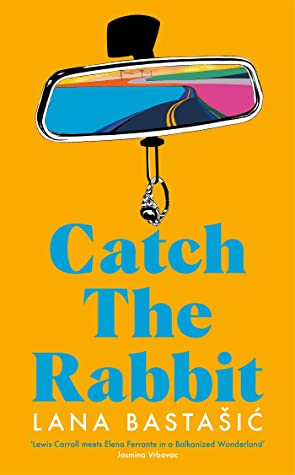 Sara has made a new life for herself in Dublin, with a boyfriend and an avocado tree. She rarely thinks about her past in Bosnia or hears her mother tongue. It’s a rude awakening, then, when she gets a phone call from her childhood best friend, Lejla Begić. Her bold, brassy pal says she needs Sara to pick her up in Mostar and drive her to Vienna to find her brother, Armin. No matter that Sara and Lejla haven’t been in contact in 12 years. But Lejla still has such a hold over Sara that she books a plane ticket right away.
Alternating chapters, with the text enclosed in brackets, dive into the friends’ past: school days, losing their virginity, and burying Lejla’s pet white rabbit, Bunny. Sara often writes as if to Lejla: “I can’t beautify those days, I can’t give them some special, big meaning. You would despise me for it. Besides, I don’t know how to write those two kids: you keep shrinking and growing in my memory, like illusive land to desperate sailors.”
In the road trip scenes, we have to shake our heads at how outrageous Lejla is: peeing in a cornfield, throwing her used tampons out the window, and orchestrating a farcical situation when she lies and tells their host that Sara only speaks English. A lovable rogue, she drives the book’s action. Indeed, Sara realizes, “both the car and I were nothing but an extension of Lejla’s will, she moved us with her words, and we followed obediently.”
This offbeat novel struck me, bizarrely, as a cross between Asylum Road and When God Was a Rabbit. I sometimes find that work in translation, particularly Eastern European, has too much quirkiness for the sake of it. That’s probably true here, and although the nostalgia element was appealing the emotional payoff wasn’t enough to satisfy me. However, I did love a late scene where Sara gazes at Albrecht Dürer’s famous Young Hare painting, and keep an eye out for how the ending connects back to the beginning.
(Simon appreciated this European Union Prize for Literature winner more than I did: his review compares the picture of asymmetrical female friendship favourably to that in Elena Ferrante’s Neapolitan Novels.)
With thanks to Picador for the free copy for review.

Did you do any special reading for Women in Translation month this year?
September Reading Plans
Each September I make a bit more of an effort to read short stories, which otherwise tend to sit on my shelves and Kindle unread. Last year I managed to read eight collections for this challenge. How many will I get to this year?! Here’s my shelf of potential reads:

I’ll reread selections from the Byatt anthology (I’ve read all of her published short story collections before and own two of them, one of which I reread last year) and will otherwise focus on books by women. I’ve had good success with Amy Bloom and Helen Simpson stories in previous years, so I’ll definitely plan to read those plus Bloodchild by Octavia E. Butler (from the university library).
Since I own THREE unread collections by Alice Munro, it’s time to tackle one, probably Dear Life since I’ve owned it the longest – it’s a review copy that arrived before her Nobel Prize win and I’ve (oops) never reviewed it. The World Does Not Require You is also a long-languishing review copy, so might be my one male-penned title.
What are your September reading plans? Any short story collections you’ve read recently and would recommend to me?
Library Checkout, August 2020 & #WITMonth 2020, Part II
I’ve been volunteering at my local library twice a week since the start of the month, shelving and picking books off the shelves to fulfill reservations. Every time I’m there I spot more titles to add to my online wish list. It’s been a convenient excuse to return and pick up books, including book group sets. I was first in the queue for some brand-new releases this month.

Have you been able to borrow more books lately? Feel free to use the image above and leave a link to your blog in the comments if you’ve taken part in Library Checkout (which runs on the last Monday of every month), or tag me on Twitter and/or Instagram (@bookishbeck / #TheLibraryCheckout).
READ
- Queenie by Candice Carty-Williams
- Addition by Toni Jordan [book club choice]
- Kim Jiyoung, Born 1982 by Cho Nam-Joo (reviewed below)
SKIMMED
- Dark, Salt, Clear: Life in a Cornish Fishing Town by Lamorna Ash

- The Butterfly Isles: A Summer in Search of Our Emperors and Admirals by Patrick Barkham
- Water Ways: A Thousand Miles along Britain’s Canals by Jasper Winn
CURRENTLY READING
- Close to Where the Heart Gives Out: A Year in the Life of an Orkney Doctor by Malcolm Alexander
- A Traveller at the Gates of Wisdom by John Boyne
- Exciting Times by Naoise Dolan
- Maid: Hard Work, Low Pay, and a Mother’s Will to Survive by Stephanie Land

CURRENTLY SKIMMING
- Can You Hear Me? A Paramedic’s Encounters with Life and Death by Jake Jones
- Dear NHS: 100 Stories to Say Thank You, edited by Adam Kay
CHECKED OUT, TO BE READ
- The Girl with the Louding Voice by Abi Daré
- What Have I Done? An Honest Memoir about Surviving Postnatal Mental Illness by Laura Dockrill
- How to Be Both by Ali Smith
- Adults by Emma Jane Unsworth
- The Interestings by Meg Wolitzer
ON HOLD, TO BE PICKED UP
- Dependency by Tove Ditlevsen

IN THE RESERVATION QUEUE
- Persuasion by Jane Austen
- Piranesi by Susanna Clarke
- The Hungover Games by Sophie Heawood
- Just Like You by Nick Hornby
- 33 Meditations on Death: Notes from the Wrong End of Medicine by David Jarrett
- Sisters by Daisy Johnson
- Vesper Flights: New and Selected Essays by Helen Macdonald
- English Pastoral: An Inheritance by James Rebanks
- Such a Fun Age by Kiley Reid
- Dear Reader: The Comfort and Joy of Books by Cathy Rentzenbrink
- Jack by Marilynne Robinson
- Love and Other Thought Experiments by Sophie Ward
- The Courage to Care: A Call for Compassion by Christie Watson
- The Wild Silence by Raynor Winn
RETURNED UNFINISHED
- Apeirogon by Colum McCann – I only made it through the first 150 pages. A work that could have been very powerful if condensed instead sprawls into repetition and pretension. I still expect it to make the Booker shortlist, but not to win. I’ll add further thoughts closer to the time.
- That Reminds Me by Derek Owusu – I was expecting a memoir in verse about life in foster care; this is autofiction in dull fragments. I read the first 23 pages out of 113, waiting for it to get better.
RETURNED UNREAD
- Their Eyes Were Watching God by Zora Neale Hurston – I needed to make room for some new books on my account, so will request this at another time.
- Utopia Avenue by David Mitchell – I realized the subject matter didn’t draw me enough to read 500+ pages. So I passed it to my husband, a big Mitchell fan, and he read it happily, but mentioned that he didn’t find it compelling until about 2/3 through and he thought the combination of real-life and made-up figures (including from Mitchell’s previous oeuvre) was a bit silly.
- 1Q84 by Haruki Murakami – Again, I needed to make space on my card and was, unsurprisingly, daunted by the length of this 1,000+-page omnibus paperback. When I do try the novel, I’ll borrow it in its three separate volumes!
What appeals from my stacks?
My second choice for Women in Translation Month (after The Bitch by Pilar Quintana) was:
Kim Jiyoung, Born 1982 by Cho Nam-Joo (2016)
[Translated from the Korean by Jamie Chang]
 The title character is a sort of South Korean Everywoman whose experiences reveal the ways in which women’s lives are still constrained by that country’s patriarchal structures and traditions. She and her fellow female students and colleagues are subject to myriad microaggressions, from being served cafeteria lunches after the boys to being excluded from leadership of university clubs to having no recourse when security guards set up cameras in the female toilets at work. Jiyoung is wary of marriage and motherhood, afraid of derailing her budding marketing career, and despite her determination to do things differently she is disappointed at how much she has to give up when she has her daughter. “Her career potential and areas of interest were being limited just because she had a baby.”
The prose is flat, with statistics about women’s lives in Korea unnaturally inserted in the text. Late on we discover there’s a particular reason for the clinically detached writing, but it’s not enough to fully compensate for a dull style. I also found the translation shaky in places, e.g. “She cautiously mentioned shop sales … to the mother who’d dropped by at home to make dinner” and “Jiyoung made it home safely on her boyfriend’s back, but their relationship didn’t.” I most liked Jiyoung’s entrepreneurial mother, who occasionally shows her feisty spirit: “The porridge shop was my idea, and I bought the apartment. And the children raised themselves. Yes, you’ve made it, but you didn’t do it all by yourself,” she says to her husband. “Run wild!” she exhorts Jiyoung, but the system makes that vanishingly difficult. 
 Bookish Beck = Rebecca Foster. American transplant to England. Freelance proofreader and book reviewer.
 Bookish Beck