Short Nonfiction Series for Novellas in November + Nonfiction November
Most Novellas in November participants focus on fiction, which is understandable and totally fine; I also like to incorporate works of short nonfiction during the month, which is a great opportunity to combine challenges with Nonfiction November.
Building on this list I wrote in 2021 (all the recommendations stand, but I’d update it by adding Weatherglass Books to the list of UK publishers), here are some nonfiction series that publish brief, intriguing works:
404 Ink’s Inklings series bears the tagline “big ideas to carry in your pocket.”
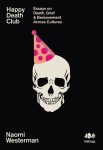 I have reviewed Happy Death Club.
Biteback Publishing’s Provocations series “is a groundbreaking new series of short polemics composed by some of the most intriguing voices in contemporary culture.”
- I have reviewed Last Rights. I spied a pair of books by John Sutherland on youth and ageing at my library.

Bloomsbury’s Object Lessons series “is a series of concise, collectable, beautifully designed books about the hidden lives of ordinary things.”
- I have reviewed Doctor, Dust, Grave, Pregnancy Test, and Recipe.
Bloomsbury’s 33 1/3 is “a series of short books about popular music.”
- I have reviewed Jesus Freak.
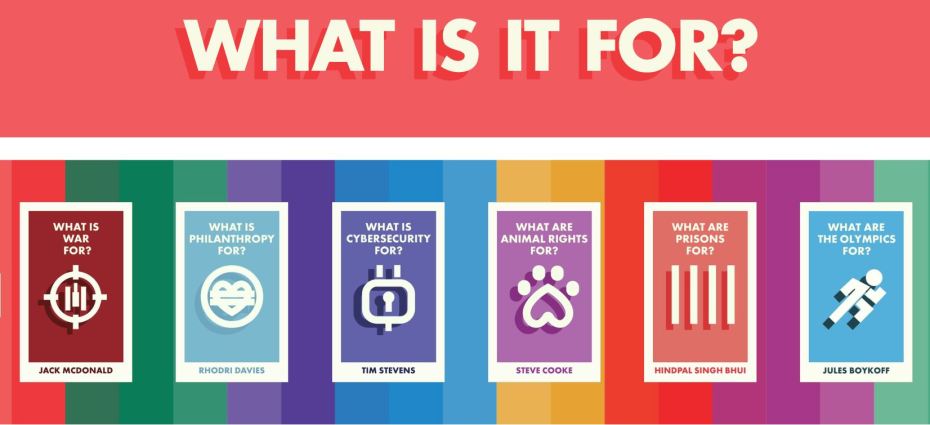
Bristol University Press’s What Is It For series is edited by George Miller, creator of the OUP Very Short Introductions (see below). Miller believes “short, affordable books can, and should, be intelligent and thought-provoking”; he hopes these will “be an agent for positive change,” addressing “tough questions about purpose and fitness for purpose: what has to change for the future to be better?”
A number of Fitzcarraldo Editions’ Essays are significantly under 200 pages.
 I have reviewed Intervals, A Very Easy Death, Happening, I Remain in Darkness, A Woman’s Story, and Alphabetical Diaries (plus others that are longer).
[Edited:] Thanks so much to Liz for letting me know about Jacaranda Books’ A Quick Ting On series, “the first ever non-fiction book series dedicated to Black British culture,” with books on plantains, Grime music, Black hair, and more.
[Edited:] There are three books so far in the Leaping Hare Press Find Your Path self-help series. I have just downloaded Find Your Path through Imposter Syndrome from Edelweiss.
Little Toller Books publishes mostly short nature and travel monographs and reprints.
- I have reviewed Deer Island, Aurochs and Auks, Orison for a Curlew, Herbaceous, The Ash Tree, and Snow.

From the Little Toller website
[Edited:] Thanks so much to Annabel for making me aware of Melville House’s The FUTURES series, which gives “imaginative future visions on a wide range of subjects, written by experts, academics, journalists and leading pop-culture figures.”
MIT Press’s Essential Knowledge series “offers accessible, concise, beautifully produced books on topics of current interest.” I spotted the Plastics book at my library.
Oxford University Press’s Very Short Introductions now cover a whopping 867 subjects!
- I had a couple of them assigned in my college days, including Judaism.
Penguin’s 100-book Great Ideas series reprints essays that introduce readers to “history’s most important and game-changing theories, philosophies and discoveries in accessible, concise editions.”
A number of Profile’s health-themed Wellcome Collection Books are well under 200 pages.
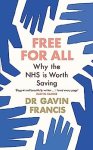
- I have reviewed Recovery, Free for All, Chasing the Sun, An Extra Pair of Hands, and After the Storm (plus others that are longer).


Saraband’s In the Moment series contains “portable, accessible books … exploring the role of both mind and body in movement, purpose, and reflection, finding ways of being fully present in our activities and environment.”
- I’m interested in Writing Landscape by Linda Cracknell and On Community by Casey Plett.
 Most of the original School of Life books are around 150 pages long. Their newer Essential Ideas series of three titles also promises “pocket books.”
- I have reviewed How to Develop Emotional Health, How to Age, How to Be Alone, and How to Think about Exercise.
Why not see if your local library has any selections from one or more of these series? #LoveYourLibrary

If you’re a reluctant nonfiction reader, choosing a short book could be a great way to engage with a topic that interests you – without a major time commitment. #NonfictionNovember
Keep in touch via X (@bookishbeck / @cathy746books) and Instagram (@bookishbeck / @cathy_746books). Add any related posts to the link-up. Don’t forget the hashtag #NovNov24.
Any suitable short nonfiction on your shelves?
Review Catch-up: Matt Gaw, Sheila Heti, Liz Jensen (and a Pile of DNFs)
Today I have a travel book about appreciating nature in any weather, a sui generis memoir drawn from a decade of diaries, and an impassioned cry for the environment in the wake of a young adult son’s death.
I’m also bidding farewell to a whole slew of review books that have been hanging around, in some cases, for literal years – I think one is from 2021, and several others from 2022. Putting a book on my “set aside” shelf can be a kiss of death … or I can go back at a better time and end up loving it. It’s hard to predict which will occur. On these, alas, I have had to admit defeat and will pass the books on to other homes.
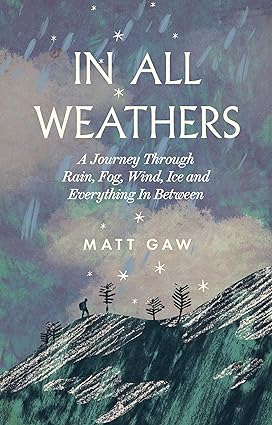
In All Weathers: A Journey through Rain, Fog, Wind, Ice and Everything in Between by Matt Gaw
Gaw’s two previous nature/travel memoirs, the enjoyable The Pull of the River and Under the Stars, involve gentle rambles through British landscapes, along with commentary on history, nature and science. The remit is much the same here. The book is split into four long sections: “Rain,” “Fog,” “Ice and Snow,” and “Wind.” The adventures always start from and end up at the author’s home in Suffolk, but he ranges as far as the Peak District, Cumbria and the Isle of Skye. Wild swimming is one way in which he experiences places. He notices a lot and describes it all in lovely and relatable prose.
 I was tickled by the definitions of, and statistics about, a “white Christmas”: in the UK, it counts if there’s even a single snowflake falling, whereas in the US there has to be 2.5 cm or more of standing snow. (Scotland is most likely to experience white Christmases; it has had 37 since 1960 vs. 26 in northern England. The English snow record is 43 cm, at Buxton and Malham Tarn in 1981 and 2009.) There’s underlying mild dread as he notes how weather patterns have changed and will likely continue changing, ever more dramatically, into his children’s future.
I find I don’t have much to say about this book because it is very nice but doesn’t do anything interesting or tackle anything that isn’t familiar from many other nature books (such as Rain by Melissa Harrison and Forecast by Joe Shute). It’s unfortunate for Gaw that his ideas often seem to have been done before – his book on night-walking, in particular, was eclipsed by several other works on that topic that came out at around the same time. I hope that the next time around he’ll get more editorial guidance to pursue original topics. It might take just a little push to get him to the next level where he could compete with top UK nature writers.
With thanks to Elliott & Thompson Books for the free copy for review.
Alphabetical Diaries by Sheila Heti
Heti put the contents of ten years of her diaries into a spreadsheet, alphabetizing each sentence (including articles), and then ruthlessly culled the results until she had a 25-chapter (no ‘X’) book. You could hardly call it a narrative, yet looking for one is so hardwired that every few sentences you are jolted out of what feels like a mini-story and into something new. Instead, you might think of it as an autobiographical mosaic. The recurring topics are familiar from the rest of Heti’s oeuvre, with obsessive cogitating about relationships, art and identity. But there are also the practicalities of trying to make a living as a woman in a creative profession. Tendrils of the everyday poke out here and there as she makes a meal, catches a plane, or buys clothes. Men loom large: explicit accounts of sex with Pavel and Lars (though also Fiona); advising her friend Lemons on his love life. There are also meta musings on what she is trying to achieve with her book projects and on what literature can be.
 Grammatically, the document is a lot more interesting than it could be – or than a similar experiment based on my diary would be, for instance – because Heti sometimes writes in incomplete sentences, dropping the initial pronoun; or intersperses rhetorical questions or notes to self in the imperative. So, yes, ‘I’ is a long chapter, but not only because of self-absorbed “I…” statements; there’s also plenty of “If…” and “It’s…” ‘H’ and ‘W’ are longer sections than might be expected because of the questioning mode. But it’s at the sentence level that the book makes the biggest impression: lines group together, complement or contradict each other, or flout coherence by being so merrily à propos of nothing. Here are a few passages to give a flavour:
Am I wasting my time? Am low on money. Am making noodles. Am reading Emma. Am tired and will go to sleep. Am tired today and I feel like I may be getting a cold. Ambivalence gives you something to do, something to think about.
Best not to live too emotionally in the future—it hardly ever comes to pass. Better to be on the outside, where you have always been, all your life, even in school, nothing changes. Better to look outward than inward. Blow jobs and tenderness. Books that fall in between the cracks of all aspects of the human endeavour.
It’s 2:34 every time I check the time these days. It’s 4 p.m. It’s 4:41 now. It’s a fantasy of being saved. It’s a stupid idea. It’s a yellow, cloudy sky. It’s amazing to me how life keeps going. It’s better to work, to go into the underground cave where there are books, than to fritter away time online. It’s crazy that I need all of these mental crutches in order to live. It’s fiction. It’s fine.
Scrambled eggs on toast at Yaddo. Second-guessing everything. Second, he said that no one is buying fiction. See the complexity. See the souls. See what kind of story the book can accommodate, if any. Seeing her for coffee was not so bad.
It’s surprising how much sense a text constructed so apparently haphazardly makes, perhaps because of the same subject and style throughout. Sometimes aphoristic, sometimes poetic (all that anaphora), the book is playful but overall serious about the capturing of a life on the page. Heti transcends the quotidian by exploding the one-thing-after-another tedium of chronology. Remarkably, the collage approach produces a more genuine, crystalline vision of the self than precise scenes and cause-and-effect chains ever could. A work of life writing like no other, it must be read in a manner all its own that it teaches you as you go along. I admire it enormously and hope I might write something even half as daring one day.
With thanks to Fitzcarraldo Editions for the free copy for review.
Your Wild and Precious Life: On grief, hope and rebellion by Liz Jensen
Jensen’s younger son, Raphaël Coleman, was just 25 when he collapsed while filming a documentary in South Africa and died of a previously undiagnosed heart condition. Raph had been involved in Extinction Rebellion and Jensen is a founding member of Writers Rebel. They both deemed activism “the best antidote to depression.” Her son had been obsessed with wildlife from a young age and was rewilding acres of their land in France, as well as making environmentalist films (he had achieved minor fame as a child actor in Nanny McPhee) and participating in direct action, such as at the Brazilian embassy in London.
 For Jensen, the challenge, especially after lockdown confined her to her Copenhagen flat, was to channel grief into further radicalism rather than retreating into herself or giving in to the lure of suicide. She tried to see personal grief as a reminder of ecogrief, and therefore as a spur. One way that she coped was turning towards the supernatural. She continued to hear and speak to Raph, in daily life as well as through a medium, and interpreted bird sightings as signs of his continued presence. An additional point of interest to me was that the author’s husband is Carsten Jensen, the writer of one of my favourite books, We, the Drowned.
This doesn’t particularly stand out among the dozens of bereavement memoirs I’ve read. (It was also remarkably similar to Alexandra Fuller’s Fi, which I’d read not long before.) Perhaps more years of reflection would have helped – Mary Karr advises seven – though I suspect Jensen felt, quite rightly, that given the current state of the environment we have no time to waste. And I have no doubt that the combination of a mother’s love and an ecological conscience will make this book meaningful to many readers.
With thanks to Canongate for the free copy for review.
And the DNFs…
there are more things, Yara Rodrigues Fowler – I loved Stubborn Archivist so much that I leapt at the chance to read her follow-up, but it was just too dull and involved about Brazilian versus UK politics. Nor did the stylistic tricks feel as novel this time around. I read 66 pages. (Fleet)
The Rabbit Hutch, Tess Gunty – Gunty dazzled critics and prize judges in the USA, winning a National Book Award. I was drawn to her debut novel for the composite picture of the residents of one Indiana apartment building and the strange connections that develop between them over one summer week, including perhaps a murder? Blandine, the central character, is a sort of modern-day mystic but hard to warm to (“She normally tries to avoid saying in which out loud, to minimize the number of people who find her insufferable”), as are all the characters. This felt like try-hard MFA writing. I read 85 pages. (Oneworld)
Eve: The Disobedient Future of Birth, Claire Horn – I usually get on well with Wellcome Collection books. I think the problem here was that there was too much material that was familiar to me from having read Womb by Leah Hazard – even the SF-geared stuff about artificial wombs. I read 45 pages. (Profile Books)
Blessings, Chukwuebuka Ibeh – This debut novel has a confident voice, buttressed by determination to reveal what life is like for queer people living in countries where homosexuality is criminalized. Obiefuna is cast out for having a crush on Aboy, his father’s apprentice, even though the two young men share nothing more physical than a significant gaze into each other’s eyes. The strict boarding school his father sends him to is a place of privation, hierarchy, hazing and, I suspect, same-sex experimentation. I found the writing capable but couldn’t get past a sense of dread about what was going to happen. Meanwhile, I didn’t think the alternating chapters from Obiefuna’s mother’s perspective added anything to the narrative. I read 62 pages. (Penguin Viking)
The War for Gloria, Atticus Lish – Lish’s debut novel, Preparation for the Next Life, was excellent, but I could never get stuck in to this follow-up, despite the appealing medical theme. When Gloria Goltz is diagnosed with ALS, her 15-year-old son Corey turns to his absent father and others for support. It was also unfortunate that Lish mentions the Ice Bucket Challenge: that was popularized in 2014, whereas the book is set in 2010. I read 75 pages. (Serpent’s Tail)
Snow Widows: Scott’s Fatal Antarctic Expedition through the Eyes of the Women They Left Behind, Katherine MacInnes – I seriously overestimated my interest in polar exploration narratives. MacInnes seems to have done quite a good job of creating novelistic scenes through research, though. I read 35 pages. (William Collins)
The Woodcock, Richard Smyth – I feel particularly bad about this one as I’ve read and enjoyed three of Smyth’s nature books and my husband and I are friendly with him on Twitter. Initially, I got Thomas Hardy, D.H. Lawrence and Sarah Perry (The Essex Serpent, anyway) vibes from this 1920s-set novel about the upheaval a naturalist and his wife experience when an American whaler and his daughters arrive in their small coastal English town. I read 90 pages. (Fairlight Books)
Better Broken than New: A Fragmented Memoir, Lisa St Aubin de Terán – I accepted this for review because I’d often seen the author’s name on spines in secondhand bookstores but didn’t know anything about her work. The précis of her globe-trotting life is stranger than fiction: marriage to a Venezuelan freedom fighter, managing a sugar plantation in the Andes, living in an Italian palace for 20 years, founding a charity in Mozambique. The vignettes in the early part of the book (e.g., skipping school and going on daytrips by train at age eight) are entertaining, if written with blithe disregard for a reader’s need for context or perspective. But the fragmented nature means it all feels as random as life, without the necessary authorial shaping. The publisher has done her a disservice as she seeks to relaunch her career by not proofreading properly: Many small errors slipped through the net, making this look like a sloppy manuscript. The worst happen to be other authors’ names: Jane ‘Austin’, ‘Kahil’ Gibran, Virginia ‘Wolfe’. Are you kidding me?! I read 53 pages. (Amaurea Press)
April Releases by Brownrigg, Ernaux, O’Connor, Waterman and Wood
Family history is a common element for the first four of these review books: a multi-generational story (incorporating autofiction in places) about Anglo-American writers and the legacy of suicide; a brief slice of memoir about the loss of a mother; a historical novella inspired by family stories and set on an island at the cusp of war; and a poetry collection drawing on a father’s death as well as on local folklore. Addiction and dementia are specific links between pairs. And to round off, a set of short stories about pregnancy and motherhood.
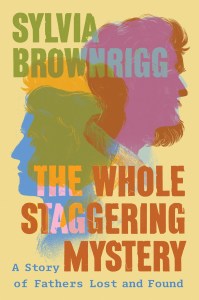
The Whole Staggering Mystery: A Story of Fathers Lost and Found by Sylvia Brownrigg
“The dead don’t come back, but they are not as far away as you think.”
I knew Brownrigg’s name as a novelist thanks to Susan’s blog (see her review of Pages for Her), but when I read about this family memoir it piqued my interest more than her fiction might have. The Brownrigg clan are nobility (really – her brother has the title “Baronet”) but have rejected conventional Englishness over the past century. First her grandfather, Gawen, separated from his wife and moved to Nairobi to work as a journalist. He also published two obscure novels before dying at age 27. The empty bottle of Nembutal and recent changes to his will suggested suicide, though his mother resisted the notion vociferously. Gawen’s son, Nicholas, was raised in California by his mother, Lucia, and became an alcoholic who lived off-grid on a ranch and had an unpublished Beats-influenced novel.
 After Nicholas’s death in 2018, Brownrigg was compelled to trace her family’s patterns of addiction and creativity. It’s a complex network of relatives and remarriages here. The family novels and letters were her primary sources, along with a scrapbook her great-grandmother Beatrice made to memorialize Gawen for Nicholas. Certain details came to seem uncanny. For instance, her grandfather’s first novel, Star Against Star, was about, of all things, a doomed lesbian romance – and when Brownrigg first read it, at 21, she had a girlfriend.
Along with the more traditional memoir sections, there are the documents that speak for themselves and extended passages of autofiction. I loved an imaginary letter by Gawen’s older brother, who died in young childhood, and a third-person segment about Beatrice’s life in England during the Second World War. But I mostly skipped over the 90 lightly fictionalized pages about the author’s (“Sophie’s”) life with her father in California. You might view this as a showcase of possible methods for engaging with family history, some of which work better than others. All of it is fascinating material, though.
Published by Counterpoint in the USA. With thanks to Nectar Literary for the advanced e-copy for review.
A Woman’s Story by Annie Ernaux (1988; 2024)
[Translated from the French by Tanya Leslie]
 This memoir of Ernaux’s mother’s life and death is, at 58 pages, little more than an extended (auto)biographical essay. Confusingly, it covers the same period she wrote about in I Remain in Darkness (originally published nine years later), a diary of her mother’s final years with dementia; I even remembered two specific events and quotes. Why not combine the two into a full-length biographical recollection? Or pair it with A Man’s Place, Ernaux’s memoir of her father, in one volume? Perhaps her works will be repackaged in the future. But this came first: Ernaux started writing just a couple of weeks after her mother’s death, and spent 10 months over it. It’s clear she was determined to salvage what she could of her mother’s life:
It’s a difficult undertaking. For me, my mother has no history. She has always been there. When I speak of her, my first impulse is to ‘freeze’ her in a series of images unrelated to time … This book can be seen as a literary venture as its purpose is to find out the truth about my mother, a truth that can be conveyed only by words. … I believe I am writing about my mother because it is my turn to bring her into the world.
Ernaux opens with news of the death, and the funeral. But soon she’s pushing back into the past. Her mother grew up in poverty near Rouen and worked in a factory before her marriage, when she and her husband took on a grocery store and café. The Second World War was in some romantic way the great drama of her life. She was exacting of her daughter: “Her overriding concern was to give me everything she hadn’t had. But this involved so much work, so much worrying about money”. In her widowhood she came to live with Ernaux, who was then divorced with two sons, and tried to find a middle way between independence and connection. Eventually, though, her memory loss required admission to a nursing home.
I’ve felt the same about all three short works I’ve read by Ernaux so far: though precisely observed, they conceal themselves behind emotional distance. So while this might seem similar to A Very Easy Death by Simone de Beauvoir, I found the latter more engaging.
With thanks to Fitzcarraldo Editions for the free copy for review.
Whale Fall by Elizabeth O’Connor
 The remote Welsh island setting of O’Connor’s debut novella was inspired by several real-life islands that were depopulated in the twentieth century due to a change in climate and ways of life: Bardsey, St Kilda, the Blasket Islands, and the Aran Islands. (A letter accompanying my review copy explained that the author’s grandmother was a Welsh speaker from North Wales and her Irish grandfather had relatives on the Blasket Islands.)
Eighteen-year-old Manod Llan is the older daughter of a lobster fisherman. Her sweetheart recently left to find work in a mainland factory. It’s 1938 and there are vague rumbles about war, but more pressing is the arrival of strangers here to study a vanishing culture. Anthropologists Edward and Joan learn snatches of Welsh and make recordings of local legends and songs, which are interspersed with the fragmentary narrative. Manod, star-struck, seeks the English researchers’ approval as she helps with translation and other secretarial duties, but becomes disillusioned with their misinterpretations and fascist leanings.
The gradual disintegration of a beached whale casts a metaphorical shadow of decay over the slow-burning story. I kept waiting for momentous events that never came. More definitive consequences? Something to do with Manod’s worries for her little sister, Llinos? A flash-forward to the abandoned island’s after-years? Or to Manod’s future? As it is, the sense of being stuck at a liminal time makes it all feel like prologue. But O’Connor’s writing is quite lovely (“The milk had formed a film over the surface and puckered, like a strange kiss”; “All of my decisions felt like trying to catch a fish that did not exist until I caught it”) and the book is strong on atmosphere and tension. I’ll look out for her next work.
With thanks to Picador for the free copy for review.
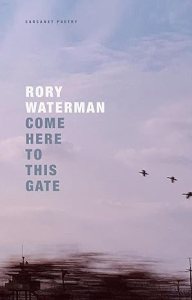
Come Here to This Gate by Rory Waterman
I was most drawn to the poems in Part I, “All but Forgotten,” about his father’s last year or so.
The titles participate in telling the story: “Alcoholic Dementia,” followed by “Twin Oaks Nursing Home.”
The sheep-tracks of your mind were worn to trenches.
…
Then what you’ve turned yourself into – half there
on one side of a final single bed
you might not leave till the rest of you has left –
starts, stares through me, says ‘I’m being held
against my will!’, tells a nurse to ‘Just fuck off’
then thanks her. Old boy, when did you get like this?
The sheep-tracks of my mind are worn to trenches.
Then they moved you to a home
that still wasn’t home. ‘Why
am I in this fucking place?
Nothing’s wrong with me.’
So I’d tell you all over again,
but only the easy part (‘You’re
not remembering things well
at present.’ ‘Yes I fucking am’)
and you relearned that you’d
never learn – mindless torture,
until I stopped it. Your
silences were trains departing.
From the miscellany of Part II, I plucked out “Gooseberries” and “Perennials,” both of which conceal emotion among plants. Then Part III, “Lincolnshire Folk Tales,” turns the tone mischievous, with the ABCB end-rhymes of “Yallery Brown,” “The Metheringham Lass,” “The Lincoln Imp,” and “Nanny Rutt” (I felt I’d stumbled on a limerick with its rhythm: “Math Wood is a small plot of trees south of Bourne, / next to McDonald’s and Lidl. / It’s privately owned, full of shot-gun shells, pheasants – / but still, a bit of an idyll”). Plenty of good stuff, then, but it doesn’t all seem to fit together in the same collection.
With thanks to Carcanet Press for the advanced e-copy for review.
This Is Why We Can’t Have Nice Things by Naomi Wood
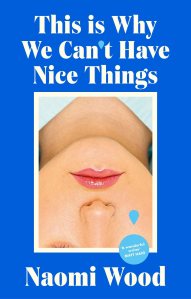 I requested this because a) I had enjoyed Wood’s novels Mrs. Hemingway and The Hiding Game and b) I couldn’t resist the title. These nine contemporary stories (five in the first person and four in the third person) all feature women who are pregnant and/or mothers of young children. Three dwell on work–life balance in particular, with the female protagonists of “Lesley, in Therapy” and “Dracula at the Movies” an animator and a filmmaker, respectively. The third, “Hurt Feelings,” in which a medical emergency forces a choice between career and motherhood, was my favourite. Claudia is working on an advertising campaign for a large pharmaceutical company whose newest product targets chronic pain. Although she suspects it’s a placebo, she knows how valuable it is for these people to have their pain acknowledged given it’s as invisible as her history of pregnancy loss.
Other highlights included “Peek-a-Boo,” in which pregnant twin sisters fly to Italy to remonstrate with their father, who refuses to cede a holiday flat to the next renters; and “Wedding Day,” about a woman bitter enough to try to sabotage her ex’s big day by demanding he bring their daughter, the flower girl, home by bedtime. “Flatten the Curve” is about restrictions and desires during Covid lockdown. Family, neighbour, and co-worker dynamics fuel the drama. In a few cases, Wood imagined promising situations but didn’t deliver on them. I could hardly believe “Comorbidities,” about a mother who films a sex tape with her husband to distract from her eco-anxiety, won the 2023 BBC National Short Story Award. If Wood was aiming for edgy, she landed on peevish instead. “Dino Moms,” the final story, was worst, with its absurd dinosaur-vet reality-TV setup. Overall, the collection is too one-note because of the obsession with motherhood (“It is not very interesting to be in love with your child; it’s commonplace, this sacrificial love”). Back to novels soon, please.
With thanks to Phoenix (Orion) for the free copy for review.
Does one of these catch your eye? What April releases can you recommend?
Assisted Dying: Intervals by Marianne Brooker; Wendy Mitchell; and a Local Panel Discussion
Intervals by Marianne Brooker is on the longlist for the inaugural Women’s Prize for Non-Fiction, which my book club has applied to shadow. I’ve now read three of the nominees, the others being Matrescence and A Flat Place (review coming up tomorrow). Unsurprisingly, I’ve gravitated towards the ones based around a personal narrative – although all three are also political and incorporate research and cultural critique. Brooker’s is an extended essay about her mother’s protracted death with multiple sclerosis and the issues it brought up around disability, poverty, and inequality of access to medical care and services.

Specifically, Brooker decries the injustice of the wealthy having the option of travelling to Dignitas in Switzerland for an assisted death (current cost: £15,000), whereas her single mother, who lived in rented accommodation and had long been disabled and unable to work, apart from crafting and reading tarot, had so such relief in sight. Instead, she resorted to refusing life-sustaining nourishment. VSED, or voluntarily stopping eating and drinking, was a topic much on my mind anyway because of Wendy Mitchell’s death last month.
 Mitchell was diagnosed with early-onset Alzheimer’s in her fifties and was an energetic campaigner for dementia education and research for the last decade of her life. With a co-author, she wrote three books that give a valuable insider’s view of life with dementia: Somebody I Used to Know, What I Wish People Knew About Dementia, and One Last Thing, in which she specifically discusses VSED. She was determined to live independently. For her, a dignified life was being able to meet her own daily physical needs. She did not want to be in a care home, or to exist past the point where she could no longer recognise her daughters. So when, in January, she fell and broke both wrists, giving her a taste of dependency and derailing her plans to travel to Dignitas, she knew that the time had come. VSED was her way out. You can read her farewell message here.
Is wilful starvation a good death? I don’t really know. It’s peaceful, at least; a person simply gets weaker and weaker, spending more and more time asleep until they fade out, at home. But it can take two weeks to die in this way. Should loved ones have to watch this process?
Denied a liveable life and a legal right to die, my mum made a choice within and between the lines of the law. A decade after her diagnosis, when she was forty-nine and I was twenty-six, she decided to stop eating and drinking to end her suffering and her life. Her MS symptoms were barely treatable and certainly incurable: severe pain, incontinence, fatigue, the gradual but intensifying loss of mobility, vision and speech. But these medical symptoms were compounded by social conditions: isolation, stress, debt and fear of a future in which she would not be able to live or die in her chosen home. We were caught in a perfect storm.
Brooker’s description of the vigil of these last days, like her account of her vivacious mother’s life, is both tender and unflinching. It’s almost like a counterpoint to Simone de Beauvoir’s A Very Easy Death, but with the same incisive attention and emotional transfer between mother and daughter. The book also incorporates political commentary and quotations from psychologists and cultural critics. This somewhat distances the reader; it feels less like a bereavement memoir and more like an impassioned, personally inspired treatise. But that’s not to say there isn’t some levity. She remembers good times from their earlier life together, and reckons with her new role as her mother’s memorial and archivist in a way that really rang true for me. I wish the title was more evocative so as to draw the right readers to this book. 
With thanks to Fitzcarraldo Editions for the free copy for review.
Also on this topic, I have read In Love by Amy Bloom, That One Patient by Ellen de Visser, The Inevitable by Katie Engelhart, Darke Matter by Rick Gekoski, and Wild and Precious Life by Deborah Ziegler.
Last night I attended a local panel discussion put on by the Campaign for Dignity in Dying. It wasn’t a debate in that 3.5 of the 4 members on the panel were pro-assisted dying, and I would guess more than four-fifths of the audience as well. In fact, the only anti- voice of the evening was from a young Catholic man during question time. I knew about the event because one panelist attends my church: George Carey, a former archbishop of Canterbury.
The Anglican Church’s line – the religious response in general – is to uphold the sanctity of life and thus to oppose assisted suicide, so for Lord Carey to do otherwise is noteworthy. He changed his mind in 2014, he explained, after the high-profile case of Tony Nicklinson, who was paralysed after a stroke and lost his appeal over the right to die. “There is no theological contradiction between valuing life and wanting a good death,” Carey insisted. Jesus showed mercy to the ill and dying, and so should we. (He also, more facetiously, described King Saul’s mercy killing by an enemy soldier in 2 Samuel as an assisted death.)
The other panelists were a lawyer, a retired doctor, and a Member of Parliament. Lawyer Graham Wood noted that the 1961 Suicide Act, under which anyone who assists a suicide can be prosecuted, would have to be abolished, and that there would also need to be a negotiation regarding Article 2 of the European Convention on Human Rights, which protects the “right to life.” He was the most wary of the speakers, warning of the danger of undue influence being exerted by relatives when money and assets are involved – he said he sees the worst of humanity in his line of work.

Dr Barry Newman pinned his support for assisted dying to compassion and autonomy, two overriding values of a liberal society. He acknowledged the current professional risk for doctors, and noted that the UK’s main medical bodies remain neutral. However, he brought up a loophole, “double effect,” administering a medication that might end life but whose intent is to alleviate suffering, e.g., a high dose of morphine to an end-stage cancer patient.
Kit Malthouse, Conservative MP for northwest Hampshire, co-chairs a group on end-of-life and has campaigned for assisted dying. (American readers may be surprised by a conservative politician having liberal views on an ethical matter. In the UK, morality is not in lockstep with religions and/or political parties as it is in the USA. This was something it took me a while to get used to: I have Christian friends who vote for four different political parties.) He was disappointed that a members’ bill on assisted dying failed in 2015, but has hope that multiple recent cases (e.g., Esther Rantzen) will put it back on the agenda and believes support in the Commons is sufficient to push legislation through in six months.
“It’s coming,” he assured, not least because many of the UK’s European neighbours and other allies have introduced assisted dying. The UK bill does not go as far as the Dutch legislation, about which all the panelists expressed doubt, and can be tailored to this country’s health system. The status quo, Malthouse cautioned, is people suffering. We know from Oregon that the current proposal will work well, he said; there is vanishingly little abuse of the system in any of the places that have instituted assisted dying legislation.
It was all preaching to the choir as far as I was concerned. Indeed, the spontaneous applause and affirming subvocalizations reminded me of a Pentecostal church service. Clearly, many from the audience had witnessed loved ones dying in horrible ways (a few of these stories came out during question time, such as a woman whose husband went to Dignitas and another who had to fight for her terminally ill sister’s wishes when she was mistakenly resuscitated by paramedics after a suicide attempt). Malthouse observed that supporters of assisted dying have often been through horrific experiences with relatives or spouses.
I was already firmly in support so last night didn’t sway me in any way, but I was encouraged that so many people are thinking and talking about these issues. Maybe by the time I face such a crisis myself, or on someone else’s behalf, a compassionate law will be in place.
#ReadIndies Catch-up: Ansell, Kinard, McNaught, Ponce, Toews and Vara
At last, my first dedicated selections for Read Indies month, two of which have been languishing on the shelf since 2022! A few more indie titles will appear in my February roundup tomorrow. I’ve got a huge variety here: an extended essay comparing life among the unhoused in London in the 1980s with the freedom of the open road and the island of Jura; gospel-saturated poems of queer African American life; an exposé of spiritual abuse in a Pentecostal church with branches in England and Nigeria; an Ecuadorian novella obsessed with bodies and sex; a funny yet heartbreaking novel about a zany family trying not to fall apart; and short stories about siblings, adolescence, memory, death and much more. I name the publishers and other books I have on the docket from each one.

Deer Island by Neil Ansell (2013)
 My last unread book by Ansell (whose Deep Country, The Last Wilderness, and The Circling Sky I’ve loved) and one that had been out of print for many years, so it was great to hear that Little Toller was reissuing it. Ansell has visited most countries; pressed for a favourite place, he names the Scottish isle of Jura. In memory he returns to a place he hadn’t been in over 20 years. In the early 1980s he lived in London and volunteered with The Simon Community, a homeless charity, for three years. Later that decade, he found himself in the same situation as those he served, squatting in chaotic multi-occupancy London properties. But in between he’d had a magical jaunt to Jura by hitchhiking and motorbike with a girlfriend. And later, when his only sentimental keepsake was stolen from his squat bedroom, he left that lifestyle behind and fled to Jura, haunt of golden eagles and otters; refuge for George Orwell, who experienced his fair share of squalor – Down and Out in Paris and London gets a mention, but Ansell doesn’t belabour a comparison he more than earns. It’s a shame this is so short, but it’s a carefully crafted slice of life, and illustrates a sobering truth: “Security is an illusion.”
With thanks to Little Toller Books for the free copy for review. Deer Island came out in paperback on 27 February.
Little Toller
Also read recently: brother. do. you. love. me. by Manni Coe
Currently reading: The Long Field by Pamela Petro
Orders of Service by Willie Lee Kinard III (2023)
 At a confluence of Southern, Black and gay identities, Kinard writes of matriarchal families, of congregations and choirs, of the descendants of enslavers and enslaved living side by side. The layout mattered more than I knew, reading an e-copy: often it is white text on a black page; words form rings or an infinity symbol; erasure poems gray out much of what has come before. “Boomerang” interludes imagine a chorus of fireflies offering commentary – just one of numerous insect metaphors. Mythology also plays a role. “A Tangle of Gorgons,” a sample poem I’d read before, wends its serpentine way across several pages. “Catalog of My Obsessions or Things I Answer to” presents an alphabetical list. For the most part, the poems were longer, wordier and more involved (four pages of notes on the style and allusions) than I tend to prefer, but I could appreciate the religious frame of reference and the alliteration.
Two favorite passages:
Ma taught me how to change a tire
the fall before it got real cold one October,
on the plot of dirt the pole beans we call Babel
spiral from, where our boozy station wagon
sat after hobbling home & passing out
in the backyard
(from “Work”)
I left before the door was closed.
I built myself of drowning hymns.
I stole every one to fly.
(from “Icarus Confesses”)
With thanks to Alice James Books for the advanced e-copy for review.
Alice James Books
Also read recently: Theophanies by Sarah Ghazal Ali
Immanuel by Matthew McNaught (2022)
 “Immanuel was the centre of the world once. Long after it imploded, its gravitational pull remains.” McNaught grew up in an evangelical church in Winchester, England, but by the time he left for university he’d fallen away. Meanwhile, some peers left for Nigeria to become disciples at charismatic preacher TB Joshua’s Synagogue Church of All Nations in Lagos. It’s obvious to outsiders that this was a cult, but not so to those caught up in it. It took years and repeated allegations for people to wake up to faked healings, sexual abuse, and the ceding of control to a megalomaniac who got rich off of duping and exploiting followers. This book won the inaugural Fitzcarraldo Editions Essay Prize. I admired its blend of journalistic and confessional styles: research, interviews with friends and strangers alike, and reflection on the author’s own loss of faith. He gets to the heart of why people stayed: “A feeling of holding and of being held. A sense of fellowship and interdependence … the rare moments of transcendence … It was nice to be a superorganism.” This gripped me from page one, but its wider appeal strikes me as limited. For me, it was the perfect chance to think about how I might write about traditions I grew up in and spurned.
With thanks to Fitzcarraldo Editions for the proof copy for review.
Fitzcarraldo Editions
Currently reading: Intervals by Marianne Brooker
Up next: Alphabetical Diaries by Sheila Heti
Blood Red by Gabriela Ponce (2020; 2024)
[Translated from the Spanish by Sarah Booker]
 Like other short works I’ve read by Hispanic women authors (Die, My Love, September and the Night, In Vitro), this Ecuadorian novella is intense, fragmentary, and obsessed with the female body and psyche. The unnamed narrator, a woman separated from her husband and freed from inhibitions, gives in to her substance and sex addictions – “For me, anything that isn’t falling in love has never merited much attention. That giddiness from proximity or bodies”. I was reminded of A Spy in the House of Love in that she flits compulsively from one lover to another, but Ponce is much more explicit than Nin. At least at the start, the sex scenes are almost constant and described in graphic detail. The narrator meets her lovers in warehouses and caves. Literal holes/orifices and blood are profuse, but also symbolically weighty, with fear of pregnancy also featuring heavily. I was impressed at how Booker rendered the stream-of-consciousness approach, which involves several-page paragraphs and metaphors of moths and moss. I wouldn’t say this was a pleasant book to spend time with, but the style and vocabulary made it worthy of note.
With thanks to Dead Ink for the free copy for review. Blood Red was first published in English by Restless Books in the USA in 2022.
Dead Ink
Up next: Sinking Bell by Bojan Louis
Fight Night by Miriam Toews (2022)
 I knew from All My Puny Sorrows that Canadian author Miriam Toews has a knack for combining humour and heartbreak. I can’t believe it took me since 2015 to read another of her novels. Once again, there seems to be a strong autobiographical element and suicide in the family is part of the backstory. Although abandonment and failure haunt these three female generations, we see everything through a child’s point-of-view, which turns life into a jolly adventure. Swiv’s mother, an underemployed actress, is heavily pregnant with “Gord”; her father is out of the picture. Swiv has been expelled, which gives her plenty of time with Grandma Elvira, who makes friends with everyone she meets but, alas, is crumbling physically. Luckily, Swiv knows just how to keep her going with nitro spray and compression socks and pills rescued from the floor. Before Gord arrives, Grandma wants one last adventure: a flight from Canada to Fresno, California to see her remaining family. Their trip is a disaster, in hilarious ways. Child narrators are tough to pull off, so kudos to Toews for making eight-year-old Swiv almost completely believable (though a bit too precocious). These characters are all foul-mouthed fighters, with a quick wit and the determination to make their stories matter. You’ll laugh and cry.
With thanks to Faber for the proof copy for review.
Faber
Also read recently: Happiness Falls by Angie Kim
Currently reading: Places I’ve Taken My Body by Molly McCully Brown
This Is Salvaged by Vauhini Vara (2023)
 The epigraph is from the two pages of laughter (“Ha!”) in “Real Estate,” one of the stories of Birds of America by Lorrie Moore. Vara shares Moore’s themes, which are the stuff of literary fiction generally – adolescence, friendship, ageing, memory, romantic relationships – but also her tone of dark comedy. The death of a sibling recurs. In “The Irates,” teenage Swati, whose brother died of cancer, and her friend Lydia get phone sales jobs through the Chinese restaurant where they go for egg rolls. In “I, Buffalo,” Sheila tries to hide her alcoholism when her sister Priya comes for a visit with Sheila’s brother-in-law and niece. “The girl” in “You Are Not Alone” is delighted to spend her eighth birthday in Florida with her estranged father, but less so when she learns there’s a stepmother figure in the picture. The women of “Sibyls” look after an elderly neighbour with dementia. The querulous child in “Unknown Unknowns” reminded me of Good Talk by Mira Jacob. My two favourites were the title story, about building a Noah’s Ark replica, and “What Next,” about a woman accompanying her teenage daughter to meet her father for the first time. A few stories didn’t stand out, and while I liked the writing, this didn’t necessarily feel like a cohesive collection.
With thanks to Grove Press UK for the free copy for review. This Is Salvaged came out in paperback in the UK on 1 February.
Grove Atlantic
Up next: Get the Picture by Bianca Bosker, Home/Land by Rebecca Mead, We Play Ourselves by Jen Silverman
Have you discovered any new-to-you independent publishers recently?
#WITMonth, Part I: de Beauvoir, Jansson, NDiaye
My first four reads for Women in Translation month were quite a varied selection: a sobering autobiographical essay about the loss of a mother, a characteristically impish children’s novel, a confoundingly elliptical family memoir, and a preview of a forthcoming Mexican novel about women’s friendships and handicraft. Another four coming up later in August.
A Very Easy Death by Simone de Beauvoir (1964; 1965)
[Translated from the French by Patrick O’Brian]
“When someone you love dies you pay for the sin of outliving her with a thousand piercing regrets.”
I’d read a lot about Simone de Beauvoir but not one of her own works until this reissue came my way. It was right up my street as a miniature bereavement memoir (just 84 pages) that doesn’t shy away from the physical details of decline or the emotional complications of a fraught mother–daughter relationship.
 In October 1963, de Beauvoir was in Rome when she got a call informing her that her mother had had an accident. Expecting the worst, she was relieved – if only temporarily – to hear that it was a fall at home, resulting in a broken femur. But when Françoise de Beauvoir got to the hospital, what at first looked like peritonitis was diagnosed as stomach cancer with an intestinal obstruction. Her daughters knew that she was dying, but she had no idea (from what I’ve read, this paternalistic notion that patients must be treated like children and kept ignorant of their prognosis is more common on the Continent, and continues even today).
Over the next month, de Beauvoir and her sister Poupette took turns visiting. Initially alarmed by their mother’s condition, they soon grew used to the deterioration. “I was not worried by her nakedness any more: it was no longer my mother, but a poor tormented body.” They found her in varying states of awareness and discomfort. “In this race between pain and death we most earnestly hoped that death would come first.” Some nurses were better than others. De Beauvoir makes tantalizing references to the standoff between her and her mother about the Catholic faith Simone left behind. (I’ll need to read Memoirs of a Dutiful Daughter for more on that.) Even the hope of heaven didn’t fully neutralize self-pity and physical suffering for the dying woman because she feared her daughters wouldn’t be joining her.
The title is what a nurse told the grieving daughters: that their mother’s had been a very easy death in the end (and an upper-class one, de Beauvoir adds). The word used in French for easy, douce, can also be translated as “gentle,” a tie-in to the epigraph from Dylan Thomas’s “Do not go gentle into that good night.” Is it better for a loved one to die suddenly, or protractedly? I’ve debated this with myself and a few others since my mother’s death from a stroke in October. Ultimately, it’s pointless to ask; any death is an affront, hard to accept and adjust to no matter how much warning is given. I appreciated how matter-of-factly and concisely de Beauvoir’s essay encapsulates the duties and feelings surrounding a death. Frank and unshowy yet potent, this is a classic of the subgenre. 
Published as Fitzcarraldo Editions Classics No. 2 in June. With thanks to the publisher for the free copy for review.
(Books of Summer, #10)
Finn Family Moomintroll by Tove Jansson (1948; 1950)
[Translated from the Swedish by Elizabeth Portch]
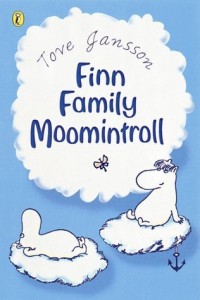 My sixth Moomins book, and ninth by Jansson overall. The novella’s gentle peril is set in motion by the discovery of the Hobgoblin’s Hat, which transforms anything placed within it. As spring moves into summer, this causes all kind of mild mischief until Thingumy and Bob, who speak in spoonerisms, show up with a suitcase containing something desired by both the Groke and the Hobgoblin, and make a deal that stops the disruptions.
As always, the creatures and events, conveyed by Jansson’s black-and-white drawings as much as by her words, are inventive and whimsical. There’s a cosy charm to the seasonal rituals, like the end-of-summer pancake party here. But what I value even more is the pointed accounts of the secondary characters’ neuroses. The Moomins are generally on a pretty even keel, though there is mention of Moominpappa’s sense of being hard done by because of childhood bullying and an enduring lack of respect. However, characters like the Muskrat and the Hemulen get a wry smile and shake of the head from me because their predicaments are so familiar: The Muskrat, terrified of mortifying situations, decides the life of a hermit might be preferable; the Hemulen gives up stamp collecting and switches to botanizing because there’s no joy in a finished quest, only in an ongoing search. The Moomins books offer the perfect combination of the familial and routine with the novel and adventurous. Even staid adults should give them a try. (Little Free Library)
Self-Portrait in Green by Marie NDiaye (2005; 2015)
[Translated from the French by Jordan Stump]
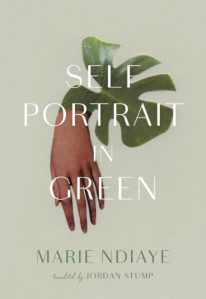 I tend to love a memoir that tries something new or experimental with the form (such as Constructing a Nervous System or In the Dream House), but this was a step too far for me; the self referred to in the title is almost wholly absent. NDiaye, a French–Senegalese author, opens in 2003 with the expected flooding of the Garonne in southwest France. Fragments of narrative from 2000–2003 chart her encounters with various women dressed in green, starting with one she thinks she sees under a banana tree (though her four children see nothing). Then there’s Katia Depetiteville, dead 10 years … NDiaye’s stepmother, once her childhood best friend; her friend Jenny’s rival for Ivan’s affection; and her mother, who now has a new family. What is a ‘woman in green’? The author explicitly associates the colour with cruelty, with presumably the usual connotation of jealousy as well. But it still feels arbitrary.
It’s all rather dreamlike, with poetic repetition, rhetorical questions and black-and-white photos that seem marginally relevant. “I’m saying to myself: Is all this really real?” NDiaye writes, and the reader will surely be asking the same. “I’m always interested in stories,” she adds, and while I’d agree, I need to know that they’re being told to build to some greater meaning. It was only in the last fifth of the book, when the author goes to a literary symposium in Ouagadougou and visits her father (a many-times-married former restaurateur and amateur architect now suffering from cataracts) and stepmother that I felt like there was a purpose: a bringing together of past and present for psychological clarity. I was relieved that this was only 112 pages. (Edelweiss) 
The 10th anniversary edition is being reissued by Two Lines Press next month.
And a bonus preview:
Cross-Stitch by Jazmina Barrera (2021; 2023)
[Translated from the Spanish by Christina MacSweeney]
 In the inventive debut novel by Mexican author Jazmina Barrera, a sudden death provokes an intricate examination of three young women’s years of shifting friendship. Their shared hobby of embroidery occasions a history of women’s handiwork, woven into a relationship study that will remind readers of works by Elena Ferrante and Deborah Levy. Citlali, Dalia, and Mila had been best friends since middle school. Mila, a writer with a young daughter, is blindsided by news that Citlali has drowned off Senegal. While waiting to be reunited with Dalia for Citlali’s memorial service, she browses her journal to revisit key moments from their friendship, especially travels in Europe and to a Mexican village. Cross-stitch becomes its own metaphorical language, passed on by female ancestors and transmitted across social classes. Reminiscent of Still Born and A Ghost in the Throat. (Edelweiss)
Coming out on 7 November from Two Lines Press. My full review for Shelf Awareness is pending.
#ReadIndies and Review Catch-up: Hazrat, Nettel, Peacock, Seldon
Another four selections for Read Indies month. I’m particularly pleased that two from this latest batch are “just because” books that I picked up off my shelves; another two are catch-up review copies. A few more indie titles will appear in my February roundup on Tuesday. For today, I have a fun variety: a history of the exclamation point, a Mexican novel about choosing motherhood versus being childfree, a memoir of a decades-long friendship between two poets, and a posthumous poetry collection with themes of history, illness and nature.

An Admirable Point: A brief history of the exclamation mark by Florence Hazrat (2022)
I’m definitely a punctuation geek. (My favourite punctuation mark is the semicolon, and there’s a book about it, too: Semicolon: The Past, Present, and Future of a Misunderstood Mark by Cecelia Watson, which I have on my Kindle.) One might think that strings of exclamation points are a pretty new thing – rounding off phrases in (ex-)presidential tweets, for instance – but, in fact, Hazrat opens with a Boston Gazette headline from 1788 that decried “CORRUPTION AND BRIBERY!!!” in relation to the adoption of the new Constitution.
 The exclamation mark as we know it has been around since 1399, and by the 16th century its use for expression and emphasis had been codified. I was reminded of Gretchen McCulloch’s discussion of emoji in Because Internet, which also considers how written speech signifies tone, especially in the digital age. There have been various proposals for other “intonation points” over the centuries, but the question mark and exclamation mark are the two that have stuck. (Though I’m currently listening to an album called interrobang – ‽, that is. Invented by Martin Speckter in 1962; recorded by Switchfoot in 2021.)
I most enjoyed Chapter 3, on punctuation in literature. Jane Austen’s original manuscripts, replete with dashes, ampersands and exclamation points, were tidied up considerably before they made it into book form. She’s literature’s third most liberal user of exclamation marks, in terms of the number per 100,000 words, according to a chart Ben Blatt drew up in 2017, topped only by Tom Wolfe and James Joyce.
There are also sections on the use of exclamation points in propaganda and political campaigns – in conjunction with fonts, which brought to mind Simon Garfield’s Just My Type and the graphic novel ABC of Typography. It might seem to have a niche subject, but at just over 150 pages this is a cheery and diverting read for word nerds.
With thanks to Profile Books for the proof copy for review.
Still Born by Guadalupe Nettel (2020; 2022)
[Translated from the Spanish by Rosalind Harvey]
This was the Mexican author’s fourth novel; she’s also a magazine director and has published several short story collections. I’d liken it to a cross between Motherhood by Sheila Heti and (the second half of) No One Is Talking About This by Patricia Lockwood. Thirtysomething friends Laura and Alina veer off in different directions, yet end up finding themselves in similar ethical dilemmas. Laura, who narrates, is adamant that she doesn’t want children, and follows through with sterilization. However, when she becomes enmeshed in a situation with her neighbours – Doris, who’s been left by her abusive husband, and her troubled son Nicolás – she understands some of the emotional burden of motherhood. Even the pigeon nest she watches on her balcony presents a sort of morality play about parenthood.
 Meanwhile, Alina and her partner Aurelio embark on infertility treatment. Laura fears losing her friend: “Alina was about to disappear and join the sect of mothers, those creatures with no life of their own who, zombie-like, with huge bags under their eyes, lugged prams around the streets of the city.” They eventually have a daughter, Inés, but learn before her birth that brain defects may cause her to die in infancy or be severely disabled. Right from the start, Alina is conflicted. Will she cling to Inés no matter her condition, or let her go? And with various unhealthy coping mechanisms to hand, will her relationship with Aurelio stay the course?
Laura alternates between her life and her friends’ circumstances, taking on an omniscient voice on Nettel’s behalf – she recounts details she couldn’t possibly be privy to, at least not at the time (there’s a similar strategy in The Group by Lara Feigel). The question of what is fated versus what is chosen, also represented by Laura’s interest in tarot and palm-reading, always appeals to me. This was a wry and sharp commentary on women’s options. (Giveaway win from Bookish Chat on Twitter)
Still Born was published by Fitzcarraldo Editions in the UK and is forthcoming from Bloomsbury in the USA on August 8th.
A Friend Sails in on a Poem by Molly Peacock (2022)
I’ve read one of Peacock’s poetry collections, The Analyst, as well as her biography of Mary Delany, The Paper Garden. I was delighted when she got in touch to offer a review copy of her latest memoir, which reflects on her nearly half a century of friendship with fellow poet Phillis Levin. They met in a Johns Hopkins University writing seminar in 1976, and ever since have shared their work in progress over meals. They are seven years apart in age and their careers took different routes – Peacock headed up the Poetry Society of America’s subway poetry project and then moved to Toronto, while Levin taught at the University of Maryland – but over the years they developed “a sense of trust that really does feel familial … There is a weird way, in our conversations about poetry, that we share a single soul.” For a time they were both based in New York City and had the same therapist; more recently, they arranged annual summer poetry retreats in Cazenovia (recalled via diary entries), with just the two attendees. Jobs and lovers came and went, but their bond has endured.
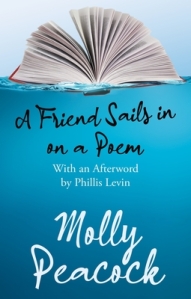 The book traces their lives but also their development as poets, through examples of their verse. Her friend is “Phillis” in real life, but “Levin” when it’s her work is being discussed – and her own poems are as written by “Peacock.” Both women became devoted to the sonnet, an unusual choice because at the time that they were graduate students free verse reigned and form was something one had to learn on one’s own time. Stanza means “room,” Peacock reminds readers, and she believes there is something about form that opens up space, almost literally but certainly metaphorically, to re-examine experience. She repeatedly tracks how traumatic childhood events, as much as everyday observations, were transmuted into her poetry. Levin did so, too, but with an opposite approach: intellectual and universal where Peacock was carnal and personal. That paradox of difference yet likeness is the essence of the friendships we sail on. What a lovely read, especially if you’re curious about ‘where poems come from’; I’d particularly recommend it to fans of Ann Patchett’s Truth and Beauty.
With thanks to Molly Peacock and Palimpsest Press for the free e-copy for review.
The Bright White Tree by Joanna Seldon (Worple Press, 2017)
This appeared the year after Seldon died of cancer; were it not for her untimely end and her famous husband Anthony (a historian and political biographer), I’m not sure it would have been published, as the poetry is fairly mediocre, with some obvious rhymes and twee sentiments. I wouldn’t want to speak ill of the dead, though, so think of this more like a self-published work collected in tribute, and then no problem. Some of the poems were written from the Royal Marsden Hospital, with “Advice” a useful rundown of how to be there for a friend undergoing cancer treatment (text to let them know you’re thinking of them; check before calling, or visiting briefly; bring sanctioned snacks; don’t be afraid to ask after their health).
 Seldon takes inspiration from history (the story of Kitty Pakenham, the bombing of the Bamiyan Buddhas), travels in England and abroad (“Robin in York” vs. “Tuscan Garden”), and family history. Her Jewish heritage is clear from poems about Israel, National Holocaust Memorial Day and Rosh Hashanah. Her own suffering is put into perspective in “A Cancer Patient Visits Auschwitz.” There are also ekphrastic responses to art and literature (a Gaugin, A Winter’s Tale, Jane Eyre, and so on). I particularly liked “Conker,” a reminder of a departed loved one “So is a good life packed full of doing / That may grow warm with others, even when / The many years have turned, and darkness filled / Places where memory shone bright and strong. / I feel the conker and feel he is here.” (New bargain book from Waterstones online sale with Christmas book token)
There are haikus dotted through the collection; here’s one perfect for the season:
“Snowdrops Haiku”
Maids demure, white tips to
Mob caps… Look now! They’ve
Splattered the lawn with snow
Have you discovered any new-to-you independent publishers recently?
20 Books of Summer, 8–10: Marram, Orchid Summer, and Bonsai
Halfway through my flora-themed reading challenge with less than half of the summer left to go. However, I’m actually partway through another seven relevant reads, so I’m confident I’ll get to 20. The sticking point for me, as always, is finishing what I’ve started!
Today I have brief responses to the two nature/travel quest memoirs I took with me to the Outer Hebrides, plus a forthcoming Chilean novella about how a relationship is to be memorialized.
Marram: Memories of Sea and Spider Silk by Leonie Charlton (2020)
I think I’d already downloaded this to my Kindle when I saw Charlton interviewed by the Bookshop Band on their breakfast-time variety show during the 2020 online Wigtown Book Festival. In 2017, Charlton and her friend Shuna undertook a three-week pony trek through the Outer Hebrides. Like many, they worked their way south to north, starting at Barra and finishing on Lewis (we travelled in the opposite direction on our recent trip).
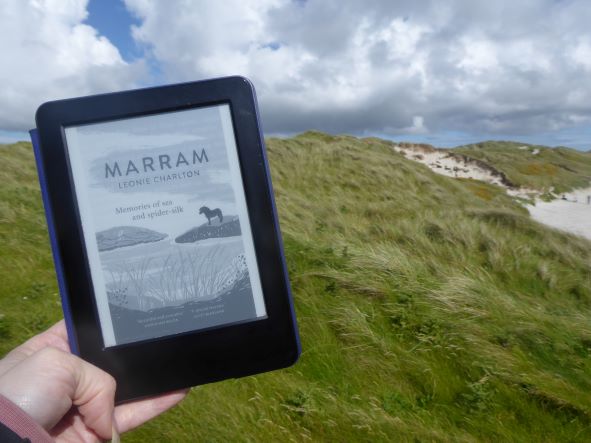
Marram grass on a Benbecula beach.
Although it was a low-key fundraising project for her daughter’s traditional music school, for Charlton there was another underlying reason. Her difficult mother, a jewellery maker, had died of brain cancer seven years before, and she had the idea of leaving beads from her mum’s collection (she’d actually nicknamed her daughter “Beady,” though for her eyes) along the route to lay her and their complicated relationship to rest. As one of her mother’s friends put it, “She was a nightmare, and wonderful, and totally impossible.”
I enjoyed the blend of topics – the amazing scenery, the rigours of the trail, the kindness of acquaintances and strangers who gave them places to camp and graze the ponies, and painful memories – and probably got more out of it because I was reading on location. Her regrets about her mother formed a larger part of the book than expected, but that wasn’t a problem for me; you might steer clear if this would be triggering, though. (Read via NetGalley)
Orchid Summer: In Search of the Wildest Flowers of the British Isles by Jon Dunn (2018)
Dunn saw all but one of Britain’s native species of orchid (51–55, depending on how you count; subspecies are still being debated) between the spring and autumn of 2016; only the ghost orchid eluded him. He alternates between his whistlestop travels, the backstory to his nature obsession, and the historical and cultural associations with orchids. “I was rapidly learning that orchids exert an influence unlike any other plant upon those who fall under their spell, he writes” (in that vein, I also recommend Susan Orlean’s The Orchid Thief).
I most enjoyed the chapters set in North Uist – where he goes to find the Hebridean marsh orchid – and his adopted home of Shetland; it’s always fun to read about somewhere I am or have been before (also including Lindisfarne). The number-driven quest seems like a peculiarly male undertaking, e.g. the similar The Butterfly Isles by Patrick Barkham, and orchids in particular are surrounded by secrecy – you have to be in the know to locate rarities, which often seem to be in roadside ditches. Dunn evades potential accusations of elitism or machismo, though, by recounting vulnerable moments: when he inadvertently strayed onto a golf course and got verbally abused; when some lads stopped their car to harass him.
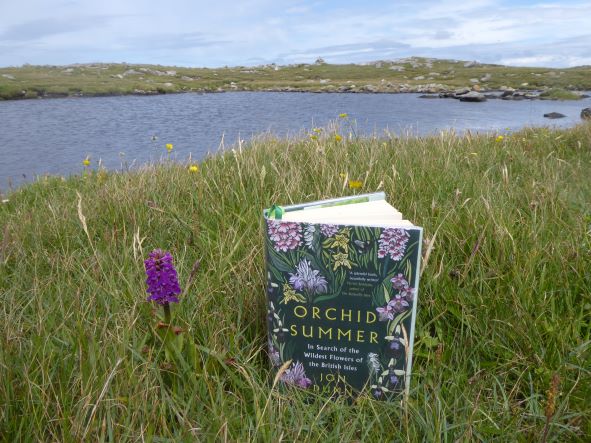
A marsh orchid at Balranald nature reserve, North Uist.
In general, this is denser with information than all but the keenest amateur botanists need, so I didn’t engage with it as much as his book about hummingbirds, The Glitter in the Green, but Dunn is a top-class nature and travel writer who really brings places and species to life on the page through his enthusiastic descriptions. Still, I wish this could have been illustrated with colour plates, as the author is an equally accomplished photographer. (Public library)
Bonsai by Alejandro Zambra (2006; 2022)
[Translated from the Spanish by Megan McDowell]
“In Emilia and Julio’s story … there are more omissions than lies, and fewer omissions than truths”
 These college students’ bond is primarily physical, with an overlay of intellectual pretentiousness: they read to each other from the likes of Proust before they go to bed. Zambra, a Chilean poet and fiction writer, zooms in and out to spotlight each one’s other connections with friends and lovers and presage how the past will lead to separate futures. Already we see Julio thinking about how this time-limited relationship will be remembered in memory and in writing. The plot of a story Zambra references in this allusion-heavy work, “Tantalia” by Macedonio Fernández, provides the title: a couple buy a small plant to signify their love, but realize that maybe wasn’t a great idea given that plants can die.
Tending a bonsai is like writing, thinks Julio. Writing is like tending a bonsai, Julio thinks.
At scarcely 60 pages, with plenty of blank space between sections, this feels most like a short story. Bonsai symbolism aside, I didn’t find much to latch onto. Zambra is playing literary games here – “Let’s say her name is or was Emilia and that his name is, was, and will be Julio,” he writes in the first paragraph – and indulging an appetite for metafiction. Drawing attention to the arbitrary nature of creation made this feel generic and soulless, like the author wasn’t committed to or fond of his characters and their story. This wasn’t my cup of tea, but fans of Open Water and Normal People who also love spare writing in translation might enjoy it.
With thanks to Fitzcarraldo Editions for the free copy for review. Bonsai will be published on August 17th.
Winter Reads, Part II: Au, Glück, Hall, Rautiainen, Slaght
In the week before Christmas I reviewed a first batch of wintry reads. We’ve had hardly any snowfall here in southern England this season, so I gave up on it in real life and sought winter weather on the page. After we’ve seen the back of Storm Franklin (it’s already moved on from Eunice!), I hope it will feel appropriate to start right in on some spring reading. But for today I have a Tokyo-set novella, sombre poems, an OTT contemporary Gothic novel, historical fiction in translation from the Finnish, and – the cream of the crop – a real-life environmentalist adventure in Russia.
Cold Enough for Snow by Jessica Au (2022)
 This slim work will be released in the UK by Fitzcarraldo Editions on the 23rd and came out elsewhere this month from New Directions and Giramondo. I actually read it in December during my travel back from the States. It’s a delicate work of autofiction – it reads most like a Chloe Aridjis or Rachel Cusk novel – about a woman and her Hong Kong-raised mother on a trip to Tokyo. You get a bit of a flavour of Japan through their tourism (a museum, a temple, handicrafts, trains, meals), but the real focus is internal as Au subtly probes the workings of memory and generational bonds.
The woman and her mother engage in surprisingly deep conversations about the soul and the meaning of life, but these are conveyed indirectly rather than through dialogue: “she said that she believed that we were all essentially nothing, just series of sensations and desires, none of it lasting. … The best we could do in this life was to pass through it, like smoke through the branches”. Though I highlighted a fair few passages, I find that no details have stuck with me. This is just the sort of spare book I can admire but not warm to. (NetGalley) 
Winter Recipes from the Collective by Louise Glück (2021)
 The only other poetry collection of Glück’s that I’d read was Vita Nova. This, her first release since her Nobel Prize win, was my final read of 2021 and my shortest, at 40-some pages; it’s composed of just 15 poems, a few of which stretch to five pages or more. “The Denial of Death,” a prose piece with more of the feel of an autobiographical travel essay, was a standout; the title poem, again in prose paragraphs, and the following one, “Winter Journey,” about farewells, bear a melancholy chill. Memories and dreams take pride of place, with the poet’s sister appearing frequently. “How heavy my mind is, filled with the past.” There are also multiple references to Chinese concepts and characters (as on the cover). The overall style is more aphoristic and reflective than expected. Few individual lines or images stood out to me.
With thanks to Carcanet Press for the e-copy for review.
The Snow Collectors by Tina May Hall (2020)
 Henna is alone in the world since her parents and twin sister disappeared in a boating accident. She lives a solitary existence with her sister’s basset hound Rembrandt in a New England village, writing encyclopaedia entries on the Arctic, until she stumbles on a corpse and embarks on an amateur investigation involving scraps of 19th-century correspondence. The dead woman asked inconvenient questions about a historical cover-up; if she takes up the thread, Henna could be a target, too. Her collaboration with the police chief, Fletcher, turns into a flirtation. After her house burns down, she ends up living with him – and his mother and housekeeper – in a Gothic mansion stuffed with birds of prey and historical snow samples. She’s at the mercy of this quirky family and the weather, wearing ancient clothing from Fletcher’s great-aunts and tramping through blizzards looking for answers.
This is a kitchen-sink novel with loads going on, as if Hall couldn’t decide which of her interests to include so threw them all in. Yet at only 221 pages, it might actually have been expanded a little to flesh out the backstory and mystery plot. It gets more than a bit ridiculous in places, but its Victorian fan fiction vibe is charming escapism nonetheless. What with the historical fiction interludes about the Franklin expedition, this reminded me most of The Still Point, but also of The World Before Us and The Birth House. I’d happily read Hall’s 2010 short story collection, too. (Christmas gift) 
Land of Snow and Ashes by Petra Rautiainen (2022)
[Translated from the Finnish by David Hackston]
 In the middle years of World War II, Finland was allied with Nazi Germany against Russia, a mutual enemy. After the Moscow Armistice, the Germans retreated in disgrace, burning as many buildings and planting as many landmines as they could (“the Lapland War”). I gleaned this helpful background information from Hackston’s preface. The story that follows is in two strands: one is set in 1944 and told via diary entries from Väinö Remes, a Finnish soldier called up to interpret at a Nazi prison camp in Inari. The other, in third person, takes place between 1947 and 1950, the early years of postwar reconstruction. Inkeri, a journalist, has come to Enontekiö to find out what happened to her husband. An amateur photographer, she teaches art to the local Sámi children and takes on one girl, Bigga-Marja, as her protégée.
Collusion and secrets; escaped prisoners and physical measurements being taken of the Sámi: there are a number of sinister hints that become clearer as the novel goes on. I felt a distance from the main characters that I could never quite overcome, such that the reveals didn’t land with as much power as I think was intended. Still, this has the kind of forthright storytelling and precise writing that fans of Hubert Mingarelli should appreciate. For another story of the complexities of being on the wrong side of history, see The Women in the Castle by Jessica Shattuck.
With thanks to Pushkin Press for the proof copy for review.
Winter words:
“Fresh snow has fallen, forming drifts across the terrain. White. Grey. Undulating. The ice has cracked here and there, raising its head in the thawed sections of the river. There is only a thin layer of ice left.”
Owls of the Eastern Ice: The Quest to Find and Save the World’s Largest Owl by Jonathan C. Slaght (2020)
Slaght has become an expert on the Blakiston’s fish owl during nearly two decades of fieldwork in the far east of Russia – much closer to Korea and Japan than to Moscow, the region is also home to Amur tigers. For his Master’s and PhD research at the University of Minnesota, he plotted the territories of breeding pairs of owls and fit them with identifying bands and data loggers to track their movements over the years. He describes these winter field seasons as recurring frontier adventures. Now, I’ve accompanied my husband on fieldwork from time to time, and I can tell you it would be hard to make it sound exciting. Then again, gathering beetles from English fields is pretty staid compared to piloting snowmobiles over melting ice, running from fire, speeding to avoid blockaded logging roads, and being served cleaning-grade ethanol when the vodka runs out.
 The sorts of towns Slaght works near are primitive places where adequate food and fuel is a matter of life and death. He and his assistants rely on the hospitality of Anatoliy the crazy hermit and also stay in huts and caravans. Tracking the owls is a rollercoaster experience, with expensive equipment failures and trial and error to narrow down the most effective trapping methods. His team develops a new low-tech technique involving a tray of live fish planted in the river shallows under a net. They come to know individuals and mourn their loss: the Sha-Mi female he’s holding in his author photo was hit by a car four years later.
Slaght thinks of Russia as his second home, and you can sense his passion for the fish owl and for conservation in general. He boils down complicated data and statistics into the simple requirements for this endangered species (fewer than 2000 in the wild): valleys containing old-growth forest with large trees and rivers that don’t fully freeze over. There are only limited areas with these characteristics. These specifications and his ongoing research – Slaght is now the Northeast Asia Coordinator for the Wildlife Conservation Society – inform the policy recommendations given to logging companies and other bodies.
Amid the science, this is just a darn good story, full of bizarre characters like Katkov, a garrulous assistant exiled for his snoring. (“He fueled his monologue with sausage and cheese, then belched zeppelins of aroma into that confined space.”) Slaght himself doesn’t play much of a role in the book, so don’t expect a soul-searching memoir. Instead, you get top-notch nature and travel writing, and a ride along on a consequential environmentalist quest. This is the kind of science book that, like Lab Girl and Entangled Life, I’d recommend even if you don’t normally pick up nonfiction. (Christmas gift) 
And a bonus children’s book:
If Winter Comes, Tell It I’m Not Here by Simona Ciraolo (2020)

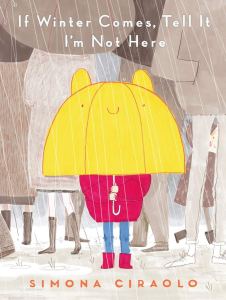 The little boy loves nothing more than to spend hours at the swimming pool and then have an ice cream cone. His big sister warns him the carefree days of summer will be over soon; it will turn cold and dark and he’ll be cooped up inside. Her words come to pass, yet the boy realizes that every season has its joys and he has to take advantage of them while they last. Cute and colourful, though the drawing style wasn’t my favourite. And a correction is in order: as President Biden would surely tell you, ice cream is a year-round treat! (Public library)
Any snowy or icy reading (or weather) for you lately?
2022 Proof Copies & Early Recommendations (Julia Armfield’s Debut Novel, Lily King’s Short Stories)
I didn’t feel like I’d done a lot of pre-release reading yet, but put it all together and somehow it looks like a lot…
My top recommendations for 2022 (so far):
Our Wives Under the Sea by Julia Armfield
Coming on March 3rd from Picador (UK) and on July 12th from Flatiron Books (USA)
I loved Armfield’s 2019 short story collection Salt Slow, which I reviewed when it was shortlisted for the Sunday Times Young Writer of the Year Award. Her strategy in her debut novel is similar: letting the magical elements seep in gradually so that, lulled into a false sense of familiarity, you find the creepy stuff all the more unsettling.
 Miri is relieved to have her wife back when Leah returns from an extended Centre for Marine Inquiry expedition. But something went wrong with the craft while in the ocean depths and it was too late to evacuate. What happened to Leah and the rest of the small crew? Miri starts to worry that Leah – who now spends 70% of her time in the bathtub – will never truly recover. Chapters alternate between Miri describing their new abnormal and Leah recalling the voyage. As Miri tries to tackle life admin for both of them, she feels increasingly alone and doesn’t know how to deal with persistent calls from the sister of one of the crew members.
This is a really sensitive consideration of dependency and grief – Miri recently lost her mother and Leah’s father also died. I especially liked the passages about Miri’s prickly mother: it was impossible not to offend her, and she truly believed that if she resisted ageing she might never die. Leah seems shell-shocked; her matter-of-fact narration is a contrast to Miri’s snark. Armfield gives an increasingly eerie story line a solid emotional foundation, and her words about family and romantic relationships ring true. I read this in about 24 hours in early December, on my way back from a rare trip into London; it got the 2022 releases off to a fab start to me. Plus, the title and cover combo is killer. I’d especially recommend this to readers of Carmen Maria Machado and Banana Yoshimoto. (Read via NetGalley) 
Five Tuesdays in Winter by Lily King
Coming on January 20th from Picador (UK); released in the USA in November 2021
 The same intimate understanding of emotions and interactions found in Euphoria and Writers & Lovers underlies King’s first short story collection. Some stories are romantic; others are retrospective coming-of-age narratives. Most are set in New England, but the time and place varies from the 1960s to the present day and from Maine to northern Europe. Several stories look back to a 1980s adolescence. “South” and “The Man at the Door” are refreshingly different, incorporating touches of magic and suspense. However, there are also a few less engaging stories, and there aren’t particularly strong linking themes. Still, the questions of love’s transience and whether any relationship can ever match up to expectations linger. I’d certainly recommend this to fans of King’s novels. (See my full review at BookBrowse. See also my related article on contemporary New England fiction.)
With thanks to Picador for the proof copy for review.
Other 2022 releases I’ve read:
(In publication date order)
 Write It All Down: How to put your life on the page by Cathy Rentzenbrink [Jan. 6, Bluebird] I’ve read all of Rentzenbrink’s books, but the last few have been disappointing. Alas, this is more of a therapy session than a practical memoir-writing guide. (Full review coming later this month.)
 Recovery: The Lost Art of Convalescence by Gavin Francis [Jan. 13, Wellcome Collection]: A short, timely book about the history and subjectivity of recovering from illness. (Full review and giveaway coming next week.)
 The Store-House of Wonder and Astonishment by Sherry Rind [Jan. 15, Pleasure Boat Studio]: In her learned and mischievous fourth collection, the Seattle poet ponders Classical and medieval attitudes towards animals. (Full review coming to Shelf Awareness soon.)
 Stepmotherland by Darrel Alejandro Holnes [Feb. 1, University of Notre Dame Press]: Holnes’s debut collection, winner of the Andrés Montoya Poetry Prize, ponders a mixed-race background and queerness through art, current events and religion. Poems take a multitude of forms; the erotic and devotional mix in provocative ways. (See my full review at Foreword.)
 Rise and Float: Poems by Brian Tierney [Feb. 8, Milkweed Editions]: A hard-hitting debut collection with themes of bereavement and mental illness – but the gorgeous imagery lifts it above pure melancholy. (Full review coming to Shelf Awareness soon.)
 Cost of Living: Essays by Emily Maloney [Feb. 8, Henry Holt]: Probing mental illness and pain from the medical professional’s perspective as well as the patient’s, 16 autobiographical essays ponder the value of life. (Full review coming to Shelf Awareness soon.)
 Circle Way: A Daughter’s Memoir, a Writer’s Journey Home by Mary Ann Hogan [Feb. 15, Wonderwell]: A posthumous memoir of family and fate that focuses on a father-daughter pair of writers. A fourth-generation Californian, Hogan followed in her father Bill’s footsteps as a local journalist. Collage-like, the book features song lyrics and wordplay as well as family anecdotes. (See my full review at Foreword.)
 Cold Enough for Snow by Jessica Au [Feb. 23, Fitzcarraldo Editions]: A delicate work of autofiction – it reads like a Chloe Aridjis or Rachel Cusk novel – about a woman and her Hong Kong-raised mother on a trip to Tokyo. (Full review coming up in a seasonal post.)
 The Carriers: What the Fragile X Gene Reveals about Family, Heredity, and Scientific Discovery by Anne Skomorowsky [May 3, Columbia UP]: Blending stories and interviews with science and statistics, this balances the worldwide scope of a disease with its intimate details. (Full review coming to Foreword soon.)
Currently reading:
(In release date order)
 This Boy We Made: A Memoir of Motherhood, Genetics, and Facing the Unknown by Taylor Harris [Jan. 11, Catapult] (Reading via Edelweiss; to review for BookBrowse)
To Paradise by Hanya Yanagihara [Jan. 11, Picador] (Blog review coming … eventually)
I Came All This Way to Meet You: Writing Myself Home by Jami Attenberg [Jan. 13, Serpent’s Tail] (Blog review coming later this month)
 Everything Is True: A Junior Doctor’s Story of Life, Death and Grief in a Time of Pandemic by Roopa Farooki [Jan. 20, Bloomsbury] (To review for Shiny New Books)
Some Integrity by Padraig Regan [Jan. 27, Carcanet] (Blog review coming later this month)
Additional proof copies on my shelf:
(In release date order; publisher blurbs from Goodreads/Amazon)

 What I Wish People Knew About Dementia by Wendy Mitchell [Jan. 20, Bloomsbury]: “When Mitchell was diagnosed with young-onset dementia at the age of fifty-eight, her brain was overwhelmed with images of the last stages of the disease – those familiar tropes, shortcuts and clichés that we are fed by the media, or even our own health professionals. … Wise, practical and life affirming, [this] combines anecdotes, research and Mitchell’s own brilliant wit and wisdom to tell readers exactly what she wishes they knew about dementia.”
 I Love You But I’ve Chosen Darkness by Claire Vaye Watkins [Came out in USA last year; UK release = Jan. 20, Quercus]: “Leaving behind her husband and their baby daughter, a writer gets on a flight for a speaking engagement in Reno, not carrying much besides a breast pump and a spiraling case of postpartum depression. … Deep in the Mojave Desert where she grew up, she meets her ghosts at every turn: the first love whose self-destruction still haunts her; her father, a member of the most famous cult in American history.”
 Beasts of a Little Land by Juhea Kim [Feb. 3, Oneworld]: “From the perfumed chambers of a courtesan school in Pyongyang to the chic cafes of a modernising Seoul and the thick forests of Manchuria, Juhea Kim’s unforgettable characters forge their own destinies as they shape the future of their nation. Immersive and elegant, firmly rooted in Korean folklore and legend, [this] unveils a world where friends become enemies, enemies become saviours, and beasts take many shapes.”

 Theatre of Marvels by Lianne Dillsworth [April 28, Hutchinson Heinemann]: “Unruly crowds descend on Crillick’s Variety Theatre. Young actress Zillah [a mixed-race orphan] is headlining tonight. … Rising up the echelons of society is everything Zillah has ever dreamed of. But when a new stage act disappears, Zillah is haunted by a feeling that something is amiss. Is the woman in danger? Her pursuit of the truth takes her into the underbelly of the city.” (Unsolicited) [Dillsworth is Black British.]
 The Secret Lives of Church Ladies by Deesha Philyaw [Came out in USA in 2020; UK release = May 5, Pushkin]: “explores the raw and tender places where Black women and girls dare to follow their desires and pursue a momentary reprieve from being good. … With their secret longings, new love, and forbidden affairs, these church ladies are as seductive as they want to be, as vulnerable as they need to be, as unfaithful and unrepentant as they care to be, and as free as they deserve to be.”
And on my NetGalley shelf:
Will you look out for one or more of these titles?
Any other 2022 reads you can recommend?
 Bookish Beck = Rebecca Foster. American transplant to England. Freelance proofreader and book reviewer.
 Bookish Beck