#WITMonth, II: Bélem, Blažević, Enríquez, Lebda, Pacheco and Yu (#17 of 20 Books)
Catching up with my Women in Translation month coverage, which concluded (after Part I, here) with five more short novels ranging from historical realism to animal-oriented allegory, plus a travel book.
The Rarest Fruit, or The Life of Edmond Albius by Gaëlle Bélem (2023; 2025)
[Translated from French by Hildegarde Serle]
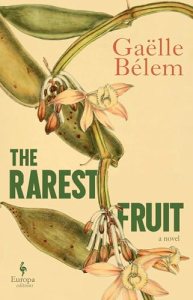 A fictionalized biography, from infancy to deathbed, of the Black botanist who introduced the world to vanilla – then a rare and expensive flavour – by discovering that the plant can be hand-pollinated in the same way as pumpkins. In 1829, the island colony of Bourbon (now the French overseas department Réunion) has just been devastated by a cyclone when widowed landowner Ferréol Bellier-Beaumont is brought the seven-week-old orphaned son of one of his sister’s enslaved women. Ferréol, who once hunted rare orchids, raises the boy as his ward. From the start, Edmond is most at home in the garden and swears he will follow in his guardian’s footsteps as a botanist. Bélem also traces Ferréol’s history and the origins of vanilla in Mexico. The inclusion of Creole phrases and the various uses of plants, including for traditional healing, chimed with Jason Allen-Paisant’s Jamaica-set The Possibility of Tenderness, and I was reminded somewhat of the historical picaresque style of Slave Old Man (Patrick Chamoiseau) and The Secret Diaries of Charles Ignatius Sancho (Paterson Joseph). The writing is solid but the subject matter so niche that this was a skim for me.
With thanks to Europa Editions, who sent an advanced e-copy for review.
In Late Summer by Magdalena Blažević (2022; 2025)
[Translated from Croatian by Anđelka Raguž]
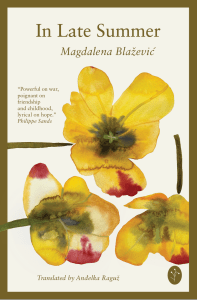 “My name is Ivana. I lived for fourteen summers, and this is the story of my last.” Blažević’s debut novella presents the before and after of one extended family, and of the Bosnian countryside, in August 1993. In the first half, few-page vignettes convey the seasonality of rural life as Ivana and her friend Dunja run wild. Mother and Grandmother slaughter chickens, wash curtains, and treat the children for lice. Foodstuffs and odours capture memory in that famous Proustian way. I marked out the piece “Camomile Flowers” for its details of the senses: “Sunlight and the scent of soap mingle. … The pantry smells like it did before, of caramel, lemon rind and vanilla sugar. Like the period leading up to Christmas. … My hair dries quickly in the sun. It rustles like the lace, dry snow from the fields.” The peaceful beauty of it all is shattered by the soldiers’ arrival. Ivana issues warnings (“Get ready! We’re running out of time. The silence and summer lethargy will not last long”) and continues narrating after her death. As in Sara Nović’s Girl at War, the child perspective contrasts innocence and enthusiasm with the horror of war. I found the first part lovely but the whole somewhat aimless because of the bitty structure.
With thanks to Linden Editions for the free copy for review.
Somebody Is Walking on Your Grave: My Cemetery Journeys by Mariana Enríquez (2013; 2025)
[Translated from Spanish by Megan McDowell]
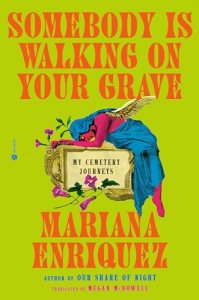 This made it onto my Most Anticipated list for the second half of the year due to my love of graveyards. Because of where Enríquez is from, a lot of the cemeteries she features are in Argentina (six) or other Spanish-speaking countries (another six including Chile, Cuba, Mexico, Peru and Spain). There are 10 more locations besides, and her journeys go back as far as 1997 in Genoa, when she was 25 and had sex with Enzo up against a gravestone. I took the most interest in those I have been to (Edinburgh) or could imagine myself travelling to someday (New Orleans and Savannah; Highgate in London and Montparnasse in Paris), but thought that every chapter got bogged down in research. Enríquez writes horror, so she is keen to visit at night and relay any ghost stories she’s heard. But the pages after pages of history were dull and outweighed the memoir and travel elements for me, so after a few chapters I ended up just skimming. I’ll keep this on my Kindle in case I go to one of her other destinations in the future and can read individual essays on location. (Edelweiss download)
Voracious by Małgorzata Lebda (2016; 2025)
[Translated from Polish by Antonia Lloyd-Jones]
Like the Blažević, this is an impressionistic, pastoral work that contrasts vitality and decay in short chapters of one to three pages. The narrator is a young woman staying in her grandmother’s house and caring for her while she is dying of cancer; “now is not the time for life. Death – that’s what fills my head. I’m at its service. Grandma is my child. I am my grandmother’s mother. And that’s all right, I think.” The house has just four inhabitants – the narrator, Grandma Róża, Grandpa, and Ann – and seems permeable: to the cold, to nature. Animals play a large role, whether pets, farmed or wild. There’s Danube the hound, the cows delivered to the nearby slaughterhouse, and a local vixen with whom the narrator identifies.
 Lebda is primarily known as a poet, and her delight in language is evident. One piece titled “Opioid,” little more than a paragraph long, revels in the power of language: “Grandma brings a beautiful word home … the word not only resonates, but does something else too – it lets light into the veins.” The wind is described as “the conscience of the forest. It’s the circulatory system. It’s the litany. It’s scented. It sings.”
In all three Linden Editions books I’ve read, the translator’s afterword has been particularly illuminating. I thought I was missing something, but Lloyd-Jones reassured me it’s unclear who Ann is: sister? friend? lover? (I was sure I spotted some homoerotic moments.) Lloyd-Jones believes she’s the mirror image of the narrator, leaning toward life while the narrator – who has endured sexual molestation and thyroid problems – tends towards death. The animal imagery reinforces that dichotomy.
The narrator and Ann remark that it feels like Grandma has been ill for a million years, but they also never want this time to end. The novel creates that luminous, eternal present. It was the best of this bunch.
With thanks to Linden Editions for the free copy for review.
Full review forthcoming for Foreword Reviews:
Pandora by Ana Paula Pacheco (2023; 2025)
[Translated from Portuguese by Julia Sanches]
 The Brazilian author’s bold novella is a startling allegory about pandemic-era hazards to women’s physical and mental health. Since the death of her partner Alice to Covid-19, Ana has been ‘married’ to a pangolin and a seven-foot-tall bat. At a psychiatrist’s behest, she revisits her childhood and interrogates the meanings of her relationships. The form varies to include numbered sections, the syllabus for Ana’s course “Is Literature a personal investment?”, journal entries, and extended fantasies. Depictions of animals enable commentary on economic inequalities and gendered struggles. Playful, visceral, intriguing.
#17 of my 20 Books of Summer:
Invisible Kitties by Yu Yoyo (2021; 2024)
[Translated from Chinese by Jeremy Tiang]
 Yu is the author of four poetry collections; her debut novel blends autofiction and magic realism with its story of a couple adjusting to the ways of a mysterious cat. They have a two-bedroom flat on a high-up floor of a complex, and Cat somehow fills the entire space yet disappears whenever the woman goes looking for him. Yu’s strategy in most of these 60 mini-chapters is to take behaviours that will be familiar to any cat owner and either turn them literal through faux-scientific descriptions, or extend them into the fantasy realm. So a cat can turn into a liquid or gaseous state, a purring cat is boiling an internal kettle, and a cat planted in a flowerbed will produce more cats. Some of the stories are whimsical and sweet, like those imagining Cat playing extreme sports, opening a massage parlour, and being the god of the household. Others are downright gross and silly: Cat’s removed testicles become “Cat-Ball Planets” and the narrator throws up a hairball that becomes Kitten. Mixed feelings, then. (Passed on by Annabel – thank you!)
I’m really pleased with myself for covering a total of 8 books for this challenge, each one translated from a different language!
Which of these would you read?
March Releases by Akbar, Bosker, García Márquez, and Wrenn
I’m catching up after a busy end to last month. Today I have an uneven debut novel from a poet whose work I’ve enjoyed before, a journalist’s jaunty submersion in the world of modern art, a posthumous novella from a famous Colombian author I’d not previously read, and a (literally) trippy memoir about C-PTSD, coral, climate breakdown, queerness and more. I can pinpoint a couple of elements that some or all of them have in common: beauty (whether in art or in nature) and dead mothers.
Martyr! by Kaveh Akbar
I’d read the Iranian American poet’s two full-length collections and particularly admired Pilgrim Bell, one of my favourite books of 2021. That was enough for me to put this on my Most Anticipated list for 2024, even though based on the synopsis I wrote: “His debut novel sounds kind of unhinged, but I figure it’s worth a try.” Here’s an excerpt from the publisher’s blurb: “When Cyrus’s obsession with the lives of the martyrs – Bobby Sands, Joan of Arc – leads him to a chance encounter with a dying artist, he finds himself drawn towards the mysteries of an uncle who rode through Iranian battlefields dressed as the Angel of Death; and toward his [late] mother, who may not have been who or what she seemed.”
 Cyrus Shams is an Iranian American aspiring poet who grew up in Indiana with a single father, his mother Roya having died in a passenger aircraft mistakenly shot down by a U.S. Navy missile cruiser (this really happened: Iran Air Flight 655, on 3 July 1988). He continues to lurk around the Keady University campus, working as a medical actor at the hospital, but his ambition is to write. During his shaky recovery from drug and alcohol abuse, he undertakes a project that seems divinely inspired: “Tired of interventionist pyrotechnics like burning bushes and locust plagues, maybe God now worked through the tired eyes of drunk Iranians in the American Midwest”. By seeking the meaning in others’ deaths, he hopes his modern “Book of Martyrs” will teach him how to cherish his own life.
This document, which we see in fragments, sets up hypothetical dialogues between figures real and imaginary, dead and living, and intersperses them with poems and short musings. But when a friend tells Cyrus about the Brooklyn Museum installation “DEATH-SPEAK,” which has terminally ill Iranian artist Orkideh living out her last days in public, he spies an opportunity to move the work beyond theory and into the physical realm. So he flies to New York City with his best friend (and occasional f**kbuddy), bartender Zee Novak, and visits Orkideh every day until the installation’s/artist’s end.
This is a wildly original but unruly novel with a few problems. One: Akbar has clung too obviously to his own story and manner of speaking with Cyrus (e.g., “I honestly actually do worry about that, no joke. Being a young Iranian man making a book about martyrdom, going around talking to people about becoming a martyr. It’s not inert, you know?”). Another is that the poems, and poetic descriptions, are much the best material. The only exception might be a zany scene where Zee and Cyrus chop wood while high. But the main issue I had is that the plot turns on a twist 50 pages from the end, a huge coincidence that feels unearned. I admire the ambition Akbar had for this – a seething, open-hearted enquiry into addiction, love, suicide and queerness – but look forward to him getting back to poetry. 
With thanks to Picador for the proof copy for review.
Get the Picture: A Mind-Bending Journey among the Inspired Artists and Obsessive Art Fiends Who Taught Me How to See by Bianca Bosker
I was a big fan of Bosker’s Cork Dork (2017), her deep dive into the world of fine wine. Her second book is similarly constructed and equally fun: more personal than authoritative, light yet substantial, and accessible to the uninitiated as well as those with an existing interest in the subject. She begins as a complete novice, wondering if she’ll ever know what art is, let alone what it means and whether it’s any good (“the familiar feeling that everyone got the punch line except me”). By the end, she has discovered that, like the love of wine, art appreciation can be a way of expanding and savouring one’s life.
The aim was to get the broadest experience possible, generally through voluntary placements. She started out as an assistant at Jack Barrett’s 315 Gallery, where one of her tasks was to paint a wall white; she failed miserably to meet his expectations even for this simple task. He never lost his fundamental distrust of her, a writer and outsider, as one of “the enemy.” It was expected that she would attend as many art shows and openings as possible per week. “Talking shit was essentially a job requirement.” Bosker might not have known what to make of the art, but others were gossipy, snobbish and opinionated enough to make up for it. When she was tasked with writing a press release for an exhibit, a gallerist taught her the clichéd shorthand: “Every f**king artist allegedly transforms the familiar into the unfamiliar, or vice versa.”

In the course of the book, the New York City-based author also:
- attends the Art Basel Miami Beach contemporary art fair and sells photographs on behalf of Denny Dimin Gallery;
- befriends performance artist and “ass influencer” Mandy AllFIRE, who – ahem – sits on Bosker’s face as part of a temporary installment;
- serves as a studio assistant for French painter Julie Curtiss, whose work is selling for alarmingly high amounts at auction (not actually what a painter wants, as it tends to signal bad things for a career);
- meets a pair of North Dakota collectors known as “the Icy Gays”; and
- works as a Guggenheim Museum guard.
This last was my favourite episode. Forty-minute placements on particular ramps gave her time to focus on one chosen artwork – for instance, an abstract sculpture. She challenged herself to stay with it for that whole time, doing as one artist advised and simply noticing five things about the work. Before, her “default approach to art had just been to plant myself in front of a piece and wait for the epiphany to wash over me.” Now, she worked at it. In fact, she counsels newcomers to not read a caption because many people take a title at face value and an interpretation as gospel, and so don’t experience the art for themselves.
At times I found the book slightly scattered in the way that it zigzags from one challenge to another. There’s differing attention to various experiences; a week-long art school merits just one paragraph. And there’s no getting past the fact that some art she encounters sounds outlandish or just plain silly. (Is it any surprise that she mistakes part of a wall, and a mousetrap, for art pieces?) Ultimately, I think it’s best if you have at least a modicum of appreciation for modern art, which I don’t; whereas I do enjoy drinking wine even if I don’t have a trained palate.
Even so, Bosker’s writing has such verve (“artists were coyly evasive about their work and treated my questions like I was a cactus running after their balloon”; “a hazy daydream of an idea solidified into a yappy, un-shut-uppable chihuahua of want”) that you’ll be glad you went along for the ride. She concludes that taste is subjective, but “Beauty … pulls you close.” Art is valuable because it “knocks us off our well-worn pathways” into something uncharted, a tantalizing prospect. 
With thanks to Allen & Unwin (Grove Press) for the free copy for review.
{SPOILERS IN THIS NEXT ONE}
Until August by Gabriel García Márquez
[Translated from the Spanish by Anne McLean]
A posthumous ‘lost’ novella was not a good place for me to have started with this celebrated author. García Márquez okayed the fifth draft of the text in 2004, 10 years before his death. By this time he was already suffering with memory loss that interfered with his creativity. His sons got the message that he didn’t think the book worked and should be destroyed. But they didn’t do his bidding and, revisiting the book nearly a decade on from his death, decided it wasn’t that bad, if not up to the standard of his best work, and that it should see the light of day after all.
Every August 16th, Ana Magdalena Bach travels to the island where her mother is buried to visit the grave and lay gladioli on it. (My review book came with a bag of three gladioli bulbs and a mini Colombian chocolate bar.) Each year she takes a different lover for the one night at a hotel. The first time, the man leaves her a $20 bill and she feels ashamed, but it doesn’t stop her doing the same thing again for the next four years in a row. Once it’s a long-ago school friend whom she runs into on the ferry. Another time, by golly, it’s a bishop.

It’s refreshing to have a woman in middle age as protagonist and for her to claim sexual freedom. However, the setup is formulaic and repetitive, the sex scenes are somewhat excruciating, and the hypocrisy of her gleefully having one-night stands while fretting over her husband’s potential infidelity is grating. I did like the ending – Ana hears that an anonymous elderly gentleman has been paying to have gladioli laid on her mother’s grave year-round and she wonders if she is in a sense following in her mother’s footsteps all along without knowing it; and decides she’s had enough and exhumes her mother’s remains, returning to her husband with a bag of bones (gruesome!).
But nothing about the plot or the writing – fluid enough bar one awkward sentence (“She listened to him worried that he meant it, but she had the strength not to appear as easy a woman as he might think”) – suggested to me a master at work. At best, this might be reminiscent of the late work of misogynist-leaning authors like Coetzee or Updike.
In my mind García Márquez is linked with magic realism, so I’d be better off trying one of his more representative works. I have several of his earlier novellas on the shelf (received as review copies as part of the same recent marketing push), and if I get on better with those then I’ll be sure to try one of the most famous full-length novels. 
With thanks to Viking (Penguin) for the free copy for review.
Mothership: A Memoir of Wonder and Crisis by Greg Wrenn
Wrenn is an associate English professor teaching environmental literature at James Madison University. He has also been exploring coral reefs for 25 years, with a love of marine wildlife sparked by growing up in Florida. But all along, he’s been trying (much like Cyrus Shams) to come to terms with addiction, queerness, suicidal inclinations, and especially his mother’s place in his life. She made him feel dirty, that he would never be good enough; she hit him with a wooden spoon and bathed him until he was 17. Though he never found out for sure, he suspects his mother was sexually abused by her father and repeated the cycle of molestation.
 This is the third C-PTSD memoir I’ve read (after What My Bones Know and A Flat Place), and has a lot in common with I’m Glad My Mom Died, which features a co-dependent relationship with an abusive mother. After Wrenn’s parents’ divorce, he and his mother remained close. “I had been her therapist, confessor, girlfriend, and punching bag.” He helped care for her after a stroke but eventually had to throw up his hands at her stubborn refusal to follow doctors’ orders. Drawing on the Greek etymology of ecology (oikos means house or family), Wrenn insists on a parallel between the personal and the environmental here: “What we’re facing amounts to global C-PTSD” as “Mother” Earth turns against us. On each trip to Raja Ampat, he knows the coral reef is dying, his carbon footprint only accelerating it.
There’s a lot in this short memoir. Even the summary had me shaking my head in disbelief. For me, though, the tone and style were too erratic. Wrenn can be wry, sorrowful, or campy; he includes scientific data, letters to Adrienne Rich and an imagined descendent, a chapter riffing on “Otters” (the animal and the gay stereotype), flashbacks, and E.T. metaphors. The final third of the book then takes a left turn as he experiments with therapeutic psychedelics via ayahuasca ceremonies in South America, and ditches dating apps and casual sex to try to find a long-term relationship. The drug literally alters his brain, allowing him to feel trust and love. Add on nature and a husband and that’s why he’s still here rather than dead by suicide.
Like Akbar, Wrenn published poetry before switching genre. Their books are both amazing in premise but wobbly in execution. Still, I’d say both authors are laudable for their effort to depict lives wrenched back from extremity. 
With thanks to Regalo Press (USA) for the proof copy for review.
#WITMonth, Part II: Wioletta Greg, Dorthe Nors, Almudena Sánchez and More
My next four reads for Women in Translation month (after Part I here) were, again, a varied selection: a mixed volume of family history in verse and fragmentary diary entries, a set of nature/travel essays set mostly in Denmark, a memoir of mental illness, and a preview of a forthcoming novel about Mary Shelley’s inspirations for Frankenstein. One final selection will be coming up as part of my Love Your Library roundup on Monday.
(20 Books of Summer, #13)
Finite Formulae & Theories of Chance by Wioletta Greg (2014)
[Translated from the Polish by Marek Kazmierski]
 I loved Greg’s Swallowing Mercury so much that I jumped at the chance to read something else of hers in English translation – plus this was less than half price AND a signed copy. I had no sense of the contents and might have reconsidered had I known a few things: the first two-thirds is family wartime history in verse, the rest is a fragmentary diary from eight years in which Greg lived on the Isle of Wight, and the book is a bilingual edition, with Polish and English on facing pages (for the poems) or one after the other (for the diary entries). I’m not sure what this format adds for English-language readers; I can’t know whether Kazmierski has rendered anything successfully. I’ve always thought it must be next to impossible to translate poetry, and it’s certainly hard to assess these as poems. They are fairly interesting snapshots from her family’s history, e.g., her grandfather’s escape from a stalag, and have quite precise vocabulary for the natural world. There’s also been an attempt to create or reproduce alliteration. I liked the poem the title phrase comes from, “A Fairytale about Death,” and “Readers.” The short diary entries, though, felt entirely superfluous. (New purchase – Waterstones bargain, 2023)
(20 Books of Summer, #14)
A Line in the World: A Year on the North Sea Coast by Dorthe Nors (2021; 2022)
[Translated from the Danish by Caroline Waight]
 Nors’s first nonfiction work is a surprise entry on this year’s Wainwright Prize nature writing shortlist. I’d be delighted to see this work in translation win, first because it would send a signal that it is not a provincial award, and secondly because her writing is stunning. Like Patrick Leigh Fermor, Aldo Leopold or Peter Matthiessen, she doesn’t just report what she sees but thinks deeply about what it means and how it connects to memory or identity. I have a soft spot for such philosophizing in nature and travel writing.
You carry the place you come from inside you, but you can never go back to it.
I longed … to live my brief and arbitrary life while I still have it.
This eternal, fertile and dread-laden stream inside us. This fundamental question: do you want to remember or forget?
Nors lives in rural Jutland – where she grew up, before her family home was razed – along the west coast of Denmark, the same coast that reaches down to Germany and the Netherlands. In comparison to Copenhagen and Amsterdam, two other places she’s lived, it’s little visited and largely unknown to foreigners. This can be both good and bad. Tourists feel they’re discovering somewhere new, but the residents are insular – Nors is persona non grata for at least a year and a half simply for joking about locals’ exaggerated fear of wolves.
Local legends and traditions, bird migration, reliance on the sea, wanderlust, maritime history, a visit to church frescoes with Signe Parkins (the book’s illustrator), the year’s longest and shortest days … I started reading this months ago and set it aside for a time, so now find it difficult to remember what some of the essays are actually about. They’re more about the atmosphere, really: the remote seaside, sometimes so bleak as to seem like the ends of the earth. (It’s why I like reading about Scottish islands.) A bit more familiarity with the places Nors writes about would have pushed my rating higher, but her prose is excellent throughout. I also marked the metaphors “A local woman is standing there with a hairstyle like a wolverine” and “The sky looks like dirty mop-water.” 
With thanks to Pushkin Press for the proof copy for review.
Pharmakon by Almudena Sánchez (2021; 2023)
[Translated from the Spanish by Katie Whittemore]
 This is a memoir in micro-essays about the author’s experience of mental illness, as she tries to write herself away from suicidal thoughts. She grew up on Mallorca, always feeling like an outsider on an island where she wasn’t a native. Did her depression stem from her childhood, she wonders? She is also a survivor of ovarian cancer, diagnosed when she was 16. As her mind bounces from subject to subject, “trying to analyze a sick brain,” she documents her doctor visits, her medications, her dreams, her retweets, and much more. She takes inspiration from famous fellow depressives such as William Styron and Virginia Woolf. Her household is obsessed with books, she says, and it’s mostly through literature that she understands her life. The writing can be poetic, but few pieces stand out on the whole. My favourite opens: “Living in between anxiety and apathy has driven me to flowerpot decorating.”
With thanks to Fum d’Estampa Press for the free copy for review.
And a bonus preview:
Mary and the Birth of Frankenstein by Anne Eekhout (2021; 2023)
[Translated from the Dutch by Laura Watkinson]
 Anne Eekhout’s fourth novel and English-language debut is an evocative recreation of two momentous periods in Mary Shelley’s life that led – directly or indirectly – to the composition of her 1818 masterpiece. Drawing parallels between the creative process and motherhood and presenting a credibly queer slant on history, the book is full of eerie encounters and mysterious phenomena that replicate the Gothic science fiction tone of Frankenstein itself. The story lines are set in the famous “Year without a Summer” of 1816 (the storytelling challenge with Lord Byron) and during a period in 1812 that she spent living in Scotland with the Baxter family; Mary falls in love with the 17-year-old daughter, Isabella.
Coming out on 3 October from HarperVia. My full review for Shelf Awareness is pending.
Recent Writing for BookBrowse, Foreword, Shelf Awareness, Shiny New Books, and the TLS
I’ve compiled excerpts from some reviews I’ve contributed to other websites and publications this year. I link to the full text where available. (When writing a paid review, I seek to be balanced but positive. Ratings reflect my personal response.)
BookBrowse
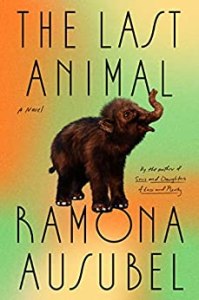 The Last Animal by Ramona Ausubel: In Ausubel’s offbeat third novel, a widowed scientist and her two daughters embark on a rogue plan to make history by resurrecting the woolly mammoth. There is a quirky combination of cosmic and domestic concerns here. A winsome sister duo is at the heart of the unusual and timely story, with priority given to the points of view of teenagers Eve and Vera, whose banter is a highlight. Ausubel has wisely chosen not to dwell on the scientific details of de-extinction, yet that means that this becomes more like speculative fiction or a fairy tale. Ironically, the fabulist-leaning novel is best when most realist, documenting struggles with bereavement, sexism and parenting teens.
 The Lost Wife by Susanna Moore: Moore’s hard-hitting novella is based in part on the memoir Six Weeks in the Sioux Tepees: A Narrative of Indian Captivity. In Moore’s version, Sarah, 25, leaves her baby behind when she flees an abusive husband, and once in Minnesota Territory marries John Brinton, who becomes a doctor on a Sioux reservation. By 1862, Sarah is friendly with the Native women. Although the Civil War is unfolding, the greater threat here is of revolt by the starving Indigenous residents. There is much of anthropological and historical interest, but Sarah’s flat storytelling, which may represent a pastiche of period style, means threatening or climactic scenes lose some of their potential gravity.
Foreword
 My Mother Says by Stine Pilgaard (trans. from the Danish by Hunter Simpson): After breaking up with her zookeeper girlfriend over their age gap and their conflicting takes on motherhood, the heroine moves back in with her father, a pastor who’s obsessed with Pink Floyd, and her stepmother. Her mother visits often, nagging her to finish her thesis. The line between her conversations and internal thoughts is thin. From her mansplaining doctor, she learns that the brain’s hippocampus is named for its seahorse shape. This inspires “Monologues of a Seahorse,” interludes of stream-of-consciousness association. Experimental and whimsical, this delivers deadpan narration of everyday woes.
 In Vitro: On Longing and Transformation by Isabel Zapata (trans. from the Spanish by Robin Myers): A Mexican poet probes the enduring mysteries of pregnancy and birth in a memoir in fragments that travels from fertility treatment through to the early weeks of pandemic-time motherhood. The clinical language of a gynecological history—late menstruation, polycystic ovary syndrome, eighteen years on the pill, and infertility—and the embryo transfer process contrasts with Zapata’s mystical thinking. The microessays integrate family stories, history, and artistic explorations. This resolute account of a personal metamorphosis alchemizes tender experiences into enchanting vignettes.
Shelf Awareness
Fiction
 Daughters of Nantucket by Julie Gerstenblatt: This engrossing debut novel explores the options for women in the mid-19th century while bringing a historical tragedy to life. Metaphorical conflagrations blaze in the background in the days leading up to the great Nantucket fire of 1846: each of three female protagonists (a whaling captain’s wife, a museum curator, and a pregnant Black entrepreneur) holds a burning secret and longs for a more expansive, authentic life. The action spans two tense weeks, one week before the fire through eight days after. The women’s lives collide in two climactic scenes. Gerstenblatt’s eye for detail results in sultry historical fiction for Sue Monk Kidd’s readers.
 Camp Zero by Michelle Min Sterling: Sterling’s brilliantly unsettling debut novel is set in mid-21st-century, post-oil North America. Prioritizing perspectives from two all-female communities, it contrasts the heights of opulence and technology with the basic instinct for survival. How the strands connect is a mystery sustained through much of the book. Characters go by multiple names and harbor ulterior motives; scenes echo each other as disparate subplots meet in unexpected ways. The background is all too plausible. Sterling also takes to its logical extreme the state of being constantly online. Compelling dystopian cli-fi with three-dimensional characters—perfect for fans of Station Eleven and To Paradise.
 Dear Chrysanthemums by Fiona Sze-Lorrain: In this elegant collection of 11 linked short stories by a poet and translator, China’s mid-20th-century political upheaval casts a long shadow. Music and food, not to mention love, bring meaning to those displaced in the aftermath of dissent. The stories—set in China, Singapore, Paris, and New York—span seven decades but always take place in a year ending in a six, a sacred number in Chinese divination. A highlight is “News from Saigon,” in which a prostitute meets Marguerite Duras in a Paris café. The connections are subtle, with the final story pulling together many strands. Ideal for readers of Madeleine Thien’s Do Not Say We Have Nothing.
Nonfiction
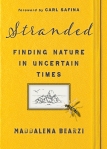 Stranded by Maddalena Bearzi: Bearzi developed a deep love for marine fauna during childhood summers in Sardinia and cofounded the Ocean Conservation Society in the 1990s. Temporarily confined to land by Covid-19 lockdowns, she adopts a different tactic for exploring animal behavior: “an urban safari in my backyard and neighborhood.” These nature essays exemplify evenhandedness, curiosity, and close observation. From wasps to night-blooming flowers, her interest is wide-ranging. Gardening is a relaxing pastime and a connection to her mother while they are separated. As a behavioral ecologist, she views even her dog as a subject of study. A passionate primer to appreciating everyday nature.
Poetry
 Lo by Melissa Crowe: This incandescent autobiographical collection travels from girlhood to marriage and motherhood in post-pandemic USA. Crowe delves into sexual abuse and growing up in rural poverty. Yet the collection is so carefully balanced in tone that it never feels bleak. The emotional range is enhanced by alliteration and botanical imagery.
 Dislocations by Karen Enns: The fourth collection by Canadian poet Enns skillfully evokes a rural upbringing and revels in the beauty of nature and music. One of its aphorisms could encapsulate the entire collection: “The ratio of love to grief / we understood as music.” Updating the pastoral tradition, the bittersweet verse also takes solace in the past.
Shiny New Books
A Fortunate Woman by Polly Morland & A Fortunate Man by John Berger: The similarities go much further than the title and subject matter: these two biographical works, both illustrated with black-and-white photographs, are set in the same English valley and the female subject of Morland’s is the next-but-one successor of the doctor who stars in Berger’s.
 Berger (1926–2017), an art critic and Booker Prize-winning novelist, spent six weeks shadowing the doctor, to whom he gives the pseudonym John Sassall, with Swiss documentary photographer Jean Mohr, his frequent collaborator. Sassall’s dedication was legendary: he attended every birth in this community, and nearly every death. Sassall’s middle-class origins set him apart from his patients. There’s something condescending about how Berger depicts the locals as simple peasants. Mohr’s photos include soft-focus close-ups on faces exhibiting a sequence of emotions, a technique that feels outdated in the age of video. Along with recording the day-to-day details of medical complaints and interventions, Berger waxes philosophical on topics such as infirmity and vocation. A Fortunate Man is a curious book, part intellectual enquiry and part hagiography.
 With its layers of local history and its braided biographical strands, A Fortunate Woman takes up many of the same heavy questions but feels more subtle and timely. It also soon delivers a jolting surprise: the doctor Berger called John Sassall was likely bipolar and, soon after the death of his beloved wife Betty, committed suicide in 1982. His story still haunts this community, where many of the older patients remember going to him for treatment. Like Berger, Morland keenly follows a range of cases. As the book progresses, we see this beautiful valley cycle through the seasons, with certain of Richard Baker’s landscape shots deliberately recreating Mohr’s scene setting. The timing of Morland’s book means that it morphs from a portrait of the quotidian for a doctor and a community to, two-thirds through, an incidental record of the challenges of medical practice during COVID-19.
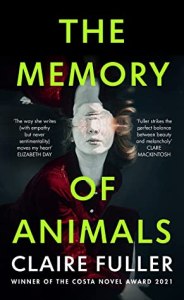 The Memory of Animals by Claire Fuller: Neffy has nothing to lose when she enrolls in a controversial vaccine trial in a familiar mid-pandemic landscape. The novel is presented as her journal. The bulk takes place in two weeks she spends on a locked unit with four fellow test subjects. In the meantime, she is introduced to an experimental technology for reliving memories. The characterisation of the four other cast members is somewhat thin, and the elements feel randomly assembled. The world-building and tech are unlikely to stand up to science fiction fans’ scrutiny, but this has just the right dose of the speculative for literary fiction readers. It also happens to fit into a recent vogue for octopus novels.
Times Literary Supplement
A late-twenties journalist sets out to survey the situation on the ground for ten British species being squeezed out by anthropogenic climate change: The mission is very similar, and both authors embody passionate dedication to conservation, but the difference in tone of these travel narratives makes them likely to appeal to separate audiences…
In Search of One Last Song by Patrick Galbraith & Forget Me Not by Sophie Pavelle:
 Galbraith’s is an elegiac tour through imperilled countryside and urban edgelands. Each chapter resembles an in-depth magazine article: a carefully crafted profile of a beloved bird species, with a focus on the specific threats it faces. Galbraith recognises the nuances of land use. However, shooting plays an outsized role. (Curious for his bio not to disclose that he is editor of the Shooting Times.) The title’s reference is to literal birdsong, but the book also celebrates birds’ cultural importance through their place in Britain’s folk music and poetry. He is clearly enamoured of countryside ways, but too often slips into laddishness, with no opportunity missed to mention him or another man having a “piss” outside. Readers could also be forgiven for concluding that “Ilka” (no surname, affiliation or job title), who briefs him on her research into kittiwake populations in Orkney, is the only female working in nature conservation in the entire country; with few exceptions, women only have bit parts: the farm wife making the tea, the receptionist on the phone line, and so on.
 Pavelle’s book is a tonic in more ways than one. Employed by Beaver Trust, she is enthusiastic and self-deprecating. Her nature quest has a broader scope, including insects like the marsh fritillary and marine species such as seagrass and the Atlantic salmon. Travelling between lockdowns in 2020–1, Pavelle took low-carbon transport wherever possible and bolsters her trip accounts with context, much of it gleaned from Zoom calls and e-mail correspondence with experts from museums and universities. Refreshingly, around half of these interviewees are women, and the animal subjects are never the obvious choices. Instead, she seeks out “underdog” species. The explanations are at a suitable level for laymen, true to her job as a science communicator. The snappy, casual prose (“the future of the bilberry bumblebee and its Aperol arse can be bright, but only if we get off our own”) could even endear her to teenage readers. As image goes, Pavelle’s cheerful naïveté holds more charm than Galbraith’s hardboiled masculinity.
 Taking Flight by Lev Parikian: Parikian’s accessible account of the animal kingdom’s development of flight exhibits a layman’s enthusiasm for an everyday wonder. He explicates the range of flying strategies and the structural adaptations that made them possible. The archaeopteryx section, chronicling the transition between dinosaurs and birds, is a highlight. Though the most science-heavy of the author’s six works, this, perhaps ironically, has fewer footnotes. His usual wit is on display: he describes the feral pigeon as “the Volkswagen Golf of birds” and penguins as “piebald blubber tubes”. This makes it a pleasure to tag along on a journey through evolutionary time, one sure to engage even history- and science-phobes.
Do any of these catch your eye?
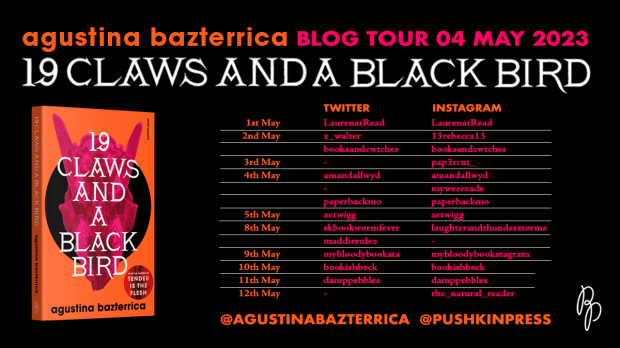
19 Claws and a Black Bird by Agustina Bazterrica (Blog Tour)
A couple of years ago, I reviewed Agustina Bazterrica’s Tender Is the Flesh for the R.I.P. challenge. It’s a dystopian horror novel in which cannibalism becomes commonplace. “Brutal but brilliant,” I called it. That’s what I was hoping for from this collection of 20 of the Argentinian author’s speculative short stories. Unfortunately, I found the death-drenched work uneven, but there were a few individual stories and recurring elements that I appreciated.
In “Unamuno’s Boxes,” a woman becomes convinced that her taxi driver is a serial killer; in “Anita and Happiness,” Pablo suspects his lover is an alien. In both of these, the imagined identity is so strongly rooted that it reflects, or even alters, the reality. My favourite line of the book came from the latter: “human beings are a mere parenthesis between two unknowns.”
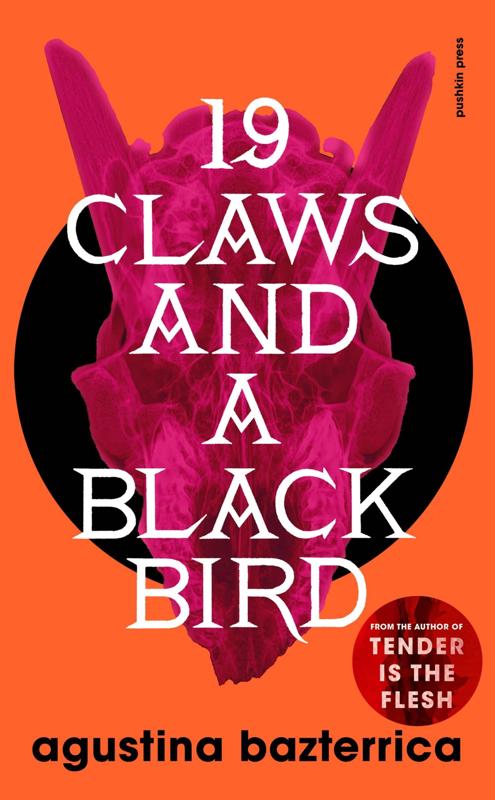
There are a few cases of poetic justice here, such as when a football obsessive decides to take out his feelings on a cat and instead gets his comeuppance. Two other stories, “Roberto” and “Earth,” include revenge for child sexual abuse – they have mighty satisfying conclusions. Along with those two, the stand-out of the collection for me was the final story, “The Solitary Ones,” which is the closest to straight-up horror and features a young woman riding the subway alone when the electricity goes out. It’s one of four second-person narratives; that’s always an interesting point-of-view. (The rest are roughly equally split between first and third person.)
My qualms were about a couple of unpleasant repeated topics and the vague or generic nature of many of the remaining stories. Several involve suicide, which is not problematic in and of itself – “A Light, Swift and Monstrous Sound” is a strong opener in which a woman finds her elderly neighbour dead on her patio – but in two places it’s a too-convenient way of concluding a story about someone with mental illness. Two late stories apply menacing imagery about religion. Perhaps I’m overly sensitive about such things, but I prefer a more balanced depiction.
The title makes intriguing reference to other creatures, particularly birds, but apart from a couple of sinister appearances and one stereotyping page about the threat of a wolf, it doesn’t live up to that promise. Although I cannot wholeheartedly recommend Bazterrica’s short fiction, you might want to seek out select stories. Meanwhile, I would urge you all to read Tender Is the Flesh, which also engages with the question of the ethical treatment of animals.
[Translated from the Spanish by Sarah Moses]
With thanks to Pushkin Press for the free copy for review.
I was happy to participate in the blog tour for 19 Claws and a Black Bird. See below for details of where other reviews have appeared or will be appearing soon.
February Releases by Nick Acheson, Charlotte Eichler and Nona Fernández (#ReadIndies)
Three final selections for Read Indies. I’m pleased to have featured 16 books from independent publishers this month. And how’s this for neat symmetry? I started the month with Chase of the Wild Goose and finish with a literal wild goose chase as Nick Acheson tracks down Norfolk’s flocks in the lockdown winter of 2020–21. Also appearing today are nature- and travel-filled poems and a hybrid memoir about Chilean and family history.

The Meaning of Geese: A thousand miles in search of home by Nick Acheson
I saw Nick Acheson speak at New Networks for Nature 2021 as the ‘anti-’ voice in a debate on ecotourism. He was a wildlife guide in South America and Africa for more than a decade before, waking up to the enormity of the climate crisis, he vowed never to fly again. Now he mostly stays close to home in North Norfolk, where he grew up and where generations of his family have lived and farmed, working for Norfolk Wildlife Trust and appreciating the flora and fauna on his doorstep.
 This was indeed to be a low-carbon initiative, undertaken on his mother’s 40-year-old red bicycle and spanning September 2021 to the start of the following spring. Whether on his own or with friends and experts, and in fair weather or foul, he became obsessed with spending as much time observing geese as he could – even six hours at a stretch. Pink-footed geese descend on the Holkham Estate in their thousands, but there were smaller flocks and rarer types as well: from Canada and greylag to white-fronted and snow geese. He also found perspective (historical, ethical and geographical) by way of Peter Scott’s conservation efforts, chats with hunters, and insight from the Icelandic researchers who watch the geese later in the year, after they leave the UK. The germane context is woven into a month-by-month diary.
The Covid-19 lockdowns spawned a number of nature books in the UK – for instance, I’ve also read Goshawk Summer by James Aldred, Birdsong in a Time of Silence by Steven Lovatt, The Consolation of Nature by Michael McCarthy, Jeremy Mynott and Peter Marren, and Skylarks with Rosie by Stephen Moss – and although the pandemic is not a major element here, one does get a sense of how Acheson struggled with isolation as well as the normal winter blues and found comfort and purpose in birdwatching.
Tundra bean, taiga bean, brent … I don’t think I’ve seen any of these species – not even pinkfeet, to my recollection – so wished for black-and-white drawings or colour photographs in the book. That’s not to say that Acheson is not successful at painting word pictures of geese; his rich descriptions, full of food-related and sartorial metaphors, are proof of how much he revels in the company of birds. But I suspect this is a book more for birders than for casual nature-watchers like myself. I would have welcomed more autobiographical material, and Wintering by Stephen Rutt seems the more suitable geese book for laymen. Still, I admire Acheson’s fervour: “I watch birds not to add them to a list of species seen; nor to sneer at birds which are not truly wild. I watch them because they are magnificent”.
With thanks to Chelsea Green Publishing for the free copy for review.
Swimming Between Islands by Charlotte Eichler
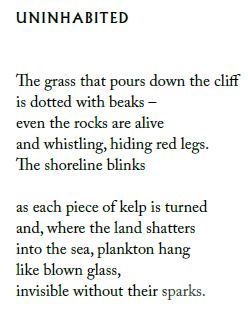
 Eichler’s debut collection was inspired by various trips to cold and remote places, such as to Lofoten 10 years ago, as she explains in a blog post on the Carcanet website. (The cover image is her painting Nusfjord.) British and Scandinavian islands and their wildlife provide much of the imagery and atmosphere. You can sink into the moss and fog, lulled by alliteration. A glance at some of the poem titles reveals the breadth of her gaze: “Brimstones” – “A Pheasant” (a perfect description in just two lines) – “A Meditation of Small Frogs” – “Trapping Moths with My Father.” There are also historical vignettes and pen portraits. The scenes of childhood, as in the four-part “What Little Girls Are Made Of,” evoke the freedom of curiosity about the natural world and feel autobiographical yet universal.
With thanks to Carcanet Press for the free copy for review.
Voyager: Constellations of Memory—A Memoir by Nona Fernández (2019; 2023)
[Translated from the Spanish by Natasha Wimmer]
Our archive of memories is the closest thing we have to a record of identity. … Disjointed fragments, a pile of mirror shards, a heap of the past. The accumulation is what we’re made of.
 When Fernández’s elderly mother started fainting and struggling with recall, it prompted the Chilean actress and writer to embark on an inquiry into memory. Astronomy provides the symbolic language here, with memory a constellation and gaps as black holes. But the stars also play a literal role. Fernández was part of an Amnesty International campaign to rename a constellation in honour of the 26 people “disappeared” in Chile’s Atacama Desert in 1973. She meets the widow of one of the victims, wondering what he might have been like as an older man as she helps to plan the star ceremony. This oblique and imaginative narrative ties together brain evolution, a medieval astronomer executed for heresy, Pinochet administration collaborators, her son’s birth, and her mother’s surprise 80th birthday party. NASA’s Voyager probes, launched in 1977, were intended as time capsules capturing something of human life at the time. The author imagines her brief memoir doing the same: “A book is a space-time capsule. It freezes the present and launches it into tomorrow as a message.”
With thanks to Daunt Books for the free copy for review.
#ReadIndies and Review Catch-up: Hazrat, Nettel, Peacock, Seldon
Another four selections for Read Indies month. I’m particularly pleased that two from this latest batch are “just because” books that I picked up off my shelves; another two are catch-up review copies. A few more indie titles will appear in my February roundup on Tuesday. For today, I have a fun variety: a history of the exclamation point, a Mexican novel about choosing motherhood versus being childfree, a memoir of a decades-long friendship between two poets, and a posthumous poetry collection with themes of history, illness and nature.
An Admirable Point: A brief history of the exclamation mark by Florence Hazrat (2022)
I’m definitely a punctuation geek. (My favourite punctuation mark is the semicolon, and there’s a book about it, too: Semicolon: The Past, Present, and Future of a Misunderstood Mark by Cecelia Watson, which I have on my Kindle.) One might think that strings of exclamation points are a pretty new thing – rounding off phrases in (ex-)presidential tweets, for instance – but, in fact, Hazrat opens with a Boston Gazette headline from 1788 that decried “CORRUPTION AND BRIBERY!!!” in relation to the adoption of the new Constitution.
 The exclamation mark as we know it has been around since 1399, and by the 16th century its use for expression and emphasis had been codified. I was reminded of Gretchen McCulloch’s discussion of emoji in Because Internet, which also considers how written speech signifies tone, especially in the digital age. There have been various proposals for other “intonation points” over the centuries, but the question mark and exclamation mark are the two that have stuck. (Though I’m currently listening to an album called interrobang – ‽, that is. Invented by Martin Speckter in 1962; recorded by Switchfoot in 2021.)
I most enjoyed Chapter 3, on punctuation in literature. Jane Austen’s original manuscripts, replete with dashes, ampersands and exclamation points, were tidied up considerably before they made it into book form. She’s literature’s third most liberal user of exclamation marks, in terms of the number per 100,000 words, according to a chart Ben Blatt drew up in 2017, topped only by Tom Wolfe and James Joyce.
There are also sections on the use of exclamation points in propaganda and political campaigns – in conjunction with fonts, which brought to mind Simon Garfield’s Just My Type and the graphic novel ABC of Typography. It might seem to have a niche subject, but at just over 150 pages this is a cheery and diverting read for word nerds.
With thanks to Profile Books for the proof copy for review.
Still Born by Guadalupe Nettel (2020; 2022)
[Translated from the Spanish by Rosalind Harvey]
This was the Mexican author’s fourth novel; she’s also a magazine director and has published several short story collections. I’d liken it to a cross between Motherhood by Sheila Heti and (the second half of) No One Is Talking About This by Patricia Lockwood. Thirtysomething friends Laura and Alina veer off in different directions, yet end up finding themselves in similar ethical dilemmas. Laura, who narrates, is adamant that she doesn’t want children, and follows through with sterilization. However, when she becomes enmeshed in a situation with her neighbours – Doris, who’s been left by her abusive husband, and her troubled son Nicolás – she understands some of the emotional burden of motherhood. Even the pigeon nest she watches on her balcony presents a sort of morality play about parenthood.
 Meanwhile, Alina and her partner Aurelio embark on infertility treatment. Laura fears losing her friend: “Alina was about to disappear and join the sect of mothers, those creatures with no life of their own who, zombie-like, with huge bags under their eyes, lugged prams around the streets of the city.” They eventually have a daughter, Inés, but learn before her birth that brain defects may cause her to die in infancy or be severely disabled. Right from the start, Alina is conflicted. Will she cling to Inés no matter her condition, or let her go? And with various unhealthy coping mechanisms to hand, will her relationship with Aurelio stay the course?
Laura alternates between her life and her friends’ circumstances, taking on an omniscient voice on Nettel’s behalf – she recounts details she couldn’t possibly be privy to, at least not at the time (there’s a similar strategy in The Group by Lara Feigel). The question of what is fated versus what is chosen, also represented by Laura’s interest in tarot and palm-reading, always appeals to me. This was a wry and sharp commentary on women’s options. (Giveaway win from Bookish Chat on Twitter)
Still Born was published by Fitzcarraldo Editions in the UK and is forthcoming from Bloomsbury in the USA on August 8th.
A Friend Sails in on a Poem by Molly Peacock (2022)
I’ve read one of Peacock’s poetry collections, The Analyst, as well as her biography of Mary Delany, The Paper Garden. I was delighted when she got in touch to offer a review copy of her latest memoir, which reflects on her nearly half a century of friendship with fellow poet Phillis Levin. They met in a Johns Hopkins University writing seminar in 1976, and ever since have shared their work in progress over meals. They are seven years apart in age and their careers took different routes – Peacock headed up the Poetry Society of America’s subway poetry project and then moved to Toronto, while Levin taught at the University of Maryland – but over the years they developed “a sense of trust that really does feel familial … There is a weird way, in our conversations about poetry, that we share a single soul.” For a time they were both based in New York City and had the same therapist; more recently, they arranged annual summer poetry retreats in Cazenovia (recalled via diary entries), with just the two attendees. Jobs and lovers came and went, but their bond has endured.
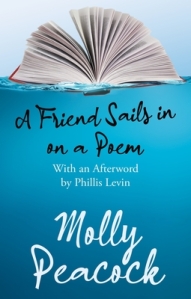 The book traces their lives but also their development as poets, through examples of their verse. Her friend is “Phillis” in real life, but “Levin” when it’s her work is being discussed – and her own poems are as written by “Peacock.” Both women became devoted to the sonnet, an unusual choice because at the time that they were graduate students free verse reigned and form was something one had to learn on one’s own time. Stanza means “room,” Peacock reminds readers, and she believes there is something about form that opens up space, almost literally but certainly metaphorically, to re-examine experience. She repeatedly tracks how traumatic childhood events, as much as everyday observations, were transmuted into her poetry. Levin did so, too, but with an opposite approach: intellectual and universal where Peacock was carnal and personal. That paradox of difference yet likeness is the essence of the friendships we sail on. What a lovely read, especially if you’re curious about ‘where poems come from’; I’d particularly recommend it to fans of Ann Patchett’s Truth and Beauty.
With thanks to Molly Peacock and Palimpsest Press for the free e-copy for review.
The Bright White Tree by Joanna Seldon (Worple Press, 2017)
This appeared the year after Seldon died of cancer; were it not for her untimely end and her famous husband Anthony (a historian and political biographer), I’m not sure it would have been published, as the poetry is fairly mediocre, with some obvious rhymes and twee sentiments. I wouldn’t want to speak ill of the dead, though, so think of this more like a self-published work collected in tribute, and then no problem. Some of the poems were written from the Royal Marsden Hospital, with “Advice” a useful rundown of how to be there for a friend undergoing cancer treatment (text to let them know you’re thinking of them; check before calling, or visiting briefly; bring sanctioned snacks; don’t be afraid to ask after their health).
 Seldon takes inspiration from history (the story of Kitty Pakenham, the bombing of the Bamiyan Buddhas), travels in England and abroad (“Robin in York” vs. “Tuscan Garden”), and family history. Her Jewish heritage is clear from poems about Israel, National Holocaust Memorial Day and Rosh Hashanah. Her own suffering is put into perspective in “A Cancer Patient Visits Auschwitz.” There are also ekphrastic responses to art and literature (a Gaugin, A Winter’s Tale, Jane Eyre, and so on). I particularly liked “Conker,” a reminder of a departed loved one “So is a good life packed full of doing / That may grow warm with others, even when / The many years have turned, and darkness filled / Places where memory shone bright and strong. / I feel the conker and feel he is here.” (New bargain book from Waterstones online sale with Christmas book token)
There are haikus dotted through the collection; here’s one perfect for the season:
“Snowdrops Haiku”
Maids demure, white tips to
Mob caps… Look now! They’ve
Splattered the lawn with snow
Have you discovered any new-to-you independent publishers recently?
Vacation Reading Plans: Spain and Scotland
As treats to look forward to after our DIY and moving adventures, we booked ourselves two summer holidays. Next week we’re off to Northern Spain for eight days. Thanks to a Brittany Ferries voucher from a cancelled trip in 2020, it ended up being a really cheap option – but it means I have to go to sea for 20 hours, each way. And I hate boats. My last sea voyage back from France only lasted four hours or so, but I was so sick. This time, I will be packing all the seasickness remedies known to woman. Your ideas are welcome!
I’ve never been to Spain and have lost my kindergarten Spanish beyond the few bits I’ve picked back up from my husband’s Duolingo practice. We’ve had next to no time to plan what we’re going to do while we’re there, but it should be a great place for hiking and wildlife watching, with a more Atlantic than Mediterranean climate. (We’re no beachgoers.)
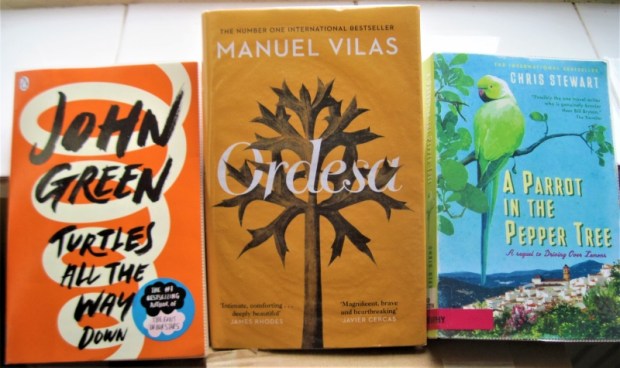
What I have been planning, of course, is what I’ll read. I asked Twitter for recommendations, and got a couple that I followed up on. My library’s holdings weren’t particularly helpful, but I found a few somewhat appropriate reads: As I Walked Out One Midsummer Morning by Laurie Lee, Homage to Catalonia by George Orwell, A Parrot in the Pepper Tree by Chris Stewart, Ordesa by Manuel Vilas, and The Shadow of the Wind by Carlos Ruiz Zafón. Alas that all of these are by men and only two are in translation! For place-specific reading, I’ve supplemented them with Book of Days by Phoebe Power, a book-length poem about the Camino pilgrimage route to Santiago de Compostela, which passes not far from where we’re staying.
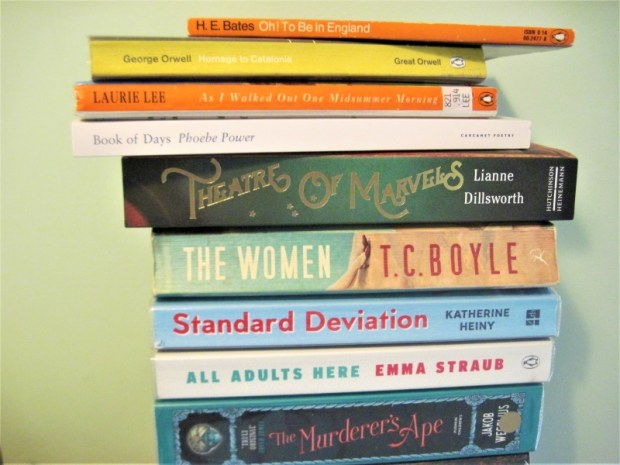
I also amassed a bunch of doorstoppers and slightly lighter literary fiction to help the hours at sea pass. See anything you’d particularly recommend? I’ll likely pack all of these and more (‘sensible’ is not a word that can generally be applied to my reading plans or habits!) because we’re taking a car onto the ferry so space/weight is not an issue.
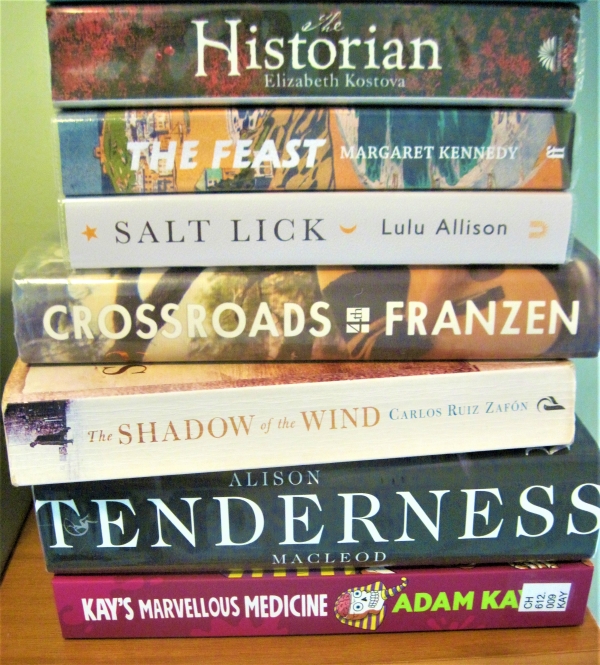
Ironically, I have many more relevant book ideas for our second summer holiday to the Outer Hebrides in late June, but we’re travelling up by train so my book capacity will be minimal! There are loads of novels set on Scottish islands. Here’s what I’m pondering from the library:


Love of Country would be a reread, but is really more for my husband to read. I also fancy a reread of Night Waking by Sarah Moss.
Do you have any trips to look forward to? Will you try for any reading on location?
Humiliation: Stories by Paulina Flores
Paulina Flores, a young Chilean author and high school teacher, won the Roberto Bolaño Short Story Prize for the title story in her debut collection. These nine stories are about how we relate to the past, particularly our childhood – whether with nostalgia or regret – and about the pivotal moments that stand out in the memory. The first two, “Humiliation” and “Teresa,” I previewed in one of my Women in Translation Month posts. They feature young fathers and turn on a moment of surprise: An unemployed father takes his two daughters along to his audition; a college student goes home with a single father for a one-night stand.
 Of the rest, my favorites were “Talcahuano,” about teenage friends whose plan to steal musical instruments from the local evangelical church goes awry when there’s a crisis with the narrator’s father, a laid-off marine (readalike: Sweet Sorrow by David Nicholls); and “Forgetting Freddy,” in which a young woman who ends up back in her mother’s apartment after a breakup listens to the neighbors fighting and relives childhood fears during her long baths (readalike: History of Wolves by Emily Fridlund).
“American Spirit” recalls two friends’ time waitressing (readalike: Sweetbitter by Stephanie Danler), and in “Last Vacation” a young man recounts his last trip to La Serena with his aunt before everything went wrong for his family. “Laika” is a troubling one in that the protagonist remembers her childhood brush with pedophilia not with terror or disgust but with a sort of fondness. A number of the stories conclude that you can’t truly remake your life, nor can you escape the memories that have shaped you – even if you might like to.
A fairly common feature in story volumes is closing with a novella. Almost invariably, I like these long stories the least, and sometimes skip them. Here, the 72-page “Lucky Me” could easily be omitted. Denise, a librarian who watches porn and reads the Old Testament in her spare time (“what she needed was to feel something. She needed pleasure and spirituality”), lets the upstairs neighbor use her bedroom for sex; Nicole, a fourth-grader, has her world turned upside down when her best friend’s mother becomes their housekeeper. Although the story brings its strands, one in the first person and one in the third (giving the book an even 4.5/4.5 split), together in a satisfying manner, it was among my least favorites in the collection.
Overall, though, these are sharp and readable stories I can give a solid recommendation.
My rating:
Humiliation (2016; English translation by Megan McDowell, 2019) is published by Oneworld today, November 7th,; it came out on the 5th from Catapult in the USA. My thanks to Margot Weale for a proof copy for review.
Women in Translation Month 2019, Part II: Almada and Fenollera
All Spanish-language choices this time: an Argentinian novella, a Spanish novel, and a couple of Chilean short stories to whet your appetite for a November release.
The Wind that Lays Waste by Selva Almada (2012; English translation, 2019)
[Translated by Chris Andrews]
 Selva Almada’s debut novella is also her first work to appear in English. Though you might swear this is set in the American South, it actually takes place in her native Argentina. The circadian narrative pits two pairs of characters against each other. On one hand we have the Reverend Pearson and his daughter Leni, itinerants who are driven ever onward by the pastor’s calling. On the other we have “The Gringo” Brauer, a mechanic, and his assistant, José Emilio, nicknamed “Tapioca.”
On his way to visit Pastor Zack, Reverend Pearson’s car breaks down. While the Gringo sets to work fixing the vehicle, the preacher tries witnessing to Tapioca. He senses something special in the boy, perhaps even recognizing a younger version of himself, and wants him to have more of a chance in life than he’s currently getting at the garage. As a violent storm comes up, we’re left to wonder how Leni’s cynicism, the Reverend’s zealousness, the Gringo’s suspicion, and Tapioca’s resolve will all play out.
Different as they are, there are parallels to be drawn between these characters, particularly Leni and Tapioca, who were both abandoned by their mothers. I particularly liked the Reverend’s remembered sermons, printed in italics, and Leni’s sarcastic thoughts about her father’s vocation: “They always ended up doing what her father wanted, or, as he saw it, what God expected of them” and “she admired the Reverend deeply but disapproved of almost everything her father did. As if he were two different people.”
The setup and characters are straight out of Flannery O’Connor. The book doesn’t go as dark as I expected; I’m not sure I found the ending believable, even if it was something of a relief.
My rating:
My thanks to Charco Press for the free copy for review. Last year I reviewed two Charco releases: Die, My Love and Fish Soup.
See also Susan’s review.
The Awakening of Miss Prim by Natalia Sanmartin Fenollera (2013; English translation, 2014)
[Translated by Sonia Soto]
 San Ireneo de Arnois is a generically European village that feels like it’s been frozen in about 1950: it’s the sort of place that people who are beaten down by busy city life retreat to so they can start creative second careers. Prudencia Prim comes here to interview for a job as a librarian, having read a rather cryptic job advertisement. Her new employer, The Man in the Wingchair (never known by any other name), has her catalogue his priceless collection of rare books, many of them theological treatises in Latin and Greek. She’s intrigued by this intellectual hermit who doesn’t value traditional schooling yet has the highest expectations for the nieces and nephews in his care.
In the village at large, she falls in with a group of women who have similarly ridiculous names like Hortensia and Herminia and call themselves feminists yet make their first task the finding of a husband for Prudencia. All of this is undertaken with the aid of endless cups of tea or hot chocolate and copious sweets. The village and its doings are, frankly, rather saccharine. No prizes for guessing who ends up being Prudencia’s chief romantic interest despite their ideological differences; you’ll guess it long before she admits it to herself at the two-thirds point.
As much as this tries to be an intellectual fable for bibliophiles (Prudencia insists that The Man in the Wingchair give Little Women to his niece to read, having first tried it himself despite his snobbery), it’s really just a thinly veiled Pride and Prejudice knock-off – and even goes strangely Christian-fiction in its last few pages. If you enjoyed The Readers of Broken Wheel Recommend and have a higher tolerance for romance and chick lit than I, you may well like this. It’s pleasantly written in an old-fashioned Pym-homage style, but ultimately it goes on my “twee” shelf and will probably return to a charity shop, from whence it came.
My rating: 
Humiliation by Paulina Flores (2016; English translation, 2019)
[Translated by Megan McDowell]
I’ve read the first two stories so far, “Humiliation” and “Teresa,” which feature young fathers and turn on a moment of surprise. An unemployed father takes his two daughters along to his audition; a college student goes home with a single father for a one-night stand. In both cases, what happens next is in no way what you’re expecting. These are sharp and readable, and I look forward to making my way through the rest over the next month or two.
My rating:
Humiliation will be published by Oneworld on November 7th. My thanks to Margot Weale for a proof copy. I will publish a full review closer to the time.
 Bookish Beck = Rebecca Foster. American transplant to England. Freelance proofreader and book reviewer.
 Bookish Beck