#NovNov25 and #GermanLitMonth: Kästner, Kehlmann & Kracht
Our trip to Germany in September whetted my appetite to read more German-language fiction, and November also being German Literature Month (hosted this year by Caroline of Beauty Is a Sleeping Cat and Tony of Tony’s Reading List) was a perfect excuse. K names only this year, please. (Perhaps next year I’ll make it S and finally get to those Sebald and Seethaler novels I have on the shelf.) These three works – a children’s classic, a set of linked short stories about the writer’s craft, and a mother–son spending spree – have coy metafictional touches, plus there’s a connection I wasn’t expecting between the Kehlmann and Kracht. All: 
Emil and the Detectives by Erich Kästner (1929; 1931)
[Translated by Eileen Hall]
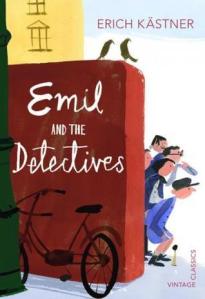 If only I’d realized this was set on a train to Berlin, I could have read it in the same situation! Instead, it was a random find while shelving in the children’s section of the library. Emil sets out on a slow train from Neustadt to stay with his aunt, grandmother and cousin in Berlin for a week’s holiday. His mother gives him £7 in an envelope he pins inside his coat for safekeeping. There are four adults in the carriage with him, but three get off early, leaving Emil alone with a man in a bowler hat. Much as he strives to stay awake, Emil drops off. No sooner has the train pulled into Berlin than he realizes the envelope is gone along with his fellow traveller. “There were four million people in Berlin at that moment, and not one of them cared what was happening to Emil Tischbein.” He’s sure he’ll have to chase the man in the bowler hat all by himself, but instead he enlists the help of a whole gang of boys, including Gustav who carries a motor-horn and poses as a bellhop, Professor with the glasses, and Little Tuesday who mans the phone lines. Together they get justice for Emil, deliver a wanted criminal to the police, and earn a hefty reward. This was a cute story and it was refreshing for children’s word to be taken seriously. There’s also the in-joke of the journalist who interviews Emil being Kästner. I’m sure as a kid I would have found this a thrilling adventure, but the cynical me of today deemed it unrealistic. (Public library) [153 pages]
Fame by Daniel Kehlmann (2009; 2010)
[Translated by Carol Brown Janeway]
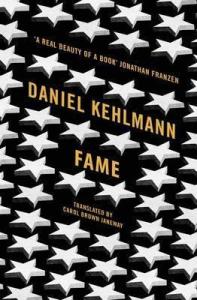 I’ve been equally enchanted by Kehlmann’s historical fiction (Measuring the World) and contemporary metafiction (F is one of my all-time favourites) in the past. These nine linked stories feature writers and their characters, actors and their look-alikes, and are about how life translates into – or is sometimes transformed by – art. Ralf Tanner starts to feel like he doesn’t exist when his calls gets diverted to someone else’s phone and an impersonator is more convincing at playing him than he is himself. Leo Richter’s new girlfriend is curiously similar to his most famous character, Lara Gaspard, a doctor working for a medical charity. Crime writer Maria Rubinstein takes Leo’s place on a cultural exchange to Central Asia and gets stuck in a Kafka-esque situation without a visa. Leo’s fan and Ralf’s call recipient are subjects of their own stories. References to Miguel Auristos Blanco’s spiritual self-help books recur and he, too, eventually becomes a character. I liked the pointed little jokes about what writers have to put up with (“Do you know how often I’ve been asked today where I get my ideas from? Fourteen. And nine times whether I work in the morning or the afternoon,” Leo complains). Mostly, these stories struck me as clever yet had me wondering what the point was. My favourite was “Rosalie Goes Off to Die,” in which Leo’s character travels to Zurich for an assisted death but he the writer decides to interfere before she can get her last wish. (Secondhand – Awesomebooks.com) [206 pages – but fairly large print]
Eurotrash by Christian Kracht (2021; 2024)
[Translated by Daniel Bowles]
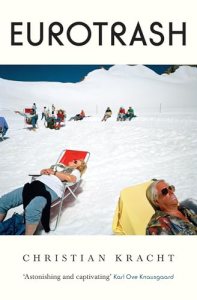 This was longlisted for the International Booker Prize and is the current Waterstones book of the month. The Swiss author’s seventh novel appears to be autofiction: the protagonist is named Christian Kracht and there are references to his previous works. Whether he actually went on a profligate road trip with his 80-year-old mother, who could say. I tend to think some details might be drawn from life – her physical and mental health struggles, her father’s Nazism, his father’s weird collections and sexual predilections – but brewed into a madcap maelstrom of a plot that sees the pair literally throwing away thousands of francs. Her fortune was gained through arms industry investment and she wants rid of it, so they hire private taxis and planes. If his mother has a whim to pick some edelweiss, off they go to find it. All the while she swigs vodka and swallows pills, and Christian changes her colostomy bags. I was wowed by individual lines (“This was the katabasis: the decline of the family expressed in the topography of her face”; “everything that does not rise into consciousness will return as fate”; “the glacial sun shone from above, unceasing and relentless, upon our little tableau vivant”) but was left chilly overall by the satire on the ultra-wealthy and those who seek to airbrush history. The fun connections: Like the Kehlmann, this involves arbitrary travel and happens to end in Africa. More than once, Kracht is confused for Kehlmann. (Little Free Library) [190 pages]
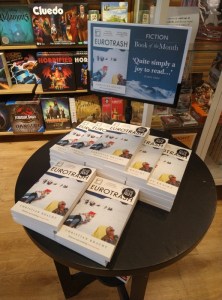
Spotted in my local Waterstones…

Three on a Theme: Christmas Novellas I (Re-)Read This Year
I wasn’t sure I’d manage any holiday-appropriate reading this year, but thanks to their novella length I actually finished three, two in advance and one in a single sitting on the day itself. Two of these happen to be in translation: little slices of continental Christmas.
Twelve Nights by Urs Faes (2018; 2020)
[Translated from the German by Jamie Lee Searle]
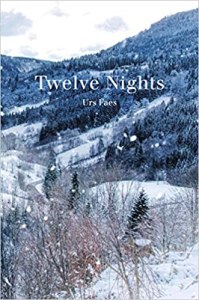 In this Swiss novella, the Twelve Nights between Christmas and Epiphany are a time of mischief when good folk have to protect themselves from the tricks of evil spirits. Manfred has trekked back to his home valley hoping to make things right with his brother, Sebastian. They have been estranged for several decades – since Sebastian unexpectedly inherited the family farm and stole Manfred’s sweetheart, Minna. These perceived betrayals were met with a vengeful act of cruelty (but why oh why did it have to be against an animal?). At a snow-surrounded inn, Manfred convalesces and tries to summon the courage to show up at Sebastian’s door. At only 84 small-format pages, this is more of a short story. The setting and spare writing are appealing, as is the prospect of grace extended. But this was over before it began; it didn’t feel worth what I paid. Perhaps I would have been happier to encounter it in an anthology or a longer collection of Faes’s short fiction. (Secondhand – Hungerford Bookshop)
Through a Glass, Darkly by Jostein Gaarder (1993; 1998)
[Translated from the Norwegian by Elizabeth Rokkan]
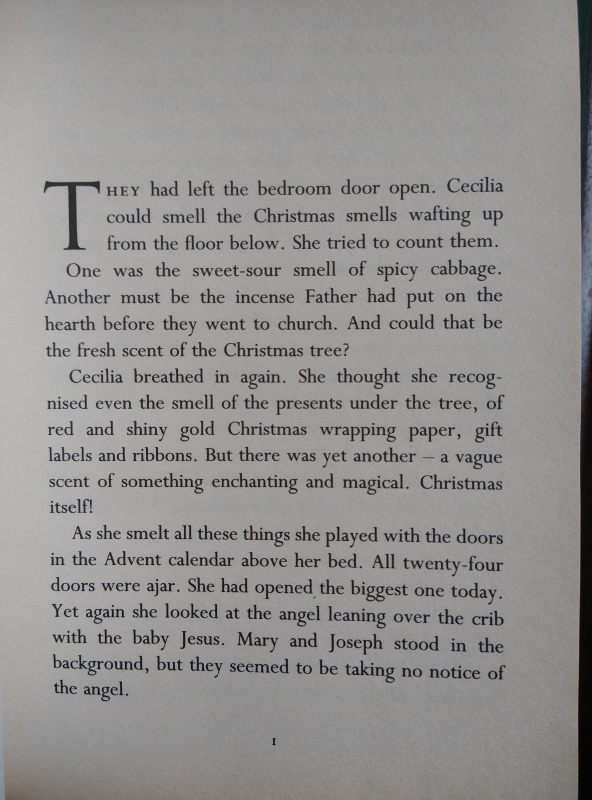
On Christmas Day, Cecilia is mostly confined to bed, yet the preteen experiences the holiday through the sounds and smells of what’s happening downstairs. (What a cosy first page!)
 Her father later carries her down to open her presents: skis, a toboggan, skates – her family has given her all she asked for even though everyone knows she won’t be doing sport again; there is no further treatment for her terminal cancer. That night, the angel Ariel appears to Cecilia and gets her thinking about the mysteries of life. He’s fascinated by memory and the temporary loss of consciousness that is sleep. How do these human processes work? “I wish I’d thought more about how it is to live,” Cecilia sighs, to which Ariel replies, “It’s never too late.” Weeks pass and Ariel engages Cecilia in dialogues and takes her on middle-of-the-night outdoor adventures, always getting her back before her parents get up to check on her. The book emphasizes the wonder of being alive: “You are an animal with the soul of an angel, Cecilia. In that way you’ve been given the best of both worlds.” This is very much a YA book and a little saccharine for me, but at least it was only 161 pages rather than the nearly 400 of Sophie’s World. (Secondhand – Community Furniture Project, Newbury)
Small Things Like These by Claire Keegan (2021)
I idly reread this while The Muppet Christmas Carol played in the background on a lazy, overfed Christmas evening.
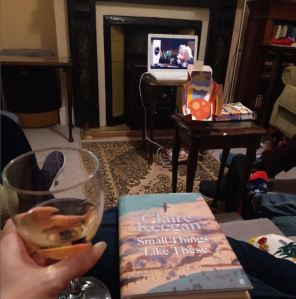
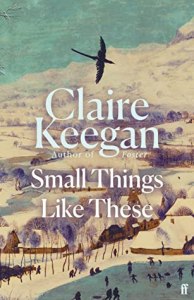 It was an odd experience: having seen the big-screen adaptation just last month, the blow-by-blow was overly familiar to me and I saw Cillian Murphy and Emily Watson, if not the minor actors, in my mind’s eye. I realized fully just how faithful the screenplay is to the book. The film enhances not just the atmosphere but also the plot through the visuals. It takes what was so subtle in the book – blink-and-you’ll-miss-it – and makes it more obvious. Normally I might think it a shame to undermine the nuance, but in this case I was glad of it. Bill Furlong’s midlife angst and emotional journey, in particular, are emphasized in the film. It was probably a mistake to read this a third time within so short a span of time; it often takes me more like 5–10 years to appreciate a book anew. So I was back to my ‘nice little story’ reaction this time, but would still recommend this to you – book or film – if you haven’t yet experienced it. (Free at a West Berkshire Council recycling event)
Previous ratings:  (2021 review);
  (2022 review)
My rating this time:
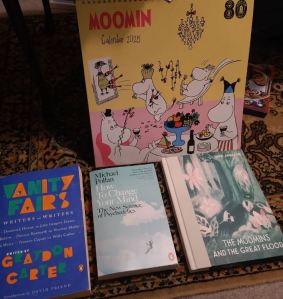
We hosted family for Christmas for the first time, which truly made me feel like a proper grown-up. It was stressful and chaotic but lovely and over all too soon. Here’s my lil’ book haul (but there was also a £50 book token, so I will buy many more!).
I hope everyone has been enjoying the holidays. I have various year-end posts in progress but of course the final Best-of list and statistics will have to wait until the turning of the year.
Coming up:
Sunday 29th: Best Backlist Reads of the Year
Monday 30th: Love Your Library & 2024 Reading Superlatives
Tuesday 31st: Best Books of 2024
Wednesday 1st: Final statistics on 2024’s reading
February Releases by Hess, Kim, Sides (#ReadIndies); Atwood and Shah
I’m pleased to have, between this post and yesterday’s review catch-up, featured 9 books from 8 independent publishers for Read Indies this month. (I have also done some indie reading from my shelves, which I’ll summarize early in March.) Three of the books in my February review stacks were indie releases. I’ve got a hybrid memoir that blends poetic exploration of scripture with personal psychological reflections; an out-of-the-ordinary mystery about a father’s disappearance that comments on disability, racism and much more; and a terrific set of fabulist short stories. My two bonus (non-indie) February books are an unconvincing collaborative novel and a counselling-focussed bibliotherapy guide.

When Fragments Make a Whole: A Personal Journey through Healing Stories in the Bible by Lory Widmer Hess
 Some of you may know Lory, who is training as a spiritual director, from her blog, Enter Enchanted. It was so kind of her to get in touch offering her first book for review. It’s a unique combination of poetry, scriptural exegesis, and fragments of memoir. Each chapter considers a different healing story from the Gospels. As in the lectio divina I learned from college Christian fellowships, the idea with the verse retellings from the Bible is to imagine oneself into a character’s position and consider the crises that led to seeking Jesus’ help. I especially liked the poem “Talitha, Koum,” which links the stories of the woman with the issue of blood and the resurrection of Jairus’ daughter. In both, faith reverses a seemingly hopeless situation.
The short sections of commentary draw in a lot of context as well as etymology from the Greek. The autobiographical essays chart a history of physical and mental challenges, including dissociation, low self-esteem and shame, and offer openness to healing as its own miracle when there are no easy answers. They are notable for their vulnerability, especially when discussing marital problems. The outlook is intellectual and psychological rather than the spiritualizing I’m used to from my evangelical background – Lory comes from the anthroposophy tradition, which I don’t claim to fully understand but (I think) eschews dogma like original sin and atonement and instead makes the spiritual journey a matter of human reconnection with God through free will and the intellect. This is nicely balanced, though, by her work with developmentally disabled adults in residential homes in New England and Switzerland, which reminds her “there is a truth beyond intellectual knowledge, a language beyond words”. It is a calm, honest, methodical book that will intrigue anyone interested in thinking through how the Bible is applicable to the challenges of daily life.
With thanks to the author and Floris Books (Edinburgh) for the free copy for review.
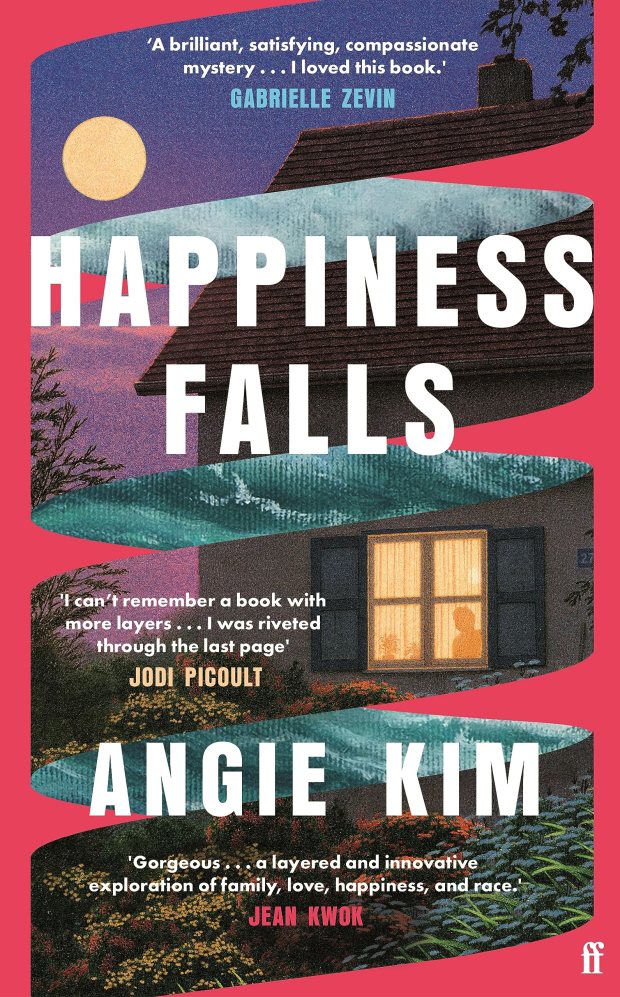
Happiness Falls by Angie Kim
Buzz from across the pond about Kim’s novels led me to request this even though I don’t typically read mysteries. The bulk is set over 2.5 days in June 2020 as the Korean American Parkson family investigates, on their own and with the help of police and various local tip-offs, what happened to the father, Adam, who’d been at River Falls Park with the severely disabled 14-year-old son, Eugene, who is autistic and has mosaic Angelman syndrome. Mother Hannah and 20-year-old twins Mia and John, home from college for the lockdown, quickly realise something is wrong when Eugene, who has blood on his shirt and under his nails, stumbles home on his own and Adam is unreachable by phone. There’s more to the setup than that, and many complicated side-tracks to the investigation, but the basic questions remain for 300+ pages: What happened to Adam? and What was Eugene’s part in it?
Mia narrates, and it’s a pleasure spending time with her quick, systematic brain as she runs through all the options and deals with each new theory and red herring. She clearly gets it from her father, whose recovered notebook is full of amateur experimentation on the “Happiness Quotient”. Her wit and garrulousness (sample aside: “I’m sorry, but I don’t care how much you love fun fonts—you cannot talk about prison rape in Comic Sans”) spills over into footnotes as if in effusive counterpoint to Eugene, who is nonspeaking.
The pandemic setting places interesting constraints on the official proceedings, and the prospect of a new communication method (involving painstaking spelling with a letter stencil) revolutionizes this family as they grasp that Eugene is far from nonverbal and has been ‘locked in’ all along. The account a therapist elicits from him seems to clinch the case, but uncertainty lingers.
This is like a blend of Celeste Ng’s Everything I Never Told You, Rebecca Makkai’s I Have Some Questions for You, and Naoki Higashida’s The Reason I Jump; if you’ve liked one or more of these, I would strongly recommend it. Mystery readers may lack patience for the digressions. The solution is eclipsed by the many issues – prejudice based on race and disability, how one’s circumstances affect contentment, nuances of communication, sibling relationships and twin ESP – explored along the way. Because I am not a crime reader, the pace was no problem for me. My annoyances were with the preponderance of hindsight (“I wish I’d said something,” “It didn’t occur to me until much later”) and the fact that Mia says “begs the question” for raising a question (misuse of a rhetorical term) several times. I found personal meaning in the book because of the Washington, DC-area locales and my severely disabled, nonverbal goddaughter. What if there really is something going on in her mind, and we could find out what it was… I mused. I’ll be keen to read Kim’s debut, Miracle Creek.
With thanks to Faber for the free copy for review.
Crocodile Tears Didn’t Cause the Flood by Bradley Sides
 These 17 flash fiction stories fully embrace the possibilities of magic and weirdness, particularly to help us reconnect with the dead. Brad and I are literary acquaintances from our time working on (the now defunct) Bookkaholic web magazine in 2014–15. I liked this even more than his first book, Those Fantastic Lives (2021), although the contours are very similar. Young people, animals and monsters abound – and sometimes the lines between those identities are unclear. There’s a lot of experimentation with form: a choose-your-own-adventure narrative, a police transcript, a two-truths-and-a-lie challenge, a story all in questions, an English exam, and a letter. A few of my favorite stories were “The Guide to King George,” about an amusement farm’s resident pond monster; “Claire & Hank,” in which a paleontologist’s unearthed Pteranodon becomes a sister to his motherless son; and “Dying at Allium Farm,” whose sassy undead owners think they’re fooling their Tennessee customers. And can you imagine a better title and cover combination?!
With thanks to Montag Press and publicist Lori Hettler for the e-copy for review.
And a couple of bonus February releases that are not from indie publishers:
Fourteen Days, ed. Margaret Atwood and Douglas Preston
This Authors Guild Foundation collaborative project is a Covid-era Decameron update in which the residents of an increasingly derelict New York City apartment complex meet on the rooftop every evening for two early lockdown weeks to clap for healthcare workers, indulge in adult beverages, and swap random stories. The tenants all go by nicknames like “Hello Kitty,” “Florida” and “Vinegar.” The frame narrative has the building superintendent (Yessie, a lesbian of Romanian heritage) worrying over her father’s wellbeing in a care home and surreptitiously recording the oral stories on her phone to later transcribe into the “bible” kept by the previous super. We’re told up front that the manuscript ends up in police custody.
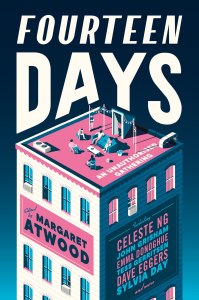 I had a misconception that each chapter would be written by a different author. I think that would actually have been the more interesting approach. Instead, each character is voiced by a different author, and sometimes by multiple authors across the 14 chapters (one per day) – a total of 36 authors took part. I soon wearied of the guess-who game. I most enjoyed the frame story, which was the work of Douglas Preston, a thriller author I don’t otherwise know.
There was a promising idea here, but problems with the execution. One is that, for the most part, the stories are pointless. The characters get hung up on whether they’re ‘true’ or not, but for readers it’s all made up and, while one or two individual tales might be amusing, they do nothing to build a plot and so I found myself mostly skipping over them to get back to the interactions on the roof and the super’s commentary. Another is that, to stand out from an ensemble cast, a voice needs to be really distinctive, and only “Eurovision” (flamboyantly gay) was that for me – based on my love for his rabbit story in particular, I should be reading Joseph Cassara. And finally, the book culminates with an annoying twist that made me cross.
With thanks to Chatto & Windus (Penguin) for the proof copy for review.
Bibliotherapy: The Healing Power of Reading by Bijal Shah
Bibliotherapy is one of my niche bookish interests (see my write-up of my bibliotherapy appointment with Ella Berthoud at the School of Life), so I was delighted to be offered a copy of another relevant book. Bijal Shah grew up in an East African Indian community before moving to the UK with her family as a teenager. When she was in training as a psychodynamic counsellor and attended therapy sessions herself, she realised how helpful literature was in helping her think through traumatic experiences from her past, such as sexism, colourism and a painful break-up. “I have lived half my life in the pages of books,” she observes, “relying on them to put my real life into perspective.” I feel the same way.

The emphasis is very much on therapy here, as Shah elaborates on practices such as literary journaling, recording audio notes, writing poetry, and focusing on gratitude. About half of the book is given over to anonymized sample case studies where she looks at the reasons why a client might come to her for bibliotherapy, the books and exercises she prescribed them, and the sorts of realizations people came to when reflecting on their own lives in relation to what they read. I suspect that the majority of readers, unless they have a vested interest in counselling, will, like me, most enjoy browsing the A–Z list of book prescriptions in the final 20% of the book (with more on Shah’s website). There is good variety to these in terms of author diversity, new vs. backlist reads, and both YA and adult fiction, though most of the recommendations are nonfiction, particularly psychology and self-help: these are much more literal (and, generally, obvious) prescriptions than Berthoud and Elderkin’s playful take.
With thanks to the author and Piatkus (Hachette) for the free copy for review.
Four for #WITMonth: Jansson, Lamarche, Lunde and Vogt
I’ve managed four novels for this year’s Women in Translation month: a nostalgic, bittersweet picture of island summers poised between childhood and old age; a brief, impressionistic account of domestic violence and rape; the third in a series looking at how climate change and species loss reverberate amid family situations; and a visceral meditation on women’s bodies and relationships. Two of these were review copies from the recently launched Héloïse Press, which “champions world-wide female talent”.

The Summer Book by Tove Jansson (1972; 1974)
[Translated from the Swedish by Thomas Teal]
It was just the same long summer, always, and everything lived and grew at its own pace.
 This was only the second time I’ve read one of Jansson’s books aimed at adults (as opposed to five from the Moomins series). Whereas A Winter Book didn’t stand out to me when I read it in 2012 – though I will try it again this winter, having acquired a free copy from a neighbour – this was a lovely read, so evocative of childhood and of languid summers free from obligation. For two months, Sophia and Grandmother go for mini adventures on their tiny Finnish island. Each chapter is almost like a stand-alone story in a linked collection. They make believe and welcome visitors and weather storms and poke their noses into a new neighbour’s unwanted construction.
Six-year-old Sophia, based on Jansson’s niece of the same name, is precocious and opinionated, liable to change her mind in an instant. In “The Cat,” one of my favourite stand-alone bits, she’s fed up with their half-feral pet who kills lots of birds and swaps him for a friend’s soppy lap cat, but then regrets it. She’s learning that logic and emotion sometimes contradict each other, which becomes clearer as she peppers Grandmother with questions about religion and superstition.
As is common to Jansson’s books, there’s a melancholy undercurrent here.
Everything was fine, and yet everything was overshadowed by a great sadness. It was August, and the weather was sometimes stormy and sometimes nice, but for Grandmother, no matter what happened, it was only time on top of time, since everything is vanity and a chasing after the wind.
Sophia’s mother died, and although her grandmother has the greater presence, Papa is also around, dealing with practicalities in the background. Death stalks around the edges, reminding Grandmother of her mortality through bouts of vertigo that have her grabbing for her heart medication. On just the second page we have this memento mori:
“When are you going to die?” the child asked.
And Grandmother answered, “Soon. But that is not the least concern of yours.”
And so it doesn’t feel like our concern either; the focus is on the now, on these beautiful little moments of connection across the generations – like in “Playing Venice,” when Grandmother stays up all night rebuilding Sophia’s model city that was washed away by the rain. (Public library)
The Memory of the Air by Caroline Lamarche (2014; 2022)
[Winner of an English PEN Award; translated from the French by Katherine Gregor]
 In a hypnotic monologue, a woman tells of her time with a violent partner (the man before, or “Manfore”) who thinks her reaction to him is disproportionate and all due to the fact that she has never processed being raped two decades ago. When she goes in for a routine breast scan, she shows the doctor her bruised arm, wanting there to be a definitive record of what she’s gone through. It’s a bracing echo of the moment she walked into a police station to report the sexual assault (and oh but the questions the male inspector asked her are horrible).
The novella opens with an image that returns in dreams but is almost more a future memory of what might have been: “I went down into a ravine and, at the bottom, found a dead woman. She was lying in a shroud, on a carpet of fallen leaves.” I read this in one sitting – er, yoga session – and it has stayed in my mind in intense flashes like that and the flounce of her red dress on the summer day that turned into a nightmare. At an intense 70 pages, this reminded me of Annie Ernaux’s concise autofiction (I’ve reviewed Happening and I Remain in Darkness). An introduction by Dr Dominique Carlini-Versini contextualizes the work by considering the treatment of rape in contemporary French women’s writing.
The Memory of the Air will be published on 26 September. With thanks to Héloïse Press for the proof copy for review.
The Last Wild Horses by Maja Lunde (2019; 2022)
[Translated from the Norwegian by Diane Oatley]
The third in Lunde’s “Climate Quartet,” with its recurring elements of migration, shortages and environmental collapse. Always, though, the overall theme is parent–child relationships and the love that might be the only thing that keeps us going in the face of unspeakable challenges. Here she returns to the tripartite structure of The History of Bees (much my favourite of the three): a historical strand, a near-contemporary one, and a dystopian future story line. The link between the three is Przewalski’s horses (aka takhi).
 In the early 1880s, Mikhail Alexandrovich Kovrov, assistant director of St. Petersburg Zoo, is brought the hide and skull of an ancient horse species assumed extinct. Although a timorous man who still lives with his mother, he becomes part of an expedition to Mongolia to bring back live specimens. In 1992, Karin, who has been obsessed with Przewalski’s horses since encountering them as a child in Nazi Germany, spearheads a mission to return the takhi to Mongolia and set up a breeding population. With her is her son Matthias, tentatively sober after years of drug abuse. In 2064 Norway, Eva and her daughter Isa are caretakers of a decaying wildlife park that houses a couple of wild horses. When a climate migrant comes to stay with them and the electricity goes off once and for all, they have to decide what comes next. This future story line engaged me the most.
I appreciated some aspects: queer and middle-aged romances, the return of a character from The End of the Ocean, the consideration across all three plots of what makes a good mother. However, the horses seemed neither here nor there. There are also many, many animal deaths. Perhaps an unsentimental attitude is necessary to reflect past and future values, and the apparent cruelty of natural processes, but it limits the book’s appeal to animal lovers. Maybe the tone fits the Norwegian prose, which the translator describes as lean.
The fourth book of the quartet, publishing in Norway next month, is called something like The Dream of a Tree; a focus on trees would be a draw for me. After the disappointment of Books 2 and 3, I’m unsure whether I want to bother with the final volume, but it makes sense to do so, if only to grasp Lunde’s full vision. (Public library)
What Concerns Us by Laura Vogt (2020; 2022)
[Translated from the German by Caroline Waight]
 Vogt’s Swiss-set second novel is about a tight-knit matriarchal family whose threads have started to unravel. For Rahel, motherhood has taken her away from her vocation as a singer. Boris stepped up when she was pregnant with another man’s baby and has been as much of a father to Rico as to Leni, the daughter they had together afterwards. But now Rahel’s postnatal depression is stopping her from bonding with the new baby, and she isn’t sure this quartet is going to make it in the long term.
Meanwhile, Rahel’s sister Fenna knows she’s pregnant but refuses a doctor’s care. When she comes to stay with Rahel, she confides that the encounter with her partner, Luc, that led to conception was odd, rough; maybe not consensual. And all this time, the women’s mother, Verena, has been undergoing treatment for breast cancer. All three characters appear to be matter-of-factly bisexual; Rahel and Fenna’s father has long been out of the picture, replaced in Verena’s affections by Inge.
As I was reading, I kept thinking of the declaration running through A Ghost in the Throat by Doireann Ní Ghríofa: “This is a female text.” Vogt’s vision is all breasts and eggs, genitals actual and metaphorical. I loved the use of food in the novel: growing up, the girls cherished “silly nights” when their mother prepared an egg feast and paired it with a feminist lecture on reproduction. Late on, there’s a wonderful scene when the three main characters gorge on preserved foodstuffs from the cellar and share their secrets. (Their language is so sexually frank; would anyone really talk to their mother and siblings in that way?!) As in the Lunde, the main question is what it means to be a mother, but negotiating their relationships with men stretches the bonds of this feminine trio. One for fans of Rachel Cusk and Sally Rooney.
With thanks to Héloïse Press for the proof copy for review.
Recommended April Releases by Amy Bloom, Sarah Manguso & Sara Rauch
Just two weeks until moving day – we’ve got a long weekend ahead of us of sanding, painting, packing and gardening. As busy as I am with house stuff, I’m endeavouring to keep up with the new releases publishers have been so good as to send me. Today I review three short works: the story of accompanying a beloved husband to Switzerland for an assisted suicide, a coolly perceptive novella of American girlhood, and a vivid memoir of two momentous relationships. (April was a big month for new books: I have another 6–8 on the go that I’ll be catching up on in the future.) All: 
In Love: A Memoir of Love and Loss by Amy Bloom
“We’re not here for a long time, we’re here for a good time.”
(Ameche family saying)
Given the psychological astuteness of her fiction, it’s no surprise that Bloom is a practicing psychotherapist. She treats her own life with the same compassionate understanding, and even though the main events covered in this brilliantly understated memoir only occurred two and a bit years ago, she has remarkable perspective and avoids self-pity and mawkishness. Her husband, Brian Ameche, was diagnosed with early-onset Alzheimer’s in his mid-60s, having exhibited mild cognitive impairment for several years. Brian quickly resolved to make a dignified exit while he still, mostly, had his faculties. But he needed Bloom’s help.
“I worry, sometimes, that a better wife, certainly a different wife, would have said no, would have insisted on keeping her husband in this world until his body gave out. It seems to me that I’m doing the right thing, in supporting Brian in his decision, but it would feel better and easier if he could make all the arrangements himself and I could just be a dutiful duckling, following in his wake. Of course, if he could make all the arrangements himself, he wouldn’t have Alzheimer’s”
U.S. cover
She achieves the perfect tone, mixing black humour with teeth-gritted practicality. Research into acquiring sodium pentobarbital via doctor friends soon hit a dead end and they settled instead on flying to Switzerland for an assisted suicide through Dignitas – a proven but bureaucracy-ridden and expensive method. The first quarter of the book is a day-by-day diary of their January 2020 trip to Zurich as they perform the farce of a couple on vacation. A long central section surveys their relationship – a second chance for both of them in midlife – and how Brian, a strapping Yale sportsman and accomplished architect, gradually descended into confusion and dependence. The assisted suicide itself, and the aftermath as she returns to the USA and organizes a memorial service, fill a matter-of-fact 20 pages towards the close.
Hard as parts of this are to read, there are so many lovely moments of kindness (the letter her psychotherapist writes about Brian’s condition to clinch their place at Dignitas!) and laughter, despite it all (Brian’s endless fishing stories!). While Bloom doesn’t spare herself here, diligently documenting times when she was impatient and petty, she doesn’t come across as impossibly brave or stoic. She was just doing what she felt she had to, to show her love for Brian, and weeping all the way. An essential, compelling read.
With thanks to Granta for the free copy for review.
Very Cold People by Sarah Manguso
I’ve read Manguso’s four nonfiction works and especially love her Wellcome Book Prize-shortlisted medical memoir The Two Kinds of Decay. The aphoristic style she developed in her two previous books continues here as discrete paragraphs and brief vignettes build to a gloomy portrait of Ruthie’s archetypical affection-starved childhood in the fictional Massachusetts town of Waitsfield in the 1980s and 90s. She’s an only child whose parents no doubt were doing their best after emotionally stunted upbringings but never managed to make her feel unconditionally loved. Praise is always qualified and stingily administered. Ruthie feels like a burden and escapes into her imaginings of how local Brahmins – Cabots and Emersons and Lowells – lived. Her family is cash-poor compared to their neighbours and loves nothing more than a trip to the dump: “My parents weren’t after shiny things or even beautiful things; they simply liked getting things that stupid people threw away.”
The depiction of Ruthie’s narcissistic mother is especially acute. She has to make everything about her; any minor success of her daughter’s is a blow to her own ego. I marked out an excruciating passage that made me feel so sorry for this character. A European friend of the family visits and Ruthie’s mother serves corn muffins that he seems to appreciate.
My mother brought up her triumph for years. … She’d believed his praise was genuine. She hadn’t noticed that he’d pegged her as a person who would snatch up any compliment into the maw of her unloved, throbbing little heart.
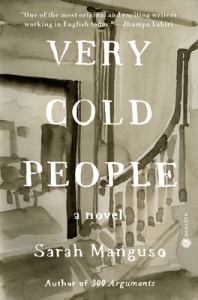
U.S. cover
At school, as in her home life, Ruthie dissociates herself from every potentially traumatic situation. “My life felt unreal and I felt half-invested. I felt indistinct, like someone else’s dream.” Her friend circle is an abbreviated A–Z of girlhood: Amber, Bee, Charlie and Colleen. “Odd” men – meaning sexual predators – seem to be everywhere and these adolescent girls are horribly vulnerable. Molestation is such an open secret in the world of the novel that Ruthie assumes this is why her mother is the way she is.
While the #MeToo theme didn’t resonate with me personally, so much else did. Chemistry class, sleepovers, getting one’s first period, falling off a bike: this is the stuff of girlhood – if not universally, then certainly for the (largely pre-tech) American 1990s as I experienced them. I found myself inhabiting memories I hadn’t revisited for years, and a thought came that had perhaps never occurred to me before: for our time and area, my family was poor, too. I’m grateful for my ignorance: what scarred Ruthie passed me by; I was a purely happy child. But I think my sister, born seven years earlier, suffered more, in ways that she’d recognize here. This has something of the flavour of Eileen and My Name Is Lucy Barton and reads like autofiction even though it’s not presented as such. The style and contents may well be divisive. I’ll be curious to hear if other readers see themselves in its sketches of childhood.
With thanks to Picador for the proof copy for review.
XO by Sara Rauch
Sara Rauch won the Electric Book Award for her short story collection What Shines from It. This compact autobiographical parcel focuses on a point in her early thirties when she lived with a long-time female partner, “Piper”, and had an intense affair with “Liam”, a fellow writer she met at a residency.
“no one sets out in search of buried treasure when they’re content with life as it is”
“Longing isn’t cheating (of this I was certain), even when it brushes its whiskers against your cheek.”
 Adultery is among the most ancient human stories we have, a fact Rauch acknowledges by braiding through the narrative her musings on religion and storytelling by way of her Catholic upbringing and interest in myths and fairy tales. She’s looking for the patterns of her own experience and how endings make way for new life. The title has multiple meanings: embraces, crossroads and coming full circle. Like a spider’s web, her narrative pulls in many threads to make an ordered whole. All through, bisexuality is a baseline, not something that needs to be interrogated.
This reminded me of a number of books I’ve read about short-lived affairs – Tides, The Instant – and about renegotiating relationships in a queer life – The Fixed Stars, In the Dream House – but felt most like reading a May Sarton journal for how intimately it recreates daily routines of writing, cooking, caring for cats, and weighing up past, present and future. Lovely stuff.
With thanks to publicist Lori Hettler and Autofocus Books for the e-copy for review.
Will you seek out one or more of these books?
What other April releases can you recommend?
Reading Robertson Davies Week: Fifth Business
I’m grateful to Lory (of The Emerald City Book Review) for hosting this past week’s Robertson Davies readalong, which was my excuse to finally try him for the first time. Of course, Canadians have long recognized what a treasure he is, but he’s less known elsewhere. I do remember that Erica Wagner, one of my literary heroes (an American in England; former books editor of the London Times, etc.), has expressed great admiration for his work.
I started with what I had to hand: Fifth Business (1970), the first volume of The Deptford Trilogy. In the theatre world, the title phrase refers to a bit player who yet has importance to the outcome of a drama, and that’s how the narrator, Dunstan Ramsay, thinks of himself. I was reminded right away of the opening of Charles Dickens’s David Copperfield: “Whether I shall turn out to be the hero of my own life, or whether that station will be held by anybody else, these pages must show.” In the first line Ramsay introduces himself in relation to another person: “My lifelong involvement with Mrs. Dempster began at 5.58 o’clock p.m. on 27 December 1908, at which time I was ten years and seven months old.”

 Specifically, he dodged a snowball meant for him – thrown by his frenemy, Percy Boyd Staunton – and it hit Mrs. Dempster, wife of the local Baptist minister, in the back of the head, knocking her over and 1) sending her into early labor with Paul, who also plays a major role in the book; and 2) permanently compromising her mental health. Surprisingly, given his tepid Protestant upbringing, Ramsay becomes a historian of Christian saints, and comes to consider Mrs. Dempster part of his personal pantheon for a few incidents he thinks of as miracles – not least his survival during First World War service. And this is despite Mrs. Dempster being caught in a situation that seriously compromises her standing in Deptford.
The novel is presented as a long, confessional letter Ramsay writes, on the occasion of his retirement, to the headmaster of the boys’ school where he taught history for 45 years. Staunton, later known simply as “Boy,” becomes a sugar magnate and politician; Paul becomes a world-renowned illusionist known by various stage names. Both Paul and Ramsay are obsessed with the unexplained and impossible, but where Paul manipulates appearances and fictionalizes the past, Ramsay looks for miracles. The Fool, the Saint and the Devil are generic characters we’re invited to ponder; perhaps they also have incarnations in the novel?
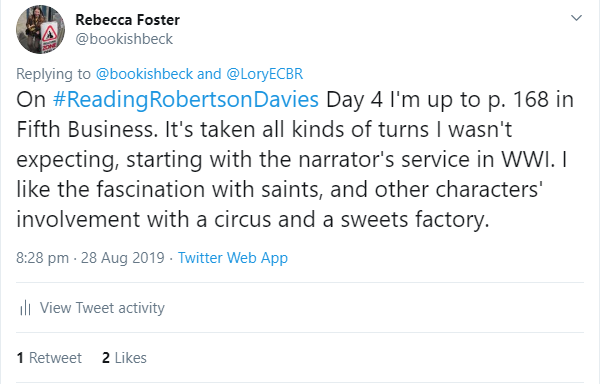
Fifth Business ends with a mysterious death, and though there are clues that seem to point to whodunit, the fact that the story segues straight into a second volume, with a third to come, indicates that it’s all more complicated than it might seem. I was so intrigued that, thanks to my omnibus edition, I carried right on with the first chapter of The Manticore (1972), which is also in the first person but this time narrated by Staunton’s son, David, from Switzerland. Freudian versus Jungian psychology promises to be a major dichotomy in this one, and I’m sure that the themes of the complexity of human desire, the search for truth and goodness, and the difficulty of seeing oneself and others clearly will crop up once again.
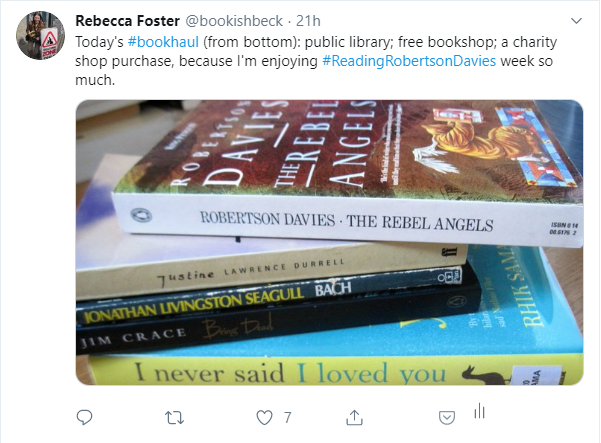
This was a very rewarding reading experience. I’d recommend Davies to those who enjoy novels of ideas, such as Iris Murdoch’s. I’ll carry on with at least the second volume of the trilogy for now, and I’ve also acquired the first volume of another, later trilogy to try.
My rating:
Some favorite lines:
“I cannot remember a time when I did not take it as understood that everybody has at least two, if not twenty-two, sides to him.”
“Forgive yourself for being a human creature, Ramezay. That is the beginning of wisdom; that is part of what is meant by the fear of God; and for you it is the only way to save your sanity.”
It’s also fascinating to see the contrast between how Ramsay sees himself, and how others do:
“it has been my luck to appear more literate than I really am, owing to a cadaverous and scowling cast of countenance, and a rather pedantic Scots voice”
vs.
“Good God, don’t you think the way you rootle in your ear with your little finger delights the boys? And the way you waggle your eyebrows … and those horrible Harris tweed suits you wear … And that disgusting trick of blowing your nose and looking into your handkerchief as if you expected to prophesy something from the mess. You look ten years older than your age.”
A Week in Italy and What I Read
We’re relieved to be back in the balmy UK after a sweltering week in northern Italy. Though our sixth-floor Airbnb apartment in Milan suited our needs perfectly, it was a challenge to keep it minimally comfortable. Eventually we worked out that it was essential to get up by 6:30 a.m. to close the balcony doors and shutter. The bedroom happened to be shaded, so I could set up my laptop in there and work until noon, when it was time to close out the heat of the day on that side. In the afternoons I read and napped on the divan, and then sometime between 6 and 10 p.m., depending on how sunny it had been during the day, we could fling the windows and doors wide open again. Fans helped, but we still passed some horribly muggy nights.


My husband was at his conference for four of the days, so we only braved the city centre itself on Monday morning, touring the Duomo and climbing the steps to the roof. This was well worth doing for views over the city. Afterwards we walked through the associated museum (mostly underground, and blissfully cool with air conditioning) and Galleria Vittorio Emanuele II, a luxurious nineteenth-century shopping arcade filled with designer fashions.


Two day trips by train got us out of the city and into slightly cooler temperatures: on Wednesday we explored Varenna and Bellagio on Lake Como, and on Saturday we took a bus and cable car from Lecco into the mountains at Piani d’Erna. We took full advantage of one-euro espressos and glasses of wine, and ate lots of pizza, pasta and gelato.

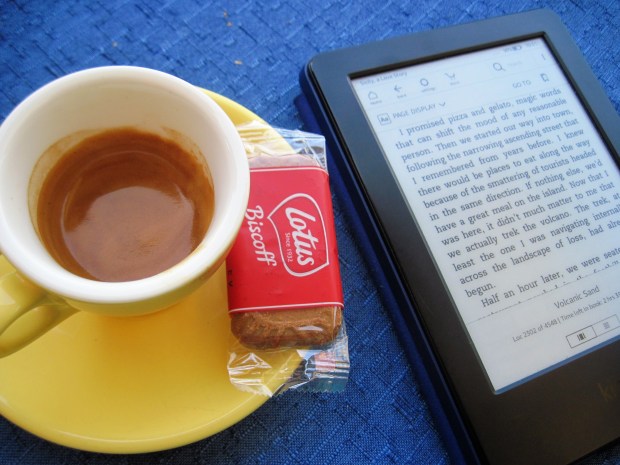
After much deliberation, this is the book stack I actually packed for our trip. I got through the first half of the Orwell, an excellent account of working as a dishwasher in Paris hotels and having to scrape together enough money to ward off starvation. I’ll be writing it up as my Classic of the Month in a couple of weeks. I also read Sunburn by Laura Lippman, which I’ll hold in reserve for a summer-themed post, and (on Kindle) So Many Rooms by Laura Scott, a debut poetry collection coming out in October that I’ll review here at a later date.
Two of my other Kindle reads ended up being perfect for the setting:
From Scratch: A Memoir of Love, Sicily, and Finding Home by Tembi Locke: This was the perfect book for me to read during the week in Italy. Not only is it set largely in Sicily, but it ticks a lot of boxes in terms of my reading interests: food, travel, bereavement, and the challenges of being an American overseas. During a semester abroad in Florence, Locke (an actress I was previously unfamiliar with) met and fell in love with Saro Gullo, an Italian chef. His parents could hardly accept him marrying someone from outside of Sicily, let alone a black woman from Texas, and refused to attend their wedding. But as the years passed they softened towards Locke, who gradually became accepted in Saro’s hometown of Aliminusa.
In fact, after Saro’s death from bone cancer in 2012, she became like a second daughter to Saro’s mother. The book focuses on the three summers in a row when she and her adopted daughter Zoela traveled to the family home in Sicily to stay with Nonna. I particularly appreciated the exploration of what it’s like to live between countries and cultures. This is one of three Reese Witherspoon book club books I’ve read so far (along with Where the Crawdads Sing and Daisy Jones and the Six), and all have been great – Reese’s recommendations are proving as reliable as Oprah’s.
 A mudslide blocked the route we should have taken back from Milan to Paris, so we rebooked onto trains via Switzerland. This plus the sub-Alpine setting for our next-to-last day made the perfect context for racing through Where the Hornbeam Grows: A Journey in Search of a Garden by Beth Lynch in just two days. Lynch moved from England to Switzerland when her husband took a job in Zurich. Suddenly she had to navigate daily life, including frosty locals and convoluted bureaucracy, in a second language. The sense of displacement was exacerbated by her lack of access to a garden. Gardening had always been a whole-family passion, and after her parents’ death their Sussex garden was lost to her. Two years later she and her husband moved to a cottage in western Switzerland and cultivated a garden idyll, but it wasn’t enough to neutralize their loneliness.
Much of what Lynch has to say about trying to find genuine connections as an expatriate rang true for me. Paradise Lost provides an unexpected frame of reference as Lynch asks what it means for a person or a plant to be transplanted somewhere new, and what it takes to thrive. Her elegant writing reminded me of Diana Athill’s and Penelope Lively’s, and the exploration of the self through gardens is reminiscent of Allan Jenkins’s Plot 29.
Other successful reads:
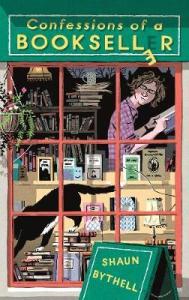 Confessions of a Bookseller by Shaun Bythell: This picks up right where The Diary of a Bookseller left off and carries through the whole of 2015. Again it’s built on the daily routines of buying and selling books, including customers’ and colleagues’ quirks, and of being out and about in a small town. I wished I was in Wigtown instead of Milan! Because of where I was reading the book, I got particular enjoyment out of the characterization of Emanuela (soon known as “Granny” for her poor eyesight and myriad aches and gripes), who comes over from Italy to volunteer in the bookshop for the summer. Bythell’s break-up with “Anna” is a recurring theme in this volume, I suspect because his editor/publisher insisted on an injection of emotional drama.
 City of Girls by Elizabeth Gilbert: There’s a fun, saucy feel to this novel set mostly in 1940s New York City. Twenty-year-old Vivian Morris comes to sew costumes for her Aunt Peg’s rundown theatre and falls in with a disreputable lot of actors and showgirls. When she does something bad enough to get her in the tabloids and jeopardize her future, she retreats in disgrace to her parents’ – but soon the war starts and she’s called back to help with Peg’s lunchtime propaganda shows at the Brooklyn Navy Yard. The quirky coming-of-age narrative reminded me a lot of classic John Irving, while the specifics of the setting made me think of Wise Children, All the Beautiful Girls and Manhattan Beach. The novel takes us to 2010, when Vivian is 90 and still brazenly independent. I was somewhat underwhelmed – while it’s a fairly touching story of how to absorb losses and make an unconventional family, I wondered if it had all meant much. I’ll be expanding this into a Shiny New Books review.
 Judgment Day by Sandra M. Gilbert: English majors will know Gilbert best for her landmark work of criticism, The Madwoman in the Attic (co-written with Susan Gubar). I had no idea that she writes poetry. This latest collection has a lot of interesting reflections on religion, food and art, as well as elegies to those she’s lost. Raised Catholic, Gilbert married a Jew, and the traditions of Judaism still hold meaning for her after husband’s death even though she’s effectively an atheist. “Pompeii and After,” a series of poems describing food scenes in paintings, from da Vinci to Hopper, is particularly memorable.
Not-so-successful reads:
 Vintage 1954 by Antoine Laurain: Dreadful! I would say: avoid this sappy time-travel novel at all costs. I thought the setup promised a gentle dose of fantasy, and liked the fact that the characters could meet their ancestors and Paris celebrities during their temporary stay in 1954. But the characters are one-dimensional stereotypes, and the plot is far-fetched and silly. I know many others have found this delightful, so consider me in the minority…
As well as a few DNFs…
What Dementia Teaches Us about Love by Nicci Gerard: I’ve read a lot of books about dementia, both clinical and anecdotal, and this doesn’t add anything new. (11%)
The Great Railway Bazaar by Paul Theroux: I read the first 32 pages, up to when Theroux arrives in northern Italy. He mostly describes his fellow passengers, as well as the details of meals and sleeping arrangements on trains. The writing struck me as old-fashioned, and I couldn’t imagine getting through another nearly 350 pages of it.
Out of the Woods by Luke Turner: Attempts to fuse nature and sexuality in a way that’s reminiscent of Hidden Nature by Alys Fowler. The writing didn’t draw me in at all. (5%)
Book Serendipity Incidents of 2019 (So Far)
I’ve continued to post my occasional reading coincidences on Twitter and/or Instagram. This is when two or more books that I’m reading at the same time or in quick succession have something pretty bizarre in common. Because I have so many books on the go at once – usually between 10 and 20 – I guess I’m more prone to such serendipitous incidents. (The following are in rough chronological order.)
What’s the weirdest coincidence you’ve had lately?
- Two titles that sound dubious about miracles: There Will Be No Miracles Here by Casey Gerald and The Unwinding of the Miracle: A Memoir of Life, Death, and Everything that Comes After by Julie Yip-Williams

- Two titles featuring light: A Light Song of Light by Kei Miller and The Age of Light by Whitney Scharer
- Grey Poupon mustard (and its snooty associations, as captured in the TV commercials) mentioned in There Will Be No Miracles Here by Casey Gerald and Drinking: A Love Story by Caroline Knapp
 “I Wanna Dance with Somebody” (the Whitney Houston song) referenced in There Will Be No Miracles Here by Casey Gerald and Don’t Call Us Dead by Danez Smith
- Two books have an on/off boyfriend named Julian: Drinking: A Love Story by Caroline Knapp and Extinctions by Josephine Wilson
- There’s an Aunt Marjorie in When I Had a Little Sister by Catherine Simpson and Extinctions by Josephine Wilson


- Set (at least partially) in a Swiss chalet: This Sunrise of Wonder by Michael Mayne and Crazy for God by Frank Schaeffer
- A character named Kiki in The Sacred and Profane Love Machine by Iris Murdoch, The Age of Light by Whitney Scharer, AND Improvement by Joan Silber
 Two books set (at least partially) in mental hospitals: Mind on Fire by Arnold Thomas Fanning and Faces in the Water by Janet Frame
- Two books in which a character thinks the saying is “It’s a doggy dog world” (rather than “dog-eat-dog”): The Friend by Sigrid Nunez and The Octopus Museum by Brenda Shaughnessy
- Reading a novel about Lee Miller (The Age of Light by Whitney Scharer), I find a metaphor involving her in My Year of Rest and Relaxation by Ottessa Moshfegh: (the narrator describes her mother) “I think she got away with so much because she was beautiful. She looked like Lee Miller if Lee Miller had been a bedroom drunk.” THEN I come across a poem in Clive James’s Injury Time entitled “Lee Miller in Hitler’s Bathtub”

- On the same night that I started Siri Hustvedt’s new novel, Memories of the Future, I also started a novel that had a Siri Hustvedt quote (from The Blindfold) as the epigraph: Besotted by Melissa Duclos
- In two books “elicit” was printed where the author meant “illicit” – I’m not going to name and shame, but one of these instances was in a finished copy! (the other in a proof, which is understandable)
- Three books in which the bibliography is in alphabetical order BY BOOK TITLE! Tell me this is not a thing; it will not do! (Vagina: A Re-education by Lynn Enright; Let’s Talk about Death (over Dinner) by Michael Hebb; Telling the Story: How to Write and Sell Narrative Nonfiction by Peter Rubie)
 References to Gerard Manley Hopkins in Another King, Another Country by Richard Holloway, This Sunrise of Wonder by Michael Mayne and The Point of Poetry by Joe Nutt (these last two also discuss his concept of the “inscape”)
- Creative placement of words on the page (different fonts; different type sizes, capitals, bold, etc.; looping around the page or at least not in traditional paragraphs) in When Death Takes Something from You Give It Back by Naja Marie Aidt [not pictured below], How Proust Can Change Your Life by Alain de Botton, Stubborn Archivist by Yara Rodrigues Fowler, Alice Iris Red Horse: Selected Poems of Yoshimasu Gozo and Lanny by Max Porter

- Twin brothers fall out over a girl in Cutting for Stone by Abraham Verghese and one story from the upcoming book Meteorites by Julie Paul
- Characters are described as being “away with the fairies” in Lanny by Max Porter and Away by Jane Urquhart
 Schindler’s Ark/List is mentioned in In the Beginning: A New Reading of the Book of Genesis by Karen Armstrong and Telling the Story: How to Write and Sell Narrative Nonfiction by Peter Rubie … makes me think that I should finally pick up my copy!
The Three Best Books I’ve Read So Far This Year
I’m very stingy with my 5-star ratings, so when I give one out you can be assured that a book is truly special. These three are all backlist reads – look out for my Classic of the Month post next week for a fourth that merits 5 stars – that are well worth seeking out. Out of the 50 books I’ve read so far this year, these are far and away the best.
This Sunrise of Wonder: Letters for the Journey by Michael Mayne (1995)

The cover image is Mark Rothko’s Orange, Red, Yellow (1956).
I plucked this Wigtown purchase at random from my shelves and it ended up being just what I needed to lift me out of January’s funk. Mayne’s thesis is that experiencing wonder, “rare, life-changing moments of seeing or hearing things with heightened perception,” is what makes us human. Call it an epiphany (as Joyce did), call it a moment of vision (as Woolf did), call it a feeling of communion with the universe; whatever you call it, you know what he is talking about. It’s that fleeting sense that you are right where you should be, that you have tapped into some universal secret of how to be in the world.
Mayne believes poets, musicians and painters, in particular, reawaken us to wonder by encouraging us to pay close attention. His frame of reference is wide, with lots of quotations and poetry extracts; he has a special love for Turner, Monet and Van Gogh and for Rilke, Blake and Hopkins. Mayne was an Anglican priest and Dean of Westminster, so he comes at things from a Christian perspective, but most of his advice is generically spiritual and not limited to a particular religion. There are about 50 pages towards the end that are specifically about Jesus; one could skip those if desired.
The book is a series of letters written to his grandchildren from a chalet in the Swiss Alps one May to June. Especially with the frequent quotations and epigraphs, the effect is of a rich compendium of wisdom from the ages. I don’t often feel awake to life’s wonder – I get lost in its tedium and unfairness instead – but this book gave me something to aspire to.
A few of the many wonderful quotes:
“The mystery is that the created world exists. It is: I am. The mystery is life itself, together with the fact that however much we seek to explore and to penetrate them, the impenetrable shadows remain.”
“Once wonder goes; once mystery is dismissed; once the holy and the numinous count for nothing; then human life becomes cheap and it is possible with a single bullet to shatter that most miraculous thing, a human skull, with scarcely a second thought. Wonder and compassion go hand-in-hand.”
“this recognition of my true worth is something entirely different from selfishness, that turned-in-upon-myselfness of the egocentric. … It is a kind of blasphemy to view ourselves with so little compassion when God views us with so much.”
Body of Work: Meditations on Mortality from the Human Anatomy Lab by Christine Montross (2007)
 When she was training to become a doctor in Rhode Island, Montross and her anatomy lab classmates were assigned an older female cadaver they named Eve. Eve taught her everything she knows about the human body. Montross is also a published poet, as evident in her lyrical exploration of the attraction and strangeness of working with the remnants of someone who was once alive. She sees the contrasts, the danger, the theatre, the wonder of it all:
“Stacked beside me on my sage green couch: this spinal column that wraps into a coil without muscle to hold it upright, hands and feet tied together with floss, this skull hinged and empty. A man’s teeth.”
“When I look at the tissues and organs responsible for keeping me alive, I am not reassured. The wall of the atrium is the thickness of an old T-shirt, and yet a tear in it means instant death. The aorta is something I have never thought about before, but if mine were punctured, I would exsanguinate, a deceptively beautiful word”
All through her training, Montross has to remind herself to preserve her empathy despite a junior doctor’s fatigue and the brutality of the work (“The force necessary in the dissections feels barbarous”), especially as the personal intrudes on her career through her grandparents’ decline and her plans to start a family with her wife – which I gather is more of a theme in her next book, Falling into the Fire, about her work as a psychiatrist. I get through a whole lot of medical reads, as any of my regular readers will know, but this one is an absolute stand-out for its lyrical language, clarity of vision, honesty and compassion.
There There by Tommy Orange (2018)
Had I finished this late last year instead of in the second week of January, it would have been vying with Lauren Groff’s Florida for the #1 spot on my Best Fiction of 2018 list.
 The title – presumably inspired by both Gertrude Stein’s remark about Oakland, California (“There is no there there”) and the Radiohead song – is no soft pat of reassurance. It’s falsely lulling; if anything, it’s a warning that there is no consolation to be found here. Orange’s dozen main characters are urban Native Americans converging on the annual Oakland Powwow. Their lives have been difficult, to say the least, with alcoholism, teen pregnancy, and gang violence as recurring sources of trauma. They have ongoing struggles with grief, mental illness and the far-reaching effects of fetal alcohol syndrome.
The novel cycles through most of the characters multiple times, alternating between the first and third person (plus one second person chapter). As we see them preparing for the powwow, whether to dance and drum, meet estranged relatives, or get up to no good, we start to work out the links between everyone. I especially liked how Orange unobtrusively weaves in examples of modern technology like 3D printing and drones.
The writing in the action sequences is noticeably weaker, and I wasn’t fully convinced by the sentimentality-within-tragedy of the ending, but I was awfully impressed with this novel overall. I’d recommend it to readers of David Chariandy’s Brother and especially Sunil Yapa’s Your Heart Is a Muscle the Size of a Fist. It was my vote for the National Book Critics Circle’s John Leonard Prize (for the best first book, of any genre, published in 2018), and I was pleased that it went on to win.
No Place to Lay One’s Head by Françoise Frenkel (1945)
Fittingly, I finished reading this on Sunday, which was International Holocaust Remembrance Day. Even after seven decades, we’re still unearthing new Holocaust narratives, such as this one: rediscovered in a flea market in 2010, it was republished in French in 2015 and first became available in English translation in 2017.
 Born Frymeta Idesa Frenkel in Poland, the author (1889–1975) was a Jew who opened the first French-language bookstore in Berlin in 1921. After Kristallnacht and the seizure of her stock and furniture, she left for France and a succession of makeshift situations, mostly in Avignon and Nice. She lived in a hotel, a chateau, and the spare room of a sewing machinist whose four cats generously shared their fleas. All along, the Mariuses, a pair of hairdressers, were like guardian angels she could go back to between emergency placements.
This memoir showcases the familiar continuum of uneasiness blooming into downright horror as people realized what was going on in Europe. To start with one could downplay the inconveniences of having belongings confiscated and work permits denied, of squeezing onto packed trains and being turned back at closed borders. Only gradually, as rumors spread of what was happening to deported Jews, did Frenkel understand how much danger she was in.
The second half of the book is more exciting than the first, especially after Frenkel is arrested at the Swiss border. (Even though you know she makes it out alive.) Her pen portraits of her fellow detainees show real empathy as well as writing talent. Strangely, Frenkel never mentions her husband, who went into exile in France in 1933 and died in Auschwitz in 1942. I would also have liked to hear more about her 17 years of normal bookselling life before everything kicked off. Still, this is a valuable glimpse into the events of the time, and a comparable read to Władysław Szpilman’s The Pianist.
My rating: 
No Place to Lay One’s Head (translated from the French by Stephanie Smee) is issued in paperback today, January 31st, by Pushkin Press. This edition includes a preface by Patrick Modiano and a dossier of documents and photos relating to Frenkel’s life. My thanks to the publisher for the free copy for review.
 Bookish Beck = Rebecca Foster. American transplant to England. Freelance proofreader and book reviewer.
 Bookish Beck