#ReadIndies Review Catch-Up: Chevillard, Hopkins & Bateman, McGrath, Richardson
Quick thoughts on some more review catch-up books, most of them from 2025. It’s a miscellaneous selection today: absurdist flash fiction by a prolific French author, a self-help graphic novel about surviving heartbreak, a blend of bird photography and poetry, and a debut poetry collection about life and death as encountered by a parish priest.
Museum Visits by Éric Chevillard (2024)
[Trans. from French by David Levin Becker]
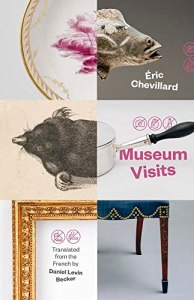 I’d not heard of Chevillard, even though he’s published 22 novels and then some. This appealed to me because it’s a collection of micro-essays and short stories, many of them witty etymological or historical riffs. “The Guide,” a tongue-in-cheek tour of places where things may have happened, reminded me of Julian Barnes: “So, right here is where Henri IV ran a hand through his beard, here’s where a raindrop landed on Dante’s forehead, this is where Buster Keaton bit into a pancake” and so on. It’s a clever way of questioning what history has commemorated and whether it matters. Some pieces elaborate on a particular object – Hegel’s cap, a chair, stones, a mass attendance certificate. A concertgoer makes too much of the fact that they were born in the same year as the featured harpsichordist. “Autofiction” had me snorting with laughter, though it’s such a simple conceit. All Chevillard had to do in this authorial rundown of a coming of age was replace “write” with “ejaculate.” This leads to such ridiculous statements as “It was around this time that I began to want to publicly share what I was ejaculating” and “I ejaculate in all the major papers.” There are some great pieces about animals. Others outstayed their welcome, however, such as “Faldoni.” Most feel like intellectual experiments, which isn’t what you want all the time but is interesting to try for a change, so you might read one or two mini-narratives between other things.
With thanks to the University of Yale Press for the free copy for review.
What to Do When You Get Dumped: A Guide to Unbreaking Your Heart by Suzy Hopkins; illus. Hallie Bateman (2025)
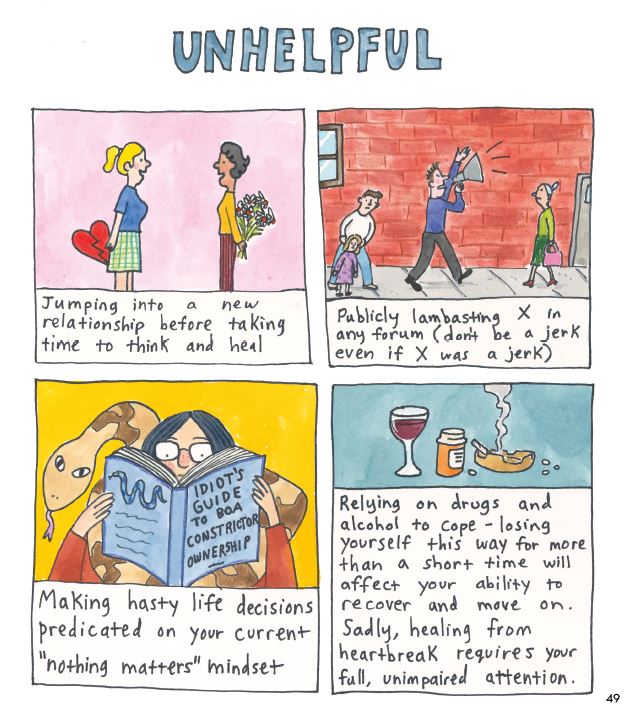
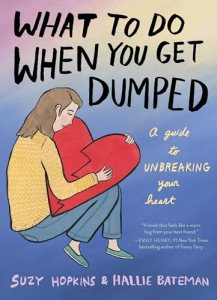 Discovered through Molly Wizenberg’s excellent author interview (she did a series on her Substack, “I’ve Got a Feeling”) with illustrator Hallie Bateman. It’s a mother–daughter collaboration – their second, after What to Do When I’m Gone, a funny advice guide that’s been likened to Roz Chast’s work (I’ve gotta get that one!). Hopkins’s husband of 30 years left her for an ex-girlfriend. (Ironic yet true: the girlfriend was a marriage counselor.) Composed while deep in grief, this is a frank look at the flood of emotions that accompany a breakup and gives wry but heartfelt suggestions for what might help: journaling, telling someone what happened, cleaning, making really easy to-do lists. Hopkins interviewed six others who had been dumped to get some extra perspective. Bateman describes her mother’s writing process: she made notes and stuck them in a shoebox with a hole in the lid, then went on a retreat to combine it all into a draft. At this point Bateman started illustrating. It was complicated for her, of course, because the dumper is her dad. She notes in the interview that she couldn’t just say “He’s an asshole” and dismiss him. But she could still position herself as a girlfriend to her mother, listening and commiserating. The vignettes are structured as a countdown starting with day 1,582 – it took over four years for Hopkins to come to terms with her loss and embrace a new life. This is a cute and gentle book that I wish had been around for my mom; it’s a heck of a lot cheaper than therapy.
With thanks to Bloomsbury for the free e-copy for review.
The Beauty of Vultures by Wendy McGrath; photos by Danny Miles (2025)
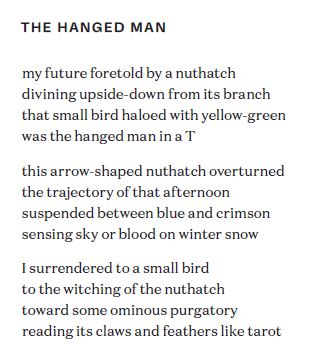
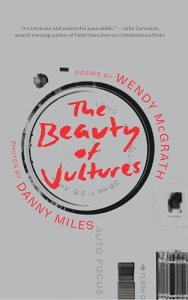 I enjoyed McGrath’s Santa Rosa trilogy and was keen to try her poetry, so I’m pleased that Marcie’s review pointed me here. McGrath came to collaborate with Miles, a musician, after her son told her of Miles’s newfound love of bird photography. She writes in her introduction that she wanted to go “beyond a simple call-and-response,” to instead use the photos as “portals” into art, history, memory, mythology, wordplay. The form varies to suit the topic: “sonnet, pantoum, acrostic, ghazal, concrete poem, … even a mini-play.” (I didn’t identify all of these on a first read, to be honest.) One poem imitates a matchbox cover and another is printed sideways. Most of the images are black-and-white close-ups, with a handful in colour. There are a few mammals as well as birds. One notable flash of colour is the recipient of the first poem, the sassy rebuttal “A Message from the Peahen to the Peacock.” The hen tells him to quit with the fancy displays and get real: “I’ve seen that gaudy display too often.”
Other poems describe birds, address them directly, or take on their perspectives. Birds are a reassuring presence (cf. Ted Hughes on swifts): “I counted on our robins to return every spring” as a balm, the anxious speaker reports in “Air raid siren.” A nest of gape-mouthed baby swallows in an outhouse is the prize at the end of a long countryside walk. With its alliteration and repetition, “The Goldfinch Charm” feels like an incantation. Birds model grace (or at least the appearance of grace):
Assume a buoyancy, lightness, as though you were about to fly.
That yellow rubber duck is my surreal mythology.
Head above water. Stay calm. Paddle like crazy.
They link the natural world and the human in these gorgeous poems that interact with the images in ways that both lead and illuminate.
A female swan is a pen and eyes open
I try to write this dream:
a moment stolen or given.
Published by NeWest Press. With thanks to the author for the free e-copy for review.
Dirt Rich by Graeme Richardson (2026)
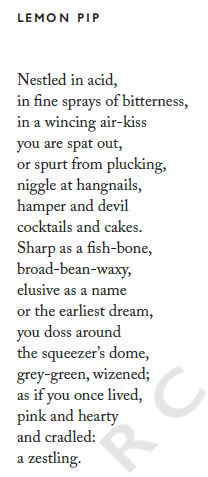
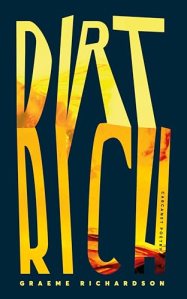 Dirt poor? Nah. Miners, gravediggers and archaeologists will tell you that dirt is precious. It’s where lots of our food and minerals come from; it’s what we’ll return to – our bodies as well as the material traces of what we loved and cared for. Richardson, the poetry critic for the Sunday Times, comes from Nottinghamshire mining country and has worked as a chaplain and parish priest. He writes of church interiors and cemeteries, funerals and crumbling faith. There’s a harsh reminder of life’s unpredictability in the juxtaposition of “For the Album,” about the photographic evidence of a wedding day; and, beginning on the facing page, “After the Death of a Child.” It opens with “A Pastoral Heckle”: “The dead live on in memory? Not true. / They lodge there dead, and yours not theirs the hell.” Richardson now lives in Germany, so there are continental scenes as well as ecclesial English ones. The elegiac tone of standouts such as “Last of the Coalmine Choirboys” (with its words drawn from scripture and hymns) is tempered by the chaotic joy of multiple poems about parenthood in the final section. Throughout, the imagery and language glisten. I loved the slant rhyme, assonance and sibilance in “Rewilding the Churchyard”: “Cedars and self-seeders link / with the storm-forked sycamore.” I highly recommend this debut collection.
With thanks to Carcanet Press for the advanced e-copy for review.
Which of these do you fancy reading?
#NovNov25 Catch-Up: Dodge, Garner, O’Collins, Sagan and A. White
As promised, I’m catching up on five novella-length works I finished in November. In fiction, I have an odd duck of a family story, a piece of autofiction about caring for a friend with cancer, a record of an affair, and a tale of settling two new cats into home life in the 1950s. And in nonfiction, a short book about the religious approach to midlife crisis.
Fup by Jim Dodge (1983)
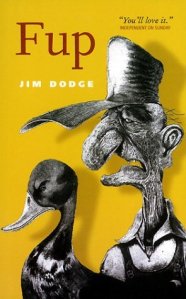 I’d never heard of this but picked it up because of my low-key project of reading books from my birth year. After his daughter died in a freak accident, Grandaddy Jake Santee adopted his grandson “Tiny.” With that touch of backstory dabbed in, we’re in the northern California hills in 1978 with grandfather and grandson – now 99 and 22, respectively. Tiny builds fences, while Grandaddy is famous for his incredibly strong, home-distilled whiskey, “Ol’ Death Whisper.” One day, Tiny rescues a filthy creature from a posthole where it’s been chased by their nemesis, Lockjaw the wild boar. It turns out to be a duckling that grows into a hen mallard named Fup Duck (it’s a spoonerism…) who eats so much she’s too heavy to fly. Grandaddy plans to continue drinking and gambling indefinitely, but the hunt for Lockjaw – who he thinks may be a reincarnation of his Native American friend, Seven Moons – breaks the household apart. This was very weird: it starts out a mixture of grit (those grotesque Harry Horse drawings!) and Homer Hickam schmaltz and then goes full Jonathan Livingston Seagull. (Secondhand – Community Furniture Project, Newbury) [89 pages]
The Spare Room by Helen Garner (2008)
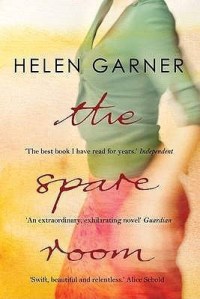 Who knew there was such a market for novels about helping a friend through cancer treatment? Or maybe it’s just that I love them so much I home right in on them. As a work of autofiction – the no-nonsense narrator, Helen, gives her old friend Nicola a place to stay in Melbourne for several weeks while she undergoes experimental procedures – this is most like What Are You Going Through by Sigrid Nunez (but I also had in mind Talk Before Sleep by Elizabeth Berg, We All Want Impossible Things by Catherine Newman, and Some Bright Nowhere by Ann Packer). Helen thinks The Theodore Institute peddles quack medicine, whereas Nicola is willing to shell out thousands of dollars for its coffee enemas and vitamin C infusions, even though they leave her terrifyingly fragile. Nicola is the only character who doesn’t acknowledge that her case is terminal. The pages turn effortlessly as Helen covers her frustration with Nicola, Nicola’s essential optimism, and the realities of living while dying. “Oh, I loved her for the way she made me laugh. She was the least self-important person I knew, the kindest, the least bitchy. I couldn’t imagine the world without her.” I’ll read more by Garner for sure. (Secondhand – Awesomebooks.com) [195 pages]
Second Journey: Spiritual Awareness and the Mid-Life Crisis by Gerald O’Collins SJ (1978; 1995)
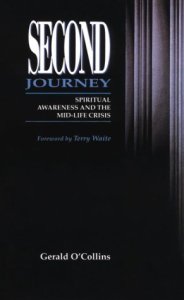 O’Collins, a Jesuit priest, sought a more constructive term than “midlife crisis” for the unease and difficult decisions that many face in their forties. He chooses instead the language of journeys, specifically one embarked upon because a previous way of life was no longer working. There are several types of triggers that O’Collins illustrates through brief case studies of famous individuals or anonymous acquaintances. The shift might be prompted by a sense of failure (John Wesley, Jimmy Carter), by literal exile (Dante), by falling in love (someone who left the priesthood to marry), by experiencing severe illness (John Henry Newman) or fighting in a war (Ignatius of Loyola), or simply by a longing for “something more” (Mother Teresa). But there are only two end points, O’Collins offers: a new place or situation; or a fresh appreciation of the old one – he quotes Eliot’s “to arrive where we started / And know the place for the first time.” This is practical and relatable, but light on actual advice. It also pales by comparison to Richard Rohr’s more recent work on spirituality in the different stages of life (especially in Falling Upward). (Free from a church member’s donations) [100 pages]
A Certain Smile by Françoise Sagan (1956)
[Translated from French by Irene Ash]
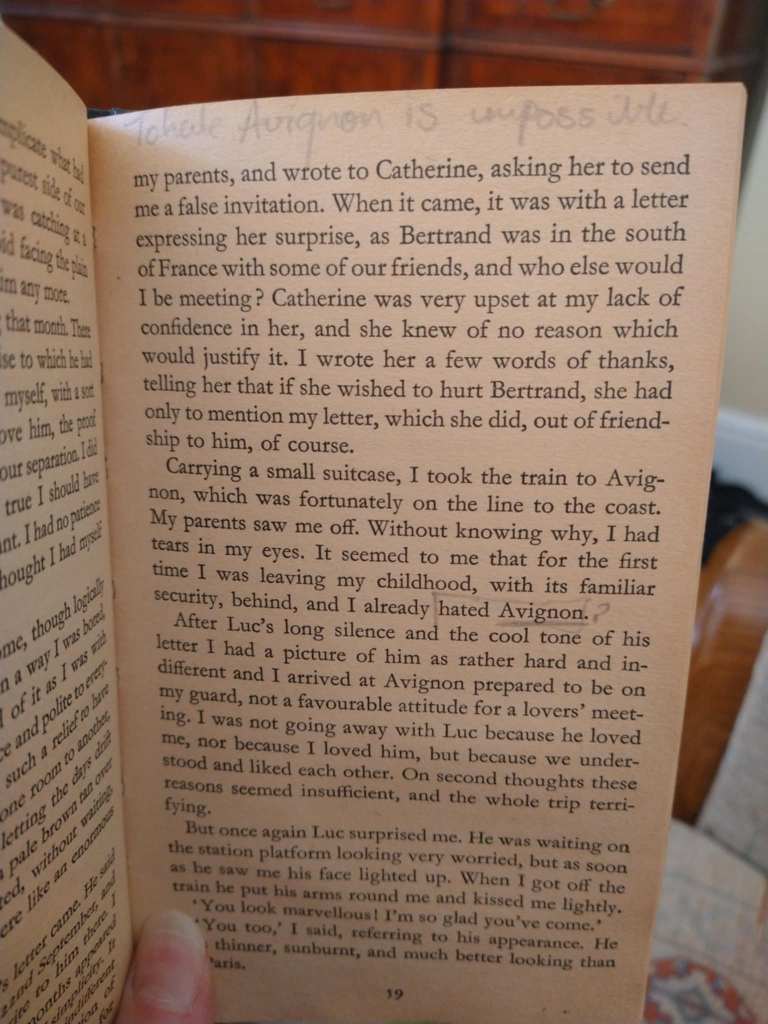
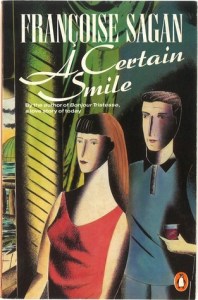 Law student Dominique is lukewarm on her boyfriend Bertrand and starts seeing his married uncle, Luc, instead. The high point is when they manage to go on a ‘honeymoon’ trip of several weeks to Avignon. Both Bertrand and Luc’s wife, Françoise, eventually find out, but everyone is very grown-up about it. The struggle is never external so much as within Dominique to accept that she doesn’t mean as much to Luc as he does to her, and that the relationship will only be a little blip in her early adulthood. I found this a disappointment compared to Bonjour Tristesse and Aimez-Vous Brahms – it really is just the story of an affair; nothing more – but Sagan is always highly readable. I read this in two days, a big section of it on a chilly beach in Devon. In its frank, cool assessment of relationship dynamics, this felt like a model for Sally Rooney. I had to laugh at the righteously angry and rather ungrammatical marginalia below (“To hate Avignon is unpossible”). (University library) [112 pages]
Minka and Curdy by Antonia White; illus. Janet and Anne Johnstone (1957)
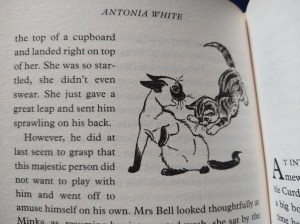
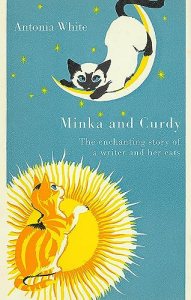 After Mrs Bell’s formidable cat Victoria dies, she hankers to get a new kitten to keep her company – she works at home as a writer. She finds herself greeting all the neighbourhood cats and, in her enthusiasm to help a ‘stray’, accidentally overfeeds someone else’s pet with fresh fish. Her heart is set on a marmalade kitten, so she reserves one from an impending litter in Kent. But then the opportunity to take on a beautiful young female Siamese cat, for free, comes her way, and though she feels guilty about the ginger tom she’s been promised, she adopts Minka anyway. When Coeur de Lion (“Curdy”) arrives a few weeks later, her challenge is to get the kitties to coexist peacefully in her London flat. This reminded me so much of myself back in February and March, when I was so glum over losing Alfie that we rushed into adopting a giant kitten who has been a bit much for us. But we’re already contemplating getting Benny a little sister or two, so I read with interest to see how she made it happen. Well, this is fiction, so it starts out fraught but then is somewhat magically fine. No matter – White writes about cats’ antics and personalities with all the warmth and delight of Derek Tangye, Doreen Tovey and the like, and this 2023 Virago reprint is adorable. (Secondhand – Awesomebooks.com) [113 pages]
I also had a few DNFs last month:
- The Book of Colour by Julia Blackburn (1995) seemed a good bet because I’ve enjoyed some of Blackburn’s nonfiction and it was on the Orange Prize shortlist. But after 60 pages I still had no idea what was going on amid the Mauritius-set welter of family history and magic realism. (Secondhand – Bas Books charity shop, 2022)
- A Single Man by Christopher Isherwood (1964) lured me because I’d so loved Goodbye to Berlin and I remember liking the Colin Firth film. But this story of an Englishman secretly mourning his dead partner while trying to carry on as normal as a professor in Los Angeles was so dreary I couldn’t persist. (Public library)
- Night Life: Walking Britain’s Wild Landscapes after Dark by John Lewis-Stempel (2025) – JLS could write one of these mini nature volumes in his sleep. (Maybe he did with this one, actually?) I’d rather one full-length book from him every few years than bitty, redundant ones annually. (Public library)
- Aunts Aren’t Gentlemen by P.G. Wodehouse (1974) – I’ve read one Jeeves & Wooster book before and enjoyed it well enough. This felt inconsequential, so as I already had way too many novellas on the go I sent it back whence it came. (Little Free Library)
Final statistics for #NovNov25 coming up tomorrow!
20 Books of Summer, 8: Au Revoir, Tristesse by Viv Groskop
This is a substitute I picked out as a potential (now belated) #ParisinJuly2025 contribution. There’s been little time for writing over the past week while we’ve been hosting my sister and brother-in-law. Their whirlwind trip was shortened by a day due to a cancelled flight from the States, but we managed to pack in a lot, including a two-night mini-break down in Devon.

Reminiscent of Something to Declare by Julian Barnes and How Proust Can Change Your Life by Alain de Botton, this is a lighthearted tour through a dozen great works of French literature and the lessons they might offer modern readers on how to live well. Ever since her school days of studying French and spending every family holiday in France, Groskop has been obsessed with the language and culture. In most of the chapters, she undertakes a rereading of a novel she first read as a teenager or Cambridge student, marveling at how much more she gets out of it with greater life experience.
 Although her choices are indisputable classics, she acknowledges they can only ever be an incomplete and biased selection, unfortunately all white and largely male, though she opens with Bonjour Tristesse and also includes Colette and Duras novels. I’d only read three of her dozen, in translation: along with the Sagan, Dangerous Liaisons and Madame Bovary (as well as other books by two of the additional authors), but it didn’t make much difference whether I was familiar with a plot or not. So long as one is not allergic to spoilers, it’s possible to enjoy these miniature essays’ witty combination of literary criticism, biographical information, self-help messaging, and a bit of autobiographical context.
The male writers tended to be syphilitic workaholics – Balzac is reputed to have drunk 50 cups of coffee per day to sustain his output – while the women flouted social conventions by drinking, taking much younger (and/or female) lovers and driving recklessly. While the subtitle promises “Lessons in Happiness,” from Hugo to Camus these are in fact pretty miserable narratives in which, as was especially common in the 19th century, protagonists are punished for ambition or transgressions, or never reach contentment because of self-delusion.
In boiling down each plot to one line of advice for a chapter title, Groskop’s tone alternates between earnest (“Our greatest weaknesses conceal our greatest strengths” = Cyrano de Bergerac) and tongue in cheek (“Social climbing rarely pays off, but you’ll probably want to do it anyway” = Le Rouge et le Noir). She describes the works with genuine affection and clearly believes they are still worth reading, yet isn’t afraid to question those aspects that have aged less well. Controversially, she suggests being selective with Proust’s mammoth oeuvre: “skim-read, rereading the passages you fall in love with and discarding the rest.” She also surveys how the stories live on through adaptations. Of the new-to-me, I’m most drawn to Bel-Ami but also fancy La Cousine Bette. This was a delight I wouldn’t hesitate to recommend to fellow Francophiles. (New purchase – remainder from Hay Cinema Bookshop) 

May Releases, Part II (Fiction): Le Blevennec, Lynch, Puchner, Stanley, Ullmann, and Wald
A cornucopia of May novels, ranging from novella to doorstopper and from Montana to Tunisia; less of a spread in time: only the 1980s to now. Just a paragraph on each to keep things simple. I’ll catch up soon with May nonfiction and poetry releases I read.
Friends and Lovers by Nolwenn Le Blevennec (2023; 2025)
[Translated from French by Madeleine Rogers]
 Armelle, Rim, and Anna are best friends – the first two since childhood. They formed a trio a decade or so ago when they worked on the same magazine. Now in their mid-thirties, partnered and with children, they’re all gripped by a sexual “great awakening” and long to escape Paris and their domestic commitments – “we went through it, this mutiny, like three sisters,” poised to blow up the “perfectly executed choreography of work, relationships, children”. The friends travel to Tunisia together in December 2014, then several years later take a completely different holiday: a disaster-prone stay in a lighthouse-keeper’s cottage on an island off the coast of Brittany. They used to tolerate each other’s foibles and infidelities, but now resentment has sprouted up, especially as Armelle (the narrator) is writing a screenplay about female friendship that’s clearly inspired by Rim and Anna. Armelle is relatably neurotic (a hilarious French blurb for the author’s previous novel is not wrong: “Woody Allen meets Annie Ernaux”) and this is wise about intimacy and duplicity, yet I never felt invested in any of the three women or sufficiently knowledgeable about their lives.
With thanks to Peirene Press for the free copy for review.
A Family Matter by Claire Lynch
 “The fluke of being born at a slightly different time, or in a slightly different place, all that might gift you or cost you.” At events for Small, Lynch’s terrific memoir about how she and her wife had children, women would speak up about how different their experience had been. Lesbians born just 10 or 20 years earlier didn’t have the same options. Often, they were in heterosexual marriages because that’s all they knew to do; certainly the only way they thought they could become mothers. In her research into divorce cases in the UK in the 1980s, Lynch learned that 90% of lesbian mothers lost custody of their children. Her aim with this earnest, delicate debut novel, which bounces between 2022 and 1982, is to imagine such a situation through close portraits of Heron, an ageing man with terminal cancer; his daughter, Maggie, who in her early forties bears responsibility for him and her own children; and Dawn, who loved Maggie desperately but felt when she met Hazel that she was “alive at last, at twenty-three.” How heartbreaking that Maggie knew only that her mother abandoned her when she was little; not until she comes across legal documents and newspaper clippings does she understand the circumstances. Lynch made the wise decision to invite sympathy for Heron from the start, so he doesn’t become the easy villain of the piece. Her compassion, and thus ours, is equal for all three characters. This confident, tender story of changing mores and steadfast love is the new Carol for our times. (Such a lovely but low-key novel was liable to make few ripples, so I’m delighted for Lynch that the U.S. release got a Read with Jenna endorsement.)
With thanks to Chatto & Windus (Penguin) for the proof copy for review.
Dream State by Eric Puchner
 If it starts and ends with a wedding, it must be a comedy. If much of the in between is marked by heartbreak, betrayal, failure, and loss, it must be a tragedy. If it stretches towards 2050 and imagines a Western USA smothered in smoke from near-constant forest fires, it must be an environmental dystopian. Somehow, this novel is all three. The first 163 pages are pure delight: a glistening romantic comedy about the chaos surrounding Charlie and Cece’s wedding at his family’s Montana lake house in the summer of 2004. First half the wedding party falls ill with norovirus, then Charlie’s best friend, Garrett (who’s also the officiant), falls in love with the bride. Do I sound shallow if I admit this was the section I enjoyed the most? The rest of this Oprah’s Book Club doorstopper examines the fallout of this uneasy love triangle. Charlie is an anaesthesiologist, Cece a bookstore owner, and Garrett a wolverine researcher in Glacier National Park, which is steadily losing its wolverines and its glaciers. The next generation comes of age in a diminished world, turning to acting or addiction. There are still plenty of lighter moments: funny set-pieces, warm family interactions, private jokes and quirky descriptions. But this feels like an appropriately grown-up vision of idealism ceding to a reality we all must face. I struggled with a lack of engagement with the children, but loved Puchner’s writing so much on the sentence level that I will certainly seek out more of his work. Imagine this as a cross between Jonathan Franzen and Maggie Shipstead.
With thanks to Sceptre (Hodder) for the proof copy for review.
Consider Yourself Kissed by Jessica Stanley
 Coralie is nearing 30 when her ad agency job transfers her from Australia to London in 2013. Within a few pages, she meets Adam when she rescues his four-year-old, Zora, from a lake. That Adam and Coralie will be together is never really in question. But over the next decade of personal and political events, we wonder whether they have staying power – and whether Coralie, a would-be writer, will lose herself in soul-destroying work and motherhood. Adam’s job as a political journalist and biographer means close coverage of each UK election and referendum. As I’ve thought about some recent Jonathan Coe novels: These events were so depressing to live through, who would want to relive them through fiction? I also found this overlong and drowning in exclamation points. Still, it’s so likable, what with Coralie’s love of literature (the title is from The Group) and adjustment to expat life without her mother; and secondary characters such as Coralie’s brother Daniel and his husband, Adam’s prickly mother and her wife, and the mums Coralie meets through NCT classes. Best of all, though, is her relationship with Zora. This falls solidly between literary fiction and popular/women’s fiction. Given that I was expecting a lighter romance-led read, it surprised me with its depth. It may well be for you if you’re a fan of Meg Mason and David Nicholls.
With thanks to Hutchinson Heinemann for the proof copy for review.
Girl, 1983 by Linn Ullmann (2021; 2025)
[Translated from Norwegian by Martin Aitken]
 Ullmann is the daughter of actress Liv Ullmann and film director Ingmar Bergman. That pedigree perhaps accounts for why she got the opportunity to travel to Paris in the winter of 1983 to model for a renowned photographer. She was 16 at the time and spent the whole trip disoriented: cold, hungry, lost. Unable to retrace the way to her hotel and wearing a blue coat and red hat, she went to the only address she knew – that of the photographer, K, who was in his mid-forties. Their sexual relationship is short-lived and unsurprising, at least in these days of #MeToo revelations. Its specifics would barely fill a page, yet the novel loops around and through the affair for more than 250. Ullmann mostly pulls this off thanks to the language of retrospection. She splits herself both psychically and chronologically. There’s a “you” she keeps addressing, a childhood imaginary friend who morphs into a critical voice of conscience and then the self dissociated from trauma. And there’s the 55-year-old writer looking back with empathy yet still suffering the effects. The repetition made this something of a sombre slog, though. It slots into a feminist autofiction tradition but is not among my favourite examples.
With thanks to Hamish Hamilton (Penguin) for the proof copy for review.
The Bayrose Files by Diane Wald
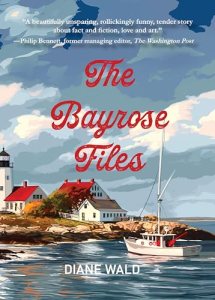 In the 1980s, Boston journalist Violet Maris infiltrates the Provincetown Home for Artists and Writers, intending to write a juicy insider’s exposé of what goes on at this artists’ colony. But to get there she has to commit a deception. Her gay friend Spencer Bayrose has a whole sheaf of unpublished short stories drawing on his Louisiana upbringing, and he offers to let her submit them as her own work to get a place at PHAW. Here Violet finds eccentrics aplenty, and even romance, but when news comes that Spence has AIDS, she has to decide how far she’ll go for a story and what she owes her friend. At barely over 100 pages, this feels more like a long short story, one with a promising setting and a sound plot arc, but not enough time to get to know or particularly care about the characters. I was reminded of books I’ve read by Julia Glass and Sara Maitland. It’s offbeat and good-natured but not top tier.
Published by Regal House Publishing. With thanks to publicist Jackie Karneth of Books Forward for the advanced e-copy for review.
A Family Matter was the best of the bunch for me, followed closely by Dream State.
Which of these do you fancy reading?
#WITMonth, Part I: Novellas by Eva Baltasar and Françoise Sagan
I’m starting off my Women in Translation month coverage with mini responses to two novellas: one Catalan and one French; both about disaffected women trying to work out what they want from life.
Mammoth by Eva Baltasar (2022; 2024)
[Translated from the Catalan by Julia Sanches]
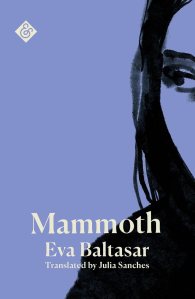 I’d been vaguely attracted by descriptions of the Spanish poet’s novels Permafrost and Boulder, which are also about lesbians in odd situations. Mammoth is the third book in a loose trilogy. Its 24-year-old narrator is so desperate for a baby that she’s decided to have unprotected sex with men until a pregnancy results. In the meantime, her sociology project at nursing homes comes to an end and she moves from Barcelona to a remote farm where she develops subsistence skills and forms an interdependent relationship with the gruff shepherd. “I’d been living in a drowning city, and I need this – the restorative silence of a decompression chamber. … my past is meaningless, and yet here, in this place, there is someone else’s past that I can set up and live in awhile.” For me this was a peculiar combination of distinguished writing (“The city pounces on the still-pale light emerging from the deep sea and seizes it with its lucrative forceps”) but absolutely repellent story, with a protagonist whose every decision makes you want to throttle her. An extended scene of exterminating feral cats certainly didn’t help matters. I’d be wary of trying Baltasar again.
With thanks to And Other Stories for the proof copy for review.
Aimez-vous Brahms… by Françoise Sagan (1959; 1960)
[Translated from the French by Peter Wiles]
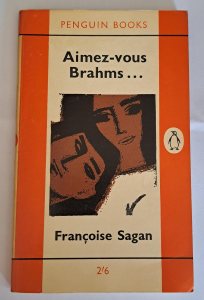 At age 39, divorced interior decorator Paule is “passionately concerned with her beauty and battling with the transition from young to youngish woman”. (Ouch. But true.) It’s an open secret that her partner Roger is always engaged in a liaison with a young woman; people pity her and scorn Roger for his infidelity. But when Paule has a dalliance with a client’s son, 25-year-old lawyer Simon, a double standard emerges: “they had never shown her the mixture of contempt and envy she was going to arouse this time.” Simon is an idealist, accusing her of “letting love go by, of neglecting your duty to be happy”, but he’s also indolent and too fond of drink. Paule wonders if she’s expected too much from an affair. “Everyone advised a change of air, and she thought sadly that all she was getting was a change of lovers: less bother, more Parisian, so common”.
I was by turns reminded of Chéri by Colette, In a Summer Season by Elizabeth Taylor, and even The Graduate (“Mrs. Robinson,” anyone?). Simon asks the title question to invite Paule to a concert; that she has to ponder it carefully tells her she’s “losing herself, losing track of herself”. But it’s all too easy for the status quo to be reinstated after a brave act. Middle-aged woman makes bid for freedom but ultimately nothing changes: same plot as The Funeral Cryer and any number of other books, but this was so much better. How did Sagan manage such insight at age 24 (and this was her fourth book)?! While not quite as memorable as Bonjour Tristesse, this is another incisive slice of fiction that has aged well apart from using “sodomite” and “Negress” as matter-of-fact terms for bit players. I’d read anything else I can find by Sagan. (Secondhand – Community Furniture Project, Newbury)
April Releases by Brownrigg, Ernaux, O’Connor, Waterman and Wood
Family history is a common element for the first four of these review books: a multi-generational story (incorporating autofiction in places) about Anglo-American writers and the legacy of suicide; a brief slice of memoir about the loss of a mother; a historical novella inspired by family stories and set on an island at the cusp of war; and a poetry collection drawing on a father’s death as well as on local folklore. Addiction and dementia are specific links between pairs. And to round off, a set of short stories about pregnancy and motherhood.
The Whole Staggering Mystery: A Story of Fathers Lost and Found by Sylvia Brownrigg
“The dead don’t come back, but they are not as far away as you think.”
I knew Brownrigg’s name as a novelist thanks to Susan’s blog (see her review of Pages for Her), but when I read about this family memoir it piqued my interest more than her fiction might have. The Brownrigg clan are nobility (really – her brother has the title “Baronet”) but have rejected conventional Englishness over the past century. First her grandfather, Gawen, separated from his wife and moved to Nairobi to work as a journalist. He also published two obscure novels before dying at age 27. The empty bottle of Nembutal and recent changes to his will suggested suicide, though his mother resisted the notion vociferously. Gawen’s son, Nicholas, was raised in California by his mother, Lucia, and became an alcoholic who lived off-grid on a ranch and had an unpublished Beats-influenced novel.
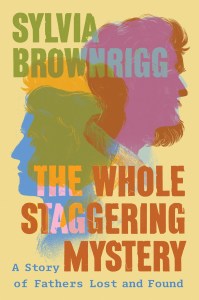 After Nicholas’s death in 2018, Brownrigg was compelled to trace her family’s patterns of addiction and creativity. It’s a complex network of relatives and remarriages here. The family novels and letters were her primary sources, along with a scrapbook her great-grandmother Beatrice made to memorialize Gawen for Nicholas. Certain details came to seem uncanny. For instance, her grandfather’s first novel, Star Against Star, was about, of all things, a doomed lesbian romance – and when Brownrigg first read it, at 21, she had a girlfriend.
Along with the more traditional memoir sections, there are the documents that speak for themselves and extended passages of autofiction. I loved an imaginary letter by Gawen’s older brother, who died in young childhood, and a third-person segment about Beatrice’s life in England during the Second World War. But I mostly skipped over the 90 lightly fictionalized pages about the author’s (“Sophie’s”) life with her father in California. You might view this as a showcase of possible methods for engaging with family history, some of which work better than others. All of it is fascinating material, though.
Published by Counterpoint in the USA. With thanks to Nectar Literary for the advanced e-copy for review.
A Woman’s Story by Annie Ernaux (1988; 2024)
[Translated from the French by Tanya Leslie]
 This memoir of Ernaux’s mother’s life and death is, at 58 pages, little more than an extended (auto)biographical essay. Confusingly, it covers the same period she wrote about in I Remain in Darkness (originally published nine years later), a diary of her mother’s final years with dementia; I even remembered two specific events and quotes. Why not combine the two into a full-length biographical recollection? Or pair it with A Man’s Place, Ernaux’s memoir of her father, in one volume? Perhaps her works will be repackaged in the future. But this came first: Ernaux started writing just a couple of weeks after her mother’s death, and spent 10 months over it. It’s clear she was determined to salvage what she could of her mother’s life:
It’s a difficult undertaking. For me, my mother has no history. She has always been there. When I speak of her, my first impulse is to ‘freeze’ her in a series of images unrelated to time … This book can be seen as a literary venture as its purpose is to find out the truth about my mother, a truth that can be conveyed only by words. … I believe I am writing about my mother because it is my turn to bring her into the world.
Ernaux opens with news of the death, and the funeral. But soon she’s pushing back into the past. Her mother grew up in poverty near Rouen and worked in a factory before her marriage, when she and her husband took on a grocery store and café. The Second World War was in some romantic way the great drama of her life. She was exacting of her daughter: “Her overriding concern was to give me everything she hadn’t had. But this involved so much work, so much worrying about money”. In her widowhood she came to live with Ernaux, who was then divorced with two sons, and tried to find a middle way between independence and connection. Eventually, though, her memory loss required admission to a nursing home.
I’ve felt the same about all three short works I’ve read by Ernaux so far: though precisely observed, they conceal themselves behind emotional distance. So while this might seem similar to A Very Easy Death by Simone de Beauvoir, I found the latter more engaging.
With thanks to Fitzcarraldo Editions for the free copy for review.
Whale Fall by Elizabeth O’Connor
 The remote Welsh island setting of O’Connor’s debut novella was inspired by several real-life islands that were depopulated in the twentieth century due to a change in climate and ways of life: Bardsey, St Kilda, the Blasket Islands, and the Aran Islands. (A letter accompanying my review copy explained that the author’s grandmother was a Welsh speaker from North Wales and her Irish grandfather had relatives on the Blasket Islands.)
Eighteen-year-old Manod Llan is the older daughter of a lobster fisherman. Her sweetheart recently left to find work in a mainland factory. It’s 1938 and there are vague rumbles about war, but more pressing is the arrival of strangers here to study a vanishing culture. Anthropologists Edward and Joan learn snatches of Welsh and make recordings of local legends and songs, which are interspersed with the fragmentary narrative. Manod, star-struck, seeks the English researchers’ approval as she helps with translation and other secretarial duties, but becomes disillusioned with their misinterpretations and fascist leanings.
The gradual disintegration of a beached whale casts a metaphorical shadow of decay over the slow-burning story. I kept waiting for momentous events that never came. More definitive consequences? Something to do with Manod’s worries for her little sister, Llinos? A flash-forward to the abandoned island’s after-years? Or to Manod’s future? As it is, the sense of being stuck at a liminal time makes it all feel like prologue. But O’Connor’s writing is quite lovely (“The milk had formed a film over the surface and puckered, like a strange kiss”; “All of my decisions felt like trying to catch a fish that did not exist until I caught it”) and the book is strong on atmosphere and tension. I’ll look out for her next work.
With thanks to Picador for the free copy for review.
Come Here to This Gate by Rory Waterman
I was most drawn to the poems in Part I, “All but Forgotten,” about his father’s last year or so.
The titles participate in telling the story: “Alcoholic Dementia,” followed by “Twin Oaks Nursing Home.”
The sheep-tracks of your mind were worn to trenches.
…
Then what you’ve turned yourself into – half there
on one side of a final single bed
you might not leave till the rest of you has left –
starts, stares through me, says ‘I’m being held
against my will!’, tells a nurse to ‘Just fuck off’
then thanks her. Old boy, when did you get like this?
The sheep-tracks of my mind are worn to trenches.
Then they moved you to a home
that still wasn’t home. ‘Why
am I in this fucking place?
Nothing’s wrong with me.’
So I’d tell you all over again,
but only the easy part (‘You’re
not remembering things well
at present.’ ‘Yes I fucking am’)
and you relearned that you’d
never learn – mindless torture,
until I stopped it. Your
silences were trains departing.
From the miscellany of Part II, I plucked out “Gooseberries” and “Perennials,” both of which conceal emotion among plants. Then Part III, “Lincolnshire Folk Tales,” turns the tone mischievous, with the ABCB end-rhymes of “Yallery Brown,” “The Metheringham Lass,” “The Lincoln Imp,” and “Nanny Rutt” (I felt I’d stumbled on a limerick with its rhythm: “Math Wood is a small plot of trees south of Bourne, / next to McDonald’s and Lidl. / It’s privately owned, full of shot-gun shells, pheasants – / but still, a bit of an idyll”). Plenty of good stuff, then, but it doesn’t all seem to fit together in the same collection.
With thanks to Carcanet Press for the advanced e-copy for review.
This Is Why We Can’t Have Nice Things by Naomi Wood
 I requested this because a) I had enjoyed Wood’s novels Mrs. Hemingway and The Hiding Game and b) I couldn’t resist the title. These nine contemporary stories (five in the first person and four in the third person) all feature women who are pregnant and/or mothers of young children. Three dwell on work–life balance in particular, with the female protagonists of “Lesley, in Therapy” and “Dracula at the Movies” an animator and a filmmaker, respectively. The third, “Hurt Feelings,” in which a medical emergency forces a choice between career and motherhood, was my favourite. Claudia is working on an advertising campaign for a large pharmaceutical company whose newest product targets chronic pain. Although she suspects it’s a placebo, she knows how valuable it is for these people to have their pain acknowledged given it’s as invisible as her history of pregnancy loss.
Other highlights included “Peek-a-Boo,” in which pregnant twin sisters fly to Italy to remonstrate with their father, who refuses to cede a holiday flat to the next renters; and “Wedding Day,” about a woman bitter enough to try to sabotage her ex’s big day by demanding he bring their daughter, the flower girl, home by bedtime. “Flatten the Curve” is about restrictions and desires during Covid lockdown. Family, neighbour, and co-worker dynamics fuel the drama. In a few cases, Wood imagined promising situations but didn’t deliver on them. I could hardly believe “Comorbidities,” about a mother who films a sex tape with her husband to distract from her eco-anxiety, won the 2023 BBC National Short Story Award. If Wood was aiming for edgy, she landed on peevish instead. “Dino Moms,” the final story, was worst, with its absurd dinosaur-vet reality-TV setup. Overall, the collection is too one-note because of the obsession with motherhood (“It is not very interesting to be in love with your child; it’s commonplace, this sacrificial love”). Back to novels soon, please.
With thanks to Phoenix (Orion) for the free copy for review.
Does one of these catch your eye? What April releases can you recommend?
Three in Translation for #NovNov23: Baek, de Beauvoir, Naspini
I’m kicking off Week 3 of Novellas in November, which we’ve dubbed “Broadening My Horizons.” You can interpret that however you like, but Cathy and I have suggested that you might like to review some works in translation and/or think about any new genres or authors you’ve been introduced to through novellas. Literature in translation is still at the edge of my comfort zone, so it’s good to have excuses such as this (and Women in Translation Month each August) to pick up books originally published in another language. Later in the week I’ll have a contribution or two for German Lit Month too.

I Want to Die but I Want to Eat Tteokbokki by Baek Se-hee (2018; 2022)
[Translated from the Korean by Anton Hur]
 Best title ever. And a really appealing premise, but it turns out that transcripts of psychiatry appointments are kinda boring. (What a lazy way to put a book together, huh?) Nonetheless, I remained engaged with this because the thoughts and feelings she expresses are so relatable that I kept finding myself or other people I know in them. Themes that emerge include co-dependent relationships, pathological lying, having impossibly high standards for oneself and others, extreme black-and-white thinking, the need for attention, and the struggle to develop a meaningful career in publishing.
There are bits of context and reflection, but I didn’t get a clear overall sense of the author as a person, just as a bundle of neuroses. Her psychiatrist tells her “writing can be a way of regarding yourself three-dimensionally,” which explains why I’ve started journaling – that, and I want believe that the everyday matters, and that it’s important to memorialize.
I think the book could have ended with Chapter 14, the note from her psychiatrist, instead of continuing with another 30+ pages of vague self-help chat. This is such an unlikely bestseller (to the extent that a sequel was published, by the same title, just with “Still” inserted!); I have to wonder if some of its charm simply did not translate. (Public library) [194 pages]
The Inseparables by Simone de Beauvoir (2020; 2021)
[Translated from the French by Lauren Elkin]
 Earlier this year I read my first work by de Beauvoir, also of novella length, A Very Easy Death, a memoir of losing her mother. This is in the same autobiographical mode: a lightly fictionalized story of her intimate friendship with Elisabeth Lacoin (nicknamed “Zaza”) from ages 10 to 21, written in 1954 but not published until recently. The author’s stand-in is Sylvie and Zaza is Andrée. When they meet at school, Sylvie is immediately enraptured by her bold, talented friend. “Many of her opinions were subversive, but because she was so young, the teachers forgave her. ‘This child has a lot of personality,’ they said at school.” Andrée takes a lot of physical risks, once even deliberately cutting her foot with an axe to get out of a situation (Zaza really did this, too).
Whereas Sylvie loses her Catholic faith (“at one time, I had loved both Andrée and God with ferocity”), Andrée remains devout. She seems destined to follow her older sister, Malou, into a safe marriage, but before that has a couple of unsanctioned romances with her cousin, Bernard, and with Pascal (based on Maurice Merleau-Ponty). Sylvie observes these with a sort of detached jealousy. I expected her obsessive love for Andrée to turn sexual, as in Emma Donoghue’s Learned by Heart, but it appears that it did not, in life or in fiction. In fact, Elkin reveals in a translator’s note that the girls always said “vous” to each other, rather than the more familiar form of you, “tu.” How odd that such stiffness lingered between them.
This feels fragmentary, unfinished. De Beauvoir wrote about Zaza several times, including in Memoirs of a Dutiful Daughter, but this was her fullest tribute. Its length, I suppose, is a fitting testament to a friendship cut short. (Passed on by Laura – thank you!) [137 pages]
(Introduction by Deborah Levy; afterword by Sylvie Le Bon de Beauvoir, de Beavoir’s adopted daughter. North American title: Inseparable.)
Tell Me About It by Sacha Naspini (2020; 2022)
[Translated from the Italian by Clarissa Botsford]
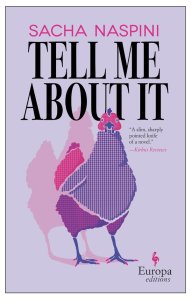 The Tuscan novelist’s second work to appear in English has an irresistible setup: Nives, recently widowed, brings her pet chicken Giacomina into the house as a companion. One evening, while a Tide commercial plays on the television, Giacomina goes as still as a statue. Nives places a call to Loriano Bottai, the local vet and an old family friend who is known to spend every night inebriated, to ask for advice, but they stay on the phone for hours as one topic leads to another. Readers learn much about these two, whom, it soon emerges, have a history.
The text is saturated with dialogue; quick wits and sharp tempers blaze. You could imagine this as a radio or stage play. The two characters discuss their children and the town’s scandals, including a lothario turned artist’s muse and a young woman who died by suicide. “The past is full of ghosts. For all of us. That’s how it is, and that’s how it will always be,” Loriano says. There’s a feeling of catharsis to getting all these secrets out into the open. But is there a third person on the line?
A couple of small translation issues hampered my enjoyment: the habit of alternating between calling him Loriano and Bottai (whereas Nives is always that), and the preponderance of sayings (“What’s true is that the business with the nightie has put a bee in my bonnet”), which is presumably to mimic the slang of the original but grates. Still, a good read. (Passed on by Annabel – thank you!) [128 pages]

September Focus on Short Stories, with Reviews of Bloom and de Kerangal
This is the eighth year in a row in which I’m making a special effort to read short stories in September; otherwise, story collections tend to languish on my shelves (and Kindle) unread. In September 2021 I read 12 collections and in September 2022 it was 11.5; let’s see how many I get to this year!
As someone who doesn’t claim to love short stories, I was surprised to see that I’ve already read 19 collections this year. Some of the highlights have been Old Babes in the Wood by Margaret Atwood, How Strange a Season by Megan Mayhew Bergman, What We Talk about When We Talk about Love by Raymond Carver, Games and Rituals by Katherine Heiny, and Sidle Creek by Jolene McIlwain.
I have a whole shelf of short story options set out for me and will make my selections from there. For now, I have brief reviews of two collections I read during a quick trip to the USA.
A Blind Man Can See How Much I Love You by Amy Bloom (2000)
 My second collection by Bloom this year, after Where the God of Love Hangs Out; somewhat confusingly, the latter reprints two of this volume’s Lionel and Julia stories, so there were actually only six stories here that were new to me (5 x first-person; 3 x third-person). However, they’re all typically great ones. The title story has a mother accompanying her daughter to the medical appointments that will transform Jessie into Jess, her son, and also taking a chance on romance. “Rowing to Eden” explores the dynamic between best friends, one lesbian and one married to a man; the one has already been through breast cancer treatment so can counsel her friend from experience.
In “Stars at Elbow and Foot,” a woman whose baby died goes back to the children’s hospital to volunteer with the disabled. “Hold Tight” also reflects on loss and accidents (but is probably the throw-away story if I had to name one). “The Story,” which closes the book, had me hunting for autobiographical correlations what with its mentions of “Amy.” By far my favourite was “The Gates Are Closing,” in which D.M. is having an affair with the synagogue president’s husband, who has Parkinson’s disease. As Yom Kippur approaches, he gives his mistress an ultimatum. The minor assisted dying theme in this one felt ironically prescient of Bloom’s own experience accompanying her husband to Dignitas (the subject of In Love). As always, Bloom’s work is sensual, wry and emotionally wise. 
Canoes by Maylis de Kerangal (2021; 2023)
[Translated from the French by Jessica Moore]
These eight stories are all in the first person; although I tend to prefer more diversity of narration, the plots are so dissimilar that it makes up for that homogeneity. In an author’s note at the end, de Kerangal writes that her overall theme was voices, especially women’s voices; perhaps ironically, then, the collection uses no speech marks. In “Mountain Stream and Iron Filings,” the narrator’s friend Zoé is on a mission to lower her voice to make it more suitable for radio. “Nevermore” has a woman contributing a recording of herself reading Edgar Allan Poe’s epic poem “The Raven” to an audio library. “A Light Bird,” which I found particularly poignant, is about a widower and his daughter deciding what to do about their late wife’s/mother’s voice on the answering machine.
 “After” has a school leaver partying and figuring out what comes next, “Ontario” revolves around a trip to Canada, and “Arianespace” has an investigator visiting an elderly woman who has reported a UFO sighting. The longest story (billed as a novella), “Mustang,” focuses on a French family that has relocated to Colorado in the 1990s. The mother, recently bereaved, learns to drive their rather impractical American car.
Like Painting Time, the collection is in thrall to questions of deep time. This is clearest in “Bivouac,” in which a woman undergoes a procedure while the dentist tells her about an ancient human jawbone found deep under Paris. Prehistory is even present in the metaphorical language: “the first foothills of the Rockies sketched the backbone of a sleepy stegosaurus who’d escaped extinction” (from “Mustang”). Each story also mentions a canoe, if only in passing (e.g., the dentist’s necklace charm in the first story).
As was my main quibble with Mend the Living, though, de Kerangal is all too fond of arcane vocabulary. I mean, she uses “alveolar” twice in this very short book; there’s also “sagittal slices” and “sinuous mnemic circuits.” Some sentences stretch to fill two-plus pages. So overwriting is a recurrent issue I have with her work, but I would certainly recommend that her fans read her short fiction, which I found more accessible than her novels. 
With thanks to MacLehose Press for the free copy for review. Canoes will be published on 28 September.
Currently reading: Revenge of the Lawn by Richard Brautigan; I Meant It Once by Kate Doyle; The Best Short Stories 2023: The O. Henry Prize Winners, ed. Lauren Groff; Why I Don’t Write by Susan Minot; Hateship, Friendship, Courtship, Loveship, Marriage by Alice Munro; The Human Origins of Beatrice Porter and Other Essential Ghosts by Soraya Palmer (linked stories); Small, Burning Things by Cathy Ulrich.
Resuming soon: The Secrets of a Fire King by Kim Edwards; If I Survive You by Jonathan Escoffery (I read the first two stories ages ago, but its longlisting for the Booker Prize is the impetus I need to pick it back up); Hey Yeah Right Get a Life by Helen Simpson.
Are you a short story fan? Read any good ones recently?
#WITMonth, Part I: de Beauvoir, Jansson, NDiaye
My first four reads for Women in Translation month were quite a varied selection: a sobering autobiographical essay about the loss of a mother, a characteristically impish children’s novel, a confoundingly elliptical family memoir, and a preview of a forthcoming Mexican novel about women’s friendships and handicraft. Another four coming up later in August.
A Very Easy Death by Simone de Beauvoir (1964; 1965)
[Translated from the French by Patrick O’Brian]
“When someone you love dies you pay for the sin of outliving her with a thousand piercing regrets.”
I’d read a lot about Simone de Beauvoir but not one of her own works until this reissue came my way. It was right up my street as a miniature bereavement memoir (just 84 pages) that doesn’t shy away from the physical details of decline or the emotional complications of a fraught mother–daughter relationship.
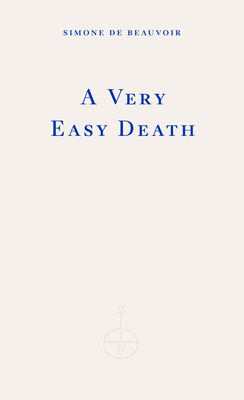 In October 1963, de Beauvoir was in Rome when she got a call informing her that her mother had had an accident. Expecting the worst, she was relieved – if only temporarily – to hear that it was a fall at home, resulting in a broken femur. But when Françoise de Beauvoir got to the hospital, what at first looked like peritonitis was diagnosed as stomach cancer with an intestinal obstruction. Her daughters knew that she was dying, but she had no idea (from what I’ve read, this paternalistic notion that patients must be treated like children and kept ignorant of their prognosis is more common on the Continent, and continues even today).
Over the next month, de Beauvoir and her sister Poupette took turns visiting. Initially alarmed by their mother’s condition, they soon grew used to the deterioration. “I was not worried by her nakedness any more: it was no longer my mother, but a poor tormented body.” They found her in varying states of awareness and discomfort. “In this race between pain and death we most earnestly hoped that death would come first.” Some nurses were better than others. De Beauvoir makes tantalizing references to the standoff between her and her mother about the Catholic faith Simone left behind. (I’ll need to read Memoirs of a Dutiful Daughter for more on that.) Even the hope of heaven didn’t fully neutralize self-pity and physical suffering for the dying woman because she feared her daughters wouldn’t be joining her.
The title is what a nurse told the grieving daughters: that their mother’s had been a very easy death in the end (and an upper-class one, de Beauvoir adds). The word used in French for easy, douce, can also be translated as “gentle,” a tie-in to the epigraph from Dylan Thomas’s “Do not go gentle into that good night.” Is it better for a loved one to die suddenly, or protractedly? I’ve debated this with myself and a few others since my mother’s death from a stroke in October. Ultimately, it’s pointless to ask; any death is an affront, hard to accept and adjust to no matter how much warning is given. I appreciated how matter-of-factly and concisely de Beauvoir’s essay encapsulates the duties and feelings surrounding a death. Frank and unshowy yet potent, this is a classic of the subgenre.
Published as Fitzcarraldo Editions Classics No. 2 in June. With thanks to the publisher for the free copy for review.
(Books of Summer, #10)
Finn Family Moomintroll by Tove Jansson (1948; 1950)
[Translated from the Swedish by Elizabeth Portch]
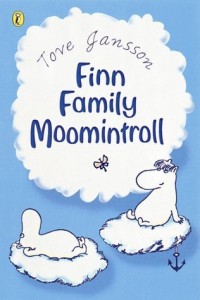 My sixth Moomins book, and ninth by Jansson overall. The novella’s gentle peril is set in motion by the discovery of the Hobgoblin’s Hat, which transforms anything placed within it. As spring moves into summer, this causes all kind of mild mischief until Thingumy and Bob, who speak in spoonerisms, show up with a suitcase containing something desired by both the Groke and the Hobgoblin, and make a deal that stops the disruptions.
As always, the creatures and events, conveyed by Jansson’s black-and-white drawings as much as by her words, are inventive and whimsical. There’s a cosy charm to the seasonal rituals, like the end-of-summer pancake party here. But what I value even more is the pointed accounts of the secondary characters’ neuroses. The Moomins are generally on a pretty even keel, though there is mention of Moominpappa’s sense of being hard done by because of childhood bullying and an enduring lack of respect. However, characters like the Muskrat and the Hemulen get a wry smile and shake of the head from me because their predicaments are so familiar: The Muskrat, terrified of mortifying situations, decides the life of a hermit might be preferable; the Hemulen gives up stamp collecting and switches to botanizing because there’s no joy in a finished quest, only in an ongoing search. The Moomins books offer the perfect combination of the familial and routine with the novel and adventurous. Even staid adults should give them a try. (Little Free Library)
Self-Portrait in Green by Marie NDiaye (2005; 2015)
[Translated from the French by Jordan Stump]
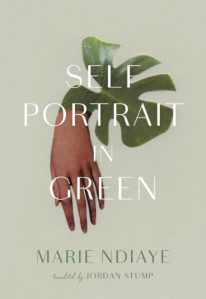 I tend to love a memoir that tries something new or experimental with the form (such as Constructing a Nervous System or In the Dream House), but this was a step too far for me; the self referred to in the title is almost wholly absent. NDiaye, a French–Senegalese author, opens in 2003 with the expected flooding of the Garonne in southwest France. Fragments of narrative from 2000–2003 chart her encounters with various women dressed in green, starting with one she thinks she sees under a banana tree (though her four children see nothing). Then there’s Katia Depetiteville, dead 10 years … NDiaye’s stepmother, once her childhood best friend; her friend Jenny’s rival for Ivan’s affection; and her mother, who now has a new family. What is a ‘woman in green’? The author explicitly associates the colour with cruelty, with presumably the usual connotation of jealousy as well. But it still feels arbitrary.
It’s all rather dreamlike, with poetic repetition, rhetorical questions and black-and-white photos that seem marginally relevant. “I’m saying to myself: Is all this really real?” NDiaye writes, and the reader will surely be asking the same. “I’m always interested in stories,” she adds, and while I’d agree, I need to know that they’re being told to build to some greater meaning. It was only in the last fifth of the book, when the author goes to a literary symposium in Ouagadougou and visits her father (a many-times-married former restaurateur and amateur architect now suffering from cataracts) and stepmother that I felt like there was a purpose: a bringing together of past and present for psychological clarity. I was relieved that this was only 112 pages. (Edelweiss) 
The 10th anniversary edition is being reissued by Two Lines Press next month.
And a bonus preview:
Cross-Stitch by Jazmina Barrera (2021; 2023)
[Translated from the Spanish by Christina MacSweeney]
 In the inventive debut novel by Mexican author Jazmina Barrera, a sudden death provokes an intricate examination of three young women’s years of shifting friendship. Their shared hobby of embroidery occasions a history of women’s handiwork, woven into a relationship study that will remind readers of works by Elena Ferrante and Deborah Levy. Citlali, Dalia, and Mila had been best friends since middle school. Mila, a writer with a young daughter, is blindsided by news that Citlali has drowned off Senegal. While waiting to be reunited with Dalia for Citlali’s memorial service, she browses her journal to revisit key moments from their friendship, especially travels in Europe and to a Mexican village. Cross-stitch becomes its own metaphorical language, passed on by female ancestors and transmitted across social classes. Reminiscent of Still Born and A Ghost in the Throat. (Edelweiss)
Coming out on 7 November from Two Lines Press. My full review for Shelf Awareness is pending.
#NovNov Translated Week: In the Company of Men and Winter Flowers
I’m sneaking in under the wire here with a couple more reviews for the literature in translation week of Novellas in November. These both happen to be translated from the French, and attracted me for their medical themes: the one ponders the Ebola crisis in Africa, and the other presents a soldier who returns from war with disfiguring facial injuries.
In the Company of Men: The Ebola Tales by Véronique Tadjo (2017; 2021)
[Translated from the French by the author and John Cullen; Small Axes Press; 133 pages]
 This creative and compassionate work takes on various personae to plot the course of the Ebola outbreak in West Africa in 2014–16: a doctor, a nurse, a morgue worker, bereaved family members and browbeaten survivors. The suffering is immense, and there are ironic situations that only compound the tragedy: the funeral of a traditional medicine woman became a super-spreader event; those who survive are shunned by their family members. Tadjo flows freely between all the first-person voices, even including non-human narrators such as baobab trees and the fruit bat in which the virus likely originated (then spreading to humans via the consumption of the so-called bush meat). Local legends and songs, along with a few of her own poems, also enter into the text.
Like I said about The Appointment, this would make a really interesting play because it is so voice-driven and each character epitomizes a different facet of a collective experience. Of course, I couldn’t help but think of the parallels with Covid – “you have to keep your distance from other people, stay at home, and wash your hands with disinfectant before entering a public space” – none of which could have been in the author’s mind when this was first composed. Let’s hope we’ll soon be able to join in cries similar to “It’s over! It’s over! … Death has brushed past us, but we have survived! Bye-bye, Ebola!” (Secondhand purchase)
Winter Flowers by Angélique Villeneuve (2014; 2021)
[Translated from the French by Adriana Hunter; 172 pages]
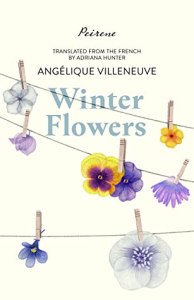 With Remembrance Day not long past, it’s been the perfect time to read this story of a family reunited at the close of the First World War. Jeanne Caillet makes paper flowers to adorn ladies’ hats – pinpricks of colour to brighten up harsh winters. Since her husband Toussaint left for the war, it’s been her and their daughter Léonie in their little Paris room. Luckily, Jeanne’s best friend Sidonie, an older seamstress, lives just across the hall. When Toussaint returns in October 1918, it isn’t the rapturous homecoming they expected. He’s been in the facial injuries department at the Val-de-Grâce military hospital, and wrote to Jeanne, “I want you not to come.” He wears a white mask over his face, hasn’t regained the power of speech, and isn’t ready for his wife to see his new appearance. Their journey back to each other is at the heart of the novella, the first of Villeneuve’s works to appear in English.
I loved the chapters that zero in on Jeanne’s handiwork and on Toussaint’s injury and recovery (Lindsey Fitzharris, author of The Butchering Art, is currently writing a book on early plastic surgery; I’ve heard it also plays a major role in Louisa Young’s My Dear, I Wanted to Tell You – both nominated for the Wellcome Book Prize), and the two gorgeous “Word is…” litanies – one pictured below – but found the book as a whole somewhat meandering and quiet. If you’re keen on the time period and have enjoyed novels like Birdsong and The Winter Soldier, it would be a safe bet. (Cathy’s reviewed this one, too.)

With thanks to Peirene Press for the free copy for review.
(In a nice connection with a previous week’s buddy read, Villeneuve’s most recent novel is about Helen Keller’s mother and is called La Belle Lumière (“The Beautiful Light”). I hope it will also be made available in English translation.)
 Bookish Beck = Rebecca Foster. American transplant to England. Freelance proofreader and book reviewer.
 Bookish Beck