June Releases by Fiona Mozley, Heather Sellers & Myfanwy Tristram
This month I have a fiction–poetry–nonfiction trio covers fake memories, Florida’s beauty and weirdness, and the past 50 years of protests in the UK. I also excerpt my reviews of five June releases I read in advance for Shelf Awareness, including one that’s in the running for my Book of the Year.
Awake Awake by Fiona Mozley
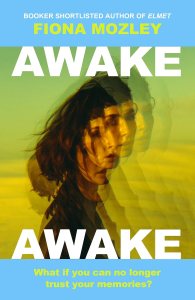 When writer Mary Mooney dives into her memories during appointments with her therapist, Sita, most of what comes up is the everyday stuff of her childhood in York: mild shenanigans with her younger brother, Jos; her friends Amelia and Eve plus Eric, a newcomer from New York City; and their wider circle. Early on, though, she warns readers that she’s untrustworthy. “In recent years, I have had difficulties with my memory,” she confesses. “It was not a sickness of forgetting. I did not have too few memories, but too many,” some of which couldn’t possibly be real – the best example being her conviction that her grandfather assassinated Hitler. She also tells Sita of a hotel fire and her rudeness to a couple of right-wing writers and journalists – things one does in dreams but not generally in real life.
The focus is on Mary and her peers’ formative teen years around the start of the Iraq War. In the final chapter, she offers a where-are-they-now for her closest friends. “Most of this is a verifiable journey through a life I really lived,” she notes, but “from hereon the fabrications begin.” This should have been an exciting revisiting of recent history in the company of an unreliable narrator, but everything about the novel is so dull that it was impossible to stay interested. It feels like pedestrian autofiction (insomuch as Mozley is from York and came of age in the same period as Mary, who is nominated for a major award for her first novel) drawing on a Blair-years upbringing. Mozley’s Elmet, which was shortlisted for the Booker Prize and the Sunday Times Young Writer of the Year Award, is one of my favourite debut novels of the last decade, so it’s a real shame that her subsequent work hasn’t lived up to that potential. Hot Stew (2021) was a DNF for me, a caricature-heavy London state-of-the-nation novel, and Awake Awake reads like a half-baked debut, not a world-class novelist’s third. Unless I hear rave reviews about a return to form in future, that’s it for me with Mozley.
With thanks to John Murray Publishers for the free copy for review.
Women in Tampa Talking about Alligators by Heather Sellers
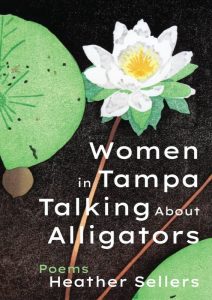 With such a title, how could you not want to read it?! In her fifth poetry collection, Sellers, a Florida native, recounts conversations with her neighbours, backyard sightings, and boat trips through swamp country. An appreciation of beauty rubs shoulders with awareness that it is threatened by climate breakdown and the state’s existential identity crisis. She describes Florida as “the thumbs-down thumb”; it “hangs on, for now, bobbing, / as she lowers into the dull warm blue sea.” Lovely poems about birds spin delightfully unexpected imagery: “watching the great white egret / stiletto across the jasmine fence, / black patent legs shining”. But they also contain barbs about the polluting influence of modern life (spot the alliteration and internal and slant rhymes):
Someone’s silvery phone gleaming underwater.
A fleet of rays flew between our little boats, skin kites on roller skates.
We discovered the things slung around the channel marker
was not a bird, just a plastic sack: the common, grey Florida Wal-Mart bag.
Cormorants dove into the chests of mangrove.
High above, paragraphs of frigates cursive-d land, land, land.
As winter and summer swap, the advantages and downsides of living in an identikit suburb mostly inhabited by retirees from elsewhere become clear. Nature is red in tooth and claw even in her garden, where crows prey on baby mockingbirds. Alligators are everywhere, and when “removed” for being a “nuisance” – in other words, interfering with human activity – their end reveals our inhumane priorities. “No? Seriously? They are euthanized? Euthanized for what, for living?” This is a terrific free verse collection at the intersection of the edenic and the diminished everyday. I would definitely read more by Sellers.
Published by Lynx House Press. With thanks to publicist Jeffrey Yamaguchi for the free e-copy for review.
Noisy Valley: The Art of Protest by Myfanwy Tristram
This is not a comprehensive history of protest but a snapshot of it over the past half-century or so, focussing on the Rhondda Valley in South Wales (not far from Cardiff), where a surprising number originated. The frame story is an exhibit of Tristram’s protest drawings at the Workers Gallery in Ynyshir, where she meets those featured. Each story is then expounded in turn, based on interviews with someone who led the protest or participated in it. We learn of miners’ strikes, a protest against a hospital closure, outrage over toxic runoff from a landfill, and a campaign to save Northern Meadows. One impetus was the worrying trend in the UK (and elsewhere) of governments cracking down on peaceful protests with overly harsh punishments.
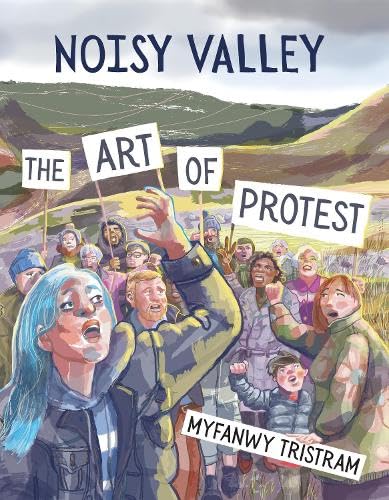
I was surprised to find that two of the chapters had local relevance for me: the Greenham Common women’s peace camp and the Aldermaston marches (part of the Campaign for Nuclear Disarmament). I was additionally taken aback to spot Martyn Joseph, a Welsh singer-songwriter we’re familiar with from Greenbelt Festival, turning up to sing a new bespoke version of “This Land Is Your Land” for a protest. I’m not fond of the talking heads approach to graphic nonfiction (also seen in Sexuality: A Graphic Guide and Trans History) or of the particular style here – monochrome in the main text with a few full-colour pages plus in the asides on the history of protest and changing regulations. I preferred the spreads focusing on landscapes. However, this is a worthwhile project and I particularly appreciated the below quote, which captures my feeling about the environmental marches I’ve been on in London.
You might find this a bit weird, but I never really thought that protest ever achieves its purpose. We still have nuclear weapons, you know. But it is worthwhile. My feeling is that protest is wonderful because it brings people together as a social group. The meeting of hearts and minds. I would argue that’s very positive.
~David Hurn, Aldermaston photographer
With thanks to SelfMadeHero for the free copy for review.
Reviewed for Shelf Awareness:
 The Daffodil Days by Helen Bain: A remarkable debut novel about the last years of Sylvia Plath’s life. I’ve already discussed it here.
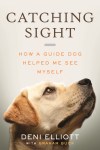 Catching Sight: How a Guide Dog Helped Me See Myself by Deni Elliott with Graham Buck: Elliott was diagnosed as legally blind as an adult, though she’d always had limited vision. She explores her relationships with five very different dogs and introduces the process of training guide dogs in this heartwarming story of human–animal connection and resilience.
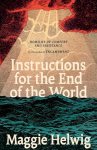 Instructions for the End of the World: Homilies of Comfort and Resistance by Maggie Helwig: Helwig is the rector of inner-city Toronto’s St. Stephen-in-the-Fields. Her stirring sermons espouse a practical, progressive theology and affirm the power of solidarity and the commitment to social justice in turbulent times (including the pandemic years).
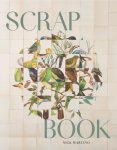 Scrap Book by Nick Martino: Martino’s formally inventive debut poetry collection draws on his mother’s journals and 1980s Polaroids to capture a Midwestern family dynamic overshadowed by divorce and his father’s incarceration.
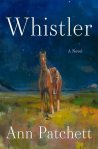 Whistler by Ann Patchett: Patchett is a master on the subject of family dysfunction, and her tenth novel, a stepdaughter–stepfather love story, is as wise as ever on secrets, traumatic memories, and storytelling. This is one of my top three books of 2026 so far, along with Brawler and John of John.
Which of these June releases have you read, or will you seek out now? What am I missing out on?
20 Books of Summer, 4–7: Fadiman; Kingsolver & O’Farrell Rereads; Sullivan
I finished several of these a while ago now, but it’s been a struggle to summon up the motivation to write about them, especially during the heat wave we’re currently experiencing in the southern half of England. You’ve heard a lot from me recently as I’ve been catching up on reviews, so I’ll try to keep these responses to one (long) paragraph each.
Frog and Other Essays by Anne Fadiman (2026)
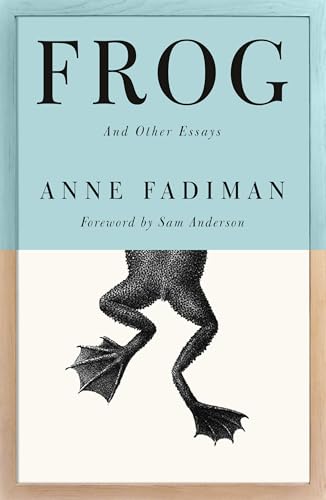 This was one of my Most Anticipated titles of the year because I’ve loved Fadiman’s nonfiction, especially the bookish Ex Libris, which I’ve read twice. Her essays are warm and fluent, braiding memoir and observation in a natural way and drawing readers in whether they share her particular preoccupations or not. “Frog” is about her guilt for not being more attentive to her children’s surprisingly long-lived pet frog, Bunky; “South Polar Times” recounts her obsession with polar exploration and what she discovered in the archives of the magazine Shackleton produced in the 1910s. At the centre of the book is a triptych on modern technology (“My Old Printer”) and language use, especially as she’s experienced it as a Yale professor trying to adjust to pandemic-era teaching (“Screen Share”) and expanded gender possibilities (“All My Pronouns,” which is mostly about getting used to “they” as a singular pronoun for nonbinary individuals). What a relief that advancing age and pedantry didn’t see her joining the anti-woke camp. The final essay, “Yes to Everything,” was – I think – the afterword to her late student Marina Keegan’s The Opposite of Loneliness (2014). For me the highlight was “The Oakling and the Oak,” about Samuel Taylor Coleridge’s disappointing son (“A penumbra of impossible expectation began to settle around Hartley’s head”). There’s a tantalizing parallel here with her own sense of needing to live up to her literary father, Clifton Fadiman, that I wish she’d explored further. So: good stuff here, but only seven essays, all of which were originally published elsewhere. It feels like scraping the barrel. And why the laudatory foreword by someone I’ve never heard of (Sam Anderson)? I ordered this while in the States to get to a free-shipping limit and I’m glad I got the chance to read it, but it’s not a must. Do seek out “Frog” and “Oak,” though. (New purchase – Target.com)
Prodigal Summer by Barbara Kingsolver (2000)
In all her life Lusa had never seen such an oversexed, muggy summer. Just breathing was a torrid proposition.
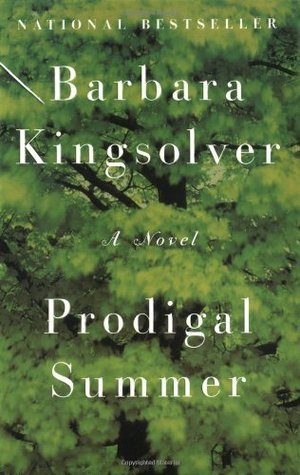 Although I remembered this as being in Kingsolver’s top tier of novels, I recalled no details beyond a female ranger who lives in the woods, has an affair with a hunter, and studies coyotes (actually, I thought it was wolves – I was conflating Deanna’s surname, Wolfe, and Sarah Hall’s The Wolf Border, which has a similar setup). I’d forgotten that there are two other strands: Lusa, a Polish-Palestinian entomologist widowed young, inherits her husband’s family farm and tries to make a go of goat breeding despite others’ disapproval; and Garnett, a pious old man trying to resurrect the American chestnut after it was wiped out by blight, has an ongoing low-key feud with his organic orchard-keeping neighbour, Nannie. These threads rotate under the headings “Predators,” “Moth Love,” and “Old Chestnuts.” There are pleasing connections between the main characters, who are also thematically linked by ideological disagreements and the possibility of new life and romance when age or circumstances seemed to disqualify them. Kingsolver writes brilliantly about science, and although she gets a little preachy through Nannie, in a way that presages Unsheltered (“It’s glory, to be part of a bigger something. The glory of an evolving world”), her environmentalist messages are always right on. It’s depressing to note that, more than a quarter-century later, the issues she raises related to food production and pesticide use are worse rather than better. Like Margaret Atwood, she’s a literary prophet of our time. I’m nearly halfway through her upcoming novel, Partita, for a Shelf Awareness review and its protagonist, Livia, seems to be in the lineage of Deanna – an Appalachian girl who tries to exceed her origins. This was a big ol’ satisfying summer read. Whyever didn’t Kingsolver win the Women’s Prize for this one? (Little Free Library)
My original rating: 
My rating now: 
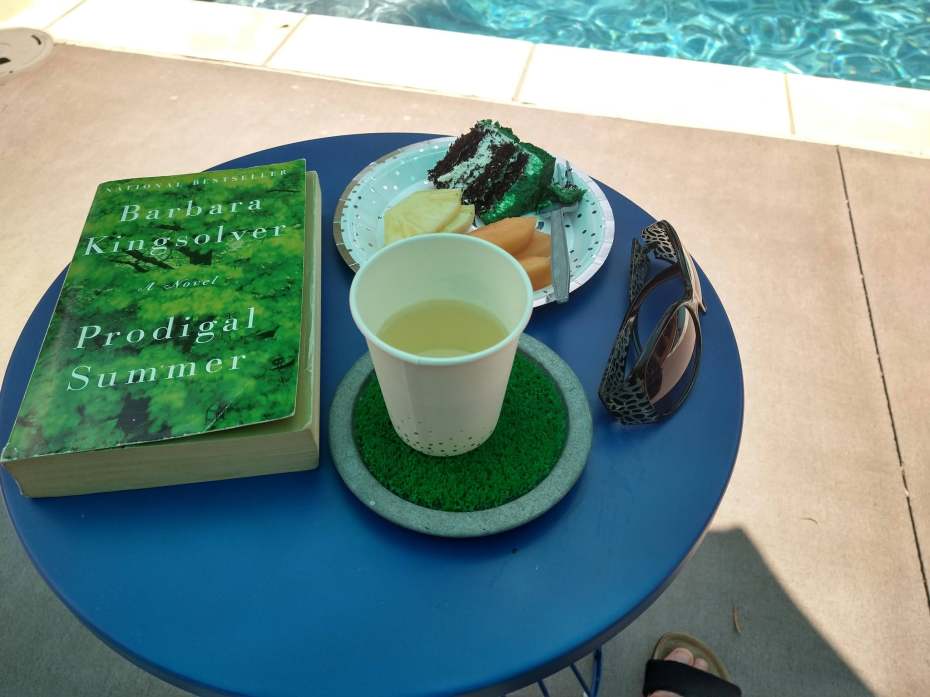
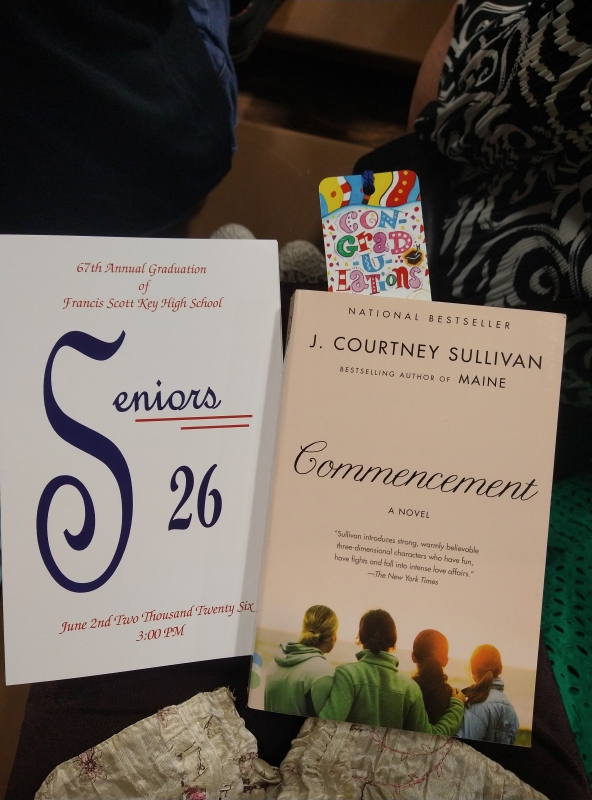
Poolside reading at my nephew’s graduation party.
The Vanishing Act of Esme Lennox by Maggie O’Farrell (2006)
Nothing is our own. We begin in the world as anagrams of our antecedents.
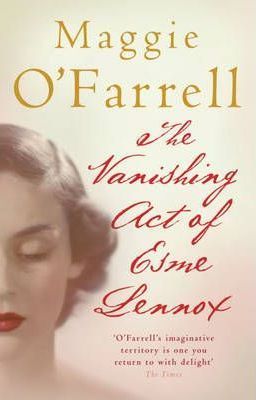 Another reread. I remembered the mental hospital element but think I may have otherwise had this confused with Sebastian Barry’s The Secret Scripture, which also features historical family secrets and a great big twist. This was our book club selection for June, and although I missed the meeting (which was also our summer social) while I was back visiting my family, I wanted to catch up by reading it again – especially after it earned a perfect score from the rest of the group! In the novel’s present day, vintage clothing store owner Iris is having an affair with a married man and learns that she has a ‘mad’ great-aunt who will soon be her responsibility when the hospital Esme has called home for 60 years closes. Why did Iris’s grandmother, Kitty, hide that she had a sister? With Kitty on a dementia ward, she can’t ask outright. Instead, narration alternates between the sisters’ growing-up years in India and Edinburgh – where flighty, rebellious Esme caught boys’ eyes while obedient Kitty didn’t – and Iris and Esme embarking on a tentative relationship. The use of the present tense for both, as well as the fragments of memory we gradually work out are Kitty’s, create a continuous narrative so gripping that I could easily have consumed it in one sitting had I not had other commitments. Grief, parenting, male privilege, family legacies, and a freedom of spirit that might today be branded neurodivergence are strong elements. It’s appalling how women have been punished for breaking the rules, but the other ensuing betrayals are just as shocking. This must have one of THE best surprise endings out there. I can’t believe I’d forgotten the details. After a couple of lacklustre early novels, O’Farrell’s career truly took off with this one. Now to reread her other gems. (Borrowed from a book club friend)
My original rating:
My rating now: 
Commencement by J. Courtney Sullivan (2009)
Smith had left its mark on her, so that the place would always feel like home
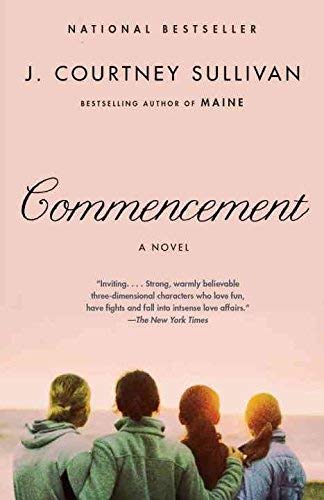 I’ve had a mixed experience with Sullivan’s novels, but this debut was a delight. Let’s start with the clever title: An American graduation ceremony is called “commencement,” so it marks both an ending and a beginning. For four friends who meet at Smith College, a women-only institution, in the late 1990s, their student experiences have effects that carry on into their ‘real’ lives afterwards. We watch how their relationships with each other, and with family members and partners, shift over the course of nearly a decade. Sally arrives on campus bereft from the death of her mother, but she doesn’t let her sadness corrode her ambition or her kind heart. Bree is engaged to a man when she comes up from Savannah but leaves in a committed relationship with a woman. April was raised by a single mother and has always been a strident feminist, but graduates with plans to go to extremes in drawing attention to the plight of sex workers. The framing story of the friends gathering for Sally’s wedding introduces us first to Celia, who is in some sense still living the student life in the small New York City apartment she brings one-night stands back to after drunken evenings. The wedding ends up in a huge fight between the four, and as the years pass they split off into pairs and trios of loyalty before a crisis brings them back together. It’s a little far-fetched how this all plays out, but I was invested enough in all four characters that I was happy to go along with it. Sullivan went to Smith (I also attended what was a women’s college at the time, Hood), so you have to wonder if anything was autobiographical for her. She weaves in various women’s issues, such as sexual assault and decisions about career and motherhood. I applaud Sullivan for mentioning support for trans men on campus, though her discussion does seem of its time and today I think the debate would be more around allowing trans women to attend. I chose this to read because my recent USA trip was for my nephew’s high school graduation. It’s perfect for Curtis Sittenfeld fans. (Secondhand purchase – 2nd & Charles)
#ReadingtheMeow2026, Part II: George Mikes & Louise Ross Memoirs; Letters of Note: Cats
I’m a few days late with this second batch (after my first post on some Chinese and Japanese cat books). Thanks again to Mallika of Literary Potpourri for hosting the annual Reading the Meow challenge, which is always a great excuse for me to get to a handful of the many cat books on my shelves and e-readers.
Tsi-Tsa by George Mikes; illus. Nicholas Bentley (1978)
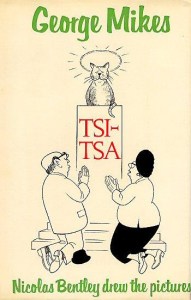 Mikes wasn’t an animal lover at all, but when Tsi-Tsa (from the Hungarian cica, which means pussycat) started turning up in his London house, he finally got it. “A man who had made fun of British cat-worship for several decades, I fell for Tsi-Tsa in the grand way – at first without even noticing it,” he writes. She was actually Sooty, his neighbour’s cat, but so determinedly adopted Mikes – sleeping on his chest, with her right paw on his left shoulder – that her owner told him he could have the cat. His transformation into an ailurophile was soon complete: “The days when I thought that all cats were alike – that a cat was a cat was a cat – have long passed. … By now I am fully aware that cats differ from one another as significantly – and are as much individuals – as humans, or more so.”
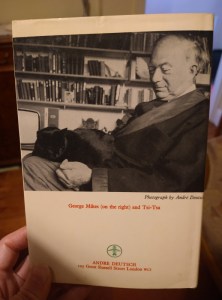 Most of the book is devoted to two crises: his diagnosis of impending blindness, and Tsi-Tsa going missing. If you’re wary of cat memoirs because the pet tends to die at the end, you needn’t worry. This ‘biography’ of Tsi-Tsa ends with her very much alive, having learned to adjust to her physical limitations after being hit by a car. I’ve read several of Mikes’s books, including the trilogy of satirical expat advice books that make up How to Be a Brit. This is similarly light-hearted, if a little insubstantial. If you’ve enjoyed books by Derek Tangye and Doreen Tovey, you’ll find it comparable. (Secondhand – Addymans bargain alley, Hay-on-Wye)
And another novella-length memoir about a black cat that makes itself at home and becomes part of the family!
Slow Blink: A Memoir by Louise Ross (2026)
A 1927 book found on her elderly father’s bookshelf, the poetry collection archy and mehitabel by Don Marquis, sparked Ross’s journey into memory for a look at two very special cats. In Marquis’ book, Archy the cockroach was a human poet in a previous life, while Mehitabel the alley cat was Cleopatra. Ross’s family thus gave to one of their cats the noble name of Mehitabel, and she became the girl’s best buddy as she was growing up in Australia. It became a nightly ritual: her mother would put the cat outside, Mehitabel cried underneath Ross’s window, which she opened to let the cat sneak in and share her bed. In the morning, back out Mehitabel would hop, dashing round to the laundry room yard to pretend she’d been outside all night. Boarding school, early career and travels drove the friends apart somewhat before Mehitabel died at the venerable age of 22.
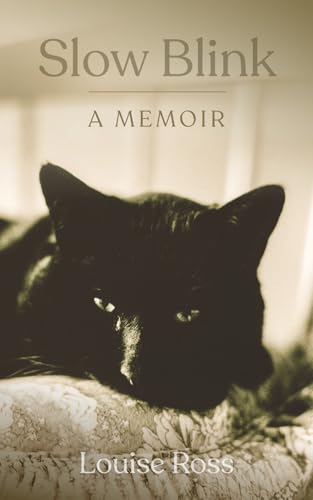 Eight years later, Ross was living in Colorado with her husband and struck up a friendship with a stray black cat who hung out by the bins of their townhouse complex. Eventually he came to trust her and even to shelter indoors from harsh winter weather. What name to give him? Archy, of course. He survived their landlord’s laying down of the law as well as a period of being lost miles away before dying of feline leukaemia. It was only a yearlong relationship in the end, but it had a lasting effect, not least because Ross continued to see Archy after his death. Future losses only reinforced for her the idea that something continues beyond death. “He taught me that some experiences can’t be explained, and that love persists in ways we don’t understand but can, if we’re open and willing, receive.”
While not all pet owners will have experience of such a literal enduring relationship, we can all affirm the strength of the bond with animals, and I also appreciated Ross’s brief (95-page) memoir for its marveling at life’s twists and turns – she now lives in Portugal and has published two volumes of interviews with fellow expatriates and immigrants living there.
With thanks to the author for the free e-copy for review.
Letters of Note: Cats, ed. Shaun Usher (2020)
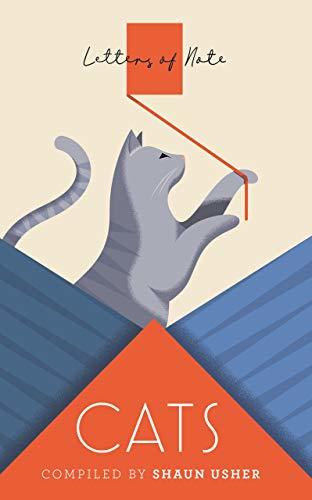 Canongate’s series of short thematic letters anthologies launched in 2013, arising from the website lettersofnote.com. There’s a variety of encounters and experiences here, and the tone ranges from forlorn or silly to outraged. Elizabeth Taylor mourns her missing cat and Jack Kerouac’s mother informs him of the death of his pet. T.S. Eliot tries out the cat-themed nonsense verse he’d become famous for in a birthday note to his godson. Jack Lemmon proposes a cat ranch to his pal Walter Matthau; Erasmus Darwin (grandfather of Charles) and poet Anna Seward exchange slightly saucy ‘love letters’ written in the voices of their cats. Charles Dickens and Jane Carlyle both recount cats’ vendettas against pet canaries.
Some letters are more interesting than others, as you’d expect. There are nice glimpses of cats’ oddities – a reminder that, in many ways, they’re the same across centuries and countries. I was most struck by two entries. One was Adlai Stevenson’s official objection to an Illinois Senate bill proposing owners restrain cats on leashes so they can’t kill birds. “The problem of cat versus bird is as old as time,” he rightly observes, but I can personally attest that leash training works and means our little hunter only kills spiders and houseflies instead of … everything that moves. This environmentalist bill would have been ahead of its time for 1949. The most affecting piece was an open letter by Guy Davenport to the drivers of Lexington, Kentucky, one of whom ran over his cat. It’s a brilliant miniature polemic. This was intermittent entertainment; fun to browse or sample. (Secondhand – hospital book sale)
Three I Read for Father’s Day: Faber Poetry Anthology; Giffels & Pascoe
I’m behind on reviews after a long weekend visiting friends. As I did last year, I picked out three books related to fathers and fatherhood. It’s my ideal Three on a Theme recipe: one fiction + one nonfiction + one poetry. I won a copy of a poetry anthology about parenthood and completed the trio with a memoir that’s been on my shelves for a number of years and a debut novel I bought secondhand mostly for the title.
Family Lines: Poems about Parents and Parenthood, ed. Simon Armitage and Rachel Bower (2026)
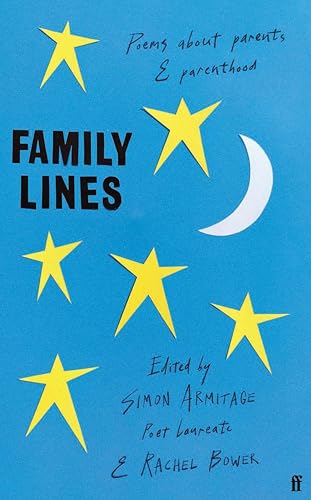 Not all of the poems are about fathers, of course, but there are plenty of selections here that feel true of any family relationship: the complicated emotions, the sometimes physical realities of transformation and care, the risks of ageing and loss, and how identity is defined by a connection or an opposition. This suffered a bit from its first third – covering pregnancy, birth, and early parenthood – being very similar in scope to Night Feeds and Morning Songs (2021, ed. Ana Sampson), which I reviewed for Mother’s Day. Some of the same contributors feature, though I think only the one specific poem overlaps, Liz Berry’s “The Republic of Motherhood.” Highlights included Gail McConnell’s prose poem “Orange” contemplating lesbian motherhood and Rita Dove’s “Daystar” about never-ending domestic duties: “She wanted a little room for thinking; / but she saw diapers steaming on the line”.
Contemporary material mingles with older; Homer and Wordsworth are two of the ten poets included in a chapter on fathers and father figures. “Sleep” by Roger Robinson was the best example of the theme, a sweet tribute to a man who “for the next twenty years / … battles on his job every day / just so you could be comfortable / and have the space to be what you want.” Relevant entries from other sections were Alden Nowlan’s “It’s Good to Be Here,” about his inauspicious beginning in 1932 with a 14-year-old mother (“I’m in trouble, she said / to him. …// … they began to talk very quietly and at last he said / well, I guess we’ll just have to make the best of it”); Anne Sexton’s “All My Pretty Ones,” about going through her late father’s things and wondering if she’s inherited his alcoholism; and Hartley Coleridge’s “Lines—,” acknowledging he’ll never live up to his father’s talent: “Because I bear my Father’s name / I am not quite despised, / My little legacy of fame / I’ve not yet realized.” (Faber giveaway)
Furnishing Eternity: A Father, a Son, a Coffin, and a Measure of Life by David Giffels (2018)
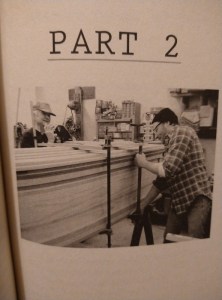
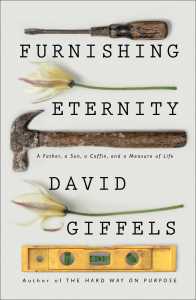 Losing his mother and best friend to cancer within a year, and then turning 50, got Giffels to thinking about mortality. He had a whim to build his own coffin and decided it would be a perfect joint project with his widowed father, who had a home workshop full of tools. As sprightly and driven as his father was, he was also in his eighties and had survived a couple of different cancers, so it was never far from the author’s mind that he needed to make the most of his time with his father while he could. I’m not at all interested in woodworking or DIY, but this is an unusual and likable memoir that alternates the practicalities of building the casket with memories of his relationships with his mother and friend John, who was an artist. While Giffels mentions his wife Gina frequently, he doesn’t talk about his own children as much as I might have expected to take the lessons full circle. No matter; I appreciated the middle-aged Ohio hipster’s thoughts on friendship, ageing and grief. Bereavement memoirs are more often the preserve of women, it seems, so it was good to have a different take.
This is how middle-aged friendships often go, slipping and slipping until ‘we really should get together soon’ becomes a discomforting veil for the truth—that such friendships cease to exist.
I thought a time would come when I would feel definitively like a grown-up, like I would have achieved a certain kind of acumen for making decisions and knowing what to do in unknowable situations, when I wouldn’t feel insecure in real-life grown-up scenarios (board meetings; ordering wine; delivering eulogies). Instead, I still felt like a kid. Or rather, I felt like an adult who was in the continuous loop of his youth.
death is a shattering. Grief is the chaos of wreckage. Only life can find the pattern, and only in its own sweet time. What I remember from the long season of loss was wanting each day to pass as quickly as possible. To get beyond it. I guess I missed the fact that the by-product of this wish was for my own life to rush by.
(New bargain purchase from Amazon)
Our Father Who Art in the Tree by Judy Pascoe (2002)
“It was simple for me: the saints were in heaven, and guardian angels had extendable wings like Batman, and my dad had died and gone to live in the tree in the back yard.”
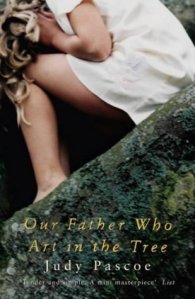 The premise of this Australia-set novella was appealing enough for me to overcome my usual antipathy to child narrators. It probably helps that Simone is looking back from adulthood rather than limited to a 10-year-old’s knowledge. She tells her mother, Dawn, about the voice coming from the tree and it turns out that the two of them are the only ones who can hear her father. He tells them that he’s sorry he left, that he will always love them, that death is not so bad. Simone’s three brothers and best friend, the judgemental neighbours: they’re all clueless. The boys carry on with normal life as best they can, while Dawn has the chance to start over with “the drain man.” Meanwhile, the tree keeps encroaching on the house, undermining the foundations. It’s both a literal problem and a symbol of the enormity of grief, and the book as a whole works on both levels. Despite the early promise of magic, I found it to be a mostly realistic and reasonably touching look at the aftermath of family tragedy. (Secondhand – Community Furniture Project, Newbury)
Some Peripheral Reading for Joyce Carol Oates’s Birthday
June 16th is Bloomsday, of course, and was Paul Auster and Siri Hustvedt’s wedding anniversary – as I learned from Ghost Stories. It’s also the 88th birthday of one of our most prolific authors, Joyce Carol Oates. As I wrote in my introductory post for 20 Books of Summer, Marcie (of Buried in Print) and I have embarked on a casual Oates buddy reading project starting this summer and extending into autumn’s spooky selections. (See her post from today on her early and recent experiences with JCO.)
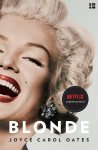 First, an update: I’m now on page 101 of Blonde! It’s such a mammoth doorstopper that I will celebrate my every milestone.
When I scoured the public library and university library catalogues for Oates’s work, I found two oddities to explore further. One is an essay contributed to an anthology on tear-jerking poems; the other is her introduction to an art book on a particular genre of funerary sculpture.
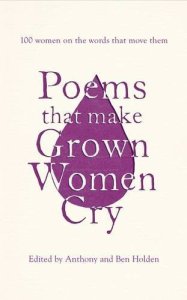
For Poems that Make Grown Women Cry: 100 Women on the Words that Move Them (2016; ed. Anthony and Ben Holden), Oates chose “City Horse” by Henri Cole (I’ve read his 2025 collection The Other Love). It’s a melodramatic portrait of a dead horse overcome by a natural disaster. We know from the title who the poem is about, though not until over halfway through do we get an actual identification: “O, wondrous horse; O, delicate horse – dead, dead”; before that, the unnamed “she” has been simply one more element of the flood detritus (“sucked out to sea and washed up again – / with uprooted trees, crumpled cars, and collapsed houses –”), with evidence of human abuse before that (“facedown in dirt, and tied to a telephone pole, / as if trying to raise herself still, though one leg is broken”). It gets more mawkish before the end: “‘She was more smarter than me, / she just wait,’ a boy sobs”. So I didn’t love the poem as a whole, but the first line of this elegy is incredible: “At the end of the road from concept to corpse”.
In her prefatory essay, Oates extrapolates from one suffering creature to pity “for us all”: “we have been made unnatural by our increasingly mechanized and impersonal society,” and we, too, will be “used up and discarded eventually … by nature, and by time.”
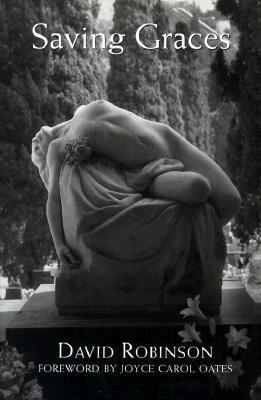 From a dead horse to cities full of dead humans … I think we can safely conclude Oates is not the most cheerful of writers. Saving Graces by David Robinson (1995) is a black-and-white photographic tour through European cemeteries, mostly in London, Milan, and Paris, with a focus on a specific class of 19th-century statuary. These are mourning women: generally semi-nude or flimsily draped and often in the throes of full-body, abandoned weeping that looks like a sexual swoon. They are not angels, Robinson insists; instead, he came to believe that they represented the meeting of the Romantic infatuation with death and “the emergence of the family as the primary focus of affection” in the Victorian period. The women emphasize the finality of death and the overwhelming nature of grief, but those who commissioned the statues may also have envisioned them as “escorts on the journey ahead … posted there to watch over and take care of the deceased.” As photographs go, they’re not hugely interesting; there’s only so much one can do, composition-wise, with gravestones, and I wish he or Oates had done more to subvert the exploitation of the sensual female image.
Oates’s foreword contrasts the photography of life with “the photography of stillness—of the arrested, meditative image.” Robinson’s are the latter type, of course. She describes the book as follows:
“an assemblage of strikingly beautiful photographs that tells us much, and hints at far more, of our collective desire that death be not mere deadness—biological decay, cellular decomposition, the extinction of the ‘unique’ human personality—but Death: mysterious, ethereal, mourned, and therefore celebrated by the most attractive among us. Contemplating these images, we realize how human anxiety, human vanity, human terror of the unknown, whether male or female, may well be the unacknowledged origin of our greatest artworks”.
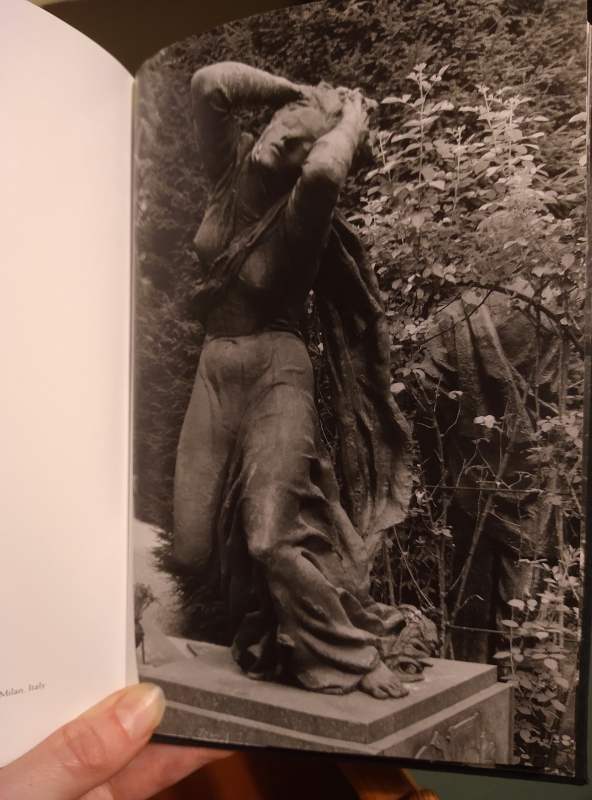
I’ve already encountered Death in the first chapter of Blonde, and I reckon he’ll be a common figure in much of Oates’s work to come, whether realist, Gothic or gory.
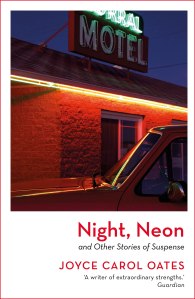 Today I picked up Night, Neon (2021), one of Oates’s many collections of suspense stories, from the library and, based on online reviews, chose two stories to read. I started with the first one, “Detour,” in which a road sign reroutes Abigail from her usual commute when she’s a mile from home. Disoriented, she ends up driving into a ditch and stumbles to the nearest dwelling for help. No one answers the door, so she lets herself in and, Goldilocks-like, makes herself at home, using the toilet and settling into a bed for a nap. When she wakes up, she’s been put into a nightgown and is locked into the bedroom by a man who claims to be her husband of 30 years and is concerned about her health. How has she entered into someone else’s life, and will she be able to get back to her own? The story ends on a note of (hopeful) uncertainty.
“Miss Golden Dreams 1949” proved to be a great companion to Blonde in that it’s voiced by a Marilyn Monroe clone/sex robot being auctioned off at Sotheby’s. Creepily, it’s addressed from her to “Daddy,” a wealthy potential buyer. Even in Oates’s short fiction, I’m finding that she uses three sentences where one would do the job, but at least the stories pass quickly.
Guardian reviewer Ben East sums up her approach nicely (“You tend to know what you’re getting with an Oatesian short – a disquieting snapshot of American life on the verge of individual or ideological collapse”) and describes her short fiction in general as “nuanced rather than neat.” This collection seems promising, so I’ll probably go ahead and read its six more stories and a novella before the summer is out.
20 Books of Summer, 1–3: Paul Auster, David Baker, Helen Ellis
I took the three of these on the plane to the States with me — I’ve been away for just over a week for my nephew’s high school graduation and a family party — and they proved to be undemanding and reasonably diverting company. All: 
Sunset Park by Paul Auster (2010)
After reading Siri Hustvedt’s Ghost Stories, I found myself hankering to try more by her late husband. This is a fairly good novel about sexual boundaries and the ongoing impact of secrets on families. Miles Heller is living in Florida, clearing out abandoned houses. He’s 29 and has been estranged from his parents — actress mother Mary-Lee, publisher father Morris — for seven years, moving from place to place and doing odd jobs but never letting anyone know where he’s living. He’s never told anyone that he believes his stepbrother Bobby’s death was his fault. When he falls in love with a Cuban American high school student named Pilar Sanchez, one of the girl’s older sisters threatens to call the police on him for sleeping with someone underage unless he steals them stuff from the foreclosed houses. To escape potential consequences, he joins his old friend Bing Nathan at a squat in Sunset Park, Brooklyn, right across from Green-Wood cemetery. What he doesn’t know is that Bing has been reporting on his movements to his parents all along.
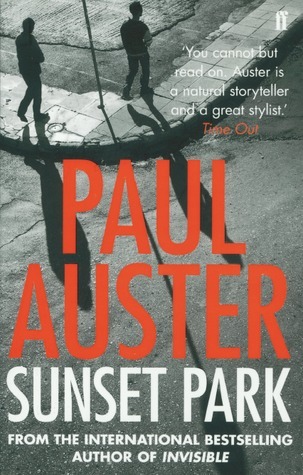 The omniscient narration moves between Miles, his parents, and the three other residents of the squat, with no speech marks throughout and one section in the second person. The prose is so fluid that the pages turn incredibly quickly, but even when he’s inhabiting women’s perspectives you feel a male presence in Auster’s work. There can be something a little distasteful in his writing about sex. If being charitable, I would say that all these examples (the underage girlfriend, having anal sex to avoid pregnancy, infidelity, housemate Ellen’s pornographic drawings, a man being in love with his male best friend) are a way of exploring the lines we draw around sex and whether they are fundamental or arbitrary. But when you’re reading it, it just feels prurient.
Auster’s pet loves of baseball (Hustvedt in Ghost Stories: “Year-round, Paul yakked to me about the Mets”) and film are here through Miles’s and Morris’s shared passion for baseball and housemate Alice’s dissertation work on The Best Years of Our Lives, a charming (or should that be sentimental?) postwar movie I watched back when I was working my way through the American Film Institute’s top 100 list in my high school and college years. Between that, the glimpse of the publishing industry through Morris and Alice’s work for PEN trying to get justice for an exiled Chinese writer, there are a number of appealing elements, but they don’t all come together in any particularly meaningful way. Definitely second-tier work from him. I know I have a lot of better ones still to come. (Secondhand — Community Furniture Project, Newbury)
Whale Fall by David Baker (2022)
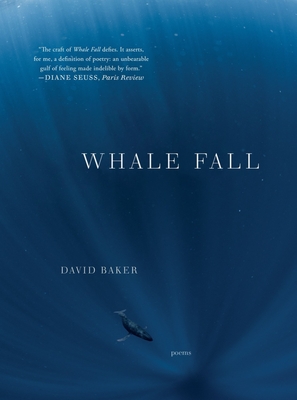 I’d never heard of Baker, even though he’s a prolific and well-respected American practitioner of eco-poetry. Nature poetry is usually right up my street, so I was keen to give this a try. The long title sequence intersperses statistics about whale journeys and ocean plastics with the poet’s memories of Cold War alarmism and current chronic health issues. There are descriptions of riverside and forest scenes, worries about an ageing father, references to Turner’s paintings of clouds, concerns about wildfires, and so on. I quite liked “Storm Psalm” and “Middle Devonian,” but there are not many other standouts overall. The stanza and line arrangements vary a good bit, with most poems ranging across several pages in numbered sections or parts separated by asterisks. Apart from a bit of alliteration, I didn’t notice a lot in the way of technique. I feel almost churlish for not appreciating this more, but it didn’t speak to me, and there were some sentimental tics, as in the brief poem below. (Secondhand — hospital book sale)
“Extinction”
When you are gone they will read your footprints,
if they still read, as they might a poem about love—
wandering in circles, here and there obscured,
washed out in places by weather, sudden landslide.
Keep walking, pilgrim. This is your great tale.
Southern Lady Code by Helen Ellis (2012)
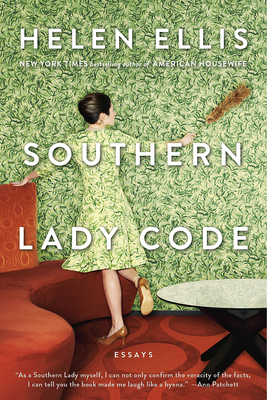 That I read the whole thing on the flight tells you that this collection of 23 micro-essays was addictive in a popcorn sort of way. Ellis is more sassy than introspective when writing about her Alabama upbringing versus her married, childfree adulthood in New York City and the etiquette that she espouses. She quotes her mother’s dictums and gives translations of phrases one might use when trying to be polite: “I’m put together. ‘Put together’ is Southern Lady Code for you can take me to church or Red Lobster and I’ll fit in fine.” She writes about reality TV, reporting pornography on Twitter (but not before enjoying it privately), her belief in ghosts, and her beauty routines for an ageing body — her debt to Nora Ephron is clearest in “Seven Things I’m Doing Instead of a Neck Lift.” I especially enjoyed one essay about her affinity for gay men (I was reminded of Beard by Kelly Foster Lundquist). The best sequence of three pieces covers making kitschy 1970s finger food for her annual holiday party, tips for how to be a good guest, and the art of the thank-you note.
But, often, I found the book quite shallow, and mentions of how much she spends on outfits rubbed me the wrong way. (I’d somehow encountered the essay on accidentally switching another woman’s Burberry coat for her own before.) “Serious Women” is the least fluffy with its account of a sordid murder trial she attended because her friend was the assistant district attorney. There were other little mentions of incidents I wished she’d had the courage to take on in full, such as her rape and her and her husband’s collective loss of parents and a brother. Still, I liked Ellis’s writing enough that I’d definitely read her short story collection, American Housewife. (Secondhand — Community Furniture Project, Newbury)
So none of these were stellar books, but I’m pleased to have read them because they were all “just-because” books from my shelves. No challenge or deadline drove me to them; I picked them up simply because I felt like reading them. Which is what I think summer reading is supposed to be about.
Graduation and party pics:
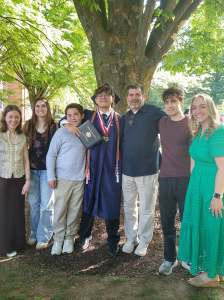
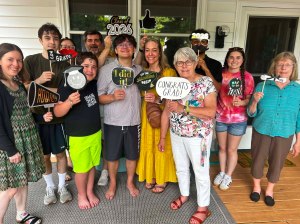
My U.S. book haul (the Houston is signed; the Carson is a review copy, out at the end of July):
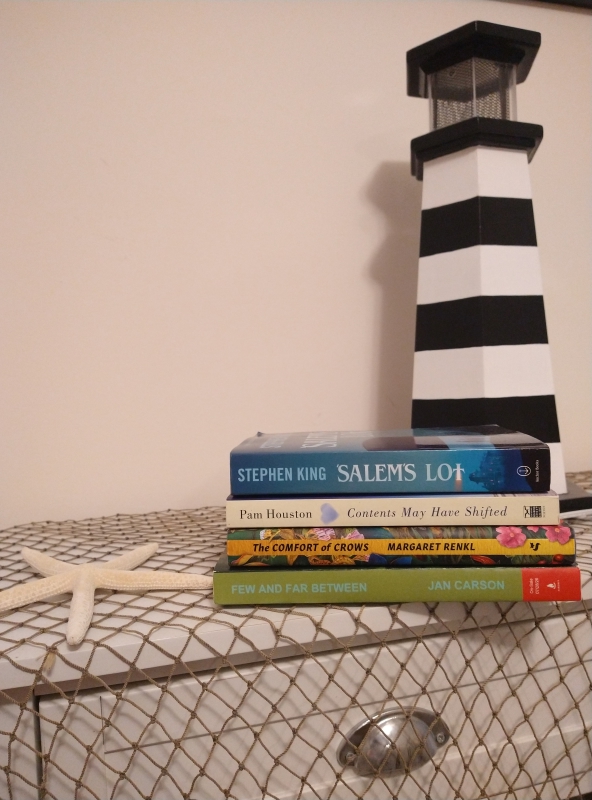
I couldn’t figure out how to log in to WordPress from the laptop I borrowed from my sister while I was away, so I’ll be catching up on blogs and comments the rest of this week. I read most of two other books during my trip and will write those up soon.
May Releases by Siri Hustvedt, Will Maclean & More
This month’s overarching theme is creepy and/or haunted houses! My main reviews are of a collage-style bereavement memoir and a slice of English horror. I also excerpt my reviews of four more May releases read in advance for Shelf Awareness, including one that’s in the running for my Book of the Year.
Ghost Stories by Siri Hustvedt
Paul Auster died of non-small cell lung cancer on April 30, 2024. His widow, Siri Hustvedt, wears his old clothes and still occasionally smells his cigar smoke in their Brooklyn home. “I’m living in a haunted house,” she writes, one “inhabited by a ghost Paul and I made together, a ‘we’ that doesn’t exist anymore.” This isn’t a straightforward bereavement memoir recounting the relationship followed by the loved one’s decline and death. Instead, it moves back and forth between past and present and incorporates various documents. There are glimpses of her state of mind as she keeps up with routines to get through the days but still experiences life as unreal and outside of time.
One section reprints 12 e-mail updates she sent to friends and family during Paul’s illness. She weaves through fragments of his shocking family history (familiar from The Invention of Solitude), certain events that have been memorialized in his books (such as the car accident he wrote about in Winter Journal), and brief tales of his work and its reception. There’s also Paul’s incomplete series of letters to his newborn grandson, Miles, in which he tells the boy the stories he thinks he should know about his ancestors. A notable one was about 9/11, which happened to be the day their daughter Sophie started at a new high school; she passed under the World Trade Center on the subway half an hour before the first attack.
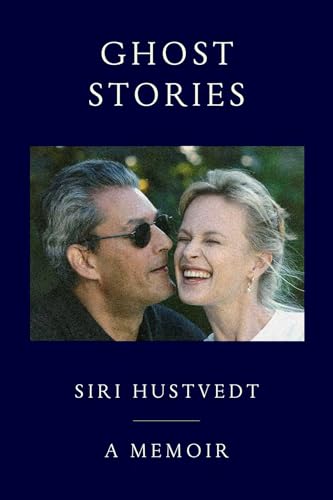 For those of us who have read both Auster and Hustvedt, it’s particularly interesting to read about how their work intersects. “We both liked the idea of our fictional worlds kissing, as it were,” she notes. She describes their connection as “intellectual-erotic” and predicts that, given another 100 years together, they would have merged into one person. Their influence on each other’s work was mutual, she insists, rather than one-sided from Paul to her as misogynistic detractors have assumed. She’s always been more the intellectual anyway, with a literature PhD and amateur interests in neurology and philosophy; and he ‘borrowed’ her character Iris Vegan (from The Blindfold) for one of his later novels, Leviathan.
The book grows increasingly political towards its close. Paul didn’t live to see “45” re-elected as 47. Hustvedt decries the rise of anti-intellectualism and, at Paul’s memorial service nearly 10 months after his death, quoted her father’s prescient words: “when fascism comes to America, they’ll call it Americanism.” It doesn’t seem like alarmism to ask what the current regime in the US and elsewhere portends for writers committed to humanism, nuance, and more or less overt voicing of outrage (as in one of Paul’s late books, a short text accompanying his son-in-law’s photographic series on gun violence in America).
This whetted my appetite to read more by Auster and fulfils her stated goal “to bring something of the man back on the page.” I can thoroughly recommend it to fans of either or both authors, as well as those interested in grief stories and the current literary scene. (Read via Edelweiss)
Solace House by Will Maclean
I hadn’t heard of Maclean’s first novel, The Apparition Phase, which was on the McKitterick Prize shortlist (before my involvement with the Prize), but I was drawn to the descriptions of his second. The cover puff from Nicholas Binge – “The Secret History meets The Haunting of Hill House” – can’t be topped, and the promotional materials’ references to Piranesi and Possession are equally accurate. In the summer of 1993, Alex Lane is 19, broke and wondering what to do with himself. He seems to be the only student left at The Ridge. Except for that pale young man he’s seen screaming at a window opposite his room…
The Student Welfare Office offers him a job on a team clearing out two Victorian properties the university has acquired or is hoping to acquire. One is Marshlands, a former mental hospital, while Solace House was the private residence of the Flaynes, the last of whom recently died at age 101. Alex finds “a lifeboat of easy camaraderie” with his seven co-workers: Clive, a loud, confident stoner; Malcolm, who’s beautiful and gay; Helen, who’s super-religious; Ruth, a Goth; Leo, a mystical researcher; Adam, a weird (traumatized rich kid; and Ella, who’s clever and alluring. But none of them is prepared for what they find at Solace House. Edwin Flayne was a hoarder and the rooms are so full that they can’t move. One is completely covered in mirrors; another has creepy effigies around a table; the hall is plastered with strange paintings; and a series of ledgers with the ravings of a madman. Alex and Ella save from the burn pile one that contains an epic poem of utopian visions and musings on the disappearance of Flayne’s mother.
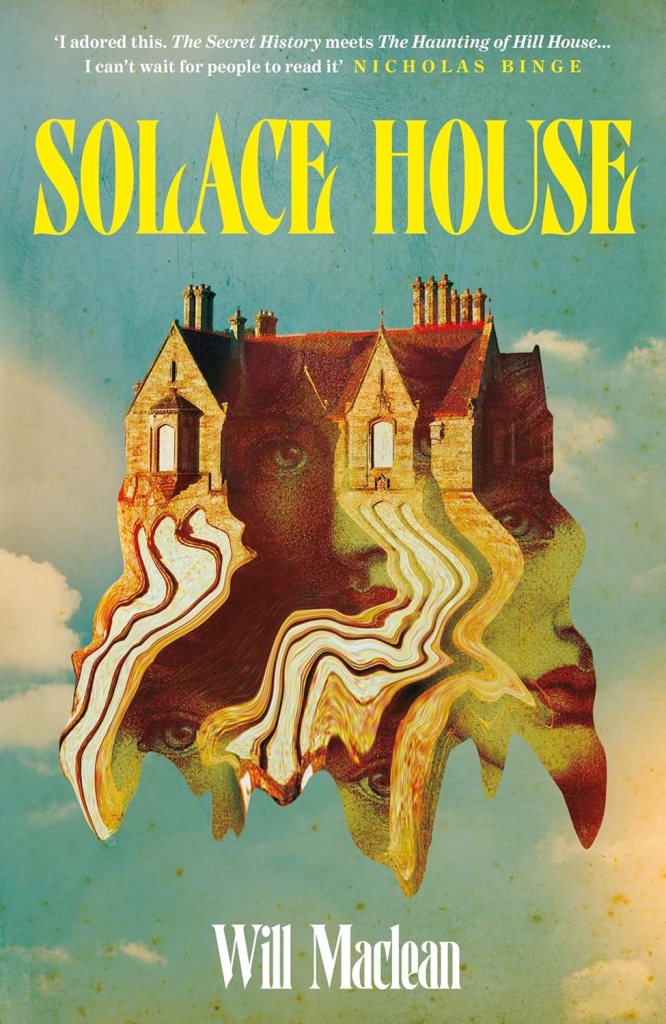
Flayne’s interest in the esoteric is only matched by Leo’s; add on some magic mushrooms and it’s a heady combination of the surreal as the team explores a cave on the property that the Flaynes considered a Thin Place. While high, Leo issues what seems to be a prophecy of the order in which they’ll all die. All along, we’re kept wondering how Alex’s parents both died on “The Last Day” at the hands of “The Annihilator.” He regurgitates fictional orphan plots to try to get Ella off his case, but she (and we) know he’s holding something back.
Although I wearied of the pastiche poetry that heads each chapter and at some point stopped reading it, it does have ultimate significance. (And bully to Maclean for adding “all written by me, rather than AI, before anyone asks” to his Acknowledgements.) Midway through, I was thinking to myself this should have been in the third person to legitimize the horror, as it can otherwise shade into silliness. Part IV jumps ahead in time and subverts what’s gone before, making Alex question not just the last four years of his life but the entire course of it. And now I knew why it had to be in the first person, so reliant is it on individual experience. Time, identity and memory all come into question.
At first I was disappointed, thinking that with this section Maclean had undermined the eerie power of what went before, but there’s another switchback still to come. The book is a little overlong at just under 500 pages, and sags a bit in the final 100, but it kept surprising me and it comes to a satisfying conclusion. I also got the sense of an author having fun with the 1990s nostalgia and student behaviour. I would certainly seek out his debut.
With thanks to Atlantic Books for the free copy for review.
Reviewed for Shelf Awareness:
 Memory House by Elaine Kraf: In this posthumous fifth novel, a novelist enters a commune for failed artists. Magic realism and metafiction coalesce in another of this unsung genius’ typically weird explorations of memory, creativity, and sexuality. It all appears to add up to a metaphorical journey, with a symbolic death and rebirth for those re-entering Society.
 Mother Tongue by Sara Nović: Nović’s fourth book is a defiant memoir of parenthood achieved in spite of the troubled histories of deaf education, religious indoctrination, and international adoption. This is a fierce defense of deafness as a culture rather than a disability to be eradicated, and a beautiful exploration of the legacies of language and love.
 Wellwater by Karen Solie: The Canadian poet Karen Solie’s intricate sixth collection (which won the T. S. Eliot Prize), gilds the natural and human worlds with religious imagery and an environmentalist conscience. The work toggles between the material and the abstract; quotidian experiences fuel meditations on concepts such as intuition, kindness, and fate.
 John of John by Douglas Stuart: In Douglas Stuart’s superb third novel set on the Isle of Harris (Outer Hebrides), a young man seeks to reconcile his sexuality and artistic goals with his family’s expectations and devout upbringing. Intriguing in its particularities but timeless in wisdom, it offers hope that relinquishing shame creates freedom to be true to oneself. (I also got to interview Douglas Stuart! This is one of my top three books of 2026 so far, along with Brawler and Whistler – forthcoming in June.)
April Releases by Victoria Bennett, Ben Lerner and Barbara Yelin
A memoir of gardening to come to terms with midlife and a new island home, a work of autofiction about memory and technology, and an arresting graphic novel tracing the life of a child Holocaust survivor: it was a real variety last month. (But then again, I say that every month, don’t I?)
The Apothecary by the Sea: A Year in an Orkney Garden by Victoria Bennett
 I’ve been hankering to get back to the Orkney Islands after two decades but haven’t managed it yet; reading about it was the next-best thing. There’s a similar make-do attitude to Bennett’s second book, which is about adapting to the unexpected and being in tune with nature. After being forced out of their rented home in Cumbria (and, disastrously, having to raze the abundant garden they’d made there), Bennett and her husband and son resettled in South Ronaldsay. Moving to Orkney was a long-held dream that allowed the couple to become property owners for the first time in their fifties. Chronic illness restricts what she can do, but over the course of a little over a year, she slowly, steadily turns their little outdoor space into a bountiful apothecary garden when not out exploring a new landscape.
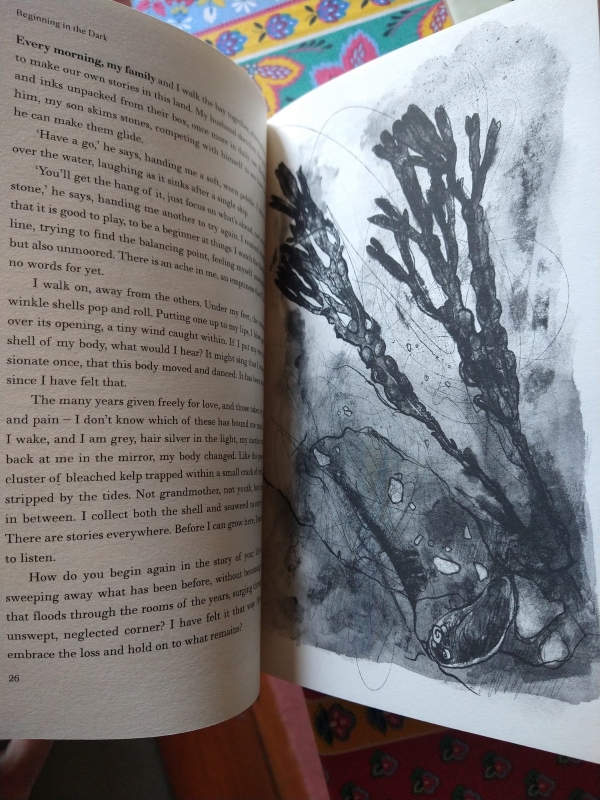
I loved Bennett’s 2023 debut memoir, All My Wild Mothers. Both employ a similar structure of short chapters named after plants with medicinal uses. However, the first book is a lot richer, distilling as it does the experiences and wisdom of an entire life. The format is fresh there, whereas this sequel needed new strategies to set it apart. It’s so short – with sections of gardening tips, further plant rundowns, and recipes for padding – that I suspected the author and publisher were scratching around for enough material to fill a book. The editing is also lacking this time around; dangling modifiers and minor typos abound. This could have been more substantial had Bennett waited a few more years to develop an intimate knowledge of Orkney and make connections with people to draw on. Still, there are reassuring sentiments about accepting one’s limitations, welcoming the changes of age, and setting humble goals (“The garden, like life, is not perfect. Start with what you have”), and the black-and-white illustrations by Bennett’s husband, Adam Clarke, are gorgeous. Though it’s fairly niche, I can, offhand, think of several people to whom I would recommend Bennett’s work.
Written while listening to Doing This for Love, the fab new album by Kris Drever, everyone’s favourite Orkney singer.
With thanks to Elliott & Thompson for the free copy for review.
{SPOILERS IN THE NEXT TWO}
Transcription by Ben Lerner
The UK cover
You know what you’re in for with a Ben Lerner work, in much the same way as when you pick up something by Rachel Cusk, Katie Kitamura or Deborah Levy. The narrator resembles Lerner in that he is a 45-year-old writer who graduated from Brown University and has spent significant time in Madrid. The novella opens with him on a train to Providence, Rhode Island to write a long profile of his mentor, a German writer named Thomas. Thomas is turning 90 and there is a sense that this is to be his “exit interview” – yet he’s as sharp as ever, describing his early life as if composed of film scenes.
There is a strong emphasis on the visual here, but also on the oral. Thomas’s first memory is of hearing Hitler’s voice on the radio, and the narrator fully intended to record this conversation, but dropped his phone in the sink at the hotel and now it won’t turn on. He decides this evening will just be a pre-chat, and tomorrow they’ll get into things properly. For some reason, though, he can’t admit his technological failure to Thomas and instead brings his dead phone out, puts it face down on the table, and pretends that this is all on the record.
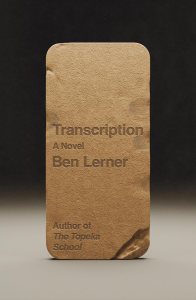
I prefer the U.S. cover, as per usual!
The book is in three long sections, named after different hotels. The second is set in Madrid, where, a few years later, the narrator gives a talk as part of a Festschrift for Thomas. He’s turned the story about his phone into a self-deprecating joke, but it turns out that his conference co-organizer, Rosa, is not the only one angry with him for what she perceives as falsifying Thomas’s last testament. This causes him to second-guess himself.
The third section is, ostensibly, a conversation between the narrator and Thomas’s son, Max – except the former can hardly get a word in edgewise (as was the case with Thomas, too), so it’s really more of a monologue. And, strangely, the subject is Max’s young daughter Emmie’s extreme food issues: a sort of pre-anorexia. Except Thomas would philosophize his granddaughter’s struggle, or query her screen time. Max remembers that when Thomas was hospitalized with Covid, apparently near death, he poured out many warm words to his father. Then Thomas recovered. On their first post-Covid visit, Max recorded his father’s speech without telling him he was doing so – an ironic counterpart to the narrator’s actions.
The themes drew me in, and the writing is addictively lucid. But what does it all mean? Lerner’s repeated references to father-and-son glassmakers and their beautiful glass flowers indicate his interest in questions of talent, (metaphorical) inheritance and legacy. The narrator’s version of Thomas’s memories being presented as gospel raises the question of whether fiction is the more appropriate vehicle for biography. There is also a message about overreliance on technology. The narrator feels helpless without his phone, even for one night: He can’t communicate with his family or confirm his walking route with online maps. But I wasn’t sure how Max’s daughter fits in, except perhaps as an emblem of multigenerational mental health struggles. This was an odd little book that I might like to discuss in a book club but found stubbornly unsatisfying to ponder on my own. (Read via Edelweiss)
Emmie Arbel: The Colour of Memory by Barbara Yelin (2023; 2026)
[Translated from German by Helge R. Dascher]
Edited by Charlotte Schallié and Alexander Korb
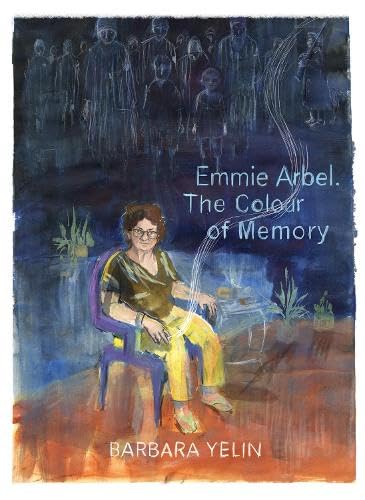 Barbara Yelin’s Irmina was the subject of an early review on my blog (just over 10 years ago!); I called it “one of the most visually stunning graphic novels I’ve ever come across” and noted that it was “based on a fascinating family story.” Such is even truer of this illustrated biography of a child Holocaust survivor. Yelin met Emmie Arbel at Ravensbrück Memorial in 2019 and over the next several years they had many conversations in person and online, which Yelin has memorialized in this solemn, powerful graphic novel. Emmie was born in the Netherlands in 1937 and first sent to a transport camp at age five. She then spent time in Ravensbrück and Bergen-Belsen, where her mother died. After the war, she and her brothers were displaced persons in Sweden before returning to the Netherlands to live with a foster family. Since then she has had a career, raised three daughters, divorced, retired early, lost a daughter, and traveled extensively but mostly lived in Israel. Yelin recreates scenes from Emmie’s life but mostly recounts recent conversations (and so is herself a repeated presence in the book). The narrative moves back and forth in time in imitation of memory. Emmie’s ever-present cigarette is a crutch as she tries to find words for the unspeakable.
A key motivation for this book is to face the facts that survival is not a one-time event and that trauma is complex and ongoing. In Emmie’s case, her foster father (himself a Holocaust survivor) molested her for years. The memory of rape remained locked inside until a breakdown in 1977, when she started seeing a therapist – which, she insists, saved her life.
The colour palette is appropriately sombre: lots of dark blue and grey shading into black, which is the colour of memory for Emmie. And yet there is vibrant colour in the depiction of Emmie’s home and garden in Tiv’on, and in her interactions with her children and grandchildren. I can’t revisit particular spreads of this book without crying. One is the final few pages before the epilogue, in which Emmie remembers lying in a camp with typhus.
“They put me with the dying and the dead. I knew I was going to die. I was not afraid. I think I remember how it felt to be dying. It was a good feeling. There was no pain, no hunger, no noise. Nothing. It was quiet and good. But I live.”
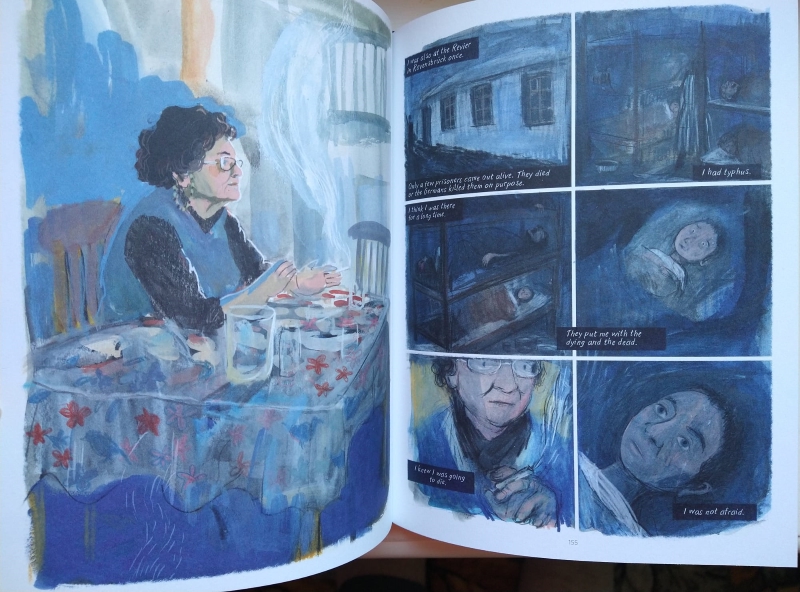
This is a work of real courage, of speaking out in spite of a suspicion that all is bleak and meaningless.
“Humiliation. I was not a human being. I was a number, you know. I feel like no one can understand what I’m feeling. But if I don’t talk about it, the others can’t understand. They can’t understand what happened. And it must not happen again. And that’s why I have to speak.”
With thanks to SelfMadeHero for the free copy for review.
Three on a Theme: Works of (Auto)biography by Susie Boyt, Sarah Laing and Jenn Shapland
“If biography is peering through the windows of someone’s house and describing what you see … [then] memoir is peeking into the windows of your own life. A voyeurism of the self. An interior looting.”
~Jenn Shapland
This thematic trio has been in the works for an awfully long time: I read the Laing in 2022 and also started the Shapland that year but took an inexplicable pause and didn’t finish it until a couple of days ago. All three are about understanding the self by way of an obsession with a particular woman from history. Sometimes it’s also a matter of coming to terms with one’s sexuality. In each case, the premise is biographical but the pursuit and reflections end up being equally autobiographical. These are beautifully introspective works with such an appealing approach that they made me ponder who I would pinpoint as my (auto)biographical muse. All: 
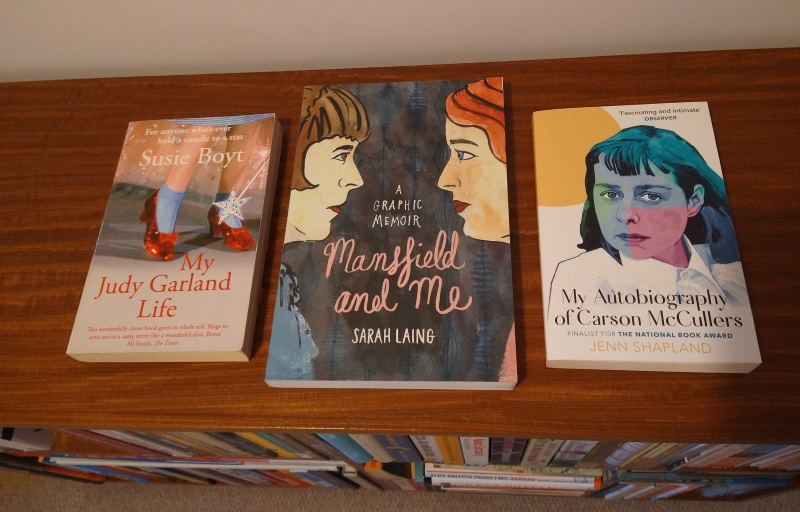
My Judy Garland Life by Susie Boyt (2008)
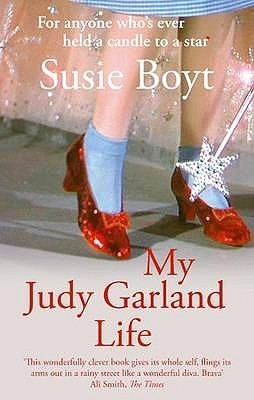 After discovering Boyt through her brilliant latest novel, Loved and Missed, I was keen to try more from her. This Ackerley Prize-shortlisted memoir was just as fascinating as it sounded. Seeing The Wizard of Oz turned Boyt into a Garland mega-fan.
A daughter of Lucian Freud raised by a single mother, Boyt was a sensitive, earnest and lonely child who harboured hopeless dreams of being on the stage herself. She admires Garland’s talent, pluck, hard work and grit. After all, Garland remained the ‘world’s greatest entertainer’ despite struggling with mental illness and prescription drug dependency for three decades.
When I begin to listen to Judy Garland there is no joy or wound from the story of my life that isn’t with me. … Her central credo, and it always always comes to me as her voice begins to swell, is that to be the person with the strongest feelings in life is to be the best. This is an instinct I am quite sure I was born with.
Boyt meets fellow Garland mega-fans in person and online, and visits her hero’s Birthplace Home and Museum (in Grand Rapids, Minnesota) and mausoleum (then in Hartsdale, New York). She draws distinctions between “bad fans” with a morbid eye to Garland’s struggles (they memorise her suicide notes, for instance), “good fans” like herself who acknowledge she was no saint but choose to focus on her successes, and the “crazy-good fans” who won’t hear a word said against her. It’s reassuring that Boyt recognises ambiguity.
“I don’t claim to know Judy Garland, of this I am sure. I feel very close to her, I love her, but I don’t understand. Perhaps I never will. I accept there are layers and layers of things.”
I don’t retain a lot of the detail of this book after over a year (and no notes, silly me!), but I do remember that I felt it blends biography and memoir skilfully and incorporates illuminating discussions of addiction, mental health, celebrity, fandom and the search for love – Garland married five times. (Secondhand – Awesomebooks.com)
Mansfield and Me: A Graphic Memoir by Sarah Laing (2016)
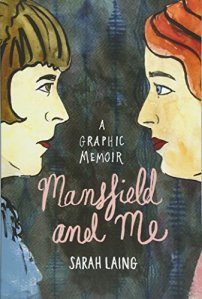 (I’ve added a few lines to my original review from 2022.) Growing up in Aotearoa New Zealand an aspiring writer, Laing looked to Katherine Mansfield as one of her idols. Here she alternates between vignettes from her own past in vivid colour and scenes from Mansfield’s short life in black and white. The Mansfield material is drawn from her letters and notebooks as well as various biographies. Mansfield was friendly with the Bloomsbury Group and lost a brother in the First World War. Laing uses a few Mansfield story titles as chapter headings, has Mansfield’s ghost turn up to comment on her authorial choices, and compares and contrasts their careers and love lives. Laing published her first short story collection at 34 – the age at which Mansfield died of tuberculosis. They share a bisexual identity. Mansfield married twice and miscarried her only pregnancy by a lover; by the end of this book Laing is married and a mother of three. This made me want to read more of Mansfield’s stories; I’ve only read a few thus far. “Katherine’s stories were full of … little lamps – moments of illumination, flashes of truth. I don’t need to be famous, but I would like someone to really see me,” Laing concludes. I’ve also reviewed her Let Me Be Frank. (New purchase – Waterstones sale)


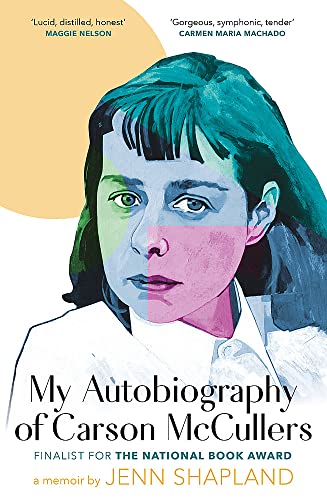
My Autobiography of Carson McCullers by Jenn Shapland (2020)
When Shapland was an intern at the Harry Ransom Center of the University of Texas, Austin (a famous literary archive), someone requested the letters sent by Annemarie Clarac-Schwarzenbach to the writer Carson McCullers. To Shapland’s surprise, these were basically love letters. “I had received letters like these,” she writes. “I had written letters like these to the women I’d loved. It was very little to go on, and yet I felt an utter certainty: Carson McCullers had loved women.” The discovery sparked a quest to know all there was to know about McCullers (she archived the writer’s clothing as part of the internship, too). It also, somehow, liberated Shapland to fully accept her lesbian identity. She was, by this point, in her mid-twenties and had been dating a fellow female student for six years, yet had been semi-closeted the whole time. The letters were, she acknowledges, “a turning point.”
Shapland later spent a month in McCullers’s childhood home in Columbus, Georgia* and worked through her archive at the state university there. Annemarie was by no means the only same-sex entanglement; Shapland lists another 21 possible girlfriends, with McCullers’s correspondence with her therapist, Dr. Mary Mercer, being particularly suggestive. But Shapland had hardly found some lesbian role model: McCullers married the same man, Reeves McCullers, twice, and called her special women “imaginary friends.” (Not to mention that she was an alcoholic, and struggled with chronic illness until her death at age 50.)
Dogged in her own search for evidence, Shapland nonetheless decries unjust expectations: “Historians demand proof from queer love stories that they never require of straight relationships.” How to prove happiness? she wonders. “Love … lives in the mundane, the moment-to-moment exchanges, and can so easily become invisible after the people who shared it are no longer alive. But, of course, it leaves traces.” I thought Shapland was perhaps too insistent on the word “lesbian” – only once entertaining the possibility that McCullers was bisexual, and never seriously considering fluidity or a change of sexuality. “I prefer the idea that we are all part lesbian, that we are lesbian to one degree or another,” she insists. “Is this semantics?” True to her dual vocation as author and archivist, Shapland continually interrogates how language and objects don’t just reflect reality, but create it. I was impressed by her willingness to call herself out on how she might be “shellacking, setting [McCullers] on my terms despite my desire to give her space in her own words.”
This debut work, a Lambda Literary Award winner and finalist for the National Book Award, is in titled sections that range in length from one paragraph to several pages. Shapland drifts back and forth in time and between her own life and McCullers’s, following thought and memory in loose loops but still conveying the sense of a chronological investigation. She doesn’t devote a lot of space to McCullers’s oeuvre– this is definitely not a work of literary appreciation or criticism – but I’m intrigued enough by the writer’s life and even a bare outline of the recurring themes and elements in her fiction to try her soon. Meanwhile, I have Shapland’s second book, the essay collection Thin Skin, on my e-reader. Her final plea for queer visibility here may be more for her own sake than for the historical McCullers, but either way it persuaded me. “Call it love.”
*I’ve not read McCullers but have always meant to, not least because my father is from Columbus, Georgia. His wasn’t a bookish family and I was never aware of the McCullers connection, though when I mentioned this book to my dad a few years ago he did know her name.
With thanks to Virago for the free copy for review.
Review Catch-Up: Memoirs by Maggie Nelson and Jonathan Tepper
Two memoirs that I’ve been meaning to post about for a while now: a novella-length response to chronic pain, and a story of growing up at a refuge for addicts and AIDS victims in Spain.
Pathemata: Or, The Story of My Mouth by Maggie Nelson (2025)
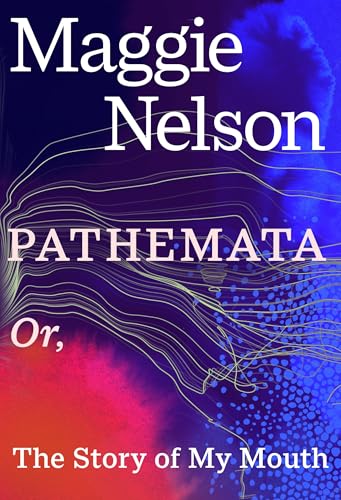 This is a very short (68-page), dreamy meditation on pain. Nelson has ongoing chronic jaw pain despite multiple expensive trips to specialist clinics and many different treatment strategies tried. As she writes, it’s the pandemic era and she’s also home-schooling her son. Meanwhile, her marriage to H seems to be crumbling. The text is composed of non-indented sentences in roughly thematic groupings. But dreams are recounted as often as real-life events, making this a particularly slippery work of autofiction, with an emphasis on the fiction.
The dentist in the valley and I go back and forth over injecting my jaw with Botox.
I hold out, realising that the only thing that frightens me more than pain and its viciousness is numbness, paralysis.
Sometimes I wonder what I would have thought about all these years, if I hadn’t spent so much time thinking about the pain.
Nelson dwells on the irony of someone who talks for a living having so much trouble with oral speech. She also reflects on the early loss of her father and the recent death of a close friend, C. Could it be that jaw pain is how her body is manifesting long-held grief and stress? she wonders.
The Argonauts is an absolute classic of life writing and I’ve long admired Nelson’s cultural criticism. She’s an important thinker on queerness and embodiment, in the vein of Garth Greenwell and Olivia Laing. Aside from the indulgence of including all the dreams (and one instance of jargon: “It sounds like an invagination – a chamber to hold the pastiche of lacerations”), there’s nothing wrong with this per se. It’s just that the essay is over before it’s begun. Why not part of a longer essay collection, or expanded into a full-length memoir?
With thanks to Fern Press, Vintage (Penguin) for the proof copy for review.
{SPOILERS IN THIS ONE}
Shooting Up: A Memoir of Love, Loss, and Addiction by Jonathan Tepper (2026)
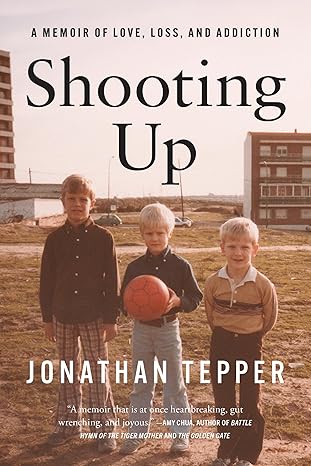 In the early 1980s, the author and his three brothers moved to Spain with their missionary parents, Elliott and Mary, who founded Betel, a rehabilitation centre for junkies (yonkis). “Our neighbourhood [San Blas in Madrid] was the biggest drug supermarket not only in Spain but in all of Europe, and it was happening right on our doorstep.” Betel is still operating today and has supported 100,000 addicts, but it all started with eight young men in the Teppers’ living room. Elliott was filled with righteous enthusiasm for the task and always had scripture passages and C.S. Lewis quotes on the tip of his tongue. When his four sons went delivering leaflets to heroin addicts on the street, they stood out for their blond hair and blue eyes. Soon, though, the yonkis they helped became more than ‘customers’, or objects of pity, but friends as close as family.
From a child’s perspective, the memoir effectively recreates scenes and dialogue from these outreach years. I especially appreciated the descriptions of what it’s like to grow up inside a religious bubble: “the invisible walls of my family and beliefs had been my world. In the [goldfish] bowl you think the water is all there is”. I’m a minister’s kid myself, so I nodded along to lines like “Being a preacher’s kid meant being the first to church and last to leave as my parents hugged and spoke to everybody.” There was real grief as, one by one, young men they knew fell victim to AIDS: Luis, Ángel, Raúl, Salva, Jambri. But there were other losses, too: Tepper’s younger brother, Timothy, died in a car accident while they were back in the USA on a sabbatical in 1991, and his mother later died by suicide after being disabled by a brain tumour.
There’s a section of black-and-white photographs at the end of the book, and the chapters are headed with Spanish phrases to evoke the setting. Later chapters follow Tepper through his college years and the triumph of getting a Rhodes scholarship. (In fact, he and his two remaining brothers all graduated from Oxford University on the same day.) The focus on academic success as a more legitimate high than that offered by drugs reminded me of Educated by Tara Westover, while the solemn duty of being an eyewitness to the AIDS crisis is reminiscent of All the Young Men by Ruth Coker Burks. This is a touching tribute to all those dead.
With thanks to the author and Constable (Little, Brown) for the advanced proof copy for review.
 Bookish Beck = Rebecca Foster. American transplant to England. Freelance proofreader and book reviewer.
